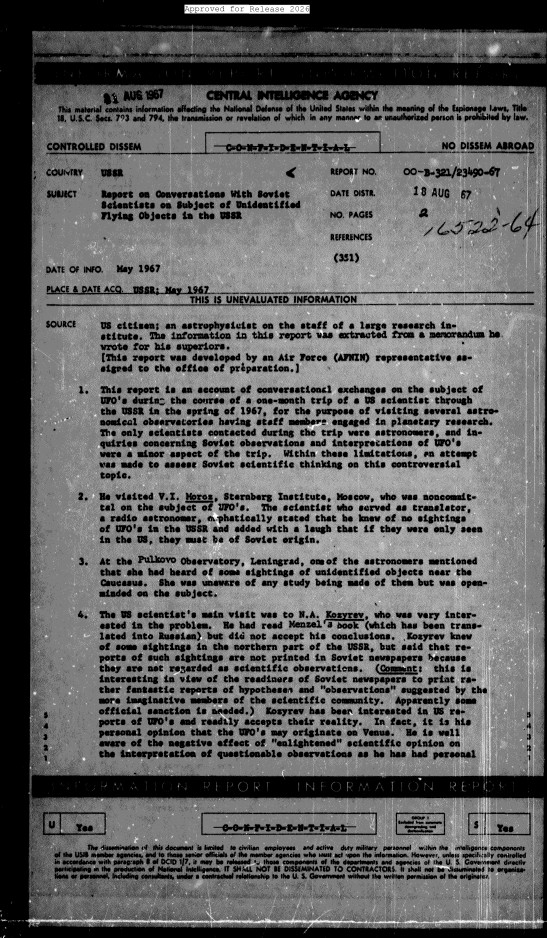
File UFO: rapporto CIA su Kardashev e Sakharov, 1972
File ufficiale: CIA-UAP-008, Documento speculativo di N. Kardashev e A. Sakharov sulla massa carica nello spazio, presentato alla conferenza sulle origini della vita, Armenia, 6-8 settembre 1971 / Basso livello scientifico degli altri documenti sovietici
Pubblicato il · Aggiornato il
Dati principali
- ID ufficiale del fascicolo
- CIA-UAP-8 (citato come CIA-UAP-008 in questa scheda)
- Tipo di documento
- Documento
- Agenzia
- CIA
- Pubblicato in
- R03 · 2026-06-12
- Data dell'incidente
- 1972
- Luogo dell'incidente
- Pagine leggibili
- 2/2
- VIRIN
- 260508-O-D0360-1085
Descrizione ufficiale
Questo rapporto informativo di intelligence della CIA del 1972 riassume le osservazioni di un partecipante statunitense relative a un documento speculativo sul comportamento della massa carica nello spazio, presentato dagli scienziati sovietici N. S. Kardashev e A. Sakharov nel corso di una conferenza tenutasi in Armenia. Una versione con più omissis di questo rapporto è disponibile sul sito web pubblico della CIA.
✦ Riassunto IA
Questo è un Intelligence Information Report di 2 pagine della Directorate of Intelligence della CIA (n. 00-B-321/07707-72, distribuito il 10 aprile 1972), contrassegnato come informazione non valutata. La fonte è un cittadino statunitense e il rapporto consiste in estratti redatti di una lettera di un collega affidabile che partecipò alla Conferenza sull'origine della vita a Erevan, RSS Armena, il 6-8 settembre 1971. Descrive un lavoro interessante ma altamente speculativo di N. S. Kardashev dell'Istituto di ricerca spaziale di Mosca, con il fisico Andrei D. Sakharov come coautore, su ciò che accade quando una massa carica collassa nello spazio: se non fosse carica, collasserebbe oltre il punto di singolarità gravitazionale e scomparirebbe per sempre, ma una massa carica potrebbe rimbalzare verso l'esterno, in una diversa parte dello spazio-tempo. Kardashev disse che Sakharov era interessato perché suggerisce che la struttura dello spazio possa essere molto più complicata di quanto si pensi, mentre lui stesso era interessato alle implicazioni per l'astrofisica se la fisica di base è corretta. Un partecipante statunitense trovò la speculazione «un po' fantastica» ma ritenne il lavoro fondato su una fisica buona e solida. La seconda pagina riporta impressioni su Kardashev, Shklovskij, Ginzburg e altri partecipanti sovietici e dice che il livello scientifico della maggior parte degli interventi non era molto alto. Riferisce inoltre che un membro di un comitato istituito dall'URSS per indagare su fenomeni insoliti, «in altre parole, dischi volanti», tenne un intervento che in realtà fu molto divertente, che Shklovskij e altri scherzarono e risero, e che Shklovskij disse che il comitato è composto da molti politici, teorici e storici con poco o nessun talento scientifico.
Generato con IA dal file ufficiale — può contenere errori.
▸Trascrizione(2 di 2 pagine leggibili)
[PAGE 1] Approved for Release 2026. DIRECTORATE OF INTELLIGENCE. Intelligence Information Report. COUNTRY: USSR. REPORT NO. 00-B-321/07707-72. DATE DISTR.: 10 Apr 72. SUBJECT: Speculative Paper by N. Kardashev and A. Sakharov on Charged Mass in Space at Conference on Origins of Life, Armenia, 6-8 September 1971/Also Scientific Level of Other Soviet DCS [Directorate of Central Sciences?] Papers, Case ST-1026. NO. PAGES: 2. DATE OF INFO.: 6-8 September 1971. PLACE & DATE ACQ. BY SOURCE: Yerevan/6-8 September 1971. THIS IS UNEVALUATED INFORMATION. SOURCE: US citizen. This report consists of edited abstracts from a letter received from a reliable colleague who attended the Yerevan Conference. 1-2. At the Conference on the Origins of Life in Yerevan, Armenia, SSR, 6-8 September 1971, N.S. Kardashev, Institute for Space Research, Moscow, read an interesting but highly speculative paper he had prepared on general relativity and the possibility of a body collapsing into a black hole in space. His co-author was the internationally famous theoretical physicist, Andrei D. Sakharov. Kardashev is very much like his superior and former teacher at the Institute, I.S. Shklovskiy, in his approach to scientific problems; he is not afraid to speculate in his effort to find a solution. The Kardashev-Sakharov paper concerned the authors' study of what happens when a charged mass or body collapses in space. Kardashev stated that if it were not charged, the mass would just collapse past the point of gravitational singularity and be gone forever -- the mass would close in on itself and have no more contact with the outside world. The Soviets speculated on what would happen if the mass were charged: they stated that then the mass would be able to bounce -- it would collapse but bounce back out. However, the mass will come back into a different part of space-time. 3. After his presentation, Kardashev told a US attendee that Sakharov was mostly interested in this charged-mass phenomenon study because it indicates that the structure of space may be much more complicated than is presently thought. Kardashev was interested in the study from the viewpoint of what implications it has for astrophysics, provided the basic physics of the phenomenon is correct. The US attendee felt the authors' speculation was 'a little fantastic' and that they had 'taken off in a rather wild way'; however, he believed their paper was grounded in good and sound physics. [Distribution/routing numbers: 5 5 4 4 3 3 2 2] [PAGE 2] CONFIDENTIAL [stamp, crossed out] -2- 4. The US attendee considers Kardashev to be very competent technically and further to be very self-possessed. He recalled an incident in the spring of 1971 when Kardashev, L I Matveyenko and he visited Academician Lev Artsimovich, secretary of the Academy's Department of General Physics and Astronomy. Matveyenko, Institute for Cosmic Research, is a Communist Party member and very expert in political matters. He was almost cringing in Artsimovich's presence whereas Kardashev was cool and confident in his business-like discussions with the senior Academi- cian. 5. In general, the scientific level of most of the Soviet papers at this Conference was not very high. One little known Soviet [source could not recall his name] gave a very naive paper on the detectability of planets. Another Soviet, who was a member of a committee the USSR has established to investigate unusual phenomena, in other words, flying saucers, gave a serious talk which was actually very humorous. His approach was, "Well, of course, we know there isn't anything to this alleged phenome- non (flying saucers), but on the other hand---." During this talk Shklovskiy and other Soviets joked and laughed and obviously did not take the speaker's remarks seriously. Shklovskiy remarked later to a US attendee that the "flying saucer committee" consists of many poli- ticians, theorists, historians and similar type people. It has little if any scientific talent. 6. Shklovskiy gave a general, entertaining talk on some interesting but unimportant subject. Vitaliy L Ginzburg, one of the leading astronomers in the USSR, also gave a talk on the basis of physical theory, that is, the identification and comparison of fundamental assumptions in physics. Ginzburg has a first rate mind and is sounder in his physics knowledge than Shklovskiy. Ginzburg thinks realistically, which was shown in his answer to a US attendee's question about the Conference. The Soviet was asked whether the Conference was worthwhile in that it was mostly devoted to theoretical subjects, very remote from tangible goals. Ginzburg said, "Well, if it helps to build up support for the Soviet researchers to get new astronomical equipment, then certainly the Con- ference makes sense." - end -
Generato con IA dal file ufficiale — può contenere errori.
Traduzione automatica — il documento originale è in inglese. Vedi in inglese →
Fonte: Dipartimento della Guerra degli Stati Uniti / AARO — pubblico dominio · war.gov/ufo
Entità in questo documento
Casi correlati
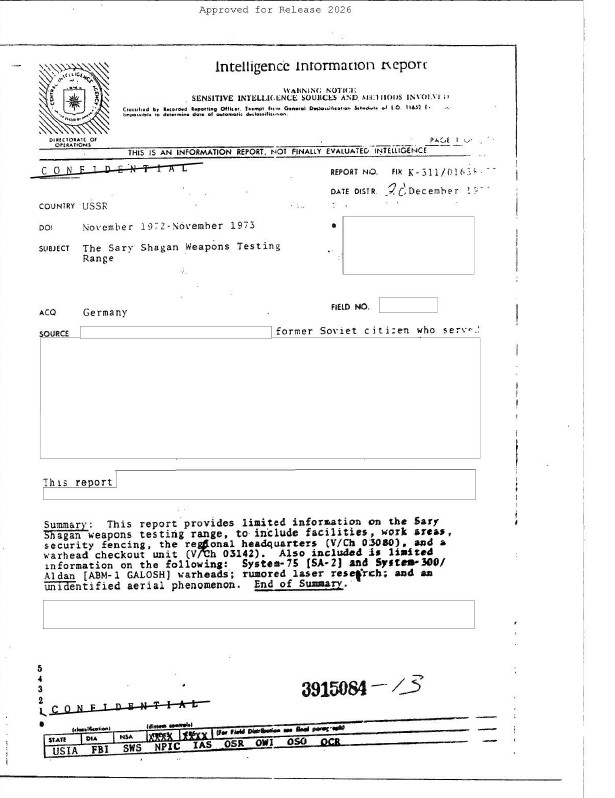
Poligono di Sary Shagan e UFO, rapporto CIA, 1973
Documento australiano su UFO e Blue Book, 1971
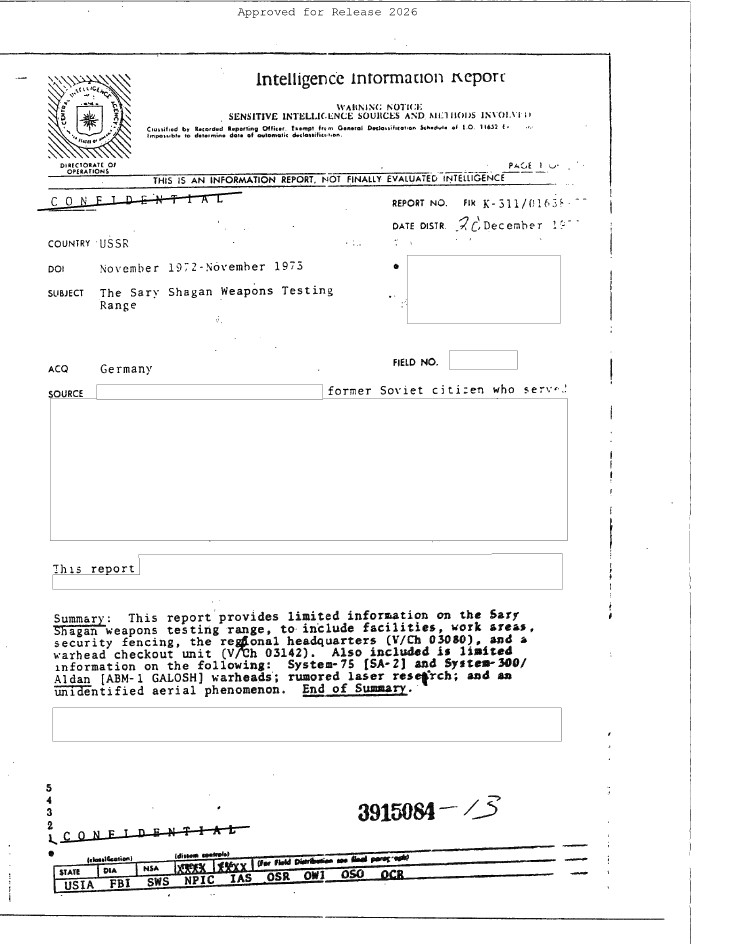
Archivio UFO: rapporto CIA sull'URSS, Sary Shagan, 1973
Corrispondenza FBI su avvistamenti UFO, 1967-1974
File UFO: debriefing dell'Apollo 14, audio 1/2
File UFO: debriefing dell'Apollo 14, audio 2/2
Stessa serie di fascicoli
Panel Robertson: rapporti UFO della CIA, 1952-53
Storia CIA di U-2 e OXCART, con capitolo UFO
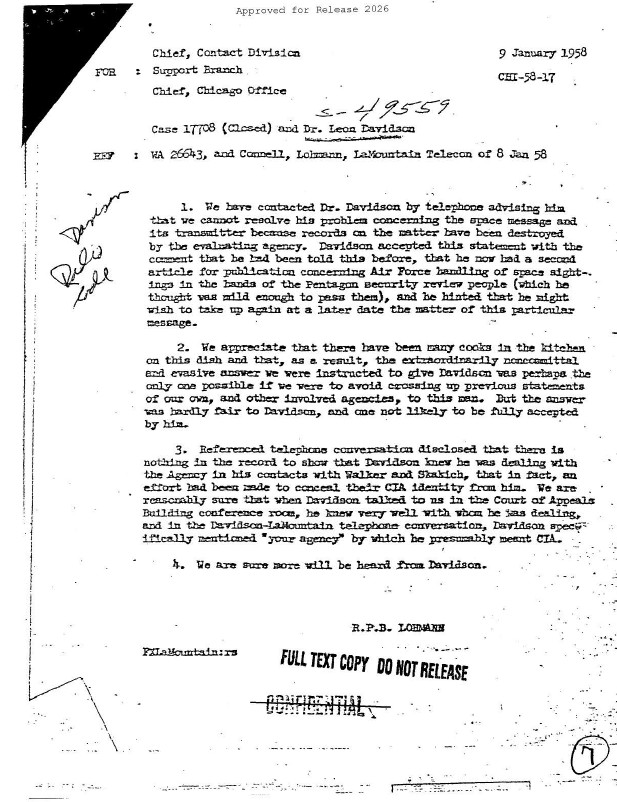
Memo CIA sul ricercatore UFO Leon Davidson, 1958
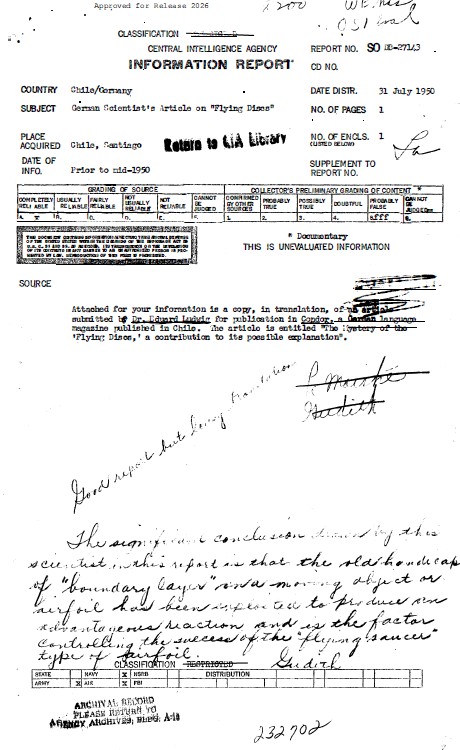
Teoria UFO di uno scienziato tedesco, CIA, 1950
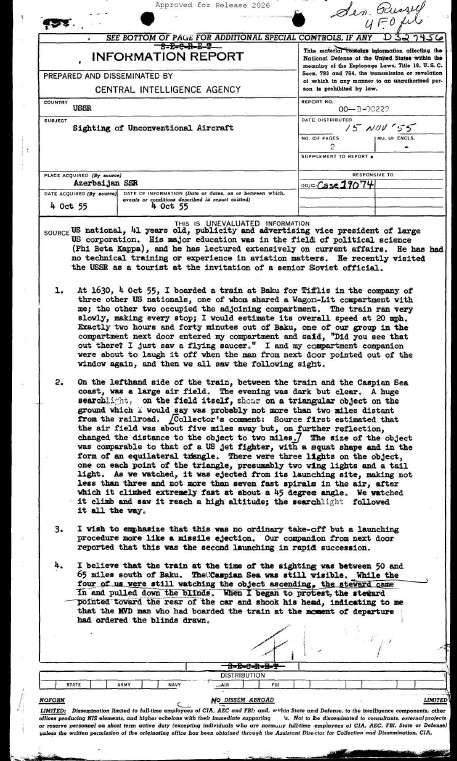
Rapporto CIA: UFO triangolari a Baku, 1955
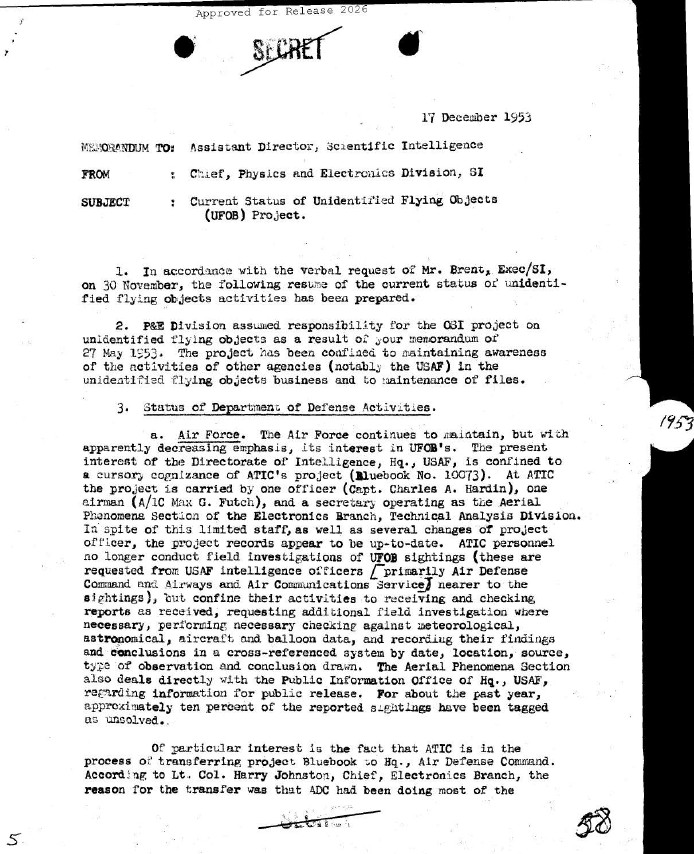
Memo CIA sul progetto UFO dell'USAF, 1953
Stesso periodo
Audio UFO: l'equipaggio di Apollo 17 vede particelle, 1972
File UFO: debriefing medico Apollo 17, audio 1/2

File UFO: debriefing medico Apollo 17, audio 2/2
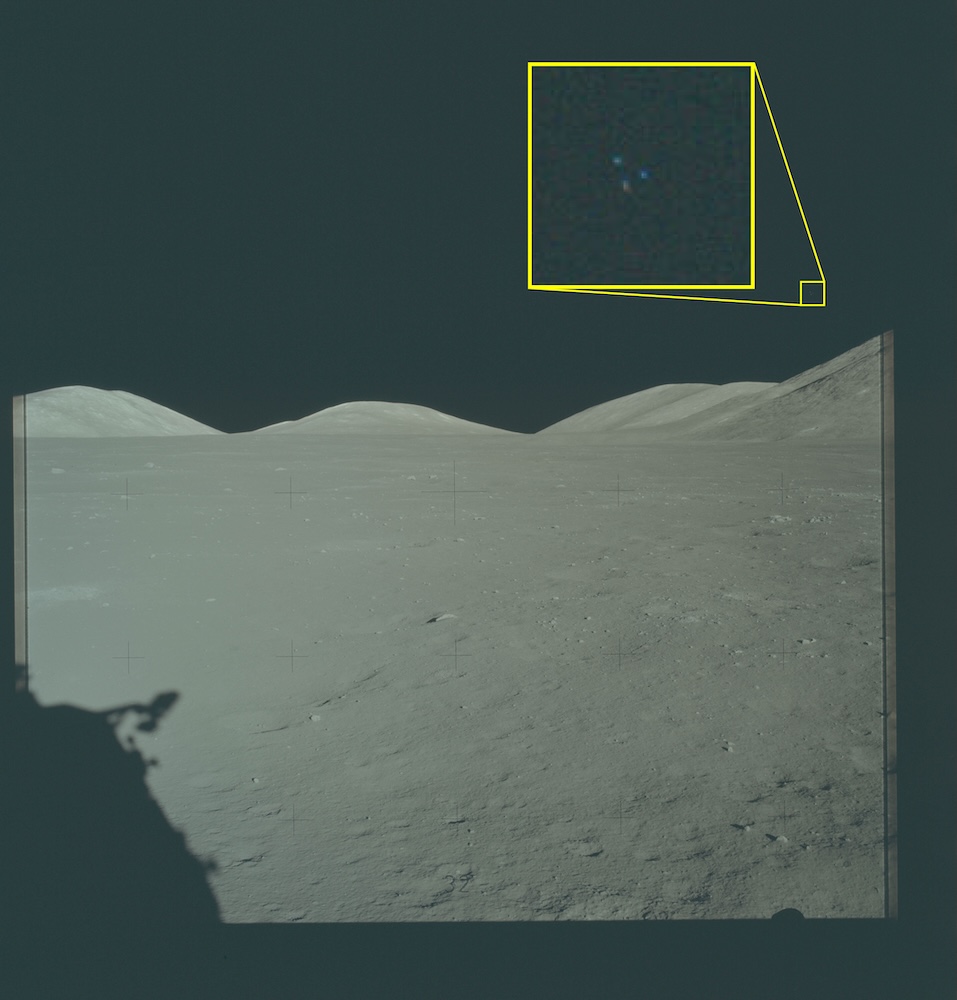
Foto UFO dell'Apollo 17: tre punti nel cielo lunare, 1972
UFO nell'Apollo 17: trascrizione radio NASA, 1972
Stessa pubblicazione
Segnalazione UFO del reverendo Barnes a Hoover, 1949
Fascicolo FBI di Newark su UFO nel New Jersey, 1952
Fascicolo FBI Flying Discs: UFO nello stato di Washington
Memo CIA sulle indagini UFO britanniche, 1952
Rapporto UFO del Panel Robertson alla Difesa, 1953
Avvistamento UFO in Ungheria da una lettera, CIA, 1955
Stessa agenzia
Analisi CIA dell’UFO visto da un treno, 1955
Memorandum CIA: UFO visto da un treno, 1955
Avvistamenti UFO a Budapest con schizzo, CIA, 1956
Avvistamenti UFO su Budapest, rapporto CIA, 1957
Memorandum CIA su un UFO a Porto Rico, 1964