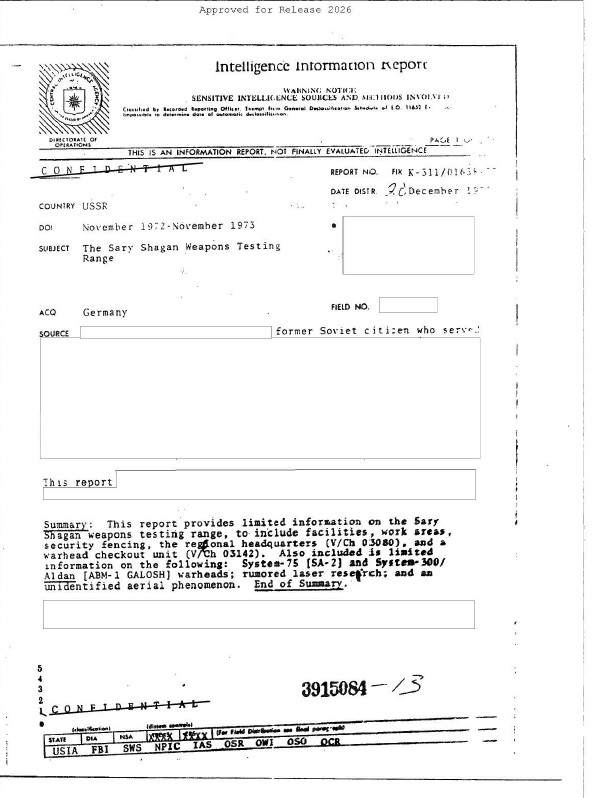
CIA-UAP-006, Avvistamento di un aeromobile non convenzionale
Dati principali
- ID ufficiale del fascicolo
- CIA-UAP-6 (citato come CIA-UAP-006 in questa scheda)
- Tipo di documento
- Documento
- Agenzia
- CIA
- Pubblicato in
- R03 · 2026-06-12
- Data dell'incidente
- November, 1955
- Luogo dell'incidente
- Baku, Azerbaigian
- Coordinate
- 40.3755885, 49.8328009
- Pagine leggibili
- 2/2
- VIRIN
- 260508-O-D0360-1083
Descrizione ufficiale
Questo rapporto informativo della CIA, del novembre 1955, descrive la testimonianza oculare di un cittadino statunitense relativa al decollo, con angolo ripido, di un aeromobile triangolare dotato di luci alari da un aeroporto nei pressi di Baku, Azerbaigian, il 4 ottobre 1955. Una versione con omissis di questo rapporto è disponibile sul sito web pubblico della CIA.
✦ Riassunto IA
Questo Rapporto Informativo della CIA di 2 pagine (Report No. 00-B-302290) documenta un avvistamento del 4 ottobre 1955 nei pressi di Baku, RSS dell'Azerbaigian, URSS, segnalato da un turista americano di 41 anni (vicepresidente per la pubblicità/marketing di una grande azienda statunitense, con formazione in scienze politiche e onorificenza Phi Beta Kappa, privo di addestramento aeronautico) che viaggiava in treno da Baku a Tiflis (Tbilisi) come parte di un gruppo di quattro cittadini statunitensi in visita all'URSS su invito di un alto funzionario sovietico. Circa due ore e quaranta minuti dopo la partenza da Baku, un compagno di viaggio avvisò il gruppo di un avvistamento, e tutti e quattro osservarono un grande aeroporto lungo la costa del Mar Caspio, dove un riflettore illuminava un oggetto triangolare e tozzo a terra, di dimensioni pressoché pari a quelle di un caccia a reazione statunitense, con tre luci (una su ciascun vertice del triangolo, presumibilmente due luci alari e una luce di coda). L'oggetto venne lanciato — non un decollo convenzionale, ma descritto più come un'espulsione simile a quella di un missile —, compiendo dalle tre alle sette spirali veloci prima di salire bruscamente a un'angolazione di circa 45 gradi fino ad alta quota, seguito ininterrottamente dal riflettore; un compagno riferì che si trattava del secondo lancio di questo tipo in rapida successione quella sera. Mentre il gruppo continuava a osservare, un addetto del treno entrò e chiuse le tendine dello scompartimento, indicando silenziosamente (con un gesto verso la parte posteriore della carrozza) che un ufficiale dell'MVD (la polizia segreta sovietica) presente a bordo del treno aveva ordinato di abbassare le tendine. Il rapporto rileva che il gruppo avrebbe voluto percorrere in aereo questa tratta del viaggio, ma l'Intourist a Baku li informò che non esistevano voli tra Baku e Tiflis — affermazione poi smentita dal personale dell'Intourist a Tiflis, che disse che c'erano diversi voli al giorno. Il rapporto è quasi certamente un'osservazione civile diretta di un test missilistico o di razzi sovietico nei pressi di un sito di lancio militare, e illustra come un'attività legittima di collaudo di armamenti potesse generare segnalazioni di avvistamenti di 'velivoli non convenzionali'.
Generato con IA dal file ufficiale — può contenere errori.
▸Trascrizione(2 di 2 pagine leggibili)
[PAGE 1] Approved for Release 2026. PREPARED AND DISSEMINATED BY CENTRAL INTELLIGENCE AGENCY. COUNTRY: USSR. SUBJECT: Sighting of Unconventional Aircraft. PLACE ACQUIRED [by source]: Azerbaijan SSR. DATE ACQUIRED [by source] / DATE OF INFORMATION: 4 Oct 55 / 4 Oct 55. THIS IS UNEVALUATED INFORMATION. SOURCE: US national, 41 years old, publicity and advertising vice president of large US corporation. His major education was in the field of political science (Phi Beta Kappa), and he has lectured extensively on current affairs. He has had no technical training or experience in aviation matters. He recently visited the USSR as a tourist at the invitation of a senior Soviet official. At 1630, 4 Oct 55, I boarded a train at Baku for Tiflis in the company of three other US nationals, one of whom shared a Wagon-Lit compartment with me; the other two occupied the adjoining compartment. The train ran very slowly, making every stop; I would estimate its overall speed at 20 mph. Exactly two hours and forty minutes out of Baku, one of our group in the compartment next door entered my compartment and said, 'Did you see that out there? I just saw a flying saucer.' I and my compartment companion were about to laugh it off when the man from next door pointed out of the window again, and then we all saw the following sight. On the left-hand side of the train, between the train and the Caspian Sea coast, was a large air field. The evening was dark but clear. A huge searchlight, on the field itself, shone on a triangular object on the ground which I would say was probably not more than two miles distant from the railroad. [Collector's comment: Source first estimated that the air field was about five miles away but, on further reflection, changed the distance to the object to two miles.] The size of the object was comparable to that of a US jet fighter, with a squat shape and in the form of an equilateral triangle. There were three lights on the object, one on each point of the triangle, presumably two wing lights and a tail light. As we watched, it was ejected from its launching site, making not less than three and not more than seven fast spirals in the air, after which it climbed extremely fast at about a 45 degree angle. We watched it climb and saw it reach a high altitude; the searchlight followed it all the way. I wish to emphasize that this was no ordinary take-off but a launching procedure more like a missile ejection. Our companion from next door reported that this was the second launching in rapid succession. Report No. 00-B-302290. [Distribution/classification block: NOFORN, NO DISSEM ABROAD, LIMITED -- dissemination limited to full-time employees of CIA, AEC and FBI, and within State and Defense to intelligence components producing NIS elements. Distribution: State, Army, Navy, FBI.] [PAGE 2] 5. Our party had wished to make this part of the journey by air, but we were informed by Intourist in Baku that there were no flights between Baku and Tiflis. In Tiflis, the Intourist people were surprised that our party had not flown and said that there were several flights a day. -- end -- 4. [Preceding paragraph continues from page 1's cutoff]: I believe that the train at the time of the sighting was between 50 and 65 miles south of Baku. The Caspian Sea was still visible. While the four of us were still watching the object ascending, the steward came in and pulled down the blinds. When I began to protest, the steward gestured toward the rear of the car and shook his head, indicating to me that the MVD man who had boarded the train at the moment of departure had ordered the blinds drawn.
Generato con IA dal file ufficiale — può contenere errori.
Traduzione automatica — il documento originale è in inglese. Vedi in inglese →
Fonte: Dipartimento della Guerra degli Stati Uniti / AARO — pubblico dominio · war.gov/ufo
Entità in questo documento
Casi collegati
DOW-UAP-D051, Email Correspondence, Pacific Time Zone, March 2023
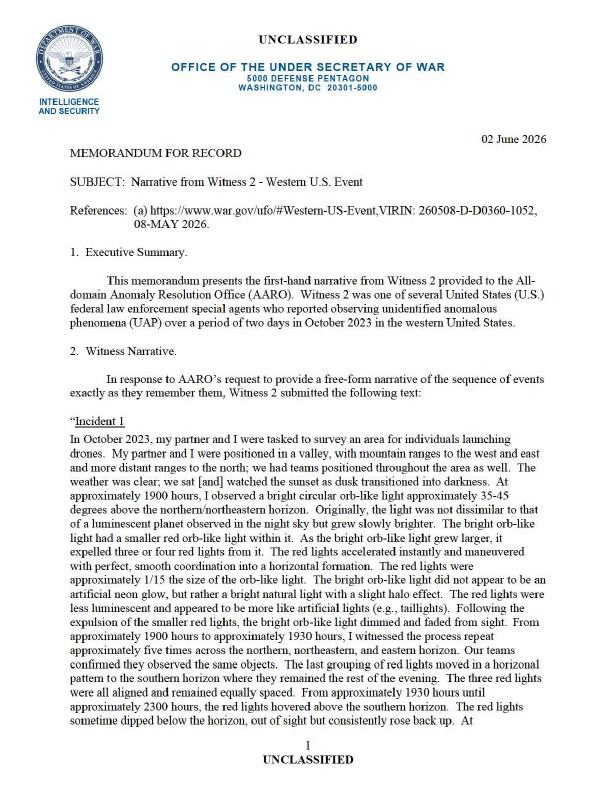
DOW-UAP-D080, Narrative Statement 2, Western United States Event, 2023
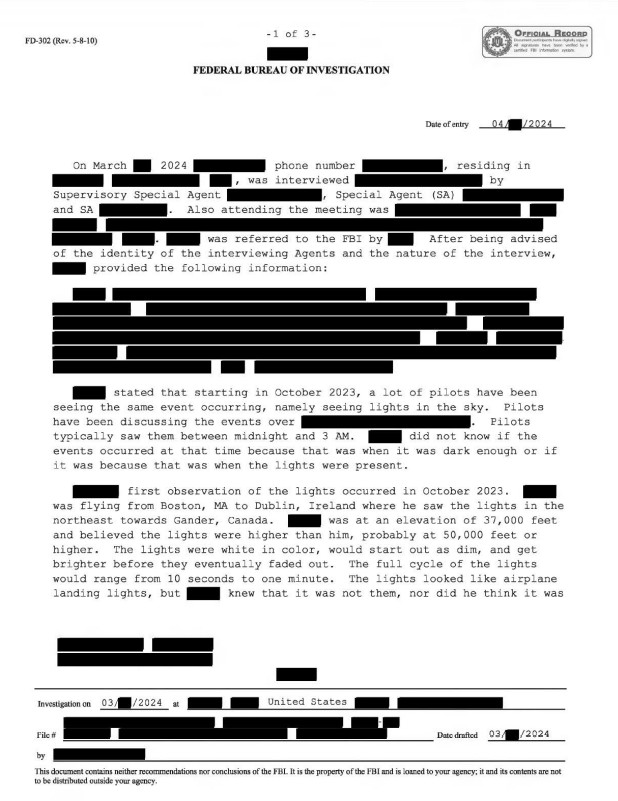
FBI-UAP-D024, FD-302, “Airborne Lights and Triangle,” 2002, 2023-2024
FBI-UAP-D026, FD-302, “Dark Translucent Triangle,” 2023
FBI-UAP-D028, FD-302, “Dark Triangle with Lights,” 2011
FBI-UAP-D030, FD-302, “Large Triangle with Red Lights,” 2023
Casi correlati
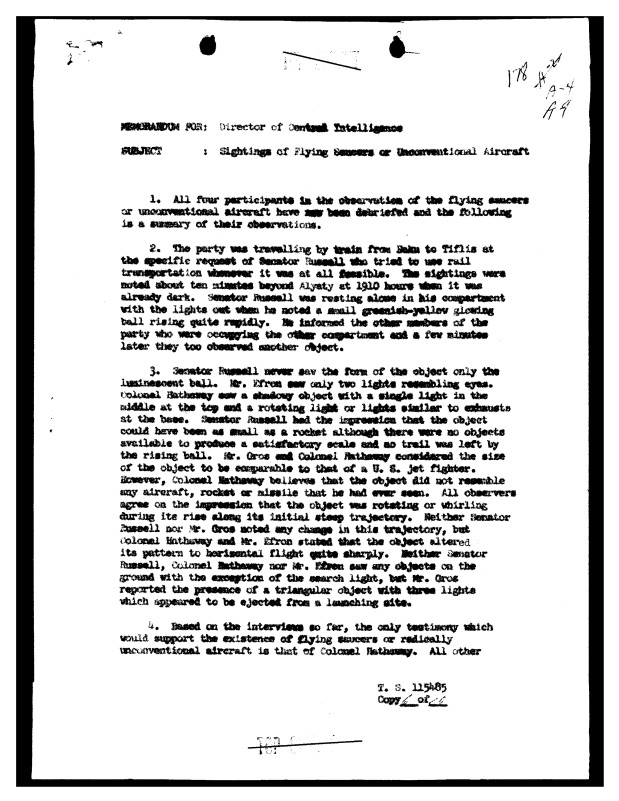
CIA-UAP-D020, Memorandum su avvistamenti di aeromobili non convenzionali, 1955
CIA-UAP-D021, Analisi di avvistamenti di aeromobili non convenzionali, 1955
CIA-UAP-003, La Central Intelligence Agency e la ricognizione aerea; i programmi U-2 e OXCART, 1954-1974
CIA-UAP-007, Stato attuale del progetto sugli oggetti volanti non identificati (UFO).
CIA-UAP-009, Oggetti volanti sconosciuti osservati sopra Budapest
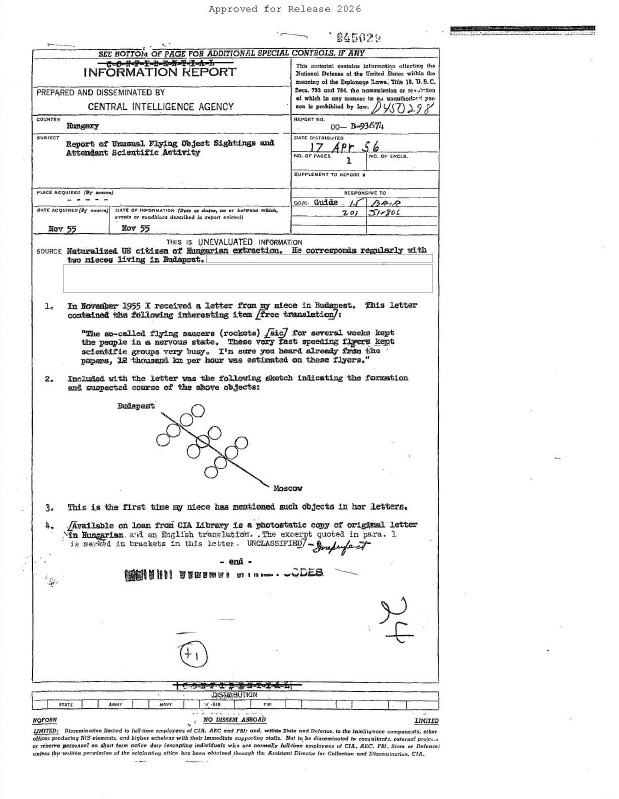
CIA-UAP-013, Rapporto su avvistamenti di insoliti oggetti volanti e sulla relativa attività scientifica
Stessa serie di fascicoli
CIA-UAP-002, Comitato consultivo scientifico sugli oggetti volanti non identificati, Rapporto, 1952-1953
CIA-UAP-003, La Central Intelligence Agency e la ricognizione aerea; i programmi U-2 e OXCART, 1954-1974
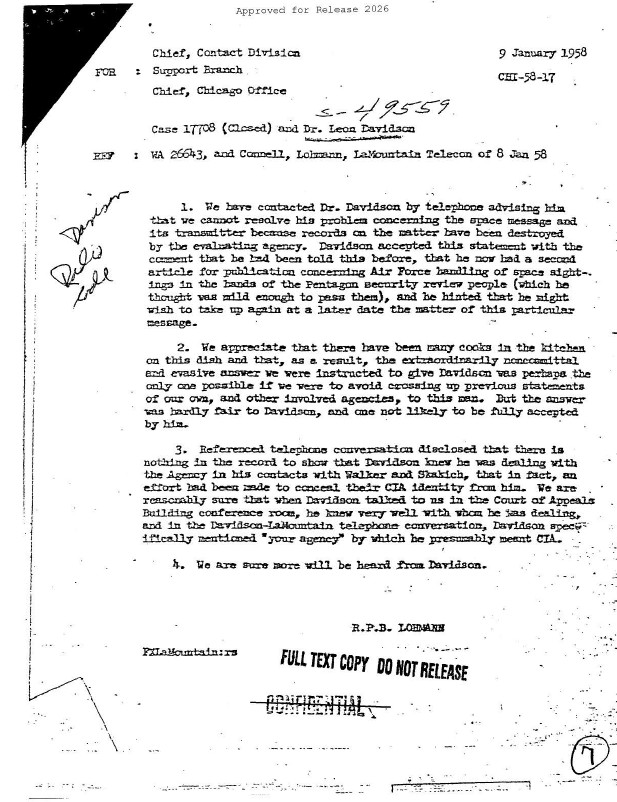
CIA-UAP-004, CASO 17708 (CHIUSO) e il dott. Leon Davidson
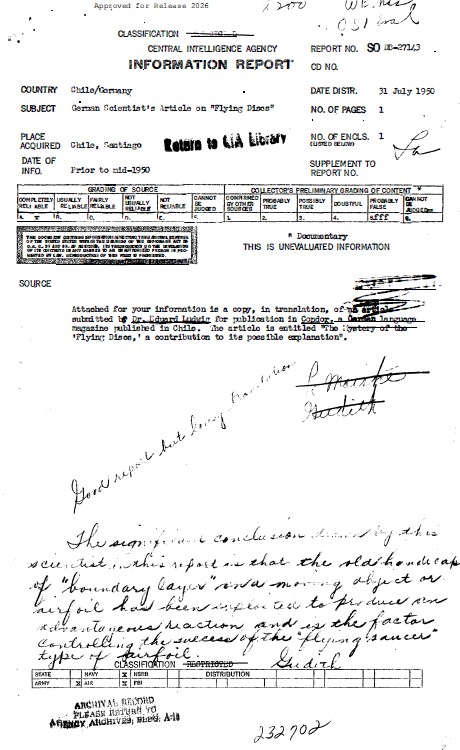
CIA-UAP-005, Articolo di uno scienziato tedesco sui «dischi volanti»
CIA-UAP-007, Stato attuale del progetto sugli oggetti volanti non identificati (UFO).
CIA-UAP-008, Documento speculativo di N. Kardashev e A. Sakharov sulla massa carica nello spazio, presentato alla conferenza sulle origini della vita, Armenia, 6-8 settembre 1971 / Basso livello scientifico degli altri documenti sovietici
Stesso periodo
341_110677_Numerical_File,_5-2500
CIA-UAP-018, Rapporto su avvistamenti di insoliti oggetti volanti e sulla relativa attività scientifica
CIA-UAP-D020, Memorandum su avvistamenti di aeromobili non convenzionali, 1955
CIA-UAP-D021, Analisi di avvistamenti di aeromobili non convenzionali, 1955
DOW-UAP-D095, Progetti aeronautici congiunti USA-Canada e rapporti di avvistamento UFO, 1954-1955
DOW-UAP-D096, Corrispondenza relativa al Project Blue Book, 1955
Stesso release
FBI-UAP-D011, Trasmissione di corrispondenza del direttore dell'FBI, 1949
CIA-UAP-014, Attività britannica nel campo degli «oggetti volanti non identificati»
FBI-UAP-D012, Ufficio distaccato di Newark, 1952-1967
FBI-UAP-D013, Indagine sugli «UFO» nello Stato di Washington, 1952-1960
DOW-UAP-D085, Trasmissione del rapporto del comitato consultivo scientifico della CIA, 1953
CIA-UAP-013, Rapporto su avvistamenti di insoliti oggetti volanti e sulla relativa attività scientifica
Stessa agenzia
CIA-UAP-009, Oggetti volanti sconosciuti osservati sopra Budapest
CIA-UAP-D022, Oggetto volante non identificato segnalato vicino a Porto Rico, 1965
CIA-UAP-010, Rapporto su conversazioni con scienziati sovietici sul tema degli oggetti volanti non identificati nell'URSS

CIA-UAP-016, Avvistamenti di oggetti volanti non identificati in Ladakh, Nepal, Sikkim e Bhutan
CIA-UAP-019, Aspetti scientifici e di intelligence del problema UFO secondo il Dipartimento della Difesa australiano