Archivos OVNI: informe CIA sobre Kardashev y Sakharov
Archivo oficial: CIA-UAP-008, Ponencia especulativa de N. Kardashev y A. Sájarov sobre masa cargada en el espacio, en la Conferencia sobre el Origen de la Vida, Armenia, 6-8 de septiembre de 1971 / Bajo nivel científico de otras ponencias soviéticas
Publicado el · Actualizado el
Datos del expediente
- ID oficial del expediente
- CIA-UAP-8 (citado como CIA-UAP-008 en este archivo)
- Tipo de documento
- Documento
- Agencia
- CIA
- Publicado en
- R03 · 2026-06-12
- Fecha del incidente
- 1972
- Lugar del incidente
- Páginas legibles
- 2/2
- VIRIN
- 260508-O-D0360-1085
Descripción oficial
Este Informe de Información de Inteligencia de la CIA de 1972 resume las observaciones de un asistente estadounidense sobre una ponencia especulativa acerca del comportamiento de la masa cargada en el espacio, presentada por los científicos soviéticos N. S. Kardashev y A. Sájarov en una conferencia en Armenia. Una versión más censurada de este informe ha estado disponible en el sitio web público de la CIA.
✦ Resumen IA
Este es un Informe de Información de 2 páginas de la Dirección de Inteligencia de la CIA (n.º 00-B-321/07707-72, distribuido el 10 de abril de 1972), marcado como información no evaluada. Su fuente es un ciudadano estadounidense, y el informe consiste en extractos editados de una carta de un colega fiable que asistió a la Conferencia sobre el Origen de la Vida en Ereván, RSS de Armenia, del 6 al 8 de septiembre de 1971. Describe un trabajo interesante pero muy especulativo de N. S. Kardashev, del Instituto de Investigación Espacial de Moscú, con el físico Andrei D. Sakharov como coautor, sobre lo que ocurre cuando una masa cargada colapsa en el espacio: si no tuviera carga, colapsaría más allá del punto de singularidad gravitacional y desaparecería para siempre, pero una masa cargada podría rebotar hacia afuera, hacia una parte distinta del espacio-tiempo. Kardashev dijo que a Sakharov le interesaba porque sugiere que la estructura del espacio puede ser mucho más complicada de lo que se piensa, mientras que a él le interesaban las implicaciones para la astrofísica si la física básica es correcta. Un asistente estadounidense encontró la especulación «un poco fantástica» pero pensó que el trabajo se apoyaba en una física buena y sólida. La segunda página ofrece impresiones de Kardashev, Shklovskiy, Ginzburg y otros participantes soviéticos, y dice que el nivel científico de la mayoría de los trabajos no era muy alto. También informa de que un miembro de un comité que la URSS estableció para investigar fenómenos inusuales, «en otras palabras, platillos voladores», dio una charla que en realidad fue muy humorística, que Shklovskiy y otros bromearon y rieron, y que Shklovskiy dijo que el comité está formado por muchos políticos, teóricos e historiadores con poco o ningún talento científico.
Generado con IA a partir del archivo oficial — puede contener errores.
▸Transcripción(2 de 2 páginas legibles)
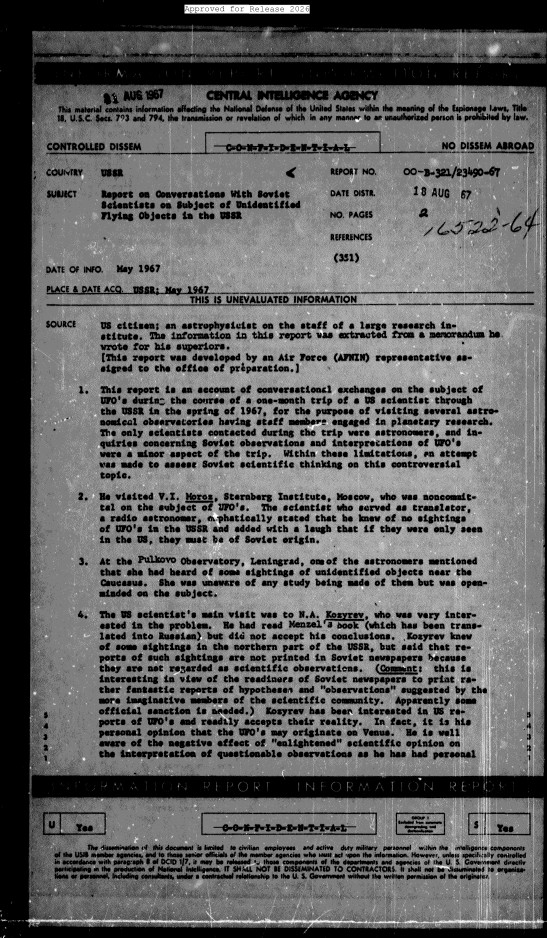
[PAGE 1] Approved for Release 2026. DIRECTORATE OF INTELLIGENCE. Intelligence Information Report. COUNTRY: USSR. REPORT NO. 00-B-321/07707-72. DATE DISTR.: 10 Apr 72. SUBJECT: Speculative Paper by N. Kardashev and A. Sakharov on Charged Mass in Space at Conference on Origins of Life, Armenia, 6-8 September 1971/Also Scientific Level of Other Soviet DCS [Directorate of Central Sciences?] Papers, Case ST-1026. NO. PAGES: 2. DATE OF INFO.: 6-8 September 1971. PLACE & DATE ACQ. BY SOURCE: Yerevan/6-8 September 1971. THIS IS UNEVALUATED INFORMATION. SOURCE: US citizen. This report consists of edited abstracts from a letter received from a reliable colleague who attended the Yerevan Conference. 1-2. At the Conference on the Origins of Life in Yerevan, Armenia, SSR, 6-8 September 1971, N.S. Kardashev, Institute for Space Research, Moscow, read an interesting but highly speculative paper he had prepared on general relativity and the possibility of a body collapsing into a black hole in space. His co-author was the internationally famous theoretical physicist, Andrei D. Sakharov. Kardashev is very much like his superior and former teacher at the Institute, I.S. Shklovskiy, in his approach to scientific problems; he is not afraid to speculate in his effort to find a solution. The Kardashev-Sakharov paper concerned the authors' study of what happens when a charged mass or body collapses in space. Kardashev stated that if it were not charged, the mass would just collapse past the point of gravitational singularity and be gone forever -- the mass would close in on itself and have no more contact with the outside world. The Soviets speculated on what would happen if the mass were charged: they stated that then the mass would be able to bounce -- it would collapse but bounce back out. However, the mass will come back into a different part of space-time. 3. After his presentation, Kardashev told a US attendee that Sakharov was mostly interested in this charged-mass phenomenon study because it indicates that the structure of space may be much more complicated than is presently thought. Kardashev was interested in the study from the viewpoint of what implications it has for astrophysics, provided the basic physics of the phenomenon is correct. The US attendee felt the authors' speculation was 'a little fantastic' and that they had 'taken off in a rather wild way'; however, he believed their paper was grounded in good and sound physics. [Distribution/routing numbers: 5 5 4 4 3 3 2 2] [PAGE 2] CONFIDENTIAL [stamp, crossed out] -2- 4. The US attendee considers Kardashev to be very competent technically and further to be very self-possessed. He recalled an incident in the spring of 1971 when Kardashev, L I Matveyenko and he visited Academician Lev Artsimovich, secretary of the Academy's Department of General Physics and Astronomy. Matveyenko, Institute for Cosmic Research, is a Communist Party member and very expert in political matters. He was almost cringing in Artsimovich's presence whereas Kardashev was cool and confident in his business-like discussions with the senior Academi- cian. 5. In general, the scientific level of most of the Soviet papers at this Conference was not very high. One little known Soviet [source could not recall his name] gave a very naive paper on the detectability of planets. Another Soviet, who was a member of a committee the USSR has established to investigate unusual phenomena, in other words, flying saucers, gave a serious talk which was actually very humorous. His approach was, "Well, of course, we know there isn't anything to this alleged phenome- non (flying saucers), but on the other hand---." During this talk Shklovskiy and other Soviets joked and laughed and obviously did not take the speaker's remarks seriously. Shklovskiy remarked later to a US attendee that the "flying saucer committee" consists of many poli- ticians, theorists, historians and similar type people. It has little if any scientific talent. 6. Shklovskiy gave a general, entertaining talk on some interesting but unimportant subject. Vitaliy L Ginzburg, one of the leading astronomers in the USSR, also gave a talk on the basis of physical theory, that is, the identification and comparison of fundamental assumptions in physics. Ginzburg has a first rate mind and is sounder in his physics knowledge than Shklovskiy. Ginzburg thinks realistically, which was shown in his answer to a US attendee's question about the Conference. The Soviet was asked whether the Conference was worthwhile in that it was mostly devoted to theoretical subjects, very remote from tangible goals. Ginzburg said, "Well, if it helps to build up support for the Soviet researchers to get new astronomical equipment, then certainly the Con- ference makes sense." - end -
Generado con IA a partir del archivo oficial — puede contener errores.
Traducción automática — el documento original está en inglés. Ver en inglés →
Fuente: Departamento de Guerra de EE. UU. / AARO — dominio público · war.gov/ufo
Entidades en este documento
Casos relacionados
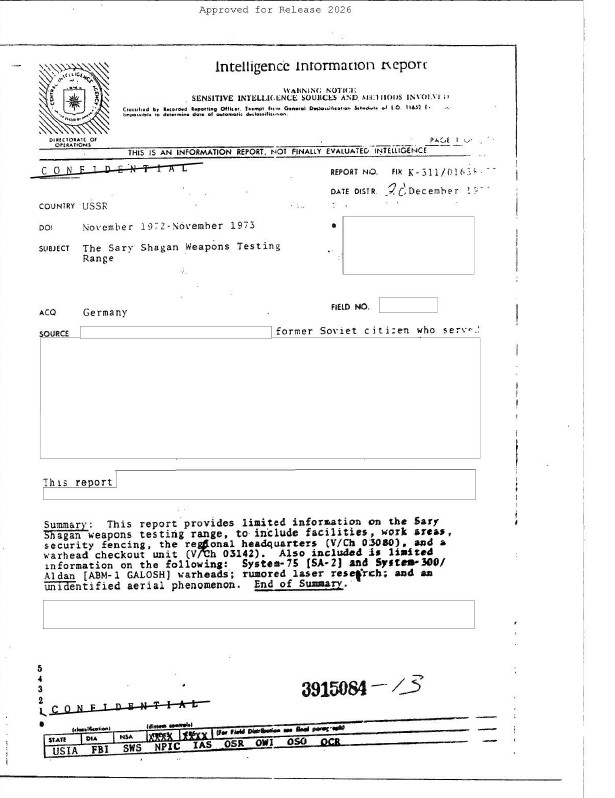
Polígono Sary Shagan y fenómenos OVNI, CIA, 1973
Informe australiano sobre OVNI y el Libro Azul, 1971
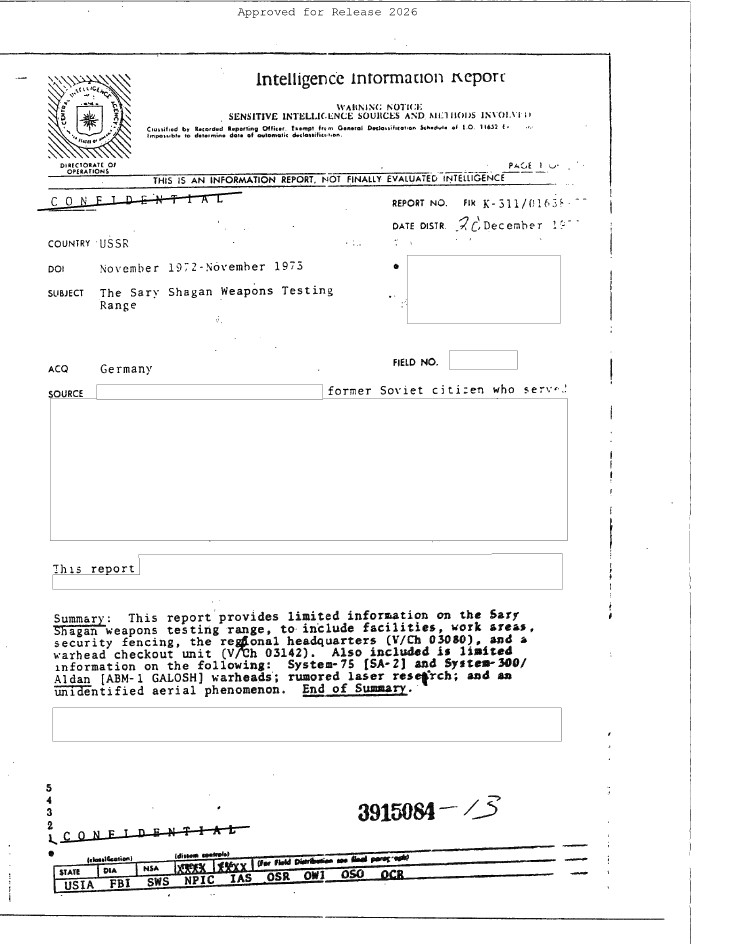
Archivo OVNI: informe de la CIA sobre la URSS, 1973
Cartas del FBI sobre avistamientos OVNI, 1967-1974
Archivos OVNI: debriefing del Apolo 14, audio 1/2
Archivos OVNI: debriefing del Apolo 14, audio 2/2
Misma serie de expedientes
Panel Robertson: informes OVNI de la CIA, 1952-53
Historia del U-2 y OXCART de la CIA y los OVNI
Memorando de la CIA sobre Leon Davidson, OVNI, 1958
Teoría OVNI de un científico alemán, CIA, 1950
Informe de la CIA: OVNI triangulares en Bakú, 1955
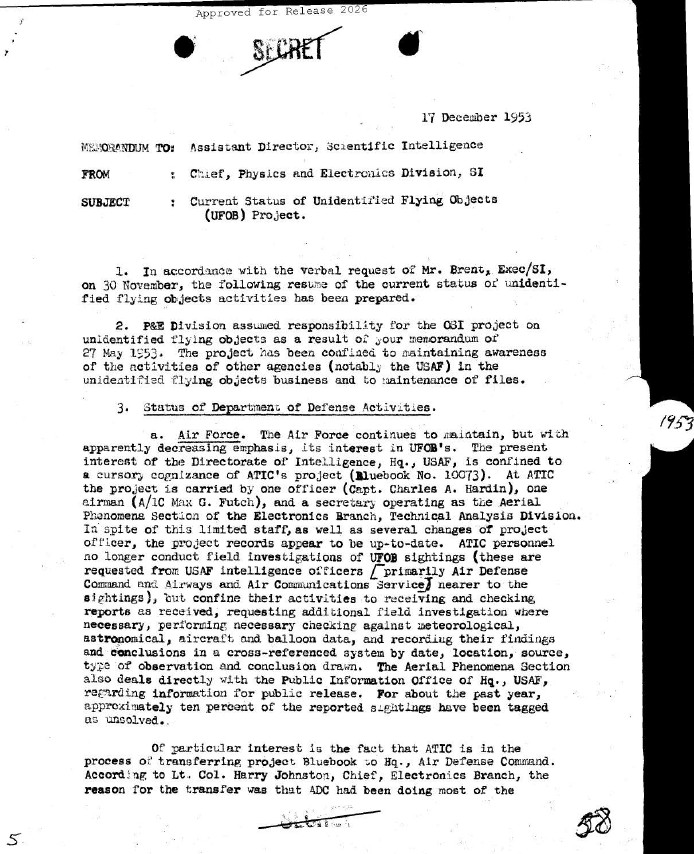
Memo de la CIA sobre el proyecto OVNI de la USAF, 1953
Mismo periodo
Archivos OVNI: debriefing médico del Apolo 17, audio 1/2

Archivos OVNI: debriefing médico del Apolo 17, audio 2/2
Audio OVNI: la tripulación del Apolo 17 ve partículas
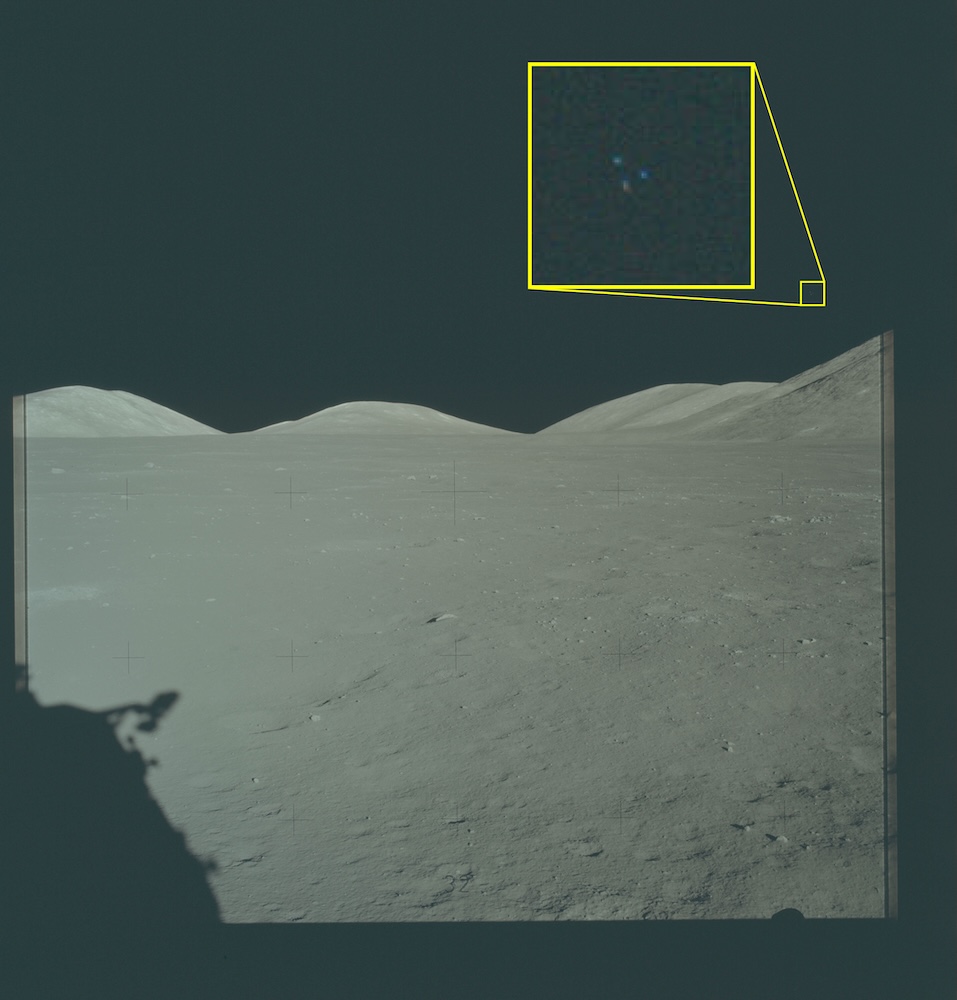
Foto OVNI de Apolo 17: tres puntos en el cielo lunar, 1972
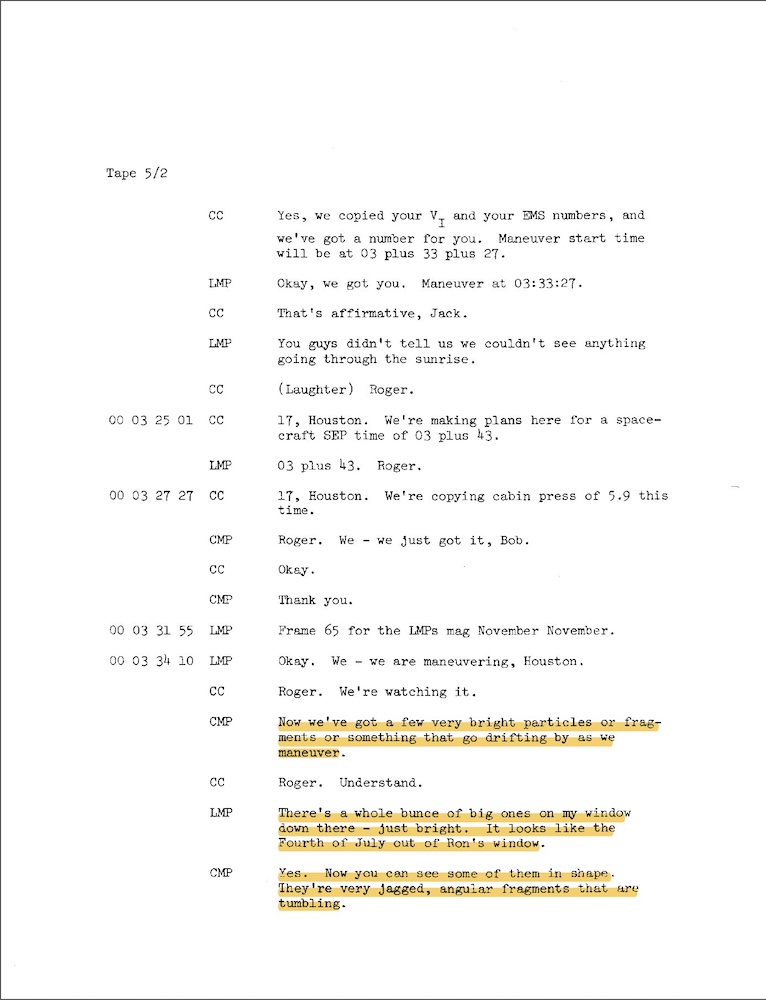
OVNI en Apolo 17: transcripción aire-tierra NASA, 1972
Misma publicación
Reporte OVNI del reverendo Barnes a Hoover, Cascadas, 1949
Archivo del FBI de Newark sobre OVNI en Nueva Jersey, 1952
Archivo Flying Discs del FBI: OVNI en Washington, 1952-60
Memo de la CIA sobre investigación OVNI británica, 1952
Informe OVNI del Panel Robertson a Defensa, 1953
Avistamiento OVNI en Hungría según una carta, CIA, 1955
Misma agencia
Análisis de la CIA del OVNI visto desde un tren, 1955
Memorando de la CIA: OVNI visto desde un tren, 1955
Avistamientos OVNI en Budapest con croquis, CIA, 1956
Avistamientos OVNI sobre Budapest, informe CIA, 1957
Memorandos de la CIA sobre un OVNI en Puerto Rico, 1964