UFO files: CIA report on Kardashev-Sakharov paper, 1972
Official file: CIA-UAP-008, Speculative Paper By N Kardashev and A Sakharov on Charged Mass in Space at Conference on Origins Of Life, Armenia, 6-8 September 1971/Low Scientific Level Of Other Soviet Papers
Published · Updated
Key facts
- Official file ID
- CIA-UAP-8 (cited as CIA-UAP-008 in this file)
- Document type
- Document
- Agency
- CIA
- Released in
- R03 · 2026-06-12
- Incident date
- 1972
- Incident location
- Pages legible
- 2/2
- VIRIN
- 260508-O-D0360-1085
Official description
This 1972 CIA Intelligence Information Report summarizes a US attendee's observations of a speculative paper regarding charged mass behavior in space presented by Soviet scientists N.S. Kardashev and A. Sakharov at a conference in Armenia. A more redacted version of this report has been available on CIA's public website.
✦ AI summary
This is a 2-page CIA Directorate of Intelligence Information Report (no. 00-B-321/07707-72, distributed 10 April 1972), marked as unevaluated information. Its source is a U.S. citizen, and the report consists of edited abstracts of a letter from a reliable colleague who attended the Conference on the Origins of Life in Yerevan, Armenian SSR, on 6-8 September 1971. It describes an interesting but highly speculative paper by N. S. Kardashev of the Institute for Space Research, Moscow, co-authored with the physicist Andrei D. Sakharov, on what happens when a charged mass collapses in space: if it were not charged, it would collapse past the point of gravitational singularity and be gone forever, but a charged mass could bounce back out, into a different part of space-time. Kardashev said Sakharov was interested because it suggests the structure of space may be much more complicated than thought, while he himself was interested in the implications for astrophysics if the basic physics is correct. A U.S. attendee found the speculation "a little fantastic" but thought the paper rested on good and sound physics. The second page gives impressions of Kardashev, Shklovskiy, Ginzburg and other Soviet participants, and says the scientific level of most papers was not very high. It also reports that a member of a committee the USSR established to investigate unusual phenomena, "in other words, flying saucers", gave a talk that was actually very humorous, that Shklovskiy and others joked and laughed, and that Shklovskiy said the committee consists of many politicians, theorists and historians with little if any scientific talent.
Generated with AI from the official file — may contain errors.
▸Transcript(2 of 2 pages legible)
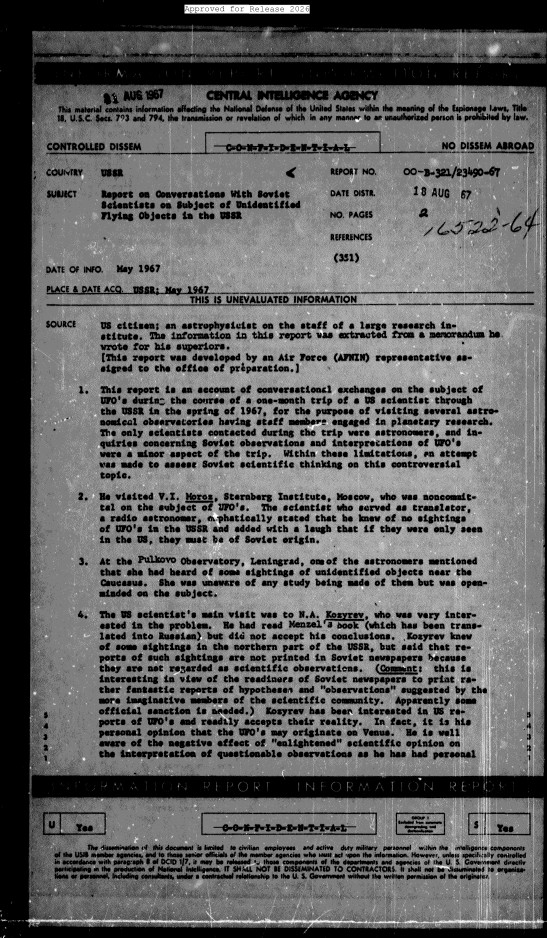
[PAGE 1] Approved for Release 2026. DIRECTORATE OF INTELLIGENCE. Intelligence Information Report. COUNTRY: USSR. REPORT NO. 00-B-321/07707-72. DATE DISTR.: 10 Apr 72. SUBJECT: Speculative Paper by N. Kardashev and A. Sakharov on Charged Mass in Space at Conference on Origins of Life, Armenia, 6-8 September 1971/Also Scientific Level of Other Soviet DCS [Directorate of Central Sciences?] Papers, Case ST-1026. NO. PAGES: 2. DATE OF INFO.: 6-8 September 1971. PLACE & DATE ACQ. BY SOURCE: Yerevan/6-8 September 1971. THIS IS UNEVALUATED INFORMATION. SOURCE: US citizen. This report consists of edited abstracts from a letter received from a reliable colleague who attended the Yerevan Conference. 1-2. At the Conference on the Origins of Life in Yerevan, Armenia, SSR, 6-8 September 1971, N.S. Kardashev, Institute for Space Research, Moscow, read an interesting but highly speculative paper he had prepared on general relativity and the possibility of a body collapsing into a black hole in space. His co-author was the internationally famous theoretical physicist, Andrei D. Sakharov. Kardashev is very much like his superior and former teacher at the Institute, I.S. Shklovskiy, in his approach to scientific problems; he is not afraid to speculate in his effort to find a solution. The Kardashev-Sakharov paper concerned the authors' study of what happens when a charged mass or body collapses in space. Kardashev stated that if it were not charged, the mass would just collapse past the point of gravitational singularity and be gone forever -- the mass would close in on itself and have no more contact with the outside world. The Soviets speculated on what would happen if the mass were charged: they stated that then the mass would be able to bounce -- it would collapse but bounce back out. However, the mass will come back into a different part of space-time. 3. After his presentation, Kardashev told a US attendee that Sakharov was mostly interested in this charged-mass phenomenon study because it indicates that the structure of space may be much more complicated than is presently thought. Kardashev was interested in the study from the viewpoint of what implications it has for astrophysics, provided the basic physics of the phenomenon is correct. The US attendee felt the authors' speculation was 'a little fantastic' and that they had 'taken off in a rather wild way'; however, he believed their paper was grounded in good and sound physics. [Distribution/routing numbers: 5 5 4 4 3 3 2 2] [PAGE 2] CONFIDENTIAL [stamp, crossed out] -2- 4. The US attendee considers Kardashev to be very competent technically and further to be very self-possessed. He recalled an incident in the spring of 1971 when Kardashev, L I Matveyenko and he visited Academician Lev Artsimovich, secretary of the Academy's Department of General Physics and Astronomy. Matveyenko, Institute for Cosmic Research, is a Communist Party member and very expert in political matters. He was almost cringing in Artsimovich's presence whereas Kardashev was cool and confident in his business-like discussions with the senior Academi- cian. 5. In general, the scientific level of most of the Soviet papers at this Conference was not very high. One little known Soviet [source could not recall his name] gave a very naive paper on the detectability of planets. Another Soviet, who was a member of a committee the USSR has established to investigate unusual phenomena, in other words, flying saucers, gave a serious talk which was actually very humorous. His approach was, "Well, of course, we know there isn't anything to this alleged phenome- non (flying saucers), but on the other hand---." During this talk Shklovskiy and other Soviets joked and laughed and obviously did not take the speaker's remarks seriously. Shklovskiy remarked later to a US attendee that the "flying saucer committee" consists of many poli- ticians, theorists, historians and similar type people. It has little if any scientific talent. 6. Shklovskiy gave a general, entertaining talk on some interesting but unimportant subject. Vitaliy L Ginzburg, one of the leading astronomers in the USSR, also gave a talk on the basis of physical theory, that is, the identification and comparison of fundamental assumptions in physics. Ginzburg has a first rate mind and is sounder in his physics knowledge than Shklovskiy. Ginzburg thinks realistically, which was shown in his answer to a US attendee's question about the Conference. The Soviet was asked whether the Conference was worthwhile in that it was mostly devoted to theoretical subjects, very remote from tangible goals. Ginzburg said, "Well, if it helps to build up support for the Soviet researchers to get new astronomical equipment, then certainly the Con- ference makes sense." - end -
Generated with AI from the official file — may contain errors.
Source: U.S. Department of War / AARO — public domain · war.gov/ufo
Entities in this document
Related cases
Sary Shagan test range and UFO phenomena, CIA, 1973
Australian Defence paper on UFOs and Blue Book, 1971
UFO file: CIA report on USSR, Sary Shagan range, 1973
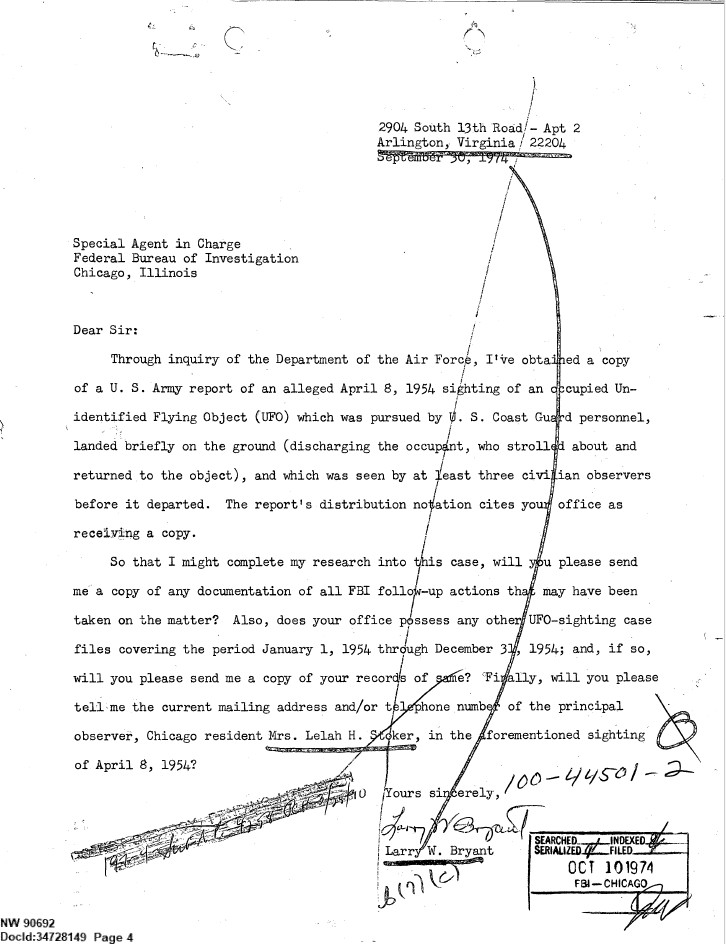
FBI correspondence on UFO sightings, 1967-1974

UFO files: Apollo 14 crew debriefing, audio 1/2
UFO files: Apollo 14 crew debriefing, audio 2/2
Same document series
Robertson Panel UFO report, CIA, 1952-1953
CIA history of U-2 and OXCART: U-2s and UFOs
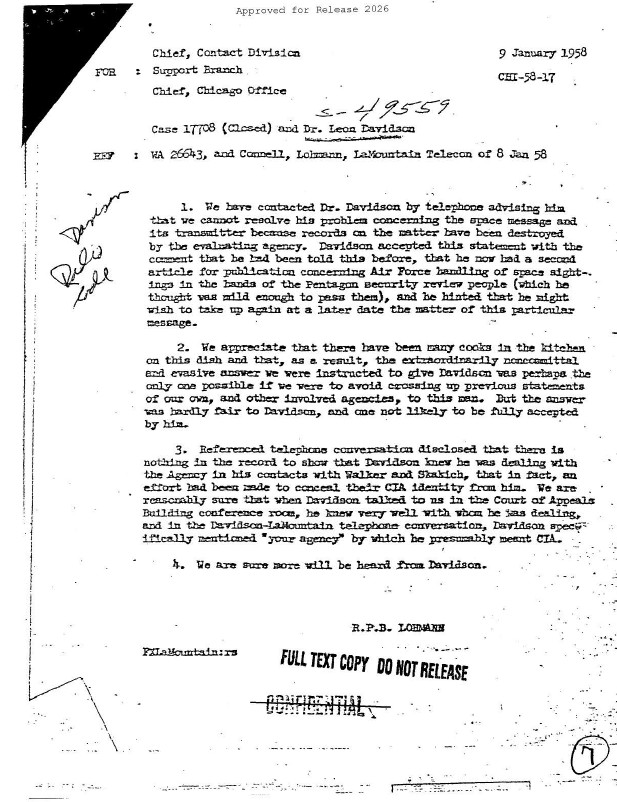
CIA memo on UFO researcher Leon Davidson, 1958
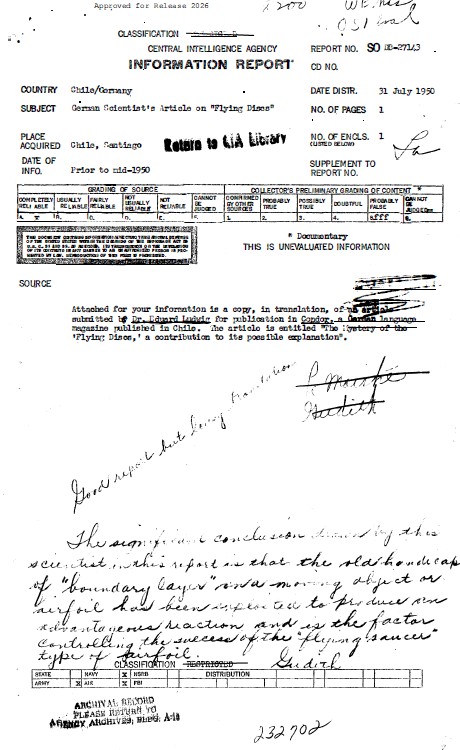
German scientist's flying disc UFO theory, CIA, 1950
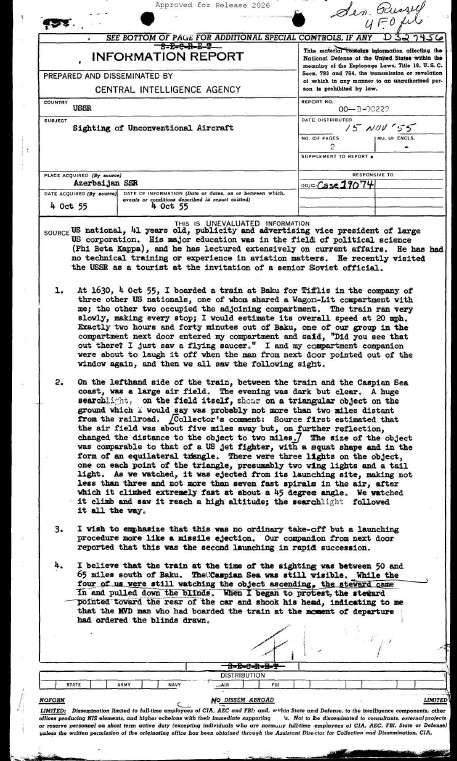
CIA report: triangular UFOs near Baku, Azerbaijan, 1955
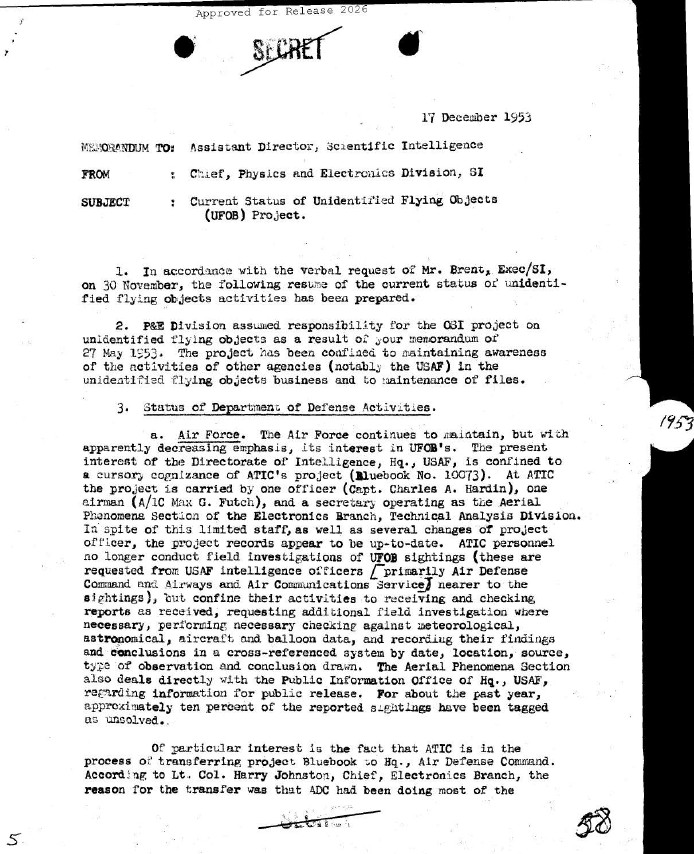
CIA memo on Air Force UFO project status, 1953
Same period
UFO audio: Apollo 17 crew sees bright particles, 1972
UFO files: Apollo 17 medical debriefing, audio 1/2

UFO files: Apollo 17 medical debriefing, audio 2/2
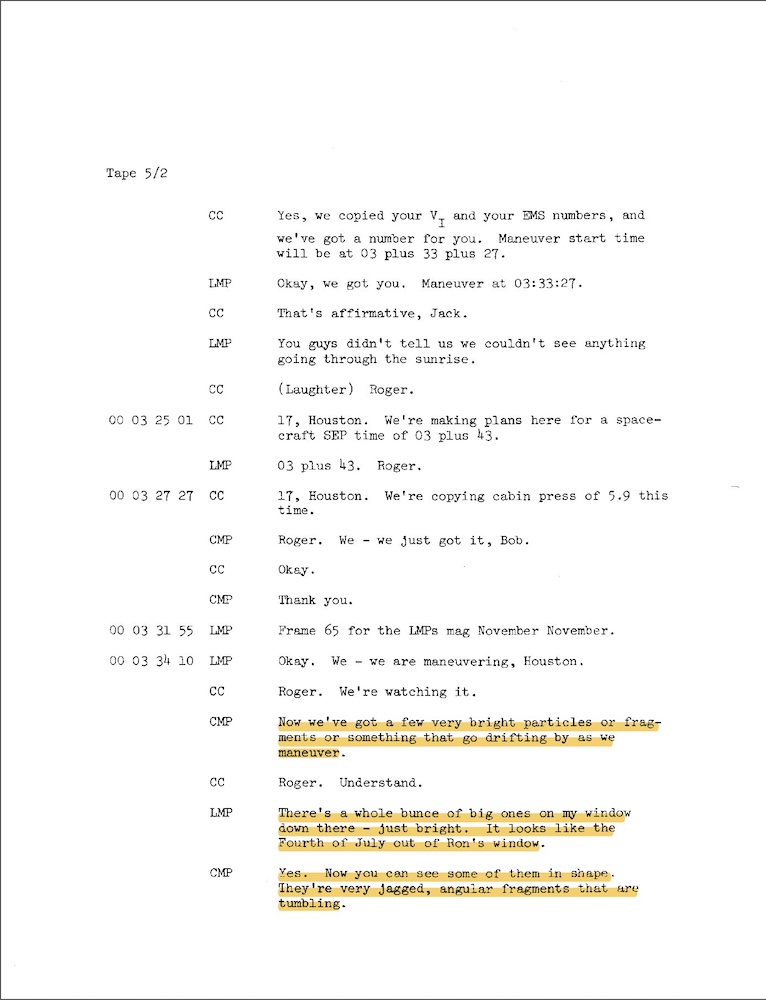
UFO Files: NASA Apollo 17 Air-to-Ground Transcript, 1972
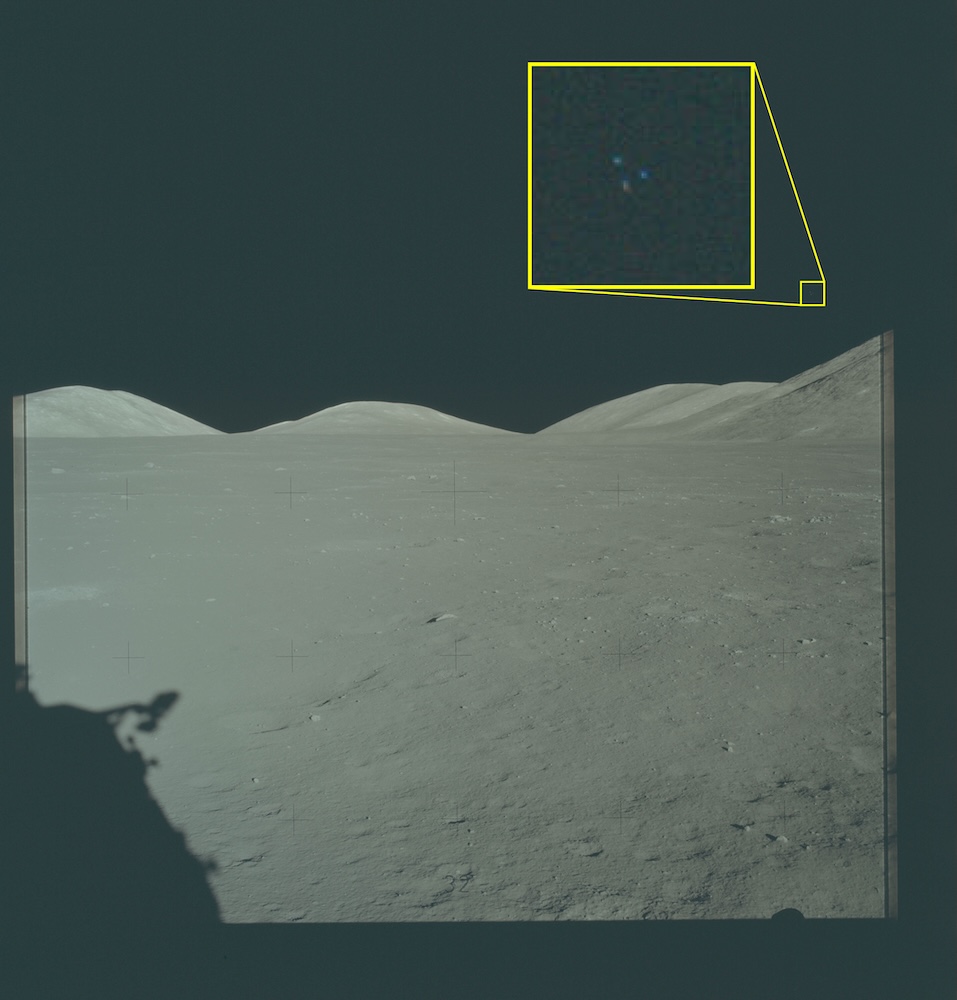
UFO Photo from Apollo 17: Three Dots in Lunar Sky, 1972
Same release
Rev. Barnes' UFO report to FBI's Hoover, Cascades, 1949
CIA memo on British UFO investigation, 1952
FBI Flying Discs file: UFO sightings in Washington State
FBI Newark file on UFO sightings in New Jersey, 1952
Robertson Panel UFO report to Defense Secretary, 1953
UFO sighting in Hungary from a family letter, CIA, 1955
Same agency
CIA analysis of the 1955 train UFO sighting
CIA memo: Senator Russell’s train UFO sighting, 1955
UFO sightings and sketch, Budapest, CIA report, 1956
UFO sightings over Budapest, CIA report, 1957
CIA memos on a UFO near Puerto Rico, 1964 (USS Gyatt)