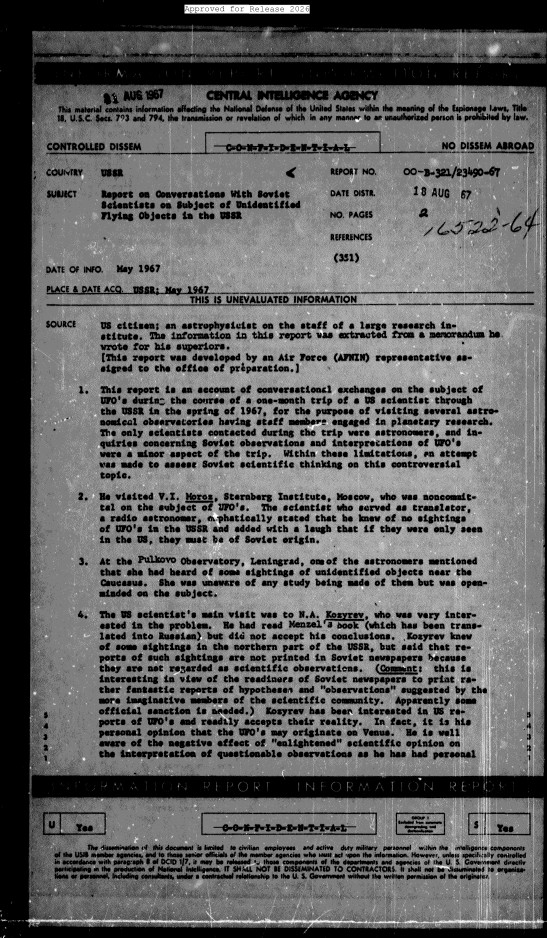
UFO-Akten: CIA-Bericht zu Kardaschow und Sacharow, 1972
Offizielle Datei: CIA-UAP-008, Spekulatives Papier von N. Kardaschow und A. Sacharow über geladene Masse im Weltraum auf der Konferenz über den Ursprung des Lebens, Armenien, 6.–8. September 1971 / Niedriges wissenschaftliches Niveau anderer sowjetischer Arbeiten
Veröffentlicht am · Aktualisiert am
Kerndaten
- Offizielle Akten-ID
- CIA-UAP-8 (hier zitiert als CIA-UAP-008)
- Dokumenttyp
- Dokument
- Behörde
- CIA
- Veröffentlicht in
- R03 · 2026-06-12
- Datum des Vorfalls
- 1972
- Ort des Vorfalls
- Lesbare Seiten
- 2/2
- VIRIN
- 260508-O-D0360-1085
Offizielle Beschreibung
Dieser CIA-Nachrichtendienstbericht (Intelligence Information Report) von 1972 fasst die Beobachtungen eines US-amerikanischen Teilnehmers zu einem spekulativen Papier über das Verhalten geladener Masse im Weltraum zusammen, das von den sowjetischen Wissenschaftlern N. S. Kardaschow und A. Sacharow auf einer Konferenz in Armenien vorgestellt wurde. Eine stärker geschwärzte Version dieses Berichts war auf der öffentlichen Website der CIA verfügbar.
✦ KI-Zusammenfassung
Dies ist ein 2-seitiger Intelligence Information Report der CIA Directorate of Intelligence (Nr. 00-B-321/07707-72, verteilt am 10. April 1972), gekennzeichnet als unbewertete Information. Quelle ist ein US-Bürger, und der Bericht besteht aus redigierten Auszügen aus dem Brief eines zuverlässigen Kollegen, der an der Konferenz über den Ursprung des Lebens in Jerewan, Armenische SSR, vom 6. bis 8. September 1971 teilnahm. Er beschreibt eine interessante, aber stark spekulative Arbeit von N. S. Kardaschow vom Institut für Weltraumforschung in Moskau, mit dem Physiker Andrei D. Sacharow als Koautor, darüber, was geschieht, wenn eine geladene Masse im Weltraum kollabiert: Wäre sie nicht geladen, würde sie über den Punkt der gravitativen Singularität hinaus kollabieren und für immer verschwinden, eine geladene Masse könnte jedoch zurückprallen, in einen anderen Teil der Raumzeit hinein. Kardaschow sagte, Sacharow interessiere sich dafür, weil es nahelege, dass die Struktur des Raums viel komplizierter sei als gedacht, während ihn selbst die Folgen für die Astrophysik interessierten, falls die grundlegende Physik stimme. Ein US-Teilnehmer fand die Spekulation „ein wenig phantastisch“, hielt die Arbeit aber für in guter und solider Physik begründet. Die zweite Seite enthält Eindrücke von Kardaschow, Schklowski, Ginsburg und anderen sowjetischen Teilnehmern und besagt, das wissenschaftliche Niveau der meisten Beiträge sei nicht sehr hoch gewesen. Außerdem wird berichtet, ein Mitglied eines von der UdSSR eingesetzten Komitees zur Untersuchung ungewöhnlicher Phänomene, „mit anderen Worten, fliegender Untertassen“, habe einen Vortrag gehalten, der tatsächlich sehr humorvoll war, Schklowski und andere hätten gescherzt und gelacht, und Schklowski habe gesagt, das Komitee bestehe aus vielen Politikern, Theoretikern und Historikern mit wenig oder gar keinem wissenschaftlichen Talent.
Mit KI aus der Originaldatei erstellt — kann Fehler enthalten.
▸Transkript(2 von 2 Seiten lesbar)
[PAGE 1] Approved for Release 2026. DIRECTORATE OF INTELLIGENCE. Intelligence Information Report. COUNTRY: USSR. REPORT NO. 00-B-321/07707-72. DATE DISTR.: 10 Apr 72. SUBJECT: Speculative Paper by N. Kardashev and A. Sakharov on Charged Mass in Space at Conference on Origins of Life, Armenia, 6-8 September 1971/Also Scientific Level of Other Soviet DCS [Directorate of Central Sciences?] Papers, Case ST-1026. NO. PAGES: 2. DATE OF INFO.: 6-8 September 1971. PLACE & DATE ACQ. BY SOURCE: Yerevan/6-8 September 1971. THIS IS UNEVALUATED INFORMATION. SOURCE: US citizen. This report consists of edited abstracts from a letter received from a reliable colleague who attended the Yerevan Conference. 1-2. At the Conference on the Origins of Life in Yerevan, Armenia, SSR, 6-8 September 1971, N.S. Kardashev, Institute for Space Research, Moscow, read an interesting but highly speculative paper he had prepared on general relativity and the possibility of a body collapsing into a black hole in space. His co-author was the internationally famous theoretical physicist, Andrei D. Sakharov. Kardashev is very much like his superior and former teacher at the Institute, I.S. Shklovskiy, in his approach to scientific problems; he is not afraid to speculate in his effort to find a solution. The Kardashev-Sakharov paper concerned the authors' study of what happens when a charged mass or body collapses in space. Kardashev stated that if it were not charged, the mass would just collapse past the point of gravitational singularity and be gone forever -- the mass would close in on itself and have no more contact with the outside world. The Soviets speculated on what would happen if the mass were charged: they stated that then the mass would be able to bounce -- it would collapse but bounce back out. However, the mass will come back into a different part of space-time. 3. After his presentation, Kardashev told a US attendee that Sakharov was mostly interested in this charged-mass phenomenon study because it indicates that the structure of space may be much more complicated than is presently thought. Kardashev was interested in the study from the viewpoint of what implications it has for astrophysics, provided the basic physics of the phenomenon is correct. The US attendee felt the authors' speculation was 'a little fantastic' and that they had 'taken off in a rather wild way'; however, he believed their paper was grounded in good and sound physics. [Distribution/routing numbers: 5 5 4 4 3 3 2 2] [PAGE 2] CONFIDENTIAL [stamp, crossed out] -2- 4. The US attendee considers Kardashev to be very competent technically and further to be very self-possessed. He recalled an incident in the spring of 1971 when Kardashev, L I Matveyenko and he visited Academician Lev Artsimovich, secretary of the Academy's Department of General Physics and Astronomy. Matveyenko, Institute for Cosmic Research, is a Communist Party member and very expert in political matters. He was almost cringing in Artsimovich's presence whereas Kardashev was cool and confident in his business-like discussions with the senior Academi- cian. 5. In general, the scientific level of most of the Soviet papers at this Conference was not very high. One little known Soviet [source could not recall his name] gave a very naive paper on the detectability of planets. Another Soviet, who was a member of a committee the USSR has established to investigate unusual phenomena, in other words, flying saucers, gave a serious talk which was actually very humorous. His approach was, "Well, of course, we know there isn't anything to this alleged phenome- non (flying saucers), but on the other hand---." During this talk Shklovskiy and other Soviets joked and laughed and obviously did not take the speaker's remarks seriously. Shklovskiy remarked later to a US attendee that the "flying saucer committee" consists of many poli- ticians, theorists, historians and similar type people. It has little if any scientific talent. 6. Shklovskiy gave a general, entertaining talk on some interesting but unimportant subject. Vitaliy L Ginzburg, one of the leading astronomers in the USSR, also gave a talk on the basis of physical theory, that is, the identification and comparison of fundamental assumptions in physics. Ginzburg has a first rate mind and is sounder in his physics knowledge than Shklovskiy. Ginzburg thinks realistically, which was shown in his answer to a US attendee's question about the Conference. The Soviet was asked whether the Conference was worthwhile in that it was mostly devoted to theoretical subjects, very remote from tangible goals. Ginzburg said, "Well, if it helps to build up support for the Soviet researchers to get new astronomical equipment, then certainly the Con- ference makes sense." - end -
Mit KI aus der Originaldatei erstellt — kann Fehler enthalten.
Automatische Übersetzung — das Originaldokument ist auf Englisch. Auf Englisch ansehen →
Quelle: US-Kriegsministerium / AARO — gemeinfrei · war.gov/ufo
Entitäten in diesem Dokument
Verwandte Fälle
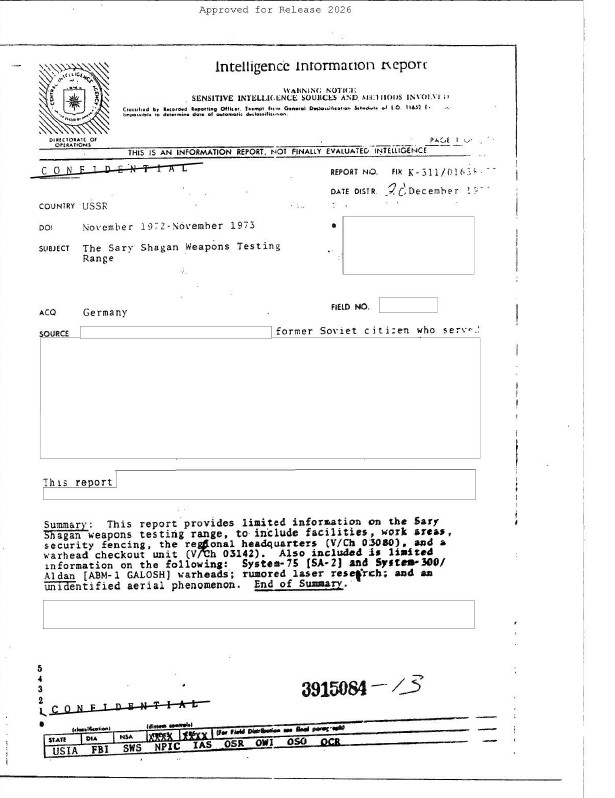
Testgelände Sary-Schagan und UFO, CIA-Bericht, 1973
Australisches UFO-Papier zu Blue Book, 1971
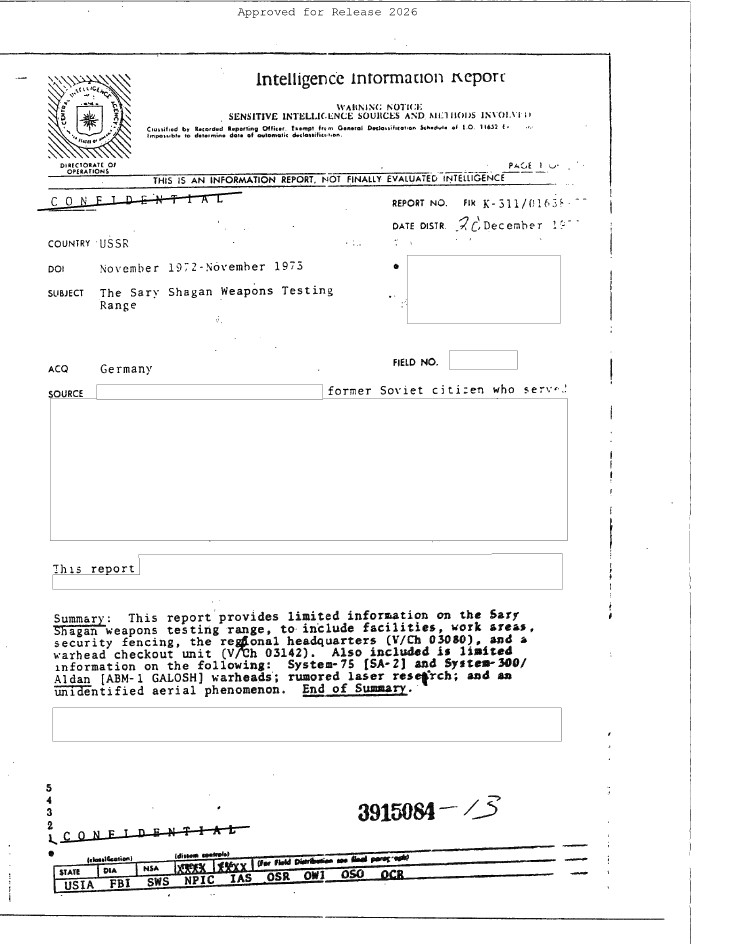
UFO-Akte: CIA-Bericht zur UdSSR, Sary Schagan, 1973
FBI-Korrespondenz zu UFO-Sichtungen, 1967-1974
UFO-Akten: Apollo-14-Nachbesprechung, Audio 1/2
UFO-Akten: Apollo-14-Nachbesprechung, Audio 2/2
Gleiche Aktenserie
Robertson-Panel: UFO-Berichte der CIA, 1952-1953
CIA-Geschichte von U-2 und OXCART mit UFO-Kapitel
CIA-Memo zu UFO-Forscher Leon Davidson, 1958
UFO-Theorie eines deutschen Forschers, CIA, 1950
CIA-Bericht: dreieckige UFOs bei Baku, 1955
CIA-Memo zum UFO-Projekt der US Air Force, 1953
Gleicher Zeitraum
UFO bei Apollo 17: NASA-Funkprotokoll Bord-Boden, 1972
UFO-Akten: medizinische Nachbesprechung Apollo 17, 1/2

UFO-Akten: medizinische Nachbesprechung Apollo 17, 2/2
UFO-Audio: Apollo-17-Crew sieht helle Partikel, 7.12.1972
UFO-Foto von Apollo 17: drei Punkte am Mondhimmel, 1972
Gleiche Veröffentlichung
UFO-Meldung von Pastor Barnes an Hoover, 1949
CIA-Memo zu britischen UFO-Untersuchungen, 1952
FBI-Akte Flying Discs: UFOs in Washington, 1952-1960
FBI-Akte Newark zu UFO-Sichtungen in New Jersey, 1952
Robertson-Panel: UFO-Bericht an Verteidigungsminister
UFO-Sichtung in Ungarn laut Brief, CIA-Bericht, 1955
Gleiche Behörde
CIA-Analyse der UFO-Sichtung vom Zug, 1955
CIA-Memo: UFO-Sichtung vom Zug aus, 1955
UFO-Sichtungen in Budapest mit Skizze, CIA, 1956
UFO-Sichtungen über Budapest, CIA-Bericht, 1957
CIA-Memos zu einem UFO bei Puerto Rico, 1964