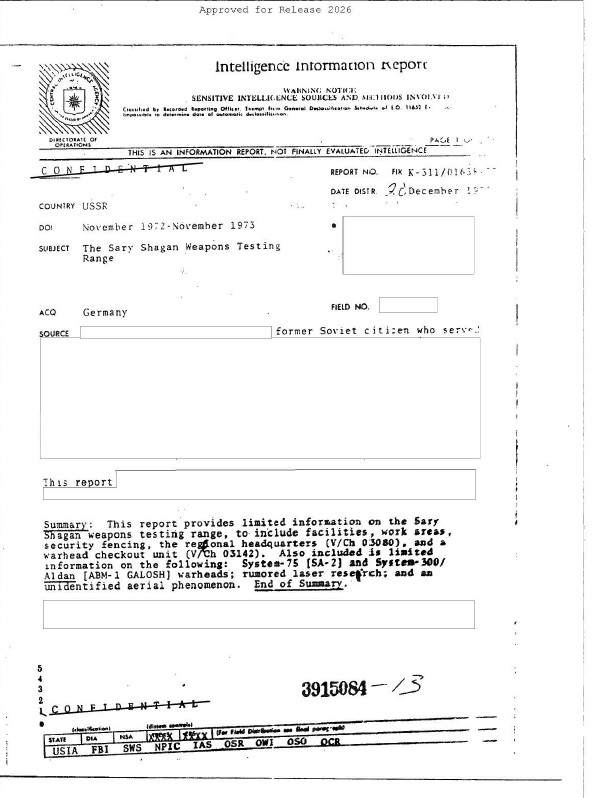
CIA-UAP-006, Avistamento de Aeronave Não Convencional
Dados principais
- ID oficial do arquivo
- CIA-UAP-6 (citado como CIA-UAP-006 neste arquivo)
- Tipo de documento
- Documento
- Agência
- CIA
- Publicado em
- R03 · 2026-06-12
- Data do incidente
- November, 1955
- Local do incidente
- Baku, Azerbaijão
- Coordenadas
- 40.3755885, 49.8328009
- Páginas legíveis
- 2/2
- VIRIN
- 260508-O-D0360-1083
Descrição oficial
Este relatório de informação da CIA, de novembro de 1955, descreve o relato de testemunha ocular de um cidadão norte-americano sobre uma aeronave triangular com luzes nas asas que decolou em ângulo acentuado a partir de um aeródromo próximo a Baku, Azerbaijão, em 4 de outubro de 1955. Uma versão com trechos censurados deste relatório está disponível no site público da CIA.
✦ Resumo IA
Este Relatório de Informação da CIA de 2 páginas (Relatório nº 00-B-302290) documenta um avistamento em 4 de outubro de 1955 perto de Baku, RSS do Azerbaijão, URSS, relatado por um turista americano de 41 anos (vice-presidente de publicidade/marketing de uma grande corporação dos EUA, com formação em ciência política e honrarias Phi Beta Kappa, sem treinamento em aviação) que viajava de trem de Baku para Tiflis (Tbilisi) como parte de um grupo de quatro cidadãos americanos visitando a URSS a convite de um alto funcionário soviético. Cerca de duas horas e quarenta minutos após a partida de Baku, um companheiro alertou o grupo sobre um avistamento, e todos os quatro testemunharam um grande campo de aviação junto à costa do Mar Cáspio, onde um holofote iluminava um objeto triangular e achatado no solo, de tamanho aproximado ao de um caça a jato dos EUA, com três luzes (uma em cada vértice do triângulo, presumivelmente duas luzes de asa e uma luz de cauda). O objeto foi lançado — não uma decolagem convencional, mas descrita mais como uma ejeção do tipo míssil —, realizando de três a sete espirais rápidas antes de subir abruptamente a cerca de 45 graus até grande altitude, sendo acompanhado continuamente pelo holofote; um companheiro relatou que este era o segundo lançamento desse tipo em rápida sucessão naquela noite. Enquanto o grupo continuava observando, um comissário do trem entrou e fechou as persianas do compartimento, indicando silenciosamente (por meio de um gesto em direção à parte traseira do vagão) que um oficial do MVD (polícia secreta soviética) a bordo do trem havia ordenado que as persianas fossem fechadas. O relatório observa que o grupo desejava fazer esse trecho da viagem de avião, mas foi informado pela Intourist em Baku de que não existiam voos entre Baku e Tiflis — afirmação posteriormente contradita pela equipe da Intourist em Tiflis, que disse haver vários voos diários. O relatório é quase certamente uma observação civil em primeira mão de um teste soviético de míssil ou foguete perto de um local de lançamento militar, ilustrando como uma atividade legítima de teste de armamentos poderia gerar relatos de avistamentos de 'aeronaves não convencionais'.
Gerado com IA a partir do arquivo oficial — pode conter erros.
▸Transcrição(2 de 2 páginas legíveis)
[PAGE 1] Approved for Release 2026. PREPARED AND DISSEMINATED BY CENTRAL INTELLIGENCE AGENCY. COUNTRY: USSR. SUBJECT: Sighting of Unconventional Aircraft. PLACE ACQUIRED [by source]: Azerbaijan SSR. DATE ACQUIRED [by source] / DATE OF INFORMATION: 4 Oct 55 / 4 Oct 55. THIS IS UNEVALUATED INFORMATION. SOURCE: US national, 41 years old, publicity and advertising vice president of large US corporation. His major education was in the field of political science (Phi Beta Kappa), and he has lectured extensively on current affairs. He has had no technical training or experience in aviation matters. He recently visited the USSR as a tourist at the invitation of a senior Soviet official. At 1630, 4 Oct 55, I boarded a train at Baku for Tiflis in the company of three other US nationals, one of whom shared a Wagon-Lit compartment with me; the other two occupied the adjoining compartment. The train ran very slowly, making every stop; I would estimate its overall speed at 20 mph. Exactly two hours and forty minutes out of Baku, one of our group in the compartment next door entered my compartment and said, 'Did you see that out there? I just saw a flying saucer.' I and my compartment companion were about to laugh it off when the man from next door pointed out of the window again, and then we all saw the following sight. On the left-hand side of the train, between the train and the Caspian Sea coast, was a large air field. The evening was dark but clear. A huge searchlight, on the field itself, shone on a triangular object on the ground which I would say was probably not more than two miles distant from the railroad. [Collector's comment: Source first estimated that the air field was about five miles away but, on further reflection, changed the distance to the object to two miles.] The size of the object was comparable to that of a US jet fighter, with a squat shape and in the form of an equilateral triangle. There were three lights on the object, one on each point of the triangle, presumably two wing lights and a tail light. As we watched, it was ejected from its launching site, making not less than three and not more than seven fast spirals in the air, after which it climbed extremely fast at about a 45 degree angle. We watched it climb and saw it reach a high altitude; the searchlight followed it all the way. I wish to emphasize that this was no ordinary take-off but a launching procedure more like a missile ejection. Our companion from next door reported that this was the second launching in rapid succession. Report No. 00-B-302290. [Distribution/classification block: NOFORN, NO DISSEM ABROAD, LIMITED -- dissemination limited to full-time employees of CIA, AEC and FBI, and within State and Defense to intelligence components producing NIS elements. Distribution: State, Army, Navy, FBI.] [PAGE 2] 5. Our party had wished to make this part of the journey by air, but we were informed by Intourist in Baku that there were no flights between Baku and Tiflis. In Tiflis, the Intourist people were surprised that our party had not flown and said that there were several flights a day. -- end -- 4. [Preceding paragraph continues from page 1's cutoff]: I believe that the train at the time of the sighting was between 50 and 65 miles south of Baku. The Caspian Sea was still visible. While the four of us were still watching the object ascending, the steward came in and pulled down the blinds. When I began to protest, the steward gestured toward the rear of the car and shook his head, indicating to me that the MVD man who had boarded the train at the moment of departure had ordered the blinds drawn.
Gerado com IA a partir do arquivo oficial — pode conter erros.
Tradução automática — o documento original está em inglês. Ver em inglês →
Fonte: Departamento de Guerra dos EUA / AARO — domínio público · war.gov/ufo
Entidades neste documento
Casos conectados
DOW-UAP-D051, Email Correspondence, Pacific Time Zone, March 2023
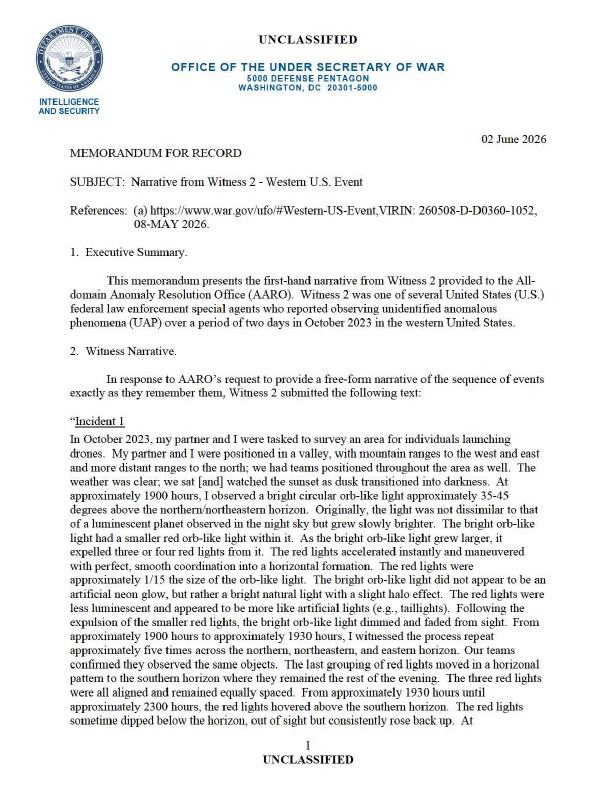
DOW-UAP-D080, Narrative Statement 2, Western United States Event, 2023
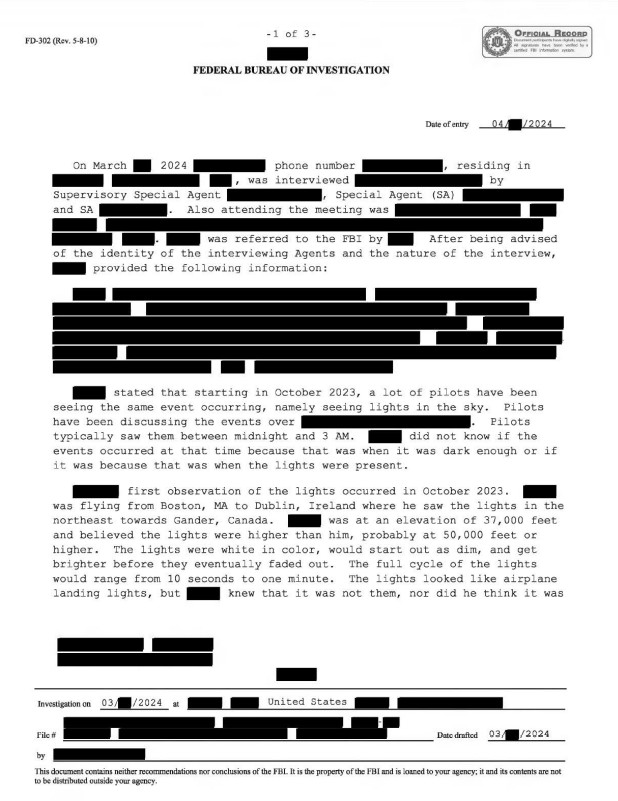
FBI-UAP-D024, FD-302, “Airborne Lights and Triangle,” 2002, 2023-2024
FBI-UAP-D026, FD-302, “Dark Translucent Triangle,” 2023
FBI-UAP-D028, FD-302, “Dark Triangle with Lights,” 2011
FBI-UAP-D030, FD-302, “Large Triangle with Red Lights,” 2023
Casos relacionados
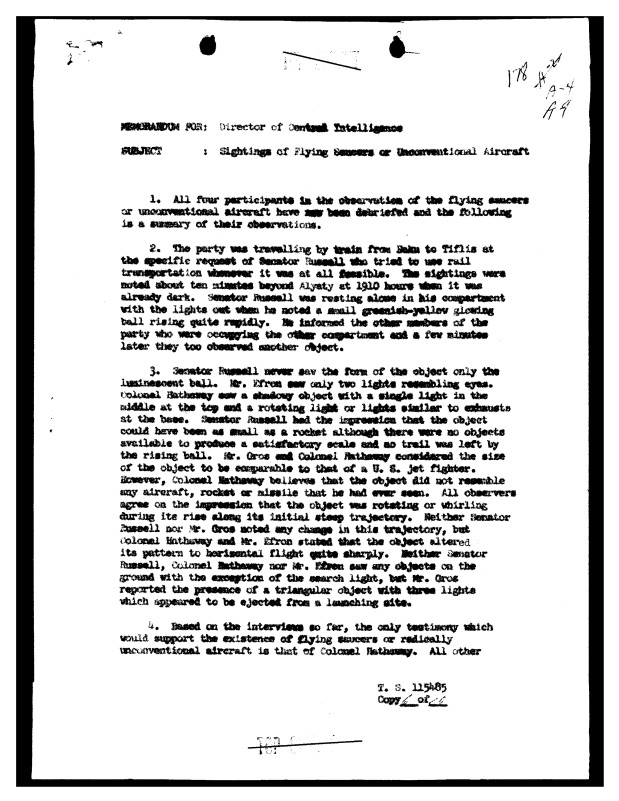
CIA-UAP-D020, Memorando sobre Avistamentos de Aeronaves Não Convencionais, 1955
CIA-UAP-D021, Análise de Avistamentos de Aeronaves Não Convencionais, 1955
CIA-UAP-003, A Central Intelligence Agency e o Reconhecimento Aéreo de Grande Altitude; Os Programas U-2 e OXCART, 1954-1974
CIA-UAP-007, Situação Atual do Projeto de Objetos Voadores Não Identificados (OVNI).
CIA-UAP-009, Objetos Voadores Desconhecidos Observados sobre Budapeste
CIA-UAP-013, Relatório de Avistamentos Incomuns de Objetos Voadores e Atividade Científica Correlata
Mesma série de arquivos
CIA-UAP-002, Painel Consultivo Científico sobre Objetos Voadores Não Identificados, Relatório, 1952-1953
CIA-UAP-003, A Central Intelligence Agency e o Reconhecimento Aéreo de Grande Altitude; Os Programas U-2 e OXCART, 1954-1974
CIA-UAP-004, Caso 17708 (Encerrado) e o Dr. Leon Davidson
CIA-UAP-005, Artigo de Cientista Alemão sobre "Discos Voadores"
CIA-UAP-007, Situação Atual do Projeto de Objetos Voadores Não Identificados (OVNI).
CIA-UAP-008, Artigo Especulativo de N. Kardashev e A. Sakharov sobre Massa Carregada no Espaço em Conferência sobre a Origem da Vida, Armênia, 6-8 de Setembro de 1971/Baixo Nível Científico de Outros Trabalhos Soviéticos
Mesmo período
341_110677_Arquivo_Numérico,_5-2500
CIA-UAP-018, Relatório de Avistamentos Incomuns de Objetos Voadores e Atividade Científica Correlata
CIA-UAP-D020, Memorando sobre Avistamentos de Aeronaves Não Convencionais, 1955
CIA-UAP-D021, Análise de Avistamentos de Aeronaves Não Convencionais, 1955
DOW-UAP-D095, Projetos Conjuntos de Aviação EUA-Canadá e Relatórios de Avistamentos de UFO, 1954-1955
DOW-UAP-D096, Correspondência Relativa ao Projeto Blue Book, 1955
Mesmo release
FBI-UAP-D011, Encaminhamento de Correspondência D/FBI, 1949
CIA-UAP-014, Atividade Britânica no Campo dos "Objetos Voadores Não Identificados"
FBI-UAP-D012, Escritório de Campo de Newark, 1952-1967
FBI-UAP-D013, Investigação de ‘OVNI’ no Estado de Washington, 1952-1960
DOW-UAP-D085_Transmission-of-CIA-Scientific-Advisory-Panel-Rept_1953
CIA-UAP-013, Relatório de Avistamentos Incomuns de Objetos Voadores e Atividade Científica Correlata
Mesma agência
CIA-UAP-009, Objetos Voadores Desconhecidos Observados sobre Budapeste
CIA-UAP-D022, Objeto Voador Não Identificado Relatado nas Proximidades de Porto Rico, 1965
CIA-UAP-010, Relatório sobre Conversas com Cientistas Soviéticos a Respeito de Objetos Voadores Não Identificados na URSS

CIA-UAP-016, Avistamentos de Objetos Voadores Não Identificados em Ladakh, Nepal, Sikkim e Butão
CIA-UAP-019, Aspectos Científicos e de Inteligência do Problema OVNI, Departamento de Defesa da Austrália