NASA-UAP-D008, Interrogatorio médico del Apollo 12 - Cinta 12, 1969
Datos del expediente
Descripción oficial
Durante un interrogatorio médico de la tripulación de la misión Apollo 12, el comandante Charles “Pete” Conrad, el piloto del módulo de mando Richard “Dick” F. Gordon y el piloto del módulo lunar Alan L. Bean describen sus observaciones de instancias de destellos de luz o “rayas de luz”. Cada uno de los astronautas reportó que estas experiencias ocurrieron en la oscuridad mientras intentaban dormir. El equipo médico de NASA consideró si fenómenos similares reportados por el piloto del módulo lunar del Apollo 11, Buzz Aldrin, habían sido atribuibles a la exposición de la retina a rayos cósmicos. NASA determinó posteriormente que los fenómenos reportados por la tripulación del Apollo 12 eran internos a la visión de los astronautas y no fuentes de luz externas.
✦ Resumen IA
Esta es una grabación de audio de una sesión de interrogatorio médico de la NASA con la tripulación del Apollo 12 —el comandante Charles "Pete" Conrad, el piloto del módulo de mando Richard "Dick" Gordon, y el piloto del módulo lunar Alan Bean— en la que discuten destellos y franjas de luz que observaron mientras intentaban dormir en la cabina oscura de la nave. Un médico de vuelo/entrevistador abre la sesión preguntando sobre un informe que menciona "descargas coronales," lo que lleva a la tripulación a describir el fenómeno en detalle: destellos o franjas vistos con un solo ojo a la vez (no ambos), que ocurren en varios ángulos aunque a menudo horizontales y moviéndose de derecha a izquierda, comparables a que alguien encendiera y apagara una luz. La tripulación relaciona esto con informes anteriores de Buzz Aldrin del Apollo 11 y comenta los intentos previos y fallidos de la NASA (desde el Proyecto Mercury) de fotografiar franjas retinianas producidas por impactos de rayos cósmicos. La NASA concluyó más tarde que los fenómenos eran internos a la visión de los astronautas (interacción de rayos cósmicos con la retina) y no fuentes de luz externas. Varios pasajes son inaudibles.
Generado con IA a partir del archivo oficial — puede contener errores.
▸Transcripción
[00:00] Interviewer: Listen, we read this paragraph in here about these, quote, "coronal discharges" that you guys were seeing, and that completely stops us. Tell us how this came about, and who talked to you about it, and what you saw. [00:19] Crew: Somebody reported on one of the earlier flights that some guy, like at the letters paper or somewhere, they shifted down and made the case about two things — where the VHF radio noises, which could be discharges from some places, played, and the other one, where I thought it was a new flight, we said [unintelligible] planned to do a spacecraft. It's [unintelligible] with their eyes closed. They noticed that when they were awake at night, the spacecraft was dark, and they thought [something in their eyes]. But whoever this guy [was] wants to know — that's a perfectly known phenomenon. You can get discharges across your eyes from gamma rays or something. [00:56] Crew: So they had a bunch of things — would we hold our eyes and face the moon? You know, when we were orbiting it, because you'd get less discharges facing the moon and away from it. But it doesn't have to be near the moon or anywhere — the first night it happened. And if you keep your eyes closed while you're awake down there and it's dark, and you think about it — when it happens, you notice it's one eye. It's not a discharge if you see it in both eyes — you really see it with one eye or the other, and you can tell what kind it is. We had two kinds — I guess it's [the retina struck] perpendicular, or a discharge parallel — and we'd get either a flash like that, or we'd get a streak. [01:48] Crew: And I feel that — I know the way they got a flash or a streak. And I, for some reason, got more with my left eye than my right eye. But I could tell which eye it was that I was seeing it in. I'm trying to tell you the reason — because each flash was always out of that side of the spacecraft. That's what I was going to point out — I called all the right ones my eyes. [laughter] [02:22] Crew: They should have protected you, Dick. They should have picked them all up. [02:26] [unintelligible] [02:48] Crew: I remember their conversation about it — they thought of it as something penetrating the spacecraft. [02:56] Crew: What Peter described is the exact phenomenon [experienced by] all three of us. You can see a light — there's a flash out there, or sometimes it would be a streak. And I saw them in both eyes, either eye — I can't remember if it was more predominant in one or the other. But I agree with Peter — the phenomenon, if you're not seeing it in both eyes, is not something external. [03:19] [unintelligible] [03:29] Crew: Well, we've been looking for cosmic rays — cosmic ray strikes, and heavy particles, heavy nuclei that go through. We started, clear back in Mercury, taking photographs of the retina to see if you could see streaks across the retina, and stuff. We never could find any. So we stopped that early, and, well, by the end of the... [03:51] [unintelligible] [04:02] Crew: Well, probably what it's doing anyway is probably hitting just a single cell. That's all it would take, particularly to make this flash — you hit a single cell. [04:12] Crew: I saw one night — I was looking at the MDC, a handrail up above, and one of my [streaks], I don't know where it went — right along my handrail for about that [length] — that's just... I just happened to be looking at that. [04:27] Crew: And now you can almost see it as well. — That's right, where it's just lying there. — He's holding your eyes. — He wanted to yell with my eye, and he hasn't already seen it — he didn't believe it on Earth. [04:39] [unintelligible] [05:02] Interviewer: Let me ask you one more question about [unintelligible]... Oh, here. [05:07] [unintelligible] [05:15] Interviewer: Okay, were these things random, or did they all seem to be in one direction? Like, were they always horizontal, or were they at random? [05:24] Crew: They could be at any kind of angle. [05:26] [unintelligible] [05:40] Crew: If I knew where I was looking, it always seemed like a horizontal streak, a little bit above the center, and it always seemed to me it went from right to left. [05:49] [unintelligible] [06:03] Crew: Like somebody was flashing a light at you. [06:06] [unintelligible] [06:19] Interviewer: Is that about the same for both of you? Is that the same reaction you had, Dick and Al, the way Pete described it? [06:29] [unintelligible] [06:39] Crew: But about the same — they seemed to appear about the same place. — No, I know. [06:44] [unintelligible] [07:32] Crew: And then I'd sit there for a while and say, okay, was that the left eye or the right eye? It'd take you a while to sort it out. But you'd usually figure it out. Now, you know what you're doing — you're supposed to be sleeping. [laughter] [07:48] Crew: And there was a comment that— [recording ends]
Generado con IA a partir del archivo oficial — puede contener errores.
Traducción automática — el documento original está en inglés. Ver en inglés →
Fuente: Departamento de Guerra de EE. UU. / AARO — dominio público · war.gov/ufo
Entidades en este documento
Casos conectados
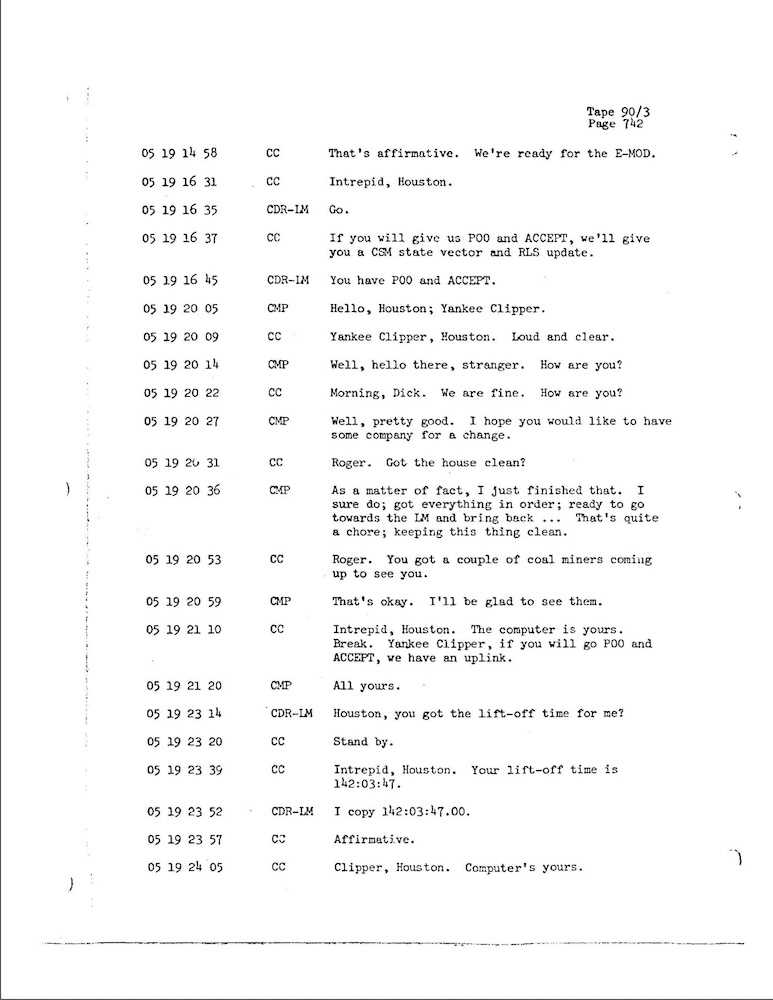
NASA-UAP-D001, Apollo 12 Transcript, 1969
NASA-UAP-D007, Skylab Technical Crew Debriefing 1973
NASA-UAP-D026, Apollo 14 Debriefing, 1971
NASA-UAP-D027, Apollo 14 Debriefing (Continued), 1971
NASA-UAP-D028, Apollo 17 Crew Medical Debriefing, 1972
NASA-UAP-D029, Apollo 17 Crew Medical Debriefing (Continued), 1972
Casos relacionados
Mismo lugar
NASA-UAP-D026, Interrogatorio de la Apolo 14, 1971
NASA-UAP-D027, Interrogatorio de la Apolo 14 (continuación), 1971
NASA-UAP-D028, Interrogatorio médico de la tripulación de la Apolo 17, 1972
NASA-UAP-D029, Interrogatorio médico de la tripulación de la Apolo 17 (continuación), 1972
DOE-UAP-D005, Informe de incidente de objeto no identificado en Pantex, 2015
Misma serie de expedientes
NASA-UAP-D001, Transcripción del Apolo 12, 1969
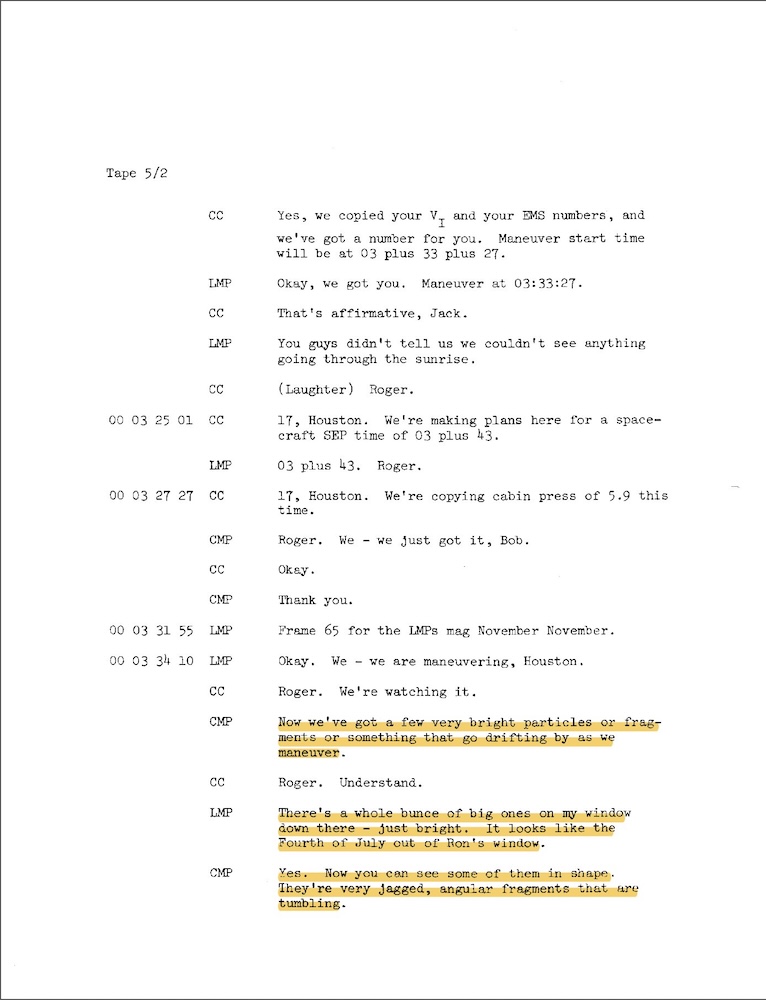
NASA-UAP-D002, Transcripción del Apolo 17, 1972
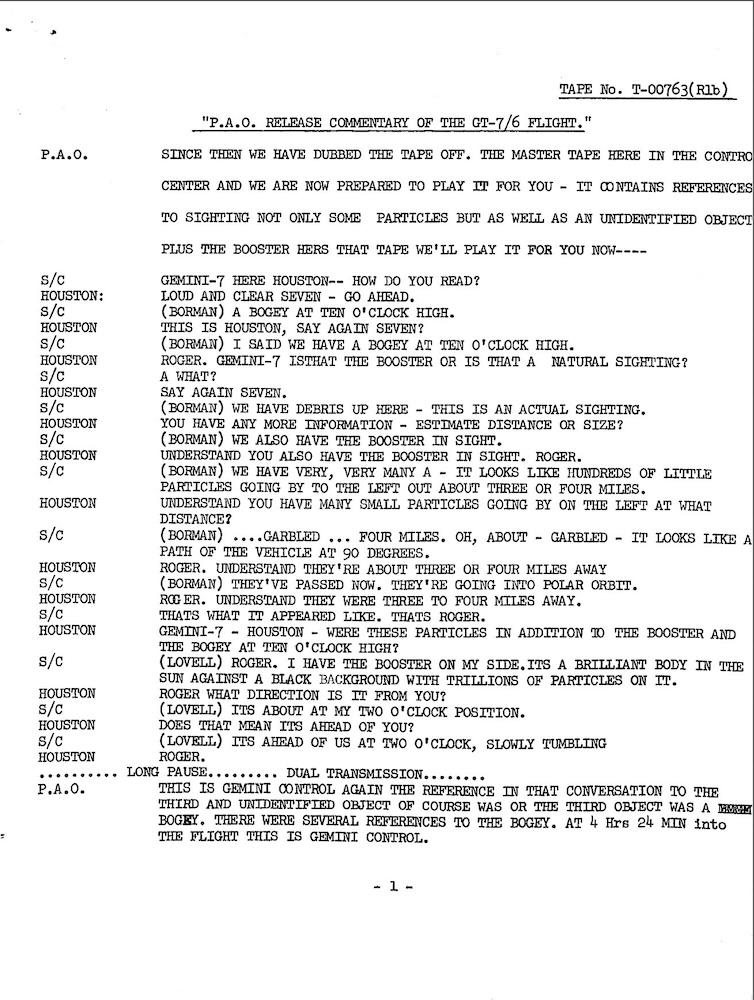
NASA-UAP-D003, Transcripción del Gemini 7, 1965

NASA-UAP-D003A, Extracto de audio del Gemini 7, 1965
NASA-UAP-D004, Interrogatorio técnico de la tripulación del Apolo 11, 1969
NASA-UAP-D005, Interrogatorio científico de la tripulación del Apolo 17, 1973
Mismo periodo
Mismo release
DOW-UAP-D017, UAP reportados en la Base Sandia, 1948-1950
NASA-UAP-D014, Mercury-Redstone 4, 21 de julio de 1961
NASA-UAP-D012, Extracto de audio del Mercury Atlas 8, 3 de octubre de 1962
NASA-UAP-D013, Mercury Atlas 7, 24 de mayo de 1962
NASA-UAP-D010, Extracto de audio del Mercury Atlas 9, 15 de mayo de 1963
NASA-UAP-D011, Extracto de audio del Mercury Atlas 9, 15 de mayo de 1963
Misma agencia
NASA-UAP-D015, Interrogatorios científicos a astronautas, 1962-1963
NASA-UAP-D023, Fragmento de entrevista con el astronauta Gordon Cooper, 1962
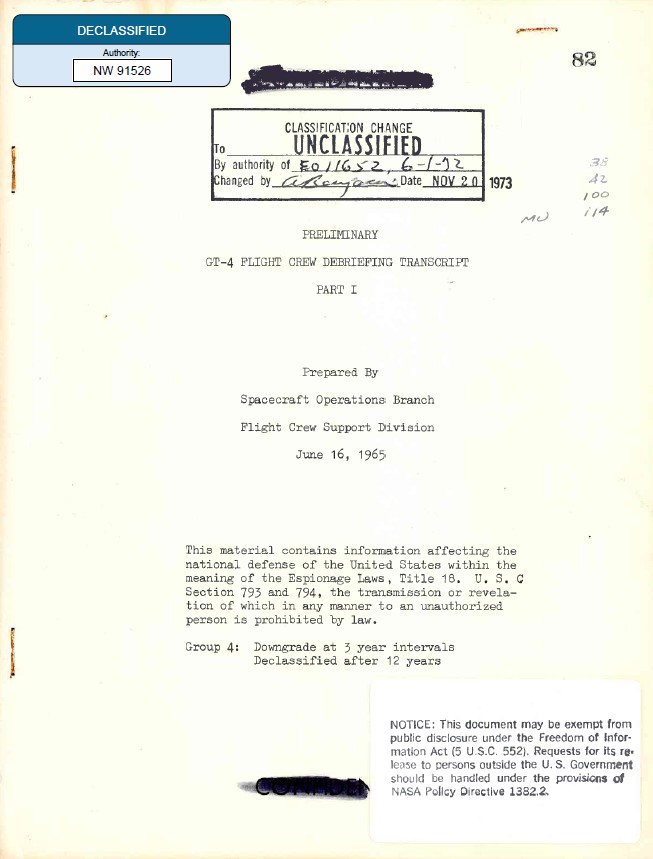
NASA-UAP-D016, Interrogatorio preliminar a la tripulación del Gemini 4, Parte I, 1965
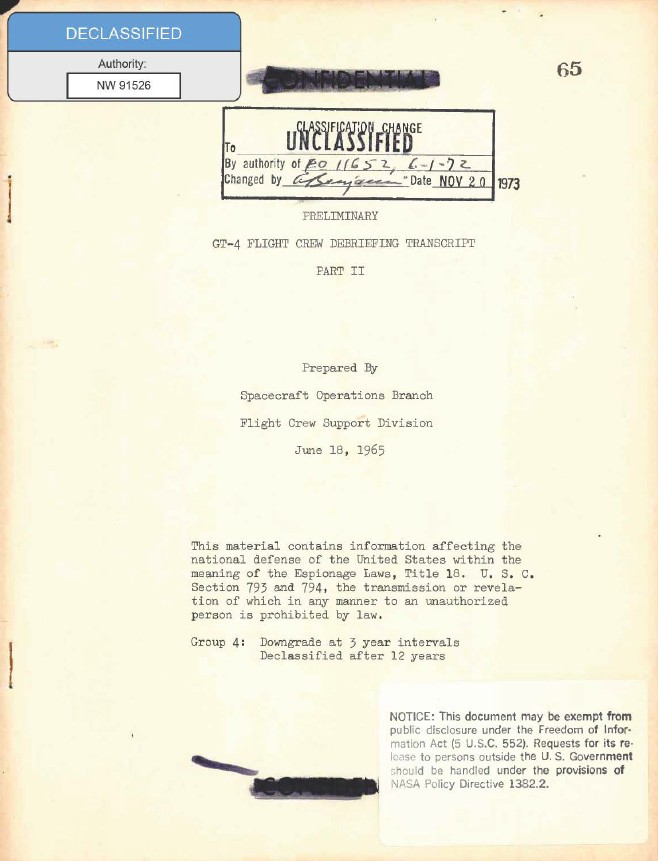
NASA-UAP-D017, Interrogatorio preliminar a la tripulación del Gemini 4, Parte II, 1965
NASA-UAP-D018, Interrogatorio del experimento del Gemini 4, 1967