NASA-UAP-D008, Apollo 12 Medizinisches Debriefing – Tonband 12, 1969
Kerndaten
Offizielle Beschreibung
Während eines medizinischen Debriefings der Besatzung der Apollo-12-Mission beschreiben Kommandant Charles „Pete“ Conrad, Kommandokapsel-Pilot Richard „Dick“ F. Gordon und Mondlandefähren-Pilot Alan L. Bean ihre Beobachtungen von Lichtblitzen oder „Lichtstreifen“. Die Astronauten berichteten übereinstimmend, dass diese Erlebnisse im Dunkeln auftraten, während sie versuchten zu schlafen. Das medizinische Team der NASA erwog, ob ähnliche, vom Mondlandefähren-Piloten der Apollo 11, Buzz Aldrin, gemeldete Phänomene auf eine Belastung der Netzhaut durch kosmische Strahlung zurückzuführen waren. Die NASA stellte später fest, dass die von der Apollo-12-Besatzung gemeldeten Phänomene ihren Ursprung im Sehvermögen der Astronauten hatten und nicht auf externe Lichtquellen zurückzuführen waren.
✦ KI-Zusammenfassung
Dies ist eine Audioaufnahme einer medizinischen Debriefing-Sitzung der NASA mit der Apollo-12-Besatzung — Kommandant Charles "Pete" Conrad, Kommandokapsel-Pilot Richard "Dick" Gordon und Mondlandefähren-Pilot Alan Bean —, in der Lichtblitze und Streifen besprochen werden, die sie beim Versuch zu schlafen in der dunklen Raumschiffkabine beobachteten. Ein Flugarzt/Interviewer eröffnet die Sitzung mit einer Frage zu einem Bericht über "Korona-Entladungen," woraufhin die Besatzung das Phänomen im Detail beschreibt: Blitze oder Streifen, die jeweils nur mit einem Auge (nicht beiden) gesehen wurden, in verschiedenen Winkeln auftraten, jedoch häufig horizontal und von rechts nach links wandernd, vergleichbar mit dem Aufblitzen einer Lampe. Die Besatzung verbindet dies mit früheren Berichten von Buzz Aldrin aus Apollo 11 und bespricht die früheren, erfolglosen Versuche der NASA (seit dem Mercury-Programm), Netzhautstreifen durch Treffer kosmischer Strahlung fotografisch festzuhalten. Die NASA kam später zu dem Schluss, dass die Phänomene ihren Ursprung im Sehsystem der Astronauten hatten (Wechselwirkung kosmischer Strahlung mit der Netzhaut) und nicht auf externe Lichtquellen zurückzuführen waren. Mehrere Passagen sind unhörbar.
Mit KI aus der Originaldatei erstellt — kann Fehler enthalten.
▸Transkript
[00:00] Interviewer: Listen, we read this paragraph in here about these, quote, "coronal discharges" that you guys were seeing, and that completely stops us. Tell us how this came about, and who talked to you about it, and what you saw. [00:19] Crew: Somebody reported on one of the earlier flights that some guy, like at the letters paper or somewhere, they shifted down and made the case about two things — where the VHF radio noises, which could be discharges from some places, played, and the other one, where I thought it was a new flight, we said [unintelligible] planned to do a spacecraft. It's [unintelligible] with their eyes closed. They noticed that when they were awake at night, the spacecraft was dark, and they thought [something in their eyes]. But whoever this guy [was] wants to know — that's a perfectly known phenomenon. You can get discharges across your eyes from gamma rays or something. [00:56] Crew: So they had a bunch of things — would we hold our eyes and face the moon? You know, when we were orbiting it, because you'd get less discharges facing the moon and away from it. But it doesn't have to be near the moon or anywhere — the first night it happened. And if you keep your eyes closed while you're awake down there and it's dark, and you think about it — when it happens, you notice it's one eye. It's not a discharge if you see it in both eyes — you really see it with one eye or the other, and you can tell what kind it is. We had two kinds — I guess it's [the retina struck] perpendicular, or a discharge parallel — and we'd get either a flash like that, or we'd get a streak. [01:48] Crew: And I feel that — I know the way they got a flash or a streak. And I, for some reason, got more with my left eye than my right eye. But I could tell which eye it was that I was seeing it in. I'm trying to tell you the reason — because each flash was always out of that side of the spacecraft. That's what I was going to point out — I called all the right ones my eyes. [laughter] [02:22] Crew: They should have protected you, Dick. They should have picked them all up. [02:26] [unintelligible] [02:48] Crew: I remember their conversation about it — they thought of it as something penetrating the spacecraft. [02:56] Crew: What Peter described is the exact phenomenon [experienced by] all three of us. You can see a light — there's a flash out there, or sometimes it would be a streak. And I saw them in both eyes, either eye — I can't remember if it was more predominant in one or the other. But I agree with Peter — the phenomenon, if you're not seeing it in both eyes, is not something external. [03:19] [unintelligible] [03:29] Crew: Well, we've been looking for cosmic rays — cosmic ray strikes, and heavy particles, heavy nuclei that go through. We started, clear back in Mercury, taking photographs of the retina to see if you could see streaks across the retina, and stuff. We never could find any. So we stopped that early, and, well, by the end of the... [03:51] [unintelligible] [04:02] Crew: Well, probably what it's doing anyway is probably hitting just a single cell. That's all it would take, particularly to make this flash — you hit a single cell. [04:12] Crew: I saw one night — I was looking at the MDC, a handrail up above, and one of my [streaks], I don't know where it went — right along my handrail for about that [length] — that's just... I just happened to be looking at that. [04:27] Crew: And now you can almost see it as well. — That's right, where it's just lying there. — He's holding your eyes. — He wanted to yell with my eye, and he hasn't already seen it — he didn't believe it on Earth. [04:39] [unintelligible] [05:02] Interviewer: Let me ask you one more question about [unintelligible]... Oh, here. [05:07] [unintelligible] [05:15] Interviewer: Okay, were these things random, or did they all seem to be in one direction? Like, were they always horizontal, or were they at random? [05:24] Crew: They could be at any kind of angle. [05:26] [unintelligible] [05:40] Crew: If I knew where I was looking, it always seemed like a horizontal streak, a little bit above the center, and it always seemed to me it went from right to left. [05:49] [unintelligible] [06:03] Crew: Like somebody was flashing a light at you. [06:06] [unintelligible] [06:19] Interviewer: Is that about the same for both of you? Is that the same reaction you had, Dick and Al, the way Pete described it? [06:29] [unintelligible] [06:39] Crew: But about the same — they seemed to appear about the same place. — No, I know. [06:44] [unintelligible] [07:32] Crew: And then I'd sit there for a while and say, okay, was that the left eye or the right eye? It'd take you a while to sort it out. But you'd usually figure it out. Now, you know what you're doing — you're supposed to be sleeping. [laughter] [07:48] Crew: And there was a comment that— [recording ends]
Mit KI aus der Originaldatei erstellt — kann Fehler enthalten.
Automatische Übersetzung — das Originaldokument ist auf Englisch. Auf Englisch ansehen →
Quelle: US-Kriegsministerium / AARO — gemeinfrei · war.gov/ufo
Entitäten in diesem Dokument
Verbundene Fälle
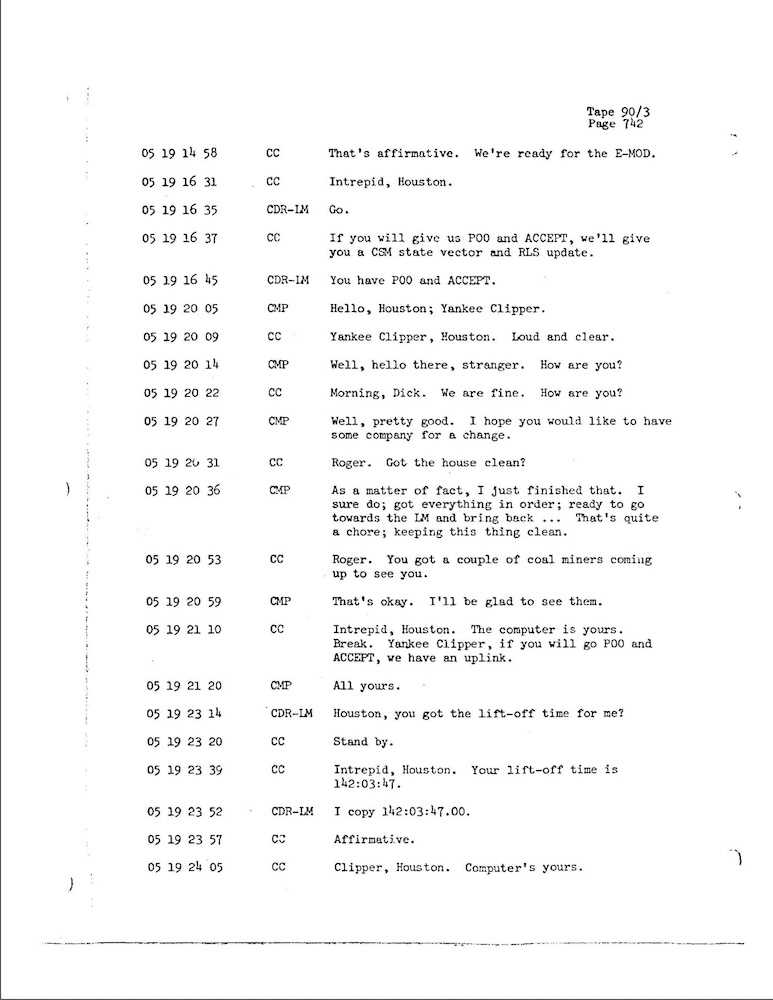
NASA-UAP-D001, Apollo 12 Transcript, 1969
NASA-UAP-D007, Skylab Technical Crew Debriefing 1973
NASA-UAP-D026, Apollo 14 Debriefing, 1971
NASA-UAP-D027, Apollo 14 Debriefing (Continued), 1971
NASA-UAP-D028, Apollo 17 Crew Medical Debriefing, 1972

NASA-UAP-D029, Apollo 17 Crew Medical Debriefing (Continued), 1972
Verwandte Fälle
Gleicher Ort
NASA-UAP-D026, Apollo-14-Nachbesprechung, 1971
NASA-UAP-D027, Apollo-14-Nachbesprechung (Fortsetzung), 1971
NASA-UAP-D028, Medizinische Nachbesprechung der Apollo-17-Besatzung, 1972
NASA-UAP-D029, Medizinische Nachbesprechung der Apollo-17-Besatzung (Fortsetzung), 1972
DOE-UAP-D005, Bericht über einen Vorfall mit einem unidentifizierten Objekt in Pantex, 2015
Gleiche Aktenserie
NASA-UAP-D001, Apollo-12-Transkript, 1969
NASA-UAP-D002, Apollo-17-Transkript, 1972
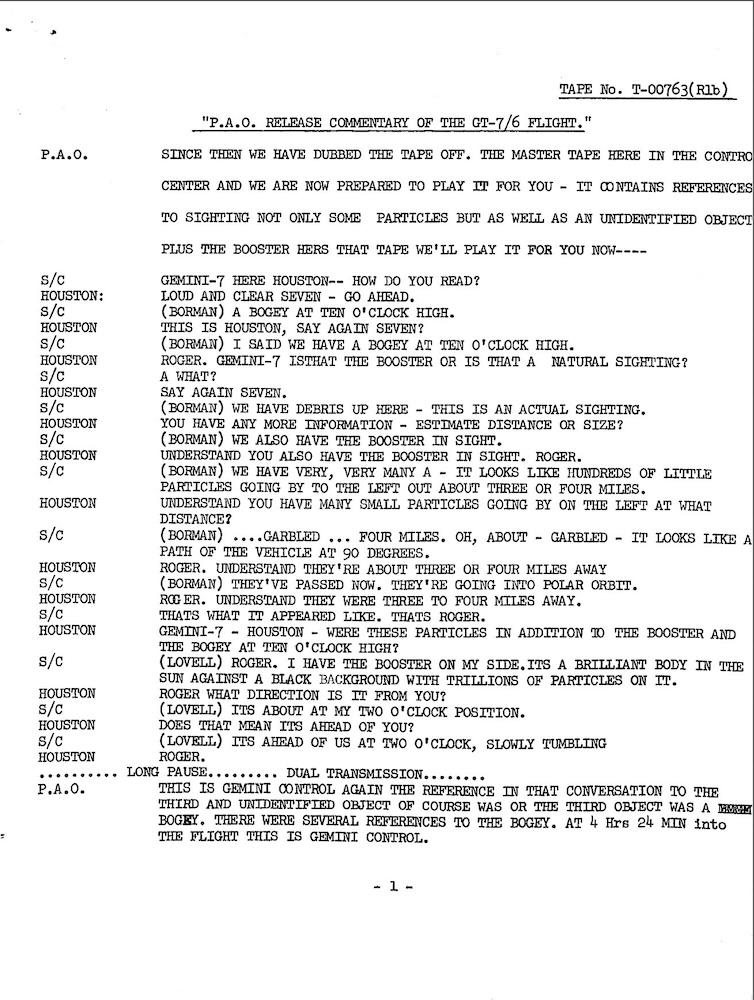
NASA-UAP-D003, Gemini-7-Transkript, 1965

NASA-UAP-D003A, Gemini-7-Audioausschnitt, 1965
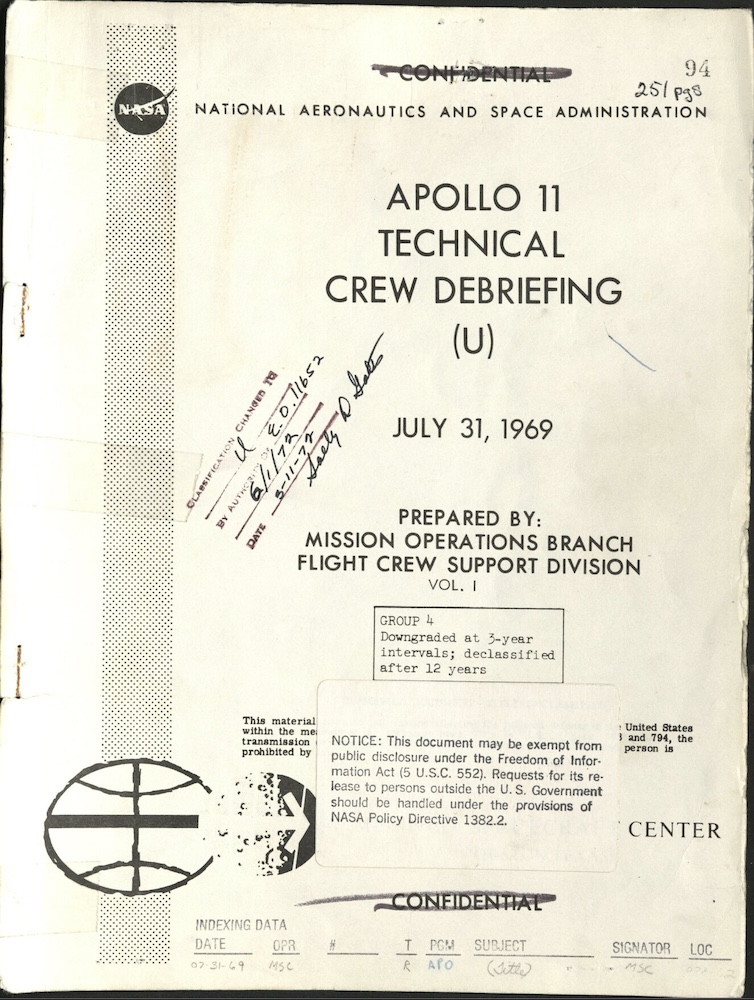
NASA-UAP-D004, Apollo-11-Technisches Besatzungsdebriefing, 1969
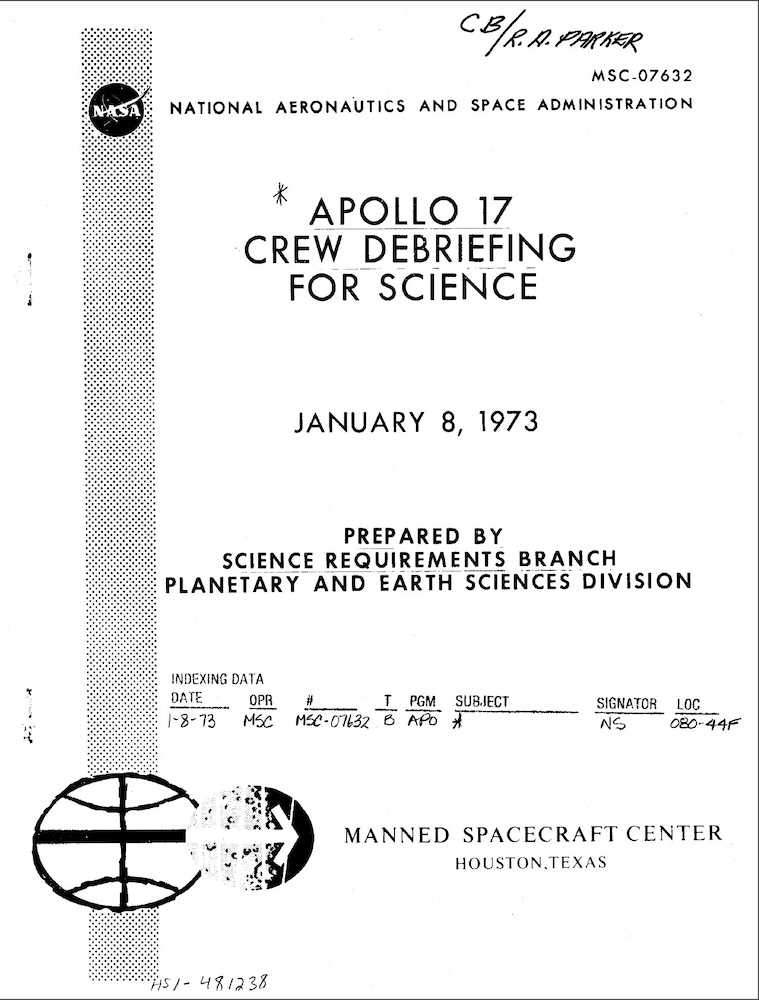
NASA-UAP-D005, Apollo-17-Besatzungsdebriefing für Wissenschaft, 1973
Gleicher Zeitraum
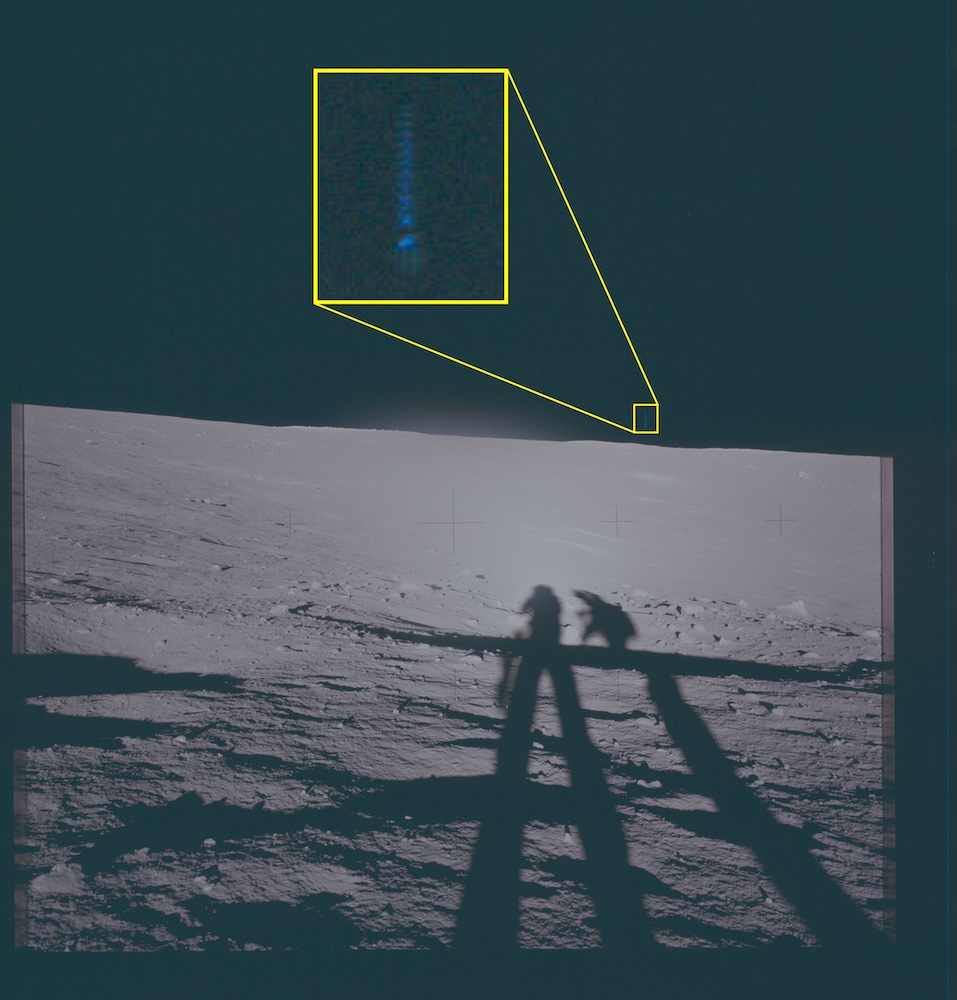
Gleiche Veröffentlichung
DOW-UAP-D017, UAP-Meldungen am Sandia-Stützpunkt, 1948–1950
NASA-UAP-D014, Mercury-Redstone 4, 21. Juli 1961
NASA-UAP-D012, Mercury-Atlas-8-Audioausschnitt, 3. Oktober 1962
NASA-UAP-D013, Mercury-Atlas 7, 24. Mai 1962
NASA-UAP-D010, Mercury-Atlas-9-Audioausschnitt, 15. Mai 1963
NASA-UAP-D011, Mercury-Atlas-9-Audioausschnitt, 15. Mai 1963
Gleiche Behörde
NASA-UAP-D015, Wissenschaftliche Astronauten-Debriefings, 1962–1963
NASA-UAP-D023, Interviewausschnitt mit Astronaut Gordon Cooper, 1962
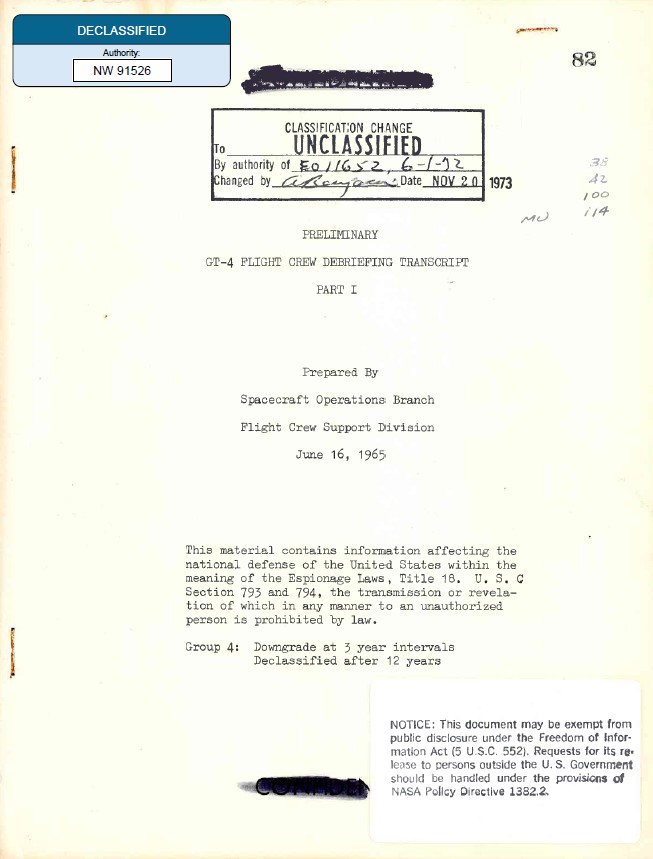
NASA-UAP-D016, Vorläufiges Gemini-4-Besatzungsdebriefing, Teil I, 1965
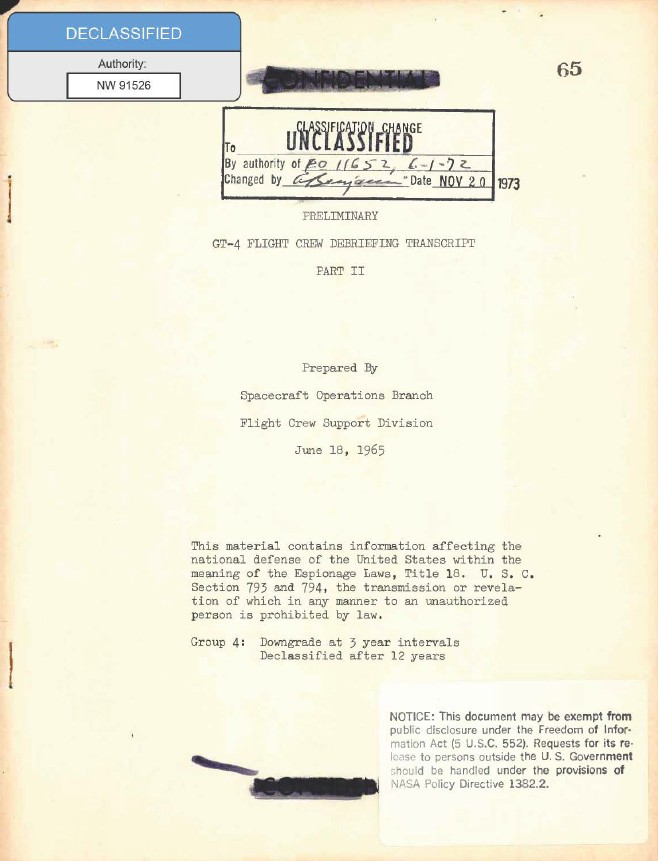
NASA-UAP-D017, Vorläufiges Gemini-4-Besatzungsdebriefing, Teil II, 1965
NASA-UAP-D018, Gemini-4-Experiment-Debriefing, 1967