NASA-UAP-D008, Interrogatoire médical de l’Apollo 12 - Bande 12, 1969
Faits essentiels
Description officielle
Lors d’un interrogatoire médical de l’équipage de la mission Apollo 12, le commandant Charles « Pete » Conrad, le pilote du module de commande Richard « Dick » F. Gordon et le pilote du module lunaire Alan L. Bean décrivent leurs observations d’éclairs de lumière ou de « traînées de lumière ». Les astronautes ont chacun rapporté que ces expériences se produisaient dans l’obscurité alors qu’ils essayaient de dormir. L’équipe médicale de la NASA s’est demandé si des phénomènes similaires signalés par le pilote du module lunaire d’Apollo 11, Buzz Aldrin, étaient attribuables à une exposition de la rétine aux rayons cosmiques. La NASA a déterminé par la suite que les phénomènes rapportés par l’équipage d’Apollo 12 étaient d’origine interne à la vision des astronautes plutôt que dus à des sources lumineuses externes.
✦ Résumé IA
Il s'agit d'un enregistrement audio d'une séance de débriefing médical de la NASA avec l'équipage d'Apollo 12 — le commandant Charles « Pete » Conrad, le pilote du module de commande Richard « Dick » Gordon, et le pilote du module lunaire Alan Bean — discutant des éclairs et traînées lumineuses qu'ils ont observés en essayant de dormir dans la cabine obscure du vaisseau. Un médecin de vol/intervieweur ouvre la séance en posant des questions sur un rapport mentionnant des « décharges coronales, » incitant l'équipage à décrire le phénomène en détail : des éclairs ou traînées vus avec un seul œil à la fois (pas les deux), survenant selon divers angles mais souvent horizontaux et se déplaçant de droite à gauche, comparables à quelqu'un allumant et éteignant une lumière. L'équipage relie cela à des rapports antérieurs de Buzz Aldrin lors d'Apollo 11 et évoque les tentatives antérieures infructueuses de la NASA (remontant au programme Mercury) de photographier des traînées rétiniennes causées par des impacts de rayons cosmiques. La NASA a conclu par la suite que ces phénomènes étaient internes à la vision des astronautes (interaction des rayons cosmiques avec la rétine) plutôt que des sources lumineuses externes. Plusieurs passages sont inaudibles.
Généré par IA à partir du fichier officiel — peut contenir des erreurs.
▸Transcription
[00:00] Interviewer: Listen, we read this paragraph in here about these, quote, "coronal discharges" that you guys were seeing, and that completely stops us. Tell us how this came about, and who talked to you about it, and what you saw. [00:19] Crew: Somebody reported on one of the earlier flights that some guy, like at the letters paper or somewhere, they shifted down and made the case about two things — where the VHF radio noises, which could be discharges from some places, played, and the other one, where I thought it was a new flight, we said [unintelligible] planned to do a spacecraft. It's [unintelligible] with their eyes closed. They noticed that when they were awake at night, the spacecraft was dark, and they thought [something in their eyes]. But whoever this guy [was] wants to know — that's a perfectly known phenomenon. You can get discharges across your eyes from gamma rays or something. [00:56] Crew: So they had a bunch of things — would we hold our eyes and face the moon? You know, when we were orbiting it, because you'd get less discharges facing the moon and away from it. But it doesn't have to be near the moon or anywhere — the first night it happened. And if you keep your eyes closed while you're awake down there and it's dark, and you think about it — when it happens, you notice it's one eye. It's not a discharge if you see it in both eyes — you really see it with one eye or the other, and you can tell what kind it is. We had two kinds — I guess it's [the retina struck] perpendicular, or a discharge parallel — and we'd get either a flash like that, or we'd get a streak. [01:48] Crew: And I feel that — I know the way they got a flash or a streak. And I, for some reason, got more with my left eye than my right eye. But I could tell which eye it was that I was seeing it in. I'm trying to tell you the reason — because each flash was always out of that side of the spacecraft. That's what I was going to point out — I called all the right ones my eyes. [laughter] [02:22] Crew: They should have protected you, Dick. They should have picked them all up. [02:26] [unintelligible] [02:48] Crew: I remember their conversation about it — they thought of it as something penetrating the spacecraft. [02:56] Crew: What Peter described is the exact phenomenon [experienced by] all three of us. You can see a light — there's a flash out there, or sometimes it would be a streak. And I saw them in both eyes, either eye — I can't remember if it was more predominant in one or the other. But I agree with Peter — the phenomenon, if you're not seeing it in both eyes, is not something external. [03:19] [unintelligible] [03:29] Crew: Well, we've been looking for cosmic rays — cosmic ray strikes, and heavy particles, heavy nuclei that go through. We started, clear back in Mercury, taking photographs of the retina to see if you could see streaks across the retina, and stuff. We never could find any. So we stopped that early, and, well, by the end of the... [03:51] [unintelligible] [04:02] Crew: Well, probably what it's doing anyway is probably hitting just a single cell. That's all it would take, particularly to make this flash — you hit a single cell. [04:12] Crew: I saw one night — I was looking at the MDC, a handrail up above, and one of my [streaks], I don't know where it went — right along my handrail for about that [length] — that's just... I just happened to be looking at that. [04:27] Crew: And now you can almost see it as well. — That's right, where it's just lying there. — He's holding your eyes. — He wanted to yell with my eye, and he hasn't already seen it — he didn't believe it on Earth. [04:39] [unintelligible] [05:02] Interviewer: Let me ask you one more question about [unintelligible]... Oh, here. [05:07] [unintelligible] [05:15] Interviewer: Okay, were these things random, or did they all seem to be in one direction? Like, were they always horizontal, or were they at random? [05:24] Crew: They could be at any kind of angle. [05:26] [unintelligible] [05:40] Crew: If I knew where I was looking, it always seemed like a horizontal streak, a little bit above the center, and it always seemed to me it went from right to left. [05:49] [unintelligible] [06:03] Crew: Like somebody was flashing a light at you. [06:06] [unintelligible] [06:19] Interviewer: Is that about the same for both of you? Is that the same reaction you had, Dick and Al, the way Pete described it? [06:29] [unintelligible] [06:39] Crew: But about the same — they seemed to appear about the same place. — No, I know. [06:44] [unintelligible] [07:32] Crew: And then I'd sit there for a while and say, okay, was that the left eye or the right eye? It'd take you a while to sort it out. But you'd usually figure it out. Now, you know what you're doing — you're supposed to be sleeping. [laughter] [07:48] Crew: And there was a comment that— [recording ends]
Généré par IA à partir du fichier officiel — peut contenir des erreurs.
Traduction automatique — le document original est en anglais. Voir en anglais →
Source : Département de la Guerre des États-Unis / AARO — domaine public · war.gov/ufo
Entités dans ce document
Dossiers reliés
NASA-UAP-D001, Apollo 12 Transcript, 1969
NASA-UAP-D007, Skylab Technical Crew Debriefing 1973
NASA-UAP-D026, Apollo 14 Debriefing, 1971
NASA-UAP-D027, Apollo 14 Debriefing (Continued), 1971
NASA-UAP-D028, Apollo 17 Crew Medical Debriefing, 1972
NASA-UAP-D029, Apollo 17 Crew Medical Debriefing (Continued), 1972
Affaires liées
Même lieu
NASA-UAP-D026, Débriefing Apollo 14, 1971
NASA-UAP-D027, Débriefing Apollo 14 (suite), 1971
NASA-UAP-D028, Débriefing médical d'équipage Apollo 17, 1972
NASA-UAP-D029, Débriefing médical d'équipage Apollo 17 (suite), 1972
DOE-UAP-D005, Rapport d'incident sur un objet non identifié à Pantex, 2015
Même série de dossiers
NASA-UAP-D001, Transcription Apollo 12, 1969
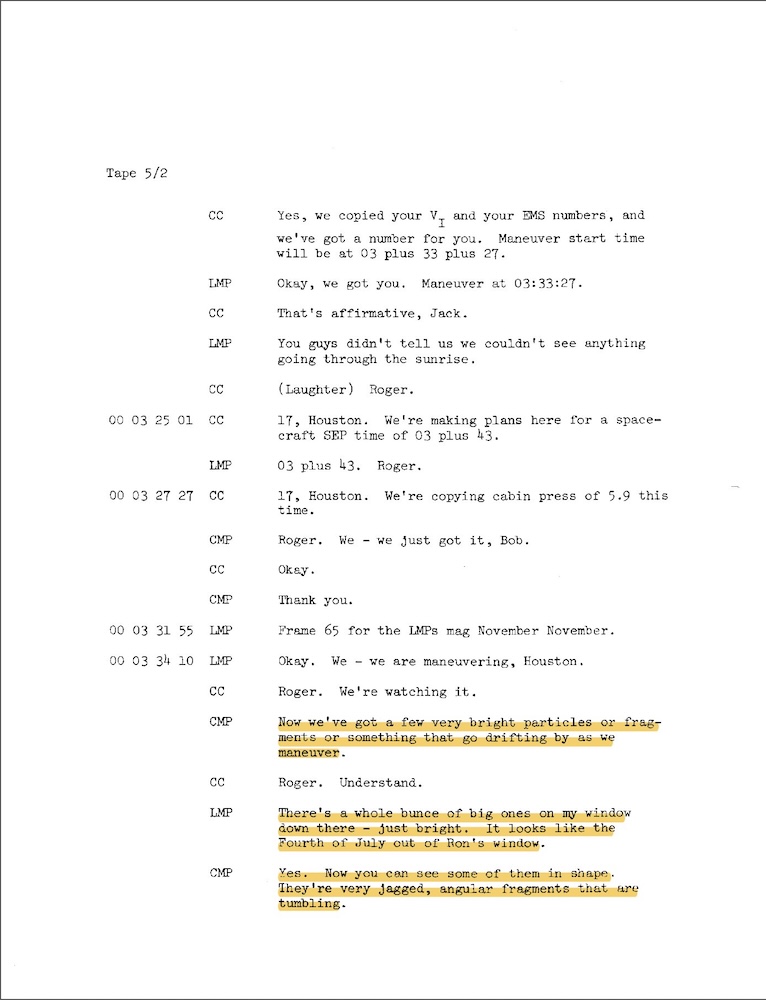
NASA-UAP-D002, Transcription Apollo 17, 1972
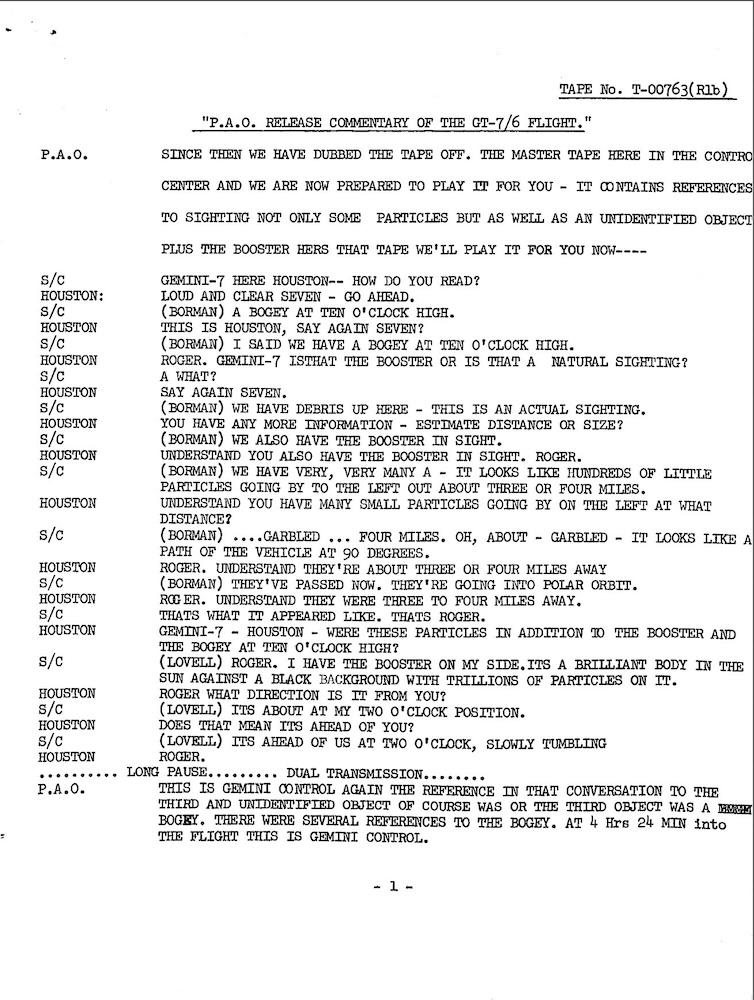
NASA-UAP-D003, Transcription Gemini 7, 1965

NASA-UAP-D003A, Extrait audio Gemini 7, 1965
NASA-UAP-D004, Débriefing technique de l’équipage d’Apollo 11, 1969
NASA-UAP-D005, Débriefing scientifique de l’équipage d’Apollo 17, 1973
Même période
Même publication
DOW-UAP-D017, UAP signalés à la base de Sandia, 1948-1950
NASA-UAP-D014, Mercury-Redstone 4, 21 juillet 1961
NASA-UAP-D012, Extrait audio de Mercury Atlas 8, 3 octobre 1962
NASA-UAP-D013, Mercury Atlas 7, 24 mai 1962
NASA-UAP-D010, Extrait audio de Mercury Atlas 9, 15 mai 1963
NASA-UAP-D011, Extrait audio de Mercury Atlas 9, 15 mai 1963
Même agence
NASA-UAP-D015, Débriefings scientifiques d'astronautes, 1962-1963
NASA-UAP-D023, Extrait d'entretien avec l'astronaute Gordon Cooper, 1962
NASA-UAP-D016, Débriefing préliminaire de l'équipage de Gemini 4, Partie I, 1965
NASA-UAP-D017, Débriefing préliminaire de l'équipage de Gemini 4, Partie II, 1965
NASA-UAP-D018, Débriefing d'expérience de Gemini 4, 1967