
NASA-UAP-D015, Interrogatorios científicos a astronautas, 1962-1963
Datos del expediente
- ID oficial del expediente
- NASA-UAP-D15 (citado como NASA-UAP-D015 en este archivo)
- Tipo de documento
- Documento
- Agencia
- NASA
- Publicado en
- R03 · 2026-06-12
- Fecha del incidente
- 1962-1963
- Lugar del incidente
- Páginas legibles
- 216/216
- VIRIN
- 260508-O-D0360-1120
Descripción oficial
Este archivo contiene memorandos, correspondencia, informes y otros materiales relacionados con el interés científico contemporáneo en investigar la naturaleza de los fenómenos luminosos reportados por los astronautas John Glenn y Walter Schirra durante el vuelo espacial. Esta colección incluye transcripciones de entrevistas e interrogatorios de la NASA con ambos astronautas sobre esas observaciones. También contiene detalles relacionados con observaciones científicas de fenómenos atmosféricos, incluyendo breves descripciones de partículas luminosas, experiencias a bordo de naves espaciales, y un análisis teórico de hacia 1955 sobre partículas meteóricas que ingresan a la atmósfera. Las páginas 34-35, 55-56, 57-63, 64-113 y 122-127 contienen contenido relevante para la iniciativa PURSUE.
✦ Resumen IA
NASA-UAP-D015 es una extensa (216 páginas) recopilación de la NASA de 1962-1963 de memorandos de interrogatorios científicos y análisis técnicos posteriores a los primeros vuelos de astronautas del Programa Mercury (este extracto cubre las páginas 1-60). En lugar de describir un único encuentro UAP, documenta el seguimiento científico de la época a dos observaciones bien conocidas de astronautas que fueron investigadas por posibles explicaciones no convencionales/anómalas antes de ser caracterizadas científicamente: (1) la observación del coronel John Glenn en febrero de 1962 durante el Friendship 7 (MA-6) de "partículas" o motas luminosas (popularmente conocidas como "las luciérnagas de Glenn") que parecían viajar junto a la nave y a su alrededor —un borrador de memorando de la NASA fechado en enero de 1962, dirigido al Director de la Oficina de Programas Espaciales [de Vuelo], analiza una posible repulsión electrostática (partículas y nave compartiendo la misma polaridad, manteniendo las partículas a una distancia constante), recomienda una observación científica adicional del fenómeno liderada por astronautas (respaldada dado el propio interés de Glenn), y considera si las partículas tenían origen geocéntrico y si su número/sección transversal podría relacionarse con la luz zodiacal o el "gegenschein" (un tenue resplandor opuesto al sol causado por polvo interplanetario); y (2) la observación del teniente comandante Scott Carpenter en mayo de 1962 durante el Aurora 7 (MA-7) de una capa brumosa cerca del limbo terrestre que parecía atenuar la luz de las estrellas —un análisis técnico detallado (que incluye cálculos de coeficientes de absorción de ozono/gas de artículos de física publicados por Wiley & Foord y Hall & Blacet) concluye que la capa no podría plausiblemente absorber suficiente luz estelar para explicar la atenuación sin ser también un objeto llamativamente brillante y dispersor visible en fotografías diurnas (lo cual no era el caso), y en su lugar atribuye el efecto a una ilusión de contraste, consistente con la propia impresión de Carpenter. El archivo incluye hojas de trámite de la Sede Central de la NASA y portadas de memorandos internos. En general, el documento refleja el riguroso proceso científico de la NASA para investigar y explicar fenómenos anómalos observados por astronautas durante los primeros vuelos espaciales tripulados, favoreciendo finalmente explicaciones físicas mundanas (restos de la nave/partículas de hielo, efectos ópticos/de contraste atmosféricos) sobre las no convencionales.
Generado con IA a partir del archivo oficial — puede contener errores.
▸Transcripción(216 de 216 páginas legibles)
[PAGE 1] [PAGE 2] [PAGE 3] ittle ra [PAGE 4] to at [PAGE 5] Vu t.Mrtid or actnaU Dll":l.,IID1 Oil I to itlllN tMt 11U a tataala tat-it etanI rtson tbe &'tall 11.gbt tll&t COIie I bo at boti tbeil ltlQ'ecl tbe ont.bento Dee [PAGE 6] [PAGE 7] [PAGE 8] [PAGE 9] [PAGE 10] [PAGE 11] [PAGE 12] [PAGE 13] hit [PAGE 14] [PAGE 15] [PAGE 16] [PAGE 17] [PAGE 18] [PAGE 19] [PAGE 20] [PAGE 21] [PAGE 22] [PAGE 23] [PAGE 24] [PAGE 25] [PAGE 26] [PAGE 27] a re [PAGE 28] [PAGE 29] [PAGE 30] [PAGE 31] [PAGE 32] [PAGE 33] [PAGE 34] ROUGH DRAFI l/13/62 CODE SCG MD:dd MEMORANDUM to Director Office of Space Sciences Subject Considerations and ecommendations of'Mtwmed pace~lorationYollowing the~t rview February 27 with Lt Col John Glenn q7co i{"i(i_erm presented a detailed and factual description of his observations during the MA flight He answered rather well the many and varied questions presented to him during the limited interview fte spi te the fact that he was it properly a number of his observations remain of JV interest aad further exploration 1further~re it is evident that the astronaut can perform various scien tific experiments has the aeiil~y capability of doing com act so despite the many limitations imposed.by the Mercury capsule Some commezits on 01 Glenn's observations are presented LL IA N.,c cl below kun.inous rticles In response to a series of questions Col Glenn described the velocity field of ii.- QM the luminous particles their brightness 8'1./i outside the in shadow of the spacecvaft the coloring aBa sunlight and their shape For the velocity field the particles all in moved at preeise)y the same speed and ll,.moved a precisely the same direction except for particles coming very close to the spacecraft This occurred similarl:i i,Q all three d'f¥t orbits From t.l¼e eie Vc onsiderations alone it may be stated that the luminous Jparticles observed by Col Glenn were not extra~errestial particles but were particles asso ciated with the spacecraft or fte la~@Mftg the booster [PAGE 35] The consistency in the observations on the three separate orbits would require that the particles were associated with the spacecraft itself I have heard that O'Keefe 6\ANI& -..,..laA has i;c;r,r9~9d the life support system which wM wat9z i;a:t;e apaee Col Glenn iJjf described the particlei and the luminosity The fact that the coloring a,~aPen was a yellow-green and the eiiee~ive observational pi,e became fluorescent in sunlight particles observed in shadow were observed in the scattered light from the spacecraft and were probably illuminated only by visible the spectrum The change of angles of the particles approaching 1ft close th the spacecraft be attributed to the since repJesive charge HD the polarities of the particles and spacecraft were the same The ability of Col Glenn to observe the particles under improper dark adaptation indicate'that an astronaut would be in a position to carry through a series of experi'1nents to investigate C.o~.L the physics of Q.QmROMS in the solar environment P.1wpe1 ry d°\he various gases and dust particles ejected while from the spacecraft during c~.~nd tH'l,BS o-\,,..U\..c.l the spacheaft is in sunlight could be by the a c\M,\t astronaut scientist 1&.,"U!S...lt'emld!.r.sr--~~~09...~~~ed Observati~ns of.~low ana:- i aze Limited by poor dark adaptation Col Glenn was not able to descibe any [PAGE 36] significant observations of th sta ield or the moon In the absen of at os pheric scattEring the sun appeared a brillant white but showed no signs of corona It is of interest however to consider Col Glenn's observation band six to eight degrees t~e twill eix- -eiga~- aegP ee-e&B a above the horizon with a haze layer about two degrees Although it has been speculated that wide at the top 5'~~1!:irl~-.eilli-il~e observation the multipa~wl:l:,ers of the window cause the high angle the horizon ti& a l.la-~l'O"l~tm~te2 this likely because of the variatio a.ad angle of Jw& Ill view a i,10w ee Sel -l.lina.._o& P0'5ft'D1 Bi& the space craft t.e'-M that he did not see any double imag~ing La any of his observations 1'1:rur ther 4'4 more he was able to infii.is8a:e that the stars e»serve hrough the haze layer became less intense while changi ng angle the horizon USSR repo:i by Tito also ind I fJ o\~t t.,.a4!d -sm rJ.-.uL -.llt dicated a high angle haze layer e,v:ia.ewe he sf AM U\~c.~Ch4 4~"-"-'1--f.a~- Au- 6her investigations of the air glow and haze layerKiG£ should be carried out Meteorology The strikin of lightning dis charges as observed by Glenn point the way to consideration of an I on system for monitoring lightning storms over the earth using the meteorological satellite The mapping of the distribution of thunderheads i(Ji)oG lightning during the night appears to be relatively straightforward while the similar ma pping during daylight appears feasible because of the short time constanu of the lightning flashes A Recommendati ns l!be re &ve -ot!- number of [PAGE 37] kehwc..4Ack recommendations paeP te a eper en+ following the very successful flight of the Mercury capsule fi The astqrnaut-scientist r.a,;rryi ng g,.i,;t iB:e ob C,~V bt s-e,~:rt..lreD.~~:im...,a....~ac.~~~le should publish~der his a A name with an associat ai111 s0Heral M~ie--lc in a widely bre eMSars Utt- these first distributed scientific journal In this manner 4;a.e obd hand servations would have wide distribution be properly C2.A.- cridited to the observer and pePtioala¥ly be edited for correctness Additional support to the astronaut in carrying out scientific observations is warranted particularly in consideration of Col Glenn's attiftude and interest in carrying out such observations Several instruments may be added to the spacecraft within engineering limitations eJ to assist in obtaining further detail data Col Glenn suggested that t.ae follo discussioms would be to his interest Such follow-on discussion is strongely recommended for further questions and exchanges inform the astronaut aihalysis to ova~~ate-~eP-tao-astPeRa~t of the results of the and study of his observations It is of se.e a:t-importan li that proper dark adaptation methods be incorporated into the spacecraft system so that the astronaut may optimize his visual observations o"'tl'l e\.s Investigations of the physics of OQB!!fteft~s and the feasibility of the th- tificial omet experiment may be carried out directly by the astronaut in a relatively strai-ghtforward way These experiments should be -o.\.u carried out ae eB Bi@eM the feasibility of this [PAGE 38] &Ao 14- tlM For ai:r low aea opt ieal etttd:ies the photo A MC,-- c,,h multi lier Be system series of filters u.v including~a J;,Oii~e flaorceeent lain fi]:l;er to stuely t-..Av,.u.,,,-.o:..c tac ultra viole:!T should be incorporated into the spacecraft iUJ£e au.ml:lal ef eeicntifie exper i:tJ.c:nto appear reasanabl.e--f'o-l:leri~ncces£ of ehe Me1cwy or'eito I J1~h consideration of the presen lanned manned-space-flight-program some reeommendatiGns are lo.\u c:r-\N f"•'ltC Q.U oc.~41•,u& apparent ts take advantage of tae im~eYeme nt& L;e tac gj ent expJ oration af tbe saJ ar £ystem and in -h;;:t In a astJ?efl:Ofl\Y At headquarters i.r recomme:ee,e,4 that A rogram a hief and supporting staff i;e ae reporting to the G.i rector of pace ciences for scientific exploration ei in the Manned pace liiht rogram as:111 YI a committee or sub-conmd ttee QQ forwed oa.e in luding such people as RGefte Utt Minnaert To sey tn Sekera asg forta- to the scientific community aB.e i;a.e and rl that a branch or dividion at one of the centers Y,l #tDf Q.suc el &»4(.WEOK4A as a scientific team fo¥ airee fll support of the -UV --t-A:,-~i £.,,.r~-..,...,s astronaut-scientists ao oei-e into sys-sola1Y spa~e V\A Y),,J [PAGE 39] 196 U.\h 2'"3ol!I- 3oco Vje0/2 w~Jo caJ v-nf [PAGE 40] UN IVERS IT OF CA LI FOR I A LOS ALAMOS SCIENTIFIC LABOltATOllY CoNnACT W-740S•BNG-36 P.O Box 1663 LOS ALAMOS NEW MEXICO IN JU!PLY a1P1a TO -l6•8J.2 I JUL I 1962 Dr Jocelyn Gill Room 62033 Federal Office Bldg No Headquarters N.A.S.A I riot I Washington 25 AA Dear Dr Gill The June 29 issue of Science brought to my attention Glenn's comments on The High layer It seemed possible that the layer he described could be accounted for as a region of relatively large nitrogen peroxide concentration and the past two weeks have been spent in checking this hypothesis Unfortunately I am not familiar with either photochemistry or upper atmosphere physics so the following analysis leaves much to be desired the hypothesis seems tenable however so I would like to bring it to your attention Effective path length and comparison with possible surface observations Referring to Figure the height of a point at a distance from a point on the surface of a sphere of radius can be found from the formula which has the solution [PAGE 41] Figure I Vertical path No No No Figure [PAGE 42] LOS ALAMOS SCIENTIFIC LABORATORY UNIVl:R ITY Of CAI.IP'ORNIA LO AI.AM0e Nl:W MUICO ro DATE Ju}¥ 13 1962 Fox- th followins I will assume that the concentr ation ot absorbins mo1ecu1es in the region of interest can be described adequate}¥ by an exponential decrease th altitude above the bottom of the layer hence can be represented by where is the scale height in the layer and must lie in the ia.yer Then the number of molecules per cm is found to be RPo I sin dy where the integral is over the range of desired usua.l.ly ex For a vertical view sin path the sollltion is simpJ.¥ where Po is the density at the base of the layer [PAGE 43] LOS ALAMOS SCIENTIFIC LABORATORY UNIVll:llalTY CAL.1,,0IINIA LOe ALAM0e NIEW MUICO 1'0z nr Jocelyn Gill DATBz July 13 1962 For a horizontal path sin te.nsent to the baae of a layer path No we note that in the contributing region hence can get an approximate form ex RPo ccy which has the value N•\J Po Here Po is the density at the base of the layer as in eqμation I An astronaut's view thru a layer from above would see twice the path computed I by equation giving Po 2nRY molecu.les/-cm A line of sight tangent to the earth and passing thru a layer at base altitude path No will have pl 10 fu and we note that is the density at the base of the layer which we set eqμal to Po as in equations and RY N,a Po Po 11 2H1 [PAGE 44] LOS ALAMOS SCIENTIFIC LABORATORY UNIVEllelTY Of CAl.lf'OIINIA LOe AI.AM09 NllW MIIXICO tO Dr Jocelyn Gill DATE July l.962 Aaeuming that km abaorbing layer ve note that a surface obaerver vieving a layer at an altitude near l.00 km vill have availabl.e the ratio 12 An astronaut vieving along path No woul.d have a mu.ch greater thickness as 2,rR 75 Viewing thru the layer to a point ne.ar the surface and out again the enhancement would be mu.ch less 14 Light received by an observer from a point source in space is attenuated by -uN a factor where CT the absorption plus scattering cross section giving I -aN 15a Io and I -CTN 15b Io [PAGE 45] LOS ALAMOS SCIENTIFIC LABORATORY UNIVl:RatTY 01 CALll"ORNIA L.09 ALAM09 NIIW MUICO TO Dr Jocelyn Gill DATI July 13 1962 From the repcrt Science I infer that for the layer reported 16 or 17 giving aNi o.o4 0.027 18 and 0N2 0.22 0.15 19 Any such absorbing layer present during the day would result in rapid heating and I reradiation in the infra-red range from whatever bands may be present However the absorbers postulated below would be destroyed by photodissociation and/or heating during the day Hence it is not surprising that solar spectra have not shown such an absorbing layer StellarJplanetary or lunar spectra might show the existence of such a layer if the absorption spectrum has sufficient structure Setting 20a we find the effective path length Xi 20b 3.9 10 cm starting absorption at 20c 100 km altitude [PAGE 46] LOB ALAMOS SCIENTIFIC LABORATORY UNIVltRelTV 01 CAL.ll"ORNIA LOe AL.AM09 NltW MUICO Dr Jocelyn Gill DATB a July 13 1962 20d 10 cm 20e Absorbers Present in the Upper Atmosphere lliree constituents of the atmosphere near 100 km altitude absorb light through mos or all of the visible range as would be re quired to get a noticeable d1mm1ng of starlight They are nitrogen peroxide negative atomic oxygen ion 02 negative molecular oxygen ion Of these I found no cross section data for For Massey Negative Ions Cambridge Press gives curves showing absorption cross sections starting at 5620 A and approaching 10 cm ion the region A 5000 A lb.ere is very little structure only the onset at 5620 A From ecpation 17 we find that N3(0- 7.5 10 18 10 could explain the observed attenuation 10 10 For an effective path length of 5.4 10 cm we have Po 1.4 negative ions/crn Since the daytime free electron concentration in the layer is 1.5 10 and the night vallle is 10 it seems- hard to believe such a high nighttime concentration of negative atomic ions [PAGE 47] LOS ALAMOS SCIENTIFIC LABORATORY UNIVll:R ITY 01 CALll"ORNIA L.09 ALAMC>e NllW Mll:XICO tO Dr Jocelyn Gill July 13 1962 NitroGen peroxide haa been extensive studied and two papers were fou.nd which gave absorption coefficients in the visible region of the spectrum Wiley and Foord Proceedings of the Royal Society Al35 174 1932 give a coefficient which I convert to er 10 cm molecule depending on the wavelengths selected by their filters the lower value was for the range 4900 525 A Hall and Blacet Chem Phys 20 1745 1952 give a curve obtained with a Cary spectrophotometer having A resolution Maxinrum absorption occurs in the range 3500 4500 A and drops to 1/2 the peak value at 5000 A They give no data for longer wavelengths I convert their absorption coefficients to 10-ia cm molecu.le at 4000 A and 10-ia cm molecule at 5000 A Structure produces changes in cross section of 10-ia cm molecule at wave lengths separated by a few angstroms Ta.king an average value of 10-ia cm molecule we find and using 10 cm Po 1.4 10 11 molecules/cm [PAGE 48] LOS ALAMOS SCIENTIFIC LABORATORY UNIVIEll81TY OP CALIP'OIINIA LOIi ALAM09 NIEW MUICO TO Dr Jocelyn Gill DATE July 13 1962 Readily detectable structure would produce ve.r1e.t1ons of o-N1 and aNa ot about half the attenuation figure given in equations 18 and 19 which is near the threshold of detectability I have not yet found an author who estimates the concentration of Ne or in the atmosphere Bates and Nicolet discuss the reactions which lead to it in the book lhe Earth as a Planet edited by Kuiper Volume II of The Solar System Ni colet calculates the photodissociation time as 200 seconds during daytime and shows the concentration must be so low that no effect on solar observations would be found As a general conclusion it seems to me more likely that would be responsible for an absorbing layer generated perhaps with the aid of downward diffusion of NO to higher pressure regions favoring oxidation to lhe color suggested by Glenn fits very well as may be quickly verified by looking thru the vapor space above concentrated nitric acid Experimental Proposal Ideally one could ask for the absorption coefficient as a function of wave length over a very wide spectral range and time after sunset on the air volume investigated I seems possible to get very useful data with a relatively simple experiment perha ps possible of inclusion in one of the manned orbital flights si ng a slow-speed movie camera photograph the star field and such planets including the moon as opportunity permits with approximately a 10° field of view and enough exposure to pennit photometric measurements as the light sources [PAGE 49] LOS ALAMOS SCIENTIFIC LABORATORY UNIVERSITY OP CALIP'ORNIA L.09 ALAM09 Nl:W MUICO 1'0 Dr Jocelyn Gill DATE July 13 1962 pasa through the atmoaphere especially the abaorbill6 layer perhap auch sequences already exif:>t At the expected orbital height I estimate a km thick layer w~ld subtend 1/2 degree and a given light source would pass through it in eight seconds Attempts to derive a density distribution would requ.ire a fair number of points in the 11 1-1/2 or degrees divide by so a frame interval near one per second seems desirable If operated continuously thru the ni.ght passage approximately 100 feet of 16 mm film would be required per passage As a crude attempt at spectroscopy color filters could be used on some of the sequences without too serious light loss For example a Corning No 5030 or No 5543 filter would limit exposure to the wavelength range of maximum absorption by light loss may be considerable and a Corning No 3480 filter would limit exposure to the wavelength range where absorption is negligible Relatively broad band interference filters would be useable on the brighter stars and planets Direct visual observation through such filters would also be useful especially if photography is impractical and the astronaut tries to reproduce any attenuati on noted by neutral density filters in combination with the same filters and stars used in space Photometric observations of some of the intense airglows mentioned by various authors would also be very instructive The increased intensity due to external tangential viewing woul help a great deal and precise height de termin at ions could be made It may be useful to ask Glenn and Carpenter to reproduce the dimming as well as memory allows by narrow strips of neutral density filters against the star I [PAGE 50] LOS ALAMOS SCIENTIFIC LABORATORY UNIVERSITY OP CALll"ORNIA l.09 ALAMO NIEW MUICO TO Dr Jocelyn Gill 10 DATI July 13 1962 field they saw or to compare the intensity and color changes noted with that thru an absorbing cell containing Ihe required thickness is readily availabl.e Acknowledgments The author has benefited greatly from discussions with several associates especially as regards references to sources of upper atmospheric and photochemical data Dr Robert Sherman has assisted in location of data on the absorption cross section of Dr Arthur Cox suggested a number of references and confirmed the author's belief that reasonably accurate photometric observations could be made on photographs of a star field Dr Ieston Miller has emphasized the importance of even crude control of the wavelengths responsible for exposure All of the men mentioned above are members of the Los Alamos Scientific Iaboratory Dr A Keefe of the Theoretical Di vision of the Goddard Space Flight Center generously discussed the observations of Glenn and Carpenter and my hypo thesis regarding absorption He has referred me to the excellent articl.es in Ille F.a.rth as a Planet and encouraged my submission of this letter Future Work I would of course be interested in your opinion and that of other experts in the field of the above hypothesis If your group recommends inclusion of such observations on a future flight we may be able to help on some points in data acquisition I am sure the project would deserve review and control by a panel of men such as Bates and Nicolet Respectfully submitted BOB WATI Assoc J-Div Ldr BEW:jo and Grp Ldr J-16 Distributi on Dr Jocelyn Gill I [PAGE 51] In ly refer to SGC:Mt:llll 21 Feb 1962 MQl)BANDt Subject Poeaible 1eritit1c Viaual IIitoruat1on Obtained Gl.enn Two 1ntentl'ting obaervationa re in the Pree as ddcribed by Colonel GJ.enn the NA-6 flight It 11 ot Vit4U 1ntereat to obtain a more 4ataUttd deacl'iption at tbfte ob t1ona in order that the &ccur&cy Md the detail ot What obseried may Pl'Ol*.rly Neoi"decl for oientitic eriJ.:uat1on The two obaer vatioDB wre The ot the m.Jl!lbW or lUIJliriowl particles ap~tl.y travelling Vith 1Pt,Cecratt at 1'r1endlhip-7 euifri1t and Th altitudel or angular view the -upper limb ot the tmo•ph&re The thouunda ot 1Ulll1n0ul parttcl ascribed travelling with tM apaoeoratt It la in;IOrtant that Glenn describe a.eta:11 preci th obaervationil characteristic under Which he aaw the piirt,1,.cl or4ir to obtain an timate of the b~tne•e ot th•e lcl fhe quat1cma that ww.d like anawerad What- the bMi1 ot 01mn 4eterminat1on wt that the particles vere tuall.y t:s'Yell.1.ng ¥1th tho pacecn:'aft and vh4tther thia condi t1on peraiated on aubuquent c>i'bi In a.di tion the ge<JDetey- or the obaMrrYatiana ehow.d be turther deacribed in order to rive th geanetric 41itrtbut10n at the parbicles relative to the e&pacecratt•a v:l.iuknr preoue obeervat1onal tw and th4I poe1t1on of sun- 1.ight lum1noa1ty can NllkJ:U:y be a.t4tj,ni;ned trom the orbit of the pacecratt itaelt l'hee particl be pocentr1c origin and may be pended in the 1'bera leUt tw hypot tor a;pla1n1ng pantclAa tr&vellbJg v1th the apacecn,tt l'he intensity to atarl~t aboul.4 lMt 4-termlned 8.1.ao tbia 1.nformat1on ia ot turther ormation about the a olute JIUlabex- and cros1•aectiona ot the 1)$'t1cl may rel.ate to tbe dujt content or zodiaciil 11 WU the gegen echein [PAGE 52] [PAGE 53] HAND-CAR BX NATIONAL AERONAUTICS AND SPACE ADMINISTRATION WASlijNGTON O.C SPECIAL GPO 16 -76 611- [PAGE 54] NASA HEADQUARTERS ROUTING SLIP ACTION CODE NAME if necmary APPROVAL CONCURRENCE I FILE 11 h-l Rec'd INFORMATION IR OU fC INVESTIGATE AND ADVISE II NOTE AND FORWARD I I I II I JA il/f.l NOTE AND RETURN if PER REQUEST A RECOMMENDATION SEE ME 011 SIGNAT.t.JRE REPLY FOR SIGNATURE OF REMARKS oJ fa ODE FROM GC I NAME Dubin l~?h/62 NASA form 26 Rev July 19~9 GOVERNMENT PRINTING OFFICE 1959 Ol'-51302.1 [PAGE 55] In reply refer to SGC:ML:ml 21 February 1962 MEMORANDUM Subject Possible Scientific Visual Information Obtained by Glenn Two interesting observations were reported in the Press as described by Colonel Glenn during the MA-6 flight It is of vital interest to obtain a more detailed description of these observa tions in order that the accuracy and the details of what was observed may be properly recorded for scientific evaluation The two obser vations were a The report of the great number of luminous particles apparently travelling with the spacecraft at Friendship-7 sunrise and The altitudes or angular view of the upper limb of the atmosphere The thousands of luminous particles were described as travelling with the spacecraft It is important that Glenn describe in detail precisely the observational characteristics under Which he saw the particles in order to obtain an estimate of the brightness of these particles The questions that we would like answered are what was the basis of Glenn's determination that the particles were actua.lly travelling with the spacecraft and Whether this condi tion persisted on subsequent orbits In addition the geometry of the observations should be further described in order to derive the geometric distribution of the particles relative to the spacecraft's window The precise observational time and the position of sun light luminosity can readily be determined from the orbit of the spacecraft itself These particles may be geocentric in origin and may be suspended in the atmosphere There are at least two hypothesis for explaining particles travelling with the spacecraft The intensity compared to starlight should be determined also as this information is of importance in determining further information about the absolute number and cross-sections of the particles and may relate to the dust content of zodiacal light as well as the gegen schein [PAGE 56] In a similar manner the observations of the horizon and the extent of the atmosphere are of great interest in determining the distribution of various atmospheric characteristics The precise lighting conditions regarding the position of the sun and the intensity of the outer edge of the horizon as observed by Colonel Glenn may be used in the consideration of what Glenn actually saw For example he may have seen the limit of the atmosphere based on the degree limb described in the press the atmosphere apparently extended to over l50 Km by Rayleigh scattering he may have seen the airglow or he may have seen the MIE scattering from dust in the atmosphere The true limiting angle of his observations and a graph of the itltensity drop-off with angle from the earth should be obtained in addition to the lighting conditions It is recommended that this information be obtained from Colonel Glenn as soon as possible Maurice Dubin Head Aeronomy Program Geophysics Astronomy Programs Office of Space Sciences FL SG fl Fellows [PAGE 57] DRAFT OF NOTE ON THE SCIENTIFIC OBSERV A TIONS Towa rd the end of the flight between 16 hr and 47 min UT and 17 hr and 03 min UT 24 May 1962 Lt Cdr Carpenter made a series of observat i ons on a umi nous band vi sible a ro und the ho ri zon The most de ci i ve obser vat i on wa ade wi th an ai glow i lter suppl i ed by Mr Iawren ce Dunkelma of Go dard Space Fl i ght Center The i lter transmits a narrow ba nd of wavelen ths a ppr ox i mately 11 An gstroms wi de at the ha lf power poi nt an centered at he a ve len gt of the strongest ra di ation of the ni ght a i rglow namely 5577 Angstroms Th i lter cut out a ll other Ught but passed the light of the luminous ba nd wh ic i thus i dent i i ed a the 55 77 a ye Lt Cd Carpenter noted th a the layer was very br i ght He ou nd hat Phecda:Ursae Majori magn i tude 2.5 was lost to i ght a the brighte pa rt of the layer Assuming that the i mage of Phecda occupi es about are mi ute of arc on the retina or 8.18 10 sterad i ans O.ssuming that a ta of a gni tude yi elds 10- lux 1umensJm we i nd that the br ig htness of he aye i about lumen1m sterad ia or 10- st i lbs Th i i ui va ent a bout 10 erg;,m sterad i anh taking the le a st mechani cal ui va le nt of light as 6-1 10- watts per lumen or 556o A as per the AIP ha ndbook It is about 50 i mes as bright as a white sur fac i llumin a ted by moo light The a ngular he i ght of the layer was found i di fferent ways By dire ct est i mate to 10° By not i ng that it is approximately twice the height of he twilight layer Lt Cdr Carpenter estimated the he i ght of the twi ligh a er a,s sun dia meters wh i ch means -1/2 degrees hence the he i ght of th 577 layer would be By obser ation of the star Phecda ju Ma a it pa ssed he mi dle of the luminous band [PAGE 58] By noting the time when Phecda was halfway rom the lumi nous oand to the horizon By noting the fact that when the ross of the ret i cle th A i i set diagonally just covers the distan ce from the band to the hor i zon By method we make use of the time of passage through the middle of the layer This point is marked by a re erence to a mark on the telemeter i enl:y ee found on he gr ottae etatiea ta:r;,e i i.--,c cn 4er a efl 1:,Pe Mt yet svail:a:til.e l,y careful timing of the capsule a pe it ap pea to have been very close to a j.9s capsule elapse time i.e 16h5cPl/5s UT For this instant the capsule coordinates as i nterpol a ted from the oomera tr a cking data were long i tude 127° 40:0 latitude -18° 49:8 he i ght 226 kilometers At th i moment the i ne of sight to Ursae Majoris was ang ent to he a yer of max i mum thi kness of 5577 The angular zen i th distan ce oft a a hi time was found to be 101°42 A line of this zeni th dist a nce i a ngent a spherical shell of the proper radius wh i ch i 137 ki lometers below the apsul or 89 ki lometers above sea level Ac ordingly th i observ at i on should be i nt erprete a i ndicating that the densest part of the 5577 aye i at a he ig ht of 89 ki lometers which is in good a greement with rocket me a sures The lower limit of the visible light appeared to be near 78 ki lometers rt ht derrmtat1f i3/no nie1d a sif1fi bt i a 1/1111i o/u hell x-p/c to/dim/nisVgragla11r d~war a i a6aren tl br i e9i e4en is faf~8 v}r ¢1/1 #J.J JiJlliJJJ lf l:!J°Y:!iJJ ir The i lter observat i on on the airglow was made at 17h UT [PAGE 59] Sunrlse was observed at about later while the observation was going on It follows that the airglow is visible even when the twilight band is very strong An attempt to observe i in the day is certainly indicated In this connection it sho ld be noted that Capt I Grissom reported a grayish band at the top of the blue sky layer Pesults of the Second Manned Subqrbit a Space Flight NASA GPO 1961 le remembers this layer as narrow and grayish i color representing an actual i ncrease in intensity He po i nted out the approximate position of the layer on one of Lt Cdr Carpenter's photographs at the height of 1.7 degrees above the horizon Grissom may have observed the da ytime airglow Carpenter did not note any structures either vertical or horizontal in this layer He did not observe it completely around the horizon but believes to be continuous all the way It does not appear possible that this layer can a ctu ally absorb starl:ight Any layer at this level capable of absorbing a not ic eable fraction of the light 25i or more would also scatter light strongly i would therefore be a very prominent object on the daylight side In fact it is not definitely visible on the photographs of the day side Th i entirely i agreement with Lt Cdr Carpenter's impression namely that the decreased visi bility of stars passing through the layer was a contrast effect A remarkable feat re of this observatton is the discrepancy between the eye estimates of 8',.10° for the alt i tudes above the hor i zon on the one hand and the results of timed observations on the other The latter i ndi ca tes altitudes of to The latter are clearly correct or example Carpenter noted th at when one ann of his ret i cle was at an angle of 45° it covered the space between the horizon and the bright band The crossann is 1.21 cent i meters i length and it is a distance of 26.2 centimeters from the astronaut's eye At an angle of 45° i subtends a vertical angle of about 2°.6 [PAGE 60] It thus appears that there i a strong i llusion wh i ch exa ger a tes angl es near the horizon and wh i ch was ev i dently also present i MA-6 i nce Lt Col Glenn a lso reports to as the height of the luminous ba nd The i llusi on is perhaps comparable to the well-known ill sion which makes the moon seem larger near the hor i zon Carpenter also not i ced and photogr aphed the Glenn ef fect He reports whit objects resembling snowflakes seen at sunri.se on all three orbits owe er he also saw these objects minutes after the i rst sunrise and aga i 43 mi nutes after su nrise and zll llm 23m 26ffl and 45m a fter the second sunr i se It i thus quite clear that they are not related to sunr i se except pe rha ps i the sense of being most easily visible then Carpenter managed to photograph a few of these particles Some of them re very considerably brighter than the moon which was then very near the i rst quarte At this i me the moon i about -10 the particles may have been be we en -12,5 magn i tude 10 br i ghter than the moon and -15 magn i tude 100 br i ghte than the moon The second i considered more i kely in vi ew of the ap pe ar an ce of the full moon -12,5 as shown on MA-6 photogr a phs At -15 the arti cle brightness i consistent with cent i meter size sno wf lakes The artic les were verbally described by Carpenter as between mm and cm i size an ha vi ng a strong visual resemblance to snowflakes Shortly before reentry just at sunr i se Carpenter performed the de ci si ve exper i ment of hitting the capsule walls with hi hand The blows promptly res ul ted i the liberation of large numbers of particles It i thus cle ar that at le ast those part i cles observed in the MA-6 flight emanated from the ca psule The possibility that the particles might be dye marker or shark re pe lan both of which are green and both of which a re exposed to the va uum as onsidered by Mr Frank Crichton NASA capsule inspector Crichton had te st made which demonstrated that ne i ther mater i al tended to esc ape rom the [PAGE 61] pac kage i a vacuum The possibility that it might represent small part ic les fr om the fiberglass i nsulator was also considered in vi ew of the smallness of the fi bers it appears lkely that they would have been blown away at once ke the Mylar confetti The dynamic pressure of dyne is suff ici ent to L\I remove at once~weighing less than about 10 to 100 milligr a ms cm which orresponds to a thickness of the order of to mi llimeter for most ordinar substan es As menti oned in the MA-6 report there are two plausible sources wit hi the ca psule for these parti les Snow formed by condensation of steam from the life-support system Small particles of dust waste bits of i nsulation and other sweepings The latter are very consp i cuous in a zero env ir onment when there nothing to keep them down it is found to be extraord ina rily difficult to free the i nterior of the capsule of such material Undoubtedly the exter i or parts of the capsule which are exposed to the env ir onment will co ntain these thing and they un doubtedly play a part i the Glenn effect In pa rticul ar a orkscrew shaped piece observed by Carpenter was probably a rning or perhaps a raveled piece of insulation On the other hand there is considerable eviden ce which points to snow as the so rce of the majority of the material In the first place water is dumped out of the capsule i far larger quantities an any other su bst a nce In the second place the material looked like snowflakes both Glenn and to Carpe nter In the third place the fre uency with wh i ch the Glenn ff ct i report ed by Carpenter appears to be correlated with the temper a ture of the exteri or of the capsule as recorded by thermocouples in the sh i ngles The temperature was always lowest at night falling to temperatures of -35°C just [PAGE 62] be ore sunrise a nd rising to pl us 10°c just a fter sunr i se DJ.r i ng the se co nd da the temper a tures were lower rea ch i ng a bout -25°c durin portions of the da Fr om about dn CET on the second period of sunli ht the temper a tures ere i.g her nd bnly one part cle is ment i oned I the effect i.s indeed due to condensation of moisture he he br oad end oi he ca psule is a more likely source than the na rrow en be ca use he temperatures were 200c or more higher at the n;:i.rrow end The condensation probably took place nside the aps le a ther th a outside bec au se even at the lowest recorde sh i.ngle i l.ilJ;)r.::- re a ro und -50°c th vapor pressure er ice amounts to a bout 0.0 39 millib a rs A lthou gh this ressure is very low i greatly exceeds the ambtent pressure at the lowest ca psule altitudes Ac cordingly it is not possible that snowf lakes should orm nd er these circumstances even though it is true that the capsule st be sur rounded by an expanding atmosphere of wa ter vapor If the water-vapor expands freely is clear th a the press re at a dis ance of meter rom a hole cm in di a meter wi.11 be of the rd i 1/10 000 of the press re at the hole Hence i i airly le ar at he ress re i nsi de the ca psule will be far higher th an the outside press re i sp i te of the presence of 18 one-centimeter apertures Hence condensation within the capsule ore likely than condensation outside It is noteworthy th a no ormat i on of ri me was not i ced either on the window or on the balloon str i ng It i con i dered most likely that tne particles of the Glenn effect are snowflakes ormed the capsule between the cabin bulkhead and the heat sh i eld by the steam haust from the li.fe-support system It is suggested that they es cape i nto spa ce through the porte being driven outward by the expanding vapor Note hat at 02 52 47 Carpenter noted a particle moving faster than he At 02 50 00 he planned to observe sunrise and was facing forward This particle was thereby probably seen east of him Most of the particles are seen behind hi and all i ng [PAGE 63] back This supports the idea that the partlcles probably are pushed outward by he expanding steam from the capsule before they begin to stream backward It proba ble that many of the particles lodge on the outside of the caps le sinc Carpenter i quite sure from the direction of stream i ng a ross the wi ndow that the particles came from a point near where the knocking was done Carpenter obtained two excellent photographs of the sun when just ab ov the horizon These photog ra:phs plainly sh~w the flatte~ed sa\.lsage- kc.h Ct fft.,;~c thh v:,h -h<v y--r 11 I ei tr,- rr shaped onn photographed earlier by Glenn Calculations of this theoretical shape a re being made at this time for compar.i son with the astronaut observations Th fl attened shape is due to the fact that the lower port i on of the sun's i sk is seen through layers whtch refract the l.ight much more strongly than those thr ough which the pper part is seen As a conse~uence the whole sk appea rs flatt ened A i milar but much smaller flatten i ng has long been known to be observab le rom the ground A part of the i nterest of th phenomenon comes fr om the fact that at great distances as at the moon the ff ect of this re frac i on is to make the sun appear as a red ring of light around the earth [PAGE 64] SCIEN'.rinc DEBRIEFING Ji.me 1963 First Experiment Flashing Light John McKee One of the first questions that I have regards some estimates you made of the beacon distance Were those based entirely on the knowle of how bright it was tram p~vious aircraft training or do you feel there was some other distance cue somehow involved in the test Coop No If I had no prev;ous experience on the light I don Vt believe I would have had any possibility of telling how far it was except that on that second night pass after ejecting the light Apparent'.cy the sun was shining on it as I saw this steady glow up to about my level on the orbital path At that time I bad a little bit more depth perception on it and could seem tp note the proper drift on it That was the first time that I saw it and the experiments we q;f,d on the aircraft When we had radar measurement I you notice the pitch rate or what was the sensation Cooper No I idn't notice any rate as such I cou1d really feel the spacecraft and to me it felt Jμst like there were doors banging open down there as it departed and Just a li~tle bit of a Jolt through he I A spacecraft It was a good so~d thump when it took oft ri- [PAGE 65] Scientific Debriefing Bill Armstrong Act Gordo it turned out it gave you about a half of a degree per second in the opposite direction This was very apparent on th postfiight record You can see your thruster acti when you start to pitch up El.lld then as you come right to the bottom of the curve you can see this little blip on your rate and then the attitude started back the other we;yo It was real definite Something on the order of a half of gegree per secon or little moreo It was real definite where it occurred Well what it does is start your pitch back the other a:riy thruster action to go back the other direction to pitch back down afte I you deployed You went to cage to retroattitude and the attitudes just and start back over It was real clear on the records where it went out Shepard Say in regard to the first question do you think because you had th earth as background you could Judge d~stan~e because you ha as background Cooper I think possibly so Of course it's like an airplane when it a considerable distance out It is almost impossible to judge the distan awe;y You can talk yourself into believing it is almost any distance fro I you And when it gets on closer you really have a bit m?re perspective on ito I did feel that I had almost Judged the distance on that first In fact I didn't even elieve that was it when I first saw ito cou1tln't I I think of anything else that it could be but it was just solid lighto i it turns out looking back now it I am sure this was because the [PAGE 66] Sci~ntific Debriefing had not completely set 11-sure 1'113 retro pack area was in the eunligh I'm sure that is what I saw glowing,--was the sun reflecting off of it AJ.though I had not seen it tram previous viewing OD tbe day side or the night si~eo McKee When you didn't see it OD the first night side did ou have any personal feeling that the light wasn't hing Did you correct your attitude when you didn't see it or did you have any feeling what the problem I was Cooper I Just don't have any idea I kept doubting Jey"Sel This was the first time of course that I had ever tried aligning to small end forward a 180° yaw -as we call it and of course aligning on the night sideo I begaxi I to doubt that I was aligned properly I went to the star charts and rechecked and found fact that I was not quite aligned correctly at first But then I did double check and found that I was I'm sure several times thru the i l't night I was aligned exactly on and in using the horizon line J~t about I the middle of the window even moving up and down almost invariably don't have any idea why I didn't see it Bill Armstrong You did change your attitudes That was one of the th I wanted to Know I?o you remember at the beginning of t~e night phase you first start looking low and then toward th eni did ust sort of scan the area or vb& [PAGE 67] Scientific Debriefing Coo:per Well first I started trying to get Tfl¥ 180° yaw point This is not the easiest thing in the world to get on the night side and particular when you have to go into your tar charts 50 ute1 ahead ot Where ou had norn:ia.;uy been used to using them ir:.finally did find star patterns that gave me the proper orientation I was wiing around 15 to 120 degrees pitched downi I was just keeping the horizon th sort of bottom of the Window I I got around this area I then tried varying the attitude and down to look for the light I She:pard You mentioned in your repOrt that,--you talked about approx 25 minutes a:f'ter you caged your gyros that you saw a lot of li'ghtning par'tfcularly in that area Cooper Well this is one possibility that there was a slight compromise to the light Particularly on the first night side there was co~iderabl lar ge lightning down ther I found concentrations of large thundersto right up in there and saw quite a lot i of light flashing through fairly I large areas I still don't believe that even on the other night spite of these I still could see the light even with -:this as a ba.ckgroun It is r~ally not an excuse for not seeing it and I really honest]¥ I say why I didn I had b~gun doUbt th~t was re flash I I [PAGE 68] Scientific Debriefing Cooper The moon was probably 14-al It was down to about a third moon It was a ver distinctive moon vb you could see it but it wasn causing the great amount of light tbat a twU moon would have caused I could see I the glow on the ground on the clouds on the land from the moono It up just at t1:ie last part c,f the n1Jtrt It -was never close to th moo:Q deylighto Bill Armstrong i in the retro pack area they ran cooler this flight Bill Carmines said th$t they- ualJ flashed the light at thi lo~r temperatures without any probla Re talked to Langley people and he says that i the light had fail 1;0 work the first time it would have never warmed enough later in the n:1~t to start flashing It is hard to visuali~T tip it no having been working t-he f:Lrst time Bll;d then worked the second t:1.me Do you think your att,itude eauld you tell any difference in your attitude the second night vl,Am $.alf the llgbt In yaw as C?JDPared st do you think 70\1 ed b~ter the [PAGE 69] I Scientific Debriefing Cooper Well not realq As I went into both night sides I cc;>u.ld pretty well estimate 18o yaw The first night side I was not complete:cy around I started awing around &114 ni,gbt wu audde upon me and I wasn°t quite in I the t'ull 180 positi so I did have to hunt for the 180 posi~ion a little bit On the second n:i..ght side af'ter ejected the light I was alre&q¥ in I I 180 position before going into the night side Merce H6w liigb above or below horizon line or dow did you look for light I I I In other words how far down or how high did you go with your pitch attitude I Cooper On the first night ide I allowed it to drift very very slow:cy and changed them as I needed to very very slight:cy to keep yaw on 180° and it varied back and forth very sl.igbt:cy But went &1.1 tlle down to I where the horizon would fill the whole window and up to where I Just ba.re:cy i i the horizon in sight Bill Armstrong Did you see it cane right a'WIQ when you iooked on I nigb.t'l I In oth rd8 you picked it up [PAGE 70] Sci ntific Debriefing Coo pe Almost Almost as it began to get dark Of course it gets dark Just like that Zam it gets dark I had Just,--it was dark earth background and as I say lI13 first teeling on at,eing it was definitely coming f'rom below very very slowly As I watched it was getting higher in lI13 line of sight to the I earth In other words as I was holding the earth on a fixed place on the window this was coming It was coming up in relation to me and was finally up to lI13 level And as I saw it coming up it was solid light My first though on it was -that it looked Just like th·e missiles that I have seen I I launched at night f'rom Cape C~veral when rou re t:cying at night at a high altitude and see them launched It didn't have the same glow but it was I I very very bright and solid and seemed to becoming up Bill Armstrong That is something else we checked into It would have be impossible for this light to have been steady for you It is neceSS_!ll'Y to fully charge the condenser and then get a quick discharge Cooper That's why I think it mat have been the suns~ine on it Because of t~e altitude we were both at the sun would be shining on it at that point I had Just gone into the night side Even though i was dark I I if I had yawed around to zero yaw it would have been in the bright sun I I [PAGE 71] Scientific Debriefing of he window when I first picked it up By the time it got up to where was may'be 15 degrees higher relation to me and l.ine of sight I suddeacy saw it flashing I Bill Armstrong at a 1ust where it would have been If woul.d have just coming to the horizon John Boynton Was this predominantly bove the horizon Bill Armstrong In the first orbit no On the first orbit it is very- low That is why he might not have seen it the initial part of the orbito I about 20 or 30 minutes thru the1night s~de it passes through the horizon and then it goes about 25 or 30 degrees high It goes through a fai,rly large angle change at first and the further out it gets of course the smal.ler the angle change is l'he second night a:f'tier depl.oyment Just about at sunset start up through the horizon and then all the time during the second night phase it is above th horizon Then the third C)ne is above the hor.:Lzon all of the time [PAGE 72] Scientific Debriefing Bill Armstrong You get a 30 degree angle view througb the window the top of the window to the bottom variation of 30 degrees John How far would he have to pitcp down'l Bill Armstrong He would probably have to be below retroattitudeG to almost have all earth in the window Probably about 30 degrees Cooper I had a few comments that I made on the onboard tape about the I am at 4st daylight going ixlto dark I had been looking for that flashing beacon This light in sight is below me It is quite a brownish b;rown and considerable titude above the ground In other words I was convinced it was not a light down on the ground but it had movemento I mentioned several other items here such as this light being visibl among the starso The ligJ;it is f.1lashing now It is the lighto It is quite I I bright and quite discernible It appears to be about 10 to miles awayo I'm keeping it exactli in the windpw About the order of a second magnitude star now and that time was 05:ll:34 The light is sM.μ in sight in the center of the window 11 Bill Armstrong Did you,--acc?rding to the voice tape it xruq have yawed away a little bit then and then c;:ame back Did you yaw away and -t?hen come right back to t'l [PAGE 73] Scientific Debriefing Cooper Just once Bill Armstrong Did you do it twice or Just once Cooper No I kept it s,ight for quite awhile ap.d then yawed away from it and then came right back Cooper At 05:13:40 I made some coments on the Mi1q Way and varioW;J things and at 05:16:35 the light was still in sight Thunderstorms were in under it at the moment but it was still quite distinctive And this at 05:18:05 Bill Armstrong What brightness do you think you need if you are going to try to acquire some target in space Cooper It was very distinctive both t1I!1-es At this brightness where i was on the second night side af'ter the ejection both times it was very distinctive more than the brightness of course it was the flashingo the third night side it was extreme faint but the flashing allowed me,to pick it up I wouldn't have been able to see it the third night but fl.ashing Bill Armstrong Do you think that either at the initial acquisition of the thing or ven toward the end of the second night phase the 1?rightness would sufficient if you wOUld be t7:Ying to l~cate a re~de~vous target [PAGE 74] I Scientific Debriefing -ll- Cooper I think so I think with that brightness if you know approximately where to look for the thing and with it flashing you certa ought to be able to find it pretty readily Day Do you think similar experiments should be carried on or is this sμfficient'l Cooper I think this prob~bly shows us What we really want to seeo I think the is going to be problem like there is in aircraft a As YO:U move to it you are going to have to have something that gives a little bit more capability to obtain distance f'rom it at the time su as perhapa two lights that you cou.l raμge on like naVigation lights on aircra:t'to I QuestiQn Were internal lights on in the night observations Cooper On most night aides I had all the lights down complet ely and used I I just the glove lights to read critical items Bill Armstrong On t;he third night phase you say you had to do a good bit of searching Were you searching the entire third night and when did you fir-st see it'l I cooper Slightly past the middle of the night I think that on the third ight side the brightness was such that it was sheer accident that I found If ou Just happen to pass it in t~e scan pattern you might see it flashing I tt would however be very easy to miss I [PAGE 75] scientific Debriefing Bill Armstrong You feel brightness suitabl f'or a rende~vous be something on the order of second or third magnitude I Cooper Yeso Bill That one of he main things we want ed to rind out Does of the secon night ook about right Was the third night too d:l.m'l Cooper Yes the thir one is getting a little too d:l.mo I Bill Do you think you have got to have go od sighting information to pick I these up ev:en W'ith bri ght light7 I C~o:per Well it is a pretty big sky at ight up there and there are a lot of bright starso I hink you're going to have to have some sight~g date to get within a eas onable one area to unt for ito McKee What about th flash rrequency a te Cooper I think the lash rate could be ut downo I think you could maybe I haJ.ye the flash rateo I woul.d rather see it twice as bright and see it fl.ash half as of'teno A flas rate even -one eve ry two seconds is stii;t distinctive I May1>e not quite as di stinctive as the one per second but it Still wbuld attract your ttenti on Bill How about the eploy marks [PAGE 76] Scientific Debriefing -13 Cooper Those deploy marks worked real well They were excellent for getting in 1·etroattitu de also They position your head to a real positive position I I Bill We have read the attitude records pretty carefull:yo You were between 20 a.nd 22 degrees so you were right in there Do you think the window I smudges the discoloration of the window might have had significant effect Do you think it produced enough attenuation to cause any trouble Act I tried and tried to note how much attenuation you get at night It's just a few seconds until the time you get dark-adapted I thought you became dark adapted very rapidly and I didn't see or note any real attenuationo I am sure there was some as there was definitezy smudge layers there But it didn't seem to be The bright stars sure seemed bright Bill Armstrong J)id you act see the light against the ground Cooper Yes I made this comment here that I even saw it against the thunderstorm I John Boynton Go:;t.;do you talked about the flash rate The flash rate in your debriefing might have been slightzy below a flash per second Cooper I did it on the tape I counted off here on the tape so you could get it of the t~pe I counted 1,2,3,4,5,6,7 It seemed to me that slightzy s+ower than one flash per second [PAGE 77] I Scientific Debriefing Question What did it check out'l i i i Carmines 62 flashes per minute Bill Did you make attempts to see it on the day side'l Cooper I sure did I never saw it then Armstrong It should have been closer on the dey side than in the night portiono It came in c;l.oser arid started out away some time during the f:t,rst day pass Before you picked it up it had started out again It should have been in to about two miles sometime during the first day sideo didn't find it but efore I got to the next night side I brought yaw back Cooper At first I was on 180 degrees yaw and allowed it to dri:f't offo II to 180 degreeso There was a possib_ility I missed it thereo McKee Did the flash seem very consistant'l Cooper Yes it seemed to be very consistant Carmines Did you see it tumble'l Cooper Carmines [PAGE 78] Scientific Debriefing -15 Bill The spread of light isn't too great Coope It is pretty hard to Judge the light Mercer Did you see the stars during this I Cooper Not this particular orbit No I didn't I I Second Experiment Balloon J?.ra,g Dey Mr Carmines will you give us a quick run-down on the balloon expe failure Carmines I tal.ked with Instrumentation people and everyone agreed that we really don't know what happened We had one relay actuateo There are several possibil.ities To me the most l.ikely place of trouble is the final plug The pins are on the pigtail and in putting this together you can bend I these pins and get a misalignment checked the plug and.in this case the pin is near the case if it ent it could ground I Bill The squibs were in parallel and a number of tests showed eithe:x one I of the squib would fire the latch The most probable cause is in the circ,uitry I I Discussion on G~ound Light Observation Bill Armstrong How hard wa.s it to pick up the light when you first Did you have trouble picking up this ground light at all I I [PAGE 79] Scientific Debriefing -16- fl Cooper No It was just a bit further to the l.e:f't than I thought be Bill More toward the center of the window Cooper Noo More slight]¥ to the le:f't of the window I coul.d have been yawed off a l.ittl.e I thought the pattern of the l.ittl.e town it was by was rea.l.ly more distinctive than the l.ight If I hadn't imown the light was there I WOul.dn have sel.ected it in preference to l.ots of other lights I saw on he ground,--•if it hadh't been for the l.ittl.e horseshoe-shape towno Bill Armstrong What brightness did you see at thi's attitude I I woul.d sq it was about between third and fourth magnitude BaW it Bill AB you continued to obse;rve it did Y9U notice dimming Cooper Noo I coul.d see it f'or se:veral econds- One f'alicy of the ground lights is that you are moying on the ground pretty rapidlyo You don't have mariy seconds to observe any f'ixed points op the groundo It's moving right on past you and gone fair]¥ rapid]¥ of course as it gets on out it gets dimmer and dimmer Question Havet yOU &J;IY idea how lo you able to ob,serve it [PAGE 80] I Scie tific Debriefing -17 I Coop Maybe as long as a minute I doubt if it was that long I 30 or 40 seconds I lost it because it got too weak It was a long f'rom being straight out on the horizon but as it got on up towards that dire tion it faded outJ Bill In checking the plot it 1ooks like it varies from a little over seco nd magnitude when you forst saw it to about a sixth magnitude whe the light was turned off I McKe Do you know what angle you pitched down to'l Coop I believe it was to -40 I was then at he angle we were to pitch to I apparently had eased off in ya However it tracked pretty well right up the window So the yaw was fairly ell on But the i light was off a li~tle further to the lef'to Bill Did you ever look away from the light and then look back able to do this and pick it up again Coop I took ray eyes off of it and had them on the photometer and looked through the hole in it and extincted it Turned the dial the wrong way in the dark and did extin ct all right I thought I'd ge1 a good reading on I I I ll I I it I gave that device up It did extinct Bill Did you ever notice any change [PAGE 81] Scientific Debriefing Cooper Yes it got dimmer Mercer Cou1d you see lights of cities through J.a¥ers of cl~dst Cooper I saw a lot of cities underneath the clouds yaw ignments was over Shangpai i Mercer Were light patterns more distinctive than individual bright lights Cooper Yes I was over the east coast of Australia I saw t~e very distinct city l.ight patterns there around the Melbourne area Paul When the light dim:Ded out did you lose the-l.ight Cooper I l.ost both in much the same period of time Jones Did the ground-li appear sharp as a point source or was it diff'u.sed I Cooper Ct was more diff'u.sed Not a sharp point single light but it -was not like the stars Smith You think a flashing light would be preferable [PAGE 82] Scientific Debriefing -19 Cooper finite The ideal would be a series of lights A better combination would be a series ot flashing lights arranged in some pattern like a running rabbit strobe pattern I am sure it wouldn't have to be synchronized Bill You mentioned how fast fast you were moving Do you think you had enough time to make use of some sighting device such as sextant Cooper You aren going to be able to take very long readingso Youvre going to ave to be set up and ready to go and you re going to have to have some devices that are re usable You figure that when you get from the west coast of the United states to the east coast of the United States the ground is moving under you fair rapi in ten minutes The ground is moving oo fast You need to have some devices that are re usable and you need to be se up and ready go I guess you have about 20 to 30 seconds for a reading Bill Armstrong One of the phas es of the Apollo mission requires a position fix ile still in a holding orbit Before going into the translunar phase I sightings of earth fixed targets for navigation would be ab~ut the same yqu experienced in the ground light Would this be practicable2 [PAGE 83] I i I Scientifi Debriefing -20 Cooper You re going to have to be right on in attitudes You re g~ing to have to know exact what time it's going to occur I'd guess you have I about 20 to 30 seconds to do your actual sighting and you have to have a_good angle off to do it I Bill How about the brightness Gordo How do you feel about this part and leaving the flas part out of it Was it bright enough light to be seen eaai:cy Cooper Tl;l.ere were a iot brighter lights on the groundo Bill I'm sure of that but do you think this is suff icient Cooper You can see it If you look for it and know it is there and if you're J.ucky Knowing where to look for it and no cl.ouds there Y9U can spot it And awe f'rom other background lights I still think a pattern woul.d be better than going to a brighter light I l,on think the cha.nge in the brightness of the light would be as effective as making some kind I of a patterno Did the ground lights twinkle Cooper Yes Just like the stars do looking at them f'rom the 01:1-lld as the stars don't t~e there McKee I would like to ask You seemed to have seen our lights as we expE:cted You saw some objects on the ground better than we expectedo [PAGE 84] out see Sci nt ific Debriefing -21- I i McK continued you say why you saw such small items ii Coo;p I was coming f'rom Houston the other day in a 102 and I no ed I coul cln see nearly as clear around 40,000 feet particularly in one area that I was in There was a lot of haze and it was quite humid and I couldn I dist i nguish things on the ground very well but yet when I got into the west coas of Florida and got into an area that was somewhat clearer at same alti tu de I could see many things I think again that it depends on how much humid ity you have and how much haze is in an area I passed right over the vic in ity of Los Angeles and San Diego and never saw them at all I wa oo very surprised I could see where they were but I couldn't see them I pass ed right over Miami and Miami Beach and I could see that there was a own there Ther was a lot of build up and civilization I could see the st reets but the buildings were not very distinct But yet over areas of El Centro and the Salton Sea and the dry lake areas I could see tremendously grea te detail 8J1.IJ individual roads Over the Himalayas up in Tibet of cour se there you'r above a good portion a certain amount of the atmosphere i I su pose I was really surprised what I could see I found some real deta i ls and little villages with maybe 20 or 30 houses I suppose stood out i very di stinctly You could estimate the number of houses and if a house was in dividually away f'rom ahythirig else I guess against the ri ght color bac kg round the yard I could discern individual buildings I saw a number of em with smoke coming out of the chimney There was snow on this upper very sandy blowy dusty Tibetan are a I could see a lot of lakes some partial.ly f'roz en over and some f'rozen solid The visibility was tremendous I could ehicles that assumed were trucks I could see them kicking up dust [PAGE 85] Sci ntific Debriefing -22 MIT Horizon Dr Peterson The purpose of these pictures is that we are teying to find definite informa.tion about the earth for Apollo guidance This is of a group of four pictures taken in four different yaw directions one the sun Is this maneuver an expensive and troublesome thing to do'l Cooper It takes control power it takes control fuel it takes time However it is not real expensive as far as fuel You have to stay power up We debated back and forth about the most accurate wa;y of making sure we get these 90° points We were a little concerned about accuracy and decided to stay powered up and utilized the gyros locate the 90° positions But it does take that period of time of power to dr;Lve the automatic system does take that fuel to move around Dr Peterson I noted you mention 25 hours 20 minutes that there is a hole in the transcript 25 hours and 26 minutes Co0per I got those at 25 hours and some odd minutes when the moon was set in the west It was right where we had plann~d to get it the first time We rescheduled them later in the flight if we didn't get them at the original time But I took them as planned initial.:cy Did those come out all right'l Dr Peterson On two of those twas possible to locate the moon I I not all of them Bill Armstrong Yes these are all of them Looking at p~ctures I I [PAGE 86] Scientific Debriefing -23 Dr Peterson There is a smudge in the middle of the window It could have been accidently concealed Since these negatives are on1¥ suitable microdensit9JI)etry there doesn't need to be e:a,y discussion Qt the details ot their significance Inf'ra.red Weather Photographic Experiment I Mr I would like to move on to Weather photography Soules This experiment went very well we got the information we wanted Thank you very JIDlch Did you have aey- trouble with the filter holder None at all It worked very well And the lens opening of 5.6 Cooper It was exactly-on what was marked on the magazineo Soules There are si pictures at the end of the series and I can Vt them Do you have aey- idea where they could have been taken There was a lot of table discussion of pictures here This was a:f'ter the Florida series [PAGE 87] Scientific Debriefing -24 Soules You ma.de the remark that you were coming over A:t'rica aey more information There was none in the tra.ns9ript Cooper What base was this oni I Bill Wasn't one of them over the coastline Cooper Yes I did one right on the coast of A:t'rica I got one coming ight over the coastline Another one I got almost over the other coast toward Johannesburg it was an inland picture almost the northern areao Soules The last four are a stery Bill Armstrong It looks like you had about a quarter inch motion on I'm sure I didn't I was holding the camera just Soules We might check the camera Soules What was the do~t color of the earth over Baja California I Cooper I found that the green showed up very little The only really djstinct green that I saw which showed up much was in the high Tibetan area It was a right emerald green by some o:f those lakes It looked like a copper sulphate mining area The browns of the Arabian Desert Sand show ed up quite distinct Th Sahara was not quite so brown although i did have I [PAGE 88] Sci ntific De br i efing -25 Cooper co ntin ued a brown look Everything predominan tly had a bluish cas All the wa er all the sea water looked very ve ry bright blue Even the alton Sea looked very blue And areas -we know were heavy toreat are as lo oked kind of blue-green The areas that a.re def initely brown you can tell they a.re brown I Soules I ha ve a question on the thunderstorms Could you hear sta.tic'l Cooper I ould hear it day or night and on both HF and UHF It was almost instantane us As I woul see the lightning and the clou ds light up I would get the static Soules What i the frequency band on HF'l Cooper HF i 15 megacycles The static was louder in the HF the.μ in tbe UHF You could ust hear it it wasn lt high magnit ud Soules as there a difference in loudness between day and night'l Cooper I th ink ight side w.as considerably louder Of course I noted thUDdersto were louder on night side There were lar ge masses of thunderst orms out to the east of Australia SoV,les Did the flash come tram below the a.psule or ould you look off angl [PAGE 89] Sci ntific Debriefing Cooper I could not see distinct lightning patterns It ju,st all lit I The whole cumulus mass of clouds would light up Soules Did.you notice thunderstorms between Hawaii and Ce.liforniao Cooper -Yes several off the west coast of the United Stateso I don•t remember just how far There were several cumul.us buildups Soules Did they look like the usual thunderstorms Qooper They went on down to a stra'j;us deck on into coast on down about Los Angeles They stood further off the coast than up north Soules Did you see any long white bands of clouds along the east coast in the tropical areas'l Cooper Yes One was over the Arabiap desert that was quite distinct too a color photograph of that Soules was it a very sharp line of clouds with bμ.ild-up in it'l Cooper Yes Number 10 picture is over the Arabian desert area Soules Over the oceans did you note wide bands with perhaps clear area over it'l [PAGE 90] Scien tific Debriefing -27 Cooper No I noticed several large cyclonics I did not notice any very I dist i nct sharp bands However I id notice tropical thunder~torms Near the olomon Island Areas there were a lot of low streets and ridges ot I smaller cumulus clouds There were little rows of them I I [PAGE 91] it scenes real distinct if it fairly it fcient f'ic Debriefing -28 i SoU::.es Was the horizon always a sharp line Cooper Yes day and night the hqrizon was sharp In the day you have this bright I I blue bund around it Soules Some photos show the horizon seemed fuzzy Cooper In the Himalayas on a couple of occasions where the horizon was rough due to the mountains the horizon was still very distinct Squles Did you se-e the moon at the time of occultation Cooper Yes several times I was sorry I d.i;d not get picture Soules Did you see a halo around the moon Cooper I saw no sign of a halo It was quite sharp I Soules Did you ever see a slight flash Did the moon's color chang at all as went through the atmosphere Cooper No I was looking for this too I was disappointed in the moon didn't see anything di'stinctive at all Soules I made a sketch of haze layer Would you take a look at it and tell me what you think Voas Gordo would you draw it on the board Period demonstrating on blackboard of horizon haze etc Cooper This is the earth with a sharp horizon on the earth The lower haze level was always under me separated from the horizon This was not a line It was a little more distinct and it appeared to be the same color as were a cloud and as the stars would pass down through it y:ou could track a high order of magnitude of star and you could track it down thro~gh haze and would app ear real bright as it came down through it Soules About what magnitur could you see I I I [PAGE 92] I cienti fi Debriefing -29 I I i ooper The stars in the Big Dipper could just be seen I noted the Big Dipper 1th the bo ttom star sinking down into it If Soules The top of the layer would be bow nany degrees above the horizon i 11 Ooo:per I figured it was about six or seven degrees Long period of sketching I Peterso Would you estimate any appraisal in terms of stellar magnitude You explai:c.ed that the fifth magnitudes could be seen did the weaker stars go out in that area I Still illustrating Note During this period when 900:per wa talking and sketching on the board the recorded comments are meaningless Cooper I can't recall a single ti.me at night but what I saw the haze leyer Dr Voa.s I described the earth as being d.a.I:k Which is darker the earth or the 11 ttl.e band of sky Cooper When there was no moon the earth was darker In general there was more light from the sky It is a difference in two different blacks The sky is a shinier black The earth is a du.11 black Dr Voa.s The horizon is very wel defined Cooper It is actually a different black There is a distinct line of horizon and the earth is darker This is in complete night Dr Voa.s When the moon comes up the earth becomes lighter as the moon shines on it Cooper It shows up distinctly especially when there are c;:1.ouds Soules Here is a picture that Wally took Does that look like a haze band on the horizo O'Keefe When was that picture taken Soules Is that too high [PAGE 93] Scienti ic Debriefing -30 I i oules You saw something over South America I fooper Yes there is this other higher level I saw over South America ptanley Soules Did you see different cloud layers at night ooper Only i:t there was moonlight and if there were towns or cities below them On several occasions I could see reflected light particularly through stratus type clouds Soules You could distinguish clouds Does the earth appear as blue to your eye as it do es in the photos Cooper Yes The overall color is pretty blue Soules What is the color of the twilight zone I Cooper It is a baby blue It is a pure pure blue very very bright I Soules Did you see any meteor trails I Cooper No Soules Did you see a lot of sun I T.TCIIY'l't to tell you I did per I Sure did Soules Was there any evidence of a corona Cooper No In fact the sun appeared to be like the moon does i'rom the earth Very br i ght You know down here there are all those rays around it But up there it is just a glob and it is very very whitish bri gb.t It doesn't look the same color It is a very arc-like color bluish white Question What about the looks of the ds.y slcy Cooper The ds.y slcy just is not as dark as the nie,:it slcy It is black and dark but not as dark as the night sky You can see the brighter stars on the day side when you are away from the sun and neither it nor the earth shine are coming in the window Give yourself a few seconds to get dark adapted and you can see the brighter On the order of 3rd magnitl.lde I stars They lave to be fairly right to see them [PAGE 94] pcientj ie Debriefing -31 pr Voe The day sides get a lot lighter at night they are about the same i fia.rknes as the inside of the spacecra.f't Cooper The night sky and the day sky is about the same as the difference between I jet bl ack and a dark gray It is about the same difference etween the night sky an the day sky It is a sorter kind of dark during the day Not nearly as dark as the night sky Dr Voe a Is it a smooth overall gray on the window Do you see any chance at a.l.l that th grayness you noted could be minute amounts of scattered light from fog on the win dow Cooper I don't believe so Bob because immediately when you got a faint amount of obli que llgh on the window it immediately looked like it was iced over All you ha to do was get just a faint amount on it and it appeared to be just like a I canopy frozen over O'Keefe Was this scattered light the window or not I hoped you could see some ki nd of a pattern Cooper That what I saying When you have any kind of scattered light on the window when the window was in any kind of an attitude demonstrated say this is the win dow and out here is the sun any time the window was moved around where there wa any kind of light shining on the window just a faint amount of it would co mpletely obliterate the vision through the window I just went completely IFR Th ere was just no looking through the window Of course the earth gives off an awful lot of light and you can't see anything as long as the earth i sh ining in the window Any time the sun was back here fmd I was faced away from the earth regardl ss of attitude the sky appeared to be a smooth gray O'Keef You could see the grit on the window Cooper You could see the light actually impinging on the Wind.ow You could see the sc um all over the inside of the outside I [PAGE 95] -32 fcienti ic Debriefing I I Keefe Somevlhat of a pattern I i ¢,ooper That's right A pattern over the outside of th window as well as the scum on the inside Keefe It this had been scattered light you would have had this pattern Cooper That's right Dim Light photograpbs Presentation of Dim Light Phenomena Roach 0'Keefe Huell Day Roach You had above this haze layer another layer Would you sketch that'l Illustration I am almost certain this was about 24 hours I Cooper This one time I did have it and 30 minutes over South America I was facing to the east and was on dri:f't I think I was looking to the east northeast area I was in ful1 dri:f't 0'Keefe Reference was on page 26 Cooper That was the luminous activity on page 37 Righi now I can make ou1 a lot of luminous activities in an easterly direction This was at 05 11 34 and on a 05 13 40 The Milky Way was quite distinct This particular time over South America I couldn't make out on this layer I wouldn't say it was mu like a layer It wasn't distinct and it didn't last long but it was higher than I was It wasn't in the vicinity of the horizon and was not well defined Roach More like a patch Cooper Smoother It was a good sized area Roach You didn't feel this bad a discrete shape It was a faint glow with a reddish brown It was very indistinct shape Cooper cast Roa.ch Because of your altitude or what'l I --~-~---___;·.......1-1.- [PAGE 96] Scienti fi Debriefing -33 It wasn't so distinctive as to move back on to it It was very faint Cooper 4,nd definitely lighter than the sky It was picking up some light of some type was light in contrast to the sky ick Da Could you see this better out ot the corner of your eye poper Yes Sort of that type of thing I'm almost certain that this was over So th America just coming up on to the northeastern part of South America It was around 50 degrees West and about zero degrees of latitude Roach This reminds me of what Mr Schirra saw off Madagascar Cooper He saw it off North Africa It seemed to be quite extensive but not well defined I-twas rather diffused but not covering the whole earth Roach Could you tell us what happens when you pass from day into night around twilight We are interested in horizon effect after sunset Cooper draws some more pict~es Cooper You never tire of looking at the sunsets As the sun begins to get down I towards the horizon it is very well defined and not diffused as it is when looking It is quite white through the atmosphere and it is quite difficult to look at and as i gets on down to where the sun begins to impinge on the horizon line it does give a spreading effect The sky is getting quite dark here and you get the I impression of blackness up here Illustrating The layer is bright orange color and light spreading out in this direption As the sun begins to go down it is replaced by this bright gold orange It extends out for some way It defines the horizon line fairly well at this time The sun does begin to get this flattened effect Roach What was it maximum flattening Cooper I never got too much It appears to get down part way below the horizon [PAGE 97] Scientific Debriefing -34 I spread It doesn't take long As it goes on down you still have this orange I fight on the horizon and this area is all considerably ligliter althou black is goming on down You do ge glow up off it You could actu sWing away and tell light ere tlle sun ll&d set a number of seconds after It is not ray-like It is har to describe sky area is lighter but there are not any rays Note At this time there was a general discussion of the night sky immediately af'ter sunset The transcript is too incomplete in this region to give a recorded account of this discussion It appears that after describing the sunset and the airglo layer someone Ast Cooper an additional glow extending vertical above the i positio on the horizon Where sunset occurred Obviously reference was being I made to observation of the Zodiacal light Cooper That right After this effect disappears glow of sunset and you think you're on complete darkness I would guess on the order a minute after I sunset you get this other I gue.ss two different times I saw faint glow but not very fa along It lfS.S more on the order of to degrees farther on and a fainter order Roach Did you notice this was cone shaped Cooper A little bit cone shaped Roach Did you happen to sweep across it that way Cooper It was a minute or so prior to sunrise and I moved back across and about the time I got back the sun was there Roach Did it seem to be confined in your Window'l Cooper Yes The bright blue band grew wider as you moved away Roach Was this jus before sunrise Cooper The sun is getting ready to come up and at this particular time I got thi glow prior to getting a blue band and in a few seconds the blue widens and I widens [PAGE 98] §~ienti ic Debriefing -35 Rpach Is this phenomenon very close to the sun Cpoper I had the feeling that this was just a glow off the su.μ It was not i br i©J as the Millcy Way Mercer as it tipped to the right or le:f't of sunriseZ C~oper I was itting tipped myself and don't rememb~r vb.ich way it was I have the imp ession it was not vertical Dr Voa It appears the red and gold you described at sunset does not occur at dawn I Cooper Sunset is more of a golden orange Dr Voa Did you notice any of the flattening as the sun rose Coo er ot as much but you do get a little bit Roach Going back to the time just preceding retro were you constantly on stellar observat ion before the dawn Were you able to follow any stars Cooper Yes With the sun to my back the first thing I got -was the moon glow and thr ugh the cloud below I got Shanghai The first indication you get of the sun go in up behind you is the lightening of the clouds underneath and you note the clo uds getting iighter and lighter and you can still see the stars As you reach a certain point your window gets enough light your window appears completely frosted over Roach What star were you using Cooper I was using Betelgeuse and tracking on up from that to Sirius and Procyo and the I had a bS-l7ren area Then I believe Castor and Pollux and Corvus was the las I couldn't pick up Antares By this time I -was getting good light on clouds The stars don't give you much yaw determination You can si there for a long ime and if you hold rates very close to zero you can get a fairly good indicat i on but it is a lengthy process when you are determining yaw by seeing the movemen of stars [PAGE 99] I moved Again i I I S~ientific Debriefing -36 iach rom that standpoint is it better to retro in the da.yl~ft cqpper You could probably do it at night but it is preferabl to do it in the day Njte he next few comments are not interpretab le but appe,-.rs eom one raised a question about the blue horizon band visible during daylight Co'pper This is predominantly blue and if you have land masses or things that you know are not blue but this is about a two degrees thick band It isn't quite as thick as the band underneath the last layer at night is thicker I than this blue band and it is a brilliant blue Roach Then is there some structure above the blue layer Cooper I never could see pattern structure above that It is really not black This is any time you have earth shine This is not a real sharply defined There is a little blue gray going thru this area here The overall band is real bright pale bluw and just faintly diffuse on this side Explanation is made using a sketch at the blackboard Question Is it diffuse on the upper side Cooper It is not just a real sharp line or two different distinct colors It does diffuse ery slightly Question How wide is that band in angle Cooper It is about 1iwo degrees Huch I understand it gave a little problem in roll and yaw You said just as the sun was inking Cooper That's right Tb.is is where I could tell where the sun had been back to hat and I put the gyros to free and went into the automatic mode using sketch Huch i th reference to the sunset do you estimate the time when the Zodiacal light sequence was started [PAGE 100] -37 Scienti ic Debriefing i qooper I would guess it was on the order of 20 to 30 second.s af'ter sunset that is jμst a guess And this is all the counting I was doing to give you the timing and I ere a interferen ce from the ground stations i I -llch id you observe capsule sta.bili ty did you f'eel it holding sufficient'.cy I till for time exposures cboper Of course we knew it would be moving Did better than I thought i wo uld Huch or the most part they came out quite clear Bill Armstrong You get pitch up at the rate of per minute Cooper Actual:cy you had more than that Shepard During the Zodiacal light sequence you had over degrees per minute Questi on What are your attitude tolerances in ASCS Cooper I would say within about degrees This will be a very slow variance Question How fast is this per minute The period is to minutes per oscillation John Ve:n Beckel It is about 05 degrees per second Shepard The limits could be as much as 11 degrees John Van Beckel It is pretty close to plus or minus 10 degrees Cooper Did you ge anything from the latter portion of the picture The airg.l.ow pictures Mercer Yes Cooper I worried that the angle of the camera was down too much Huch was there anything unusual that happened through the night Cooper There was a lot of lightning Huch Was there an accumulatio of moisture on the window Coop-er No To me it didn't seem to cut down too much Huch You rep orted a lot of lightning Cooper Right when I was taking dim light pictures there were several thunder storms and a lot of li ghtning [PAGE 101] I cienti fi Debriefing Did you get any readout on attitudes epard ercer We got good attitudes On the pictures ce.n you relate the airg,low band to what you drew on the board id you take e:ny exposures into the sunlit sky Cpoper No I didn't I was going to try and snap one of this planet but couldn't get the camera out in time After I once got it out of the equipment locker the planet was gone Huch as the camera easy to use'l Cooper Yes after I once got it out of the locker it was easy to use Huch ould it be possible to take a picture of the Milky Way I Cooper Yes The last picture that I made was this haze layer when it was so bright It should be somewhere right near It was near the vertical coming through the window Huch The range of light intensity was very extreme Cooper The last exposure I made was of this glow and I think I used a 20 or a 15 second exposure time Note A general discussion was carried on at this point concerning the number of exposures and general observations It is not possible to decipher these comments into usable form Radiation Experiments Warren We have some preliminary results I will give to you later Did you take the chamber out of the dit.ty bag and fasten it on the hatch Cooper I took it out of the storage container and fastened it to the hatch on the first orbit Warren Could you give me a time estimate Cooper I would say within an hour fter liftoff I [PAGE 102] scienti ic Debriefing -39 bu,ren Did you take it off prior to retro I I Qooper Yes I took it off just prior to retro I stowed it lfl the glove compartment rren Did you take a reading of it at any time I I I I I croper No I didn W~rren Di"d you place it vertically Where did you place it Cooper I placed it vertically Warren We got from that and also from film badger you carried on under I clothin We got an estimate of 15-20 milliroentgens I think you would get more in an X-ray than you had here It was about what expected Warren Is there any particular reason that the 7th and 9th orbits were left out or were you just too busy Cooper I don't remember which orbit I missed I believe one of them I was q~te busy trying to get this condensate water situation straightened out and debated turning it on later but decid,ed I had better not I Warren It wouldn't have served much use later Cooper That was the 5th orbit Warren The 6th and 7th were the ones missed Cooper The 6th one was where I was having the condensate difficulty I don't know wh I missed the other one on the 9th orbit We weren't schedule to run one on the 9tht Bill He had one at hours and minutes OX the 7th orbit then he had another one on he 8th 11:15 to ll:25 And then you go into rest period after that Warren We got that Bill went into rest period a:f'ter that Warren Late in the night you turned the tape on continuous and it steyed on the rest of the flight Was there any particular reason you could not have le:f't the switch on I Cooper You mean the radiation We hadn't planned to do this because of power [PAGE 103] $cient fic Debriefing -40- I I I onserv a tion It does ta.ke a certain amount of power I I I I cKann Th at decision was ma.de not to turn that on continuous pecause it bad I ever been checked out for continuous operation because of som difficul.ties that piight ar ise because of this I heps.rd That seems to be a reasonable decision I I I Warren That is all I had Cooper Did you get anything at all Warren Particul.a.rly on the 7th orbit we got some good Lt of background Thank you I date that gave us quite a I [PAGE 104] I -41 Scient i fic Debriefing General Observations Pr O'Keefe I u.:c.dersta.nd the hissing noise was completely negative Can you i sur it was not then'l Ooo:per I didn't ever hear it at all I had good fit~ing ear caps Dr O'Keefe Were you listening for it at the time'l Cooper Yes except I had my visor closed and with he visor closed you can't hear too much I Dr Keefe At one int a rumor circulated in the public mess that you had seen a meteor Cooper This was a false rumor Dr Keefe At one point you said you saw frost on the window I Cooper This is the mat erial that turned out to be oil Paul Lewan Have you seen the terrain photos Have yo:u seen number east coast of Africa Does it look this blue'l Cooper Not quite The film has fairly true'reproduction but in several cases it might be a little more blue in film than it actually is Paul Lewan How apout the shots over Himalayas Cooper They look fai~~y true to color Paul Lewan Where you're goo.ng over the ocean could you distinguish different shades of b1ue'l Cooper Yes over GBI E1euthera and Buba and right down the whole island chain you could very definitely tell the shallower water areas You could see reefs and re en water in some of the lagoons Not real distinctive green as you might think and yo could se sand at about its normal color If you are looking strai ght down If you're looking on th in gs the color is more true than if you're looking at an angle at an angle there is more of a bluish tint i [PAGE 105] I I Scienttfic Debriefing -42 I i I l?aul Lowman When you were over the daep ocean could you see FY evidence of currents o.t the oast of Africa or the coast of South America Did you see different colors gooper There was some slight difference in color I couldn't determine a pattern co ul dn't determine what it was I thought it might be'wave patterns Paul Lowman Were there different colors going over fores areas over Africa Were he re different shades of green Cooper Not too many They looked to be a blue-green instead of a pure green Greens didn't come through too well They were somewhat diffused with this blue color Paul Lo man Over the Himalayas shot number 12 was the green true Cooper Yes fairly true Shepard I think should get weather records and corrilate the color with the moistur content Cooper Did you get the list where I identified the pictures Paul Lowman Comparing with these rocket photographs over in El Paso area do you rec a ll looking there or to we~t over Arizona Cooper I didn't I noted I was over this area It looked familar I had the feeling in looking out I was right over the Mexican Border I don't recall just what gave me this f~eling Soules There is quite a bit of detail in IR photos Cooper Just before that I noted the town of El Centro and the air base I I noted one little dry lake area east of there I kept trying to see Muroc Dry Lake and Ros mond up north but neve:c did see those but saq several dry lakes I saw one very clear It was not a large one It was about due east of Salton Sea area Paul Lowman Could you:,see Biggs Air Force Base Cooper I didn't notice Biggs at all in fact I couldn't see the main part of [PAGE 106] I fcient if ic Debriefing -43 i he ci ty of El Pase I could see some little isolated civilized areas pever di see the main part of city tf i Paul Lowman Did you see any distinct shadows from the terrai!n Mountains Cooper Yes You could see shadows of the ountains quite clearly Even more I blearly than the mountains in the twilight were the shadows from clouds on ground Paul Lowman How did the camera o_perate while taking pictures Do you recall shaking the camera at any time Cooper No I don't recall shaking the camera at all Paul Lowman They all look pretty good I just wanted to make sure Is there any vibration in the capsule when you are taking pictures Cooper No Very little It is pretty smooth Paul Lowman Do yqu think if you had a cha.nee to sit down with those photographs you could give us an idea of the inclination to the vertical or horizontal You said over the West you couldn't see Los Angeles or San Diego do you remember how far north you could see'l along the coast'l Cooper I could see three or four hundred miles on up north There was a lot of cloud cover-a lot of stratus You could see patterns where the ground caused differ ence in cloud formation Paul Lowman How about on the east coast I Could you identify anything there'l Cooper I could see the Cape clearly on one pass e.nd the St Johns river and could see where it ca.me in the inlet at Jacksonville Right to a.bout Savannah Georgia and clouds became broken and I could see banks of clouds lined on up to what I believe was the bulge of the Hatteras area and prehaps 150 miles on further But clouds wer obscuring I felt I could see quite clearly on up north to Hatteras and perhaps on up to the Washington area My sight of this was when I made my turnaround It looked just like a map It was a great wide expanse of [PAGE 107] I cient if ic Debriefing -44 he Ear,t coast But there was a quite a bit of clouds up north broken clouds faul Lo w.man Were there any up.usu.al terrain features ti -gooper Ke efe Did you see anything that looked like a crater I Cooper No I sure didn't I was looking for it too Paul Lowman You went over one in Ghana but I don't know if it was good or not Cooper Over Africa there was unasua.l rocky terrain up in the Atlas mountains I didn see any craters Dr Vo as Do you--could you see clouds and shore lines at night with no moon Cooper Fairly well If there was no moon you could see them faintly Dr Vo as Any other terrain features that you could see At night with no oon Cooper No Not much You could see the moonlight on the water Dr O'K efe You mentioned these small particles Do I understand correctly I that th ey seemed to be pushed outward from the capsule Cooper If you consider this west and this east 8.lad the spacecraft is going east regardl ss of spacecraft attitude if any time I fired one of the thrusters at night I could see glow from almost every one of the thrusters The pitch-down thruste I could see and the yaw I could see sh(?rtly after they got out of the nozzle You get tremendous streams of luminous particles of fireflies and regardl ss of what attitude you were in ther appeared to come out from the spacecr a ft A grea1 many could be seen for some period imd they seemed to go back along flight path Dr Vo Did they actually appear to flow around Would you say now that they were par a lle they go back they will appear optically to come together But did they act ually curve around as if there was a flow field Cooper I felt they were actually moving around Their relative movement was I I I Ir [PAGE 108] $cienti ic Debriefing -45 i ti rea rast I could see them move right on out In a matter of or seconds i i they would be as far away as the other end of the room Some you t>uld see for maybe as long a.s 30 or 40 seconds estion Do you mean back from you or back along the t'light path7 C~oper I mean back the actual flight path I Dr Voa Were these paths actually curved You're of course familiar with the fact th at as things go backward they appear to converge Did they actually seem to curv in Cooper If I would be sitting facing this way the ones out of the left yaw thruste would move right out and move directly back along the flight path the ones out of the right one would go out in front of me and would turn back John Boynton Did you note any difficulty in identifying lunar features Cooper I couldn't 9-istinguish anything on the moon It seemed considerably brighter And seeme.d to have more light I couldn't really distinguish anything Roach Would it be practicl.e to have binoculars aboard Cooper I think it would The moon was much clearer than on the ground Huch Could you see the earth shine on the moon7 Cooper The moon w~s f'uller when it was settil:lg than at other times during the night I never realized that before just now But it seemed to be almost full when it was setting But on the night side there was only a thir of the moon How about that now The moon was almost f'ully round when it was setting I think the pict ures will show it Roach That could be earth shine Cooper That's right It is a pale color of course in daylight Dr Voa Did it appear to you normal in brightness on the day side7 Cooper Yes it was just a lightish blue color I [PAGE 109] I invers i on Hanel Cooper Hanel heparcl the smoke Cooper was bl Hanel Hanel in pol ar Cooper an airplane clouds Hanel pictur es Cooper the cient fic Debriefing -46 I A iuestion Could you determine wind direction and velocity by SillOke I Cooper I could tell direction over the Tibet·area the wind was from the south I i I I I uestion Did you see industrial smoke i coper I remember one fairly large area there was considerable haze and factory ype sm oke winding up but don't remember where it was It seemed to be like an You did not see the motion of the clouds No I could not determine the motion the clouds Oh you mean velocity by the way the smoke was moving I mean the clouds were moving Your first question was could he tellwind velocity and direction from I don't know whether I could judge velocity or not I could tell the wind ving fairly strongly because the smoke appeared to c9me out of the smoke stacks flatly it didn't drift up But looking at the clouds I could not tell which irection the wind was blowing Did you have difficulty in seeing Cirrus clouds Another question We may have some trouble distinguishing snow from clouds regions You had no difficulty in distinguishing snow from clouds No I thought the snow was very very distinct It is just like flying Sometimes when the snow is very smooth and even it is difficult to tellclouds from snow You can determine the cloud height if you have a good perspective of the cloud height You can tell vhether the clouds are low or medium or very high clouds You never took two pictures of the same a~ea That is two overlapping Yes I think I id over the Himalayas I have two pictures of almost sam area of the Tibetan High Lake area I [PAGE 110] I tcientific Debriefing -47 Yes th~y do overlap They are pretty badly tilted/but they do I Janel Did you have difficulty in seeing Cirrus clouds Co~d you estimate how wuch of the surface was covered with Cirrus qooper Surprising little of surface was covered with Cirrus clouds I would guess nb out half There were some areas where clouds were fairly extensive Cirrus were biggest portion about 75% of all clouds were Cirrus Question Did you see any dust storms Cooper At no time did I note a dust storm I looked fpr them over Africa One place I thought I might find them was over Arabia but I saw no dust at all John Boynton You mentioned that particles of dust or water were attracted to the wiI1 dow Was this rapid or gradual Cooper Very gradual Numberous little dust particles a little water and little crumbs The larger objects didn't seem to be attracted They just moved slowly i about There was less motion after we powered down cabin fan Various pieces of dust or crumbs off of sandwiches I had eaten John Boyn ton Did you note they might have been attracted to other areas Cooper I didn't note any particular pattern I did note the sun was very very hot through the window The particular pattern of the sun would be hot on my suit I would feel heat through m.y glove when I touched the window [PAGE 111] srienti ic Debriefing -48 Pf Voao You seemed to have the general impression that you w~re stationary 8:fld everything else is moving Cpoper That's right You sort of become the center of everytijing and you think hpw you can move the earth around When you want it rather than move yourself Dr I Voao Now as you sat there with this moving picture in front of you did you have the general feeling you were sitting upright or flying on your back Cooper I did very distinctly feel I was sitting upright A couple of times on account of the way you fee in the straps like hanging upside down Every ti.me I dropped something I grabbed at it below I never had trouble handling pencil I never had any trouble putting it where I wanted or getting it One ti.me I made a wild grab for the camera as I thought it was going to fall but of course it didn't Dr Voas On periods af'ter you awakened did you have reeling you had gone to sleep sitting upright Cooper Yes Definitely Dr Voao You mentioned sometimes you had the feeling of being upside down Was this correlated with the spacecraf't being inverted Visually I mean I Cooper No I think this was purely a feeling of the straps You're floating in the straps rather than being firm like inverted flight in an aircraf't Voas Did you have general feeling of being stationary This general feeling of being stationary was not changed by any control action Cooper I tried to give them some pretty good rates but bad no feel for rates at all Cooper Vision-wise you would see things changing ou then pretty fast but it wasn't bothersome at all Dr Voas When you say pretty good rates this is to degrees per second Cooper Three four or five degrees [PAGE 112] Scient i fic Debriefing -49 i hr Voi At retro fire did you note feelings of lateral motion pooper On the third one it gave me pretty good little boot in yaw I il)r Vons This is distinguished from what you could see lookiig out As I I understand it you felt the retro rockets but they didn't change your imprilssion that you were sitting stationary Cooper All I did was feel them and I still had the feeling I was moving right along Dr Vons Did you feel you were moving backwards Cooper I moving backWards in retro attitude then you get quite a motion as I stated over the earth Question Did you have any sensations of change in attitude between perigee and apogee perh aps as a result of the amount of curvature you could see in the earth's surface Cooper I couldn't see any noticeable change in that What was more distinct was wh ther you had haze or were in a clear area Lou Fir.her We identified one of your pictures taken vertical off Calcutta Cooper Did you note the one before that over the Rangoon area with the little things out over the river they look like warehouses or something Fisher Did you see Calcutta I Cooper No Fisher Did you see any airports Cooper Ye I saw numerous airports The runway patterns show up very distinctly I [PAGE 113] I i scient i fic Debriefing -50 i_i Boynton Did you find that later in the flight audio inputs bec ame more startling i or more distinct'Z Did they seem to be more profound'Z Cooper Later in flight I began to notice the relay panel wiping back and forth whereas I hadn't noticed it before The music sounded pretty good If I'd had a radio on board I could have used it John Boynton Did you find you might look forward to hearing collllllunications say more than in the first of the fligbt'Z Cooper No Not that I noted John Could you hear better Cooper No Dr vo as Did you at any time hear an unusual noise I Cooper No Roach Was there any change of radio static in electrical storms'Z In connection with he pr oblem of radio static there is a phenomenon of static going to and fro between the hemis:pheres wen it returns it comes back as a wistle D~d you ever ea a wistle'Z Cooper No I didn't Note Some questio~s were then raised concerning the appearance of the horizon I at sun ri se and sunset Cooper stated that the horizon near the sun was a golden color at sunset spreading away from the sun He stated The real dom inant thing is that it is gold as it is setting and it is real blue as it s~arts to come up 11 He sta te again tha he saw the Zodiacal light both night and morning It was a very low order magn,i tude light about the s~e at sunrise and at sunset He estimated its elongation to be bout 15 degrees I [PAGE 114] SCIENTIFIC DEBRIEFING OF LT CMDR WALTER SCHIRRA HELD AT NASA HEAD UARTERS TUESDAY ARCH 12 1963 [PAGE 115] FOR OFFICIAL USE ONLY 15 November 1963 In Reply Refer to SM(JRG:neml 1EM ORANDU FOR All Participants FROM Gill SUBJECT Scientific Debriefing of Lt alter Schirra held at NASA Cmdr Headquarters 1arch 12 1963 This document is a literal transcription of the subject de-briefing made from the tape recording It is issued to participants only for their comments and/or re~ommended deletbn Deadline for receipt of this is December 20 1963 After that time an edited version may be prepared for wider distribution gocel~n Gi ll nclosure FOR OFFICIAL USE ONLY [PAGE 116] Dro Eugene Shoemaker Chairman Manned Space Science Working Group served as Chairman substituting for Dr John Clark Chief Scientisto The following people were present Mro Carl Abraham NASA Headquarters Mr Richard Daniels NASA Headquarters Oro Winifred Cameron Goddard Space Flight Center Mr Maurice Dubin NASA Headquarters Mr Larry Dunkelman Goddard Space Flight Center Dr Jocelyn Ro Gill NASA Headquarters Oro Dale Jenkins NASA Headquarters Dr Urner Liddel NASA H~adquarters Mr Oran Nicks NASA Headquarters Oro John Nordberg Goddard Space Flight Center Oro John O'Keefe Goddard Space Flight Center Cmdr Walter Schirra Manned Spacecraft Center Mr George Tennyson Goddard Space Flight Center Oro Eugene Shoemaker NASA Headquarters Dr Shoemaker I have a series of written questions to start things off These have been submitted by some of the people here today and we may then ask for some supplementary questions from the rest of the people this morning We might start off with the question on airglowo Will you give us an account of Mercury's passage through the airglow layers How did you identify the planet Mercury Did it seem to have color Were there any stars nearby Cmdr Schirra I think Larry Dunkelman and I discussed this at [PAGE 117] great length and I don't know whether we could be any more expansive on that subject than we have already The only thing that I can think of that we didn't talk about is an fective color of the planet 1ercury It was as white to me as any other star It was not blue red or some other color It was definitely star-appearing to me It would have a definite atmosphere where it would change colors and where it di dn't have any atmosphere it didn't change colors I would say that from that it had no different appearance than if I could see it from the earth as a star 1ercury itself was plotted on my star chart which is a very valuable tool for these flights There is just no doubt where Mercury has to be and we checked on it and of course it was Mercury I think Larry called me one day and we all were surprised that I saw Mercury longer than I shouid have seen it and I guess this was explained by its being seen through the refraction of the atmosphere Is this orrect Dr Keefe Yes that's the answer Mrs Cameron is the one who made the contribution This is her theory Schirra This was a tremendous yardstick as far as I was concerned It was so obvious to me that I just had to take the time to desc ib its passage through the various layers of light and the way I descr i bed it in the handouts Results of Third fanned Orbital Space Flight October 1962 that you have is about as accurate as I can describe it now Dr Gill Could you make a little drawing on the blackboard for us [PAGE 118] Schirra Again Larry do you have that Referring to drawing prepared by Cameron and Dunkelman Mr Dun-ke Iman We have Schirra We sat down for about an hour and traced this very carefully Mr Dunkelman It happens that the movement of Mercury behind our atmosphere is really not phenomenally related to airglow as such Mercury is simply a pointer an index finger It gave us a chance to see what parts of the upper atmosphere you were looking at and this has more to do with ozone and atmospheric constituents than it has to do with airglow We think the answer here lies in the fact that the ozone is absorbing the orange yellow and green light and leaves this interesting blue which is an ozone blue rather than a Rayleigh blue and we think the reason why Astronaut Schirra saw the several shades of blue is he may have been looking edge on at the ozone layer So it is really not so much related to airglow as it is to the way of looking at what produces the color I think we are interested in finding out what causes the phenomenon rather than to attempting to learn anything new about the atmos phere Schirra I think one of the reasons that I was so enthused about tracking Mercury through these colors is that I am a fan of blue colors I grew up with a Maxfield Parish painting if anybody knows his colors of blues they are fantastic Gold blues electric blues As a result these caught my attention I am [PAGE 119] not that much of an artist or poet but I was trapped with this set of blues and I did expand on it at greath length I thought These electric blues Ke efe Interrupting Subtraction is what it sounds like Schirra So it connotes ozone in that sense electric blue is exactly what it looked like A very very satisfying color Dr Roman Coming back to the color of Mercury do I gather from your comment that you feel it was distinctly yellow yellowish or example or was it that you didn't pay a great deal of attention to Schirra No Nancy I would say it is very much like any other star that I would see rather than having a color I didn't detect a color Dr Roman Astronomers think of stars as having color Schirra I have seen different-colored stars from earth-bound environment and anticipated or in fact,I was looking for different colored stars or planets and did not detect any colors Roman This means that your background was just a little too bright to see colors Schirra That and the window itself just isn't an optimum plate series of plates to look thro~gh I insisted that what I really felt had happeried is that I was seeing no more than about 5th or 6th magni ude stars that the clouding of the windows as a result of the escaped rocket reduced my visibility of the stars about one magnitude In other words there wasn't gross clouding of the win dow That is what I was trying to make clear by using magnitude of stars as the yardstick in this case I'll stick with that This [PAGE 120] is about the best way I can describe it I could see more stars as Scott Carpenter described it when back on th surface of the art and many many more stars in an airplane cockpit than in or it al flight Rom an You could see more in an airplane Sch i rra Yes So in the debriefing of the flight I stated that this is not a problem for pursuit of Mercury flights It is a ob lem for pursuit of space observation and with the Gemini ve hic le we have so1v~d th i by having the windows properly co ver ed and also we hope so well Gemini doesn't have an escape ocket for one which helps us Now on Apollo we are plus or minus on whether we can afford the weight of having window cove but if we do it does have an escape rocket If we have cov ers then these windows should be protected And better be caus we will need the stars on this particular mission But to go ba ck and try to cover the Mercury window at this late date would be ohibitive hardware-wise and schedule wise Ke fe What would you cover it with chi ra First of all for Gemini we have no problem There is no tower rocket With Apollo they had window shutters the last time I saw the mock up which is not at all static It is quite dynamic even though it hasn't flown How this will be done I don know but I think this is a requirement I don even think it I know it is a requirement for Apollo O'Keef You don think there is a possibility of putting a thin say some transparent grease over the window which would come [PAGE 121] off in the vacuum Schirra This might be a way of doing it Having it sublime away or something of this order O'Keefe That could be done If that were done Schirra I definitely feel that th~s should not be a neglected problem if we for example do remove the window cover from the Apollo command module It definitely should have some type of protection when the star rocket goes This is going to be a by-product of its own combustion it won't leave marks on the window I saw marks on mine as weli as a clouded effect and I feel so strongly about this~- When I had the sun at oblique angles shallow to the window I could see this film much as you describe it Smokers in the gr~up will appreciate this On the inside of an automobile window you can see the smoke condensa tion on there which you very rarely get washed off until you wash the car yourself You see this when you have light at very oblique angles across this window This is about the same type of intensity it is not enough to restrict your vision although it does affect it at night This is exactly why I make the point I think that is about the easiest analogy I can make for you Dr Nordberg You say this was on the Mercury window after the exhaust Schirra Yes sir this is the result of this exhaust gas bathing this window as the rocket lit and left almost instantaneously but the gas does form over it [PAGE 122] Nordberg Could you were you able to observe during the orbital flight any decrease in the film on the window It may have evaporated away or did it just stay Schirra I was hoping to see that and I did not observe a decrease This surprised me too I would anticipate that that gas would sub lime awayo I suspect that the vehicle itself we are getting into the fireflies again but the vehicle itself is surrounded by an environmento We have the same problem when we try to run a capsule or spacecraft in an altitude chamber It is outgassing the water cooler systems and other components even in a man created vacuum and as a result we can't maintain this vacuum because it is creating an environment all the time I think this is what we have done in the Mercury spacecraft with the by product hydrbgen peroxide gas and the water coolers antl this is where I feel our firefly frost particles come from Oid you notice b~the ay- getting into that that the particles were observed almost immediately after I as in orbit I said I see frost flakes Mr Dubin You were in sunlight at that time too Schirra That's correct This is my only definition of the difference in the way the sunlight itself gets to where I waso Meaning that at sunrise it goes through a lot of atmosphere and as I get into sun above my horizon I have no atmosphere so then its white again Nordberg This deposit is of great interest to us That is [PAGE 123] why I asked the question because we observed this on Tiros tooo One of the two cameras was just completely clouded for a few hundred orbits and then gradually after a few hundred orbits it improved a little bit Schirra I need a little more flight time I all for ito Nordberg We eliminated this by putting a sheet over it in third stage and since then we have never had any troubleo Schirra Sure that's ito I am sure this is something we can't let rest We've got to cover these windows to protect them from clouding during the transition to where we are now to space itselL Dubin Do you ever detect any gas around the vehicle In sun light due to shadowing of the vehicleo Schirra No I looked for thato The only vestige of something around me were these particles as we have described them O'Keefe Well it is very helpful to know that they were seen throughout the dayo Schirra Yes I think really what it depended on was how much sunlight I had coming through the window If it was really bright within the vehicle I didn't see them as wello If I got an off angle where the sun was fairly shallow in relation to my windowp I could then see these particles of course up until my loca noonp I did not see them anyway Keef About this problem of condensation and the local environ ment you are speaking of I think that someone investigated that at the Manned Spacecraft Center It is quite true that with an outflow [PAGE 124] 10 of gas like that the ambient pressure the general ambient pressure is quite different from the pressure right around your vehicle I still wonder whether you can get the pressure up around the vehicle for the level where condensation takes place I have been trying to persuade some people that the condensation takes place before it leaves these ports of course as it spreads out in space The pressure is certainly much higher around the bottom of the heat shield but I do not know whether that is right or not Shoemaker Do we have any more questions on the airglow They are very usefulo Dr Liddel We have two problems here One is the pressure and the other is the rate of evaporation O'Keefe That's trueo Once formed they may not sublime out Question is how were they formed Schirra I think there is one thing that we might bring into this before we leave it unless there is a separate question on it The green yellow almost a chartreuse coloring of these particles I feel did not permit you to see the edges of the particles as well as they appeared when they were in the white band in the sense of looking like frost particles So they looked more like blobs and this is typical of fireflies themselves You can def i ne the size of the blob you see as green yellow but if you see a snow flake which is white you can very asily see its edges in a sense Not that you focus on them bu you can visualize that they have edges This is a point that I don't think I have made in the past [PAGE 125] 11 but I think this is basically why we refer to the white particles as frost because it does remind us of this This is what probably tempts me to say that it has to be watero ameron Do you think the chartreuse ones were maybe the ones tha Glenn thought actually glowed didnvt he They were lighted wrong Schirra I think well this gets back to my opinion and I saw myself on film yesterday at the press conference talking about it and said that I guess we need some more opinions but we ha~three opinions now and basically I put two together and made my own but the green I feel is strictly the case of the sunlight going through this tremendou amount of atmosphere at sunriseo What is left as a light spectrum is this green yellow on these particles You can all explain this better than I can I am sure but what gets through all this atmosphere would probab1y be this green yellow I think that in a sense they are not self-illumi nated but they reflect as if they were self-illuminated O'Keefe Well if you pass sunlight through a 1:hick layer of atmosphere then of course what you will get will be a red a deep red however that doesn't necessarily prove that you are wrong in what you are saying because the things would be illumina ted in two ways They would be illuminated not only by the direct sunlight but also by the scattered light around the horizon which you have photographed at sunrise and the combination of these two colors might give you a chartreuse as you have said because it is a double illumination However there is another possible [PAGE 126] 12 explanation If it is really true that this chartreuse color only turns up only at suprise we may be with the explanation that Herzfeldllput forward for it Schirra This is the nitrogen effect O'Keefe Yes Schirra I would like to stamp that one out We an't afford to have nitrogen outgas in the vehicle Laughter The only nitrogen which we have stored aboard is that which pressurizes the hydrogen peroxide system If we lose any of that this is almost fatal O'Keefe Well there is plenty of nitrogen in the atmosphere at that level Still Schirra You mean in the external atmosphere O'Keefe Yes Ambient atmosphere Schirra Fair enoug Well then that paper I was left with the impression that the nitrogen came from the vehicle itself O'Keefe I am sure that it didn't cross Herzfeld's mind Dubin There's also nitrogen Schirra Well it read that way to me I should say that I am very conscious of what nitrogen does for me within the vehicle Laughter This is basically my control field Dubin I was going to say there is also nitrogen absorbed in met als Schirra The gaseous content of the vehicle is very carefully measured prior to sealing up the vehicle for lift off It is purged and we go up to about 97 or 98 percent oxygen Obviously there is not much left in the cabin you can't get it all out becaus Abstract published in Voll 136 #3522 1121 July 29 1962 of Science by Charles Herzfe [PAGE 127] 13 you just can't purge particles in the interior in that these are angles and trap volume but I would suspect that we had a very low order of nitrogen gas within the vehicle that could come out Now it can come out if the vehicle's leak rate in the vehicle is excessive and in this one it was somewhat less than 600 cc I think it was about 500 Dunkelman 588 Roman I think your suggestion Larry was that it would be on the outside of the vehicle Schirra That I hadn't had a feeling for and I suspect this is the only way you could get it in contrast to getting it from within So I won't argue this point I am well aw~re of the fact that it could be adsorbed and then passed off in this environment Roman John to Dr O'Keefe is it obvious that sunlight coming through in the upper atmosphere would be red if you are above the dust layer QJ Keefe Well when you look at the sun in th photographs which were taken it looks red Roman I see Schirra The sunset is red Same old sun that we see here O'Keefe Yes but what you see on either side of it flanking it is Maxfield Parish cloud at least in the color photographs I think this is what Maxfield Parish went in for particularly He went in for very powerful colors subtraction colors Turquo i rather than the pastels rather than colors of the spectrum [PAGE 128] 14 Shoemaker Any other items on airglow we should take up Schirra We will bring up this other thing I $aw I guess Shoemaker The cloud bright area you saw over Madagascar Schirra Yes Dubin I was wondering on these various effects on the horizon You make some statements about the blue horizon~-the different colors Schirra What time is this Dubin This is at 06 44 GMT See blue book 104 Now Report of Third Manned Orbital Flight Schirra This was the beiinning to what Mrs Cameron has a sketch of I believe Cameron Actually you give two descriptions here I believe they conflict I assume that one is an expansion of a part of the other Sch irra It is and as you can see it's a time span here where it obviously is changing as the sun is setting as well Not much in time but my time was pretty fast in relation to sun sets I guess Dubin Question is what the heck did you really see Schirra Maybe if I just read it back myself I can expand on i I'll read it out loud How's that I guess we can pic up right at 0604 33 and I say there is a nice interesting hor i zon which rne~nt that I was captured by it The sun was off to the left and I would say about 40 degrees This just [PAGE 129] 15 meant that it was off to the left of my yaw angle I was in flight path in yaw at this instant of time which means you could determine where the vehicle was oriented and then also get the sun-line in relation to the window Cameron Incidentally the sun must have been very close to setting at that time wasn't it Schirra It was setting in fact This is where I went on There is a dark line at the surface of the earth orange at the clouds Now there was a cloud horizon as well that I could see Then a light yellow a light white and then a blue band This was coming from the surface of the earth going up A very light blue and then I got all excited and said that I had the planet Mercury in sight at this point Mercury obviously was in the black It had not come down into the Mercury set If you want to describe it in the sense of sunset Mercury set I think it deserves the term of having the opportunity to set as well I was coming up from the surface of the earth towards the darkness of space and then I detected Mercury where it belonged trailing the sun Dubin Well The sun was off to your left about 40 degrees Schirra As well as Mercury Dubin In the same direction Schirra It was trailing almost a~cive the sun in this sense Which is where I had it plotted on the star chart Then I wanted to describe the blue band and I said that there is a [PAGE 130] 16 relatively dark blue band right at the surface of the earth Of course the orange and light yellow was changing at this point and I then came into seeing this dark blue bando In other words I had lost the orange cloud effect just above the surface of the clouds This was the same kind of red-orange we typically see through the atmosphere on the surface of the earth which is of course the atmosphere I realize this cuts out most everything but reds and yellow~orange But the light yellow wasn't at all unusual either I had seen this in many sunsets The sun had set I wanted to describe this blue band I realized I had gone through some 34 seconds When I say describing the blue band it is some 30 seconds later Took me say seconds to say that Relatively dark blue banq right at the surface of the earth and a light blue band meaning a next band above it another dark blue band a large white band which is the airglow This is the way I felt it should be I have not made a careful study prior to the time of the various layers on the earth or above the eartho Then a deep black one and it sort of goes from a grayish blue to a dense black almost looks like the underneath surfac of a summer cumulo-nimbus effect where you have a nice bright earth and then you go into this black cloud and then there is this roll cloud that precedes a thunder storm and it's a very very choppy underneath surface It looks very turbulent to you This surprised me expected to see another sharp line and I did not This is what I [PAGE 131] 17 I was referring to here as the transition from the last blue band I could see to the total darkness of spaceo I gaess this is the only way I can describe thato This was a surprise to me to see thisp really Keefe Well it is astonishing isn't it Schirra Yes it iso I expected to see a nice sharply delin eated arcp and this was not the case by any means Keefe Whatever it was it was turbulence Schirra Yes this is the way I would describe it It has to be or the light in a sense made it look turbulent I think you have all seen the base of a thunderstorm as it comes towards you and the light starts diminishing rapidly as you get a thunderstorm Just because it is so thick and almost opaque in contrast to sunlight that can get througho Then we see this vortex effect underneath it and this is very much the way I would describe it myselfo This was the transition from visible to no light No sharp lineo I think you probably have it fairly well sketched right thereo Dubin Have you seen the sketches Mrso Cameron's sketches of colored bands around the horizono Sch i rra No I haven'to Keefe Why don ut you take them around there Mrs Cameron so we can get additions and corrections to the drawings Schirra and Cameron looking at the drawings Cameron This is your first description drawing shown to Schirra oo This is the second descriptiono ooo [PAGE 132] 18 Schirra Yeso Now as we progressed in time to the second drawing the sun has now really set and the reds and yellows in the drawing are fine ooo now just getting the afterlight ooo that the ragged effect I saw ooo Schirra This isn as thick as that grey to black band as I saw it We are stuck with a small circle radius of curvature used in the drawing and I had a big circle Dub i Okayp could you re draw it on the board the way you saw it Schirra Al it is is a straight line with a slight curvature to it I had a broad angle of view but the whole thing is flattened out I don see that much curvature at allo Keefe to Mrso Cameron Put in that remark about this band is too narrow Schirra This is too wideo indicating drawing It would be the grey to black band)o Shoemaker It faded out more rapidly in proportion to the white band Schirra It was definitely not something you would like to make with a compass Cameron Narrower and wider oo I tried to indicate that but as to scalep I didn ooo I was just trying Keefe We made a first try at it oo Schirra Reading in the Blue Book I will bring up the fingertip light Th is will clue you This will make it [PAGE 133] 19 clear to you that the internal lighting was off inside the vehicle I don't know why I didn't bring that point out This reminds me that it was dark and it was 0605 52 I had to see what time it wasa We had this counter clock as you know and to see the numerals I had to bring my fingertip lights up to see them It was quite dark within the vehicle and this is quite an advantage to this observation Then I say that Mercury is on the horizon and this meant that it was just coming down through what I described going up if you can follow my directions here This is where Mercury was as the pointer or index as it passed through these layers Now again we proceeded through time so that light patterns will change and that's why these descriptions do conflict as we progress on in time I think this might explain why As I come back through with Mercury now setting these same light bands are not the identical ones that I described previously and I used the word airglow and even the way it came out in the tape I said see the Mercury going through the and I was searching for a term and so I just said airglow just so I wouldn't have to get into a big discussion about what I was going to report on Actually I could have said through the I was searching for a term but this airglow I was using simply as a term to describe what I was looking at I could have said through the lighted horizon O'Keefe Twilight layer is probably a better way to say it [PAGE 134] 20 Schirra Very good a better way of saying it O'Keefe Airglow is a very complicated term We don't know what it is all about That's what we are after Schirra In fact on occasion I have used airglow through here just out of ignorance I think what we all are trying to do right here is to try and clear up some of this ignorance so we need more data of course Then,I say reading from the Blue Book again We'll see if she holds up meaning can I track Mercury through all this That was interesting in itself that I could I thought O'Keefe This was quite important This was one of the questions raised by Glenn on his flight whether some layers are opaque or not Schirra I could track Mercury through all of these points or layers Nicks Does it change its apparent size like the sun when it sets Schirra I don't recall having observed this Roman Did you see any additional stars the fact that it has a finite disk Mercury Schirra No again the window cuts out the fun of that I think O'Keefe No you wouldn't see a disk Schirra It would have been great to have had some magnifying device at this point to make this observation No it just looked [PAGE 135] 21 like a star O'Kcefe I think when Nicks asked if the sun changed in size he really the sun qoesn't change in size as it setso He meant change in brightnesso Schirra Apparent size not the size but the illusion at least I've got to break off a second here I don't recall seeing many moon sets on earth Have any of you ever seen a good moon set Roman Yes Sch i rra You have to be on the West Coast to do it but of course I saw a moon set on this flight and that is why I brought it up To me it was the first real good moon set I had seen Laughter Keefe There is a good solid reason for that That is hat a full moon will set at sunrise Not many people are up at that time Schirra I hope you have had a chance to see the photographs I took of this moon set Gill No Schirra There are two black and white sets of these The original prints were very good I understand there is a lot of halat i on around this I definitely think you all should et these out and examine them Now the subsequent prints were not very good They were too fuzzy ill Who would have them [PAGE 136] 22 Schirra Paul Backer could trace them down at least He was the film-handler He could chase them down O'Keefe Minnaert has suggested that after moonset that there might be a lunar zodiacal light Minnaert Light and Color in the Open Air 295 Schirra Oh O'Keefe It's a dim hope Schirra Getting back to this light magnitude in relation to stars is about 12 to 15 magnitude I wouldn't even see this I suspect Gordon won't unless he just happens to look out at the right time and has enough lighting Now with instrumentation we could detect it but visibly with the naked eye you can't detect because you can't see through the window You can't detect this low illumination level I might add that I saw something subsequent to the flight that really flipped me I was on route to the West Coast on a night flight commercial I was sitting way in the back in the tourist section in middle of a three-seater and thought I was anonymous when the stewardess came roaring back and said mdr Schirra would you come up front and out of my obscurity I was drawn to the cockpit and I said to myself that we ve either lost a pilot or co pilot Laughter So I went roaring up front and the passengers were looking with a degree of apprehension at least I went up to the cockpit and looked out and we were heading West just after sunset and a [PAGE 137] I 23 blue scout had been launched from Vandenberg AF$ It had the most fantastic lighting I have ever seen anywhere It had the exhaust trail and above the horizon it had this fantastic glow ionization glow like a vapor cloud would describe it as which would best pin down resemble the zodiacal light if you ever wanted to do it It had a band across the horizon about 60 to 70 degrees and it went right up the ecliptic and picked up the moon and the planets It was just amazing Shoemaker How far could you trace it Schirra I could see it right up to the zenith as much as I could see out the cockpit We were all oohing and ahing I think you have seen this same glow from a booster flight at night particularly if you can pick up a sunset or sunrise when you get above the earth's shadow and get into the lighted area where the booster is There is a tremendous expansion wa ve that's behind the vehicle and this is basically what it looks like Dubin These pictures of Glenn's Atlas flight show the same thing Schirra I think it was mine you saw O'Keefe What you saw from the cockpit was it from the blue streak or was it the zodiacal light Schirra I think the two just drew it together and that it was definitely stimulated by this blue streak as it went up almost up the ecliptic in relation to the arc field of view [PAGE 138] 24 O'Keefe It is not a difficult thing to see the zodiacal light under reasonably favor~ble conditions Schirra No I have seen it frequently but not as brilliantl Gill Have you seen it in Houston by any chance Schiira I have seen it just flying at night I haven't seen it from Houston recently no Gill Well this is the season to see it You should see it about three-quarters of an hour after sunset Schirra From an airplane you can see it better than yoμ can from a Mercury spacecraft You don't have this dimming of ligh through your canopy as you do from the spacecraft This is rea lly a spectacular sight Of course the pilots were so concerned because they didn't know what it was This was hundreds and hundreds of miles away and yet they felt they were in danger Laughter They wanted answers right away Gill They got them didn't they Schirra Of course you've heard that the whole West Coast was enthralled by this sight It was in the newspapers Roman Speaking of the brightness of the zodiacal light Dr Mulders NSF was in Chile at a high altitude last fall and he commented to me that the zodiacal light was so bright that he was able to see it from horizon to horizon without difficulty Schirra Amazing--horizon to horizon- am not sure what we a going to see at thousands of miles from earth I suspect that [PAGE 139] 25 we are going to see a batch of clouds if it's lighted the earth That's really what I saw a lot of I was just amazed Obviously when I flew over Africa it was loud and clear and you would see this if you were looking at Africa from some vantage point many many miles away I suspect that if you looked at earth from a long distance away that there is so uch cloud cover that it might have an appearance much like Venus in this sense Shoemaker While we are on Africa would you like to go on and talk about the interruption Schirra You can't match my blues Maybe Parish could help Nordberg Does anyone have anything on the altitude parti cular ly on that top that sort of turbulent thing Schirra That's another one you should check into Through the trajectory tables you should find my altitude Now at this point I was just passed Indian Ocean ship as I recall O'Keefe We've done all that If you say when Mercury went through that we will tell you what the height was To Cameron You have it Cameron I have it It's about 280 kilometers Height of the layers is about 66 kilometers I only know the height of his observation not knowing the width of it O'Keefe to Schirra But you made a mark when you went through it The first time hack was when you weTe going through this turbulent area right [PAGE 140] 26 Schirra Correct that's when I came into it O'Keefe What was the height of the layers at this time 66 kilometers is that right Schirra Right that's what I was saying I hope we can hold Mercury meaning that I'd like to see it go through this and I did not know that I could but obviously I proved that I could I did This was quite a surprise Didn~t you say Jocelyn that there aren't many people that have seen ercu ry sets Gill Very true Mercury the planet period Very ew people know that it exists O'Keefe Can I point out that you used the word airglow ju st in general terms a faint glowing light seen from the atmospher without your What you called the airglow is not what is technically know as the airglow Schirra Yes any time we use airglow I don't use it as we professionally talk about airglow I was using it merely as an escape clause Dunkelman There is one other point there One isn't sure just in what plane these phenomena took place They may hav been ahead or behind this plane of the spacecraft We hav to think of this The 66 kilometers might indeed be reflec ted as something that had been before this point you see Nordberg Comment inaudible Schirra My local vertical would be this hand as I show it and of course 40 degrees to the left where the sun and [PAGE 141] 27 Mercury were traversing was in a plane something like thiso This is your point I think Larry Isn't it Dunkelman That's one Schirra So they come down this way which mathematically isn't hard to solve but you should consider this Dubin This plane may vary a certain amount and it is very difficult to know which way Schirra The spacecraft at this point was under attitude control and was fairly tight in a sense Roman I think Larry's point is that though we don•t real know if we are if we are actually taking a traverse st a igh through the atmosphere it may be something in front a ta ngen line or behind it Dunkelman The first thought is to put a line right through there and at this point this may be on the plane but it may not be that Some may be ahead or behind or both Schirra In other words these layers in this sense could be all staggered out and this one stacked like a bunch of steps in a sense Dubin And they could be higher in altitude than a simple i ht angle projection O'Keefe It's quite safe Schirra I was looking at two dimensions in a sense Cameron The right angles of proj~ction and this is the twilight zone of the spectrum [PAGE 142] 28 Schirra If there is another one of those coffees I'll trad this one in I don't mind it cool Break General conversation [PAGE 143] 29 Schirra And the rare occasions that I've had the timing for this O'Keefe There is a nice Delta Flight from Washington down to Houston The thing goes exactly toward the sun you can't miss it Cameron You'll have to go to the cockpit Schirra Hmm You have to make the Delta Flight in this pa i cu lar ase from Dallas to Los Angeles I passed Albuquerque Shoemaker This peculiar thing you saw over Afri a maybe you uld tell us about it Sch i rra That as I have said was my biggest surprise I talked to most of you at great length about things we woul hope to see or expect to see This I had no prior knowledge of and I bas i cally can say that I was sucked in and originally called thi airglow if you recall I guess it is best to refer back to the record again This was hours and 20 minutes Cameron That's the time I got from you The only thing I notice from the script was that you said Glenn was asking you when you were passing over California if you had seen what the airglow was Then you said something about you were surprised at how hig it was Schirra This was the same phenomena I had come back from th ere think isn't that correct Let's see Dubin The Indian Ocean Keefe David Stern at Goddard predicted that you would see something very unusual in this flight before you went up Schirra Really I [PAGE 144] 30 Keefe Yes he gave me a note I was supposed to pass that note down to the Manned Spacecraft Center I don't think I did I think it's my fault Ed copies were forwarded to MSC Roman What is this you are referring to O'Keefe There is a very strong magnetic anomaly in this region and this is where Dunkelman I think the fact that Schirra had not heard of this makes the observation even better scientifically Schirra Hmm O'Keefe Quite exciting about this thing but exactly what region is Cdr Schirra talking about He's talking about the South Atl anti and the South Atlantic was in sunlight This is probably as clos to it as we could get to be in darkness Schirra I think what happened is I looked out as I was drifting and this happened to be in the right attitude to see this which probably meant that I was looking toward the North although I can confir this Cameron You said something about you would judge that the width was about a fourth of your window Schirra Yes Cameron Can you say how far anything about how high it was from the horizon Schirra I was surprised when I saw what I thought were city lig ts and they turned out to be stars below this thing As a result I was confused in the sense that I wasn't then looking for yardsticks [PAGE 145] 31 Cameron Was this a patch or do you think there was a layer there Schirra It was a layer across my whole visible horizon It wasn just a blob in other words Cameron And is that the only time you saw it Sch i rra That is the only time that I recall ever ha~ing see it At one particular point Was it at hours 20 minu tes in the record I don seem to refer to it too well in here Dunkelrnan We had to find it Schirra You had to dig it out Dunkelman We had to dig it out from your self-debriefing later Roman Was there any color apparent in this case Schirra I would like to refer to it Nancy as a little smog color having a little brown in it Sort of Brownish gray rathe it wa black or white It was definitely toward the brown smog hing I sur you have had the unfortunate privilege of letting down in Los A geles and seeing what smog brown is Roma Right Sch i a This isn what you would see from the surface of Lo Angeles but above it when you look into this Sort of a dust color i a sense If you'd like to use that term I don't like use that term because if you have seen a dust cloud you've seen more olidity to it in your mind at least I don't want to giv you that picture Definitely a fog effect rather than seeing particles I think of it that way [PAGE 146] 32 Dunkelman We are here to hear yours and I think we should figure out om mo of this I don't want to inject my thought into this but I was trying to quote you in saying that it is brownish smog layers and wasn sure how to define it Sch i rra Yes This is dirty brown not a pleasant brown not one you ould like to see Sort of like a tattle tale rown instead of a attle tale gray Cameron Venus was just off the edge of it I have th repor of i Schir a Let see where are we there Cameron don't think you are saying anything about that I wa wonde ing if you noticed Venus at that time Sch i a There was some point in here where I miscalled Venus or Mercury I forget which but this is wrong I told them to correc it an they never did But anyway this is what I did say I think you could disprove me very easily because it just couldn't be he I for ot which one it was I referred to Venus and the moon were alwa ys together is the whole point» and they were me in a hori zont al ine which gave me a good reference °Keefe Cdr Schirra there are some important points here Fir of all of course both Glenn and Carpenter saw stars undernea th ordinary airglow layer Schirra Yes I remember Keefe So it clearly can be seen and one would expect th a an yw ay Schirra I would say that this is substantiated by my report of seeing Mercury as it passed through these layers as Mercury set which [PAGE 147] 33 would prove that the stars well could be seen going through the sam traverse This thing I saw let's just call it the smog belt Ii on this southern pass to go back and recap the sensation that brought this to mind which is not brought out here other than the fact that I can identify what I saw I was coming over a land ar ea I think I better take a second and break out my orbital map which I have here O'Keefe If you have the tape we might replay that Schirra This would be better because some of the nine hours there I have not identified carefully enough and I should- have by going back over the tape and these areas of interest I thin we should listen to the original tape again Let's get down to where we were Cameron Larry Dunkelrnan has listened to it at the Cape I think Dunkelman Did you see wh~t I call normal airglow at night That is the soft white band Schirra Yes I did Dunkelman All right yes that's important because I think late it will help Cameron Was that the thing you saw Schirra This is distinctly different and this I think we ident ified in our earlier discussion speaking of the use of the term airglow Dunkelman Fine Schirra I had moonlight as well but I could definitely see this fa int white effect [PAGE 148] 34 Dubin W.as there any color whatever in it Schirra In the airglow that I saw No other than during sunset times where you would have sunlight itself Dubin No color whatever Schirra I think of white as being all colors and you can see I've been trapped with painting few times This patch was denser as you came into the middle of this belt It definitely had tb have a light stimulus to it or I wouldn't have seen it I was well aware of this and thought this as I saw it The initial impression that brought to my attention is first off and this is the liabil ity we have we're wanting to see something that needs to be seen with the naked eye when the inside of the vehicle is dark Cameron In the patch did you notice any variation in color eithe horizontal or vertical Or was it all one Schirra The airglow now we are iscussing Cameron The patth over Madagascar Schirra Oh this patch it seemed You can't keep t~ack of whethe you re over land or water continually and time is progressing fai rly rapidly for example on this particular period where we are talking in terms of hours and 20 minutes going back just a few minutes am over Africa because I had left the southeast coast of Africa in other words Durban and this is the place I had one time in my mind wanted to see a flare and I did see cities and I know I saw Capeto wn which was in the clear I talked to the Ambassador from that section of Africa when we were at Goddard for the 5th year celebration of satellites and he saiq Oh I wish we had known that because I [PAGE 149] 35 everybody thinks that all you see is Perth laughter Well we see a lot of other places as well To go back I was trying to re establish this phenomenon in my mind so I had passed over Africa and I was darkened within the vehicle I was drifting As I was drifting we like to say that we can see a city because the people of the city get quite excited about it as we know Perth did and I was proceeding across the Indian Ocean drifting so my attitudes cannot be defined I wanted to say to myself oh I see some more cities below me Now I wasn't convinced in my mind that I was over the Indian Ocean yet with the attitudes not carefully defined I might well have seen cities These I said ah those ci ies are quite constellation setups They looked like onstellations Then I said my gosh they are constellations They are stars and this was below what I then in my mind at least had planted as airglowo Again a lump term meaning a lighted horizon and I looked above this brown smog effect and saw more stars again Then I could see through this brown effect stars but they were dimmed considerably by it Now I did not have the opportunity in that the attitudes were dynamic to trace an individual star or planet through this particular areao I wasn't at this point too intereste in knowing what constellations I was looking at In drifting fli ght you don't really have a requirement to navigate that is to know where you are in relation to a star field or surface Roman So you don't know what you were looking at Schirra So any particular star or constellation I could not ident i fy at this timeo If I needed to I would then have to destroy [PAGE 150] 36 my dark adaptation and light up my star chart and then identify these things This is the problem we have O'Keefe One of the classic problems in astronomy one of the solutions for it is to illuminate with a red light because you don't destroy the dark adaptation so quickly Schirra This is why we went to these fingerti.P lights which are red I started out and this might interest you I went to the planetarium in Chapel Hill and took both gloves with me One had white lights and one had the red lights This was my test of these lights We used them while working in the planetarium We lit up the white lights and the whole dome was just brilliant white These are tiny little peanut bulbs really minute This was the last time I used those white lights That very day they were painted red as a result of this You need very very low orders of light to Dunkelman I had the impression the first time we talked about this that you had not seen any stars through the patch this brownish patch but you feel that you had seen Schirra Yes sir this is what I am trying to do recreate the scene That is why I went back to coming off Africa Having looked for the lights and having seen Capetown I then felt that I was seeing more city lights and then I was so surprised to realize that these were stars Now this only means that I was not pitched down enough to really see the earth itself So this means that it was quite high Roman Do you feel that you were looking at the airglow laye a sunset or might you have been looking down at this sort of tangentially as you are at some angle [PAGE 151] 37 Schirra I feel that I was looking up at it now in relation to my local horizon Roman You were actually looking up at it Have you any idea how high it was above the apparent horizon at that time Schirra That is where I am in trouble Nancy because there is no direct repeated knowledge of what this attitude is Roman Well the other question is Sch irra But I saw a good batch of stars below it which meant that my axis had to be fairly well above the horizon Roman Any structure either turbulent or wave-like Schirra No this was a very soft we best describe this in clou ds as being a cirrus layer rather than a cumulus layer a stratus would be a better term I think Nordberg Sort of diffuse Roman I am still not quite sure I have the answer to my question then I not a meteorologist Schirra If I were to do it I'd take a chalk eraser and just make a streak across the blackboard it would be more intense in the cente of the eraser and then diffused as I got Roman But no other structure Schirra No other structure Roman The reason I am asking this is that it sounds as if it might be related to some other equatorial red airglow which has been observe from the ground This has a distinct wave structure Schirra I see No I did not see the permanent wave effect or the [PAGE 152] 38 mackerel effect that you see in clouds This is very much a well I would say if you really wanted to do it well do it in water colors rather than chalk Nordberg Did it cover your entire field of view Schirra It covered my whole field of view yes That's where I suckered in thinking that I was looking at airglow what we have used now I think you understand how I have used airglow and that there were cities below it and stars above it Then these cities were defined rapidly as stars and then I Dubin You actually saw no horizon then And you saw none of th regular airglow Schirra No I could not see any vestige of the surface of the arth meaning the true airglow in this sense Dubin What you saw then were some of the bands with stars above an below you remember how high up you were looking Schirra No If I had not had the fetish of conserving fuel in this drifting period was most important not only conserving fuel but to see what effects the vehicle would get while it drifted over a per iod of time in other words what this minute atmosphere might do to the vehicle whether it would spin it up or slow it down or what ha ve yo I could have picked up my attitude just by pitching down and pick i ng up the surface of the earth But then I would have destroyed the period of time that we had been drifting to see if the vehicle attitude had been affected by the orbital period Roman For something like that would it be desirable to carry a small mirror something like a woman's pocketbook mirror which you [PAGE 153] 39 could look down at the different angles Schirra We had a mirror on there This permitted me basically to look toward the heat shield Something like a rear view mirror except it was a front view mirror in Mercury But in any case you almost need we need something like a dental mirror to move around I think again you get in trouble with a mirror I con sidered this In fact I had a mirror on my hand which was a flat plate much like the woman's cosmetic mirror It was about the same size and when you use a mirror you lose so much just by the fact that you change distances Your image has been ranged differently So I found that I didn't have any luck at all Tennyson It was just your disorientation Schirra That itself was another problem Cameron showing Schirra a drawing Cameron I have a drawing here of what I think you saw out your window at hours 20 minutes Schirra Oh really I'd like to see that yes Cameron It's just the star chart I tried I think this is whe you we~e well I made a tracing of the thing and slid it the plast ic slide which represents the capsule window up on the star chart here here's the horizon and I tried to guess where you might have been and I put the width about showing Schirra you thought it was Schirra Very good But the thing is you see I could be tilted as well in roll and it would move this field--see what I mean [PAGE 154] 40 Cameron I was wondering if you recognized this pattern here that you saw below it Schirra What really flipped me this is where I got in trouble- I said somethin$ about the Pleiades and I know I could not see those Cameron You see according to this the Moon was up at the top of the window and Venus was off to the left Did you see them Schirra I did not see them during this period no O°Keefe Where is Delphinus Delphinus is somewhere Roman I was just thinking about that Cameron Well he's in Ophiuchus and Hercules and General discussion which is inaudible Schirra Delphinus does look something like the Pleiades in a sense yes Roman It's a little larger but I'm sure that Schirra At one time I tried to trace this down and see what I really was looking at and I frankly have not done it This is typical of everything we do we always rushed into something else O°Keefe to Cameron Can you find Delphinus It's right next to the Northern Cross Cameron I don't see it I don't think it's on here Schirra D~d I identify when I said Aldebaran I may well have been talking about Cameron There's a Norton Star Atlas in my bag maybe I'm if you hand it to me maybe I've got the wrong page--I don't know I don know why he got it there very clearly Keefe You have Ophiuchus Hercules [PAGE 155] 41 Conversation inaudible Schir~a I used to carry my little star chart slide rule thing around with me Roman Alternatively there are some star clusters we if it the Pleiades it would be well enough defined and you wouldn't confuse it there are some clusters in a star field which at fir glance give you the same haziness that you get from a cluster like the Pl eiades Cameron It the wrong di rection of course Roman Well but he is down in the Scorpio region if you think of it Schirra One of those things I do recall very vividly was that I talke about Aldebaran and it just couldn't have been there at he time I Gill well maybe you didn have the Pleiades then Schirra I know it wasn't It wasn't the Pleiades Gill Because you ve got Orion here Orion the Pleiades and Aldebaran go nicely together Schirra They sure do but they shouldn't be there fill But those were the wrong ones Laughter They can't be there Dunkelman I think Voas corrected that at that one time You see Aldebaran wasn there Schirra Yes this is the liability you get into if you don't really know your attitude with this star chart you can sweep out a whole new segment of the sky Keefe Why can't you have seen Aldebaran and these other things Were they above the horizon [PAGE 156] 42 Schirra I don't think they are in this area We have to expand this star chart Now if I were yawed around 90 degrees this star chart is absolutely worthless because this only goes a plus or minus 60 degrees Keefe I know I know Sch i rra Maybe I could have Keefe But your flight path did go over Aldebaran Orion the plane of the orbit Schirra As I recall and my memory of course is suffering from the time span which has elapsed since the flight on October 1962 As I recall Orion was on the daylight i de you see it's Roman As I say I was going to say that Orion was actually very late just before dawn if it were up at all Schirra Physically it was impossible to see here is the constella tion Orion way down here in time this is on my daylight side Roman I would think that Aldebaran would be much the same problem Cameron Just the same thing Schirra It is right in this same family of course Roman What time of night was this Can you give me any idea of the distance between sunlight and sunset Schirra That vs why I am perfectly convinced that I could not possibly see anything associated with the constellation Orion or Aldebaran With this star chart Nancy what we do is have a time margin Looking at the chart Now Orion down here is actually in my local daylight It just was impossible for me to see it at this point way back here It was occluded frank ly by the [PAGE 157] 43 surface of the earth physically I just couldn't see ito Roman That what I meant when I said at best you see those just before sunrise if at all at this time of year Schirra Right It was just impossible for me to see it at thi point way back here so it was occluded by the surface of the earth frankly I just couldn physically I couldn't see it What really would be fun by gosh would be to go back up and have Tony Jenzano Director Morehead Planetarium lay this out in the planetar i filJl Yes yes you ought to be able to solve that Schirra I would be able to tell exactly what I saw I'll do it That the way to solve this because then I can get the whole star field the complete celestial heaven at this time and space And then we can make some points I think one of you should go there with me so we can have this pinned down I think we should lay this out He Jenzano can lay out the whole light plan Gill To get it pinned down Roman I would say here that Arcturus or Antares could have been con fused for Aldebaran here Gill Absolutely Those would be good candidates Keefe Let not let this point go Who should go Shoemaker I think we should plan to do this Schirra I think this is the way to answer this rather than trying to beat it to death I'll bet I'll be able to give you a whole bunch of information in there at the planetarium)o Keefe Should it be you or Jocelyn Gill It depends on when it comes off what time it comes off [PAGE 158] 44 Shoemaker hy don't we say we'll lan on this and then we can make the arrangements Schirra I am afraid that I can't do it rapidly but I'd say the first part of April would be okay Shoemak er Jocelyn would you like to take this on to set it up and follow it through Gill Certainly Sch i rra I would like to nail this one downo I has been bo theri ng me or a long time and I just don't seem to be getting any ans er that I would like to have as well Gill It is possible to have hindsight here I other words we can recon truct the crime and it is worth doing I think Dunke rn-an I am glad you mentioned that you could see some stars dimme through this patch because-if you don't see -any,-1:he patch turns out to be extremely bright Dunkelman It's about 300 times higher than what the normal airglow seen edge on is Schirr-a Well it wasn't dim by any means Dunkelman It wasn dim the answer I get is that it is abo ut ergs/cm sec which is extremely bright and its structure is extre mel high It is about three hundred times brighter than the normal ai glow I think we can home in on this brightness rather nicely because if you saw color you know it is a dirty brown but if it was color that does require at least SO to 100 times more han the normal night airglow Schir~a That's why you were asking me earlier was there a color [PAGE 159] 45 in the airglow and I did not see it Dunkelman We are trying not influence your reply Schirra laying one response against the other is indeed a good way of doing it Dunkelman Another think is that this was indeed brighter Schirra Bu well below Dunke man It is possible that the normal ai rg low was the ire but you didn't see it Schirra It was well below my field of view though Dunkelman But are we sure I assumed that it was well below too but Schirra Yes I saw what amounted to a clear starfield below this Dunkelman About how many degrees worth though Schirra I was just trying to think Well the window itself I'm just trying to think what I can see degrees-wise-this is Cameron Thirty degrees Schirra It was roughly thirty degrees Keefe But there is a trap here because that window shapes out at such a steep angle that if you attempt to estimate height by estimating portions of the window-- Schirra Oh no I wasn't doing that All I am trying to say is that i the window included in the window let~s forget this smog band it were stars only it was below the window which would be the earth There was no horizon and even if I could have been inverted we could just say that the window would be this way There was still no earth vision nothing of earth I could see including airglow or [PAGE 160] 46 anything else So I was strictly looking if you could almost say I could even be looking straight up which I know I wasn't The stars were equally bright and equally in number almost on either side of this band Dubin It was about through the middle of the window Schirra That is correct I went even as far as to say that it wasn a third of the window and then I modified this down to a fourth but twas more than a fourth and less than a third This means in any case that it's approximately ten degrees thick and this is a very rough estimate O'Keefe It wasn't the Milky Way Schirra No No like to look at the Milky Way so I've seen it enough to say no O'Keefe Because you were facing according to your picture to well no Sculptor Fornax no Roman The Milky Way in that part of the sky should have a very distinct rift down the middle it wouldn't be brightest to the center and shading off Schi rra Yes in fact if I recall from the way we ran the planetarium the Milky Way was almost on my horizon Dubin How long can you see this by the way Schirra We can do this too John They have the Milky Way projected on this chart It is a very fine tool I might add particularly when you want to reconstruct the crime Gill Might be very good practice afterwards for thq pilot to go [PAGE 161] I 47 back to the planetarium to reconstruct his flight path Schirra I sure wish I had thought of this a long time ago when was fresher on this Gill It would fix things in your mind too you'd be able to see them again right away to pin them down Dubin How long did you see this Schirra I would not say seconds I would say minutes Nordberg Did this go away simply because of your progression in orbit or because of your drifting Schirra I think more because of the drifting perhaps Dubjn Did you see the stars through it Schirra There again I didn't have time to track stars through it When I say minutes I don't mean a whole bunch of minutes I mean one or two or three minutes Dubin Yes but do you know whether you saw stars moving relative to the band Schirra No they weren't It wasn't relative to the band That a good question now that you bring it up Dubin In other words the stars seemed to stand still Schirra The band and the stars were planted together much the sam way as you would see the Milky Way in a sense That's a very good point O'Keefe You saw a bunch of things there It might have been Aldeba an or it might have been Antares Schirra I suspect that is what I did see at Antares or Alpheca and I think that is in that same spectrum there I think rather [PAGE 162] 48 than beat this any further it's circumbent on us to go to the planetarium and really nail this down All I have to do is just take this window box we have and just move it around and ah ha there it is ounkeiman Something we would li ke to know is the dimming ef ect Schirra Uh huh Dunkelman You say that this patch was quite bright that's on hi ng and then was it quite bright because it appeared bright or because there are many many fewer stars This is the question we ha ve to answer Schirra Right You know what went through my mind when I in ally realized what I was looking at I was livid about the fact th at I had the periscope Absolutely livid because I would have shot up a whole roll of film right on that using uv spectrograph Laught er I was fighting for that thing and that's why you can look through and I make perisocpe sound like a dirty word All through here the wo periscope is shortened to four letters practically Laughter Shoemaker Why don't we go on Jocelyn why don't you get toget er with Cdr Schirra and write a conclusion on this Schirra We'll set up a rendezvous here Shoemaker I think we have covered quite a few of the remainder of the questions partly in discussion I would like to go back to dark adaptation here which is the next question You have talked about i and let's see whether there are any points that we havenJt covered The question is would you tell us when you think you were best dark-adapt ed Was there any time during flight when you employed only red light in the [PAGE 163] 49 capsule Schirra We have answered that with the fingertips Shoe maker Did the light of the time-correlation clock shine in your eyes throughout flight Schirra The answer is no They put in a switch to turn that off and I turned it once and it was never turned on again This was a very great annoyance This was my prediction that I would turn i of and never turn it on again Gill You were responsible for having the switch put in weren't youT Schirra Yes I went through some very careful studies on the da kne ss of this interior I ran a special test at the Cape and it is amazin how much light comes in there John and Scott were surprised when I told them this Scott came back from his flight furious about this time correlation clock light So I put in a switch-in-series and just clicked it off as soon as I got to the switch Gill Good for you Schirra It was the first time it was dark outside frankly and that was the end of that light Laughter The cabin lights are tube lights They leak like mad Just terribly So I turned those off as well when I wanted darkness Then I had pure darknes The only light I could create then were the fingertip lights When I blacked out that capsule it was black dark other than when I ne eded to see something with the fingertip lights This is where our crutches as I described the map the time and the star charts [PAGE 164] so became a liability because we had then to bring on light again I brought on the finger tip lights to do this Gordon knows how strongly I feel about the star chart device This is a valuable tool But it required two tools and a slider Actually two tools with sliders on each to use them I had to take one tool which gave me a reference in the time that had elapsed to come back to the star har which had a reference for one time I think it was an hour's worth So I had to come over here and compute For example say I had hou and 20 minutes so I'd run down hours and 20 minutes and look acro ss and this is equivalent to say 53 minutes So then I would say Ah 53 minutes so then I would race over here and set the little window thing on the index of 53 minutes and this thing is floating around and I would stamp it off and get it out of the way This is quite a chore It really is So now we have included this on the flight plan itself what index of the star chart to use So we have simplified this task quite a bit Cameron As far as the star charts are concerned fluorescence Roman Suppose you had an ultra violet lamp in the capsule Schirra If you kept it up Roman That's what I was going to suggest fluorescent paint on charts Not depending on storing it up and letting it go down afterwards Gill You mean keep it on Roman Well depending on which looks more desirable But you could set that at a level where it would not blind you and [PAGE 165] 51 and you could see what you needed on the chart Schirra Now this could be practiced in a planetarium O'Keefe There are plenty of fluorescent inks Schirra This star chart thing was a real problem even to get it to the degree of refinement that I ad Gill It has a white background now Schirra We had to take the surface and sand it in a sens to ge it non reflecting because that was a problem Dunkelmari I want to caution you on that ultra violet light thoug It has to be very carefully designed because if just a wee bit of 3615 leaks out of it your eyeballs fluoresce It must be carefully done Schirra I've become very interested in this as a problem in that on the Apollo mission where you will need to find particular stars we should have some kind of star map that you can see without blinding yourself Those fingertips to me were awfully bright Roman You can turn it down Schirra No Gill You must have been well dark adapted Schirra Yes that's right I feel very strongly about this dark adaptation by the way I have felt this way about this ever since I have been involved with this As a night carrier-pilot it was always a problem as you know We would sit in the ready room with red lights on and red goggles on and we then would go roaring up to flight deck and there would always be sbmebody there with a white light to shine right in your face [PAGE 166] 52 Dun ke i man The Navy has done this very carefully Schirra It can be destroyed very rapidly It turns out quite frequently when you are in a cockpit and you're time critical more so than when you are on a carrier deck fo a night launch than when you are on the pad Things are in a an tic tempo You make a very rapid checkout of the cockpit and you real don care about light adaptation You just want to be sure that eve rythin is in its proper position So all of a sudde bo om- -you are hot ff into the black and surprisingly you are very well ad apted I feel- I know Scott has made a test on this think you come down to a ver rapid adaptation in seconds and then you pro ress get ting be tter dark adapted over many many minutes I know this has been document ed It is not worth trying to adapt to this exponential curve that yo ar trying to get hold of Gill Five minutes certainly helps a great deal Schirra I have said this in the past for example if it wer night ou tside right now we could tep outside that door ith i lighting you have in here you can see outside this door assu ming you are looking at the celestial night You can see more th an I could see out of the window of the capsule with perfect adapta tio I have done this I have been in a lighted room since the fligh and have stepped outside Now we have done this frequently at the various control stations around the net I did this at Guaymas which you well know is a tremendous place to look at star I wa lked out of a room just as lighted as this and got outside and boom I saw more than I could see in the capsule [PAGE 167] 53 Cameron I saw the zodiacal light once doing that in Chicagoo I came out of a lighted building It was the first time I had seen it It was in a part of the sky where I didn't expect to see it Schirra I think that our test frankly that have been conducted to determine dark adaptation are not done well enough I don't think we can really justify how fast we adapt b:y the tests we hav run I have yet to see that quan~itative analysis made that shou ld be made Intuitively I feel that I ad a pt faster than the tes has ever proven to me We had very comp icated system suc as th at at Pensacola where you pick up the horizon and objects trucks and airplanes and ships I'm sure you member this routine an I never was sympathetic to this study I think there is a bet way of defining it however by having you in an opaque room or rat he going from a lighted room into an opaque room seeing what can you ee Have these measured light sources there and then identify them as rapidly as you can Of course you've got to keep identifying because you are adapting all the time Tennyson Is it correct then that this window of ours Vicor window has never really been nailed down as far as transmissivity is concerned Schirra It has been carefully nailed down I understand Roman Yes but not under quite the flight conditions Schirra Well I was carrying this photometer and did make some measured readings on some objects but this comes back to the photo meter check on Aldebaran This comes back to what I really made [PAGE 168] 54 it on I think they are trying to trace that through It wasn't Aldebaran that for sure Dubin You say that you never saw your fluorescent numbers on your watch Schirra No I did not This bothered me Dub in Did you look at it Sch i rra Yes Dunke man Is this some watch that req ires posure to li ght or awhi Sch i rra Correct There is another answer to th i The ti function meaning just running time has th fluorescent ut the elapsed time that I used on this watch i just black and whi te I wanted badly to get at least the hands coated and this i a eal chore Very few people do this for you I would have liked very much to have had this done but couldn't get it DUnke man I would sure like to see the CIC lighting people have a chance to put their two cents into this who thing ab out the lights for Apollo or something like that Schirra I have gone on record saying that Gemini ill not until I personally run a lighting mockup on that vehicle a we as on Apollo There are many people who know how strongly I el on his subject Gill Very good Very good Sch i rra What I getting at is if you can get the ligh out of the vehicle you don't need to spend a lot of time adapting Gill Right [PAGE 169] 55 Nordberg I am curious if you ha<l a chance to observe variations of brightness around the horizon around as far as possible during both in day and nighto Schirra Again the field of view isn't that big I know just what you are asking faro I didn take the liberty of making these what would amount toi large yaw changes I did no have the opportunity to observe that transition The field of view I had did not show these various changes O'Keefe You see this is like 30 degr es that's half a radius I on't hink he could see much more than you could see overhe ad at ni ght Schirra Yes ovKeefe It means that if he doesn't see patterns in the airglo from a single place at night unless he has the freedom to yaw al around he doesn't have the opportunity of tracing out the rather large patterns which must be in the airglow They are of the orde of a thousand miles in diameter Nordberg I was also curious about daytime because of the forward scattering and backscattering and 90° to the sun and actually in daytime if your turnaround maneuvers arep ay ey don go around in a plane tangential to the surface of the earth They go around in a radial plane don they Schirra Well this is the awful thing about our vehicle All the thrusters are not aligned through the body axis thereforep you get two and three axes when you ask for one If you were trying to track the horizon using the yaw input say the horizon being like an arc here you go like this Then you ve got to roll [PAGE 170] 56 pitchJ like this rollj pitch In other words you step your way around It is not a smooth maneuver as you would anticipate in an airplane where you just roll and come around and cut a swathe without changing attitudeo Nordberg In daytime it should be really a striking thing the horizon looking toward the sun and on either side of the sun and also looking straight away from the sun it co uld be extremely bright ooo and at 90° Schirra You know where we are going to have the most fun It with the lunar module the LEM or the Bug in earth orbito By gosh that's going to be great because you pract ical ly have an observatory on your hands A lot of open panel area that doesn't have to be protected for re entry or exito That will give us our first real opportunity to look in almost any direction at any timeo You should see the fight we had to keep a 5th window in the Apollo command module They were about to rip it up and save 16 lbso It was in the right seat where you spend 90% of the time on a trans lunar tripo gasp Negative Laughter We said no so we had a seancej that what we call ito This is when we get a majority of the astro~auts together and we agree If there are any dissenters it is just too bad If they are in the minority wel we come out with a united opinion This is how we got our window in Mercuryo It was the result of a seance it cost $500;000 and I think you know its worth it It was for observation not only getting attitudes [PAGE 171] 57 Schirra These things you canvt define by numbers In spite of what my philosophy was for this flight you can't resist making scientific observations That's taped I think it's legal Gill That what I thought You wouldn't be human if you didn't Norqberg I would like to get away from the horizon now for a moment This is going to clouds There have bee reports by aJ f:i ve of you on seeing cloud patterns and the like is there any good indication when you look down of on de th cloud Sc hj Very much so You can et Paul Ba ck er try Charles Coler MSC better to give you the Weat her Bur eau photos I too It fantastic what you can see It is the meteorolo gist's dream to see this depth cumulus effect high cumulu etc As an example I SqW the Sierras I could very definitely see the rising terrain I was very much pleased I can best say this by s~ying if you ve flown at 30 thousand or 40 thousand feetp which you must have in a jet transport you see this of course Now if the horizon itself is not visible to you when you are looking more towards the surface of the earth if the curvature of the earth is not visible you feel that you are at about 50 thousand feet Nordberg And is this because of some sort of stereoscopic view that you can still see shadows and brightness Schirra I think you take every cue that you got and you d~fferentiate colors by grays blacks whites but there is no doubt in your mind tha you see depth and there is one striking picture this Weather Bureau picture that shows ten different types of cloud structure One is a big towering cumul us almost a cumulus [PAGE 172] 58 nimbus that stands out like a ruler in relation to tpe vertical plane I think it might be here in the record Nordberg I have seen some of the films I don't know if they were your flight or previous ones I am just curious whether the eye sees something better than what shows up on the color film Schirra Yes they do You use every cue availabl o•Keefe He doesn't have the stereoscopic effect i the ordinary I sense but you remember that he is in motion when He sees that th peak of the clous moves at a differen rate so he gets a sort of pseudo stereoscopic effect like you et when you are dr i in a lon in a car by the fact that they are moving relative to he caps ule Schirra Take page nine here and put a sheet of paper on the top of it to cut off the curvature of the earth and you've seen this from an airplane Haven't you Nordberg Yes Schirra That is why I've used it in this example that I am trying to get across You can see cloud structures in this yellow band here that are just terrific Nordberg Well how about at night Have you been able to see any clouds in real darkness at all Schirra Yes I did and they were lighted by lightning In fa ct I gave Woomera a report on the first orbit saying I would not possibly see their flare because I was seeing lightning and they hadn stepped outside their room I said that you are about have some real brutal thunder storms and the second orbit they agreed with me because they were there then This was during the night side [PAGE 173] 59 This was sort of interesting because I described the thunderstorm flashes of discharges as blobs of lightning [PAGE 174] I 60 BEGINNING OF THIRD TAPE Schirra I could not pick up cloud structure because I was looking down and at this pointp you don't have time and don think your cues are good enough to separate elevations Nordberg You don't recall seeing any clouds when there was no lightning Schirra No I don recall this I don't think I did reall I was really frantically trying to see this typ hoo and we cal led it a typhoon where Pacific Command Ship was It was down south of it and I could not see it It was still too dark and I think the other reason for it was that the periscope here we go was annoying to me that picked up the sunrise before I had my sunrise because it was looking in that direction and it ruined my adaptati on That was when I threw the filter over it and that was the end of the periscope forever I forgot to remove that filter not that I even intended to On descent on the parachute and in a way I would like to have had the prerogative of lookin at the periscope and seeing the recovery forces deployed arou nd there It took me a long time to realize why I couldn't see the recovery forces Laughter And it finally came out that I threw this filter over it just prior to retrofire And that was the end of the periscope laughter which also showed that didn need it obviously Nordberg This question of frequency of lightning is a real importan one Would you say that you saw lightning through each night time orbit I [PAGE 175] 61 Schirra No that was only during this area This could best be described as the eastern half of Australia Dubin Did you notice any lightning while looking down you couldn't see the flashes away from the capsule Schirra No oh no no I didn't get any light fed into the capsu le It was just my eyes that captured this light Dubin In the daytime did you also see lightning the same way Di your Schirra I don't recall having seen lightning in the daytime I a good question though and I don't recall it I'm sure I woul hav noted it if I had seen it Nordberg One question that I am sure you can't answer becau se of the orbit of your vehicle but it's of tremendous importance to th geological satellite people and this is the distinction of cloud and ice and snow I know you probably never went over snow or ice Schirra I looked up at the Sierras when I was on the second or third orbit we can pin this down and I was talking to John Gle nn about somebody water skiiing on the Salton Sea and at this time it was amazing how much I could see because this area is practica ly crisp clear air in the desert and I lived there for a number of years so I know that I could look all at the Sierras and I ould see snow capped mountains up there Nordberg But no clouds of course Schirra Not not well on the other side of the Sierras westward there was this terrible fog belt and I do recall saying sometime I may fly over the Pacific and see the Pacific I have [PAGE 176] 62 yet to do this in aircraft in all the times I've been out there see all of the Pacific I have never had that opportunity and I don't know that anybody ever will Tennyson I think what he was getting at is when in the TIROS satellite the cottonpicker goes over and takes a picture perhaps of stratus deck which to a continual extent runs right up against the mountains that we know are snow-covered wh re one stops and the other begins the snow and the stratus It is difficu lt or impossible to tell Schirra No well my daytime was of course northern latitu de and this was basically summer I was in the snow-capped Sier ras Nordberg This question was really sort of just to make a po int that if ever an astronaut goes into a polar orbit Schirra Yes Nordberg or has the opportunity to fly over the ice caps to look for this distinction because this is something we find we are going to live with Schirra I have flown beyond a cloud deck in aircraft at 40,000 feet and had snow on the surface and usually trees will come up ut of the snow and then make you realize that you are no longer looki ng at a cloud surface Tennyson Well our definition of a TIROS Satellite because of the width of the TV raster which is just not good enough to pick up trees with the wide angle and the mediocre lenses we use Schirra Well yes When you are low enough you get these terrai changes which helps you too I think [PAGE 177] 63 Nordberg There are some thoughts that by polarization and so one can distinguish it over a uniform surface of course the eye doesn't have this but I'm just looking for a clue that the eye might have which we hadn't thought of in an instrument such as depth because it's interesting when you say you can see all this depth in the clouds themselves Schirra Yes Nordbe.!.,& whether one could see because of depth difference an shadows or something this distinction between clouds and snow On the first TI ROS satellite TI ROS I Schirra This thing is stalled out referring to tape recorder Is that o.k Is it finished No no that's going Nordberg The first TIROS was just sort of an observation when we still were at this Ge Whiz stage on satellites Boy we see something Schirra Sure now you want more Laughter So do I Nordberg People said look at those beautiful orgraphic clouds over northern India and there is this huge band until somebody saw valleys in these clouds and all there was was snow~covered areas and with the valleys being clear Schi rra Very good Tennyson John O'Keefe has come up with a statement that I at least would like to think about some more and that is the relative motion involved here TIROS and Nimbus etc are still picture type items think his Schirra's statement there that watching the tops and bases and of the earth moving at different relative speeds may be at least as important to height determination as anything we can I [PAGE 178] 64 do with spare part items or items like that Nordberg It's again the depth Schirra Well we are working a movie camera where TIROS is taking stills is what you are saying Tennyson Exactly and you imply a height which the eye in itself in a still picture mode can't see but as it goes you say ah ha this moves at a different speed and therefore it had to be higher Schirra I would accept that except or the photograph I have here which shows this depth Or is it reminding me of it I do not know Do you see the depth I talk about in that photograph on page Tennyson To some degree perhaps b~t no not as directly I found that picture interesting but as indecisive as a good many of these prints are Schirra Well now do you have all of the~e Weather Bureau photographs Nordberg I have not seen all of them well we may not have the I find that sometimes it is very peculiar that as a NASA outfit NASA Center we often have less immediate access to some of these films than the Weather Bureau has Laughter Schirra Well let's I find this disturbs me very much in that when I yielded to taking a camera I actually did want to take one but I wanted to make people fight to give me the best piece of equipment they could get rather than fust take a camera I wanted it very clear that those people who could use this data would get [PAGE 179] 65 the best print available and I definitely have this group on that list For one I am disappointed that this occasion where I pu~led this Weather Bureau filter out of the back to take these two pictures of the moon I have heard and I have yet to have seen the graphic results of those two black and whites on the moon which are quite interesting to a lot of people I have heard this Now where they've gone I don't know Although I know they can be obtained ag ain I thou ht this as a shame Tennyson I don't think that I have ever seen these pri ts And we are in the office that supposedly collects the requ i re ments for meteorological satellites and I have not seen the irect prints of this The only thing I have seen come out Schirra Well I have heard that if you take and I haven't had the prerogative either if you take the motion and project it on a very good s~reen it is really something to see at least of these two lunar pictures And that why I took the Hasselblad To take this big piece of emulsion the 70 mm film rather than a 16 or 35 mm and this I do know about photography that the larger the strip of film the more you will get out of it That's why we went first class with a Hasselblad camera and why I am not at all in favor of taking a 16 mm a mera along which is wh at we are using Nordberg We had in the early days right after MA-6 we had written to Kleinknecht and had gotten periscope film which you know what the quality is and we got always the answer that they [PAGE 180] 66 don't have the 70 mm yet but as soon as they become available they'd send them to us but actually we haven't really received anything from them since and the only time that I have seen some of these photographs that you are talking about Schirra Well Kleinknecht doesn't have control of this SC doesn't have control of these pictures I took obviously or actually I would have been able to se them ill Who does ennyson The person involved with this at least in th pa st is Stanley Soules Schirra Yes when you think of the all number of ictures I did take and the expense that was involved in taking these pictures it is just a ma zin that first class reproductions haven't been disseminated widely Shoemaker I think Jocelyn this is something that you and I an John O'Keefe should take up with our joint committee Gill rv 11 look into it Schirra They should be all over the place is really hat I am really getting at Shoemaker This is something we can do something about Schirra Sure I know Kleinknecht can't help you with this because he has no control over this Shoemaker I think we can straighten this out Ca eron Did you ever think you could see highways Schirra I saw roads in areas such as exico where they disturb the terrain by being in a straight line I never did have the [PAGE 181] 67 opportunity to see a highway for example and trace it because I wasn't over those populated areas such as the Southern United States long enough or had the clear weather to just sit there and observe them In contrast I think what you would do if you saw something and wanted to look at it I think what you would do is that you would pitch down more to look almost straight down and see it which Scott had the capability of doing and he could really take a careful look at it O'Keefe One curious fact that I haven't seen anybody take advantage of is this It is quite common in triangulatio that two stations which are a couple of hundred miles apart or a hundred miles apart and that therefore as far apart as you a re from the ground and along a light path which is much inferior it's nearly parallel to the earth In order for one of those stations to see the other one to measure on it they provide one of them with a 6-inch heliotrope that's enough That means that somebody on the ground with a six-inch heliotrope who knew how to point could point a light that you could see even in the daytime if they had a dark background and conversely if you had a heliotrope you could also be seen from the ground I have nev er seen this possibility discussed Of course it also goes with the fact that instead of these tremendous flares if they knew how to point they could make a much stronger light where you are with a search light Schirra Sure Keefe The army foot searchlight gives 800 million candles [PAGE 182] 68 on the axis which is easily the equivalent of 800 million candle poweroo single flare on the ground ooo Schirra uh huh O'Keefe Well I think or million is the biggest thing they ever tried to use So the directed beam has quite a big advantage over the undirected beam if people orbital work is good enough Schirra Agreedo Our problem of course is unless we have the win meaning of course attitude fairly vertical in relation to the surface of the earth you can take advantage of this This i st the confined attitude that we ve been flying ino Shoemaker I think this bears on another question that was submitted I might read it and find out what else we can add to it The ph otographs of terrain were not successful Some of the trouble was obviously due to cloud cover and some of the film was over exposed Can you comment further on this and do you have any suggestions for successful terrain ph6tography on future flights Schirra Yes I do I used a BIWI automatic light meter which is still ideal for the job and again we were not briefed carefully enough on the BIWI automatic and if I had this to do again I would get the manufacturer from BIWI to come down In fact many things I talked about for equipment I would not ever I said this years before this flight but while on the programo.oif I needed some inf ormation on the capsule I would not feel adverse to callin Mr McD onell McDonnell Aircraft down as an exampleo I I had a BIWI exposure meter I would like to have Mr BIWI or whoe ver is [PAGE 183] 69 the man to brief me on it and I since have read up a little bit further on this exposure meter and there is a little soft white cap that goes over the eye of the exposure meter which takes diffused light It doesn change the light meter reading but it basically hen takes an average of all the ligh it sees Now when I was using it I didn have this cap on there and I then got the brightest light of some area and that why we overexposed the fil Nordberg Yes yes oo it's very simple ooo Schirra It as basic as that and that why I over exposed these light values that I came back with and which were recorded are really of no great value because of this I think I t's a small focus the exposure meter is just about that size cubed demonstrating it a beautiful little piece of equipment and quite accurate We had a calibrator but it should have been capped oo Gordon Cooper knows this and will have a cap on his I might add Nordberg Have all pictures been overexposed Schirra No I looked out on occasion where I would be looking at an almost uniformly lighted area such as the surface of the earth When I had the horizon in the picture we usually overexposed because I had two different light levelso Dunkelman Well the pity of it all is since you do need an exposure meter to get a good picture and exposure meters give you a number it's too bad the numbers isn available Schirra I did record these Dunkelman Sooner or later these numbers are going to give you a [PAGE 184] 70 lot of information about these flights Schirra That was my intent in taking the exposure meter and the Hasselblad because you took light values rather than F-stops and shutter speeds and this means nothing those numbers The light values connote exactly what you want to know Dunkelman And a few of those and you've got it all made and you know all the circumstances Schirra Cooper will have this very same type of li ght meter Nordberg You know why I asked this question Larry because we are measuring visible radiation in one hannel of the TIROS satellite which is essentially the same thing as an incident light meter measuring in one direction and when we compute the reflected energy from the earth it always comes out too little which is the same thing as overexposed pictures Schirra Sure Sure It just depends on how much it sees I it sees the horizon it's going to have some black in there relative to the bright surface of the earth so it avera ges it out Shoemaker I like to add some questions of my own to this You were over Africa during daylight on part of your flight were you not Schirra Oh yes Shoemaker And how about Australia ere you over there during daytime at all Schirra No never having daylight over Australia Shoemaker I am curious as to how much detail you could see on the [PAGE 185] 71 ground as to structure Could you infer anything about it Schirra Amazingly enough I felt I saw every bit of what I see here The terrain changes the rivers one of the best shots this is of course South America that's the one I'd like to use in fact when I came across South America her we are on the sixth orbit in this area it was all clouded and I finally broke into the clear in this sense just before I got to Rio de Janeir and I could see I think it was the Corono River I am not sure This is about where it started clear again I could trace that river out very easily Just follow it all the way through there Roman To the ocean Schirra No I could not do that I thought I could but at hi point it's sort of a local sunrise so you don't have good vertical lighting on it at this point Now in Africa I had vertical lighting almost This was almost its local noon when I crossed i I would like to have seen this large lake right here almost in the center of the mass of Africa and I don't recall seeing it Keefe Chad Chad Schirra Yes I think this is probably when I was conversing with Conno and we had quite a bit of discourse about the suit circuit O'Keefe Chad is a very tricky lake anyway Lots of the reeds in it and it is very shallow I think sometimes it just isn't there Schirra I think you just simply get a light reflection off it possib ly It looked so pronounced here that I wanted to see this as a check point and had it in mind and I've forgotten [PAGE 186] 72 O'Keefe I think this is swamp and it's very shallow Gill You never would see it then Shoemaker In photographs I've seen from previous flights both Glenn's and Carpenter's flfghts I think we got some pictures on Africa and I was quite interested in these because they begin to show up the structurep the bedding etc Schirra Yes I was looking for this particularly over Africa and South America because this was supposed to be real prime in transi tion on the northwest part of South America which was really a beauty when you visualize how you hit that with the 6th orbit and I did n't have that prerogative either Yes when you come down to it this was all primed for geologic study I thought Even Cuba was hard to see Laughter Cameron Did you see anything -on the order of craters Schirra No this is not the map I flew with by the way sort of blocked out for specific attention I frankly wa very disappointed about the cloud cover I think you've detected that anyway That doesn't go too far No rth and South you are in this tropical zone which is the cloudiest part of the earth Schirra Yes O'Keefe It is most systematically cloudy If you can go just a little further north and south the chance of get ting this weather will be better although this would probably always be true just as you've said that most of the earth at any one time will be cloudy This belt goes from about 35 degrees North to 35 degrees south You didn't quite get an inclination of about 33 egrees [PAGE 187] 73 Schirra As an example I was hoping that I could look up at Japan after retrofire and I couldn't see it at all It was clouded in too Tennyson Japan this time of year looks like it would be cloudy Nordberg Particularly at this time of year this was October so that was already in the Northern Hemisphere and should be out of the tropical convergence zone Tennyson But still Japan by nature is cloudy Schirra There was quite a bit of weather in the Pacific at that i O'Keefe Still if he goes 28 degrees to 28 degrees he was in the tropical convergence zone most of the ti me So thin gs aren't qu i te as bad as they would appear from this flight Shoemaker The point is that this also is in the area which is mostly extensive deserts these are the precise areas where you would see the geology best Schirra Yes O'Keefe This is 30 North and 30 South the deserts are 35 degrees Shoemak er Well actually the extensive deserts nearly all lie in interrup ted Schirra Something I curious about is I would like to have some body well there are two ways of doing this I bet I probably had water underneath me about 90% of the time Cameron About how much cloud coverage would you estim a te Wo uld you estimate the amount of the earth that was covered by clouds Schirra I guess I could check this more carefu lly I would [PAGE 188] 74 estimate it to be about 80 to 90% When I went over the United States was clear east of the Sierra's but it sacked in clouded over again by the time I got to the Gulf of Mexico so I just had a small band when you look at this part of the United States This is not very much percenta e-wise South America I didn't et to until the 5th and 6th orbits so I was over water all the other time The northsic portion of the contin en was cloudy and finally I got into the clear on the 5th and orb it by the time I'd just left South A eric a Aus ralia of course as ni ht so it turned out that there wasn't much I could ay about it other than the fact that it was clo ded over too I sa ig htn in as I got to the eastern half of Australia ill You never saw any large view of water then In other wor you didn't see any part of an ocean Schirra No I expected to have some fun looking at shorelines This is what I really wanted to look a to see if I could see color contrast and even the Pacific Islands I had hoped to se th Hawaiian Islands which would have been a real a sy one to pi ck up an I think I had one little li pse about as much as i you fly 9/10 cumulus structure and you pop one through there That's abou as much as I had and I couldn't even identify which Island I was looking at O'Keefe Probably Haleala or else Schirra ight have even been Hawaii itself I am not sure wh ich is probably the highest of the bunch and it mi ht have opped up through it [PAGE 189] 75 Keefe There's a 10,000 foot peak Haleaki or Maui Dubin How were you overall set for time You were up to the sixth orbit and you had some trouble with your suit so we found out Did you have time to basically do more scientific work than you had the privilege of doing Schirra I think as we and this is the trouble with Mercury because this is just about phasing out as you get your confiden ce in the systems to where you don't need to monitor them as of te yo could take time for observation But you continually at this st age of the game cannot rely on the systems running themselves and so you keep carefully monitoring these things This draws your attention away from say a five minute observation The only ime that you could make a lengthy observation would be when you are under this automatic control when the capsule is maintaining its attitude for you rather than you trying to maintain it This is very hard to do to maintain a capsule attitude In that it a three axis motion everytime you make one motion because each one is influenced by another axis thrusting So as a result it gets qu ite expensive fuel wise to point your field of view at an obj ect You have to sit there and just steam around like mad to do th is Gill Would you say that you ever had as much as five minutes at a time to look out of the window Schirra Oh yes I think I took a fairly long amount of time for example observing this particular sunset that's repres ent ati ve of about three or four minutes Even then you keep checking thin gs to see if what you see is really what you are seeing For example [PAGE 190] 76 was that really Mercury Well I knew it was Mercury just by having had the opportunity to have Mercury projected on approximate launc day so I knew it had to trail the sun and everytime we ran the la netarium we had ercury projected tracking the sun on the a at of co rs Gill So it is a great help to kn ow what things a re there and where they are before you take off Schirra Yes You've got to have most of this stuff in your mind rather than have to refer to something to remind you of it again This is why you can get confused as I was when I was drifti ng as what star or constellations I was looking at Shoemaker We have one more question I think this is rathe a trivial one I don't think we need to dwell on it Did the moon interfere with your view at anytime or did you make use of it in anyway Schirra I used it liberally of course for attitude reference On best example on the third orbit I was drifting and then restore my attitude during the night rather than during the daytime We were trying to determine whether we could get the attitude back both daylight and night Out of the unknown attitude I first picked up the horizon which was on the night side very easily which then gave me roll and pitch and then I had no idea which way to go for yaw We had no compass whether it would work or not is som eth ing else I started looking around at this starfield which was not on my flight path by far and finally Cassiopeia became quite obvious [PAGE 191] 77 to me I said Well I that means I must go left and as I came left I started picking up other stars which became known to me through the starfield that I had rehearsed Then the moon and Venus showed up and that was here O'Keefe It must be very difficult to pick up constellations when you have a starfield to look at that is as small as through your wind ow Gill It isn't Schirra No Orion for example wa not included in he windo so you might see the belt and that's about i or maybe one or two ot hers in the constellation That's about all hen you see something like Aldebaran and the Hyades in the Constellation Ta urus if you just saw that alone you might very well get trapped thinking it was the Pleiades particularly if you don't have an attitude You know how well I know you got trapped turning to Dr Gill when we went into the Planetarium for the first ime things were inverted for you Gill Oh yes yes indeed Schirra When you have an unknown attitude the star icture is ben out of shape You can get into trouble fast ordberg I had a heck of a time the first time I was in Austr alia it was difficult to recognize anything Schirra Isn't it Yes and when we aren changing attitude and even when we know the starfield it's not chan ging once youv seen it on the first orbit So I was sitting there ith the star [PAGE 192] 78 chart bending it around Laughter Gill It's very hard to get oriented Dubin Did you or Glenn or Carpenter see any meteors Schirra No and we were naturally anxious to see them I understand some little Japanese boy picked up one recently Comet Ikey Isn't that right That was a comet and we wer looking for mbteors and comets and we never saw any Dubin And so you never saw any Schirra So I suspect that you have to see the meteors from he surface of the earth Dunkelman No again the field of view is too limited Schirra Again the odds are pretty grim You take this lit tle window and you project it through 180 degrees and it's prett hard to see anything That's why I say this lab lunar module is going to be fabulous It really will That's practically a bird cage Nordberg How about the brightness of the sky looking as stra ight out as possible in the laytime Schirra I have asked Gordon to go ahead and do this again an concentrate on it I did not but in my recollection I did not see anything in the heavens on the daylight side I think what did this was the reflections off the window with this smoked over effect which made it even less visible This film back to the windshield thing where the smoke is condensed on there under the right lighting conditions you can barely see through one of these things That's basically what happened there [PAGE 193] 79 Nordberg How about color Was it very dark blue Schirra Oh it went from blue to black ot an appealing blue by any means Dunkelman Well really to be fair to an astronaut one ought to take a replica of the window and go in the dark room and illumina te it side-wise with a xenon arc or a solar simulator or so methi ng that will come near it and then look out and see what you an see and I am afraid that it is going to be pretty miserable Nordberg It worked well in an experiment Dunkelman I think it should be done it's the sort of thing yo should do Schirra We continually do this in airplanes at 50,000 feet in daylight and the sky is quite dark It's very dark to you It turns out that all this incident light that's re lecting around this panel just b~cause its plastic it feeds light through it much like a fibre optics system and becomes a glowing panel that you are looking through here O'Keefe The full moon which is as black as yet we all know that the full moon just about blasts the sky That means that if when you are lookin out of that window you see any object which is illuminated by the sun and which is as big as one-inch ten feet away you've ot the equivalent of illuminatio by the full moon in terms of you know disturbing your adaptation Schirra Oh yes O'Keefe Even if it's painted black and of course you are not likely to be that lucky you are likely to have some nice bright [PAGE 194] 80 gleaming thing Schirra The only opportunities I had for looking vertically were during boost and re-entry and a lucky chance while drifting O'Keefe If you are going to observe during the daytime the whole window has to be turned so that the window doesn't look at the su and so that it doesn't look at anything that looks at the sun and so that it doesn't look at anything that looks at something that loo kJ at the sun Schirra Right Tennyson Otherwise this would imply that to know with a son able exactitude what is being photographed through the window in ter ms of spectra or anything like that you'd not only have to know the tr a ns missivity of the window spectrum range by running it value by value across it but you would have to know what was on the window and what the angle the incident sunlight and everything else were because some of this is going to wind up inside on the camera Schirra Right Gill So you didn't go through the periscope hole you say Schirra Basically you were Tennyson I was talking about these weather bureau pictures Gill Oh you were those weather bureau pictures oh well Schirra Where we are trapped really is that we can't duplicat what amounts to being in the bottom of a well Tennyson Well I understand Schirra That's the whole thing Tennyson This isn't a criticism it's just a comment really [PAGE 195] 81 Schirra That's our liability with the window being on an external surface You are that close to the top of the well so you get incident light all over the place eefe We don't want to create artificial problems here That smoke scum on the window would not re a lly distur a s~el la ec tru be cause the absorption would be broad hand and would not be confuse with the stellar lines Dunkelman That's right Tennyson I was thinking about the I SY ph ot ogra phs Schirra Yes yes Tennyson We are going with the problem of oh the ultr a vi le and what is going to fog our nimbus pictures so to spe ak thro ugh th ese photographs well the same still unknown film on this thin ap ule window being reflected in sunlight at an unknown altitude throug this window when you get through what I'm saying is it would be very hard for us to tell from these weather bureau pictures et inaudible Nordberg Well of course but it's really more an intensity problem-just brightness rather than spectral-I think spectr al i no too much of a problem but the fact that it just di ms thin gs un der certain angles makes me things that much clearer But th is experiment you suggested there is a real excellent one ref rrin to Dunkelman's Schirra Oh yeah Dunkelman Well I mean it modifies it even more ma kes it better because you can do the same thing outside at night in clear air [PAGE 196] 82 just look at the night sky and then again having a low level source coming up and even if the window is absolutely clean what happens with these eight reflections Schirra Sure Dunkelman You see the problem of not lett i ng any thin look at the sun or letting that look at the sun look at hi i ve ry impo rta nt even with automatic satellites Schirra Well I be very glad to see it except ca sul window Nordberg Okay can we get a window Schirra I think we have got enough us capsul aroun I think mine is on its way to South America though laughter In fac its to be there in three days Shoemaker I wonder if we have one last question If not we should adjourn Any further questions you like to pose to Commande Schirra Dubin Yes Commander Schirra one question what suggestions do you have for improving the operation over and above what you have already mentioned so far That's not a very nice question Schirra No you mean as far as pursuing investigation sc ientifically is concerned Dubin Yes Schirra I feel at this point for example in Cooper flight what we are really trying to do is to get at least man in space for ne day We don dare compromise that because we need to know how man can hold up for this and we design the capability in the systems [PAGE 197] 83 I admit this is my old pitch but still he will have a lot of time to do things So he has a number of experiments on his flight and he definitely will perform these Now in my case once I solved the suit circuit problem I really didn have many problems Frankly none to speak of But again to conserve the energy to stay in orbit meaning the control fuel and the electrical powerp I had to thro away control attitudes Once you try to get a control attitud back again you ve got to bring all electrical power back on the lin You have to use a sizeable chunk of the control fuel Thi cost us dearly with this weight limited system The way to get around this of course is to have a larger field of view since you don't need to move the vehicle as much and this is I can already see the first salvation on this and this is the lunar module in earth orbit The Gemini has even less field of view than Mer cury Apollo has possibly as much per man To get a large field of view in space the first time we can do it with the vehicle that isn going to re enter lunar module basically that what it amounts to ordberg I think it really fantastic that you fellows have seen what you have seen with such limitations I think it re ally probably is one of the reasons that people like ourselves are used just oking at one dial and we stand in the laboratory and ead one meter These fellows are really looking fo everything Schirra Wellp I think that this is part of what fell out of the criteria that we were selected from and that is the inquisitive mind [PAGE 198] 84 We don't li ke to let things go on without knowing at what they are and you explore them pretty thoroughly maybe with limited know ledge but at least you try to get it down I have been fighting like mad to get this continuous tape recording This was invaluable to get answers just like Larry and I and rs Cameron went back and tr a ced out some of this like the smog layer I ould have remembered this but I probably couldn have tol you hen I aw it ithout referring back to this continuous tape This is some thing we are not getting Keefe It es quite a fascinating thing to i ste to he se ta pe recordings undergoing this is a tremendous experience You an hear what the person is I think that is a debt to humanity that it ought to be done Schirra I ve been fighting for it all along At least we oug ht to be able tp store £or a period of ti me and then dump it in fast time and then retape Dunkelman And with your flight we actually see the be inning of an interesting turn of events In the past people on the ground I think we had ch i a Sure Dunkelman Would tell the astronaut what to look for now in our case when you saw this brownish smog thing here a case where you could have said to the ground now you lo ok now it seem~-d bright enough so if there were any people on the ground Schirra Unfortunately I left my last point of contact which was [PAGE 199] 85 the Indian Ocean Ship Dunkelman Yes but the point is this is the return what I'm trying to get at the moment you saw that which no one saw at the time on the ground is the beginning of a new period which we have to take advantage of on the next flight Schirra Oh of course Dunkelman Here's the case where an astronaut can tell the ground Now look here now you see Schirra Interestingly enough it was about that same i me whe the Indian Ocean ship saw me Dunkelman Oh oh now of course they are in the clouds and Gill Much more interested in seeing you Schirra I didn't know it at that point though Nordberg That lightning case though Schirra Yes I gave them a weather report and they didn't believe me either laughter They said Oh it's clear here Well of tourse I had to look back on a very long slant line to see the flare and this was then covered by clouds well then if this were Woomera then the cloud structure would go up like this we'll say well I was over here so I really couldn see oomer a at that time That how I satisfied myself I never would even though they had a beautiful clear sky over their station for that first period Tennyson This is not only great for you it's great for he scientific world Schirra It is [PAGE 200] 86 Tennyson It's good to have somebody else who isn't constrained to party lines Gill It's a privilege to meet with you really Tennyson Something that shocks me is that the discussion from Scott Carpenter and your discussion is the picking out of clues from about heaven knows how many scientific disciplines from your general experience etc and integrate them all together and be able to present them frankly I just find this very interesting that anybody can do that The wide range of experience Schirra I think it's the opportunities of so ma ny exposures we've had and we have taken advantage of them and as an example we can have an audience with you people anytime we call and if we have questions and this is true throughout the whole pr ogram I can talk to Von Braun if I'd like to right now I can talk to a technici an that's working on a nut and bolt on Von Braun's booster right now We have this prerogative which is very great for us We are not stuck with the disciplines of crossing party lines or anything like this or going up to the ladder and back down again We go we just take a straight path to where we want to get information It is a tremendous opportunity for us and we try not to abuse it but we use it liberally really I might add that anytime you have a question our phones are always available for this kind of thing Don ever think we are incommunicado Shoemaker Good that's very good Commander I'd like to thank you very much Schirra Sure I was glad to come by TIIE END [PAGE 201] President he can observe and make plans judgments that no instrument Apollo or animal can accomplish As an example Douglas said that Glenn on his own initia tive had turned his space craft around 180 degrees on his on orbit to see Glenn tried to terious held 35-mi filled with Force doct tives showe ible but the whether the mysterious fire- larged for clo flies he had noticed on his perts first orbit might be paint or In reloading other particles from his craft Douglas said The astronaut found that the grip on a film unknown ct streamed floated in front past his window in the same weightless flight direction as on his first sight- for the tip of ing proving they were inde- it and it sailed pendent of the spacecraft never could get Scientists here b~lieve the again s~1ll unknown luminous par- The astronaut ticles when fu~ther explored he had no trouble may lead to rmportant new ta ts and a knowledge of space ph~nom- ueezed from a ena No unmanned satelhte or Dq a observation from earth had de- sai tected anything like this be- fore Glenn reported they were small but as he lacked any checkpoi nt it could be that the particles were more distant and larger than he th()lllght Similarly scientists are much interested in the luminous haze belt Glenn saw about 11ILK-Frou1 For An to degrees above the horizon I over the dark pa rt of the wards year end an earth Tuesda Sov iet cosmo- naut Gherman Titov reported again next pring seeing about the same thing If the estimated level but there has been no expla- to be those actuall.ly nation of it as yet the will sti'll These observations sa Mer- ence cury officials are an answer below the perm1ss1ble to those who have opposed els et by Government sending man into space when ciail in~ruments can make obser- Strontiu Ris vations better and cheaper ar Astronaut Glenn himself The PHS yesterday also believes that the m~st signifi I ported that radioactive str cant technical result of his tium meas urements from Se flight was to prove the im- tember through NovemlJ portance of man as a pilot in 1961 do not differ materia space travel from those found prior to We have piped man aboard sumption of Russian nucle as th pilot spacecraft he weapons te~ts Milk sampl said in nautical lingo Now from Washington for exa we can get rid of some of that ple averaged seven micro automatic equipment microcuries per liter during Much of the weight of the September and 10 micromioro Friendship capsule includes curies during October and No duplicating systems put in be vember cause it was not known These figures do not vary whether man could function in I greatly from those reported a weightless state for other American cities The fact that man can be with the exception of Port an active pilot and not largely land Ore which showed a passenger on a spacecraft micromicrocuries per i will have its impact on future during November A Mercury flights and later spokesman said the Port CORRECTION Inadvertently a price was omitted in Food Fair's a in this newspaper yesterday The Post regre and publishes the complete li sting below FRYERS or BROILERS [PAGE 202] A Jr.,w fl.,J..l At1LW-'1'_,-.J Jo 9'M-k tJ It t:.cf...pk 4~4 u#U&t,~{dj J-J4 IJ,.J..:C- -o,.,,J~/~·~-1--P'd,,ct-- Jiu r.f a-J~"~~4 Jl4 [PAGE 203] V)~o n'l μ,n#/vi£ L<f c"w Iv t.u It~,-- vtt cl- JJ c:::::,,,L I i C--..c [PAGE 204] f/,,,,,.,,IJ'V rlJJ c,,,..y i -wM 1A'1,,,,,- II C)--r I 14 Jf I YIY 4)'71Uf II t'~"\'f lf 1:1 lo 1'1""'\- -,q\~t q,e c,r tt r'·".!!1-l'WA/"'O 11,J- i a fl I r~,,,./"1'7 111 MJ.9-- +<'1AI I Tl I #'fl SAJ i I s,.•~-..o -Cl Ms -vf a fr -~"'x:Ar c,tt..••t·r [PAGE 205] [PAGE 206] d"q,.c u,,/oeQ 30-0 -<AM I e,,v t,,,A...d ol I lL eu -tl,.._,,,17tt:A..t i It po J-t t...-..J qt ia~c•c:k li.,.f'/-'·-c II JI 5(0 ro Aftk d.:.,-J d.,,,o/1 di- i A I I 14- [PAGE 207] A A--l [PAGE 208] a -=-h,<-,<-lu fa- I L,I c.f lu-wJt?f!-.tfi,f lo IL(./£ --AoW J.v...v.r- VV'- I Ul cl UA -,;CAJ A..c.£ ->-IA t:i:o 1,-tl 1.-,..,.l«A cl~11 fo [PAGE 209] Meteor A Symposium on Meteor Physics Special Supplement ol toJ Atmosph err Phys 1955 Meteor Ionization in the E-region MAURICE BIN Air Forc Cambridge Research Center U.S.A AB STRAC Th theories of meteoric interaction with the atmosp ere ave been reviewed to ete rmin the tota cont ribution by eteors to he ionization content of the E-reg ion From Herlofson's heor et ical tr eatmen of this int ra ction and Watson's distribution of he iz and numbers of meteoric part icles ente ring the atmosph ere per day number of el ect ons produced at various altitudes in the E-r gion was comp uted Th ese comp ut at ions indicated that most of the i onizat ion at high er altitudes resulted fr om ete ors ofl a rg visual magnitude Since as Whipple as shown the ab at ion process would probab ly not occur in the case of micrometeorites because of eat loss by radiation the collision processes for ionization were ev i ewed it seems that the ion iz at i on process is mainly a function of the relative nergy of the co11 ion and therefore ab at ion prior to ionization wo uld not be required for small particles Using the Ju of GREENHOW a nd AWKINS 1952 for he effici ency of he ionization process and the re cent ly re ised va lu for the amo unt of meteoric mate rial ente rin the at mo sp her per day the rat of pr oduc tion el ectrons was found to be 20 el ect rons/cc sec From this va lu and th ec ombination coefficients th E-r egion he quilibrium el ectron den sity in he E-region was found to between 10 and 10 el ectrons/cc It is therefore proposed that the night-time value for the el ectron ens it in the region results from meteoric ombardment and that spo ad ic Eis caused by th same process on the assumption at the di st ributi on of meteor ic particles in space is non-isotropic and contains cent res of hi gh density er aps also the interaction of charged mi rom eteor it es with the earth's magnetic fie ld may be cons idered as a mechanism for he product ion of magn etic torm INTRODU CT IO ME TEORS as commonly known are extra-terrestrial par icles of only a few milli grams which enter the earth's atmosphere at relatively high velocities In their interaction with the air they are vaporized by the eat generated and re respon sible for the emission of light and production of ions along the meteor trail The major portion of the kinetic energy of the ete oric parti cles is absorbed in the a ltitude region between 80 and 120 km It is attempted below to consider whether the integrated effects of this ete oric interaction might contribute to the struct ure of the E-region TH EORY HERLOFSON 1948 ha constructed a model for the inter act ion of meteoric particles with the atmospher It is assumed that in the region of meteoric flash the mean free path of the molecule is much greater than the radius of the meteor Under such conditions the front surface of the meteor is bombarded by single air mole cules and the major portion of them is trapped in the metal surface The kinetic energy relative to the meteor which is given up to the meteor suffices to bring the temperature to that of ev:aporation The meteor atoms evaporate off the meteor ablation with velocities appropriate to the temperature and the relative veloc ity of the meteor with respect to the air From consideration of the physical interaction of the meteor with the air mass using the differential form of the conse rv at ion of energy and momentum HERLOFSON determined the equation for the rate of evaporation at any point along th trail nmax(P/Pmax ¼(P/Pmax wher.e nmax 10 23 00 the maximum rate of evaporation the pressure at any point along the trail Pmax 10 00 pressure along the trail where nmax occurs 00 the initial radius of the meteoric particle 111 [PAGE 210] 112 MAURICE DUBIN Since the velocity distribution of ete ors is over the range from 10 to 70 km sec for the purpo se of computation an ave rage velocity of 40 km sec was used Pmax and nm.a.-- were determined accordingly From equation and WATSON 1941 est im ate for the number and size di st ribution of meteors entering the earth's atmosphere Table I was computed The computation ha been made for three al titudes 85 km 100 km and 115 km using the following rocket pre ss ur es Altitude km I Pr ess ure mm.of Hg Number density of air molecules cm 85 10 14 100 10l3 11 10- 10 12 Thus equation becomes 10 23 10- pr a 10- 00 1.6 21 115 00 10 00 The number of electro ns per cm of path becomes from HERLOFSO 1948 10- 10- cm- From Table I it is evident that the number of electrons for a shell of cm thic kness over the surface of the ea rth res ulting from meteors is 10 20 electrons per day at 85 km produced mainly from meteors of visual magnitudes to about 10 20 electrons per day at 100 km with the major contribution for visual magnitudes to 15 and again about 10 20 electrons per day at 115 km from mag to 20 The number of electrons produced per cm of path per cm per sec at these hree altitudes is thus 10 20 10 23 10- electrons per cm per second Now according to HERLOFSO the kinetic energy of a typical meteor is divided in the ratio 10 10 for the production of heat light and ionization respec tively These values were used in the computation of Table I However from [PAGE 211] I He i ght 85 km Height 100 km Height 115 km No of of Observ ed No of Total No of No of atoms Visual True Radius Total Total No of Mass electrons electrons atoms cm- atoms cm- evap magnitude No CID cm- cm- cm cm cm meteors per cm cm 68 12 6-0 22 1·5 14 4-218 6-721 68 13 2-8+4 17 2-8+ 720 4·7 16 56 17 3.0 22 7.51a 721 9.2512 3.720 4·83- 9·2 11 1·6 5·321 6-616 4.31s 72 22 7.7318 1-8 3.54- 2512 1-8 6·3- 5·3 11 21 20 9·5 16 9·45 17 75 12 9.518 8·3 21 4.5 4.5 2-5- l13 60- 2518 2·8 11 20 25 17 21 45 11 4.021 1.412 1-0- 1-013 5-620 1·!+6 l·l 1-92- 54 18 5-819 1·60 17 3.po 86 21 19 4-0- 1-41- 4·6512 2-8 3·2 19 8·010 2·8 7·75 11 2·17 18 2·24 17 8·0 20 2-012 4·0 11 620 4.310 1·7 19 6-4+6 1·04- 3·0 17 421 2·84 18 I 19 2.920 19 6-3- 7-6- 9.21s 2.310 9-0 3·8418 25 11 4·1 17 2·13 11 4.410 8·0 19 9-018 2-5- 5·6- 2·Oll 3-6+ 018 5·6 17 4·5 4·95 18 11 10 2·3 19 2-4310 2-718 4-12- 1718 l·O- 2-718 6·3218 7·4 17 l·l 5·75 10 6·8 I 46 18 2·8810 3·03- 0518 2·8 1·4618 18 3·65 1·02 18 15 19 3·7 2·24- 1·6- 7·8 17 5·75 18 44 39 18 1·02 19 1·96 218 27 19 6-3- 65- 4·2 17 1·8 7·19 1·06 1·91 35 19 2-5- 1-21- 2O18 16 17 418 4·5 10 5·4 4·5 11 2-5- 2·6- 8-215 05 9-218 15 1·08 16 21 19 513 2-5- 20 19 16 14 2·9 4.515 1-21 2-5- 11 25 2-5- 13 4·5 17 2-6- 30 Table I Calculation of the number of electrons produced per cm of path per meteor and per l!wenty-four lwwrn;ura function of visual magnitude number in upper right is power of 10 to [PAGE 212] Il4 MAURICE DUDIN consideration oflong-duration meteor echoe it ha been suggested that the electron density in the trail is greater than the critical density for the radio wavelengths emp loyed in probing meteors and has led to a revision of the Herlofson ratios for the production of heat light and ionization GREENHOW and HAWKINS 1952 thereby found that a mete.or of visual magnitude would produce approxi mately 10 12 electrons per centimetre of path This is one hundred times greater than HERLOFSON estimates and leads to a discrepancy of roughly five ste llar magnitudes between his theoretical estimate and the experimental determination of electron-line density in meteor trail GREENHOW and HAWKINS conclude that meteors produc more ionization than was originally estimated Instead of the kinetic energy of the meteor being divided between heat light and ionization in the ratio 10 10 the ratios are probably 10 10 10 for bright meteors and 10 10 10 for faint meteors These revised estimates imply that the visual magnitudes corresponding to ap echo of given characteristics is about five magni tudes fainter than giv en by HEBLOFSON This means that the majority of echoes of short duration must arise from meteors which are below the limits of naked-eye visibility and conversely that all visible meteors must produce radio echoes of long duration well-known ob ervational fact A further consideration in the model of HEBLOFSON is the fact that unmelted meteorites hav been found on the smface of the earth WHIPPLE 1950 1951 has shown that the micrometeorite if below a certain size can dissipate the energy gained sufficient ly rapidly to permit the particles to be stopped by the atmosphere without melting Recalling that the Herlofson model required that ablation of the meteorite was the initial step in the production of light and ionization thi point warrants some discussion GREE HOW and HAWKINS 1952 have indicated that fo radio meteors the amount of light produced is correspondingly reduced for small meteoric particles but the relative ionization is not reduced but rather is generally larger than indicated by HERLOFSON's treatment It seems worthwhi le to review briefly the physical process involved in the interaction of a micrometeorite with the atmosphere Since it is not believed that ablation results for these very small particle one might question whether or not the ionization efficiency would become correspondingly poorer The physical problem is one of considering a collision of the micrometeorite with a molecule or atom of air with the relative energy of collision in the range from 10 to 800 eV The mean free path of the air is much greater than the diameter of tho micro meteorite and thus the problem may be treated by kinetic theory rather than fluid dynamic There are everal proces es which might occur An elastic collision of a molecule of air with the micrometeorite would yield a molecule with a velocity capable of ionizing An inelastic collision of a molecule of air with the Inicro meteorites such that the air molecule enter the surface of the micrometeor ite and thereby heats the Inicrometeorite and al forms a monolayer on the surface such molecules if not chemically bonded to the surface might very easily evaporate off the surface with the velocity high enough for ionization Secondary ioniza tion from collisions with a surface Attachment to oxygen by the co ll ision and the eventual addition of a free electron to the atmosphere and sputter ing of [PAGE 213] 115 Meteor ionization in the E-region the micrometeorite and the subsequent ionization by the freed particle Experi mental information on co llisions of neutral particles and the resulting excitation and ioniz ation is very limited Much of the available information is contained in MASSEY and BURHOP 1952 Although the ionization efficiency is much greater for electrons than for heavy ions as long as the ion energy is greater than the threshold value for ionization the possibility of ionization exists For example a recent technique for obtaining velocities for neutra particles near the range of meteor velocities is the shock-tube method of RESLER et al 1952 It was found that the extent of ionization as a function of Mach number was rather large In the case of argon at Mach 18 a rgon at cm of pressu,re was 50 per cent ionized Mach 18 corresponds to a linear velocity of 18 0·350 km sec somewhat less than meteor ve locities For this low velo ty there also was a highly luminous region associated with the shock fronts in argon and air BERRY et al 1942 investigated the ionization of gases by collisions of their own accelerated olecules They found that the onset energies observed for such ionization were roughly only three times the ionization potentials of the atoms They also concluded that in the range of speeds for argon between 48 eV to 1,000 eV relatively little change had occurred in the kinetic energy delivered to the newly formed argon ion and therefore it seemed unlikely that the mechanism of ionization was one involving a transfer of kinetic energy Also at energies of about 2,000 eV the cross-section for ionization of argon was greater than for by only a factor of In fact the arrangement of the cross-sections for ionization in decreasing order was found to be A and He An estimate of the order of magnitude may be determined for a few of the reactions from MASSEY and BuRHOP Although most experiments have been made with positive ions it seems that the cross-section for ionization in the case of neutral atoms is at east the same order but usually somewhat higher The secondary emission coefficient for surfaces is the q.umber of ej ected electrons per incident positive ion Some ob ervers have found a higher value of for surfaces which oxidize readily implying that higher values arise from the oxide layer PAE'.1.'0W and WALCHER 1938 reason tha since the electron emission cannot depend much on the work function of the adsorbed atoms in th case of a monolayer of ox~gen on caesium it wou ld follow that the extra electron emission came from the bsorbed layer itself The value of for the low-energy range in the case of mi rometeorites and based on positive ion bombardment would probably be in range from 0·02 to 0·5 Allowing for an energy absorption of 10 eV for a secondary electron these coefficients are in themselves sufficient to give a ratio of kinetic energy absorbed in ionization for 200 eV of better than 10 Negative ions have been found to result from the impact of positive ions on surfaces ARNOT and MILLIGAN 1936 have estimated that for incident Hg+ ions of about 200 eV energy about 10- Hg ions were formed per incident ion For neutral oxygen atoms and molecules which also form negative ions this ratio could very well be higher Positive ions incident on surfaces may be reflected without neutra liz ation although it is generally felt that an ion on striking a wall become neutralized For rare gas ions incident on nickel the reflection coefficient [PAGE 214] 116 MAURICE DUBIN found by HEALEA and HouTERMANS 1940 wa in the range from 0·2 to 0·05 for ions of He Ne and A at about 400 eV The impact of ion on a solid surface re ults also in a process known as sputtering wherein atoms or clusters of atoms are ejected from the surface as a result of impact The threshold for sputtering is of the order of 40 eV and most values given or rate of sputtering lie between and 10 gm amp hour For incident ions at 200 eV the sputtering rate would probably fall to one-third this range of values For a surface containing atoms of mass number 60 one gram per ampere hour is equivalent to approximll,tely 0·5 sputtered atoms per incident ion Thu the sputtering rate for metallic meteorites might be of the order of one atom per incident air particle and possibly higher for stony meteorites Basicall for all these proces es the important parameter for ionization is the relative ve city The relative amount of energy absorbed by ionization should not be diffe ent whe~her or not ablation of the meteoric particle occurs Because of the long- ean-face path of air compared to the size of the meteoric particle the air particles must act independently of each other Effectively the cross-section for ionizatio might increase during evaporation but this is equivalent to increas ing the air density to allow for a lar ger number of collisions Indeed one may as a gross estimate expect that on the average a fixed percentage of the kinetic energy absorbed by the air is transmitted into ionization with an effic iency given by GREENHOW and HAWKINS correction of HERLOFSON's treatment Recently WHIPPLE 1952 has investigated the amount of meteoric material entering the earth's atmosphere From experiments of BURNIGHT and BOHN and NADIG using rockets CROZIER and SEELY on air pollution VAN DE HuLST and ALLEN by observations of zodiacal li ght and eclip and PET'l'ERSSON and ROTS HI from observat ion of deep-sea sediments containing nickel WHIPPLE noted that data from these methods genera lly agree as to order of magnitude of the amount of material falling into the earth atmosphere From this the frequency of small meteoric bodies encountering the earth atmosphere shou ld exceed the older estimates based on meteors and meteorites WATSON'S by a factor of possibly 10 The result is perhaps 10 tons or more per day on the entire earth Earlier the value for the number of electrons formed per cc sec was found to be 10- erctrons per cc/sec based on WATSO estimates and HERLOFSON'S theory Sine GREE HOW has indicated that HERLOFSON's value should be increa ed by factor between 10 and 10 and the number of micrometeorites should be inc ased by a factor of 10 to 10 th rate of production of electrons shou ld be mul tiplied by a factor of about 10 giving an average production rate of electrons of twenty electrons per cc Having determined roughly the rate of production of electrons the rate of dis appearance of lectron must be considered in order to calculate the equilibrium electron density The rate of loss of electrons along the meteor trail is given by on J.,n ynn at Where is the diffusion coefficient the recombination coeffic ient is the coefficie nt of attachment is the neutral atomic or molecular density and is [PAGE 215] Meteor ionization in the E-region 117 now the electron density For small particles where the number of electrons formed per centimetre of path is small the diffusion term is predominant and the train quickly decreases to the equilibrium electron density which is thus given by rate of production of electrons The effective recombination coefficient for the E-region is e<(O 10- cm sec- when is present and e<(O 10- cm sec- if oxygen has been dissociated Thus is approximately equal to 10 and 10 in the upper and lower E-region respectively Co cLusrn The above is app cable to three effects in the E-layers First the diurnal variation of the E-layer is found to agree fairly well with the cos x)t law for the variation of the simple Ch pman region xis the zenith angle of the sun The variation is found to be alm~st symmetrical with reference to the maximum at noon MITRA 1952 However with the accepted value of the recombination coefficient the E-layer ionization at night should fall to a very low value The residual ionization density as observed is much greater than it hould be It is therefore suggested that this night-time value results from the bombardment of micrometeorites Secondly measurements of effective electron density obtained by rockets LIEN et al 1953 indicated that a bifurcation or two maxima in electron density were present in the B-region It is suggested that one maximum results from solar radiation the other from micrometeoric bombardment And finally it is proposed that the sporadic E-clouds of ionization result from micrometeorites Although some correlation with meteor showers is found the major portion of the ionization results from micrometeorites with a fine structure undetectable by radio probing The cloud-like structure of the E-layer very possibly re ults from clouds of micrometeorit es The amount of micrometeorites the penetration depth the ionization efficiency and the distribution of the micro meteorites are all con istent with the conditions required for such an explanation Granted the laboratory evidence for the ionization process is not adequate but the general physical reasoning based on ionization density measurements by radio methods of lower visual magnitude meteorites leads to an order of magnitude that seems very promising In conclusion it may be possible also to relate the meteoric bombardment of the upper atmosphere to the high-latitude magnetic storms and aurorae For this process it is necessary that sufficient photo electric effect from solar ultraviolet radiation be Present to charge the micrometeorites and thereby allow some control by the earth magnetic field This investigation will be described elsewhere REFEREN ES ARNOT a nd I IL LIGA 1936 Proc Roy A 156 538 BERRY 1942 Phy ev 62 378 BERRY VARNEY R.H and NEWBERRY 1942 Phy Rev 61 63 GRE NHOW and HAWKINS 1952 Natur Lond 170 355 HEALE A and Ho TERMAN 1940 Phys 58 608 liERLOF SON 1948 Phy oc ep Prog Phy 11 444 LIEN MARCOU ULW IC McMORROW BLUNDFORD and HAYCO 1953 Phys Rev 508 [PAGE 216] MAURICE Dunrn MASSEY and BmtHor 1952 Electronic and Ionic I mpact Phenomena Oxford Clarendon Press MITRA 1952 The Upper Atmosphere The Asiatic Soc Calcutta PAETOW and ALC HER 1938 its.j Phy 110 69 RESLER SHoo-Cm LIN and KANTROWITZ A 1952 Appl Phys 23 1390 WATSON 1941 Between the Planets pp 140- 77 Blakiston WmrrLE 1950 Proc Nat Acad ci U.S.A 36 1951 Proc Nat A.cad Sci U.S.A 37 19 1952 Bull Am er Soc 33 13
Generado con IA a partir del archivo oficial — puede contener errores.
Traducción automática — el documento original está en inglés. Ver en inglés →
Fuente: Departamento de Guerra de EE. UU. / AARO — dominio público · war.gov/ufo
Entidades en este documento
Casos conectados
NASA-UAP-D023, Interview Excerpt with Astronaut Gordon Cooper, 1962
NASA-UAP-D010, Mercury Atlas 9 Audio Excerpt, May 15, 1963
NASA-UAP-D012, Mercury Atlas 8 Audio Excerpt, October 3, 1962
NASA-UAP-D013, Mercury Atlas 7, May 24, 1962
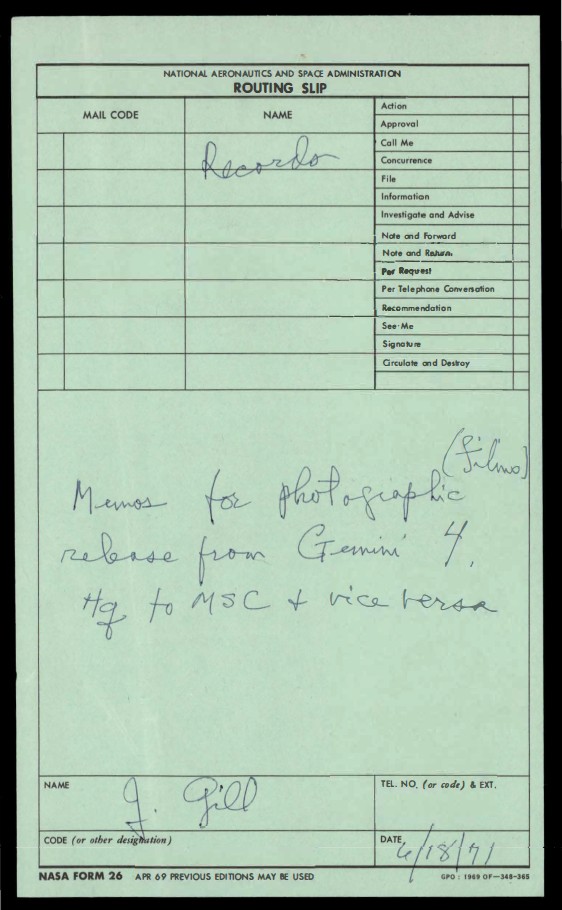
NASA-UAP-D018, Gemini 4 Experiment Debriefing, 1967
NASA-UAP-D011, Mercury Atlas 9 Audio Excerpt, May 15, 1963
Casos relacionados
Misma serie de expedientes
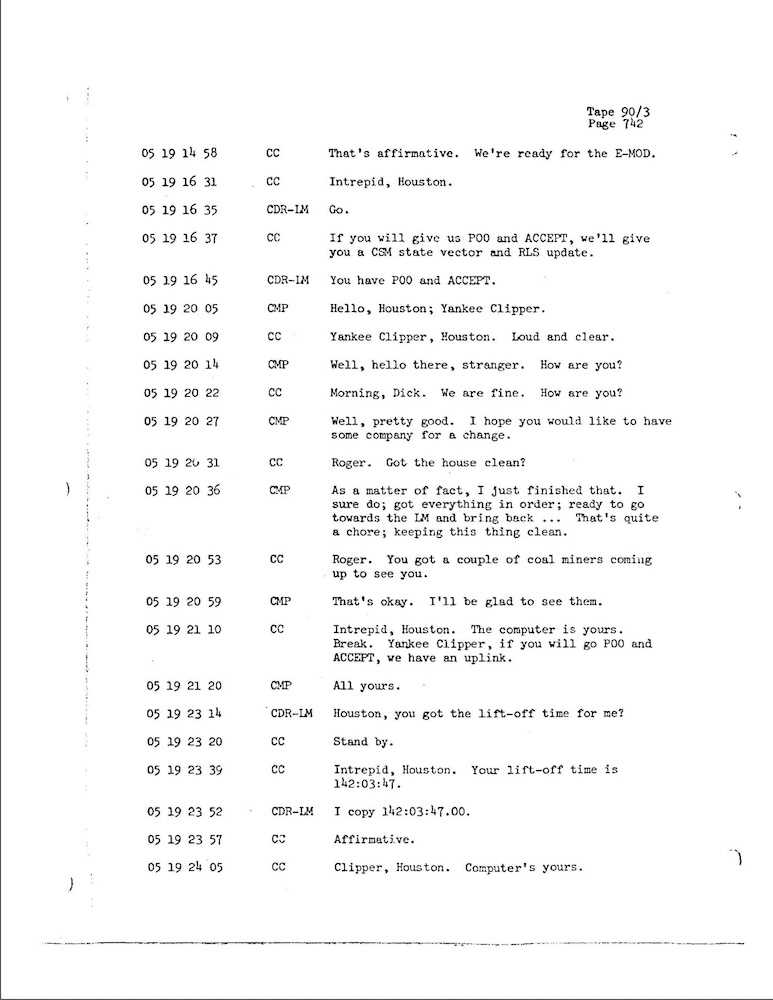
NASA-UAP-D001, Transcripción del Apolo 12, 1969
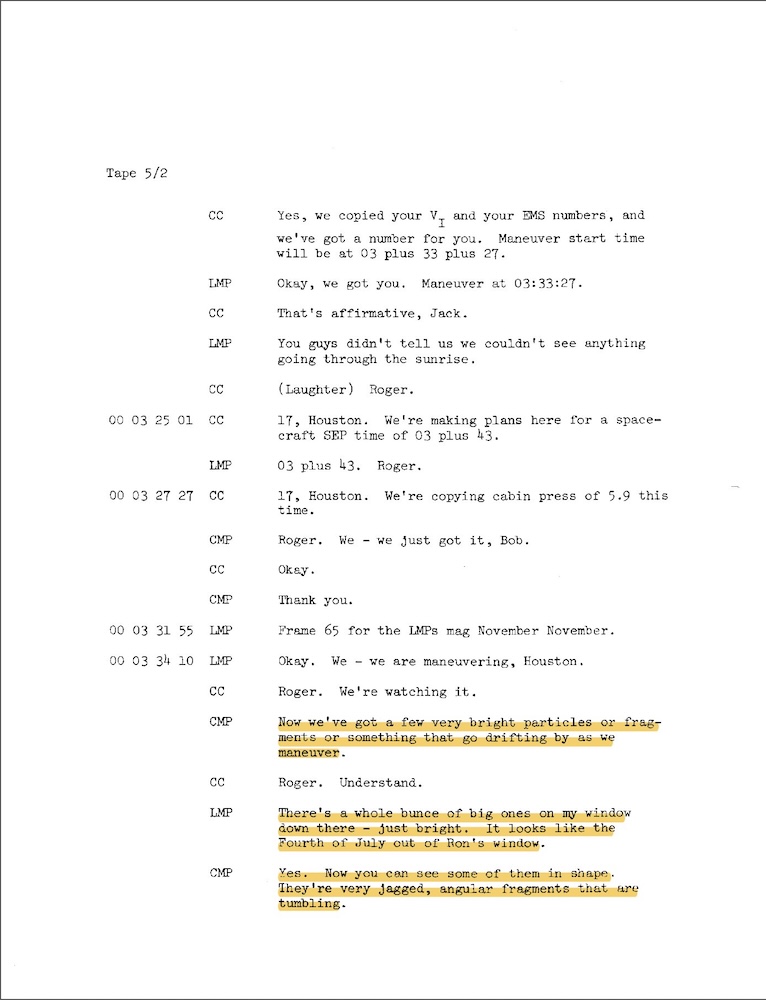
NASA-UAP-D002, Transcripción del Apolo 17, 1972
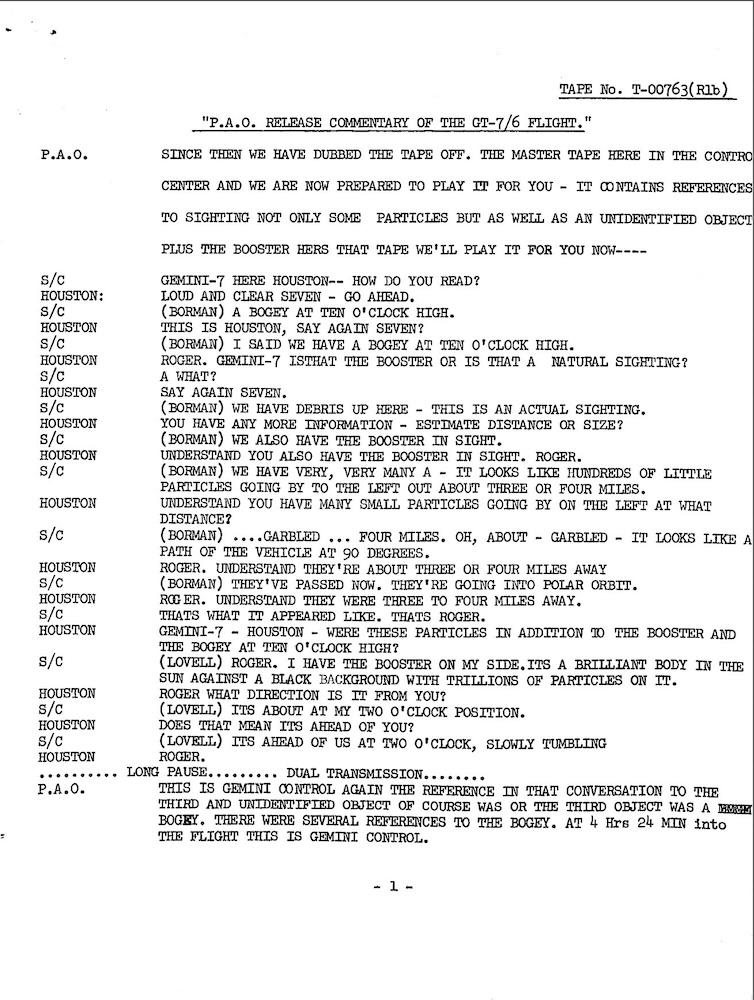
NASA-UAP-D003, Transcripción del Gemini 7, 1965

NASA-UAP-D003A, Extracto de audio del Gemini 7, 1965
NASA-UAP-D004, Interrogatorio técnico de la tripulación del Apolo 11, 1969
NASA-UAP-D005, Interrogatorio científico de la tripulación del Apolo 17, 1973
Mismo periodo
Mismo release
FBI-UAP-D011, Remisión de correspondencia del Director del FBI, 1949
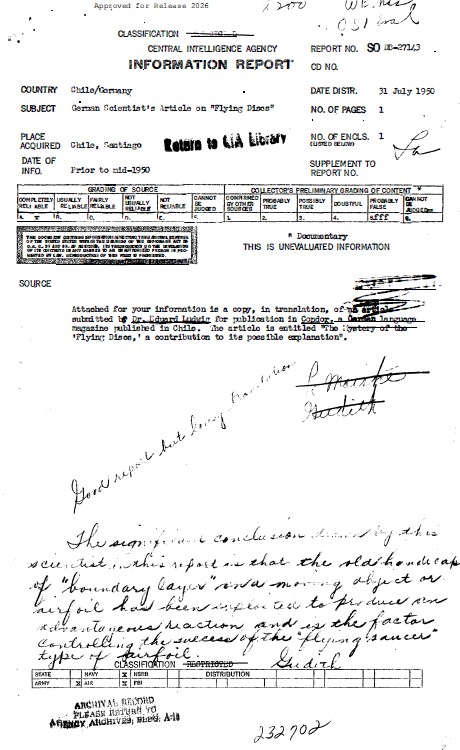
CIA-UAP-005, Artículo de un científico alemán sobre los “discos voladores”
CIA-UAP-002, Panel Asesor Científico sobre Objetos Voladores No Identificados, Informe, 1952-1953
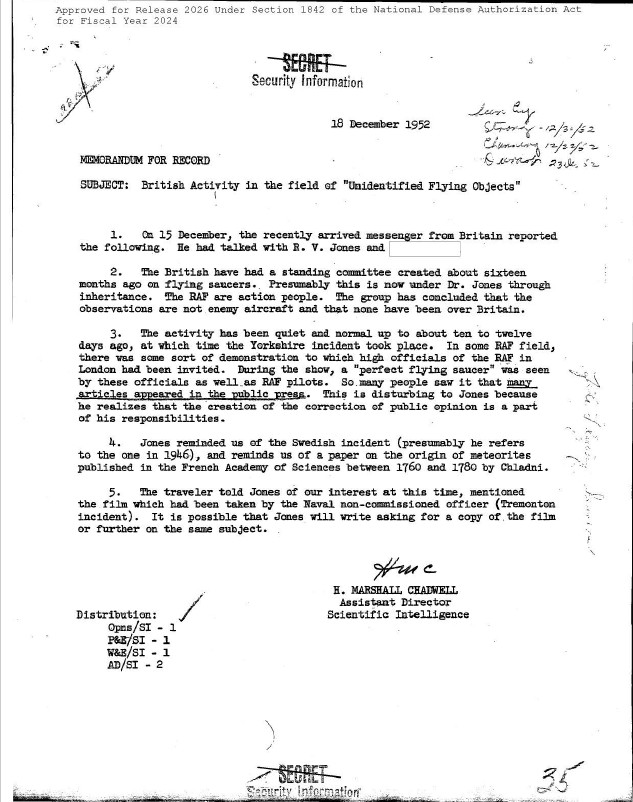
CIA-UAP-014, Actividad británica en el campo de los “objetos voladores no identificados”
FBI-UAP-D012, Oficina de Campo de Newark, 1952-1967
FBI-UAP-D013, Investigación de “OVNIs” en el estado de Washington, 1952-1960
Misma agencia
NASA-UAP-D014, Mercury-Redstone 4, 21 de julio de 1961
NASA-UAP-D010, Extracto de audio del Mercury Atlas 9, 15 de mayo de 1963
NASA-UAP-D011, Extracto de audio del Mercury Atlas 9, 15 de mayo de 1963
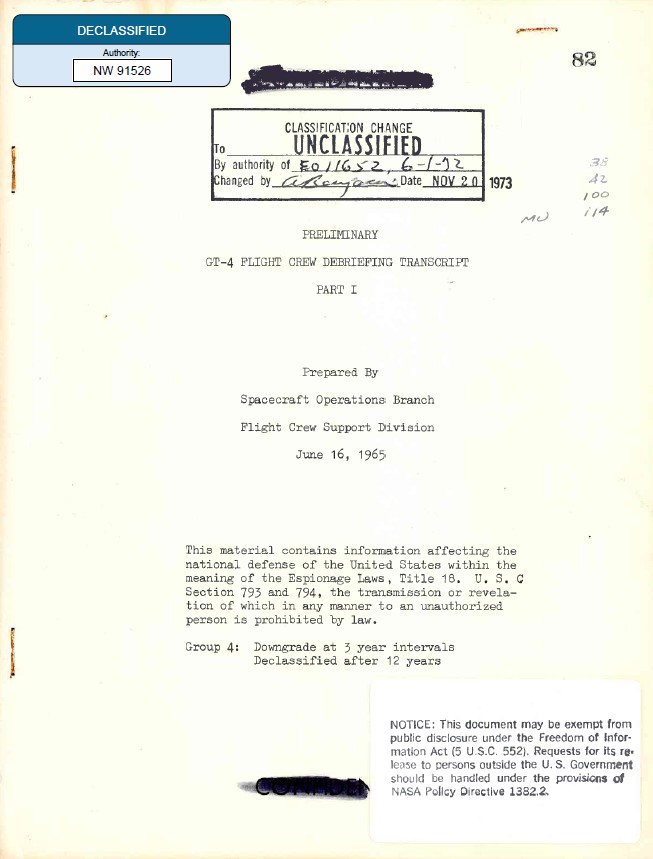
NASA-UAP-D016, Interrogatorio preliminar a la tripulación del Gemini 4, Parte I, 1965
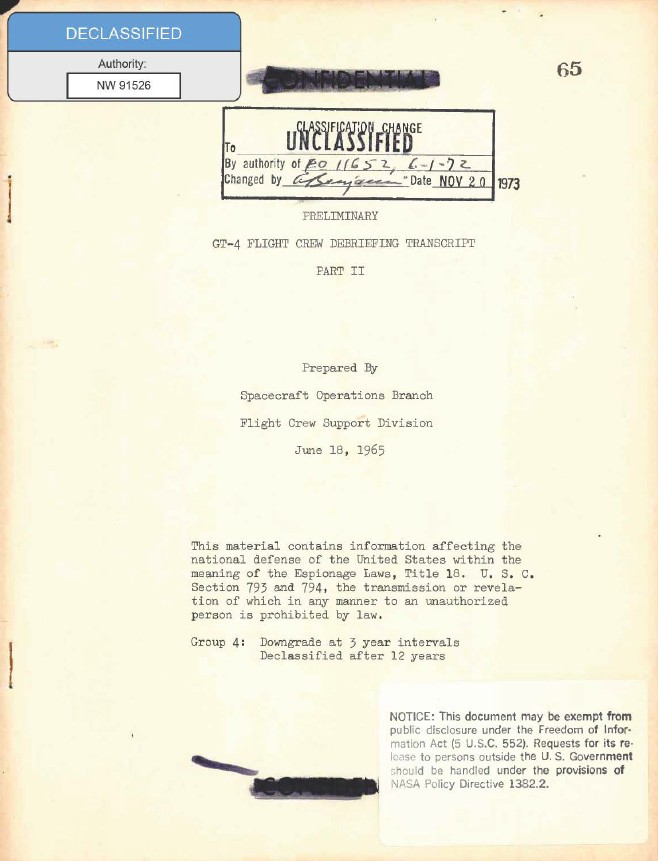
NASA-UAP-D017, Interrogatorio preliminar a la tripulación del Gemini 4, Parte II, 1965