NASA-UAP-D026, Interrogatorio de la Apolo 14, 1971
Datos del expediente
Descripción oficial
Este archivo contiene el segmento 1 de 2 del interrogatorio posterior a la misión de la tripulación del Apolo 14 en el Centro de Naves Tripuladas (hoy Centro Espacial Johnson), Houston, Texas. En la grabación, los miembros de la tripulación y los entrevistadores discuten el “fenómeno del destello de luz” (light flash phenomena), un efecto biológico entonces novedoso, hoy bien documentado, en el cual los rayos cósmicos de alta energía atraviesan el ojo e impactan la retina, causando la percepción de estelas o destellos de luz. Los entrevistadores intentan distinguir las características del fenómeno observado. El interrogatorio continúa en el siguiente archivo (NASA-UAP-D027), que contiene contenido de audio parcialmente superpuesto.
✦ Resumen IA
Este es el segmento 1 de 2 del informe posterior a la misión de la tripulación del Apolo 14 en el Manned Spacecraft Center, Houston. Un médico de la NASA (referido como el Dr. Berry) y otros entrevistadores interrogan a la tripulación de tres hombres en formato de preguntas y respuestas. Aproximadamente los primeros 90 minutos cubren temas médicos rutinarios: comprensión de los requisitos médicos previos al vuelo, hábitos de ejercicio (Exergym), ingesta de líquidos, alimentación, pérdida de peso, un problema con el arnés del EKG, sensaciones por carga G, fatiga en los guantes durante la actividad extravehicular, una sensación subjetiva de 'cabeza llena', la iluminación en la superficie lunar, un sensor respiratorio perdido y labios agrietados. En los últimos aproximadamente seis minutos, a partir de preguntas transmitidas por el científico Phil Chapman, la tripulación describe el 'fenómeno de destellos de luz': rayas nítidas e instantáneas (no difusas), algunas percibidas como un punto de luz en movimiento que deja una estela, vistas mayormente en visión periférica, ocasionales destellos de 'doble disparo', una sensación no confirmada de direccionalidad, y en una ocasión un destello en forma de punto y coma. Los entrevistadores hacen una demostración con una luz de comparación en una habitación oscurecida. La grabación se corta a mitad de la discusión y continúa en NASA-UAP-D027.
Generado con IA a partir del archivo oficial — puede contener errores.
▸Transcripción
[00:00] [BLANK_AUDIO, then routine mic checks, sound-level adjustments, and informal greetings between crew and debriefers] [04:03] Debriefer: "Okay, the show's all yours." Crew: "What kind of format do you have in mind today?" Debriefer: "Questions and answers." The tape is identified for the record as the medical debriefing conducted by Dr. Berry, who will ask most of the questions; others present will identify themselves before speaking. [04:32] [routine — microphone volume adjustments and audio test counting ("one, two, three, four, five...")] [06:11] Debriefer raises medical requirements (referencing section 27 of the written debrief): did the crew have a clear understanding of the medical requirements going into the flight? He notes the written comments suggest they did not. Crew responds it was a "question of degree" — they understood the general forms but not always the full rationale. [06:59] Debriefer agrees requirements should be substantiated and clear so the crew knows the data is used and not wasted, and offers to review the crew's own lab/data results with them before the end of quarantine. [08:34] Crew clarifies the comment was not a specific complaint about their flight but a general point: without understanding the scientific rationale, crew buy-in and protocol success suffer. Discussion turns to timing — the last weeks before flight are the wrong time to brief medical requirements, since crew attention is elsewhere; it should be scheduled earlier in training, alongside other systems/scientific briefings, so protocols and equipment needs are settled early. One crew member notes the actual burden (24-hour urine collections, repeated blood draws) was understood in principle but the mechanics and how it connected to the science (e.g., total body water) were never fully explained. [12:37] Debriefer shifts to the exercise question, asking for a rough account of what the exercise consisted of, how long, and whether the crew tried to judge exertion (heart rate, breathing) — important for separating effects of lunar-surface work (LMP/CDR) from time in the spacecraft (CMP). Crew describes using the "Exergym" isometric/isotonic friction device for a targeted ~10 minutes/day (excluding the two lunar-surface days for the surface crew), following the standard "big four" leg/arm exercise pattern, and reports skipping some days, including no exercise at all during the two lunar-orbit days for one crew member, and getting only one session in on the way home. One crew member notes exertion was enough to raise heart rate and breathing but was kept short of a sweat; the CMP's ability to exercise was limited by a busy flight-plan workload, not a deliberate attempt to compensate for the surface crew's activity. [17:12] [routine reminder from a debriefer about the urine hose kinking incident from the prior day's technical debrief] Discussion of the in-suit urine collection device (UCTA): it was worn only twice — once shortly after launch (~6-7 hours in) and once from just before the lunar descent until after docking — with no discomfort reported by any crew member, pre-flight or in-flight. [22:57] Debriefer asks about fluid intake — was the crew consciously forcing fluids? Crew describes deliberately drinking from the water gun whenever passing it, preferring juices over plain water (despite not caring for juices before flight), and forcing water intake to keep fluid levels up; one crew member estimates drinking about a third less juice than the other two. [routine follow-up: crew confirms they were sometimes thirsty in flight and briefly discusses drinking water stored in their suits] [29:55] Crew offers a consensus comment on food: preference and ease of use depended on flight-plan activity level — spoon-in-bag rehydratable meals worked fine during quiet coast periods, but during high-activity periods (e.g., lunar orbit troubleshooting) wet-packs and cans that could be opened quickly were strongly preferred; preparing a full rehydrated meal was seen as too time-consuming when busy. One crew member ate a can of chicken salad and a wet-pack for a meal during a busy lunar-orbit period rather than mixing a full meal. [31:00–33:00] [routine — further back-and-forth on food quantity, whether portions were too large, and confirmation that thirst was experienced during flight] [35:00] Discussion of individual weight loss (up to ~10 lb for one crew member vs ~1 lb for others) — crew members offer personal theories (possible pre-flight overweight, normal day-to-day weight variability unrelated to zero-G, uncertainty about the accuracy of the in-flight scale); debriefer notes upcoming total-body-water and lab data review will help clarify whether the loss reflects a true physiological effect. [38:35] [routine — discussion of a biomedical/EKG harness problem and a communications-adapter (CWG) swap early in the flight, including troubleshooting timing] [43:51–46:00] [routine, with laughter — further discussion of harness/telemetry troubleshooting and EVA glove/hand fatigue] [55:15] Debriefer asks whether the crew sensed more G-load during entry than instruments registered. Crew jokes they don't recall anything over 2G. [routine follow-on exchange about sensations during entry] [63:34] Crew notes lunar-surface mobility was easier and faster than expected; no discomfort at any time moving on the surface, despite fighting the pressure glove. [69:35] Crew describes difficulty working the core tubes on the lunar surface — hard on the gloved hands, with one tube that could not be unscrewed alone. [75:52] A crew member offers a personal (unconfirmed) theory that a recurring "full head" sensation was related to nasal/mucus congestion rather than the cardiovascular system, possibly worsened by talking a lot during a session; nose drops helped the mucus but not the overall fullness feeling. [routine follow-up about glove-cutting and an oxygen-bottle comment] [83:40] Debriefer asks whether lunar-surface light levels felt different from LM simulator training. Crew agrees light levels on the surface were generally higher than inside the lunar module, and notes the LM simulator does not reproduce the day/night lighting difference on the Moon. [86:57] Debriefer notes a data gap: the crew's respiratory/CO2 sensor reading was lost around 196 hours mission elapsed time. [routine brief exchange] [89:36] Crew discusses cracked/dry lips beginning around the fourth or fifth day after trans-Earth injection; no one reports feeling generally dehydrated despite this. [90:03] Debriefer: "Did they talk to you about — Phil Chapman wanted to tack on the light-flash thing on the end of this?" Crew: "Yeah, they're out here." Debriefer asks to bring them in to get it out of the way. [1:30:20–1:31:50: routine tangent — a crew member raises a concern that their ~5 lb weight loss shouldn't be over-interpreted as flight-related, since similar swings happen on Earth (e.g., after a field trip to Iceland); debriefer explains total-body-water/exercise data won't be available until after quarantine (beta data), only gamma counting is available now; brief break for coffee] [91:54] Debriefer: "Dick suggested we should tack on a few questions about light flashes. What we'd like to do is clarify some of the subjective impressions you've got of what you saw in the way of light flashes, and also clarify the conditions under which you saw them." [routine — seating/microphone adjustment] [92:44] Debriefer: "The first question we've got is about the streaks you saw — was it a very sharp phenomenon, or were they rather diffuse, fuzzy?" Crew: "The ones I saw were very sharp — there was no mistaking what it was. It was a streak, appearing and gone almost instantaneously." Second crew member: "Yeah, I think that's correct. Both the single streak and the 'double shot' appeared very clear to me." [93:15] Crew: "They were quite clear, and I think I made the comment over the loop that most of my streaks appeared to be on the periphery [of my vision]. For the first several days I got the impression that one direction was predominant, but later on I don't think I could establish that good a pattern — that was just my first impression for the first couple of days." [93:41] Debriefer: "The next question is, was there any apparent direction of propagation — could you tell it was moving from one side to the other, or was it just a flash?" Crew: "Sometimes we'd report it going from left to right or something like that. I tried to correlate it, but in my case I couldn't really pin down a consistent pattern." Another crew member: "I would think the time period during which we tried to report them — streak by streak, flash by flash — was representative, and it was my feeling that it was generally random during that period, and therefore generally random throughout the times we noticed it." [94:18] Debriefer clarifies: "I meant, could you detect that it was moving from one side to the other, in general?" Crew: "It was moving in a specific direction — yes." Debriefer: "But you could see it travel from one side to the other?" Crew: "I think we tried to report it that way — yes, we did report it. That's what was puzzling about it, because it happens — it has to be very fast." [brief exchange: "Isn't that question kind of redundant then?" / "I didn't believe you."] [94:47] Debriefer: "Was there some character to these flashes that had some aspect of direction — were they all the same rod shape, or did they have a tail on them?" Crew: "Well, what I reported as a streak was simply that. Maybe the way I subconsciously determined direction was that it was a ball of light moving in a direction and leaving a tail behind it — but I can't say that for sure. All I reported was a streak, and I had the impression of it moving from one direction to the other, and I reported that direction, but I can't clarify it any further." [95:28] Debriefer, apparently demonstrating a comparison light source with the room darkened: "Maybe while you're asking the question, just show them the light — I think they can see this in the dark room. The idea is to see whether this is what you saw, or similar to it... Can you see anything?" Crew: "Yeah, that's what it looked like, except it was traveling — it started out and definitely progressed across the field of view." Debriefer: "Direction of motion for an individual [flash] — was it that bright?" Crew: "Yeah, except — you're not traveling, it was traveling. You saw it as a point that made the streak." [96:03] Crew: "I never did see two [flashes] simultaneously, either." Second crew member: "Neither did I." Crew, referring to the demonstration light: "You have two streaks right now — I never saw that." Debriefer: "At one time you said you saw a semicolon-shaped thing." Crew: "So what [about it]?" Debriefer: "A semicolon." [Transcript ends here mid-discussion; the topic continues in NASA-UAP-D027.]
Generado con IA a partir del archivo oficial — puede contener errores.
Traducción automática — el documento original está en inglés. Ver en inglés →
Fuente: Departamento de Guerra de EE. UU. / AARO — dominio público · war.gov/ufo
Entidades en este documento
Casos conectados
NASA-UAP-D027, Apollo 14 Debriefing (Continued), 1971
NASA-UAP-D008, Apollo 12 Medical Debriefing - Tape 12, 1969
NASA-UAP-D028, Apollo 17 Crew Medical Debriefing, 1972

NASA-UAP-D029, Apollo 17 Crew Medical Debriefing (Continued), 1972
DOE-UAP-D001, Enhanced PANTEX Imagery
DOE-UAP-D004, Los Alamos Conference on Aerial Phenomena, 1949
Casos relacionados
Mismo lugar
NASA-UAP-D008, Interrogatorio médico del Apollo 12 - Cinta 12, 1969
NASA-UAP-D027, Interrogatorio de la Apolo 14 (continuación), 1971
NASA-UAP-D028, Interrogatorio médico de la tripulación de la Apolo 17, 1972
NASA-UAP-D029, Interrogatorio médico de la tripulación de la Apolo 17 (continuación), 1972
DOE-UAP-D005, Informe de incidente de objeto no identificado en Pantex, 2015
Misma serie de expedientes
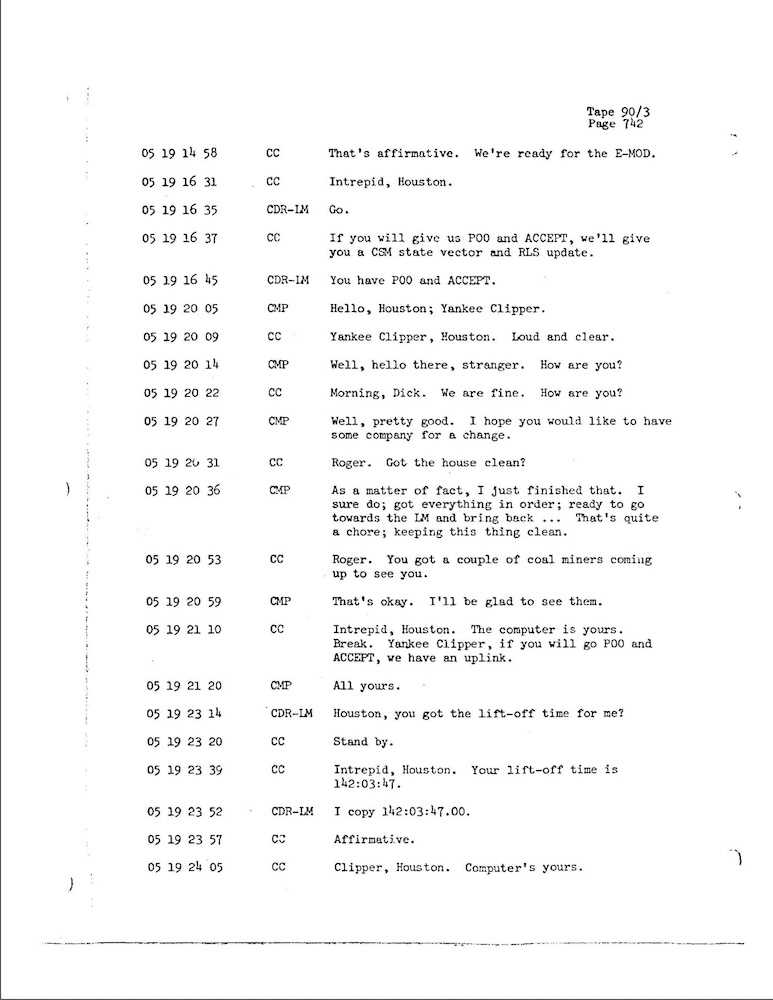
NASA-UAP-D001, Transcripción del Apolo 12, 1969
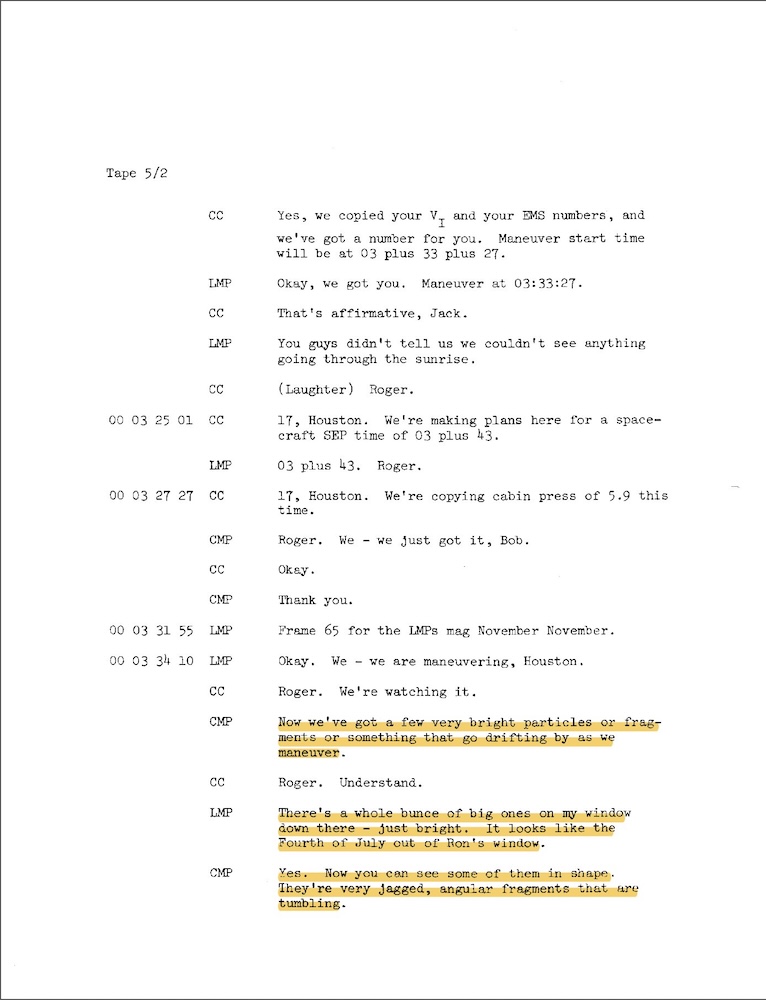
NASA-UAP-D002, Transcripción del Apolo 17, 1972
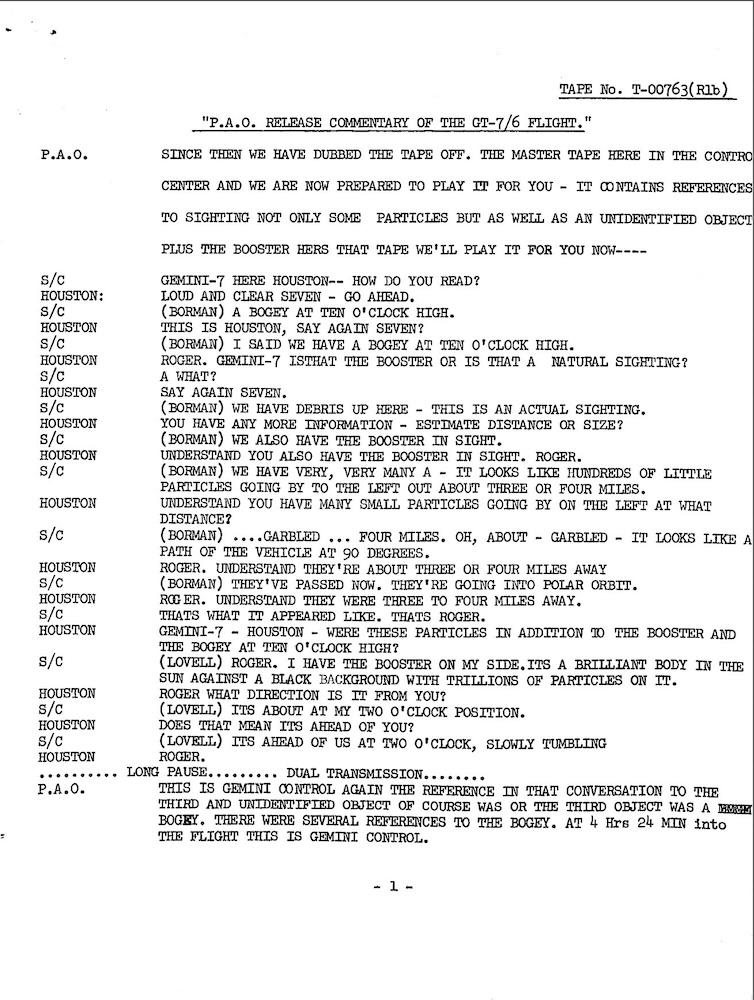
NASA-UAP-D003, Transcripción del Gemini 7, 1965

NASA-UAP-D003A, Extracto de audio del Gemini 7, 1965
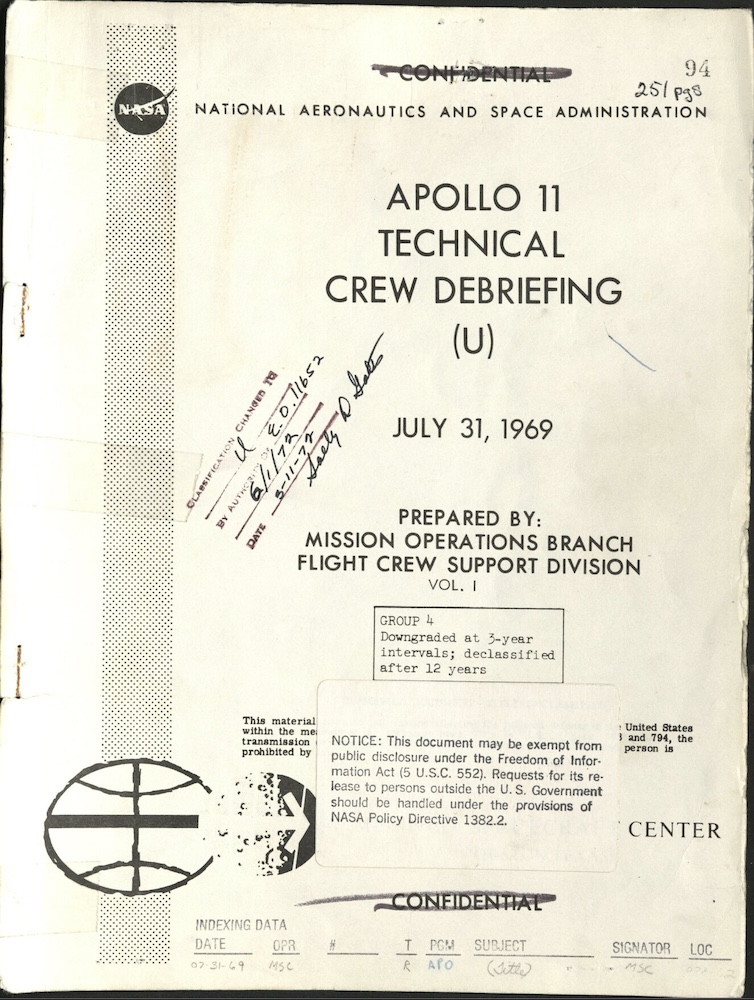
NASA-UAP-D004, Interrogatorio técnico de la tripulación del Apolo 11, 1969
NASA-UAP-D005, Interrogatorio científico de la tripulación del Apolo 17, 1973
Mismo release
DOW-UAP-D093, Análisis de incidentes de objetos voladores en Estados Unidos, 1948
DOW-UAP-D097, Informe de avance del Proyecto Sign, 1948
DOE-UAP-D004, Conferencia de Los Álamos sobre fenómenos aéreos, 1949
DOW-UAP-D094, Análisis de incidentes de objetos voladores en Estados Unidos, 1949
CIA-UAP-D020, Memorando sobre avistamientos de aeronaves no convencionales, 1955
CIA-UAP-D021, Análisis de avistamientos de aeronaves no convencionales, 1955
Misma agencia
NASA-UAP-D014, Mercury-Redstone 4, 21 de julio de 1961
NASA-UAP-D012, Extracto de audio del Mercury Atlas 8, 3 de octubre de 1962
NASA-UAP-D013, Mercury Atlas 7, 24 de mayo de 1962
NASA-UAP-D015, Interrogatorios científicos a astronautas, 1962-1963
NASA-UAP-D023, Fragmento de entrevista con el astronauta Gordon Cooper, 1962