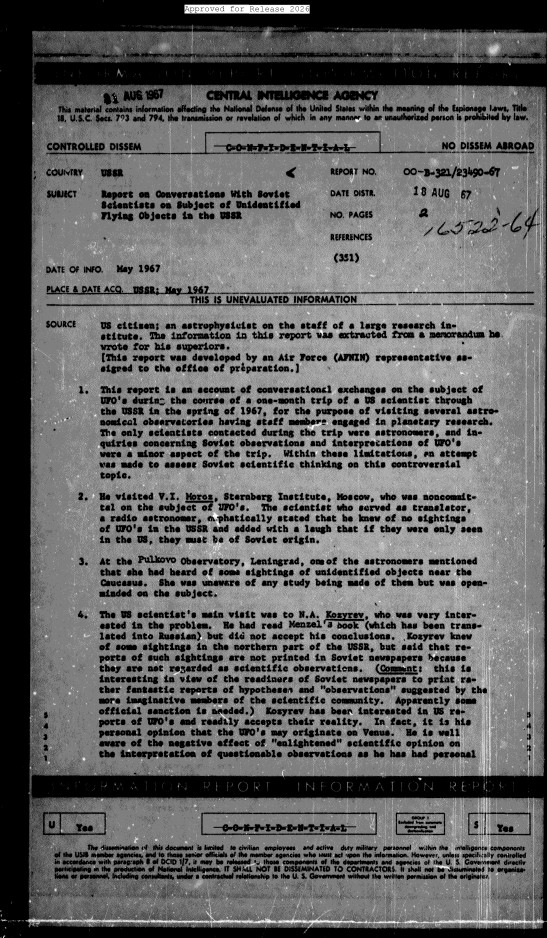
CIA-UAP-003, La Agencia Central de Inteligencia y el reconocimiento aéreo; los programas U-2 y OXCART, 1954-1974
Datos del expediente
- ID oficial del expediente
- CIA-UAP-3 (citado como CIA-UAP-003 en este archivo)
- Tipo de documento
- Documento
- Agencia
- CIA
- Publicado en
- R03 · 2026-06-12
- Fecha del incidente
- 1954-1974
- Lugar del incidente
- Páginas legibles
- 406/406
- VIRIN
- 260508-O-D0360-1080
Descripción oficial
Este documento del Equipo de Historia de la CIA (CIA History Staff) narra la historia completa de los programas de aeronaves de reconocimiento de gran altitud U-2 y OXCART (A-12) entre 1954 y 1974, detallando su desarrollo, las operaciones sobre la Unión Soviética y otros objetivos en todo el mundo, el célebre derribo de Francis Gary Powers en 1960, las reformas organizacionales tras ese incidente, y la eventual transferencia de las operaciones de la CIA al control de la Fuerza Aérea. Una versión más censurada de este documento ha estado disponible en el sitio web público de la CIA.
✦ Resumen IA
Este documento es la historia oficial desclasificada de 1992 del Personal de Historia de la CIA, 'The Central Intelligence Agency and Overhead Reconnaissance: The U-2 and OXCART Programs, 1954-1974', escrita por Gregory W. Pedlow y Donald E. Welzenbach, una historia de 406 páginas sobre el avión espía U-2 y su sucesor Mach-3, el A-12 OXCART. Fue incluido en esta publicación de documentos sobre UAP debido a una sección específica e históricamente significativa titulada 'U-2s, UFOs, and Operation BLUE BOOK' (páginas 72-73 del libro), que ofrece la explicación oficial de la propia CIA para una gran parte de los reportes de UFO investigados por el Proyecto Blue Book de la Fuerza Aérea durante finales de la década de 1950 y la década de 1960. El libro explica que, una vez que los vuelos de prueba del U-2 comenzaron a operar por encima de los 60,000 pies a mediados de la década de 1950 —muy por encima de las altitudes de 10,000 a 40,000 pies de los aviones comerciales y las aeronaves militares de la época—, los controladores de tráfico aéreo y los pilotos de aerolíneas comenzaron a reportar un aumento de avistamientos de UFO, especialmente al anochecer, cuando las alas plateadas de un U-2, que aún captaban la luz solar a gran altitud, aparecían como objetos ardientes ante pilotos que ya volaban en la oscuridad debajo. Los investigadores de Blue Book de la Fuerza Aérea, con base en Wright-Patterson AFB, contactaban regularmente al Personal del Proyecto U-2 de la CIA para contrastar los avistamientos reportados con los registros de vuelo del U-2 (y más tarde del OXCART), lo que les permitía descartar discretamente la mayoría de los reportes sin poder revelar a quienes escribían las cartas la verdadera causa, aún clasificada. El documento afirma claramente que los vuelos del U-2 y del OXCART representaron más de la mitad de todos los reportes de UFO durante finales de la década de 1950 y la mayor parte de la década de 1960. Dada la extensión del libro, el resto del volumen abarca la historia institucional más amplia del desarrollo del reconocimiento a gran altitud (Capítulo 1: orígenes del concepto del U-2, el Lockheed CL-282, el informe BEACON HILL), el diseño y las pruebas del U-2 (Capítulo 2), y capítulos posteriores (según la tabla de contenido) que cubren las operaciones del U-2 sobre el Bloque Soviético y Medio Oriente entre 1956 y 1958, y más allá.
Generado con IA a partir del archivo oficial — puede contener errores.
▸Transcripción(406 de 406 páginas legibles)
[PAGE 1] fri i i THE CENTRAL INTELLIGEN CE AGENCY AND OVERHEAD ECONNA I SSANCE The and OX C.\RT Program 1954 19 74 Gr egory vV Pedlow and Donald vVelzenbach [PAGE 2] Secret l<JOFOFU'il The Central Intelligence Agency and Overhead Reconnaissance The and OXCART Programs 1954-1974 Secret [PAGE 3] ec et MOFORf The Central Intelligence Agency and Overhead Reconnaissance The and OXCART Programs 1954-1974 Gregory Pedlow and Donald Wel zenbach History Staff Central Intelligence Agency Washington 1992 Sec,et [PAGE 4] Chapter Searching for a System The Need for High-Altitude Reconnaissance Early Postwar Aerial Reconnaissance New Approaches to Photoreconnaissance The Air Force Search for a New Reconnaissance Aircraft Lockheed CL-282 Supporters and the CIA 13 Scientists and Overhead Reconnaissance 17 The BEACON HILL Report 17 Concern About the Danger of a Soviet Surprise Attack 19 The Air Force Intelligence Systems Panel 21 British Overflight of Kapustin Yar 23 The Intelligence Systems Pane and the CL-282 24 The Technological Capabilities Panel 26 Project Three Support for the Lockheed CL-282 27 A Meeting With the President 32 CIA and Air Force Agreement on the CL-282 33 Chapter Developing the The Establishment of the Project 39 Funding Arrangements for Project AQUATONE 43 Major Design Features of the 45 The Development of the Camera System 48 Preparations for Testing the 56 Security for the Project 59 The CIA Air Force Partnership 60 Technical Challenges to High-Altitude Flight 61 Delivery of the First 66 Initial Testing of the 68 U-2s UFOs and Operation BLUE BOOK 72 [PAGE 5] Sec el NOFORN Hiring Pilots 73 Pilot Training 75 Final Tests of the 76 Three Fatal Crashes in 1956 79 Coordination of Collection Requirements 80 Preparations To Handle the Product of Missions 82 The Impact of the Air Force Project GENETRIX Balloons 84 AQUATONE Briefings for Selected Members of Congress 88 The Cover Story 89 Chapter Operations in the Soviet Bloc and Middle East 1956-1958 The Deployment of Detachment A to Lakenheath 94 The Move to Wiesbaden 95 President Eisenhower's Attitude Toward Overflights 96 First Overflights of Eastern Europe 100 First Flights Over the Soviet Union 104 Soviet Protest Note 109 The End of the Bomber Gap 111 Tactical Intelligence From U-2s During the Suez Crisis 112 Renewed Overflights of the Soviet Union 122 Radar-Deceptive Dirty Birds 128 The New Detachment 133 Detachment Flights From Pakistan 135 The Decline of Detachment A 139 Cooperation With Norway 142 Declining Overflight Activity 143 Concerns About Soviet Countermeasures Against the 147 More Powerful Engines for the 149 Intervention in Lebanon 1958 152 British Participation in the Project 153 The Project at the Beginning of 1959 157 Chapter The Final Overflights of the Soviet Union 1959-1960 The and the Missile-Gap Debate 159 The Last Overflight Operation GRAND SLAM 170 The Aftermath of the Downing 177 The Withdrawal of the Overseas Detachments 181 The Fate of Francis Gary Powers 183 Changes in Overflight Procedures After May 1960 187 [PAGE 6] Ge eret PJOFORN Chapter Operations A ft er ay 1960 Operati ons in Latin Ameri ca 197 Support to the Bay of Pigs Invasi on 197 Aerial Refueling Capabili ty for the 198 Coverage Duri ng the Cuban Missile Crisis 199 U-2s Over South Amer ica 211 Operations in Asia 211 Detachment and the Indonesian Revolt of 1958 211 China Offshore Islands Dispute of 1958 15 Support for DDP Operations in Ti bet 216 U-2Cs for Detachment 217 Cr ash in Thailand 219 End of Detachment Operations 219 Detachment Missions Over Laos and North Vietnam 221 New Detachment on Taiwan 222 Use of Detachment Aircraft by US Pilots 230 U-2s in In dia 231 Increasing Responsib ilit i es Inadequate Resources in Asia 233 Advanced ECM Equipment for Detach ment 237 Infrared Scann er Over PRC Nuclear Plants 238 240 -::;--::,-;-~~:F:::.:-:=--::-r- he End of Overflights ain an Ch i na 242 Peripheral issions by Detachment 244 Operation SCOPE SHIELD Over Nort Vietnam 246 Imp rovements in Techn ology 247 Mod ification of fo Airc raft Carrier Depl oyment 247 Use of Car rier-Based To Fi lm a French Nuclear Test Site 249 A New Version of the 251 Replacement of the Orig i na i th 2Rs 253 The Final Years of the 25 upport to Ot he Agencies 254 Overseas Deployment Exercises and Miss ions 255 The Phaseout of the Off ice of Special Acti vities 257 Ch apter The U-2·s Intended Successor Project OXCART 1956-19 68 The Evaluation of Designs for a Successor to the 260 Competition Between Lockheed and Convair 267 he Selec ti on of he Lockheed Design 270 ffo rt To Red uce the A·12's Ra dar Cross Section 27 The OXCART Contract 277 [PAGE 7] See et NOFOAN New Technologies Necessitated By OXCART's Hig Speed 279 Desi gning the OXCART's Cameras 281 Choosing Pilots for OXCART 283 Selection of a Testing Site fo he OXCART 283 Delive ry of the irst OXCART 286 Changes in the Project Ma nagement 286 OXCART First Fl ig hts 28 Speed -Re lated Pr oblems 29 New Versions of the OXCART 291 The Question of Surfacing a Version of the OXCART 292 Add itio nal Probl ems Dur i ng Fi na Testing 295 Discussions on the OXCART's Future Employmen 297 First A-12 Deployment Operation BLACK SHIELD 304 The End of th OXCART Program 307 Poss ible Successors to the OXCART 312 Summary of the OXCART Pr ogram 313 Chapter Conclusion Overf lights of the Sov iet Unio 315 Participation of Allies in the Prog am 319 U-2s as Collectors of Tactical Inte lli gence 319 Advances in Techno logy 320 Cooperation With the Air Force 321 Impact of the Overhead Reconnaissance Pr ogram the CIA 321 Appendix A Acronyms 325 Appendix Key Personnel 327 Appendix Electronic Devices Carried by the 335 Appendix Overflights of the Soviet Union 337 July 1954-1 May 1960 Appendix Unmanned Reconnaissance Projects 339 Bibliography 347 Index 355 [PAGE 8] Warning Notice Intelligence Sources or Methods Involved WNINTEL National Security Information Unauthorized Disclosure Subject to Criminal Sanctions Dissemination Control Abbreviations NOFORN NF Not releasable to foreign nationals NOCONTRACT NC Not releasable to contractors or contractor consultants PROPIN PR Caution-proprietary information involved ORCON OC Dissemination and extraction of information controlled by originator REL This information has been authorized for re lease to WN WNINTEL-lntelligence sources and meth ods involved Classified by Declassify OADR Derived from multiple sources All material on this page is Unclassified [PAGE 9] ieeret NOFGftN FOREWORD This History Staff Monograph offers a comprehensive and authorita tive history of the CIA's manned overhead reconnaissance program which from 1954 to 1974 developed and operated two extraordinary aircraft the and the A-12 OXCART It describes not only the program's technological and bureaucratic aspects but also its politi cal and international context The manned reconnaissance program along with other overhead systems that emerged from it changed the CIA's work and structure i.n ways that were both revolutionary and permanent The formation of the Directorate of Science and Technology in the I 960s principally to develop and direct reconnais sance programs is the most obvious legacy of the events recounted in this study The authors tell an enigrossing story The struggle between the CIA and the US Air Force to control the and A-12 OXCART projects reveals how the manned reconnaissance program confronted problems that still beset successor programs today The was an enormous technological suc:cess its first flight over the USSR in July 1956 made it immediately the most important source of intelligence on the Soviet Union Using it against the Soviet target it was designed for nevertheless produced a persistent tension between its program managers and the President The program managers eager for cover age repeatedly urged the President to authorize frequent missions over the Soviet Union President Eisenhower from the outset doubt ful of the prudence and prt0priety of invading Soviet airspace only reluctantly allowed any overflights at all After the Soviets shot down Francis Gary Powers on I May 1960 President Eisenhower forbade any further flights over the USSR Since the Agency must always assess a covert operation's potential payoff against the diplomatic or military cost if it fails this account of the U-2's em ployment over the Soviet Union offers insights that go beyond overhead reconnaissance programs Indeed this study should be useful for a variety of purposes It is the only history of this program based upon both full access to CIA records and extensive classified interviews of its participants The authors have found records that were nearly irretrievably lost and have interviewed participants whose personal recollections gave in formation available nowhere else Although the story of the manned -Sac,et [PAGE 10] See1et N0F0RN reconnaissance program offers no tidy model for imitation it does reveal how resourceful managers coped with unprecedented techno logic al cha ll enges and their implications for intelligence and national pol i cy For this reason the program's history provides profitable reading for intellige nc professionals and policymakers today Many people made import.1nt contributions to the production of this vo ume ln the History ta ff's preparation of the manuscript Gerald Haines did the final revision Diane Marvin again demon strated her high talent as a copy editor and provided staunch secretarial support throughout As usual we are i ndebted to more members than we can name from the Publications Design and Cartography Centers in the Office of Current Prod uction and Analytic Support whose lively interest in the publication went far beyond the call of duty he ir exceptional professional skill and the masterly work of the Printing and Photography Group combined to create this handsome volume Donald Welzenbach who began this study and Gregory Pedlow w_llo completed it brought complementary strengths to this work A eteran of C[A service since 1960 Mr Welzenbach began research on this study in 1983 when he joined the DCI History Staff on a rotational assignment from the Directorate of Science and Technology After tireless documentary research and extensive inter viewing he finished a draft manuscript of the history before returning to his directorate In early 1986 Gregory Pedlow a new member of the DC History Staff was assigned to compl ete the study A Johns Hopkins University Ph.D who has served as an Army intelligence officer and University of Nebr aska professor of history Dr Pedlow undertook important research in several new areas and reorganized edited and revi sed the entire manuscript before leaving CIA to be come NATO Historian in late 19 89 The final work which has greatly benefited from both authors contributions is the CIA's own history of the world's first great overhead reconnaissance program Kenneth McDonald Chief CIA is tory Staff April 992 [PAGE 11] Secret l\10FeAN PREFACE When the Central Intelligence Agency came into existence in 1947 no one foresaw that in less than a decade it would undertake a major program of overhead reconnaissance whose principal purpo se would be to fly over the Soviet Union Traditionally the military services had been responsible for overhead reconnaissance and flights deep into unfriendly territory only took place during wartime By the early I 950s howe v,er the United States had an urgent and growing need for strategic intelligence on the Soviet Union and its satellite states At great risk US Air Force and Navy aircraft had been conducting peripheral reconnaissance and shallow-penetration overflights but these missions were paying a high price in lives lost and increased international tension Furthermore many important areas of the Soviet Union lay beyond the range of existing reconnais sance aircraft The Air Force had therefore begun to develop a high-altitude reconnaissance aircraft that would be able to conduct deep-penetration reconnaissance missions over the Soviet Union President Dwight Eisenhower and his civilian scientific advisers feared that the loss of such an aircraft deep in Soviet territory could lead to war and therefore authorized the development of new non military aircraft first the and later the A-12 OXCART to be manned by civilians and operated only under cover and in the greatest secrecy Primary responsibili ty for this new reconnaissance program was assigned to the Central Intelligence Agency but the Air Force provided vital support The Agency's manned overhead reconnaissance program lasted 20 years It began with President Eisenhower's authorization of the project in late 1954 and ended with the transfer of the remaining Agency U-2s to the Air Force in 1974 During this period the CIA developed a successor to the the 12 OXCART but this ad vanced aircraft saw little operational use and the program was canceled in 1968 after the Air Force deployed a fle et of similar air craft a military variant of the A-12 called the SR-71 Neither of these aircraft remai ns secret today A great deal of in formation about the and its overflight program became known to the public after I May 1960 when the Soviet Union shot down a CIA and publicly tried its pilot Francis Gary Powers Four years See,et [PAGE 12] later at press conferences in February and July 964 President Lyndon Johnson revealed the existence of the OXCART-type of aircraft although only in its military YF- interceptor and SR-7 strategic reconnaissance versions The two CIA reconnaissance aircraft have also been the subject of a number of books beginning with David Wise's and Thomas Ross's The Affair in 1962 and then Francis Gary Powers memoirs Operation Overflight in 1970 Two recent books give many more details about the and OXCART air,craft Michael Beschloss's Mayday Eisenhower Khrushchev and the Affair 986 and William Burrow s's Deep Black Space Espionage and National Security 1987 Although well written and generally ac curate these books suffer from their authors lack of access to classified official documentation By drawing upon he considerable amount of fonnerly classified data on the now available to the public Beschloss has provided an accurate and insightful depiction of the program in the context of the Eisenhower 21dministration overall foreign policy but his book does contain errors and omissions on some aspects of the program Burrows's broader work suffers more from the lack of classified documentation particularly in the OXCART/SR-71 section which concentrates on the Air Force air craft because little information about the Agency's aircraft has been officially declassified and released After the present study of the Agency's overhead reconnaissance projects was completed a new book on the was p+ublished in the United Kingdom Chris Pocock Dragon Lady The History of the Spyplane is by far the most accurate unclassified account of the program Pocock has been able to compensate for his lack of ac cess to classified documents by interviewing many former participants in the program especially former pilots Pocock is also quite familiar with aircraft itself for he had worked with Jay Miller on the latte r's excellent technical study of the Lockheed 983 There has also been a classified official study of the and OXCART programs In 1969 the Directorate of Science and Technology published a History of the Office of Speci,al Activities by SeeFet [PAGE 13] Helen Hill Kleyla and Robert O'Hern This 16-volume Top Secret Codeword study of the Agency's reconnaissance aircraft provides a wealth of technical and operational information on the two projects but does not attempt to place them in their historical context Without examining the international situation and bureaucratic pressures af fecting the president and other key policymakers however it is impossible to understand the decisions that began carried out and ended the CIA's reconnaissance aircraft projects In preparing this study of CIA's overhead reconnaissance pro gram the authors drew on published sources classified government documents and interviews with key participants from the CIA Air Force contractors scientific advisory committees and the Eisenhower administration The interviews were particularly impor tant for piecing together the story of how the CIA became involved in overhead reconnaissance in the first place because Agency documen tation on the prehistory of the project is very sketchy and there are no accurate published accounts Research on the period of actual reconnaissance operations included the records of the Director of Central Intelligence the Office of Special Activities in the Directorate of Science and Technology and the Intelligence Community Staff along with documents from the Eisenhower Presidential Library in Abilene Kansas and additional interviews Both authors are grateful for the assistance they have received from many individuals who played important roles in the events they recount Without their help a good deal of this story could never have become known The assistance of Agency records management officers in the search for documents on the overhead reconnaissance program is also greatly appreciated To ensure that this study of the Agency's involvement in over head reconnaissance reaches the widest possible audience the authors have kept it at the Secret classification level As a result some aspects of the overhead reconnaissance program particularly those involving satellites and related interagency agreements have had to be described in very general terms The omission of such information is not significant for this book which focuses on the Agency's recon naissance aircraft [PAGE 14] Seeret NOFORN Chapter Searching for a System THE NEED FOR HIGH-ALTITUDE RECONNAISSANCE For centuries soldiers in wartime have sought the highest ground or structure in order to get a better view of the enemy At first it was tall trees then church steeples and bell towers By the time oif the American Civil War and the Franco-Prussian War of 1870-71 ob se_ryers were using hot-air balloons to get up in the sky for a better view of the ot her side of the hill With the advent of dry film it became possible to carry cameras into the sky to record the disposi tion of enemy troops and emplacements Indeed photoreconnaissance proved so valuable during World War I that in 1938 Gen Werner von Fritsch Commander in Chief of the German Army predicte The nation with the best aerial reconnaissance facilities will win the next war By World War II lenses films and cameras had undergone many improvements as had the airplane which could fly higher and faster than the primitive craft of World War I Now it was possible to use photoreconnaissance to obtain information about potential targets be fore a bombing raid and to assess the effectiveness of the bombing afteiwarcl Peacetime applications of high-altitude photography at first in cluded only photornapping and surveying for transcontinental high ways and mineral and oil exploration There was little thought given to using photography for peacetime espionage until after World War II when the I ro Curtain rang down and cut off most fonns of communi cation between the Soviet Bloc of nations and the rest of the world Roy Stanley II World War I Photo Intelligence New York Scribners 1981 [PAGE 15] 6cc ct P.OFORN Chapter By I 949 th Soviet Uni on and the ta tes of Eastern Europe had been effective ly curtai ned off from the outside world an he Sov i et military carried out i ts planning production a nd deployment ac tivi ies with the utmost secrecy All So viet strateg ic capab ili tie bomber forces ballistic missiles submarine forces and nuclear weap ons pl an ts -were conce al ed fr om outside obse rva tion The Soviet air defense syst em a prime considerati on in determining US retaliatory policies was al so la rgely an unknown factor Tight security along the Soviet Bloc borders seve rely cu rtailed the mo ve me nt of human in te llig ence sources In addition the Soviet Union ma de its conventional means of communication-telephone te le grap and radio-telepho ne -mo re sec ure thereby greatly re duc ing the intelligence available from tlhese sources The stringent secu rity mea su es impo se by the Communist Bloc nat io ns effectively blunted traditional ethods for gathering int elli ge ce secret agents using covert mea ns to communicate inte ll igence travelers to and from target areas who could be asked to keep their eyes open an re port the ir observations ater wi retaps and ot he eavesdropping meth ods and postal intercept Indeed the en tire pa noply of intelligence tradecraft seemed ineffecti ve against the Soviet Bloc and no other methods were available Early Postwar Aerial Reconnaissance Although at the end of World War II the Un i ted States had cap tur ed large quantiti es of German pho tos and oc uments on the Soviet Union this mat erial as rapid ly becoming outdated The main source of current intellig ence on the Soviet Union's military installations was interrogation of prisoners of war returning from Soviet captiv it To obtain in fo ma tion abou Soviet sci,entitic progress the intelligence community es tablished several programs to debri ef German scientists who had been taken to the Sov iet Vi nion after the end of the war but were now be in allowed to le ave A the end of World War II th Bri ti sh had e:stablished Project DRAGON to g:iin infor mation from German scientists who had work,:d on the eenernu nde rocket project and the term DRAGO later was used to refer to individuals possessing scient ific or technical information In 1948 the US Air Force se up Project WRINGER in Germany to gather intt:lligen ce on the Soviet Union from de fecto1 rs and refugees th is project was later ab sorbed into the co mbined armed forces/CIA Detector Reception Center DRC which gan operations in February 19 51 In October 1951 a separate organization 10 expl oit individuals with scientific or technical backgrou1 nds espec ially German scientists who had worked inside the Soviet Union c:ime into existence This organiz:ition wa known is the Returnee Exploitation Group REG and was located in Fra~kfurt By 1958 the flow of i,-orisrs as so small that th REG merged wi th the DRC he Defecwr Receprio11 Cen er Germany 1951 967 Clandestine Service Historical Series CSHP-41 CIA History Staff 1972 pp 5-6 29-30 I [PAGE 16] Interrogation of returning Germans offered only fragmentary in formation and this source could not be expected to last much longer As a result in the late 1940s the US Air Force and Navy began trying to obtain aerial photography of the Soviet Union The main Air Force effort involved Boeing RB-47 aircraft the reconnaissance version of the B-47 jet-propelled medium bomber equipped with cameras and electronic ferret equipment that enabled aircrews to detect tracking by Soviet radars At that time the Soviet Union had not yet com pletely ringed its borders with radars and much of the interior also lacked radar coverage Thus when the RB-47s found a gap in the air-warning network they would dart inland to take photographs of any accessible targets These penetration photography flights called SENSINT-sensitive intelligence-missions occurred along the northern and Pacific coasts of Russia One RB-47 aircraft even managed to fly 450 miles inland and photograph the city of Igarka in Siberia Such intrusions brought protests from Moscow but no Soviet military response In 1950 there was a major change in Soviet policy Air defense units became very aggressive in defending their airspace attacking all aircraft that came near the borders of the Soviet Union On April 1950 Soviet fighters shot down a US Navy Privateer patrol aircraft over the Baltic Sea Following the outbreak of the Korean war in June 1950 the Soviet Union extended its severe air defense policy to the Far East In the autumn of 1951 Soviet aircraft downed a twin-en gine US Navy Neptune bomber near Vladivostok An RB-29 lost in the Sea of Japan on 13 June 1952 was probably also a victim of Soviet fighters The United States was not the only country affected by the new aggressive Soviet air defense policy Britain and Turkey also reported attacks on their planes A George Case Studies of Actual and Alleged Overflights 1930-1953 Rand Study RM-1349 Santa Monica Rand 1955 Arthur Lundahl and Dino Brugioni inter view by Donald Welzenbach tape recording Washington DC 14 December 1983 TS Codeword Recordings transcript5 and notes for the interviews conducted for this study are on file at the DCI History Staff Jeffrey Richelson states on page 121 of American Espionage and the Soviet Target New York Morrow 1987 that the first recorded attack by Soviet air defense forces in this case fighters occurred on October 22 1949 In this incident however Soviet fighters did not attempt to hit the US aircrati they merely fired warning shots The real change in Soviet policy did not occur until the April 1950 downing of the US Navy Privateer George Case Studies pp 1-2 9-16 Sec et NOF=ORI\J Chapter -Seere:t [PAGE 17] Sec et NOFORN Chapter The Soviet Union's air defense policy became even more aggres sive in August I952 when its reconnaissance aircraft began violating Japanese airspace over Hokkaido the northernmost Japanese home island Two months later on October 1952 Soviet fighter aircraft stalked and shot down a US RB-29 flying over Hokkaido Aerial re connaissance of the Soviet Union and surrounding areas had become a very dangerous business Despite the growing risks associated with aerial reconnaissance of the Soviet Bloc senior US officials strongly believed that such missions were necessary The lack of information about the Soviet Union coupled with the perception that it was an aggressive nation determined to expand its borders-a perception that had been greatly strengthened by the Soviet-backed North Korean invasion of South Korea in June 1950--increased US determination to obtain informa tion about Soviet intentions and capabilities and thus reduce the dan ger of being surprised by a Soviet attack New Approaches to Photoreconnaissance While existing Navy and Air Force aircraft were flying their risky re connaissance missions over the Soviet Union the United States began planning for a more systematic and less dangerous approach using new technology One of the leading advocates of the need for new high-altitude reconnaissance aircraft was Richard Leghorn a Massachusetts Institute of Technology graduate and employee of Eastman Kodak who had commanded the Army Air Forces 67th Reconnaissance Group in Europe during World War IL After the war he returned to Kodak but maintained his interest in photoreconnais sance Leghorn strongly believed in the need for what he called pre-D-day reconnaissance that is reconnaissance of a potential enemy before the outbreak of actual hostilities in contrast to combat reconnaissance in wartime In papers presented in 1946 and 1948 Leghorn argued that the United States needed to develop such a capa bility which would require high-altitude aircraft and high-resolution cameras The outbreak of the Korean war gave Leghorn an opportu nity to put his ideas into effect Recalled to active duty by the Air Force Lieutenant Colonel Leghorn became the head of the Reconnaissance Systems Branch of the Wright Air Development Command at Dayton Ohio in April 1951 Richard Leghorn interview by Donald Welzenbach tape recording Washington DC 19 August 1985 SeoFat [PAGE 18] In Leghorn's view altitude was the key to success for overhead reconnaissance Since the best Soviet interceptor at that time the MIG-17 had to struggle to reach 45,000 feet,6 Leghorn reasoned that an aircraft that cou ld exceed 60,000 feet would be safe from Sovi et fighters Recognizing that the fastest way to produce a high-altitude reconnaissance aircraft was to modify an existing aircraft he began looking for the highest flying aircraft available in the Free World This search soon led him to a British twin-engine medium bomber the Canberra-built by the English Electr ic Company The Canberra had made its first flight in May I 949 Its speed of 469 knots 870 ki lometers per hour and its service ceiling of 48,000 feet made the Canberra a natural choice for high-altitude reconnaissance work The Roy al Air Force quickly developed a reconnaissance version of the Canberra the PR3 the PR stood for photoreconnaissance which be gan flying in March 1950 At Leghorn's insistence the Wright Air Development Command invited English Electric representatives to Dayton in the summer of 1951 to help find ways to make the Canberra fly even higher By this time the Air Force had already adopted the bomber version of the Canberra which the Glenn Marrin Aircraft Company was to produce under license as the B-57 medium bomb er Leghorn and his English Electric colleagues designed a new Canberra configuration with very long high-lift wings new Rolls-Royce Avon-109 engines a so li tary pi lot and an airframe that was stressed to le ss than the standard military specifications Leghorn calculated that a Canberra so equipped might reach 63,000 feet early in a long mission and as high as 67,000 feet as the declin ing fuel supply lighten ed the aircraft He believed that such a modi fied Canberra could penetrate the Soviet Union and China for a radius of 800 miles from bases around their periphery and photo graph up to 85 percent of the intelligence targets in those countries Leghorn persuaded his superiors to submit his suggestion to the Pentagon for funding He had not however cleared his idea with the Air Research and Development Command whose reconnaissance 13.716 meters To avoid givi ng a false impression of e:imemely precise measurement.s original English measuring system figures in round numbers have not been converted to the metric system To convert feet to meters multipl by 0.3048 To convert airspeeds in knots nautical miles per hour to kilometers per hour mult ip ly by 1.85 Dick van der Aart Aerial Espionage Secret Intelligence Flights by Easr and Wes Shrewsbury England Airlife Publishing 1985 etNOFOAN Chapter Richard Leghorn [PAGE 19] Secret i'JOF'OfUd Chapter division in Baltimore headed by Lt Col Joseph Pellegrini had to approve all new reconnaissance aircraft designs Pellegrini·s unit reviewed Leghorn's design and ordered extensive modifications According to Leghorn Pellegrini was not interested in a special- pur pose aircraft that was only suitable for covert peacetime reconnais sance missions for he believed that all Air Force reconnaissance aircraft shou ld be capable of operating under wartime conditions Pellegri ni therefore insisted that Leghorn design meet the specifica tions for combat aircraft which required heavily st ressed airframes armor plate and other apparatus that made an aircraft too heavy to reach the higher altitudes necessary for safe overflights the Soviet Bloc The final result of Leghorn's concept after its alteration by Pellegrini staff was the RB -57D in I 955 whose maximum altitude RAF Canberra Mark-PR3 Seeret [PAGE 20] was only 64,000 feet Meanwhile Leghorn frustrated by the rejection of his original concept had transferred to the Pentagon in early 1952 to work for Col Bernard A Schriever Assistant for Development Planning to the Air Force's Deputy Chief of Staff for Development In his new position Leghorn became responsible for planning the Air Force's reconnaissance needs for the next decade He worked closely with Charles Bud Wienberg-a colleague who had fol lowed him from Wright Field-and Eugene Kiefer a Notre Dame-educated aeronautical engineer who had designed reconnais sance aircraft at the Wright Air Development Center during World War IL All three of these reconnaissance experts believed that the Air Force should emphasize high-altitude photoreconnaissance Underlying their advocacy of high-altitude photoreconnaissance was the belief that Soviet radars would not be able to track aircraft flying above 65,000 feet This assumption was based on the fact that the Soviet Union used American-built radar sets that had been sup plied under Lend-Lease during World War II Although the SCR-584 Signal Corps Radio target-tracking radar could track targets up to 90,000 feet its high power consumption burned out a key component quickly so this radar was normally not turned on until an early warn ing radar had detected a target The SCR-270 early warning radar could be left on for much longer periods and had a greater horizontal range approximately 120 miles but was limited by the curvature of the earth to a maximum altitude of 40,000 feet As a result Leghorn Kiefer and Wienberg believed that an aircraft that could ascend to 65,000 feet before entering an area being swept by the early warning radar would go undetected because the target-tracking radars would not be activated The problem with this assumption was that the Soviet Union un like Britain and the United States had continued to improve radar technology after the end of World War II Even after evidence of im proved Soviet radar capabilities became available however many ad vocates of high-altitude overflight continued to believe that aircraft flying above 65,000 feet were safe from detection by Soviet radars Leghorn interview Ivan A Getting interview by Donald Welzenbach Los Angeles 28 August 1988 Sec,et NOFORN Chapter SeeFet [PAGE 21] iHret NOFORN Chapter The Air Force Search for Reconnaissance Aircraft a Ni:tw With interest in high-altitude reconnaissance growi several Air Force agencies began to develop ain aircraft to conduct such mis sion In September 19 52 the Air Research and Development Command gave the Martin Aircraft Company a contract to examine the high-altitude potential of he B-57 by modifying a single aircraft to give it long high-l ift wi ngs and tlhe American version of the new Rolls-Royce Avon-109 engine Th ese were the modificati ons that Richard Leghorn had ug gested during the previous year At about the same time another Air Force office the Wright Air Development Command WA DC in Dayton Ohio was also examin i ng ways to ac hi eve sustained flight at high al ti tud es Working with two German aeronautical expert s--Wo ld emar Voigt and Richard Vogt-who had come to the United tate after World War II Air Force Maj John Seabe rg advocated the development of a new aircraft that would combine the high-a ltit ude perfonnance of he latest turbo jet ng ines with high-efficiency wings in order to reach ultrahigh alti tudes Seaberg an aeronautical engineer for the han ce Vo ught Corporation until his recall to active duty during the Korean war was serving as ass i stan chief of he New Developments Office of WADC's Bombardment Branch By March 1953 Seaberg had expanded his ideas for a high-alti tude aircraft into a co mpl ete eques for proposal for an aircraft weapon system having an ope rat io nal rad i us of 1.500 nm nautical mi les and capab le of conducting pre- and post-strike re onn aissance mi ss ions during daylight good visi bilit condit io The require ment sta ted ha such an aircraft mu st have an optimu sub so ic crui se speed at altitudes of 70,000 feet or higher over the target carry a payload of 100 to 700 pounds of reconnai ssa ce equipment and have a crew of one 11 The Wright Air Development Command decided not to seek pro posa ls from major airframe manufacturers on the gro un ds that a smaller company wou ld give he ne proj ec a hi gher priority and Phi lip Strong Chi c:f Operations Staff OSI Memorandum for the Record Recon naissance Capabili ties 21 August I 953 OSI records Jay Miller uKkheed Aerograph Aus:tin Texas Acrofax 1983 10 Seeret [PAGE 22] produce a bener aircraft more quickly In July 1953 the Bell Aircraft Corporation of Buff alo New York and the Fairchild Engine and Airplane Corporation of Hagerstown Maryland received study con tracts to develop an entirely new high-altitude reconnaissance aircraft In addition the Glenn Martin Company of Baltimore was asked to examine the possibility of improving the already exceptional high-al titude performance of the 8-57 Canberra By January 19 54 all three firms had submitted their proposals Fairchild's entry was a singl.e-en gine plane known as M-195 which had a maximum altitude potc!ntial of 67,200 feet Bell's was a twin-engine craft called the Modd 67 later the 16 which had a maximum altitude of 69,500 feet and Martin's design was a big-wing version of the 8-57 called the Model 294 which was to cruise at 64,000 feet In March 1954 Seaberg and other engineers at Wright Field having evaluated the three contend ing designs recommended the adoption of both the Martin and Bell proposals They considered Martin's version of the B-57 an interim project that could be completed and deployed rapidly while the more advanced concept from Bell was still being developed 11 Air Force headquarters soon approved Martin's proposal to mod ify the B-57 and was very much interested in the Bell design But word of the competition for a new reconnaissance airplane had reached another aircraft manufacturer the Lockheed Aircraft Corporation wh ic submitted an unsolicited design Lockheed had first become aware of the reconnaissance aircraft competition in the fall of 1953 John Jack Carter who had recently retired from the Air Force to become the assistant director of Lockheed's Advanced Development Program was in the Pentagon on business and dropped in to see Eugene Kiefer an old friend and colleague from the Air Force Office of Development Planning more commonly known as AFDAP from its Air Force office symbol Kiefer told Carter about the competition for a high-flying aircraft and expressed the opinion that the Air Force was going about the search in the wrong way by requiring the new aircraft to be suit able for both strategic and tactical reconnaissance Immediately after returning to California Carter proposed to Lockheed Vice President Eugene Root previously the top civilian official in the Air Force's Office of Development Planning that The request for proposal known as Design Study Requirements ldentiti catic1 No 53WC-J6j07 has been reprinted in Miller Lockheed U·Z pp 10 11 Chapter [PAGE 23] 10 Secret ld0F8RN Chapter Lockheed also submit a design Carter noted that the proposed aircraft Designs for the Air Force would have co reach altitudes of between 65 000 and 70,000 feet and competition for a high-altitude reconnaissance aircraft correctly forecast If extreme altitude performance can be realiz:ed in a practical aircraft at speeds in the vicinity of Mach it should be capable of avoiding virtually all Russian defenses until about 1960 Carter added To achieve these characteristics in an aircraft which will have a reasonably useful operational life during the period before 1960 will of course require very strenuous efforts and extraordinary procedures as well as nonstandard design philosophy Some of the nonstandard design cna racteristics suggested by Carter were the elimination of landing gear the disregard of military specifications and the use of very low load factors Carter's memorandum closed with a warning that time was of the essence In order that this spe cial aircraft can have a reasonably long and useful ife it is obvious that its development must be greatly accelerated beyond tha consid er ed normal Lockheed's senior officials approved Carter's proposal and early in 1954 the corporation's best aircraft designer-Clarence Kelly Johnson-began working on the project then known as the CL-282 but later to become famous under its Air Force designa1tor the Already one of the world's leading aeronautical engirneers Kelly Johnson had many successful military and civi lian designs to his credit including the P-38 P-80 F-I04 and Constellmtion Johnson quickly came up with a radical design based upon the fuse age of the F-I04 jet fighter but incorporating a high- aspect- -ratio sa i lp ane wing To save weight and thereby increase he ai rcraft"s a titude Johnson decided to stress the airframe to only 2.5 units of Milkr U1''kheed 12 -See,oc [PAGE 24] 11 Chapter gravity g's instead of the mi li tary specification streng Lh of 5.33 g's For the power plant he selected the Gene ral Electric 173/GE-3 nonaf terburning turbojet engine with 9,300 pounds of thrust this was the same engine he had chosen for the 104 which had been the basis for the design Many of the 282's design features were adapted from gliders Thu the wings and tail were detacihable In stead of a conventional landing gear Johnson propose using two skis and a reinforced belly rib for landing- a common sa illplane technique-and a jettisonable wheeled dolly for take off Other tea tures inclu ded an unpressurized cockpit and a 15 -cubic-foot prnyload area that could accommodate 600 pounds of sensors The CL--282's maximum altitude would be just over 70,000 feet with a 000-mile range Essentially Kelly Johnson had designed a jet-propelled I er Early in March 1954 Kelly Johnson su bmitt ed the CL-282 de sign to Brig Gen Bernard A Schriever's Office of Development Planning Eugene Kiefer and Bud Wienberg studied he design and recommended it to General Schriever who then asked Lockheed to Kelly Johnson sμbmit a specific proposal In early April Kelly Johnson presented a full description of the CL-282 an a proposal for the construction and maintenance of 30 aircraft to a group of sen ior Pentagon official that included Schriever·s superior Lt Gen Dona ld Putt Deputy Chief of Staff fo Development and Trevor Gardner Special Assistant for Research and Development to the Secreta ry of the Air Force Afterward Kelly Johnson noted that the civi li an officials were very much interested in his design but the generals were not 16 The CL-282 design was also presented to the commander of the Strategic Air Command SAC Gen Curtis LeMay in early April by Eugene Kief er Bud Wienberg a nd Burton Klein from the Office of Lockheed Corporation strategic Reconnai sance and Intelligence Development Planning Note 30 November 1953 Miller locklctted 12 For more J.:tails on Kdly Johnson's origi na pr posal see Profile of CL-282 High Altitude Aircraft prepared by Lockheed Aircrati Corporation March 1954 in Helen Kkyla and Robert Hem Hiswr of the Office of Special A ct ivities DS&T Directo rate of Science an<l Technology Hi~:torical Series OSA-1 16 vols IA DS&T 1969 chap I annex TS Codeword Th 16 volumes of this history contain 20 chaptr:rs ach paginated separately Future rd,:rcm;,;;s will be shorten,:d to OSA Hiswry follow<:!d by the rekvant chapter and pag numbers Kelly Johnson Papers Log for Project Apr il 1954 Lo.:khec:d Corporation Advanced Devdopmcnt Projec:ts Divi~ion Burbank Ca lifornia Sec,et [PAGE 25] 12 Sec,et NOFORN Chapter The Lockheed CL -282 Development Planning According to Wienberg General LeMay stood up halfway through the briefing took his cigar out of his mouth and told the briefers that if he wan1ted high-altitude photographs he would put cameras in hi B-36 bombers and added that he was not interested in a plane that had no whe:els or guns The general then left the room remarki ng that the whole business was a waste of his time Meanwhile the CL-282 design proceeded through the Air Force development channels and reached Major Seaberg at the Wright Air Development Command in mid-May Seaberg and his colleagues care fully evaluated the Lockheed submission and finally rejected it in early June One of their main reasons for doing so was Kelly Johnson's choice of the unproven General Electric J73 engine The engineers at Wright Field considered the Pratt aind Whitney J57 to be the most powerful engine available and the de:signs from Fairchild Martin and Be ll all incorporated this engine The absence of conventional landing gear was also a perce iv ed shortcoming of th Lockheed design Another factor in the rejection of Kelly Johnson's submission was the Air Force preference for multiengine aircraft Air Force re connaissance experts had ga ined their practical experience during Wienb<!rg telephone conversation with Donald Welzenbach 23 July 1988 Miller Lockheed 12 See1et [PAGE 26] 13 Sect et NOFORN Chapter World War II in multiengine bombers In addition aerial photography experts in the late 1940s and early 1950s emphasized focal length as the primary factor in reconnaissance photography and therefore pre ferred large aircraft capable of accommodating long focal-length cameras This preference reached an extreme in the early 1950s with the development of the cumbersome 240-inch Boston camera a de vice so large that the YC-97 Boeing Stratocruiser that carried it had to be partially disassembled before the camera could be installed Finally there was the feeling shared by many Air Force officers that two engines are always better than one because if one fails there is a spare to get the aircraft back to base In reality however aviation re cords show that single-engine aircraft have always been more reliable than multiengine planes Furthermore a high-altitude reconnaissance aircraft deep in enemy territory would have little chance of returning if one of the engines failed forcing the aircraft to descend 19 On June 1954 Kelly Johnson received a letter from the Air Force rejecting the CL-282 proposal because it had only one engine and was too unusual and because the Air Force was already commit ted to the modification of the Martin B-57.w By this time the Air Force had also selected the Bell X-16 the formal contract calling for 28 aircraft was signed in September Despite the Air Force's selection of the X-16 Lockheed continued to work on the CL-282 and began seeking new sources of support for the aircraft Lockheed CL-282 Supporters and the CIA Although the Air Force's uniformed hierarchy had decided in favor of the Bell and Martin aircraft some high-level civilian officials contin ued to favor the Lockheed design The most prominent proponent of the Lockheed proposal was Trevor Gardner Special Assistant for Research and Development to Air Force Secretary Harold Talbott Gardner had many contacts in west coast aeronautical circles because before coming to Washington he had headed the Hycon Manufacturing Company which made aerial cameras in Pasadena California He had been present at Kelly Johnson's presentation on the CL-282 at the Pentagon in early April 1954 and believed that this Allen Donovan interview by Donald Welzenbach Corona del Mar California 20 May 1985 Johnson Log for Project June 1954 iaaret [PAGE 27] 14 Sec et NOFOAN Chapter Trevor Gardner design showed the most promise for reconnaissance of the Soviet Union This belief was shared by Gardner's special assistant Frederick Ayer Jr and Garrison Norton an adviser to Secretary Talbott According to Norton Gardner tried to interest SAC commander LeMay in the Lockheed aircraft because Gardner envisioned it pri marily as a collector of strat eg ic rather than tactical intell igence But Genera LeMay had already show ni that he was not interested in an unarmed aircraft Gardner Ayer and Norton then decided to seek CIA support for the high-flyi ng aircraft At that rime the Agency·s official involvement in overhead reconnaissance was limit ed to advising the A ir Force on the problems of launiching large camera-carryi ng ba loons for reconnaissance flights over host ile territory for the details of this program see chap ter The Chief of he Operations Staff in he Office of Scientific Intelligence Philip Strong however served on severa Air Force adv isory boards and kept himself well in formed on deve lopments in recon nai ssance aircraft Gardner Norton and Ayer met with Strong in the Pentagon on 12 May 19 54 six clays before the Wrig ht Air Deve lopment Command began to evalu ate the Lockheed proposal Gardner described Kelly John so n's proposal a nd showed the drawings to Strong After this meet i ng Strong summarized his impressions of the Air Force·s search for a high-alti tude reconnaissance aircraft Proposals for special reconnaissance aircraft have been re ceived in the Air Staff from Lockheed Fairchild and Bell The Lockheed proposal is considered to be the best It has been given the type designation of CL-282 and in many respects is a jet -powered glider based essentially on the Lockheed Day Fighter XF- 104 It is primarily subsonic but can attain transonic speeds over the target with a consequent loss of range With an altitude of 73,000 feet over the target it has a combat radius of 1,400 nautical miles The CL-282 can be manufactured Ga rrison Norton interview by Donald Wt!lzcnbach tape recording Wa.shington DC 23 May 1983 Michael Beschloss Mayd"y Eisenhower Kltrmhchev and the Affuir New York Harper Row 1986 79 Strong was a colonel in the Marine Corps Reserve and often used that tille even though he was not on active duty He later ad,·anced to the rank or brigadier general in the reserve For S1rong contacts with senior Air Force officials concerning 1he CL-282 see the Norton interview 6ee,ot [PAGE 28] Set1 el NOP'OAN Chapter 15 mainly with XF-104 jigs and designs The prototype of this plane can be produced within a year from the date of order Five planes could be delivered for operations within two years The Bell proposal is a more conventional airc rai having nor mal landing gear As a result its maximum altiwde over rarget is 69,500 feet and the speed and range are not as good as the Lockheed CL-282 Gardner's ent hu si asm for the CL-282 had gi ve Strong the false impression tha mos A ir Force officials supported the Loc khee de sign reality the Ai Force's uniformed hierarchy was in the pro cess of choosing the modifi ed version of the Mart in 57 and the new Bell 16 to meet future reconnaissance needs During their meeting with Strong Tr evor Gardner Fredle rick Ayer and Garrison Norton explained that they favored the CL -282 because it gave promise of flying higher than the other desi ns and beca use at maximum altitude its smaller radar cross section might make it in vis ible to existing Soviet radars The hree officials asked S.trong if the IA would be interested in such an aircraf Strong prom ised to talk to the Director of Central Intelligence's newly hi red Special Assistant for Planning and Coordination Rich ard Bissell Jr about possible Agency int erest in the CL -282 Philip Strong Richard Bi ssell had already had an active and va ri ed career be fore he jo i ned the CIA A graduate of Groton a nd Yale isse ll stud i ed at the London School of Economics for a year and then complet ed a doctorate at Yale in 1939 He taug ht economics first at Yale and then from 1942 at the Massachu setts Institute of ec hn ology IT whe re he became a full professor in 1948 During World War II Bi sse ll ad managed American sh i pp ing as executive officer of the Combin ed Shipping Adjustment Board A fter the war he serve as deputy director of the Marsha ll Pl an from 1948 unt il he end of 19 when he became a staff member of the Ford Fo undation His fi st association with the Agen cy came in late 1953 wh en he undertook a contract study of possible responses the United Philip Strong Memorandum for the Record Special Aircraft for Penet r:nion Photo econnaissance 12 May 1954 OS I records now in OSWR job 80R -0l424 box I Sl Karl Weber The Office of Scientific r11elligence 949-68 Directorate of Science and Technology Historical Series OS I CIA DS&T I 971 vol I tab A pp 16- 17 TS Codeword Gee,et [PAGE 29] 16 Chapter Richard Bissell Jr States might use against the Soviet Bloc in the event of another up rising such as the East Berlin riots of Jun 1953 Bissell quickly concluded that there was not much hope for clandestine operations against Bloc nations As he remark,ed later I know I emerged from that exercise feeling that very little could be done This beli ef would lat er make Bissell a le ading advocate of technical rather than human means of intelligence collection 25 Bissell jo ined the Agency in late January 1954 and soon became involved in coordination for the operation aimed a overthrowing Guatemalan President Jacobo Arbe1nz He was therefore very preoc cupied when Philip Strong approached him in id -May 1954 with the conce pt of the proposed spyplane from Lockheed Bissell said that the idea had merit and told Strong to get some topflight scientists to ad vise on the matter Afterward he returned to the final planning for the Guatemalan operation and promptly forgot about the CL-282 Meanwhile Strong went about drumming up support for high-al titude overflight In May 1954 he persuaded DCI Allen Dulles to ask the Air Force to take the initiative in gaining approval for an overflight of the Soviet guided-missile test range at Kapustin Yar Dulles's memorandum did not me,ntion the CL-282 or any of the other proposed high-altitude aircraft CIA and Air Force officials met on several occasions to explore the overflight proposal which the Air Force finally turned down in October I 954 Although Allen Dull es was willing to support an Air Force over flight of the Soviet Union he was mot enthusiastic about the CIA un dertaking such a project Few deta iils about Dulles's precise attitude toward the proposed Lockheed reconnaissance aircraft are available but many who knew him believe that he did not want the CIA to be come involved in projects that belonged to the military and the Lockheed CL-282 had been designed for an Air Force requirement Thomas owers The Man Who Kept the Secrets Richard Helms and the CIA New York Alfred A Knopf 1979 79 Beschlo ss Mayday pp 86-89 Memorandum for Marshall Chadwell Assistant Director/Scientific Intelligence from Chief Support Staff OSI ev ie of OSA Activities Concerned with Scientific and Technical Collection Techniques 13 May 1955 OSI OSWR records job 14 24 bo I Richard Bissell Jr interview by Donald Welzenbach tape recordi ng Farmington Connecticut November 19 84 emorandum fo Richard Bissell Speci,al Assistant to the Director for Planning and Coordination from Philip Strong Chief Operations Staff OSI --overflight of Kapustin Yar 15 October 19 54 OSI OSWR records job S0R-01424 bo I TS down graded 10 Secret [PAGE 30] iac;ret l)IQFORL'I Chapter 17 Moreover high-altitu de reconnaiss ance of the Soviet Union did not fit well into Allen Dulles·s perception of the proper role of an in telli gence agency He tended to favor the classical form of espionage which relied on agents rather than technology At th is point the summer of 1954 ockheed's CL -282 proposal still lacked official support Although the design had tr ong backers among some Air Force civilians and CIA officials the key decisionmakers at both Air Force and CI A remained unconvinced To make Kelly John son revolutionary design a reality one add it ional source of support was necessary prominent scientists serving on gov ernment advisory boards SCIENTISTS AND OVERHEAD RECONNAISSANCE Scientists and engineers from universities and private industry ad played a major role in advising the government on technical matters during World War II At the end of the war most of the sc ientific ad visory boards were disbanded but within a few yea rs the growing te n_sio ns of he Cold War again led governmen agencies to seek sci ent ifi advice an ass i sta ce In 19 47 the Air Force established a Sc ientific Advisory Board which met periodically to discuss topics of current interest and advise the Air Force on the potential usefulne:ss of new technologies The following year the Office of Defense Mobilization es tablished the Scientific Advisory Committee bU1t the Truman administration made little use of this new advisory body DC Allen Dulles The BEACON HILL Report In 19 51 the Air Force sought even more assistance from scientists be cau se the Strategic Air Command's requests for information about targets behind the Iron Curtain could not be fl tied To look for new ways of conducting reconnaissance against the Soviet Bloc the Air Force's Deputy Chief of Staff for Development Maj Gen Gordon Saville added 15 reconnai ssance experts to an existing project on air Powers Man Who Kept rhe Secrets pp 103-104 Edwin Land interview by Donald Welzenbach tape recording Cambridge Massachusetts 17 and Septembc:r 198.t TS Codeword Robert Amory Jr interview by Donald Welzenbach and Gregory Ped ow Washingt0n DC 22 April 1987 Fo more informa1ion on the Air Force·s use of sciemis see Thomas A Stu Tit USAF Scienrific Advis orv Board Its First Twenty Years 9.J.J 964 Washington DC USAF Historical Oftice 196 [PAGE 31] 18 Secret OfiORN Chapter Sec1et defense known as Project LINCOLN then under way at the Massachusetts Institute of Technology By the end of the year these experts had assembled in Boston to begin their research Their head quarters was located over a secretarial school on Beacon Hill which soon became the codename for the reconnaissance project The con sultants were called the BEACON HILL Study Group The study group's chairman was Kodak physicist Carl Overhage and its members included James Baker and Edward Purcell from Harvard Saville Davis from the Christian Science Monitor Allen Donovan from the Cornell Aeronautical Laboratory Peter Goldmark from Columbia Broadcasting System Laboratories Edwin Land founder of the Polaroid Corporation Stewart Miller of Bell Laboratories Richard Perkin of the Perkin-Elmer Company and Louis Ridenour of Ridenour Associates Inc The Wright Air Development Command sent Lt Col Richard Leghorn to serve as its liaison officer 30 During January and February 1952 the BEACON HILL Study Group traveled every weekend to various airbases laboratories and firms for briefings on the latest technology and projects The panel members were particularly interested in new approaches to aerial re connaissance such as photography from high-flying aircraft and camera-carrying balloons One of the more unusual albeit unsuccess ful proposals examined by the panel was an invisible dirigible This was to be a giant almost flat-shaped airship with a blue-tinted nonreflective coating it would cruise at an altitude of 90,000 feet along the borders of the Soviet Union at very slow speeds while using a large lens to photograph targets of interest 31 After completing these briefings at the end of February 1952 the BEACON HILL Study Group returned to MIT where the panel mem bers spent the next three months writing a report detailing their recommendations for ways to improve the amount and quality of in telligence being gathered on the Soviet Bloc Published as a classified USAF Project LINCOLN BEACON HILL Report Problems of Air Force Intelligence and Reconnaissance Massachusetts Institute of Technology 15 June 1952 pp xi app A downgraded to Allen Donovan telephone conversation with Donald Welzenbach 21 June 1985 James Baker interview by Donald Welzenbach tape recording Washington DC 24 April 1985 [PAGE 32] 19 Sec et NOFOAN Chapter document on 15 June 1952 the BEACON HILL Report advocated radical approaches to obtain the information needed for national intel ligence estimates Its 14 chapters covered radar radio and photo graphic surveillance examined the use of passive infrared and microwave reconnaissance and discussed the development of ad vanced reconnaissance vehicles One of the report's key recommenda tions called for the development of high-altitude reconnaissance aircraft We have reached a period in history when our peacetime knowl edge of the capabilities activities and dispositions of a poten tially hostile nation is such as to demand that we supplement it with the maximum amount of information obtainable through aerial reconnaissance To avoid political involvements such aerial reconnaissance must be conducted either from vehicles flying in friendly airspace or-a decision on this point permitting-from vehicles whose performance is such that they can operate in Soviet airspace with greatly reduced chances of detection or interception Concern About the Danger of a Soviet Surprise Attack The Air Force did not begin to implement the ideas of the BEACON HILL Report until the summer of 1953 By this time interest in recon naissance had increased after Dwight Eisenhower became President in January 1953 and soon expressed his dissatisfaction with the quality of the intelligence estimates of Soviet strategic capabilities and the paucity of reconnaissance on the Soviet Bloc 11 To President Eisenhower and many other US political and mili tary leaders the Soviet Union was a dangerous opponent that ap peared to be moving inexorably toward a position of military parity with the United States Particularly alarming was Soviet progress in the area of nuclear weapons In the late summer of 1949 the Soviet Union had detonated an atomic bomb nearly three years sooner than US ex.perts had predicted Then in August 1953-a scant nine months after the first US test of a hydrogen bomb-the Soviet Union deto nated a hydrogen bomb manufactured from lithium deuteride a tech nology more advanced than the heavy water method used by US BEACON Hill Report pp 164 167-168 This section of the report was written by Allen Donovan and Louis Ridenour Lundahl and Brugioni interview TS Codeword See,e'l [PAGE 33] 20 Sec et NOFOAN Chapter scientists Thus new and extremely powerful weapons were coming into the hands of a government whose actions greatly disturbed the leaders of the West Only two months before the successful hydrogen bomb test Soviet troops had crushed an uprising in East Berlin And at the United Nations the Soviet Bloc seemed bent on causing dissen sion between Western Europe and the United States and between the developed and undeveloped nations This aggressive Soviet foreign policy combined with advances in nuclear weapons led officials such as Secretary of State John Foster Dulles to see the Soviet Union as a menace to peace and world order The Soviet Union's growing military strength soon became a threat not just to US forces overseas but to the continental United States itself In the spring of 1953 a top secret RAND study pointed out the vulnerability of the SAC's US bases to a surprise attack by Soviet long-range bombers.- Concern about the danger of a Soviet attack on the continental United States grew after an American military attache sighted a new Soviet intercontinental bomber at Ramenskoye airfield south of Moscow in 1953 The new bomber was the Myasishchev-4 later designated Bison by NATO Powered by jet engines rather than the turboprops of Russia's other long-range bombers the Bison appeared to be the Soviet equivalent of the US B-52 which was only then going into production Pictures of the Bison taken at the Moscow May Day air show in 1954 had an enormous impact on the US intel ligence community Unlike several other Soviet postwar aircraft the Bison was not a derivative of US or British designs but represented a native Soviet design capability that surprised US intelligence ex perts This new long-range jet bomber along with the Soviet Union's large numbers of older propeller and turboprop bombers seemed to pose a significant threat to the United States and in the summer of 1954 newspapers and magazines began publishing articles highlight ing the growing airpower of the Soviet Union Pictures of the Bison bomber featured prominently in such stories RAND Corporation Plans Analysis Section V11/11aahi/ity of U.S Strategic Power to a Surprise A/lack in 956 RAND Special Memorandum No 15 Santa Monica California the RAND Corporation April 15 1953 TS dcclassiticd May 1967 AF Cites Red Bomber Progress Aviation Week May 1954 14 Is Russia Winning the Arms Race US News cmd World Report June 18 1954 pp 28-19 Russia Parades Airpower as Big Stick Aviation Week June 28 1954 15 Red Air Force The World's Biggest Newsweek August 23 1954 pp 28-33 Sec,et [PAGE 34] 21 Sec et NOf'Oft Chapter l-f.Je au£ Sov iet Myas ishch ev bomber the Bison The Air Force Intelligence Systems Panel Even before the publication of photographs of the Bison raised fears that the Soviet bomber force might eventua lly surpass that the United States the Air Force had already established a new advisory body to look for ways to implement the main recommendation of he BEACON HILL Report-the construction of high-flying aircraft and high-acuity cameras Created in July 1953 the Intelligence Systems anel ISP included several experts from the BEACON HILL Study Group Land Overhage Donovan and Miller At the request of the Air Force the CIA also participated in the panel represent«!d by Edward Allen of the Office of Research and Reports ORR and Phil ip Strong of the Office of Scientific Intelligence OSI 31 The chairman of the new panel was Dr James Baker a re search associate at the Harvard College Observatory Baker had been invol ved in aerial reconnaissance since 1940 when he first advised the Army Air Corps on ways to improve it lenses He then estab lished a full-scale optical laboratory at Harvard-the Hrnrvard University Optical Research Laboratory-to produce high-quality Mc moram.lum for Rolxrt Amory Jr Dt::puty Direcl or lnlelligence from Edward Allen Chief Economic Research ORR and Ph ilip Stron Chief Operation:s Staff OSI Meeling of lhe Intelligence Systems Panc:l of th Scientific Advisory Board USAF 26 Augusl 1953 OSI OSWR records job 80R 424 bo I Seeret [PAGE 35] 22 Secret l\'JOFOAl\1 Chapter lenses Since the university did not wish to continue manufacturing cameras and lenses after the end of the war the optical laboratory moved to Boston University which agreed to sponsor the effort as long as the Air Force would fund it Baker decided to remain at Harvard so his assistant Dr Duncan Macdonald became the new head of what was now called the Boston University Optical Research Laboratory UORL Baker's association with the Air Force did not end with the transfer of the optical laboratory to Boston University because he continued to design lenses to be used in photoreconnais sance 17 The SP first met at Boston University on August 1953 To provide background on the poor state of US knowledge of the Soviet Union Philip Strong informed the other panel members that the best intelligence then available on the Soviet Union's interior was photog raphy taken by the German Luftwaffe during World War Since the German photography covered only the Soviet Union west of the Urals primarily west of the Volga River many vital regions were not included The ISP would therefore have to look for ways to provide up-to-date photography of all of the Soviet Union Several Air Force agencies then briefed the panel members on the latest developments and proposed future projects in the area of aerial reconnaissance in cluding new cameras reconnaissance balloons and even satellites Among the Air Force reconnaissance projects discussed were multi ple sensors for use in existing aircraft such as the RB-47 RB-52 and RB-58 Project FICON-an acronym for fighter conversion"-for adapting a giant I 0-engine 8-36 bomber to enable it to launch and retrieve a Republic RF-84F Thunderflash reconnaissance aircraft re connaissance versions of the Navajo and Snark missiles the high-alti tude balloon program which would be ready to go into operation by the summer of 1955 and the search for a new high-altitude reconnais sance aircraft Baker interview In 1957 after the Air Force decided to cut back its funding of BGORL Duncan Macdonald and Richard Leghorn by then retired from the Air Force formt:d their own corporation-ltek-an<l purchased the laboratory from Boston University Leghorn interview SJ lemorandurn for Robert Amory Jr Deputy Din.:ctor lntc:lligence from Edward Allen Chief Economic Research ORR and Philip Strong Chief Operations Staff OSI Meeting of the Intelligence Systems Panel of the Scientitic Advisory Boar<l USAF 26 August I 953 Memorandum for Marshall Cha<lwell Assistant Director/Scientific lnrelligence from Chief Support Staff OSI Review of OSA Activities Concerned with Scientific an<l Technical Collection Techniques 13 May I955 OSI OSWR records job S0R-01424 bo I Donovan interview 22 May 1985 Sasret [PAGE 36] 23 See1 et NOFOftN Chapter The wide variety of programs discussed at the conference were all products of the Air Force's all-out effort to find a way to collect intelligence on the Communist Bloc Some of the schemes went be yond the existing level of technology others like the camera-carrying balloons were technically feasible but involved dangerous political consequences British Overflight of Kapustin Var The British were also working on high-altitude reconnaissance air craft In 1952 the Royal Air Force RAF began Project ROBIN which was designed to modify the Canberra bomber for high-altitude reconnaissance This project was probably inspired by Richard Leghorn's collaboration with English Electric Company designers in 195 I when they calculated ways to increase the altitude of the Canberra The RAF equipped the new Canberra PR7 with Rolls Royce Avon-109 engines and gave it long fuel-filled wings The range of this variant of the Canberra was now 4,300 miles and on 29 August 1955 it achieved an altitude of 65,880 feet.n Sometime during the first half of 1953 the RAF employed a high-altitude Canberra on a daring overflight of the Soviet Union to photograph the missile test range at Kapustin Yar Because of ad vanced warning from either radar or agents inside British intelli gence the overflight did not catch the Soviet Union by surprise Soviet fighters damaged and nearly shot down the Canberra Rumors about this flight reached Washington during the summer of 1953 but official confirmation by the United Kingdom did not come until February 1954 While on a six-week tour of Europe to study aerial reconnaissance problems for the US Air Force's Scientific Advisory Board James Baker was briefed by RAF intelligence offi cials on the Canberra overflight of the Soviet Union On 22 and 23 March 1954 he reported on it to the full Scientific Advisory Board at Langley AFB Virginia Van der Aart Aerial Espionage 18 Philip Strong Chief Operations Staff OSI Memorandum for the Record Meeting of Air Force Scientific Advisory Board 18-21 October 1953 26 October 1953 OSI OS WR records job 80R-0 1424 box I TS downgraded to Stewart Alsop The Center New York Popular Library 1968 194 Beschloss Mayday pp 78-79 Both of these books state that the project included the CIA but there is no evidence to support this assertion GeeFot [PAGE 37] 24 Sec et NOFOAP Chapter Allen Donovan Baker also cha ir ed the next mee ting of he Air Force's Inte ll igence Systems Panel in late April 1954 but could not tell its me bers about the British overflight of Kap~stin Yar because hey were not cleared for this info rm ation The panel did however discuss the modi ficati ons for high-alti tude flight being made to the US Canberra the B-57 The Intelligence Systems Panel and the CL-282 The next In te ll igence Systems Panel meeting took place on 24 and 25 May at Boston University and the Polaroid Corporatio Panel mem ber Allen Donovan from the Cornell Aeronautical Laboratory eva ua ted the changes bei ng made to the B-57 by the Martin Aircraft Company Even wichout Martin spec ifications or drawings Dono van had been able to estimate what cou ld be done to the 8-57 by lengthening the wi ngs and ightening the fu selage He had determined that a lt erati ons to the B-57 airframe would not so ve he reconnais sance needs ex.pressed in the BEACON HILL Report Theoretica lly he explained to the panel any mu lti engine aircraft built accordiing to military specifications including th B-57 would be too heavy to fly abo ve 65,000 feet and hence would be vulnerable to Soviet intercep tion To be safe Donovan explained pen etrating a ir craft would nee 10 fly above 70,000 feet for the entire mission De velopme nt of such an aircraft was already under way Donov an continued for Philip Strong of the CIA had told him that the Lockhe ed Aircraft Corporation had designed a lightweight high-fly ing aircraft ISP ch airman Baker then urged Donovan to travel so uthern California to evaluate he Lockheed design and gather id eas on high-alti tude aircraft from other aircraft manufacturers When he was finally ab le to make this tri in late summer Donovan found the plane that he and the other I SP members ad been seeking On the afternoon of August 1954 Donovan met wiith Eu gene Root an old Air For ce acq ua i ta nce who was ow a Lockheed vice-president and learned abou the Air Force's competi tion for a high-altitude reconnai ssance aircraft Kelly Johnson then showed Dono van the plans for Lo ckheed's unsuccessful entry A life long sa ilplane enthusiast Donov an im mediately recognized that he Donovan interview Baker i nterview Geeret [PAGE 38] 25 CL-282 design was essentially a jet-propelled glider capable of attain ing the altitudes that he felt were necessary to carry out reconnais sance of the Soviet Union successfully Upon his return east on August Donovan got in touch with James Baker and suggested an urgent meeting of the Intelligence Systems Panel Because of other commitments by the members how ever the panel did not meet to hear Donovan's report until 24 September 1954 at the Cornell Aeronautical Laboratory Several members including Land and Strong were absent Those who did at tend were upset to learn that the Air Force had funded a closed com petition for a tactical reconnaissance plane without informing them But once Donovan began describing Kelly Johnson's rejected design for a jet-powered glider they quickly forgot their annoyance and lis tened intently Donovan began by stressing that high-altitude reconnaissance aircraft had to fly above 70,000 feet to be safe from interception Next he set out what he considered to be the three essential re quirements for a high-altitude spyplane a single engine a sailplane wing and low structural load factors Donovan strongly favored single-engine aircraft because they are both lighter and more reli able than multiengine aircraft Although a twin-engine aircraft could theoretically return to base on only one engine Donovan explained it could only do so at a much lower altitude about 34,000 feet where it was sure to be shot down The second of Donovan's essential factors a sailplane wing in technical terms a high-aspect-ratio low-induced-drag wing was needed to take maximum advantage of the reduced thrust of a jet en gine operating in the rarefied atmosphere of extreme altitude Because of the thinness of the atmosphere above 70,000 feet engineers esti mated that the power curve of a jet engine would fall off to about percent of its sea-level thrust Finally low structural load factors like those used by transport aircraft were necessary to reduce weight and thereby achieve maxi mum altitude Donovan explained that strengthening wings and Donovan interview Seeret NOFORN Chapter Seeret [PAGE 39] 26 Set1et NOl'ORN Chapter wingroot area to withstand the hi gh speeds and sharp turns man dated by he standard military airworthiness ru les added too much weight to the airframe thereby negating the efficiency of he sail plane wing In short it was poss ib le to achi i eve altitudes in excess of 70 000 feet but only by making certain that al parts of the aeronautical equation were in ba ance thrust ift and weight he only plane eet in these requirements Donovan insisted was Kelly Johnson's CL-282 eca se it was essent ially a sa ilplane In Donovan's view the CL-282 did not ave to meet the S[Pecifications of a combat aircraft because it could fly safely above Soviet fighters Donovan's arguments conv in ce:d th Intelligence Systems Panel of the merits of the CL-282 proposal but this pane reported to the A ir Force which had already re ject c:d the CL -282 Thus even though the Lockheed CL-282 had several important sources of support by September I 954-the members of the Intelligence Systems Panel and high-ranking Air Force civilians such as Trevor Gardner-these back ers were all conn ec te with the Air Force They could not offer funds to Lockheed to pursue the CL 82 oncept because the Air Force was already committed to the Martin RB -57 and the Bell Additional support from outside the Air Force wa needed to bring the CL-282 project to life and th is support would come from sc ient ists serv in on high-level advisory committees The Technological Capabilities Panel The Eisenhower administration was growing increasingly concerned over the capabil it of the Soviet Un,ion to launch a surprise attack on the United States Early in 1954 Trevor Gardner had become alarmed by a RAND Corporation tu dy waming that a Soviet surpri se attack might es troy 85 percent of the SAC bomber force Gardner then met wit Dr Lee DuBridge Pre siden of the Cal ifornia Institute of Technology and Chairman of he Offic of Defense Mobilization Science Advisory Committee and criticized the com mitt ee for not deal ing with such essential problems as the possibility of a surpri se attack This criticism led DuBridge to invite Gardner to speak at the Science Advisory Committee's next meeting After istening to Donovan interview Baker in1erview [PAGE 40] 27 et PdOfiOP\r\J Gardner the commi ttee members decided to approach Pres ident Eisenhower on the matte On 27 March 954 the President told them about the discovery of the Sovi et Bison bombers and his concern that these new aircraft might be used in a surprise attack on the United States Stressing the high priority he gave to reducing the risk of mil i tary surprise the President asked the committ ee to advise him on this problem.is he President's request led Chairman DuB ri dge to ask one of the most prominent members MIT President Ja es Killian Jr to meet with other Science Advisory Commi ttee members in the Boston area to discuss the feasibility of a comprehensive sci entific assess ment of the nation's defense At their meeting at MIT on 15 April 1954 the group called for the recruitment of such a task force if the President endorsed the concept On 26 July 1954 President Eisenhower authorized Killian to re cru it and lead a panel of experts to study the country's technologi cal capabilities to meet some of its current probl ems Killian quickly set up shop in offices located in the Old Executive Office u_ilding and organized 42 of the nat ion's leading scientists into three special project groups investigating US offensive defensive and i ntelligence capabilites with an additional communications working group see chart page 28 The Technological Capabi lities Panel TCP groups began meeting on 13 September 19 54 For the next 20 weeks the members of th various panels met on 307 sepa rate occas ions for briefings field trips conferences and meetings with every major unit of the US defense and intelligence estab li sh ments After receiv in the most up-to- date informati on available on the nation's defense and intelligence programs the panel members began drafting their report to the National Security Council A Project Three Support for the Lockheed CL-282 Chapter James Killian Jr Even before he final Technological Capabilities Panel report was ready one of the hree working groups took acti ons that would have a major impact on the US reconnaissance program Project Three had Beschloss MC1ydav pp 73 Technol og ii:al C:1pabili es Pan.:I of 1he Science Advisory Committee Meeting the Threat of Surprise Auack I-i February 1955 185 her eafter cited as TCP Report CTS Rcs 1ri<:1eJ Dat:1 wng rn Jed to Jamc:s Killian Jr Spmnik Sci e111ists and Eisettlww,:r A Memoir of the r;;_~t Sp ec ial Assiswnr to the Pre.~ide11t for Sc ience and Technology ambridge MIT Press 1977 68 Beschloss W<1y Jay TCP Reporr pp 185 186 Secret [PAGE 41] 28 Secf@t NOl'OPU'-.t Ch ap ter Technological Capabilities Panel I The President of the United States I Director Office of Defense Mob ilization Executive Staff Technological Capabilities Military Advisory Panel of the Science Committee Da vid Beckler ODM Advisory Committee Lt Col Ford USAF Lt Gen Lemnitzer USA St eering Committee RAdm Felt US a Administrative Staff Br ig Gen Holloway Killian Jr Director USAF a William Brazeal Fisk Deputy Director Maj Gen McK Roper a Comerford Klett Wiesner A OuBridge Baxter Holloway Constitute military consultant group Hocke tt Doolittle Le wis Haworth Welchold Land Sp rague Consultant Pr oject Project Project Communications Working Group Holloway Dir Haworth Dir Land Dir Aurand Barlow Baker Wiesner Chmn Belzer Dustin J.Kennedy Gilman Hight Emberson A Latham Jr Friis Mettler A.G Hill Purcell Radford Plesset McMillan Tukey Stratton Rollefson Subcommittee West cov ille Jr Zimmerman A Tuve A Affel Horton Gilruth Davenport Jr Morton Scherer Mouzon Consultant for Technical Agency Contacts Personnel LK a cl.We he.r e;IA Chittim CIA Cle ments DOD [PAGE 42] 29 Sec ct NO l'OP 111 Chapte the tas of investigating the nation's intelligence capab ili ties Its chairman was Edwin Din Land the inventor of the po larizing fi ter and the ins tant camera hen James illian asked Land to head Project Three Land ad to make a major dec ision abou his care At the time the 45-year-old millionaire was on a leave of absence from Polaroid and was living in Ho ll ywood advising Alfred Hitchcock on the technological aspects of making three -dimensional movi es La nd dec i ded to give up his interest in cinema's th ird dimension and return eas to Polaroid and the panel appoint mem Land's Pro ject hree was the smallest of the three ech nological Capabili ties Panel projects for he pr efe rred what he called ax i cab commi ttees -comm i ttees small eno ugh to fit into a single taxicab he Pro ject Three committee consis te of Land James Baker and Edward Purcell of Harvard chemist Joseph Kennedy of Washington University St Loui ma hemat ician Jo hn Tuke:y of Princet on University and Be ll Te ep ho ne Laboratories and A ll en Latham Jr of Ar thur Little nc an engineer and fo rme tr easu rer of the Polaroid Corporation Edwin and mid-August 1954 Land and Baker went to Washington t,o ar range for the various intelligen ce organizations to brief the Project Three study group As the briefings progressed the pane members became more and more dist ressed at the poor state of the na tion in te lli ge ce resources Land later noted We would go in and in terview genera ls and adm irals in charge of in te lli gence and come away wor ried He re we were five or six yo ng men asking questions that thes high-ranking officers couldn't a nswe and added that the Prnject Three members were also not overly impr essed with the Central Intelligence Age cy Land learn ed the details of Lockheed's proposed CL-282 air craft soo after he arrived in Washington Philip Strong showed him Kelly Johnson's conceptual drawing of the plane an told him that the Air Force had rejected it A lthough Land had heard Alle Donovan James Killian Jr interview by Donald We zenbach tape recording C:imbridgc Massachusetts November 198- Land interview TS Codcword TCP Report 188 Land interview TS Codeword Sec,et [PAGE 43] 30 Sec et NOFORM Chapter briefly mention a Lockheed design for a high-flying aircraft at the 24-25 May meeting of Baker's Intelligence Systems Panel he did not realize that that plane and the one in Strong's drawing were the same As soon as Land saw Strong's copy of the CL-282 drawing however he telephoned Baker to say Jim think have the plane you are after 50 A few days later when Land showed Kelly Johnson's conceptual drawing to Baker and the other Project Three members they all be came enthusiastic about the aircraft's possibilities Although Baker had heard Allen Donovan brief mention of the Lockheed design in May he had not yet seen a drawing of the aircraft because Donovan did not report to the ISP on his early-August trip to Lockheed until 24 September After seeing the CL-282 drawing Baker began designing a camera and lens system that would fit in the Lockheed craft 51 At the end of August Land discussed the CL-282 with Allen Dulles's Special Assistant for Planning and Coordination Richard Bissell who came away from the meeting without any definite ideas as to what Land wanted to do with the aircraft Overhead reconnais sance was not uppermost in Bissell's mind at the time and it was un clear to him why he had even been contacted 51 Bissell's outstanding academic credentials his acquaintanceship with James Killian through his previous teaching experience at MIT and his direct access to DCI Dulles may have led the Technological Capabilities Panel members to consider him the best CIA point of contact Although surprised that he had become involved in the CL-282 project Bissell's interest was piqued and he set out to learn what he could about reconnaissance systems In early September 1954 Bissell had Douglas Ashford a young Air Force officer on his staff put together a general status report on air reconnaissance pro grams Bissell forwarded the 16-page study to the Deputy Director of Central Intelligence DDCI Lt Gen Charles Pearre Cabell USAF on 24 September In a covering memorandum Bissell called Cabell's Baker interview Ibid Bissell interview iaeret [PAGE 44] 31 attention to a section of the report about a stripped or specialized aircraft called the Lockheed CL-282 53 By September 1954 Land's Project Three study group had be come very much interested in the Lockheed CL-282 design Their in terest grew even stronger when James Baker told them of Allen Donovan's strong case for the CL-282 at the 24-25 September meeting of the ISP It is not possible to determine exactly when the Land com mittee decided to back the CL-282 in fact there may never have been a formal decision as such In view of Land's impulsive nature he probably seized upon the CL-282 design as being a workable concept and immediately began developing it into a complete reconnaissance system During September and October the Project Three study group met frequently to discuss the Lockheed design and the reconnaissance equipment it would carry Meetings were small generally with fewer than IO participants Garrison Norton was often the only government official in attendance At times outside experts joined in the proceed ings When the discussion turned to cameras and film Land invited Dr Henry Yutzy Eastman Kodak's film expert and Richard Perkin President of the Perkin-Elmer Company to participate For discussions on the 157 engine the panel members asked Perry Pratt Pratt and Whitney's chief engineer to attend Kelly Johnson also met with the panel to review plans for the CL-282 system By the end of October the Project Three meetings had covered every aspect of the Lockheed design The CL-282 was to be more than an airplane with a camera it was to be an integrated intelli gence-collection system that the Project Three members were confi dent could find and photograph the Soviet Union's Bison bomber fleet and thus resolve the growing bomber gap controversy It was not just the Lockheed aircraft that had captured the Land group's fan cy the plane was seen as the platform for a whole new generation of aerial cameras that several committee members had been discussing since the BEACON HILL and Intelligence Systems Panel meetings James Baker was in the process of developing a revolutionary new Memorandum for DOC Charles Pearre Cabell from Bissell Special Assistant to the Director for Planning and Coordination Aerial Reconnaissance 24 September I954 DCI Records job 80-B- I 676R box 25 TS downgraded to Killian Sputnik Scientists and Eisenhower 82 Secret l'<JOFOAN Chapter Sec,et [PAGE 45] 32 Secret NelFOAN Chapter camera with tremendously improved resolution and film capacity and the Eastman Kodak company was working on new thin lightweight film 55 By October 954 the Project Three study group had drafted a complete program for an overhead reconnaissance effort based on the CL-282 aircraft The one remaining question was who would conduct the overflights The committee's members particularly Land were not in favor of the Air Force conducting such missions in peacetime Firmly believing that military overflights in armed aircraft could pro voke a war they argued for civilian overflights in unarmed unmarked aircraft In their view the organization most suited for this mission was the Central Intelligence Agency 56 In late October 954 the Project Three panel discussed the CL-282 system concept with DCI Allen Dulles and the Secretary of the Air Force's Special Assistant for Research and Development Trevor Gardner Dulles was reluctant to have the CIA undertake the project He did not like to involve the CIA with military projects even ones that the military had rejected like the CL-282 Furthermore the DCI strongly believed that the Agency's mission lay in the use of hu man operatives and secret communications the classic forms of intel ligence gathering Land came away from this meeting with the impression that Dulles somehow thought overflights were not fair play Project Three committee members were nevertheless convinced that technology particularly in the form of the CL-282 and the new camera designs would solve the nation's intelligence problems 57 A Meeting With the President Allen Dulles's reluctance to involve the CIA in the CL-282 project did not stop the Project Three committee from pursuing its aims because it was able to go over Dulles's head and appeal directly to the President Having participated in the BEACON HILL Study and the Intelligence Systems Panel several Project Three members had definite ideas on how to improve intelligence collection ideas that they were deter mined to present to the highest levels of government They were able Land interview TS Codeword Land interview TS Codeword Baker interview Land interview TS Codeword Scere [PAGE 46] 33 Secret NOfiORN Chapter to do so because the Land committee was part of a panel commis sioned by President Eisenhower to examine the nation's intelligence community and recommend changes The committee thus had a direct line to the White House through James Killian's contacts there Early in November 1954 Land and Killian met with President Eisenhower to discuss high-altitude reconnaissance Killian's mem oirs contain an account of this crucial meeting Land described the CL-282 system using an unarmed plane and recommended that its development be undertaken After listening to our proposal and asking many hard questions Eisenhower ap proved the development of the system but he stipulated that it should be handled in an unconventional way so that it would not become entangled in the bureaucracy of the Defense Department or troubled by rivalries among the services 58 The scientists from the advisory committees and the President were thus in agreement that the new reconnaissance program should be controlled by the CIA not the military ClA and Air Force Agreement on the CL-282 Meanwhile Edwin Land and his Project Three colleagues were work ing to convince Allen Dulles that the CIA should run the proposed overflight program On November Land wrote to the DCI strongly urging that the CIA undertake the CL-282 project Here is the brief report from our panel telling why we think overflight is urgent and presently feasible I Land am not sure that we have made it clear that we feel there are many reasons why this activity is appropriate for CIA always with Air Force assistance We told you that this seems to us the kind of action and technique that is right for the contemporary version of CIA a modem and scientific way for an Agency that is always supposed to be looking to do its looking Quite strongly we feel that you must always assert your first right to pioneer in scientific techniques for collecting intelligence-and choosing such partners to assist you as may be needed This present op portunity for aerial photography seems to us a fine place to start 59 Killian Sputnik Scientists and Eisenhower 82 The exact date of the meeting cannot be detennined but it occurred during the first half of November 1954 Letter Project Three Panel to DCI Allen Dulles November 1954 in OSA History chap I annex I TS Codeword Sec,et [PAGE 47] 34 Sec et NOFORN Chapter The letter had two attachments a two-page summary of a com plete operational plan for organizing building and deploying the CL-282 within a period of 20 months at a cost of $22 million and a three-page memorandum entitled A Unique Opportunity for Comprehensive Intelligence Aware of Dulles's preference for classical intelligence work the Project Three memorandum stressed the superi.ori.ty of the CL-282 program over traditional espionage methods We believe that these planes can go where we need to have them go efficiently and safely and that no amount of fragmentary and indirect intelligence can be pieced together to be equivalent to such positive information as can thus be provided 60 The Land committee memorandum also stressed the need for the CIA to undertake such reconnaissance missions rather than the Air Force noting that For the present it seems rather dangerous for one of our military arms to engage directly in extensive overflight The committee members also listed the advantages of using the CL-282 rather than an Air Force aircraft The Lockheed super glider will fly at 70,000 feet well out of the reach of present Russian interceptors and high enough to have a good chance of avoiding detection The plane itself is so light 15,000 pounds so obviously unarmed and devoid of military usefulness that it would minimize affront to the Russians even if through some remote mischance it were detected and identi fied 61 One additional advantage of the Lockheed design over the Air Force's proposed high-altitude reconnaissance aircraft was a faster completion time Kelly Johnson had promised the Land committee that his aircraft would be flying by August 1955 just eight months after he proposed to start construction The Bell X-16 prototype was not scheduled for completion before the spring of 1956 The strong advocacy of Killian and the other scientists on the various advisory committees concerned with overhead reconnais sance combined with President Eisenhower's support finally won Memorandum for DCI Allen Dulles from Project Three Panel A Unique Opportunity for Comprehensive Intelligence November 1954 TS downgraded to in OSA History chap I annex I TS Codeword Ibid &eaFet [PAGE 48] 35 over DCI Dulles but a project of this magnitude also required the support of the Air Force Some Air Force officials however feared that a decision to build the CL-282 might jeopardize the Air Force's own RB-57 and X-16 projects Just one month earlier in October 1954 the Wright Air Development Command had appealed to the Air Force Deputy Chief of Staff for Development Lt Gen Donald Putt to oppose the adoption of the Lockheed design The officials ar gued that the Bell X-16 was a better design because it was more air worthy than the CL-282 and could be used throughout the Air Force in different types of missions because it had two engines wheels and an armor-plated pressurized pilot's compartment If 157 engines were diverted to the CL-282 the appeal to General Putt warned there would not be enough of these popular powerplants to meet the needs of the X-16 prograrn 62 Having heard of the Wright Air Development Command attack on the CL-282 Allen Donovan of the Intelligence Systems Panel met with General Putt on 19 October to argue in favor of the Lockheed design This discussion led General Putt to meet with 15 scientists from the Technological Capabilities Panel on 18 November 1954 to discuss the merits of the four proposed reconnaissance aircraft Also present as a briefer was Maj John Seaberg from the Wright Air Development Command who later recalled What I did was present the results of my comparative analysis of all four designs I showed the relative high altitude performance capabilities of all four I pointed out that aerodynamically the Bell Fairchild and Lockheed designs were close Martin B-57 being a modification was not quite as capable I stated that in my opinion the 173 General Electric engine would not be good enough to do the job in Johnson's airplane And further I overlaid a curve showing that with the 157 Pratt Whitney en gine installed it would then be competitive with the Bell and Fairchild designs 63 This meeting-along with the knowledge that President Eisenhower also supported the CL-282-helped win over the Air Force To be on the safe side however the Air Force did not abandon the X-16 program until the Lockheed aircraft had begun flying Donovan interview Quoted in Miller Lockheed 13 eeret NOF6ftr<J Chapter Secret [PAGE 49] 36 Sec et NOP'ORl\1 Chapter On 19 November the day after Seaberg's briefing the final deci sion on the CL-282 came at a luncheon hosted by Air Force Secretary Talbott The participants-Dulles and Cabell from the CIA Gardner Ayer and General Putt from the Air Force Kelly Johnson and Edwin Land-all agreed that the special item of material described by Lockheed was practical and desirable and would be sought It was agreed that the Project should be a joint Air Force-CIA one but that regardless of the source of the funds whether AF or CIA CIA unvouchered channels would be needed to pass the funds It is interesting to note that Lockheed which had originally de veloped the CL-282 on its own and had devoted considerable effort to promoting it had to be persuaded to undertake the project in November 1954 because the company had become heavily committed to several other civilian and military projects When Kelly Johnson received a call from Trevor Gardner on November asking him to come to Washington for conversations on the project his instructions from Lockheed's senior management were to not commit to any program during the visit but to get the information and return When he returned to California Johnson noted in his project log that I was impressed with the secrecy aspect and was told by Gardner that I was essentially being drafted for the project It seemed in fact that if I did not talk quietly I might have to take a leave of absence from my job at Lockheed to do this special project 05 Of course Kelly Johnson did not need to be drafted or persuaded into undertak ing such a bold step forward in aircraft design He used Gardner's statement to convince Lockheed's senior management to approve the project which they did after meeting with Johnson when he returned to California on the evening of I November Four days later on 23 November the Intelligence Advisory Committee IAC approved DCI Dulles's request to undertake the CL-282 project The following day Dulles signed a three-page mem orandum drafted by DDCI Cabell asking President Eisenhower to approve the overhead reconnaissance project That same afternoon at a meeting attended by the Secretaries of State and Defense and senior Air Force officials Dulles and Cabell presented the document to the Charles Pearre Cabell Memorandum for the Record Luncheon Meeting with the Secretary of the Air Force 19 November 1954 in OSA History chap annex TS Codeword Johnson Log for Project 17 and 19 -.:ovember 1954 6eerati [PAGE 50] 37 President and received verbal authorization to proceed Eisenhower told Dulles that the project was to be managed by the Agency and that the Air Force was to provide any assistance needed to get it operational 66 Thus it was that the CIA entered into the world of high technol ogy primarily because of decisions and actions taken outside the Agency the Air Force's refusal to build the CL-282 aircraft President Eisenhower's desire to have a sensitive overflight project conducted by a civilian agency rather than the military and above all the determination by a small group of prominent scientists that the Lockheed design represented the best possible overhead reconnais sance system Charles Pearre Cabell Memorandum for the Record Meeting at the White House 24 November 1954 in OSA History chap annex TS Codeword Beschloss Mayday pp 82-83 Andrew Goodpaster Memorandum of Conference with the President 24 November 1954 White House Office of the Staff Secretary Alpha Series Dwight Eisenhower Library hereafter cited as WHOSS Alpha DDEL TS declassified Scientists remained active in advising the government on overhead reconnaissance In February 1955 the Technological Capabilities Panel issued its final report which strongly urged the use of technology to gather intelligence President Eisenhower strongly backed the panel's findings and directed government agencies to respond to the recommendations by June The CIA's most important reaction to the Technological Capabilities Panel report was to create its own Scientific Advisory Board composed of the members of the Project Three Study Group with the addition of James Killian and Jerome Wiesner professor of electrical engineering at MIT Edwin Land served as chairman of the CIA Scientific Advisory Board for the next 10 years and it soon became known unofficially as the Land Panel This panel provided important advice to the Agency particularly in the field of over head reconnaissance President Eisenhower also acted to increase the amount and quality of scientific advice he was receiving In January 1956 he established the President's Board of Consultants on Foreign Intelligence Activities renamed the President's Foreign Intelligence Advisory Board in 1961 to oversee the intelligence community and advise him on intelligence mat ters The board's first chairman was James Killian In 1957 the President reorganized and upgraded the Office of Defense Mobilization's Science Advisory Committee which be came the President's Science Advisory Committee He also named James Killian to be the first Special Assistant to the President for Science and Technology In this new position Killian served as the President's scientific advisor and the chairman of the President's Scientific Advisory Committee Killian stepped down as chairman of the President's Board of Consultants on Foreign Intelligence Activities but remained a member These actions by the President brought scientists into the White House and gave them considerable influence Sec et NOi-ORN Chapter See,et [PAGE 51] l0-,vi [PAGE 52] 39 Sec et NOPOPU Chapter Developing the THE ESTABLISHMENT OF THE PROJECT On 26 November 1954 the day after Thanksgiving Allen Dulles called hi special assistant Richard Bissell into his office to te:ll him that President Eisenhower had just approved a very secret program and that Dulles wanted Bissell to take charge of it Saying it was too cret for him to explain Dulles gave Bissell a packet of docuiments and told him he could keep it for several days to acquaint him self with the project Bisse ll had long known of the proposal to build a high-altitude reconnaissance aircraf but on ly in the most general terms Now he learned in detail about the project that proposed send ing aircraft over the Soviet Unio Late on the morning of December 1954 Dulles told Bissell to go to the Pentagon on the following day to represent the Agency at an organizational meeting for the project Before leaving Bissell asked Dulles which agency was to run the project The DCI replied that nothing had been clearly decided Bissell then asked who was going to pay for the project Dulles answered That wasn'li even mentioned You 11 have to work that out Bissell was accompanied by Herbert I Miller chief of the Office of Scientific Intelligence's Nuclear Energy Division who soon be came the executive officer of the overflight project When Bissell and Miller arrived at the Pentagon on the afternoon of Decembeli they Although the Lockheed CL-282 was not designated as th unt il July 1955 this study will use the more widely known designator to avoid confusion Bissell interview OSA History chap TS Codeword 5earet [PAGE 53] 40 Secret 1\101'0~1\1 Chapter James A Cunningham sat down with a group of key Air Force officials that included Trevor Gardner and Lt Gen Donald Put Th participants spent very lit tle time de li neating Air Force and Agency responsibilities in th Pro ject taking for granted that the CIA would handle the sec uir ity matters Much of the discussion centered on methods for diverting Air Force materiel to the program particularly the Pratt Whitney J57 engines because a separate contract for the engin es might eop ardize the project's security The Air Force promised to um v,e a number of J57 engines whi ch were then being produced for B-:52s KC- 35s F-100s and RB-57s Eventually Bissell asked who was going to pay fo the airfram es to be built by Lockheed His query was greeted with silence Everyone present had their eyes on hi be ca use they all expected the Agency to come up with the funds Bissell rose from his chair said he would see what he co ul do and the rne ti ng adjoumed After the meeting Bisse ll told Dull es that the CIA would hav,e to use money from the Contingency Reserve Fund to get the project goi ng The DC used this fu nd to pay for covert activities following approval by the President and the Director of the Budge Dull es 1told Bis se ll to dr af a memorandum for the President on funding the over fli ght program and to start putting together a taff for Proj ect AQUATONE the project's new codename At first the new Pro jec St aff renamed the Development Proje cts Staff in April 1958 consisted of Bissell Miller and the sma ll existing staff in Bi ssel l's Office of the Special Assistant to the DCI During the months that followed th establishment of the pro ject its administrative workload increased rapidly and in May 955 the project staff added an administrative officer Ja mes A Cunningham Jr a form er Marine Corps pilot then working in the Directorate of Support Cunningham stayed wi th th project for the next lO years Two other key project ffi cials who began their du in 1955 we the finance officer and c==i L_l th contracting officer OSA Hi story chap TS Codeword Bissell in terview November 1984 Beschloss Mayd t1y 89 OSA History cha pp 6-7 chap pp 1-2 ch ap pp 27-29 TS Codew or Chronology of rite Office of Speda Activities 195.J 968 CIA DS&T 1969 2-4 TS Codeword hereafter cited as OSA Chronology [PAGE 54] 41 Gee ct NOfOftN Chapter I US Field Test Base CIA 26 26 Project AOUATONE Personnel Special Assistant to the DC I for Planning and Coordination I Headquarters CIA USAF 25 I I I Foreign Field Base A Fo reign Fi el cj Base CIA 16 CIA 16 USAF 34 USAF 34 Contract 52 Contract 52 10 102 Total employees CIA USAF Contract I Foreign Field Base CIA 16 USAF 34 Co ntr act 52 102 During the firs ha of 1955 the project staff grew slowly many of the individuals working on verhea re co nnai ssan ce remained on the rolls of other Ag enc components To achieve maximum security isse ll made the project staff self-sufficient Project AQ UA TONE had its own contract management ad ministrative financial logistic om municati ons and security personne and thu did not need to tum to the Agency directorat es for assist anc Funding for Proj,ect AQUATONE was also kept separate from other A ge cy co mponen ts its per so nel a nd operating cos ts were not paid out of regular Agency a cc ou nt As approving officer for the project Richard Bissell could obligate funds in amounts up to $100,000 larger sums requ i red i.he DCl approval At the end of April 195 Bi ss elrs staff developed and the Deputy Director for Support approved the firs ta ble of organization for Proj ect AQUA TONE On ce operational he project would have a OSA History chap pp 5-7 TS Ccxkword [PAGE 55] 42 Sec.ct NOFOAN Chapter The Matomic Building total of 357 personnel divided among project headquarters a US test ing faci li ty and three foreign field bases IA employees represented only one-fourth 92 of the tota The Air Force personnel commit ment was larger with l09 positions on th 19 55 ta ble of organization th is total does not include many other Air Force personnel such as SAC meteorologists who supported the project in addition to their other duties The largest Project AQUATONE category was contract employees with 156 positions in 1955 Th is category in cluded maintenance and support personnel from Lockheed five per aircraft the pilots and support personnel from other contractors for items such as photographic equipment The first project headquarters was in CIA Administration East Building at 2430 Street NW Continued growth caused the AQUATONE staff to move several times during i ts first two years On May 955 the project staff moved to the third floor of a small red brick building the Briggs School at 2210 Street NW Then on October the staff moved to Wings A and of Quarters Eye a World War fI te mpor ary building on Ohio Drive NW in the West Potomac Park area of Washington On 25 February l956 the project staff moved again this time to the fifth floor of the Matomic Building Proj,:ct AQUATONE Table of Organization 28 April 19 55 in OSA History chap an neK 15 TS Codeword Secret [PAGE 56] 43 at 1717 Street NW He re he staff remained for the next six years until it moved into the new CIA Head quarters building at Langley in March 962 The final move came in January 1968 when the project staff by that time known as the Office of Special Activities moved to the Tyler Building in Tysons Comer Virginia Bissell reported directly to the DCI although in ea lity the DDCI Gen Charles Pearre Cabell was much more close ly involved in the day-to-day affairs of the overhead reconnaissance project Cabell's extensive background in Air Force intelligence particularly in overhead econnaissance made him ideally qualified to oversee the project Cabell frequently attended White House meetings on the fo the DCI FUNDING ARRANGEMENTS FOR PROJECT AOUATONE Seth!l NOFORN Chapter Althou gh Allen Du ll es had approved the concept of covert funding for the reconnaissance projec many financial details remained to be settled including the contract with Lockheed Nevertheless wo rk on the began as soon as the project was au thoriz ed Betw ee 29 November and December 1954 Kelly Joh nson pulled together a eam of 25 enginee rs which was not easy because he had to take them off other Lockheed projects without being ab le to explain why to their former supervisors he eng i neers immediately bega to work 45 hours a week on the project The project staff gradually expa ded to a total of personne and the workweek soon increase to 65 hours DDCI Charles Pearre Cabell Ke ll Joh nson's willingness to begin work on the aircraft it out a contract illustrates one of he most important aspects of this pro gram the use of unvouche red funds for covert procurement Lockheed was well acquain ted with the covert procurement process having previously mod ifi ed severa aircraft for covert use by the CI A Covert funding for sens iti ve projects sirnpli fies both procure men and security procedur es because the funds are not attributable to the Federal Government and there is no public acco untabi lity for their OSA History chap 18 pp 7-8 TS Codeword OSA Chronology pp 10 45 TS Codeword Johnson Log for Project 29 ovembe December 19 54 -Sec.et [PAGE 57] 44 Sasret NOFORN Chapter use Public Law 110 approved by the 81st Congress on 20 June 1949 designates the Director of Central Intelligence as the only government employee who can obligate Federal money without the use of vouch ers By using unvouchered funds it is possible to eliminate competi tive bidding and thereby limit the number of parties who know about a given project The use of unvouchered funds also speeds up the Federal procurement cycle A general contractor such as Lockheed can purchase much if not all of the supplies needed for a project without resorting at each step to the mandated procurement proce dures involving public competitive bidding Covert contracting also permits the use of second and third parties many of them dummy corporations or unwitting suppliers thus hiding the intended destina tion or use of the various purchases In mid-December 1954 President Eisenhower authorized DCI Dulles to use $35 million from the Agency's Contingency Reserve Fund to finance the project Then on 22 December 1954 the Agency signed a letter contract with Lockheed using the codename Project OARFISH The Agency had proposed to give Lockheed performance specifications rather than the standard Air Force technical specifica tions which were more rigid and demanding and Kelly Johnson agreed that such a move would save a lot of money Lockheed's original pro posal to the Air Force in May 954 had been $28 million for 20 U-2s equipped with GE 173 engines During negotiations with CIA General Counsel Lawrence Houston Lockheed changed its proposal to $26 million for 20 airframes plus a two-seat trainer model and spares the Air Force was to furnish the engines Houston insisted that the Agency could only budget $22.5 million for the airframes because it needed the balance of the available $35 million for cameras and life-support gear The two sides finally agreed on a fixed-price contract with a provision for a re view three-fourths of the way through to determine if the costs were going to exceed the $22.5 million figure The formal contract No SP-1913 was signed on March 1955 and called for the delivery of the first in July 1955 and the last in November 1956 Meanwhile to keep work moving at Lockheed Richard Bissell wrote a check for $1,256,000 I nd mailed it to Kelly Johnson's home on 21 February 1955 John Warner Oftice of the General Counsel interview by Donald Welzenbach Washington DC tape recording Aug 1983 OSA History chap pp 1-2 and annex 42 TS Codeword Johnson Log for Project 21 February 1955 Searet [PAGE 58] 45 6eeret NOFOAN Chapter As it turned out no review of the contract was necessary at the three-fourths point Lockheed delivered the aircraft not only on time but under budget During the final contract negotiations in the spring of 1958 Lockheed and the US Government agreed on a price for the original 20 aircraft of $17,025,542 plus a profit of $1,952,055 for a total of $18,977,597-less than million for each aircraft Because its design was based on Lockheed's F-104 the was relatively in expensive even though only a small number of aircraft had been or dered Only the wings and tail were unique Lockheed manufactured the other portions of the aircraft using the F-104's jigs and dies MAJOR DESIGN FEATURES OF THE Aware of the great need for secrecy in the new project Kelly Johnson placed it in Lockheed's Advanced Development facility at Burbank California known as the Skunk Works 10 Lockheed had established this highly secure area in 1945 to develop the nation's first jet aircraft the P-80 Shooting Star The small Skunk Works staff began making the detailed drawings for the which was nicknamed the Angel because it was to fly so high Kelly Johnson's approach to prototype development was to have his engineers and draftsmen located not more than 50 feet from the aircraft assembly line Difficulties in construction were immediately brought to the attention of the engineers who gathered the mechanics around the drafting tables to discuss ways to overcome the difficul ties As a result engineers were generally able to fix problems in the design in a matter of hours not days or weeks There was no empha sis placed on producing neatly typed memorandums engineers sim ply made pencil notations on the engineering drawings in order to keep the project moving quickly 11 A little more than a week after he had been authorized to begin the project Kelly Johnson wrote a 23-page report detailing his most recent ideas on the proposal The aircraft he explained would be designed to meet load factors of only 2.5 g's which was the limit for transport aircraft rather than combat planes The would have a The Lockheed Skunk Works was named after the Kickapoo Joy Juice factory known as the Skonk Works in Al Capp·s comic strip Li Abner Ben A Rich current head of the Skunk Works interview by Donald Welzenbach and Gregory Pedlow Burbank California 26 August 1988 6eeret 11 [PAGE 59] 46 Secret NOfi6fltN Chapter Jt i speed of Mach 0.8 or 460 knots at altitude Its initial maximum alti tude would be 70,600 feet and the lllltimate maximum altitude would be 73,100 feet According to these early December 1954 specifica tions the new pla ne would take off at 90 knots land at 76 knots and be able to glide 244 nautical miles from an altitude of 70,000 feet After discussing the reconnaissance bay with James Baker Johnson had worked out various equipment combinatio ns that wou ld not ex ceed the weight limit of 450 pounds Johnson ended his report by promising the first test flight by August 955 and the completion of four aircraft by I December I 955 Skunk Works Design Staff Kell Johnson A High-Alti tude Rcconna i~s an(;C Aircraft Dc:cc mbc:r 195-i Lockheed Contract Fil c:s OSA Records SeeFet [PAGE 60] 47 In designing the aircraft Kelly Johnson was confronted with two major problems-fuel capacity and weight To achieve interconti nental range the aircraft had to carry a large supply of fuel yet it also had to be light enough to attain the ultrahigh altitudes needed to be safe from interception Although the final product resembled a typ ical jet aircraft its construction was unlike any other US military air craft One unusual design feature was the tail assembly which-to save weight-was attached to the main body with just three tension bolts This feature had been adapted from sailplane designs The wings were also unique Unlike conventional aircraft whose main wing spar passes through the fuselage to give the wings continu ity and strength the had two separate wing panels which were attached to the fuselage sides with tension bolts again just as in sail planes Because the wing spar did not pass through the fuselage Johnson was able to locate the camera behind the pilot and ahead of the engine thereby improving the aircraft's center of gravity and re ducing its weight The wings were the most challenging design feature of the entire airp~ane Their combination of high-aspect ratio and low-_drag ratio in other words the wings were long narrow and thin made them unique in jet aircraft design The wings were actually integral fuel tanks that carried almost all of the U-2's fuel supply The fragility of the wings and tail section which were only bolted to the fuselage forced Kelly Johnson to look for a way to pro tect the aircraft from gusts of wind at altitudes below 35,000 feet which otherwise might cause the aircraft to disintegrate Johnson again borrowed from sailplane designs to devise a gust control mechanism that set the ailerons and horizontal stabilizers into a posi tion that kept the aircraft in a slightly nose-up attitude thereby avoiding sudden stresses caused by wind gusts Nevertheless the remained a very fragile aircraft that required great skill and concen tration from its pilots The final major design feature was the lightweight bicycle-type landing gear The entire structure-a single oleostrut with two light weight wheels toward the front of the aircraft and two small solid-mount wheels under the tail-weighed only 208 pounds yet could withstand the force of touchdown for this 7-ton aircraft Because both sets of wheels were located underneath the fuselage the was also equipped with detachable pogos long curved sticks with two small wheels on them on each wing to keep the wings level during takeoff The pilot would drop the pogos immediately after takeoff so Secr&t PJOFOFU'd Chapter Seeret [PAGE 61] 48 Sec et NOFORN Chapter at testing site before attachment of wings and tail assembly that they could be recovered and reused The aircraft la nded on its front and back landing gear and then gradually ilt ed over onto one of the wingtips which ere equ ip pe with and ing sk id THE DEVELOPMENT OF THE CAMERA SYSTEM By ece mbe 95 Kelly John son was at work on drawings for the U-2's airframe and Pra tt Wh i tn was already building the 57 je For th des ign ft:atures of the in early 1955 see Boc:hrne Summary Report Reconnaissance Aircraf Lockheed Airc raft Corpor.ition Report I04'.!0 28 January 1955 pp 7-9 OSA ec ords job 74-B-6-l5 box I [PAGE 62] 49 Sec et NOFOAN Chapter i i engine but no firm plans existed for the all-important cameras Existing cameras were too bulky and lacked sufficient resolution to be used in high-altitude reconnaissance The workhorses of World W'ilf II aerial photography had been the Fairchild K-19 and -21 framing cameras with lenses of varying focal lengths from 24 to 40 inches Late in the war the trimetrogon K-17 mapping-camera system came into use This system consis~ed of lhree separate cameras which made three photographs simultaneously a vertical an oblique to the left and an oblique to the right The major shortcomings of he trimetrogon system were the large amount of film required and the system's lack of sharp definition on the obliques The standard aerial cameras available in the e'ilfly 1950s c:ou ld achieve resolutions of about 20 to 25 feet to meters on a side when used at an altitude of 33,000 feet 10,000 meters or about 25 lines per millimeter in current tenns of reference Such resolution was considered adequate because aerial photography was then used pri marily to choose targets for strategic bombing to assess bomb dam age after air raids and to make maps and charts Unfortunately a camera with a resolution of only 20 to 25 feet at a height of 33,000 feet was too crude to be used at twice that altitude lndeed for intelli gence purposes a resolution of less than 10 feet was necessary to dis cern smaller targets in greater detail This meant that any camera carried to altitudes above 68 000 feet had to be almost four times as good as existing aerial cameras in order to achieve a resolution of less than 10 feet As a result some scientists doubted that useful photogra phy could be obtained from altitudes higher than 40,000 feet Baker imervil!w landing gear and pogos Sea,et [PAGE 63] 50 Seeret NOFORN Chapter i James Baker The first success in designing very-high-acuity lenses came in the mid- I940s when James Baker of Harvard and Richard Perkin of the Perkin-Elmer P-E Company of Norwalk Connecticut collaborated on a design for an ex.perimental camera for the Army Air Force They developed a 48-inch focal-length scanning camera that was mounted in a modified B-36 bomber When tested over Fort Worth Texas at 34,000 feet the new camera produced photographs in which two golf balls on a putting green could be distinguished in reality however the golf balls were inches in diamete These photographs demonstrated the high acuity of Baker lens but the camera weighed more than a ton and was much too large to be carried aloft in an aircraft as small as the Realizing that size and weiglht were the major restraining factors in developing a camera for the James Baker began working on a radically new system in October 1954 even before the CIA adopted the Lockheed proposal Baker quickly recognized however that he would need almost a year to produce a working model of such a com plex camera Since Kelly Johnson had promised to have a in the air within eight months Baker needed to find an existing camera that could be used until the new came:ra was ready After consulting with his friend and colleague Richard Perkin Baker decided to adapt for the an Air Force camera krnown as the K-38 a 24-inch aerial framing camera built by the Hycon Manufacturing Company of Pasadena California Perkin suggested modifying several standard K-38 cameras in order to reduce their weight to the U-2's 450-pound payload limit At the same time Baker would ma:ke critical adj ustments to existing K-38 lenses to improve their acuiity Baker was able to do this in a few weeks so several modified K-38s now known as cameras were ready when the first Angel aircraft took to the air in id -1955 15 CIA awarded Hycon a contract for the modified K-38 cameras and Hycon in um subcontracte:d to Perkin-Elmer to provide new lenses and to make other modifications to the cameras in order to make them less bulky In its tum Perkin-Elmer subcontracted to Baker to rework the existing K-38 lenses and later design an im proved lens system To keep his li en s-designing efforts separate from Ibid See,et [PAGE 64] 51 Secret NOFORN Chapter hi research associate duties at Harvard and his service on go,vem ment advisory bodies Bak er established a small firm known as Spica Incorpo ra ted on 31 January 1955 The camera system consisted of two 24-inch K-38 fra ming cameras One was mounted vertically and photographed a 17 swath beneath the aircraft onto a roll of 9.5- inch fi The second 38 was placed in a rocking mount so that it al ternately phot ogr aphed the le ft oblique and right oblique out to 36.5° onto separate rolls of 9.5-inch fi lm The film supplies unwound in opposite directions in ordler to minimize their effect on the balance of the aircraf Both cameras used standard Air Force 24-inch focal-length lenses adjusted for max imum acuity by Baker The development of the special rocking mount by Perkin-Elmer's Dr Roderic Scott was a major factor in neduc ing the size an weight of the I system beca us the mou nt pro vided broad transverse coverage with a single lens ending the need for two separate cameras 16 OSA History chap I annt!x pp 1-3 TS Co1 kword camera SeGF&t [PAGE 65] 52 Settet N0FORl)I Chapter camera U-2s eq uipp ed with the I camera system also carried a Perkin-Elmer tracking ca mera us i ng 2.75-inch film and a 3-inch lens This device made continuous horizon-to-horizon photographs of the terrain passing beneath the aircraft Be cau se he A I syste was new it also included a backup ame ra system a K-17 6-inch three-camera trimetrogon unit using 9-inch film Whi le the A sys tem was sti ll being de velo ped Jame Baker was already working on the next generation of le nses for high-alr titude reco nn aissance Baker was a pioneer in using computers to synthesi ze optical syst ems His software algorithms ade it possible to model ens designs and de termi ne in advance the effects that variati ns in lens curvatures gl ass compoun ds and ens spacings would have on rays of li ght pass ing through a lens The se ray-tracing programs re quired extensive computations and for this he turned to the most modem computer available an IBM CPC card-programmed ca llcul a or installation at nearby Boston University 17 Ibid chap I pp 7-8 TS Codeword -Seeret [PAGE 66] 53 Baker's new lenses were used in a camera system known as the which returned to a trimetrogon arrangement because of prob lems with the system's rocking mount The consisted of three separate K-38 framing cameras and 9.5-inch film magazines One K-38 filmed the right oblique another the vertical and a third the left oblique The system also included a 3-inch tracking camera All cameras were equipped with the new 24-inch f/8.0 Baker-designed lenses These were the first relatively large photo graphic objective lenses to employ several aspheric surfaces James Baker personally ground these surfaces and made the final bench tests on each lens before releasing it to the Agency These lenses were able to resolve 60 lines per millimeter a 240-percent improvement over existing lenses 18 Once Baker and Scott had redesigned the 24-inch lens for the K-38 devices they turned their attention to Baker's new camera de sign known as the model It was a totally new concept a high-reso lution panoramic-type framing camera with a much longer 36-inch f/10.0 aspheric lens The camera was a very complex device that used a single lens to obtain photography from one horizon to the other thereby reducing weight by having two fewer lenses and shutter assemblies than the standard trimetrogon configuration Because its lens was longer than those used in the A cameras the camera achieved even higher resolution-100 lines per millimeter The camera used an 18- by 18-inch format which was achieved by focusing the image onto two counterrotating but overlap ping 5-inch wide strips of film Baker designed this camera so that one film supply was located forward the other aft Thus as the film supplies unwound they counterbalanced each other and did not dis turb the aircraft's center of gravity The camera had two modes of operation In mode I the camera used a single lens to make seven unique exposures from 73.5° on the far right and far left obliques to vertical photos beneath the air craft effectively covering from horizon to horizon Mode II narrowed the lateral coverage to 21 on either side of vertical This increased the available number of exposures and almost doubled the camera's Basic Configuration and Camera Data 24 January 1956 OSA Records TS Codeword OSA History chap annex 44 TS Codeword Seeret NOFORN Chapter Seeret [PAGE 67] 54 &ee1 et NOFOAN Chapt er camera operating time Three of the seven B-camera frames provided stereo coverage The compl ex cameras were engineered by Hycon's chief designer William McFadden James Baker's idea for the ultimate high-altitude camera wa:s the model that would have a 240-inch focal length In December 1954 he made preliminary designs for folding the optical pa th us ing three mirrors a prism and an f/20.0 ens system Before working ouIt the detai ls of this design however Baker flew to California in early January 1955 to consult with Kelly Johnson about the weight and space limitations of the U-2·s payload compartment Despite eve~y ef fort to reduce the physical dimensions of the camera Baker ne eded an additional six inches of pay oad space to accommodate the bigger le ns When he broached this subject to Johnson the latter replied Six more inches I'd sell my grandmother for six more inches I Ibid Bakl!r interview Bakc:r intl!rvkw [PAGE 68] 55 Realizing that the 240-inch lens was both too large and too heavy for the camera bay Baker scaled the lens down to a 200-inch f/16 system This was still too big Further reductions followed re sulting by July 1955 in a 120-inch fl 10.9 lens that met both the weight and space limitations Later in the year Baker decided to make the mirrors for the system out of a new lightweight foamed silica mate rial developed by Pittsburgh-Coming Glass Company This reduced the weight significantly and he was able to scale up the lens to a 180-inch f/13.85 reflective system for a 13- by 13-inch format In the past the calculations for such a complex camera lens would have taken years to complete but thanks to Baker's ray-tracing computer program he was able to accomplish the task in just 16 days When a camera built by Hycon was flight-tested on 31 January 957 project engineers discovered that its 180-inch focal length which was five times longer than that of the camera made the camera very sensitive to aircraft vibration and led to great difficulty in aiming the camera from altitudes above 68,000 feet The engi neers therefore decided to shelve the camera More than five years later a redesigned camera was employed during the Cuban Missile Crisis in 0ctober 1962 but the results were not very satisfactory The failure of the camera design was not a serious setback to the high-altitude reconnaissance program because the camera proved highly successful Once initial difficulties with the film-trans port system were overcome the camera became the workhorse of high-altitude photography An improved version known as the is still in use Both of the earlier A-model cameras were phased out after September 1958 During the period when he was designing lenses for the CIA's overhead reconnaissance program James Baker was also working on classified lens designs for the Air Force and unclassified designs for the Smithsonian Institution To protect the security of Baker's work for the Agency Herbert Miller of the Development Projects Staff told Baker to work on lenses for the in the open and not make any effort to classify the documents connected with the project Miller be lieved that by not calling attention to the effort through the use of spe cial security measures the project could be completed faster and still not be compromised This hiding in the open strategy proved very successful Ibid 6ee1 et NOFOfitM Chapter $ee,et [PAGE 69] Sec et NOFORN Chapter 56 In addition to the camera systems the carried one other im portant item of optical equipment a periscope Designed by James Baker and built by Walter Baird of Baird Associates the optical peri scope helped pilots recognize targets beneath the aircraft and also proved to be a valuable navigational aid 22 PREPARATIONS FOR TESTING THE As work progressed in California on the airframe in Connecticut on the engines and in Boston on the camera system the top officials of the Development Projects Staff flew to California and Nevada to search for a site where the aircraft could be tested safely and secretly On 12 April 1955 Richard Bissell and Col Osmund Ritland the se nior Air Force officer on the project staff flew over Nevada with Kelly Johnson in a small Beechcraft plane piloted by Lockheed's chief test pilot Tony Le Vier They spotted what appeared to be an air strip by a salt flat known as Groom Lake near the northeast corner of the Atomic Energy Commission's AEC Nevada Proving Ground After debating about landing on the old airstrip LeVier set the plane down on the lakebed and all four walked over to examine the strip The facility had been used during World War II as an aerial gunnery range for Army Air Corps pilots From the air the strip appeared to be paved but on closer inspection it turned out to have originally been fashioned from compacted earth that had turned into ankle-deep dust after more than a decade of disuse If Le Vier had attempted to land on the airstrip the plane would probably have nosed over when the wheels sank into the loose soil killing or injuring all of the key fig ures in the project 23 Bissell and his colleagues all agreed that Groom Lake would make an ideal site for testing the and training its pilots Upon re turning to Washington Bissell discovered that Groom Lake was not part of the AEC proving ground After consulting with Dulles Bissell and Miller asked the Atomic Energy Commission to add the Groom Lake area to its real estate holdings in Nevada AEC Chairman Adm Lewis Strauss readily agreed and President Eisenhower also ap proved the addition of this strip of wasteland known by its map des ignation as Area 51 to the Nevada Test Site The outlines of Area 51 Information supplied by James Baker to Donald Welzenbach 12 May 1986 OSA History chap pp 1-2 TS Codeword Miller Lockheed pp 19-20 Sea,at [PAGE 70] 57 Mt N6f0Ri\J Chapter are shown on current unclassified maps as a small rectangular area adjoini ng the north east co mer of the much larger Nevada Te st Site To make the new facility in the middle of now here so nd more attractive to his workers Kelly Johnson called it the Paradise Ranch which was soon shortened to the Ranch Although the dry lakebed could have served as a landing strip project anagers decided that a paved runway was needed so that testing could also take place during the times when rainwater runoff from nearby mountains fi ll ed the lake at such times the bas acquired ye another unofficial name Wa te rtown Strip By July 1955 the base was ready and Agency Air Force and Lockheed personnel began moving in Area 51 the Ranch OSA History chap pp 2-6 TS Co,kword John:;on Log for Project -29 April I955 Clarence Kelly Joh ns with Maggi Smith Kelly More Thun My Share of Ir All Washington DC Smithsonian Institute Press 1985 123 Sec,et [PAGE 71] North Pacific Ocean Area 51 Oregon California 20- -:i-1o Mileo AEC/Vevada Nevada Edwards AFB 1.osAllgeles Area Springs Spriaga LasVega Arizo11a 50 oo- -.-~-"'"J,ooMilet 50 Secro NOFORl<I [PAGE 72] 59 Sec,et NOFORN Chapter SECURITY FOR THE PROJECT On 29 April 1955 Richard Bissell signed an agreement with the Air Force and the Navy which at that time was also interested in the in which the services agreed that the CIA assumed primary respon sibility for all security for the overhead reconnaissance project AQUATONE From this time on the CIA has been responsible for the security of overhead programs This responsibility has placed a heavy burden on the Office of Security for establishing procedures to keep large numbers of contracts untraceable to the Central Intelligence Agency The Office of Security has also had to determine which contractor employees require security clearances and has had to devise physical security measures for the various manufacturing fa cilities Keeping the and subsequent overhead systems secret has been a time-consuming and costly undertaking 25 The most important aspect of the security program for the project was the creation of an entire new compartmented system for the product of missions Access to the photographs taken by the would be strictly controlled which often limited the ability of CIA analysts to use the products of missions The terminology used to describe aircraft and pilots also played a part in maintaining the security of the overhead reconnais sance program To reduce the chances of a security breach the Agency always referred to its high-altitude aircraft as articles with each aircraft having its own article number Similarly the pilots were always called drivers In cable traffic the aircraft were known as KWEXTRA-00 the two-digit number identified the precise air craft these numbers were not related to the three-digit article num bers assigned by the factory The pilots were referred to as KWGLITTER-00 the two-digit number identified the precise pilot Thus even if a message or document about overflight activities fell into unfriendly hands the contents would simply refer to codewords or at worst to articles and drivers giving no indication of the nature of the program Even the aircraft's onboard equipment required the involvement of CIA security planners Thus when Kelly Johnson ordered altime ters from the Kollman Instrument Company he specified that the OSA History chap pp 4-6 TS Codeword lnfonnation supplied by James Cunningham to Donald Welzenbach Secret [PAGE 73] Sec,st NOFORN Chapter 60 devices had to be calibrated to 80,000 feet This immediately raised eyebrows at Kollman because its instruments only went to 45,000 feet Agency security personnel quickly briefed several Kollman offi cials and produced a cover story that the altimeters were to be used on experimental rocket planes 27 THE CIA AIR FORCE PARTNERSHIP At the initial interagency meetings to establish the program in December 1954 the participants did not work out a clear delineation of responsibilities between the CIA and the Air Force They agreed only that the Air Force would supply the engines and the Agency would pay for the airframes and cameras With a myriad of details still unsettled CIA and Air Force representatives began to work on an interagency agreement that would assign specific responsibilities for the program These negotiations proved difficult Discussions on this subject between DCI Allen Dulles and Air Force Chief of Staff Nathan Twining began in March 1955 Twining wanted SAC headed by Gen Curtis LeMay to run the project once the planes and pilots were ready to fly but Dulles opposed such an arrangement The CIA-USAF talks dragged on for several months with Twining determined that SAC should have full control once the aircraft was deployed Eventually President Eisenhower settled the dispute I want this whole thing to be a civilian operation the President wrote If uni formed personnel of the armed services of the United States fly over Russia it is an act of war-legally-and I don't want any part of it 28 With the issue of control over the program settled the two agen cies soon worked out the remaining details On August 1955 Dulles and Twining met at SAC headquarters in Omaha to sign the basic agreement titled Organization and Delineation of Responsibilities Project OILSTONE OILSTONE was the Air Force codename for the project This pact gave the Air Force responsibility for pilot selection and training weather information mission plotting and operational support The Agency was responsible for cameras security contract ing film processing and arrangements for foreign bases and it also had a voice in the selection of pilots All aeronautical aspects of the Ibid OSA History chap pp 8-15 TS Codeword Beschloss Mayday pp 105-107 ieare:& [PAGE 74] 61 project-the construction and testing of the aircraft-rema ined the ex clusive province of Lockheed As a result of this agreement CIA remain ed in control of the program but the Air Force played a very important role as wel As Richard Bisse ll later remarked about the project Th Air Force wasn't just in on this as a up porting element and to a major eg ree it wasn't in on it just supplying about half th government personnel but the Air Force held if you want to be precise 49 percent of the common stock 30 One of the first Air Force officers assigned to Project OILSTONE was Col Osmund Rieland He began coordinating Air Force a:ctivi ties in the program with Richard Bissell in December 1954 On 27 June 1955 Rieland became Bissell's deput although Air Force hi ef of Staff Twining did not officially approve this assignment until August the day after the signing of the CIA- Air Force agreement ln March 1956 Colonel Ritland returned to the Air Force and was fol lowed as deputy project director by Col Jack A ib bs Another Air Force officer Lt Co Leo Geary joined the pro gram in June 19 55 and remained with it until August 1966 l1onger than any of the other project managers Using the Air Fo ce Inspector General's office as cov er wi th the title of Project tific er AFCIG-5 Geary served as the focal point for all Defense Department support to the and OXCART programs His 11 years with the overhead reconnaissance pr ojects provided a high degree of Air Force continuity.J TECHNICAL CHALLENGES TO HIGH-ALTITUDE FLIGHT To get the aircraft ready to Ry Lockheed engineers had to solve problems never before encountered Among these pro bl ems th need for a fuel that would not boil off and evaporate at the very high altitudes for which the aircraft was designed Gen James Doolittle See el N61-0ftN Chapter Osmund Rieland OSA History chap 15 and annex 14 TS Codeword Speech given by Richard Bissell at CIA Headquaners 12 October 1965 TS Codc::word Brig Gen Leo A Geary USAF-Ret interview by Donald Wc:lzc:n bach tape re cording Apri 1986 OSA History chap TS Codtword Secret [PAGE 75] 62 See el N61'0Rl\1 Chapter Leo Geary USAF Ret a vice president of the Shell Oil Company who had lo ng be en involved in overhead reconnaissance most recently as a member of the Technological Capabilities Panel arranged for She ll to develop a special low-volatility low-vapor-pressure kerosene fuel for the craf The result was a dense mixture known as LF-1 A JP-TS thermally stab le or JP-7 with a boiling point of 300°F at sea level Manufacturing this special fuel required petroleum byproducts that Shell normally used to make its Flit fly and bug spray In ord er to produce several hund re thousand gallons LF-1 A for the pro ject in the spri ng and summer of 1955 Shell had to limit the produc tion of Flit caus in a nationwide slhortage Because of the new fuel density it required special tanks 11nd modifications to the aircraft's fuel-control and ignition systems Even more important than the problem of boiling fuel was the problem of boiling blood namely the pilot's At altitudes above 65,000 feet fluids in the human body will vaporize unless the body ca be kept under pressure Furthermore the reduced atmospheric pressure placed considerable stress on the pilot's cardiovascular sys tem and did not provide adequate oxygenation of the blood Keeping the pilot alive at the extreme altitudes required for overflights there fore called for a totally different approach to environmental equip ment it required a system that coul,d maintain pressure over much of the pilot's body The technology tha enabled pilots to operate for extended periods in reduced atmospheric pressure would later play a major ro le in the manned space program Advising the Agency on high- altitude survival were two highly experienced Air Force doctors Co Donald Flickinger and Col Randolph Lovelace 11 Dr Love la ce had begun hi research on high-altitude flight before World War II and wa a coinventor of the standard Air Force oxygen maslk In the early 1950s he and Flickinger made daring parachute jiumps from B-47 bombers to test pilot-survival gear under extreme conditions Flickinger served as the medical adv is er to Project AQUATONE for almost a decade Flickinger and Lovelace suggested that the Agency ask the David Clark Company of Worcester Massachusetts manufacturer of environmental suits for Air Force pilots to submit designs for mo re Land interv ie TS Codeword Bissell inte rview James A Cunningham Jr inter view by Donald Welzenba ch Washington DC tape recording October 1983 TS Codeword OSA History chap 10 pp 29-34 TS Codeword [PAGE 76] 63 SacFat NQFOAN Chapter MC-2 partial-pressure suit seen on pilot Francis Gary Powers advanced gear for the pilots David Clark expert Joseph Rus•!ckas then developed a complex life-support system which was the first partially pressurized spacesuit for keeping humans alive for lengthy periods at ultrah ig altitudes The effort to provide a safe en vironment for pilots at high altitudes also involved the Fi1 rewel Company of Buffalo New York which pressurized the cockpit to create an interior environment equivalent to the air pressure at an alti tude of 28,000 feet The system was de signed so that if the interior cockpit pressure fell be low the 28,000-feet level the pilot's suit would automatically inflate In eith er case he co uld obtain oxygen only through his he lm et Ibid chap 19 TS Codeword Secret [PAGE 77] 64 6eeret NOFOAN Chapter The early models of these MC-2 and MC-3 partial-pressure suits were very uncomfortable for the pilots To prevent loss of pressure the heavy coverall had to fit tightly at the wrists and ankles in the early models of these suits the feet were not included in the pressur ization scheme The pilot had to wear gloves and a heavy helmet that tended to chafe his neck and shoulders and was prone to fogging Problems with the pilot life-support system were believed to have been the cause of several early crashes of the Having gotten a pilot into this bulky suit and shoehorned him into his seat in the cockpit the next problem was how to get him out in an emergency The cockpit was very small and the early mod els did not have an ejection seat Even after an ejection seat was in stalled pilots were reluctant to use it because they were afraid they would lose their legs below the knees when they were blown out of the cockpit To save weight the first pilot's seat was extremely simple with no height adjustment mechanism Designed for pilots of above-average height the seat could be adjusted for shorter pilots by inserting wooden blocks beneath the seat to raise it In later versions of the aircraft Kelly Johnson added a fully adjustable seat 35 The Air Force undertook bailout experiments at high altitudes from balloons in the autumn of 1955 to determine if the suit designed for the pilot would also protect him during his parachute descent once he was separated from the life-support mechanisms inside the aircraft To avoid getting the bends during such descents or during the long flights pilots had to don their pressure suits and begin breathing oxygen at least 90 minutes before takeoff so that their bod ies would have time to dissipate nitrogen This procedure was known as prebreathing Once the pilots were in their suits eating and drink ing became a major problem as did urination The first model of the pressure suit used by Lockheed test pilots made no provision for uri nation A subsequent model required the pilot to be catheterized be fore donning his flying suit This method of permitting urination during flight proved very uncomfortable and by the autumn of 1955 was replaced with an external bladder arrangement that made the catheter unnecessary To reduce elimination pilots ate a low-bulk high-protein diet on the day before and the morning of each mission Lecture by Maj Gen Patrick Halloran former Air Force pilot at the National Air Space Museum 24 April 1986 iearet [PAGE 78] 65 &ee et Pd6p;Ofllrd Chapter To prevent pilots from becoming dessicated du ring the long missions-a condition aggravated by their having to breathe pure oxygen-provision was made for them to drink sweetened water This was accomp li shed by providing a small self-sealing hole in the face mask through which the pil ot cou ld push a strawlike tube attached to the water supply Project personnel also pioneered in the development of ready-to-eat foods in squeezable container These were primarily bacon- or cheese-flavored mixtures that the pilot could squeeze into his mouth using the self-sealing hole in the face mask Despite all these precautions pilots normally lost to pounds of body we ight during an eight-hour mission Food and water were not the only items provided to pilots on overflight missions they also received a suicide pill During the early l950s tales of Soviet secret police torture of captured foreign agents Pilot undergoing prebreathing lnforma1ion supplied by fames Cunningham and former pilots Carmine Vi10 Hervey Stockman Jacob Krall and Gknd on Dunaway 10 Donald Wel1.cnbach May 1986 Seccet [PAGE 79] Se1.ret NOfiORN Chapter 66 led Bissell and Cunningham to approa ch Dr A ex Batlin of ec hni ca Services Division in the Directo ra te of Plans for id eas to help cap tu re pilots avoid such sufferin Ba ttin uggest ed the method use by Na zi war criminal ermarnn Goering a thin glass ampule containing liquid potassium cyanide He said a ilo ad only to put the ampu le in his mouth and bite down on the glass death would fol low in 10 to 15 seconds Pro ject AQUATONE ord ere six of th poi son ampules called L-pill and offered one to each pilot just before a mission It was up to ea ch pilot to decide if he wanted to take an 33 L-pill with him Some did mo st did not DELIVERY OF THE FIRST On 25 Jul less than ei gh months after he go-ahead call from Tr evor Gardn er Kelly ohnson was re ady to deliver the first aircraft known as article 341 to the aradise Ranch site With its long slender wings and tail assemb ly remov ed the airc:raft was wrapped in tarpau li ns loaded aboard a C-124 and flown to Groom Lake where Lockheed me cha nics pent the nex six da ys readyi ng the craft for i ts maiden flight Before Kelly's Angel could actually take to he ai however it ee ded an Ai Force designator Col Allman Culbertson from the Air Force Office of the Director of Resea ch and Development pointed this ou to Lieutenant Colonel Geary in July 1955 and he two officers then looked throu gh the aircraft des ignator handbook to see what th op tions were They decided that they could not call the proj ec aircraft a bomber fight er or transport plane and they did not wa nt anyone to know that the new pl ane was for reco nn aissa ce so Gea ry and Culbertson decided that i shou ld come under the uti lity aircraft category At the time there were only two utility aircraft on the bo ks a and a Geary told Culbertson that he Lockheed CL-282 was going to be known officially as he 39 At the time this Direc1ora1e was known as th,e Deputy Directorate/Plans with the slash interpreted to mean eith.:r for or of Terminology for the major su bdivisions of the CIA and their directors ha va ried over the pa.~t four eca des For the sake of consistency all titl es of Directorates and Deputy Directors h,1vc bc:c:n placed in the cu rre nt Agency fo mat the organizati on is known a the irectorate of and the head is known as the Deputy Di rector for Information supplied by James Cunningham to Donald Wdzenbach Sayre Stevens Memorandum for the Record Discussion with Dr Alex Batlin Re Project MKNAOMI July 1975 Geary intervic:w $1)Qf8t [PAGE 80] 67 Secret NOFORN Chap ter Arrival of prororype ar Area 51 left Article 341 the prototype below i~;:t Johnson had designed the to use the Pratt Whitney P&W J57 I engine which developed 13,000 pounds of thrust and weighed 3.820 pounds giving it a power-to-weight ra ti of 3.4 When the firs took to the air however these engines were not available because the entire producti on was needed to power spedally configured Canberra RB-57Ds for the Air Force he first there fore used P&W 157/P-37 engines which were 276 pounds heavier and delivered only 10.200 pounds of thrust at sea level the resulting Secret [PAGE 81] Sec,el NOFOPIN Chapter 68 power-to-weight ratio of 2.7 I was almost 20 percent less efficient than the preferred P-31 version To conduct lengthy missions over hostile territory the needed to carry a large amount of fuel Kelly Johnson used a wet-wing design for the which meant that fuel was not stored in separate fuel tanks but rather in the wing itself Each wing was di vided into two leak-proof compartments and fuel was pumped into all the cavities within these areas only the outer feet of the wings were not used for fuel storage The also had a I 00-gallon reserve tank in its nose Later in 1957 Johnson increased the fuel capacity of the by adding 100-gallon slipper tanks under each wing pro jecting slightly ahead of the leading edge One of the most important considerations in the U-2's fuel sys tem was the need to maintain aircraft trim as the fuel was consumed The aircraft therefore contained a complex system of feed lines and valves draining to a central sump which made it impossible to pro vide the pilot with an empty/full type of fuel gauge None of the first 50 U-2s had normal fuel gauges Instead there were mechanical fuel totalizer/counters Before the start of a mission the ground crew set the counters to indicate the total amount of fuel in the wings and then a flow meter subtracted the gallons of fuel actually consumed during the flight The pilot kept a log of the fuel consumption shown by the counters and compared it with estimates made by mission planners for each leg of the flight As a double check pilots also kept track of their fuel consumption by monitoring airspeed and time in the air Most pilots became quite expert at this Several who did not came up short of their home base during the 20 years these planes were flown INITIAL TESTING OF THE Preliminary taxi trials began on 27 July 1955 when the first run down the newly completed runway took the plane to 50 knots Lockheed's chief test pilot Tony Le Vier was at the controls A second taxi trial OSA Hiswry chap 13 TS Codeword Information supplied by Norman Nelson former director of Lockheed's Skunk Works 10 Donald Welzenbach 14 March 1986 Miller ltickheed pp 77 96 SeeFet [PAGE 82] 69 followed on I August Le Vier accelerated to 70 knots and began to try the ailerons It was at this point that I became aware of being air borne LeYier noted afterward which left me with utter amaze ment as I had no intentions whatsoever of flying I immediately started back toward the ground but had difficulty determining my height because the lakebed had no markings to judge distance or height I made contact with the ground in a left bank of approximately degrees The bounced back into the air but Le Vier was able to bring it back down for a second landing He then applied the brakes with little effect and the aircraft rolled for a long distance before coming to a stop Bissell Cunningham and Johnson saw the aircraft fall and bounce Leaping into a jeep they roared off toward the plane They signaled to Le Vier to climb out and then used fire extinguishers to put out a fire in the brakes At a debriefing session that followed LeYier complained about the poor performance of the brakes and the absence of markings on the runway Damage to the prototype was very minor blown tires a leaking oleostrut on the undercarriage and dam aged brakes This unplanned flight was but a foretaste of the airwor thiness of the New pilots all had difficulty in getting the U-2's wheels on the ground because at low speeds it would remain in ground effect and glide effortlessly above the runway for great dis tances Taxi trials continued for one more day and were followed by the first planned flight on August 1955 LeVier was again at the con trols and had been instructed by Kelly Johnson to land the by making initial contact with the main or forward landing gear and let ting the plane settle back on the rear wheel LeVier had disagreed with this approach believing that the would bounce if he tried to touch down on the forward gear first After flying the aircraft up to 8,000 feet Le Vier leveled off and began cycling the landing gear up and down then he tested the flaps and the plane's stability and control systems Finally LeYier made his first landing approach As the settled down the forward landing gear touched the runway and the plane skipped and bounced into the air Le Vier made a second attempt to land front wheels first and again the plane bounded into the air Transcripts of th test pilors and obs.:rv.:rs comments on the initial tt:st flights have been published in secret First Flight of Artide 0OI Spyplanes vol 1988 pp 64 I 82-85 Sect et NOFORN Chapter Sesret [PAGE 83] 70 Sec,et NOfO"N Chapter First flight of the August 1955 Wi th elly Joh nson watching from a chase plane and giving a co stant stream of instructi ons LeYie:r made th ree mo re uns uc cessful lan ding attem pts With the light fading and a thunderstorm fast ap roa ch ing from the mountains to the west LeVier made on ast ap pr oach using the method he had advoca te letting the aircraft to uch on its ear wheel first This ti me he mad a near-perfect an ding which ca me ju st in the nick of im Ten minutes later the thunder storm began dumpi ng an unh ea d-of i nche of rain flooding he dry lake ed a nd making the ai rstrip unusable Now that the first problems in flying and landing the had ee worked ou Kelly Johnson sche du led the fficia first flight for August 1955 This ti me outsiders were pres ent includi ng Ri ch ard Bi ssel Col Os mond Rit la1nd Richard Homer a nd Garrison Nort on The flew to 32,000 feet and performed very we ll Kelly Jo hn so had met his eig ht -month de ad line Ibid pp 21 -22 Johnson Log for Project August 1955 Johnson Log for Project August 1955 Seeret [PAGE 84] 71 Le Vier made an additional 19 flights in article 341 before mov ing on to other Lockheed flight test programs in early September This first phase of testing explored the craft's stall envelope took the aircraft to its maximum stress limit 2.5 g's and explored its speed potential LeVier soon flew the aircraft at its maximum speed of Mach 0.85 Flight tests continued with the ascending to alti tudes never before attained in sustained flight On 16 August LeVier took the aircraft up to 52,000 feet In preparation for this flight the 42-year-old test pilot completed the Air Force partial-pressure suit training program becoming the oldest pilot to do so Testing at even higher altitudes continued and on September the reached its initial design altitude of 65,600 feet 05 On 22 September 1955 the experienced its first flameout at 64,000 feet-more than 12 miles up After a brief restart the 157 P-37 engine again flamed out at 60,000 feet and the aircraft descended to 35,000 feet before the engine could be relit Engineers from Pratt Whitney immediately set to work on this problem The P-37 model engine had significantly poorer combustion characteris ti than the preferred but unavailable P-31 version and therefore tended to flame out at high altitudes Combustion problems usually became apparent as the began the final part of its climb from 57,000 to 65,000 feet causing pilots to refer to this area as the bad lands or the chimney F\ameouts bedeviled the project until sufficient numbers of the more powerful P-31 engines became avail able in the spring of 1956 Meanwhile with the airworthiness of the airframe proven Lockheed set up a production line in the Skunk Works but delivery of even the second-choice 157/P-37 engines became a major problem Pratt Whitney's full production capacity for these engines for the next year was contracted to the Air Force for use in F-100 fighters and KC-135 tankers Colonel Geary with the help of a colleague in the Air Force Materiel Command managed to arrange the diversion of a number of these engines from a shipment destined for Boeing's KC-135 production line making it possible to continue building the U-2s 47 OSA Chronology TS Codeword Miller Lockheed 22 OSA Hiswry chap pp 12-14 TS Codeword Geary interview Sectel NOFORP Chapter SeeFet [PAGE 85] Secret Q~OR~I Chapter 72 As the deliveries of airframes to the testing site increased a major logistic problem arose how to transfer Lockheed employees from Burbank to Area without arousing a great deal of curiosity The project staff decided that the simplest approach would be to fly the essential personnel to the site on Monday morning and return them to Burbank on Friday evening Frequent flights were also neces sary to bring in supplies and visitors from contractors and headquar ters Therefore a regularly scheduled Military Air Transport Service MATS flight using a USAF C-54 aircraft began on October 1955 James Cunningham promptly dubbed this activity Bissell's Narrow-Gauge Airline Less than seven weeks after it started a MATS aircraft bound for Area SI crashed on 17 November killing all 14 persons aboard the plane including the Project Security Officer CIA's William Marr four members of his staff and personnel from Lockheed and Hycon This crash represented the greatest single loss of life in the entire program U-2s UFOs AND OPERATION BLUE BOOK High-altitude testing of the soon led to an unexpected side effect-a tremendous increase in reports of unidentified flying objects UFOs In the mid- 950s most commercial airliners flew at altitudes between 10,000 and 20,000 feet and military aircraft like the B-47s and B-57s operated at altitudes below 40,000 feet Consequently once U-2s started flying at altitudes above 60,000 feet air-traffic con trollers began receiving increasing numbers of UFO reports Such reports were most prevalent in the early evening hours from pilots of airliners flying from east to west When the sun dropped below the horizon of an airliner flying at 20,000 feet the plane was in darkness But if a was airborne in the vicinity of the airliner at the same time its horizon from an altitude of 60,000 feet was considerably more distant and being so high in the sky its silver wings would catch and reflect the rays of the sun and appear to the airliner pilot 40,000 feet below to be fiery objects Even during day light hours the silver bodies of the high-flying U-2s could catch the sun and cause reflections or glints that could be seen at lower alti tudes and even on the ground At this time no one believed manned flight was possible above 60,000 feet so no one expected to see an object so high in the sky OSA Hisrory chap pp 17-19 TS Co<lcwor<l Saeret [PAGE 86] 73 Seeret PJOFORN Chapter Not only did the airline pilots report their sightings to air-traffic controllers but they and ground-based observers also wrote letters to the Air Force unit at Wright Air Development Command in Dayton charged with investigating such phenomena This in turn led to the Air Force's Operation BLUE BOOK Based at Wright-Patterson the operation collected all reports of UFO sightings Air Force investiga tors then attempted to explain such sightings by linking them to natu ral phenomena BLUE BOOK investigators regularly called on the Agency's Project Staff in Washington to check reported UFO sight ings against flight logs This enabled the investigators to elimi nate the majority of the UFO reports although they could not reveal to the letter writers the true cause of the UFO sightings and later OXCART flights accounted for more than one-half of all UFO reports during the late 1950s and most of the I 960s HIRING PILOTS In authorizing the project President Eisenhower told DC Dulles that he wanted the pilots of these planes to be non-US citizens It was his belief that should a come down in hostile territory it would be much easier for the United States to deny any responsibility for the activity if the pilot was not an American The initial effort to find pilots was assigned to the Directorate of Plans Air/Maritime Division AMO The DDP had ex- AMO op e_ra_t~iv-e~---------------~-a~sk~e-d~th,---,at discreet inquiries be made to see if an fliers were interested in a high-paying covert project brought to the United States---.t_o_r tr_a_t_m_n_g r,.;~i-e-an-w~h~1 A~N~l~D~h-,r~e~a~a-n lflier residing in England and he also came to the United States for training In theory the use of foreign pilots seemed quite logical in prac tice it did not work out Th ------~---~~~and could only tly light aircraft Language was also a barrier for the although several were good fliers Because Lieutenant C_o_l_o_n_e_l Geary ad taken a class ofl hrough tlyincr school at Randolph AFB in 1950 he got the job of training the Information suppli.:d by James Cunningham to Donald Welzcnbach [PAGE 87] Seeret NOFORN Chapter 74 recruits in mid-1955 Geary arran ged for an Air Force officer of I Jto stay with the group during a preliminary training program at Lu Air Force~e plan to use foreign pilots soon ran into trouble when only pi lo ts passed the school and reported to Area hey made on ly a few flights in the and by the autumn of 1955 they we re out of the program 51 Even before the elimination of the I lit was clear th at there would not be enough trained foreigrn pilots available in time for de ploymen Bissell therefore had to tar the search for pilots all over again Lt Gen Emmett Rosy Donnell the Air Force's Deputy Chief of Staff for Personnel authorized the use of Air Force pi lots and provided considerable assistance in the search for pilots who met the high standards established by the Agency and the Air Force The search included only SAC fi ghter il ts who held reserve commission The se of regular Air Force pilots was not considered because of the complexities involv ed in having th em res ig from the Air Force a procedure that was necessary in order to hire them as ci vi lians for the AQUATONE project SAC pilots interested in the project had to be willing to re- sign fr om the Air Force and assume ivil ian tatus-a process known as sheep-dipping -in order to condu ct the overflights Although Air Force pilots were attracted by th challenge of flying U-2s over hos tile territory they were re luctant to eave the service and give up their seniority To overcome pilots reluctance the Agency offered hand some sa laries and th Air Force promised each pilot that upon satis factory conclusion of his employment with the Agency he could return to his unit In the meantime he wou ld be co ns id ered for pro motion along with his contemporari,es who had continued their Air Force career The sele ct ion process for Agenc:y pilots was very rigorou Because of the strain involved in flying at extreme altitudes for long periods of time painstaking eff orts were made to exclude all pilots who might be nervous or unstable in any way Th physical and psy chological screening of potential pilots was conducted by the Lovelace Foundation for Medical Education and Research in Albuquerque New Mexico und er a co ntra ct signed with the CIA on OSA History chap pp 1-10 TS Codeword Geary interview OS History chap 10 pp 5-6 TS Codeword Geary interview Francis Gary Powers with Curt Gentry Openuion Overflight New York Holt Rinehart and il son 1970 pp 25-27 [PAGE 88] 75 eeret NOFOAPJ Chapter 28 November 1955 The CIA's insistence on more stringent physical and mental examinations than those used by the Air Force to select pilots for its fleet resulted in a higher rejection rate of candidates The Agency's selection criteria remained high throughout its manned overflight program and resulted in a much lower accident rate for CIA pilots than for their counterparts in the Air Force program 51 PILOT TRAINING Even before the recruiting effort got under way the Air Force and CIA began to develop a pilot training program Under the terms of the OILSTONE agreement between the Agency and the Air Force re sponsibility for pilot training lay with SAC This essential activity was carried out under the supervision of Col William Yancey who was assigned to March AFB and flew to nearby Area 51 each day Colonel Yancey was in charge of six SAC pilots who were to be trained by Lockheed test pilots to fly the Once they became qualified these SAC pilots would become the trainers for the sheep-dipped former Reserve SAC pilots who would fly mis sions for the CIA The original test pilot Tony Le Vier trained several other Lockheed test pilots in the difficult art of flying the Eventually there were enough trained Lockheed pilots available to test the air craft coming off the assembly line and also train the SAC pilots Training was difficult because there was no two-seat model of the All instruction had to be given on the ground before takeoff and then over the radio once the craft was airborne Almost 15 years elapsed before a two-seat was available for training new pilots Despite the difficulties involved in training pilots Colonel Yancey had a cadre of six qualified Air Force pilots by September 1955 These six were now ready to train the Agency's pi lots 51 Training pilots was not easy because the was a mixture of glider and jet Although those chosen for the overflight program were all qualified fighter pilots they now had to learn to fly the delicate Its large wings had tremendous lift but were also very fragile OSA History chap 10 pp 5-6 chap 18 TS Codeword OSA History ch,1p 11 pp 1-7 TS Codeword Searct [PAGE 89] 76 Seerct NOFORN Chapter and could not survive the stresses of loops and barrel rolls Moreover the original U-2s were placarded which meant that they could not be flown at sea level faster than 190 knots in smooth air or 150 knots in rough air At operational altitude where the air was much less dense they could not exceed Mach 0.8 394 knots Speeds in excess of these limits could cause the wings or tail section to fall off Airspeed was a very critical factor for the At maximum alti tude only knots separated the speeds at which low-speed stall and high-speed buffet occurred Pilots called this narrow range of accept able airspeeds at maximum altitude the coffin corner because at this point the was always on the brink of falling out of the sky If the aircraft slowed beyond the low-speed stall limit it would lose lift and begin to fall causing stresses that would tear the wings and tail off A little too much speed would lead to buffeting which would also cause the loss of the wings or tail Flying conditions such as these required a pilot's full attention when he was not using the autopilot Airspeed was such a critical factor that Kelly Johnson added a vernier adjustment to the throttle to allow the pilot to make minute alterations to the fuel supply 50 Among the unique devices developed for the was a small sextant for making celestial fixes during the long overflights Because cloud cover often prevented pilots from locating naviga tional points on the earth through the periscope the sextant turned out to be the pilots principal navigational instrument during the first three years of deployment When clouds were not a factor however the periscope proved highly accurate for navigation During the final tests before the aircraft became operational pilots found they could navigate by dead reckoning with an error of less than I nautical mile over a 1.000-nm course FINAL TESTS OF THE Flight-testing of the continued throughout the fall and winter of 1955-56 in order to test all the various systems By mid-January 1956 SAC officials were so impressed that they also wanted to pur chase a fleet of these planes On 30 January DCI Dulles agreed to Cunningham int.:rview TS Codeword John Parangosky intt:rview by Donald Wdzenhach tape recording March 1986 information supplied by James Ch..:rbonneaux to Donald Wdzenhach Cunningham interview TS Codeword Seci:et [PAGE 90] 77 Sec et MOFOKI\I Chapter camera being installed in have CIA ace as execu tive agent for this transac tion which the A ir Force called Project DRAGON LADY To ma intain secre the Air Force transferred funds to the CIA which then placed an order wi th Lockheed for 29 U-2s in configurations to be determined by the Air Force The Air Force later bought two more U-2s for a total of 31 The aircraft purchased for the Air Force were known as the Follow-On Group which was soon shortened to FOG 56 Once enough pilots had been trained Project AQ UATONE man agers concentrated on checking out the compl ete system planes pilots navigation systems life-support systems and cameras From through 14 April 1956 U-2s equipped with cameras took off from Area and made eight overflights of the Uni ted States in order to test the various flight and camera systems as part of the standard Air Force Operational Readiness Inspection Colonel Yancey and his detachment served as observers ur ing th is weeklong exercise OSA Historv chap pp 5-26 TS Code.word Scc,et [PAGE 91] 78 Secret NOfORN Chapter detachment in formation over Nevada Colonel Yancey's group car efully examined all aspects of the unit from flight crews to camera technicians and mission pro grammers When the exercise was over Yancey reported that the de tachment was ready for deployment He then briefed a high-level Penta gon anel that included the Secretary of the Air Force and the Chief of Air Staff These officials concurred with Yancey's detem1i nation that the was ready for deployment 57 During hese final tests in the sp ring of 1956 the once again demonstrated its unique airworthiiness On 14 April 1956 James Cunningham was sitting in his office in Washington when he received a call from Area 51 informing him that a westward-bound had experienced a flameout over the Mississippi River at the western bor der of Tenn essee After restarting his engine the pilot reported a sec ond flameout and engine vibrations so violent that he was unable to get the power plant to start again Early in the program Bissell and Ritland had foreseen suc an emergency and with the cooperation of the Air Force had arranged for sealled orders to be delivered to every airbase in the continental United States giving in struct ions about what to do if a needed to make an e:me rgency landing Cunningham had the project office ask the pilot how far he could glide so they could determine which SAC base should be alerted The pilot who by this time was over Arkansas radioed back that given the prevailing winds and the U-2·s 21:1 glide ratio he thought he could reach Albuquerque New Mexico Within minutes Cunningham was on the phone to Colonel Geary in he Pentagon who the had the Air Force's Assistant Director of Operations Brig Gen Ralph Bbscll imcrv i cw OSA flisrory chap 11 pp 15-16 TS Codeword Geeret [PAGE 92] 79 Sec et NOFORN Chapter Koon call the commander of Kirtland AFB near Albuquerque General Koon told the base commander about the sealed orders and explained that an unusual aircraft would make a deadstick landing at Kirtland within the next half hour The general then instructed the base commander to have air police keep everyone away from the craft and get it inside a hanger as quickly as possible After a half hour passed the base commander called the Pentagon to ask where the crippled aircraft was As he was speaking the officer saw the touch down on the runway and remarked It's not a plane it's a glider Even more surprised were the air po lice who surrounded the craft when it came to a halt As the pilot climbed from the cockpit in his space suit one air policeman re marked that the pilot looked like a man from Mars The pilot Jacob Kratt later reported to Cunningham that from the beginning of the first flameout until the landing at Albuquerque the had covered over 900 miles including more than 300 by gliding 58 Aside from this extraordinary gliding ability however the was a very difficult aircraft to fly Its very light weight which enabled it to achieve extreme altitude also made it very fragile The aircraft -was also very sleek and it sliced through the air with little drag This feature was dangerous however because the was not built to withstand the G-forces of high speed Pilots had to be extremely care ful to keep the craft in a slightly nose-up attitude when flying at operational altitude If the nose dropped only a degree or two into the nose-down position the plane would gain speed at a dramatic rate exceeding the placarded speed limit in less than a minute at which point the aircraft would begin to come apart Pilots therefore had to pay close attention to the aircraft's speed indicator because at 65,000 feet there was no physical sensation of speed without objects close at hand for the eye to use as a reference 59 THREE FATAL CRASHES IN 1956 The first fatality directly connected with flying the occurred on 15 May 1956 when test pilot Wilburn Rose flying article 345A had trouble dropping his pogos the outrigger wheels that keep the Bissell interview Cunningham interview TS Codeword Brig Gen Leo A Geary interview by Gregory Pedlow Colorado Springs Colorado 12 October 1988 James Cherbonneaux Carmine Vito and Hervey Stockman former pilots inter view by Donald Welzenbach Washington DC May 1986 Secaet [PAGE 93] 80 eerct NOPORl<I Chapter wi ngs parallel to the grou nd duriing takeoff Once airborne Rose made a low-level pass over the airstrip and shook loose the lefthand pogo When he attempted to make a righthand turn to come back over the runway to shake oose the remaining pogo Rose stalled the and it plunged to earth disintegratiing over a wide area Three months later on Augu st 1956 a second fa tal cr as occurred during a night-flying exercise Frank Grace stalled article 354 at an alti tude of about 50 feet when he tried to climb too steeply at takeoff The craft fell cartwheeled on its left wing and struck a power pole near the runway More experienced pilots always cut back abruptly on the throttle as soo as the pogo ti cks fell away in order to avoid such tal Is Before the yea was out two mo re U-2s were destroyed in crashes one of them fatal On 17 September 1956 article 346 lost part of i ts right wing while on i ts takeoff ascent from Lindsey Air Force Base in Wiesbaden Germany The aircraft disintegrated in mid air ill ing pilot Howard Carey he oss of article 357 on December 1956 resulted from pilot hypoxia A small leak prema tur dy de pl eted the oxygen supp ly and impa ir ed Robert Ericson's judgment as he flew over Arizona Because of his inability to act quickly and keep track of his ai rcraft's spee the ex ceed ed the placarded speed of 190 knots and literall dis in tegrated when it reached 270 knots Ericson managed to jettison the canopy and was sucked out of the aircraft at 28 0001 feet His chute opened automati cally at 15 000 feet and he landed without injury The aircraft was a total loss COORDINATION OF COLLECTION REQUIREMENTS From the very beginning of the program it was appare nt that some so rt of an interagency task force or office wou ld be needed to develop and coordinate collection requ i rements for the covert over head reconnaissa nce effort In a 1th ree-page me morand um to DCI Dulles on November 195 setting forth the ideas of the Technological Capabilities Pane Project on this subject Edwin and wrote It is recommended that a permanent task force including Air Force supporting elements he set up under suitable cover to provide guidance on procurement to consolidate requirements Acci<l.:nt R.:po rt folders 10 and 1-1 OSA records job 67 8--115 ox I [PAGE 94] 81 -&ec:t et rc:iOFORN and plan missions in view of priority and feasibility to maintain the operation on a continuing basis and to carry out the dissem ination of rhe resulting information in a manner consistent with its special security requirementsY When the U-2's deve lopment and testing approached compl tion Land's recommendation was put into effect Following a mt!et ing with Deputy Secretary of Defense Donald Quarles and Trevor Gardner who had been promoted from his special assistant post become Assistant Secretary of the Air Force for Research and Development Richard Bissell establ i shed an Ad Hoc Requirements Committee ARC on I December 1955 He th en named Ja es Reber to be Inte ll igence Requ irements Officer for the project and chairman of the ARC Reber was already experienced in coordination with other intelligence agenc i es for he had headed the Directorate of Intelligence DI Office of Inte lli gence Coordination for four years he first full-scale ARC meeting took pl ace on I February 1956 with re presentatives from the Army Navy and Air Force present Attending for the CIA were representatives from the Office of Research and Reports RR and the Office of Scienti fic Intell igence QS I he CIA membership later expan ded to include th Office of Current Intell i gence OCI and a representative fr om the Dir ectorate of Pl ans In 1957 he Nation al Security Agency NSA also began sending a rep resentative The St ate Department followed suit in 1960 although it ha bee receiving reports from the committee all along A RC's main ta sk was to draw up lists of collecti on requ i re ents primarily for the bu also for other mea ns of collection These li sts prioritized targets accordi ng to their a bi lity to meet the th ree ma jor national intelli gence objectives concerning the Soviet Union in the mid- 950s long-range bombers guided missiles and nuclear energy The committee i ssued its ist of cargets for the use of the ntir intelli gence community using all avail ab le eans of collec ti on not ust for the CIA wi th the 63 OSA History chap I annex I TS Codeword Minu1es of lh Ad Hoc Rcquiremc:n1s Commiuc:e of I February 1956 lmclli gence Communi IC Staff records COMIREX job 33 21 A boll I ARC Minu1cs 1956-1957 Memorandum for the Joim Study Group from James Reber Ha ndling of Requirements for he 15 August 960 IC St aff record job 33-T-123A box 10 CHALICE GeneralJ TS Codeword t,,lemorandum for lhc Joint S1udy Group from James Rc:bcr Handling of Requirements for 1he 15 August 1960 IC Staff records job 33-T-123A bo I CHALICE Gen.:rall TS Cod.:worJ Chapter James Reber [PAGE 95] 82 Gee et NOFOAN Chapt er Arthur Lundahl ARC gave the top prior ity target list to he Project Director and tlie project staff's operations section then used the list to plarn the tlightpachs for mi ssions Although the requirements committee was not responsible for developing fl ight plan it assisted he plan ners wi th detailed target information as required When a flight plan was ready for submission to the President for approval the committee drew up a decailed just i fication for the se lection of the targets This paper accompanied the flight plan.(J developi ng and pnontIz1ng li sts of arge ts the committee members had to take into account the varying needs and interesIts of their parent organizations Thus the CIA representatives generally emphasized strategic intelligence ai rcraft and munitions factories power-generating complexes nu clear establishments roads bridlges inland waterways In contrast the military se rvi ces usually plac ed a heavier emphasis on order- of -baule data Th Ai Force in panicular ad a strong interest in gathering intelligence on the location of Sovi et and Eas Eu opean airfields and radars A lthough the committee members ke pt the interests of their ser vic es or agencies in mind their awareness of th vi tal nature of their mission kept the level of cooperation high The gro up always attempted to reach a consensus before issuing its recommendations although oc casionally this was not possible and one or more age ncies would add a dissent to the recommen da tion the committee as a whole PREPARATIONS TO HANDLE THE PRODUCT OF MISSIONS On 13 December 1954 DCI Allen Dulles and his assis an Richard Bissell briefed Art hur Lundahl the chief of CIA's Photo Intelligence Divisio PID on Project AQ ATONE At DC Dulles's direction Lundahl immediately set in motion wi thin his div i sion a compartmented effort known as Project EQUINE to plan for the exploication of overh ea photography from the project Wit only 13 members the PID staff was too small co handle the expe,c ed bi<l Jam.:s Rebe interview by Donald Wd lenbach and Gregory Pedlow Wash ington DC 21 May 1987 Reber intervi ew Sl Gec,et [PAGE 96] 83 -see et P.OFQRPJ Chapter The Steuart Building home of the Photo-lntelligel"lce Division flood of photographs ha the would bring back so in May 1955 Di ect orate of Support DS authori zed expanding PID to 44 per sons Soon afterward th div isi on moved from its room in Building to la rge qua rte rs in Que Building The Photo-[ntelligence Div is ion continu ed to expand in an ticip a tion of large quantiti es of photography lts authorized streng th doubled in Ja nuary 1956 when a new project known as HT AU TOMAT came into exist ence to expl oit photography All of the products from this project would be placed in the new control sys tem By the summer of 1956 the PlD had moved to larger qu arte rs in the Ste ua rt Bui ldi ng at 5th Street and New York Avenue NW PID photointerpreters had already be gun to work with photography following a series of missions in April 1956 wh en U-2s photo graph ed a number of US in sta ll ations that were considered analogous to high-priority Soviet installations As a result of these preparation PrD was eady for the mass of photography that bega coming when operations comme nced in the summer of 1956 For a more detailed history of photointerpretation in the CIA sec rban Li m:han The National Photographic lmerpretation Center vol I Antecedents anti Early Years Directorate of Science and Technology Histo ri cal Sc:r ies NPIC-2 December 1972 pp 171 19 [PAGE 97] 84 Geeret NOFOAN Cha pt er Project GENETRIX balloon launch i THE IMPACT OF THE AIR FOR:CE PROJECT GENETRIX BALLOONS While the Agency was ma ing its i na pr eparations for over fli ghts the Air Force started a reconnaissan ce proj ect that would cause considerable protest around the wor ld and threaten th exist ence he overfl ight program before it eve egan Project GENETRIX involved the use of camera-carryi ng balloons to obtain high ltitude photography of Eastern Europe he Soviet Union and Seeret [PAGE 98] 85 the People's Republic of China This project had its ongms 10 a RAND Corporation study from 1951 By the end of I 955 the Air Force had overcome a number of technical problems in camera design and recovery techniques and had manufactured a large number of bal loons for use in the project President Eisenhower gave his approval on 27 December 1955 and two weeks later the launches from bases in Western Europe began By the end of February 1956 the Air Force had launched a total of 516 balloons 67 Project GENETRIX was much less successful than its sponsors had hoped Once launched the balloons were at the mercy of the pre vailing winds and many tended to drift toward southern Europe and then across the Black Sea and the desert areas of China These bal loons therefore missed the prime target areas which lay in the higher latitudes Large numbers of balloons did not succeed in crossing the Soviet Union and China some because they were shot down by hos tile aircraft others because they prematurely expended their ballast supplies and descended too soon Only 46 payloads were eventually recovered one more than a year later and the last not until 1958 from the 16 balloons that had been launched In four of these pay- Joads the camera had malfunctioned and in another eight the photog raphy was of no intelligence value Thus only 34 balloons succeeded in obtaining useful photographs The low success rate of the Project GENETRIX balloons was not the only problem encountered far more serious was the storm of pro test and unfavorable publicity that the balloon overflights provoked Although the Air Force had issued a cover story that the balloons were being used for weather research connected with the International Geophysical Year East European nations protested strongly to the United States and to international aviation authorities claiming that the balloons endangered civilian aircraft The Soviet Union sent strongly worded protest notes to the United States and the nations from which the balloons had been launched The Soviets also col lected numerous polyethelene gasbags camera payloads and trans mitters from GENETRIX balloons and put them on display in Moscow for the world press Strong Attachment to Memorandum for DCI Dulles Project GENETRIX Summary 15 February 1956 Final Report Project I 19L 1st Air Division Meteorological Survey Strategic Air Command Mar~·h 1956 D-582 Genernl Summary declassitic:d 1979 New Yr,rk Times IO February 1956 I Omaha World Herald 11 February I 956 I Sec.el NOfOftN Chapter Sea,et [PAGE 99] 86 Secret NOFORN Chapter Photograph of Dodonovo At omic Energy complex taken by a Project GENETRIX balloon All of this pub li city an protest ed President Eisenhower to co clude that the ba llo ons gave more legiti mate grounds for irritation than could be matched by the good obtained from th em an h,e or dered the project halted On February 1956 Secretary of State Dulles in fo rmed the Soviet Union that no more weather es earch balloons would be releas ed but he did not offer an apology for he ft over ts De spite th furor caused by GENET RIX Air Force Chief of Staff Twining proposed et another balloon project on ly fi ve eek later in mid-March 195 This project would employ even higher fly ing balloons than GENETRIX and would be rea dy in 18 rn oinths President Eisenhower informed the Air Force however that he was not inter est ed in any more ballo ons Andrew Goo<lpastcr Memorandum for R.:i:ord 10 Fcbrnary 1956 Confonmcc of Joint Chids of Scaff with hc President WHOSS Alpha DDEL TS dcclassiticd 1980 St.:phcn Ambrose Eiserzhmn:r The Pri id,:111 vol Ncw York Simon and Schuster 1984 10 oted in Ambrose £isenltm a Tiu Pri:sid i 111 10 See,et [PAGE 100] 87 Although the photo intelligence gained from Project GENETRIX was limited in quantity it was still some of the best and most com plete photography obtained of the Soviet Union since World War IL It was referred to as pioneer photography because it provided a base line for all future overhead photography Even innocuous photos of such things as forests and streams proved valuable in later years when and satellite photography revealed construction activity Of still greater importance to the program however was the data that US and NATO radars obtained as they tracked the paths of the balloons-whose average altitude was 45,800 feet-over the Soviet Bloc This data provided the most accurate record to date of high-altitude wind currents knowledge that meteorologists were later able to put to use to determine optimum flightpaths for flights One completely fortuitous development from Project GENETRIX had nothing to do with the cameras but involved a steel bar This bar served a dual purpose the rigging of the huge polyethyl ene gasbag was secured to the top of the bar and the camera-payload and automatic-ballasting equipment was attached to the bottom By sheer chance the length of the bar-91 centimeters-corresponded to the wavelength of the radio frequency used by a Soviet radar known by its NATO designator as TOKEN This was an S-band radar used by Soviet forces for early warning and ground-controlled intercept The bar on the GENETRIX balloons resonated when struck by TOKEN radar pulses making it possible for radar operators at US and NATO installations on the periphery of the Soviet Union to locate a number of previously unknown TOKEN radars These radar findings coupled with other intercepts made during the balloon flights provided extensive data on Warsaw Pact radar net works radar sets and ground-controlled interception techniques Analysis of these intercepts revealed the altitude capabilities and tracking accuracy of radars the methods used by Warsaw Pact nations to notify each other of the balloons passage handing off and the altitudes at which Soviet aircraft could intercept the balloons All of this information could be directly applied to future missions Final Report Project 19L 1st Air Division Meteorological Survey Strategic Air Command March 1956 D-582 General Summary TS declassified 1979 Seeret NOFOAN Chapter i,eeret [PAGE 101] Seeret NOFORP Chapter 88 These positive results from Project GENETRIX did not outweigh the political liabilities of the international protesLS CIA officials be came concerned that the ill will generated by balloon overflights could sour the Eisenhower administration on all overflights including those by the which was just about ready for deployment Therefore DDCI Cabell wrote to Air Force Chief of Staff Twining in February 1956 to warn aga inst ur ther balloon flights because of the additional political res ur es being generated against all balloon operations and overflight thus increasi ng the di ffi cu lties of policy decisions which would permit such operations in the future 73 In addition to its concern fo tl he future of the program the Agency feared that Pre sident Eisenhower's anger at balloon over flights might result in th curtailment of the balloon program that the Free Europe Committee-a covert A ge ncy operation based in West Ger many-used to release propaganda pamphlets over Eastern Europe AQUATONE BRIEFINGS FOR SELECTED MEMBERS OF CONGRESS Although know le dge of the project was a closely guarded se cret within both the Agency and the Eisenhower administration DCI Dulles decided that a few key members of Congress should be told about the project On 24 February 1956 Dulles met with Senators Leverett Saltonstall and Richard Russell the ranking mem bers of the Senate Armed Services Committee and its subcom mitt ee on the CI A He shared with them the details of Project AQUATONE and hen asked the ir opini on on whether some mem bers of the House of Repre sen tati ves sho uld al so be in formed As a re su lt of the sen ato rs recornmendllttion that the senior members of the House Appropriations Committee shou ld be briefed Dul es later met with its ranking members Representatives John Taber and Clarence Cannon Official Congress ional knowledge of the pro ject remained confined to this small group for the next four yea The House Armed Services Committee and its CIA subcomrninee did not recei\·e a CIA briefing on the project until after the loss of Francis Gary Pow rs over the Sov iet Union in Ma 1960 Philip Strong Attachment 10 Mcmoran lum for DCI Dulk Projcct GENETRIX Summary 15 Fcbruary 1956 OSI records John Wa rn.:r Lcgi slativc Counsel McrnoranJum for the Rccord AQUATONE Bri.:t ings 18 Novc:mbc:r 1957 ffic of C,ongressional Aff airs rci:onJs job 61-357 box Wam.:r interview Secr:et [PAGE 102] 89 eeret NOFOAN Chapter THE COVER STORY In February 1956 while the controversy over balloon flights was still raging and the was completing its final airworthiness tests Richard Bissell and his staff began working on a cover story for over seas operations It was important to have a plausible reason for de ploying such an unusual looking plane whose glider wings and odd landing gear were certain to arouse curiosity Bissell decided that the best cover for the deployment of the was an ostensible mission of high-altitude weather research by the National Advisory Committee on Aeronautics NACA Such a cover story however needed the approval of all concerned Air Force intel ligence the Air Weather Service the Third Air Force the Seventh Air Division the SAC project officer the Air Force Headquarters project officer and NACA's top official Dr Hugh Dryden Moreover the CIA Scientific Advisory Committee was also consulted about the cover plan Senior CIA officials and the other agencies involved in provid ing cover for the approved the final version of the overall cover story at the end of March 1956 The project staff then began working on contingency plans for the loss of a over hostile territory Bissell advised the project's cover officer to produce a document which sets forth all actions to be taken not only press releases and the public Line to be taken but also the suspension of operations and at least an indication of the diplomatic action We should at least make the attempt in this case to be prepared for the worst in a really orderly fashion The cover officer then prepared emergency proce dures based on the overall weather research cover story and Bissell approved these plans There was one final high-level look at the cover story on 21 June 1956 the day after the first mission over Eastern Europe when Bissell met with General Goodpaster James Killian and Edwin Land to discuss the pending overflights of the Soviet Union including the proposed emergency procedures Killian and Land disagreed with Bissell's concept and made a much bolder and more forthright proposal in the event of the loss of a over hostile territory the United States should not try to deny responsibility but should state that overflights were being conducted to guard against surprise attack This proposal was put aside for further thought which it never received and Bissell weather research cover re mained the basis for statements to be made after a loss The project staff then went on to prepare a number of different statements to be See,et [PAGE 103] Sec et NOfORN Chapter 90 used in various scenarios including one in which the pilot was cap tured Even in such a case however the proposed policy was for the United States to stick to the weather research cover story a course of action that would prove disastrous in May 1960 75 OSA History chap pp 30-35 chap 11 annex 73 TS Codeword Secrei [PAGE 104] QI C0V\L [PAGE 105] BlanL [PAGE 106] 93 iee,et NOFORN Chapter Operations in the Soviet Bloc and Middle East 1956-1968 By January 1956 everyone working on Project AQUATONE could see that the was nearing the time for operational deployment During tests the aircraft had met all the criteria established in late I954 Its range of 2,950 miles was sufficient to overfly continents its altitude of 72,000 feet was beyond the reach of all known antiaircraft weapons and interceptor aircraft and its camera le nses were the finest available Because the main targets for the ay behind the Iron Curtain Bissell and his staff began lo oking for operational bases in Europe The United Kingdom America's closest ally seemed the logical choice for bases and on 10 January 1956 Bissell flew to London to discuss the maner wi th Royal Air Force RAF and MI officials Their initial response was favorable but they told Bissell th at the proposal needed approval at a much higher leve Bissell reported his findings to DCI Dulles who promptly ar ranged to meet with Foreign Secretary Selwyn Lloyd in Londcin to explore the possibility of winning the British Government's approval for the project Dulles presented his case to Lloyd on Fe bruary and by early March Prime Minister Anthony Eden approved the basing of U-2s in the Un ited Kingdom The U-2s were to use Lakenheath AFB an RAF base also used by the USAF Strategic Air Command SAC OSA History ch ap 11 pp 10-15 TS Codeword Secaet [PAGE 107] eo,et PIIOFOAN Chapter 94 THE DEPLOYMENT OF DETACHMENT A TO LAKENHEATH The first Agency detachment consisting of four aircraft and pilots was known publicly as the 1st Weather Reconnaissance Squadron Provisional WRSP-1 The provisional designation gave the detachments greater security because provisional Air Force units did not have to report to higher headquarters WRSP-1 known within the Agency as Detachment A began deploying to the United Kingdom on 29 April 1956 By May all of the detachment's personnel and equipment including four aircraft had arrived at Lakenheath Shortly after deployment on May the National Advisory Committee on Aeronautics NACA released an unclassified cover story stating that a Lockheed-developed aircraft would be flown by the USAF Air Weather Service to study such high-altitude phenom ena as the jet stream convective clouds temperature and wind struc tures at jet-stream levels and cosmic-ray effects up to 55,000 feet Before overflights could begin from Lakenheath however sev eral incidents occurred that dampened Prime Minister Eden interest in having the U-2s on British territory In mid-April 1956 a Soviet naval squadron brought Soviet leaders Nikita Khrushchev and Nikolai Bulganin on an official visit to the United Kingdom Although the ships were docked in Portsmouth Harbor a British counterintelli gence operative and underwater expert retired Royal Navy Commander Lionel Crabb apparently undertook a mission to exam ine the hulls of these vessels but vanished in the process His headless body was later found washed up on a beach This so-called Frogman Incident caused an uproar in Parliament and a protest from Moscow that soured relations between the United Kingdom and the Soviet Union To avoid further deterioration of Anglo-Soviet relations the Prime Minister wrote to President Eisenhower on 16 May asking that overflights be postponed Only two days later a on a training flight from Lakenheath inadvertently penetrated the British radar net work causing RAF fighters to scramble Afterward the Air Ministry made a public announcement that a special NACA aircraft was con ducting high-altitude research in the United Kingdom At about the Ibid pp 17-18 TS Codeword Press Release of May 1956 in OSA History chap annex 60 TS Codeword Sec1et [PAGE 108] 95 Seeret NOFORN Chapter same time Richard Bissell learned that the State Department had told Prime Minister Eden that only one was based at Lakenheath when in reality there were four THE MOVE TO WIESBADEN To avoid arousing further reaction in the United Kingdom and to begin the program of overflights beyond the Iron Curtain without further delay Bissell moved Detachment A on 11 June I 956 to Wiesbaden one of the busiest airfields in West Germany without notifying West German authorities The detachment commander Col Frederick McCoy was disappointed in his hope that the redeployment of the U-2s could be accomplished without drawing undue attention The strange-looking planes with bicycle-type wheels and wings so long they touched the ground after landing aroused considerable in terest Wiesbaden was to be only a temporary home for Detachment A the Air Force began preparing Giebelstadt near the East German border for use by the U-2s Giebelstadt was an old World War II airbase that had been one of the launching sites for the GENETRIX balloons Soon after the four U-2s arrived in Wiesbaden they were refitted with the more powerful J57/P-3 engines The new engines were bet ter suited for operations behind the Iron Curtain because they were less likely to suffer flameouts than the earlier model Once the new engines were installed the aircraft received the designation U-2B Bissell was anxious to get the overflights started by late June because SAC weather experts had predicted that the best weather for photographing the Soviet Union would be between 20 June and 10 July Bissell however had not yet received final authorization from President Eisenhower to begin overflights of the Soviet Union On 28 May 1956 when DCI Allen Dulles met with the President to discuss the U-2's readiness for operations Eisenhower still made no decision on overflights Three days later Dulles and Air Force Chief of Staff Christopher Andrew Her Majesty's Secret Service The Making of the British Intelligence Community New York 1986 pp 495-496 Beschloss Mayday I 16 OSA History chap 11 pp 18-21 TS Codeword OSA History chap 11 pp 21-23 TS Codeword Ibid pp 23 26 TS Codeword Secret [PAGE 109] 96 See1 et NOFOAN Chapter Nathan Twining prepared a paper for the President outlining AQU ATONE Operational Plans In the meantime President Eisenhower had entered Walter Reed Hospital for tests for an abdomi nal ailment that turned out to be ileitis requiring an operation During his recovery from surgery Eisenhower would make his final decision on the overflight program PRESIDENT EISENHOWER'S ATTITUDE TOWARD OVERFLIGHTS The President had mixed feelings about overflights of the Soviet Union Aware that they could provide extremely valuable intelligence about Soviet capabilities he nevertheless remained deeply con cerned that such flights brought with them the risk of starting a war From the very beginning of the program President Eisenhower had worked to minimize the possibility that overflights could lead to hostilities He had always insisted that overflights by military aircraft were too provocative and in 1954 he had therefore supported the Land committee's proposal for an unarmed civilian aircraft instead of the military reconnaissance planes favored by the Air Force For the same reason Eisenhower had resisted attempts by the Air Force to take the program away from the CIA in 1955 In fact the President's desire to avoid secret reconnaissance mis sions over the Soviet Union with all their risks led him to make his famous Open Skies proposal in the summer of 1955 when the was still under development but making good progress At the Geneva summit conference on 21 July 1955 President Eisenhower offered to provide airfields and other facilities in the United States for the Soviet Union to conduct aerial photography of all US military in stallations if the Soviet Union would provide the United States with similar facilities in Russia Not surprisingly Soviet leader Nikita Khrushchev almost immediately rejected Eisenhower's offer Although the President had hoped that the Soviet Union would accept his proposal he was prepared for rejection While Open Skies was still being considered Eisenhower had stated Tl give it one shot Then if they don't accept it we'll fly the U-2."x Ibid pp 23-25 and anne 73 AQU ATONE Operational Plans 31 May 1956 TS Codeword Quoted in Beschloss Mayday 105 Secaet [PAGE 110] 97 Even though President Eisenhower had approved every stage of the U-2's development knowing full well that the aircraft was being built to fly over the Soviet Union the actual decision to authorize such flights was very difficult for him He remained concerned that overflights could poison relations with the Soviet Union and might even lead to hostilities One argument that helped overcome the President's reluctance was the CIA's longstanding contention that flights might actually go undetected because Soviet radars would not be able to track aircraft at such high altitudes This belief was based on a 1952 study of Soviet World War II-vintage radars and on 1955 tests using US radars which-unknown to US officials-were not as effective as Soviet radars against high-altitude targets Shortly before operations began however the CIA's Office of Scientific Intelligence OSI conducted a vulnerability study of the that was published on 28 May 1956 The study's conclusion was that Maxi mum Soviet radar detection ranges against the Project aircraft at ele vation in excess of 55,000 feet would vary from 20 to 150 miles In our opinion detection can therefore be assumed The OSI study added however It is doubtful that the Soviets can achieve consis tent tracking of the Project vehicle Completed just thr~e weeks be fore the initation of overflights this study seems to have had little impact on the thinking of the top project officials They continued to believe that the Soviets would not be able to track the and might even fail to detect it except for possible vague indications 10 Soviet radars were not President Eisenhower's only concern Also fearing that a malfunction might cause a to crash inside the Soviet Union he asked Allen Dulles what the consequences would be The President's staff secretary Col Andrew Goodpaster who was present at virtually all White House meetings on the project and served as the President's intermediary to the CIA on this issue later recalled Allen approach was that we were unlikely to lose one If we did lose one the pilot would not survive We were told-and it was part of our understanding of the situation-that it was al most certain that the plane would disintegrate and that we could OSA Histor chap 11 31 TS Codeword For the belief that the might go unde tected see the Leghorn interview and Dwight Eisenhower Waging Peace 1956-1961 New York 1965 41 Richard Bissell Jr interview by Gregory Pedlow tape recording Farmington Connecticut 28 October I988 Sec et NOFORN Chapter Secaet [PAGE 111] 98 ioe,et IQFORN Chapter Colonel Goodpaster with President Eisenhower wke it as a certainty that no pilot would survive and that al though they would know where the plane came from it would be difficult to prove it in any con vincing way CIA assurances that the would probably not be detected and that a crashed could not be traced back to the United Stat es helped ve come the President's worri es about overflights The most important reason why Pre sident Ei senhower dec i ded to send recon naissance aircraft over the Soviet Union however was the urgent need for accurate intelligence to confirm or disprove claims of Soviet advances in long-range bombers and missi les The initial sighting of the new Soviet Bison bomber in he spring of 1954 had been fo ll owed by reported sightin gs of more th an 30 of these bombers in he spring and summer of 195 in reality these were si ghtings of the same group of IO aircraft that circl ed aro nd out of sight and made severa passes duri ng a Soviet air show Soon members of Congress were calling for investigations into the relative strength of the US a nd Quoted in Bc:schloss ay day 118 6eeret [PAGE 112] 99 Soviet Air Forces 12 Early in 1956 concern about a possible Soviet advantage in long-range bombers grew as Air Force Chief of Staff Twining informed the Senate Armed Services Committee that the Soviet Union already had more Bisons than the United States had B-52s and that the Soviets would be able to maintain this advantage for some time if they keep on the production curve we are now pre dicting 13 By May 1956 reporting on the growing Soviet air strength was no longer confined to aviation journals U.S News and World Report for example featured articles headlined Can Soviets Take the Air Lead and Is U.S Really Losing in the Air Alongside fear of possible Soviet superiority in long-range bombers came a new potential threat Soviet progress in guided mis sile research Trevor Gardner Air Force Assistant Secretary for Research and Development warned in September 1955 that the most complex and baffling technological mystery today is not the Russian capability in aircraft and nuclear weapons but rather what the Soviet progress has been in the field of guided missiles 15 On 30 January 1956 Time magazine made the guided missile its cover story The article began by describing a hypothetical crisis set in 1962 in which the United States suffered a humiliating defeat because it had lagged behind the Soviet Union in guided missile development 16 Just two weeks after this story appeared the Soviets successfully tested a missile with a range of 900 miles and President Eisenhower admitted at a press conference that the Soviet Union might be ahead of the United States in some areas of the missile field Administration critic Senator Stuart Symington then claimed The facts are that our missile development may be ahead in the short-range area but their mis sile development is ahead in the area that counts by far the most-the Robert Hotz Russian Jet Airpower Gains Fast on US Aviation Week 23 May 1955 pp I 2-15 Aviation Week Story Spurs Debate on US Red Airpower Positions Aviation Week 30 May 1955 pp 13-14 Claude Witze Russians Outpacing US in Air Quality Twining Warns Congress Aviation Week 27 February 1956 pp 26-28 Robert Hotz Russian Air Force Now Gaining in Quality Aviation Week 12 March I956 286 Can Soviets Take the Air Lead What LeMay Wilson Ike Say US News and World Report 11 May 1956 pp 108-114 ls U.S Really Losing in the Air US News and World Report I May I956 pp 25-27 William Coughlin Gardner Defends Greater R&D Spending Aviation Week 26 September 1955 14 Missiles Away Time 30 January 1956 pp 52-55 Seu et ftlUFOHN Chapter S&&fCt [PAGE 113] 100 Seoret NOFOAN Chapter Secaet long-range area 17 Fears of Soviet missile progress increased when Nikita Khrushchev stated on 23 April 1956 I am quite sure that we shall have very soon a guided missile with a hydrogen-bomb warhead which could hit any point in the world 18 Faced with growing Congressional and public anxiety over Soviet offensive capabilties President Eisenhower approved the pro posed overflight program Colonel Goodpaster relayed this decision to Bissell Land and Killian at a meeting on 21 June The President nevertheless maintained tight control over the program and authorized only 10 days of overflights when operations over the Soviet Union were ready to start in early July 1956 19 FIRST OVERFLIGHTS OF EASTERN EUROPE The CIA initiated flights over hostile territory even before the President granted final approval for overflights of the Soviet Union After consulting with the Commander of US Air Force Europe Richard Bissell used existing Presidential permission for Air Force overflights of the Soviet Union's East European satellites as his au thority to plan a mission over Poland and East Germany Bissell had informed the President of his intention to conduct such missions in the AQUATONE Operational Plan submitted on 31 May The first operational use of a took place on Wednesday 20 June 1956 Carl Overstreet flew a equipped with an camera over Poland and East Germany At the end of the mis sion Detachment A immediately rushed the exposed film to the United States for processing The developed film arrived at the Photo-Intelligence Division PIO on 22 June 1956 PIO personnel considered the pictures obtained by mission 2003 to be of good I qua 1ty.- Robert Hotz Firing of900-Mile Russian Missile Spurs US Changes Aviation Week 20 February 1956 27 Is Russia Really Ahead in Missile Race US News and World Report May 1956 34 OSA History chap 11 pp 27-29 TS Codeword A Goodpaster Memorandum for the Record 21 June 1956 WHOSS Alpha DDEL TS OSA History chap 11 27 TS Codeword Mission folder 2003 20 June 1956 OSA records job 67-B-328 box TS Codeword [PAGE 114] 101 Following the success of this first mission Bissell was eager to begin overflights of the Soviet Union But even after the President granted his approval on 21 June such missions could not yet take place for two reasons First President Eisenhower had agreed with a CIA and State Department recommendation that West German Chancellor Konrad Adenauer be informed in advance of US plans to overfly the Soviet Union from bases in Germany in keeping with ex isting policies Adenauer was not informed about overflights of Eastern Europe Second Soviet party chief Nikita Khrushchev had invited representatives of the US Air Force to the Moscow Air Show which opened on 23 June 1956 Led by Air Force Chief of Staff Nathan Twining the delegation would be in the Soviet Union for a week and General Twining requested that no overflights of the Soviet Union be staged until the Air Force delegation had left 11 Both of these restrictions on overflights of the Soviet Union were cleared up by the end of June Accompanied by General Cabell and the Chief of Station for Germany Tracy Barnes Bissell briefed Chancellor Adenauer and his trusted adviser State Secretary Hans Globke on 27 June Adenauer enthusiastically endorsed the project 11 A few days later the Air Force delegation returned from Moscow but now unfavorable weather prevented the start of opera tions against the Soviet Union While waiting for the clouds over the Soviet Union to clear Detachment A carried out two more overflights of Eastern Europe on July 1956 mission 2009 over Czechoslovakia Hungary and Bulgaria and mission 2010 over East Germany Poland Hungary and Romania That afternoon Bissell and DDCI Cabell gave President Eisenhower a detailed briefing on the first overflight which the President found very interesting very positive Eisenhower was anxious to know however whether radars had tracked the aircraft Bissell replied that although East European radars had picked up the 20 June flight radar operators had misread the altitude as only 42,000 feet He added that the Agency was awaiting reports on that morn ing's flights to see if they too had been detected Noting that the Nathan Twining Neither Liberty nor Safety New York Holt Rinehart Winston 1966 pp 259-260 OSA History chap 11 27 TS Codeword OSA History chap 11 28 TS Codeword 6eeret NOFGRN Chapter eeret [PAGE 115] North Sea First Overflight 20 June July 1956 Sweden STOCICHOUil Sea Finland Mission 2003 f!.ElSINICI Mission 2009 Mission 2010 I 20June July July Romania A IUCIIA REST Black Sea Turkey Mediterranean Sea &,c,et tof6f0At [PAGE 116] North Sea AMSTE RD AM Baltic S<la Mi ssion 2013 Ju ly Mission 2014 July photography of Leningrad July 1956 Fili Ai rframe Plant Moscow July 1956 Fe ll:===============,J na7.:J(BO 42 [PAGE 117] 104 Sec et NOFORN Chapter detachment had four aircraft working and could average up to two flights per day Bissell told the President that the crews were ready and eager to go in beyond the satellites and overfly the center of the Soviet Union 23 Eisenhower replied that he thought it urgent to know whether the recent flights had been tracked by hostile radars The President was obviously concerned that CIA estimates that the could fly virtually undetected were proving false One of the reasons why he had approved the overflight program was the CIA's assurance that the Soviet Union would remain unaware of the flights or-at the very worst-receive only occasional vague indications FIRST FLIGHTS OVER THE SOVIET UNION The question of how well the Soviets could track flights had not yet been settled when the first overflights of the Soviet Union took place On Wednesday July 1956 the known as Article 347 be gan the first flight over the Soviet Union Final authorization for mis sion 2013 had come shortly before takeoff Late on the evening of July Bissell went to project headquarters in the Matomic Building to give the Go or No go decision Although the President had ap proved the overflight the final decision to start a mission depended on a number of factors especially the weather over the target area and at the takeoff and landing sites Bissell made the decision just before midnight Washington time which was six o'clock in the morning in Wiesbaden This pattern of last-minute approvals continued for the duration of the overflight program When Wiesbaden received the Go signal a equipped with an camera and flown by pilot Hervey Stockman took off on a course that took it over Poznan Poland where riots had occurred on 28-30 June After Poznan Stockman headed for Belorussia where he turned north to Leningrad The last leg of the mission took the over the Soviet Baltic states before returning to Wiesbaden The main target of this mission was the naval shipyards in Leningrad center of Andrew Goodpaster·s handwritten notes on July 1956 meeting WHOSS Alpha DDEL TS Bissell interview by Welzenbach Cunningham interview TS Codeword -ieerct [PAGE 118] 105 the Soviet Union's submarine construction program Mission 2013's route also overflew a number of major military airfields to make an inventory of the new Bison jet-engine heavy bomber The secon overflight on the following day continued the search for Bison bombers Pilot Carmine Vito's route was similar but somewhat to the south of Stockman's and also flew farther east more than 200 kilometers past Moscow Although the Soviet capital was al most completely hidden by clouds the camera with haze filters took some usable photographs of the city These turned out to be the only photographs of Moscow because no other mission was sent over the Soviet capital Among the key targets photographed during mission 2014 were the Fili airframe plant where the Bison was being built the bomber arse al at Ramenskoye where the Bisons weire test ed the Kaliningrad missile plant and the Khimki rocket-,engine plant When Allen Dulles returned to work on Thursday July 1956 he asked Bissell if any overflights had taken place during the Independence Day holiday One had been made on the fqurth and an other just that mo rning Bissell replied Because of the six-hour ti me difference the Ju ly flight was safe ly back in Wiesbaden by the time Dulles spoke to Bissell When Dulles asked the routes of these mi ssions Bissell told him that they had overflown both Moscciw and Leningrad Oh my Lord Dulles exclaimed do you thi1:1k that was wise the first time Allen Bissell replied the first is the safest Pre sident Eisenhower also wanted to know the results of the and July fli ghts but his principal concern was whether there had been any indication that either flight had been discovered or tracked by radar Eisenhower told Colonel Goodpaster to advise Mr Allen Urban Linehan Na1io11al Phowgraphic merpretatio11 Center The Years of Project HTAUTOMAT 1956- 1958 Directorate of Science and Technology Historical Series NPIC-3 December 1974 vols hereafter cited as NPIC History vol 20 Mission folder 2013 July 1956 OSA records job 67-8-328 bo,c TS Codeword Note on mission numbers each proposed mission received a number but no all of these missions were flown NP/C History vol I 21 Mission folder 2014 July 1956 OSA records job 67-8-328 box TS Codeword Bissell interview by Welzenbach Sec et NOFOAN Chapter [PAGE 119] 106 Sect et NOFOffN Chapter Dulles that if we obtain any information or warning that any of the flights has been discovered or tracked the operation should be sus pended Goodpaster called both Dulles and Bissell and was told that reports on tracking or attempted interception of the U-2s would not be available for another 36 hours Later that day the two CIA officials met with Goodpaster to ask if flights could continue in the meantime Goodpaster replied that his understanding of the President's directive was that the operation should continue at the maximum rate until the first evidence of tracking was received Although President Eisenhower had originally spoken of sus pending the overflights if they were discovered or tracked his main concern was to learn if the Soviets could track missions meaning that they could follow the flight on their radar screens for most or all of the missions and thus have numerous opportunities to attempt interception Certainly the President hoped that flights could not even be detected but reports received on the 20 June over flight of Eastern Europe had already indicated that this goal was unre alistic The President's emphasis therefore shifted to tracking If the Soviets could successfully track missions he wanted the over flights halted Reports on Soviet radar coverage of the first two overflights of the Soviet Union became available on July These re ports showed that although the Soviets did detect the aircraft and made several very unsuccessful attempts at interception they could not track U-2s consistently Interestingly the Soviet radar coverage was weakest around the most important targets Moscow and Leningrad and the Soviets did not realize that U-2s had overflown these two cities 30 Detachment A carried out three more overflights of the Soviet Union during the 10-day period authorized by the President Two of the missions 2020 and 2021 took place on a single day July 1956 They covered much of Eastern Europe and the Ukraine and Belorussia in the Soviet Union Unfortunately a broken camera Andrew Goodpaster Memorandum for the Record July 1956 WHOSS Alpha DDEL TS Gen Andrew Goodpaster interview by Donald Welzenbach and Gregory Pedlow Washington DC July 1987 Mission fold.:rs 2013 July 1956 and 1014 July 1956 OSA records job 67-B-328 box TS Codeword QGFet [PAGE 120] Additional Overflights 9-10 July 1956 Mission 2020 July 1956 Finland Mission 2021 July 1956 Mission 2023 10 July 1956 North Sea MCISCOW Black SEia TurkE~Y 111 13 Mediterranean Sea Malta Sec et NOFORN [PAGE 121] 108 Sec et NOFORIQ Chapter shutter ruined much of the photography of one of the flights The third mission 2023 on the following day included the Crimean Peinsula 31 The film from the first overflight July was flown to the United States immediately after the landed at Wiesbaden Several members of the Photo Intelligence Division were on hand when the film was developed to check on the results Also present was James Baker who had accepted an offer by project officials to get a first hand look at how the new lenses were working The photos from July overflights were generally good despite occasional problems caused by cloud cover The huge amount of film taken by these missions provided more information about the Soviet Union's ability to track and intercept U-2s Photointerpreters examin ing the films eventually discovered the tiny images of MiG-15s and MiG- beneath the U-2s in various pursuit and attack attitudes climbing flipping over and falling toward Earth It was even possible to determine their approximate altitudes These photographs showed that the Soviet air defense system was able to track U-2s well enough to attempt interception but they also provided proof that the fighter aircraft available to the Soviet Union in 956 could not bring down a at operational altitude One problem with early photography became apparent only after the first films were developed If there was surface water on the runway at Wiesbaden when the took off the camera windows be came begrimed Although the water dried during the flight the oily scum it left behind degraded the photographic image To combat this problem AQUATONE ground crews took brooms and spent several hours before takeoff sweeping puddles of water from the runway to be used by the Kelly Johnson eventually designed a jettisonable cover for the camera windows which was released at the same time as the pogos so that it could be recovered and reused 34 Mission folders 2020 July 1956 2021 July 1956 and 2023 10 July 1956 OSA records job 67-8-328 box TS Codeword Cunningham interview TS Codeword Lundahl and Brugioni interview TS Codeword Baker interview Sec et [PAGE 122] 109 Sect et NOFORl'1 Chapter SOVIET PROTEST NOTE The and July overflights brought a strong protest from the Soviet Union on 10 July in the form of a note handed to the US Embassy in Moscow The note said that the overflights had been made by a twin-engine medium bomber of the United States Air Force and gave details of the routes flown by the first two missions The note did not mention Moscow or Leningrad however because the Soviets had not been able to track these portions of the overflights The Soviet note stated that the flights could only be evaluated as inten tional and conducted for the purposes of intelligence As soon as the note arrived at the White House on the evening of 10 July 1956 Colonel Goodpaster called Bissell and told him to stop all over flights until further notice The next morning Goodpaster met with Bissell to review the situation Bissell said three additional flights had taken place since the missions mentioned in the Soviet note but added that no more were planned 35 Later Eisenhower told Goodpaster that he didn't like a thing about the Soviet note and was going to discuss the matter with Secretary of State Dulles With the strong approval of President Eisenhower Goodpaster informed DCI Dulles that there is to be no mention of the existence of this project or of operations incident to it outside the Executive Branch and no mention within the Executive Branch to others than those who directly need to know of the opera tion as distinguished from output deriving from it 36 During these initial overflights the flew above 69,000 feet and could be seen only fleetingly by pilots of the Soviet interceptor aircraft Thus it appears that the Soviet claim that the intruder was a twin-engine bomber was probably based on the assumption that this was another overflight by a reconnaissance version of the twin-engine Canberra bomber similar to the RAF overflight of Kapustin Yar in 1953 The US reply sent to the Soviets on 19 July truthfully denied that any US military planes had overflown the Soviet Union on the days in question Meanwhile on 16 July the Polish Ambassador to Alleged Violations of Soviet Territory Soviet Note of July I 956 with U.S Reply US Department of State Bulletin 30 July I 956 pp 19 I92 Andrew Goodpaster Memorandum for the Record 11 July 1956 WHOSS Alpha DDEL TS Andrew Goodpaster Memorandum for the Record 11 July 1956 WHOSS Alpha DDEL TS Seeaet [PAGE 123] 110 Sec,el NOFORN Chapter the United States delivered an oral protest concerning overflights of Poland on 20 June and July This was followed by a protest note from the Czechoslovak Government on 21 July No formal reply was sent to the two Soviet satellite states 37 The details of the flightpaths listed in the Soviet and Polish pro tests along with the subsequent photographic evidence of Soviet in terception attempts made it clear that U-2s could not fly undetected over the Soviet Union or Eastern Europe and could even be tracked for extended periods of time This news greatly disturbed President Eisenhower In a meeting with Allen Dulles on 19 July 1956 the President recalled how he had been told that not over a very minor percentage of these flights would be picked up He went on to question how far this should now be pushed knowing that detection is not likely to be avoided After discussing the possibility of basing U-2s in the Far East President Eisenhower went on to say that he had lost enthusiasm for the activity He noted that if the United States were on the receiving end of a Soviet overflight operation the reaction would be drastic The President was also concerned that the American public might learn of the overflights and be shocked that their country had violated international law He stated Soviet pro tests were one thing any loss of confidence by our own people would th 38 quite ano er The President's rapid disenchantment with the project was not lost on Richard Bissell Fearing for the program's survival he met with the Land committee in early August 1956 to urge them to help make the less vulnerable to radar pulses His goal was to reduce the aircraft's radar cross section so that it would be less sus ceptible to detection Edward Purcell had some ideas on this and sug gested that he supervise a new project in the Boston area to explore them At the direction of the Land committee Bissell set in motion a project known as HTNAMABLE to establish a proprietary firm called the Scientific Engineering Institute SEI in Cambridge Former Air Force Col Richard Leghorn headed the SEI operation for the Agency when it began on 26 November 1956 SEI was staffed by sev eral MIT scholars who conducted studies and experiments into Alleged Violations of Soviet Territory Soviet Note of July 1956 with U.S Reply US Department of State Bulletin 30 July 1956 pp 191-192 OSA History chap 11 pp 32-33 TS Codeword Andrew Goodpaster Memorandum for the Record 19 July 1956 WHOSS Alpha DDEL TS Searet [PAGE 124] 111 39 Sec et NOFOAP4 Chapter radar-absorbing materials and techniques proposed by Purcell The ef fort known as Project RAINBOW got under way by the end of the year THE END OF THE BOMBER GAP During the three-week period of 20 June to 10 July 1956 U-2s had made eight overflights beyond the Iron Curtain including five over the Soviet Union PID's photointerpreters were busy until the end of August with their initial evaluation of the photography obtained by these flights Their efforts were complicated by the division's move on July from Que Building to the Steuart Building but when the photo interpreters were finished they were able to write finis to the controversy over Soviet bomber strength Although the Air Force had claimed that the Soviet Union pos sessed almost 100 of the new Myasishchev-4 Bison heavy bombers photography proved this assertion wrong There were no Bison 6ombers at any of the nine long-range bomber bases photographed by the July missions DCI Allen Dulles was particularly impressed by the photographs of the Soviet bomber bases which in later years he called million-dollar photography The actual value of the photos was probably even greater because on the strength of their ev idence the White House was able to deny Air Force requests for ad ditional B-52 bombers to catch up to the Soviets Because of the need to protect the source of the information about Soviet bomber strength the controversy surrounding this issue did not immediately die down In November 1956 when the CIA began providing new Bison production figures based on photog raphy without identifying the source some members of Congress unaware of the existence of the U-2-questioned the motivation be hind the reduced estimates They suggested that either the earlier es timates of Soviet bomber strength had been inflated to increase Air Force appropriations or the new estimates had been reduced by White House direction in order to hold down military expenditures Records of Scientific Engineering Institute Project HTNAMABLE OSA records TS Codeword NP!C History vol I 23 Seeret [PAGE 125] Seeret NOFOAN Chapter 112 No one in the White House the CIA or the Air Force could reveal that photographs had actually provided the primary evidence for this change in the estimates The need to keep the existence of the program secret caused problems even within the CIA itself The Office of Security sharply restricted the number of persons who could be cleared for access to photography The special clearance was granted on a slot ba sis and only the person assigned to a particular position or slot could have the clearance The photographs were kept in a secure room and only those with special clearances were admitted to the room In addition the Office of Security considered information too sensitive to use in CIA publications As a result many analysts did not have access to information that would have greatly aided the production of intelligence estimates TACTICAL INTELLIGENCE FROM U-2s DURING THE SUEZ CRISIS Although U-2s had ceased flying over the Soviet Bloc because of President Eisenhower's standdown order they could still be used elsewhere in the world The Middle East would be the next area for operations On 26 July 1956 Egyptian President Gama Abdel Nasser nationalized the Suez Canal Company in retaliation for the de cision by the United States and the United Kingdom to withdraw fi nancial support for the Aswan Dam project Nasser's action provoked an international crisis that would have a permanent effect on the program Long before the Suez Crisis developed the CIA had planned to deploy U-2s in Turkey for use in the Soviet overflight program On I May 1956 US Charge Affaires Foy Kohler approached Turkish Prime Minister Adnan Menderes on this matter He told the Prime Minister that the effort was a continuation of the GENETRIX pro gram during which balloons had been released from Turkey and in volved aircraft that could fly 10,000 feet higher than any Soviet plane Menderes gave his approval immediately At the time of the John Prados The Soviet Estimate U.S Intelligence Analysis and Russian Military Strength New York Dial Press 1982 pp 45-47 Lundahl and Brugioni interview TS Codeword eeret [PAGE 126] 113 Seeret NOFORN Chapt er Bases for Operations in the Middle East 1956 NORTH ATLANTIC OCellN &eeret f'40FOAP Suez takeover however the second contingent of aircraft and pi lots was still being trained in Nevada This unit would not be ready for redeployment before the end of August and would not become es tablished at Incirlik airbase near Adana Turkey until early September 1956 The Agency referred to the AQUATONE detachment at Adana as Detachment cryptonym KWCORK the Air Force covername was Weather Reconnaissance Squadron Provisional and the unit unofficial name was Tuslog Detachment 10-10 By whatever name the Adana detachment became the mainstay of activity for the next three and a half years The fast-moving events of the Suez Crisis would not wait for Detachment pilots to complete their training With tension growing between Egypt and the Suez Canal Compan y's former owners the United Kingdom and France as well as between Egypt and Israel US OSA History chap 11 pp 39-40 chap 12 pp 12 TS Codeword Geeret [PAGE 127] 114 Secret NOFORI\I Chapter military and foreign policy planners needed immediate information about developments in the eastern Mediterranean Detachment A was therefore assigned the first Middle East overflights On 29 August missions 1104 and 1105 left Wiesbaden and overflew the eastern Mediterranean littoral starting with Greece then Egypt Israel Lebanon Syria and Turkey Because these target areas were beyond the round trip range of the Wiesbaden-based U-2s the planes landed at Adana for refueling The next day the same two planes with dif ferent pilots took off from Adana and overflew the same Middle East territory this time including the Gaza Strip before returning to Wiesbaden The film contained evidence of large numbers of British troops on Malta and Cyprus and more new French-made aircraft in Israel than had previously been reported As the situation around Suez grew more tense the Eisenhower administration decided to release some of the photos to the British Government On September James Reber chairman of the Ad Hoc Requirements Committee and Arthur Lundahl chief of the Photo Intelligence Division flew to London taking with them photos of the eastern Mediterranean area including the Suez Canal taken on 30 August These were the first and the only photos of the Middle East that the President authorized to be given to the British during the 1956 crisis The Eisenhower administration viewed the developments in the eastern Mediterranean with great concern To keep the President and Secretary of State abreast of developments in the area Deputy Director for Intelligence Robert Amory established on 12 September a multiagency group known as the PARAMOUNT Committee to monitor the situation on a round-the-clock basis The PARAMOUNT Committee worked inside PID headquarters in the Steuart Building Composed of members from CIA State NSA Army Navy and Air Force this committee met daily-frequently several times a day-to produce reports based on information obtained from photogra phy communications and electronic intelligence and agents The photointerpreters working for the PARMOUNT committee also came from several agencies the CIA the Army and the Navy 46 Mission folders 1104 29 August 1956 and 1105 29 August 1956 OSA records job 67-8-972 box TS Codeword Lundahl and Brugioni interview TS Codeword NP/C History vol I pp 56-58 NP/C History vol I pp 47-49 54-56 Secret [PAGE 128] 115 The Suez Crisjs was a major turning point in the use of the airplane Before this crisis the had been seen sole ly as a collector of strategic intelligence with high-quality results considered more important than speed film had therefore been returned to the manufacturer for optimum development and then interpreted in Washington using the most up-to-date devices Now because of the Middle East crisis Project AQUATONE was expected to perform like a tactical reconnaissance unit developing film immediately after landing for instant interpretation or readout Photo-Intelligence Division personnel assigned to Project HTAUTOMAT film ex ploitation therefore had to arrange for forward processing of the film to avoid unacceptable delays in providing intelligence on tactical developments around Suez PIO acted quickly co carry out its new assignment Lundahl and Reber flew from the United Kingdom to US Air Force Europe head quarters in Wiesbaden on 12 September to make arrangements for processing and inte retin film in West Gennany They had been preceded by:.,;--,r;,.,.-.,...,..-,.-,.,..,....,-..,.1 hief of PIO's Special Projects Branch Following eta1 sions with Air Force photo intelligence personnel the CIA representatives arranged to use a por tion of a nea,by Air photo laboratory for developing film With the assistance of chi7~TAUTOMAT photo laboratory and t-orce personnel L__J had the lab ready for processing on the following day when the next mission the Middle East After quickly developing the film his joint staff of CIA and armed forces personnel stud or indications of British and French preparations for hostilities and sent their first report to Washington on 15 September Although the Air Force provided considerable assistance in es tablishing photo laboratory Air Force offic ia ls did not like the idea of CIA personnel controlling overseas photo processing and interpretation centers which were normally under Air Force con trol Further negotiations led to a CIA-Air Force agreement at the end of October under which the Air Force would name the commanding officer for such installations and the CIA would designate the deputy who was responsible for technical and intelligence matters PIO soon added two photointerpreters and a lab technician to the West German operation which continued to develop and interpret photograp hy of the Middle East throughout September and Ib id pp 49-52 etNOFORN Chapter Geeret [PAGE 129] 116 Secret NOPOAN Chapter October 19 56 This unit's timely and accurate information enabled the PARAMOUNT Com mi ttee to predict the oint I srae i-Bri tish-French attac on Egypt three days before it took pl ace On I I September Detachment A pi lot Jacob Kratt overflew the French Mediterranean naval base at Toulon He broug ht back imagery revealing that France was loading troopships at Toulon During the res of the month Detachment A pilots flew another eight missions over the Middle East By this tim th new Detachment in Turkey was ready for operations and it was better positioned to provide cov erage of the Middle Ea st Detachme nt began flying missions in September and soon became the primary detachment for Middle East overflights conducting nine out of the IO such missions flown in October Detachment B's first flight on 11 September 1956 made pas ses over Turkey Cyprus and Rhodes The next flight more than tw weeks later covered much the same ground but flew as far west as Malta Sicily and Crete Both were special mi ssions aimed at maintaining survei lla nce of the British and French fleets and forces as they prepared for the attack on Egyp Meanwhile Detachment A pi lots flew four missions in the Western Mediterranean During this period the PARAMOUNT Committee's photo interpreters developed the new science of tent-ology -counting the tents of British forces on the isla nds of Cyprus and Malta to deter mine the number of tr oops de pl oyed The photointerpreters used changes in the number of ten ts to determine that the Briti sh forces were beginning to move toward the beaches wh ere they were eventu ally lightered to offshore troopships Noting the activity in the Middle East President Eisenhower wrote in his diary on 15 October 1956 Our high-flying reconnais sance planes have shown that Israel has obtained some 60 of the French Myste re pursuit planes when there had been reported the transfer of only 24 50 Other photographs revea led the presence OSA History chap annex 120 CIA Missi ons Flown 1956-1968 pp TS Codeword Lundahl and Brugioni interview TS Codeword Dwight Eisenhower Diary 15 October 1956 DDEL [PAGE 130] 117 Sec et N6fOFU Chapter British Canberra bombers at Akrotiri Cyprus The Anglo-French military buildup greatly irritated President Eisenhower who consid ered these activities a violation of the 1950 Tripartite Declaration in which the United States the United Kingdom and France had agreed to m~ntain the status quo in armaments and borders in the Middle EastXfo Arthur Lundahl he remarked It's a hell of a note when you have to your friends photography continued to keep the President and other key officials well informed about the progress of the crisis lights over Israel and Rhodes on 21 October and Cyprus on 25 October revealed heavy military concentrations and an increase in the number of troop transports and air forces On the basis of this information Secretary of State John Foster Dulles told the President on 28 October that he believed an Israeli attack on Jordan was imminent adding that he thought the British and French would take advantage of such an at tack to occupy the Suez Canal 51 The 10-day Middle East war began on the afternoon of 29 October 1956 with Israeli paratroop drops in the Sinai peninsula fol lowed by mobile columns striking deep into Egyptian territory tfhe next day 30 October Francis Gary Powers conducted mission 1314 He overflew Lebanon Jordan Israel and finally the Sinai.Jwhere he photographed black puffs of smoke from the fighting between Israel and Egypt Adana-based U-2s were in the air for the next two days filming the Suez Canal area@fld neighboring countrie£f3 The United Kingdom and France entered the fray on the evening of 31 October with bombing raids against major Egyptian airfields The Anglo-French bombing campaign continued for the next 48 hours Ear)Y on the morning of November an Adana-based pi loted by LWilliam Hall took off to gather intelligence on the Anglo-French military activity After photographing Cyprus Hal flew south to the Sinai Desert where he made several passes to obtain complete coverage of the Israeli-Egyptian fighting there He then headed west to Cairi passing directly over the main Egyptian airbase Lundahl and Brugioni interview TS Codeword Telephone calls 28 October 1956 DOE Diary DDEL Powers Operation Overflight pp 308-309 Mission folder 1314 30 October 1956 OSA records job 67-B-972 box I TS Codeword -Secret [PAGE 131] Mission 131 November 1956 Turkey Cyprus U.K Mediterranean Sea lncirlik Airbase Syria Sinai Egypt Pemnsula Saudi Arabia --'----r-...&.100- --,,oo Secret NOFORN 7:14 l!OOa 131 44 [PAGE 132] 119 Sec et NOFOA Chapter at Almaza where he fi lmed neatly arranged rows of Egyptian military i photography of Egyptian aircraft Contmumg past Cairo to film another a1rfield,U:lal.!Jturned airbase at Almaza southeast and then north to fly along the Nile again crossing directly i 29 October 1956 over Almaza The photography from this leg of the mission rev,eaJed the burning wreckage of the Egyptian aircraft During the short period of time that had passed betweenCHall tw passes a combined Anglo-French air armada had attacked the airbase When shown the before and after photos of Almaza President Eisenhower told Arthur Lundahl Ten-minute reconnaissance now th at's a goal to shoot for Eisenhower was pleased with the aerial photography but Lundahl and Brugioni interview TS Codeword i3eschloss Mayday 138 mistak enly identifi this quote as coming from the British but hey did not receive copies of these photos:__i See,et [PAGE 133] 120 Seeret NOFOAN Chapter angered by what it depicted an Anglo-French attack on Egypt He quickly called for a cease-fire and denied the United Kingdom any further photographs of the Middle Eaaj The November mission over Cyprus and Egypt also photo graphed Anglo-French preparations to invade Egypt President Eisenhower was informed of this impending invasion on Sunday November On the following day British and French paratroopers dropped near Port Said at the north end of the Suez Canal This action prompted Soviet Premier Nikolai Bulganin to send messages to France Britain and Israel warning that the Soviet Union was ready to use force to crush the aggressors 55 Early on the morning of election day November the Anglo-French invasion armada arrived at Port Said and began landing troops Back in Washington President Eisenhower met with Allen Dulles to discuss the deepening international crisis Worried that the Soviet Union might be poised to intervene in the war the President ordered Dulles to have the Adana-based U-2s fly over Syria to see whether the Soviets were moving planes to Syrian airbases in preparation for a strike against the forces attacking Egypt The answer to Eisenhower's question came much sooner than expected because on the previous day a had already overflown Syria before making a run across northern Egypt The film from this flight had reached Wiesbaden for processing and readout during the night The results were in the hands of the PARAMOUNT Committee by midmorning on November while the President was motoring to Gettysburg to cast his ballot By the time the President returned to the White House by helicopter at noon Colonel Goodpaster was waiting for him with an answer there were no Soviet aircraft in Syria Because of the President's concern about possible Soviet moves Syria was the target of 14 additional flights between November and 18 December 1956 56 The increasing reliance on Adana-based U-2s for coverage of the Middle East during the Suez Crisis made it difficult for the photointerpreters to supply timely information When Detachment aircraft returned to their base at Adana there were no film-processing Donald Neff Warriors at Sue:- Eisenhower Takes America intv the Middle East New York Simon and Schuster 1981 403 Memorandum of Conference November 1956 Eisenhower Diary Whitman File DDEL OSA History chap 19 annex 120 TS Codeword iearet [PAGE 134] 121 et NOFORP4 Chapter facilities available and the film had to be flown to Wiesbaden adding a 10- to 15-hour delay During the gradual buildup of the ri sis this delay had been tolerated but once actual hos tiliti es broke out US decisionmakers needed a more rapid res ponse On 29 October Richard Bi ssell ordered Lundahl to establish a fi lm-processing facility at Adana Two PlD employees went to Adana on 13 November to set up the facility and two photointerpreters moved from Wiesbaden to Adana to help in the effort Forward processing was however ham pe red by the location of the Adana facility on a tlat arid plain in southern Turkey 35 miles from the Mediterranean at the very end of a long supply line The PID team obtained and outfitted a trailer for film processing but many problems had to be overcome The first major problem was obtaining enough clean water Det ac hment personnel therefore purchased large amounts of borax locally for use in purifying water In fact they bought so much borax on the lo cal market that one of them was arrested by the Turkish police who believed he was using the chemical to make drugs It was also difficult to obtain a constant source of developers and fixers for processing the film si nce th large Ai Force supply facility at Wheelus AFB in Libya refused to provide the needed photographic chemicals When PIO personn el ac co mpanied processed film from Turkey to the United States they re turned to Turkey sitting atop cartons of hem icals for the next day's processing At first film was developed in improvised tanks using flimsy wooden spools and hand-turned cranks to move the film thro ugh the solutions Later the Adana facility moved from its trailer to a building and received more up- to -date processing equipment As was the case with the photo lab in Germany the Adana lab's person nel came from the Agency and the armed forces 57 The need to produce very timely intelligence dimin is hed after the British and French agreed to a cease- fire on November 1956 By the end of the month foreign troops began evacuating Egyptian terri tory and the pressure on the Adana photointerpretation unit eased The facility remained in existence however and was used twice in December 19 56 and 11 times in the first half of 1957 It was then placed in caretaker status for emergency use only NP/C History vol I pp 53-54 Lun<hhl nd Brugioni in terview TS Codeword Geeret [PAGE 135] 122 Sec,el NOFORN Chapter RENEWED OVERFLIGHTS OF THE SOVIET UNION Throughout the fall of 1956 U-2s provided valuable coverage of the Middle East crisis but they were not conducting their original mission of strategic reconnaissance of the Soviet Union President Eisenhower had halted all such overflights by his order of 10 July and in the months that followed he remained unconvinced by CIA arguments in favor of a resumption of overflights On 17 September 1956 DDCI Cabell and Richard Bissell went to the White House to ask President Eisenhower to authorize more flights over the Soviet Union Adm Arthur Radford Chairman of the Joint Chiefs of Staff also at tended the meeting Bissell and Defense Department representatives reviewed the valuable intelligence from the July flights and Bissell then informed Eisenhower that many important intelligence re quirements remained unfilled To fill these requirements Bissell not ed would require photography of approximately 15 separate areas of the Soviet Union Pleading for the authority to resume overflights Bissell stressed that conditions for photography were becoming less favorable as the days grew shorter While the was then still safe from interception he added it might not be in the future President Eisenhower aclrnowledged the value of the but emphasized that the international political aspects of overflights re mained his overriding concern He said he would talk further with John Foster Dulles about the matter noting that the Secretary of State had at first seemed to belittle the political risk but had later found it increasingly worrisome A little more than two weeks later on October when the President again met with Bissell Cabell and Radford John Foster Dulles was also present In opening the meeting Eisenhower said he had become discouraged regarding Project AQUATONE Although he had been assured that there would be a good chance of not being discovered on most if not all operations just the opposite had proved true The President observed that arguments in favor of re suming operations did not take world opinion into consideration He added that great efforts had been made for many years to create an opinion in the world that we are not truculent and do not want war and if knowledge of the overflights got out world opinion would view them as provocative and unjustified 59 Andrew Goodpaster Memorandum of Conference 17 September 1956 WHOSS Alpha DDEL TS Andrew Goodpaster Memorandum for the Record October 1956 WHOSS Alpha DDEL TS -Se&FOt [PAGE 136] 123 Secretary of State Dulles said that although he essentially agreed with the President's comments he thought that really impor tant results might be obtained by a seven to 10-day operation He nevertheless questioned the long-term value of the results DDCI Cabell replied that photographs would be useful much longer than the Secretary of State had implied because they would establish a reference bank of geographic and manmade features Siding with Cabell Admiral Radford pointed out the ne ed for more intelligence to make estimates better President Eisenhower was not convinced by these arguments Although willing to consider extensions of the radar-seeking ferret flights he had authorized along the Soviet borders he remained op posed to penetration flights over the Soviet Union Events in Eastern Europe in the fall of 956 helped to change the President's mind In October the Soviet Union backed away fro a confrontation with nati ona list Communist leaders in Poland only to find itself facing a similar situation in Hungary where mass demon strations led to the formation of a new government under Imr Nagy on 23 October 19 56 Soviet troops and tanks temporarily withdrew from Budapest while awaiting reinforcements By early November however the Kremlin leadership decided that events in Hungary were getting out of hand-particular ly when Premier Nagy announced his nation withdrawal from the Warsaw Pac t-and ordered Soviet troops to suppress the Hungarian uprising Although President Eisenhower deplored the Soviet intervent io he turned down CIA quests for permission to airdrop arms and supplies to the Hungarian rebels In fact the President forbid a ll overflights of that nation in cluding those by aircraft and none was made 60 Although President Eisenhow er had not been willing to allow overflights during the Hungarian crisis the Soviet Union's actions in Hungary convinced him to authorize renewed overflights of the Soviet Bloc a decision that was made easier by his reelecti on by a large margin in early November Initially however the President only authorized overflights of Eastern ur ope and Soviet border regions not the deep penetration overfl ights that had been requested by CIA At a 15 November 1956 meeting with Acting Secretary of State Herbert Hoover Jr John Foster Dulles was recovering from cancer Cunningham interview TS Codeword -5-ec,-et NOFORN Chapter [PAGE 137] 124 Sec et NOf6ftN Chapter surgery JCS Chairman Adm Arthur Radford DCI Allen Dulles and Richa rd Bissell Eisenhower explained why he refused to allow over flights of the Soviet Union Everyone in he world says that in the as six weeks the United States has gained a pla ce it has n't held since World War fl To make trips now would cost more than we would gain in form of solid information Hoover agreed and rnoted If we lost a plane at this stage it would be almost catastrophic Tom between his desire to maintain a correct and moral position and his wish to know what the Soviet Union was up to the Pres.idem finally authorized several overflights of Eastern Europe and the Soviet border but not the deep one adding that the aircraft should stay as close to the border as po ssib le I The first of these fl ights mission 4016 on 20 November 1956 was the first overflight of Soviet te rritory since IO July This mission left Adana and flew east over Iran then reversed and flew west along the Soviet-Iranian border to Soviet Armenia where it crossed into the Soviet Union and photographed Yere an An electrical malfunction then forced the pilot Francis Gary Powers to retu rn to Adana Soviet interceptor aircraft made sev eral unsuccessful attempts to reach this and the Soviet Government se nt a secret protest note to as ington On IO December Bulgaria was th target of two missions one 40 I from Detachment at Adana and another 2029 from Detachment A at Giebelstadt Bulgarian fighter aircraft made lO dif ferent attempts to intercept the first mission but the flight proceeded without difficulty The se cond flight came close to crashing but not through the ef forts of interceptors The pilot of mission 2029 was Carmine Vito who had flown the first mission over Moscow on July He was known co his colleagues as the Lemon-Drop Kid because he always carried these hard candies in the knee pocket of his flight suit Despite Andrew Goodpaster Memorandum of Conference with the President ovember IS 1956 WHOSS Alpha DDEL TS Ambrose Eisenhower The President 374 ission folder 40 16 20 November 1956 OSA records job 67-8 -972 bo TS Codeword Mission folders 1019 IO December 1956 and 4018 10 December 1956 OSA re cords job 67 -328 box and job 67-B-972 box TS Codeword secret [PAGE 138] 25 warnings to all pilots about the danger of opening the helmet face plate at high altitudes several pilots were known to do so Some ate candy bars Vito favored lemon drops On he morning of 10 Decembe while Vito was undergoing prebreathing th Air Force en li sted man who oversaw his preflight re gimen placed an L-pill in the righthand knee pock et of Vito's flight su it una ware that this pocket also contained Vito's supply of le mon drops After he took off Vito began indulging in his habit of sucking lemon rops About midway into the mi ss io he op ned his faceplate and popped into his mouth what he thought was another lemon drop After closing the faceplate he began sucking on the object and thought it st range th at it ha rd no flavor and was much smoother than the previous lemon drops Although tempted to bite down Vito decided i nstead to reopeI his faceplate and see wh at it was he had in his mouth Sp i cting the object into is hand he saw that he had been suck in on the L-pi ll wi1th its lethal contents of potass ium cyanide Just a thin layer of glass had stood be twe en him and dea th The oss of his a ir craft over Bulgaria wou ld ha ve exposed the progr am to wor ldw i de publicity and would probably have resulted in an early end to overflights Detachment A's security officer overheard Vito rel ating the L-pi ll story to a fellow pilot severa days later and promptly reported the conversation to headquarters When details of Vito's close call re ached Wa shington James Cunnin gham im med iately ordered pills placed in boxes so that there wou ld be no ch ance of mistaking them for any thing else The L-pill continu ed to be available for another three ears Th en in January 19 60 the commander of Detachmernt Col William She lto rai sed an important question that had niever been considered what would happen if an L-pill with its volati le con te nts accidentally broke inside the cockpit of a Realiz in that such an accident would result i the death of the pilot Jame Cun ningham ordered the destruction of a ll L-pills an th en turned to the Technical Servi ces Division TSO for a better id ea By this time the state of the art in lethal devi ces was a needle poi so ed with cJ lgal an extremely deadly she llfish toxi The needle was hidden in a tiny hole in a silver dollar supplied by Cunningham On ly one po i so --ne dle coin was made bec au se Cun ningham decided that if any pilo1 had to se it because of cap tu re there would probably not be any ore overfl Cunningham interview TS Codeword Carmine Vito interview by Donald Welzenbach Wash ington DC May 1986 Cable from Detachment to Development Projects Division DPD January 1960 cabk from DPD to Detachment Ja nuary 1960 OSA recor ds job 67-B-972 box 18 Operation KNIFE EDGE TS Codeword Sec et NOFORN Chapter [PAGE 139] Sceret NOFORN Chapter 126 Although the overflights of Eastern Europe in late 1956 caused renewed Soviet protests the sharpest protest came on 15 December 1956 after three specially modified USAF RB-57D bomb ers photographed the city of Vladivostok in a high-speed dash over the Far Eastern coast of the Soviet Union as part of the Air Force's Operation BLACK KNIGHT President Eisenhower had approved the mission after being told by the Air Force that the high-speed RB-57Ds would probably not be detected 66 Reacting strongly to the Soviet protest the President told Secretary of State Dulles on 18 December that he was going to order complete stoppage of this entire business As for a reply to the Soviet protest Dulles said I think we will have to admit this was done and say we are sorry We cannot deny it Dulles noted that our relations with Russia are pretty tense at the moment Eisenhower agreed noting that this was no time to be provocative He then instructed Colonel Goodpaster to call Secretary of Defense Wilson Joint Chiefs of Staff Chairman Radford and DCI Dulles to order Effective immediately there are to be no flights by US recon naissance aircraft over Iron Curtain countries 67 Flights along the borders of Iron Curtain countries continued however and on 22 December 1956 Detachment flew the first mission 4019 by a equipped for electronic intercept The elec tronic-detection equipment known as the System-V unit see appendix was installed in the bay normally used by the main camera and the plane flew along the Soviet border from the Black Sea to the Caspian Sea and on to Afghanistan The System-V unit worked well 68 Early in 1957 a mission along the Soviet border accidentally turned into an overflight On 18 March 1957 a collecting elec tronic intelligence along the Soviet southern border entered Soviet Goodpaster interview Telephone calls 18 December 1956 DDE Diary DDEL Andrew Goodpaster Memorandum for the Record 18 December l956 WHOSS Alpha DDEL TS down graded to the Soviet protest note of 15 December 1956 and the U.S reply of I I January 1957 are contained in Alleged Overflight of Soviet Area by American Planes US Department of Stare Bulletin vol 36 28 January 957 135 Although Dulles"s ini tial inclination had been to offer an apology the U.S reply stated that the only autho rized United States Air Force flights in the general area of the Sea of Japan were normal training activities Mission folder 4019 22 December 1956 OSA records job 67-B-972 box TS Codeword Sec,et [PAGE 140] 127 airspace because of compass error compounded by a slight error in the pilot's dead reckoning Because of heavy cloud cover the pilot James Cherbonneaux did not realize he was over the Soviet Union until he saw Soviet fighters attempting to intercept him These attempts at interception once again demonstrated the Soviets ability to track the and their inability to harm it 69 At this point in early 1957 the program was in limbo Although the President would not allow U-2s to fly their primary mis sion of reconnaissance of the Soviet Union he did not cancel the pro gram and continued to authorize flights along Soviet borders The CIA's overhead reconnaissance program also faced a renewed bid by the Air Force which now had its own growing fleet to gain con trol of the overflight program in the spring of 1957 The uncertainty surrounding the future of the project made planning and budgeting extremely difficult In April 1957 Richard Bissell asked the DCI and DDCI to push for a decision on whether the program was to con tinue in civilian hands and what its scope was to be In briefing papers prepared for the DCI Bissell argued for maintaining a nonmilitary overflight capability which could maintain greater security employ deeper cover use civilian pilots keep the aircraft outside military control and therefore make possible more plausible denial of US military responsibility in the face of any Soviet charges In urging the resumption of overflights Bissell stated that four missions over border regions of the Soviet Union or Eastern Europe had been detected by the Soviets without causing any diplomatic protest He also noted that the President's Board of Consultants on Foreign Intelligence Activities had unanimously recommended the resumption of overflights 70 All of these issues were discussed on May 1957 when President Eisenhower met with Deputy Secretary of Defense Donald Quarles Air Force Chief of Staff Nathan Twining Acting Secretary of State Christian Herter and three CIA officals-DCI Dulles DDCI Cabell and Richard Bissell The President expressed concern about the impact of overflights on US-Soviet relations and about possible Soviet responses such as closing off access to Berlin Although Information supplied by James Cherbonneaux to Donald Welzenbach Mission folder 4020 18 March 1957 OSA records job 67-B-972 box TS Codeword OSA History chap pp 15-16 annex 22 TS Codeword Sec1 et NOFORN Chapter Seeret [PAGE 141] 128 ieeret NOFORN Chapter remaining opposed to flights over most of the Soviet Union Eisenhower finally agreed to permit some flights over peripheral areas such as Kamchatka Peninsula and Lake Baikal as well as the Soviet Union's atomic testing area at Semipalatinsk Such overflights could be staged from Pakistan if the Pakistani Government consent ed The President rejected the Air Force's request to take over the program stating that he preferred to have the aircraft manned by civilians during operations of this kind 71 The President had once again agreed to allow overflights of the Soviet Union although only over certain areas because the need to learn more about the capabilities and intentions of the Soviet Union was too compelling In particular the President and top administra tion officials wanted to gather more data on the Soviet Union's mis sile program a subject for which considerable Soviet boasting-but no hard data-was available Even after he had authorized the resumption of overflights President Eisenhower maintained tight control over the program He personally authorized each overflight which meant that Richard Bissell would bring maps to the White House with the proposed routes marked on them for the President to examine More than once accord ing to Bissell Eisenhower spread the map out on his Oval Office desk for detailed study usually with his son John an Army officer serving as a White House aide and Colonel Goodpaster looking over his shoulder On occasion the President would pick up a pencil and elimi nate a flight leg or make some other correction to the flight plan 71 RADAR-DECEPTIVE DIRTY BIRDS One additional reason why President Eisenhower had again autho rized overflights of the Soviet Union was renewed CIA promises that Soviet detection or tracking of the was unlikely At the May 1957 meeting with the President Richard Bissell reported on the progress that had been made in developing radar camouflage and Andrew Goodpaster Memorandum of Conft:rence with the President May 1957 TS Record of Action-Meeting of May 1957 WHOSS Alpha DDEL TS Bissell interview by Welzenbach Beschloss Mayday 140 SeoFat [PAGE 142] 129 Sll,tc et NQFQRN Chapter Chordwise wire Spanwise wire absorption devices for the Once these devices_were in stall,ed on the operational U-2s he explained the majority of incidents would be undetected 73 Work on methods of reducing the U-2's vu lnerability to radar de tection had begun in the fall of 1956 as the result of President Eisenhower's disenchantment with the overflight program following Soviet detection and track in of the first series of missions The CIA proprietary firm Scientific Engineering In st itute was condutcting this research under a project codenamed RAINBOW SEI Chief Engineer Dr Franklin A Rodgers formerly of MIT converted the theories of Harvard physicist Edward Purcell into systems that could be used on aircraft SEI's radar-deception system consisted of a series of attachments to the First bamboo poles and later fiberglass rods were attached to the wings where they would not interfere with the control surfaces At the ends of these poles completely circling Andrew Goodpaster Memorandum of Conference with the President Ma:y 1957 TS Record of Action-Meeting of May 1957 WHOSS Alpha DDEL TS Trapeze antiradar attachments to the SU&Fet [PAGE 143] 130 Sec et NOFetU Chapter the aircraft was a small-gauge wire with precisely spaced ferrite beads The wire and beads were supposed to capture incoming 70-MHz radar pulses and either trap them in the loop or weaken them so much that they would not register as a valid radar return This con figuration was called the trapeze and was not very successful A second approach tested in early 1958 involved the use of plastic material containing a printed circuit designed to absorb radar pulses in the 65- to 85-MHz range Nicknamed wallpaper this ma terial was glued to parts of the U-2's fuselage nose and tail Although the trapeze and wallpaper systems provided protection against some Soviet radars the systems proved ineffective against ra dars operating below 65-MHz or above 85-MHz Furthermore both of these additions degraded the U-2's performance The weight and drag of trapeze reduced the aircraft's operating ceiling by 1,500 feet and wallpaper sometimes caused engines to overheat 74 SEI's research results were tested by another firm known as Edgerton Germeshausen Grier EG&G which was also composed of MIT faculty members Under an Air Force contract to evaluate ra dars EG&G operated a small testing facility at Indian Springs Nevada not far from Area 51 Although Kelly Johnson had been closely involved with the radar deception project since its early days he cooperated reluctantly because he disliked adding attachments that made his aircraft less airworthy Johnson's dislike of the antiradar at tachments was reflected in the unofficial nickname for aircraft that had been so modified-"dirty birds After Lockheed mechanics had mounted the various RAINBOW devices on the prototype a Lockheed test pilot would fly the plane over EG&G's Indian Springs installation This was little more than a series of radar sets and a trailer containing instrumentation EG&G technicians could thus re cord and evaluate the U-2's radar returns as it traversed a specified course over their facility 75 This method of testing radar-deceptive modifications proved both time consuming and dangerous During a test flight on April 1957 the wallpaper modification acted as insulation around the Records of the Scientific Engineering Institute Project HTNAMABLE OSA records TS Codeword References to EG&G programs for the are contained in the later Convair contracts for Projects FISH and KINGFISH OSA records job 67-B-415 box I TS Codeword Seeret [PAGE 144] 131 SHret NOFORN Chapter engine of the known as article 341 caus in it to overheat and tlameout Un ab le to restart the power pla nt Lockheed tesi pilo Robert Sieker bailed out but was struck and il ed in midair lby the U-2's tailpl ane The aircraft crashed in an area of Nevada so remote that Area search teams eeded four days to locate the wreoekage The extensive search attract ed the attention of the pr ess and a wallpaper Sec,el [PAGE 145] 132 Saaret NOF6ftl'II Chapter Wreckage of Article 34 April 1957 12 April 195 article in the Chicago Daily Tribune was headliined Secrecy Veils High-Altitude Re se ar ch Jet Lo ckheed Ca.lied Sup er Snooper 76 Be cause of its arge wingspan an out-of-control tended to enter a clas sical flat sp in before ground contact This slo wed descent and actua ll lessened the impact If th ere was no fire after im pa ct the re ai ns of crashed were often salvageable as was the case with the wr ec age of article 34 Kelly Joh nson crew at the Skunk Works used the wreckage along with sp ares and salvaged parts of other cras hed produce another flyable airf ra me for about $185,000 77 The U-2's abi lit to survive a cras in fairly good co1ndi tion should have been not ed by the Development Projects Staff for cons ideration in its contingency plans for a loss over hostile terriItory because the equipment on board the aircraft could easily co mpromi se the weather res ear ch cover story The loss of one of Lockh ee d's best tes pilots as well as the pro tot ype dirty bi rd led elly Joh nson to ugg est that Lockh ee install a large boom at the Indian Springs radar tes fac ilit Using the Accident folder cr-ish of Ap ril 1957 OSA rec rds Lockheed co nt racts OSA Records [PAGE 146] 133 Seeret NOFORN Chapter boom which could lift entire airframes 50 feet in the air technicians could change the airframe's attitude and run radar tests almost contin uously without having to fuel and fly the plane.n By the summer of 1957 testing of the radar-deception system was complete and in July the first dirty bird DB arrived at Detachment The first operational use of this aircraft occurred on 21 July 957 in mission 4030 over Iran Iraq and Syria On 31 July the same aircraft made a run over the Black Sea There were a total of nine DB missions over the USSR The antiradar system did not prove very effective and its use was curtailed in May 1958 79 THE NEW DETACHMENT On June 1957 a took off from Eielson Air Force Base in Alaska to conduct the first intentional overflight of the Soviet Union since December 1956 This mission broke new ground in two re spects it was the first overflight conducted from American soil and -the first by the new Detachment Detachment known officially as Weather Reconnaissance Squadron Provisional-3 was composed of the third group of pilots to complete their training in Nevada In the autumn of 1956 this third detachment needed a new base because Area 51 was about to become the training site for a large number of Air Force pilots who would fly the 29 U-2s purchased by the Air Force The Agency decided that the best location for Detachment would be the Far East and begao looking for bases there Even without the arrival of the Air Force pilots Detachment could not have stayed in Nevada much longer In June 1957 the en tire facility had to be evacuated because the Atomic Energy Commission was about to conduct a series of nuclear tests whose fall out was expected to contaminate the Groom Lake facility All remain ing CIA personnel materiel and aircraft were transferred to Edwards AFB California and became known as Detachment Ibid Cunningham interview TS Codeword Soe11et [PAGE 147] 134 Gee et NOl'OFUQ Chapter he search for a new home for Detachment led the Agency to ask the Ai Force in the autumn of 1956 fo permission to lo ca te the detachment at Yokota AFB Japan Be au se Yokota was a lr eady the ba se fo one covert project the ve ry sec re Air Force Project BLACK KNIGHT us ing RB -57s Air Force Chief of Staff Twi ning did not wish to locate another one there an denied the reques The Agency then urne he Navy whi ch granted permission for etachmernt to use th Naval Air Station at Atsugi Japan The Japan ese Government received no notification of th proposed deployment be cause at ha time it ad no con trol over activities involving US mili tary bases in Japan Deployment of Detachment began in early 19 57 but was complicated by a recent decisi on to pe rmit he families of Project AQUATONE employees to accompany them on overseas tou As a result program managers ad to find hous in facilities on th base or in nearby communit ie not an easy ta sk in crowded Japan Det ach ment be gan conducting 1ss1ons in June 1957 alfter sever al aircraft and pilots flew to Eie so Air Force Base near Fairbanks Alaska Air Force rndar order-of-b att le reports and NSA studies ad evea led that the radar network in he Soviet Far East wi th antiquat ed radar sets and personnel of a lower caliber than those in the western Sov ie Unio wa relati vely ineffective To take ad an tag of hese weaknesses Det ac hment sta ged hr ee mi ss ion from Alaska into he Soviet Far Eas The first on 7/8 Jun the air cra ft cr oss ed the international date line duri ng the flight was unable to photograph its target he IC BM impact area near Klyuchi on th Kamchatka Peni nsula becau se of bad weather and therefore never ente red Soviet airspace A second attempt to photograph Klyuchi on 19 20 June wa marred by a ca era malfunction that ruined ev;ery third frame of ph otograph This fl ight was rac ked by Soviet radars but th ere was no attempt at interception After a pause of a lm ost three mo nths during which Detachment receiv ed a dirty-bird the de tac hme nt's third mission over Klyuchi on 15 16 September 19 57 achieved exce llent resu lt The radar -dece ption devices proved in ef fect iv however as the was tr acked by Soviet radar and trailed by five fighters.s OSA History ch.ip pp 16-19 chap 16 I TS Co<lcword Mission folders 6002 June 1957 6005 June 1957 and 6008 16 Septembe 95 OSA records job 67-8-3'.!8 bo TS Codeword [PAGE 148] 135 -$ee,Fet NOFORN Chapter DETACHMENT FLIGHTS FROM PAKISTAN The most important series of overflights in the summer of 957 were those that Detachment staged to gather intelligence on the Soviet Union's guided missile and nuclear programs President Eisenhower had approved these overflights at the meeting on May 1957 pro vided that Paki stan allowed the U-2s to operate from its territory the taroets were too far away from th base in Turkey Richard Bissell ersonal assistant and met with President M.--:.:-i i me M.--:,,-i yn eed Su hra ward and an d:.-e rz a 01 cer:-riru se -c:-::a Anny Commander Gen Ayub Khan between and June 1957 and rec eived permission to operate from Lahore The airfield at Peshawar a more desirable location was not available because of re pair work Detachment at Ankara fe rr ied four of its U-2s two of which were dirty birds to Lahore A C-124 brought in eight pilots and ground crews to prepare for missions over the Soviet Union and the People Republic of China PRC beginning on August Operation SOFf TOUCH Duri ng a 23-day period these aircraft made nine flights seven over the USSR and two over the PRC Although one of the seven flights over the USSR was a failure because the camera malfunction ed after taking only 125 exposures the remaining mis sions over Central Asia were a complete success producing a bo nanza of information that kept scores of photointerpreters busy for more th an a year The August flight a dirty bird piloted by Buster Ed ens was the first to photograph the major Soviet space launch facility east of the Aral Sea in Kazakhstan None of the mission planners was certain just where the range was located so the pilot followed the rail lines in the area As a result the plane did not pass directly over the rangehead and obtained only oblique photography Although known in the West today as Tyuratam this missi le in stallation had no name when it was first photographed in August 1957 In preparat io for a briefing to President Eisenhower on the SOFf TOUCH photography Dino Brugioni an assistant to PIO chief Arthur Lundahl examined all the existing maps of the area to see if he could find a place name for the missile base On ly one map made by the Gennans during World War 11 showed a community in the vi cinity of the missile facility The settlement's name was Tyuratam which means arrow burial ground in the Kazakh language and this OSA History chap pp 19-20 TS Codeword NP/C Hiswry vo pp 159-161 Sl Seccet [PAGE 149] Operation SOFT TOUCH Overflights August 1957 r-'t Mission 4036 August Mission 4039 12 August Mi ssion 4045 21 August Mission 4048 21 August Mission 4049 22 August Mission 4050 22 August Missi on 4051 22 August Mi ssion 4058 28 August Ila Pa Secret NOFORN I I I I I Sinkiang ur Autonomous I I Region II II I [PAGE 150] 137 eeret N6f'OPUQ Chapter photography of 1"yuratam Missile Testi ng RangEi was the name Brugioni gave the missile base Official Soviet releases concerning this base have always referred to it as Baykonu but the community of Baykonyr is actually more than 200 miles north of Tyuratam 11 While PID was still analyzing the SOFT TOUCH photography the Soviet Union announced the successfu launch of an interconti nental ballistic missile ICBM from Baykonyr Tyuratam On 26 August 957 the Soviet news agency TASS stated that a su per-long-range multistage intercontinental ballistic rocket had been successfully tested adding it is now possible to send missiles to any Lundahl and Brugioni intcrv i TS Codeword &ecuet [PAGE 151] 38 Set1 et N6F8RN Chapter Semipa/atinsk Nuclear Weapons Proving Ground 22 August 1957 part of the world The Soviet announcement made the intelligence community wan even more information on Tyuratam and a second piloted by Edwin Jones flew over the area on 28 August 1957 just one week after he Soviet ICBM launch This mission obtained excellent venical photographs of the main launch complex and photointerpreters soon determined that the Soviets had only one la un chpad at Tyuratam he base was not photographed again unt il July 1959 at which time it still had only one laun ch pad although two more were under construction On 20 and 21 August 1957 U-2s conducted the first overflights of the Soviet nuclear testing grounds al Semipalatinsk north-north west of ake Balkhash The first mission pi loted by Sammy Snider passed over part of the provi ng grounds flew on to Novoku znets and then proceeded to Tomsk where it began its re turn leg that included coverage of a very large ur anium-processing fa cility at the new city of Berezovskiy In the seco nd missio James Cherbonneaux flew directly over the Semipalatinsk proving grounds only four hours before a ha lf- me gaton device was deton ated In fact the unknowingly photographed the ai rcraft that was to drop the Is Russia A~ad in Missil Raet US News and World Report September 1957 pp 30- 3.3 Mission fokkr 4058 28 August 1957 an<l 4125 July 1959 OSA recor<ls job 67-8-972 boxes and 11 TS Codeword 6e&FOt [PAGE 152] 139 Sec et N6f6filN Chapter On its way to Semipalatinsk the 21 Augu st ss1on tle:w a search pattern over the western end of Lake Balkash looking for an ot er Soviet missi le-relat ed installation and made the first photo graphs of what was later determin ed to be the new missile test center at Saryshagan This faci li ty was used to test radars against incoming missiles fired from Kapustin Yar I 400 mi les to the west Sarysh:agan later became the center fo the development of the Soviet Union's ad vanced antiballistic missile ABM weapon system On 23 August 1957 DDC I Cabell Richard Bisse ll and Air Fo rce Chief of Staff Twining met with President Eisenhower to re port on the resul ts of Operation SOFT TOUCH hey showed the Pres id ent some of the photographic resul ts of the earlier missions and reported on the effects of the antiradar measures Although th an ti radar measures had ot proved successful the photographic yield from the missions was extremely valuable Bi ssell then inform ed the President that the SOFT TOUCH operation was just about to con clude with the transfer of the aircraft back to Adana He asked per mission for one of the U-2s to make another overflight of the Soviet Union on this return trip but the President de ni ed the request not wishing to conduct any more overflights than were necessary THE DECLINE OF DETACHMENT A During the summer of 1957 all overflights of the Sovi et Union were conducted by eith er De tachment or Detachment Detachment A in Germany was a less desirable starting point for overfl ights of the Soviet Union because such missions had to cross Eastern Europe firs increasing the likelihood of detection and diplomatic protests Furthermore the Soviet Uni on's ai defense and radar networks were strongest along its western borders so Detachment missions over the southern porti on of the Soviet Union and Detachment missions Mission folder 4045 10 August 1957 and 4050 21 August 1957 OSA records job 67-B-972 box TS Codeword Andrew Goodpaster Memorandum for the Record 23 August 1957 WHOSS Alpha DDEL TS [PAGE 153] 140 Seu et NOFORP Chapter in the Far East were less risky than those conducted by Detachment A Finally the main target of photography after the bomber issue eceded was Soviet missile and nuclear progress The testing areas for these weapons were locat ed in the vast open spaces of the south-cen tral and eastern portions of the Soviet Union which ay beyond the range of Detachment A's aircraft The decline in importance of Detachment A had begun with the President's standdown or de of IO July I 956 During the next three months the detachment conducted only 11 missions all over the Mediterranean region rather than the original target of the Soviet Union and the slow pace of activity and change in mission adverse ly affected pilot morale One of the detachment's aircraft was lost in a cra sh on 17 September killing pilot Howard Carey and garnering un wan ed publicity Conditions improved when the detachment moved to the newly renovated facility at Giebelstadt in early October 1956 but security now became a problem there Detachment A personnel discovered that a long black Soviet-Bloc limousine was parked at he end of the Giebelstadt runway whenever the to ok off.:s,s During the next year Detachment A mounted on ly four over flights The first two were over Eastern Europe one over Bulgaria on 10 December 1956 and the other over Albania on 25 April 1957 Then a lo ng period of inact ivity folllowed end ing wit a third mission on 11 October 1957 which conducted electronic surve ill ance of Soviet naval maneuvers in the Barents Sea The final overflight of Detachment A mission 2040 on October 1957 flew north over Norway to the Bering Sea turned southeast to overfly Murmansk and then exited to the north returni ng to Germany via Norway 89 A lthough the final missions of Detachment A achieved excellent results project headquarters had already decided that Western Europe was not a satisfactory lo cation for overflights of he Soviet Union and had notified Detachment A on 20 September 1957 that its operations would cease in November By 15 November 1957 a ll of the detach ment's personnel and aircraft had returned to he United States During Detachment A's 17-month period of operations seven pilots OSA History chap 11 pp -U-42 TS Codeword Mis ion folder 40 18 JO December 1956 2036 25 April 1957 2037 II October 1957 2040 13 October 1957 OSA records job 67-8-972 boll and job 67 -8-328 box TS Codeword --sec,et [PAGE 154] Final Overflight by Detachment A 13 October 1957 200 K~ome<e tOO 200Mi les Norwegian Sea Barents Sea Kola Peninsula Sweden Finlaind Gulf of Bothn ia A HEl$1NIO Gulf ot Fi mand Baltic Sea Secret NOFORN 800950 4-92 [PAGE 155] Sec et NOFOAN Chapter 142 had flown a total of 23 missions six over the Soviet Union five over Eastern Europe and most of the remaining 12 missions over the Mediterranean area COOPERATION WITH NORWAY The final missions of Detachment A had one unforeseen result the beginning of cooperation between CIA and the Norwegian Intelligence Service on the program Norwegian radars tracked the overflights of the Barents Sea and Murmansk in October 1957 and Col Vilhelm Evan° Chief of the Norweoian Defense Staff Intelli ence Service In March 1958 Colonel Evang came to ashington and received a briefing from Arthur Lundahl together with sanitized photos that did not reveal the altitude of the aircraft or the focal length of the camera The Agency provided additional photos to Norway during a visit by a PIO staff member in July Later that year Norway agreed to provide an airfield for the United States to conduct flights that did not violate Soviet air space On 15 September a Detachment staging party arrived at Bodo Air Force Base -----c~~~~~\this was followed by an ELINT collection flight over international waters the Kara Sea on 25 October On November the returned to Adana by conducting a lengthy ELINT collection flight along the bor ders of the Soviet Union and East Germany During the initial portion of the mission when the flew along the Soviet-Finnish border and then turned east over the Gulf of Finland to come within 60 miles of Leningrad while remaining over international waters the aircraft was the target of 23 unsuccessful Soviet intercept attempts 92 OSA History chap I 44 chap I annex 120 TS Codeword Ibid chap 11 pp 44-45 TS Codeword NPIC History vol pp 447-8 Mission folders 482 October 958 4092 25 October 958 and 4093 November 1958 OSA records job 67-B-972 boxes and 10 Saeret [PAGE 156] 143 Sewet NOFOHN Chapter DECLINING OVERFLIGHT ACTIVITY operation SO Ff TOUCH 4-27 August 1957 proved to be the high wa ter mark of operations agains the Soviet Union Detachment staged one more overflight on IO September 1957 when a pi lot ed by Wi lliam Hall flew from Adana to photograph the Kapustin Yar i ss i le est Range for the first time since he RAF's overflight in 1953 obtaining photographs of a la rge medium-range ball istic missile BM on the launchpad Six days later Detachment conducted its successful overflight of the CBM impact site at Kl yuchi and October saw the final two overfl i ghts of Detachment A Af ter these missions pene trat ion overflights became a rarity There wou ld be only six more during the ne xt 32 months one in 1958 two in 1959 and three in 1960 one of which was unsuccessful Du rin this period res ident Eisenhower did authorize a number of fl ig ht along Sov iet bo rder areas that occasionally penetrated shon di stances inside the border but the Chief Executive had become extremely wary of authorizing deep penetration overflights which invariably brought protests from Moscow The border fligh ts took pl ace under tight controls Begi nning in the fall of 1957 all messages from Washing ton to Adana givi ng coor dinates for flights along the Soviet border contained the statement This is not a penetration overflight and warned about flyi ng too close to Soviet borders The Soviets even attempted to shoot down at Bodo Norway Secret [PAGE 157] 144 Sec1 et NOFOAN Chapter U-2s flying well within international airspace above the Black Sea as was the case on 27 October I957 when electronic intelligence equip ment on a flight over the Black Sea that never violated Soviet airspace revealed 12 attempts at interception by Soviet fighters.'n The sole overflight of 1958 was conducted by a dirty bird from Detachment On I March 1958 mission 6011 overflew the Soviet Far East and photographed the Trans-Siberian Railroad Sovetskaya Gavan the Tatar Strait and a strange installation at Malaya Sazanka which was eventually determined to be a structure for mating nuclear devices with their detonators This was the first and only overflight of the Soviet Union staged from Japan 94 On March 1958 the Soviet Union delivered a vigorous protest concerning this mission prompting President Eisenhower to tell Colonel Goodpaster on March to inform the CIA that flights were to be discontinued effective at once 95 This standdown was to last more than 16 months until July 1959 The Soviets had not been fooled by the antiradar devices carried by mission 601 as was demonstrated by the detailed information about the mission contained in a Soviet aide-memoire delivered on 21 April I958 It was clear that dirty bird aircraft were not effective and that Soviet radar operators had little difficulty in tracking them At this point the Agency aban doned the use of the antiradar devices on the As a substitute Lockheed began working to develop a paint with radar-suppressant qualities but this project also proved unsuccessful The U-2s were not the only cause for the Soviet protests that so vexed the President On 27 June 1958 an Agency C-118 on a courier flight from Adana to Teheran strayed into Soviet Armenia and was shot down the Soviets captured two survivors including one Agency employee Ten days later the Air Force began launching balloons de signed to fly across the Soviet Union and Eastern Europe This new balloon project known as WS-461 had been authorized by President Eisenhower on 25 June after Deputy Secretary of Defense Donald Quarles argued that a small number of balloons should be Mission folder 4061 27 October 1957 OSA records job 67-B-972 bol TS Codeword Mission folder 6011 March 1958 OSA records job 67-B-972 box 13 TS Codeword Andrew Goodpaster Memorandum for the Record March 1958 WHOSS Alpha DDEL TS declassified G8GF8t [PAGE 158] 145 launched to take advantage of a newly discovered change in the west-to-east jet stream Normally this fast-moving air current stayed at an altitude of 55,000 feet but during June and July it turned abruptly upward over the Bering Sea just west of Alaska climbed to 110,000 feet and then reversed direction One of the key arguments that convinced the President to approve the project was Quarles claim that the balloons chance of being detected is rather small and their identification or shootdown practically nil 96 Release of the balloons took place from an aircraft carrier in the Bering Sea on July 1958 Nothing was heard about them until 28 July when Poland sent a note protesting the overflight of a US-made camera-carrying balloon that had fallen to earth in central Poland The loss of this balloon was because of human error Each balloon was equipped with a timing device that would cause it to drop its camera and film payload after crossing the target areas An Air Force technician aboard the aircraft carrier had calculated that the balloons should cross the Eurasian landmass in about 16 days Thus he ad justed regulators aboard the balloons to cause automatic descent after 400 hours aloft When bad weather delayed the launch for three suc cessive days however the technician forgot to reset the timing de vices As a result one payload fell into Poland None of the three WS-461 balloon payloads was recovered.'n The Polish protest was quickly followed by a Soviet note pro testing the balloons violation of the Soviet Union's airspace Several months later the Soviets placed the US balloon and photographic equipment on display in Moscow for the world's press President Eisenhower was angry that the Defense Department's assurances that the balloons would not be detected had proved false Even worse one of the balloons had been recovered by the Poles because the Air Force had disobeyed his instructions for the balloon project When the Air Force had proposed the use of timers to bring down the balloons at the end of the mission Eisenhower had said no fearing that a mal function could cause the balloons to come down prematurely Furious at the Air Force's insubordination the President ordered General Andrew Goodpaster Memorandum for the Record 25 June 1958 WHOSS Alpha DDEL TS Donald Welzenbach Observation Balloons and Weather Satellites Studies in Intelligence 30 Spring 1986 pp 26-28 Secret r'10FORN Chapter Seere:t [PAGE 159] 146 Secret NOFORN Chapter Equipment from a WS-461L balloon on display in Moscow 11 October 1958 Goodpa ste on 29 Ju ly 195 rell he A ir Force that the project is to be di sco ntinued at once and every cent tha has een made avail able as part of any project involving crossing the Iro Curtain is 1to be impounded and no further expenditures are to be made Two days later Eisenhower followed up this order wi th a formal me mora nd um co Secretary of efense Nei McElroy telling him that there is disturbing evidence of a deterioration in the processes of discipline and responsibility within the armed forces He cited in particular unauthorized decisions whi ch ave apparent ly resu lted in certa in balloons falling wit hin the territory of the Communist loc and overflights over routes tha contravened my standing orders 99 On September I 958 there was another violation of Soviet ai space he an unarmed Air Force EC-130 on an electronic intelligence collection mission crossed from Turkey into Soviet Armenia and was sho down by Soviet fighter aircraft Six of the men on board we re ille and the remaining 11 were never heard from aga i de spite St ate Department attempts to get the Soviet Union to reveal their fate Andrew Goodpaster l\lkmorandum for the Record July 958 WHOSS Alpha DDEL Goodpa.~ter interview Quo1e in Am brose Eiserrhower The President pp 475-476 US Rc:presen1a1i ons to 1he Sovie Government on C-130 Transport Sho Down by Sovi Fig hl<!r Aircr.i.ft US Departmerrt of State Bulletin 23 Fd,ruary 1959 pp 2621-271 Beschloss Mayday 59 Secret [PAGE 160] 147 Seeret NOFOAN Chapter Presid en Eisenhower was disturbed by the increased superpower tension that had resulted from viola ti ons of Soviet airspace by US balloons and aircraft because he still hop ed to enter into arms I imi ta tion nego tiations with the Soviets On Sep te mber 19 58 the Uni te States sent a note to he Soviet Union calling for a Soviet answer to US proposals for a study of the technical aspects of safeguards against the poss ibil ity of surprise attack One week later the S,o viets agreed to participate and sug geste that the talks begin in Geneva on IO November I 958 President Eisenhower was also attempting tt per suade the Soviet Union to begin talks aimed at eliminating the atmo spheric testing of nuclear weapons These effo rt began with a 22 A ugust 1958 offer to suspen US nuclear tests for one year on the condition that the Soviet Union al so refrain from further tests and join in negotiations On 30 Augus Soviet Pr em ier Nikita Khrushchev ac cepted the propo sa and ag ree to start talks on I October 1958 in Geneva When the talks began however the Soviets ef used to agree to a test ban and carried out nuclear te sts at Semipalatinsk on I and November Nevertheless during the late summer and early au tumn of 1958 Pres ident Eisenhower de tennin ed to reduce to a minimum any aggravation of the Soviets kept the overflight program in 10 ro In November 1958 relations with the Soviet Union worsened af ter Khrushchev pr ec ipitated a new crisis over West Berlin by an nouncing plans to sign a peace treaty with East Germany by May 1959 He state th at such a treaty wou ld terminate Allied rights in West Berlin Four days late Soviet troops began harassing US Anny tru ck convoys on the hi ghways leading from West Germany to West Berlin Although this new Berlin crisis neve became as threat ening as the blockade of 948-49 Pr es ident Ei se nhower wished to avoid any actions that would provoke the Sovie ts Ten sion over West Berlin was therefore an additional reason for continuing to keep the away from the Soviet Bloc oo CONCERNS ABOUT SOVIET COUNTERMEASURES AGAINST THE Another reason for Pr es ident Eisenhower's gro ing re l!J ance to au thorize flights over the Soviet Union may have en rn hat the Soviets were developing countenneasures th at would enab le them to Ambrose Eisenhower The President pp 489- I Ibid pp 502-504 Secret [PAGE 161] 148 Secret NOFORN Chapter shoot down a Before the program started Richard Bissell had estimated that the would be able to fly over the Soviet Union with impunity for only about two years This period was already over and the Soviets were working frantically to devise a means to stop overflights From the very beginning Soviet air defense units had not only tracked U-2s with radars but had also made repeated efforts to shoot them down with antiaircraft weapons and interceptor aircraft In 1956 such attempted interceptions had involved primarily MiG-15s and MiG- which could barely reach 55,000 feet The advent of MiG- and MiG-21 which could climb even higher provided a greater threat for pilots Realistic training for pilots learning to intercept the became possible after the Soviets developed a new high-altitude aircraft the Mandrake which was actually an improved version of the Yakovlev-25 all-weather interceptor The Mandrake used a high-lift low-drag wing design similar to that employed by the but its twin engines made it heavier The Mandrake's operating altitude was 55,000 to 65,000 feet and its maximum altitude was 69,000 far less than the 75,000 feet reached by the Like the the Mandrake's wings would not tolerate great stresses so it could not be used as an attack aircraft at the high altitudes at which both planes operated Between 1957 and 1959 Yakovlev built 15 to 20 of these aircraft in two versions the Mandrake-R or YAK-25RM and the Mandrake-T sometimes called the YAK-26 These high-altitude air craft were used to overfly the Middle East India China and Pakistan as well as border regions of NATO nations in Europe during the late 1950s and early I 960s It is not believed that Mandrakes ever attempted to overfly the continental United States."'- Beginning in late 1957 the Mandrake served as a practice target for pilots of high-performance Soviet MiG-19 and MiG-21 intercep tors The Soviet technique that most concerned pilots was the snap up or power dive and zoom climb In this maneuver ground-based radar operators would direct the interceptor aircraft along the same flight path as the When the MiG pilot achieved the same compass heading as the flying more than 10,000 feet above him he would put his aircraft into a shallow dive to pick up 01 Yakovlev Yak-25RM Mandrake Jane's Defence Weekly vol no 16 February 1985 Seeret [PAGE 162] 149 Seer et N6F6RN Chapter speed apply full throttle to the engine then pull back on the stick and zoom as high as he could In this manner the Soviet pilot hoped to come up directly beneath the so he could use his guns and mis siles against the shiny etched in silver against the dark blue-black of space Using this maneuver some MiGs were able to climb as high as the but seldom got very close At this height the MiGs were completely out of control their small swept-back wings provided in sufficient lift and their control surfaces were too small to maintain aircraft stability pilots often spotted MiGs that reached the apex of their zoom climbs and then fell away toward the earth The US pi lots greatest fear was that one of the MiGs would actually collide with a during a zoom climb 1().1 pilots complained that they felt like ducks in a shooting gal lery under these circumstances and suggested that the underside of the silvery aircraft be camouflaged in some manner Kelly Johnson had originally believed the would fly so high that it would be invisi ble thus eliminating the need to paint the aircraft and thereby avoid ing the added weight and drag that paint produced The paint penalty was calculated to be a foot of altitude for every pound of paint A full c_O;J.t of paint cost the 250 feet of altitude substantially less than the L,500-foot penalty paid for the addition of dirty bird-devices By late 1957 Johnson agreed that something had to be done After a series of tests over Edwards AFB Lockheed began coating the U-2s with a standard blue-black military specification paint on top and a lighter cloud-blue paint below Subsequent tests over Nevada revealed that the U-2s were less conspicuous when painted all over with a matte-finish blue-black color which helped them blend with the dar canopy space 105 MORE POWERFUL ENGINES FOR THE Less conspicuous paints were not the only answer to the growing threat of Soviet interceptors A more powerful engine would increase the U-2's maximum altitude which was the surest way to protect the aircraft from all Soviet threats During late 1958 and early 1959 Lockheed began refitting the Agency's 13 remaining U-2s originally the Agency had taken delivery of 20 planes and the Air Information supplied by Jacob Kratt and James Cherbonneaux to Donald Wt:lz.:nbach May 1986 Lockheed contracts OSA r.:cords Seeret [PAGE 163] 1Su Soviet MiG-21 interceptor top Soviet MiG- 19 intercep to middle Soviet MiG-19 photographed by a 13 October 1957 bottom Sec.et NOFORN [PAGE 164] a YAK -25RD Mandrake on display at the Gagarin Military Academy Museum top and middle in the new black paint scheme left Sec.et NOFORN [PAGE 165] 152 Sec et NOFOAN Chapter Force of 31-with the more powerful Pratt Whitney 175-Pl3 jet engine This new power plant generated 4,200 pounds more thrust while adding only 2,050 pounds more weight With its greater power the engine permitted the to reach operational altitude more quick ly thereby reducing the telltale contrails that the produced as it passed through the tropopause at 45,000 to 55,000 feet With the new engine passed through this portion of the atmosphere faster and did so before entering hostile airspace thus reducing the chance of visual detection The 175 power plant also made it possible for the to carry a larger payload and gain another 2,500 feet in altitude permitting it to cruise at 74,600 feet The new engines were in very short supply because of the needs of the Air Force's F-105 construc tion program but Colonel Geary used his Air Force contacts to obtain an initial supply of 12 engines The Air Force never equipped its orig inal U-2s with the 175 engines 10 Detachment in Japan received the first of these re-engined air craft known as U-2Cs in July 1959 and two more arrived in Turkey for Detachment in August All Agency U-2s had the new engines by the summer of 1962 but by then only seven CIA U-2s remained in service INTERVENTION IN LEBANON 1958 Although the was used less and less for its original role of gather ing strategic intelligence on the Soviet Bloc it had acquired the new mission of providing US decisionmakers with up-to-date information on crisis situations all around the world The first use of the to gather tactical intelligence occurred during the 1956 Suez Crisis Afterward U-2s from the Turkish-based Detachment conducted pe riodic overflights to monitor the situation in the troubled Middle East and they became especially active during the summer of 1958 On 15 July 1958 President Eisenhower ordered US troops to land in Lebanon in response to a request for assistance by Lebanese President Camille Chamoun Three months earlier Eisenhower had turned down a similar request because the rioting that had led President Chamoun to ask for American aid had died down before in tervention became necessary In July however President Eisenhower saw the overall situation in the Middle East as much more threaten ing On 14 July forces aligned toward Egyptian President Gama OSA History chap 16 TS Codeword Geary interview Geeret [PAGE 166] 153 Sect et NOFOfU Chapter Abdel Nasser overthrew the Government of Iraq and assassinated the royal family Long concerned by the growing influence of Nasser who had close ties to the Soviet Union and now headed both Egypt and Syria in the new United Arab Republic President Eisenhower de cided that US intervention was necessary to stabilize the situation in Lebanon and to show Nasser that the United States was willing to use force to defend its vital interests in the region Before intervening in Lebanon the United States consulted with the United Kingdom which also decided to intervene in the Middle East by sending para troopers to assist the Government of Jordan on 17 July With US Marines and Army troops deployed in a potentially hostile situation in Lebanon US military commanders and intelli gence community analysts immediately requested tactical reconnais sance flights to look for threats to the US units and evidence that other Middle Eastern countries or the Soviet Union might be prepar ing to intervene The U-2s of Detachment in Turkey carried out these missions Because tactical reconnaissance required an immediate readout of-the films taken the Photographic Intelligence Center the new name for the Photo-Intelligence Division from August 1958 quickly reopened the film-developing unit at Adana and staffed it with lab technicians and photointerpreters Throughout the summer of 1958 Detachment U-2s brought back photography of military camps air fields and ports of those Mediterranean countries receiving Soviet arms The detachment also kept a close watch on Egyptian-based Soviet submarines which posed a threat to US 6th Fleet ships in the Mediterranean In addition U-2s flew occasional electronic intelli gence collection missions along the Soviet border and over the Black Sea without entering Soviet airspace In late August as the crisis in the Middle East eased the United States began withdrawing its 14,300 troops It was not until 25 October however that the last American soldier left Lebanon 101 BRITISH PARTICIPATION IN THE PROJECT Shortly after the withdrawal of US troops from Lebanon a new group of pilots joined the project In November 1958 four RAF officers arrived at Detachment at Adana thus beginning the United Kingdom's participation in operations The British had first Ambrose Eisenhower Tlte President pp 462--473 See1et [PAGE 167] 154 See et NOFOAN Chapter become involved in the project in September 1956 when the United States supplied them with photography from missions To handle material the British created a new control system which later merged with the US control system By 1957 cooperation be tween the United Kingdom and the United States had expanded to include frequent consultation between the requirements and photo interpretation organizations of both countries James Reber and Arthur Lundahl made periodic trips to the United Kingdom for discussions with Alan Crick's UK Requirements Committee gener ally known as the Crick Committee later as the Joint Priorities Committee the Joint Intelligence Committee the Joint Air Recon naissance Intelligence Center and MI-6 108 The idea of using British pilots in the program first arose in the spring of 1957 when Richard Bissell-upset that his aircraft had not been allowed to fly over the Soviet Union since the December 1956 standdown-was searching for ways to reduce the political risks of overflights and thus obtain more frequent authorization for mis sions over the Soviet Union One of his proposals was to use non-US pilots-possibly British-to increase the possibility of plausible de nial in the event of a loss At a meeting with key CIA Defense Department and State Department officials on May 1957 President Eisenhower approved the concept of British participation in the IC>'J proJect During the next six months Dulles and Bissell met with Sir Dick White head of MI-6 and Air Vice Marshal William MacDonald Assistant Chief of the Air Staff for Intelligence on sev eral occasions to discuss the proposal in general terms At first the CIA did not push the proposal too hard because at the same meeting in which he approved British participation President Eisenhower had consented to the resumption of missions over the Soviet Union resulting in 10 overflights during the summer and early fall of 1957 But when flights ceased in October the thought of British participa tion became more attractive By early 1958 Bissell was pressing the British to begin training pilots in the even though no final politi cal decision on their participation had been made On February 1958 Bis sell instructed the Chief of Station in Londonj to ask Air Vice Marshal MacDonald if the RAF was prepared to See for ex:ample the trip reports of the Ad Hoc Requirements Committee in the COMIREX records IC Staff TS Codeword Andrew Goodpaster Memorandum of Conference with the President May 1957 TS idem Record of Action-Meeting of May 1957 WHOSS Alpha DDEL TS Scere4i [PAGE 168] 155 select a group of pilots for the project MacDonald agreed to Bissell's proposal and began recruiting RAF pilots to fly the 110 In June 1958 representatives from the British Air Ministry came to project headquarters for an orientation and then sat down with CIA officials to work out an agreement on plans and procedures for the joint project The two sides decided to establish a small RAF contin gent that would be integrated into and supported by Detachment at Adana The British missions would be operationally controlled by CIA project headquarters Soon afterward four British pilots began training in Texas One of these pilots Squadron Leader Christopher Walker died in a training accident in July 1958 Because of the addition of RAF officers to the program Project AQUATONE re ceived a new codename CHALICE By the end of November 1958 three RAF pilots and a flight surgeon joined Detachment at Adana with Turkish approval Formal approval by the political leaders of the United Kingdom and the United States had come several months earlier On 27 August -1958 Prime Minister Harold Macmillan gave his approval to British participation in the project as long as he had the right to approve or disapprove all operational flights by RAF pilots On the same day President Eisenhower gave his approval in principle for the joint pro Ill Ject Both sides stood to gain from the joint nature of the project For Richard Bissell British participation was a means to gain an addi tional source of authorization for overflights of the Soviet Union Six months earlier Bissell had cabled to the London Chief of Station that he wanted British participation because it would facilitate operations by them at times or under circumstances beyond the scope of author ity accorded by US political authorities 112 President Eisenhower viewed British participation as a way to confuse the Soviets as to the sponsorship of particular overflights and also to spread the risk in the event of a loss Furthermore he was used OSA History chap 13 pp 1-2 TS Codeword Ibid pp 5-6 TS Codeword Ibid I TS Codeword See1 et NOFOAN Chapter Secs et [PAGE 169] i 15 Secret NOFQRO.L Chapter to working closely with the British from hi wartime experience and believed that their involvement in he program was a natural as pect of their alliance with the United States 113 On the British side ar ticipation in flights was a logical ex te nsion of the close cooperation that already existed between the two countries on the program he direct involvement of the British also enabled them to conduct additional flights in areas such as the Middle East that were of more intelligence interest to the United Kingdom than to he United States he British also may have rea soned that dir ect participation in the program was the best way to en sure that they had a right to share in the take Otherwise the Unit ed States might decide at some point to cut off the flow of photography as it had done during the 1956 Suez Crisis By November 19 58 British pi ots had joined Detachment and arrangements had been made for the title to the aircr.ift they would be usi ng to be transferred on paper to the British Government In a final exchange of letters between Preside nt Eisenhower and Prime Mi ni ster Macmillan in December the President summarized the in es of au thority for the joint program itish missions are carried out on your authority and are your re sponsibility just as our activities are au thorized and controlled here in accordance with the procedures I have established In this sense it could be said that we are carryi ng out two complementary programs rather than a jo int one IIJ Ri chard Bi ssell had achieved his goal of gaining another source of approval for overflights of th Soviet Union In late 195 and ear ly 196 this arrangement proved its value when British pilots conducted two highly successful mi ssions over Soviet missile testing facilities at a time when President Eisenhower had not authorized an overflight for almost ix months see chap te Most flights by the RAF pilots in Detachment however took place in the Middle East where the United Kingdom carried out 27 missions during the two years its pi lots took part in overflights In Britain the cov er story fo the RAF participation in the program was that British fliers were being trained to fly high-altitude weather-sampling missions for the RAF weather service To support this cover a was ferried to Watton RAF Base England in early Goodpaster interview OSA Hi story ch:ip 13 pp I 0-11 TS Cod,:word £ee.ot [PAGE 170] 157 Sec et MOF'ORI\I Chapter May 1959 and used to fly weather missions on and May before returning to Adana Two more weather-sampling flights took place over England on and October 1959 THE PROJECT AT THE BEGINNING OF 1959 Early 1959 saw Detachment aircraft active primarily over Middle Eastern countries with occasional overflights of Albania to check for reported Soviet missile installations Detachment mainly collected high-altitude weather data although it also flew two missions over Tibet and Southwest China see chapter The overflight program against the Soviet Union seemed to be at a standstill but pressures within the government were building to resume deep-penetration flights to resolve the growing missile-gap controversy Organizationally the project underwent a major change after Richard Bissell became CIA's Deputy Director for Plans on I January 1959 At first glance Bissell's selection seems unusual because he liad spent most of his Agency career heading the project but his first major assignment had been coordinating support for the opera tion that overthrew the leftist Government of Guatemala in 1954 Furthermore Bissell's project was the major covert collector intelligence against the CIA's primary target the Soviet Union During his years as head of the Development Projects Staff DPS Bissell had opposed proposals to bring all Agency air activi ties together into a single office fearing that he would lose control of the project Once he became Deputy Director for Plans his view point changed he was now in a position to consolidate all air activi ties under his own control On 16 February 1959 the DPS became the Development Projects Division DPD of the Directorate of Plans at the time known as the Deputy Directorate/Plans or DDP Despite the tremendous increase in the scope of his duties after assuming control of the DDP Bissell retained personal control of his previous Development Projects Staff projects the program another pro ject to develop a photosatellite and a third project to design a fol low-on aircraft for the OXCART Although the amalgamation of all Agency air operations and the transfer of the project to the DDP made sense the question remained as to whether one individual could effectively control all these different activities iearet [PAGE 171] [PAGE 172] 159 The Final Overflights of Geern·t NOf'OHN Chapter the Soviet Union 1959-1960 THE AND THE MISSILE-GAP DEBATE Despite President Eisenhower's re luc tance to send U-2s over the Soviet Bloc he once again authorized overflights in the summer of 1959 after a pause of more than a year The overriding factor in his decision was the growing missile-gap controversy which had its roots in a series of dramatic Soviet announcements during the second half of 1957 The first announcement revealed the successful test of an intercontinental ballistic missile in August Then in October the Soviets announced the successful orbiting of the world's first artificial earth satellite Sputnik One month later the Soviets orbited a second satellite containing a dog and a television camera To many Americans including some influential members of Congress the Soviet Union's space successes seemed to indicate that its missile program was ahead of that of the United States By the spring of 1958 after the United Sta es had successfully launched several satel lit es fears of a space technology gap between the two superpowers had eased By the end of the year howeve new concerns arose that the Soviet Union was producing a missile arsenal that wou ld be much larger than that of the Un it ed States This was the famous missile gap that received widespread publicity beginning in ear ly 1959 The missile-gap controversy was fueled by Soviet boasts about the success of their missile program On December 1958 a Soviet delegate to the Geneva Conference on Surprise Attack stated Soviet ICBM are at present in mas production Five days later Soviet For an overview of tht controversy see Roy Lickl ider The Missile Gap Controversy Political SL'ience Quanerly 85 I 970):600-6 Secact [PAGE 173] 160 Sec,et N6F6AN Chapter Launch of Sputnik October 1957 Premier Nikita Khrushchev asserted that the Soviet Union had an ICBM capab le of carrying a 5-megaton nuclear warhead 8,000 miles These statements seemed all the more ominous because during this same month of December the firs:t attempt to launch the new US Titan ICBM failed In reali ty all of the Soviet statements were sheer propaganda they had encountered difficulties with the SS-6 ICBM and the program was at a standstill As a result there were no ICBM launches from Tyuratam between 29 May 1958 and 17 February 1959 a space of almost nine months To conceal the difficulties in their missile program Soviet lead ers continued to praise its alleged successes At the beginning of February 1959 Khrushchev opened the Soviet Communist Party Congress in Moscow by claiming that serial production of intercon tinental ballistic rockets has been organized Several months later Soviet Defense in ister Rodion Ma linovsky stated that these mi ssiles were capable of hitting precisely ainy point and added ur army is equipped with a whole series of intercontinental continental and other rockets of long medium an short range When asked at a press conference to comment on Malinovsky statement President Eisenhower replied They also said that they inven te the fly ing ma chine and the automobile and the tellephone and other things Why should you be so respectful of this statement this morning if you are not so respectful of the other three Nevertheless the Soviet state ments were taken at face value by most Americans including many members of he intelligence community Lawrence Fre edman US lntell(~ttnce and the Soviet Strategic Threat 2nd ed Princeton Princeton University Press 1936 pp 69-70 Ford Eastman Defense Officials Concede Missile Lag Aviation Week Febru.:lf 1959 pp 26-27 Scerel [PAGE 174] 161 As co nc ern about Soviet missile progress increased even the in terruption in Soviet ICBM testing was seen as evidence of a Sovi et advantage Although the CIA correctly reasoned that the Soviets were experiencing iffi cu lties in deve lop i ng an operational ICB the Air Force assumed that the Soviets had halted testing because the missile was ready for deployment The controversy intensified early in February 19 59 when Secretary Defense Ne il McElroy testified before the Senate Preparedness In vestigating Committee on Soviet miss il capabilities for the next fe years McElroy told the Senators that in the early 1960s the Soviet Union might have a to I advantage over the United States in operational IC BMs cE lroy stressed that the gap would be temporary and that at its end the Un ited States would enjoy a techno logical advantage because it was concentrating on developing the more advanced solid-fueled missiles rather than increasing the num ber of obsolescent liquid-fue led missiles but it was his mention of a to mi ssile gap that made the headlines Administration crit ic such as Senator Stuart Symington quickly charged that the actual gap would eventually be even larger Faced with rising publ ic and Congressional concern about the missile gap Defense Department officials pressed President Eisenhower to authorize renew ed overflights to gather up-to-date in fonnation about the status of the Soviet missile program Following a National Security Council meeting on 12 Fe bruary Chainnan of the Joint Chiefs of Staff Twining Secretary of Defense McElroy and Deputy Secretary of Defense Quarles stayed behi nd to talk to the President about overflights They hoped that the need to refute criti cism of the missile gap fro Symington and other Democratic Se nators would persuade the President to loosen his policy on the use of the cE lroy pointed out that no matter how often Allen Dulles briefed these critics th ey would not be lieve his reassurances about th absence of a missile gap without positive proof such as pho tographs More overflights would be needed to obtain the kinds of photographs required The President was not swayed by these arguments Noting that the reconnaissance satellite project was coming along ni cely he stated that flights should be held to a mi nimum pending the Freedman US Intelligence iO What About the Missile Gap 1irne Febru:iry 1959 pp 11- 13 Sec et NOFORN Chapter Seci:et [PAGE 175] 162 Sec et NOfOF'IN Chapter availability of this new equipment Quarles objected that the satel lites would not be ready for up to two years but the President replied that this did not matter because the Soviets would not be able to build a first-strike force of ICBMs in the near future President Eisenhower finally conceded that one or two flights might possibly be permissi ble but he ruled out an extensive program In light of the crisis which is impending over Berlin he did not want to be provocative As the missile-gap controversy raged President Eisenhower stuck to his refusal to permit overflights of the Soviet Union al though the Soviet Union's resumption of ICBM testing almost per suaded him to change his mind On lO April 1959 the President tentatively approved several overflights but on the following day he called in McE!roy and Bissell to inform them that he was withdraw ing his authorization explaining that there seems no hope for the fu ture unless we can make some progress in negotiation Eisenhower remained worried by the terrible propaganda impact that would be occasioned if a reconnaissance plane were to fail Although he agreed that new information was necessary especially in light of the distortions several senators are making of our military position rela tive to the Soviets Eisenhower believed that such information would not be worth the political costs The President remained willing to consider flights that did not overfly Soviet territory and in June he authorized two electronic in telligence collection missions along the Soviet-Iranian border The two missions of Operation HOT SHOP took place on and 18 June 1959 The first of these missions was noteworthy because it involved both an Agency and an Air Force RB-57D Canberra The two air craft cruised along the Soviet border and made the first telemetry in tercept ever from a Soviet ICBM during first-stage flight 80 seconds after launch Efforts to persuade the President to authorize penetration mis sions continued On July 1959 Allen Dulles and Richard Bissell met with Eisenhower to discuss the possibility of a penetration flight Andrew Goodpaster Memorandum for the Record 12 February 1959 WHOSS Alpha DDEL TS Ambrose Eisenhower The President pp 513-514 Beschloss Mayday 173 Quoted in Ambrose Eisenhower The President pp 514-515 Beschloss Mayday p.176 Mission folders 4120 June 1959 and 4121 18 June I 959 OSA records job 67-8-972 boxes 10 and 11 TS Codeword iearet [PAGE 176] 163 to gather intelli gence on the Soviet missile program Discussions con tinued the fo llo wing day with the addition of Secretary of State Hert er who stated in support of the CIA proposal that the intelli gence objective outwei ghs the danger of getting trapped The strong backing of the proposed overflight by both CIA and the State Department finally convin ced Presid en Eisenhower to app rove the mIss10n On Ju ly 1959 more han 16 months af ter th previous over flight of the Soviet Union a equipped with a camera left eshawar Pa kis tan flew over the Urals and then crossed the missile test ra ge at Tyuratam This mission known as Operation TOUCHDOWN produced excellent results Its photography evea ed that the Soviets were expanding the launch facilities at Tyuratam Whi le this overflight was under way another flew a diversionary mission along the Soviet -Ir anian border Despite its success this overflight remained an isolated incident President Eisenhower was unwilling to authorize additional over fligh ts of I.he Soviet Union in part because he did not wish to i ncrease tension before Premier Khru shc hev's visit to the United Sta tes sc hed uled for 15-27 September 1959 Neverthele ss the President st ill wa nt ed as much intelligen ce on the Soviet missile program as possi ble Because he Soviets were conducting an extensi ve program of missile tests in mid- I 959 Eisenhower authorized a teady stre am of I.he less provocative electronic inte llig ence ELINT)-gathering mis sio ns 14 in all along the Soviet border during the rema inder of the II year Within the United States concern about the Soviet missile pro gram continued to grow On 12 September 1959 the Soviets scored another space success when their Luna rocket reached the moon and Khrush ch ev stressed th is success when he arrived in the United States three days later He also boasted of Soviet mi ssile progress in private conversations with Pres ident Ei se nhower wh ile making no Andrew Goodpaster Memorandum for the Record Ju ly 1959 TS iJem Memorandum of Conference with th President July 959 WHOSS Alpha DDEL TS Mi ssion folder 115 July 19 59 OSA records TS Codeword OSA Hisrorv chap 19 anne 120 pp 12- 14 TS Codeword etNOFORPJ Chapter iiee,et [PAGE 177] 164 See et NOFOAN Chapter mention of overflights by the United States After the trip was over Khrushchev and other leading Soviet officials continued to make ex aggerated claims about the extent of their missile force adding to the confusion and concern within the US intelligence community Thus in November 1959 Soviet Premier Khrushchev told a conference of journalists Now we have such a stock of rockets such an amount of atomic and hydrogen weapons that if they attack us we could wipe our potential enemies off the face of the earth He then added that in one year 250 rockets with hydrogen warheads came off the as sembly line in the factory we visited 11 Because the Soviet Union had been launching at least one missile per week since early fall US policymakers placed great weight on his remarks Despite the intelligence community's intense interest in the Soviet Union's nuclear and missile programs President Eisenhower did not authorize any more overflights of the Soviet Union during the remainder of the year On the other hand he raised no objections to and probably welcomed the first British overflight of the Soviet Union in December 1959 For almost a year the RAF pilots of Detachment had been ready to fly over the Soviet Union but Prime Minister Harold Macmillan had not previously authorized any such missions because of his own visit to the Soviet Union several interna tional meetings and other state visits As a result British mis sions had been confined to the Middle East Now that the Prime Minister's approval had been obtained Detachment conducted Operation HIGH WIRE with an RAF pilot Squadron leader Robert Robinson left Peshawar on December and overflew Kuybyshev Saratov Engels Airfield and the Kapustin Yar Missile Test Range before landing at Adana The mission photography was excellent but it did not provide intelligence on Soviet ICBMs which were tested at Tyuratam not Kapustin Yar 13 Because there had been so few overflights in 1958 and 1959 many questions about the Soviet missile program remained unan swered Within the intelligence community there was still consider able disagreement over the size of the Soviet missile force Thus during testimony before the US Senate in January 1960 DCI Allen Dulles Secretary of Defense Thomas Gates and Air Force Chief of William Burrows Deep Black Space Espionage and National Security New York Random House 1987 10 I OSA History chap 11 33 TS Codeword Mission folder 8005 December 1959 OSA records job 67-B-972 box 13 TS Codeword &earet [PAGE 178] 165 Sec et NOFORl'J Chapter Staff Nathan Twining each gave different figures for the number of deployed Soviet missiles Although the CIA figures were based on evidence gained from overflights Dulles could not reveal this fact to the Senate and therefore faced very sharp questioning 14 As a result of these Senate hearings Dulles was determinced to obtain permission for more overflights in order to settle the mis sile-gap question once and for all and end the debate within the intelli gence community To accomplish this Dulles proposed photographing the most likely areas for the deployment of Soviet missiles Alt this time there was still no evidence of SS ICBM deployment outside the Tyuratam missile test range Because the SS-6 was e:<tremely large and liquid fueled analys ts believed th ese missiles could only bie de ployed near railroads Existing photography showed rai!l road tracks going ri ght to the launching pad at the test site Dulles lh ere fore argued that SS-6 installations could easi ly be located by flying along railroad lines Dulles was supported by members of the Licklider Missile Gap Contro ve rsy pp 608-609 Saratov Engels Airfield December 1959 [PAGE 179] Bal tic a Finland Black Sea Tu ir.fa First British Overflight December 19 59 I Kaz.3kh S.S.R eeFet NOFORU La ke Balkhash [PAGE 180] i 167 President"s Board of Consultants on Foreign Intelligence Activities At a meeting of the board on February 1960 Gen James Doolittle urged President Eisenhower to use overflights of the Soviet Union to the maximum degree possible The President's response as summarized in General Goodpaster's notes of the meeting showed th at the upcoming summit meeting was already an important factor in his attitude toward flights The President said that he has one tremendous asset in a summit meeting as regards effect in the free world That is his reputation for honesty If one of these aircraft were lost when we are engaged in apparently sincere deliberations it could be put on display in Moscow and ruin the President's effectiveness 15 A few days later another took to the sky on a mission over the Soviet Union As in December the pilot was British and the mis sion had been ordered by Prime Minister Macmillan On Felbruary 1960 a Detachment U-2C with squadron leader John MacAnthur at the controls left Peshawar Pakistan to conduct Operation KNIFE EDGE The plane overflew the Tyuratarn Missile Test Range headed northwest to Kazan and then turned south photographing long stretches of the Soviet rail network The excellent photography from tnis mission did not reveal a single missile site but analysts diid dis cover a ew Soviet bomber dubbed the BACKFIN at Kazan 16 Despite the outcome of th is mission the missile-gap debate con tinued The Air Force still insisted that the Soviets had deployed as many as 100 missiles The Army Navy and IA however doubted that any had been deployed because none could be found Add itional photography was needed to settle the debate In mi d-February President Eisenhower reviewed plans for four additional mis sions The success of the two British missions along with the absence of Sovi et protests made the President more willing to consideir a re sumption of US overflights and he agreed to allow one missi orn to be flown during the month of March The President's continued riestric tions upon the use of the disturbed DCI Dulles who sent a memo randum to the National Security Council on I March 1960 ass,erting that the cardinal objective of obtaining information on Sovi et missile deployment could be better achieved if the were given freer rein Ambrose Eisenhower The President 568 Beschloss Mayda 233 Mission folder 8009 February 1960 OSA records job 67-8-972 box 13 TS Codeword OSA Chronology 25 TS Codeword OSA Chronolog_v 25 TS Codeword Philip Edwards The Pre sident's Board 1956-60 Studies in Intelligence 13 Summer 1969 18 Chapter 5eeret [PAGE 181] 168 Sec et N6f6IU4 Chapter In authorizing another overflight of the Soviet Union President Eisenhower directed that it be conducted before 30 March Because of complications in getting permission from Pakistan to use the airfield at Peshawar however the mission could not be staged in March and th President agreed to extend his dleadline until April 1960 One day before the expiration of this cle adline a equipped with a B-camera took off from Peshawar on the last successful overflight of the Soviet Union Operation SQUARE DEAL As had been the case during the previous two overflights a second flew a diversionary mission along the Soviet-Iranian border After leaving Peshawar mis sion 4155 headed first for Saryshagan where it obtained the first pic tures of two new Soviet radars the HEN HOUSE and HEN ROOST installations The then flew to the nuclear testing site at Semipalatinsk Returning to the Saryshagan area it crisscrossed the railroad network there and then proceeded to Tyuratam where it pho tographed a new two-pad road-served la unch area that suggested a new Soviet missile was in the offing 18 In his memoirs Nikita Khrushchev remarked that this should have been shot down but our antiaircraft batteries were caught nap ping and didn open fire soon enough Khrushchev explained that Soviet missile designers had developed a high-altitude antiaircraft missile and batteries of thi missile had been deployed near known targets of the 19 The CIA already had strong indications of improvements in the Soviet air defense system and early in 1960 the Development Projects Division had asked Air force experts at the Air Technical Intelligence Center ATIC for a frank assessment of Soviet capabili ties ag ainst the On 14 March ll960 Col William Burke acting chief of the DPD relayed the ATIC assessment to Richard Bissell The sreatest threat to the is the Soviet SAM Although the AT!C analysis concedes a remote possibility thac the SAM may be less effective than estimatea their present evaluation is that the SAM Guideline has a high probability of successful inter cept at 70,000 feet providing th.at detection is made in sufficient time lO alert the site 10 Mission folder 4155 April 1960 OSA records job 67-8 -328 box TS Codeword Nikita Khrushchev Khrushchev Remembers The Last Testament Boston Little Brown Co 1974 pp 443-444 Memorandum for Richard Bissell Deputy Director Pl ans from Col William Burke Acting Chief DPD Evaluation of Proposed CHALICE Operations 14 March 1960 IC Staff COMIREX records.job 33-T-123A box CHALICE General TS Codeword [PAGE 182] Operation SQUARE DEAL April 1960 i 300- I gan ake Bal khash Seeret IOFOAt China 7241'0 BOQ;MSJ 442 [PAGE 183] 170 eeFet J.\IOFOAN Chapter One of the reasons why Operation SQUARE DEAL had been se lected for the April flight was that mission planners believed that penetration from the Pakistan/Afghanistan area offered the greatest chance of escaping detection by the Soviet air defense system Colonel Burke's 14 March letter recommending SQUARE DEAL as the preferred route for the next overflight had stated There is a rea sonable chance of completing this operation without detection Escaping detection had become important because if the Soviet SAMs received sufficient advanced warning they posed a major threat to the CIA hopes that flights from Pakistan or Afghanistan might go undetected proved false On the April overflight the ELINT-collection unit System VI indicated Soviet tracking at a very early stage of the mission Although the Soviets failed to intercept the their success at tracking it should have served as a warning against future overflights from Pakistan or anywhere else for that matter On 26 April 1960 Colonel Burke informed Richard Bissell that experience gained as a result of Operation SQUARE DEAL indicates that penetration without detection from the Pakistan Afghanistan area may not be as easy in the future as heretofor 11 Unfortunately neither Colonel Burke nor Richard Bissell took the logical step of recommending the cessation of overflights now that the risks had increased substantially The lure of the prospective intel ligence gain from each mission was too strong and the Soviets lack of success at interception to date had probably made the project staff overconfident Furthermore both DCI Allen Dulles and the President's Board of Consultants on Foreign Intelligence Activities were pressing for more photos of the Soviet Union in order to settle the missile-gap debate raging in the intelligence community and Congress THE LAST OVERFLIGHT OPERATION GRAND SLAM Even before the April overflight took place President Eisenhower had consented on 28 March to an additional overflight during the month of April His willingness to allow yet another overflight was Memorandum for Richard Bissell Deputy Director Plans from Colonel Burke Acting Chief DPD Operational Priority of Proposed CHALICE Missions 26 April 1960 IC Staff COMIREX records.job 33-T-123A box 10 CHALICE General TS Codeword Secaet [PAGE 184] 171 Sec et NOPORICJ Chapter strengthened when the Soviet Union did not protest the April mis sion As Presidential sc ience adviser George Kistiakowsky later marked about the lack of protest This was virtually invi ting us to repeat the sortie Although President Eisenhower had authorized another over flight for April he left the designation of its targets up to the experts at the lA Of the three missions that re mained under consideration one-Operation SUN SPOT-would overfly sou thern targets Tyuratam and Vladimirovka while the other two would cover rail road networks in the north-central portion of the Soviet Union The intelli gence community had been intere sted in this area ever since late 1959 when there were indications that the Soviets were building an SS-6 launch facility there This was the first indication that SS-6s might be located anywhere other than Tyuratam testing facility where the missi les were launched from a general purpose launching pad he intelligence community was anxious to obtain photography of a George Kistiakowsky A Sc i entist lll rlie ¥/,ire House CamhriJg varJ Univ.:rsity Press 1976 3::8 SA-2 surface-to-air missile SeG:ret [PAGE 185] 172 6eeret l).!Qi;QRPJ Chapter deployed SS-6 site because it could provide exemplars for photointerpreters to use in searching subsequent overhead photogra phy for similar installations 13 The two proposed overflights that would cover the northern rail road lines received the strongest consideration Both plans contained new features Operation TIME STEP called for a to take off from the USAF base at Thule Greenland which would be the first over flight staged from this base The aircraft would then fly over Novaya Zemlya on its way to cover the railroad lines from the Polyamyy Ural Mountains to Kotlas The return flight would be over Murmansk with the landing to take place at either Bodo or Andoya on Norway's northeast coast The other proposed overflight Operation GRAND SLAM was the first mission planned to transit the Soviet Union all previous missions had penetrated not more than halfway and then left in the general direction from which they came GRAND SLAM proposed to fly across the Soviet Union from south to north departing from Peshawar Pakistan and landing at Bodo Norway The mission would overfly Tyuratam Sverdlovsk Kirov Kotlas Severodvinsk and Murmansk The two preferred missions both required the use of the airfield at Bodo which had been authorized by senior Norwegian intelligence and military officers Because the Bodo airfield was involved in NATO maneuvers taking place in the Barents Sea area Bissell in formed the White House that neither mission could be flown before 19 April Once the maneuvers ended bad weather over the Soviet Union kept the mission from taking place when it was originally scheduled Richard Bissell therefore asked President Eisenhower for more time and on 25 April General Goodpaster relayed the President's instructions to Bissell that one additional operation may be undertaken provided it is carried out prior to May No operation is to be carried out after May 14 The President did not want to fly missions any later than that because the Paris Summit was scheduled to begin on 16 May 1960 By this time CIA planners were concentrating on Operation GRAND SLAM as the most likely route for the proposed mission be cause it offered the best chance of photographing suspected locations OSA Hi.1·tory chap 12 pp 35-36 TS Codeword Ambrose Eisenhower The President 569 Beschloss Mayday 10 6eere [PAGE 186] I Turkey MOSCOW a 200 Operation GRAND SLAM May 1960 Proposed mi ss i on route Actual mission route Kazakh S.S.R Turkmen TEHERAN i I i [PAGE 187] 174 Sec el NOFOAN Chapter of Soviet ICBM sites The other proposed overflight Operation TIME STEP out of Greenland was more likely to run into bad weather which would affect both navigation and photography because the flightpath would remain above 60° north latitude during the entire mission Furthermore mission planners opposed this route because of its greater risk In his letter to Richard Bis sell on 14 March 1960 Colonel Burke stated Operation TIME STEP is our last choice because we can as sume with a 90 percent probability of being correct that we will be detected on entr tracked accurately throughout the period in denied territory approximately four hours and will evoke a strong PVO Soviet Air Defense reaction This flight plan would permit alerting of SAM sites and pre-positioning of missile equipped fighters in the Murmansk area point of exit thus enhancing the possibility of successful intercept In addition we must assume that even were the Soviets unable to physically in terfere with such an incursion sufficient evidence will be avail able to permit them to document a diplomatic protest should they desire to do so 15 The concerns raised by Colonel Burke about TIME STEP should also have been raised about Operation GRAND SLAM which would be the most adventuresome overflight to date because it proposed covering so much of the Soviet Union If the Soviets could track the early in the mission they would have plenty of time to prepare to intercept the aircraft The pilot selected for Operation GRAND SLAM was Francis Gary Powers the most experienced pilot in the program Powers had joined the project in May 1956 and had flown 27 operational mis sions in the including one each over the Soviet Union and China as well as six along the Soviet border To prevent the from being seen at Peshawar project manag ers decided to ferry the aircraft from Adana to Pakistan the night be fore the scheduled flight Once the plane was refueled and its camera was loaded it would take off at daybreak with little if any exposure to local residents because of darkness and its short stay-less than six Memorandum for Richard Bissell Deputy Director Plans from Col William Burke Acting Chic:f DPD Evaluation of Proposed CHALICE Operations 14 March 1960 IC Staff COMIREX records job 33-T-123A box 10 CHALICE General TS Codeword 6ec,et [PAGE 188] 175 hours on the ground Originally scheduled for Thursday 28 April GRAND SLAM was canceled because of bad weather over the north ern Soviet Union This had been the case for the past several weeks When this flight was canceled the returned to Adana before sun rise That evening the flew back to Peshawar for another attempt to stage the mission early on the 29th but bad weather again forced cancellation of the mission and the returned to Adana Because of continued bad weather over the target areas no mission was planned for Saturday 30 April 20 Meanwhile the plane ferried to Peshawar on 27 and 28 April had accumulated so many hours of flight time that it had to be removed from service for periodic maintenance A different aircraft was therefore ferried to Peshawar on Saturday night 30 April This aircraft article 360 had made a crash landing in Japan during the pre vious September see chapter Although it had been refurbished by Lockheed and now had the more powerful 175 engine that would give it greater altitude pilots did not completely trust this aircraft and con sidered it a hangar queen As Powers noted in his memoirs Its current idiosyncrasy was one of the fuel tanks which wouldn't feed all its fuel 27 The aircraft was equipped with a B-model camera a System-YI electronic intelligence unit and a System-lXB device which generated false-angle information in response to the radar pulses used by some Soviet airborne-missile fire-control systems Operation GRAND SLAM mission 4154 and the 24th deep-pen etration overflight of the Soviet Union began almost 30 minutes late on Sunday I May 1960 a delay due to difficulty in getting takeoff approval from Washington This delay was caused by communications problems that are typical at sunrise and sunset during spring and autumn when the ionosphere will not support reli able communications In attempting to relay the authorization mes sage the radio operator in Adana was unable to reach the base in Peshawar whose codename was HBJARGON Realizing that neither the prearranged nighttime nor daytime frequencies were working the operator began sending a message in the clear using one of the guard frequencies in the transition area between the daytime and nighttime frequencies The radio operators at Peshawar kept hearing the Morse Mission folder -115-1 I May 1960 OSA records TS Codeword Powers Operation Overflight 76 Sect et N6f6RN Chapter Se&ret [PAGE 189] 176 Sec.et rdOFOAN Chapter code letters JGOHB JGOHB as they tuned from one prearranged fre quency to the other Then one of the Peshawar operators decided to tune in the guard frequency where the Morse transmission was stron gest He was able to discern a break in the letters making the mes sage read HBJGO HBJGO The Peshawar operators realized this stood for HBJARGON Go The detachment chief Col William Shelton who had been waiting anxiously inside the radio van for a Go or No Go message leaped from the van and ran across the field to give the signal for takeoff to Powers who was sitting in the U-2C at the end of the runway 28 Powers started his takeoff roll at 59Z on May 1960 Once airborne Powers guided his aircraft toward Afghanistan Following standard operating procedure Powers clicked his radio switch when he reached penetration altitude of 66,000 feet which signaled the op erations unit at Peshawar that everything aboard the aircraft was working and the mission would proceed as planned Aside from this simple signal Powers and all pilots maintained strict radio si lence during penetration missions Powers first target was- the Tyuratam Missile Test Range after which he headed for Chelyabinsk just south of Sverdlovsk The planned route would take him over Kyshtym Sverdlovsk northwest to Kirov north over Yur'ya and Plesetsk then to Severodvinsk north west to Kandalaksha north to Murmansk and finally west to Bodo Norway May Day turned out to be a bad time to overfly the Soviet Union On this major holiday there was much less Soviet military air traffic than usual so Soviet radars could easily identify and track Powers In addition the Soviets responded to the intrusion by ordering a ban on civilian air traffic in a large portion of the Soviet Union Soviet radar began tracking the when it was still 15 miles south of the Soviet-Afghan border and continued to do so as the air craft flew across the Central Asian republics When Powers reached the Tashkent area as many as 13 Soviet interceptor aircraft scrambled in an unsuccessful attempt to intercept his plane Powers never made it past Sverdlovsk Four and a half hours into the mission an SA-2 surface-to-air missile detonated close to and just behind his aircraft and disabled it 70,500 feet above the Sverdlovsk Richard Pero Message Received-Unfortunately Studies in Intelligence 27 Winter 1983 29 Sec,et [PAGE 190] 177 See et NOFORN Chapter area The plane began spiraling down toward the ground and Powers looked for a way out Unable to use the ejection seat because centrifu gal force had thrown him against the canopy he released the canopy and prepared to bail out waiting to arm the destruction device at the last minute so that it would not go off while he was still in the plane When he released his seatbelt however he was immediately sucked out of the aircraft and found himself dangling by his oxygen hose un able to reach the destruction switches Finally the hose broke and he tlew away from the falling aircraft After he fell several thousand feet his parachute opened automatically and he drifted to earth where he was quickly surrounded by farmers and then by Soviet officials 29 His aircraft had not been destroyed by the crash and the Soviets were able to identify much of its equipment when they put it on display 10 days later Even if Powers had been able to activate the destruction device however it would not have destroyed the aircraft The small explosive charge was only designed to wreck the camera How had the Soviets succeeded in downing the Although some CIA project officials initially wondered if Powers had been fly i_ng too low through an error or mechanical malfunction he main tained that he had been flying at his assigned altitude and had been brought down by a near miss of a Soviet surface-to-air missile This turned out to be the case for in March 1963 the US air attache in Moscow learned that the Sverdlovsk SA-2 battery had fired a three-missile salvo that in addition to disabling Powers plane also scored a direct hit on a Soviet fighter aircraft sent aloft to intercept the Mission planners had not known about this SAM site be fore the mission because they always laid out flight plans to avoid known SAM sites THE AFTERMATH OF THE DOWNING The first indication that something was wrong with Powers m1ss1on came even before he was overdue at Bodo Norway The CIA Operations Center learned on May at 0330 hours Washington time Powers Operation Overjliglzt pp 82-84 Beschloss Mayday pp 26-28 Transcript of Debriefing Tapes of Francis Gary Powers 13 February 1962 Board of Inquiry on the Conduct of Francis Gary Powers Operations MUDLARK tiles OSA records job 74-8-605 box Cunningham interview October 1983 TS Codeword OSA History chap 14 55 TS Codeword &eeret [PAGE 191] 178 Secret l'JOFORl'J Chapter that the Soviets had discontinued radar tracking of the flight pro gress two hours earlier 0529Z southwest of Sverdlovsk Although there was no word from the Soviet Union concerning the mi:ssing key project personnel ass embled in the Agency co ntrol center that morning with he exception of Bissell who was out of town and did not arrive until 1530 to analyze the la test information and discuss courses of action They quickly established a new project known as Operation MU LARK co gather and evaluate all ava ilable informa tion about the downed Bissell and the other project officials did not know wh,ether Powers was dead or if the plane and camera had been destroyed but they believed chat there was no way that a pilot could survive a crash from an altitude above 70,000 feet Th ey therefore decided to stick with the standard cover story for fl ights that th ey were we:acher flights staged by the National Aeronautics and Space Administr:ation NASA)-orig inally the National Advisory Committee for Aeronautics rena med in 1958 Thi cover story had been approve:d by the President in 1956 By the end of the day the Operation MUDLARK officials had prepared a statement based on the standard cover story but modified to fie the available information on Powers flight and to show Adana as the aircraft's base in order to conceal Pakistan's role in the mission This revised cover story along with a mission flight plan consistent with it was sent to the field commander at Adana co Air Force Europe headquarters and co the Chief of Station at Ankara to replace th cover story that had been prepared and distributed in advance of the mission The first announcement of the new cover story came late on May by the Adana base commander but it did not appear in print until the following day On Tue sday Ma NASA released a state ment about a high-altitude weather plane th at was mis si ng on a flight inside Turkey The sta tement ha been designed to provide an e>epla nation for the presence of wreck age inside he Soviet Union by noting that the pilot reported over the emergency frequency that he was ex periencing oxygen difficulties Thus if the Soviets protested and pointed to wreckage inside their borders NASA could claim that the pilot had lost consciousness and the aircraft had then flown into the Soviet Union before crashing Geary incerview Beschloss Mayday 39 [PAGE 192] 179 gee1 et NOFORl'ii Chapter This statement had been prepared for a best case scenario that is to say one in which neither the pilot nor the plane and film sur vived However pilots had bailed out from extremely high altitudes and survived and there was even evidence from previous crashes that much of the aircraft itself could be salvaged The small destruc tive charge aboard the was not sufficient to destroy much more than the camera The tightly rolled film which could reveal the exact purpose of the mission even if the pilot and aircraft did not survive was very hard to destroy Kelly Johnson later conducted an experi ment that revealed film taken out of a completely burned-out aircraft could still provide usable imagery 33 After almost four years of suc cessful missions Richard Bissell and the rest of the Development Projects Division had become overconfident and were not prepared for the worst case scenario that actually occurred in May I 960 This failure played directly into the hands of Soviet Premier Nikita Khrushchev who shrewdly decided to release information about the downed a little at a time thereby encouraging the United States to stick with its vulnerable cover story too long As he later wrote Our intention here was to confuse the government circles of the United States As long as the Americans thought the pilot was dead they would keep putting out the story that perhaps the plane had acci dentally strayed off course and been shot down in the mountains on the Soviet side of the border The first word from the Soviet Union came on Thursday May when Premier Khrushchev announced to a meeting of the Supreme Soviet that a US spyplane had been downed near Sverdlovsk He made no mention of the fate of its pilot Khrushchev's announcement aroused considerable interest in the media in the United States and that same day the State Department and NASA issued another statement that continued the weather plane cover story adding that the pilot became lost during a routine mission near the Caucasus Mountains Soon afterward the US Ambassador to Moscow cabled a report to the State Department indi cating that the pilot might be alive after all Two days later on May 1960 Khrushchev confirmed this report by revealing that the pi lot was alive and had admitted his mission of spying on the Soviet Union Geary intt!rview Khrushcht!v Khrushchev Remembers The Lase Teswmem 507 Sec1et [PAGE 193] 180 Secret NOFOAN Chapter Khrushchev and the wreckage This revelation completely demolished the US cover story and sen i or administration officials then debated what the appropriate course of action should be Allen Dulles offered to take responsibility for the overflight and resign but President Eisenhower did no want to give he world the impression that he was not in control of his ad ministration On Wednesday 11 May the President read a statement to the press in which he assumed full re sponsibility for the mis sion but left open the question of future overflights even though four days earlier he had approved the recommendation of his key foireign policy advisers to terminate all provocative intelligence operati ons against the Soviet Union The affair had its grea te st consequences when the long-awaited summit meeting in Paris began less than a week latc:r on 16 May Soviet Premier Khrushchev insisted on being the firs speaker and read a long protest about the overflight ending with a de mand for an apo logy from President Eisenhower In his reply OSA i stor chap I pp 14-16 TS CocJ,:worcJJ Bcschloss Mayday pp 43-66 243-J58 Gea,et [PAGE 194] 181 Sec et OFORI\I Chapter Eisenhower stated that overflights had been suspended and would not be resumed but he refused to make a formal apology At that point the summit ended as did all hopes for a visit to the Soviet Union by President Eisenhower THE WITHDRAWAL OF THE OVERSEAS DETACHMENTS The loss of Powers ultimately resulted in the end of Detachment in Turkey As soon as the Development Projects Division learned that Powers was alive in Soviet hands it immediately evacuated the British pilots from Adana to protect the secret of their involvement in the project Project officials hoped that tlights might eventually re sume from Adana but President Eisenhower's order ending over flights of the Soviet Union made this very unlikely Less than four weeks later a coup ousted the government of Turkish Premier Adnan Menderes on the night of 27 May 1960 Because the new government had not been briefed on the Project Headquarters refused to al l_Qw any tlights from Adana even those necessary for maintain ing the aircraft's airworthiness As a result no more U-2s flew out of Adana Instead of being ferried home three of the four remaining U-2s were disassembled and loaded aboard C-124 cargo planes for the return trip to the United States The fourth remained inside a hangar at Incirlik airbase for several years looked after by a skeleton crew in case the Adana in stallation needed to be reactivated Finally the decision was made to close down the Adana facility During Detachment B's 44 months of active existence 21 pilots had flown its aircraft including four RAF pilots and three pilots transferred from the deactivated Detachment A Fourteen Detachment pilots were later assigned to other detachments but the closing down of Detachment marked the end of Britain's direct involvement in operational overflights A four-man unit of RAF pilots was stationed at Detachment Edwards AFB until the end of the CIA program in I 974 but RAF pilots never again conducted an overt1ight in an Agency The loss of Powers the resultant failure of the Paris Summit and the end of operations in Turkey were just the first in a series of setbacks for the program On July 1960 the OSA History chap 12 pp 46-47 TS Codeword See.et [PAGE 195] 182 Secret NOFOfUd Chapter Japanese Government faced with growing anti-American sentiment and complaints in the press about the presence of spyplanes on Japanese territory asked the United States to remove the U-2s The very next day the CIA closed Detachment its U-2s were disman tled and returned to the United States aboard C-124s 37 the midst of the furor in Japan on July 1960 just six weeks after the Paris Summit Soviet fighter aircraft shot down an Air Force RB-47 on an electronic intelligence collection mission over interna tional waters near the Soviet Union's Kola Peninsula Two survivors were captured The Soviet Union claimed that the aircraft had vio lated its airspace while the United States denounced the Soviets for downing the plane over international waters The acrimony exacer bated an already tense international atmosphere One additional blow to the program came in the summer of I 960 NASA concerned about the damage to its reputation from its involvement in the affair and hoping to obtain international coop eration for its space program decided to end its support of the cover story that U-2s were conducting weather research under its auspices These developments resulted in a complete halt to all opera tions from overseas bases for more than six months Pilots and air craft from Detachments and were consolidated into Detachment at Edwards Air Force Base California the unit formed after the C[A had vacated the Nevada testing site in 1957 as a result of AEC nuclear testing Detachment now comprised eight pilots from Detachment and three pilots from Detachment Because Powers capture had compromised Project CHALICE the Agency assigned a new cryptonym to the effort henceforth it was called Project IDEALIST OSA Chronology 28 TS Codeword Mystery of the RB--+7 Newsweek 25 July 1960 pp 36-37 Nikita and the RB--+7 Time 25 July I960 pp 30-31 At a meeting of high-levt:1 CIA NASA and State Department ofticials on 31 May 1960 NASA was willing to continue its association with flights for the time being but the Administrator of NASA Dr Keith Glennan believed that his agency would be well ad vised to disengage from the program as rapidly as possible James A Cunningham Memorandum for the Record Tdephont Conversation with Dr Hugh Dryden Deputy Director NASA I June 1960 DPD chrono tile #.+553-60 OSA records OSA Hisrorv chap pp chap 16 10 TS Codeword Se&Fet [PAGE 196] 183 Secret NOFORN Chapter THE FATE OF FRANCIS GARY POWERS Downed pilot Francis Gary Powers underwent extensive interro gation at the hands of the Soviets His instructions from the CIA on what to do in the event of capture were meager and he had been told that he might as well tell the Soviets whatever they wanted to know because they could get the information from his aircraft anyway Nevertheless Powers tried to conceal as much classified information as possible while giving the appearance of cooperating with his cap tors To extract the maximum propaganda value from the Affair the Soviets prepared an elaborate show trial for Powers which began on 17 August 1960 Powers continued to conceal as much information as possible but on the advice of his Soviet defense counsel he stated that he was sorry for his actions The Soviet court sentenced him to IO years deprivation of liberty with the first three to be spent in 01 pnson During the next 18 months confidential negotiations to obtain the release of Powers took place as the United States explored the possibility of trading convicted Soviet master spy Rudolf Abel for Powers These negotiations were conducted by Abel court-ap pointed defense counsel former OSS lawyer James Donovan in cor respondence with Abel's wife probably his Soviet control in East Germany In November 1961 Acting DCI Pearre Cabell wrote to Secretary of State Dean Rusk supporting such a trade and on February 1962 the actual exchange took place in the middle of the Glienecke Bridge connecting East and West Berlin As part of the deal American graduate student Frederick Pryor who had been jailed in East Germany for espionage was released at another location After Powers returned to the United States he underwent exten sive debriefing for many questions about his mission remained unan swered To conduct the debriefing the Agency immediately reconvened the Damage Assessment Team that had met for two months in the summer of 1960 to estimate what Powers knew about the overflight program and could have told Soviet interrogators Given Powers long involvement with the program the team had concluded in 1960 that his knowledge was extensive and he had prob ably revealed most of it to the Soviets After two weeks of debriefing Powers in February 1962 however the team found that the damage was much less than had been estimated and they were quite satisfied Powers Operation Overjlight pp 160-192 Beschloss Mayday pp 33 1-335 SeGFet [PAGE 197] Seu et N0F0flN Chapter 184 Trial of Francis Gary Powers with Pow ers behavior.'J After reading the de briefing reports Allen Dulles ex pressed support of Powers actio ns and told Powers --we are proud of what you av done but Dull es had alre ady resigne:d as DCI in Nove mbe 1961 The new DCI Joh A McCone de manded a closer look at Powers actions an set up a Board of Inquiry headed by ret ir ed Federal Judge Barrett Prettyman After eight days of ea rings and deliberation the board reported on 27 eb rua ry that Powers had acted in a cc ordance with his instructions and had c:orn plied with his obligations as an American citizen during this period The board there fore re commended ha he receive his back pay James Whit Fr anc Gary Powcr.;- Th Unmaking of a Hero 1960-1965 drafti CIA History Staff 197 19 ISL Po wa Or,acui on erjf igfrt 07 Seeret [PAGE 198] 185 The Prettyman Board's finding was based on a large body of evi dence indicating that Powers was telling the truth about the events of I May 1960 the testimony of the experts who had debriefed Powers after his return a thorough investigation of Powers background with testimony by doctors psychiatrists former Air Force colleagues and his commander at Adana Powers own testimony before the board the results of a polygraph examination that he had volunteered to un dergo and the evidence provided by photographs of the wreckage of his aircraft which Kelly Johnson had analyzed and found consistent with Powers story Nevertheless DCI McCone remained skeptical He asked the Air Force to convene its own panel of experts to check Johnson's assessment of the photographs of the The Air Force quickly complied and the panel supported Johnson's findings McCone then seized upon the one piece of evidence that contradicted Powers testimony-a report by the National Security Agency NSA that suggested that Powers may have descended to a lower altitude and turned back in a broad curve toward Sverdlovsk before being downed-and ordered the Prettyman Board to reconvene on I March for another look at this evidence The board remained unconvinced by NSA's thin evidence and stuck to its original findings A few days lat er on March 1962 Powers appeared before the Senate Armed Services Committee which commended his actions The Senate Foreign Relations Committee also held brief hearings on the Affair with DCI McCone representing the CIA.-'- Although all of these inquiries found Powers to have acted prop erly they did not release many of their favorable findings to the pub lic which had received a very negative image of Powers behavior from sensational press reports and statements by public figures who were not aware of or chose to ignore the truth about Powers actions while in captivity One member of the Senate Foreign Relations Committee Senator John Williams expressed concern about the impact of this silence on Powers reputation in a question to DCI McCone on March 1962 Don't you think he is being left with just a little bit of a cloud hanging over him If he did everything he is supposed to do why leave it hanging Doubts about Powers did remain in the public mind because he received no public recognition for his efforts to withhold information from the Soviets He was also Beschloss Mayday 352-35-k Thomas Powers Man Wlzo Kept the Secrets 328 Prettyman Board DCI records United States Congress Senate Foreign Relations Committee £recutive Sessions of tlze Sencae Foreign Relations Committee Historical Series vol 12 86th Congre.~s Second Session Report on the Incident March 1962 265 declassified 1982 Secret NOfiotUd Chapter Seccet [PAGE 199] 186 Sec et NO,-OPU Chapter snubbed by President Kennedy who one year earl ie had warmly wel comed two Air Force RB -47 fliers released by the Sovi et Union McCone remained hostile to Power and in April 1963 he awarded the Intelligen ce Star to a ll of the pilots except Powers Finally on 25 April 1965 just two days before McCon e's resignation became ef fective Powers received the Star which was dated 1963 on the back from DDCI Marshall Carter Powers return from cap ti vity raised the question of what his fu ture emp loyment should be This issue had already ee discussed one year earlier by John McMahon executive officer of the DPD who noted that he and Col Leo Geary the Air Force project offi cer were concerned about a major dilemma fo the CIA and the US Government On the one hand we have gone to considerable lengths to prove that the program was a civilian undertaking and not mil itary aggression on the other hand there is on fi le a document that assures Francis Gary Powers that if he so desires he may be reinstated into the USA On 21 March 1961 McMahon wrote If we grant him Power the right that is now his namely rein statement in the Air Force then we would be subjecting our selves to probable adverse propaganda by the USSR Admitting little appreciation for the finer points of political and psycholog ical warfare should Francis Gary Powers return to the USAF I suspect that the Soviets would have a PP field day illustrating our big lie The question then si nce we cannot permit Powers to return to the USAF is what do we do with him De spite this negative recommendation the Ai Force agreed on April I 962 to reinstate Powers effective I Jul a decision that was approved by the Agency State Dep artment and White House Then Powers divor ce proceedings began and the Air Force concerned about adverse publicit postponed reinstatement until the end of the proceedings In the meantime Pow 1ers began or ki ng for Lockheed as a pilot In March 1963 he met with ol onel Geary to discuss his future plans and decided to stay with Loc kheed 11 Powers re mained at ock eed unt il testing ceased in September 19 69 Earlier in the year he had published an account of his experiences on OSA Hiswry chap 14 54 TS Codeword Beschloss Mayday 397 John McMahon to Chief Cover Staff DPD 21 March I 961 Operation MUDLARK files OSA records job 74 -605 box OSA History chap 14 52 TS Codeword [PAGE 200] 187 See el NGfiOAN Chapter the project under the title Operation Overflight Later he flew a light plane as a traffic reporter for a Los Angeles radio station and then a helicopter for a television station On August 1977 he and a cameraman from the station died when his helicopter crashed on the -19 way to an assignment CHANGES IN OVERFLIGHT PROCEDURES AFTER MAY 1960 One of the most important changes in the overflight program after the loss of Francis Gary Powers was the institution of more formal procedures for the approval of missions During the first four years of activity very few members of the Eisenhower adminis tration had been involved in making decisions concerning the over flight program The President personally authorized all flights over the Soviet Union and was consulted by Richard Bissell and either the DCI or the DDCI about each such proposed mission In addition to CIA officials the President's discussions of individual missions or of the program as a whole generally included the Secretary of State or his Under Secretary the Chairman of the Joint Chiefs_of Staff the Secretary of Defense or his deputy and the President's secretary Colonel later General Goodpaster The approval process under President Eisenhower was thus very unstructured There was no formal approval body charged with re viewing overflight proposals the President kept this authority in his hands and simply consulted with selected cabinet officials and advis ers before reaching a decision In 1959 the program had gained a second approval authority when British Prime Minister Harold Macmillan became the approval authority for missions conducted by the RAF pilots in Detachment The loss of Powers in May 1960 led to major changes in the approval process For all practical purposes Prime Minister Macmillan ceased to be a source of approval because the RAF pilots who remained in the program did not conduct any more operational missions although the use of British pilots was consid ered on several occasions In the United States the approval process Beschloss Mayday pp 396-401 Beschloss claims that Powers was tired by Lockheed for criticizing the Agency in his memoirs which he had shown to the Agency in draft form but Kelly Johnson's U-2R Log records on 25 September 1969 We havt no Right test activity at all I must let Gary Powers go Have protected him for about seven years but he doesn't have an ATR Air Transport Rating so we have no other job for him-not even flying the Beechcraft Seccet [PAGE 201] 188 Chapter Sec,et became more formal as the National Security Council became involved Henceforth proposed missions had to be submitted to the National Security Council NSC Special Group for approval In the early 1960s the Sptcial Group consisted of the DCI the Deputy Secretary of Defense the Under Secretary of State and the Military Adviser to the President After the Military Adviser Gen Maxwell Taylor became Chairman of the Joint Chiefs of Staff in 1962 his place on the Special Group was taken by McGeorge Bundy the President's Special Assistant for National Security Affairs 50 Before requesting permission from the Special Group for a mission over denied territory the CIA prepared a detailed submission giving justification for the proposed mission and maps showing the targets to be photographed flight times and emergency landing sites Such submissions came to be known as black books because they were placed in black looseleaf binders The decision of the Special Group was generally final although on occasion controversial issues were presented to the President for his decision This approval process did not come into play immediately after May 1960 because there was a long pause in operations as the detachments returned from overseas It was not until late October 1960 that the next operation occurred this time over Cuba By this time the full approval procedure had been established and the Special Group approved the mission sec chapter The approval process was not the only part of the program that changed after May 960 The process for establishing require ments for overhead reconnaissance missions also became more for mal In August 1960 the US Intelligence Board took over the Ad Hoc Requirements Committee and merged it with the Satellite Intelligence Requirements Committee to form the Committee on Overhead Reconnaissance DCI Directive 2/7 tasked COMOR with the coor dinated development of foreign intelligence requirements for overhead-reconnaissance projects over denied areas The DCID defined overhead reconnaissance to include all reconnaissance for foreign-intelligence purposes by satellite or by any vehicle over The Special Group which had becn creatcd by NSC lntcl!igen,e Documt:nt 54 211 in 1955 to ovcrsc covert a,tivitics was originally known as the 54 Committ.:e Later the Sp,xial Group bccame known as the 303 Committce and then thc 40 Committee Unitcd States Congress Senate Sckct Committee to Study Governmental Operations with Rcspcct to lntt:lligcnce Activities Foreign and Wiliwry l111elligence book Washington DC US Government Printing Office 1976 pp 4S-53 [PAGE 202] 189 denied areas whether by pho1ographic EUNT COMfNT infrared RAD INT or oche eans he only exception to COM OR area of res ponsibil ity was reconnaissance and ae rial su rveilla nce in direct support of actively combatant forces By this lime the Air Force had deve lo ped a lar ge overhead re connaissance pr og ram of its own including a fleet of and occa sionally there were conflicts between the areas of responsibili1y of COM OR and the military services for colleccion req ir emenc The Air Force had a lr ea dy won a major victory in 1958 when it claimed that the Wh ile House had giv en responsibility for peripheral recon nai ssance of the Soviet Union 10 the military DCI Dulles wh was alwa ys reluctan1 to be come involved in matters hat see med to lie in he military's area of responsibility did not resist this clai and the Ad Hoc Requ iremen ts Committee stopped preparing requirements for peripheral flights This ended a major requirements comm i ttee study whi ch soug ht to estimate wha could be gained from oblique pho tography along the entire border of the Soviet Unio The last CIA miss ion along the Soviet Union's coasts occurred on 22 une 1958 thereafter the only peripheral missions conducted by the CIA were th ose along the Sovi et Union·s sou thern border with I ran and Afghanis tan from bases in Pak istan and Turkey under covert arrange ments with the host governme nts Until the spri ng of 1961 th ere was virtually no coordination of military reconnaissance activities even within the individual services Each commander of a Theater or a Unified and Specified Command conducted his own independent reconnaissance activities To meet the growing need for overall coordination of these activiti es at the na tional level the Joi nt Chiefs of Staff JCS esta blis hed the Joint Reconnaissa nce Center JRC under the Ope ra tions of the Joint Staff The JRC immed iately bega to coordi nate and obtain approval for approximately 500 missions pe month assigning eac a risk fac tor of Critical Sensitive Unique or Routi ne he JRC then pr epared a monthly Activities Book giving details of the proposed miss io ns and briefed the Joint Chiefs of Staff on th more risky missions The C[A received a copy of the Activities Book DCID 217 cffo::1.:tive August 1960 Memorandum for DC I McCon from James Reber Cha i rman COMOR Proposo::<l Procedure fo Approval of Critical Reconnaissance March 1962 CO MIREX r~cor<ls TS Co<kwor<l See et NOFORN Chapter Seerct [PAGE 203] 190 Sec et NOfiO~N Chapter Most military reconnaissance missions were approved or disap proved at the JCS level but the most sensitive missions were submit ted through the Secretary of Defense to the Special Group for approval In addition to this Department of Defense approval path the military services could also submit requirements through the DCI us ing their representatives on COMOR As a result the military ser vices had two channels for submitting reconnaissance missions to the Special Group The Agency had only one-COMOR 51 The main conflicts between the requirements committee and the military services arose over missions in the Far East In the early I 960s North Vietnam had not been designated a denied area by the US Intelligence Board USIB so the military services could plan missions there without consulting COMOR Such missions however came very close to China which was a denied area and therefore came under COM OR area of responsibility Once the war in Southeast Asia escalated in 1964 the military services received re sponsibility for the entire area see chapter To reduce the number of disputes between the competing CIA and Air Force reconnaissance programs and to manage the growing satellite program the two agencies worked out an agreement to pro vide overall coordination for reconnaissance activities at the national level The first such interagency agreement came in the fall of 1961 and it was followed by three additional agreements during the next four years 50 Interest in coordinating the reconnaissance efforts of the military services and the CIA also affected the field of photographic interpre tation In the wake of the loss of Francis Gary Powers on I May 1960 the President's Board of Consultants on Foreign Intelligence Activities PFIAB had urged the establishment of an interagency group to study ways to improve the entire US intelligence community Formed on May 1960 the Joint Study Group on Foreign Intelligence Activities met for the next seven months under the lead ership of Lyman Kirkpatrick CIA Inspector General One of the study group's key recommendations in the report it issued in December 1960 was the creation of a national photointerpretation Ibid TS Codeword Problems of classitication prevent a more detailc:d discussion of this aspect of the recon naissance program which will be covered in a future history of satellite reconnaissance at a higher level of classification Seeret [PAGE 204] 191 center that would bring together photointerpreters from the Agency and the military services The report further recommended that the CIA be placed in charge of the new center Ignoring Air Force claims that it should head such a center President Eisenhower approved the report's recommendation and on 18 January 1961 National Security Council Intelligence Directive NSCID No established the National Photographic Interpretation Center NPIC Henceforth the director of NPIC would be designated by the DCI and approved by the Secretary of Defense and the deputy director would come from one of the military services The first director of NPIC was Arthur Lundahl head of the CIA's Photo-Intelligence Division 55 One additional major change in the program in the years im mediately following the May Day incident-although not directly re lated to the loss of Powers U-2-was the departure of Richard Bissell from the CIA and the subsequent reorganization of the Agency's reconnaissance and scientific activities The roots of Bissell's downfall went back to January 1959 when he became Deputy Director for Plans and decided to place all Agency air assets in the DDP in order to maintain control of his overhead reconnais sance projects the and its two proposed successors the OXCART aircraft and the reconnaissance satellite The previously independent Development Projects Staff became the Development Projects Division DPD of the DDP and now controlled all Agency air operations including air support for covert operations As a result U-2s were occasionally employed for gathering intelligence to sup port DDP operations in addition to their primary mission of gathering strategic and tactical intelligence Although the reorganization made sense in terms of increasing the efficiency of Agency air operations the use of the to support covert action disturbed Bissell's backers among the scientists advising Presidents Eisenhower and Kennedy especially James Killian and Edwin Land They were concerned that Bissell was becoming too in volved in covert action and was not able to devote sufficient time to the overhead reconnaissance program Then came the disastrous Bay of Pigs invasion in April 1961 which discredited Bissell with the Kennedy administration in general and the two scientists in particular Later that year Bissell lost another important source of support when Allen Dulles resigned as DCI in November 1961 During his final Lundahl and Brugioni interview TS Codeword Sec et NOF'ORl<J Chapter See,et [PAGE 205] 192 Sec et NOFORl'd Chapter months as the Deputy Director for Plans Bissell found himself in volved in a major struggle with Killian and Land who were serving on President Kennedy's Foreign Intelligence Advisory Board succes sor to the Eisenhower administration's President's Board of Consultants on Foreign Intelligence Activities These two influential Presidential advisers strongly advocated removing the Agency's over head reconnaissance programs from the DDP and placing them in a new science-oriented directorate but Bissell resisted this proposal With his position in the Agency becoming increasingly untenable Bissell resigned on 17 February 1962 after turning down an offer from the new DCI John A McCone to become the CIA's first Deputy Director for Research 56 Two days after Bissell's departure the new Directorate came into existence and it absorbed all of the Development Projects Division's special reconnaissance projects Only conventional air sup port for the Clandestine Services remained with the DDP in the new Special Operations Division The program was no longer con nected with covert operations The first half of 1962 was a confusing period for the Development Projects Division After losing the individual who had created and supervised it for seven years the DPD also lost its feeling of autonomy when it was transferred from its own building to the new CIA Headquarters at Langley Soon afterward Col Stanley Beerli who had headed the DPD since 1960 returned to the Air Force Then on 30 July 1962 the overhead reconnaissance projects underwent a major reorganization with the formation of the new Office of Special Activities OSA to replace the DPD The original organization of OSA with IO division or staff heads reporting directly to the director of the office at that time known as the Assistant Director for Special Activities proved too cumbersome and on 30 September 1962 a re organization divided most of these offices between two major subordinates the Deputy for Technology and the Deputy for Field Activities see chart page 193 The Office of Special Activities OSA continued to control reconnaissance activities and related re search and development after the Directorate of Research was en larged and renamed the Deputy Directorate for Science and Technology DDS&T on August 1963 along with the other Killian interview Land interview TS Codeword Richard Bissell to John A McCone February 1962 DCI records job 80-B-1676R box 18 folder 10 Seeret [PAGE 206] 193 Secret NOF'OAN Chapter Special Assistant for Liaison Security Staff I Deputy for Technology I Advanced Engineering Projects Analysis Division Division Development Contracts Division Division Office of Special Activities Assistant Director for Special Activities Deputy Assistant Director Executive Officer Programs Staff I Deputy for Field Ac tivities I Support Intelligence Co mmuni Division Division cations Division Operations Materiel Division Division Directorates DDS&T dropped the Deputy from its title in 1965 and became known as the Directorate of Science and Technology In 1965 the head of OSA received a new title Director of Special Activities The Office of Special Activities remained in control of the CIA's overhead reconnaissance activities until 1974 when the Agency ended its involvement with manned reconnaissance aircraft 57 OSA Chronology pp 34-35 TS Codeword Soe,er [PAGE 207] lJ'Jf t,bl [PAGE 208] 195 Sec et N6f8AN Chapter Operatiqns After May 1960 The lo ss of Francis Gary Powers over the Soviet Union on May 1960 marked the nd of the aircraft's use over the Sovi et Bloc Soon after the May Day in ci dent President Eisenhower ordlered an end to ove rfli gh Similarly his successor Jo hn Kenned old a 25 Janu ary 961 pr ess confer ence I have or ered ha the flights not be es umed which is a conti nua ti on of the order gi ven by President Eis en hower in May of ast year his was no a bi nd ing pledge as John A McCone who beca me DCI in November 196 poi nted out to Pres i de nt ennedy's successor Lyndon Jo hnson on 15 Jan uary 1964 in response to the new Pr es ident's reques for information on overflight policies Contrary to popular assumption President Kennedy did not make any pledge or give an assurance at least publicly that there would be no further overflights He limited his response to a statement that he had ordered that the flights not be sumed An order obviously is valid only until countermanded Tec hnica ll McCone was co rr ect but no President was ik ely to order a resumption of overflights of the Soviet Union without very good reas on and such a situation never deve loped in part beca se sa tellite photography gr adu ally began to fill the ga eft by the end of coverag A lthough there were seve ral pr oposals to resume overflights of the Soviet Union in the ye a rs th at followed one eached the mi ss ion planning st age he Ke nnedy adm inistrat io ca me closest to resuming Memorandum for President Johnson from DCI McCone Response to Query Concerning Overflight Policy 15 January 1964 DC I records job 80-8-1676R box 17 folder 14 TS Codeword Seerec [PAGE 209] Sec1et NOFOAN Chapter 196 overflights of the Soviet Union during the Berlin Crisis in the summer and fall of 1961 On 14 September 1961 Kelly Johnson noted in his project log Have had request from Mr Bissell to propose ways and means for increasing safety of the on probable overflights It seems that President Kennedy who publicly stated that no would ever be over Russia while he was president has requested additional flights Some poetic justice in this One week later Colonel Geary called to order Lockheed to up grade six older U-2s into U-2Cs with the more powerful engines on a priority basis even if it meant taking people off the work on the suc cessor aircraft in order to speed up the conversions Shortly thereafter the resumption of overflights became a major topic of discussion within the intelligence community On 25 September 1961 the Committee on Overhead Reconnaissance pre pared a detailed Justification for Photography over the USSR which argued in favor of missions over selected high-priority targets such as ICBM complexes The COMOR paper stated that sat ellite photography did not provide sufficient detail to answer many critical questions about the Soviet ICBM program To back up this contention the report placed and satellite photography of the same Soviet targets side by side clearly demonstrating the far supe rior resolution of the U-2's cameras Not all members of COMOR supported the resumption of overflights however When COMOR formally recommended this course of action to the USIB on October 1961 the State Department and CIA members dissented having found insufficient justification for resuming overflights of the USSR at this time Johnson Log for Project 14 September 1961 In preparation for the possible re sumption of overflights Kelly Johnson began thinking about what to do in a worst case scenario like that of I May 1960 He noted in the project log on 21 September 1961 One of the greatest technical problems and of course a great moral one is how we insure destroying the aircraft and the pilot should the mission fail I have proposed a rime-alti tude fusing setup for multitude bombs that looks like it should do the trick Beerli Col Stanley Beerli USAF Director of the Office of Special Activities doesn want anything to do with this bur we will go ahead and develop it in case someone decides it is necessary Memorandum for USIB from COMOR Justification for Photography over the USSR 25 September 1961 IC Staff COMIREX records job 33-T- 23A box 10 COMOR General TS Codeword Memorandum for USIB from COMOR Require ments for Resumption of Overt1ights of the USSR October 1961 IC Staff COMIREX records job 33-B- box I TS Codeword Seerat [PAGE 210] Sec et NOFOAN Chapter Nothing came of the proposal to resume overflights in the fall of 1961 as both the USIB and the Special Group came out against it but as long as photography remained clearly superior to satellite photography the thought of obtaining coverage of the Soviet Union remained tempting In February 1962 the USIB seriously con sidered a COMOR proposal to send a over Kamchatka to photo graph Soviet antiballistic-missile facilities but finally decided to wait for the results of an Air Force peripheral mission The board later ac cepted DCI McCone's recommendation to seek satellite rather than coverage of the area With both the CIA and the State Department strongly opposed to sending the highly vulnerable over the Soviet Union prospects for resuming flights remained slight unless the international situation 197 worsened to such a degree that overflights would be worth the risks involved Since this never happened Francis Gary Powers flight on May 1960 proved to be the last CIA overflight of the Soviet Bloc Yet the remained useful for it could operate successfully in other areas with less developed radar and air defense systems After May 1960 the main focus of activity shifted to two new areas Latin America where U-2s would play an extremely important role during the early 1960s and the Far East where CIA U-2s were active from 1958 until 1974 when the Agency's involvement in manned re connaissance finally ended OPERATIONS IN LATIN AMERICA Support to the Bay of Pigs Invasion During late summer 1960 the Directorate of Plans was planning a counterrevolutionary invasion of Cuba for the following year To sup port this effort the Agency asked the National Security Council's Memorandum for the Special Group from COMOR Illustrations of Policy Restraints on the Collection of Information through Overflight of Denied Areas during 1962 14 December 1962 IC Staff COMIREX records job 33-8-1 I9A box TS Codeword James Lay The United States Intelligence Board 1958- I965 draft CIA History Staff MS-2 1974 385 TS Codeword One year later Saryshagan was the topic of US Intelligence Board deliberations In October 1963 the board asked COMOR to prepare recommendations on the need for an electronic intelligence-gathering mission against the Soviet ABM installations at Saryshagan The proposed mission would not however vio late Soviet airspace instead the would fly over the portion of the People's Republic of China closest to Saryshagan Lay USIB History pp 393-94 TS Codeword SHret [PAGE 211] 198 Seu et NOFORN Chapter Special Group to approve overflights of Cuba Known as Operation KICK OFF these flights were designed to obtain intelli gence on Cuban air and ground order of battle and to provide geo graphic data for choosing an invasion site To allay fears that mechanical problems could lead to the loss of a over Cuba the submission to the Special Group for overflights emphasized that if a had a flameout anywhere over Cuba it could still glide back and make a safe landing in Florida The Special Group approved Operation KICK OFF but stipulated that only two overflights could be made Detachment staged the Cuban missions from Laughlin AFB near Del Rio Texas a base used by SAC aircraft Agency photointerpreters went to Del Rio to read out the photography after these missions The two flights on 26 and 27 October 1960 were very long missions covering 3,500 miles and lasting over nine hours Because of cloud cover over Cuba the results of both missions were poor The Agency therefore asked the Special Group to approve additional missions After receiving authorization Detachment conducted three missions Operation GREEN EYES on 27 November and and 11 December 1960 with good results Overflights of Cuba continued under the new administration of President Kennedy Under the codename Operation LONG GREEN two overflights on 19 and 21 March 1961 photographed Cuba exten sively to aid the final preparations for the invasion Two weeks later Detachment again deployed from Edwards AFB California to Laughlin AFB Texas Beginning on April Detachment U-2s made 15 flights over Cuba to provide photographic coverage of the ill-fated Bay of Pigs invasion and its aftermath These flights were known as Operation FLIP TOP Aerial Refueling Capability for the Long missions conducted over Cuba in late 1960 and over Southeast Asia in early 196 pointed out the need to increase the range of the In May 1961 Lockheed began modifying Agency U-2s so that they could be refueled in flight to extend their operating range The six Agency aircraft that were modified to achieve this capability re ceived the designation U-2F All Agency pilots then underwent training in the techniques of in-flight refueling OSA History chap 16 pp I 3-15 TS Codeword See,et [PAGE 212] 199 Sec el NOFORN Chapter Aftermath of the Bay of Pigs invasion 20 April 1961 Refueling a in flight was a very delicate task When fully loaded with fuel KC-135 tankers found it difficult to reduce airspeed w-200 knots the safest speed for refueling a As for the U-2s they were in a very vulnerable position when approaching a tanker at 200 knots because their frai wings could not stand much stress As a result pi lots had to approach the KC 135 tankers very carefully in order to avoid the vonexes from the wingtips of the tanker and the turbulence caused by the four large jet engines During the first few years of refueling operations two crashed after their wings broke off as they crossed into the turb ul ent area behind the tai11kers one of the pilots was killed The in-flight re fu eling capability was a useful modificati on to the but it could not dramatically extend mission length The main limiting factor remained pilot fatigue which prevented missions from lasting longer th an approximately 10 hou rs Coverage During the Cuban Missile Crisis Cuba remained a high-priority target even after the Bay of Pigs inva sion failed in April 1961 Soon afterward Detachment U-2s ibegan flying monthly missions over Cuba in a program known as Project Ibid 11 -12 TS Cod~word [PAGE 213] 200 Secret NOfOflN Chapter In-flight refueling of a U-Z NIMBUS Most of the flights were s1taged from Lau gh in AFB Texas but three were flown from Edwards AFB California using in-flight refueling to extend he range of the aircraft By the spring of 1962 having received reports of increased Soviet activity in Cuba the CIA requested permission for additional photographic coverage of th is and The Special Group authorized increasing the number of Cuban overflights to at lea st two per month beginning in May 1962 At the same time the National Photographic Int erpretat io Center beg an pub li shing a Photographic Evaluation of Information on Cuba se ries By early August 1962 CIA analysts had noted a substan tial in crease in Soviet arms deliveries to Cuba during the preceding weeks The first overflight in August mission 3086 on the 5th flew too soon to detect the Soviet construction prog ram st getting under way at various sites in Cuba A second mission 3088 was originally set for August but bad weather forced repeated postponem ents until 29 August Thi mission's photography provided he first hard evidence Ibid pp 19 20 TS Codc:word Seeret [PAGE 214] 20 Chapter of the nature of the Soviet buildup in Cuba Two days after the mis sion the CIA reported in the Pr esident Intelligence Checklist that there were at least eight surface-to-air missile SA sites in the western half of Cuba The map on page 202 shows the routes taken by the two August overflights On September the next overflight mission 3089 provided more evidence of the Soviet buildup The mi ss ion's photography showed three mo re SAM sites and also revealed a MiG- I one of the newes Sov iet fighter aircraft at the Santa Clara airfield The discovery of SAMs in Cuba had a twofold effect on the US reconnaissance effort over Cuba First it ad de substance to DCI McCone·s fe ars that Cuba might become a base for Soviet medi um-range ballistic missiles he argued that SAM sites would only be set up to protect high-priority facilities such as missile bases Al this time however McCone's suspicions were not shared by other offi cials in the Agency or the administration The seco nd and most signif icant effect of the discovery of SAMs in Cuba was to make the administration far more cautious in its use of U-2s for reconnaissance DC John A McCone o_f_the island As the loss of Francis Gary Powers in May 1960 had demonstrated the was very vulnerabk to the SA missile Within the administration concern mounted about the vul nerabi lity to SAMs in Cuba and the possibility that a loss could cause a major diplomatic crisis Such fears increased as the result of two incidents in other parts of the world On 30 August 1962 a SAC on a peripheral reconnaissance mission overflew Sakhalin Island in the Far East prompting a Soviet protest on September The United States apologized for the intrusion Then on September a with a Nationalist Chinese pi lot was shot down over he People's Rep ublic of China this CIA reconnai ssance program is discussed later in th is chapter in the section on Asian operations Increasing concern about vulnerability led to an im promptu meeting on lO September 1962 of Secretary of State Dean Rusk National Security Adviser McGeorge Bundy and DDCI Marshall Carter in place of the DCI who was on his honeymoon in France The Secretary of State ob jected to the CIA's plans for two extended overflights covering the re maining areas Cuba not covered by the last two missions Rusk wanted peripheral flights over international waters kept se pa rate from Richard L.:hman CIA Handling of the Soviet Buildup in Cuba I July-16 October 196 14 November 1962 Hereafter cited as Lehm an Rep ort DCI rc:c rds job 80-B-1676R bol 17 folder I TS Codeword [PAGE 215] Overflights of Cuba August October 1962 Gulf of Mexico HA Caribbean Sea Caymanlsl"""5 I_U i iss ion 3086 August Mission 3088 29 August NOR TH ATLA NTIC OCE..AN Ntw JI 8-1.:S u,1n i.t mo 100 200 K.&ometers 100 200Mi Mi ssio 3089 Septem be Mi ssio 3093 26 September Mi ssio 3095 29 Sept embe i Gulf i of Mexico NORTH A Tl.ANTIC OCEAN Caribbean Sea i 100 200 l(jfome1:en 100 200M I Sec.et t40FOAN [PAGE 216] United Slates Missi on 3098 October October 14 October NORTH ATI..ANnC OCEAN I Caribbean Sea lOOKiloml.it 00 200 Mff.-s Guvt of Mex co I Caribbean Sea Multiple missions 15-22 October I NORTH ATLANnc OCEAN 100 OOM i ln 24163 iR004261 4•92 [PAGE 217] SAM Sites in Cuba August 1962 Gu lf of Me xico Isl ands Cayma NORTH ATLANTIC OCEAN 100 Ktl~1e,s lflQO MII- I t~OFOAN 7247S4(R004Z9 [PAGE 218] 205 overflights of Cuban territory He argued that the loss of an aircraft on a mission that combined both types of flights would make it difficult for the United States to stand on its rights to fly over international wa ters Bundy and Carter therefore agreed to split the proposed recon naissance program into four missions two overflights and two peripheral flights all planned for maximum safety The overflights were thus designed to be quick in-and-out operations across the narrow width of the island instead of flights along the entire length of Cuba as had been the case previously As the map on page 202 illus trates the September mission was the last one to fly along the length of the island As an additional precaution flightpaths would be laid out to avoid known SAM sites Although these changes greatly reduced the danger to the they slowed the gathering of information on the Soviet buildup by reducing each mission's coverage To ensure that the photographs taken by these missions were of the highest quality the CIA decided to conduct flights only when the weather along the flight routes was less than 25 percent overcast Weather proved to be a major problem during the month of Se.ptember Unfavorable forecasts along with a brief standdown of overflights after the loss of the Nationalist Chinese pre vented the launching of any missions from through 16 September Moreover when mission 3091 finally flew on 17 September the fa vorable weather forecast proved inaccurate and heavy clouds pre vented the mission from obtaining usable photography Bad weather continued to rule out missions until 26 September when mission 3093 covered eastern Cuba and found three additional SAM sites Three days later mission 3095 flew over the Isle of Pines and Bay of Pigs area finding one more SAM site and a coastal-defense cruise missile site 10 The cautious series of flights in September had turned up many more SAM sites but no concrete evidence of the presence of surface-to-surface missiles Growing impatient with the restrictions Lehman Report pp 12-13 TS Codeword DCI John A McCone Memorandum for the Record Overflights of Cuba 29 August through 14 October 1962 27 February 1963 DCI n:cords job 80-8-16 76R box 17 folder 18 Although this DCI memo states that the delay in completing the photo graphic coverage was due solely to the unfavorable weather predicted during this period a more contemporary COMOR memo re~orted a standdown of overtlights until 16 September as a result of the loss of mission No GRC-127 over China on September Memorandum for DOC Carter from James Reber Chairman COMOR Historical Analysis of Overflights of Cuba 24 October 1962 IC Staff COMIREX records job 33-B- I 22A box I Cuba Requirements 1961-63 TS Codeword Sec el NOFORN Chapter eeret [PAGE 219] 206 Secret NOFORN Chapter that had been placed on overflights of Cuba DCI McCone told the Special Group on October 1962 that their policy of avoiding SAM sites had restricted the Agency to using the only in Cuba's southeastern quadrant He questioned whether this was a reasonable restriction at this time particularly since the SAM's were almost cer tainly not operational 11 The Special Group then requested the preparation of an overall program for reconnaissance of Cuba in time for its next meeting on October In the meantime C[A U-2s continued the reconnaissance pro gram that the Special Group had approved in September In early October two peripheral missions-3098 along the southeastern coast on October and 3100 along the northern coast on October see map on page 203)-discovered an additional five SAM sites This brought the total to 19 but there was still no evidence of sur face-to-surface missiles Evidence was mounting that the portion of Cuba that the September and early October missions had avoided was the most likely location for Soviet medium-range ballistic missiles MRBMs On October 1962 the Committee on Overhead Reconnaissance rec ommended frequent and regular coverage of Cuba pointing in partic ular to the need for renewed coverage of western Cuba The absence of coverage of the western end since August 29 coupled with the rate of construction we have observed means that there may well be many more sites now being built of which we are una;vare Ground observers have in several recent in stances reported sightings of what they believe to be the SS-4 SHYSTER MRBM in Cuba These reports must be confirmed or denied hy photo coverage Attached to this memorandum was a list of targets vith the area around San Cristobal at the top On October the Special Group met to discuss COMOR's rec ommendations the most important of which was a flight over the suspect MRBM site as soon as weather permits This mission was also designed to pass over one of the SA-2 sites that was thought to be most nearly operational in order to determine the status of SA-2 Minutes of the Special Group meeting October 1962 in Memorandum for DC lcCone from Earman Inspector General Handling of Raw Intelligence Information During the Cuban Arms Buildup 20 November 1962 DC records job 80-B- 1676R box I TS Codeword Lehman Report 30 TS Codc::word Seeret [PAGE 220] 207 defenses of Cuba If this overflight did not provoke an SA-2 reaction the study recommended maximum coverage of the western end of the island by multiple U-2s simultaneously Because the danger posed by the SA-2 sites was one of the major topics at the Special Group meeting DCI McCone brought along Col Jack Ledford USAF head of the Office of Special Activities who presented a vulnerability analysis that estimated the odds of losing a over Cuba at I in The Special Group approved the recommended flight over San Cristobal As the Special Group meeting was breaking up Deputy Secretary of Defense Roswell Gilpatric and the Air Force repre sentative questioned the adequacy of the Agency's cover story which was that its pilots were Lockheed employees on a ferry flight to Puerto Rico The Air Force and DOD representatives argued that it would be better to use Air Force pilots and state in the event of a mis hap that the overflight was a routine Air Force peripheral surveillance mission that had gone off course McCone then asked Colonel Ledford"s opinion of the proposed change Ledford agreed that the DOD cover story was better but pointed out that the SAC U-2s were much more vulnerable than those of the Agency which had superior electronic countermeasures and a higher maximum altitude Ledford then suggested that Air Force pilots use Agency aircraft after receiv ing familiarization training After leaving the Special Group meeting McCone and Gilpatric met with President Kennedy who approved the San Cristobal mission and the use of Air Force pilots Two days later 11 October Air Force and CIA representatives met to discuss the change in cover stories Herbert Scoville CIA Deputy Director for Research agreed that in the long run the Air Force cover story was best but emphasized that an Air Force pilot should not be used until he had received adequate training The con versation then turned to the issue of who would run the next mission the CIA or the Air Force Strongly favoring Air Force control of the missions over Cuba the DOD representatives called DCI McCone and obtained his consent Shortly thereafter McCone left Ibid 31 TS Codeword Brig Gen Jack Ledford USAF Ret interview by Gregory Pedlow Washington DC 20 February I 987 Memorandum for DCI McCone from Herbert Scoville Jr Deputy Director Research The Chronology of Evt:nts Leading to tht Trans for of Cuban Overflight Responsibility 28 February I 963 DC rt:cords job 80-B-1676R bo 17 folder 18 Sec el PdOfOFmi Chapter Seara [PAGE 221] 208 secret 1\JoFonra Chapte DOC Marshall Carter Washington for California and did not return until 14 Octobe Air Force control of the Cub an overflights became official on October when Pre si de nt Kenn edy transferred respon si bility to include com ma nd and control and operational decisions with regard to re connai ssa ce overflights of Cuba from the CIA to the Department of Defense 05 The Air Force then aske:d to borrow two of IA U-2Cs The Acting DCI Lt Gen Mairshall Carter US Army reacted strongly to the Air Force takeover of a major CIA operation At one point he remarked I think it a hell of a way to run a railroad It's perfectly obviously a geared operation to get SAC in the act 16 In a se ri es of conversations with high-ranking Air Force and administra tion officials Carter argued aga in st changing command and control of the flights at such a crucial cimi he Agency operation Carter pointed out was already in pl ace aind working well whereas the Air Force lacked experience in controlling overflights particularly with the U-2C wh ich was not in the Air Force in ve ntory Carter also emphasized that Air Force pilots lacked experience with he more powerful J75 engines in the U-2C He told Roswell Gilpatric To put in a brand new green pi lot just because he happens to have on a blue suit and to completely disrupt the command and control and commu nication and ground support system on 72 hour notice to me doesn make a God damn bit of se se Mr Secretary DDCI Carter admit ted that he Air Force's cover story was probably better than the IA but suggested at one point Let's take one of my boys and put him in a blue su i Rea lizing however that the pilot would probably have to come from the Air Force Carter concentrated his efforts on trying to convince DOD and administration of ficials to conduct an orderly trans it ion by a llo wing the CIA to continue i ts operation for a few weeks using an Air Force pilot and the Air Force gradually ta.Ic ing over command and control Carter's efforts were i vain The Ai Force insisted on immediate control of the operation and adm inistra tion officials we re unwilling to become involved in what they Memorandum for DC McCone from McGeorge Bundy Reconnaissance Overflights of Cuba 12 October 1962 DCI records job 80-B-1676R bo I folder I TSJ Telephone conversation between DOC I Ca11er and McGeorge Bundy 13 October 1962 DCI records jo 80-B-1676R boll 17 folder 18 TS Co<leword Telephone con versation between DOC I Caner and Roswell Gilpatric 12 October 1962 DCI records jo 80-B-1676R ox 17 folder 18 TS Codeword Telephone conversation betwee DOC I Carter and G<!n William McKee 12 October I 962 DC I recorti job 80-8-1676R bo 17 folder 13 TS Cod.:word See,et [PAGE 222] 209 perceived as a jurisdictional dispute Presidential Assistant for National Security Affairs McGeorge Bundy told DDCI Carter that the whole thing looks to me like two quarreling children 19 Furthermore no one wanted to speak out against a decision that the President had already made Once the decision was clearly irrevocable the Agency gave its complete support to the Air Force in preparing for the upcoming overflight A SAC pilot had already arrived unannounced at the CIA's Detachment at Edwards Air Force Base on 11 October and the CIA detachment put him through a hasty training program to familiarize him with the U-2C By Sunday 14 October 1962 the weather over Cuba had cleared and the first SAC overflight of the island took place When the returned its film was rushed to the National Photographic Interpretation Center By the evening of 15 October photointerpreters had found evidence of the presence of MRBMs in the San Cristobal area NPIC Director Arthur Lundahl immediately notified DD Ray Cline who in turn notified DDCI Carter DCI McCone had again left town As the readout progressed and the evi dence became firmer the DOI notified National Security Adviser Bundy and Roger Hilsman of the Department of State's Bureau of Intelligence and Research who informed Secretary of State Dean Rusk On the following morning 16 October DDCI Carter briefed the President on the results of the 14 October mission Now that the presence of Soviet medium-range surface-to-sur face missiles in Cuba had been confirmed the rules for mission approval changed The Strategic Air Command received blanket ap proval to fly as many missions as needed to cover Cuba completely without again consulting the Special Group During the week that fol lowed the discovery of the missiles SAC U-2s conducted multiple missions each day see map on page 203 photography was sup plemented by low-level photography taken by high-performance Navy and Air Force aircraft Throughout the remainder of the Cuban Missile Crisis the Agency's pilots remained idle but the photointerpreters at NPIC did yeoman service in studying the Telephone conversation between DDC I Carter and McGeorge Bundy 12 October 1962 DCI records job 80-B-1676R bo 17 folder 18 TS Codeword For a more detailed account of NPIC's discovery of the Soviet missiles in Cuba see Dino Brugioni The Cuban Missile Crisis-Phase I 29 August-16 October 1962 DDS&T Historical Series NPIC-1 CIA NPIC 1971 Secret NOFORN Chapter Seeret [PAGE 223] 210 Sec et NOFORN Chapter Soviet MRBM site in Cuba October 1962 thousands of feet of film returned by Air Force and Navy reconnais sance aircraft President Kennedy sed NPIC photographs to i llus tr ate his address to the nation on 22 October I 962 when he revealed lhe Sovi et missile buildup in Cuba and declared his nav al qua ran in to pr eve nt the shipment of offensi ve weapons to Cuba On 27 Oct ober at th height of the crisis one of the 2Cs knt by the Agency to he Air Fo ce was shot down over Cuba killing th pilot Maj Rudolph Anderson hi loss aga in illustrated the U-2's vulnerab ili ty to the SA-2 missi le Neve rt he le ss SAC overflights continued both during and after he crisis Responsibility for photo graphic coverage of Cuba remained with the Air Force Agency pil,ots never flew another mission over he island Although SAC carried out most of the activity during the Cuban Missi le Crisis the Agency missions had made it al con tributions during the i itia sta ges of the crisi In all roj,ec IDEALIS pi lots had spen 459 hours overflyi ng Cuba during 19 and 1962 They had provided concrete eviden ce of the Soviet buildlup on the island evi dence that was simply not available through any Seeret [PAGE 224] 211 Sec,et NOfORN Chapter other means Although by late 1962 photographic sate ll ites had be come an in tegral part of the overhead collection program only U-2s could provide the highly detailed photography that photointerpreters needed to spot the early stages of work on missi le si es Attempts had been made to photograph Cuba with satellites but to no avail because the satellites normal orbits placed them over Cuba at the wrong time of day after clou ds had formed U-2s Over South America Agency U-2s again conducted operations in the Western Hemisphere in December 1963 Th Directorate of Plans had requested photo graphic coverage of Venezuela and neighboring British Guianm be cause of guerrilla acti itie conducted by a pro-Castro movement inside Venezuela Supplies for this movement appeared to be coming across the border from Bri tish Guiana On 30 November 1963 the NSC Special Group approved overflights of the British Guiana Venezuela border to determine the scope and rate of buildup of guer rilla forces The Special Group stipulated that the entire effort w:as to be conducted without the knowledge of either the British or the Venezuelans Within three days several Detachment aircraft and pilots de ployed to Ramey AFB Puerto Rico from which they made six flights over the border areas between and I De ce mber 1963 in an operation known as SEAFOAM The results of the effort were in conclusive and the task force returned to Edwards AFB on 22 December OPERATIONS IN ASIA Detachment and the Indonesian Revolt of 1958 operations in Asia began even befo re the end of overflights of he Soviet Bloc By 1958 the Eisenhower administration although very reluctant to approve flights over or ne ar Soviet and East European borders was not averse to using the spyplanes in the Third World where radar detection was unlikely Thu in the spring of 1958 Agency U-2s from Detachment conducted a major reconnais sance effort over Indonesi a Operation ROBIN HOOD OSA Hi story chap 16 pp 35-36 TS Codeword 6ee,et [PAGE 225] 212 Seeret NOFOftN Chapter Long unhappy with President Achmed Sukarno's perceived sym pathy to Communism and his institution of guided democracy in Indonesia the CIA after consultation with the State Department be gan in early 957 to supply financial assistance to a group of dissident Indonesian Army officers on the island of Sumatra By 25 September 1957 the National Security Council had become concerned with the course of events in Indonesia and on its recommendation President Eisenhower authorized the Agency to employ all feasible covert means to support the dissidents Planning for increased aid of all types began immediately and in January 1958 a US arms shipment for the dissidents arrived in Sumatra Then on 10 February the situa tion came to a head While Sukarno was out of the country on a state visit to Japan the dissident army colonels without consulting CIA organized a Revolutionary Council in Padang West Sumatra and de manded the abolition of President Sukarno's guided democracy Five days later this council proclaimed itself the new Revolutionary Government of Indonesia President Sukarno's armed forces re sponded swiftly to this threat In late February the Indonesian Air Force began bombing dissident strongholds and by mid-March gov ernment forces were conducting an all-out air-sea-land drive against the rebel-held areas in central Sumatra Although the Sumatran rebels were falling back additional unrest broke out over 1,800 miles away in the islands of Celebes Sulawesi and CIA quickly began supply ing weapons to these dissidents too 11 Increasingly involved in Indonesia the Agency urgently needed accurate information on the situation there As in previous crises U-2s flew reconnaissance missions On 24 March 1958 the Development Projects Staff moved the entire complement of Detachment C's pilots and planes from Japan to a base more easily accessible to Indonesia Cubi Point Naval Air Station in the Philippines Cubi Point was far from any facility that could develop and interpret the photographs so two Photo-Intelligence Division employees went to Clark Airfield just 30 minutes by air from Cubi Point to establish a forward processing center They arrived on 28 March and had the photo lab ready to go on the following day.:?J I Fovert Support to Indonesian Revolutionary Government 957-1958 vols Clandestine Service Historical Series CSHP-53 CIA History Staff 1970 John Prados Presidents Secret Wars CIA and Pentagon Covert Operations Since World War I New York William Morrow 1986 pp 133-144 OSA History chap 15 pp 25-26 TS Codeword Sec,et [PAGE 226] IND/AN OCEAN 300 300 IIOOMlloo Philippine Sea [PAGE 227] 214 SechH rdOFORP Chapter The first mission over Indonesia took place on 28 March 1958 By 12 June when the operation was phased out Detachment U-2s had flown 30 missions over the major islands of Indonesia Sanitized photos from these missions were used to brief members of the DDP's Covert Action Staff CAS who were in charge of a small force of World War II-vintage aircraft such as ls and B-26s used to support the rebel troops The CIA's proprietary Civil Air Transport supplied the aircraft which were based on the Indonesian island of Morotai and flown by mercenary pilots Desperately short of pilots the CAS asked if some of the pilots with experience in World War II aircraft could be detailed to the Morotai effort Although such a request represented an improper use of the highly trained pilots and posed a potential threat to the entire pro gram if one of them were captured Richard Bissell agreed to send pi lots James Cherbonneaux and Carmine Vito to help Both were expe rienced with World War II aircraft although Vito had never flown the rebels fighter aircraft the P-51 Mustang After arriving on Morotai Cherbonneaux explained to Vito how to fly the fast and powerful Mustang while the two were sitting at a makeshift bar on the edge of the airfield Several days later when Cherbonneaux was off the island on an other mission a flight of Indonesian twin-engine bombers of Czechoslovak manufacture was spotted making its way toward the is land Exclaiming I'm not going to sit around and wait to be bombed Vito had a Filipino mechanic start up a P-51 sitting on the tarmac In his first and only flight in a P-51 Vito managed to get the plane off the ground Once he was airborne and turned in the direction of the lumbering bombers they all took flight in as many directions as there were aircraft After firing a few SO-caliber rounds in the di rection of the closest bomber Vito circled the field and landed the air craft safely Agency efforts in support of the rebel government proved fruit less By early May Central Government forces had taken most of the remaining rebel strongholds and the Sumatran rebellion was deterio rating into small-scale guerrilla activity Then on 18 May an American mercenary pilot Allen Lawrence Pope was shot down on a bombing mission over Ambon Island Pope's capture ended Allen Dulles's enthusiasm for the effort and President Eisenhower also Information supplied by Carmine Vito and James Cherbonneaux to Donald Welienbach May 1986 &ee,et [PAGE 228] 215 Sec et NOFOAN Chapter wanted no more part of it The US Government rapidly withdrew its support and the remaining remnants of the rebellion collapsed Four years later the Indonesians freed Pope after Attorney General Robert Kennedy personally appealed to President Sukarno When the revolt ended the U-2s returned to Atsugi On the way back one of the planes which was equipped with a System-Y elec tronic intelligence unit flew along the coast of China to gather data on Communist Chinese radars China Offshore Islands Dispute of 1958 During the summer of 958 tension between the People's Republic of China and Nationalist China Taiwan increased to such an extent that on 18 June Detachment mounted a mission to film the Chinese mainland coast and adjacent island areas On 11 August People's Liberation Army PLA artillery began bombarding the offshore islands of Quemoy and Little Quemoy where the Nationalists had stationed large numbers of troops to ward off any invasion On 23 gust the Communists increased the shelling After five days of intense bombardment which made resupply of the islands from Taiwan impossible the PLA commander ordered the Nationalist garrisons to surrender intimating that an invasion was imminent The Nationalists refused to surrender and received support from the United States in the form of warships from the 7th Fleet which began escorting Nationalist ships carrying supplies to the beleaguered garrisons During this period Detachment U-2s flew four missions over the mainland searching for troop movements that would indicate that the PRC was planning to invade the islands Photos from these mis sions showed no evidence of a PRC buildup but the atmosphere in the region remained tense Detachment U-2s flew two more mis sions September and 22 October to monitor PRC troop move ments and again found no indications of preparations for an invasion The Offshore Islands Crisis receded in late October 1958 after the PRC learned that it would not receive support from the Soviet Union if the crisis escalated into a confrontation with the United States Mission folder 1773 10 June 1958 OSA n:cords job 67-B-328 box TS Codeword OSA History chap 15 pp 25-26 TS Codeword OSA History chap 15 27 TS Codeword -Seeret [PAGE 229] 216 Seu et NOi-ORN Chapter Se&Fat While the Offshore Islands Crisis was still in progress Detachment began conducting flights in support of its weather re connaissance cover story On 14 15 and 16 July 1958 U-2s flew high above Typhoon Winnie which was causing great damage on Taiwan These missions provided the first photography ever obtained of such a massive storm system Photographs of the storm were the subject of articles in the magazine Weatherwise and the 21 July edi tion of Aviation Week In September Detachment aircraft photo graphed two more typhoons Support for DDP Operations in Tibet The consolidation of all Agency air activities under the DDP in 959 led to increased involvement of the program with clandestine ef forts against Communist governments One important area of DDP activity during this period was Tibet In March 959 the PLA suppressed an uprising against the Chinese occupation of Tibet and several thousand Tibetans fled the country along with their spiritual leader the Dalai Lama Afterward Agency operatives from the DDP's Far East Division began training some of these Tibetan refu gees for paramilitary operations inside Tibet Once the Tibetans com pleted their training FE Division planned to parachute them back into Tibet Such missions however required detailed maps and aerial pho tographs of the areas of operation Richard Bissell therefore obtained permission from the President to use Detachment U-2s to provide the necessary photography Operation MILL TOWN as the reconnaissance missions over Tibet were known consisted of two missions staged from Cubi Point Naval Air Station on 12 and 14 May 1959 The photography revealed that Communist China had built new roads with supply and defense points Agency photointerpreters also discovered two large new air fields at elevations above 13,000 feet Later in the year the Far East Division needed photographs and maps of another area of Tibet To conceal the target of this new operation which was codenamed SOUTH GATE the Development Projects Division planned and flew a total of six missions coverinf much of Southeast Asia-Vietnam Laos Cambodia as well as the desired area in Tibet Only four of the m1ss1ons involved the area of operational interest Five of the flights took place between 29 August and September and one additional flight Operation QUICK KICK followed on November All of these missions were Fast Move operations in which necessary supplies and personnel flew to a remote staging area in a C-130 where they rendezvoused with a that had been ferried [PAGE 230] 217 Sec et NOfllOlltN Chapter in The staging base in this case was Ta Khli Thailand These flights photography of Typhoon did not go unnoticed on 13 September 1959 Hong Kon g's China Winnie July 1958 Po st published a story headlined of USAF Said Reconno it,e ring Red China at Unreachable Altitude U-2Cs for Detachment Late in 958 Lockheed began refitting the Agency's 13 remaining U-2s with the more powerful Pratt Whitney J75/P-13 jet eng in The first of these U-2Cs arrived at Detachment in the summer of 19 59 During a test flight of this aircraft article 360 on 24 September 1959 the pilot decided to set a new altitude re,:ord Ibid chap 18 pp 6-7 12 chap 15 29 TS Codeword Sce,ef [PAGE 231] Secfei NeF8AN Chapter 218 A tho ugh the plane was equipped with a camera it carri ed no film Lhasa Tibet November 1959 an di ot have a full load of fuel which made it considerably lighter than an operational U-2C As a es lt the plane reached 76.400 feet-the highest altitude achieved by any of the original aircraft In the proce ss however the aircraft consumed more fuel than was called for in the test fligh plan causing the engine to fl ame out during the return to base The pi lo then made an emergency wheels-up landing at a glider-club st rip near Fujisawa south of Atsugi The crash did not cause any injuries or serious damage 10 the air craft but it did bri ng unwanted publicity to the program Much of the publicity resulted from the actions of Detachment C's security unit whose conspicuous Hawaian shirts and lar ge pistols drew the [PAGE 232] 219 Seeret NOFOAN Chapter attention of Japanese reporters One reporter even flew over the area in a helicopter taking pictures of the These photographs ap peared in many Japanese newspapers and magazines 18 Crash in Thailand Flights by Detachment U-2s over Tibet and western China contin ued during the first half of 1960 under Operation TOPPER The first mission on 30 March was very successful The second mission on April took good photographs but encountered mechanical problems At the start of the mission the landing-gear doors failed to close com pletely resulting in increased drag and higher fuel consumption With no fuel gauge to warn the pilot of the critical fuel situation the air craft ran out of fuel far short of Ta Khli forcing the pilot to make a crash landing in a rice paddy The area was inaccessible to large vehi cles and the plane article 349 had to be cut into pieces in order to remove it With the help of local villagers the retrieval team dissassembled the aircraft for transport to the base where the pieces were loaded onto a C-124 under cover of darkness The crash and subsequent recovery of the did not attract the attention of the p~e.ss there was only one report in a local Thai newspaper which simply referred to the crash of a jet plane In appreciation for the as sistance provided by the villagers the Agency's Thailand Station gave the headman funds to build a new school 19 End of Detachment Operations The loss of two aircraft in slightly more than six months left Detachment with just two aircraft Fortunately the level of mission activity remained low because Detachment was no longer conduct ing overflights of the Soviet Union One important remaining mission was high-altitude air sampling HASP in which specially equipped U-2s gathered upper-altitude air samples to look for evidence of Soviet nuclear testing The direction of the prevailing winds made Detachment ideally situated for this activity which began in the fall of 1958 and continued in 1959 In late April 1960 Detachment was preparing to stage to the Philippines to conduct additional air-sampling missions when the loss of Powers temporarily halted all activities Ibid chap 15 30 TS Codeword Ibid chap 15 pp 32-33 TS Codeword Searet [PAGE 233] 220 secret i'JOFORN Chapter Recovery of Article 349 April 1960 The publicity generated by the incident st irr ed consider.ab le controversy in Japan and there were soon demonstrations against the continui ng presence of U-2s in Japan On June 1960 project ead quarters decided on a phased-out withdrawal of Detachment betwee 15 July and September but this timetable ha to be ac:cel erated when the Japanese Government formally requested the re moval of the U-2s on July Ibid chap 15 pp 33 -36 TS Codeword -Seere1 [PAGE 234] 221 Seei et PdOFOF\1'1 Chapter Detachment Missions Over Laos and North Vietnam In the aftermath of the Powers loss both of the overseas detach ments returned to the United States and their aircraft and personnel were incorporated into Detachment at Edwards Air Force Base in California This detachment was now responsible for providing cover age in Asia and its first mission came in Laos After the neutralist Laotian Government of Souvanna Phouma collapsed in early December 1960 reports began circulating that leftist antigovernment forces were using Soviet arms Then on 30 December a new Laotian Government appealed for UN aid against what it said was an invasion from North Vietnam and possibly Communist China Alarmed over the possibility of the civil war expanding because of the introduction of foreign troops the Eisenhower administration ordered Detachment to gather more information on the events in Southeast Asia Five Detachment pilots and planes were ferried to Cubi Point Naval Air Station in the Philippines to conduct an operation known as POLECAT During the period to 18 January 1961 these U-2s made s~yen flights over Laos and North Vietnam To search for the reported foreign troops these missions concentrated on the lines of communi cations leading into Laos from North Vietnam and China In addition the U-2s scanned North Vietnamese airfields for Soviet aircraft to determine the magnitude of the airdrop operation allegedly supporting the Pathet Lao troops NPIC sent photointerpreters to Clark Air Force Base in the Philippines to obtain an immediate readout of the results of each mission The photography did not substantiate the Laotian claims and on 26 January the Laotian Government retracted its charges of a foreign invasion Detachment G's U-2s returned to California in early February 96 I 31 During the final stages of Operation POLECAT there was a ma jor threat to the security of the mission The film from the flights made on 16 and I January had been sent to the United States for du plicate processing Afterward the film was put aboard an Agency C-47 on 14 March to ferry it to Washington During the flight one of the aircraft's engines failed forcing the crew to jettison 43 boxes of highly classified film over mountainous terrain around Williamsport Pennsylvania to keep the craft airborne After making an emergency Ibid chap 16 17 TS Codeword SeeFat [PAGE 235] Sec et NOFORN Chapter 222 landing at the Scranton-Wilkes-Bame Airport the pilot reported the incident to Headquarters The Office of Security immediately con tacted the Pennsylvania State Police who sealed off the wooded area Agency security officers soon arrived to search for the boxes They recovered all 43 containers not one had broken 32 Detachment G's only other act ivity during the summer of 196 was a so li tary overflight of North Vietnam known as Operation EBONY In preparation for this mission a deployed to Cubi Point on 13 August 96 Two days later it successfully conducted the overflight and subsequently returned to the United States.JJ New Detachment on Taiwan Long before the Nationalist Chinese became involved in the pro gram they were flying covert reconnaissance missions for the CIA In 1952 the CIA began recruiting Nationalist Chinese crews to replace US personnel from the proprietary ti.rm Civ il Air Transport who had been flying Agency aircraft to drop leaflets agents and supplies over the Chinese mainland This project BGMARQUE aJso provided photographic coverage of the rail li.ne from Shanghai to the border with French In dochina CIA-sponsored aerial reconnaissance over the mainland increased substantially in 1955 with the establishment of Project ST POLLY which used Agency aircraft with Nationalist Chinese crews to gather Signals Intelligence SIGINT and conduct psychological warfare against the Pe,ople's Republic of China At first the SIGlNT equipment was installed in World War II-vintage aircraft such as PB-4Ys and B-17s but in 1958 the project received a new aircraft procured covertly by the Agency from Lockheed the P2V7 with an extremely sophisticated airborne SIGINT system STPOLLY added the more advanced Lockheed P3A in 1963 Between 1955 and 1967 when the CIA terminated the project STPOLLY conducted 399 overflights of the People's Republic of China losing a total of eight aircraft and crews In addition to CIA-sponsored aerial reconnaissance projects the Nationalist Chinese Air Force had ii own reconnaissance capability with US-supplied RB-57 aircraft ln 19 58 the US Air Force proposed Ibid chap 24 TS Codeword Ib id chap 16 18 TS Cod.:word Su,et [PAGE 236] 223 ec et NOFORN Chapter supplying the Nationalist Chinese Government with the most ad vanced reconnaissance aircraft available the The C[A opposed a Nationalist Chinese program because such flights would des.troy the exist in unclassified cover for the In discussions with the Air Force DDCI Cabell only consented to having Nationalist p.ilots trained to fly U-2s so that they would be ready in case they were needed in the future he opposed any Nationalist overflights Th training of the Nationa li st Chinese pilots began in March 1959 By the end of th year there was a gr oup of train ed pilots ready for oper ations and DCI Dulles met with the Joint Ch iefs of Staff to dis,cuss the program's future Dulles reaffirmed the Agency oppositi on to Nationalist Chinese missions and the Air Force which had Lockheed P-2V7 and P3A reconnaissance aircraft [PAGE 237] 224 Sec.et NOFORN Chapter -SeeFet wanted the Nationalists to be allowed to begin operations reluctantly agreed to wait until conditions were favorable The situation changed radically in May 1960 after the loss of Powers de stroyed the existing cover story for operations Now there was no longer any reason not to use the Nationalist pilots In addition the Agency soon found itself in need of a base of operations in the Far East after Detachment had to leave Japan During discussions with Nationalist officials on May 1960 the CIA's Chief of Station in Taipei Ray Cline raised the possibility of assigning U-2s to the Chinese Air Force Two weeks later Gen Chiang Ching-kuo head of the National Security Bureau approached Cline informally to propose that the aircraft based in Japan be moved to Taiwan This was followed three days later by an official offer on behalf of General Chiang's father Generalissimo Chiang Kai-shek President Eisenhower learned of Nationalist China's pro posal on 18 June Several weeks later Richard Bissell suggested that two U-2s be turned over to the Nationalists for use in overflying the mainland The project would be conducted along the lines of Project STPOLLY 35 On 26 August 960 President Eisenhower and the State Department approved Bissell proposal to tum U-2s over to the Nationalist Chinese rather than move an American detachment to Taiwan Using Nationalist pilots for overflights had the advantage of providing complete deniability for the United States even if an air craft was lost over hostile territory The U-2s would belong to Nationalist China and would have Nationalist pilots and there was no overt US involvement with the overflights In reality however the United States would maintain strict control over the missions to be flown 36 On December 960 two U-2s were officially licensed for ex port to Nationalist China as part of a new effort codenamed TACKLE These planes came from the Agency's inventory and arrived in Andrew Russo Low-Level Technical Reconnaissance Over Mainland China 1955-1966 draft Clandestine Services Historical Program CSHP-2.348 CIA History Staff 1972 OSA History chap 17 pp 1-7 TS Codeword Ibid chap 17 pp 12-13 44 TS Codeword [PAGE 238] 225 Saaret N0FORN Chapter Taiwan on 14 December Within the Agency the Nationalist pilots and aircraft were known as Detachment and they were based a1t the Nationalist Chinese Air Force Base at T'ao-yuan One of the U-2s was painted with the Nationalist Chinese insignia and the other was left unmarked so that it could also be used by Agency pilots as need ed The planes were maintained by Lockheed mechanics under con tract to the CIA The Agency attempted to maintain at least two U-2s in Detachment so lost or damaged aircraft were replaced from the Agency's inventory During 1961 Detachment conducted training missions with both U-2s and one Nationalist pilot was killed in a crash on 19 March Although the detachment was ready to begin operations the new Kennedy administration was not yet ready to authorize over flights of the PRC In a March 1961 meeting between tate Department and CIA officials to discuss the possibility of such over flights Under Secretary of State Chester Bowles noted that the President was feeling his way on the international scene and time was needed to evaluate the new Sino-Soviet posture with relation to the United States 37 In July 1961 the USIB considered the possibility of conducting overflights of the PRC but the State Department re mained opposed By the fall of 196 interest in overflights of the PRC was grow ing because of indications that the Chinese were making progress in nuclear energy and missile development As a result on Oc1tober Detachment at T'ao-yuan Airfield James A Cunningham Jr Assistant Chief DPD DD/P Memorandum for the Record TACKLE STPOLLY Briefing for State Depanment Officials March 1961 IC Staff COMIREX records job 33 119A bol I IDEALISTffACKLE 196 Gearet [PAGE 239] Seeret NOFO"N Chapter 226 1961 PFIAB recommended the initiation of a limited number of photographic missions over the Chinese mainland The President ap proved the board's recommendation Because the US-Nationalist Chinese overflight program Project TACKLE was a joint effort both countries participated in the ap proval process and also shared in the results of the missions The USlB COMOR established the requirements for Detachment H's overflights which had to be approved by the NSC's Special Group 5412 Committee and the President The Nationalist Chinese Government also approved all missions flown by its pilots Under the terms of an agreement reached with the Nationalist Chinese Government film from the overflights of the mainland would be pro cessed in the United States with a duplicate positive copy returned to Nationalist China within IO days NPIC was responsible for the initial reporting on these missions Project TACKLE overflights began early in 1962 Following a January Special Group decision to approve three missions a Detachment with a Nationalist Chinese pilot flew its first mis sion over the PRC's missile-testing range at Shuangchengzi on 12 January 1962 Unfortunately because of faulty navigation or faulty maps the aircraft was poorly positioned and obtained only oblique rather than vertical photography of the range En route to and from Shuangchengzi the overflew Fukien and Chekiang Provinces looking for suspected deployed missiles but none could be found in the mission photography 39 The second Project TACKLE mission took place on 23 February 1962 when a overflew the PRC's nuclear weapons establishment at Lan-chou Photography from this mission revealed that the installa tion was at least two years away from operational capacity Two more missions on 13 and 26 March flew over K'un-ming and central China covering numerous airfields that had been discovered in satellite pho tography The photographs showed more detail than the satellite pictures thereby providing additional intelligence data particularly OSA History chap 17 pp 18-19 annex 107 TS Codeword Ibid chap 17 45 TS Codeword Mission folder GRC I 00 12 January 1962 OSA records.job 67-B-972 box 19 TS Codeword Note The numbers for missions flown by Nationalist Chinese pilots began with GRC Government of the Republic of China ecret [PAGE 240] Initial Overflights of China January March 1962 Mission GRC 100 13 January 1962 Mission GRC 102 23 February 1962 Mission GRC 104 13 March 1962 N~f fsf trtr th:i-~ifii~ifilf J:~j Sea of PEIPING Japan l'EKIHCI rJ I Ye llo Sea 1.Hlla 01 haneflai Eas China Sea Ph il ippine Sea South China Sea Philippines SeGFet NOFOAl<J 72<1 IU)0428J 4o92 [PAGE 241] 228 Chapter Lan-chou PRC 23 February 1962 for air order of battle In addition to the primary targets already de scribed the initial series of Project TACKLE missions obtained pho tography of the submarine construction facilities at Shanghai and Wu-ch ang which showed a low evd of activity Other photographs revealed tremendous expan sion of the industrial co mpl exes at Nanking a nd Ch a ng-sha and the pre:sence of a previously unknown industrial area at Chiang-yu Encouraged by the ucce ss of the first TACKLE missions COMOR recommended in May 1962 hat Detachment cover as many as possib le of the highest priority industrial and airfield targets in northeast China and the missile tes range in north China COMOR noted that with the exception of the areas around Peiping and the Shuangchengzi missile test range the chances of a being downed were low The USIB concu red with COMOR's recommen dation and Detachment therefore conducted three more over flights of the PRC during the month of June OSr History chap 17 TS Codeword Mission folders GRCI02 23 February 1962 GRCIO-l 13 March 1962 and GRCI06 26 March 1962 OSA records ob 67 -8-972 box 19 TS Codeword Lay USIB Hi story vol pp 385 386 T:S Codeword [PAGE 242] 229 Before the month was over however another confrontation be tween Nationalist China and the PRC over the Formosa Strait erupted The Nationalist Government reported a massive buildup of PRC troops and aircraft in Fukien Province opposite the Nationalist-held Quemoy and Ma-tsu Islands Secretary of Defense Robert McNamara immediately ordered coverage of the Strait area to determine the extent of the PRC buildup In response Detachment flew six mis sions over the Strait between 25 June and 28 July 1962 To speed up the readout of this photography the films were processed at the Asian Photographic Interpretation Center ASPIC at Yokota Japan a joint military-CIA endeavor The coverage ended in late July when it became apparent that the PRC did not intend to mount an invasion of the offshore islands The pace of Detachment m1ss10ns slowed considerably in August 1962 the sole Project TACKLE overflight covered Peiping and Manchuria The following month the detachment mounted two missions one over south China on the eighth and the second over Kiangsu Province on the ninth Unfortunately mechanical difficulties led to the loss of the latter aircraft near Lu-shan A flameout forced the down to an altitude where PRC interceptors were able to hit the with an air-to-air rocket The Nationalist Chinese pilot para chuted and was captured At this point President Kennedy ordered a standdown of overflights of the PRC Following the capture of the Nationalist Chinese pilot the People Republic of China accused the United States of masterminding the overflights but the State Department denied any involvement Nationalist China then revealed that the United States had granted it a license to purchase two aircraft In a September 1962 response to the Chinese protest President Kennedy denied any responsibility for the sale of the U-2s to Taiwan noting that the sale had occurred under the previous administration He stated that there were no current plans to sell any more U-2s to Nationalist China Eight months later however the President ap proved an export license for the delivery of another to Taiwan Such licenses were needed only for cover purposes The Agency con tinued to maintain two U-2s on Taiwan bringing new ones in to replace aircraft lost in training or on missions OSA History chap 17 46 TS Codeword Ibid pp 46-47 TS Codeword Mission folders GRC 125 11 August 1962 GRC 126 September 1962 and GRC 127 September 1962 OSA records job 67-B-972 boxes 20 and 21 TS Codeword Seeret NOFORN Chapter Sec1et [PAGE 243] 230 Seeret NOFORN Chapter Detachment resumed overflights of mainland China in December 1962 but its missions now concentrated on the southe rn portion where there were fewer radars and SAM sites During December 962 and January 196 the detachment conducted two successful overflights of Sichuan but a mission over south China had to be aborted prematurely The results of Detachment H's continuing coverage of the People's Republic of China remained of considerable interest to the United States On 17 December 1962 the Special Group approved plans for fiscal year 1963/64 that included require ments for photo coverage of mainland China and for maintaining at least two operational aircraft in Detachment Use of Detachment Aircraft by US Pilots Detachment H's importance did not lie solely in the missions carried out by its Nationalist Chinese pilots against targets in mainland China the detachment also provided aircraft for use by American pi lots flying missions in other parts of Asia Indochina was an area of particular interest as American involvement there began growing dur ing the early 1960s Beginning in February 1962 Detachment pi lots went to Tao-yuan to use the unmarked Project TACKLE for overflights of North Vietnam During the first half of 1962 Detachment pilots made seven overflights of North Vietnam from the Tao Yuan base Thereafter Detachment pilots could use their own aircraft because the unit began staging teams and aircraft from Edwards AFB to Ta Khli AFB in Thailand Between 1962 and 1964 Agency U-2s staged a total of 36 pho tographic missions over North and South Vietnam By April 1964 however photographic requirements were changing from strategic re connaissance to tactical support as the Viet Cong became more active taking advantage of the weakness of the South Vietnamese central government following the coup tha1 overthrew President Ngo Dinh Diem in 1963 and subsequent coups by disgruntled army officers During this period the South Vietnamese strategic hamlet concept began breaking down and the Viet Cong forces stepped up the pace of their attacks As a result of the increasing level of combat in Indochina the USIB gave responsibility for aerial reconnaissance of the areas where fighting was taking place to the SAC Henceforth SAC U-2s would be used over South Vietnam parts of Cambodia OSA History chap 17 pp 48-49 TS Codeword Mission folders GRC 134 25 December 1962 GRC136 28 December 1962 and GRC138 20 January 1963 OSA records job 67-B-972 bo;,c 21 and job 66-8 -664 bo;,c I TS Codeword Se&reL [PAGE 244] 231 Sect et NOFOFll'\I Chapter within 30 miles of South Vietnam all of Laos south of Paksane and all of North Vietnam within 30 miles of South Vietnam or the coast The remaining portions of Indochina remained the responsibility of the Agency's U-2s Then in August 1964 following the Gulf of Tonkin Resolution the Air Force assumed responsibility for all of Indochina U-2s in India In October 1962 the People's Republic of China launched a series of massive surprise attacks against India's frontier forces in the western provinces of Jammu and Kashmir and in the North-East Frontier Agency NEFA The Chinese overran all Indian fortifications north of the Brahmaputra Valley before halting their operations The Indian Government appealed to the United States for mili tary aid In the negotiations that followed it became apparent that Indian claims concerning the extent of the Chinese incursions could not be reliably evaluated US Ambassador John Kenneth Galbraith therefore suggested to the Indian Government that US aerial recon naissance of the disputed areas would provide both governments with a more accurate picture of the Communist Chinese incursions On 11 November 1962 Prime Minister Jawaharlal Nehru consented to the proposed operation and gave the United States permission to refuel the reconnaissance aircraft U-2s in Indian airspace In late November Detachment deployed to Ta Khli Thailand to carry out the overflights of the Sino-Indian border area Since the U-2s were not authorized to overfly Burma they had to reach the tar get area via the Bay of Bengal and eastern India and therefore re quired midair refueling Because of severe winter weather conditions the first flight did not take place until December Poor weather and air turbulence hampered the mission and only 40 percent of the target area could be photographed A second mission on 10 December was more success ful but the experienced rough engine performance because of icing of the fuel lines 47 OSA History chap I pp 18- I TS Codeword Ibid chap 16 pp 26-27 TS Codeword Ibid 28 TS Codeword Mission folders 320 I December 1962 and 3203 I December 1962 OSA records job 67-B-972 box 26 TS Codeword Sec,et [PAGE 245] 232 Sec et NOFORP Chapter Detachment U-2s made four more overflights of the Sino-Indian border areas in January 1963 which led to a PRC protest to India Photography from these missions was used in January and again in March 1963 to brief Prime Minister Nehru who then in formed the Indian Parliament about Communist Chinese troop move ments along the border Although Nehru did not reveal the source of his intelligence a UPI wire story surmised that the information had been obtained by U-2s The United States had provided photographic coverage of the border area to India for two reasons First of all US policymakers wanted a clear picture of the area under dispute In addition the intel ligence community wanted to establish a precedent for overflights from India which could lead to obtaining a permanent staging base in India for electronic reconnaissance missions against the Soviet ABM site at Saryshagan and photographic missions against those portions of western China that were out of range of Detachment In April 1963 Ambassador Galbraith and the Chief of Station at New Delhi made the first official request to India for a base The following month President Kennedy agreed to DCI McCone's suggestion to raise the question of a base in India when he met with India's President Savepalli Radhakrishnan on June This meeting resulted in an Indian offer of an abandoned World War II base at Charbatia south of Calcutta.4 The Charbatia base was in poor condition and needed consider able renovation before it could be used for operations Work on the base by the Indians took much longer than expected so Detachment continued to use Ta Khli when it staged four sorties over Tibet from 29 September to November 1963 In addition to the coverage of the Sino-Indian border during this series of flights the U-2s also photographed all of Thailand to produce a photomap of the border regions as a quid pro quo for the Thai Government During one of these photomapping missions a pilot conducted the lon gest mission ever recorded in this aircraft- I I hours and 45 minutes At the end of this flight on IO November 1963 the pilot was in such poor physical condition that project managers prohibited the schedul ing of future missions longer than IO hours OSA History chap 16 30 TS Codeword Mission folder 3238 November 963 OSA records job 67-B-971 bo 29 TS Codeword Seo,et [PAGE 246] 233 Sec et NO!iORN Chapter Charbatia was still not ready in early 1964 so on 31 March 1964 Detachment staged another mission from Ta Khli The first mission out of Charbatia did not take place until 24 May 1964 Three days later Prime Minister Nehru died and further operations were post poned The pilots and aircraft left Charbatia but other equipment re mained in place to save staging costs In December 1964 when Sino-Indian tensions increased along the border Detachment re turned to Charbatia and conducted three highly successful missions satisfying all of COMOR's requirements for the Sino-Indian border region By this time however Ta Khli had become the main base for Detachment G's Asian operations and Charbatia served merely as a forward staging base Charbatia was closed out in July 1967 50 Increasing Responsibilities Inadequate Resources in Asia The main focus of Agency activity in Asia remained the U-2s of Detachment on Taiwan In March and April 1963 the USIB met to consider COMOR proposals for aerial reconnaissance of Laos North Vietnam North Korea and the People's Republic of China All of COMOR's intelligence requirements could best be met by the be cause heavy cloud cover made it difficult to obtain satellite photogra phy of the region At the 28 May 1963 meeting of the Special Group DCI McCone requested authorization for a series of overflights to meet these requirements and stressed the need for additional intelli gence on the atomic energy facilities of the PRC The Special Group then established a bank of four authorizations for overflights of the PRC subject to monthly review by the Group 51 As a result of the increasing intelligence community interest in the Far East both Agency detachments became very active in the region Detachment conducted a number of missions over the bor der areas of China North Vietnam and Laos during April and May of 1963 At the same time Detachment became more adventurous sending U-2s deeper and deeper into the PRC These missions in cluded renewed overflights of the missile test range near Baotou and the Lan-chou nuclear facilities as well as targets in northern China Manchuria and west-central China as far as Koko Nor OSA History chap 16 pp 30-3-1 TS Codeword Lay USIB History vol pp 391-392 TS Codeword 6eeret [PAGE 247] 234 Sec,et N6FOfU\1 Chapter The increased level of activity in the Far East during the spring of 1963 exposed a serious weakness in Projects IDEALIST and TACKLE a shortage of aircraft The Agency only had seven flyable U-2s when the TACKLE overflights of the PRC began in January 1962 and one of these aircraft had already been lost during an over flight in September 1962 To deal with this shortage DCI McCone asked Defense Secretary McNamara and the Joint Chiefs of Staff on IO June 1963 to transfer two U-2s from the Air Force to the CIA The Defense Department quickly approved this request Before the two Air Force aircraft were placed in service however the Agency had them upgraded with J75/P- engines and various electronic de vices a process that took more than four months 52 As overflights over the PRC increased so did concern about the growing number of Chinese surface-to-air missile sites The Office of Special Activities therefore got permission from the Defense Department to equip Project TACKLE aircraft with System-XII SAM-warning units These devices alerted the pilot that his aircraft was being tracked by the FAN SONG acquisition radar part of the SA-2's electronic targeting system The System-XII units also re corded each radar-tracking sequence Analysis of these recordings re vealed changes in the FAN SONG radar's characteristics information that proved useful in designing electronic-countermeasure ECM de vices for US aircraft operating over Vietnam during the late 960s 51 Despite the addition of System-XII in the spring of 1963 the Nationalist Chinese-piloted U-2s of Project TACKLE had far fewer ECM devices than other Agency U-2s Project IDEALIST aircraft possessed a complete suite of ECM gear in addition to the previously mentioned System-XII unit Among this ECM equipment was a de vice that told the pilot that an SA-2 missile had been launched nicknamed the Oscar-Sierra unit which was the acronym for the expletive pilots used when they learned that an SA-2 missile was on the way Oh shit and a System-XIII unit that produced false-angle returns to the homing radar aboard the approaching mis sile in an effort to steer it away from the aircraft The Defense Department opposed installing such devices aboard Detachment H's U-2s for fear they could fall into Communist hands OSA History chap 16 10 TS Codeword Ibid chap 17 50 TS Codeword Sec,et [PAGE 248] 235 The danger posed by the growing number of SA-2 sites in the PRC was clearly demonstrated on November 1963 when a second Project TACKLE was lost near the Kiangsi-Chekiang border on its way back from photographing the PRC's Shuangchengzi missile test range As was the case after the first operational loss over China in September 1961 President Kennedy ordered a standdown of over flights of mainland China This standdown lasted almost five months As a result of this second loss over the PRC the Office of Special Activities began installing a new 30-channel telemetry system aboard Detachment U-2s to monitor various aircraft functions Known as BIRDWATCHER this unit periodically broadcast a burst of data to the airbase that launched the This data burst contained a status report on all the major systems aboard the plane such as air speed altitude exhaust temperature fuel supply film supply and ox ygen supply BIRDWATCHER provided project managers with a benchmark of aircraft performance that could be used to determine if a lost plane had been shot down at altitude or had suffered mechanical failure 54 BIRDWATCHER's first operational use came on 16 March 1964 when overflights resumed with a mission over southern China The PRC was now a high-priority target for the because more data were needed to prepare National Intelligence Estimates due in the autumn Of particular concern was the PRC's nuclear program Despite the high priority of its missions Detachment H's resources remained scarce It was short of both pilots and planes and never had more than three U-2s or six qualified Nationalist Chinese pilots at any one time By the spring of 1964 crashes during training and the two losses over the mainland had reduced Detachment to only two qual ified pilots one of whom suffered from ulcers and a nervous disorder Indeed this pilot had every reason to be nervous he flew three of the next four Detachment overflights and became the third Nationalist Chinese pilot to be shot down over the mainland This loss came on July 1964 The Nationalist Chinese pilot's last transmission was that his System-XII unit had alerted him that he was being tracked by the FAN SONG radar BIRDWATCHER data revealed that the aircraft was at penetration altitude and all systems Ibid 51 53 TS Codeword 6eeret NOFORN Chapter Sea,et [PAGE 249] 236 6eeFet AJOl=OSN Chapter were normal when the pilot made this report Project managers pre sumed that the was downed by a direct hit or near miss by an SA-2 missile 55 President Johnson ordered a standdown of overflights of the PRC This standdown was welcomed by the Nationalist Chinese Government which told the Taiwan Chief of Station that it wanted to let some time go by before more overflights were scheduled The Nationalists pointed out that the only remaining qualified pi lot had disqualified himself because of nervous tension No new pilots could be qualified for flights before mid-August The Nationalists then demanded faster and higher flying aircraft as well as better antimissile equipment for the planes This request led some CIA personnel to suspect that Nationalist China had learned about Project OXCART the successor to the that was still under going testing Despite the Nationalists request for better ECM equip ment the Defense Department remained reluctant to authorize the use of the System-XIII false-angle radar jammer on Project TACKLE U-2s The Defense Department feared that the loss of this device with its highly advanced traveling-wave tube TWT would enable Communist Bloc technicians to devise countermeasures and also learn how to produce the highly efficient TWT themselves As an in centive for the Nationalist Chinese to agree to more overflights the CIA agreed to permit them to process the film on Taiwan and to use their own photointerpreters to exploit the film along with US photointerpreters To counter the shortage of pilots in Detachment DCI McCone suggested to the Special Group on August 1964 that civilian CIA pilots be used to fly missions over mainland China The group agreed that the matter should be taken up with President Johnson On the fol lowing day however Presidential National Security Assistant McGeorge Bundy informed McCone that because Secretary of State Rusk and Secretary of Defense McNamara opposed the idea he would not take it up with the President OS History chap 17 pp 53-55 TS Codeword Mission folder Cl 74C July I 964 OSA records job 66-8-664 box TS Codeword Note beginning in 1964 Nationalist Chinese mission numbers began with instead of GRC OSA History chap 17 pp 58-59 TS Codeword See,et [PAGE 250] 237 6ee1 el l\16t-OFU'\1 Chapter Advanced ECM Equipment for Detachment Demand for overhead photography of the PRC continued to grow spurred in part by the results of earlier missions that revealed the presence of Soviet-made MiG-2ls in the PRC In addition there were indications that Communist China might be producing its own SAMs Furthermore satellite photography revealed that preparations for the first Chinese nuclear test were almost complete at the Lop Nor test site The need for photographs of the Lop Nor site was considered so urgent that the Defense Department finally relented and permitted the System-XIII false-angle device jammer to be installed in Project TACKLE aircraft with the proviso that it not be turned on until after the pilot had been alerted by System-XII that he was being tracked by FAN SONG radars Photographing Lop Nor however was not a sim ple task Located more than 2,000 miles west-northwest of Taiwan Lop Nor lay beyond the round trip range of T'ao-yuan-based U-2s and in-flight refueling was not possible Lop Nor was closer to Ta Khli Thailand only 1,650 miles northwest of that base and much closer to Charbatia India which lay only 1,200 miles south of the testing site After refusing DCI McCone's suggestion to stage a Lop Nor overflight from Charbatia using a CIA civilian pilot President Johnson approved a proposal to send a Project TACKLE unit to Ta Khli for the mission to Lop Nor A Detachment with a Nationalist Chinese pilot deployed to Ta Khli in mid-October to pre pare for the overflight Before mission preparations could be complet ed however the Chinese detonated their first nuclear weapon on 16 October 1964 and the mission was canceled 57 The first overflight of Communist China since the July 1964 loss was a 31 October mission over Lan-chou By mid-November three more overflights had taken place one over North Korea and northern China and two over southern and central China An over flight of Manchuria on December 1964 brought back photos of a G-class ballistic-missile submarine By this time the mass of data be ing provided by Project TACKLE overflights was overwhelming the analysts of the Office of Research and Reports ORR An ORR memorandum from 11 January 1965 reported that analysis of the large backlog of unexploited photography on Chinese Communist Lay USIB History vol pp 751 753-755 --6ec1er [PAGE 251] 238 Setret PdOFQRl)I Chapter ground force installations would require about two man-years work backed up by a larger expansion of photointerpretation ef fort Use of Infrared Scanner Over PRC Nuclear Plants Photographic missions were not the only method used by the Agency to gather information on the PRC's rogress in developing nuclear weapons fn fact standard overhead photography was of little value in determining whether or not various nuclear-related facilities were producing weapon-grade materials Such information could onl1 be obtained from agent reports or infrared imaging of the targets which would reveal the heat associated with nuclear-refining activity Early in 1963 the Agency sought speci al funds from the Pentagon to de velop a high-resolution infrared scanner for the in order to ascer tain the operntional status of Chine se nuclear reactors After this request was turned down the Agency decided to fund the develop ment of such a scanner itself In the spring of 1963 the Office of Research and Development ORD signed a contract with the Texas Instruments C'Jmoration for the roduction of an infrared scanner that wou ld operat To conceal the intended purpose of the scanne the dev ices we re called forest fire dete ctors and assigned model numbers such as FFD-I Tests conducted in Septe oro...-ed that model FFD-2 was ca reveal incr activit I Further im provements followed and on 26 October 1964 ORUcleclarecl he infrared unit operational In re porting the successful res ult of the in frared testing to DCI McCone ORD Director Robert Chapman men tioned that there was only one su ch unit in existence McCone immedi ately told Chapman to order more and the Agency then pur chased several for Project TACKLE and a stereo-configured FFD-4 for Project OXCART DC McCone reviewed these infrared detection deve lopments wi th Defense Secretary McNamara and his new deputy Cyrus Vance on 30 October being careful to point out that the new device was a E..-ncv-snn nsored R&D because he Pentagon had ref ORR M.:moran<lum tor tho R.:cord 11 January 1965 OSA records TS Co<l.:wonJ So5ret [PAGE 252] 239 eeret NOFORN Chapter The FFD-2 unit was installed in a U-2C Nn mnre fli2:hts over Lnma usea tne mrrareo I scannerj The loss of yet another and its pilot made Nationalist Chinese officials reluctant to resume overflights of the mainland They insisted that their pilots be given permission to turn on the System-XIII false-angle device during the entire time they were over hostile territory not just after they had been alerted by the System-XII radar-detection device The Defense Department acceded to these de mands in order to keep the TACKLE flights going In addition the Project TACKLE U-2s began receiving even more advanced ECM 60 equipment Mission folders C284C 22 November 1964 C304C 25 November 1964 C344C 19 December 1964 and C0l5C January 1965 OSA records job 66-B-664 box job 69-B-404 bait and job 66-8-597 bait I USIB History vol 758 TS Codeword Ibid chap 17 pp 59-61 TS Codeword Seoret [PAGE 253] 240 Secret NOFORl'3 Chapter With their demands met Nationalist Chinese officials again con sented to overflights by Detachment and operations resumed in February 1965 with three missions over the mainland By this time US interest in the People's Republic of China was very high because of the PRC's development of nuclear weapons The Special Group therefore approved an extensive reconnaissance program directed against the PRC By the end of the year Detachment had flown 30 missions the highest annual total during the entire program The level of activity declined during 1966 with only IO missions flown over the mainland Detachment also suffered the loss of two more aircraft and pilots in crashes during training missions in 1966 In the fall of that year joint US-Nationalist Chinese relations in the field of overhead reconnaissance were further strained by the unilat eral US decision to kill the longstanding program of low-altitude nighttime overflights of the mainland STPOLLY 61 Ibid chap 19 annex 120 pp 22-24 chap 17 69 TS Codeword -Sesret [PAGE 254] Sec et r~ot=ORl'l1 Chapter 241 Sec,ct [PAGE 255] 242 Sec el N6fiOFU'<J Chapter I Ihe nw missi:r mounted by Project TACKU ook place on September 1967 The U-2C air craft overflew centr China and fell victim to a SAM in the vicinity of Shanghai the fate of the pilot was unknown This loss reduced the number of U-2s in the Agency's inventory to five The entire overflight program was temporarily halted in early November 967 after an Air Force in Vietnam was discov ered to have cracks in its wing All Air Force and CIA U-2s were or dered back to Lockheed for ultrasonic inspection of the wings and other stress points to check on metal fatigue Upon completion of this inspection both the Air Force and the Agency resumed their over flight activity The End of Overflights of Mainland China Project TACKLE mounted a mission over northeastern China on 13 December 1967 and an overflight of central China on January 1968 Later that month the Far East became very tense when North Korea seized the US electronic intelligence ship Pueblo on 23 January One Ibid chap 17 72 TS Codeword Mission folder C297C September 1967 OSA records TS Codeword OSA Histor chap 16 TS Codeword -Seeret [PAGE 256] 243 week later the Viet Cong and North Vietnamese launched their Tet of fensive in South Vietnam The 303 Committee the new name for the Special Group after 1964 decided on February 1968 to suspend a group of overflights scheduled for February and called for mis sion-by-mission approval during this period of tension The com mittee approved one additional overflight of southern China which was flown by Detachment on 16 March 1968 and two overflights of Cambodia carried out on 27 March and April 1968 by Detachment in its first operations since early 1966 These three missions turned out to be the last overflights by U-2s in the Far East By this time flights over the PRC had become so dangerous that the State Department opposed further overflights and on April 1968 the 303 Committee decided not to approve any mission that would fly closer than 20 miles from the coast of China One reason why Detachment H's overflights were stopped was the steady increase in the PRC's ability to track and engage U-2s as evidenced by its success in downing five U-2s By 1968 PRC radars along the coast opposite Taiwan were keeping a close watch on activity from the T'ao-yuan base and actively tracked U-2s as soon as they became airborne The U-2s then had to face a growing PRC air defense system that not only consisted of SA-2 missiles but also the fast and high~flying MiG-21 The PRC's MiG-21 pilots had become adept at the power-zoom technique and were threatening almost every mission The risks to U-2s now seemed too great 65 The decision to end Asian overflights was also rooted in the Johnson administration's change in its whole approach to the war in Indochina in the spring of 1968 On 31 March 1968 the President limited the bombing of North Vietnam in order to improve the chances for peace talks The end of flights over the People's Republic of China was viewed as another way to improve the peace process During its six years of overflight operations Project TACKLE had been extremely active staging a total of 104 flights over the People's Republic of China see table page 244 These missions had brought back huge amounts of data about the PRC but not without a price five Project TACKLE aircraft had been downed by the PRC with two of the pilots killed and the other three captured although later returned In addition five other Nationalist Chinese pilots had been killed in training accidents OSA Chronology of Events Leading to Present Impasse on Resumption of TACKLE Overflights of Mainland China December 1968 OSA records TS Sec et NOFORl\,I Chapter 6eeret [PAGE 257] 244 eeFet NOFOAN Chapter Overflights by Project TACKLE Fiscal Year Overflights Total 104 1961 18 1963 17 1964 13 1965 30 1966 10 1967 14 1968 Peripheral Missions by Detachment Detachment did not cease its activities following the termination of overflights of mainland China Its next mission took place on 18 May 1968 This was an electronic intelligence mission that in ac cordance with the new guidelines never came closer than 20 miles to the Chinese coast All future Detachment missions against the PRC also conformed with this restriction but were still the target of interception attempts by PRC MiG-2ls or hastily erected SAM sites on offshore islands The use of peripheral missions prevented any further losses although one aircraft crashed into the sea from un known causes shortly after taking off to start a mission on January 1969 Another pilot was killed on 24 November 1970 in a crash dur mg a routine training m1ss10n The level of activity gradually increased during the remaining years of Project TACKLE as can be seen in the table on page 245 The U-2s flying these missions were generally equipped with the or the newly designed 48-inch cameras to obtain oblique pho tography and with various signal-intelligence-gathering systems Beginning in May 1971 Project TACKLE began using a new com munications-intelligence collection package known as LONG SHAFT This system was used on 32 occasions through 12 December 1973 when the LONG SHAFT collection program ended oftice of Special Activities History April 1969 to Phase-Out draft hereafter cited as OSA History-2 CIA DS&T 1974 chap pp 36-41 TS Codeword Secret [PAGE 258] 245 See,,e:t NOFORN Chapter Project TACKLE Pe rip heral Missions 1969- 1974 Display of downed detachment U-2s in Peiping Fiscal Year Missions 1969 1970 1971 1972 1973 1974 19 23 31 17 Once he United States began seeking a rapprochement with the People's Repub lic of China Detachment U-2s came under more and more restrictions Soon after the impending visit of President Richard Nixon to he PRC was announced mi ss i ons were ordered to stay even farther away from the mainland 25 nautical miles i nstead of the previous 20 During the months of Februa ry and Seer et [PAGE 259] 246 Sec et NOfOPIN Chapter Nationalist Chinese U-2R March 1972 when the Pr esi dent's visit took place Detachment ceased all operational missions In March 1973 the TACKLE agreement with the National ist Chinese was renegotiated Although no end date was set the a gree ment contained a termination lau se that would become effective thr ee months af ter notification by either party This clause provided more flexib il ity to the United States which could now end the Nationalist Chinese progr am whenever US foreign policy considerations made such a step desirable Operation SCOPE SHIELD Ovm North Vietnam In addition to the Project ACKLE peripheral missions aga inst th PRC Detachment wi th Agency rather than Nationali st Chinese pi ocs flew a se ries of missions known as Opera tion SCOPE SHIELD to gather intelligence on activities in North Vietnam The In dochina area had become the responsiblity of the Air Force in 1964 but unde the te rms of the cease-fire agreement nego tiat ed with North lbi<l pp 44-45 TS o<l cwor<l See.et [PAGE 260] 247 Chapter Vietnam in January 1973 US mi litary fligh ts in the area were forbid den The Ni xon administration therefore tasked the CIA with moni toring North Vietnam's co mpliance with the cease-fire accords The Agency dispatched seve ral pilots to Taiwan under th cover of Lockheed employees working on a government contract to check weather conditions Their high ly sensitive is sions had to remain at le ast 15 nau tical miles away from the North Vietn amese coast and they init ia lly flew at low altitude in a deceptive direction in order to avoid PRC radars These constrai nts made the missions diffic ult because at low altitude the consumed more fuel and encoun tered more turbulence and the pilocs pressure suits tended to overheat The first mission on 30 March 1973 was only marginally suc cessful because of cloud cover and haze which prevented it from photographi ng most of its targets A second mission on the following day had somewhat better luck with the weather but problems with he film processing reduced the mission coverage Afterward the mon soon season prevented any further missions until 21 July 1973 This mission ob tained usable photography of SAM sites and North Vietnamese supply operations although the resolution was not as high as it sh ould have been because the camera ens had not been properly focused The last SCOPE SHIELD mission on January 197 finally succeeded in obtaining high-quality photography The mission provided complete coverage of shipping in Haiphong Harbor SAM defenses and North Vietnamese naval order of battl e.M IMPROVEMENTS IN TECHNOLOGY Modification of U-2s for Aircraft Carrier Deployment In mid-1963 the Office of Special Activities set in motion Project WHALE TALE to examine the poss ibi lity of adapting the aircraft for operations from an aircraft carrier In the past protest notes from the Soviet Union to Turkey and Pakistan and from Communist China to India had been responsible for interrupting overflight operations CIA pl anners believed that if U-2s could be modified to operate from aircraft carriers the Uni ted States could avoid the political problems Ibid pp 48-51 TS Codeword [PAGE 261] 248 Sec.et NOFOAN Chapter i t..,f ii involved in seeking permission to bw;e U-::!s in other nat i ons Kelly on the USS Kitty Hawk Jo hnson began working on changes to the aircraft and Offi ce of August 1963 Special Activities ep uty Dir ector James A Cunningham Jr a for mer Marine Corps aviator asked he Navy for assistance The fi rs es of the U-2's capability for carr ie operations took place in A ugust 1963 from the USS Kitt Hawk operating in the Pacific Oce an off San Diego Cal ifornia A U-2C which ad een loade aboard he carrier at North ls.land Naval Base oo off from the flight deck with a full load of fuel and wa airborne within 32 feet No assistance from catapults was necessary A ltho ug the tak off was very successful the attempted la nd i ng was not he air craft bounced hit hard on one ing tip and then ju st ba re ly managed to become airbo rne ag ain before reaching the end of the deck Kelly Johnson realized that the airframe would av to be al tered in rd er to ma ke carrier landings possible These alterations in vo lved strengthening he landing gear installing an arresting hook at th rear of the fuse age and fining spoilers on he wings to cancel the ae rodynamic if nc the aircraft was over che tlighc deck Aircraf hu od i fi ed we re design at ed U-2G While several aircraft See.et [PAGE 262] 249 Sec et NOFOFIN Chapter underwent these modificati ons De tachment pilots began undergo ing training in landing on aircraft carriers The first succ essful carrier landing took place on March 964 69 on the USS Kitty Haw August 1963 Use of Carrier-Based To Film a French Nuclear Test Site Within a few months after the completion of carrier testing one of the carrier-modified U-2s conducted an operation in the Paciti Its mis sion was to gather informati on on the activities of an al ly In Aircraft Carri.:r Operations Proj.:ct WHALE TALE Op,:racion FISH HAWK OS&T 1964 pp 1-13 TS Co<l.:wordl Johnson Log for Proj.:ct August 1963 and March 1964 S:eeret [PAGE 263] 250 Sec et PJOFORPJ Chapter December 1963 France had announced its intention to detonate a hy drogen device over Mururoa Atoll in the Tuamotu Archipelago area of French Polynesia but had given no specific date for the event The Committee on Overhead Reconnaissance had been following French nuclear developments since September 1963 when it had apprised the USIB of the need for overflights of this South Pacific area At that time the USIB decided against recommending such overflights be cause of State Department concern about potential political difficul ties with France in the event the mission was discovered Following reports of a buildup of French troops and technical personnel in neighboring Tahiti the Special Group on 24 April 1964 approved a mission to overfly the atoll to check for activity This re quired photography with a resolution better than the to feet possi ble with the standard B-model camera that had been in use since October 1956 Work on a very-high-resolution camera had begun in early 1963 when the Agency contracted with the Itek Corporation to modify for placement in the a camera that had been developed for the satellite program Known as the Delta-II or the 112A this de vice could photograph a 28-kilometer swath with 26° convergent ste reoscopic lenses resulting in a 70° lateral coverage and a ground resolution of 10 inches This camera was installed in a Detachment and used on two missions conducted over Indochina in late December 1963 Resolution was not as high as had been expected and the unit was returned to Itek for modifications By early 1964 the 112A had been reworked and was now known as the 112B In tests it had proved capable of providing photography with resolution in the I to 12-inch range Detachment conducted Operation FISH HA WK in May 1964 by sending two pilots an NPIC photointerpreter and a U-2G equipped with the Itek 112B camera to make the first operational flights from an aircraft carrier On 19 May the took off from the USS Ranger and overflew the French atomic test area As soon as the aircraft returned to the Ranger the film was developed in the carrier's photo lab and the NPIC photointerpreter then read out the film to see if the photography met the requirements for resolution and quality A second flight carried out a similar mission on 22 May The pho tography provided all the detail needed to identify the preparations for the nuclear test that occurred later that year 111 Aircraft Carrier Operations Project WHALE TALE Operation FISH HAWK DS&T 1964 pp 17-25 See.et [PAGE 264] 251 Seu et NOFOAN Chapter There was never another Agency mission from an aircraft carrier Although the idea of using a floating airbase to avoid political sensitivity proved feasible the cost did not Aircraft carriers are enor mously expensive to operate and require an entire flotilla of vessels to protect and service them The movement of large numbers of big ships is difficult to conceal and cannot be hastily accomplished while the deployment of a solitary to a remote airfield can take place overnight A New Version of the By the summer of 1966 the number of flyable Agency U-2s had dwindled to six-two at Detachment in Taiwan and four at Detachment in California-with three more at Lockheed undergo ing repair The Agency had originally ordered 20 U-2s in 1954-55 the Air Force had purchased another 31 of these planes and Kelly Johnson's crew at the Skunk Works had managed to assemble four additional craft for the Agency from leftover spare parts and usable sections of crashed aircraft This brought the total number of U-2s ac quired by the Agency to 24 for an average cost of $812.500 each At this point the DCI and the Secretary of Defense on I August 1966 decided to place an order with Lockheed for eight more aircraft to be used in the Agency and Air Force programs-a completely new version of the aircraft Kelly Johnson had been working on ways to improve the performance of the since early I 965 because he was concerned that all the modifications and additions to the aircraft over the years had made it so heavy that it had lost almost half of its range and several thousand feet in cruising altitude 11 The new model known as the U-2R had a longer fuselage and a wider wingspan than the original The U-2R's wings were 103 feet long with 1,000 square feet of lifting surface in contrast to the U-2C's 80-foot wings with only 600 square feet The longer fuselage of the U-2R made it possible to provide two pressurized bays with an additional 2.2 cubic meters of equipment space and also achieve a better weight distribu tion The net result of all these improvements was a much better per forming aircraft No longer did the pilot have to worry about keeping the aircraft's speed at altitude within a 6-knot window in the stall/buffet corner of the flight envelope The envelope was now ex tended to 20 knots which greatly improved flyability Johnson Log for Projc::ct F.:bruary 1965 June to Octobc::r 1965 20 Octobc::r 1965 Johnson U-2R Log January to August 1966 SeoFet [PAGE 265] 252 3ec et NOFOfUd Chapter It fi U-2C and U-2R The U-2R used the upgraded Pratt Whitney J75/P- erngine and was able to fly higher-in excess of 74,000 eet-and faster Mach 0.72 41 knot which is 12 knots fas ter th an the When flying at the higher a lti tud however the ange was less th an he he restart capability of he 13B engine was signifi cantly better th an the power plant As a resul he could be res tart ed at 54.000 feet which was I 0.000 feet higher tham the U-2C ranc is Gary Powers was one of the Lockheed test pilots who checked ut this new aircraft whe it first took to the air on 28 Auigust 1967 he last of he U-2Rs was delivered on 11 De cember 19 68 The increa:-;ed performance of the U-2R did not come cheapl At million per aircraft the new models cost almo st 10 times as much as the original U-2s uch of the incr eased co st was Ut to inflation but some was the re sult of technological advances The ini tial rd er for eight of the new version of the was followed on 23 November 1966 by an order from the DC I and the Secretary of Defe nse for four more This brought the total number of U-2Rs pur chase by the CIA and the Air Force to 12 In addition to a ne aircraft the program received a new camera Agency managers felt that because he came ra was now years old the U-2R neede a camera that incorporated the many im portant advances that had occurred in recent years The 112B--the mod ified version of the satell i te program ste reo camera that had been used in the 2G-had not proved totally successful Despite its stereo capabi lity th is camera's shorter focal length could no provide OSr ffi story hap pp 34-36 TS Co(kword OSA Hiswry-2 c.:hap pp 1-2 TS Codcwon.l SeeFat [PAGE 266] 253 See et rdOFORN Chapter the scale of imagery needed to obtain the highly technical data de sired by analysts As a result the Office of Special Activities asked the Hycon Manufacturing Company of Pasadena California to adapt its successful high-resolution 48-inch by 9-inch format camera de veloped for the OXCART aircraft for use in the U-2R This camera was actually a very advanced version of the original camera with a new lens designed by James Baker The new camera was designed to resolve objects smaller than inches Hycon began work on the HR-333 camera in 1966 Unlike the OXCART camera the new unit was to use the split 18- by 18-inch format of the camera so the lens had to be redesigned James Baker's contribution to this effort was a 48-inch f/5.6 system that pro vided remarkably sharp imagery Hycon completed the camera in time for it to be installed in the first U-2Rs delivered to the Agency in 1968 it is known as the camera 71 Replacement of the Original U-2s With U-2Rs As the new U-2Rs began coming off the production line at Lockheed in-the autumn of 1968 CIA and the Department of Defense had to decide who would get the new aircraft At a meeting on 13 November DCI Richard Helms and Secretary of Defense Robert McNamara agreed that the Air Force and the Agency would each get six U-2Rs The six older U-2s remaining from the original 1954-55 production were to be kept in flyable condition and be used as re placements if newer models were lost Despite the greatly increased capabilities of the new model of the the era of overflights of hostile territory was over The U-2R would have six years of useful service with the Agency but its mis sions did not include penetration flights over hostile territory THE FINAL YEARS OF THE When the OXCART's brief operational career with the Agency ended in 1968 the was once again the center of the Agency's manned reconnaissance program But by this time reconnaissance aircraft had declined in importance as collection systems Overflights were a thing of the past Although Project TACKLE U-2s with Nationalist Chinese OSA History-2 chap pp 10-l2 eeret [PAGE 267] 254 6eeret NOFORN Chapter pilots were still flying missions targeted against the People's Republic of China these missions did not overfly PRC territory Increasingly Agency U-2s flew missions that did not involve intelligence collec tion requirements Support to Other Agencies Beginning in 1964 the Agency conducted a program known as RED DOT for the Department of Defense RED DOT involved the devel opment and testing of various color black and white and infrared films emulsions and processing techniques for use in manned and unmanned high-altitude reconnaissance systems From 1968 until 1974 Detachment U-2s photographed areas within the United States that were analagous to portions of the Soviet Union in order to test films and techniques for spotting certain targets This analogous filming was particularly valuable in connection with agricultural areas and nuclear test sites Some missions supported agencies outside the intelligence community In I 968 and 1969 Detachment U-2s flew high-altitude photographic missions in conjunction with the Apollo VII and IX spaceflights in response to a NASA request These flights provided photography of the western United States for comparison with the photography taken by the Apollo crews The Department of the Interior also requested support in early 1969 to help determine the extent of damage caused by a leak in an offshore oil well in California's Santa Barbara Channel After preliminary assessment of the film at NPIC the mission photography was given to the US Geological Survey for further study Also in early 1969 Detachment began providing coverage of the western United States at the request of the Department of Commerce U-2s filmed the Sierra snowfield to aid hydrologists in forecasting snowmelt and nooding potentials Later that year Detachment supported the Office of Emergency Preparedness by photographing 000 square miles of the southern United States as part of a Hurricane Baseline Survey These photographs could be used for future damage assessment following a major hurricane A subse quent mission in fiscal year 1971 continued the Hurricane Baseline Survey by photographing the Gulf Coast When a major earthquake struck the Los Angeles area on February 1971 Detachment U-2s flew four sorties to obtain damage-assessment photos 70 lbiJ chap pp 3-29 TS CoJc:worJ eeret [PAGE 268] 255 Set et PdOFORPI Chapt er If I i It i Subsequent mi ssions in supp ort of Federa agencies included Earthquake damage San COMPASS TRIP in fiscal year 1973 when Agency photo Fernando Valley 1971 graphed poppy fiel ds that had been plant ed by the Bureau of Narcotics in order to provide a standar for comparison with sate:lli te imagery In the following year U-2s assisted he Corps of Engirneers in conducting a geological su rvey Overseas Deployment Exercises and Missions With the excepti on of the Chinese Nationalist-piloted of Detachment all of the Agency's asse ts were concentrated in Detachment in California To tes the ab ility of etach ment to respo nd to a crisis in Europe or the Mi ddle East the Agency staged an overseas deployment exercise known as SCOPE SA IN each year unless th ere was an act al operational deployment as was the case i 19 70 1973 an 197 The fir st of these exerci ses SCOPE SAINT- I took place 19 when Detachment de loved a to the he con ucted several training fli ghts and then returned to California SCOPE SAI NT-II followed in April 1969 and dennon strate the fea si bi lity of employing a C-14 I a ir craft to accompainy a Secaet [PAGE 269] 256 Secret NOFOAN Chapter ir;t- tlil!ht to its destination The C-I41 carried support equipment to the In October I es a ce 11 a i io fe en lo a No overse as deployment exercise was necessary in 1970 for ele ments of Detachment actually deployed overseas to provide photog raphy of the Middle East At the time Pre si dent Nixon's National Security Adviser Henry A Kissinger was mediating between the Arabs and lsraelis in order to obtain a cease-fire along the Suez Canal where a virtual undeclared war was taking place Once agreement was reached in August Kissinger promised both sides that the Uni ted States would monitor th agreed upon 32-mile pullback from the wa terway Originally iss inger intended for photosatellites to do the mo nitoring One satellite was tasked to photograph the Suez Canal area on 10 August but the qual ity of its imagery lacked the detail needed to discover such small targets as gun emplacements and jeeps In early A gus Kissinger asked the Air Force to provide U-2s to overtly the Cana but the A ir Force demurred saying it would take several weeks to move a detachment from Del Rio Texas to the Middle East At this point DCI Helms told an NSC meeting that the Agency's Detachment at Edwards Air Force Bas could deploy air craft to and begin ti I mi ng the Suez area with in the week and it did In fact the first arrived in Jo nly 71 hours after receiv i ng notification to deploy Between st and 10 November 1970 Agency flew 29 missio ns over the cease-fire zone as part of Project EVEN ST EVEN Most fli ghts used the camera but 12 were equipped with th new high-resolu tion camera The EVEN STEVEN U-2s also employed a dozen electron ic-intelligence-collection packages from System-X to System- XXIV After 10 November 1970 Air Force SR-7 took over the task of photographing the cease -fire zone 76 The idd le East was again the ca use of a Detachment deploy ment in October I 97 wbea aoorbec Ac ab- scae li war bcol,e anr Two U-2s d,eployed to the and October 1973 to be ready for pos si ble coverage of the con fl ict Detach rnent received no such tasking however and the last of the aircraft returned to California on 13 November The 1973 war did Ibid pp 10 11 tTS Co<.l.:word Ibid pp 15 20 TS Cod.:worJL -Sec [PAGE 270] 257 lead to the overseas deployment of Detachment U-2s in 1974 when the CIA was tasked to monitor the Israeli-Egyptian and la teir the Israeli-Syrian disengagement areas On 21 April 974 a Detachment with appropriate support elements arrived at Akrotiri Cyprus to conduct Operation OLIVE HARVEST Between May and 28 July the detachment conducted six over fli ghts of he disengagement areas During these missions the electronic warning systems of the registered numerous radar lockons but no surface-to-air mi s:siles were fired On August 1974 responsibility for the OUYE HARVEST missions as well as the aircraft itself came into the hands of the Air Force as part of the transfer of the entire Agency pro gram at that time 77 The Phaseout of the Office of Special Activities The Agency's program had been un der review since the autumn of 969 to detennine if it should be continued alo ng with the larger Air Force program In December 1969 President Nixon decided to keep the Agency's program in existence through 971 and asked for a formal review by the 40 Committee the new name for the 303 Committee/Special Group ln August 1970 the committee recom mended continuing the program through fiscal year 1972 On 12 August 1972 the 40 Committee again favored continuation of the CIA program This recommendation was motivated primarily by a desire not to alienate the Nationalist Chinese Government by el.imi nating Project TACKLE In June 1973 however DCI Jam e:s Schlesinger informed the 40 Committee that this project could be ter minated without causing major difficulties with the Nationalist Chinese On 30 August 1973 the 40 Committee approved the C:IA's plans to tenninate the program effective I August 1974 The Air Force would assume funding responsibility for the four U-2R airicraft assigned to the Agency and would take physical possession of them then or shortly thereafter On April 974 Ambassador Walter McConaughy informed the Nationalist Chinese Government of the US intention to end the project and the two countries then worked out a schedule for phasing out Project TACKLE 73 The transfer of all Agency U-2s to the Air Force eliminated Detachments and Their parent organization the Office of Special Activities began i ts phaseout immediately thereafter The 20-year career of the with the CIA had come to an end Ib id pp 31-H TS Codeword Ibid chap 10 pp 1-4 TS Codeword Secret NOfOftN Chapter [PAGE 271] [PAGE 272] 259 Chapter The U-2's Intended Successor Project OXCART 1956-1968 Before the became operational in June 1956 CIA project offi cials had estimated that its life expectancy for flying safely over the Sovi et Uni on would be between 18 months and two years After overflights began and the Soviets demonstrated the capability of tracking and attempting to intercept the this estimate seemed too optimistic By August 1956 Richard Bissell was so concerned a6out th U-2's vulnerability that he despaired of its ability to avoid destruction for six months let alone two years To extend the useful operational life project officials first attempted to reduce the aircraft's vulnerability to detection by Soviet radars Project RAINBOW's efforts 10 mask the radar image of the not only proved ineffect iv but actually made the aircraft mo re vu lnerable by adding extra weight that reduced its maximum altitude Because Soviet radar operators continued to find and track U-2s equipped with antiradar systems the CIA canceled Project RAINBOW in May 1958 Long before the failure of Project RAINBOW Richard Bissell and his Air Force assistant Col Jack A Gibbs ha begun to look for a more radical solut io to the problem of Soviet radar detection-an entirely new aircraft the late summer of 1956 the two officials visited a number of airframe contractors in a search for new ide a Among the more unusual was Northrop Aviation's proposal for a gi gantic aircraft with a very-high-lift wing Because it would not be made of meta the wing would require a type of bridge truss on its upper side to give it rigidity The proposed aircraft would achieve See,et [PAGE 273] Setiel NOFOfitN Chapter 260 altitudes of 80,000 to 90,000 feet but only at subsonic speeds just enough to keep it airborne The slow-flying Northrop design did not solve the problem of radar detection and in 1957 the emphasis switched to supersonic de signs In August 1957 the Scientific Engineering Institute SEI a CIA proprietary firm that had been working on ways to reduce the U-2's vulnerability to radar began to investigate the possibility of designing an aircraft with a very small radar cross section SEI soon discovered that supersonic speed greatly reduced the chances of de tection by radar From this point on the CIA's attention focused in creasingly on the possibility of building an aircraft that could fly at both extremely high speeds and high altitudes while incorporating the best ideas in radar-absorbing or radar-deflecting techniques THE EVALUATION OF DESIGNS FOR A SUCCESSOR TO THE By the autumn of 1957 Bissell and Gibbs had collected so many ideas for a successor to the that Bissell asked DCI Dulles for per mission to establish an advisory committee to assist in the selection process Bissell also felt that the support of a committee of prominent scientists and engineers would prove useful when it came time to ask for funding for such an expensive project Edwin Land became the chairman of the new committee which included some of the scien tists and engineers who had served on previous advisory bodies for overhead reconnaissance Edward Purcell Allen Donovan Guyford Stever and Eugene Kiefer The Air Force's chief scientist Courtland Perkins was also a member The committee first met in November 1957 and held six more meetings between July 1958 and the late summer of 1959 The meetings usually took place in Land's Boston office and almost always included the Air Force's Assistant Secretary for Research and Development Dr Joseph Charyk and his Navy counterpart Garrison Norton Designers from several air craft manufacturers also attended some of the meetings Donovan interview Minnich The OXCART Story Studies in Intelligence 15 Winter 1971 Clarence Johnson Report No SP-1362 History of the OXCART Program Lockheed Aircraft Corporation Burbank CA I July 1968 I TS Codeword Sacr:at [PAGE 274] 261 --&ec-ret NOFORN Chapte 23 April 1958 26 June 1958 Johnson's first dra wi ng of the revised version of the Seeret [PAGE 275] 262 6eeret NOFORN Chapter The two most prominent firms involved in the search for a new aircraft were Lockheed which had designed the successful and Convair which was building the supersonic 8-58 Hustler bomber for the Air Force and also working on an even faster model known as the B-588 Super Hustler Early in 1958 Richard Bissell asked of ficials from both finns to submit designs for a high-speed reconnais sance aircraft During the spring and summer of 1958 both fiirms worked on design concepts without government contracts or funds Following extended discussions with Bissell on the subject of a supersonic successor to the Lockheed's Kelly Johnson bega ni de signing an aircraft that would cruise at Mach 3.0 at altitudes above 90,000 feet On 23 July 1958 Johnson presented his new high-speed concept to Land advisory committee which expressed interest in the approach he was taking At the same meeting Navy representatives present ed a concept for a high-altitude re connaissance vehicle that ex amined the possibility of developing a ramjet-powered inflatatble rubber vehicle that would be lifted to altitude by a balloon and 1the be propelled by a rocket to a speed where the ramjets could produce thrust Richard Bissell asked Johnson to evaluate this concept and three weeks later after re ce iving more details from Navy repre sentatives Kelly Johnson made some quick calculations that showed that the design was impractical because the balloon would have to be a mile in diameter to lift the vehicle which in tum would need a wing surface area greater than one-seventh of an acre to carry the payload By September 1958 Lockheed had studied a number of possible configurations some based on ramjet engines others with both ram jets and turbojets Personnel at Lockheed's Skunk Works referred to these aircraft concepts as Archangel-I Archangel-2 and so fonh a carryover from the original nickname of A ngel given tci the during its development These nicknames for the various de s:igns sooo became simply A-l etc In September 1958 the Land committee met again to review all the concepts then under consideration and to winnow out the few that were most practicable Among the concepts rejected were the Navy's proposal for an inflatable ramjet-powered aircraft a Boeing proposal for a 190-foot-long hydrogen-powered inflatable aircraft and a Cla ren ce Johnson Development of the Lockheed SR-7 I Blacl.bird Srudi.es in Intelligence 26 Summer 1982):4 John son Arc angel lo 23 July 1958 Augu st I 958 iiiel.lret [PAGE 276] 263 See et NOFORN Chapter Lockheed design for a hydrogen-powered aircraft the CL-400 The committee examined two other Kelly Johnson designs at this meeting-a tailless subsonic aircraft with a very-low-radar cross sec tion the G2A and a new supersonic design the A-2)-and did not accept either one the former because of its slow speed and the latter because of its dependence on exotic fuels for its ramjets and its over all high cost The committee approved the continuation of Convair's work on a ramjet-powered Mach 4.0 parasite aircraft that would be launched from a specially configured version of the B-58B bomber The design was termed a parasite because it could not take off on its own but needed a larger aircraft to carry it aloft and accelerate it to the speed required to start the ramjet engine The Convair design was called the FISH Two months later after reviewing the Convair proposal and yet another Lockheed design for a high-speed reconnaissance aircraft the the Land committee concluded in late November 1958 that it would indeed be feasible to build an aircraft whose speed and altitude would make radar tracking difficult or impossible The committee therefore recommended that DCI Dulles ask President Eisenhower to approve further pursuit of the project and to provide funds for addi tional studies and tests On 17 December 1958 Allen Dulles and Richard Bissell briefed the President on the progress toward a successor to the Also present were Land and Purcell from the advisory committee Presidential Science Adviser James Killian and Air Force Secretary Donald Quarles DCI Dulles reviewed the results of the missions to date and stated his belief that a successor to the could be used all over the world and would have a much greater invulnerability to detection Bissell then described the two competing projects by Lockheed and Convair noting that the chief question at the moment was whether to use air launch or ground takeoff The next phase he add ed would be detailed engineering at the end of which it was pro posed that 12 aircraft be ordered at a cost of about $100 million OSA History chap 20 TS Codeword Johnson Archangel log 17-24 September 1958 OSA Chronology 21 TS Codeword Minnich OXCART Story OSA History chap 20 TS Codeword Johnson Archangel log 12 November 1958 Secret [PAGE 277] 264 Secret NOPOftN Chapter 444 37 Convair FISH Seee:et [PAGE 278] 77 I I ff I hapter 265 [PAGE 279] Chapter 266 Kelly Johnson's Qesign wt 13 2.-00 A T-1-LA 30 lee.- Jd1l# zl t>e I C..-s- SP Sr [PAGE 280] 267 Secret NOF'OFU Chapter Although President Eisenhower supported the purchase of this type of aircraft he questioned the plan to procure any before they had been tested Promising that more thought would be given to the mat ter before such an order was placed Secretary Quarles noted that CIA the Defense Department and the Bureau of the Budget were working on a funding plan for the project The President suggested that the Air Force could support the project by transferring some re connaissance money At the close of the meeting Eisenhower asked the group to return after completing the next work phase to discuss further stages of the project with him COMPETITION BETWEEN LOCKHEED AND CONVAIR With funding for the proposed new type of aircraft now available Richard Bissell asked Lockheed and Convair to submit detailed pro posals During the first half of 1959 both Lockheed and Convair worked to reduce the radar cross section of their designs with assis tance from Franklin Rodgers of the Scientific Engineering Institute lri pursuing his antiradar studies Rodgers had discovered a phenome non that he believed could be used to advantage by the new recon naissance aircraft Known as the Blip/Scan Ratio but also referred to as the Rodgers Effect this phenomenon involved three elements the strength of a radar return the altitude of the object being illuminated by the radar and the persistence of the radar return on the radar screen Pulse-Position Indicator display Most tracking radars in the late 1950s swept a band of sky 30° to 45° wide and 360° in circumference Any object encountered in this area reflected the radar pulse in a manner directly proportional to its size-the larger the object the stronger the returning radar signal This return appeared on the cathode-ray tube of the radar screen as a spot or blip and the persistence of this blip on the radar screen also depended on the strength of the radar return with blips from larger objects remaining on the screen longer During the late 1950s and early 1960s a human radar operator watched the radar screen and kept track of the blips that indicated aircraft within the radar's field of view Andrew Goodpaster Memorandum of Conference with the President 17 December 1958 10:26 a.m 22 December 1958 WHOSS Alpha DDEL TS See.et [PAGE 281] 268 Secret NOFOAN Chapter Rodgers determined that a high-altitude object moving two to three times as fast as a normal aircraft would produce such a small blip with so little persistence that the radar operator would have great difficulty tracking it if indeed he could even see it Rodgers esti mated that for an aircraft to take advantage this Blip/Scan Ratio phenomenon it must fly at altitudes approaching 90,000 feet and have a radar cross section of less than 10 square meters preferably not much over square meters However for a Mach 3.0 aircraft to achieve such a small radar cross section its designers would have to make many concessions in its structural design and aerodynamics By the summer of 1959 both firms had completed their propos als In early June Lockheed submitted a design for a ground-launched aircraft known as the A-11 It would have a speed of Mach 3.2 a range of 3,200 miles an altitude of 90,000 feet and a completion date of January 1961 Kelly Johnson had refused to reduce the aerodynam ics of his design in order to achieve a greater antiradar capability and the A-11 radar cross section although not great was substantially larger than that of the much smaller parasite aircraft being designed by Convair The Convair proposal called for a small manned ramjet-pow ered reconnaissance vehicle to be air launched from one of two spe cially configured Convair B-58B Super Hustlers The FISH vehicle a radical lifting body with a very-small-radar cross section would fly at Mach 4.2 at 90.000 feet and have a range of 3,900 miles Two Marquardt ramjets would power its Mach 4.2 dash over the target area Once the FISH decelerated two Pratt Whitney JT-12 turbojets would bring it back to base The ramjet exit nozzles and wing edges would be constructed of Pyroceram a ceramic material that could withstand the high temperatures of very high speeds and would ab sorb radiofrequency energy from radar pulses Convair stated that the FISH could be ready by January I 961 Convair's proposal depended on two uncertain factors First and foremost was the unproven technology of ramjet engines At the time no aircraft in existence could carry a large ramjet-powered craft into the sky and then accelerate to sufficient speed for the ramjet engines Unnumbered Convair document on the Blip/Scan Ratio or Rodgers Effect TS Johnson Archangel log Dt:l:ember 1958-July 1959 OSA History chap 20 12 TS Codeword Convair Division General Dynamics Corporation Pniject FISH Status Review June 1959 Seere;t [PAGE 282] 269 et NOFOAN Chapter to be igni ted Since ramjet engines had on ly been tested in wind tun nels there was no available data to prove that these engines would work in the application proposed by Convair The second uncertain factor was the B-58B bomber that was supposed to achieve Mach before launching the FISH above 35 000 feet This version of the B-58 was still in the design stage Convair's proposal suffered a major set ack in June 1959 when the Air Force canceled the 8-58B project Conversion of the older slower B-58A into a supersonic launching platform for the FISH was ruled out by the high cost and technical difficulties invo ved Moreover the Air Force was unwilling to part with two aircraft from the small inventory of its most advanced bomber Even had the B-588 program not been cance ed however the FISH proposal would proba bly not have been feas ible Convair engineers ad calculated that the added weight of the FISH would prevent the B-588 from achieving the speed required to ignite the parasite aircraft's ramjet eng in es The Convai proposal was therefore unusable but the Lockheed design with its high radar cross section wa al so unacceptable to the Land committee On 14 July 1959 the commit tee rejected both Lockheed A 11 Sec,et [PAGE 283] 270 Secret NOfiOftN Chapter designs and continued the competition Lockheed continued to work on developing a design that would be less vulnerable to detection and Convair received a new C[A contract to design an air-breathing twin-engine aircraft that would meet the general specifications being 11 followed by Lockhee Following recommendations by the Land committee both Lockheed and Convair incorporated the Pratt Whitney 158 power plant into their designs This engine had originally been developed for the Navy's large jet-powered flying boat the Glenn Martin Company's P6M Seamaster and was the most powerful engine available 1958 the Navy had canceled the Seamaster program which had left Pratt Whitney without a buyer for the powerful 158 I engine Although the Land committee had not yet found an acceptable design it informed President Eisenhower on 20 July 1959 that the search was making good progress Concerned about the U-2's vulner ability to detection and possible interception and aware that the photosatellite project was encountering significant problems the President gave his final approval to the high-speed reconnaissance aircraft project 13 THE SELECTION OF THE LOCKHEED DESIGN By the late summer of 1959 both Convair and Lockheed had com pleted new designs for a follow-on to the Convair's entry known as the KINGFISH used much of the technology developed for the F-102 F-106 and B-58 including stainless steel honeycomb skin planiform wing design and a crew capsule escape system which eliminated the need for the pilot to wear a pressurized suit The KfNGFISH had two side-by-side 158 engines inside the fuselage which significantly reduced the radar cross section Two additional OSA History chap 20 I TS Codeword Cunningham interview October 1983 TS Codeword Joseph Charyk interview by Donald We[zenbach tape recording Washington DC December 1984 TS Codeword Andrew Goodpaster Memorandum of Conference with the President 20 July 959 WHOSS ALPHA DDEL TS Secret [PAGE 284] 271 Sect et NOFOAN Chapter 60 important design featur es that contributed to a small radar retu rn were Convair K!NGFISH fiberglass engine inlets and wings whose leading edges were made of Pyroceram Lockheed's new entry was much like its first but with several modi fi cat ions and a new designator A-12 It too would employ two of the powerful J58 engines Lockheed's major innovation in reduci ng radar return was a cesium additive in the fuel hi ch decreased the radar cross section of the afterburner plume This improvement had been proposed by Edward Purce ll of the Land committee Desiring to save weight Ke lly Johnson had decided no to construct the 12 out of steel Traditi ona lightweight metals such as aluminum were out of he question because they co ul not stand the heat that would be gen erated as the 12 flew at Mach 3.2 so Johnson chose a titanium a ll oy On 20 August 1959 Lockheed and Co nvair submitted their pro posals to a joint Department of Defense Air Force and CIA selection panel As the table shows the two ai rcraft were sim il ar in performance Convair Division General Dynamics Corporation KINGFISH Summary Re port 1959 Kelly Johnson was very skeptical of the Convair des ign noting in the Archangel project log on 1-20 August 19 59 Convair have promised substantially reduced radar cross seclion on an airplane the size of our A-12 They are doing this in my view with lOtal disregard for aerodynamics inlet and afterburner p,:rformance Secaet [PAGE 285] 272 Secret NOFOFM Chapter Wi nd tunn el test of A-12 model [PAGE 286] 273 Secret NOFORN Chapter characteristics although the Lockheed design's specifications were slightly better in each category The Lockheed design was also prefer able in terms of overall cost In the vital area of vulnerability to radar detection however the Convair design was superior Its smaller size and internally mounted engines gave it a smaller radar cross section than the Lockheed A-12 15 Comparison of Lockheed and Convair Designs Lockheed A-12 Speed Range total Range at altitude Cruising Altitude Start Midrange End Cost summary for 12 aircraft without engines Mach 3.2 4,120 nm 3,800 nm 84,500 ft 91.000 ft 97,600 ft $96.6 million Convair KINGFISH Mach 3.2 3,400 nm 3,400 nm 85.000 ft 88.000 ft 94,000 ft I 21.6 million Some of the CIA representatives initially favored the Convair KINGFISH design because of its smaller radar cross section but they were eventually convinced to support the Lockheed design by the Air Force members of the panel who believed that Convair's cost over runs and production delays on the B-58 project might be repeated in this new project In contrast Lockheed had produced the under budget and on time Another factor favoring the A-12 was security Lockheed had experience in running a highly secure facility the Skunk Works in which all of the key employees were already cleared by the Agency Despite its vote in favor of the Lockheed proposal the selection panel remained concerned about the A-12 vulnerability to radar de tection and therefore required Lockheed to prove its concept for reducing the A-l2's radar cross section by January 1960 On 14 September 1959 the CIA awarded a four-month contract to Lockheed OSA History chap 20 pp 18-19 TS Codeword Secret [PAGE 287] 274 Sec1 et NOFOAN Chapter to proceed with antiradar studies aerodynamic structural tests and en gineering designs This research and all later work on the A-12 took place under a new codename Project OXCART established at the end of August 1959 to replace its more widely known predecessor Project GUSTO The CfA's project manager for OXCART was John Parangosky who had long been associated with the program EFFORTS TO REDUCE THE A-12'S RADAR CROSS SECTION During the spring of 1959 Kelly Johnson's Skunk Works crew which then numbered only 50-had begun building a full-scale mockup of the proposed aircraft The mockup was to be tested for its radar cross section by Edgerton Germeshausen Grier EG&G in cooperation with the Scientific Engineering Institute at a small testing facility at Indian Springs Nevada Lockheed objected to this site be cause its pylon would not support the full-scale mockup and because the facilities were in full view of a nearby highway On IO September 1959 EG&G agreed to move its radar test facility to the former testing site at Area 51 of the Atomic Energy Commission's Nevada Proving Grounds 11 When the new radar test facility with its larger pylon was ready Johnson put the A-12 mockup on a specially designed trailer truck that carried it from Burbank to Area I By 18 November 1959 the mockup was in place atop the pylon and radar testing could begin These tests soon proved that Lockheed's concept of shape fuel addi tive and nonmetallic parts was workable but it would take more than 18 months of testing and adjustment before the OXCART achieved a satisfactory radar cross section It was in the course of this radar testing that the OXCART received its characteristic cobra-like appearance Edward Purcell and Franklin Rodgers had come up with a theory that a continuously curving airframe would be difficult to track with a radar pulse be cause it would present few corner reflectors or sharp angles from which pulses could bounce in the direction of the radar To achieve the continuously curving airframe Kelly Johnson added thin curved extensions to the engine housings and leading edges of the wings and Parangosky interview OSA History chap 20 pp 19-21 TS Codeword OSA History chap 20 22 TS Codeword -SesreL [PAGE 288] 275 Settee NOPORN Chapter Radar testing of A-72 mockup Sea,et [PAGE 289] 276 Sec et NOFOAN Chapter Wing too th Fi Sp ike Antiradar features of the A-12 [PAGE 290] 277 Seeret NOFORN Chapter eventually to the fuselage itself creating what is known as a chine on each side At first John son was concerned that these additions might impair the airworthiness of the plane but wind tunnel testing deter mined that the chines act ually imparted a us eful aer odynamic I ift to the vehicle Because titanium was very brittle and therefore diffic ult to bend Johnson achieved the necessary curvature by combining tri angular- shaped pi eces of titanium called fillets hese fillets were glued to the framework of the chines with a special adhesive epoxy resin On later OXCART modds the fillets were made from electri cally resistive honeycomb plastic with a glass-fiber surface that would not melt at high speed When struck by a radar pulse th com pos i te chines tended to ab sorb the pul se rather than reflect it A simi lar approach was used for the leading edges of the wings Again electrically resistive honeycomb ma te rial was fabricated into tn.J1ngu lar shapes known as wing teeth and fitted into the titanium wings Both the metal and co mposite fillets and teeth were he ld in place with the newly developed epoxy cements The greatest remaini ng area of concern in the radar cross section was the two vertical stabilizers To reduce radar reflections Kelly John so canted the stabilizers inward 15° and fabricated them out of resin -impregnated nonmetall ic materials Once these changes were completed the only meta in each vertical stabilizer was a s.tain less steel pivot The Air Force which later ordered several versions of the OXCART aircraft for its own use never adopted the laminated ve rti cal stab ii izers THE OXCART CONTRACT By mid-January 1960 Lockheed had demonstrated that i ts concept of shape fuel additive and nonmetallic parts would reduce the OXCART's radar cross section substantially Richard Bissell howev er was very upset to learn that the cha ges had ed to a reduction in the aircraft's performance which meant it would no be able to aiuain the penetration altitude he had promised to Pre side nt Eise nhower Kelly Johnson then proposed to red uce the aircraft's weight by 1,000 pounds and increase the fuel load by 2.000 pounds making it possible Johnson veloprnc:n1 of Lo<:khcci.l SR-71 pp 6-7 OSr Hiswry chap TS Codeword $ee et [PAGE 291] Secret i<JOFOHl'iJ Chapter 278 to achieve the desired target altitude of 91,000 feet Afterward he noted in the project log we have no performance margins left so this project instead of being 10 times as hard as anything we have done is 12 times as hard This matches the design number and is ob viously right These changes satisfied Bissell who notified Johnson on 26 January that the CIA was authorizing the construction of 12 of the new aircraft The actual contract was signed on 11 February 960 Lockheed's original quotation for the project was $96.6 million for aircraft but technological difficulties eventually made this price im possible to meet Recognizing that fabricating an aircraft from tita nium might involve unforeseen difficulties the CIA included a clause in the contract that allowed costs to be reevaluated During the next five years this clause had to be invoked on a number of occasions as the A-12's costs soared to more than double the original estimate NEW TECHNOLOGIES NECESSITATED BY OXCART'S HIGH SPEED According to the specifications the OXCART aircraft was to achieve a speed of Mach 3.2 2.064 knots or 0.57 miles per second which would make it as fast as a rifle bullet have a range of 4.120 nautical miles and reach altitudes of 84.500 to 97,600 feet The new aircraft would thus be more than five times as fast as the and would go almost miles higher One major disadvantage of the OXCART's great speed was high temperatures Flying through the earth's atmosphere at Mach 3.2 heated portions of the aircraft's skin to almost 900°F An aircraft op erating at these high speeds and high temperatures required fuels lu bricants and hydraulic fluids that had not yet been invented The OXCART's fuel requirement called for a low-vapor-pressure fuel with a low volume at operating temperatures the fuel would also be used as a heat sink to cool various parts of the aircraft The 158 en gines required lubricants that did not break down at the very high op erating temperatures of Mach 3.2 speeds This requirement led to the Johnson Archangc I log I January I960 OSA Hiswry chap 20 pp 27-29 33-34 36 TS Colkword 6ee1et [PAGE 292] 279 Sec1et NOFORN Chapter invention of synthetic lubricants Lockheed also had to search long OXCART production fac ilities and hard for a hydraulic fluid ha would not vaporize at high speed but would still be usab le at low altitu des Finding a suitable hydrau lic pump was just as difficult Kelly John son finally modified a pump tha was being deve lo ped for North American's B-70 bomber proJect Some of the greatest problems re lat ed to the high speeds and high temperatures at which he OXCART operated resu ted from working with the material chosen for the airframe-titan ium Af ter evaluating many materials Johnson had chosen an alloy of titanium Johnson --Devdopm.:nt ot Lockh.:.:<l SR-7 pp I I [PAGE 293] 280 Secret NOF8RN Chapter OXCART pilot suit B-120 characterized by great strength relatively light weight an good es i stance to high temperatures bur high in cost As strong as sta inless steel titanium weigh ed sligh tly more tha half as muc Obtaining sufficient quantities of titanium of a quality suitable for fabricating aircraft components pro ve very difficult because me thods for maintain i ng good quali ty control during the milling of titanium were not fully developed Up to 80 percent of the ea rl deliveries from Titanium Metals Corporation had to be rejected It was no until 961 when company officials were informed of the objecti ves and high priority of the OXCA RT program that problems with the tita nium supply ended Even after sufficient high-qual ity ti tanium was received Lockheed·s difficu lties with the metal were not over Titanium was so hard that tools normally used in aircraft fabrication brok new ones therefore ad to be devised Asse bly line produc tion was not possible and the cost of the pr og ra mounted well above or iginal es timates he high temperatures that the XCA RT would encounter al so necessitated planning for the pilot's safety and comfort becaus,e the inside of the aircraft would be like a moderately hot oven To save Minnich OXCART Story OSA Hi swn- chap TS Co<l.:wu,rd [PAGE 294] 281 eeFet PJOFORN Chapter weight Kelly Johnson did not attempt to insulate the interior of the aircraft The pilot would therefore have to wear a type of space suit with its own cooling pressure control oxygen supply and other necessities for survival DESIGNING THE OXCART'S CAMERAS Providing cameras for the A-12 posed a number of unique problems In late 1959 OXCART managers asked Perkin-Elmer Eastman Kodak and Hycon to develop three different photographic systems for the new aircraft These cameras would provide a range of photog raphy from high-ground-resolution stereo to extremely-high-resolu tion spotting data The Perkin-Elmer P-E entry known as the Type-I camera was a high-ground-resolution general stereo camera using an f/4.0 18-inch lens and 6.6-inch film It produced pairs of photographs covering a s~ath 71 miles wide with an approximately 30-percent stereo overlap The system had a 5,000-foot film supply and was able to resolve 140 lines per millimeter and provide a ground resolution of 12 inches To meet severe design constraints in the areas of size weight thermal environment desired photographic resolution and coverage Perkin Elmer's Dr Roderick Scott employed concepts never be fore used in camera systems These included the use of a reflecting cube rather than a prism for the scanner a concentric film supply and takeup system to minimize weight shift a constant-velocity film transport that provided for the contiguous placement of stereo images on one piece of film and airbars for the film transport and takeup systems.c Eastman Kodak's entry called the Type-II camera was a high-convergent stereo device using a 21-inch lens and 8-inch film It produced pairs of photographs covering a swath 60 miles wide with an approximately 30-percent stereo overlap It had an 8,400-foot film supply and was able to resolve 105 lines per millimeter and provide a ground resolution of 17 inches OSA History chap 20 26 TS Codc:word Minnich OXCART Story Sec;et [PAGE 295] 282 Sec et NOF0RN Chapter The Hycon entry designed by James Baker and known as the Type-IV camera was a spotting camera with extremely-high-ground resolution In fact it was an advanced version of the highly reliable camera developed for the original program It used a 48-inch Baker-designed f/5.6 lens to focus images onto 9.5-inch tilm Like the camera it could provide seven frames of photography covering a swath 41 miles wide with stereo overlap on 19 miles of the swath The Hycon camera carried the largest film supply of the three cameras 12,000 feet It was able to resolve 100 lines per millimeter and provide a ground resolution of inches A version of this 48-inch Hycon camera known as the camera later saw service in u-2R air craft Each of the three camera systems had unique capabilities and advantages so all three were purchased for the OXCART Before they could be effectively employed in the aircraft however new types of camera windows were needed The OXCART's camera win dows had to be completely free from optical distortion Achieving this goal was difficult in a window whose exterior would be sub jected to temperatures of 550"F whik the interior surface would be only I scrF After three years and the expenditure of 52 million in re search and development the Corning Glass Works which had joined this effort as a Perkin-Elmer subcontractor solved the problem of producing a camera window that could withstand tremendous heat differentials Its quartz glass window was fused to the metal frame by an unprecedented process involving high-frequency sound waves Later in the program the OXCART received yet another camera system In 1964 the Texas Instruments Corporation developed an in frared camera for Project TACKLE U-2s that were being used to de termine whether the People's Republic of China was producing weapons-grade nuclear material This stereo device known as the FFD-4 was adapted for use in OXCART The camera had an effective focal length of 50 inches and a 150-foot supply of 3.5-inch film The camera's resolution was thermally I milliradian spatially and 60 feet on the ground It could be used for both day and night imagery collection Baker intcrvicw Minnich OXCART Stury pp I Sl sec1et [PAGE 296] 283 Seerct NOFORN Chapter CHOOSING PILOTS FOR OXCART Just as in the program the Air Force provided considerable sup port to Project OXCART including training fuel storage and weather service One of the most important areas of support was the provision of pilots all of the OXCART pilots came from the Air Force Prospective pilots had to be qualified in the most advanced fighters and be emotionally stable and well motivated In contrast to 1955 when cover considerations had limited the pilot selection process to individuals with reserve commissions the Air Force was able to devise personnel and cover procedures that enabled both regular and reserve officers to volunteer to become OXCART pilots Because of the limited size of the A-12 cockpit they had to be under six feet tall and weigh less than 175 pounds Following extensive physical and psychological screening 16 potential nominees were selected for in tensive security and medical screening by the Agency By the end of this screening in November 961 only five individuals had been ap proved and had accepted the Agency's offer of employment on a highly classified project involving a very advanced aircraft A second search and screening raised the number of pilots for the OXCART to eleven The thorough screening process produced an elite group of pi tots all but one of these 11 officers eventually became generals The new pilots transferred from military to civilian status and received compensation and insurance arrangements somewhat better than those of the pilots 15 SELECTION OF A TESTING SITE FOR THE OXCART From the very beginning it was clear that Lockheed could not test the OXCART aircraft at its Burbank facility where the runway was too short and too exposed to the public The ideal testing site would be far removed from metropolitan areas away from civil and military air ways easily accessible by air blessed with good weather capable of accommodating large numbers of personnel near an Air Force instal lation and having a runway at least 8,000 feet long But no such place was to be found After considering 10 Air Force bases programmed for closing Richard Bissell decided to upgrade the Area 51 site in Nevada where the had been tested Although its personnel accommodations fuel Minnich --OXCART Story pp OSA Hiswry chap 20 pp -l8-50 TS Codeword Geary interview with Pedlow Secaet [PAGE 297] 284 ee ret NOFORN Chapter storage capacity and runway lelllgth were insufficient for the OXCART program the site remot,e location would greatly ease the task of maintaining the program's security and a moderate co nstruc tion program could provide adequate facilities Constructi on began in September 1960 a C-47 shuttle s,ervice ferried work crews from Burbank to Las Vegas and from Las Vegas to the site The new 8,500-foot runway was completed by 15 November 1960 Ke ll Johnson had been reluctant to have a standard Air Force runway with expansion joints every 25 feet because he feared the joints wou ld set up undesirable vibirations in the speedy aircraft At his suggestion a 150-foot wide runway was therefore constructed of six 25-foot-wide longitudinal sections each 150 feet long but stag gered This layout put most of the expansion jo i nts parallel to the di rection of airer-aft roll and reduced the frequency of the joints Additional improvements included the resurfacing of 18 miles of highway leading to the base so that heavy fuel trucks could bring in the necessary fuel The need for additional bui ldings on the base was met by the Navy Three surplus Navy hangars were dismantled mo\'ed and reassembled on the north si de of the ba se and more tha 100 surplus Navy housing buildings were also transported to Area 51 All essential facilit i es were ready in time for the forecast delivery date of the first I on I August 1961 Unfortunately th is delivery date began to slip further and further into the future Delays in obtaining the titanium and lacer the J58 en gines caused the postponement of the final assembly of the first plane Eventually Kelly Johnson and Agency project offic i als decided to be gin testing wit hout waiting for the 58 engines by using Pratt Whitney J75/l engines designed for the Convair 06 to test the A-12 at altitudes up to 50,000 feet and at speeds up to Mach Such a change however meant that the engine compartment of he first air craft had to be reconfigured to accommodate the J75 engine Lockheed hoped that this substitution would petrmit the delivery of the first A-12 by 22 December 961 and its initial test flight by 27 February 1962 ockheed ran into so many technological problems with the OXCART effort tha by October 196 I its costs had swollen to 36 million and were still climbing Something obviously had to be done OSA History hap pp 39-10 51 1TS CoJcword Minnich oxCART Story pp Seeret [PAGE 298] 285 to reduce expenditures After much refiguring project officials de cided to decrease the number of deliverable aircraft Amendment No 11 to the contract reduced from 12 to IO the number of for a total cost of $16 million 21 The cancellation of these two was offset by an Air Force order for the development of a supersonic interceptor variant of the A-12 to serve as a replacement for the North American l08A Rapier interceptor project which had been canceled in late 1960 With the assistance of the Agency's west coast contracting office the Air Force entered into an agreement with Lockheed to produce three AF-12 air craft based on the I design but modified to carry a second crew man and three air-to-air missiles This effort was called Project KEDLOCK The AF-12 later redesignated the YF- was de signed to intercept enemy bombers long before they reached the United States and initial Air Force plans envisioned a force of up to I 00 of these supersonic interceptors In fact only three of these planes were built and delivered during the 1963-64 time frame because Secretary of Defense McNamara canceled the program as a cost-cut ting measure The Air Force bore all of the costs of the YF-12A pro jecf CIA was only involved in helping to write black contracts Lockheed was not the only OXCART contractor having trouble containing costs Pratt Whitney was fighting an even bigger battle In mid-1961 Pratt Whitney overruns threatened to halt the entire OXCART project At the suggestion of Cdr William Holcomb in the office of the Chief of Naval Materiel Richard Bissell asked the Navy to assist in funding the 158's development After hearing Bissell and Holcomb's suggestion that the 158 might be used in future Navy air craft VAdm William A Schoech Chief of the Navy Materiel Command that had originally financed the 158 engine authorized the transfer of $38 million in end-of-year funds to the project thus keep ing the OXCARTs head above water As it turned out the 158 was never used in a Navy aircraft OSA History chap 20 pp 46-47 51-55 TS Codeword Minnich OXCART Story 10 OSA History chap 20 pp 46-47 TS Codeword Parangosky interview OSA History chap 20 55 TS Codeword During this period Kelly Johnson was very disappointed with Pratt Whitney·s work on the 158 particularly when they shocked him in September 1961 with the news that the engine would be overweight underpowered and late Johnson Archangel log 11 September 1961 See et NOFOAN Chapter Seeaet [PAGE 299] 286 Seeret NOFOAN Chapter DELIVERY OF THE FIRST OXCART The first known as article 121 was assembled and tested at Burbank during January and February 1962 Since it could not be flown to the Nevada site the aircraft had to be partially disassembled and put on a specially designed trailer that cost nearly 100,000 The entire fuselage without the wings was crated and covered creating a load 35 feet wide and 105 feet long To transport this huge load safely over the hundreds of miles to the site obstructing road signs were re moved trees were trimmed and some roadbanks had to be leveled The plane left Burbank on 26 February 1962 and arrived at Area 51 two days later After the fuselage arrived in Nevada its wings were attached and the 175 engines were installed but the aircraft was still not ready to be tested This new delay was caused by leaking fuel tanks a problem that would never be solved completely Because the I high speeds heat the titanium airframe to more than 500°F Lockheed designers had to make allowances for expansion When the metal was cold the expansion joints were at their widest In the fuel tanks these gaps were filled by pliable sealants but the fuel for the A-12's engines acted as a strong reducing agent that softened the sealants causing leaks Thus when fuel was first poured into the aircraft 68 leaks developed Lockheed technicians then stripped and replaced all the sealant a tedious and time consuming procedure because the sealant required four curing cycles each at a different temperature over a period of 30 to 54 hours The engineers were never able to discover a sealant compound that was completely impervious to the jet fuel while remaining elastic enough to expand and contract sufficiently The I tanks continued to leak so when it was fueled it only received enough fuel to get airborne The plane would then rendezvous with a tanker top off its tanks and immediately climb to operating altitude causing the metal to expand and the leaks to stop 10 CHANGES IN THE PROJECT MANAGEMENT Richard Bissell whose concern for the viability of the in 1956 had led to the establishment of Project OXCART and who had di rected its growth all along was no longer in charge when the first OSA fiistorv chap 20 62 TS C0<.!t:worJJ linnich OXCART Story 11 Secret [PAGE 300] 287 secret NOFORN Chapter Delivery of OXCART aircraft to Area 51 OXCART aircraft took to the air He resigned from the Agency in February 1962 and his departure brought a major reorganization of the reconnaissance program The Development Projects Division of the Directorate of Plans with its two aircraft OXCART and and its satellite project were transferred to the new Directorate of Research headed by Herbert Pe te Scoville The following year Scoville resigned and this Directorate was reo rganized and its name changed to the Directorate of Science and Technology with A lbert Bud Wheelon Jr as its first head The overhead reconnaissance Geeret [PAGE 301] 288 6eeret NQI-Omj Chapter In-flight refueling of the OXCART projects belonged to the Office of Special Activities headed by Col Jack Ledford who now had the tit le of Assistant Director for Spec ia Activ it ies These project management changes in the ClA had no immediate impact on the OXCART project becau se the a ir craft was till in he development stage handled mainly by the con tractors Mo reover a good deal of continuity was provid ed by officers who had served for a numbe:r of years with the program and we re now invo lv ed with OXCART James Cunningh am the Dep uty Assistant Director for Special Activities Col Leo Geary the A ir Force's project officer for the two aircraft and John Parangosky who oversaw the day-to-day affairs the OXCART project OXCART'S FIRST FLIGHTS With new sealant in its fuel tanks the prototype OXCART was ready to take to the air On 25 April 1962 est pi lot Louis Schalk took ar ticle 121 for an unofficial unannounced tlight whi ch was an old Lockheed tradition He flew the cratft less than two miles at an alti tude of about 20 feet and encountered considerable problems because of the improper hookup c,f several controls These were promptly repaired and on the next day 26 April Scha lk made the official 40-minute maiden fl ight After a beautiful ta keoff the air craft began shedding the triangular fillets that covered the frame work of the chin es along the edge of the aircraft body The lost Sec,;ret [PAGE 302] 289 ieeret NOFORN Chapter fillets which had been secured to the airframe with epoxy resin had to be recovered and ea ffix ed to the aircraft a process that took the next four days Once the fillets we re in place the OXCART'S official first flight t0ok place on 30 April 19 62 witnessed by a number of Agency per sonnel including DOR Scoville Richard Bissell was also present and Kelly John on no ted in the project log was very happy to have Dick see this flight with all that he has contributed to the pro gram This official first flight was also the first flight with the wheels up Pilot ed again by Schalk the OXCART took off at 70 knots and climbed to 30.000 feet During the 59-minute flight the A-I2 achieved a top speed of 340 knots Kelly Johnson declared it to be the smoothest first test flight of any aircraft he had designed or tested On May 1962 during the second test flight the OXCART broke the sound barrier achieving a speed of Mach Four more aircraft including a two-seat trainer arrived at the testing si te before the end of the year During the second de live,y on John Parangosky 2~.June 1962 the ex tra-wide vehicle carrying the aircraft acciderntally struck a Greyhound bus traveling in the opposite direction Pr- oject managers quickly authorized payment of $4,890 for the damage done to the bus in order to avoid having to explain in court why the OXCART de li very vehicle was so wide ne of the biggest problems connected with flight testing the A-I2 was keeping its existence secret Re aliz in that the nation's air traffic co ntrollers would be among the first unwitting people to llearn about the plane the Deputy Assistant Dir ector fo Special Activities James Cunningham had called on Federal Aviation Administrator Najeeb Halaby in ear ly 1962 to brief him about the craft's existence and ask is assistance in keeping it secret Halaby cooperated fully with the Agency and personally briefed all FAA regional chiefs on how to handle reports of unusually fast high-tlying aircraft Air contrcillers were warned not to mention the craft on the radio but to submit written reports of sightings or radar truckings The Air Force gave similar briefings to NORAD the North American Air Defense Command Johnson Archangel log 30 Apri 19 62 OSA History chap 20 63 TS CoJewor<l Minnich OXCART Story pp 11-12 Minnich OXCART Story pp 10-11 OSA Hiswry chap 20 60 TS Co<lcworJ Gee,et [PAGE 303] 90 6ee1 et NOFOAN Chapter First flight of the A-12 30 April 1962 Initi al testing could not explore the A-12·s maximum potential si nce the 58 engine was stil not ready Developing this power plant to OXCART specifications was proving much mo re diffic ult than had been expected because th 58 had to reach performance levels never before achieved by a jet engine while operating nde ex tremely difficu lt environmental conditions To simulate the stress that the J58 would undergo during maximum power output Mach 3.2 at 97 000 feet the power plant was tested in the exhaust stream of a 175 engine ln the course of this extremely severe tes ting he 58 problems were gradua ll overcome By January 1963 Pratt Whitney had delivered 10 58 engines to the Nevada tes ti ng it he first flight of an 12 wit wo 58 eng i nes took place on 15 Jan uary 1963 SPEED-RELATED PROBLEMS As 158-equipped A-12s reached higher and higher speeds more diffi culties arose Major problems developed at speeds between ach 2.4 and 2.8 because he aircraft's shoc wave interfer ed with the flow of air into the engine greatly reduci ng its performance Solving this problem required long a nd of ten highly frustrating experimentation William Brown J58/SR-7 I Propulsion lntt!gration Studies i11 ntellis:,·11c,e 26 Summt!r 1981):pp 17 -18 OSA History chap 20 pp 67 TS Co<lc:wor<l [PAGE 304] 291 SeeFet NOFOfU'il Chapter that ultimately required a complete redesign of the air-inlet system that controlled the amount of air admitted to the engine In the new adjustable inlet the cone-shaped projection at the front-known as a spike-was designed to move in or out as much as three feet in order to capture and contain the shock wave produced by the aircraft at high speeds thus preventing the shock wave from blowing out the fire in engine Another 158 engine problem in early 1963 was foreign object damage Small objects such as pens pencils screws bolts nuts and metal shavings that fell into the engine nacelles during assembly at Burbank were sucked into the power plant during initial engine testing at Area and damaged impeller and compressor vanes To control the problem Lockheed instituted a program that included X-rays shaking of the nacelles installing screens over various air inlets to the engine and even having workers wear coveralls without breast pockets Another source of foreign object damage was trash on the runways The giant 158 engines acted like immense vacuum cleaners sucking in anything lying loose on the paving as they propelled the A-12 down the runway for takeoff To prevent engine damage Area 51 personnel to sweep and vacuum the runway before aircraft takeoff 10 NEW VERSIONS OF THE OXCART In 1962 the Agency and the Air Force ordered two more versions of the OXCART in addition to the A-12 and the YF-12A One was a modification of the A-12 to carry and launch ramjet-powered 43-feet-long drones capable of reaching Mach 3.3 The two-seater mothership received the designation M-12 the drone was called the 0-21 This project was known as TAGBOARD The original develop ment of the drones and mothership was sponsored by the CIA but in June 1963 the project was turned over to the Air Force which had overall responsibility for unmanned reconnaissance aircraft Development of the M-12/0-21 combination continued until 1966 when an unsuccessful D-21 launch caused the loss of its mothership and the death of one of the crew members Afterward the Air Force turned to B-52 bombers to carry the drones 11 OSA History chap 20 67 TS Codeword Johnson Development of Lockheed SR-71 12 OSA History chap 20 71 Jay Miller Lockheed SR-71 A/2/YF/2/D-2 Aerofax Minigraph I Arlington Texas Aerofax Inc 1985 -Secre [PAGE 305] 292 Sec et PdGfORN Chapter The second new version of the OXCART was another recon naissance aircraft In December 1962 the Air Force ordered six reconnaissance/strike aircraft which were designed to conduct high-speed high-altitude reconnaissance of enemy territory after a nuclear strike This new aircraft differed from other A-12 versions in that it was longer had a full-blown two-seat cockpit and carried a large variety of photographic and electronic sensors The additional weight of all this equipment gave the Air Force craft a slower maxi mum speed and a lower operating ceiling than the Agency's A-12 In August 1963 the Air Force added 25 more aircraft to this contract for a total of 31 THE QUESTION OF SURFACING A VERSION OF THE OXCART As the funds being spent on Air Force versions of the OXCART in creased dramatically the Defense Department became concerned that it could not offer any public explanation for these expenditures At the same time Agency and Defense Department officials recognized the growing danger that a crash or sightings of test flights could com promise the program This led the Defense Department in late 1962 and early 1963 to consider surfacing the Air Force's interceptor ver sion of the A-12 to provide a cover for OXCART sightings or crashes and an explanation for the rise in Air Force spending Some journal ists had also become aware of the aircraft's existence raising concern that the secret would eventually come out in the press Agency offi cials remained reluctant to reveal the existence of any version of the A-12 and the issue soon came to the attention of the PFIAB James Killian and Edwin Land strongly opposed disclosing OXCART's ex istence and in January 1963 they presented their views to President Kennedy at a meeting attended by DCI McCone and Defense Secretary Robert McNamara Killian Land and McCone succeeded in persuading the President and Secretary of Defense to keep the OXCART's existence a secret for the time being Later that year supporters of the idea of surfacing the OXCART found a more powerful argument for their proposal-the need to dis seminate the supersonic technology that had been developed for the OSA History chap 20 pp 71- 72 TS Co1kword SeeFet [PAGE 306] 293 Chapter J·;~:~t';.f J::tt OXCART This technology would be invaluable for Air For ce pro jec!s such as the 8-70 bomber and for the civilian supersonic trans po rt SST then being discussed in Congress the fall of 1963 several Presidential advisers exp res sed their concern to DCI McCone that Lockheed had received a $700 million headstart in the develop ment of supersonic tech nology giving the firm a tremendous ad.van tage over other aerospace companies working on a supersonic transport McCone passed these concerns on to President Kennedy on 12 November 1963 just 10 days before the fateful trip to Dallas The Pre sident instructed CIA and the Defense Department to develop a plan for surfacing the OXCART but to await further discussions with him before taking any action 30 President Lyndon Johnson received a detailed briefing on the OXCART program from McCone McNamara Bundy and Rus:k on 29 November after just one week in office McNamara strongly ad vocated surfacing a version of the OXCART McCone was more cau tious calling for the preparation of a statement that could be 1USed when surfacing became necessary but arguing that suc a step was not Joh A McCool Memorandum of vketing in Cabinet Room for the Pu pose of Discussing the Surfacing of the ox 21 January 1963 DC records TS Codeword idem Memorandum for the Record Discuss ion with the President-October 21 t--6:00 p.m 22 October 1963 DCl records OSA fliswry chap 20 pp 73- TS Codeword It i~~i i fi M-12 carrying D-21 Drone Sec,et [PAGE 307] 294 Secret NOFOAN Chapter yet needed Agreeing with McCone's position President Johnson said the issue should be reviewed again in February One additional argument in favor of surfacing the OXCART was the realization that the aircraft could not be used to fly undetected over the Soviet Union By 1962 the United States had become aware of the effectiveness of a new Soviet radar system codenamed TALL KING The introduction of this computer-controlled radar undercut one of the basic premises of the OXCART program the assumption that radar operators would not be able to track high-flying supersonic targets visually because of their small nonpersistent radar returns By coupling a computer to a radar the Soviets could now weight the in dividual radar returns and identify those produced by high-flying very fast objects By February 1964 DCI McCone had become convinced that sur facing was necessary Soviet development of the TALL KING radar system had eliminated his hope that OXCART would eventually be able to carry out its original intended purpose-overflights of the USSR The final decision on the issue of surfacing the OXCART came at a National Security Council meeting on 29 February 1964 at which all of the participants supported the decision to surface That same day President Johnson held a news conference at which he an nounced the successful development of an advanced experimental jet aircraft the A-11 which has been tested in sustained flight at more than 2,000 miles per hour and at altitudes in excess of 70,000 feet President Johnson had spoken of the I I rather than the Agency's A-12 and the aircraft that was actually revealed to the pub lic was the Air Force's YF- interceptor a project that had already been canceled Following the President's announcement two of John A McCone Memorandum for the Record Meeting with the President Secretary McNamara Mr Bundy and DC 29 November 1963 DCI records TS OSA History chap 20 73 TS Codeword OSA History chap 20 pp I-n-149 TS Codeword John A McCone Memorandum for the Record Discussion at the NSC Meeting Attended by the President all members and the four members of the President's personal staff 29 February 1964 March 1964 DC records Minnich OXCART Story 14-erroneously identifies the date as 24 February-(S President Johnson use of the designator A-11 at the press conference has sometimes been called an error but Kelly Johnson wrote the President's press release and chose this designator for security reasons because it referred to the earlier version of the aircraft that lacked the radar-defeating modifi1.:ations of the A-12 Johnson Archangel log 25 February 1964 6eeret [PAGE 308] 295 Sect et NOFORN Chapter these aircraft were hastily flown to Edwards Air Force Base From this point on the Air Force versions of the OXCART were based at Edwards and provided a diversion so that the faster and higher flying at the Nevada site could continue testing out of the public eye The President's announcement did not mention the CIA's in volvement in the project which remained classified but keeping the Agency's extensive role in the OXCART a secret was not an easy task The first step had been to separate the Air Force's versions of the A-12 from the Agency's by moving the Air Force aircraft to California Next those firms that were to be given the new technology had to be briefed on the program and agree to abide by the same secrecy agree ments then in force with Lockheed Moreover everyone witting of OXCART including those no longer associated with the program such as Allen Dulles Richard Bissell and General Cabell had been briefed about the impending Presidential announcement so that they would not think that the need for secrecy about OXCART had ended The process of surfacing versions of the OXCART continued on 25.J uly 1964 when President Johnson revealed the existence of a new Air Force reconnaissance aircraft which he called the SR-71 Actually the President was supposed to say RS- 71 for reconnais sance-strike Deciding that renaming the aircraft was easier than correcting President Johnson the Air Force invented a new category strategic reconnaissance"-to explain the SR-7l's designation ADDITIONAL PROBLEMS DURING FINAL TESTING The first A-12 crash occurred on 24 May 1963 when a detachment pilot realizing the airspeed indication was confusing and erroneous decided to eject The pilot was unhurt but the plane was destroyed when it crashed near Wendover Utah A cover story for the press de scribed the plane as an F-105 All A-l were grounded for a week while the accident was investigated The malfunction was found to be caused by ice that had plugged up a pitot-static tube used to determine atrspee OSr Hi~wry chap 20 76 TS Cod~word Ibid pp 69-70 TS Codeword See,et [PAGE 309] So&Fet NOFORN Chapter 296 Two more were lost in later testing On July 1964 arti cle 133 crashed while landing when a pitch-control servo device froze rolling the plane into a wing-down position Ejecting from an altitude of 120 feet the pilot was blown sideways out of the craft Although he was not very high off the ground his parachute did open and he landed during the parachute's first swing Fortunately he was unhurt and no news of the accident filtered out of the base Eighteen months later on 28 December 1965 article 126 crashed immediately after takeoff because of an improperly wired stability augmentation system As in the previous crash the pilot ejected safely and there was no publicity connected with the crash An investigation ordered by DCI McCone determined that the wiring error had resulted from negligence not sabotage The A-12 made its first long-range high-speed flight on 27 January 1965 The flight lasted I 00 minutes 75 minutes of which were flown at speeds greater than Mach 3.1 and the aircraft covered 2.580 miles at altitudes between 75,600 and 80,000 feet By this time the OXCART was performing well The engine inlet camera hydrau lic navigation and flight-control systems all demonstrated acceptable reliability Nevertheless as the OXCART began flying longer faster and higher new problems arose The most serious of these problems in volved the aircraft's wiring Continuing malfunctions of the inlet con trols communications equipment ECM systems and cockpit instruments were often attributable to wiring failures Wiring connec tors and components had to withstand temperatures above 800'F structural flexing vibration and shock Such demands were more than the materials could stand Not all of the OXCART's problems could be traced to materiel failures however and Agency officials believed that careless maintenance by Lockheed employees also con tributed to malfunctions Concerned that Lockheed would not be able to meet the OXCART's schedule for operational readiness the Office of Special Activities Director of Technology John Parangosky met with Kelly Johnson on August 1965 to discuss the project's problems Johnson not only assigned more top-level supervisors to the project but also Ibid pp 80-81 TS Codeword Minnich OXCART Story pp 17-18 tS OSA History chap 20 9-4 TS Codr:word Seeret [PAGE 310] 297 eeret NOFOPU''l Chapter decided to go to Nevada and take charge of the OXCART's develop ment himself His presence made a big difference as can be seen in his notes in the project log I uncovered many items of a managerial materiel and design na ture I had meetings with vendors to improve their opera tion Changed supervision and had daily talks with them going over in detail all problems on the aircraft Increased the supervision in the electrical group by 500% We tightened up the inspection procedures a great deal and made inspection stick It appears that the problems are one-third due to bum engineer ing The addition of so many systems to the A-12 has greatly complicated the problems but we did solve the overall problem These improvements in on-site management got the project back on schedule By 20 November 1965 the final validation flights for OXCART deployment were finished During these tests the OXCART achieved a maximum speed of Mach 3.29 an altitude of 90,000 feet and sus tained flight time above Mach 3.2 of 74 minutes The maximum errdurance test lasted six hours and 20 minutes On 22 November Kelly Johnson wrote to Brig Gen Jack Ledford head of the Office of Special Activities stating The time has come when the bird should leave its nest Three years and seven months after its first flight in April 1962 the OXCART was ready for operational use It was now time to find work for the most advanced aircraft ever conceived and built DISCUSSIONS ON THE OXCART'S FUTURE EMPLOYMENT Although the OXCART had been designed to replace the as a strategic reconnaissance aircraft to fly over the Soviet Union this use had become doubtful long before the OXCART was ready for operational use The Affair of 1960 made Presidents very reluc tant to consider overflights of the Soviet Union Indeed Presidents Eisenhower and Kennedy had both stated publicly that the United States would not conduct such overflights In July 1962 Secretary of Johnson Archangel log August-30 April 1965 Minnich OXCART Story 23 Secret [PAGE 311] 298 Sect et NOP'ORN Chapter A-12s at Area 51 Defense McNamara told DCI McCone that he doubted tha the OXCART would ever be used and suggested tha improvements in satellite reconnaissance would very likely el iminate the need for the expensive OXCART program Strongly disagreeing McCone told McNamara that he ad every intention of us i ng OXCART aircraft to fly over the Soviet Union McCone raised this issue with President Kennedy in April 1963 at a time when the na tion's photosatellites were experiencing a gr eat number of failures and the intelligence community was clamoring for better photography to confirm or disprove allegations of the exist ence of an antiballistic missile system at Leningrad Unconvinced by McCone·s arg uments for OXCART overflights Pres ident Kennedy expressed the hope that some mean might be devised for improving satellite imagery instead John A McCone i\,kmorandum fur he Rccord Summary of meeting wi1h Secre1ary McNamara and Sec retary Gilpa1 ric Gencr.11 Career and Mr McCone on Ju ly 1962 July 1962 DCI ecords McCone Memorandum for the File Meeting wi1h 1he President-5:3 0-1 Apr 1963 in Palm Beach Florida DCI recor ds SJ [PAGE 312] 299 Although overflights of the Soviet Union appeared to be out of the question the OXCART's eventual employment elsewhere in the world remained a strong possibility particularly after the Cuban Missile Crisis of October 1962 demonstrated the continuing need for manned strategic reconnaissance aircraft Since satellites had not been able to supply the kinds of coverage needed U-2s had carried out nu merous overflights of Cuba Nevertheless the remained vulnera ble to surface-to-air missiles as had once again been demonstrated by the downing of a SAC during the Missile Crisis and project headquarters had even briefly considered sending the A-12 over Cuba in October 1962 even though the aircraft still lacked the required 158 engines and would have had to use much less powerful ones After the Missile Crisis ended Air Force U-2s continued to photograph Cuba under a tacit superpower understanding that such monitoring of the withdrawal of the missiles would proceed without interference But the possibility of future Soviet or Cuban action against the U-2s remained raising the dismaying prospect that the United States would not be able to tell if the Soviet Union was reintroducing ballistic mis siles into Cuba Such fears became acute in the summer of 1964 after Soviet Premier Nikita Khrushchev told foreign visitors such as columnist Drew Pearson former Senator William Benton and Danish Prime Minister Jens Otto Krag that once the US elections had been held in November U-2s flying over Cuba would be shot down Project head quarters therefore began preparing contingency plans Project SKYLARK for the possible employment of OXCART over Cuba even though the new aircraft was not yet ready for operations On August 1964 the Acting DCI Gen Marshall Carter ordered the project staff to achieve emergency operational readiness of the OXCART by November 1964 in case Premier Khrushchev actually carried out his threat to shoot down U-2s To meet this deadline the Office of Special Activities organized a detachment of five pilots and ground crews to conduct flights to val idate camera performance and qualify pilots for Mach 2.8 operations Simulating Cuban missions during training flights the detachment On 23 October 1962 Johnson noted in his Archangel log that the performance of an A-12 with J75 engines as suggested by project headquarters for possible use over Cuba would be hardly spectacular Johnson Archangel log 17 August 1964 Minnich OXCART Story 19 OSA History chap 20 81 TS Codeword Sec et NOFORN Chapter &ee,ct [PAGE 313] 300 Seeret NOFORN Chapter demonstrated its ability to conduct overflights of Cuba by the November deadline which passed without any hostile action by the Soviets or Cubans The detachment then worked to develop the capa bility for sustained operations with its five aircraft All these preparations were valuable training for the OXCART program even though the SKYLARK contingency plan was never put into effect Since U-2s continued to satisfy collection requirements for Cuba the were reserved for more critical situations When the Agency declared that OXCART had achieved emer gency operational status on November 196-+ the aircraft was still not prepared for electronic warfare as only one of the several planned electronic countermeasure devices had been installed Nevertheless a senior government panel decided that the OXCART could conduct initial overflights of Cuba without a full complement of warning and jamming devices should the need for such missions arise One reason for the delay in completing OXCART's electronic warfare preparations was the Air Force's concern that OXCART use of existing ECM devices c_ould in the event of the loss of an OXCART over hostile territory compromise the ECM equipment used by Air Force bombers and fighters Even if OXCART's ECM devices were merely similar to military ECM systems the Air Force still worried that their use would give the Soviets an opportunity to work out countermeasures Such concerns led the Agency to an entirely different approach to antiradar efforts in Project KEMPSTER This project attempted to develop electron guns that could be mounted on the OXCART to gen erate an ion cloud in front of the plane that would reduce its radar cross section Although this project proved unsuccessful the CIA also developed a number of more conventional ECM devices for use in the OXCART 53 As the OXCART's performance and equipment continued to im prove there was renewed consideration of deploying the aircraft overseas particularly in Asia where US military activity was increas ing On 18 March 1965 DCI McCone Secretary of Defense McNamara and Deputy Secretary of Defense Vance discussed the OSA History chap 20 pp 1-49-151 TS Codeword Notes on the OXCART project by John Parangosky OSA records TS Codeword Seer:at [PAGE 314] 301 growing hazards confronting aerial reconnaissance of the People's Republic of China In three years the Agency had lost four U-2s over China and the Air Force had lost numerous reconnaissance drones The three men agreed to go ahead with all the preparatory steps needed for the OXCART to operate over China so that it would be ready in case the President decided to authorize such missions Project BLACK SHIELD the plan for Far East operations called for OXCART aircraft to be based at Kadena airbase on Okinawa In the first phase three planes would be flown to Okinawa for 60-day periods twice a year an operation which would involve about 225 personnel Later there would be a permanent detachment at Kadena In preparation for the possibility of such operations the Defense Department spent $3.7 million to provide support facilities and real-time secure communications on the island by early autumn I 965 In the summer of 1965 after the United States had begun intro ducing large numbers of troops into South Vietnam Southeast Asia beca!Ue another possible target for the OXCART Because the contin ued use of U-2s for reconnaissance missions over North Vietnam was threatened by the deployment of Soviet-made surface-to-air missiles McNamara asked the CIA on June 1965 whether it would be possi ble to substitute OXCART aircraft for U-2s The new DCI Adm William Raborn replied that the OXCART could operate over Vietnam as soon as it had passed its final operational readiness tests 55 Formal consideration of proposed OXCART missions involved the same approval process that was used for overflights In late November 1965 after the OXCART had passed its final validation tests the 303 Committee met to consider a proposal to deploy the OXCART to Okinawa to overfly Southeast Asia and China Although the committee did not approve deployment it ordered the develop ment and maintenance of a quick-reaction capability ready to deploy to Okinawa within 21 days after notification There the matter remained for more than a year During the first half of I 966 DC Raborn raised the issue of deploying the OXCART to Okinawa at five separate 303 Committee meetings but failed to win OSA Hiswry chap 20 pp 90-91 TS Codeword Minnich OXCART Story 21 See et NOFOAN Chapter 6ccaet [PAGE 315] Secret fdOFORN Chapter 302 sufficient support The JCS and the PFIAB supported the CIA's advo cacy of OXCART deployment Top State and Defense Department of ficials however thought that the political risks of basing the aircraft in Okinawa-which would almost certainly disclose it to the Japanese-outweighed any gains from the intelligence the OXCART might gather On 12 August I 966 the divergent views were presented to President Johnson who upheld the 303 Committee's majority opin ion against deployment for the time being The CIA then proposed an OXCART overflight of Cuba in order to test the aircraft's ECM systems in a hostile environment On 15 September the 303 Committee considered and rejected this idea on the grounds that sending OXCART over Cuba would disturb the ex isting calm prevailing in that area of our foreign affairs 57 With operational missions still ruled out proficiency training re mained the main order of business This led to improvements in mis sion plans and flight tactics that enabled the detachment to reduce the time requi~ed to deploy to Okinawa from 21 days to 15 Records con tinued to fall to the OXCART On 21 December 1966 a Lockheed test pilot tlew an A-12 for 16,408 kilometers over the continental United States in slightly more than six hours for an average speed of 2,670 kilometers per hour which included in-flight refueling at speeds as low as 970 kilometers per hour This flight set a record for speed and distance unapproachable by any other aircraft 58 Two weeks later on January 1967 an A-12 crashed after a fuel gauge malfunctioned and the aircraft ran out of fuel short of the run way Pilot Walter Ray ejected but was killed when he could not become separated from the ejection seat To preserve the secrecy of the OXCART program the Air Force informed the press that an SR-71 was missing and presumed down in Nevada This loss like the three preceding crashes did not result from difficulties caused by high-speed high-temperature flight but from traditional problems in herent in any new aircraft Proposals for OXCART operations continued to surface and in May 1967 the CIA forwarded a detailed request to the 303 Committee to use the OXCART to collect strategic intelligence about a new Minnich OXCART Story 23 OSA History chap 20 pp 110-111 TS Codeword OSA History chap 20 112 TS Codeword Minnich OXCART Story 24 Seeret [PAGE 316] 303 Soviet missile system As early as 1962 the intelligence community began to be concerned about the actual purpose of new missile instal lations that first appeared near Tallinn Estonia and soon spread along the northwestern quadrant of the Soviet Union Attempts to photo graph the sites using reconnaissance satellites had been frustrated by the prevailing cloud cover in the region Because of the lack of accu rate information about the missile sites there was a wide divergence of views within the intelligence community about their purpose These views ranged from the CIA's belief that the installations con tained long-range surface-to-air missiles designed to counter strate gic bombers to the Air Force's contention that Tallinn sites represented a deployed antiballistic missile system Photointerpreters insisted that imagery with a resolution of 12 to 18 inches was necessary to determine missile size antenna pattern and configuration of the engagement radars associated with the sys tem Electronic intelligence ELINT analysts also needed data about the Tallinn radars but there were no collection sites that could moni tor the Tallinn emanations when the radars were being tested Moreover the Soviets never operated the radars in the tracking and lockon modes a fact that prevented analysts from knowing the fre quencies or any other performance characteristics of the radar To settle the question of the purpose of the Tallinn installations Office of Special Activities planners proposed a mission that would use the high resolution of the OXCART's camera along with the U-2's sophisticated ELINT-collection equipment This project's un classified name was Project SCOPE LOGIC its classified title was Operation UPWIND The proposed project involved launching an A-12 OXCART air craft from Area 51 in Nevada and flying it to a Baltic Sea rendezvous with a Project IDEALIST flying from an RAF facility in Great Britain The OXCART would fly north of Norway and then turn south along the Soviet-Finnish border Shortly before Leningrad the A-12 would head west-southwest down the Baltic Sea skirting the coasts of Estonia Latvia Lithuania Poland and East Germany before heading west to return to Area 51 The entire flight would cover 11,000 nauti cal miles take eight hours and 38 minutes and require four aerial re fuelings Although the A-12 would not violate Soviet airspace during this dash it would appear to Soviet radar network operators to be headed for an overflight penetration in the vicinity of Leningrad It was 6ee1 et NOFOFUil Chapter &eeret [PAGE 317] 304 eerct PJOHHU Chapter hoped that the 12 passage would provoke Soviet air defense per sonnel to activate the Tallinn system radars in order to track the swift OXCART aircraft As the A-12 made its dash down the Baltic its Type-I camera would be filming the entire south coast If Agency an alysts were correct in their assumption that the Tallinn system was de signed to counter high-altitude aircraft at long ranges then the OXCART would be in jeopardy during this dash down the Baltic Nevertheless Agency weapons experts believed that the A-12 air craft's speed and suite of electronic countermeasures would keep it safe from the standard Soviet surface-to-air missile installations While the A-12 was conducting its high-speed dash along the Baltic coast of Eastern Europe the would be flying farther out to sea safely beyond the range of all Soviet SAMs The would be able to collect the Tallinn radar installation's ELINT emanations Agency and Defense Department officials supported the pro posed mission but Secretary of State Dean Rusk strongly opposed it and the 303 Committee never forwarded the proposal to President Johnson The Tallinn radar installation remained of great interest to the intelligence community and in the late 1960s the CIA attempted to develop a small unmanned reconnaissance aircraft that could pho tograph Tallinn and other coastal areas The project AQUILINE was abandoned in 1971 see appendix FIRST A-12 DEPLOYMENT OPERATION BLACK SHIELD Although the Tallinn mission was still being considered in May 1967 another possible employment for the OXCART came under discus sion This time the proposal was for OXCART to collect tactical rather than strategic intelligence The cause was apprehension in Washington about the possible undetected introduction of sur face-to-surface missiles into North Vietnam When President Johnson asked for a proposal on the matter the CIA suggested that the OXCART be used While the State and Defense Departments were still examining the proposal's political risks DCI Richard Helms Memorandum for DOC Taylor from Duckett DDS&T Collection of Photo and ELINT Data on Tallinn Sites Utilizing the OXCART and the May 1967 DS&T records TS Codeword Sec el [PAGE 318] 305 raised the issue at President Johnson's Tuesday lunch on 16 lay Helms got the President's approval and the CIA put the BLACK SHIELD plan to deploy the OXCART to the Far East into effect later that same day The airlift of personnel and equipment to Kadena began on 17 May 1967 and on 22 May the first A-12 flew nonstop from Area 51 to Kadena in six hours and six minutes A second aircraft arrived on 24 May The third A-12 left on 26 May but the pilot had trouble with the inertial navigation system and communications near Wake Island He made a precautionary landing at Wake where a pre-positioned emergency recovery team was located The problem was corrected and the aircraft continued its flight to Kadena on the following day Before the start of the operation the CIA briefed a number of key US and Allied officials on the operation Included were the US Ambassadors and Chiefs of Station in the Phillippines Formosa Thailand South Vietna he High inner::_an_d Chief of Station on Okinawa the Pnme Ministe Thailand the President and Defense Minister of epu China and the Air Force chiefs of Thailand and the Republic of China All of these officials favored the operation By 29 May 1967 13 days after President Johnson's approval BLACK SHIELD was ready to fly an operational mission On 30 May the detachment was alerted for a mission on the following day As the takeoff time approached Kadena was being deluged by rain but since weather over the target area was clear flight preparations continued The OXCART which had never operated in heavy rain taxied to the runway and took off This first BLACK SHIELD mission flew one flight path over North Vietnam and another over the demilitarized zone DMZ The mission was flown at Mach 3.1 and 80.000 feet and lasted three hours and 39 minutes While over North Vietnam the A-12 photographed 70 of the 190 known surface-to-air missile sites and nine other prior ity targets The I ECM equipment did not detect any radar sig nals during the mission which indicated that the flight had gone completely unnoticed by both the Chinese and North Vietnamese Minnich OXCART Story 25 Sl Sec et NOFOAN Chapter eeret [PAGE 319] 306 Secret NOFOAN Chapter During the next six weeks there were alerts for 15 BLACK SHIELD missions seven of which were actually flown Only four de tected hostile radar signals By mid-July 1967 the BLACK SHIELD missions had provided sufficient evidence for analysts to conclude that no surface-to-surface missiles had been deployed in North Vietnam 61 Project Headquarters in Langley planned and directed all operational BLACK SHIELD missions To ensure secure communica tions between Headauarters and KadenaJ I A typical mission over North Vietnam required refueling south of Okinawa shortly after takeoff After the planned photographic pas ses the aircraft withdrew for a second aerial refueling in the Thailand area before returning to Kadena So great was the plane's speed that it spent only 12.5 minutes over Vietnam during a single-pass mis sion and 21.5 minutes during a two-pass mission Because of its wide 86-mile turning radius the plane occasionally crossed into Chinese airspace when getting into position for a second pass After the aircraft landed the camera film was removed and sent by special plane to processing facilities in the United States By late summer however an Air Force photo laboratory in Japan began do ing the processing in order to place the photointelligence in the hands of US commanders in Vietnam within 24 hours of a mission's com pletion BLACK SHIELD activity continued unabated during the second half of 1967 From 16 August to 31 December 1967 26 missions were alerted and 15 were flown On I September one SAM site tracked the vehicle with its acquisition radar but was unsuccessful with its FAN SONG guidance radar It was not until 28 October that a North Vietnamese SAM site launched a missile at the OXCART Mission photography documented the event with photographs of mis sile smoke above the SAM firing site and pictures of the missile and its contrail Electronic countermeasures equipment aboard the OXCART performed well and the missile did not endanger the air craft Minnich OXCART Story pp 25-28 OSA History chap 20 pp 119-124 ann.:x 152 TS Cod.:word ieeret [PAGE 320] 307 Sec et NOFOAN Chapter The only time the enemy came close to downing an OXCART was on 30 October 1967 During his first pass over North Vietnam pilot Dennis Sullivan detected radar tracking Two SAM sites pre pared to launch missiles but neither did During Sullivan's second pass the North Vietnamese fired at least six missiles at the OXCART each confirmed by vapor trails on mission photography The pilot saw these vapor trails and witnessed three missile detonations near but be hind the A-12 which was traveling at Mach at about 84,000 feet Postflight inspection of the aircraft revealed that a piece of metal had penetrated the underside of the right wing passed through three lay ers of titanium and lodged against a support structure of the wing tank The fragment was not a warhead pellet but probably debris from one of the missile detonations that the pilot observed 61 BLACK SHIELD missions continued during the first three months of 1968 with four missions flown over North Vietnam out of 14 alerts The last OXCART overflight of Vietnam took place on March 1968 During this same three-month period the OXCART made its first overflight of North Korea after the USS Pueblo was seized on 23 January 1968 The goal of this mission was to discover wh_ether the North Koreans were preparing any large-scale hostile move in the wake of this incident When NPIC photointerpreters ex amined OXCART photography taken onf 26 January they found the missing USS Pueblo in Wonsan harbor Secretary of State Dean Rusk was reluctant to endorse a second mission over North Korea for fear of diplomatic repercussions should the aircraft come down in hostile territory The Secretary was assured that the plane could transit North Korea in seven minutes and was un likely to land in either North Korea or China The 303 Committee then endorsed a second mission over North Korea which was flown on 19 February A third and final overflight of North Korea on May 1968 proved to be the last operational deployment of the OXCART aircraft THE END OF THE OXCART PROGRAM Almost a decade had elapsed between the time when the concept for the OXCART aircraft was first examined and the first A-12 was oper ationally deployed Now after only 29 operational missions the most Minnich OXCART Story 28 Ibid pp 28-29 ioePet [PAGE 321] 308 Sectet NOF6RN Chapter USS Pueblo in Wonsan Harbor advanced aircraft ever built was to be put out to pasture The aban donment of the OXCART did not result from any shortcomings of the aircraft the ca ses lay in fi scal pn:ssures and competiti on between the reconnaissance programs of the CIA and the A ir Force Throughout the OXCART program the Air Force had been ex ceedingly helpful it gave financial support conducted the refueling program provided operational facilities at Kadena and airl i fted OXCART personnel and supplies to Okinawa for the Vietnam and Korean operations Air Force orders for variants of he CIA A-12 the YF- I interceptor and the SR 71 reconnaissance aircraft-had helped lower developm en and procurement costs for the OXCART Nevertheless once the Air Force had built up its own fleet of recon nai ssance aircraft budgetary expert:s began to criticize the ex i stence of two expensive fleets of similar aiircraft In November 1965 the very month that the 12 had been de clared operational the Bureau of thte Budget circulated a memoran dum that expressed concern about he coses of the A-12 and SR 71 programs It questioned both the total number of planes required for the combined fleets and the necessity for a separa te CIA fleet The memorandum recommended phas iing out the A-12 program by September 1966 and stopping any further procurement of the SR- 71 Seere+ [PAGE 322] 309 models The Secretary of Defense rejected this recommendation pre sumably because the SR-7 would not be operational by September 1966 In July 1966 at the Bureau of the Budget's suggestion a study group was established to look for ways to reduce the cost of the OXCART and SR-7 programs The study group consisted of Fischer from the Bureau of the Budget Herbert Bennington from the Department of Defense and John Parangosky from CIA The study group listed three possible courses of action maintain both fleets mothball the A-12s but share the SR-7ls between CIA and the Air Force or mothball the and assign all missions to Air Force SR- 71 On 12 December 1966 four high-level officials met to con sider these alternatives Over the objections of DCI Helms the other three officials-Deputy Secretary of Defense Cyrus Vance Bureau of the Budget Director Charles Schultze and Presidential Scientific Adviser Donald Hornig-decided to terminate the OXCART fleet Concerned that this recommendation would strip the CIA of its super sonic reconnaissance capability Helms then asked that the SR-71 fleet be shared between CIA and the Air Force Four days later Schultze handed Helms a draft memorandum for the President requesting a decision either to share the SR- 71 t1cet be tween CIA and the Air Force or to terminate the CIA capability en tirely Having just received new information indicating that the SR- 71 performance was inferior to that of the A-12 Helms asked for another meeting to review this data His concern was that the SR-71 could not match the photographic coverage that the A-12 could provide Only one of the SR-71 three camera systems was working anywhere near the original specifications and that was its Operational Objective system which could only photograph a swath 28 miles wide with a resolution of 28 to 30 inches The A-12's Type-I P-E camera could photograph a swath 72 miles wide with a nadir resolution of 12 to 18 inches and oblique resolution of 54 inches Thus the A-l2's camera covered three times as much territory as the SR-71 camera and did so with better resolution In addition the A-12 could fly 2.000 to 5.000 feet hig:her than the SR-71 and was also faster with a maximum speed of M';ch 3.1 compared with the SR-71 Mach 3.0 OSA Hisron ch:1p 20 130 TS Codeword Minnich --oXC.-\RT Story 30 OSA Hiswn ch:1p 20 pp 130-133 TS Cmkword Minnich OXCART Swry pp 30-31 Minni<:h OXCART Story 31 SJ OS Histon pp 133-13-+ TS Codeword Sec et NOFORM Chapter Sec,et [PAGE 323] 310 Secret NOEQBN Chapter In spite of Helms's request and the strength of his arguments the Bureau of the Budget memorandum was submitted to President Johnson On 28 December 1966 the President approved the termina tion of the OXCART program by I January 968 This decision meant that CIA had to develop a schedule for an orderly phaseout of the This activity was known as Project SCOPE COTTON Project headquarters informed Deputy Defense Secretary Vance on lO January I 967 that the would gradually be placed in storage with the process to be completed by the end of January 1968 In May 1967 Vance directed that SR-7ls would as sume responsibility for Cuban overflights by I July 1967 and would add responsibility for overflights of Southeast Asia by I December 1967 Until these capabilities were developed OXCART was to re main able to conduct assignments on a 15-day notice for Southeast Asia and a seven-day notice for Cuba 67 All these arrangements were made before the OXCART had con ducted a single operational mission which did not occur until May I967 In the months that followed the initiation of operations in Asia the OXCART demonstrated its exceptional technical capabilities Soon some high-level Presidential advisers and Congressional leaders began to question the decision to phase out OXCART and the issue was reopened The CIA contended that the was the better craft because it flew higher faster and had superior cameras The Air Force main tained that its two-seat SR-71 had a better suite of sensors with three different cameras area search spotting and mapping infrared de tectors side-looking aerial radar and ELINT-collection gear In an ef fort to resolve this argument the two aircraft were pitted against each other in a flyoff codenamed NICE GIRL On November 1967 an A-12 and an SR- 71 flew identical flight paths separated in time by one hour from north to south roughly above the Mississippi River The data collected during these missions were evaluated by repre sentatives of the CIA DIA and other Defense Department intelli gence organizations The results proved inconclusive Both photographic systems pro vided imagery of sufficient quality for analysis The A-12 Type-I camera's 72-mile swath width and 5,000-foot film supply were supe rior to the SR-71 Operational Objective camera's 28-mile swath and Minnich OXCART Story 31 OSA History 138 TS Codi:word See.at [PAGE 324] 311 3,300-foot film supply On the other hand the SR- 71 infrared side-looking aerial radar and ELINT/COMINT equipment provided some unique intelligence not available from the A-12 Air Force plan ners admitted however that some of this equipment would have to be sacrificed in order to provide the SR- 71 with ECM gear 68 Although the flyoff had not settled the question of which aircraft was superior the OXCART did win a temporary reprieve in late November 1967 The Johnson administration decided to keep both fleets for the time being particularly because the OXCART was actu ally flying missions over North Vietnam With expenditures for the Vietnam war rising steadily the question of reducing the costs of competing reconnaissance programs was bound to surface again In the spring of 1968 there was yet another study of the OXCART and SR-71 programs On 16 May 1968 the new Secretary of Defense Clark Clifford reaffirmed the original decision to terminate the OXCART program and store the aircraft President Johnson con firmed this decision on 21 May Project headquarters selected June 1968 as the earliest possi ble date for phasing out all OXCART aircraft Those A-12s already at the Nevada site were placed in storage and the aircraft on Okinawa were scheduled to return by June Unfortunately tragedy struck before this redeployment took place On June 1968 during a test flight from Kadena to check out a new engine an A-12 disap peared 520 miles east of Manila Search and rescue missions found no trace of the plane or its pilot Jack Weeks Several days later the remaining two left Okinawa to join the other eight OXCART aircraft in storage at Palmdale California Because the A-12s were smaller than either of the Air Force's versions the only parts that could be salvaged for Air Force use were the J58 engines The OXCART's outstanding Perkin-Elmer camera cannot be used in the SR-71 because the two-seater Air Force aircraft has a smaller camera compartment than that of the A-12 Constructed from one of the most durable metals known to man but unable to fly for want of engines the OXCART aircraft are fated to remain inactive at Palmdale for many many years Information supplied by James Cunningham to Donald Welzenbach Minnich OXCART Story pp 32-33 OSA History chap 20 pp 143-146 TS Codeword eeFet PWFORN Chapter [PAGE 325] 312 6eeret NOFOAN Chapter Initial storage arrangements for A-12s at Palmdale POSSIBLE SUCCESSORS TO lrHE OXCART The OXCART was the last high-altitude reconnaissance aircraft pro duced for the CIA although the Office of Special Activities did briefly consider severa possible successors to the OXCART during the mid- I960s The first of these known as Project ISINGLASS was prepared by General Dynamics to utilize technology developed for its Convair Division earlier FISH propo sal and its new I I fighter in order to create an aircraft capable of Mach at I 00,000 feet General Dynamics completed it feasibility study in the fall of 1964 and OSA took no further action because the proposed aircraft would st ill be vulnerable to existing Soviet counte rmeasures In 965 a more ambitious design from McDonnell Aircraft came under consideration as Project RHEINBERRY although some of the work seems to have come under the ISINGLASS designation as well This proposal fea tured a rocket-powe red aircraft that would be launched from a B-52 mother ship and ultimately reach spe:eds as high as Mach 20 and alti tudes of up to 200,000 feet Because building this aircraft would have involved tremendous technical chall.enges and correspondingly high costs the Agency was not will i ng to embark on such a program at a time when the main emphasis in overhead reco nnaissance had shifted from aircraft to satellit es As a resuilt when the OXCART program ended in the su mmer of 1968 no mcire advanced successor was wait ing in the wings-on ly the veteran 5iee,et [PAGE 326] 313 asret PJOFORPd Chapter SUMMARY OF THE OXCART PROGRAM fntended to replace the as a collector of strategic intelligence the OXCART was never used for this purpose Its brief deployment was strictly for obtaining tactical intelligence and its photographic product contributed very little to the Agency's strategic intelligence mission By the time OXCART became operational photosatellite systems had filled the role originally conceived for it The most advanced aircraft of the 20th century had become an anachronism before it was ever 11 70 used operatwna The OXCART did not even outlast the the aircraft it was supposed to replace The OXCART lacked the quick-response capa bility of the smaller craft a unit could be activated overnight and within a week it could deploy abroad fly sorties and return to home base The OXCART planes required precise logistic planning for fuel and emergency landing fields and their inertial guidance systems needed several days for programming and stabilization Aerial tankers had to be deployed in advance along an OXCART's flight route and b_e p.rovisioned with the highly specialized fuel used by the J58 en gines All of this required a great deal of time and the effort or several hundred people A mission could be planned and flown with a third fewer personnel Although the OXCART program created a strategic reconnais sance aircraft with unprecedented speed range and altitude the pro gram's most important contributions lay in other areas aerodynamic design high-impact plastics engine performance cameras electronic countermeasures pilot life-support systems antiradar devices use of nonmetallic materials for major aircraft assemblies and improve ments in milling machining and shaping titanium In all of these ar eas the OXCART pushed back the frontiers of aerospace technology and helped lay the foundation for future stealth research On 26 January 1967 Kelly Johnson noted in his Archangel log I think buck to 959 beji,re we sturred this airplu11e to disc11ssio11.1 with Dick Jis.\'ell where we seriously considered the problem of 11'/zerlzer there would he one more mum of aircraji be}<Jrl the sute/lites took over We jointly agreed there would be just one round and nor rwo That seems ro huve heerz a 1·ery accurate evaluariim as it seems rlrcll JO SR-71 I ive us erwugh overflight recormais.1·a11t·e capahi/iry and we dort need tlze adcfi tional IV Oxcart aircraft -ee1el [PAGE 327] [PAGE 328] i Conclusion See el N01'0Afl1 Chapter 315 OVERFLIGHTS OF THE SOVIET UNION Before the firs overflights in the summ er of 1956 project man agers believed that their aircraft could fly virtually undetected over the Soviet Union They did not expect this advantage to last very long however because they also expected the Soviets to develolP ef fective countermeasures against the within 12 to 18 rrionths Recognizing that time was against them the project manage rs planned a large number of missions to obtain complete coverage of the Soviet Union as qu ic kly as possible At this time the program focused solely on the collection of strategic intelligen ce Once operations began however project managers fo und them se lves operating under severe constraints Contrary to the CIA's ex pectations the could not fl undetected Its overflights ed to Soviet diplomatic protests and numerous attempts at interception Not wishing to aggravate the Soviet Union during periods of tension or to harm relations during more favorab le in tervals President Eisen ho wer placed strict limits on overflights personally au thorizing each one and greatly limiting their number Yet th President never went so far as to eliminate the overflight program As Commander in Ch ielf he valued the intelligence that the over fli gh ts collected especially at times when the press and Congress alleged that the United States was falling behind the Soviet Union militarily fi rst in bo mbers and then in missiles As a result of the President's ambivalence toward over fl ights the years 19 56-60 were marked by lo ng periods during which no overflights occurred followed by brief bursts of activi ty [PAGE 329] 316 Sec et NOFORN Chapter The low level of overflight activity did not prevent the from accomplishing a lot in the four years it flew over the Soviet Union and Eastern Europe Twenty-four missions made deep penetra tion overflights of the Soviet Union six by Detachment A from Germany three by Detachment from the Far East and Alaska and 15 by Detachment from Turkey and Pakistan including the unsuc cessful Powers mission The amount of information these missions gathered was impres sive By the summer of 1960 the project had developed more than 285,000 feet of film-a strip almost 250 miles long The U-2s covered more than 1,300,000 square miles of the Soviet Union ap proximately 15 percent of its total area nformation from photo graphs was used to prepare 5,425 separate photoanalytical reports Numbers alone cannot describe the importance of the over flight project a 28 May 1960 memorandum after Powers was shot down DCI Allen Dulles described the program's accomplish ments Five years ago before the beginning of the program half knowledge of the Soviet Union and uncertainty of its true power position posed tremendous problems for the United States We were faced with the constant risk of exposing ourselves to enemy attack or of needlessly expending a great deal of money and effort on misdi rected military preparations of our own Dulles went on to describe the U-2's contribution in gathering information on four critical as pects of the Soviet Union's power position its bomber force its mis sile force its atomic energy program and its air defense system The first major contribution of intelligence collected from overflights was the exposure of the bomber gap as a myth Contrary to the US Air Force's claims the Soviet Union was not building a large force of long-range bombers Armed with information from overflights President Eisenhower was able to resist pressure to build a large US bomber fleet to meet a nonexistent Soviet threat DCI Allen Dulles Memorandum for Brig Gen Andrew Goodpaster Statistics Relating to the Program 19 August 1960 Operation MUDLARK tiles OSA re cords job 74-8-605 box TS Codeword The original draft of this document was probably written by James Reber It was then revised by DCI Dulles Accomplishments of the Program 27 May 1960 Operation MUDLARK tiles OSA records job 74-B-605 box TS Codeword SeeFot [PAGE 330] 317 The bomber-gap controversy was soon followed by a mis sile-gap controversy provoked by an extensive Soviet propaganda campaign that claimed a substantial Soviet lead in developing and deploying ICBMs missions searched huge stretches of the Soviet Union along the rail network looking for ICBMs deployed outside the known missile testing facilities These missions enabled the CIA to conclude as Dulles explained to Congress in May 1960 that the Soviet ICBM program has not been and is not now a crash program instead it is an orderly well-planned high-priority program aimed at achieving an early ICBM operational capability As with the controversy over Soviet bomber strength information from photography enabled President Eisenhower to resist pressure to ac celerate the US missile deployment program by building obsolescent liquid-fueled missiles rather than waiting to complete the develop ment of more reliable solid-fueled missiles missions also gathered considerable data on the Soviet Union's atomic energy program including the production of fission able materials weapons development and testing activities and the location and size of nuclear weapons stockpile sites Such pho tography also revealed no evidence that the Soviet Union had violated the nuclear testing moratorium One of the greatest contributions of the program was to in crease the capabilities of the US deterrent force Before the over flights most target information was based on obsolete materials dating back to World War II or shortly thereafter With the assistance of photography the Defense Department could allocate weapons and crews more efficiently and identify many new targets photos also proved invaluable in determining the precise location of targets One further contribution to the capabilities of the US deterrent force was the information that U-2s collected on the Soviet air defense sys tem photography located Soviet fighter airfields and gained in telligence on new fighter models Special electronic intercept and recording equipment carried on many missions enabled the CIA to analyze the technical characteristics operational techniques and radar order of battle of the Soviet Union's electronic defenses This information was vital both for planning the routes for US deterrent forces and for developing electronic countermeasures Ibid TS Codeword Secret OFORl<J Chapter -Scc,er [PAGE 331] 318 See et NOFORN Chapter The program not only provided information on individual Soviet weapons systems but also helped analysts assess basic Soviet intentions particularly during crisis situations as Dulles wrote in May 1960 Whenever the international situation becomes tense because of a problem in some particular area we are concerned whether the situation might get beyond control-that someone on the other side might suddenly and irrationally unleash big war Our knowledge of Soviet military preparations however result ing from the overflight program has given us an ability to dis count or call the bluffs of the Soviets with confidence We have been able to conclude that Soviet statements were more rhetori cal than threatening and that our courses of action could be carried through without serious risk of war and without Soviet interference Dulles closed his report on the U-2's accomplishments by put ting the program in perspective as part of the entire national intelli gence effort noting that in terms of reliability of precision of access to otherwise inaccessible installations its contribution has been unique And in the opinion of the military of the scientists and of the senior officials responsible for our national security it has been to put it simply invaluable The impact of the overflights on international relations is harder to measure On the one hand the intelligence they gathered was a major factor in keeping the United States from beginning a costly and destabilizing arms race in the late 1950s and early 1960s by showing that the Soviet Union was not engaged in major buildups of strategic bombers and intercontinental ballistic missiles On the other hand violations of Soviet airspace by U-2s strained relations with Moscow at times and led to the collapse of the 1960 summit meeting On balance however the impact of the on superpower relations was positive Without the intelligence gathered by the the Soviet Cnion's strategic military capabilities would have remained a mystery making it very difficult for the President to resist pressure from the military the Congress and the public to carry out major increases in strategic weapons which would have poisoned relations with the Soviet Union far more than the small number of overflights did Ibid pp IO TS Codeword Seeret [PAGE 332] 319 Sec el NOFORN Chapter PARTICIPATION OF ALLIES IN THE PROGRAM From the very beginning of the overflight project US Allies provided valuable support Bases in Germany Turkey Norway and Pakistan played a major role in overflights of the Soviet Union Bases in India Thailand Japan and the Philippines greatly assisted operations in Asia Two Allies-the United Kingdom and Nationalist China-made an even greater contribution to the program by providing pilots and conducting overflights British pilots began flying in late 1958 and conducted two important overflights of the Soviet Union in late 1959 and early 1960 After the end of such missions in May 1960 the need for British participation lessened RAF pilots henceforth flew only training or ferry missions although their use for operational mis sions was considered on several occasions The end of overflights of the Soviet Union reduced the impor tance of British participation but resulted in the addition of a new source of pilots when the focus of interest for the in its strategic intelligence-gathering role shifted to the People's Republic of China The United States and Nationalist China had been conducting joint r~<;onnaissance projects over the Chinese mainland since the mid- 950s and in 1961 the CIA equipped the Nationalist Chinese with the latest in reconnaissance aircraft the For the next 12 years Agency U-2s with Nationalist Chinese pilots brought back large quantities of information on the development of Communist China's armed forces nuclear technology and economy Such information was extremely important to US policymakers Nationalist China paid a high price in lives for its participation in the program seven pilots died five in training accidents and two on overflights and another three were captured U-2s AS COLLECTORS OF TACTICAL INTELLIGENCE The low level of mission activity over the project's original target the Soviet Union-was initially very frustrating for CIA project man agers but the soon found new missions not originally envisioned for the program With its strategic-intelligence-collection role often on hold the became highly useful as a collector of tactical intelli gence during crisis situations Beginning with the Suez Crisis of 1956 and continuing with sub sequent Middle Eastern wars a rebellion in Indonesia Sino-Indian border fighting and culminating in support to the growing US -ieerct [PAGE 333] 320 Sec el NOI-O"N Chapter involvement in fndochina photography provided accurate and up-to-date intelligence to US policymakers and tield commanders as sisting them in crisis management and the planning of military opera tions Agency U-2s also assisted in monitoring cease-fire agreements in the Middle East with operations occurring after an undeclared war in 1970 and the 1973 Middle East war By the time the OXCART became fully operational manned strategic reconnaissance of the Soviet Union was no longer seriously considered The political risks were too high especially since the quality of intelligence from reconnaissance satellites was increasing steadily Thus the OXCARTs only operational use was for collecting tactical intelligence in the Far East Like the the OXCART gath ered valuable intelligence during crisis situations Thus in January 1968 OXCART photography revealed the location of the USS Pueblo and showed that the North Koreans were not preparing any large-scale military activity in conjunction with the ship's seizure ADVANCES IN TECHNOLOGY One very important byproduct of the CIA's manned reconnaissance program was the many advances in technology that it generated Thanks to simplified covert procurement arrangements and the lack of detailed and restricting specifications creative designers such as Kelly Johnson produced state-of-the-art aircraft in record time The designed to carry out reconnaissance missions for two years at best proved so successful that even after its original area of activity became too dangerous for overflights at the end of four years the air craft served the CIA well for another 14 years and still is in service with other government agencies The OXCART is an even better example of the technological ad vances generated by the CIA's reconnaissance program Although the OXCART was designed almost 30 years ago and first flown in 1962 its speed and altitude have never been equaled The development of this aircraft also led to the use of new materials in aircraft construc tion Unfortunately the technological breakthroughs that made the OXCART possible took longer than expected By the time the aircraft was ready for operations the missions originally planned for it were not practicable The tremendous technological achievement repre sented by the OXCART ultimately led to the aircraft's demise by in spiring the Air Force to purchase its own version of the aircraft The See1et [PAGE 334] 321 Seeret NOFORN Chapter government could not afford to maintain two such similar reconnais sance programs The elimination of the Agency's OXCART program did not however spell the end of the usefulness of the world's most advanced aircraft its offspring the SR-71 is still in service In addition to the aircraft themselves many other items associ ated with the reconnaissance program have represented important ad vances in technology The flight suits and life-support systems of the and OXCART pilots were the forerunners of the equipment used in the space program Camera resolution improved dramatically as the result of cameras and lenses produced for the CIA's reconnaissance program COOPERATION WITH THE AIR FORCE In this history which concentrates on the CIA's involvement in over head reconnaissance it is easy to overlook the important role that the US Air Force played in the and OXCART programs From the v_ery beginnings of the program in 1954 the Agency and the Air Force were partners in advancing the state of the art in overhead re connaissance Air Force personnel served at all levels of the recon naissance program from project headquarters to the testing site and field detachments The Air Force supplied the U-2's engines at times diverting them from other high-priority production lines Perhaps most important of all the Air Force provided pilots for the U-2s after the Agency's original attempt to recruit a sufficient number of skilled foreign pilots proved unsuccessful Finally the day-to-day operations of the U-2s could not have been conducted without the help of Air Force mission planners weather forecasters and support personnel in the field detachments The cooperation between the Agency and the Air Force that began with the and continued with Project OXCART remains a major feature in US reconnaissance programs today IMPACT OF THE OVERHEAD RECONNAISSANCE PROGRAM ON THE CIA CIA's entry into the world of overhead reconnaissance at the end of 1954 ultimately produced major changes in the Agency Classical forms of intelligence-the use of covert agents and clandestine operations-gradually lost their primacy to the new scientific and &ec,et [PAGE 335] 322 Seeret NOFOflN Chapter SeePet technical means of collection As soon as the began flying over the Soviet Union its photographs became the most important source of intelligence available The flood of information that the missions gathered led to a major expansion of the Agency's photointerpretation capabilities which finally resulted in the creation of the National Photographic Interpretation Center to serve the entire intelligence community The U-2's tremendous success as an intelligence-gathering sys tem led the Agency to search for follow-on systems that could con tinue to obtain highly reliable information in large quantities Thus the CIA sponsored the development of the world's most advanced aircraft-the OXCART-and also pioneered research into photo satellites Less than a decade after the program began the Agency's new emphasis on technical means of collection had brought about the creation of a new science-oriented directorate which would ultimately rival in manpower and budget the Agency's other three directorates combined The negative aspect of this new emphasis on technology is exploding costs The Agency's first strategic reconnaissance aircraft the cost less than million apiece With the U-2's successor the OXCART each aircraft cost more than $20 million and the cost explosion has continued with each new generation of reconnaissance satellites Perhaps the greatest significance of the CIA's entry into the world of overhead reconnaissance in December 1954 was the new na tional policy that it signaled Although US military aircraft had fre quently violated Soviet airspace in the decade after World War II such shallow-penetration overflights concentrating primarily on or der-of-battle data had been authorized and controlled by US field commanders not by the President In the autumn of 1954 however President Dwight Eisenhower-determined to avoid another Pearl Harbor-authorized the construction of a new aircraft designed solely to fly over the Soviet Union and gather strategic intelligence Peacetime reconnaissance flights over the territory of a potential en emy power thus became national policy Moreover to reduce the dan ger of conflict the President entrusted this mission not to the armed forces but to a civilian agency-the CIA From that time forward overhead reconnaissance has been one of the CIA's most important missions [PAGE 336] [PAGE 337] [PAGE 338] 325 APPENDIX A Acronyms AEC AFB AFDAP AMO ARC ARDC ASPIC ATIC BSAP BUORL COMINT COMIREX COMOR DB DCI DCID DDCI DOI DDP DDS&T DPD DPS ECM EG&G ELINT FCRC HASP IAC IAS ICBM IR ISP JRC MATS Atomic Energy Commission Air Force Base Air Force office symbol for the Assistant for Development Planning under the Deputy Chief of Staff for Development Air/Maritime Division Ad Hoc Requirements Committee Air Research and Development Command USAF Asian Photographic Interpretation Center Air Technical Intelligence Center USAF Boston Scientific Advisory Panel Boston University Optical Research Laboratory Communications Intelligence Committee on Imagery Requirements and Exploitation Committee on Overhead Reconnaissance Dirty Bird Director of Central Intelligence Director of Central Intelligence Directive Deputy Director of Central Intelligence Deputy Director for Intelligence Deputy Director or Directorate for Plans Deputy Director for Science and Technology Development Projects Division Development Projects Staff Electronic Countermeasures Edgerton Germeshausen Grier Incorporated Electronic Intelligence Federally Controlled Research Center High-Altitude Air Sampling Program Intelligence Advisory Committee Indicated air speed Intelligence community Intercontinental ballistic missile Infrared Intelligence Systems Panel USAF Joint Reconnaissance Center Military Air Transport Service USAF 11,soFet NOFORN Appendix A See,et IC [PAGE 339] 326 6ee1 et NOFORN Appendix A iearet MRBM NACA NAS NASA NIE NPIC NSA NSC NSCID ODM ORR OSA OSI PBCFIA P-E PFIAB PI PIC PID PSAC RAF RFP SAB SAC SAC SA/PC/DCI SAM SEI SENSINT SLAR TAS TCP USIB WADC WRSP Medium-range ballistic missile National Advisory Committee for Aeronautics Naval air station National Aeronautics and Space Administration National Intelligence Estimate National Photographic Interpretation Center National Security Agency National Security Council National Security Council Intelligence Directive Office of Defense Mobilization Office of Research and Reports Office of Special Activities Office of Scientific Intelligence President's Board of Consultants on Foreign Intelligence Activities Perkin-Elmer Company President's Foreign Intelligence Advisory Board Photointerpreter Photographic Intelligence Center Photo-Intelligence Division President's Science Advisory Committee Royal Air Force Request for proposal Scientific Advisory Board USAF Science Advisory Committee Strategic Air Command Special Assistant to the DCI for Planning and Coordination Surface-to-air missile Scientific Engineering Institute Sensitive intelligence USAF Side-looking aerial radar True air speed Technological Capabilities Panel United States Intelligence Board Wright Air Development Command USAF Weather Reconnaissance Squadron Provisional [PAGE 340] 327 Seeret NOFOAN Appendix APPENDIX Key Personnel AYER Frederick Jr Special assistant to Trevor Gardner in the Office of the Secretary of the Air Force Ayer was a strong advocate of overhead reconnaissance by balloons and an early supporter of Lockheed's CL-282 design BAKER James Harvard astronomer and lens designer Baker was a leading designer of high-acuity aerial lenses during World War II and continued this work after the war He also headed the Air Force Intelligence Systems Panel and served on the Technological Capabilities Panel's Project Three committee that urged the development of the aircraft Baker designed the lenses for the U-2's cameras BISSELL Richard Jr Head of all CIA overhead reconnaissance programs from 1954 until 1962 a former economics professor at MIT and high official of the Marshall Plan Bissell became Allen Dulles's Special Assistant for Planning and Coordination in January 1954 and received responsibil ity for the new project at the end of that year Later he also headed the first photosatellite project and oversaw the development of the OXCART In 1959 Bissell became Deputy Director for Plans but kept the reconnaissance projects under his control He resigned from the CIA in February 1962 CABELL George Pearre Air Force general and DDCI from 1953 until 1962 Because of Cabell's many years of experience in aerial reconnaissance DCI Dulles delegated most of the responsibility for the reconnaissance projects to him CARTER Marshall Anny general who served as DDCI from 1962 until 1965 During the period leading up to the Cuban Missile Crisis Carter served as Acting DCI on a number of occasions while DCI McCone was out of town In October 1962 he fought unsuccessfully to keep the CIA involved in flying reconnaissance missions over Cuba Carter became the Director of the National Security Agency in 1965 CHARYK Joseph An aeronautical engineer who had followed careers first in academia and then the aerospace industry Charyk became the Chief Scientist of -&ec,et [PAGE 341] 328 Sec,st NOFORPd Appendix Secret the Air Force in January 1959 Five months later he moved up to Assistant Secretary of the Air Force for Research and Development and the following y~ar he became Under Secretary of the Air Force In these positions he was involved in coordination with the CIA on both the and OXCART projects In 1963 Charyk left government to become the first chairman of the Communications Satellite Corporation CUNNINGHAM James A Jr An ex-Marine Corps pilot he became the administrative officer for the project in April 1955 Cunningham handled the day-to-day management of the program and brought only the more complex problems to Richard Bissell's attention Later he served as the Deputy Director of the Office of Special Activities and then Special Assistant to the Deputy Director for Science and Technology DONOVAN Allen An aeronautical engineer who had helped to design the P-40 fighter while working at the Curtiss-Wright Corporation Donovan was one of the founders of the Cornell Aeronautical Laboratory after World War IL He served on several Air Force advisory panels and was a strong advocate of the proposed Lockheed CL-282 aircraft Later he became vice president of the Aerospace Corporation DOOLITTLE James A vice president of Shell Oil Company and an Army Air Force re serve general Doolittle headed General Eisenhower's Air Staff dur ing World War II After the war Doolittle served on many Air Force advisory panels and in 1954 he chaired a special panel investigating the CIA's covert activities Doolittle also served on the Technological Capabilities Panel and the President's Board of Consultants on Foreign Intelligence Activities DUCKETT Carl Headed the Directorate of Science and Technology from September 1966 until May 1976 first as Acting Deputy Director and then as Deputy Director beginning in April 1967 During his tenure the em phasis in the CIA's overhead reconnaissance program shifted from aircraft to satellites DULLES Allen DCI from 1953 until 196 Although initially reluctant to see the CIA involved in aerial reconnaissance which he viewed as the military's area of responsibility Dulles became a strong supporter of the [PAGE 342] 329 program when he saw how much intelligence it could gather on the Soviet Union Because his own interests lay more in the area of hu man intelligence he left the management of the reconnaissance pro gram in the hands of DDCI Cabell and project director Richard Bissell GARDNER Trevor During World War II Gardner worked on the Manhattan Project and later he headed the General Tire and Rubber Company before starting his own research and development firm the Hycon Company which built aerial cameras Gardner served as the Secretary of the Air Force's Special Assistant for Research and Development and then as the Assistant Secretary for Research and Development during Eisenhower's first term of office Gardner's concern about the danger of a surprise attack helped lead to the establishment of the Technological Capabilities Panel Gardner also urged the building of Lockheed's CL-282 aircraft GEARY Leo Air Force colonel later brigadier general who was James Cunningham's Air Force counterpart in the program He was in strumental in diverting engines from other Air Force projects for use in the and his 10 years with the project provided a high de gree of continuity GOODPASTER Andrew An Army colonel who served as President Eisenhower's Staff Secretary from 1954 to 196 During this period he was the CIA's point of contact in the White House for arranging meetings with the President on the subject of overhead reconnaissance Goodpaster's later career included service as the supreme commander of NATO and then commandant of the US Military Academy at West Point HELMS Richard DCI from 1966 to 1973 During his tenure as DCI the CIA's manned reconnaissance program came under heavy pressure because of com petition from the Air Force's reconnaissance program JOHNSON Clarence Kelly One of the nation's foremost aeronautical designers Kelly Johnson graduated from the University of Michigan's School of Aeronautics in 1933 and began working for the Lockheed Aircraft Corporation During World War he designed the P-38 fighter and after the war his design successes continued with the F-104 jet fighter the Constellation airliner and the CIA's two strategic reconnaissance air craft the and the OXCART A-12 eeret NOF'ORN Appendix Secaer [PAGE 343] 330 6ee1 et NOFORN Appendix Secaet KIEFER Eugene An Air Force officer with a degree in aeronautical engineering who in 1953 informed a friend at Lockheed of the Air Force's search for a high-altitude reconnaissance aircraft thus leading to the initial de sign of the CL-282 After leaving the Air Force Kiefer became Richard Bissell's technical adviser for the OXCART and photosatellite programs KILLIAN James Jr President of the Massachusetts Institute of Technology Killian headed a high-level and very secret study of the nation's ability to withstand a surprise attack While this project was still under way he and Edwin Land persuaded President Eisenhower to support the de velopment of a high-altitude reconnaissance aircraft the Later Killian headed Eisenhower's Board of Consultants for Foreign Intelligence Activities served as his Cabinet-level science adviser and chaired the President's Science Advisory Board Killian was also chairman of the President's Foreign Intelligence Advisory Board un der John Kennedy LAND Edwin An extremely talented inventor famous for the development of polar izing filters and the instant-film camera Land also devoted consider able time and energy to voluntary government service During World War II Land worked for the Radiation Laboratories and after the war he served on numerous Air Force advisory panels As the head of the Technological Capabilitites Panel's study group investigating US in telligence-gathering capabilities Land became a strong advocate of the development of a high-altitude reconnaissance aircraft the CL-282 under civilian rather than Air Force control Land and James Killian persuaded President Eisenhower to approve the project and later the first photosatellite project Land also served on the President's Board of Consultants for Foreign Intelligence Activities LEGHORN Richard An MIT graduate in physics Leghorn joined the Army Air Force in I 942 and went to work for reconnaissance expert Col George Goddard By the time of the invasion of Europe Leghorn was chief of reconnaissance for the 9th Tactical Air Force After the war Leghorn began preaching the need for pre-D-day reconnaissance in order to gather intelligence on the Soviet Bloc He returned to the Air Force during the Korean war and later worked for Harold Stassen Disarmament Office In 1956 he became the head of the Scientific [PAGE 344] 331 Engineering Institute an Agency proprietary working on ways to re duce the U-2's vulnerability to radar detection In 1957 he founded Itek Corporation LUNDAHL Arthur A Navy photointerpreter during World War II and afterward Lundahl became the chief of the Photo-Intelligence Division in I 953 To sup port the project he established a separate photointerpretation center under Project HTAUTOMAT Under his leadership the Photo Intelligence Division grew rapidly and achieved office status as the Photographic Intelligence Center in 1958 In 1961 Lundahl became the first head of the National Photograhic Interpretation Center which combined the photointerpretation efforts of the CIA and the military services McCONE John A DCI from 1961 to 1965 A strong supporter of the CIA's manned re connaissance program McCone presided over the OXCART's main period of development and pushed for a greater role for the CIA in its joint reconnaissance programs with the Department of Defense MILLER Herbert I Miller worked in the Office of Scientific Intelligence's nuclear branch and became Richard Bissell's first deputy for the project He later left the Agency to work for the Scientific Engineering Institute NORTON Garrison An assistant to Trevor Gardner Norton became an early supporter of the Lockheed CL-282 and started the CIA's interest in overhead re connaissance by informing Philip Strong about the aircraft Norton later became Navy Assistant Secretary for Research and Development and was involved with the OXCART program OVERHAGE Carl After working on the development of Technicolor Overhage went to work for Kodak He headed the Beacon Hill Panel in 1952 and later became director of Lincoln Laboratories PARANGOSKY John Parangosky worked for Richard Bissell's Development Projects Staff in the mid- I 950s He served as deputy chief of the Adana unit in 1959 and became project manager of the OXCART program from its inception through the test flight stage eerct NOFORN Appendix 6ec:et [PAGE 345] 332 Sec,et NOFOAN Appendix Gs&ra1i PERKIN Richard President of the Perkin-Elmer Corporation Perkin was a close friend of James Baker and was also a member of several advisory panels including the BEACON HILL project He helped Baker decide what cameras to use in the first aircraft POWERS Francis Gary An Air Force Reserve Officer who became a CIA pilot in 1956 Powers flew 27 successful missions before being shot down over the Soviet Union on May 1960 After his return to the United States in exchange for Soviet spymaster Rudolf Abel in 1962 Powers was cleared of all allegations of misconduct in his mission capture trial and captivity He became a test pilot for Lockheed and later piloted light aircraft and helicopters for radio and television stations He died in a helicopter crash on August 1977 PURCELL Edward A physicist who won a Nobel prize in 1954 for his work in nuclear resonance Purcell served on a number of advisory bodies including the USAF Scientific Advisory Committee and Edwin Land's Technological Capabilities Panel study group It was Purcell's ideas for reducing the radar cross section of the that led to the OXCART program Purcell also contributed to the satellite pro grams RABORN William Jr DCI from 1965 to 1966 Raborn pushed for the deployment of OXCART to the Far East but failed to sway the top officials of the Johnson administration REBER James After serving as the Assistant Director for Intelligence Coordination in the early 1950s Reber became the chairman of the Ad Hoc Requirements Committee in 1955 and continued to chair this commit tee after it was taken over by the US Intelligence Board in 1960 and renamed the Committee on Overhead Requirements In 1969 he be came the chairman of the USIB's SIGINT Committee RODGERS Franklin A Formerly of MIT Rodgers was the chief engineer at the Scientific Engineering Institute who converted the theories of Edward Purcell into practical systems to reduce the radar image of the and espe cially the OXCART [PAGE 346] 333 SCHLESINGER James DCI from February to July 1973 Schlesinger supported the Nixon ad ministration's proposal to terminate the Agency's program SCOTT Roderic An engineer with Perkin-Elmer who worked with James Baker in de signing the first cameras for use in the Scott helped design the 30001 camera for the OXCART SCOVILLE Herbert Jr In February 1962 Scoville became the first Deputy Director for Research which took over control of the Agency's reconnaissance programs from the Deputy Director for Plans Frustrated by the lack of support from the DCI and the other directorates he resigned in June 1963 SEABERG John An aeronautical engineer who was recalled to active duty with the Air Force during the Korean war Seaberg drafted the first specifications fo a high-flying jet reconnaissance aircraft in 1953 STEVER Guyford A professor of aeronautical engineering at MIT Stever served on nu merous Air Force advisory panels and later became the Air Force's chief scientist STRONG Philip Chief of collection in the Office of Scientific Intelligence Strong kept himself well informed on developments in overhead reconnaissance and attended many Air Force advisory panel meetings as an observer In 1954 he learned about the Lockheed CL-282 design and passed the information on to Edwin Land's study group investigating US intelli gence-gathering capabilities WHEELON Albert Bud Wheelon became the Deputy Director for Science and Technology in August 1963 following the reorganization and renaming of the Deputy Director for Research He held this position until September 1966 See1 et NOFOAN Appendix 5ee1et [PAGE 347] [PAGE 348] 335 Sec et NOfiOF\l'fJ Appendix APPENDIX Electronic Devices Carried by the From the beginning the was envisioned as more than a camera platform In fact the would ultimately carry only five types of photographic equipment but more than 20 different types of electronic devices some for collecting electronic intelligence ELINT others ferret equipment for gathering intelligence on foreign radars and a few for self-protection--electronic countermeasures to defeat en emy missile-control radars The various electronic countermeasures and intelligence-gather ing systems designed for the received designations using Roman numerals-Systems I through XXII The first seven devices were built by the Ramo-Wooldridge firm now part of the TRW Corporation System-I used and X-band ELINT receivers to collect ground-controlled intercept and air defense signals Weighing only kilograms this system was aboard all U-2s from I 955 through 1959 System-IL a communications and navigation system never worked properly and was canceled System-III a 16-kilogram VHF recorder for communications intelligence COMINT was never used and was transferred to the Navy in 1958 System-IV a ferret device that recorded electromagnetic energy in the 150- to 4,000-MHz range was used on 16 missions between 1957 and 1959 when it was given to the Air Force System-V was similar to System-I but covered nine wave bands The device was so heav·y that U-2s using it could not carry a camera system System-V was used on only three missions and was replaced by the lighter weight System-VI that covered the and X-band frequencies and could be used with either the A or camera System- VI was used from 1959 through 1966 The growing need for data on Soviet missile development led to a contract with the firm of Haller-Raymond-Brown HRB to build a missile-telemetry intercept system as quickly as possible The result ing device System-VII could record up to 12 minutes of data from six simultaneous frequencies This unit first saw service on June 1959 and was used on another 22 missions during the next year Following modifications to make System-VII suitable for use by the Navy the designation was changed to System-VIII System-IX was an electronic-countermeasures ECM device for generating false-angle information in response to X-band radar pulses from surface-to-air missile radars Also known as the Mark-30 the See,et [PAGE 349] 336 eeeret PmFOAN Appendix --Seeret unit was manufactured by the Granger Company One of these de vices was aboard Gary Powers when he was shot down System-X was a modification of the HRB's System-VII that was specially built in 1962 for a mission over the Soviet Union that never took place Systems-XI through XV were ECM devices used by U-2s overflying China and North Vietnam during the Vietnam war System-XVI was a passive ELINT collector System-XVII was built by HRB-Singer as a result of an October 963 USIB requirement for the collection of antiballistic-missile ABM data from Saryshagan The system was to be deployed in a that would fly over western China along the Sino-Soviet border collecting data on the ABMs being tested at Saryshagan By the time the unit was completed in 965 however the tipoff time before test launches had been reduced from almost 24 hours to less than an hour making it impossible to stage missions in time to collect the data In the late 960s additional ECM systems were needed to coun ter the increasing threats posed by more accurate SAMs and higher flying aircraft System-XX was specifically designed to counter the acquisition and guidance radars used by MIG aircraft and System-XXII was an infrared jammer to counter air-to-air missiles System-XXI a COMINT package that replaced the much older System-III was originally developed for the OXCART program and was later adapted for use aboard the follow-on the U-2R [PAGE 350] See et NOFORN Appendix 337 APPENDIX Overflights of the Soviet Union July 1954-1 May 1960 Date Mission Pilot Airfield Unit Payload Route July 1956 2013 Stockman Wiesbaden A East Germany Poland Minsk Leningrad Estonia Latvia Poland July 1956 2014 Vito Wiesbaden A East Germany Warsaw Minsk Moscow Estonia Latvia Lithuania Poland July 1956 2020 Knutson Wiesbaden A East Germany Poland Minsk Poland July 1956 2021 Overstreet Wiesbaden A Czechoslovakia Vienna Hungary L'vov Kiev Minsk Poland 10-July 1956 2024 Dunaway Wiesbaden A Poland Kishinev Kerch Sevastopol Simferopol Odessa Romania Hungary 20 November 1956 4016 Powers Adana Iran Yerevan Baku Astara Caucasus 18 March 1957 4020 Cherbonneaux Adana Sys-V Soviet border to Afghanistan Azerbaijan Armenia Georgia 20 June 1957 6005 Rand Eielson Khaylyulya Ust'-Kamchatsk Kozyrevsk Karaganskiy-Ostrov August 1957 4035 Edens Lahore Afghanistan Tashkent Tyuratam Kazalinsk Aral Sea 11 August 1957 4039 McMurray Lahore Alma-Ata Ust -Kamenogorsk Sinkiang 21 August 1957 4045 Snider Lahore Novokuznetsk Tomsk 21 August 1957 4048 Jones Lahore Lake Balkhash Karaganda Omsk Alma-Ata Saa,et [PAGE 351] 338 Secret NOFOAN Appendix APPENDIX Overflights of the Soviet Union July 1954-1 May 1960 continued Date Mission Pilot Airfield Unit Payload Route 22 August 957 4049 Birkhead Lahore Merket Bazar Kuldja Abakan Krasnoyarsk Kansk Sinkiang 22 August 957 4050 Cherbonneaux Lahore Lake Balkhash Semipalatinsk Barnaul Prokop'yevsk Novokuznetsk Leninogorsk 28 August 1957 4058 Jones Lahore Dushanbe Tashkent Tyuratam Kazalinsk Aral Sea 10 September 1957 4059 Hall Adana Krasnovodsk Gur'yev Astrakhan Tbilisi 16 September 1957 6008 Baker Eielson Kamchatka Peninsula Milkovo 13 October 1957 2040 Stockman Giebelstadt A Norway Finland Murmansk Kandalaksha I March 1958 601 Crull Atsugi Dal nerechensk Khabarovsk Blagoveshchensk Belagorsk Komsomolsk Sovetskaya Gavan July 1959 4125 Knutson Peshawar Tyuratam for suspected Sputnik launch December 1959 8005 Robinson Peshawar Kuybyshev Kapustin Yar Caucasus February 960 8009 MacArthur Peshawar Tyuratam Kazan April 1960 4155 Erickson Peshawar Lake Balkhash Semipalatinsk Kyzylespe Dzhezhkazgan Tyuratarn I May 1960 4154 Powers Peshawar Tyuratam Kyshtym Sverdlovsk downed by SAM a RAF pilot Sec1 et [PAGE 352] 339 Secret NOFORN- Appendix APPENDIX Unmanned Reconnaissance Projects AQUILINE In the early 960s there were many problems in obtaining coverage of hostile territory The was too vulnerable to Soviet sur face-to-air missiles as had been demonstrated by losses over the Soviet Union Cuba and the People's Republic of China The OXCART was still under development and even when completed might prove vulnerable to Soviet radars and missiles Although safe from interception the newly developed photosatellites could not pro vide coverage of a desired target on short notice Because several of the intelligence community's primary targets such as Cuba and the new Soviet radar installation at Tallinn Estonia were not located deep in hostile territory CIA scientists and engineers began to con sider the possibility of using small unmanned aircraft for aerial reconnaissance They believed that recent advances in the minia turization of electronic technology would make possible the development of a reconnaissance vehicle with a very-low-radar cross section and small visual and acoustical signatures Such a vehicle could reconnoiter an area of interest without the hostile country real izing that it had been overflown In mid-1965 David Christ chief of the Office of Research and Development's Applied Physics Division and Frank Briglia of the same office began working on the concept of a small inexpensive aircraft that would be about the size of a large bird and could carry various payloads for photography nuclear sensing and ELINT collec tion ORD soon formed a Special Projects Group to develop the air craft with Briglia as the project manager Only one firm-the Douglas Aircraft Company-responded favorably to a request for proposal to study the feasibility of a low-altitude reconnaissance system On 15 November 1965 Douglas received a study contract This was followed by two Agency contracts on 21 November 1966 for the development of an operational low-altitude intelligence-gathering system Further contracts followed in 1968 and 1969 The AQUILINE prototype developed by Douglas Aircraft which became part of McDonnell-Douglas in 1969 as the result of a merger was essentially a powered glider with an 8.5-foot wingspan The aircraft weighed only 105 pounds AQUILINE's tail-mounted en gine drove a two-bladed propeller Powered by a small 3.5-horse power two-cycle engine originally developed by the McCullough 5-eeret [PAGE 353] Secret OFORl'J Appendix 340 Project AQUILINE Corporation fo chainsaws the aircraft's designed speed was 60 knots at an altitude of 1.000 feet with a 15-pound payload The air•::raft could fly at this speed for up to 30 hours thanks to the engine's ex tremely high fuel efficiency 480 nautical mil es per gallon of fuel In 1968 tests on an AQUILINE prototype at Randsburg Was on the US Navy's Naval Ordnan ce Tes Station at China Lake California showed tha the aircraft was extremely difficult to see To ass ist pilots of chase aircraft in keep ing AQUILINE in sight it ent ir upper surface was painted bright orange even so sighting remained difficult The 1esting process was very hard on AQU ILI NE beca se it was recovered by flying it into a net close to the ground which almos:t al ways caused some damage to the wings or propell er As a result one Secret [PAGE 354] 341 or more of the aircraft was always being repaired and eventually three of the five AQUILINE prototypes were destroyed in testing Although AQUILINE's visual and accoustic signatures were very small its radar cross section continued to cause problems The radar cross section at low frequencies was less than one-tenth of a square meter giving it a radar signature smaller than that of an eagle but there were flares in the VHF region that increased the likelihood of detection Studies indicated that the radar cross section problems could eventually be reduced to acceptable levels but the greatest weakness of the AQUILINE project was its navigational system AQUILINE did not have a programmable autopilot it had to be flown by remote control from the ground Once the aircraft flew over the horizon all navigational commands had to be relayed to it by high-flying aircraft A DC-6 loitering at 25,000 feet would give AQUILINE a range of 250 nautical miles use of a at 70,000 feet could increase this to 350 nautical miles -Such a range was suitable for the targets originally conceived for AQUILINE but the need for intelligence on targets located much dee er in the Soviet Union and the Peo le's Re ublic of China and the development time and costs for AQUILINE began to soar By 971 ORD had spent six years and $33 million on AQUILINE but still had many important problems to re solve At this point the project was turned over to the Office of Special Activities for operational testing at Area 51 in Nevada Flight tests showed the aircraft to be successful by the standards originally set for the project in 967 as it flew 30 miles and obtained very high reso lution photography of a target before returning successfully to the original launchsite However improving AQUILINE sufficiently to make it a practical long-range reconnaissance system was estimated to cost another $35 million and take two to three years On the recom mendation of DDS&T Carl Duckett on I November 971 Project AQUILINE was canceled The project's aircraft and equipment were eventually transferred to the US Army for use in a battlefield manage ment system known as AQUILA which has yet to be deployed be cause of continuing developmental problems Sectet NOfORN Appendix Sec.et [PAGE 355] 342 Gee,et AIO~ORN Appendix Project AXILLARY AXILLARY While Project AQU ILINE was still under development its chief aero dynamicist Charles Adkins left the program because he believed that its escalating costs wou ld prev,ent it from ever producing a de pl oya ble aircraft He wanted to build a small inexpensive re mote-controlled aircraft to te st a low-cost lightweight autopilot currently being developed by oRD Under a $5,000 time-and-materi als contract with Melpar Incorporatt:d Adkins hired a local model aircraft builder to assemble and modify a standard Hawk-750 glider kit and power it with a rear-mounted engine and pusher propeller Following a series of successful test flights Adkins installed a small am era and took a number of aer i al photographs By this time the effort to build a Min iature Multi-Purpose Airborne Vehicl had become known as Project AXILLA RY Melpar In received a second contract for $50,000 to install ORD's autopilot in the aircraft and the projj ect managers now began search ing for a use for th eir vehicle The two main possibilites were I as a short-range reconnai ssa nce veh icle for use in a peace-monitoring or intelligence-gathering system and as a short-range warhead deliv ery syste In 197 the Office of Special Activities evaluated AXILLARY flight-testing and determined that the small model air craft was not suitable for use as a covert reconnai ssa nce vehicle be cause of its large radar cross secition and significant accoustical signature The aircraft's radar signature made it potentially useful as a we apons systems however ORD suggested that AXILLARY be equipped with a radar-homing unitE which would make it an inexpensive means for surface-to-air missile systems in North Vietnam he Director of [PAGE 356] 343 Defense Research and Engineering John Foster liked the concept and provided DOD funding for ORD to develop two versions of AXILLARY one with a radar-homer and one with a television recon naissance package The radar homing system proved successful as AXILLARY sought out and destroyed a radar during testing at China Lake Naval Air Station However the end of US involvement in Vietnam in early 1973 led to the cancellation of further DOD funding and AXILLARY was placed on the shelf Melpar Inc continued to work on the radar-homing version and eventually sold some AXILLARY-type aircraft to srael which used them to destroy Syrian radars in Lebanon in 1982 PINE RIDGE While work was still in progress on low-altitude short-range recon naissance systems like AQUILINE and AXILLARY CIA scientists and engineers were also working on a high-altitude recoverable un manned reconnaissance vehicle with an extremely-low-radar cross section that would enable it to fly undetected over hostile territory During the 1960s there had been a study conducted by the Teledyne Ryan Aeronautical Company of San Diego on the construction of an unaetectable drone known as SANDY HOOK This 44-foot long drone would operate at 120,000 feet at Mach 0.9 with a range of 5,000 nautical miles Its radar cross section 07zwould be 0.0 I square meters Project SANDY HOOK never advanced very far in develop ment projected high costs and substantial technical risks led to its cancellation in December I 969 Some of the concepts in SANDY HOOK were carried over into a new project known as PINE RIDGE which was a proposal for an un manned reconnaissance vehicle with an even lower radar cross sec tion 0.001 square meter Research on SANDY HOOK had indicated that a radar cross section this low was attainable and would prevent detection and tracking by existing radar defense systems The PINE RIDGE proposal called for a delta-shaped vehicle approximately 17 feet long with a 21-foot wingspan Two vertical stabilizers would give the vehicle an overall height of three to four feet An existing Teledyne lO0-CA-100 Turbojet engine could have been used to power the vehicle at Mach 0.9 at the operating altitude of 65,000 to 75,000 feet Range was estimated at 3,300 nautical miles Despite interest within the CIA and the Air Force for an unde tectable reconnaissance vehicle PINE RIDGE was never funded In January 1971 high-level representatives from DOD and CIA rejected a proposal for a feasibility study to be conducted by Ryan Aircraft S98FCt NOfOF\N Appendix eeret [PAGE 357] 344 See et NOfORN Appendix The following year the Director of the Office of Special Activities Brig Gen Harold Knowles wrote a memorandum to the DCI pro posing that the ClA develop a clandestine low-radar-cross-section vehicle like PINE RIDGE bu this proposal also failed to attract sup port With all the improvements in sa tellite reconnaissance that had taken place during the previous decade neither CIA no the Air Force was willing to i nv est substantial funding in a project to send aircraft manned or unmanned over the Sovii et Union [PAGE 358] [PAGE 359] elewL [PAGE 360] 347 SeeFet NOFOAN Bibliography BIBLIOGRAPHY Published Works Cited Aart Dick van der Aerial Espionage Secret Intelligence Flights by East and West Shrewsbury England Airlife Publishing 1985 AF Cites Red Bomber Progress Aviation Week 24 May 1954 14 Alleged Overflight of Soviet Area by American Planes US Department of State Bulletin vol 36 28 January 1957 135 Alleged Violations of Soviet Territory Soviet Note of July 10 1956 with U.S Reply US Department of State Bulletin 30 July 1956 pp 191-192 Alsop Stewart The Center New York Popular Library 1968 Ambrose Stephen Eisenhower Vol The President New York Simon and Schuster 1984 Andrew Christopher Her Majesty Secret Service The Making of the British Intelligence Community New York Viking 1986 Aviation Week Story Spurs Debate on US Red Airpower Positions Aviation Week 30 May 1955 pp 13-14 Beschloss Michael Mayday Eisenhower Khrushchev and the Affair New York Harper Row 1986 Brown William J58/SR-7 Propulsion Integration Studies in Intelligence 26 Summer 1982 pp 17-18 Unclassified Brugioni Dino The Cuban Missile Crisis-Phase I 29 August-16 October 1962 DDS&T Historical Series NPIC-1 CIA NPIC 1971 Secret Burrows William Deep Black Space Espionage and National Security New York Random House 1987 Can Soviets Take the Air Lead What Le May Wilson Ike Say US News and World Report 11 May 1956 pp I08-114 Chronology of the Office of Special Activities 1954-1968 CIA DS&T 1969 Top Secret Codeword Secret [PAGE 361] 348 Seerct NOFORN Bibliography See1ct Coughlin William Gardner Defends Greater R&D Spending Aviation Week 26 September 1955 14 Eastman Ford Defense Officials Concede Missile Lag Aviation Week February 1959 pp 26-27 Edwards Philip The President's Board 1956-60 Studies in Intelligence 13 Summer 1969 118 Secret Eisenhower Dwight Waging Peace 1956-1961 Garden City NY Doubleday 1965 Freedman Lawrence US Intelligence and the Soviet Strategic Threat 2nd ed Princeton Princeton University Press I986 George A Case Studies of Actual and Alleged Overflights 1930-/953 Rand Study RM-1349 Santa Monica Rand 1955 Secret The Defector Reception Center Germany 951 to 1967 Clandestine Service Historical Series CSHP-41 CIA History Staff 1972 Secret Hotz Robert Firing of 900-Mile Russian Missile Spurs US Changes Aviation Week 20 February 1956 pp 26-28 Russian Air Force Now Gaining in Quality Aviation Week 12 March 1956 pp 286-291 Russian Jet Airpower Gains Fast on US Aviation Week 23 May 1955 pp 12-15 Is Russia Ahead in Missile Race US News and World Report September 1957 pp 30-33 rs Russia Really Ahead in Missile Race US News and World Report May 1956 pp 34-35 ls Russia Winning the Arms Race US News and World Report 18 June 1954 pp 28-29 Is US Really Losing in the Air US News and World Report 18 May 1956 pp 25-27 [PAGE 362] 349 Johnson Clarence Development of the Lockheed SR- 71 Blackbird Studies in Intelligence 26 Summer 1982 Un classified Johnson Clarence with Maggie Smith Kelly More Than My Share of It All Washington DC Smithsonian Institute Press 985 Khrushchev Nikita Khrushchev Remembers The Last Testament Boston Little Brown Co 974 Killian James Jr Sputnik Scientists and Eisenhower A Memoir of the First Special Assistant to the President for Science and Technology Cambridge M[T Press 977 Kistiakowsky George A Scientist at the White House Cambridge Harvard University Press 976 Kleyla Helen and Robert O'Hern History of the Office of Special Activities DS& vols Directorate of Science and Technology Historical Series OSA-1 CIA DS&T 1969 Top Secret Codeword Lay James The United States Intelligence Board 1958-1965 CIA History Staff MS-2 draft 1974 Top Secret Codeword Licklider Roy The Missile Gap Controversy Political Science Quarterly 85 1970 pp 600-615 Linehan Urban The National Photographic Interpretation Center Vol Antecedents and Early Years Directorate of Science and Technology Historical Series NPIC-2 CIA NPIC 1972 Secret National Photographic Interpretation Center The Years of Project HTAUTOMAT 1956-1958 vols Directorate of Science and Technology Historical Series NPIC-3 CIA NPIC 1974 Secret Miller Jay Lockheed Aerograph Austin Texas Aerofax 983 Minnie l'The OXCART Story Studies in Intelligence 15 mter 19/l pp 1-34 Secret Missiles Away Time 30 January 1956 pp 52-55 See et NOFORN Bibliography eeret [PAGE 363] 350 Sec et NOFORN Bibliography ieeFet Mystery of the RB-47 Newsweek 25 July 1960 pp 36-37 Nikita and the RB-47 Time 25 July 1960 pp 30-3 I Office of Special Activities History April 1969 to Phase-Out draft CIA DS&T 1974 chap pp 36-42 Top Secret Codeword Pero Richard Message Received-Unfortunately Studies in Intelligence 27 Winter 1983 29 Secret Pocock Chris Dragon lady The Histor_v of the Spyplane Shrewsbury England Airlife 1989 Powers Francis Gary with Curt Gentry Operation Overflight New York Holt Rinehart and Wilson 1970 Powers Thomas The Man Who Kept the Secrets Richard Helms and the CIA New York Alfred A Knopf 1979 Prados John Presidents Secret Wars CIA and Pentagon Covert Operations Since World War fl New York William Morrow 1986 The Soviet Estimate U.S Intelligence Analysis and Russian iHilitary Strength New York Dial Press 1982 Covert Support to Indonesian Revolutionary Government 1957-/958 vols Clandestine Service Historical Series CSHP-53 CIA History Staff 1970 Secret Red Air Force The World's Biggest New.rn·eek 23 August 1954 pp 28-33 Richelson Jeffrey American Espionage and the Soviet Target New York William Morrow 1987 Russia Parades Airpower as Big Stick Aviation Week 28 June 1954 15 Russo Andrew low-level Technical Reconnaissance over Mainland China 1955-66 Clandestine Services Historical Program CSHP-2.348 CIA History Staff 1972 Secret Stanley Roy II World War II Photo Intelligence New York Scribners 1981 [PAGE 364] 351 Sturm Thomas A The USAF Scientific Advisory Board Its First Twenty Years 1944-1964 Washington DC USAF Historical Office 1967 Twining Nathan Neither Liberty nor Safety New York Holt Rinehart Winston 1966 United States Air Force Project LINCOLN BEACON HILL Report Problems of Air Force Intelligence and Reconnaissance Massachusetts Institute of Technology 15 June 1952 Secret downgraded to Confidential United States Congress Senate Foreign Relations Committee Executive Sessions of the Senate Foreign Relations Committee Historical Series vol 12 86th Congress 2nd Session Report on the Incident March 1962 declassified 1982 United States Congress Senate Select Committee to Study Governmental Operations with Respect to Intelligence Activities Foreign and Military Intelligence Book Washington DC US Government Printing Office 1976 United States Office of Defense Mobilization Science Advisory Committee Technological Capabilities Panel Meeting the Threat of Surprise Attack 14 February 1955 Top Secret/Restricted Data downgraded to Secret US Representations to the Soviet Government on C-130 Transport Shot Down by Soviet Fighter Aircraft US Department of State Bulletin 23 February 1959 pp 262-27 Weber Karl The Office of Scientific Intelligence 1949-68 Directorate of Science and Technology Historical Series OSI- CIA DS&T 1972 Top Secret Codeword Welzenbach Donald Observation Balloons and Weather Satellites Studies in Intelligence 30 Spring 1986 pp 21-28 Secret White James Francis Gary Powers-The Unmaking of a Hero 1960-1965 draft CIA History Staff 1974 Secret Wise David and Thomas Ross The Affair New York Random House 1962 Seeret PWFQR Bibliography Se«.Fet [PAGE 365] 352 Secret PJOFORl:iJ Bibliography Witze Claude Russians Outpacing US in Air Quality Twining Warns Congress Aviation Week 27 February 1956 pp 26-28 Yakovlev Yak-25RM Mandrake Jane's Defence Weekly vol no 16 February 85 Interviews and Speeches Interview with Robert Amory Jr by Donald Welzenbach and Gregory Pedlow Washington DC 22 April 1987 Secret Interview with James Baker by Donald Welzenbach Washington DC 24 April 1985 Secret Speech given by Richard Bissell at CIA Headquarters 12 October 1965 Top Secret Codeword Interview with Joseph Charyk by Donald Welzenbach Washington DC December 1984 Top Secret Codeword Interview with fonner pilots James Cherbonneaux Cannine Vito and Hervey Stockman by Donald Welzenbach Washington DC May 1986 Secret Interview with James A Cunningham Jr by Donald Welzenbach Washington DC October 1983 Top Secret Codeword Interview with Allen Donovan by Donald Welzenbach Corona de Mar California 20 May 1985 Secret Interview with Brig Gen Leo A Geary USAF Ret by Donald Welzenbach April 1986 Secret Interview with Gen Andrew Goodpaster by Donald Welzenbach and Gregory Pedlow Washington DC July 1987 Secret Speech by Maj Gen Patrick Halloran fonner Air Force pilot at the National Air Space Museum 24 April 1986 Unclassified Interview with James Killian Jr by Donald Welzenbach Cambridge Massachusetts November 1984 Secret Interview with Edwin Land by Donald Welzenbach Cambridge Massachusetts 17 and 20 September 1984 Top Secret Codeword -&ec,er [PAGE 366] 353 Interview with Brig Gen Jack Ledford USAF Ret by Gr egory Pedlow Washington DC 20 February 1987 Secret Interview with Richard Leghorn by Donald We lzenbach Washington DC 19 August 1985 Secret Interview with Arthur Lundahl and Dino Brugioni by Don 2tld Welzenbach Washington DC 14 December 1983 Top Secret Codeword Interview with Garrison Norton by Donald Welzenbach Wa shington DC 23 May 1983 Secret Interview with John Parangosky by Donald Welzenbach March 1986 Secret Interview with James ebe by Donald Welzenbach and Gregory Pedlow Washington DC 21 May 1987 Secret J1_1terview with Carmine Vito by Don~ld Welzenbach Washington DC May 1986 Secret Interview with John Warner Office of the General Counsel by Donald Welzenbach Wa shington DC August 1983 Top Secret Codeword iearet NOFORN Bibliography &ea,at [PAGE 367] [PAGE 368] 355 Seeret NOFORN Index A A-I camera 50 aircraft 262-263 camera 53 77 100 104-105 108 aircraft 263 A-II 268 294 A-12 271 273-274 277-278 28 I 283-286 289-292 294-297 299 302-305 307-311 329 Abel Rudolf 183 332 Ad Hoc Requirements Committee 81 114 188-189 332 Adana Turkey 113 Ade11auer Konrad 101 Adkins Charles 342 Administration East Building 42 advanced antiballistic-missile ABM 139 aerial cameras 13 31 49 329 aerial lenses 327 aerial photography 13 33 49 96 119 aerial tankers 313 aerodynamic lift 248 277 aerodynamic structural tests 274 aerodynamicist 342 Aerospace Corporation 328 Afghanistan 126 170 176 189 afterburner plume 271 ailerons 47 69 Air Research and Development Command Air Staff for Intelligence 154 Air Weather Service 89 94 air-cooled reactor 239 air-inlet system 291 air-to-air missiles 285,336 air-traffic controllers 72-73 289 Air/Maritime Division AMO 73 aircraft carrier 145 247 250 airfields 82 95-96 105 117 153 216 221,226,317 airframe 10 24 26 48 56 71 105 132-133 248 259 274 279 286 289 airframe contractors 259 airspace 3-4 19 127 134 142 144-147 152-153 182 231 239,241 303 306 318 322 airspeed I 16 I gg 35 Alaska 133-134 145 316 Sec,et [PAGE 369] 356 iieeret NOFOAN Index Albania 140 157 Albuquerque New Mexico 74 78-79 Allen Edward 21 Almaza Airbase Egypt 119 altimeters 59-60 altitude I 4-6 8-11 12 13-19 22-26 33-35 39 46-47 49 52 54-55 59 61-64 71-72 74 76 79-80 84 87 89 93-94 97 101 108 125 132 142 145 148-149 152 156-157 168 175-179 185,207 217-219 229 235 240-241 246-247 251 254 259-260 262 263 267 268 273 277 278-279 284,286,288,292,294 296-297 304 312-313 320 330 339 340 343 aluminum 271 Ambon Island 214 American Civil War I Amory Robert 114 Anderson Rudolph 210 Andaya Norway 172 Angel 45 50 66,262 Anglo-French bombing campaign 117 Anglo-Soviet relations 94 Ankara Turkey 135 178 antiaircraft missile 168 antiaircraft weapons 93 148 antiballistic missile system 298,303 antiradar studies 267,274 Apollo VII 254 Applied Physics Division 339 AQUATONE 40-43 59 62 66 74 77 82 88 93 96 100 108 113 115 122 134 155 AQUILA 341 AQUILINE 304 339-343 Arabs 256 Aral Sea 135 Arbenz Jacobo 16 Archangel-I 262 Archangel-2 262 Area 51 56 72 74-75 77-78 130-131 133 274 283-284 286 291 303 305 341 Arizona 80 Arkansas 78 Armenia 124 144 146 arms limitation negotiations 147 arms race 318 Army Air Corps 21 56 Army Air Force 50,328,330 article 121 286 288 article 126 296 article 133 296 article 341 66 71 131-132 Seeret [PAGE 370] 357 article 345A 79 article 346 80 article 347 104 article 349 219 article 354 80 article 357 80 article 360 175,217 article number 59 articles 20 59 99,216 Ashford Douglas 30 Asia 135 190,198,211,216,221 230,233 300-301 310,319 Asian Photographic Interpretation 229 aspheric lens 53 ASPIC 229 Aswan Dam 112 atmosphere 278 25 152 182,215 atmospheric testing 147 atomic bomb 19 Atomic Energy Commission 56 133 182 241-242 274 atomic energy facilities 233 ATR Air Transport Rating 187 Atsugi Japan 134 215 218 autopilot 76 341-342 Aviation Week 216 AXILLARY 342 Ayer Frederick Jr 14-15 36,327 model camera 53 B-17 bomber 222 B-26 bomber 214 B-36 bomber 22 50 B-47 bomber 72 B-52 bomber 20 111 291 12 B-57 bomber 8-9 13 15 24 35 72 B-58 bomber 262 269-270 273 B-58 Hustler bomber 262 B-58A bomber 269 B-588 Super Hustler 262 B-58B bomber 263 269 B-70 bomber 279 293 BACKFIN 167 badlands 71 Baikal Lake 128 Baird Walter 56 Baird Associates 56 Baker James 18 21-25 29-31 46 50-56 108,253,282.327 332-333 Balkhash Lake 138 139 ballistic missiles 2,201,206,299,318 See1et NOF8RN Index Saeret [PAGE 371] 358 &ee,et NQFQRN Index Baltic Sea 303 Ba tic states 104 Baltimore Maryland Barents Sea 140 142 172 Bamesi rcv barrel roll 76 Batlin Alex 66 Bay of Bengal 231 Bay of Pigs 191 197-199 205 Baykonur Soviet Union 137 Beacon Hill 17-19 21 24 1-32 331-33 BEACON HILL Report 17 19 21 24 BEACON HILL Study Group 18 21 Beechcraft 56 187 Beerli Stanley I 196 Beijing China see Peiping China 228-229 Bell Aircraft Corporation Bell Laboratories 18 Bell Te lephone Laboratories 29 bends 64 Bennington Herbert 309 Benton William 299 Berezovskiy Soviet Union 138 Berlin Gennany 16 20 127 147 162 183 196 Berlin crisis 147 196 BGMARQUE 222 bhangmeter 40 BI RDWATCHER 235 Bison bomber 20-21 27 31 98 105 111 Bissell Richard Jr 15 16 30 39-41 -B-44 56 59 61 66 69-70 74 78 81-82 89 93 95 100-101 104-106 109 110 121-122 124 127-128 135 139 148 154 57 162 168 170 172 174 178-179 187 19 192 196 214 216 224 259-260 262-263 267 277-278 283 285 286 -287 289 295 327 328-329 330-331 Bissell's Narrow-Gauge Airline 72 black books 188 lack contracts 285 BL ACK KNIGHT 126 134 Black Sea 85 126 133 1-1-l 153 BL ACK SHIELD 301 Blip/Scan Racio 267-268 BLUE BOOK 72-73 Board of Inquiry 184 Bodo AFB Norway 142 172 176- 77 Boeing RB-47 Boeing KC 35 bomb damage 49 bomber 20-23 26 31 so 66 98 105 109 111 140 167 214 262-263 269 279 293 316-317 Bomber Gap 31.111.316 [PAGE 372] 359 borax 121 Boston assac husetts 13 IS 22 24 27 52 56 10 26 Boston camera 13 Boston Uni vers ity 22 24 52 Bowles Chester 225 Brahmapu tra Valky 231 brid ges 82 Briggs School 42 Briglia FrJnk 339 Britis and ren ch fleets 116 British Guiana 211 British Gu ia na -Venezuela border 211 Bri tish overflight of the Soviet Union 23-24 I rit i sh Parliament 94 232 British radar network 9-1 Brugioni Dino 135 13 udapes Hungary 123 Budget Bureau of the 267 308-310 Budget Direcwr of he 40 Buffalo New or 63 Bulganin Nikolai 94 12 Bu lg aria 10 124- 125 Bundy McGeorge 188 201 205 209 236 293 BUORL 22 Burbank Ca li fornia 45 &eeret NOFe"N Index Burke il liam 168 120 14 Byeloruss1 a 104 106 model camera 54 118 airc ra ft 144 24 cargo planes 66 135 181 219 Cabe ll Charles 30 36 43 88 IO I 122-123 127 39 18 223 295 327 329 Cairo Egypt 117 119 Calcutta India 232 California 13 24 26 36 45 50 54 56 133 18 198 200 208 22 247 251-252 254-256 295 311 3-10 California Institute of Technology 26 Cambodia 216 230 243 camera en scs 93 camera technicians 78 camera-carrying balloo ns 14 18 23 84 145 cameras I 3-4 12-13 21 22 I 44 49-5 S3-55 60 77 87 196 244 281-282 0,313.321 327 329 332 33 Canberra 23 -24 67 109 11 162 Cannon Clarence 88 Capp A 45 cardiovascular system 62 liaewet [PAGE 373] 360 Sec et NOFORN Index Carey Howard 80 140 Carter John Jack 9-10 Carter Marshall 186 201 205 208-209 299 327 Caspian Sea 126 catheterized 64 cathode-ray tube 267 Caucasus Mountains 179 celestial fixes 76 Central Asia 135 Central Asian republics 176 Central Intelligence Agency CIA 29 32 59 Air Force competition 308 air operations 157 191 General Counsel 44 Inspector General 190 proprietary 260 129 proprietary firm 110 129 222 260 program 257 181 centrifugal force 177 CHALICE 155 170 182 Chamoun Camille 152 Chance Vought Corporation Ch'ang-sha China 228 Chapman Robert 238 Charbatia India 232-233 237 239 Charyk Joseph 260 327-328 Chekiang Province 235 Chelyabinsk Soviet Union 176 Cherbonneaux James 127 138 214 Chiang Ching-kuo 224 Chiang Kai-shek 224 Chiang-yu China 228 Chicago Daily Tribune 132 Chief of Station for Germany IOI Chief of Station in Taipei 224 Chief of the German General Staff I chimney 71 China 85 135 148 157 174 190 201 211 215-217 219 221-222 224-226 228-233 235-237 239-240 242-243 245 247 253 282 301 305 307 319 336 339-341 343 See also Nationalist China and People's Republic of China PRC China Lake California 340 chine 277 Chinese Communist nuclear tests 240 Chinese mainland 319 215,222.226 Chinese nuclear reactors 238 Chinese nuclear test 237 Christ David 339 Christian Science Monitor 18 Civil Air Transport 214 222 civilian supersonic transport SST 293 Secact [PAGE 374] 36 CL-282 Proje ct 10-17 24-27 29-37 66 327-331 333 CL-400 aircraft 263 clandestine operations 16,321 Clandestine Services 192 Clark Airfield Philippines 212 Clifford Clark 311 Cline Ray 209 224 coffin comer 76 Co ld War 17 collection requirements 80-81 189 253 300 Columbia Broadcasting System 18 combat aircraft 26 45 Combined Shipping Adjustmenc Board 15 Commerce Depanment of 254 commercial airliners 72 communications intelligence COMINT 189 311 335-336 Communications Satellite Corporation 328 COMPASS TRIP 254 competitive bidding 44 compressor vanes 291 computer-controlled radar 294 computers 52 Congress Uni ted States 44 88 98 111 159 -160 170 293 315 317-3 18 constant-velocity film transport 281 Conste ll a ti on airliner IO 329 Contingency Reserve Fund 40,44 Secret NOFORN Index contractors 42 72 259 288 contrails 15 Convair 262-263 267-271 273 284 312 Convair 106 284 convective clouds 94 Cornell Aeronautical Laboratory 18 24-25 328 Corning Glass Works 282 cosmic-ray effects 94 cover officer 89 coven activities 40 43-44 73 80 88 134 157 189 191 -192 212 214 222 320-321 328 342 Covert Action Staff CAS 214 covert funding 43 Crabb Lionel 94 Crete 116 Crick Alan 154 Crick Commiuee 154 Crimean Peninsula 108 Cuba 188 197 -201 205-211 299-300 302 310 327 339 Cuban air and ground order of battle 198 Cuban Missile Crisis 55 199 209-210 299 327 Cubi Point Naval Air Station Philippines 212 216 221 Culbertson Allma.n 66 Cunningham James A Jr 40 66 69 72 78- 125 247 288-289 328-329 Current Intelligence ffice of 81 oret [PAGE 375] 362 Secret rllOFOAN Index Curtiss-Wright Corporation 328 Czechoslovakia IOI D-21 aircraft 291 Dalai Lama 216 Dallas Texas 293 Damage Assessment Team 183 David Clark Company 62 Davis Saville 18 Dayton Ohio DC-6 aircraft 341 deep penetration overflights 316 123 Defector Reception Center DRC defectors Defense Department of 33 61 122 145 154 161 234 236-237 239 267 292-293 301-302 304 310 317 Defense Deputy Secretary of 81 127 144 161 188 207 300 309 Defense Secretary of 161 298 Defense Mobilization Office of 17 26 Science Advisory Committee 37 Del Rio Texas 256 198 Delta-rI camera 250 denied territory 174 188 190 Deputy Director of Central Intelligence DDCI 30 36 43 327,329.88 101 122-123 127 139 186-187 201 208-209 223 Detachment A 94-95 00-101 106 114 116 124-125 139-140 142-143 181,316 Detachment 113 116 120-121 124-126 133 135 139 142-143 152-153 155-157 164 167 181-182 187 316 Detachment 133-134 139 143-144 152 157 182 211-212 214-220 224 316 Detachment 133 181-182 198-199 211 221-222 230-233 243 248 250-251 254-257 Detachment 225-226 228-230 232-237 239-241 243-246 250-251 255 Development Deputy Chief of Staff for 11 17 35 Development Planning Office of 12 Development Projects Division DPD 157 191 Development Projects Staff 40 55-56 132 157 191 212,331 Dirty-Birds 128 130 135 Donovan Allen 18 21 24-26 29-31 35 260 328 Donovan James 183 Doolittle James 61 167 328 Douglas Aircraft 339 DRAGON DRAGON LADY 77 drivers 59 drone 291 343 Dryden Hugh 89 182 DuBridge Lee 26-27 8ecaet [PAGE 376] 363 Seeret PdOF6PU'<J Dulles Allen 16-17 30 32-37 39-40 43-44 56 60 73 76 80 82 86 88 93 95 97 105-106 109-111 117 120 124 127 154 161-162 164-165 167 170 180 184 189 191,214 223-224 260 263 295 316-318 327-328 Dulles John Foster 20 86 109 117 122-123 126 dummy corporations 44 Dunaway Glendon 65 Earman 206 earth's atmosphere 278 East Berlin riots of June 1953 16 East Germany 100-101 142 147,183,303 Eastern Europe 84 88-89 100-101 106 I IO 123-124 126-127 139-140 142 144 304 316 Eastman Kodak 31-32 eavesdropping EBONY 222 Eden Anthony 93-95 Edens Buster 135 Edgerton Germeshausen Grier EG&G 130 274 Edwards AFB California 133 149 181 198 200,211,230 Eielson AFB Alaska 133-134 Eisenhower Dwight I 26-27 33-37 39 44 56 60 73 85-86 88 94-101 104-106 109-110 112 114 116-117 l19-120.122-124 126-129 135 139 143-147 152-156 Index 159-164 167-168 170-172 180-181 187 191-192 195 211-212 214 221 224 263 267 270 277 297 315-317 322 328-330 electromagnetic energy 335 electromagnetic pulse indicator 240 electronic countermeasures ECM 207 239,304.313 317 335-336 electronic intelligence ELINT I 14 126 144 146 153 162-163 175 182 215 242 244 303 335 electronic intercept 126,317 electronic sensors 292 electronic warfare 300 ELINT collection 142 339 ELINT emanations 304 ELINT-collection gear 310 ELINT-collection unit System VI 170 Emergency Preparedness Office of 254 engine nacelles 291 engineers 9-10 12 17 25 43 45 55 61 71 255,260,269.286 339,343 English Electric Company 23 epoxy resin 277 289 EQUINE 82 Ericson Robert 80 espionage I Estonia 303 339 Eurasian landmass 145 Europe 20 23 84-85 88-89 93 100-101 106 110 115 123-124 126-127 139-140 142 144 148 178,255,304,316.330 Seeret [PAGE 377] 6ec1 el NOFORN Index 364 Evang Vilhelm 142 EVEN STEVEN 256 Executive Branch 109 exotic fuels 263 F-100 fighter 71 I 02 fighter 270 I04 fighter 10-1 I 45 329 I 06 fighter 270 284 I 08A Rapier 285 F-111 tighter 312 Fairbanks Alaska 134 Fairchild K-19 aircraft 49 FAN SONG acquisition radar 234 Far East 110 133-134 140 144 190 197 201 216 224 233-234 242-243 301,305.316 320 332 Fast Move operations 216 Federal Aviation Administrator 289 Federal procurement cycle 44 ferret equipment 335 ferret flights 123 FFD-1 238 FFD-2 238-239 FFD-4 282 238 FICON 22 Field Activities Deputy for 192 5412 Committee 188 226 fighter 14 22 66 74-75 I08 I 24 146 177 182 201 214,312,317 328-329 fighter conversion 22 Fili airframe plant 105 fillets 277 288-289 film I 31-32 49 51-53 55 60 100 108 114-115 119-121 145,153,179 209 215 218 221-222 226 235-236 239,241,247 249-250 254 281-282 306 310-311 316 330 film processing 60 121 247 film-transport system 55 Firewel Company 63 First Weather Reconnaissance Squadron Provisional WRSP-1 94 Fischer 309 FISH 250 263 268-269 312 FISH HAWK 249-250 Flickinger Donald 62 FLIPTOP 198 Flit 62 Florida 198 flying boat 270 focal-length cameras 13 focal-length lenses 51 Seeret [PAGE 378] 365 Follow-On Group FOG 77 Ford Foundation 15 Foreign Intelligence Advisory Board 192,226,292,302,330 forest fire detectors 238 Formosa 305 See also Taiwan Fort Worth Texas 50 40 Committee 188 257 forward processing center 212 Foster John 343 France 113 116-117 120,201,249 Franco-Prussian War I Frankfurt Germany Free Europe Committee 88 French atomic test area 250 French Indochina 222 French Mediterranean 116 French Mystere 116 French nuclear developments 249 French Polynesia 249 Frogman Incident 94 Fujisawa Japan 218 Fukien Province 226 229 G-forces 79 G2A aircraft 263 Galbraith John Kenneth 231-232 Gardner Trevor 11 13-15 26-27 32 36 40 66 81 99,327,329,331 Gates Thomas 164 Gaza Strip 114 Geary Leo 61 66 71 73-74 78 152 186 196 288 329 General Dynamics 312 General Electric 173/GE-3 11 General Tire and Rubber Company 329 GENETRIX 84-85 87-88 Geneva Switzerland 96 147 159 Geneva Conference on Surprise Attack 159 Geneva summit conference 96 geological survey 254-255 German Luftwaffe 22 German scientists Gettysburg Pennsylvania 120 Gibbs Jack A 61 259-260 Giebelstadt Airbase West Germany 95 124 140 Gilpatric Roswell 207-208 Glennan Keith 182 gliders II Glienecke Bridge 183 Globke Hans 101 Goddard George 330 Sec,et NOFOAN Index ieeret [PAGE 379] 366 Sec el 10FOAl\i Index Goering Hermann 66 Goldmark Peter 18 golf balls 50 Goodpaster Andrew 89 97 100 105-106 109 120 126 128 144 146 167 172,187,329 Grace Frank 80 GRANDSLAM 170 172 174-175 Granger Company 336 GRC- 127 205 Great Britain 23 93-95 112-113 115 117 120 153-156 181 303 319 Air Ministry 94 155 counterintelligence operative 94 Greyhoun<I bus 289 Groom Lake 56 66 133 Groton 15 round resolution 281-282 250 Guatemala 157 gui ded democracy 212 Gulf Coast 254 Gulf of Finland 142 Gulf of Tonkin Resolution 231 2ust control 47 GUSTO 274 camera 244 247 253 256 282 Hagerstown Maryland Haiphong Harbor 247 H:ilaby Najeeb 289 Hall Wiliam 17 119 143 Haller-Raymond-Brown HRS 335 handing off 87 hanger queen 175 Harvard University 18 21-22 29 50-51 327 129 Harvard College Observatory 21 IHawk-750 glider kit 342 haze filters 105 IHBJARGON 175-176 IHBJGO 176 heavy water 19 Helms Richard 253 256 304-305 309-310 329 HEN HOUSE 168 HEN ROOST installations 168 Hener Christian 127 163 hiding in the open 55 high-acuity cameras 50-51 327 high-altitude air sampling ASP 219 hi!!h-altitude aircraft 24 59 148 304 Seecet [PAGE 380] 367 high-altitude balloon program 22 high-altitude photography I 55 84 high-altitude photoreconnaissance high-altitude reconnaissance I 4-5 8-9 13-14 17 19 22-25 33-34 39 49 52 55 254 262 292 312 330 high-altitude weather plane 178 high-impact plastics 313 high-resolution cameras high-resolution infrared scanner 238 high-speed buffet 76 high-speed reconnaissance aircraft 262-263 270 HIGH WIRE 164 Hitsman Roger 209 Hitchcock Alfred 29 Hokkaido Japan Holcomb William 285 Hollywood California 29 Hong Kong 217 Hoover Herbert Jr 123-124 horizontal stabilizers 47 Horner Richard 70 Hornig Donald 309 HOT SHOP 162 Houston Lawrence 44 HR-333 camera 253 HRB-Singer Corporation 336 HTAUTOMAT 83,115,331 HTNAMABLE l0-111 human intelligence sources Hungarian uprising 123 Hungary 101 123 Hurricane Baseline Survey 254 Hycon Manufacturing Company 13 50 252 hydraulic fluid 279 hydraulic pump 279 hydrogen bomb 19-20 242 hydrogen weapons 164 hydrogen-powered aircraft 263 hydrologists 254 I IBM CPC card-programmed calculator 52 IDEALIST 182 210 234 303 IDEALIST 303 lgarka Soviet Union ileitis 96 imagery 116 179 252-253 255-256 282 298 303,310 impeller 291 in-and-out operations 205 in-flight refueling 198-200 237 302 Sec et NOFORN Index $eeret [PAGE 381] 368 Sec1 et NOFORN Index lncirlik Airbase Turkey 113 181 India 148 231-232 237 247 319 Indian Parliament 232 Indian Springs Nevada 274 130 132 Indonesia 211-212 214,319 Indonesian Air Force 212 inertial guidance systems 313 inflatable aircraft 262 infrared camera 282 infrared jammer 336 infrared scanner 238-239 inland waterways 82 instant-film camera 330 intelligence collection of 16 31-32 80-81 142 146 153 162 170 I 82 189 211 245 253 256 282 300,303.310 315 319 322 333 336 339 Intelligence and Research Bureau of 209 intelligence community 20 33 81 138 153 160 164-165 170-171 190 196 232-233 254 298 303-304 322 339 Intelligence Coordination Office of 81 intelligence requirements 25-26 80-82 114 122 154 188-190 226 230,233.250 253,300,332 Intelligence Requirements Officer 81 Intelligence Star 186 Intelligence Systems Panel ISP 21-22 24-26 30-32 35 327 intercept 87 108 124 126-127 142 148 162 168 170 174 176-177 259 285,317.335 interceptor aircraft 93 109 124 148 176 intercontinental ballistic missile 137 159 Interior Department of the 254 international date line 134 International Geophysical Year 85 international law 110 interrogation 2-3 183 241 intruder 109 invisible dirigible 18 ion cloud 300 ionosphere 175 Iran 124 133 189 Iraq 133 153 Iron Curtain I 17 93 95 Ill 126 146 ISINGLASS 312 Isle of Pines 205 Israel 113-114 116-117 120 343 Israeli paratroop 117 Israeli-Egyptian conflict 257 117 Israeli-Syrian disengagement 257 Itek Corporation 331 250 IX spaceflights 254 Secaet [PAGE 382] 369 Operations 189 175 power plant 152 jamming devices 300 Jammu and Kashmir 231 Japanese airspace Japanese Government 134 182 221 jet stream 94 145 jet-propelled glider II 25 Johnson Clarence Kelly 10-12 13-14 17 24-26 29-31 34-36 43-48 50 54 56-57 59 64 66-70 76 108 130 132 149 179 185 196 247-248 251 262-263 268,271,274 277-279 281 284 289 293-297 320 329 Johnson Lyndon 195 236-237 243 293-295 302 304-305 310-311 332 Joint Chiefs of Staff JCS 122 124 126 161 187-190 223 234,302 Joint Intelligence Committee 154 Joint Priorities Committee 154 Joint Reconnaissance Center JRC 189 Jones Edwin 138 Jordan 117 153 JP-7 fuel 62 6eeret NOFOAN Index K-21 framing cameras 49 K-38 camera 50-5 I 53 Kadena Airbase Okinawa Japan 301 Kaliningrad missile plant 105 Kamchatka Peninsula 128 134 197 Kandalaksha Soviet Union 176 Kapustin Yar Soviet Union 16 23-24 109 139 143 164 Kara Sea 142 Kazakh language 135 Kazakhstan 135 Kazan Soviet Union 167 KC- I 35 tankers 71 199 KEDLOCK 285 Kelly's Angel 66 KEMPSTER 300 Kennedy John 186 191-192 195-196 198 207-208 I 225 229 232 235 292-293 297-298 330 Kennedy Joseph 29 Kennedy Robert 215 Kennedy administration 191 195 225 kerosene fuel 62 Khan Ayub 135 Secret [PAGE 383] 370 Sec et NOFOAN Index Khimki rocket-engine plant 105 Khrushchev Nikita 94 96 I00-101 147 160 163-164 168 179-180 299 Kiangsi Province 235 Kiangsu Province 229 KICK OFF 198 Kickapoo Joy Juice 45 Kiefer Eugene II 260 330 Killian James 27 29-30 33-34 89 100 191-192 263 292 330 KINGFISH 270 273 Kirkpatrick Lyman 190 Kirov Soviet Union 172,- T76 Kirtland AFB 79 Kissinger Henry 256 Kistiakowsky George 171 Klein Burton 11 Klyuchi Soviet Union 134 143 KNIFE E~E 167 Knowles Harold 344 Kohler Foy 112 Koko Nor 233 Kola Peninsula 182 Kollman Instrument Company 59 Koon Ralph 79 Korea demilitarized zone DMZ 305 See also North Korea Kotlas Soviet Union 172 Krag Jens Otto 299 Kratt Jacob 65 79 I 16 Kremlin 123 Kunming China 2"6 Kuybyshev Soviet Union 164 KWCORK 113 KWEXTRA-00 59 KWGLITTER-00 59 Kyshtym Soviet Union 176 L'il Abner 47 L-pills 66 125 Lahore Pakistan 135 Lakenheath AFB England 93 ieeret [PAGE 384] Land Edw in Din 18 21 25 29-34 36 80-81 89 96 100 110 19 1-192 260 262-263 269-27 292,307,330 332-333 Land Panel 37 Langley Virginia 43 192 306 Langley AFB Virginia 23 Laos 22 231 233 Las Vegas Nevada 284 Latham Allen Jr 29 Latvia 303 Laughlin AFB Texas 98,200 Lebanon 14 17 152-153 343 Ledford Jack 207 288 297 Leghorn Richard 18 23 110 330 LeMay Curtis 11 12 14 60 Lemon-Drop l(jd 124 Lend-Lease Leningrad Soviet Union 104-106 109 142 298 303 lens I 18 1-22 30 49-55 93 I 08 250 47 253 28 1-282 321 327 le ns curvatures 52 lens designs 52 55 LeVier Tony 56 68-7 75 F-lA fuel 62 Libya 121 Sec et NOFOftN Index 37 lightweight film 32 LINCOLN 18 Lindsey Air Force Base Wiesbaden West Gennany 80 liquid-fueled missiles 161,317 lithium deut,eride 19 Lithuania 303 Little Arthur Inc 29 Liule Quem1:ly 215 Lloyd Selwyn 93 Lockheed A:ircraft Corporation 24 329 Lockheed D:ay Fighter 14 Lockheed m,echanics 66 13,0 225 London School of Economics 15 LONG GREEN 198 long-range bombers 20 81 98-99 316 LONG SHAFT 245 Lop Nor test site 237 Los Ange es California 186 254 Lo velace Randolph III 62 74 Lovelace Foundation fo Medical Education antd Research 74 low-radar-cross-section vehicle 344 low-level phmography 209 low-vapor-pressure fuel 278 Luke AFB Arizona 74 [PAGE 385] 372 Seeret QlzOR Index Luna rocket 163 Lundahl Arthur 82 114-115 117,119,121,135 142 154 191,209,241 331 Building 83 M-12 aircraft 291 M-195 aircraft MacArthur John 167 Macdonald Duncan 22 154-155 Macmillan Harold 155-156 164 167 187 Malaya Sazanka Soviet Union 144 Malinovsky Rodion 160 Malta 114 -116 Manchuria 229 233 237 Mandrake 148 Manhattan Project 329 Manila Philippines 311 manned space program 62 March AFB California 75 Mark-30 335 Marquardt ramjets 268 Marr William 72 Mars Marsna1 Plan 15,327 Martin Glenn Aircraft Corporation 8-9 24 270 Massachusetts Institute of Technology MIT 15 18 27 30 110 129-130 327 330 332-333 Matomic Building 42 104 MATS 72 Matsu Islands 229 May Day 20 176 191 195 MC-2 and MC-3 partial-pressure suits 64 McConaughy Walter 257 McCone John A 184-186 192 195 197 201 206-207 209 232-234 236-238 240 292-294 296,298,300,327,331 McCoy Frederick 95 McCullough Corporation 339 McDonnell Aircraft 312 McElroy Neil 146 161-162 McFadden William 54 McMahon John 186 McNamara Robert 229 234 236 238 253 285 292-293 298 300-301 mechanical fuel totalizer/counters 68 Mediterranean Sea 114 116 121 140 142 153 medium-range ballistic missiles 201,206 Melpar Incorporated 342 Menderes Adnan 112 181 mercenary pilots 214 metal fatigue 242 SHret [PAGE 386] 373 eeret NOFORN meteorologists 42 87 MI-6 93 154 Michigan University of School of Aeronautics 329 microwave reconnaissance 19 Middle East overflights 114 116 MiG aircraft 336 MiG-15 108 148 MiG-17 108 148 MiG-19 148 MiG-21 148 237 244 Military Adviser to the President 188 Military Air Transport Service 72 MILL TOWN 216 Miller Stewart 18 21 39-40 55-56 331 I million-dollar photography Ill miniaturization 339 mirrors 54-55 Mirza 135 missile gap 157 159,317 missiles 22 81 98-99 137 139 149 160-161 165 167,171,201 205-206 209 226 239 243 257 285 299 301 303-304 306-307 315 317-318 336,339 Mississippi River 78,310 MKNAOMI 66 Monthly Activities Book 189 Index moon 163 Morotai 214 Moscow Soviet Union 20 85 94 IOI 105-106 109 124 143 145 160 167 177 179,318 MUDLARK 178 multiengine aircraft 12 24-25 multiple sensors 22 Murmansk Soviet Union 140 142 172 174 176 Mururoa Atoll 250 Myasishchev-4 see Bison bomber Nagy lmre 123 Nank.ing China 228 Narcotics Bureau of 254-255 Nasser Gama Abdel 112 153 National Advisory Committee on Aeronautics 89 94 National Aeronautics and Space Agency NASA 178-179 254 National Air Space Museum 64 National Intelligence Estimates 19 235 national intelligence objectives 81 National Security Agency 81,114,134,185,327 National Security Bureau 224 National Security Council 27 294 161 167 187-188 191 197 212 Seeret [PAGE 387] SeoFet NOF6ftrq Index 374 National Security Council Intelligence Directive NSCID 191 Nationalist China 319,215,224,226,229,236 Nationalist Chinese 201 205 222-226 229-230 234-237 239-240 243 245-246 253,257,319 Air Force 223,225 insignia 225 pilots 319,223,230,235,243,246,253 205 223-224 229 246 Navajo missile 22 Naval Air Station at Atsugi Japan 134 naval quarantine 210 Nehru Jawaharlal 231~233 Nelson Nonnan 68 Nevada 56-57 341 113 130-131 133 149 182 241 274 283 286 290 295 297 302-303 31 I Nevada Proving Ground 56,241 New Delhi India 232 Ngo Dinh Diem 230 NICE GIRL 310 nickel-cadmium batteries 240 Nile River 119 NIMBUS 200 1973 Middle East war 256,320 9th Tactical Air Force 330 nitrogen 64 Nixon Richard 245-246 256-257 333 Nobel Prize 332 North American Air Defense Command NORAD 289 North Atlantic Treaty Organization NATO 20 329 87 148 172 radars 87 North Island Naval Base California 248 North Korea 4,233,237,242,307 North Vietnam 190 221-222 230-231 233 243 246-247 301 304-307 311,336,342 North-East Frontier Agency NEFA 231 Northrop Aviation 259 Norton Garrison 14-15 31 70,260,331 Norwalk Connecticut 50 Norway 140 142 172 176-177 303,319 Norwegian Defense Staff 142 Norwegian Intelligence Service 142 Notre Dame University Novaya Zemlya 172 Novokuznetsk Soviet Union 138 nuclear energy 39 81 225 Nuclear Energy Division 39 -seOfeL [PAGE 388] 375 nuclear fireball 240 nuclear resonance 332 nuclear strike 292 nuclear testing moratorium 317 nuclear tests 133 147 240 nuclear weapons 19-20 99 147 226 238,240,317 GARFISH 44 O'Donnell Emmett Rosy oblique photography 135 189,244 Offshore Islands Crisis 215-216 OILSTONE 60-61 Okinawa 301-302 305-306 308 311 Old Executive Office Building 27 OLIVE HARVEST 257 Omaha Nebraska 60 112A camera 250 112B camera 250 252 Open-Skies 96 Operation Overflight 186 optical distortion 282 &Gret NQFQRN Index Optical Research Laboratory 21-22 optical systems 52 order-of-battle 82 134 322 Oscar-Sierra unit 234 over-the-horizon radar 241 Overhage Carl 18 21 331 overhead photography 82 87 172 237-238 overhead reconnaissance missions 188 Overstreet Carl 100 OXCART 61 73 157 191,236.238 252-253 259,274 277-313 320-322 327-333 336 339 oxygenation 62 P-38 fighter IO 329 P-40 fighter 328 P-51 Mustang 214 P-80 fighter 10 45 P-80 Shooting Star 45 P2V7 222 P3A 222 Pacific Ocean 247 Padang West Sumatra 212 6ee,et [PAGE 389] 376 6eeret NOFORN Index Pakistan 128 135 139 148 163 167-168 170 172 174 178 189,247,316,319 Paksane Laos 231 Palmdale California 31 I panoramic-type framing camera 53 Paradise Ranch 57 66 PARAMOUNT Committee 114 116 120 Parangosky John 274,288.296 309 331 parasite aircraft 263 Paris Summit 172 181-182 Pasadena California 13 50,252 Pathet Lao 221 PB-4Y aircraft 222 Pearl Harbor 322 Pearson Drew 299 Peenemunde rocket project Peiping China 228-229 Pellegrini Joseph Pennsylvania State Police 222 Pentagon ll 13-14 39 78-79 238 People Liberation Anny PLA 215 People's Republic of China PRC 85 135 201 215 222 225-226 228-247 253 282 301 319 339 341 See also China radars 215 troop movements 215 nuclear plants 238 nuclear weapons establishment 226 Shuangchengzi missile-test range 235 periscope 56 76 Perkin Richard 18 31 50-52 281-282 31 I 332-333 Perkin-Elmer P-E Company 18 31 50 281 Perkin-Elmer tracking camera 52 Perkins Courtland 260 Personnel USAF Deputy Chief of Staff for 74 Peshawar Pakistan 135 163-164 167-168 172 174-!76 Philippines 305 Photo-Intelligence Division PID 82 100 135 photographic chemicals 121 Photographic Evaluation of n/onniltion on Cuba 200 photographic resolution 281 photo interpreters 83 108 Ill 114-116 120-121 135 138 153 172 191 198 209 I 221 236 303 307 photomapping I 232 photoreconnaissance I 4-5 22 photosatellite 270 I 327 330 157 Phouma Souvanna 221 PID's Special Projects Branch ll5 PINE RIDGE 343-344 pioneer photography 87 pitot-static tube 295 Pittsburgh-Corning Glass Company 55 Plans Deputy Director for 157 191-192 327 333 [PAGE 390] 377 Plans Directorate of 73 81 157,197,211,287 Plesetsk Soviet Union 176 Poland I00-101 l04 I 10 123 145,303 polarizing filters 330 Polaroid Corporation 18 24 29 POLECAT 221 Polish Ambassador to the US 109 Polyarny Ural 172 polygraph examination 185 Pope Allen 214-215 poppy fields 254 Port Said Egypt 120 Portsmouth Harbor 94 P9tassium cyanide 66 125 powered glider 14 25 339 Powers Francis Gary 88,117,124 174-178 181-187 190-191 195 197,201.219 221 224,252,316,322.332 336 Poznan Poland 104 PR3 aircraft Pratt Perry 31 Pratt Whitney 12 31 35 40 48 67 71 152,217 251,268,270 284-285 290 Pratt Whitney J58 power plant 270 Pratt Whitney J75-Pl3 jet engine 152 Pratt Whitney J75/19W engines 284 Pratt and Whitney J57 12 President's Board of Consultants on Foreign Intelligence Activities 37 127 167 170 190 192,328 330 President's Foreign Intelligence Advisory Board 37 President's Intelligence Checklist 201 President's Science Advisory Committee 37 pressure suits 64 247 pressurized spacesuit 63 Prettyman Barrett 184-185 Prettyman Board 185 Princeton University 29 processing and interpretation centers 115 Project Director 61 82 329 Project Officer AFCIG-5 61 Project Staff 40-43 56 72-73 82 89 170 299 Project Three 27 29-34 327 propaganda 88 160 162 183 186 317 Pryor Frederick 183 psychological warfare 186 222 Pueblo 242 307,320 Puerto Rico 207,211 Pulse-Position Indicator display 267 Purcell Edward 18 29 110-111 129,260,263 271 274 332 Putt Donald 11 35-36 40 PYO Soviet Air Defense 174 Sec et NOfOAl'I Index Secret [PAGE 391] 378 Seu et NOfOfUd Index Pyroceram 268 271 Quarles Donald 81 127 144-145 161-162 263 267 Quarters Eye 42 quartz glass window 282 Que Building 83 111 Quemoy 215 229 QUICK KICK 216 quick-reaction capability 301,313 Raborn William Jr 240 301 332 radar 15 19 23 82 87 94 97 101 104- 106 110-111 123 128-130 132-134 139 142 144 148 168 175-176 178 197 211,215,230 234-237 239 241-243 247,257 259-260 263 267-271 273-274 277,289,294,300 303-307 310-311 317 331-332 335-336 339 341-342 radar camouflage 128 radar cross section 15,260,263 267-270 271 273-274 277 300 332 339 341-343 110 radar deception 130 radar defense systems 343 radar image 259,332 radar pulses 87 110 130 175 268 335 radar signature 341-342 radar technology radar-absorbing 111 260 radar-deflecting 260 radar-homing unit 342 Radford Arthur 122-124 126 Radhakrishnan Savepalli 232 Radiation Laboratories 330 RADINT 189 radio 19 75 87 175-176 186 268 289 332 RAINBOW 111 129-130 259 Ramenskoye Soviet Union 20 105 Ramey AFB Puerto Rico 211 ramjet-powered 262-263 268 291 Ramo-Wooldridge firm 335 RAND Corporation 20 26 85 Randolph AFB Tex.as 73 Randsburg Wash 340 Ray Walter 302 ray-tracing programs 52 55 RB-29 aircraft 3-4 RB-47 aircraft 22 182 186 RB-52 aircraft 22 RB-57 aircraft 26 35 40 134 223 RB-57D aircraft 126 162 Seeret [PAGE 392] 379 RB-58 aircraft 22 Reber James 81 114 -115 154,332 reconnaissance 1-9 12- 19 21-25 27 30-37 39 41 43 46 49 52 55 59 61-62 66 80 84 94 96 98 109 113 115 116 119 122 12 127 133 153-154 161-162 188-193 196-197 201 205-206 208 2!0-212 216 222-223 226 228 230-233 240 249 253-254 260 262-263 267-268 270 287 291 -292 295 297-299 301 303-304 308-309 311-313 319-322 327-331 333,339 341-344 reconnaissance aircraft competition reconnaissance drones 301 reconnaissance satellite project 16 reconnaissance strike 295 Reconnaissance Systems Branch records altitude 302 records speed 302 RED DOT 254 reflecting cube 281 reflective system 55 refueling 114 198-200 231 237 241 302 306 308 refugees Republic RF-84F Thunderflash 22 Research Directorate of 192 287 Re search and Development Director of 66 Research and Reports ORR Office of 21 81 237 Returnee Exploi tation Group REG Revolutionary Counc il 212 -Secret NOFORN Index Rhodes 116-117 Ridenour Louis 18 Ridenour Associates Inc 18 Rieland Osmond 56 61 70 78 ROBIN 23 ROB I HOOD 21 I Robinson Robe1t 16 rocket planes 60 rocket-powered ai1rcraft 312 Rodgers Franklin A 129 267-268 274 332 Rodgers Effect 267 Rolls-Royce Avon -109 engines 23 Romania I OI RoO Eugene 24 Rose Wilburn Ml 70.l!Qj runway 57 68 -69 79 -80 108 140 176 283-284 29 302 305 RS-71 295 Ruseckas Joseph 63 Rusk Dean 183 201 209 236 293 304 307 Se et [PAGE 393] 380 Secret NOFORN Index Russell Richard 88 Ryan Aircraft 343 S-band radar 87 sailplane 10-11 24-26 47 Sakhalin Island 201 Saltonstall Leverett 88 SAM site 177 205 306 San Cristobal Cuba 206-207 209 San Diego California 343 SANDY HOOK 343 Santa Barbara Channel 254 Santa Clara Airfield Cuba 201 Saratov Engels Airfield Soviet Union IM Saryshagan Soviet Union 139 168 232 336 satellite imagery 298 255 satellite navigation systems 341 satellite photography 87 195-197 22 233 237 241 satellites 22 100 104 159 162,211.299 303 312 320 322 328 Saville Gordon 17-18 Schalk Louis 288-289 Schlesinger James 257 333 Schoech William A 285 Schriever Bernard A II Schultze Charles 309 Science and Technology Directorate of I 93 287 328 Science and Technology Special Assistant to the President for 37 Scientific Advisory Board 17 23 Scientific Advisory Committee 17 89 332 Scientific Engineering Institute SE 110- I 129 260 267 27-+ 331-332 Scientific Intelligence OSI Office of 14 21 39 81 97,331,333 SCOPE COTTON 310 SCOPE CRANE 242 SCOPE LOGIC 303 SCOPE SAINT 255 SCOPE SAINT-I 255 SCOPE SAINT-11 255 SCOPE SHIELD 246-247 Scott Roderick 51 53 281 333 Scoville Herbert 207,287,289.333 SCR-270 radar Scranton-Wilkes-Barre Airport Pennsylvania 222 Sea of Japan Seaberg John 8-9 12 35-36 333 SEAFOAM 211 sealant 286 288 secrecy agreements 295 Seeret [PAGE 394] 381 security 27 40-41 43 55 59-60 72 94 112 25 127 140 161 167 185 187- 188 191 197,201,209 212 218 221-222 224 236 256 273 283-284 294 318 327 Security Office of 59 11 222 Se mipalatinsk Soviet Union 128 138-139 147 168 SENSINT--Sensitive Intelligence sensors 11 22 241 292 I Seventh Air Division 89 Severodvinsk Soviet Union 172 176 Shanghai China 222 228 242 sheep -dipping 74 She ll Oil Company 62 328 shellfi sh toxin 125 Shelton William 125 176 shock wave 290-291 short- range reconnaissance vehicle 342 show 1rial 183 Shuangchengzi Ch in a 226 228 235 shutter assemblies 53 Siberia Sichuan China 230 Sicily 116 Sieker Robert 131 Si erra snowfield 25 IGI NT Committee 332 Signals Intelligence SIGI NT 222 Index Sinai penins1 ula 17 single- pass mission 306 Sino-Indian border 231 -2:33 319 Sino-Soviet lborder 336 Skonk Works 45 Skunk Work:s 45 71 132 251 262 273-274 SKYLARK 299 Smithsonian Institution 55 snap-up 148 Snark missil,:s 22 Snider Sammy 138 snowme lt 254 SOFT TO UCH 135 139 143 software algorithms 52 so lar cells 240 solid-fuel ed imissiles 161.3 17 sound barrier 289 SOUTH GATE 16 South Vietnam 230-231 243 301 305 Southeast Asia 90,198,216 221.301 310 Sovetskaya Gavan Soviet Union 144 Soviet oc 1-2 16-20 87 93 112 123 147 152,159 19 197,211.330 Soviet Communist Party Congress 160 Soviet Far East 134,144 [PAGE 395] 382 Sec el l'(IOFORl'.J Index Soviet Union 1-3 4-7 14-27 31 39 65 81-89 93-101 104-106 108-112 120 122-124 126-130 133-135 137 140 142-149 152-157 159-165 167-168 170-172 174-183 186-187 189 195-197 200-201 205-206 209-211 215 219,221,225,232,237 247 254 259 294 297-299 301 303-304 312 315-320 322 329-330 332 335-336 339,341,344 activity in Cuba 200,201 air defense system I 08 I 68 I 70 317 air power of the 20 air show 98 atomic energy program 317 bomber 21 11 I 167 317 borders 123 127 143 diplomatic protests 315- electronic defenses 317 fighters 23 26 I 27 144 G-class ballistic-missile submarine 237 guided missile and nuclear programs 135 guided missile research 99 guided missiles 81 99 guided-missile test range 16 intentions 318 intercept attempts 142 interception of 19 24-25 47 87 106 108 110 122 127 134 144 I 70 244 270 I 339 medium-range ballistic missiles 201 206 missile program 128 I59- I61 163-164 missile test range 16 23 143 164 167 176 overflight operation 110 propaganda campaign 317 Protest Note 109 radar coverage 106 radars 15 97 130 134 168 176 259 339 rail network 167 strategic capabilities 19 Supreme Soviet 179 surface-to-air missile SAM 177 168 304 surprise attack 19 26-27 89 147 159 329-330 Soviet-Finnish border 303 142 Soviet-Iranian border 124 162-163 168 Special Activities Director of 193 Special Activities OSA Office of 43 192-193 207 234-235 242 247 252 257,288 296-297 299 303 312 328 341-342 344 Special Assistant for National Security Affairs 188 Special Assistant to the DCI 40 special missions 116 Special Operations Division 192 Spica Incorporated 51 spotting camera 282 Sputnik 159 SQUARE DEAL 168 170 Sec,et [PAGE 396] 383 SR-71 295 302 308-31 I 321 SS-4 SHYSTER MRBM 206 SS-6 ICBM 160 165 171-171 stainless steel 277 280 Stassen Harold 330 State Department 81 95 IOI 146 154 163 179 186 196-197 212 224-225 229,243,249 stealth research 313 stereo camera 281 252 stereoscopic lenses 250 Steuart Building 83 Ill 114 STEVER 260 333 Stockman Hervey 65 J-04-105 STPOLLY 222,224,240 Strategic Air Command SAC 11 14 17 20 26 42 60 74-76 78 89 93 95 198 201 207-210 299 230 meteorologists 42 strategic bombing 49 strategic hamlet 230 strategic intelligence 82,115,152,302,304,313,315 319,322 strategic reconnaissance 122,230,295 297 299 313 320,322,329 Strauss Lewis 56 Strong Philip 14-17 21-22 24-25 29-30 333 subsonic 14 260 263 Seeret NOFORN Index Suez Canal 112-114 117,120,256 Suez Canal Israeli-British-French attack on 116 Suez Canal Company I 12-113 Suez Crisis 152 Suhrawardy Huseyn Shaheed 135 suicide pill 65 Sukarno Achmed 212,215 Sulawesi Celebes 212 Sullivan Dennis 307 Sumatra 212 SUN SPOT 171 Super Snooper 132 supersonic designs 260 supersonic interceptor 285 supersonic technology 292-293 Support Directorate of 40 83 surface-to-air missile SA-2 sites 201 surface-to-air missiles 257,299,301,303,339 surface-to-surface missiles 205-206 209 304 306 Sverdlovsk Soviet Union 172 176-179 185 Symington Stuart 99 161 synthetic lubricants 279 Syria 114 120 133 153 Syrian radars 343 System-I 335 &ee,er [PAGE 397] 384 See1 et NOFORN Index System-II 335 System-III 335-336 System-IV 335 System-Y 126 215 335 System-YI 335 175 System-VII 335-336 System-VIII 335 System-IX 335 System-IXB device 175 System-X 256 336 System-XII units 23-4 System-XIII 234 236-237 239 System-XVI 336 System-XVH 336 System-XX 336 System-XX 336 System-XXII 336 System-XXIV 256 Taber John 88 TACKLE 224 226 228-230 234-239 241-246 53 257 282 tactical intelligence 304 tactical reconnaissance 25 115 153 TAGBOARD 291 Tahiti 250 tailless subsonic aircraft 263 Taiwan 215-216 222 224-225 229 233 236-237 239 241-243 2-46 251 Taiwan Strait 229 Ta Khli AFB Thailand 230 lalbott Harold 13-14 36 TALL KING 294 Tallinn Estonia 303 Tashkent Soviet Uni on 176 TASS 137 Tatar Strait 144 Taylor Maxwell 188 TCP 27 Technical Services Division TSO 66 125 Technicolor 331 Technological Capabilities Panel 26-27 29-30 35 62 80 327 329 332 Technology Deputy for 192 Teheran Iran 144 Teledyne J-100-CA-IOO Turbojet engine 343 Teledyne Ryan Aeronautical Company 343 [PAGE 398] 385 television reconnaissance package 343 Tennessee 78,238 tent-ology 116 test ban 147 Tet offensive 243 Texas Instruments Corporation 238 282 Third World 211 three-camera trimetrogon unit 52 three-dimensional movies 29 3000 I camera 333 303 Committee 243 257 301-302 304 307 Thule Greenland 172 Tibet 157 216 219 232 99 TIME STEP 172 174 Titan ICBM 160 titanium alloy 271 Titanium Metals Corporation 280 TOKEN 87 Tomsk Soviet Union 138 TOPPER 219 TOUCHDOWN 163 Toulon France 116 tracker camera 241 SeoFet NOFORN Index tracking 52-53 87 97 106 128-129 144 170 I76 178 234 259 263 267-268 303,307,343 tracking radars 7,267 Trans-Siberian Railroad 144 transport aircraft 25 45 66 traveling-wave tube TWT 236 trimetrogon K-17 mapping-camera system 49 Tripartite Declaration 1950 117 tropopause 152 Truman administration 17 TRW Corporation 335 Tuamotu Archipelago 249 Tuesday lunch 305 Tukey John 29 turbojet engine 11 262 268 343 Turkey 112-114 116 121,135,146 152-153 178 181 189,247 316,319 Tuslog Detachment I0-10 113 Twining Nathan 60-61 86 88 96 99 101 127 134 139 161 165 Tyler Building 43 Type-I camera 281 304 310 Type-II camera 281 Type-IV camera 282 Typhoon Winnie 216 Tysons Comer Virginia 43 [PAGE 399] Sec.et N6f'OPIN Index 386 Tyuratam Soviet Union 135 137-138 160 163-165 167-168 171- 172 176 66 accomplishments 316 assembly 45 47 66 75 164 280 284 291 bailout experiments 64 bases 93 bicycle-type landing gear 47 blue-black color 149 brakes 69 canopy 80 149 177 cockpit 63-64 79 125 283 292 296 cost 34 124 149 250-252 263 269 273 280 285-286 309 322 341-342 cover story 60 85 89-90 94 99 132 156 178-180 182 207-208 216,224,295 coverage 316 deadstick landing 79 deployment 74 76 78 88-89 93-94 134 161 165 167 247 250 255-257 297 301-302 304 307,3 3,3 7.332 design 47 destruction device 177 detachable pogos 47 ejection seat 64 177 302 emergency landing 78 188 222,313 film exploitation 115 flameout 71 78-79 131 198 229 flight plans 82 177 flights approval process 187-188 226 30 I foreign pilo ts 73-74 32 fuel 23 47 61-62 68 76 133 161 175 199 218-219 231 235 241 247-248 271 274 277-278 283-284 286 288 302 313 340 fuel consumption 68 219 fuel auae 68 z"19.~302 fuselage 10 24 47 130,248.251 270,277,286 inspection procedures 297 landing gear 10-12 IS 47-48 69 89 248 low-speed stall 76 maiden flight 66 288 mission 1104 I 14 mission 1105 114 mission 1314 117 mission 2003 100 mission 2009 IO I mission 2010 10 mission 2013 104-105 mission 2014 105 mission 2020 106 mission 2021 06 ioe,at [PAGE 400] 387 Sec1 et NOFORN mission 2023 108 mission 2029 124 mission 3086 200 mission 3088 200 mission 3089 201 mission 3091 205 mission 3093 205 mission 3095 205 mission 3098 206 mission 100 206 mission 4016 124 mission 40 18 124 mission 4019 126 mission 4030 133 mission 4154 175 mission I55 168 mission 6011 144 mission length 199 mission plotting 60 mission programmers 78 missions 59 75 82 87 106 I 14 124 127 129 154 164 167 179 187 196 207 210,224,237,245,254,263 316-317 322,336 Nationalist Chinese crews 222 oleostrut 47 69 operational altitude 76 79 108 152 Operational Objective system 309 Index Operational Readiness Inspection 77 outrigger wheels 79 overflights 32 62 74 76-77 84-86 88-89 94-98 I00-10 I I04-106 108-111 114 16 122-128 135 138-140 142-143 146 148 152 154-157 159 161-165 167-168 170 172 180-181 195-198 200-20 I 205-206 208 210-21 219 222-226 228-237 239-240 242-244 249 253 257 259 294 297-301 310 315-317 318-320 322 paint penalty 149 payload 262 11 50 54 340 87 145 152 peripheral missions I 89 206 244 246 phaseout 257 310 pilot fatigue 199 pilot hypoxia 80 pilot life-support system 64 pilot selection 60,283 pilot-survival gear 62 pilot training program 75 pilot urination 64 pilots 42 299 47 56 59-60,62-66 68-69 71-77 79-80 94 109 113-114 116 125 127 132-135 140 148-149 153 156 164 175-176 179 181-183 186-187 198-199 207-212 214 221 223-226 229-230 233-236 238-240 243 246-248 250-253 256,283,319,321,332,340 pilots dessicated 65 pitch-control servo device 296 pogos 47 79 108 ieeFet [PAGE 401] 388 Sec et NOFORN Index prebreathing 64 125 projects 39-40 42-44 56 59 61-62 71 73 74 81-82 88-89 97 153-155 157 186,257,316 327-331 rocking mount 51 53 stall envelope 71 stalls 80 tail section 47 76 taxi trials 68-69 training 302 vertical stabilizers 277,343 vulnerability study 97 207 U-28 95 U-2Cs 152 196 208 210 217 U-2F 198 U-2G 248 250 252 255 U-2R 251-253 257 282 336 66 Ukraine 106 Under Secretary of State 188 225 Unidentified Flying Objects UFOs 72 United Arab Republic 153 United Kingdom See Great Britain United Kingdom Requirements Committee 154 United Nations 20 United Press International UPI 232 United States 2-4 7-8 19-21 26-27 73 77-78 85 89-90 96 98- I00 I08-110 112 117 121 124 140 142 147-148 153-156 159 161 163-164 179 181-183 187,201 205,215 221-222 224-226 229-232 245 247 254 256 285 294 297 299 301-302 306 315 60 316 318-319 332 unmanned reconnaissance aircraft 1QJ 304 UPWIND 303 Urals 22 163 uranium gaseous-diffusion plant 239 uranium-processing facility 138 US Air Attache in Moscow 177 US Air Force Secretary of the I I 32 78 81 327-329 US Air Force Air Weather Service 94 Chief of Air Scaff 78 EC-130 146 Inspector General 61 oxygen mask 62 RB-57D Canberra 162 Third Air Force 89 US deterrent force 317 US Geological Survey 254 US House of Representatives Appropriations Committee 88 US Marine Corps 40 153 247 328 US Marine Corps Reserve 14 US Military Academy at West Point 329 US Navy Chief of Naval Materiel 285 Secret [PAGE 402] 389 Nept une bomber Privateer patrol aircraft Naval Ordnance Test Station 340 U.S News and World Report 99 US nuclear test monitoring system 139 US nuclear tests 147 US Senate Anned Services Commiuee 88 99 185 US Senate Foreign Re lations Committee 165 185 US 6th Fleet 153 US 7th Fleet 215 US lmelligence Board USIB 19 6-197 225,228,249 332,336 USS Kitty Hawk 247 USS Ranger 250 utility airc ra ft 66 Vance Cyrus 238 300 309-310 Venezue la 211 vernier adjustment 76 very-high-acuity lenses 50 Viet Cong 230 243 Vietnam 190 216 22 1-222 230-231 233-234 242-243 246 30 I 304-308 311 336 342-343 Vito Carmine 65 105 124-125 214 Vladimirovka Soviet Union 17 Vladivostok Soviet Un io 126 Vogt Richard Voigt Woldemar Vo ga iv er 22 vo Fritsch Wc:m er I WADC's Bombardment Branch Wake Island 305 Walker Christopher 155 wallpaper 130 Walter Reed Hospital 96 Warsaw Pact 87 Washington University St Louis 29 Watertown Strip 57 Watton RAF Base England 156 weath er plane cover story 179 weather research 85 -86 89-'90 I 32 182 Wearherwise 16 Wendover Utah 295 West Potomac P~irk 42 Western Europe 20 85 40 Western Hemisphere 21 wet -wi design 68 Sec et N6f6RN Index iuret [PAGE 403] 390 ieeret NOFORN Index WHALE TALE 247,249 Wheelon Albert Bud 240 287 333 Wheelus AFB 121 White House 33 43 97 109 ll 1-112 120 122 128 154 172 186 189 Wienberg Charles Bud 11-12 Wiesbaden Gennany 80 95 104-105 108 14-ll5 120-121 Wiesner Jerome 37 Williams John 185 Williamsport Pennsylvania 222 Wilson Charles 126 wind currents 87 wind tunnels 269 wing teeth 277 wings 23-25 42 45 47 66 68 72 75-76 80 89 95 129 148-149 199 242,248 25 271 274,277 286 312 340 wiretaps Wonsan Harbor 307 Worcester Massachusetts 62 world press 85 122 World Warr World War II 1-2 7-8 13 15 17 22 42 49 56 62 87 95 97 24 135 214 222 232 317 322 327-33 Wright Air Development Command 4-5 12 14 18 35 73 Wright-Patterson 73 WRINGER WS-461L 144-145 Wu-ch'ang China 228 XF-104 See Lockheed Day Fighter X-16 13 15 26 34-35 X-band radar pulses 335 X-rays 291 YAK-25RM See Mandrake YAK-26 See Mandrake Yakov!ev 148 Yakovlev-25 148 Yale University 15 Yancey William 75 77-78 YC-97 Boeing Stratocruiser 13 Yerevan Soviet Union 124 YF-!2A 285 291 294 308 50z(See also AF-12 Yokota AFB Japan 134 Sec1et [PAGE 404] 391 Sec el NOFOAN Index Yur'ya Soviet Union 176 Yutzy Henry 31 Seeret [PAGE 405] [PAGE 406]
Generado con IA a partir del archivo oficial — puede contener errores.
Traducción automática — el documento original está en inglés. Ver en inglés →
Fuente: Departamento de Guerra de EE. UU. / AARO — dominio público · war.gov/ufo
Entidades en este documento
Casos conectados
CIA-UAP-015, Project Blue Book Special Report No. 14 (Analysis of Reports of Unidentified Aerial Objects)
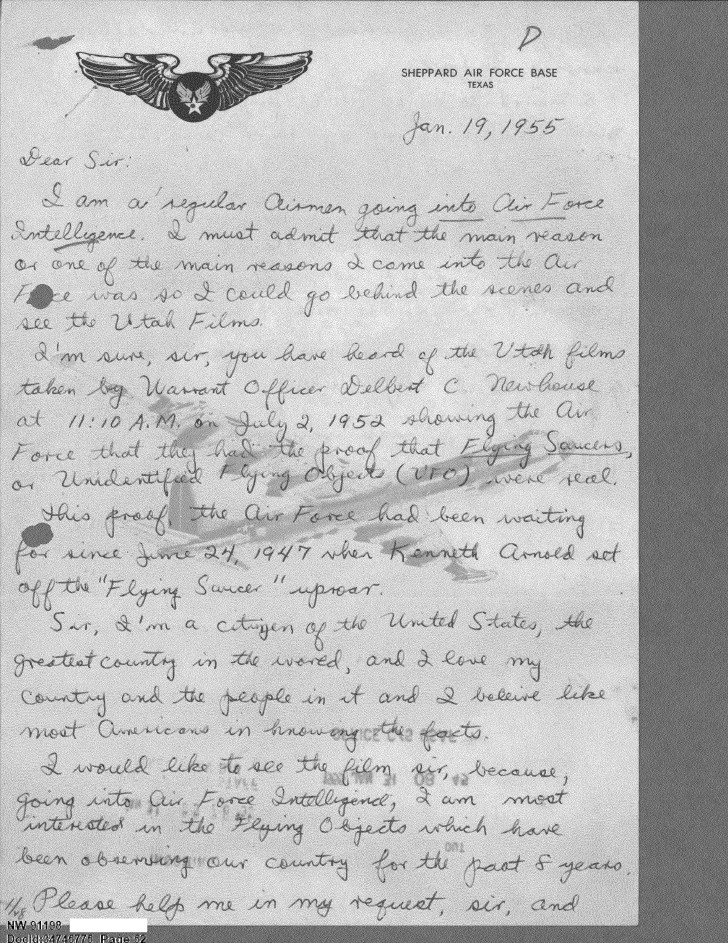
DOW-UAP-D096, Correspondence Relating to Project Blue Book, 1955
255_413270_UFO's_and_Defense_What_Should_we_Prepare_For
65_HS1-834228961_62-HQ-83894_Section_009
65_HS1-834228961_62-HQ-83894_Serial_164
CIA-UAP-002, Scientific Advisory Panel on Unidentified Flying Objects, Report, 1952-1953
Casos relacionados
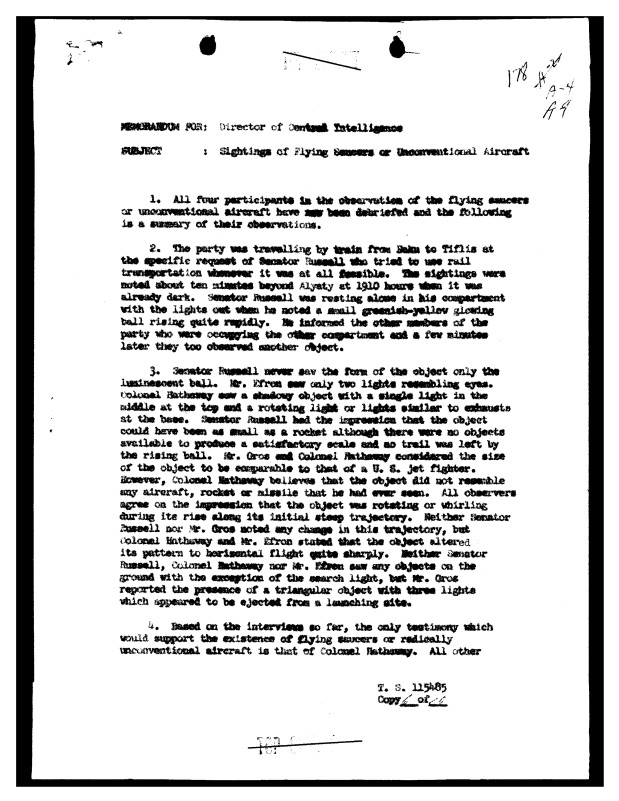
CIA-UAP-D020, Memorando sobre avistamientos de aeronaves no convencionales, 1955
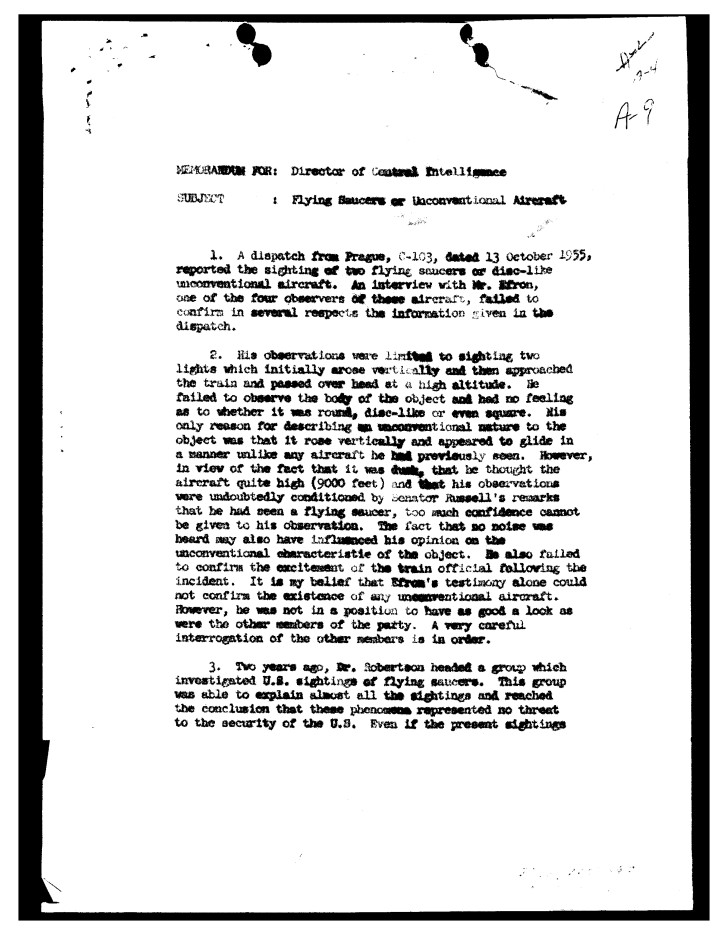
CIA-UAP-D021, Análisis de avistamientos de aeronaves no convencionales, 1955
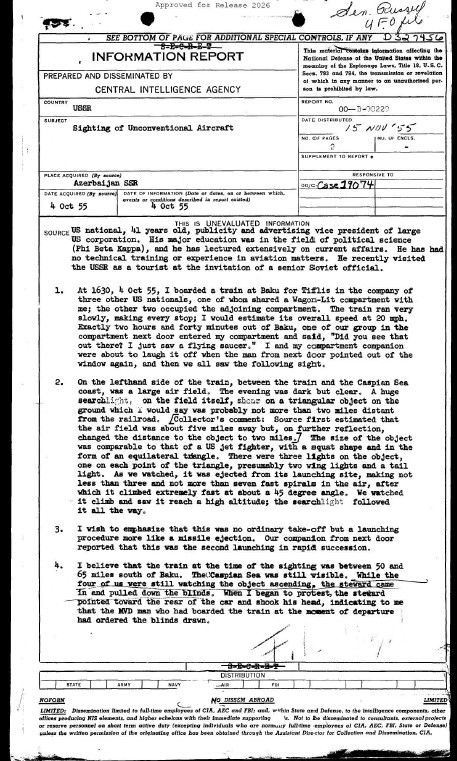
CIA-UAP-006, Avistamiento de aeronave no convencional
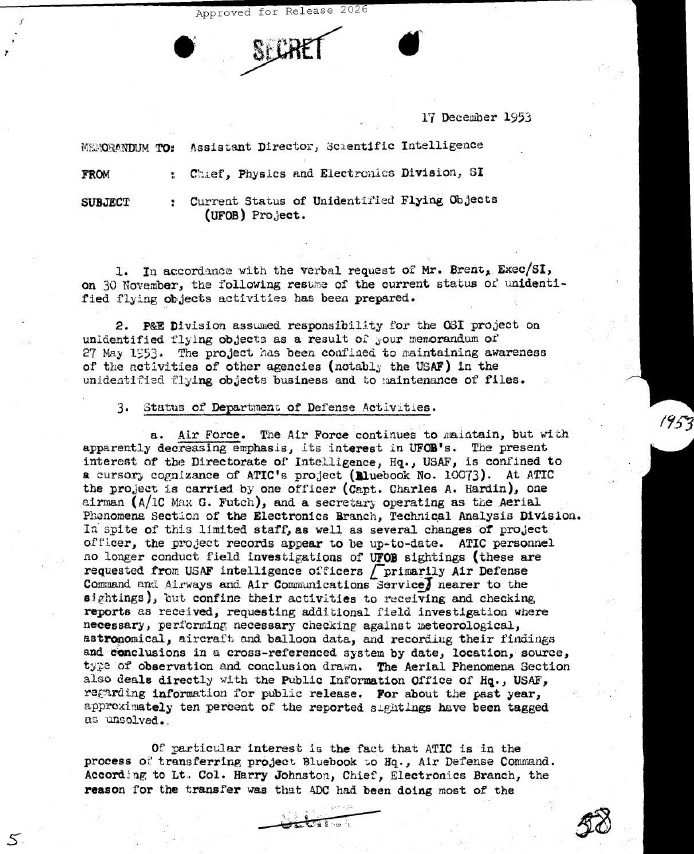
CIA-UAP-007, Estado actual del proyecto sobre objetos voladores no identificados (OVNI)
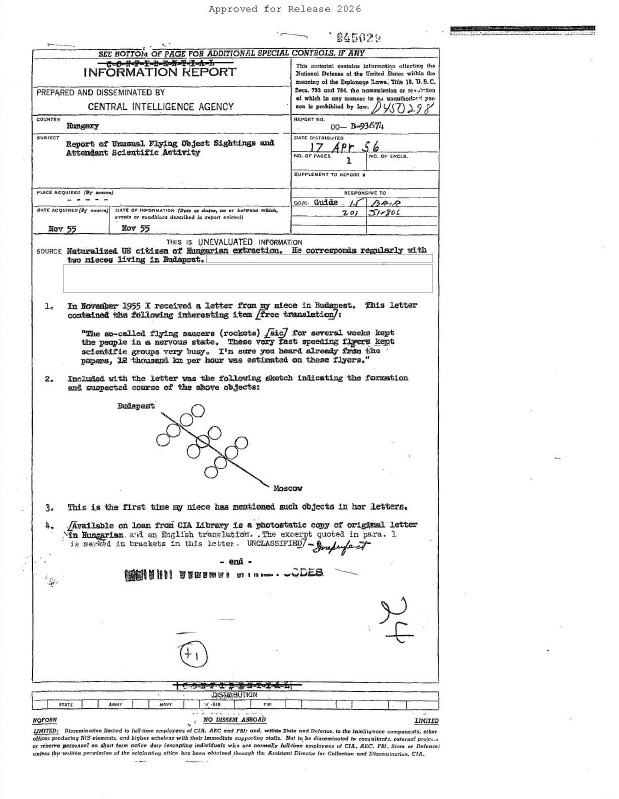
CIA-UAP-013, Informe de avistamientos de objetos voladores inusuales y actividad científica asociada
Misma serie de expedientes
CIA-UAP-002, Panel Asesor Científico sobre Objetos Voladores No Identificados, Informe, 1952-1953
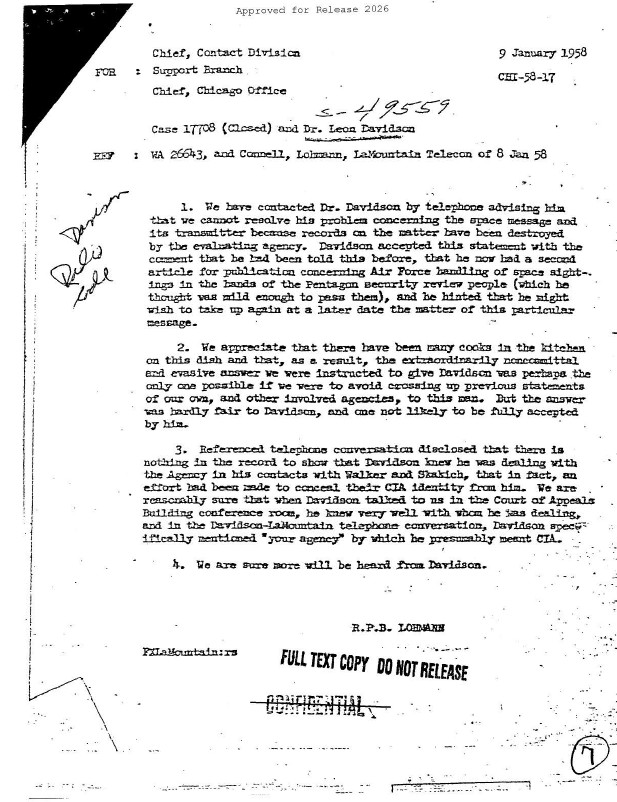
CIA-UAP-004, CASO 17708 (CERRADO) y el Dr. Leon Davidson
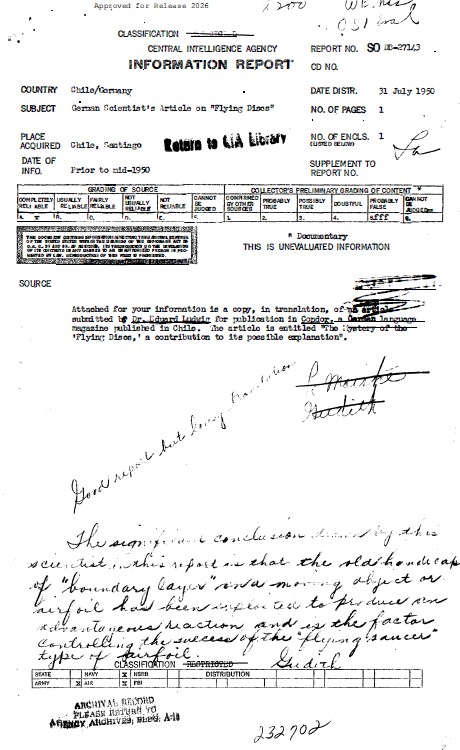
CIA-UAP-005, Artículo de un científico alemán sobre los “discos voladores”
CIA-UAP-006, Avistamiento de aeronave no convencional
CIA-UAP-007, Estado actual del proyecto sobre objetos voladores no identificados (OVNI)
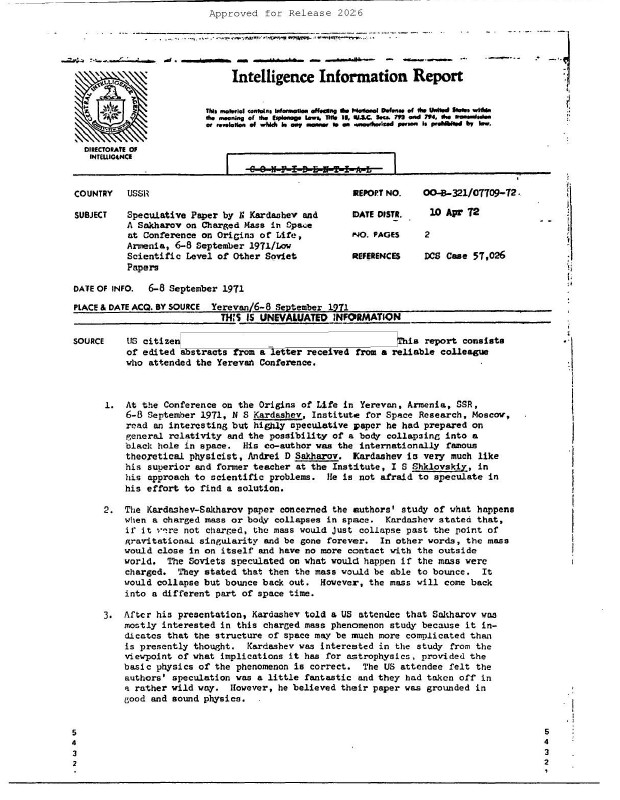
CIA-UAP-008, Ponencia especulativa de N. Kardashev y A. Sájarov sobre masa cargada en el espacio, en la Conferencia sobre el Origen de la Vida, Armenia, 6-8 de septiembre de 1971 / Bajo nivel científico de otras ponencias soviéticas
Mismo release
FBI-UAP-D011, Remisión de correspondencia del Director del FBI, 1949
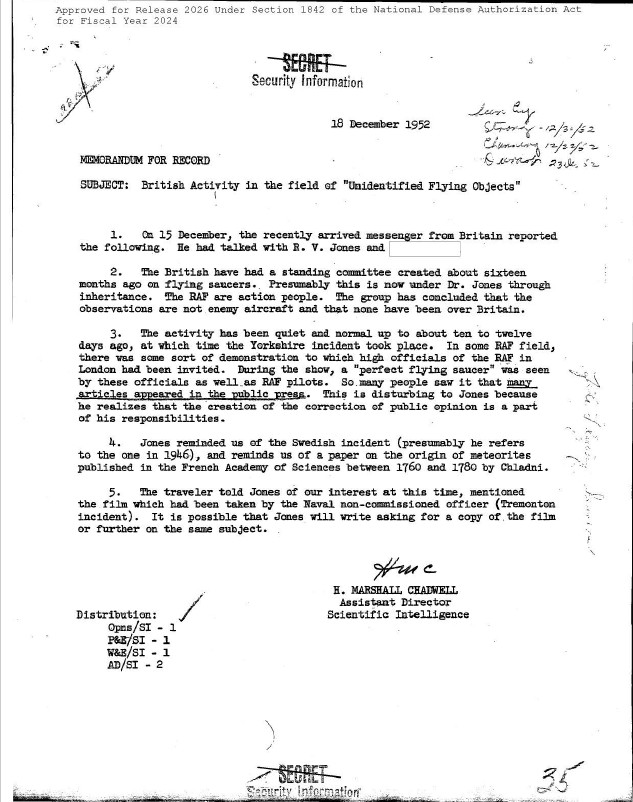
CIA-UAP-014, Actividad británica en el campo de los “objetos voladores no identificados”
FBI-UAP-D012, Oficina de Campo de Newark, 1952-1967
FBI-UAP-D013, Investigación de “OVNIs” en el estado de Washington, 1952-1960
DOW-UAP-D085, Transmisión del informe del Panel Asesor Científico de la CIA, 1953
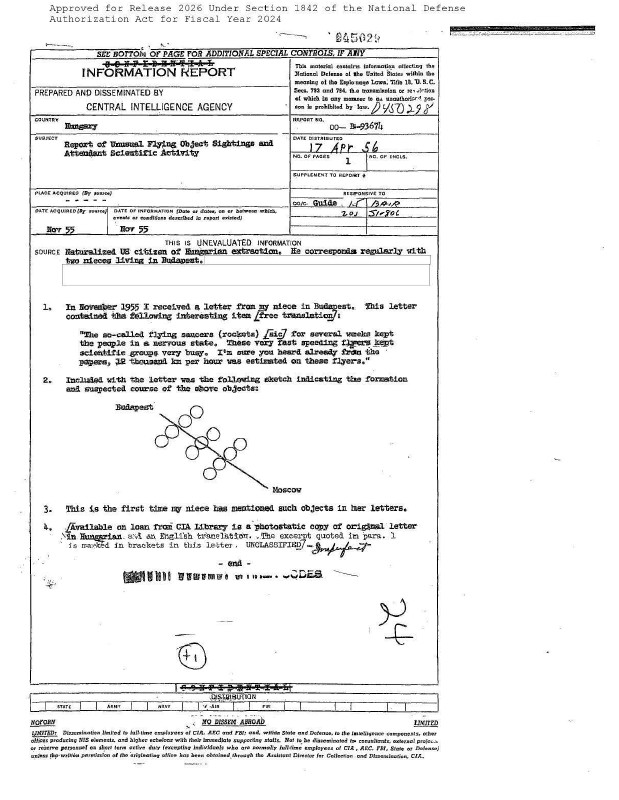
CIA-UAP-018, Informe de avistamientos de objetos voladores inusuales y actividad científica asociada
Misma agencia
CIA-UAP-D020, Memorando sobre avistamientos de aeronaves no convencionales, 1955
CIA-UAP-D021, Análisis de avistamientos de aeronaves no convencionales, 1955
CIA-UAP-013, Informe de avistamientos de objetos voladores inusuales y actividad científica asociada
CIA-UAP-009, Objetos voladores desconocidos observados sobre Budapest
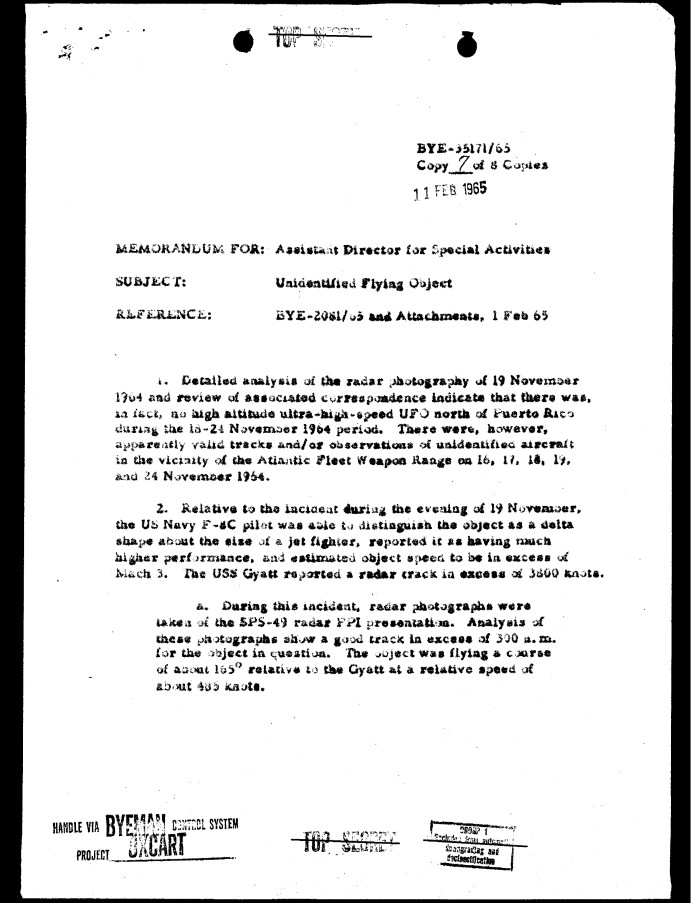
CIA-UAP-D022, Objeto volador no identificado reportado cerca de Puerto Rico, 1965