
File UFO: affaticamento equipaggi Aeroflot, 1976
File ufficiale: CIA-UAP-012, Contrastare l'affaticamento dei membri dell'equipaggio
Pubblicato il · Aggiornato il
Dati principali
- ID ufficiale del fascicolo
- CIA-UAP-12 (citato come CIA-UAP-012 in questa scheda)
- Tipo di documento
- Documento
- Agenzia
- CIA
- Pubblicato in
- R03 · 2026-06-12
- Data dell'incidente
- November, 1976
- Luogo dell'incidente
- Pagine leggibili
- 2/2
- VIRIN
- 260508-O-D0360-1089
Descrizione ufficiale
Questo rapporto informativo di intelligence estera della CIA, del novembre 1976, riassume il coinvolgimento della sovietica Aeroflot nella ricerca in medicina aerospaziale, comprese le sue metodologie per contrastare l'affaticamento dell'equipaggio mediante il condizionamento fisico, apparecchiature automatizzate per test biologici in grado di misurare i parametri vitali in 1-3 minuti, e discussioni sul fenomeno UFO con un biologo sovietico specializzato in radiazioni. Una versione con più omissis di questo rapporto è disponibile sul sito web pubblico della CIA.
✦ Riassunto IA
CIA-UAP-012 è un Foreign Intelligence Information Report della CIA declassificato (Domestic Collection Division, Directorate of Operations), n. DO-B-321/33474-76, datato 10 novembre 1976, paese URSS, oggetto 'Combating Fatigue in Crewmembers/Aeroflot Work Cycles/Use of Drugs/Biological Effects of Aircraft Noise'. La riga dei riferimenti elenca tra gli altri 'Radiation Research/UFO Phenomena' ed è contrassegnato come informazione non valutata. Il rapporto afferma che i funzionari dell'Aeroflot sono attivi nella ricerca medica aerospaziale. Il dott. Oral Georgiyevich Akoyev, biologo specializzato in radiazioni, ha spiegato che particelle di raggi cosmici (fosfeni) fanno 'vedere' ai piloti dell'Aeroflot lampi di luce durante il volo notturno. Il testo prosegue dicendo che Akoyev chiese un'opinione personale sul fenomeno UFO e gli fu risposto che il 99 per cento di tali episodi era riconducibile a fenomeni naturali o artificiali, come movimenti celesti, aeromobili o satelliti artificiali, e che l'altro 1 per cento non poteva essere spiegato, forse un'allucinazione; Akoyev chiese allora se qualcosa potesse venire dallo spazio. Il dott. Akutin dell'Istituto dell'Aviazione Civile di Leningrado ha sviluppato prototipi di apparecchiature automatiche per il collaudo dei piloti che misurano pressione sanguigna, frequenza cardiaca, elettrocardiogramma e reazione motoria; un test completo dura circa tre minuti. Il rapporto descrive anche tre approcci dell'Aeroflot alla fatica degli equipaggi: condizionamento fisico con strutture per l'esercizio nei principali aeroporti, test approfondito di ogni membro dell'equipaggio prima del volo (chi non lo supera non può volare) e un 'profilattorio', un edificio di riposo presso ogni grande aeroporto. Il testo della pagina 1 si interrompe a metà della descrizione di tale struttura.
Generato con IA dal file ufficiale — può contenere errori.
▸Trascrizione(2 di 2 pagine leggibili)
[PAGE 1] Approved for [release] — Domestic Collection Division, Foreign Intelligence Information Report. DIRECTORATE OF OPERATIONS. COUNTRY: USSR. DCD REPORT NO. DO-B-321/33474-76. SUBJECT: Combating Fatigue in Crewmembers/Aeroflot Work Cycles/Use of Drugs/Biological Effects of Aircraft Noise. DATE DISTR.: 10 November 1976. NO. PAGES: 4. SOURCE: [redacted]. REFERENCES: Radiation Research/UFO Phenomena, Prototype Pilot Biological Psychomotor [testing], [Inertial?] Navigation. THIS IS UNEVALUATED INFORMATION. SUMMARY: Aeroflot officials are actively involved in aerospace medical research. They are concerned with the medical aspects of physical conditioning which impinge upon crewmember performance and have perfected several devices which test pilot biological functioning and motor response ability. Dr. Oral Georgiyevich Akoyev, a noted radiation biologist, explained cosmic ray particles (phosphenes) which are causing Aeroflot pilots to "see" flashes of light during night flying. Dr. [fnu] Akutin, [chemist?] at the Civil Aviation Institute of Leningrad, showed a prototype pilot biological psychomotor testing equipment [device] which measures blood pressure, pulse rate, cardiovascular function and motor ability. The equipment is automatic and testing is completed in approximately three minutes. The Soviets deal with crewmember fatigue in several ways. First, they emphasize and promote physical conditioning. If a crewmember is physically fit, he will be less prone to fatigue and will recover sooner after tiring flights. Aeroflot provides exercise facilities at all major airports, and these facilities are supervised by a well-known athlete. The second thing they do is thoroughly test each crewmember prior to flight to insure his physical fitness and mental alertness. At the present time, these tests are conducted by a medical team headed by a doctor, usually a woman. A crewmember is not allowed to fly if he fails the examination. These tests are now being automated and will take only 1-3 minutes when the prototype equipment becomes operational. Finally, there is a third approach Aeroflot is using — a prophylactorium. Each major airport has one, a 3- to 4-story building set off from the main airport buildings, but easily accessible by foot. These facilities are well landscaped and are designed to provide total rest and relaxation for transient crewmembers. They have a large kitchen [text ends/truncated]. [PAGE 2] 10. | — C—O ta DFA — | 008-321/35474~76 Dr AKeyey asked for. personal opinion of the QFO pheromencr, He was teld thar 99 percent of these occurrences were tracegble to either nacural or man-made phenomena such as celesctal movement, air- cratt or artificial satellices, and thac the other one percent cannot he explained--possibly an hallucination. Akoyev then asked, “Do you think it is possible...could there be somezhing coming’ frum cuter space?" Dr [fauj Akutin, w cybernecicist at the Civil Aviation Instituce of Leningrad. has developed several prototypes of pilot cresting eyuipmenc. The equi:vent is planned to replace most of the currenc ducies of mediccl nersonnel who examine pilots prior to flight. The automatic devices will be installed in ali airport flight operations facilicies. Akucin and his Igsociaras lenonstrated | |a sec of instruments which automac- {feally mereure a pilot's blood pressure and pulse rate, cecord his cardio- vaseuhsi: taneniening with aelectcc tardiogram, ened test his motor reaction process. The device is activated by inserting a small metallic plate into the testing machine. The plate, one of which is carried by each crewmember, contains a biological baseline on that particular individual. His normal blood pressure, pulse rate, electrocardiogram, and motor ability are coded into the metal place. This plate is updated annually,or more often if required. After rhe plate is inserted into the machine, the pilot places the middle finger of each hand into two little holes and rests his wrists on two small metal plates on a table. Small, automatic pneumatic cups close around the fingers and inflate. The machine then measures the blood pressure and pulse rate by comparing the two fingers, computing a mean, and then comparing the result with the encoded information on the pilot's plate. The systolic and diastolic blood pressure and pulse rate are chen displayen on the face of che machine in an electronic digital form. At the same tixe the machine automatically administers an electrocardiogram “across the heart" and displays this on a cathode-ray tube. If any of these values 2. outside the normal standazd for that particular individual, a light illui.. tates and further examination is required by a medical doctor. If no lighter ‘Alluminates, the pilot is passed. The pilot then faces a panel of red and green colored lights. On the panci are green and red colored bntrons. The lights begin to illuminate in a random fashion, with the pilot being required to press the corresponding color button immediately to extinouish the colored light. This test continues for approximately 20-30 seconds, during which the lights flash in 6 random sequence. At the end of the testing period, the machine scores the pilot's performance and digitally displays his score in the number of correct and wrong responses. If he. scores as high or higher than his standard, he is passed; if his score is lower, a light illuminates ana further examinacion is required by a medical doctor. There are three separate programs which are randomly selected, making it impossible to memorize the sequence of the lights. Finally, the pilot is seated before a minfature cockpit with a control stick and an attitude indicator. The.control stick must be moved to keep the attitude indicator (artificial horizon) ‘straight and level. The indicator pitches up and down and From side to side and very closely dupii- cates actual instrument flying conditions. The control stick also closely approximated necessary pilot skilis.’ At the end of this tesr, the score is again displayed and, depending upon his standard, a pilot passes or fails. The entire sequence of testing, from ‘taking blood pressure to the control stick evaluation, takes approximately three minutes. If a pilot passes all phases, his personal profile plate along with a certiii- cate card is returned to him. He must present the certificate card to the flight dispatcher before he ia allowed to board the aircraft. ‘Roa oO
Generato con IA dal file ufficiale — può contenere errori.
Traduzione automatica — il documento originale è in inglese. Vedi in inglese →
Fonte: Dipartimento della Guerra degli Stati Uniti / AARO — pubblico dominio · war.gov/ufo
Entità in questo documento
Casi collegati
341_110677_Numerical_File,_5-2500
CIA-UAP-010, Report on Conversations with Soviet Scientists on Subject of Unidentified Flying Objects in the USSR
CIA-UAP-011, The Sary Shagan Weapons Testing Range
CIA-UAP-D001, Intelligence Information Report, USSR, 1973

DOW-UAP-D161, Air Intelligence Information Report, Alaska, 1953
Casi correlati
Corrispondenza FBI su avvistamenti UFO, 1967-1974
Memorandum CIA su un UFO a Porto Rico, 1964
Briefing CIA: UFO a Porto Rico, USS Gyatt, 1964
Memorandum CIA: UFO visto da un treno, 1955
Analisi CIA dell’UFO visto da un treno, 1955
Panel Robertson: rapporti UFO della CIA, 1952-53
Stessa serie di fascicoli
Panel Robertson: rapporti UFO della CIA, 1952-53
Storia CIA di U-2 e OXCART, con capitolo UFO
Memo CIA sul ricercatore UFO Leon Davidson, 1958
Teoria UFO di uno scienziato tedesco, CIA, 1950
Rapporto CIA: UFO triangolari a Baku, 1955
Memo CIA sul progetto UFO dell'USAF, 1953
Stessa pubblicazione
Segnalazione UFO del reverendo Barnes a Hoover, 1949
Fascicolo FBI di Newark su UFO nel New Jersey, 1952
Fascicolo FBI Flying Discs: UFO nello stato di Washington
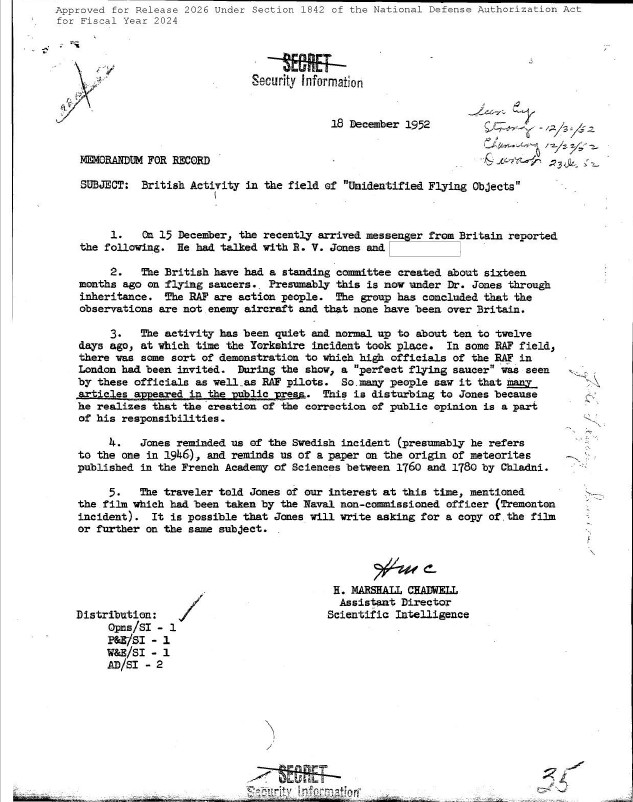
Memo CIA sulle indagini UFO britanniche, 1952
Rapporto UFO del Panel Robertson alla Difesa, 1953
Avvistamento UFO in Ungheria da una lettera, CIA, 1955
Stessa agenzia
Analisi CIA dell’UFO visto da un treno, 1955
Memorandum CIA: UFO visto da un treno, 1955
Avvistamenti UFO a Budapest con schizzo, CIA, 1956
Avvistamenti UFO su Budapest, rapporto CIA, 1957
Memorandum CIA su un UFO a Porto Rico, 1964