
Arquivos OVNI: fadiga de tripulações da Aeroflot, 1976
Arquivo oficial: CIA-UAP-012, Combate à Fadiga em Tripulantes
Publicado em · Atualizado em
Dados principais
- ID oficial do arquivo
- CIA-UAP-12 (citado como CIA-UAP-012 neste arquivo)
- Tipo de documento
- Documento
- Agência
- CIA
- Publicado em
- R03 · 2026-06-12
- Data do incidente
- November, 1976
- Local do incidente
- Páginas legíveis
- 2/2
- VIRIN
- 260508-O-D0360-1089
Descrição oficial
Este Relatório de Informação de Inteligência Estrangeira da CIA de novembro de 1976 resume o envolvimento da Aeroflot soviética em pesquisas de medicina aeroespacial, incluindo seus métodos de combate à fadiga da tripulação por meio de condicionamento físico, equipamentos automatizados de testes biológicos capazes de medir sinais vitais em 1 a 3 minutos, e discussões sobre fenômenos de OVNIs com um biólogo especializado em radiação soviético. Uma versão mais censurada deste relatório está disponível no site público da CIA.
✦ Resumo IA
CIA-UAP-012 é um Foreign Intelligence Information Report da CIA desclassificado (Domestic Collection Division, Directorate of Operations), n.º DO-B-321/33474-76, datado de 10 de novembro de 1976, país URSS, assunto 'Combating Fatigue in Crewmembers/Aeroflot Work Cycles/Use of Drugs/Biological Effects of Aircraft Noise'. A linha de referências lista 'Radiation Research/UFO Phenomena' entre outros temas, e o documento está marcado como informação não avaliada. O relatório diz que os funcionários da Aeroflot atuam em pesquisa médica aeroespacial. O Dr. Oral Georgiyevich Akoyev, biólogo especialista em radiação, explicou que partículas de raios cósmicos (fosfenos) fazem os pilotos da Aeroflot 'verem' clarões de luz durante o voo noturno. O texto continua dizendo que Akoyev pediu uma opinião pessoal sobre o fenômeno OVNI e foi informado de que 99 por cento dessas ocorrências podiam ser atribuídas a fenômenos naturais ou artificiais, como movimentos celestes, aeronaves ou satélites artificiais, e que o 1 por cento restante não podia ser explicado, possivelmente uma alucinação; Akoyev então perguntou se algo poderia vir do espaço sideral. O Dr. Akutin, do Instituto de Aviação Civil de Leningrado, desenvolveu protótipos de equipamentos automáticos de teste de pilotos que medem pressão arterial, pulso, eletrocardiograma e reação motora; um teste completo leva cerca de três minutos. O relatório descreve ainda três abordagens da Aeroflot contra a fadiga das tripulações: condicionamento físico com instalações de exercício nos principais aeroportos, teste minucioso de cada tripulante antes do voo (quem é reprovado não pode voar) e um 'profilatório', um edifício de descanso em cada grande aeroporto. O texto da página 1 termina no meio da descrição dessa instalação.
Gerado com IA a partir do arquivo oficial — pode conter erros.
▸Transcrição(2 de 2 páginas legíveis)
[PAGE 1] Approved for [release] — Domestic Collection Division, Foreign Intelligence Information Report. DIRECTORATE OF OPERATIONS. COUNTRY: USSR. DCD REPORT NO. DO-B-321/33474-76. SUBJECT: Combating Fatigue in Crewmembers/Aeroflot Work Cycles/Use of Drugs/Biological Effects of Aircraft Noise. DATE DISTR.: 10 November 1976. NO. PAGES: 4. SOURCE: [redacted]. REFERENCES: Radiation Research/UFO Phenomena, Prototype Pilot Biological Psychomotor [testing], [Inertial?] Navigation. THIS IS UNEVALUATED INFORMATION. SUMMARY: Aeroflot officials are actively involved in aerospace medical research. They are concerned with the medical aspects of physical conditioning which impinge upon crewmember performance and have perfected several devices which test pilot biological functioning and motor response ability. Dr. Oral Georgiyevich Akoyev, a noted radiation biologist, explained cosmic ray particles (phosphenes) which are causing Aeroflot pilots to "see" flashes of light during night flying. Dr. [fnu] Akutin, [chemist?] at the Civil Aviation Institute of Leningrad, showed a prototype pilot biological psychomotor testing equipment [device] which measures blood pressure, pulse rate, cardiovascular function and motor ability. The equipment is automatic and testing is completed in approximately three minutes. The Soviets deal with crewmember fatigue in several ways. First, they emphasize and promote physical conditioning. If a crewmember is physically fit, he will be less prone to fatigue and will recover sooner after tiring flights. Aeroflot provides exercise facilities at all major airports, and these facilities are supervised by a well-known athlete. The second thing they do is thoroughly test each crewmember prior to flight to insure his physical fitness and mental alertness. At the present time, these tests are conducted by a medical team headed by a doctor, usually a woman. A crewmember is not allowed to fly if he fails the examination. These tests are now being automated and will take only 1-3 minutes when the prototype equipment becomes operational. Finally, there is a third approach Aeroflot is using — a prophylactorium. Each major airport has one, a 3- to 4-story building set off from the main airport buildings, but easily accessible by foot. These facilities are well landscaped and are designed to provide total rest and relaxation for transient crewmembers. They have a large kitchen [text ends/truncated]. [PAGE 2] 10. | — C—O ta DFA — | 008-321/35474~76 Dr AKeyey asked for. personal opinion of the QFO pheromencr, He was teld thar 99 percent of these occurrences were tracegble to either nacural or man-made phenomena such as celesctal movement, air- cratt or artificial satellices, and thac the other one percent cannot he explained--possibly an hallucination. Akoyev then asked, “Do you think it is possible...could there be somezhing coming’ frum cuter space?" Dr [fauj Akutin, w cybernecicist at the Civil Aviation Instituce of Leningrad. has developed several prototypes of pilot cresting eyuipmenc. The equi:vent is planned to replace most of the currenc ducies of mediccl nersonnel who examine pilots prior to flight. The automatic devices will be installed in ali airport flight operations facilicies. Akucin and his Igsociaras lenonstrated | |a sec of instruments which automac- {feally mereure a pilot's blood pressure and pulse rate, cecord his cardio- vaseuhsi: taneniening with aelectcc tardiogram, ened test his motor reaction process. The device is activated by inserting a small metallic plate into the testing machine. The plate, one of which is carried by each crewmember, contains a biological baseline on that particular individual. His normal blood pressure, pulse rate, electrocardiogram, and motor ability are coded into the metal place. This plate is updated annually,or more often if required. After rhe plate is inserted into the machine, the pilot places the middle finger of each hand into two little holes and rests his wrists on two small metal plates on a table. Small, automatic pneumatic cups close around the fingers and inflate. The machine then measures the blood pressure and pulse rate by comparing the two fingers, computing a mean, and then comparing the result with the encoded information on the pilot's plate. The systolic and diastolic blood pressure and pulse rate are chen displayen on the face of che machine in an electronic digital form. At the same tixe the machine automatically administers an electrocardiogram “across the heart" and displays this on a cathode-ray tube. If any of these values 2. outside the normal standazd for that particular individual, a light illui.. tates and further examination is required by a medical doctor. If no lighter ‘Alluminates, the pilot is passed. The pilot then faces a panel of red and green colored lights. On the panci are green and red colored bntrons. The lights begin to illuminate in a random fashion, with the pilot being required to press the corresponding color button immediately to extinouish the colored light. This test continues for approximately 20-30 seconds, during which the lights flash in 6 random sequence. At the end of the testing period, the machine scores the pilot's performance and digitally displays his score in the number of correct and wrong responses. If he. scores as high or higher than his standard, he is passed; if his score is lower, a light illuminates ana further examinacion is required by a medical doctor. There are three separate programs which are randomly selected, making it impossible to memorize the sequence of the lights. Finally, the pilot is seated before a minfature cockpit with a control stick and an attitude indicator. The.control stick must be moved to keep the attitude indicator (artificial horizon) ‘straight and level. The indicator pitches up and down and From side to side and very closely dupii- cates actual instrument flying conditions. The control stick also closely approximated necessary pilot skilis.’ At the end of this tesr, the score is again displayed and, depending upon his standard, a pilot passes or fails. The entire sequence of testing, from ‘taking blood pressure to the control stick evaluation, takes approximately three minutes. If a pilot passes all phases, his personal profile plate along with a certiii- cate card is returned to him. He must present the certificate card to the flight dispatcher before he ia allowed to board the aircraft. ‘Roa oO
Gerado com IA a partir do arquivo oficial — pode conter erros.
Tradução automática — o documento original está em inglês. Ver em inglês →
Fonte: Departamento de Guerra dos EUA / AARO — domínio público · war.gov/ufo
Entidades neste documento
Casos conectados
341_110677_Numerical_File,_5-2500
CIA-UAP-010, Report on Conversations with Soviet Scientists on Subject of Unidentified Flying Objects in the USSR
CIA-UAP-011, The Sary Shagan Weapons Testing Range
CIA-UAP-D001, Intelligence Information Report, USSR, 1973

DOW-UAP-D161, Air Intelligence Information Report, Alaska, 1953
Casos relacionados
Correspondência do FBI sobre OVNIs, 1967-1974
Memorandos da CIA sobre OVNI em Porto Rico, 1964
Briefing da CIA: OVNI em Porto Rico, USS Gyatt, 1964
Memorando da CIA: OVNI visto de um trem, 1955
Análise da CIA do OVNI visto de um trem, 1955
Painel Robertson: relatórios OVNI da CIA, 1952-53
Mesma série de arquivos
Painel Robertson: relatórios OVNI da CIA, 1952-53
História do U-2 e OXCART da CIA, com capítulo OVNI
Memorando da CIA sobre Leon Davidson, OVNI, 1958
Teoria OVNI de cientista alemão, relatório da CIA, 1950
Relatório da CIA: OVNIs triangulares em Baku, 1955
Memorando da CIA sobre o projeto OVNI da USAF, 1953
Mesma publicação
Relato OVNI do reverendo Barnes a Hoover, 1949
Arquivo do FBI de Newark sobre OVNI em Nova Jersey, 1952
Arquivo Flying Discs do FBI: OVNI em Washington, 1952-60
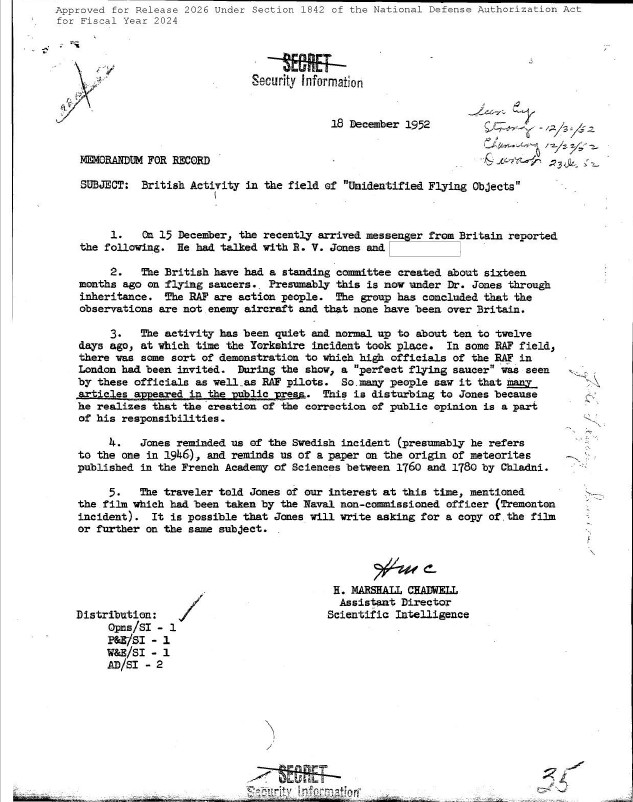
Memorando da CIA sobre investigações OVNI britânicas, 1952
Relatório OVNI do Painel Robertson à Defesa, 1953
Avistamento OVNI na Hungria em carta, relatório CIA, 1955
Mesma agência
Análise da CIA do OVNI visto de um trem, 1955
Memorando da CIA: OVNI visto de um trem, 1955
Avistamentos OVNI em Budapeste com esboço, CIA, 1956
Avistamentos de OVNIs sobre Budapeste, CIA, 1957
Memorandos da CIA sobre OVNI em Porto Rico, 1964