NASA-UAP-D029, Débriefing médical d'équipage Apollo 17 (suite), 1972
Faits essentiels
Description officielle
Ce dossier contient le segment 2 sur 2 du débriefing médical post-mission d'Apollo 17 au Manned Spacecraft Center (aujourd'hui Johnson Space Center), à Houston, au Texas. Dans ce segment de suite, les membres d'équipage et les responsables du débriefing poursuivent leur discussion sur les « phénomènes de flashs lumineux », un effet biologique alors nouveau, aujourd'hui bien documenté, dans lequel des rayons cosmiques de haute énergie traversent l'œil et frappent la rétine, provoquant la perception de traînées ou d'éclairs lumineux. Deux des trois membres d'équipage ont signalé avoir observé ces flashs à divers moments de la mission, notamment en orbite lunaire et à la surface de la Lune.
✦ Résumé IA
Il s'agit du segment 2 sur 2 du débriefing technique/médical post-mission d'Apollo 17 au Manned Spacecraft Center, à Houston. Contrairement à une discussion à plusieurs voix, ce segment consiste en grande partie en un débriefing individuel et structuré mené par le pilote du module lunaire Harrison 'Jack' Schmitt, qui parcourt des points numérotés de l'ordre du jour : critique du fichier de données de vol, soutien pré-vol, observations visuelles, planification pré-mission, soutien du contrôle de mission, et facteurs humains (alimentation, hygiène, sommeil). La discussion sur le phénomène des éclairs lumineux apparaît brièvement sous 'Observations Visuelles' : Schmitt rapporte que des éclairs se sont produits presque continuellement en vol dès qu'il était adapté à l'obscurité, se souvient d'un éclair qu'il pense avoir vu en observant la surface lunaire lors de la première révolution en orbite lunaire, et relève un écart frappant — aucun des trois membres d'équipage n'a remarqué d'éclairs pendant la période où ils portaient un bandeau pour l'expérience de l'alphabet en vol, les éclairs reprenant ce même soir avant qu'il ne s'endorme. Il ne tire pas de conclusion ferme de ce schéma avant de passer aux observations en orbite lunaire, qu'il renvoie à son carnet d'équipage et à la transcription de la mission.
Généré par IA à partir du fichier officiel — peut contenir des erreurs.
▸Transcription
[00:00] Take 14, continuing the debrief of section 23.0 (Flight Data File) with Lunar Module Pilot Jack Schmitt. Overall he has nothing but praise for the CSM/LM flight data file. One suggestion: the perforated, split pages used for medical and food logging were a mistake — too thin, they fell out of the book; recommends not splitting them, or using heavier paper. [01:31] The extra cue card built for panel 229, summarizing circuit-breaker functions for panels 229 and 8, was excellent though never actually needed in flight; he recommends keeping this kind of card available for training and sims. [02:11] He added his own pen-and-ink notes in the flight plan margins for personal observation targets, keyed to elapsed time — worked well as an individual-preference tool. Gordon Fullerton had prepared a similar circular orbital cue card marking craters by time, but Schmitt ended up not using it because he became familiar with lunar surface features very quickly after a couple of orbits and could navigate visually by looking out the window. [04:20] All flight data file items were excellent. He logged specific data (alignment data, etc.) directly in the checklist at the point of collection rather than in a separate data book, without any difficulty. The cuff checklist was excellent; its photo maps were useful for station reference, though used less than expected since navigation and the pre-selected investigation points worked out well on their own. The per-station item lists mainly served as memory joggers and, since the crew had grown so familiar with them from building the checklist, ended up functioning more as a training/learning tool than an in-flight reference. [06:53] Compliments Chuck Lewis on the Timeline Book — no problems with it at all; no procedural errors recalled in any of the checklists. The systems data book was pulled out only once, for a problem he can no longer recall; the malfunction book was never needed. [07:51] Charts and Maps: the CSM orbit monitor chart saw little use beyond some post-TEI sketching of about five labeled reference areas (A through E, tied to his crew notebook). Recommends the chart be identical to the CMP's chart (a few pen-and-ink updates were missing from his copy, causing brief confusion). The landmark/photo maps added at the back of the book were also little used in real time — he tended to jot notes rather than pause to sketch on photographs while observing a target — though he still considers this kind of pre-flight-studied reference material worth carrying even when not used heavily in flight. Notes the CMP made considerably more use of his own visual target maps, mostly post-TEI when there was more free time to sketch. [13:00] Section 23.5, Pre-flight support: rated excellent. He valued several dedicated pre-flight briefing sessions where flight planners walked him in detail through CSM attitudes, maneuvers, and window availability for lunar-orbit observations, letting him plan his personal observations efficiently — calls it above and beyond the call of duty. Also valued a day-long joint session with flight controllers, crew, and planners covering flight-plan portions not normally simulated; felt the Apollo 17 flight plan had reached 'the peak of perfection' compared to earlier missions. His one disappointment: some people who ended up intimately involved in the mission were not present at that flight-plan review, apparently due to scheduling conflicts with other programs at the center. [16:09] Section 24.0, Visual sightings: countdown, launch, powered flight, and earth-orbit weather/geographic observations were already covered in the transcript from earlier debriefing sessions. During trans-earth coast only a small crescent of Earth was visible, so extensive weather observation was not feasible. [16:58] Light flash phenomena: 'I don't know whether I recorded yet that although we had light flashes just about continuously during the whole flight when you were dark adapted, and I may have even had one which I thought was a flash on the lunar surface during the first rev.' He then describes one specific interval when flashes appeared to stop: during the period the crew wore blindfolds for the in-flight alphabet experiment, there were no visible flashes reported by himself or the other two crewmen; that same evening, the night before he went to sleep, he noticed he was seeing the light flashes again. He characterizes it as one bounded interval — the blindfolded period — in which the flash was not observed by any of the three crewmen, with flashes present on either side of that interval. He offers no further explanation for the gap before moving on. [17:55] Lunar orbit sightings: says the flight transcript and his crew notebook cover what he can remember at this point without going orbit-by-orbit and feature-by-feature against the photography — that level of detail, he says, has to come later. Entry, landing, and recovery were already covered in previous debriefing sessions. Recording is paused briefly ('why don't you stop for a second'). [18:33] Section 25.0, Pre-mission planning (LMP): hard to identify anything done wrong. Despite some pre-flight difficulty coordinating medical requirements and last-minute sample-related science requirements, everything was resolved well, largely through support crew Bob Parker (science) and Gordon Fullerton / Bob Overmyer (operations). No significant spacecraft changes occurred during training; the lunar sounder took up the most of Ron Evans's attention among equipment changes. Mission rules and techniques (Phil Shaffer's techniques group, Jerry Griffin's mission-rules group) were well defined early and changed only to open up mission-saving workarounds. The one case where a mission rule was a real controlling factor: the walk-back constraint cut work at Station 4 (Shorty Crater) short at 35 minutes; he believes another 30 minutes there would have been very valuable, though hopes enough data was gathered to understand the phenomena found at that crater. [22:35] Section 26.0, Mission Control: outstanding support throughout, including many off-duty hours (Saturdays and other times) LM and CSM (ECOM) flight controllers spent with him going over systems, techniques, and mission rules. Controllers essentially designed the Apollo 17 LM emergency cue cards, which — though never needed in flight — helped him quickly understand and solve systems problems in simulations. He singles out Dick Thorson for organizing LM and joint CSM/LM sessions and for leading creation and updating of the emergency cue cards. [24:53] Still under 26.0 (post-flight): notes that some things he had hoped for during the flight were not possible because of real-time discussion constraints in mission control — specifically, getting a summary of the ground science team's thinking on the data he had transmitted verbally and via television. He recommends a stronger 'team approach' to science investigation on future missions, using ground-based expertise ('brain power') rather than relying solely on the crew's own observational and interpretive judgment. [26:44] Section 27.0, Human factors (pre-flight): health-stabilization program logistics were mainly handled by the commander; Schmitt had no major difficulty complying. Medical care was good — a couple of sinus infections resolved normally over one to two weeks. Exercise time was somewhat limited but supplemented by EVA training workouts; the flight surgeon (Tex) later scheduled dedicated late-afternoon exercise time. He treats sleep as an individual matter and made a deliberate effort to stay ahead on rest, since in his experience fatigue was linked to his colds and sinus infections. [29:04] Medical exams (pre- and post-flight, including aboard USS Ticonderoga) were efficient and as painless as possible — credits the medical staff. Food intake was normal except right before launch on flight-type food, when appetite dropped; he also lost weight in flight, and his weight had still not returned to pre-flight levels by the time of this recording. [31:18] Food and appetite: broadly similar likes/dislikes in flight versus pre-flight; increasingly preferred wet-pack foods over rehydratables and solids as the flight progressed. After one early episode of loose bowel movements, he cut potassium-heavy foods and had no further loose movements in flight (though post-flight bowel movements aboard Ticonderoga alternated normal/loose). Appetite was lowest on day one, then rose and leveled off by about day three. Preferred foods: wet packs, juices, fruitcake, chocolate, crackers/cookies, and peanut butter and jelly. Avoided canned fruit (messy to eat), corn chowder and cocoa (gas and aftertaste), and shrimp/lobster bisque (long aftertaste). [42:39] Loose-stool and electrolyte discussion: considers loose stools a major operational and hygiene hazard that could cut a crew member's efficiency by as much as roughly 30% if the problem became chronic. Comparing Apollo 17 (the problem didn't appear until day 11-12, and never for the commander) with Apollo 16, he hypothesizes that Apollo 17's lower electrolyte intake delayed reaching an 'electrolyte saturation' threshold, beyond which excess electrolytes act like a laxative by drawing water into the intestine. Recommends Skylab reduce electrolyte intake to avoid the saturation point, and cut intake further if loose stools begin. [45:44] Water/food waste, odors, and comfort: chlorination odor was barely noticeable, slightly more so in the LM; no significant physical discomfort beyond occasional tiredness, EVA-related sore muscles, and bruised fingernails; never seriously thirsty even during EVAs, and never drank all the water in the in-suit drink bag. [46:59] Work, rest, and sleep: found the sleep aid (Seconal) usually unnecessary for falling asleep; tended to wake roughly an hour after falling asleep and periodically thereafter, with sleep rarely continuous for more than about three hours. Estimates he averaged five and a half to six hours of actual sleep per night, which he felt was adequate for the workload, though an eight-hour scheduled sleep period was needed to reliably obtain that six hours. He preferred some head and limb restraint to sleep well and would build smaller, snugger restraints if redesigning them. Identifies loss of positional (proprioceptive) sensation in the limbs in zero gravity — when limbs were held still — as one of the two biggest factors making sleep difficult; sensation returned immediately upon moving them. The recording ends abruptly mid-topic.
Généré par IA à partir du fichier officiel — peut contenir des erreurs.
Traduction automatique — le document original est en anglais. Voir en anglais →
Source : Département de la Guerre des États-Unis / AARO — domaine public · war.gov/ufo
Entités dans ce document
Dossiers reliés
NASA-UAP-D028, Apollo 17 Crew Medical Debriefing, 1972
NASA-UAP-D002, Apollo 17 Transcript, 1972
NASA-UAP-D006, Apollo 17 Technical Crew Debriefing, 1973
NASA-UAP-D008, Apollo 12 Medical Debriefing - Tape 12, 1969
NASA-UAP-D009, Apollo 17 Audio Excerpt, December 7, 1972
NASA-UAP-D024, “Apollo 16 Scientific Debriefing”
Affaires liées
Même lieu
NASA-UAP-D008, Interrogatoire médical de l’Apollo 12 - Bande 12, 1969
NASA-UAP-D026, Débriefing Apollo 14, 1971
NASA-UAP-D027, Débriefing Apollo 14 (suite), 1971
NASA-UAP-D028, Débriefing médical d'équipage Apollo 17, 1972
DOE-UAP-D005, Rapport d'incident sur un objet non identifié à Pantex, 2015
Même série de dossiers
NASA-UAP-D001, Transcription Apollo 12, 1969
NASA-UAP-D002, Transcription Apollo 17, 1972
NASA-UAP-D003, Transcription Gemini 7, 1965

NASA-UAP-D003A, Extrait audio Gemini 7, 1965
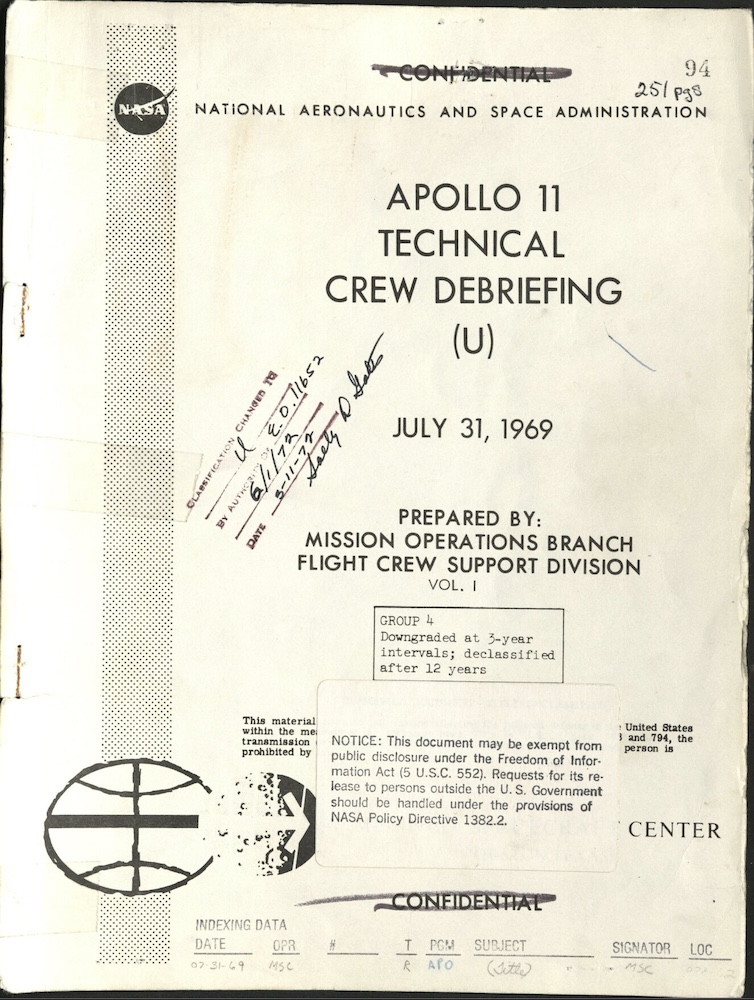
NASA-UAP-D004, Débriefing technique de l’équipage d’Apollo 11, 1969
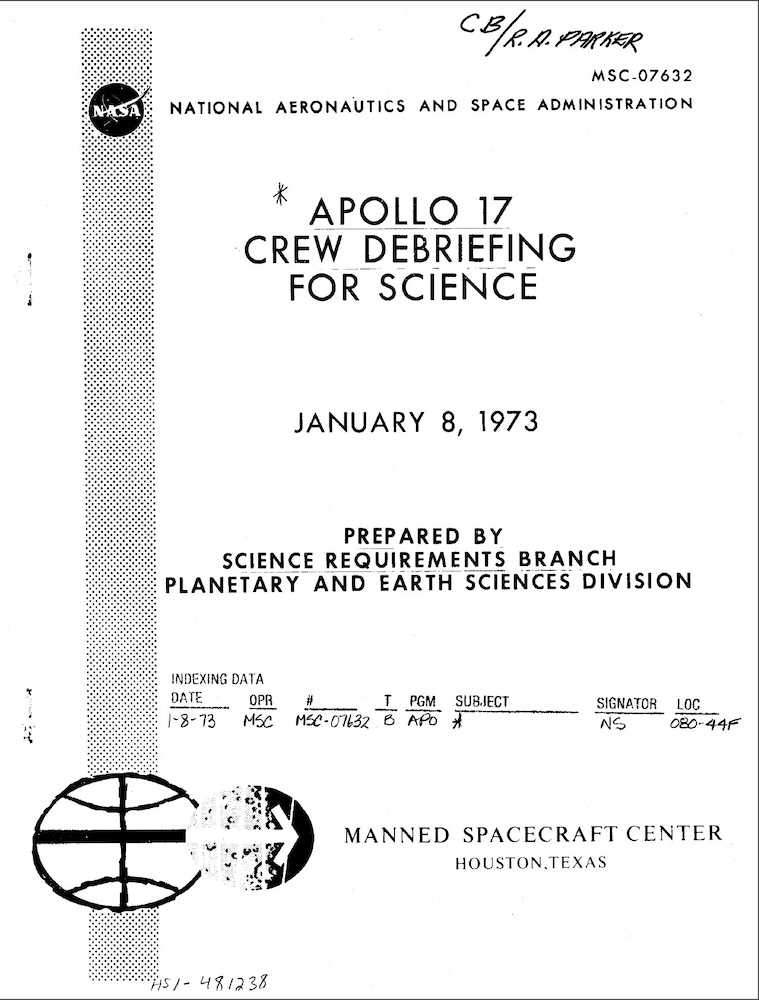
NASA-UAP-D005, Débriefing scientifique de l’équipage d’Apollo 17, 1973
Même période
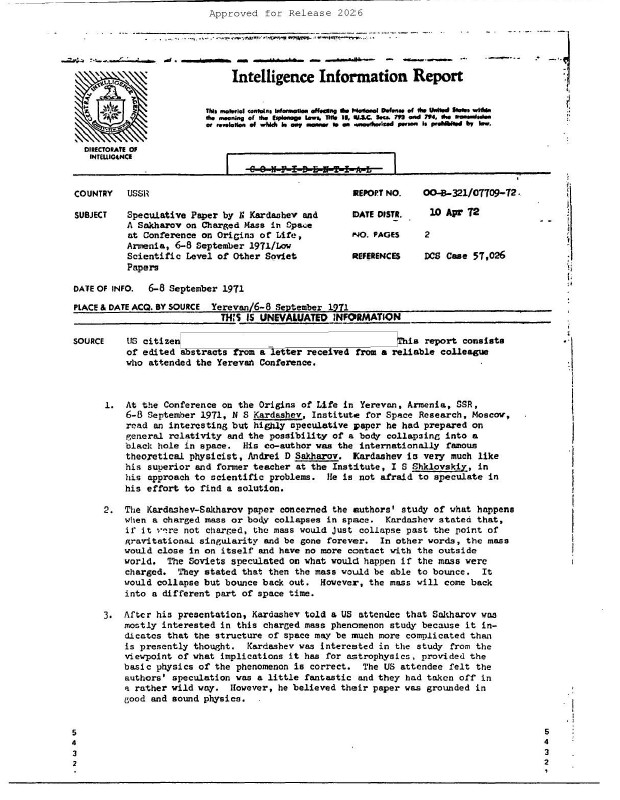
CIA-UAP-008, Article spéculatif de N. Kardashev et A. Sakharov sur la masse chargée dans l'espace lors de la conférence sur les origines de la vie, Arménie, 6-8 septembre 1971 / Faible niveau scientifique des autres articles soviétiques
NASA-UAP-D009, Extrait audio de l’Apollo 17, 7 décembre 1972
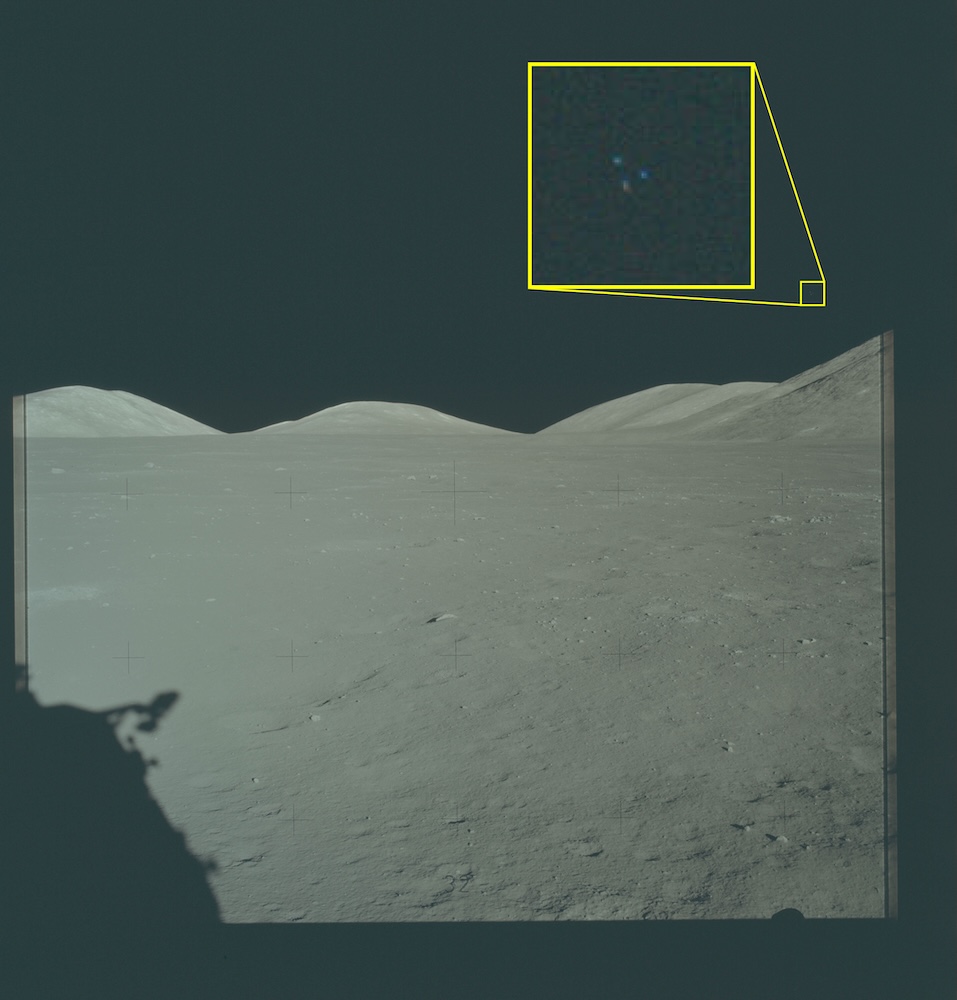
NASA-UAP-VM006, Apollo 17, 1972
Même publication
DOW-UAP-D093, Analyse des incidents liés à des objets volants aux États-Unis, 1948
DOW-UAP-D097, Rapport d'avancement du Project Sign, 1948
DOE-UAP-D004, Conférence de Los Alamos sur les phénomènes aériens, 1949
DOW-UAP-D094, Analyse des incidents liés à des objets volants aux États-Unis, 1949
CIA-UAP-D020, Mémorandum sur des observations d'aéronefs non conventionnels, 1955
CIA-UAP-D021, Analyse d'observations d'aéronefs non conventionnels, 1955
Même agence
NASA-UAP-D014, Mercury-Redstone 4, 21 juillet 1961
NASA-UAP-D012, Extrait audio de Mercury Atlas 8, 3 octobre 1962
NASA-UAP-D013, Mercury Atlas 7, 24 mai 1962
NASA-UAP-D015, Débriefings scientifiques d'astronautes, 1962-1963
NASA-UAP-D023, Extrait d'entretien avec l'astronaute Gordon Cooper, 1962