
DOW-UAP-D097, Rapport d'avancement du Project Sign, 1948
Faits essentiels
- ID officiel du dossier
- DOW-UAP-D97 (cité comme DOW-UAP-D097 dans cette fiche)
- Type de document
- Document
- Agence
- Department of War
- Publié dans
- R04 · 2026-07-10
- Date de l'incident
- 1948
- Lieu de l'incident
- Divers
- Pages lisibles
- 9/45
- VIRIN
- 260710-D-D0360-1082
Description officielle
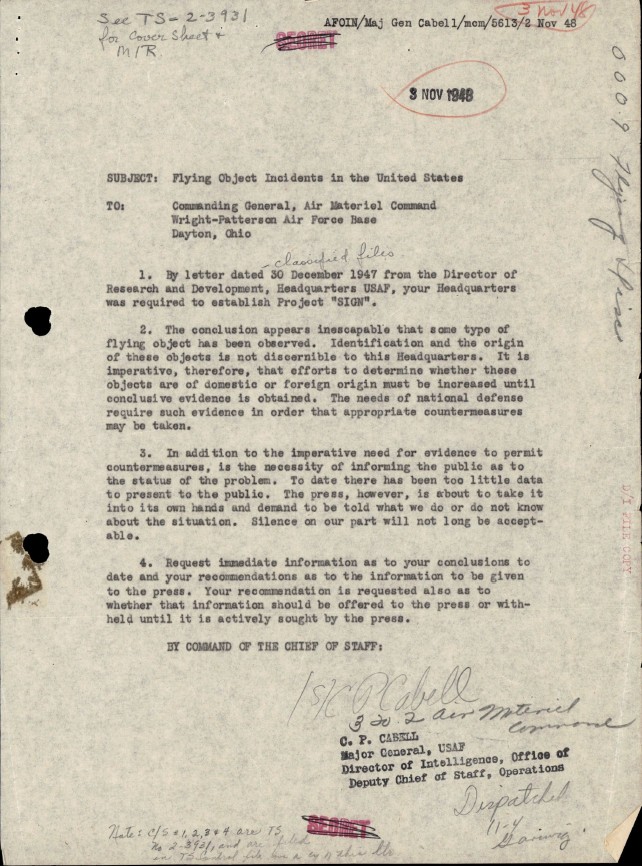
Ce dossier contient un rapport initial de l'Air Materiel Command concernant le Project Sign. Le Project Sign était un programme de l'U.S. Air Force mené de 1948 à 1949 pour enquêter sur la nature et l'origine des objets volants non identifiés (OVNI). Le rapport détaille 100 observations d'OVNI survenues entre 1947 et 1948. Le dossier contient également un extrait d'article tiré de « The Aeroplane », un magazine périodique consacré à l'aviation publié entre 1911 et 1968, intitulé « The Biology of the Flying Saucer ».
État du document
Résumé IA retiré : seules 9 pages sur 45 numérisées contiennent du texte lisible, un résumé automatique risquait donc d'être inexact. Lisez la description officielle ci-dessus ou consultez le PDF source pour le dossier complet.
▸Transcription(9 des 45 pages lisibles)
[PAGE 1] HEADQUARTERS AIR MATERIEL COMMAND MCIAJCB/amb Wright-Patterson Air Force Base 28 APR 1948 SUBJECT: Project "SIGN" TO: Chief of Staff United States Air Force Washington 25, D. C. ATTN: Director of Intelligence 1. This is an initial report on unidentified flying objects as directed by Hq, USAF letter dated 30 December 1947, signed by General L. C. Craigie, subject "Flying Discs." Quarterly reports will be submitted beginning 1 July 1948. 2. As a result of this letter, Project MX-364 was activated on 26 January 1948 and Technical Instruction 2185, dated 11 February 1948, was published. Present files on Project "SIGN" represent a consolidation of reports received directly by Hq, AMC and those forwarded by the Director of Intelligence, USAF. 3. Schedules of activities of lighted night-flying advertising blimps have been secured and cross-checked at this Headquarters to consider them as a possible source of incident reports. 4. Inclosure 1 represents a tabulation and breakdown of all available reports through 1 February 1948. 5. The following is a series of interesting observations that were noted when reviewing the many incident cases: a. High rate of climb, as well as the apparent ability to remain motionless or hover for a considerable length of time. b. The object was described as being oval, disc or saucer-shaped [figure illegible in OCR] times. c. Associated sound was present [figure illegible in OCR] times. d. Reported sizes have varied from that of a 25-cent piece to 250 feet in diameter, and from the size of a pursuit plane to the bulk of six B-29 airplanes. [NND 927545 — declassification/handling stamp appears repeatedly throughout the document] [PAGE 2] 28 April 1948 Subject: Project "SIGN" (AMC) e. Number of objects per sighting. Objects per sighting: 1 | 2-6 | 6-10 Number of sightings: 77 | 21 | 8 (Note: exact digits in this small summary table are partly obscured in the scan; the above is the OCR's best reading.) f. Exhaust trails were reported 23 times. g. Speed has been estimated throughout the entire range from very slow or hovering to supersonic. 6. Inclosures 2 and 3 are enlargements of photographs taken of Incident #40. Inclosure 4 is an evaluation of Inclosure 2 by this Headquarters. Attention is invited to the marked similarity between Inclosures 2 and 3, and Inclosure 5. Similarity also exists between Inclosures 2 and 3 and configurations illustrated in Inclosure 6. 7. Representatives from this Headquarters visited Dr. Irving Langmuir of the Research Laboratories, General Electric Company, Schenectady, N.Y., to discuss Project "SIGN." It was the opinion of this scientist that present available data does not encompass sufficient information to enable a positive identification to be made. Dr. Langmuir was reluctant to consider the so-called "flying discs" as a reality. However, it is believed at this Headquarters that it is possible to construct a low aspect ratio aircraft that would duplicate many of the appearance and performance characteristics of reported "flying discs." Experts have agreed that this would be possible through the intelligent application of boundary layer control. FOR THE COMMANDING GENERAL: [Signature] H. M. McCoy, Colonel, USAF Chief of Intelligence 6 Inclosures: 1. Tabulation 2. Photo 3. Photo 4. Evaluation of Inclosure 2 5. Horten Parabola 6. Biology of Flying Saucer [PAGES 3-28 — INCLOSURE 1: TABULATION OF INCIDENTS THROUGH 1 FEBRUARY 1948] EDITORIAL NOTE: These pages contain a wide multi-column statistical tabulation of roughly 100 numbered incident reports (numbered 1, 1a-1e, 2 through 100, with sub-lettered entries such as 30a-30c, 33a-33g, 48a-48d, 52a, etc.), broken across several multi-page tables with columns for: Incident No. / Date / Hour / Location Sighted From / Number Observed / Observed From (pages 3-7); Observer's Occupation / Maneuvers / Weather (pages 8-13); Color / Shape / Size / Sound (pages 14-20); and Exhaust Trail / Heading / Altitude (Ft.) / Speed / Effect on Clouds (pages 21-28). The source PDF renders these as wide tables; when the text layer is extracted, column boundaries are not preserved, so numeric/text fields from adjacent columns can run together or interleave. Because of this, precise cell-by-cell incident-to-value pairing cannot be reconstructed with full confidence from the OCR text alone. Below is a best-effort, cleaned reading of the clearly legible content, organized by page and column-group, preserving all dates, locations, unit/aircraft names, and figures exactly as legible. Passages too garbled to confidently reconstruct are marked [illegible]. Date/Hour/Location/Observed-From table (Incidents 1-100, pages 3-7): Confirmed/legible entries include (Incident No. — Date — Hour — Location — No. Observed — Observed From): - 1 (and sub-incidents 1a-1e) — 8 Jul 47 (some sub-entries 4 Jul 47/2 Jul 47 per OCR) — approx. 0930-1305 — Muroc Air Field, Muroc, Calif. — 1 to 5 — Ground (one sub-entry Air) - 2 — 7 Jul 47 — 0930 — Muroc Air Field, Muroc, Calif. — 2 — Ground - 3-4 — 7-8 Jul 47 — Muroc Air Field, Muroc, Calif. — Ground - 5 — 4 Jul 47 — 1305 — Area 13, Rogers Dry Lake, Muroc Air Field, Muroc, Calif. — 1 — Ground - 6-16 — 4 Jul 47 — 1305-1700 — Portland, Oregon / Milwaukie, Oregon / Vancouver, Washington / Mount Jefferson near Redmond, Oregon — 1 to 30 — Ground (this cluster is the well-known 4 July 1947 Portland, Oregon mass-sighting wave) - 17 — 24 Jun 47 — 1500 — Mt. Rainier, Washington — 9 — Air (this corresponds to the Kenneth Arnold Mt. Rainier sighting of 24 June 1947, the incident that popularized the term "flying saucer") - 18 — undated — Toronto, Canada — 1 — Ground - 19-20 — 20 Oct 47 — Dayton, Ohio / Xenia, Ohio — 1-2 — Ground - 21 — 29 Jun 47 — 1645 — Des Moines, Iowa — Ground - 22 — 21 Jun 47 — about noon — Spokane, Washington — Ground - 23 — 30 Jun 47 — 1745 — Boise, Idaho — Ground - 24 — 12 Jul 47 — Weiser, Idaho — Ground - 25 — 4 Jul 47 — 2345 — West Trenton, N.J. — Ground - 26-27 — 10 Jul 47 — Harmon Field, Newfoundland — Ground - 28 — 24 Jun 47 — Idaho — Ground - 29 — 23 Jun 47 — Bakersfield, Calif. — Ground - 30, 30a-30c — 7 Jan 48 — 1925-1940 EST — Lockbourne AFB, Columbus, Ohio — 1 — Ground each - 32 — mid-December, early a.m. — Northern Arizona — Ground - 33, 33c-33g — 7 Jan 48 — 1330-1954 CST — Godman Field, Kentucky (and vicinity, south of) — Ground/Air (this is the well-known Godman Field / Kentucky incident of 7 January 1948 — the Thomas Mantell case — in which an Air National Guard F-51 pilot, Captain Thomas Mantell, died pursuing an unidentified object near Godman Field, Kentucky) - 34 — Madisonville, Kentucky — Ground - 35 — 12 Nov 47 — 14 miles north of Dauphin, Manitoba, Canada — Ground - entries continue through incident 100 covering sightings in, among other locations: Boise/Owyhee, Idaho; Budapest, Hungary; Grand Falls, Newfoundland; Phoenix, Arizona; Elmendorf Field, Alaska; Clinton, Iowa; Rockford, Wisconsin; Illinois; Wilmington, Ohio (7 Jan 48, multiple sub-incidents 48a-48d); Maysville, Kentucky; Milkwood, New Jersey; Hamilton Field, California; Lake Mead, Oregon; North Sea (50 miles off the Dutch coast); Bermuda; and additional 1947-48 sightings through Houston, Texas (2 Nov 47) and Vaasa/Pietarsaari, Finland (5 Jan 46). Observer's Occupation / Maneuvers / Weather table (pages 8-13): Observers whose occupations are legibly recorded include: 1st Lt., USAF; S/Sgt, USAF; Pfc, USAF; Maj, USAF; Capt, USAF; a Portland, Oregon police patrolman (former Air Force pilot); a private pilot; a Coast Guardsman; a Deputy Sheriff; a professor and head of an aeronautical engineering department; a Kentucky State Police colonel; a Navy Second Officer; a CAA official; a judge; Hungarian peasants; a constable; a bridge-construction worker; an airline chief pilot; an insurance adjuster; a prospector; a bank employee; a county commissioner; an astronomer; a weather observer; a sign painter; U.S. Army personnel; railroad employees; an immigration-service official; and an Executive Director of a Housing Authority, among others. Maneuvers described include: horizontal/level flight; flying in tight circles; descending in an oscillating fashion nearly to the ground before climbing again to great altitude and moving off slowly; falling at roughly three times the rate of a parachute; formation flying (objects following one another in a straight line, with the last object fluttering rapidly in a side-to-side arc); hovering with 360-degree turns; abrupt climbs and descents; spiraling; and, for the Godman Field/Mantell case, an object reported "hovering," which the pursuing pilot chased to high altitude. Weather is frequently recorded as "clear," "overcast," "high scattered clouds," or "not stated." Color / Shape / Size / Sound table (pages 14-20): Colors recorded include: silver/silvery; aluminum-colored; yellowish-white; white; brownish; amber; gray; reddish; and "reflected the sun's rays." Shapes recorded include: disc; saucer-shaped; oval; round; spherical; elliptical; cigar-shaped ("much longer than wide"); cone-shaped; "like a wagon wheel"; "comet-like"; and, for one photographed object (Incident #40, discussed further below on pages 33-35), a thin metallic object of unconventional shape with what may have been thin fins or ribs on its upper surface. Sizes range from about 12 inches to 250 feet in diameter; several entries compare the apparent size to a 25-cent piece, a silver dollar, a dinner plate, or (at the largest) to six B-29 aircraft in formation. Sound is overwhelmingly recorded as "none" or "not stated"; a few entries describe a low humming sound, a sound "like an electric motor or dynamo," or a hissing/buzzing noise. Exhaust Trail / Heading / Altitude / Speed / Effect on Clouds table (pages 21-28): Exhaust trails are mostly recorded as "none" or "not stated"; where present they are described as bluish-black, white and heavy, or a thin streak resembling a tracer bullet or a meteor trail. Reported altitudes range from about 1,000 feet to 40,000+ feet (several entries note "very high" or "extremely high" with no numeric altitude given). Reported speeds range from "stationary"/"motionless" and "hovering" to figures given in the hundreds of miles per hour, with several entries describing speed as "terrific," "tremendous," or explicitly faster than a jet aircraft; one entry (Incident 54, involving a British "Mosquito" aircraft in pursuit over the North Sea) states the object's speed was "equal to or greater than that of a British Mosquito." Effects on clouds are mostly "not stated"; a few entries describe the object appearing to "cut a clear path through clouds." [PAGE 29] NOTE: Incident #18 — It has now been definitely determined that both the photograph and story were a hoax, perpetrated for publicity and money. Incident #8a — The person making the report on this incident was determined to be an excitable person, very talkative, and possessing an exaggerated imagination and inclined to impress people with his continuous chatter. [PAGE 30] REPORTED DIRECTIONS OF FLIGHT (chart) Circling: 16 Straight down: 5 Direction Indefinite: 64 Direction Not Stated: 61 (Additional column headers/figures at the top of this chart — apparently single-digit or short labels — are not legibly reproduced by the OCR.) Note printed on the chart: "There are an undetermined number of objects reported; the minimum number of objects are plotted. Same object reported by different people is shown only once." [PAGE 31] [No substantive OCR text recovered — page appears to contain only the "NND 927545" declassification stamp.] [PAGE 32] [PAGE 32 — illegible/no OCR text] [PAGE 33] CONFIDENTIAL Identification of Subject Matter (as per sample) HQAC MCICT [reading uncertain] — 19 Feb 48 1. Reference is made to the film frames submitted by Mr. Rhoades (Incident #40) which were forwarded for examination. The following data were derived from a study of the specimens: a. It is concluded that the smear is of a photographic nature, and is not due to imperfections in the emulsion or lack of development in the portion in question. The image exhibits a "tail" indicating the proper type of distortion due to the type of shutter used, the speed of the object, and the fixed speed of the shutter. This trailing-off conforms to the general information given in the report. b. The report states the object was seen at approximately 2000 feet at the time of exposure. The observer also reports being able to see clearly the window of the enclosure. The visual acuity of an average person would allow for this perception, but detail may not extend much further, as the subject had low tonal contrast, being gray against a gray sky. To establish the distance from camera to subject, we will need quantity "f." The report states that a 620 camera was used, indicating several possibilities since the 620 is considered for the specific film and width of the film — it may have negatives 2-1/4" x 2-1/4", 2-1/4" x 3-1/4", and 2-1/4" x 4-1/4". The sample submitted had been cut, and it was not possible to establish the exact frame size. The 2-1/4" x 2-1/4" size was ruled out, leaving 2-1/4" x 3-1/4" and 2-1/4" x 4-1/4". If it were the former, then the focal length of the lens would be [value as given in original — figure not clearly legible in OCR], and using 2000 feet as the approximate subject distance and the negative size at 1/25", we have an approximate size of 44 feet as the diagonal of the object. Now if we choose the latter value of "f" for focal length, we have an approximate value of 66 feet for the diagonal. Points of measurement are indicated from "x" to "x" on Exhibit "___". CONFIDENTIAL [PAGE 34] [No substantive OCR text recovered beyond the "NND 927545" stamp — likely a photo/exhibit page.] [PAGE 35] [No substantive OCR text recovered beyond the "NND 927545" stamp — likely a photo/exhibit page.] [PAGES 36-45 — INCLOSURE 6: "THE BIOLOGY OF THE FLYING SAUCER," A THREE-PART ARTICLE BY A. R. WEYL, A.F.R.AE.S., REPRINTED FROM THE BRITISH TRADE JOURNAL "THE AEROPLANE" (ISSUES OF FEBRUARY 13, MARCH 5, AND MARCH 19, 1948)] NOTE ON THIS SECTION: Pages 36 through 45 of the released PDF consist of a lengthy three-part magazine article, "The Biology of the Flying Saucer," by aeronautical writer A. R. Weyl, originally published in the British aviation trade weekly "The Aeroplane" (13 Feb, 5 Mar, and 19 Mar 1948 issues). Project SIGN attached it as Inclosure 6 — background technical reading supporting the Air Materiel Command's view (stated in paragraph 7 of the cover letter, page 2) that a conventional low-aspect-ratio ("disc-wing" or "annular-wing") aircraft could account for many "flying disc" reports. Because this exhibit is a copyrighted third-party periodical article reproduced at length in the source PDF, it is summarized here rather than transcribed verbatim. Summary of the article's content: Weyl traces the roughly 40-year engineering history of "low aspect ratio" (i.e., short-span, disc/round/annular-shaped) aircraft wings, arguing that a genuine "flying saucer"-like aircraft was aerodynamically plausible and, in several respects, already flying. He opens by noting that saucer-shaped or lenticular wings are "not as new as some people have tried to make out," and reviews early theoretical work by F. W. Lanchester (1907) and Frederick Handley Page (1911) on the favorable stalling behavior of low-aspect-ratio and annular ("ring-shaped") wings. He surveys a long line of experimental disc- and annular-wing aircraft: the German Fritz Huth annular biplane (1909-10); the British "Secret-Circle Plane"/"Doughnut" built by Cedric Lee and G. Tilghman Richards (1911-1918), which reportedly flew some 11,000 miles over 128 hours and was demonstrated to Winston Churchill; A. H. Edwards's rhomboidal ring wing (1908); French, German, Italian and Russian disc/annular/parabola-shaped designs of the 1920s-30s (Bourgoin, Antes, Willoughby Delta, Tscheranowsky's "parabola" gliders, Payen, Piana Canova); and, most significantly, the pioneering low-aspect-ratio wind-tunnel research of Charles H. Zimmermann of the U.S. National Advisory Committee for Aeronautics (NACA) beginning around 1930, which found that disc- and near-square wings (aspect ratio roughly 0.75-1.5) exhibited unusually gentle, gradual stalling characteristics at very high angles of incidence, with little tendency toward the abrupt, dangerous stall of conventional slender wings. Zimmermann patented and built a small manned disc-wing aircraft in his own home in the mid-1930s, then licensed his patents to Chance Vought (United Aircraft Corporation), leading to the experimental Vought V-173 "flying pancake" (1942) and the Vought XF5U-1 (1946) — twin-engine, near-circular "disc wing" naval fighter/helicopter-airplane hybrids capable of very low landing speeds and near-vertical flight. Weyl states plainly that "it is possible that the public conception of the mysterious 'Flying Saucers' has originated from this development." He further discusses wartime German research into swept-back and delta ("disc") wings for transonic/supersonic flight (Horten brothers, Lippisch, Messerschmitt, Junkers, and a secret German research airfield at Oranienburg near Berlin), noting that when Soviet forces occupied the site they found several advanced tailless delta-wing prototypes and captured German aeronautical personnel — Weyl speculates this German expertise may have been "completely transferred to Russia." He closes the third installment discussing sweep-back, thin aerofoil sections, and ramjet ("Athodyd") propulsion as German wartime approaches to supersonic flight, name-checking Eugen Sänger and Alexander Lippisch. Numerous technical figures/diagrams referenced in the original (wind-tunnel lift/drag curves, aircraft silhouettes) are described in captions but are not reproduced here. [END OF TRANSCRIPT — pages 1 through 45 of 45 covered]
Généré par IA à partir du fichier officiel — peut contenir des erreurs.
Traduction automatique — le document original est en anglais. Voir en anglais →
Source : Département de la Guerre des États-Unis / AARO — domaine public · war.gov/ufo
Entités dans ce document
Dossiers reliés
DOW-UAP-D100, Air Materiel Command Report on Unidentified Flying Objects, 1947-1948
65_HS1-834228961_62-HQ-83894_Section_004

DOW-UAP-D154, Transcript of a Presentation by Captain Edward J. Ruppelt, 1952
DOW-UAP-PR160, Presentation by Captain Edward J. Ruppelt, 1952
18_100754_ General 1946-7_Vol_2
18_6369445_General_1948_Vol_1
Affaires liées
DOW-UAP-D098, Analyse cinématographique d'objets non identifiés, 1953
DOW-UAP-D099, Analyse de renseignement sur les incidents de « fusées fantômes », 1947
DOW-UAP-D093, Analyse des incidents liés à des objets volants aux États-Unis, 1948
DOW-UAP-D094, Analyse des incidents liés à des objets volants aux États-Unis, 1949
DOW-UAP-D017, UAP signalés à la base de Sandia, 1948-1950
Même série de dossiers
DOW-UAP-D003, Rapport de mission, golfe Arabique, 2020

DOW-UAP-D004, Rapport de mission, golfe Arabique, 2020

DOW-UAP-D005, Rapport de mission, golfe Arabique, 2020

DOW-UAP-D006, Rapport de mission, golfe Arabique, 2020

DOW-UAP-D007, Rapport de mission, golfe Arabique, 2020

DOW-UAP-D008, Rapport de mission, Djibouti, 2025
Même période
18_6369445_General_1948_Vol_1
341_110448_Records_Relating_to_the_Collection_and_Dissemination_of_Intelligence_1948-1955-TS_CONT_No.2_2-5300-2-5399
DOW-UAP-D017, UAP signalés à la base de Sandia, 1948-1950
DOW-UAP-D093, Analyse des incidents liés à des objets volants aux États-Unis, 1948
Même publication
DOE-UAP-D004, Conférence de Los Alamos sur les phénomènes aériens, 1949
DOW-UAP-D094, Analyse des incidents liés à des objets volants aux États-Unis, 1949
CIA-UAP-D020, Mémorandum sur des observations d'aéronefs non conventionnels, 1955
CIA-UAP-D021, Analyse d'observations d'aéronefs non conventionnels, 1955
DOW-UAP-D095, Projets aéronautiques conjoints américano-canadiens et signalements d'observations d'OVNI, 1954-1955
DOW-UAP-D096, Correspondance relative au Project Blue Book, 1955
Même agence
331_120752_Numeric_Files_1944–1945_37153_German_Armament_Equipment_Documents
18_100754_ General 1946-7_Vol_2
DOW-UAP-D099, Analyse de renseignement sur les incidents de « fusées fantômes », 1947
DOW-UAP-D100, Rapport de l'Air Materiel Command sur les objets volants non identifiés, 1947-1948
342_HS1-416511228_319.1 Flying Discs 1949