NASA-UAP-D025, „Wissenschaftliches Apollo-16-Debriefing“
Kerndaten
- Offizielle Akten-ID
- NASA-UAP-D25 (hier zitiert als NASA-UAP-D025)
- Dokumenttyp
- Audio
- Behörde
- NASA
- Veröffentlicht in
- R03 · 2026-06-12
- Datum des Vorfalls
- nicht angegeben
- Ort des Vorfalls
- Houston, Texas
- Koordinaten
- 29.7589382, -95.3676974
Offizielle Beschreibung
Bei 32:41 macht der Sprecher beiläufig die Bemerkung „Könnte eine außerirdische Sternenbasis sein oder so etwas, ich weiß es nicht“, während er Zusammenhänge zwischen experimentellen Datensätzen diskutiert.
✦ KI-Zusammenfassung
Diese Aufnahme ist ein wissenschaftliches Nach-Missions-Debriefing der NASA nach Apollo 16, bei dem Missionswissenschaftler den Programmverantwortlichen und der zurückgekehrten Flugbesatzung vorläufige Ergebnisse präsentieren. Die Sprecher behandeln die Abdeckung der Orbitalfotografie und Kameraanomalien, die Leistung des Laser-Höhenmessers, Teilchen- und Felddaten des Subsatelliten, die Mondschwerkraft (Verfolgung per S-Band-Transponder) und – am ausführlichsten – die Ergebnisse des Subsatelliten-Magnetometers, das magnetische Anomalien auf der erdabgewandten Seite des Mondes kartiert, insbesondere die große magnetische Senke nahe dem Krater Van de Graaff. Gegen 32:41 Uhr, während er diese magnetischen Anomaliedaten mit Laser-Höhenmessungen und Schwereprofilen derselben Region vergleicht, erklärt der Magnetometer-Wissenschaftler, er sehe keine wissenschaftliche Rechtfertigung für eine Korrelation der beiden Datensätze, und fügt beiläufig hinzu, es 'könnte eine außerirdische Sternenbasis oder so etwas sein', bevor er sofort zur nächsten Folie übergeht. Im Kontext liest sich die Bemerkung als beiläufiger Scherz, eingestreut in eine dichte technische Diskussion über kraterbedingte magnetische Senken, nicht als ernsthaft vorgebrachte Hypothese.
Mit KI aus der Originaldatei erstellt — kann Fehler enthalten.
▸Transkript
[00:00] Photo team lead reviews orbital photography coverage: areas in black show total area covered during the mission; areas in red show pieces missed due to deletion of the plane change and the day-early return. A small oblique pass planned for Rev. 72 with the pan camera (to photograph an ascending feature of geological interest) was lost. Overall coverage effectiveness was about 90% of the pre-mission goal. He thanks the flight planners and thanks Ken (the Command Module Pilot) for camera operations, acknowledging the confusing series of on/off changes to the flight plan. [01:35] Next slide compares planned coverage for Apollo 15, 16, and 17 (dotted line); the areas lost on 16 unfortunately fall outside what 15 covered and what 17 will cover, so the loss, while small, is real. [02:09] Discussion of the stellar camera glare shield reported hung up on a handrail during the film-retrieval EVA: the crew clarifies which cover was involved and that its tip was bent back after catching on the (uninstalled) handrail, not in full extension. The team notes this could let excess light into the stellar camera, raising background density and reducing visible stars. A related concern: an exposure-control malfunction on the panoramic (pan) camera may have overexposed frames away from the terminator; both issues are to be reviewed further that afternoon before film processing. [04:18] Laser altimeter results slide: planned ~20 hours of operation vs. 14.5 hours actual (down ~25%); planned 10.3 revolutions in longitude vs. 7.5 actual (down ~25%); planned 3,283 firings vs. 2,106 actual (down ~30%); valid elevation readings came in at a little under half of plan. Performance was nominal for the first several revs, then degraded (~75%, 65%, 60%, and only ~10% effective on the final data pass, Rev 62), in an alternating good-shot/bad-shot pattern to be covered in the next day's systems review. Effect on photo reduction is negligible; effect on tracking/gravity correlation is a bit more of a concern, requiring extra smoothing between data points. [07:12] Photo reduction utilization update: work at ACIC (St. Louis) indicates photographic positional accuracy of 10-12 meters, matching pre-mission predictions. Tracking data is internally consistent within a single orbital pass but shows discrepancies up to a kilometer between adjacent passes; photo reduction is producing a better tie between passes than the raw tracking data, and the team expects an eventual internally consistent lunar reference/coordinate system accurate to about 12-15 meters. [08:44] Pan camera map compilations show ~3-meter precision (not yet absolute accuracy, due to geometric issues with pan camera photography); resolution held up as expected: 1.5-3 meters at the subvehicle point, degrading to 5-6 meters at the edges of the film. [10:00] Q&A: a question about metal particles/shavings found associated with the mapping camera — described as enough to concern the processing lab; possibly linked to more film than expected remaining for post-TEI (trans-Earth injection) photography, suggesting the camera may not have been feeding film properly and could have chewed it up internally. A review with the camera contractor is scheduled for that afternoon before deciding how to proceed with processing (originals within the week, duplicates within four weeks). [12:05] Altimeter precision: least count of 1 meter; overall accuracy about 3-5 meters depending on surface slope and albedo in the illuminated area. [12:36] Further discussion of the pan camera exposure problem: frames are slightly underexposed near the terminator (where the slit can't open wide enough) and become progressively overexposed farther from it, since the aperture stayed open wider than intended; a variable, pass-by-pass processing correction is desirable but likely not feasible. [14:04] Session moves to particles and fields data from the subsatellite, covered by a speaker identified in the recording as Jim McCoy. [15:07] The subsatellite deployed successfully with a nominal spin rate (~5-second period) and good attitude (only a couple of degrees of tip-off from the ecliptic, well within limits). The electrostatic analyzers and both solid-state telescopes are operating well; the noise problem and accumulator counting error seen on Apollo 15 have not recurred. [16:22] Quick-look results from the first magnetotail pass show unexpectedly high fluxes of low-energy protons, also seen by another (IMP-series) satellite; possibly remnants of a small solar event (high-energy solar cosmic-ray electrons and protons), useful for interpreting particle 'shadow' data and electric fields in the magnetotail. [17:10] Recap of Apollo 15 results for context: the primary experiment examines particle-shadow configurations in the magnetotail to study whether magnetic field lines there connect openly to the interplanetary field and, ultimately, to the Van Allen belts. Apollo 15 showed these field lines are open/connected most of the time; the mission also observed a plasma sheet extending to lunar distance and, on a few occasions, cross-tail electric fields relevant to auroral and radiation-belt acceleration theories. [19:16] An unexpected finding: large, consistent fluxes of roughly 30 keV protons seen both inside and outside the magnetotail. Initially thought to be a solar cosmic-ray component, but their low energy and steady flux density instead point toward an origin in the outer Van Allen belt, with protons somehow escaping the Earth's field outward into the interplanetary medium — possibly the inverse of the process thought to populate the Van Allen belts from solar cosmic rays in the first place. Detailed analysis awaits a computer program being developed at Berkeley. [21:31] A slide of one orbit's telescope data shows these steady proton fluxes, a slight shadowing effect (a minor electron-motion phenomenon), and then an abrupt cutoff, 'as though somebody closed a valve' — the on/off mechanism and source region are still under investigation. [22:56] Brief Q&A: hope for extended subsatellite operation given its good performance so far; confirmation that telemetry, battery charging, and all detectors remain nominal, with the only limiting factor being the subsatellite's inherently short orbital lifetime. [24:01] Session moves to the magnetometer experiment, covered by a speaker identified in the recording as Larry Sharp. [24:09] Three objectives: map remnant magnetism on the lunar surface; map electrical conductivity of the lunar interior; and study the moon's interaction with the fields and particles of its environment — made possible because the subsatellite passes through three distinct regions of space. Mapping remnant surface magnetism specifically requires passes through the geomagnetic tail, where the ambient field is steady with little temporal variation. [25:02] The subsatellite's orbit was lower than Apollo 15's, with an inclination of about 11 degrees versus 28. Orbit-decay predictions (initial altitude about 97 by 123 km) showed the crash probability rising over roughly 200 days; an updated, more recent prediction (now measured in hours rather than days) showed a faster decay, with roughly four days of orbital life estimated remaining and about 50/50 odds it survives the next low pass, with the following pass likely to end it. A questioner asks why the actual decay diverged from the original prediction; the answer: six months of planning can't be fully reconciled in two days of new tracking data. [27:58] One month of good magnetometer data will supplement Apollo 15's models. A slide shows the average of 17 orbital passes through the Earth's magnetotail, plotting lunar longitude against magnetic field strength in gammas; the standout result is a large magnetic dip located over, or near, the Van de Graaff crater on the lunar far side. [28:52] Most magnetic dips correlate with craters lying within a few degrees of the ground track: seven local minima were identified, five named for associated craters — Van de Graaff, Korolev (where the ground tracks cross in the tail region), Hertzsprung, Pavlov, a small crater called Stein, and one near Mendeleev. [29:39] Repeating these passes over different lunations builds a contour map; the resulting ground tracks line up well with major craters (Hertzsprung, Korolev, Van de Graaff near the northern border, Pavlov, and one over Milne) — a good one-to-one correspondence with large craters. Apollo 16's more equatorial orbit (inclination up to about ±11 degrees) also passed over Korolev and the small Stein crater. [30:33] A compiled contour map is described as hard to read in places — a dark blotch near Van de Graaff results from overlapping contour lines — but shows visible structure over Korolev, a hint of structure over Hertzsprung, and an enhancement in the southern sea region. Apollo 16 data should extend and improve this map's resolution, though a coverage gap remains in one area. [31:30] Units are given as tenths of a gamma at an assumed altitude of 100 kilometers; a representative field value is about 30 gamma, with zero arbitrarily set at the lowest reading, at the bottom of the Van de Graaff dip — meaning a roughly 3-gamma dip is seen crossing Van de Graaff on average at that altitude. [32:02] A questioner asks whether the near-side gravity profile correlates with the magnetic data. The speaker says gravity doesn't appear to correlate at all, but laser altimetry data correlates better, showing a large low ('big hole') on the lunar far side around Van de Graaff, matching the magnetic dip there. [32:28] 'But I can't see any scientific justification for connecting the two results — could be an alien star base or something.' [32:41] The speaker immediately moves on: 'Anyway, the next slide shows the front side of the moon' — shown upside down at first, prompting a brief aside asking the projectionist to turn the slide around ('he's on a coffee break'). [33:12] The lunar near side (front side) is described as far smoother magnetically than the far side — variations are roughly an order of magnitude (about a factor of 10) smaller, with little structure and contours that are hard to draw. [33:37] A questioner asks whether effects of passing through Earth's magnetic field (since the near side always faces Earth) can be distinguished from genuine near-side lunar variations. The speaker replies that the tail field is very steady away from the neutral sheet, which is where this data was taken, implying minimal contamination from Earth's field. [34:09] A close-up slide of the Van de Graaff region attempts to pinpoint the exact source of the large anomaly. The team had suspected it sits directly over the crater, consistent with a theory that a meteorite impact uniformly demagnetized/remagnetized the crust and left a residual dipole. New radial-component (Bx) data complicates this: the dip actually sits between two craters rather than centered on one, and the other components (By, Bz) rule out a simple angled dipole originating from the crater alone. [35:13] The same detailed analysis is now being repeated for the other anomalies; the Korolev anomaly, completed the day before the briefing, does sit centered within its crater, which is encouraging for the shock-magnetization theory there. [35:28] Q&A on confidence in ground-track and ephemeris accuracy on the far side: little additional far-side coverage is expected before the subsatellite eventually impacts the moon, but the final approximately 10 kilometers of descent should provide a useful high-resolution data swath. [36:21] Front-side (near-side) magnetic map walkthrough: covering roughly zero to 90 degrees east and west to the terminator; the Mare Australe ('Southern Sea') region is the only distinctive magnetic feature on the near side, showing relatively high values (about 3 gamma above the Van de Graaff zero baseline). The Apollo 16 (Descartes) landing site itself lies outside the subsatellite's coverage. [37:29] Most front-side values cluster around 27-30 gamma, with a spread of roughly plus or minus half a gamma; this uniformity is partly an artifact of sparse data, since small orbit-to-orbit offsets stretch what should be circular contours into elongated ones. [37:57] Q&A comparing this orbital data to surface magnetometer readings from earlier landed missions: no real one-to-one correlation is possible because surface instruments measure much smaller-scale phenomena. Examples given: Apollo 14's surface magnetometer read 43 gamma at one spot and 103 gamma just a kilometer away; Apollo 15 measured a steady 6 plus-or-minus 4 gamma (essentially zero); and preliminary Apollo 16 surface results showed a striking gradient of about 313 gamma between two nearby points — underscoring how unrepresentative a single local reading can be of the wider region. [39:58] Brief aside: the speaker notes he is 'not a geologist type.' [40:12] Speculation that younger craters may leave cleaner magnetic 'signatures': Van de Graaff appears relatively young (few secondary craters in its floor), while Hertzsprung appears much older (heavily overprinted with secondary craters). Some crater-distance figures are given (on the order of 88 to roughly 130-140 kilometers) in describing the geometry of the anomaly relative to Van de Graaff's rim and center. [41:05] Session moves to the final subject, the gravity (S-band transponder) experiment, covered by a speaker identified in the recording as Bill Sjogren. [41:35] The gravity experiment works by tracking the velocity of the spacecraft, lunar module, or subsatellite via transponder. Lunar module impact data was lost this mission because the LM began tumbling after separation, but useful data was obtained from the Command/Service Module in low lunar orbit. [42:29] A ground-track and gravity-anomaly profile slide is shown: the zero line represents isostatic equilibrium; the track shows a large negative anomaly (nearly 100 milligals) over Ptolemaeus, a positive reading over highland material, a relative low between the old craters Ptolemaeus and Albategnius, another high, and then roughly a 50-milligal negative anomaly at the Descartes landing site region — correlating well with laser altimetry data shown on a later slide. [43:42] Coverage spans roughly plus/minus 110 degrees longitude (limb to limb), with 8 good revolutions of data (Revs 3-11) before station-keeping maneuvers degraded further readings. [44:17] A notable finding: the Ptolemaeus gravity anomaly is much lower than that of Mare Nubium, even though laser altimetry shows Ptolemaeus's floor is actually about two kilometers lower in elevation than expected relative to Nubium — the opposite of what pre-mission ACIC maps indicated (which showed Nubium about a kilometer higher than Ptolemaeus). That amounts to a roughly three-kilometer discrepancy in that small area, confirming that pre-mission lunar altitude data was unreliable; this also explains why the crew's low-sun-angle photography timing over Nubium was off, since it was based on the incorrect relative heights. The consistency was confirmed by three of five good laser-tracking passes over the region (Rev 28) all showing the same drop. [46:02] Several mare regions are noted as sitting at roughly the same elevation level; Mare Smythii ('Smith's Eye') again reads about 4.5 kilometers low, matching an earlier Apollo 15 pass over the same feature. Referencing the moon's mean radius (1738 km), fitting the data to a model with the lunar center of gravity offset from its geometric (optical) center reproduces the observed roughly two-kilometer shift, consistent with the moon's center of gravity sitting about two kilometers closer to Earth than its geometric center. [46:59] Mare Tranquillitatis is about two and a half kilometers lower in elevation than the Descartes site; the Descartes landing site itself sits in a negative gravity anomaly, consistent with resting on a topographic load. [47:30] Far-side coverage still has some data gaps (to be filled once station tapes are delivered), but Hertzsprung clearly shows a central peak. Comparing this mission's far-side profile to Apollo 15's: the deep (~4.5 km) trough Apollo 15 found centered near longitude 180 is not reproduced on Apollo 16, but the same highland high seen on 15 does appear again on 16, indicating good consistency between the two data sets overall. [48:49] A repeat pass ten orbits later over the Mare Smythii region shows a highly consistent profile with the earlier pass. [49:07] Brief Q&A: the speaker notes he also has Apollo 15 subsatellite data available but prefers to keep this session focused on Apollo 16 results; he reports being very pleased with the Apollo 16 data overall, though the subsatellite's remaining lifetime is 'pretty grim.' [49:54] Orbit-decay status update: no new solution was run in the last hour, so the last available state vector is being used; based on the lifetime model used at injection, the subsatellite should not crash immediately, but its status bears close watching over the next couple of days. [50:24] Discussion of the anticipated eventual impact: the roughly 50-pound subsatellite is unlikely to register a detectable seismic signal; a linear extrapolation puts the predicted impact point at roughly 20-30 degrees west longitude and 5-6 degrees north latitude. [51:12] Closing remarks: thanks to the crew for attending the debrief. A senior figure commends the Command Module Pilot's (Ken's) operation of the SIM bay instruments as outstanding, reflects on the broader long-term importance of the science being done despite it seeming abstract to the public, advocates for the U.S. increasing basic and applied research funding by two to three times, and asks the science team to keep the crew and program office informally updated by phone as new findings emerge, noting that 'questions are pretty cheap and not asking questions can be very expensive.' [54:44] The crew responds with thanks for how well the hardware performed, both on the lunar surface and in orbit, and says they would be glad to fly again 'if you can gin up another one.' [55:12] End of debriefing (brief trailing audio).
Mit KI aus der Originaldatei erstellt — kann Fehler enthalten.
Automatische Übersetzung — das Originaldokument ist auf Englisch. Auf Englisch ansehen →
Quelle: US-Kriegsministerium / AARO — gemeinfrei · war.gov/ufo
Entitäten in diesem Dokument
Verbundene Fälle
NASA-UAP-D024, “Apollo 16 Scientific Debriefing”
18_6369445_General_1948_Vol_1
NASA-UAP-D001, Apollo 12 Transcript, 1969
NASA-UAP-D002, Apollo 17 Transcript, 1972
NASA-UAP-D005, Apollo 17 Crew Debriefing for Science, 1973
NASA-UAP-D007, Skylab Technical Crew Debriefing 1973
Verwandte Fälle
NASA-UAP-D026, Apollo-14-Nachbesprechung, 1971
NASA-UAP-D027, Apollo-14-Nachbesprechung (Fortsetzung), 1971
NASA-UAP-D028, Medizinische Nachbesprechung der Apollo-17-Besatzung, 1972

NASA-UAP-D029, Medizinische Nachbesprechung der Apollo-17-Besatzung (Fortsetzung), 1972
NASA-UAP-D030, STS-80, Bild 1 eines unidentifizierten Objekts, 1996
Gleiche Aktenserie
NASA-UAP-D001, Apollo-12-Transkript, 1969
NASA-UAP-D002, Apollo-17-Transkript, 1972
NASA-UAP-D003, Gemini-7-Transkript, 1965

NASA-UAP-D003A, Gemini-7-Audioausschnitt, 1965
NASA-UAP-D004, Apollo-11-Technisches Besatzungsdebriefing, 1969
NASA-UAP-D005, Apollo-17-Besatzungsdebriefing für Wissenschaft, 1973
Gleicher Zeitraum
255_413270_UFO's_and_Defense_What_Should_we_Prepare_For
38_143685_box_Incident_Summaries_101-172
38_143685_box_Incident_Summaries_173-233
38_143685_box7_Incident_Summaries_1-100

65_HS1-834228961_62-HQ-83894_Section_001
65_HS1-834228961_62-HQ-83894_Section_002
Gleiche Veröffentlichung
FBI-UAP-D011, D/FBI-Korrespondenzweiterleitung, 1949
CIA-UAP-005, Artikel eines deutschen Wissenschaftlers über „Fliegende Scheiben“
CIA-UAP-002, Wissenschaftlicher Beirat für nicht identifizierte Flugobjekte, Bericht, 1952-1953
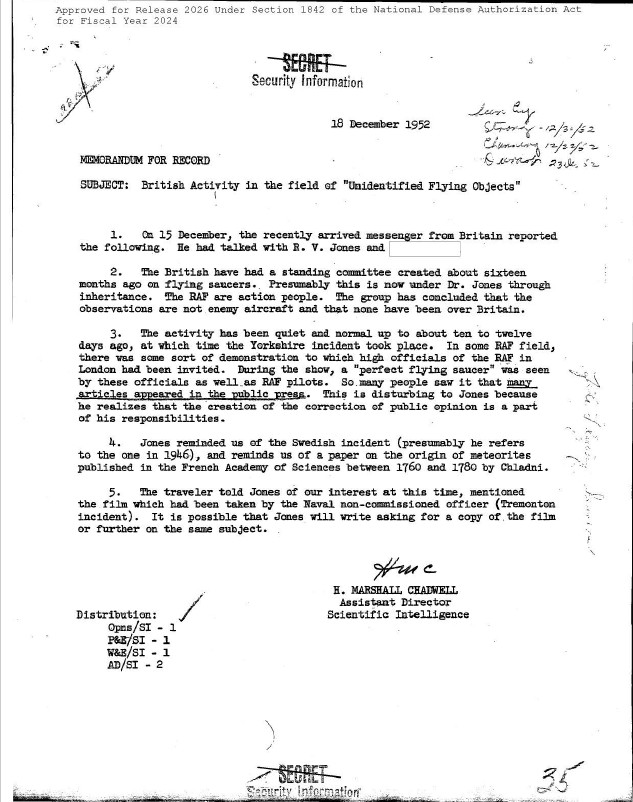
CIA-UAP-014, Britische Aktivität auf dem Gebiet „unidentifizierter Flugobjekte“
FBI-UAP-D012, Außenstelle Newark, 1952–1967
FBI-UAP-D013, „UFO“-Ermittlung im Bundesstaat Washington, 1952–1960
Gleiche Behörde
NASA-UAP-D014, Mercury-Redstone 4, 21. Juli 1961
NASA-UAP-D012, Mercury-Atlas-8-Audioausschnitt, 3. Oktober 1962
NASA-UAP-D013, Mercury-Atlas 7, 24. Mai 1962
NASA-UAP-D015, Wissenschaftliche Astronauten-Debriefings, 1962–1963
NASA-UAP-D023, Interviewausschnitt mit Astronaut Gordon Cooper, 1962