Rapporto USAF: UFO al radar, piloti F-86D, Giappone, 1956
File ufficiale: DOW-UAP-D205, Rapporto informativo di intelligence aerea, Giappone, 1956
Pubblicato il
Dati principali
- ID ufficiale del fascicolo
- DOW-UAP-D205
- Tipo di documento
- Documento
- Agenzia
- Department of War
- Pubblicato in
- R08 · 2026-11-20
- Data dell'incidente
- 12/17/56
- Luogo dell'incidente
- Giappone
- Coordinate
- 36.5748441, 139.2394179
- Pagine leggibili
- 4/5
- VIRIN
- 261120-D-D0360-1199
Descrizione ufficiale
Questo AIIR registra un episodio del 17 dicembre 1956 nei pressi di Ube, Giappone, in cui due piloti di F-86D dell'Aeronautica degli Stati Uniti stavano conducendo intercettazioni di addestramento sotto la guida di un radar a terra, quando uno dei piloti ha riferito di aver rilevato un secondo bersaglio radar, distinto dall'altro F-86D, a una distanza di 20 miglia nautiche. Il rapporto afferma che l'eco non identificata appariva più grande di quella dell'altro velivolo e rimaneva visibile sullo schermo radar dell'intercettore per circa sette-otto minuti. Afferma inoltre che il pilota ha poi ottenuto un contatto visivo intermittente per circa tre-quattro minuti dopo essersi avvicinato fino a circa cinque miglia nautiche, descrivendo l'oggetto come simile soprattutto alla metà superiore di una sfera. Il rapporto rileva anche una possibile interferenza di contromisure elettroniche sullo schermo radar dell'F-86D e stima la velocità di allontanamento dell'oggetto in 1.500-1.800 nodi (1.726–2.071 mph) dopo che l'eco radar è uscita rapidamente dalla parte alta dello schermo, osservando però che tale valore superava ciò che il radar poteva indicare direttamente per una velocità di avvicinamento negativa. Il rapporto afferma inoltre che né i siti radar a terra né il secondo pilota hanno acquisito l'oggetto sul radar. Tutto il linguaggio descrittivo e valutativo contenuto in questo rapporto riflette l'interpretazione soggettiva dell'osservatore al momento dell'evento. Tali caratterizzazioni non devono essere interpretate come un'indicazione conclusiva della presenza o dell'assenza di caratteristiche intrinseche dell'oggetto o delle sue prestazioni.
Su questo tipo di documento
Questo documento è un Air Intelligence Information Report (AIIR), un modulo standardizzato dell'Aeronautica degli Stati Uniti utilizzato per registrare informazioni grezze di potenziale valore di intelligence ai fini di un'analisi successiva. Il modulo fu uno dei principali strumenti di raccolta di intelligence sul campo dell'Aeronautica degli Stati Uniti nei primi anni della Guerra fredda, finché all'inizio degli anni Sessanta non furono introdotti standard di segnalazione validi per l'intero settore della difesa.
Vedi il glossario →✦ Riassunto IA
Si tratta di un Air Intelligence Information Report dell'USAF, IR-12-57, datato 20 febbraio 1957 e redatto, sulla base di un debriefing, dai capitani Alan G. Pound e William J. Buchanan dell'Air Technical Intelligence Liaison Office delle Far East Air Forces. Il 17 dicembre 1956, intorno alle 15:20 ora locale, due piloti di F-86D del 68th Fighter-Interceptor Squadron effettuavano intercettazioni di addestramento con il radar vicino a Ube, in Giappone, quando il pilota intercettore rilevò a 20 miglia un secondo eco radar, più grande, che il radar del gregario non mostrava. Si avvicinò fino a circa cinque miglia, ma l'eco rimase a 20 miglia finché non decise di identificarlo; poi il suo radar indicò una velocità di avvicinamento di 600-700 nodi. A circa otto miglia vide un piccolo oggetto color marrone dorato, circolare nella parte inferiore e descritto al meglio come la metà superiore di una sfera, senza riflesso del sole. L'eco uscì poi dallo schermo a una velocità stimata di 1.500-1.800 nodi. Il pilota subì anche interferenze sul radar simili, ma più deboli, a quelle degli apparati di disturbo dell'USAF. Il suo velivolo risultò normale al controllo e nessuna stazione radar a terra segnalò tracce non identificate, circostanza a cui gli ufficiali dicono di non dare molto peso perché entrambi gli aerei necessitavano dell'IFF per essere tracciati. Descrivono il pilota come coscienzioso e un po' imbarazzato.
Generato con IA dal file ufficiale — può contenere errori.
Luoghi citati nel documento
Altri luoghi a cui si riferisce il documento, oltre alla sua posizione ufficiale.
- Ube, Yamaguchi, JapanIncidente · 1956
two USAF F-86D pilots were practicing ground radar positioned intercepts on each other in the vicinity of UBE, JAPAN (33°59'N - 131°18'E).
▸Trascrizione(4 di 5 pagine leggibili)
[PAGE 1] AF FORM 112 APPROVED 1 JUNE 1948 CONFIDENTIAL (struck through, handwritten "Confidential" above) 1079475 COUNTRY: Japan REPORT NO.: IR-12-57 AIR INTELLIGENCE INFORMATION REPORT SUBJECT: (U) Unidentified Flying Object Report AREA REPORTED ON: Japan FROM (Agency): DI FEAF ATILO DATE OF REPORT: 20 February 1957 DATE OF INFORMATION: 20 December 1956 EVALUATION: B-2 PREPARED BY (Officer): Captain Alan G. Pound, ATILO and Captain William J. Buchanan, ATILO SOURCE: Debriefing REFERENCES (Control number, directive, previous report, etc., as applicable): AFR 200-2 SUMMARY: (Enter concise summary of report. Give significance in final one-sentence paragraph. List inclosures at lower left. Begin text of report on AF Form 112—Part II.) On 17 December 1956 two USAF F-86D pilots were practicing ground radar positioned intercepts on each other in the vicinity of UBE, JAPAN (33°59'N - 131°18'E). During one run, the intercepting pilot picked up a second radar target (other than the target F-86D) on his radar scope at 20 nautical mile range and later obtained a visual sighting of something best described as the upper half of a sphere. The object was painted on the F-86D radar scope for seven to eight minutes and was seen visually off and on for three to four minutes. The F-86D closed to within five nautical miles of the object and could not close further. The object's radar return disappeared by moving rapidly off the top of the scope. Estimated rate of departure was 1500 to 1800 knots. During the incident possible ECM interference was evident on the F-86D radar scope. APPROVED: [signature, with handwritten initials] HARRY J. KIELING, Colonel, USAF, Director of Collections 0 INCLS. DECLASSIFIED Authority NND 78452 By DF [illegible] NARA Date 3/19/26 Handwritten: ABC DISTRIBUTION BY ORIGINATOR: AFOIN-4, W-P AFB, O.; ARDC; ADC; AAC; 5th AF; 41st AIR DIV NOTE: THIS DOCUMENT CONTAINS INFORMATION AFFECTING THE NATIONAL DEFENSE OF THE UNITED STATES WITHIN THE MEANING OF THE ESPIONAGE ACT, 50 U.S.C.—31 AND 32, AS AMENDED. ITS TRANSMISSION OR THE REVELATION OF ITS CONTENTS IN ANY MANNER TO AN UNAUTHORIZED PERSON IS PROHIBITED BY LAW. IT MAY NOT BE REPRODUCED IN WHOLE OR IN PART, BY OTHER THAN UNITED STATES AIR FORCE AGENCIES, EXCEPT BY PERMISSION OF THE DIRECTOR OF INTELLIGENCE, USAF. X13219 [PAGE 2] AF FORM 112—PART II APPROVED 1 JUNE 1948 AIR INTELLIGENCE INFORMATION REPORT FROM (Agency): DI FEAF ATILO REPORT NO.: IR-12-57 PAGE 2 OF 4 PAGES 1. On 17 December 1956, 1st Lt's R. N. Brumet and R. A. Sneary, both assigned to the 68th Fighter-Interceptor Squadron, Itazuke, Japan, were flying practice intercepts under Ground Control Intercept radar direction in the vicinity of UBE, JAPAN (33°39'N-131°18'E). 2. The F-86D aircraft involved were being tracked by IFF because they were not picked up by skin tracking. The practice intercepts were being made approximately fifty nautical miles from the GCI site which was controlling the flights. 3. At approximately 1520I (Local) Lt Brumet was making a beam attack on his wing man. Lt Brumet's heading was approximately 270 degrees. The wingman's F-86D was painted on the E-4 radar scope 20 degrees left at 12 miles range. When the wingman was picked up a second, larger blip was picked up 30 degrees left at 20 miles range. The second blip appeared similar to the return from an island, but was on the upper portion of the radar scope. Blip dimensions were estimated to be one-eight inch high by three-eights inch wide - similar in size to that expected from a B-29 at comparable range. 4. When Lt Brumet had closed to within 5 miles of the other F-86D, the unidentified blip was still indicating 20 mile range. Lt Brumet called the GCI site to ask if they had a target which would correspond to the unidentified blip. After receiving an answer to the negative, he asked for and received permission to determine the nature of the source of the radar return. 5. Immediately after deciding to attempt to identify the unknown blip source, the F-86D radar indicated a rate of closure of six to seven hundred knots. At eight miles range, Lt Brumet attempted to sight the object visually and did see something in the proper location. He described the object as comparable to the size and shape of an eraser from a common lead pencil if placed on the F-86D wind screen - sketch follows: [small sketch of a dome shape] 6. By the time that Lt Brumet picked up the object visually, the other F-86D piloted by Lt Sneary had maneuvered to an in-trail position four to five miles behind Lt Brumet's F-86D. 7. When Lt Brumet had closed to four to five miles from the unidentified object, either the F-86D had turned left or the object had moved to the right so that it was directly ahead of the F-86D. The AI radar had been in lock on mode. About this time Lt Brumet experienced interference pulses coming down the 'GIZZLE' band on his radar scope. The interference was not of sufficient intensity to cause the radar to break lock. Utilization of the AI radar anti-jam procedure would eliminate the interference for ten seconds after frequency change. Lt Sneary could pick up Lt Brumet's F-86D on AI radar but did not pick up the object. His radar did show a cluster of small bright pin point spots stationary and level at 12 miles range. 8. Lt Brumet had flown practice missions against ECM equipped B-36 and B-47 aircraft. The interference on this mission under discussion was similar to but less intense than that experienced during runs against USAF ECM. 9. When Lt Brumet was closest to the unidentified object, it appeared to make a shallow left turn. It had the appearance of being circular on the bottom. Even though the sun was in a position to reflect off a metalic object, there was no reflection. The color of the object was described as golden tan. 10. After the apparent slight turn the object's return on radar indicated it was moving up and away at from 1500 to 1800 knots. This speed was an estimate since it is considerably faster than the radar set can indicate negative rate of closure. NOTE: THIS DOCUMENT CONTAINS INFORMATION AFFECTING THE NATIONAL DEFENSE OF THE UNITED STATES WITHIN THE MEANING OF THE ESPIONAGE ACT, 50 U.S.C.—31 AND 32, AS AMENDED. ITS TRANSMISSION OR THE REVELATION OF ITS CONTENTS IN ANY MANNER TO AN UNAUTHORIZED PERSON IS PROHIBITED BY LAW. IT MAY NOT BE REPRODUCED IN WHOLE OR IN PART, BY OTHER THAN UNITED STATES AIR FORCE AGENCIES, EXCEPT BY PERMISSION OF THE DIRECTOR OF INTELLIGENCE, USAF. [PAGE 3] AF FORM 112—PART II APPROVED 1 JUNE 1948 AIR INTELLIGENCE INFORMATION REPORT FROM (Agency): DI FEAF ATILO REPORT NO.: IR-12-57 PAGE 3 OF 4 PAGES 11. Upon completion of this mission, the aircraft flown by Lt Brumet was flown by another pilot. All systems appeared to operate satisfactorily. The aircraft was checked by ground personnel after the next landing and all systems were satisfactory. A check of all ground radar sites was made and none reported unidentified tracks. There were no other tracks that could have been the unidentified object. 12. Following is a sketch of the location of the incident: [Diagram: hand-annotated sketch map of the Japanese island of Honshu (north) and Kyushu (south) with the Shimonoseki strait area; labels: Mi-Shima (Location of Monitoring GCI Site); HONSHU; KYUSHU; Bogie Last Here; F86D At Last Sight; Bogie First Seen Here; F86D At First Sighting; OVERLAY TO WAC 388 G] NOTE: THIS DOCUMENT CONTAINS INFORMATION AFFECTING THE NATIONAL DEFENSE OF THE UNITED STATES WITHIN THE MEANING OF THE ESPIONAGE ACT, 50 U.S.C.—31 AND 32, AS AMENDED. ITS TRANSMISSION OR THE REVELATION OF ITS CONTENTS IN ANY MANNER TO AN UNAUTHORIZED PERSON IS PROHIBITED BY LAW. IT MAY NOT BE REPRODUCED IN WHOLE OR IN PART, BY OTHER THAN UNITED STATES AIR FORCE AGENCIES, EXCEPT BY PERMISSION OF THE DIRECTOR OF INTELLIGENCE, USAF. [PAGE 4] AF FORM 112—PART II APPROVED 1 JUNE 1948 AIR INTELLIGENCE INFORMATION REPORT FROM (Agency): DI FEAF ATILO REPORT NO.: IR-12-57 PAGE 4 OF 4 PAGES COMMENTS OF THE PREPARING OFFICERS: 13. Operations, maintenance and intelligence personnel of the 68th Fighter-Interceptor Squadron, 8th Fighter-Bomber Wing and 41st Air Division were of great assistance in the UFOB investigation. Written statements from the above organizations verifying information in this report are on file in the DI FEAF ATIL Office. 14. The observing pilot, 1st Lt R. N. Brumet had 1275:45 flying hours as of the time of the incident. 687:15 hours had been logged in the F-86D. He appeared to be conscientious and reported the incident in a straight forward, slightly embarrassed manner, saying that he would doubt the possibility of such an occurrance if it hadn't actually happened to him. 15. The fact that no unidentified tracks were observed by ground radar should not be given much weight in evaluating this report. Both F-86D aircraft involved required IFF in order that the controlling GCI site could plot them. [signature] WILLIAM J. BUCHANAN, Captain, USAF, Air Tech Intell Liaison Officer [signature] ALAN G. POUND, Captain, USAF, Air Tech Intell Liaison Officer COMMENTS OF THE APPROVING OFFICER: This report was prepared in its entirety by members of the Air Technical Intelligence Liaison Office. HJK NOTE: THIS DOCUMENT CONTAINS INFORMATION AFFECTING THE NATIONAL DEFENSE OF THE UNITED STATES WITHIN THE MEANING OF THE ESPIONAGE ACT, 50 U.S.C.—31 AND 32, AS AMENDED. ITS TRANSMISSION OR THE REVELATION OF ITS CONTENTS IN ANY MANNER TO AN UNAUTHORIZED PERSON IS PROHIBITED BY LAW. IT MAY NOT BE REPRODUCED IN WHOLE OR IN PART, BY OTHER THAN UNITED STATES AIR FORCE AGENCIES, EXCEPT BY PERMISSION OF THE DIRECTOR OF INTELLIGENCE, USAF. Handwritten: D-1709; 34635873 [PAGE 5] [Diagram: mirror-image duplicate scan of page 4 (Part II, page 4 of 4, Comments of the Preparing Officers); the text is legible only when reversed and repeats the text of page 4] Handwritten: D-1709; 34635873
Generato con IA dal file ufficiale — può contenere errori.
Traduzione automatica — il documento originale è in inglese. Vedi in inglese →
Fonte: Dipartimento della Guerra degli Stati Uniti / AARO — pubblico dominio · war.gov/ufo
Casi collegati


Casi correlati

Rapporto USAF su un UFO in Virginia, ottobre 1957

Rapporto USAF su un UFO in Massachusetts, 1957

Caso Levelland: rapporto USAF su UFO, Texas, 1957

Reinhold Schmidt: UFO a Kearney, Nebraska, 1957
Stessa località
Stessa serie di fascicoli
Rapporto di missione UFO, Golfo Persico, 2020
Rapporto di missione UFO, Golfo Persico, 2020
Rapporto di missione UFO, Golfo Persico, 2020
Rapporto di missione UFO, Golfo Persico, 2020
Rapporto di missione UFO, Golfo Persico, 2020

Rapporto di missione UFO, Gibuti, 2025
Stesso periodo
Avvistamenti UFO a Budapest con schizzo, CIA, 1956

Avvistamento UFO: oggetto rosso a Fontana, agosto 1956

Luci UFO vicino a Fontana e La Jolla, California, 1956

Rapporto UFO: luce vista da un pilota a Guam, 1956
Stessa pubblicazione

Rapporti UFO: Glendale e Los Angeles, giugno 1949

Briefing CIA su dischi volanti e UFO, agosto 1952

Diario ufficiale CIA su UFO e dischi volanti, 1952

Memo CIA sui UFO: guerra psicologica, 1952

Memo CIA: UFO e sicurezza nazionale, ottobre 1952

UFO e CIA: proposta di un panel scientifico, 1952
Stessa agenzia
Foo fighters: file UFO dello SHAEF, 1945
Dossier UFO del Project Sign: Air Materiel Command, 1948
Fascicolo UFO Flying Discs: lettera Twining, 1947
Razzi fantasma sulla Svezia: rapporto UFO, 1947
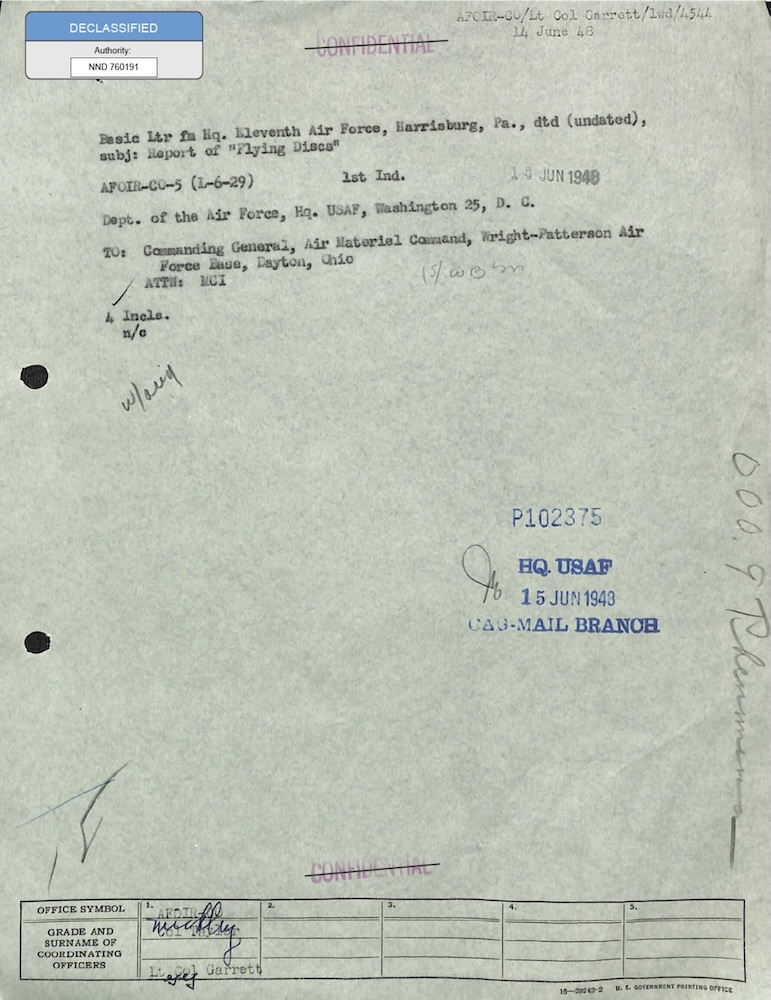
Project Sign: fascicolo UFO Flying Discs, 1948