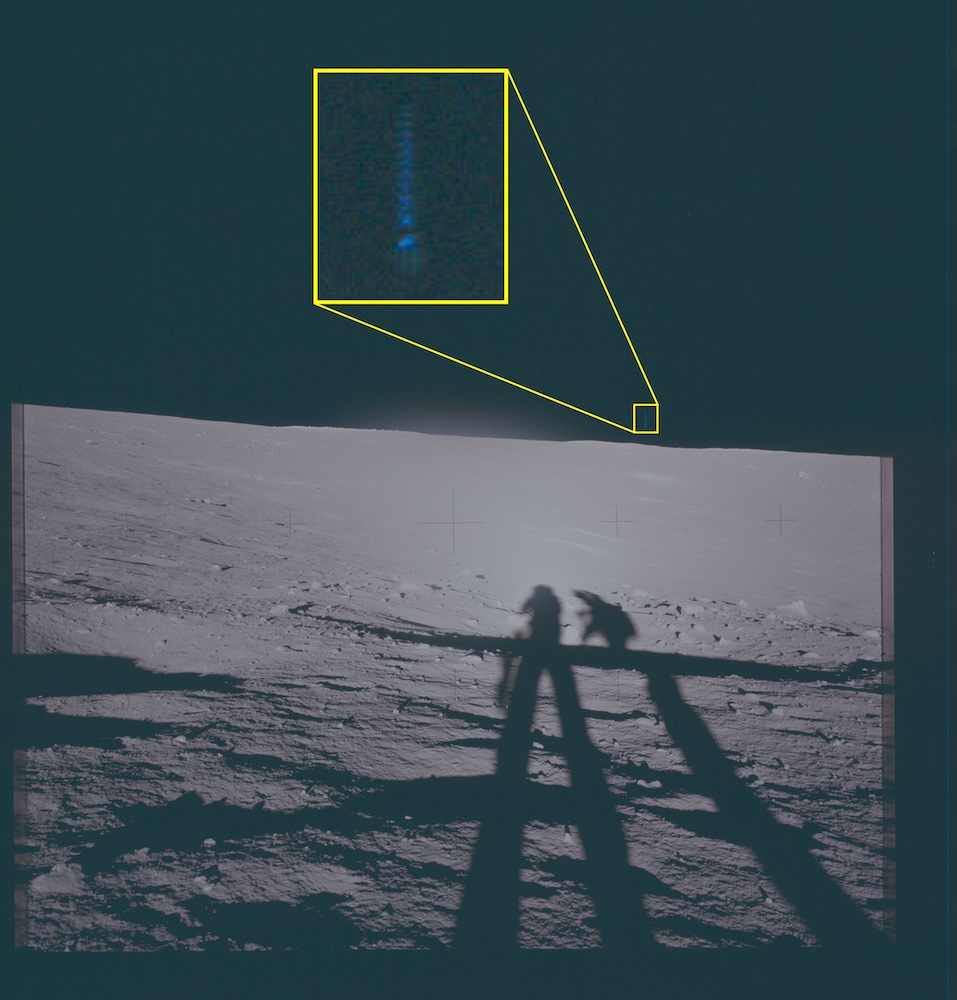
NASA-UAP-D018, Debriefing do Experimento da Gemini 4, 1967
Dados principais
- ID oficial do arquivo
- NASA-UAP-D18 (citado como NASA-UAP-D018 neste arquivo)
- Tipo de documento
- Documento
- Agência
- NASA
- Publicado em
- R03 · 2026-06-12
- Data do incidente
- June 3-7, 1965
- Local do incidente
- órbita terrestre baixa
- Páginas legíveis
- 180/224
- VIRIN
- 260508-O-D0360-1123
Descrição oficial
Gemini IV foi a segunda missão tripulada da série Gemini. Os astronautas James McDivitt e Edward White concluíram com sucesso o voo de quatro dias, entre 3 e 7 de junho de 1965. A missão incluiu a primeira caminhada espacial americana. Esta coleção de documentos contém uma transcrição na qual os astronautas relatam suas observações de partículas brilhantes fora da espaçonave, datada de cerca de 25 de junho de 1967, nas páginas 78-81 e na página 101.
✦ Resumo IA
Este documento reúne vários materiais de planejamento e pós-voo da NASA relativos à Gemini 4 (GT-4): um Mission Operation Report (n.º M-913-65-04) de maio-junho de 1965 descrevendo os objetivos da missão, o plano de voo adicional de EVA/encontro orbital, o novo traje espacial G4C, biografias da tripulação (McDivitt, White, reservas Borman/Lovell), trajetória, zonas de recuperação e rede de rastreamento, seguido por uma transcrição mal digitalizada de um debriefing científico/experimental da NASA (rotulado 'Belt 11-14') abrangendo o experimento D-9 de navegação/observação de aeroluminescência. Nesse debriefing, um cientista da NASA revisa observações visuais anteriores de astronautas da camada natural de aeroluminescência (vista de perfil a partir da órbita) por Glenn, Carpenter, Cooper, Schirra, White e McDivitt, incluindo comentários sobre tênues faixas autoluminosas, cores crepusculares, um brilho auroral ultravioleta visto visualmente sobre o sul da Austrália, um possível meteoro observado entrando na atmosfera abaixo da espaçonave, e uma estrutura tênue inexplicada notada pela primeira vez na camada de aeroluminescência. Encerra-se com conteúdo não relacionado do debriefing médico/experimental pós-voo (fonocardiograma, dados de exercício de desmineralização óssea, experimentos fotográficos). Nenhum avistamento de UAP/aeronave desconhecida aparece; o conteúdo 'incomum' é ciência padrão de aeroluminescência/aurora da atmosfera superior, discutido explicitamente como um fenômeno natural conhecido.
Gerado com IA a partir do arquivo oficial — pode conter erros.
▸Transcrição(180 de 224 páginas legíveis)
[PAGE 1] NATIONAL AERONAUTICS AND SPACE ADMINISTRATION ROUTING SLIP Action MAIL CODE Approval Call Me Concurrence File Information Investigate and Advise Note and Forward Note and Return Per Request Per Telephone Conversation Recommendation See-Me Signature Circulate ond Destroy TEL NO or code EXT CODE or other desighation NASA FORM 26 ApR 69 PREVIOUS EDITIONS MAY BE USED 1969 OF —348-365 [PAGE 2] Mission Operation Report No M-913-65-04 MEMORANDUM June 1965 To A/Administrator From M/Associate Administrator for Manned Space Flight Subject Gemini Flight Number Four GT-4 Additional Flight Activities Subsequent to the preparation of the GT-4 Mission Operation Report several new procedures and items of equipment have progressed to a stage of flight readiness Consequently three significant additional flight activities are now possible and have been included in the mission These activities are extra vehicular activities EVA extra vehicular propulsion and demonstration of rendezvous with the booster second stage Additional details of these flight plan activities are provided in the attached supplement to the basic report eorge’f fleet Enclosure MOR No 913-65-04 Change FOR INTERNAL USE ONLY [PAGE 3] M-913-65-04 ADDITIONAL GT-4 FLIGHT PLAN ACTIVITIES Three additional special engineering and operational objectives are now planned for the first four orbits of the GT-4 Mission Demonstration of extravehicular activities EVA using a 25 foot umbilical Potential future application includes crew transfer in- flight repair and inspection of orbiting objects Demonstration of extravehicular maneuvering using a simple one- man propulsion unit This device could be used with or without a spacecraft tether on future missions Demonstration of rendezvous with the booster second stage This activity will provide valuable early information and maneuvering procedures necessary to rendezvous with a target vehicle Flashing lights identical to those designed for the Gemini/Agena Vehicle have been installed on the booster second stage for this test The Flight Plan sequence involves post-launch separation from the launch vehicle then maneuvering to stop the spacecraft separation velocity The first two orbits will be flown with the spacecraft at distances less than one quarter of a mile from the launch vehicle Nighttime separation will be sufficient to prevent the flashing lights from disturbing the pilot's visual dark adaptation The first orbit will be occupied with operational checks of the spacecraft guidance maneuvering and environmental control systems The pilots will utilize the second orbit to prepare for the extravehicular activity This procedure involves unstowing and assembling a 25-foot umbilical the emergency oxygen pack a maneuvering unit and the cameras Over Hawaii at daybreak near the end of the second orbit the cabin will be depressurized and Jim McDivitt will maneuver to within close proximity of the booster At this point the right hatch will be opened and Ed White will climb out and hold on the right forward portion of the spacecraft until McDivitt gives him a release command Upon command White will push off slowly and reorient himself with the hand-held maneuvering unit to face the booster A 35-mm still camera Zeiss-Contarex mounted on the maneuvering unit will be used to photo- graph the booster and spacecraft with various earth/sky backgrounds After testing his ability to maneuver in a zero gravity environment White will maneuver back toward the spacecraft and ingress The total time separated from the spacecraft will be approximately 10 minutes He will be inside with the cabin repressurized by the time the spacecraft passes over Ascension Island on the start of the third orbit Shortly after passing Ascension McDivitt will maneuver ahead of the booster with feet per second separation velocity Because this maneuver places the spacecraft in a higher altitude and longer period orbit than the booster it will rise above and fall behind the booster One orbit later the spacecraft 6/1/65 Page [PAGE 4] M-913-65-04 will trail 16 miles behind the booster At this point a spacecraft retardation maneuver of 13 feet per second will initiate the visual rendezvous sequence The spacecraft will approach the booster from behind and below Because of unknown variation in the atmospheric density and drag of the slowly tumbling booster the exact approach trajectory cannot be predicted The flight crew will measure elevation angles of the booster and will initiate rendezvous maneuvers when the booster is approximately 45 degrees elevation angle above the spacecraft By observing the movement of the booster with respect to the star background and with respect to the spacecraft inertial platform display the crew can determine the proper lateral maneuver to null the lateral component of velocity thereby resulting in a spacecraft velocity vector which is directly toward the booster After removing the lateral velocity difference the pilot will apply a series of breaking maneuvers with the forward firing thrusters to reduce the closing velocity The flight crew will measure with onboard instruments the total maneuvering velocity required for the rendezvous procedure The spacecraft should be back in close proximity of the launch vehicle over the Northeast coast of South America at the beginning of the fifth orbit After the rendezvous operation is complete the spacecraft will again separate from the booster this time using a maneuver which will place the Gemini spacecraft on an orbit with a predicted lifetime of four days The EVA suit is the new G4C suit which replaces the G3C suit used so successfully by the GT-3 flight crew The G4C suit has the following new features a Helmet incorporation of triple lens shield visors for visual thermal impact and micrometeorite protection Torso Change to Nomex HT-1 Linknet in restraint layer for increased structural strength Incorporation of strain relief zipper in sealing closure Incorporation of redesigned ventilation inlet and outlet fittings with automatic locking and redundant sealing features Replace Nomex HT-1 coverlayer with integrated thermal and micrometeority cover layer Gloves Incorporate new design with increased mobility abrasion resistance and thermal protection Bio-connector Self-alighment pin protective design [PAGE 5] M-913-65-04 Figure depicts the principal physical differences between the old G3C suit and the new EVA GAC suit Figure shows that with one visor down on the new G4C helmet there is practically no attenutation of light entering whereas Figure shows that with two of the visors down there is a noticeable difference in the amount of light that enters the astronaut's eyes With the third visor down there would be a similar decrease in the amount of light allowed to enter the helmet The multivarious layers of materials used in the EVA GAC suits are delineated in Figure It should G-4C be noted that the old OVERVISOR G3C suit consisted SPACE only of the pressure HELMET and restraint layers of Figure with the HT-1 nylon outer protective layer The EVA spacesuit has received the A following qualifi- cation tests [PAGE 6] G-4C OVERVISOR SPACE HELMET G-4C EXTRAVEHICULAR SUIT THERMAL AND MICROMETEOROID HI-INYLON OUTER LAYERS PROTECTIVE LAYER 6.8 02/0 WHITE USE WEAR AND SOLAR REFLECTANCE DACRON SPACERS PRESSURE AND RESTRAINT LAYERS M-913-65-04 [PAGE 7] M-913-65-04 Leakage Proof pressure 02 compatibility Ejection envelope Cold temperature Rapid decompression Life cycling Visor testing a ce fs Should the 25-foot long tether fail in some manner the pilot will be carrying a chestpack that has been compatibility qualified with the G4C suit and con- sists principally of an emergency oxygen bottle with automatic valving It should be emphasized that both the primary and backup flight crews have undergone 40 minutes cabin depressurization with the hatches open at a simulated altitude of 150,000 feet in the chambers at McDonnell St Louis during which time they practiced opening and closing the hatches taking pictures and other actions that will take place during EVA The extravehicular maneuvering will be accomplished using a zero Integral Propulsion ZIP Unit as shown in Figure This device is handheld and accomplishes propulsion by jetting oxygen out through a single forward firing nozzle and two aft firing nozzles as selected and aimed by the operator It includes a camera mounted for convenient extravehicular photography [PAGE 8] Mission Operation Report No M-913-65-04 MEMORANDUM May 24 1965 To A/Administrator From M/Associate Administrator for Manned Space Flight Subject Gemini Flight Number Four GT-4 GT-4 the fourth in a series of twelve planned Gemini flights is scheduled to be launched from Complex 19 at the John Kennedy Space Center on or after June 1965 This will be the second manned Gemini mission and the longest ever attempted by a two-man crew The purpose of the mission is to further demonstrate manned space flight for a period of four days The nominal launch time is 10 a.m EDT 1400 GMT The space vehicle is to be launched on an azimuth of 72 degrees and the spacecraft will be inserted into an initial orbit of 87-161 N.M at an orbital inclination of 32.5 degrees The 62 revolution mission will have a duration of approximately 97 hours and 50 minutes The primary and backup flight crews are of the new generation being members of the second group of astronauts James A McDivitt will be the command pilot and Edward White II will be the pilot Because the duration of the flight is one of the most significant aspects of their mission the post- flight activities will involve expanded medical evaluation as compared with previous missions including at least 24 hours aboard the recovery aircraft carrier the USS WASP After conducting various orbital maneuvers and the thirteen experiments during the four-day mission the spacecraft will reenter and touchdown approximately 400 miles southwest of Bermuda for a water landing and carrier retrieval vor George oe Enclosure MOR No M-913-65-04 FOR INTERNAL USE ONLY [PAGE 9] Report No M-913-65-04 MISSION OPERATION REPORT Ld GEMINI FLIGHT NUMBER FOUR GT-4 OFFICE OF MANNED SPACE FLIGHT FOR INTERNAL USE ONLY [PAGE 10] FOREWORD MISSION OPERATION REPORTS are published expressly for the use of NASA General Management as required by the Administra- tor in NASA Instruction 6-2-10 dated August 15 1963 The pur- pose of these reports is to provide NASA General Management with timely complete and definitive information on flight mission plans and results from launchings with Scout class or larger vehicles Initial reports are to be prepared and issued for each flight project just prior to launch Following launch updating reports for each mission will be issued to keep General Management currently in- formed as provided in NASA Instruction 6-2-10 Distribution of these reports has been specifically directed by Gen- eral Management and they are not available for additional or general distribution The Office of Public Affairs publishes a comprehensive series of pre-launch and post-launch reports on NASA flight missions which are available for general distribution Published and Distributed by OFFICE OF PROGRAM REPORTS OFFICE OF PROGRAMMING NATIONAL AERONAUTICS AND SPACE ADMINISTRATION Washington 20546 [PAGE 11] Re-entry capsule Adapter sectior Equipment bay contains Batteries’ Malfunction detection system MDS unit Range safety command control syste Programmer Three-axis reference system Radio guidance system RGS Autopilot Instrumentation and telemetry syster FIG 5/24/65 M-913-65-04 GENERAL Gemini Flight Number Four GT-4 is the second manned orbital flight in the Gemini Program and the fourth flight in a series of twelve planned to develop long-duration and rendezvous capability docking techniques extra-vehicular activities and controlled reentry The first three Gemini flights demonstrated orbital insertion capability spacecraft structural integrity and spacecraft systems performance and crew accommodation qualities respectively This GT-4 mission is intended to further demonstrate manned space flight for a period of four days the longest ever flown by two astronauts The space vehicle is depicted in Figure MISSION OBJECTIVES PRIMARY Demonstrate and evaluate the performance of the Gemini spacecraft systems for a period exceeding four days Evaluate the effects of prolonged exposure to the space environment on the two-man flight crew in preparation for missions of longer duration SECONDARY Demonstrate OAMS capability to perform retro fire backup Demonstrate the capability of the spacecraft and flight crew to make significant in-plane and out-of-plane maneuvers Conduct further evaluation of spacecraft systems as outlined below Structure and thermal protection Environmental Control Systems ECS Crew stations Guidance and Control System Orbital Attitude and Maneuver System OAMS Execute the following experiments Basic Object Photography Surface Photography Radiation in Spacecraft Simple Navigation In-Flight Exercises In-Flight Phonocardiogram Bone Demineralization MSC-1 Electrostatic Charge [PAGE 12] M-913-65-04 MSC-2 Proton Electron Spectrometer MSC-3 Tri-Axis Magnetometer MSC-10 Two-Color Earth's Limb Photos Synoptic Terrain Photography Synoptic Weather Photography UNUSUAL TASKS OF THIS MISSION One of the interesting tasks of this mission is the duration of the flight It will be the longest ever to be conducted by a two-man crew Another highly interesting item is that control of the mission for the first time will be from the Mission Control Center MCC Houston Some elements of the Mission Control Center at Cape Kennedy and the GSFC computing facility will be standing by as a backup during the launch phase The computing facilities at GSFC will also be used as a backup to MCC-Houston during the orbital phase Flight controllers will man the MCC in three shifts to give complete round-the-clock coverage of the four- day mission Crew control of reentry will be accomplished by tracking the roll needle rather than nulling the down-range and cross-range needles as on GT-3 The experiments will of course contribute much information for the scientific and medical communities The G4C suit which replaces the G3C suit used on GT-3 has the following new features a triple overvisor a redundant pressure closure seal zipper and thermal and meteoroid protection integrated in the outer cover layer Abort procedures to be utilized by the astronauts in the unlikely event it becomes necessary for them to terminate a mission before orbital insertion are different from those used in the Mercury program In that program the fireball that would have been created had a conflagration occurred on the pad would have been large enough to ABORT PROCEDURES engulf an ejecting astronaut so it was necessary to add an escape rocket to lift the entire spacecraft free of the area The GLV on MOE ETHOPME Yn ATE TRN AROUND the other hand uses self-igniting fuels which upon mixing create a fireball small enough so that the 20,700 Fes astronauts can eject from the spacecraft in much the same man- ner as is done in today's high performance jet aircraft This is called the Mode abort pro- cedure The three abort modes are more fully defined by the altitude and elapsed time-after- launch parameters depicted on Figure MODE I EJECT AFTER SHUTDOWN MODE II SALVO RETROS AFTER SHUTDOWN 5/24/65 [PAGE 13] M-931-65-04 LAUNCH VEHICLE DESCRIPTION The Gemini Launch Vehicle GLV has been modified by man-rating an Air Force Titan II missile The GLV has two stages the first 71 feet long and the second 18 feet long both stages have a diameter of 10 feet The gross loaded weight of the two stages is 337,521 pounds and they both burn storable hypergolic self-igniting upon mixture propellants First stage thrust is approximately 430,000 pounds at sea level Second stage thrust is approximately 100,000 pounds The various systems of the GLV have been detailed in previous Gemini MOR's and what follows is additional information concerning modifications made to GLV-4 The fuel dampener and oxidizer standpipe used to suppress longitudinal oscillations have been redesigned Butt welding vice lapped joints have been utilized on the fuel tank conduits to eliminate minute cracks Malfunction Detection System circuitry has been redesigned to provide separate indications of the subassembly thrust level and additional insulation has been applied to provide increased fire protection Sixteen T/M readout points have been removed from the GLV because they are no longer required and one range safety circuit has been added to the destruct system interlocking AGE and the GLV motor driven switch control This circuit will prevent switch cycling in the event that both set and reset signals are inadvertently applied during checkout TABLE PROJECT COST In Millions FY 63 FY 64 FY 65 FY 66 FY 67 Total Spacecraft 205.1 280.5 165.3 122:7 19.1 823.0 Launch Vehicle i 79.1 122.7 115.4 88.6 8.5 438.7 Operational Support ail 4.9 15.7 PT 30.8 13.0 92.2 Total RD 54.8 289.1 418.9 308.4 242.1 40.6 1353.9 This level of funding will provide for twelve Gemini Launch Vehicles twelve space- craft seven Agena Target Vehicles six Atlas booster missiles and the operational costs of flight testing and the associated Ground Support Equipment SPACECRAFT The spacecraft is 18.75 feet long and its two sections a reentry module and an adapter section will weigh 7799 Ibs fully loaded with the astronauts onboard The configuration will be the same as was flown on GT-3 except for the following minor changes have been made to switch positions and nomenclature three additional total of six adapter 5/24/65 Page [PAGE 14] M-913-65-04 batteries will be required radial thrusting TCA's and burst diaphragms in the package that were removed for GT-3 are both installed on GT-4 and will act through the Spacecraft Centers of Gravity An HF antenna has been added to the adapter section for orbital use and the HF transciever there has been removed The C-band phase shifter now has its own inverter the recovery flashing light can now be turned off during daylight hours the HF antenna on the cabin section has been redesigned and the adapter S-band transponder in the adapter section has been replaced with a C-band transponder which will have a different pulse spacing from the one in the spacecraft In the GT-4 mission S$/C urine will be dumped directly overboard from the urine bellows through a shut-off and selector valve a solenoid valve and a heated line Redundancy is provided by the capability to dump urine through the launch cooling heat exchanger water boiler The main chute disconnect cartridge has been changed from a 22-second time delay to a zero second delay and new long-life attitude thrusters have been installed EXPERIMENTS The 13 experiments are depicted and described on the following pages Basic Object Photography In conducting this experiment the as- BASIC OBJECT tronauts will employ elaborate photo- ppOTOGRAPHY optical equipment to investigate the technical problems associated with observing evaluating and photo- graphing objects in space These objects include the 2nd stage of the launch vehicle and natural celestial bodies such as the moon Data from this experiment will be used to evaluate the astronauts ability to view and track objects and to maintain object-camera orientation by maneuvering the spacecraft Equipment which will be used is illustrated in Figure 5/24/65 [PAGE 15] Surface Photography This experiment will investigate the technical problems associated with an astronaut's ability to acquire track and photograph terrestrial objects from a space- craft with more elaborate photo- optical equipment than that used previously The astronaut will photograph selected series of objects during day-side and night-side intervals of the flight using specified lens-film combi- nations The resulting data will be used to evaluate the astronaut's ability to maintain object-camera orientation by maneuvering the spacecraft Figure shows the camera mount installed on the spacecraft window Radiation in Spacecraft Data from this experiment will be used to supplement external radi- ation measurements in studying the dose levels within the space- craft resulting from passes through regions of varying radiation intensity Two tissue-equivalent current-mode ionization chambers will be used to measure the variation of absorbed dose-rate inside the spacecraft Five small packets containing radia- tion detection and measurement devices will be placed at various locations in the cabin to ascertain their suitability as convenient dosimeters of space radiation and measure total accumulated dose Figure shows some of the equipment to be used for this experiment 5/24/65 M-913-65-04 SURFACE PHOTOGRAPHY RADIATION IN SPACECRAFT PORTABLE UNIT MG5-8095 [PAGE 16] M-913-65-04 Simple Navigation This experiment is designed to SIMPLE NAVIGATION develop and test navigation pro- cedures which employ a simple stadimetric device and a sextant to make sightings and measurements in space using the horizon and stars as references Data from sightings will be used in compu- tations to determine orbital parameters These results will be compared with actual parameters to determine the accuracy of the procedures The hand held sextant to be used is shown in Figure HAND HELD SPACE SEXTANT MG5-8097 FIG In-Flight Exerciser The purpose of this experiment is to assess the astronauts capacity IN-FLIGHT to perform physical work under EXERCISER spacecraft conditions Monitored exercise will be performed by the astronauts prior to the flight to establish control data Isotonic exercises employing a bungee cord and involving the arms and legs will be taken prior to and after exercising Pulse rate will be monitored continuously The inflight data obtained will be compared with the control data to determine the capacity for work in space Figure shows the manner in which this exercise will be performed 5/24/65 [PAGE 17] In-Flight Phonocardiogram The purpose of this experiment is to measure the fatigue-stage of an astranaut's heart muscle during a long-duration flight A microphone will be applied to an astronaut's chest wall at the cardiac apex Heart sounds detected during the flight will be recorded on an on- board biomedical recorder The sound trace will be compared to the waveform obtained from a simultaneous inflight electro- cardiogram to determine the time interval between electrical activation of the heart muscle and the onset of ventricular systrole Figure illustrates the method of installation of the phono- cardiogram transducer Bone Demineralization The purpose of this experiment is to establish the occurrence and degree of bone deminerali- zation resulting from prolonged weightlessness during spaceflight Special X-rays will be taken of an astronaut's heel bone and the terminal bone of the fifth digit of the right hand Three pre- flight and three postflight exposures will be taken of these two bones and compared to determine if any bone deminerali- zation has occurred due to the space flight Figure illustrates the laboratory procedure which will be used for this experiment 5/24/65 M-~-913-65-04 IN-FLIGHT PHONOCARDIOGRAM PROTOTYPE PHONOCARDIOGRAM TRANSDUCER AND SIGNAL CONDITIONER GEMIN EXPERIMENT WO BONE DEMINERALIZATION ESTABLISH DEGREE OF BONE DETERIORATION PURPOSE EQUIPMENT STANDARD X-RAY WEIGHT N/A VOLUME N/A PRE AND POST PROCEDURE FLIGHT X-RAY LOCATION N/A a MG4-1886 FIG [PAGE 18] M-913-65-04 MSC-1 Electrostatic Charge Before rendezvous missions are SC-1 attempted an investigation MSC- must be made of the possibility ELECTROSTATIC of inadvertent ignition of CHARGE pyrotechnics and other detri- mental effects due to discharge of electrostatic charge potentials during rendezvous In this experiment an electrostatic- potential meter which protrudes through the wall of the space- craft adapter assembly will be used to detect and measure any accumulated electrostatic charge that may be created on the surface of the spacecraft by cay ionization from engine exhaust FIG 10 This data will be analyzed to determine if the charge is adequate to create a rendezvous hazard Fig- ure 10 shows the detector installation MSC-2 Proton Electron Spectrometer This experiment is designed to measure the quantity and energy of protons and electrons present immediately exterior to the orbiting spacecraft This will be accomplished by means of a PROTON scintillating-crystal charged- particle analyzer mounted on ELECTRON the adapter assembly of the sedidennat Data from this SPECTROMETER experiment will be used to correlate radiation measure- ments made inside the space- craft and to predict radiation levels on future space missions The proton electron spectrometer installation is shown in Figure 11 5/24/65 [PAGE 19] M-913-65-04 10 MSC-3 Tri-Axis Magnetometer In this experiment the direction and magnitude of the earth's magnetic field with respect to the spacecraft will be measured MSC-3 TRI-AXIS A tri-axis fluxgate magneto- MAGNETOMETER meter mounted in the adapter assembly of the spacecraft will be used The equipment instal la- tion is shown in Figure 12 11 MSC-10 Two-Color Earth's Limb Photos MSC-10 TWO-COLOR The astronaut will obtain photo- EARTH’S LIMB PHOTOS graphs of the earth's limb using a hand-held camera black and white film and a special filter mosaic which will allow each picture to be taken partly through a red filter and partly through a blue filter After the flight the negative will be subjected to careful measure- ments and the resulting data will be used in statistical analyses to evaluate the limb radiance These studies will be used to determine if the sun-lit earth's limit can be reliably observed in the short- FIG 13 visible or near-ultraviolet spectral region The camera to be used for this experiment is shown in Figure 13 MG5-8105 5/24/65 [PAGE 20] 12 Synoptic Terrain Photography The objective of this experi- ment is to obtain high quality photographs of selected parts of the earth's surface The spacecraft will be manually oriented from an orbit mode attitude to a moderately high camera depression angle attitude After a series of photographs has been taken the spacecraft will be reoriented to the orbit mode attitude Four spacecraft orientation maneuvers will be required during which approxi- mately 40 pictures will be taken over areas of the United States Figure 14 shows one of the photos taken by Gordon Cooper which is similar to the terrain photographs planned 13 Synoptic Weather Photography The objective of this experi- ment is to learn more about the earth's weather systems by obtaining high quality photo- graphs of selected cloud for- mations As in experiment the spacecraft will be oriented from an orbit mode attitude to a moderately high camera depression angle attitude After a series of photographs has been taken the spacecraft will be reoriented to the orbit mode attitude Approximately 10 orientation maneuvers will be required during which approximately 40 pictures will be taken The photograph shown in Figure 15 taken by Gordon Cooper is similar to those planned on this flight 5/24/65 M-913-65-04 GEMINI EXPERIMENT NO SYNOPTIC TERRAIN PHOTOGRAPHY PURPOSE ostain HIGH QUALITY PHOTOGRAPHS OF THE EARTH'S SURFACE PROCEDURE Position SPACECRAFT TAKE PICTURES LOCATION ressurizeD CABIN PHOTOGRAPH OF THE HIMALAYAS IN THE INDIA NEPAL TIBET BORDER AREA TAKEN BY ASTRONAUT GORDON COOPER JR DURING HIS 22-ORBIT MA-9 MISSION MG4-17 GEMINI EXPERIMENT NO SYNOPTIC WEATHER PHOTOGRAPHY Be PURPOSE —ostaw wich ouatrry c.oup PHOTOGRAPHS EQUIPMENT 70 mm CAMERA AND FILM WEIGHT 118 VOLUME 0.036 CU FT PROCEDURE Position SPACECRAFT AND TAKE PHOTOGRAPHS LOCATION pressurize cain PHOTOGRAPH OF CLOUDS AND THE BURMA WEST COAST WEST OF RANGOON TAKEN BY ASTRONAUT GORDON COOPER JR DURING HIS 22-ORBIT MA-9 MISSION [PAGE 21] M-913-65-04 ASTRONAUTS The Command Pilot for the GT-4 mission will be James A McDivitt and the Pilot will be Edward White Il The backup flight crew will consist of Frank Borman as Command Pilot and James A Lovell Jr as Pilot Their pictures and biographies follow FIG 16 JAMES A MCDIVITT Bor in Chicago Illinois on June 10 1929 He graduated first in his class from the University of Michigan with a B.S in aeronautical engineering McDivitt is married to the former Patricia A Hass of Cleveland Ohio and has three children McDivitt joined the Air Force in 1951 and is an Air Force Major He was awarded three Distinguished Flying Crosses five Air Medals and the Choo Moo Medal from South Korea He is a graduate of the United States Air Force Experimental Test Pilot School and the United States Air Force Aerospace Research pilot course He served at Edwards Air Force Base California as an experimental test pilot McDivitt has logged more than 3,000 hours flying time including 2,500 hours in jet aircraft McDivitt was selected as an astronaut by NASA in September 1962 In addition to participating in the overall astronaut training program he has had additional specialized duties These duties include monitoring the design and development of the guidance and navigation systems for the Gemini and Apollo spacecraft as well as monitoring the overall Apollo Command and Service Modules EDWARD WHITE Il Born in San Antonio Texas on November 14 1930 White received his B.S from the United States Military Academy and his M.S in aeronautical engineering from 5/24/65 Page 11 [PAGE 22] M-913-65-04 the University of Michigan He is married to the former Patricia Finegan of Washington D.C and has two children White an Air Force Major received flight training in Florida and Texas following his graduation from West Point He attended the Air Force Test Pilot School at Edwards Air Force Base California in 1959 White was later assigned to Wright-Patterson Air Force Base Ohio as an experimental test pilot with the Aeronautical Systems Division In this assignment he made flight tests for research and weapons systems development wrote technical engineering reports and made recommen- dations for improvement in aircraft design and construction He has logged more than 3,600 hours flying time including more than 2,200 hours in jet aircraft White was named as a member of the astronaut team selected by NASA in September 1962 FRANK BORMAN Bor in Gary Indiana on March 14 1928 He re- ceived his B.S from the United States Military Academy and his M.S in aeronautical engineering from the California Institute of Technology He is married to the former Susan Bugbee of Tucson Arizona and has two sons Upon graduation from West Point Borman now an Air Force Major chose an Air Force career and received his pilot training at Williams Air Force Base California From 1951 to 1956 he served with fighter squadrons in the United States and in the Philippines and was an instructor of thermodynamics and fluid mechanics at the U.S Military Academy West Point He was graduated from the USAF Aerospace Research Pilots School in 1960 and later served there as an instructor In this capacity he prepared and delivered academic lectures and simulator briefings and flight test brief- ings on the theory and practice of spacecraft testing Borman has logged more than 4,400 hours flying time including more than 3,600 hours in jet aircraft Borman was one of the nine astronauts named by NASA in September 1962 JAMES A LOVELL JR Born in Cleveland Ohio on March 25 1928 He received his B.S from the United States Naval Academy Lovell is married to the former Merilyn Gerlach of Milwaukee Wisconsin and has three children Lovell a Navy Lieutenant Commander received flight training following his graduation from Annapolis He served in a number of Naval 5/24/65 Page 12 [PAGE 23] M-913-65-04 aviator assignments including a three year tour as a test pilot at the Naval Air Test Center at Patuxent River Maryland His duties there included service as program manager for the F4H Weapon System Evaluation Lovell was graduated from the Aviation Safety School of the University of Southern California He served as flight instructor and safety officer with Fighter Squadron 101 at the Naval Air Station at Oceana Virginia Lovell has logged 3,000 hours flying time including more than 2,000 hours in jet aircraft Lovell was selected as an astronaut by NASA in September 1962 In addition to participating in the overall astronaut training program he has been assigned special duties These duties included monitoring design and development of recovery and crew life support systems These include space suits environmental control system and developing techniques for lunar and earth landings and recovery TRAJECTORY The launch trajectory for the GT-4 mission will be similar to that flown by GT-3 In- sertion will be at the same altitude 87 miles but the first apogee of GT-4 will be 161 miles The Gemini launch sequence is shown in Figure 20 I SHUTDOWN FLIGHT PLAN -Sernoee eve yp oa So In addition to the various orbital maneuvers to be performed during the mis- sion as called out in Table Il other activities will be taking place as 15.000 0:50 gc is shown below in Table ae g-29 START PITCH IIL a summarization of the Flight Plan The 2000 -—0:20 STOP ROLL 072° consumable items loaded onboard the spacecraft 500 0:10 START ROLL 085 Soc —Se are shown in Table IV 5/24/65 [PAGE 24] HP/HA AFTER MANEUVERS MANEUVER POINT OF APPLICATION DIRECTION OF THRUST TRANSLA- TIONAL THRUSTER PURPOSE Separation 87/161 N.M MN/161 N.M 94/134 N.M 6FPS 93/124 N.M 110FPS 45/99 45/97 SECO+2- Apogee Apogee of 30th Rev Approx 15 min after min after TSC min after TSC Perigee following Apogee of 45th Rev Perigee following 62d Rev or 66th Rev FWD FWD AFT S/C-Booster Separation Adjust lifetime for insertion dispersions Evaluate thruster operation Adjust lifetime Evaluate thruster operation Evaluate thruster operation Determine visual characteristics of thruster plume Evaluate thruster operation Determine visual characteristics of thruster plume Evaluate thruster operation Determine visual characteristics of thruster plume Adjust lifetime Evaluate 3-axis application Adjust lifetime Evaluate thruster operation Adjust lifetime Evaluate thruster operation Achieve OAMS retrofire operation Evaluate thruster FOR PACIFIC LANDING +TRANSLATIONAL SYSTEM CHECK vO-S9-EL6-W [PAGE 25] TABLE III IN-FLIGHT ACTIVITIES 13-65-04 Time —_|Revolution HRS:MIN EVENT Function cP Insertion Checklist Experiment Translation Maneuver Experiment MSC-1,2,3 and 10 Experiments Experiment MSC-2 and Experiments Experiment Experiment Experiment Experiment Experiment HF Communication Tests Experiment Experiment MSC-2 Experiments Experiment Experiment Experiment Experiment Experiment Experiment Experiment MSC-1 Experiment Translation Maneuvers KK IK KK OK OK OK Translation Maneuvers Thruster Failure Check Power Down Experiment Experiment Experiment Experiment MSC-2 Experiments Experiment Experiment Translation Maneuvers Experiment Apollo Yaw Orientation Power Down S/C Experiment Experiment Power Down S/C Experiment Pre Retro Checklist TR-5 Minutes Checklist TR-1 Minute Checklist Retrofire Retro Jettison Post-Retro Checklist xX KK KK OK OK 5/24/65 Reentry Drogue Chute Deploy Pilot Chute Deploy Main Chute Deploy Two-Point Suspension Touchdown Post-Landing Checklist Page 15 [PAGE 26] M-913-65-03 TABLE IV GT-4 CONSUMABLE LOADINGS ITEM QUANTITY REMARKS Batteries 703 Ibs based Each battery has a ona 2400 A-h 400 A-h capacity OAMS Propellants Odixizer 246 Ibs Fuel 164 Ibs Oxygen Primary 52 Ibs Egress bottle are also Secondary 13 Ibs carried if ejection is required Lithium Hydroxide 97 bs Food Ibs Drinking Water Spacecraft 14 Ibs Adapter 61 Ibs RCS Propellants Oxidizer 40.4 Ibs Fuel 31.6 lbs GEMINI PARACHUTE LANDING SEQUENCE 50,000 FEET HIGH ALTITUDE DROGUE CHUTE DEPLOYED LANDING SEQUENCE At the end of the mission the parachute sooo eee landing sequence shown in Figure 21 will be employed One item that should be SeneATION mentioned in this regard is that should the 9,000 Feet wont 84-foot main parachute fail to open the crew can abandon the spacecraft by eject- ing and using their personal parachutes to effect a safe water landing The latter sequence would also be employed should sro rer ee the spacecraft come in overland instead of Sense the intended water landing SEAL CLOSED PILOT PARACHUTE DEPLOYED SEA LEVEL TouchDown JETTISON CHUTE 5/24/65 [PAGE 27] M-913-65-03 MISSION MANAGEMENT RESPONSIBILITY The Gemini Program is managed by the Gemini Program Director who exercises his direction through the Project Manager at the Manned Spacecraft Center The direc- tion of a specific mission is accomplished by a Mission Director acting under the cognizance of the Associate Administrator for Manned Space Flight from the time a space vehicle is committed to flight test until the end of the Mission Period TITLE NAME ORGANIZATION Program Director Acting Dr G.E Mueller NASA Headquarters Deputy Program Director Mr W.C Schneider NASA Headquarters Program Manager Mr C.W Mathews MSC Mission Director Mr C.C Kraft MSC PROGRAM MANAGEMENT NASA HEADQUARTERS Office of Manned Space Flight PROJECT MANAGE MENT Manned Spacecraft Center TRACKING DATA ACQUISITION SPACECRAFT LAUNCH VEHICLE MSC MSC MSC GSFC McDonnell Aircraft Co SSD ETR Aerospace Corporatios Martin Company Aerojet General OPERATIONS ORGANIZATION FOR MISSION PERIOD DOD Mgr for MISSION DIRECTOR MSF Support Staff Operations Gemini Flight Ops Rep Requirements Coordinator Security fi Officer Deputy tor Deputy for Meteorological Launch Flight Group Operations Operati ons Gemini Program Manager DOD Recovery Director GLV Atlas/Agena Medical Flight Recovery Launch Launch Director Affairs Crew Support Director Director Director Director Officer Gemini i Flight S/C Test Communi Support Conductor cator Officer Medical Flight Monitor ontrol 5/24/65 [PAGE 28] M-913-65-04 TRACKING AND DATA ACQUISITION The ground support network for GT-4 will be the Gemini Manned Space Flight Network MSFN illustrated in Figure 22 and tabulated in Table There will be however some minor modifications to the MSFN for the GT-4 mission These changes for the GT-4 flight are primarily in locating the range tracking ships in positions most advantageous for the orbits to be flown TABLE NETWORK REQUIREMENTS FOR GT-4 Tracking Telemetry Gemini launch Flight Mistram Acq aid Spacecraft Command Controller vehicle Manned Ground Station Code or others as listed PCMIFM/F Lae Rt DA DCS Tone Sites ceive Network jerritt Island MILA i Cape Kennedy CNV GE-Mod Mission Control MCC Patrick AFB PAFB Grand Bahomas GBI Grand Turk GTI Antiqua ANT Ascension Island ASC Valkaria Fla VAL Eleuthera Island ELU Bermuda BDA Canary Island CYI Kano Nigeria KNO Tonanarive TAN Carnarvon CRO Canton Island CTN Hawaii HAW IGuaymas Mex.|GYM Corpus Christi TEX Rose Knot Victor RKV Coastal Sentry CSQ Range Tracker RTK Pt Arguello Cal CAL White Sands NM WHS Eglin AFB EGL MSC Houston MCC elemetry Aircraft NOTES a Record Only Remoted to and from the MCC Remoted to MCC Three telemetry aircraft in primary recovery area Remote Site Data Process RSDP The ground network support facilities include the MCC-Houston Cape Kennedy CNV Air Force Eastern Test Range AFETR downrange stations the MSFN and Goddard Space Flight Center GSFC Real time tracking and the acqui- sition of data for post flight evaluation will be provided by optical and photo- graphic systems MISTRAM GE Mod III radar C-band radar and the Impact Predictor IP 7094 The network as listed in Table will monitor spacecraft and launch vehicle PCM telemetry The flight controller-manned stations as shown in Table will display selected spacecraft data for real-time evaluation and transmit these data to the MCC via teletype The MCC will use both the Digital Command System DCS for transmitting commands All the remote sites that are flight controller-manned except for GYM will have the DCS command capability Tone commands for use by the Range Safety Officer will be used for manual fuel cutoff MFCO auxiliary second stage cutoff ASCO and Destruct 5/24/65 [PAGE 29] GT-4 MANNED SPACE FLIGHT NETWORK GEMINI VO-S9-E16-W [PAGE 30] M-913-65-04 BACKGROUND Project Gemini is the stepping stone between the comparatively simple one-man orbital flights of Project Mercury and the complexities involved in the multi-man lunar flights of Project Apollo As such Gemini's prime reason for being is to increase knowledge of man's capabilities in space and in developing operational techniques to support the Apollo Program Thus Gemini's objectives become Long-duration flights up to fourteen days Rendezvous and maneuver in space Docking with a target vehicle Extra-vehicular activities by the astronauts Controlled reentry Operational training for all flight personnel concerned To accomplish these objectives a series of flights have been planned of which this GT-4 is the fourth The first three demonstrated respectively orbital insertion capability spacecraft structural integrity and crew accommodation qualities The four-day manned flight will further demonstrate manned space flight capabilities for the support of future missions of even longer duration The remaining eight Gemini flights all of which will be manned by two astronauts are tabulated in Table VJ with type of missson and approximate date of flight TABLE VI Mission No Mission Objectives Date GT-5 Seven-day flight with experiments Latter 1965 GTA-6 Radar rendezvous and docking Early 1966 GT-7 14-day Extra-vehicular activities Early 1966 GTA-8 Optical rendezvous and docking Early 1966 GTA-9 Simultaneous countdown and Mid 1966 rendezvous GTA-10 Direct rendezvous Mid 1966 GTA-11 Apollo-LEM rendezvous simulation Late 1966 GTA-12 Apollo-LEM abort simulation Early 1967 Includes rendezvous evaluation pod The planned end-of-the-mission touchdown point is in the Atlantic Ocean approxi- mately 400 miles southwest of Bermuda as is shown in Figure 23 This is the primary landing area The GT-4 mission employs a zone concept for recovery which estab- lishes four recovery zones East Atlantic West Atlantic West Pacific and Mid- Pacific Each zone consists of a circular area with a radius of 240 nautical miles in which various ships and planes will be stationed An aircraft carrier will be sta- tioned only in the primary landing area as illustrated in the recovery forces diagram 5/24/65 Page 20 [PAGE 31] M-913-65-04 GT-4 PRIMARY AND SECONDARY LANDING ZONES RECOVERY SHIP SUPPORT AND CONTINGENCY RESCUE FORCES CLIN a LAIES gc Do KINDLEY me 00 Va SAN DIEGO PATRICK wy SERS PALMAS ae ole CVS 00 HICKAM AL Ns oat qo seni 23 GUAM ALBROOK’ woes TE Ce’ PRIMARY ASCENSION SBesy RECOVERY AREA Uma pena eng SECONDARY RECOVERY AREA RIO DE JANEIRO MAURITIUS i a rnudesue CVS CARRIER oS TOWNSVILLE DD DESTROYER PERTH “aaa AO OILER CONTINGENCY RESCUE FORCES Av oy FIG 23 of Figure 24 Other areas in the world along the ground tracks are called contingency landing areas Because these contingency landing areas are world-wide it has been necessary to pre-position certain aircraft with their associated crews pararescuemen and paramedics so that they will be able to reach the spacecraft in sufficient time to render aid to the downed astronauts These contingency forces have been deployed to the bases shown in Figure 23 It should be noted that there are numerous types of aircraft in the launch area and primary landing area for telemetry weather reconnaissance aerial ARS AIRCRAFT PRIMARY RECOVERY ZONE photography and recovery 480 MILES IN DIAMETER operations In addition to these aircraft there are also several helicopters in the pri- mary recovery area from the aircraft carrier that are carry- PANDING!FO OFF Si ELLIPSE 200 MILES BY ing swimmers These swimmers 40 MILES deploy into the water and attach an auxiliary flotation collar to the spacecraft Launch uss wasr AND ONE DESTROYER area recovery forces are de- AT TOUCHDOWN POINT WASP HELICOPTERS picted in Figure 25 iL WASRICOMMAND AIRCRAFT USAF SSB RELAY AIRCRAFT xy ARS AIRCRAFT RECOVERY AREA FORCES FIG 24 5/24/65 [PAGE 32] M-913-65-04 LAUNCH AREA RECOVERY FORCES ese MINESWEEPER OCEAN GOING SHIPS MSO LANDING FOOTPRINT USMC 27 MILES LONG AMPHIBS FOUR HELICOPTERS TWO PHOTO JETS 5/24/65 [PAGE 33] NASA ROUTING SLIP ‘ACTION APPROVAL ary CONCURRENCE Pees FILE INFORMATION INVESTIGATE AND ADVISE NOTE AND FORWARD NOTE AND RETURN PER REQUEST RECOMMENDATION SEE ME SIGNATURE REPLY FOR SIGNATURE OF NAME if necessary REMARKS a brticvcn da ye iS Cs Per mee YMA WA OA frp Se Oe ag oot al’ ie oar e=ya De Back Rees Sr0Aon gattew Qtr hares BEL hin Ges Fy Neo Cins Me Le Arne i ae do AR Sg ane Aw atk ad RA wl G/21 NAME ooo FROM NASA Form 26 Rev Jan 1963 I SIRE DCO DTPA RES OTST [PAGE 34] NASA ROUTING SLIP NAME if necessary ACTION APPROVAL CONCURRENCE FILE INFORMATION INVESTIGATE AND ADVISE NOTE AND FORWARD NOTE AND RETURN PER REQUEST RECOMMENDATION SEE ME SIGNATURE REPLY FOR SIGNATURE OF FROM CODE NAME NASA Form 26 Rev Jan 1963 U.S GOVERNMENT PRIKTING OFFICE 1963 OF —671845 [PAGE 35] EXI3 ROUTING SLIP NAME INITIAL FOSTER COX EATON HRABAL A MOKE NEWMAN SMISTAD BROCKER MARKS Pes Coen fe Dr Toceryn Giec [PAGE 36] bh de YO te Mrtohead Se Daf is vs rt i Cc eninajnie cy Of Arrerncew Sesion Or QGT-¢4¢ EXP OVbEIGFING “For anaes oT 6-5 aa vered ground hard way and uh uh by betometer ngulation by trying to determine how high it was it was many years before one hud come idea how high the air glow really was we WILL Indiente seconds Glenn and of -conds how high hard work Again there made tt point wis that in a few seconds from Yr An point you the air glow then lever mean bj mned band Like some ind and earth and this is roughly about Lometers determined by Carpenter and rockct passing throu glow Uh the glow edge we have heard about it was used in comection with the Scxtan experiments and so on Now I just wanted some idea Land in htness Now before ty LO Sen very much [PAGE 37] that you don't know whether haze or luminous sort it Unfortunately and other people kept that term Really what Glenn was ir Ns Mowe me little dust there it the predominate feature Now Carpenter has more time ilters bac xp with hi and uh able to star was upper the Lower and when it red From Lnormat one wis able to pin down the exact tim this i rita took many many years to ry difficult cause ssion was [PAGE 38] some be abl White and McDivitt the very well Uh the let's there's another well we'll go back to that in a moment The reason I think hm he other desi¢ns to show what can be done If be donc by extending visual observations we will do so Uh some ot’ new results hat McDivitt and Wr were able to record are very interesting Uh of all they saw a structure i he air glow and this is the first this is reported In one instance a uh is seen some structure in tow that they're looking edge on turns white This has never been observed before It is very 50 Observe this with a rocket you don't know when to the rocket to do tha They they observed that sting thing They observed meteor going into down below them It is irst time a meteor reported from uh space by an astronaut And it was a very pecu- liar experience for them I am sur ro they saw the things below them soing down into tt Tt saw when they were over southern li ‘eported by astronau [PAGE 39] spectactr to expl Ty we to whet saw duri sunset uh Me Mars and he observed at twilight sun had cular array of colors he describes them very in the blue book is blue book and summarys iescribed a rather interesting blue band that you can call Schirra's blues Uh to quite well with blues He observed a dar dark blue And the word Light one do Light it was brighter it appears to be a words for what they stand observations wer and afterwards we are all sist very con construct thi The time around “irst Schirra me wher ite know not too sure Uh timeless tube because Carpente observing the 10 Le oh Lrom scems to he cimum we know is very abs very “ficult word Anyway tent Wi around the the ozonisph Cooper what Schirra He observed uh the planet just set a very specta- carefully in the report blue book too Uh he le bh th ree blue bands is true and he's able to blue light blue and a When one blue and one we uh from what these is reportedly on to a tape and is debriefing had an order to try to it needed a little correction was somewhat he was thin what this band we think it might be tomorrow or around or 20 kilometers in the ultraviolet [PAGE 40] tion this band some Chain doe [PAGE 41] yer in could add some toc [PAGE 42] looking sort of two passes nd you are from the asked him [PAGE 44] atomic sreen line have caused people to think tha green line If you are starting the to observe the green line observe holding the green line FOr we applications i continuim In other words while those 4000 000 mentioned but there's Light we've glow edge on is is the there and just in critical perhaps the reason why the one is throwing away a lot of light fog lights you know hey were light wasters There is no worked wel is they were low down But you don't war waste any Liycht observation wink to point how one makes upplications uh things Yy you weren't about I she ir glow in and uh would continue near may not be always you're dea voTT continuim right along been talking a total the Sextant experiment Uh this rcason so eventually 12 ‘om the continual we may thi something very magic about sreen line certain ou want are built very carefully to But subtract the and this is again ing with is the green line right here here A lot of light here out ‘Tt visual night glow there's a lot of light constructively didn't work too well is after not as bad as the case of is Remember years ago the fog lights were yellow the only reason why they the yellow disappear Mowever White will point out to ereen ilter and McDivitt preferred st to depends a lot your own method very careful spe yesterday reity it each of astronauts [PAGE 45] starting with Glenn who had trouble bing Well I really don't want to get into that too much for this reason there will fine experiment carefully planned through the I mean sensitivity uh Oh uh uh Well Glenn didn't a change to get and therefore he wasn't able to make Same acute observations for example as Cooper was able to make because for example I don't think Glenn hed an oppor- tunity to really get and sce very much on the daytime skies but you mean maybe uh that type of uh Well yes uh or even starlight fine alright I what you mean was the landing nitude going back to let me continue with that Uh in one case Cooper was taking a small woke up and opened his blind and looked out and he was on the day side he earth was directly below the sun was directly behind hi So the earth was not illuminating any portion of the window nor was it illuminating anything that the window saw ‘There is not primary secondar aud om pretty food situati id he did see st daytime bub he did indiente he was not ab to see as well did ut mipht and he as wuite ll at night And again know there's a day air glow but its very icult to measure and here i beginning of subjective observation of of its men at the [PAGE 46] board or what the day air glow is have the orbiting lem Two of the orbiting air glow this air glow good higher and it our situatior between day and ni see down to 7th and were not able to sce aS S11 SO WC itive cnouvh Look and observe physically Now this is very important because here we next year and very important background prob- observatories are above the But day air glow dence in the rocket measurements that sociated with a red air glow And so here's where an astronaut was able to subjectively note the difference McDivitt and White were able to ture stars where as the other astronauts Again may be a question of time darkmentation perhaps not that much more time but uh they were getting down to uh should be possible under the kinds of sensitivity that uh under good conditions of dull atmosphere Uh should we mention anything about the window pane and uh to hear more about it the window or take somet from what we heard that a accumulation and wher Wwimuow it BCOMS window whi he chem senttering the it look at »Oked SsensCc feh had ac which the question on did uy White smear something on ing off with his elbow or something It appeared tood something there has been some medium on the window and we took what black because “Umi little particles whict light the place where would Looked ter all the cockpit inside is But [PAGE 47] looked out through the window uh there seemed to be a change In fact they have aphotograph of this spot talk about that Uh they are very uh they say the astronauts have taken advantages of every possible opportunity to note something unusual And he keeps all the copies Uh I think we can look a little bit to the future I think we all would like to extend the range of vision and the way to do that is with im ge converters This may be very practical Uh if one is dealing with uh the idea of perhaps using a violet lens rather than a blue to #¢cet down to region that is many more comments on You may be getting into a region where the eyc Is not very sensitive or not sensitive at all yet it is a very inter- esting region to do us a navigation well there one can use the converter and have the eye become sensitive through an image converter to uh the near violet There are mar Observations that have made rockets that are hard to repeat Uh for example ultraviolet aurora We re not sure this happened but uli two of these in a rocket und th ugh air and it got saturated and it turns that it probably Was very strones uitraviolet aurora ov ops lan And fortunately Lwo of the sactometors worked and counterpart of this aren there was of knowing it look around and utraviolet surore hey is aurora in south Perhaps with image [PAGE 48] bulocities which ma bulocities in the 1200-1300 ain one mig have an imaye converter or create an image can see ronau take a coffee break while shori Colonel [PAGE 49] The X-rays didn't cause sign as far as the hey made us get 10 minutes earlier ‘that's most serious problems as soon as I landed and I couldn't have it Said I couldn't have any calcium until what 20 hours afterwards As as the flight problems a pretty safe floor my heel didn't hurt at Mine's all healed up lla Ha Lt didn't think you had enough shield at the moment Ha Ha The uh phonocardiogram like some of the other senses touple days Not so that we couldn't carry on the mission than a of the other ones interested i our motion licrophone enough hat ecard a lot of other not necessarily our hear Bul we did uh alwe [PAGE 50] On the biometry tape recorder They were arranged in such a manner that the the phonocardio- gram by itself was not recorded on both tape recorders It was only recorded on one tupe recorder And since we were not necessarily man who was awake because he wa moving around gel around to that a ying to try his biomed tape recorder wis on le on the biomed you talk in your sleep elieve so ‘there were hy hout the sleep I felt fine I know I moved around moved my arms and tried to get more comfortable only used about half om irst three sleep periods which Lions on that’ eeee YOur heel to meaning the al calcium the time the third right now [PAGE 51] on out of om now we else are just curious to find oul Now we realize that you have heen puradis the more you jomp around he more comes back know if you ave been jomping more or tell you haven't had my fair share of ice your last X-rays about it's a little over 10 days believ it yesterday morning so Came down about inction of exercise variable funetLion I mear WOuld iown [PAGE 52] yr took our pr ly the first two we only went down your met uation but itely within pe I produced it deviated I wasn't any exercise a all and there is imit to how much push- you can do learance from Dr Grady exerciser [PAGE 53] without really yself all managed to get all the food dif ficult task I managed to it out without any effort whatsoever once I got the first one oeeeuund they were and left a Lrg wouldn't go back into the taped all.....and I have to worry about Losing ist reached back and fink and I just jerked it and pre soon the next meal would flop would take issors and that one off with no whatsoever and I ant icipated to turn that we thought ercise just didn't to make And n't feel like during for exerci because we weren't getting all the desire [PAGE 54] se conditions made the comment th 50 was ki warm MOSUL ade me you would sople fact word exerci Ne should good workout [PAGE 55] same for himself only and I had oop We had loop that was closed but we same mechanical unit so that anytime the air temp- in the suit regardless of whether Ed added the ther added the went across exchany it was only taking out so much of the heat higher temperature than it would it essentially it came in a little have if he wasn't exerc So you can noti erature changes -vel associated with the cold uir through the bably no but shink proba noise in your intercom was was so much more that obably didn't even notice it much as somebody in not used to probably when you ionab4 nd you concerned lack know whe [PAGE 56] meter shaped them on you electron and magno- we didn't get any at all on those three from an instrument tand i ad the switches cceptable even to me I thought Ed was asleep when we had on I to reach across with this thing we end on it that we could reach unde switches and flick and off ever see the back end did you get far enough back Lo look in deep enough to see hear it extend extended it first time yone time mus Somethings wrong [PAGE 57] you got any data back on it yet computer sLions on and marine photoyraphy Did Okay 10 would like to say we got some good pictures and I appreciate it here again it was a pretty straight forward experiment We didn't ve got a couple of questions about the HSS A couple of things came up last night You said know the systematic photo- @raphy across the sd States ever seconds how did you time or how minules and seconds took one it and control the [PAGE 58] think you could som pictures but the same set that you got we lostin the southern part of Mexico I believe I did one time when Jim was asleep but it was not nearly as long a period and I think it was only probably about 12 pictures ‘This is shorter piece but the country isn't very long Well were focusing it then Rd Yeah just wanted to get it all set up ahead of time and by the time we passed there we didn't change it a great deal But on the pass that we made across the United States it was I think most precisely held straight down and we went much longer period of time and there were controls that were made and to sit there and fiddle with the controller and time yourself and turn the camera and take the picture you can't do it as exact as you can Okay I will put that in as a firmative request for my experiment all possible have both pilots on the or any of your sequence pictures Yoahi Those other ones the target........6 ind of bell [PAGE 59] any of your seque pictures Another one's Target of Opportunities if you don't need the controls weeeeeethe ones that we've got you weren't all straightened out...++e-+-s ou don't necessarily pas sr them you know want ire over here it's best to hing they pict ire guys certainly have your eyes open buy some of those thing volcano shot th structure especially that's really going to give us ie mileage ‘ould you make a comment just the general stability of the cevcceoeese ce pulS ing and you stopped once and you were wait- it take for rates to build up for instance how sount on maybe pulling position in general topped I'd say it take him a couple of days There's nothing nake them go except that rates underneé want [PAGE 60] move you really kind of a thing I was feeling so I don't know whether or whether it was the I don't..0ceee don't up these motions footwe heard and disturbd knew the times when when and ime move [PAGE 61] ort of the ee three quar- th and aw maneuvers tt we mide anc didn try i take out roll very much roll time I called--I imes YOu yaw maneuvers yr [PAGE 62] One more quick question you were moving the struct undead me something twenty feet sight Wait now wait minute We ‘en by ten wha weeeeeeeMoving where Do wouldn't yuld how whe od especially 2rs members say side configuration wor your on where reacn you out in but I could've secti ONSseeeeee things right [PAGE 63] knew knew wnere htless up there but they're not things going you govt™ -some means woing and wall down leaning at that you can tion that you would ith automat ing you wouldn't probably would you know how i you've gotta your automatic stat it would [PAGE 64] »Urappe automatic stat ion and tra ion person well ian you've got the whole of a or «Ss hing that you were hold- ig when you were down in one corner of it sure that you would'nt have engouth stabilization control authority to handle the translation something like that because you're putting your Well it depends on hi ass Again you said were magnesium bonds or something then yink we're asking well know what we're talking sbout--we're talking about building a space station I'm as anxious to do that us the next but this isn't quite what we looked into I appreciate your question we certainly have to fact On-stabilization uh suppose you were trying to take off both pi tures on Gemini compared to Mercury Would it take you what Suppose you try to take one photo pictur she star say three stars at do you think your sensitivity in terms of angular accuracy for sa ten seconds or three seconds focus a ular-wise took you know uunteract the motion Yeah you Le Le it Lo compare Mercuey [PAGE 65] you have pet moment of impulse of the contro then apply it moment ine of the do the same with the Gemini No in this case he'd be moving a camera Pardon you just hold You hold it yeah We could take them a as you could in Mer- cury according to how stable they tie it's quite possible that you could stabilize spacecraft better than you could stabilize the Yeah can you get that in the spacecraft......Thank you Uh-huh I would use the ft stabilize to hold it out the window kinda hold it out the wondow you to you don't have to move the stabilizer The spacecraft is moving that means that you've gotta you have to move your hand at the an opp¢ rate or the opposite direction ume rate that the spacecraft is moving I don't think that you ‘ause you've got a stabilizer thing you would the spacecraft we've got a site on the spacecraft blastoff that i going to li for night so with the minimum [PAGE 66] and get a fixed itude stabilized in this would pro- bably be rather have the feeli ve stabl Some of our section sitings over there particularly when we were working on the Apollo siting where I was keeping a certuin fixed two stars on a certain cation on my window on im just doing it over there with pulses Hie @idn't have the radical on fle had the radical on On yeah weeeceeceesse- YOu were well within degree aking few minutes of oxygen You can hold it within a degree or quarter of a degree You can get the exact answer to this iff you just analytically Do you have the data quote it to you off-hand It's in the order of hun- rees per second overa impression was that we were more stable that I thought we would be when we wanted Lo stabilize -We've looked at our agenda here and it's wot some general questions in the end get a good stabilization hat's ine were there any more questions on the terr photography questior an a fellow you know look at the movies and from what you showed [PAGE 67] water but i look there might toward the end of Lructures to pacific on and the of We took a Lot Was there ever Looking probably United St any blocked because we be over the not mistaken on the little bit I just caught a be some land bands you got three uh they're that box Llimeter shows 2ctular tuken outside they were over they really nice hose definitely should movies movies of the clouds times just turn the weren't around of took some over zy structure he up over the northern Pacific between Hawaii ates aboul minutes ocean movies yuestion in your mind to whether or not you slouds too ground [PAGE 68] Over North Africa a couple times we commented on dust storms although they weren't L1y st storms We weren't sure that was a dust storm right Remember I said that weseeeeey and then we said well maybe not wasn't a dust storm as you would see it from an airplane where you wind blowing on or prior to the desert decided it was a dust storm just a dusty haze Over North Africa Over North Africa Over north Indiu there was quite a pronounced haze redorded IL would way you were far less conscious of it In fact a rather interesting thing it's on one of our first passes over the Cape was looking on talking to the Cape at that time I told them I could look down and see the Cape launch pads and everything was quite clear But in fact the weather down there was not clear at all Some of the fellows were leaving at that time to go back to ilouston knd the visibility was very very low You could see a mile it was qui straight down bul did you ever rudio the charge on the ground tad you id yo any i you have correlated with being near disturbed weather on the ground sort of a chance obs ion if you made it don't think I did didn't either We was ot of Lightening we fad [PAGE 69] ly that suess you would call it but you couldn't any rate Did you notice the with the flash if lightning Sure was South Amerie Any water photo phenomena as though you would have time to them instrumentully I mean from the time that they come shey pass out of vic Did you go through the exercise say a hand-held spectrometer or that your studies require my problem I was trying to get some I'cel as to the duration had something in sight phenomer you'd fly along in regard you'd nt minutes after eleven set the thing up and where you been reported to which of these [PAGE 70] you just don't Looking shem O00 in front of Now about something in the sense a target of opportunity You see it without advanced warning would think you'd he order of a minute or 80 seconds maybe to lready mileaged if you wanted to study it if you have your equipment it you've got to aim the spacecraft Aiming the spaceecrnf't at it is not dif you've got a field to do a point Eis suy a thunderstorm say off to your left you could maneuver the spacecraft uround there and just keep pointing at it down at's about at's 80 seconds Gi tude you car fn titudes on just provided down below [PAGE 71] they it it's a sequence camera real movie 30 they put the pieces in and in- extra frames so is such a movie camera I think you can get of exactly how long you can see So if you know how much re- using your instrumentation is concerned you can or whal kind of measurements you can you can also theoretically figure it out Loo ig problem is to identif’y he ject If you're looking for specific object ac ain thunderstorm or the northeast corner of the Red Sea or something that means that you don't you're not going to be K-44 ee able to pick it up and aim the spacecraft at 30° below the horizon You re going to have to wait awhile You're probably not going to picked out til later so that your time on the target is going to be less course you know the range is chaning very rapidly That Low you say it's ght below your track When you firs 200 miles nwniy and if you pa If something that re anyt yw like a constant know exacbly how you'd that is is a problem that nk you were tracki rephrase the question ab [PAGE 72] the night Ww th wWiligt and the day glow Now ere are Le Ww would take perhaps a second exposure and you know where to look the next time around and you can do that forever LO seconds alrglow you would want maybe minutes Now how do you feel programmed in with proper spectographs Either hand- capsule How do you cel about it Taking a one-second exposure of the dayglow a 10-second exposure of the twilight glow and i 4-minute exposure of the nightglov You're moving al time but she phenomena are pretty much the same during that period One second's no problem for us Four minutes you might have to be blaar think you could probubly if tried enough you could probably 1O-second our minutes the time spec torruph because even though it did wobble a ttle bit inute one [PAGE 73] You'd have to be spacecraft-modern You could get the rates down and you could— nly hold it within a nalf a degree jut now your have half-deeree tones within the spacecraft would do it That's all right You can build in certain amount of smear so ret a very good iny Wait a second Let me ask you another thing is the airglow that you're looking at now flow will you look at Where abouts is it going to be Well it will be at the horizon or degree or two above it I know but you sec you're looking at the horizon behind you is gone donw by very fast The airglow is essent if you're looking at a different piece of the airglow nob the horizon at a certain spot Now you going to look bel ind you nnd took at continually changing airglow front of you nnd see a continually changing airglow or are you ook oul night in viewpoint try to pick up a piece rood quescbion ‘“iLed uspech so bry the other experiment wat didn't think of your experiment Dr complain [PAGE 74] trying to track certain spot in the airglow because that means that if your flight pa is this way you've got to aim the spacecraft over here and then you've got to track it along like this would scem to me that it's easier to just put it some place and hold it there MM- hm And especially the pilot's standpoint when you've got a gunsite or maintain that spacecraft essentially wings and if the pitch att de's proper you don't have to translation across question on both and In of arned subjects like ese storms und sort thing A lot of pre-warned subjects ‘To your eye how ar below the horizon could you feel you could pick up say a weather phenomenon Now you're not looking through the atmosphere at something in the atmosphere Do you feel you could see say below the horizon Can you come up with some estimate there If you're pointed head essentially try the plane towards it so your window do upon what the phenomenon was— low the hori of Uhund« we were [PAGE 75] good place to Jook for cmnll ob- Wher it onus thcy have to have large identifying fea- tures near them maybe i re goi to start looking for something like the cloud below the he 6on I think you could probably is below the apparent horizon This i local horizontal Right to water and land you sr i Ly be 20 to 30 As for clouds perhaps about the Or maybe A little further up rurtner uf Di sll the difference between storm and just a sheaf that's so far you tell if i's just a sheaf of clouds or is it honestly storm gathering out there below the horizon when you're know the differenee One ither side miles so if’ you pet right down below you one degree either you get too close to point out there.— 73 ar 20° below the horizon would ood place to piv a ma i value on would be would be [PAGE 76] you're playing game here between giving you when you get there and at the same time not so far that it's wasting time Really to me you're not wa sting time at 211 when you tell me where to start even if you start me way out To tell you the truth I want to start looking as soon as tell you a this though if you're just going to give one time— no good would you like now IJ was talking— If you're going to give them multiple times you know start early and just continue out but if you're just going to give one time then I'd say 50° maybe but no closer to the horizon the earth's horizon That's about 45 half the horizontal or some- ke that about a ininute ZOeS enrly enough your weight Cields pickin seound [PAGE 77] your real shough is the first ti you look at it it's pretty hard to fir i As soon as you've gone by it once maybe missed it once the next time you come through you can give it up there at 10° if you want You know exactly what you're looking for and you know what's coming before and you vo right up to it and geta Cause you're snying about 30 to do that or 45 down from the horizon for terrain and perhaps a Little further up for weather 10 further yp tor weather on 10 chunce basis target of opportunity just wanted to as in your part IT iis under the great and under the terrial is the ground altitude that you took shots with the pitch down I don't know if both of you were up or not You pitched down and you fired a thruster as a preliminary to the expe ment on the rediacal light to see how much the thruster flame would and could interfere wi he target was wondering what you actually observed Any brightness of the thruster and so forth ond if it could have any effect on the reet haven't found a photograph yet on something like you'd better really «et over there and look for because they're going to turn out balek and your polaroid probably going to print them that's probably why we have seen them and-white roll aren't and-white roll [PAGE 78] document OF he bape man shin where the PE we I believe it's in the book there Tim Do you recall how they came out You could see ight or Oh no No It's in the same ball park but the diagonal light that we saw muybe once or twice You looked Like you saw it once and You did see it once Well we thought we did from what we'd been briefed up to Did you draw a picture of it yesterday Yeah I could comment We talked quite a bi I thi after the GT-3 flight and I know Gus and John both had it to say about it if you want to check the notes on it You mean on the— On the bright thrusters yeah Wait a second LI think they may have been talking a lot about the re-entry control system No No No Do you know what cnused you to see it Was it reflected off the space- raft or was it an «low somewhere around— lat comes your way primary or condary low you think reflections off ti i that were round you could tel It wos so dim you couldn't tell [PAGE 79] part have any particular question to have the inform ion later thougt had about appeared whether you could icular the [PAGE 80] iifference come off by the window they are going off spherically from what you can Now maybe they are not going out the back but I doubt that uu see them at any other time Glenn mentioned that he had ‘rystals they weren't associat with such situa- mce in while issociated with syste ater cooler und the water sepurator and the suit water and the evuporator and there are things hey're from the space- generally that Jim made and think I've made it clear but they were actually going small end forward actually were going front forward quite you the stream- there is duced ft CE sf stream- a yaw refer- [PAGE 81] ny way you were going were were ulways Llowir When with you and pucecr one iow and they would both win- out you know you this whole flight [PAGE 82] Belt 16 would observe sometning down below you something Like that on our flight on our didn't follow it exactly We were getting from the ground on when to do certain things We were doing that were coming over Carla hurricane and the hurricane ive accounts the tensive cloud areas Lb was unfortunate at tha Line fh there were no characteristic slouds that chara zed a tropical storm here was just a big structure of cloud mass we took some pictures of it ‘They don't the circulation that you would like to see but they int we did on the ground tracking too they ip certain targets We did we picked ame actually with getting into the anomaly We had requested px tion versus altitude We had to change time and run ours down we got orbit tracked up there which we couldn't deal with our own ves because the orbit track ib along if and we could independently know at a coming over an object of interest on the ground uny difficulty in operation of the whether we had one When we i brought camera back about [PAGE 83] around in ed glove I turned the wheel and actually turned it about you have to turn it this find out what you turned it to and I am afraid of course and I could have done that with the hand on the one source ol error which would have been Che operation of it Another or gh that we had prior the time thal continuous tuking pictures the inside shutter doesn't back doesn't open SC drop the front shutter all you want and you get a black frame und we got quite a weries of black Cram on the film But this may be a mechanical problem that we had far as operating the cameru the mounting of the camera on the gun itself made it di ficult to operate ‘ihe same thing if had a camera that was foot wide and one and one-half foot would be harder to operate salize that I noticed that in one of your shots from the space- rricnced also during your training period iclure Jim took of the window know the one IT referri took right right front nose straight into symetrical streak all the [PAGE 84] film about the same width all the way across ie-down stru exposure on icular too because the exposure foes ‘ross the film You there is a peculiarity there 1ave looked at it and mechanicul problem is an exposure stigating it an imae shooting at Ol P00 feet wouldn't be black image there you could bring i out whicl [PAGE 85] nave some underexpos I think so Our measured success of that camera hasn't been high I'm afraid every time we used it it failed Jf course we are getting a lot of these things but when we go to trace them down we can't really tie them down can tie down about times for you When the film in the altitude chamber in exactly that mode the shutter doesn't fall That is whe mirror in the ba doesn't fall handle on that one and he discovered the reason for camera back at McDonnell right now we hh the flight The one we flight and they are looking at it see there were any of those kind of event frames that they found that the one found in the altitude chamber was a bent know how it sot bent they don't know what they are going to look at this camera to to see sre were an those kinds ot frames apparent think what is a i ing iber looking in the ike the film I saw has lot of sequence It two rolis to out the sequence could Look at original sequence and I think we camera failure or we had an exposure failure you had it from then on [PAGE 86] on large number of mntly thut were blac looked string Ly good them two point the color he color ink this random applying thi failure some sometime almost every frame frames that ind there were where there problem th ‘allure in the mirror three experiments [PAGE 87] that were probably were dirty with that here a definite flow of parti anyone hit i there something inless you see it Lt -ver dawned on me some periods of time where lid was asleep and I mic 50 I fooled uround with what things do in srvation of energy until you release an object and pust in a certain direction it continued ricochet around the spacecraft foes boom boom boom boom Ii keeps going [PAGE 88] a fan in our suit loop and you could feel that inlet underneath the inst Lrument panel and I really shouldn't be ir going through there because you only blowing just with all sort recir- air from the cabin and mixing it with mostly and it jus so happened that I notic the spacecraft tended to flow down and you could streamline fell throuyh my leg und this metal was above that but up against the lat panel so that the [PAGE 89] Belt 17 and the Spacecraft tended to pull down to here th redefinite streamline down through my legs and this metal was mounted just above that but up against a flat panel so that the ballad of the panel is here and the metal is mounted up in here And I watched that thing start into motion Really I'd just touch it and it would start loffing It would loff over like this and bounce up like this And it went on for one time I timed it for over 20 minutes and other times for as long as 30 minutes and the only thing that ever stopped it from this continuous motion this loffing back and forth was a piece of gawkroll that we had glued on underneath it and every once in a while it had an edge on it like a nickel or a dime where It essentially came off like this and every once in a while I'm sure that that edge got stuck in the gawkroll but it never ever stopped unless it got stuck in the gawkroll And the same kind of thing could have happened to the glove It might have been put in motion in the spacecraft and then just I wasn't looking*at it AND it could have been ricocheting around inside the spacecraft for a long time and it finally went off The same thing applies to your strap think what you ought as far as a flowout of spacechart is concerned there's a tremendous example of it in the first part of the film on my helmet tied-on strap It's definitely taking exactly the path of the flow comes up goes out and arches over and if you recall the glove came out and followed exactly that path It came up and out arched over and went right out the right side of the spacecraft over the top of’ the [PAGE 90] It continued right on out You can see there was a fair amount of sun in and out of the cockpit Quite a bit You could see all the dust particles You can count the streamline on the way out Maybe we'll have a touch on these last two experiments and then come back if there just to make we touch on all the the radiation experiment inside the cabin Is there any comment or question that that this was the little ball Right Ed White why don't you comment on that Yeah this is a fairly straightforward experiment in which I'm sure the people responsible that are familiar with it It was a measuring device in which we measured the spacecraft radiations for l-minute periods of time at different spots of the spacecraft and this we did at prescribed times during the flight A very straightforward experiment That's all the background up to this morning Are there any questions about it The last one was the Hangdella Sexon experiment We covered this in great great detail yesterday and I don't Did anybody brief on that experiment I think it would be better if y'all asked questions on it because if we went through it it would take about three hours Does anybody have any questions about it No I think we got a very good thorough field for it yesterday when we went through it in detail That leaves the visual observations Yes And I know you went through that yesterday and I listened carfully That's right We won't have to [PAGE 91] Belt 17 And I personally asked Glen Cochran Schirra and Cooper if they say a meteor and they all said negative And then you both said you saw a meteor No a falling star Ha Ha I think there's a difference between what we say and what we were expected to see as ffar as meteors are concerned Are you talking about micro-,eteorites striking the— No I'm talking about meteors in the atmosphere QO Below Below we saw them Little ones Ah little ones Yes Now one of the obvious situations is that you said you said a 7th magnitude star So probably your visual sensitivity was better than another observation The window was better or something Is that it Did you make a count of the number of the— Wait a minute What are files you use success Well if you have poor visual sensitivity then the number of meteors observable drops off very quickly with the sensitivity of the eyes You see 10th magnitude you could see a lot more meteors in the atmosphere than you can if you Qnd magnitude And the question arises How many do I exceed of meteor Yeah They were 2nd order meteors and [PAGE 92] They were quite bright You saw only bright ones About how many did you see About how often did you see any Could you have made a coumt of them and said Let's look at meteors for awhile Yes we could have Could you have sat down there and counted them all off as you say them and give them relative attention You see I hesitate to give you a number because I think that if we did you'd tend to come to the wrong conclusion because we weren't looking out of the windows at night all the time No Quite often we had things to do inside and we turned the lights up and never even looked out Oh you weren't dark enough is that it No we already were looking out We were attempting to look out and we couldn't see out because we had the lights way up and first we were working at the window and secondly if we were we couldn't have seen So if we give you a number make sure that you don't say that we say 15 meteors in four days and therefore they're going to see and that's not right No But because If you want a number I saw probably between 10 and 20 but again I wasn't Looking out all the time No so you really weren't looking for a meteor right No we sure weren't And you have to remember also they occur in a rather uninteresting place [PAGE 93] Belt 17 They don't occur up in the heavens they occur down below you This is the area that you spend a great deal of time looking at in the night You're looking up at the stars We came to the conclusion that you looked at the ground in the daytime you looked at the horizon starting at night and if you were looking some- where else you really didn't see much You find out that sky in the daytime you don't see anything— I was just curious whether it would be worthwhile to spend a little bit of time looking sort of at the ground close to the horizon and trying to count meteors in terms of finding out what I'm sure we could Getting a count on It occurred quite low down You looked down at 30° and there'd be meteors at 45° there'd be meteors Obviously well below you Did they look any different from shooting stars from a balloon The thing that I noticed about them is that they were short and I think this is probably because you're looking at them from above and the angle.— the length of them of short and you're seeing them as they come down through the atmosphere from above and so you see a line that's lonly that long from above Up there it's only that long and then when you look at them from down below you see them come all the way down and they appear to me— They're probably microscopic The random slope direction Sometimes they're real little tiny short ones and— And I think the short ones would more be an indication that they were very dim ones because the dimmer the meteor the shorter the trail Well that seems reasonable [PAGE 94] Belt 17 But what you're looking at right here then if it was dark To tell you the truth I think what's more important is the angle that you're looking at them at Well anyway we did see a lot of them And they're not difficult to see And I don't think we were looking at anything that approaches a 7th magni- tude meteor You see we could see— Well I was just curious whether this was the reason why the— Much brighter than that I didn't see any real dim ones As a matter of fact since we weren't looking for them you know we wouldn't have seen them You look up there and you say I wonder what magnitude star I can see and you look around and you say I know that's a 3rd magnitude and that's a fifth and then I see that one over there is dimmer than the fifth and that one's evan dimmer so that eventually you come to the conclusion that maybe you can see 7th magnitude I saw those because I was looking for them and I could come to that conclusion but I never looked out at them to see how dim a meteorite I was only seeing the ones that I was attracted to while I was looking for something else So that might be a nice thing to ask on the next flight Well if you looked out for them you probably could see a lot dimmer ones Dr A ue eR general question or something [PAGE 95] Do you remember on your consumption of oxygen You shouldn't ask That's a hard one for me to answer I know what the flow into the suit was and— Look somebody might have given YOu CHE eid ose I don't believe that you could get that figure because you see it was an open roof system and— What's not used goes right on In fact not only that it comes in at a fixed rate and it goes right over the sides You can't get that when you're fueling Did you come across any unusual problem outside the vehicle that you didn't expect No Here's one you may not want to comment on Do you have any comments to make in regard to the capability of putting man aboard and hide inside the vehicle the satellite without actually oe ae Doing what Putting a man aboard You mean go over and take a look Sure That's one of the reasons we're doing this You think it's perfect Pull up along side of it and go over and take a look at it You don't foresec any unusual problems do you No the tumbling mold Excuse me Even if it's in the tumbling mold You're going to use some good Judgment about what you do as far as going [PAGE 96] Belt 17 es tat Sy It's the same kind of problem we have associated with the booster We spend quite a bit of time ahead of time trying to determine exactly how much of the tumbling booster we could plan to go up and take a look at and we finally came to the conclusion that it was up to the pilot's good judgment to approach the booster using his own judgment on it There just wasn't a way to put a handle on it well it's tumbling so many de- grees and out of plane and you can go or you can't go I think if you see it you'll know whether you can or you cantt Is the problems connected with the difficulties in closing the hatch unidentified They're working on those I think I'm not sure that they completely completed the case I was asked to find out whether we have some lubricants in the very close cauldrons was contributed I think that kind of information should come from the systems people who have done a lot of work on it Yes think Are there any other general questions Yes I have one In your effort to photograph specific objects on the ground what kind of siting devices —.did you use optical siting Did you try at any time to use the reflex viewing arrangement of the 35 mm uh siting device For siting yes We looked out through it but it was mounted in such a manner that you [PAGE 97] couldn't do any more than look out You couldn't aim at a particular point and correct for— No because it amounted to looking over this way and then controlling the spacecraft back that way In addition to that you had up and down which is worse A reduced That's the reason I asked the question I wondered if you had used that particular thing and whether it was useful You could see what you were looking at yes but controlling a space- craft no I think you could have made a little near actually got around to that part of it you did the first time But if you wanted to take a picture of specific object and one person was controlling the spacecraft and the other person was going to take the picture he could take the pictures when he saw them in the viewer control the spacecraft too it would be a One other point is how accurately do you think you can point a photo-system with the optical site Certainly with a half a degree Plus or minus half a degree Probably less than that Maybe on the order of a quarter Do you have a picture of the site again No we don't There's a difference between the open bars on the site Do you havt to go Bill No I don't can give you a better answer if you come and ask me in a day or two [PAGE 98] Excuse me uve you seen No Look you the Knowing can do “xactly what you the view view Yeah How would visual sensibility out have little hrive You Let me field you know I'm sure second th ing outside you describe the difference in field in looking at the a pieture answer one more the tracking film could probably putting a grid on a screen You coulda view that you got that you're looking at you could calculate exactly what you do want to ask Dr White about comments of fields the spacecratt and then you had a wider field of view in terms of your lemo Any problems about that the bathroom wi sus looking out the front window which is to movie theatre where quite adequate nd to see you find any differences [PAGE 99] alone the horizo You can see the curvature in orlzon when you're just looking out the window of the spacecraft And then when you're looking out there you see— then you could compare one part of the horizon to another to look for variations Yes In daylight Yes You could see great deal of the horizon out the window Did it look all the same uniform or did you find any variations No I didn't It looked just the same like three more pieces of dough What about stars in the daytime any outside And I didn't specifically try to chaff myself Scattered light It was very bright out there and I even looked in the shaded areas which weren't shaded deed shade but behind the door places like that Were Cooper and Schirra in the daytime Saw a dayglow [PAGE 100] Belt 18 dcep shade behind the door places like that Were Cooper and Schirra in the daytime Sort of date-low Could you see that also What did they describe as the basis They......the sky had a brightness to it.....above them And when Cooper woke up he was mostly in the daytime He noticed out on the window he knew it was daytime right away Mnwen cepa He Has I could tell by up and down......- I tell ya I wouldn't be uh I would hesitate that there was actually phenomena like day glow because it might be uh....You could liik out the window and whether you're at night or in the daytime But it may not have anything to do with what's out there It might have anything to do with the spacecraft You've got two windows anyhow You can tell whether you're There's more to it than that You know you've got a big long nose [PAGE 101] Belt 18 sticking out on that spacecrat't and if the sun is shinin that nose you know darn well it's based on i Also the light on the nose is reflected back into the windows gives you a light And there's a lot of things outside that window that give light to your eyes We found that there was a flim on the cone that gave light to your eyes There are so many things around there that would give you a clue You could indeed be placed out into a.....if you tllk that same spacecraft and I knew there wasn't anything outside no dayglow just nothing but an absolutely black sky up there shining light on the spacecraft I would get the impression that I was in the daytime I hesitate to lead you down the wrong path Did you see stars in the daytime from inside the spacecraft At inset and sunrise that you couldn't when you shaded both one's sides Here again it's the same kind of problem We had something on the windows we had the bright nose of the spacecraft the sun was shining on the spacecraft anyplace it eventually came into the windows......in the form of money And I once or twice when we were free drift I could see something bright up in the sky I couldn't tell you whether it was planet or whether it was a star or anything But you've got a lot of light coming into the space- eraft on the day side from the sun....doesn't have anything to do with what's out there has to do with the fact that you've got a lot of nose stickins# out you've vot a lot of window there was something on the window nnd even if there wasn't anything on the window the Ligh comes in the window from the sun and is reflected around inside spacecraft You've got sources of light just all [PAGE 102] over the place It follows then if you switch that I mean the next time is terical and the next time was great...........that if you could get out in the spacecraft at night You'd see a lot more You say it's great because you saw 7th magnitude ars but Ed and I both proved that we could see more stars flying in an airplane at 40,000 feet here on earth than we could re But then if you want to look at the diagolectric example which is geometrically extended object--you're looking through this little narrow angle restriction whereas if you'd gone outside you could see this elongated phenomenon with ease--the same with looking at meteors You're making some conclusions right now that we're not--haven't made-- nor making Well I'm trying to get your impression as to whether-- And I'm not sure before when you were talking about the dayglow of what conclusion you drew from what I said Are you trying to imply that there's a difference between a night sky and a day sky which are obviously........or between the sky and the ground in the daytime i'm trying to find out how well your seeing conditions were compared to the Mercury crew's Uh-huh And the implication that I get the implication is the same condition in the daytime with terrical probably because of the way the spacecraft is shaped and multiple scattered light [PAGE 103] ink you're drawing improper conclusions I don't see why you say that the seeing conditions in the daytime were extremely poor In terms of visual accuity for looking for example at stars,-- Well how about for turning down and looking at objects on the ground Now that's visual accuity also Yes And thought it was outstanding Looking at bright objects you see Where you don't have a high contrast required You mean on the ground they're bright yes Then there is a high contrast required on the ground If you're Looking out at a star you know you've got a bright star against black sky That's pretty high contrast The same thing looking down at the ground You're looking at a white road going across a dark field You can see those things Yes but the only problem here is that you're looking through a haze or a scattered layer of light......scattering into the space- craft or on the window For instance the case if there's no seattered frost on the spacecraft When that disappears at night you can see directly through the window and your visual sensitivity goes up to a maximum of photographication Which obviously must have happened because of the way things were Let me tell you what I think I think there are so many things involved i spacecraft peometry the windows the layer on the [PAGE 104] Belt 18 coming through that I couldn"t tell you whether anything that if I looked up above I could see an image or not But I think that possibly if we could find a long black tube and a window with no film on it and some way of closing off all the light inside the spacecraft I feel that maybe I could look up and IT could have seen the black sky and the stars Yeah we didn't have that so I wouldn't draw that conclusion from what I saw up there All I can say is that you couldn't see up and see the stars in the daylight because of all these other reasons Now if you eliminate other reasons I think probably you could I wouldn't say for sure that that's right The point that interests you when you're talking about accuit is to look down Jv on the ground and you can see very small objects in the daylight So that with one is resolution and the other one is sensitivity to different light levels nd I'm talking about light levels from Gemini in terms of having a niosy background I want you to be careful of the conclusion that you made You've vings that you're obviously trying to make conclusions id I want to be sure that you didn't make some of your own conelusions out them Out of this Mercury they have Mercury and you're going to compare Mercury and Gemini observations and you took the inside-the-spacecraft observations and said at night it was #reat and in the daytime it was lousy Well in the daytime I didn't feel it was lousy I don't know what standard you're com- You're comparing it against Mercury I think very careful in drawing that conclusion there another area that you want to make conclusions on [PAGE 105] Belt 18 and that's vision outside the spacecraft and I can make a comparison between those two and I have already but you can see clearer from outside the spacecraft And I was quite surprised at this because I had three visors on one of them was a left-hand visor which high on optical properties and one of them which is a sun visor which is probably pretty good optically with a gold coating on it and then a flexiglass which is very hieh in optical qualities And I felt as far as vision was concerned I could see better out- side the spacecraft and I'd love to be able to make some further visual testing out and I think we probably well do this--take the visors up this type of work later on So you're comparing three different things and I think we can definitely tell you some con- clusions between inside and outside as far as Gemini is concerned I'd be very careful against saying that the vision out of Mercury was worse or better with respect to what we could see out of Gemini in the day At night we were able to see and compare high magnitudes down to what we felt was 7th order magnitude stars The only thing that)bothers me just a little bit is you saying because Gordo said he could he woke up in the daylight pointed at the sky he could tell whether it was day or night and therefore it was an airglow Now I could wake up and tell whether it was day or night too but it wasn't because there was any airglow It was because I had sun in the spacecraft And I think Gordo A160 SAW ec cccceecvveccceceveveceeeein the daylight So that's the second indication [PAGE 106] Eelt 18 Yeah this is a unique situation He happened to be in a situation where the earth was beneath and the sun was behind him and there was no light- ning scattered into his window or anything or at least apparently there wasn't anything He didn't feel there was any and that he had a good opportunity There's only one datum Two were there when they have poor days Shade on the windows You know the stars are there there's no question that they're up there and if we make the conditions right we can see them Couple times I did see stars or planets or something in the daylight I couldn't tell you what they were what magnitude they were at all All TI could tell you is that as we drifted around some random positions I could see some sorts of light coming through the window I think the point that we tried to make also is we have been working on Apollo and we know that stars and measurement of stars in the daytime and the lighting conditions are very important And on a routine operation in this matter the stars weren't there This is the observation that I felt I made and I think we've both been working in guidance I think this is what Jim was driving at also I was looking for them in the day- time because I wanted to see them out there in the daytime I didn't want to see them tn a cloud Apollo But they weren't there to the extent that I would like to have seen As a matter of fact that was one of the real surprises we had They just iren't out there At least they weren't out there in the configuration You see a passing star of a lst or 2nd magnitude out there that's not going to do you a bit of good as far as anything but saying look I [PAGE 107] Belt 18 see one because you don't have any idea what it is certainly can't get into measurement Results of this Maybe we can give Dr Ritch a chance Did he have any questions I was curious as to what the difference is between sunset and sunrise Well particularly with respect to the shape of the sun and how much does it spread out in lattitude Is it different for night and day We sort of concluded that the sunrise was prettier than the— no the sunset was prettier than the sunrise The sunrise seems to be to my way of think- ing was more white and blue But the sunset was many colors A lot of red It is red and blue They were mich prettier I don't know why because we've got some movies with us Actually we do have some movies that we tried to vary on some of them the aperture and I think we've got at least at certain times during the film- ing we've got a fairly true representation of what's up there The colors in the pictures really do look right and in fact I was pretty happy with them There are certain parts in there that give you pretty close to the impression that we got and I think these will also show you that the sunset Is a little more spectacular than the sunrise Now there is one thing that certainly is different in the sunrise When the sm comes it really comes up with such a much higher rate and it just booms right up and bang it's light and a big ball of fire from the sun comes up Now when it goes down though it's the reverse and it kind of dies out slowly and you can maybe sit there and enjoy and absorb the colors a little more Maybe that's the reason that the sunset is a little prettier [PAGE 108] Belt 18 Is the sunset more billiant than the sunrise Yes Contrast-wise Right How about the elongation Wait a second When you say it's really That was brightness Sunrise is more brilliant Sunrise is more brilliant Up it comes See it's dark and then the next thing it's light It's really light Sunset seems to take longer and the gradation- And more color More colorful What about the elongation and latitude Is there a difference in sunset and Does the sun squash down elliptical No It doesn't move It goes so You.know It takes about seconds to reverse the whole thing there and it's so bright you don't notice it squashing Did you No I didn't No I've seen a lot of peculiar sunsets and moonsets the sun and moon have ears on them and things like that- It's all due to the thick amount of atmosphere that you're going in It all goes pretty quickly and I didn't notice that the sun came up in any different shape was set but it may have You know one thing on the films when you see them the bottom part looks like the reflection or something either in the lens or I don't think [PAGE 109] Belt 18 it's in the processing must be in the lens under the film The down at the bottom part kind of duplicates and lets magnitude look on top and that's really not fair It doesn't reflect down and what you see is only on top Did you see any difference between moonsets and moonrises No I didn't Did you see any classing of the moon The elongation that you see No I didn't I didn't notice any I thought the interesting thing too about the moon is that clarity that you see it's quite clear when you look at it here but also it just looked like a little silver globule going down It just goes right down You have no scanning or anything associated with it That's right it goes right down And also your viewing of the stars beyond my comment on this earlier doing this It doesn't obscure your viewing the moon being up there doesn't particularly bother you as far as the stars Then you could always tell where the horizon was because of the stars which you know appeared And then the airglow Could you also tell from the stars sort of a supplemental picture of the horizon from the stars [PAGE 110] horizon watched certain star the horizon You just can't look horizon It depends on the stars now that's the horiz Because ie lack of the And also thunderstorms on the hori proves that you can get it pictur and I never would ever say that I find Line and say that's the horiz in the daytime cither Did you get the point that Edward when you look at it from even far You see the moon but you don't se see a lot of glow around it didn't see any glow around it Right next to it was dark There's nothing around i It's ven when yo sharp rim here here and wus is moor That depends on the humidity on a Vormally moon's out on that's the atmosphere if hav tars a end to see you could tell when it went below out there and say that's the Now you can look out there and on not because of the stars nd also the air glow ZON weovecs avs Of the Lark could take a pencil and draw But you never can say on at night As a matter of made about the moon though that and high you can see all these stars just the light of the moon You nd from on earth But up in orbit I saw the light--I saw the moon snarp on earth--You see if the moon were glow around here You do at mes slear night have a lot of haze clear night you shere air which you'd expect You know we received a picture ing been on space fli I think [PAGE 111] more to me....now that I Expec as look at it now and the artist has taken these things and he's it them in very clearly on a stark black background--and you know and you say Gee isn't that artificial looking But that's not artificial looking That's the way it really does look The moon's up there on a stark black background and the other artists should pai ike that I'd like to ask Colonel White what color was his watch blush Just silvery white suppose 1569-08 oe eae Drs Chore take it you would not have any trouble finding the sun if you were to try orient at some angle with respect to this You wouldn't have to too much searching if you wanted to line up with the sun in order to No No You can generally tell where it is by the brightness The same holds true with an open Landing You can find it on the way in It's easier if you've got an attitude reference wi inertial references working and you just go up there and swoop across the sky and you can find it But if you've got to ind it without any references out in the space- if you get on the horizon and get all set and then a pitch rate or something you can go find 3ut when you're freely and you don't know which way is down you simply end the sky and you don't know how to get to the local there and your plane here and you're [PAGE 112] Belt 19 start looking for it like this and you can search around for a long time You can search a long time And never get back down to the horizon but if you establish a per rate well you can get there ‘The big thing is how much fuel you've got to da You “et right on the horizon and pick up......Milky Way well it can help you...well you can get there The big thing is how much fuel you've got to expend You get right on the horizon and pick up Milky Way well it can help you Dr Ayer I ink we're getting close to time to go home here In regard to your meter program in your notes that you made in the auditorium could you make any recommendations as to the new make-up of that meter program I think Ed and I have a common recommendation that we don't fly many more flights in GMT and elapse time at the same time We've got a one real problem to kinda sort all this stuff out and I think we ‘ly these things in alloted times...I think that's the one single recommendation we'd make that stands head and shoulders above ull other ones ‘Trying Lo correlate the time is very tough Beyond that would you say that you could make recommendations as to make-up of the...books thought the books were outstanding and I think that make-up modifies white as way we Ought to go at them nding too and of cou and I designed [PAGE 113] Na Ha Ha 46 matt ight anner over in the spacecr center You roll three times durin flight--You roll when you come down to from the launch bases which you have never looked at and about 20 hours later we rolled around for 20 hours--I never even got it to 20 here Just part of re-entry we rolled it around some more and then gave ip 70 hours We milked some stuff on it Storm books are real good Excuse me let me see these hooks We have a book like this To do any real time fli planning you have to have access to the--every- y--all at once and you don't want to have to get every some- hing on a roller when you've got to roll through it like this If you want to know what's going to happen in hours you just open the hook up and turn over to 95 hours Then if you want to compare that with say 4oO hours--you want to have a comparison there you can't fo this on a roller film Unless you've got some quick access a way of getting that our like you had your own sort of a meteor microfilm take notes on your book sir did think one thing that we did decide on is that the we have in our flight plan here are--neither one The early part of the mission was highly was washed down a little I think we have latter stage and we have an hour per page [PAGE 114] Ye Let pure no You What ‘The desivned by dia mc ke shat it ask rouble wouldn were zonnal book has Een you one the nip to could going it is 4-satel reproduced nere horizon to down spacecraft daown more Do you tt with sop of make the ai and take pictures do when you and fl window spacecraft i is camera Like the he air glow fortunately it three or some- room to Phere are copies for everyone ink you could hold half a degree the radical layer and you'd have need a filter or anything go away or any dimmer And the it's adequate to use at night otherwise held this was camera now ush-mounted camera for GT5 and so the camera is looking on over at an angle like this So while the point way it's certainly desi experimentor nas this nothings time it did radical you could [PAGE 115] HOUGi ease wearers like to get your feeling on calcium balance coming up on the seven.....what do you think how it will affect your post-flight don't know how it's going to affect your postflight but I know it's poing to be a real problem You've just got a lot of things to do There are a lot of things that can't be done until two weeks before the flight If you wet involved in the bit data-- gathering exercises before the flirht I think that it could indeed is my personal opinion I sort some of the medical examinations that we had should be moved back earlier We had a big medical examination that's one of those few days we got a lot of other thing ould be taking place and I can't see that my physical condition changed in the last week Except maybe I got sleepier But I just feel that when you put all these things into the last couple weeks you really--the ys that are flying the flight--have got to get ready and there's almost an infinite amount of work to do You just you take time for data-gathering exercises jeopardizes the success of the whole flight ld--another question--Do you think if you had a ight window with a swizzle stick arrangement for pitch you think could sites could lock onto have ‘ontrol be iteh you could with a rigid mounted camera window control of the mounting for the camera a contro of the mount and the pitch [PAGE 116] elt 19 or somethi a pitch.....for holding a pitch atti- Oh for the air glow For the air glow yes This would be for one minute photosraphing For minut« Some of them may QO minutes Wow I to be a You mechanize it with a low-speed electronic drive and a rheostat- type drive on it No Manually A manual livel Let's do sound effects for the good flroy V.'s charging you're not going to have more than nutes exposure of night air We're safe there aren't we Ha Ha Ha here in the right coming out you have authority iifferent one arry did you trlk to them about the Northern Lights below the southern Light tried to Oh excellent excellent just covered a few i things and I surely would like to hear your comments abc tt ld love to Venus ssed with the planet Venus come out with [PAGE 117] appe a beautiful sight fte up there it's very brilliant and much more large as far as I was concerned and bright in magni- tude than anything I've seen looking from the ground Mercury proved very very pretty bet you caught a photograph too sah just........you know and you've just-- sah the colors on those things The colors that we took on the ground weren't too graphic Mid youvever see-- Black Was there anything else Black actually looked utiful and this is the way the sky looks The sky's black but it's a beautiful black background But that sn't come out on the picture the radical any good in the day tas would be brighter than it is twice as bright the round on bie thing here the land the land and the water It was fine But loud I think we ought to have two rings very bright and just the next beat tannicals gradation of dims [PAGE 118] is excellent variation of brightness Did you find any difference in the two windows Did you see any ventigral difference in those two windows We couldn't change places See I looked in mine he looked in hi any way world that we could-- You could't get near enough to start a ration No No You really can't Independent of your ration You're pretty safe to check your radi- eal brightness against the brig cloud right on the earth You know on a bright day like this Shoot they said it was checked against the snowbank You can't bank there You're in trouble Unless there's @...cescscceees A couple of times I was looking for it Those were dirty St Louis snowbanks snowguns Ha Ha Ha think......the more you want to say If you'll wrap it up I think between this morning and Jim and Ed's comments this afternoon we can extract everythin» we present something The way it looks right now you have 11 experiments and everyone of them is a total iccess There is no indication that here's anythir ny anomaly and there's no indi- cation that there will be any anomaly Just a quick look operatic mean it's not operational all Now you've got a couple of equipment pro- fhat T'm tols fas perfect as [PAGE 119] Belt 19 There was nothing could have been done to is the way the guider shows it this is the way the mock-up Even the experiment you didn't have a very successful flight Ha Ha Ha Well we've got how many more....8 more to go huh Ha Ha What No flights snd of tape [PAGE 120] Notes from the De-Briefing transcript mentioned seeing number of meteors below themt We saw quite a few fall and burn up below our altitude They were about one-half to one-third as high as we were when they were consumed ‘ie newer saw one above us short and swift As the accompanying plots of numbers of meteors against the months of they year shows the smoung of meteor activity in early June is at rather low #Fig 1(Roach's plot of Olivier data from Smithsonian Contrib to Astrophys level beginning to rise very shortly adter that towards peak in August on the average from to altitude Regardless of their brightness/meteors appear kx 40 and 60 miles/in the earth's ere Bright meteors are seen to reach about 40 miles whereas imighkx large fireballs may still be seen as miles or 50 re height th:-oughout the path is greater for fainter meteors and for thos of high velocities Actually the bright objects are larger and hence travel further before they are consumed often traveling for several hundred Planets The pilots remarked that"the planets are so clear end bright,"and later that all the sunsets had the planet in it They have in fact recorded Vems in the origon bands on one of their sunset pictures At that date Venus haat vas still close to the sun being angular disté nee Sup.conj.Apr.11 about 15deg On the color print S-65—34771 the image of Venus horizon bands [PAGE 121] Zodiacal Licht Temxantommngx Mc Divitt and White were taking 16 mm movies seanssbiene vefore one"capsule dawn when they noiced the zodiacal light and described it mm thus it was a shaft of light and a long time before the sun cam up On the ground observers can note the cone Yof light in the eastern sky or western sky after the sun has set and gone down about 18 deg about and hour after sunset or an hour before sunrise lots a 00 eet con follow it for a longer span since they Condition of the Wind mini optical window is quite superior to the Mercury window None ea nic wa ere sosrel less the pilots note that"both their windows ere foggy3 and at one point during EVA White rubbed his sleeve aceid ntelly on Jinés window amudging it —probably partis [PAGE 123] RE REL STATIC CHARGE PAPE PLYBACK BLOOD PRESSURE 3-1 4-1 UPDATES EGRESS PREPARATION UNSTOW AND ATTACH UMBILICAL FITTINGS EMER PACK MANEUVER UNIT CAMERA ALIGN PLATFORM NULL REL VEL xh BLOOD PRESSURE GO/NO GO FOR EVA SRTMARY RIMARY JPEN RALCE ANI ANU STAND UP oO [PAGE 124] INGRESS S/C CLOSE HATCH REPRESSURIZE S/C ALIGN PLATFORM SEPARATION MV FT/SEC COMPLETE INGRESS CHECKLIST D/T TAPE PLYBK MEDICAL DATA PASS TYPE [PAGE 125] TERMINAL REND PHASE MEASURE AV REQ'D CLOSE WITH BOOSTER PHOTOGRAPHS DURING APPROACH INCREASE SEPARATION WITH BOOSTER PRIOR TO DARKNESS 30/NO GO FOR AREA 18-1 [PAGE 126] MANEUVER UPDATE ALIGN PLATFORM CLOSING AV 13 FT/SEC PLATFORM MONITOR BOOSTER ELEV [PAGE 127] I MANEUVER UPDATE ALIGN PLATFORM SEPARATION AV FT/SEC SEXTANT BOOSTER/STAR OBSERVATION FLASHING EZGHT EVAL [PAGE 128] NOMINAL GT-4 TRANSLATIONAL MANEUVERS HP/HA Point of After Direction Translational Application Maneuvers of Thrust Thruster Purpose SECO +30 Posigrade Aft S/C-Booster Separation 86/153 Retrograde Aft Station-Keep on Booster Beginning of 3rd Rev 3:33 88/154 Posigrade Fwd S/C Separation 99 min later 82/153 Retrograde Aft Rendezvous Maneuver 5312 4th Rev Start intercept 76 min later 86/150 Posigrade Various Terminal Phase/Braking 6:28 5th Rev 106 min later 93/150 Posigrade Aft Orbital Lifetime Adjust days 8:14 6th Rev 15th or 16th Rev aajust lifetime days 30th Rev Various Adjust lifetime days 45th Rev Adjust lifetime days 62nd Rev +110 Achieve OAMS Retrofire or 66th Rev“ Lifetime Adjustments will be minimum required For Pacific landing If available [PAGE 129] LAUNCH SECO+30 SEP~5 FT/SEC YAW 180° NULL REL VEL~5 FT/SEC G40 FT SEP INSERTION CHECKLIST 2-1 UPDATE ALIGN PLATFORM CNTL MODE CK COMM DUMP LAUNCH DAY URINE BAGS SUIT INTEGRITY CHECK CHECK-ACC.-BIAS NULL REL VEL WITH BOOSTER RADIATOR FLOW GO/NO GO FOR 2-1 BLOOD PRESSURE PILOT UNSTOW “CAMERAS [PAGE 132] Astronauts Track Missile in Space In ‘Typical Day’ Aboard Gemini By Howard Simons Washington Post Staff Writer HOUSTON Aug 24—Astro- nauts Gordon Cooper Jr and Charles Conrad Jr spotted tracked and photo- graphed a Minuteman inter- continental ballistic missile launched from California to- day as their Gemini space- craft orbited the earth see it I see it!” Conrad shouted as the missile streaked through space on its way to a watery target in the Pacific ie For two minutes “astro- nauts watched the Minuteman Conrad took six pictures of it At the same time an in- frared or heat-sensing device recorded the kind and amount of heat being emitted by the solid-fueled ICBM—a thousand’ of which constitute the bulk of America’s strategic nuclear punch Conrad and Cooper con- tinue to circle the earth in their fourth day They have already been granted permis- sion to continue their journey for another day and Gemini Officials see no current prob- lems that might foreshorten an eight-day mission If all goes well the astronauts will pass the four-day mark at rowghly 10 am EDT Wednesday “Dull” and “Typical” Today was variously de- seribed as “dull,” “typical,” and “busy.” Flight Surgeon Charles Berry characterized the day as “dull,” which -he explained is’ good day” medically The astronauts were “alert” and appeared to have mas- tered the temperature-regu- lating mechanism which was giving them the chills and causing them to shiver par- ticularly during sleep Astronaut James McDivitt called it a “typical” day dur- ing which the astronauts were eatching up with their experi- ments Some of these were successful others were not Cooper ‘had repaired his faulty reticle or gunsight ‘which helped’ the astronauts better to pinpoint targets in Space ‘and on the ground Henee they took a heat-sens- ing measurement of the star Deneb which they were un- able:to do the day before The astronauts also have photo- graphed the mysterious zodia- eal light which ‘is thought-to be a backscattering of light from dust orbiting the earth Trouble in Spotting Attempts to see giant 2000x 2000-foot eye charts on the ground near Laredo Tex have been less successful Al though they could see smoke from smoke pots set out to help them pinpoint the Laredo charts they first missed the charts altogether and then saw two that they misidentified More visible to the orbiting sightseers were contrails from three airplanes near Jackson- ville Fla “and all the streets in it Jacksonville and ‘the Cape Kennedy and all the way down to Miami.” But the experiment that caused the most excitement was the successful tracking by the astronauts of the Minute- man missile from Vandenberg Air Force Base in California The 65-foot Minuteman was launched at 12:37 am EDT as part of a missile combat crew training mission Shortly after the ICBM was off the pad Conrad spotted it The Minuteman was flying a path 155 statute miles north of Gemini path The point of closest approach to the spacecraft was 201 miles At the time Conrad and Cooper tracked the missile theyswere 125 miles above the earth's su face Questions Raised The fact that the heat-sens- ing measurements and the photographs of Minuteman and other targets are being conducted for the Defense De- partment has raised some questions here The problem seems to be this National policy has cast the activities of the National Aero- nautics and Space Administra- tion in a peaceful light Great care has been taken to divorce the military aspects of space from civilian program notably space flight effort The kind of information be- ing gathered by Cooper and Conrad does have potential application for the military The challenge therefore is whether the Nation should preclude all military scientific and engineering experiments from NASA’s activities Chronology of astronauts’ fourth day in- orbit essentially [PAGE 133] Water Excess Forees Cut in Gemini’s Power By Washington Post Staff writer HOUSTON Aug 25 A new problem aboard the Gem- ini Spagecraft and a new Amerie jan-in-space record docs ster orbital ac- tivities of astronauts Gor- don Jr and Charles Too nondrinking wa- ter is luced by Gem- ini’s -and threatens to flood the power-producing cell Lo stem the flow of ex- cess water Gemini officials decked reduce the amount of ‘used by the astro- nauts for experiments Flight Director Christopher Columbus Kraft does not re- gard the problem as serious The astronauts still will be able to orbit for eight days ‘They still will be able to per- form their planned experi- ments What will be limited in the remaining days of the flight are extra experiments that might’ have been added to the space flight plan New Space Record The new record established by Cooper and Conrad rough- ly at noon EDD today in Gemini 62d orbit bested that for duration of an Ameri- can space-flight The old record was set early in June by astronauts James A MeDivitt and Ed- ward White who stayed aloft for 97 hours and 37 minutes From the Control center here McDivitt radioed the orbiting astronauts “Let me be the first to con- gratulate you on setting a new American record for manned spacecrait.” An even more impressive record will fall to the two Americans at LG am Thursday At that time Cooper and Conrad will have been in space longer than any other human When the astranauts pass Cosmonaut Valery fF Bykovsky’s 1963 endurance record of 119 hours it will also mark the first time that Amer- ica has wrested a major tanned space flight record from Russia There were ‘these other highlights today Cooper and Conrad saw and recorded a second Min-|re uteman intereontinental bal- listie missile fired from Cali- fornia They also saw and fe- corded a rocket sled test at Hollomon Air Force Base in New Mexico And after sev- eral previous and unsuccess- ful attempts they got a good jook at the aircraft carrier ‘Lake Champlain “Tf ean see her turning big- ger than heck,’ was the way Conrad put it The astronauts took some pictures of Cuba “Just scenic shots,” said Cooper They also photographed cloud patterns thunderstorms and on request of U.S Weather Bureau scien- tists they tried to photograph the eye of tropical storm Do- reen roughly 200 miles south bested of Hawaii In spite of mild discomfort brought on by itching con- tinued cold and sleepless nights Cooper and Conrad were said to be in “extremely good condition” by Kraft and chief flight surgeon Charles Berry Relief for some of Conrad’s itching came when he asked for and received permission to eut the tight pneumatic cuffs around his thighs The experi- mental cuffs were designed to counter the effects of weight- lessness on the cardiovascular system But the power supply for the cuffs which automati- cally tighten and relax con- tinuously ran out of gas Just how much this reduces the value of the experiment is not yet known Discussing another medical matter Dr Berry said there was absolutely no concern over the fact that apparently only one astranaut has had a bowel movement over the last four days of flight Indeed accord- ing to Dr Berry the astronauts could maintain their Fuel Cell Problem As for the fuel cell water problem what is involved is this Fuel cells convert oxygen and hydrogen gases into elec- tricity heat and water The more power the fuel cell is asked to produce the more of these byproducts it pro- duces Similarly lesser demands for electricity mean lesser amounts of water and heat too This is why the Gemini officials have taken a “con- servative” approach and or- dered the astronauts to use less power Because the fuel cell water is poor in color and’ taste and high in acid it is being used to press upon a plastic bladder containing the astro- naut’s normal drinking water supply But the fuel cell is producing more water than’ desired and officials fear if the situation continues a back-pressure could result and flood out the fuel cell Anticipating a similar lem on longer flights Gemini officials already are develo ing filters that will make fuel cell water clean and ta for drinking Finally Gemini officials nounced today that barring unforseen difficulties the ee prob-/hours minutes counting his astronauts are expected tofthe skin sensors in his suit Jand in the Atlantic Ocean off Bermuda at 10:27 a.m Sunday Round-by-Round Story Of Gemini Flight HOUSTON Aug 25 UPI Here is a chronological ac- count of the activities of the Gemini Astronauts 56th 57th Orbits No voice contact was estab- lished with the dur- spacecraft ing its 56th orbit which began at 1:30 am and during the 57th the ship's track took it out of range of most of the tracking stations 58th Orbits With both astronauts awake Gemini Control at Houston re- layed a long list of experi- ments for them’ to perform Cooper reported that the tight schedule was still hampering performance of experiments 59th Orbit—6:19 a.m “We would like to request that we keep everything to a minimum in the evenings,” Cooper told fellow astronaut tastelmiliot See Jr “We for some reason are having trou- ble sleeping.” He said noise from the experiments posed a problem 60th Orbit—7:54 a.m Gemini Control relayed con- gratulations to Cooper from his wife Trudy on passing the total space flight record of 119 rlier orbital flight Bad weather over Laredo ‘ex forced cancellation of on this pass of whether astronauts could spot huge ye charts on the ground Cooper reported that he had seven hours of sleep He said his beard was itching but that ere more irritating than the eard “Pete’s pressure cuffs re itching him a lot,” he noted 61st Orbit—9:29 a.m Cooper and Conrad watched the firing of a rocket sled at Holloman Air Force Base N.M “There it goes we see it!” eried Conrad “We could see it very well we were right on the money with the track- ing,” Cooper reported The astronauts used infrared de- tection devices to measure ra- diation from the rocket’s en- gine 62d Orbit—11:03 a.m At the beginning of the or- bit Cooper and Conrad spotted the aircraft carrier Lake Champlain steaming in circles in the Atlantic near Bermuda At the end of the orbit they watched a second Minuteman missile launch from Vandenberg Air Force Base Calif They were unable to track the rocket on their infrared radiation detection equipment Conrad reported he slept six hours last night “in bits.” 63d Orbit—12:38 p.m Cooper made the flight sur- ‘geon’s heart flip by remarking onehalantly “We feel much better since we got our suits off.” The surgeon quickly realized Cooper was joking Conrad was allowed to remove some inflatable pressure cuffs around his thighs He said they “itch pretty bad” and ere not working anyway th Orbit—2:13 p.m Cooper reported he and ad had completed all of the day’s assigned experi- ments except one The space- craft was powered down and THE WASHINGTON POST Thursday Aug 26 1965 All ical Storm Doreen in the Pa- cific as an experiment for the Bureau Conrad was told to get some Weather sleep The 66th orbit which began at 5:26 pm the 67th which 65th Orbit—3:50 p.m started at 7:02 and the 68th at 8:36 apparently Cooper photographed Trop-|were relatively quiet [PAGE 134] a ig eee tae sti as onGe Sih ails Be iid situs a EG rr iH iets i nt ne eats i ar iia ih ie a im atl ae i Hl ie a iE ay mgent aun oe i ile ae Hae Ae Hig ae ae ay iy 388 i aa a Hy spa as ae quad tal aa ie Hi iE iu He i ie i PAY Pa ae HN ie i it i iat a ih et “out add Hi He a al iat sat tia CHE Hie nt a28 ie a SUF ETTIn ELH Hey [PAGE 135] Tuesday dug 24 1965 THE WASHINGTON POST GEMINI—From Page Al Gemini Makes Precision Maneuvers Mrs Charles Conrad Jr accompanied by her father Winn DuBose sits in the view- ing booth behind Gemini Control Center spacecraft ue NASA Photo from UPI and gets a first-hand view of the progress of her husband’s aboard the Gemini Chronological Account of Orbits As Space Flight Enters Day Following is the chronol- ogy of the Gemini space flight of Astronauts Gor- don Cooper Jr and Charles Conrad Jr compiled fr news di Shortly after midnight Sun- day Gemini had completed 24 orbits and 38 hours of its 121-orbit 190-hour scheduled voyage 25th Orbit—12:15 a.m Gemini Control at Houston concluded that Conrad’s hus- ky voice resulted from lack of sleep and not from any serious throat condition Dr Duane Catterson said it had ‘not affected his ability to perform.” Cooper continued to catch up on sleep 26th Orbit—1:48 a.m Conrad tried several simpie experiments as the capsule passed over central Asia Cooper woke up and Conrad began a long sleep Ground Control said the flight “looked real good.” 27th Orbit—3:31 a.m The orbit began along the west coast of South America near the equator While his companion remained in a deep sleep Cooper made con- tact with the Canary Island tracking station and con- ducted a successful purge of the fuel cell oxygen and hy- drogen systems He aso made periodic checks on electron and ion flux interaction with the spacecraft 28th Orbit—5:05 a.m Cooper ate a substantial meal of concentrates of chick- en and gravy bacon and eggs and chocolate pudding Con- rad continued to sleep 29th Orbit—6:39 a.m Conrad woke up and had the following conversation with the Canary Island track- ing station Surgeon “You’re pumping full scale We have a good blood pressure Give me a mark when you begin exercis- ing.” Conrad “Stand by—mark.” Surgeon “We have a good blood pressure.” Conrad “Roger the com- mand pilot Cooper is taking his two-hour period nap now The pilot Conrad slept about hours 45 minutes of his six- hour period very soundly.” Surgeon “How’s your water intake?” Conrad “Twelve and a half pounds of water for the com- mand pilot 11 pounds ounces for the pilot oughly six quarts each I’m just getting ready to eat Meal Charlie.” 30th Orbit—8:14 a.m The astronauts reported that each had slept a total of about 10 hours since the flight began at 10 am Saturday The oxygen pressure at more than 100 pounds was up 10 pounds from the previous day and 40 pounds from the low point Sat- urday when it appeared that the mission might have to splash down prematurely after the sixth orbit Control gave the capsule instructions for performing a simulated rendez- vous with a make-believe Agena rocket on the 32d through 34th orbits 31st Orbit—9:47 a.m The mission passed the two- day mark The astronauts again complained of the work- load ordered by Ground Con- trol in this conversation with astronaut James A McDivitt ae communicator at Hous- on Cooper “You might have a little talk with the flight plan- ning people They’re filling us just a little bit too full We can’t get the equipment put to- gether and torn apart in the time they're putting these things together.” MeDivitt “Okay Gordo I'll take a check on that think one of the flight plan- ning problems Gordon is that the weather is not too good today so they are try- ing to stick them experi- ments in where they have good weather...” Cooper “Yeah well some of these were just bang bang bang right together We just can’t do them that close together That’s rather poor planning.” MeDivitt “Okay.” these lens changes We got every piece of gear in the spacecraft floating around in here We can’t keep up with it.” McDivitt “Roger roger.” Then later MeDivitt “Hey Pete Gem- ini Houston here Why don’t you make a few comments for the better sex.” Conrad “Hello there We just passed over Tampico Mexico.” McDivitt “Pete Pete Jane’s up here Why don’t you say something?” Jane is Conrad’s wife Conrad “Hello there How’s all the boys his four sons doing?” MeDivitt “She says fine.” Still later in the orbit the Conrad “We got to watch banter turned into an im- promptu variety act with this exchange between the capsule and Houston MeDivitt “You sure do talk a lot.” Conrad “Say again.” MeDivitt said you sure do talk a lot.” Conrad “What do you want me to do sing you a song?” MeDivitt “Think you can?” Cooper “He sings off key.” Conrad in a singsong “Over the ocean over the blue here’s Gemini singing to you Pause Well I’m going back to talking.” MeDivitt “Get you a job with the Houston Astros.” At 11:18 am control told the spacemen they could go at least until the 47th orbit or until about noon Tuesday 32d Orbit—11:21 am The astronauts powered up their equipment and executed the first of four blasts from their maneuyering rockets to change their orbit and bring them into theoretical rendez- ‘vous with the phantom Agena whose track was being pro- grammed by a ground com- puter By comparing the lat- ter with the actual track of Gemini Control would later estimate the closeness of the simulated linkup 33d Orbit—12:56 p.m Cooper and Conrad per- formed two more rendezvous maneuvers The command pilot spotted a huge checker- board design laid out on the ground near Laredo Tex as a test of the astronauts’ abil- ity to see from more than 100 miles in space 34th Orbit—2:31 p.m The astronauts completed the make-believe rendezvous attempt and learned they had come within two minutes of being in the right spot at the right time Then they turned off much of their electrical equipment successfully pe formed a routine test of their fuel cell system and settled down for some sleep and meals 35th Orbit—4:07 p.m While Conrad slept Cooper snapped pictures of selected landmarks in an experiment designed to help future astro- nauts navigate successfully home from the moon A med- ieal check indicated both spacemen were in excellent condition looper was told weather conditions around the world were good 36th Orbit—5:43 p.m Conrad reported that the temperature gauge in the eapsule cabin had failed but he said a hand-held gauge was working Ground Control said the temperature reading made from telemetry data was 74 degrees During the ‘jorbit the astronauts photo- graphed a tropical storm 37th Orbit—7:19 p.m The Ground Control center reported that the radar set aboard the spacecraft was be- coming too cold To warm it up officials ordered the as- tronauts to turn the radar on The temperature rose from 16 degrees to 26 degrees which is normal All other systems aboard the capsule were also operating normally looks very good for eight days and there is nothing that says it shouldn’t.” In.a mishap on the ground trouble developed in a com- puter memory system at Gem- ini mission control late to- day but was cleared up with- in 11 minutes The failure in the memory system did not adversely affect the flight It developed in the historical data drums which provide instant displays of flight trends After the problem was solved personnel who had calculated lost data manually programmed the trends into the drums The drums store flight information for 12 hours then are erased The failure occurred at 6:23 p.m EST during the 37th orbit As for the astronauts their day was filled with experi- ments sightseeing from space and some complaint Cooper’s Complaint The complaint came from Cooper In a brief flare-up of irritability the normally la- conic astronaut said the flight planners were not giving the astronauts enough time to get their chores done “We can’t get the equipment put to- gether and torn apart by the time they are putting these gether,” said Cooper Report on Sightings As for the sights the astron- auts reported seeing their home territory of Houston and nearby Clear and Taylor Lakes They also saw Florida the Bahamas and Cuba But there was a lot they did not see too largely because of the faulty reticle Missed for example was a planned view of an aircraft carrier and destroyer a star called Denub and a Minuteman missile sent aloft from Cape Kennedy which though not planned to be viewed by the orbiting as- tronauts was the object of their attention as they passed roughly 1000 miles away In spite of their difficulties in viewing the world around them Cooper and Conrad are doggedly performing as many of the 17 medical engineering and scientific experiments as possible Pod Heat Measured Indeed today an Air Force spokesman reported that the astronauts had recorded more than an hour of radiation data information on the amount and kind of heat emitted both by objects of nature and man- made objects—in space and on the ground One man-made object in par- ticular the small radar evalu- ation pod was measured by the astronauts for its heat sig- nature The Air Force spokesman noted from a preliminary an- alysis that it gave off roughly as much heat as had been an- ticipated This is the first time that a space object has been studied in this manner by Americans from space Such infrared or heat-sensing devices could things the experiments to- prove useful to the military for satellite inspection in space The radar evaluation pod which was to have played a significant role in a Gemini rendezvous attempt on Satur- day is expected to plunge into the earth's atmosphere and a fiery disintegration during the evening of Aug 26 Today Gemini officials indi- cated that if they knew on Saturday what they know now it might have been pos- sible to have carried out their original rendezvous plans with the small pod Since Saturday ground tests have shown that would have been possible with the amount of oxygen available on Satur- day What the officials did not know at that time was when the falling pressure in the oxygen would stabilize if at all Nonetheless Gemini offi- eials obviously are delighted with their makeshift simulated rendezvous carried out today It involved making believe that an Agena rocket was at a given point in space—actu- ally the point a real Agena is expected to be at during the forthcoming Gemini mis- sion Then using radar data from ground stations com- mands were sent to Gemini instructing Cooper and Con- rad to maneuver on four dif- rent occasions during three revolutions around the earth How Craft Was Maneuvered What Gemini officials as- sumed was that the Agena was in an elliptical orbit whose high point and low point were about 210 and 141 miles re- spectively To effect a near rendezvous with the imaginary Agena the astronauts had to maneuver their craft into an orbit with high and low points of 193 and 124 miles above the earth After four maneuvers in- eluding an orbital plane change of roughly 1-50th of a degree Gemini virtually achieved the high and low points desired An orbital plane change works this way The plane of every orbit cuts through the earth’s center Most of these orbits are with reference to the Equator The angle the plane makes to the Equator is its inelination Through the use of propulsion spacecraft can alter that incli- nation and henee change their orbital plane Police Reinforced After Ramleh Attack Reuters TEL AVIV Aug 23—Rein- toured the township of Ram- toured the twonship of Ram- leh where a crowd of Jewish youths attacked the Arab quarter yesterday youths attacked the Arabs after the funeral of a Jewish youth killed on Friday in a collision between his mo- toreycle and a taxi driven by an Arab Some 12 Arabs were injured in the attack Police said today they had arrested 22 of the youths Staking of Claims On Moon Ruled Out Associated Press The Government has some advice for would-be moon homesteaders For- get it “The moon belongs to the world not the first ar- rival,” said a spokesman for the National Aeronau- tics and Space Administra- tion “We assume that any ex- ploration there will be handled on an interna- tional cooperative basis much like that in Ant- arctica.” Over the years how- ever many Americans have contemplated a life beyond earth Some even filed claims with a county recorder listing the moon or part of it as their own Venus Heat Held Caused By Snowfall BLACKSBURG Va Aug 23 AP)—Venus the red hot planet between the earth and the sun is almost as hot on its “black side”—the side away from the sun—as its lighted face and it is kept hot by isnowfalls a Johns Hopkins University theoretical physi- cist speculated today Dr John Strong a pioneer in balloon telescope astron- omy dropped this curious item into the scientific pot on the first day of Virginia Tech’s fifth annual space conference The conference is devoted to “the exploration of Mars and Venus.” scientists the instrumentation and techniques of the Novem- ther 1964 balloon ascent pro- ducing the identification of ice erystals in the atmosphere of Venus Water vapor had been discovered on a 1959 bal- loon flight He speculated that a 120- mile-an-hour wind on the face Strong described for 250 HOUSTON Tex AP)—Dis- posal of body waste is no prob- lemon the space trip of astro- nauts Gordon Cooper- Jr and Charles Conrad Jr A plastic bag with a-new- style adhesive lip is used for collection of feces The adhe- sive provides a secure attach- ment to the body A germicide inside the bag prevents the formation of bac- teria and gas After use soiled items toilet tissues and a wet towel are placed in the bag which then is sealed rolled and stowed in empty food container spaces The bags will be brought back to earth for analysis Urine is disposed of with an adaptation of the relief tube system currently used in mili- tary fighter planes Tooth-brushing is just that The brush hangs on the space- craft interior by means of the material used as fasteners on golf gloves and women’s purses There is no toothpaste on board so the astronauts squirt their mouths full of water brush and swallow Washing after each of the day’s four meals is done with wash pads and towels that re- of Venus drags the ice crystals around to the back side there presumably to become the “warming snowfall.” Dr Strong told the engi- ers from universities space exploration companies and government that man’s cur- rent knowledge of Venus owes as much to “Gulliverian spec- ulation” as to documented re- search Later this year he said an- other balloon carrying equip- “|ment from his laboratory is expected to bring back more information on the character- istics of Venus He told the conference the automated unmanned baloon is much preferable to the manned vehicle also that a balloon gondola is never an easy base from which to fix on and track a planet like Venus Dr Dick Brouwer director of Yale University observa- tory spoke on the orbits of Mars and Venus He was asked by reporters about speculation about life on Mars “Cross it off,” he answered with a laugh neers teachers and research- Disposal of Body Waste Is Easy for Astronauts semble deodorant pads and face cloths The pads are treated with a nontoxic disinfectant that has no odor but does clean and is lint-free Cooper and Conrad will re- semble grizzled old prospectors because scientists have not found a way to get rid of whiskers Fainting Possible At Orbits’ End ABOARD USS LAKE CHAMPLAIN AT SEA Aug 23 UPI)—The physician for the Gemini astronauts aboard the recovery carrier Lake Champlain said today there is a “possibility’ they may faint when they leave their capsule at the end of eight days Dr Howard Minners said they might experience the faintness a person feels who has been bedridden for some time and first gets to his feet “The treatment is simple,” said Minners “Lie down.” He called the faintness “ortho- statie hypertension-” West Va [PAGE 146] ce kok aca ate Fe a Qerv\rne wen Rape Ln wf ra ATCO oO Saoae a ty Vinee tit oe Suc he iE As Lanny br «fo Le apron ane ed aD rem fo 47 [PAGE 150] ope Hart Go doa SRW’ atthe a Ss [PAGE 151] Jot GOI pF 6049 SH Www p04 shaky a bch pe ee panes ou fote a i nar toby Law aw Mtn he Thos Apo Pe en pare a fe On Co he pee nl byte Cra Cok Sf Mie ch fs ij 2.0 HA Jury CI afro MA 44 a [PAGE 152] Ts Oar Apne pli i Nest to Po tured phate of Ye te ai ie Ve a LS S¥IY TRE AW ke FAneny Ax ere Rivet ol FAR Cry owe vr AN “fe wlacr f0ke pp RY A Qo ta fe AL ve wee Fide aes kh fork hax Qt fe fawn ya Wa CPi din At i ee fe av ‘oa i a tae laphh fa 0-4 deta Sig Nitepes Fare rh Put Ae nas ae 37 rare An Reviger phthhoe— Qin of Ans ae ii FQax Cu AAD Be fe lv dae any Faby yp Oita A Pond Fa in Pisce one ve tn bic AY pe teed Ars fae arm Ke eas [PAGE 153] ef Ot te Wart La drmnny i ay Osa aba Las LI kaw my tric fj CR rato Se CCS Tras [PAGE 154] a YU bun AG Ly CH for [PAGE 158] rp AL PWV [PAGE 159] Ce re LOT [PAGE 161] Yo Vv pret Af pernae [PAGE 163] a Ov hekeow apr fA1n-_é Ey Pe Pee eee hay Xég lit Ar ie ai aw “tH ay Maat celia animes [PAGE 164] NASA RO ois SLIP ACTION APPROVAL CONCURRENCE FILE INFORMATION INVESTIGATE AND ADVISE NOTE AND FORWARD NOTE AND RETURN PER REQUEST RECOMMENDATION SEE ME SIGNATURE REPLY FOR SIGNATURE OF NAME if necessary REMARKS CODE NAME DATE UPON eel SESS ZJ-2 NASA Form 26 Rev Jan 1963 U.S GOVERNMENT PRINTING OFFICE 1963 OF—671845 FROM [PAGE 165] SUBJECT OPTIONAL FORM No 10 5010-107 MAY 1982 EDITION GSA GEN REG NO 27 UNITED STATES GOVERNMENT Memorandum SM/Manned Space Science DATE JUL 1965 M-C MGS 1352.2 MG/Deputy Director Gemini Program Technical Analysis of Gemini GT-4 Photography ee The attached TWX on the subject matter from Willis Foster to Robert Piland on July 16 1965 has been coordinated by Mr Liccardi of my office and Dr Gill of your office I believe that this TWX satisfies the request of your letter to me of July 16 1965 on the same subject I do not anticipate any problems in your office receiving the 70MM film however should you encounter any difficulties my office will prepare additional authorization that may be deemed necessary to expedite this matter William neider Buy U.S Savings Bonds Regularly on the Payroll Savings Plan [PAGE 168] NATIONAL AERONAUTICS AND SPACE ADMINISTRATION WASHINGTON D.C 20546 IN REPLY REFER TO ator tion ten manne innin i emt 7633 [PAGE 169] We hope that tl lanning constructio di zpation be brought con experiment a with those on the atta ay serve payload a su addition pay Program since Enclosure List of Approved Lxperin [PAGE 170] OPTIONAL FORM NO 10 S010—107 MAY 1662 EDITION GSA REG NO 27 UNITED STATES GOVERNMENT Memorandum SM/Manned Space Science DATE M-C MGS 1352.2 MG/Deputy Director Gemini Prog SUBJECT Technical Analysis of Gemini GT-4 Photography The attached TWX on the subject matter from Willis Foster to Robert Piland on July 16 1965 has been coordinated by Mr Liccardi of my office and Dr Gill of your office I believe that this TWX satisfies the request of your letter to me of July 16 1965 on the same subject I do not anticipate any problems in your office receiving the 70MM film however should you encounter any difficulties my office will prepare additional authorization that may be deemed necessary to expedite this matter William Schneider ec Dr Gill Buy U.S Savings Bonds Regularly on the Payroll Savings Plan [PAGE 171] NAME OF AGENCY PRECEDENCE ACTION nro PRIORITY UNCLASSIFIED TYPE OF MESSAGE CLASSIFICATION wanes ERB age ad S77 fc sincte s00x STANDARD FORM 14 REV MARCH 15 1957 MULTI-ADDRESS GSA REGULATION 2-IX-301.00 14-304 THIS BLOCK FOR USE OF COMMUNICATIONS UNIT TELEGRAPHIC MESSAGE OFFICIAL BUSINESS GOVERNMENT MESSAGE TO BE TRANSMITTED Use double spacing and all capital letters THIS COL FOR AGENCY USE MR ROBERT PILAND EXPERIMENTS PROGRAM OFFICE MANNED SPACECRAFT CENTER HOUSTON TEXAS INFO TO DR PAUL LOWMAN GODDARD SPACE FLIGHT CENTER GREENBELT MARYLAND MR LEO CHILDS CODE ET22 MANNED SPACECRAFT CENTER HOUSTON TEXAS IT IS REQUESTED THAT YOU AUTHORIZE THE APPROPRIATE AUTHORITIES AT MSC TO RELEASE THE ORIGINAL FILM OF SPOOL OF MAGAZINE WHICH COVERS THE SOUTHWESTERN U.S TO MR LEO CHILDS MSC FOR TO DAYS MR CHILDS WILL CARRY IT TO DATA CORPORATION DAYTON OHIO MICROSENSITOMETER FOR MEASUREMENT ON THEIR WIXROSEUSTOMEMERX THE PURPOSE OF THESE MEASUREMENTS IS TO DETERMINE THE TRUE RESOLUTION OF THE 8-5 70 mm PHOTOGRAPHY ON GT-4 WE REFER TO A TELEPHONE CONVERSATION BETWEEN EMORY HARRIS OF YOUR OFFICE AND ANTHONY LICCARDI OMSF LAST NIGHT DO NOT TYPE MESSAGE BEYOND THIS LINE WHILE MAKING THESRESOLUTION ANALYSIS WE ARE ASKING DATA CORPORATION TO MAKE FIVE SETS OF CONTACT PRINTS AND ONE DUPLICATE NEGATIVE OF SELECTED FRAMES USING VERY FINE-GRAINED MATERIALS WHICH GIVE ALMOST 100% TRANSFER THESE PRINTS AND FIIM WILL BE USED FOR FURTHER ANALYSIS BY AGENCIES IN THE WASHINGTON AREA NO OF PAGES [PAGE 172] sett NAME OF AGENCY PRECEDENCE a ACTION xu INFO TYPE OF MESSAGE CLASSIFICATION beac os neal ACCOUNTING CLASSIFICATION sincte s0ox STANDARD FORM 14 REV MARCH 15 1957 MULTI-ADDRESS GSA REGULATION 2-IX-301.00 14-304 TELEGRAPHIC MESSAGE OFFICIAL BUSINESS GOVERNMENT THIS BLOCK FOR USE OF COMMUNICATIONS UNIT MESSAGE TO BE TRANSMITTED Use double spacing and all capital letters THIS COL FOR AGENCY USE PAGE TWO DR PAUL LOWMAN PRINCIPAL INVESTIGATOR ON THE EXPERIMENT HAS CONCURRED IN THESE ARRANGEMENTS IT IS UNDERSTOOD THAT MR LEO CHILDS WILL SAFEGUARD THE FILM IN TRANSIT AND AT DATA CORPORATION AT DATA CORPORATION THE CONTACTS ARE MR WILLIAM GOROG CHAIRMAN OF THE BOARD AND MR ROBERT BOONE WE WILL GREATLY APPRECIATE YOUR EXPEDITING OUR OBTAINING THIS IMPORTANT SCIENTIFIC DATA WHICH CAN BE ACQUIRED FROM THE oc a na wn uw a a oO wn wa a 70 mm FILM WILLIS FOSTER DIRECTOR MANNED SPACE SCIENCE PROGRAMS DO NOT TYPE MESSAGE BEYOND THIS LINE ee MG/Schneider MGS/Liceardi $M/Colvocoresses PAGE NO NO OF PAGES NAME AND TITLE OF ORIGINATOR Type I cely2 ne ORIGINATOR'S TEL NO DATE AND TIME PREPARED ‘ocel Jocelyn Gill 20593 7/16/65 2:00 p.m Chief Inflight Sciences SEES AASSINATIAS certify that thif message is official business is not personal and is in the interest of the Government CAN LS Ed UNCLASSIFIED Signature U.S GOVERNMENT PRINTING OFFICE 1964 O—724~475 [PAGE 173] JRG:kby JUL 14 1965 Dr Karl Henize Dearborn Observatory Northwestern University Evanston Illinois 60201 Dear Karl Thank you so much for your letter of June telling me that you were not present at the GI-4 debriefing I am sorry you could not make it but I am aware that the rescheduling wes most inconvenient It wee a most interesting two-day session with one day for the individual experimenters and another dsy for the general scientific public I am attempting to plan the next Inflight Experimenters meeting to occur in juxtaposition with the Selentific Debriefing Sessions in Houston At present we are hoping for a whole week of meetings In Houston August 30 September SO put this on your calender with the thought thet last~- minute shifts are still the order of the day in this business I wont to congratulate you on the fine reports you have been submitting for your 8-13 experiment and especially the document entitled “Definitive Plan The full documentation of your experiment is very important and I em gled to see you are keeping up with that I want to urge you to leok into the final stages of documentution for equipment delivery at the Cape Just this week we had a trying experience of a co-experimenter arriving with his piece of equipment and McDonnell refusing to accept it Some or pleces of documentation with stamps etc were missing and the experimenter had apparently never even heard of these pieces of paper In the orderly ssesembly of the spacecraft and its equipment much documentation has of course to be assembled time-consuming as it is I suggest that you have Mr Wackerling check very carefully into the documentation required for McDonnell to accept a piece of experimental [PAGE 174] equipment for an actual flight.in the event that you should make use of Boggess camera I also plan to have this as an agende item at the next Experimenters meeting Best of luck with your membership on the Astronomy Subcommittee You will certainly find it educational Have a good sumer Sincerely yours Jocelyn Hi Gay Jocelyn Gill Chief Inflight Sciences Manned Space Science Programs ec Dr Al Boggess III/esFC Willis Foster SM Subject File Reading File SM:JRGil1l:kby 20593 7/12/65 [PAGE 175] DEARBORN OBSERVATORY NORTHWESTERN UNIVERSITY EVANSTON ILLINOIS 60201 [PAGE 176] SM JRG:evd JUL 14 1965 TO Manned Spacecraft Center Chief Photographie Division Code BT2 FROM NASA Headquarters Chief Inflight Sciences SUBJECT Request for duplicate movie films and color prints of all 70 mm hand-held pictures One copy of each of color movie films which include sunsets sunrises horizon bands limb of earth and terrain views is re- quested to be forwarded to Dr J.R Gill Code SM NASA Head- quarters Please send these air mail since this material is needed soon for preparation of an astronomical report on Gi One of the most important films for this purpose is Magazine Two sets of color prints of all color still pictures which were taken with Hasselblad 70 mm camera on GT-4 are also requested It will be adequate to send these by regular mail These prints pertain mainly to the and Gemini Experiments Jocelyn Gill Jocelyn Gill [PAGE 177] SM JRG:kby Manned Spacecraft Center Mr Robert Piland Deputy Manager Apollo Spacecraft Program Office Chief Inflight Sciences Branch Manned Space SciencerPrograms SUBJECT Request for copies of transcript of voice tape from oT-h As per our telephone conversation some days ago the following persons will greatly appreciate receipt of copies of subject transcript viz Dr Franklin Roach National Bureau of Standards Bureau of Central Radio Propagation Boulder Colorado Mr Laurence Dunkelman Institute for Defense Analyses 400 Army-Navy Drive Arlington Virginia Mrs Winifred Cameron Code 641 Goddard Space Flight Center Greenbelt Maryland Dr Gill Code SM NASA Headquarters Washington D.C 20546 Jocelyn Ry Gill Jocelyn Gill ee MGS/Mr Liccardi SM Reading Files SM File Sci debriefing GT-4 file CONCURRENCES SM JRGill:kby 20593 7/1 65 OFFICIAL FILE COPY OFFICE CODE SIGNATURE U.S GOVERNMENT PRINTING OFFICE 16--77210-1 [PAGE 178] Dr Elisabeth Roemer U.S Navel Observatory Flagstaff Station Plagetaff Arizona Dear Pat Thank you so very much for responding to my request for comet photogrephs and ephemerides so that I could apprise the astronauts on this subject I do not know how you managed to assemble this material and send it to me promptly The timing wae perfect it arrived just in time so I could forward the comet photogrephs along with some other information I was mailing to them Hope the western weather cleared sufficiently so that your trip was not difficult from that standpoint Thanks agein for your contribution to the Gr-h mission Best regards Sincerely yours Jocelyn FR Gill Chief Inflight Sciences Branch Manned Space Science Programs SMYJRGDLL:kby 20593 6/7/65 [PAGE 179] Dr Elisabeth Roemer U.S Naval Observatory Flagstaff Station Flagstaff Arizona Dear Pat Thank you so very much for responding to my request for comet photographs and ephemerides so that I could apprise the astronauts on this subject I do not mew how you managed to assemble this material and send it to me so promptly ‘The timing was perfect it arrived just in time so I could forward the comet photographs along with some other information I was mailing to them Hope the western weather cleared sufficiently so that your trip was not difficult from that standpoint Thanks again for your contribution to the Gf-4 mission Best regards Sincerely yours Jocelyn Gill Chief Inflight Sciences Branch Manned Space Science Programs SM:JRGill:kby 20593 [PAGE 180] Dr Elisabeth Roemer Naval Observatory Flagstaff Station Plagetaff Arizona Dear Pat Thank you so very much for responding to my request for comet photographs and ephencrides so that I could apprise the astronaute on this subject I do not know how you managed to assemble this material and send it to me so promptly The timing was perfect it arrived just in time so I could forward the comet photographs along with some other information I was mailing to them Hope the western weather cleared sufficiently eo that your trip wae aot 4ifficult from that etandpoint fhenks again for your contributicn to the GT-4 mission Best regards Sincerely yours doceiyn BR Gill Chief Inflight Sciences Branch Manned Space Scienee Programs SM:JRGill:kby 20593 6/7/65 [PAGE 181] JUN 1.7 1965 Dr Flieebeth Roemer U.S Naval Observatory Plagstaff Station Plagetaff Arizons Dear Pat Thank you so very much for reeponding te my request to “et photogrephs and ephemerides oo that I could apprise OT-4 astronaute on this subject I de not know how you managed to azsemble this meterial and seng to ve prowptly The timing was perfect it arrived just in tise so I sould the coset photographs along vith came other information I wns mailing to thes Hope the weetera weather clesred sufficiently eo that your trip was not tifficult from that standpoint Phenks again for your contribution to the OF-4b migsion Best regarde Sincerely yours MAI Jocelyn Biil Chief Inflight Sciences Branch Menned Space Science Programa SM JRGillikby [PAGE 182] NATIONAL AERONAUTICS AND SPACE ADMINISTRATION WASHINGTON 20546 IN REPLY REFERTO SM=(JRG:kby Dear We are enclosing lists of Gemini photographs for Missions IV through VIII which you requested These include the numbers that Creative Arts can utilize in filling orders The Gemini IV material can be ordered by the magazine spool and frame numbers Example Gemini IV Magazine 16 Spool Frame 31 The Gemini VI VII and VIII material can be ordered by the HC number Example 65-HC~701 Note that the column GET signifies ground elapsed time and can be converted to GMT which is Greenwich Mean Time We hope this information will answer your needs Thank you for your interest in the Gemini photographs Sincerely yours preoky Pe Pw Jocelyn Gill Manned Flight Experiments Office Enclosures Lists of Gemini IV VI VII VIII photographs Creative Arts Attn Mr Tinsley 814 Street N.W Washington D.C [PAGE 183] From NORTHERN ARIZONA SOCIETY OF SCIENCE AND ART INC FLAGSTAFF ARIZONA P.O Box 1389 Yonal Aeronautics Space Admin odes g9F Dr Jocelyn Gill ‘Waghineton D/C 20546 eevesevssse(CLASS MAIL CO Insured OO Parcel Post Book Post CO Printed Matter [PAGE 186] Sol Cade SM NASA& NO Week DC Za Fel4e [PAGE 188] te Ru ak Sr WASH NO Week OC FEL [PAGE 189] [PAGE 190] 5.00 cote SM Nash BO Wah JG [PAGE 192] Feb Cade CM WasA [PAGE 194] an sm WAS BP Wee D.C [PAGE 196] ‘dy SM VASA Waek [PAGE 198] JK feo ahs wash NO Gast HC [PAGE 199] EE PT POP Ss ee HERR ey ees Te [PAGE 200] Ge Gado SM NASA HY Week JC [PAGE 202] pur Cade sm NASA HO Wak 4224 FG veARS [PAGE 204] Forges [PAGE 206] Ade wa VASA SO Wwro Pe [PAGE 208] wzs7tss [PAGE 212] ezsetes onv ss a [PAGE 214] Le frpe eads NASA IS a Be [PAGE 216] Fgisces POLAROID [PAGE 220] qTEstI4 Granvs7e [PAGE 222] ypol Cate SM NASP ISG Nach Pol4ZECA [PAGE 223] A bilan [PAGE 224] Vasrtss xl cy bY VR SA Ne Winer
Gerado com IA a partir do arquivo oficial — pode conter erros.
Tradução automática — o documento original está em inglês. Ver em inglês →
Fonte: Departamento de Guerra dos EUA / AARO — domínio público · war.gov/ufo
Entidades neste documento
Casos conectados
NASA-UAP-D023, Interview Excerpt with Astronaut Gordon Cooper, 1962
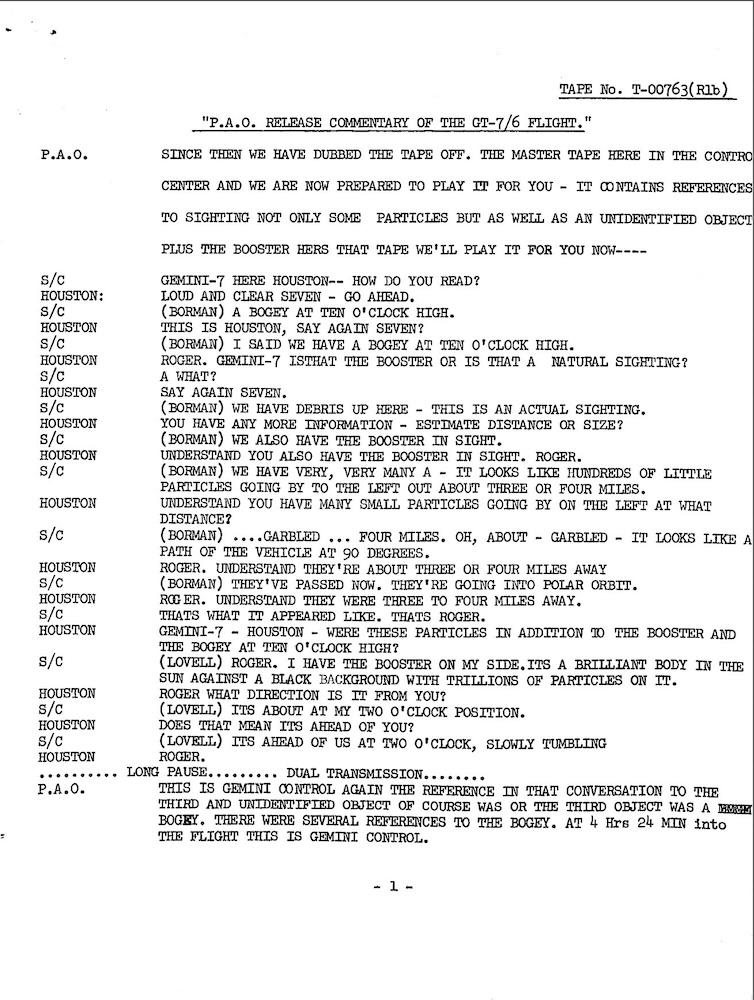
NASA-UAP-D003, Gemini 7 Transcript, 1965

NASA-UAP-D003A, Gemini 7 Audio Excerpt, 1965
NASA-UAP-D010, Mercury Atlas 9 Audio Excerpt, May 15, 1963
NASA-UAP-D012, Mercury Atlas 8 Audio Excerpt, October 3, 1962
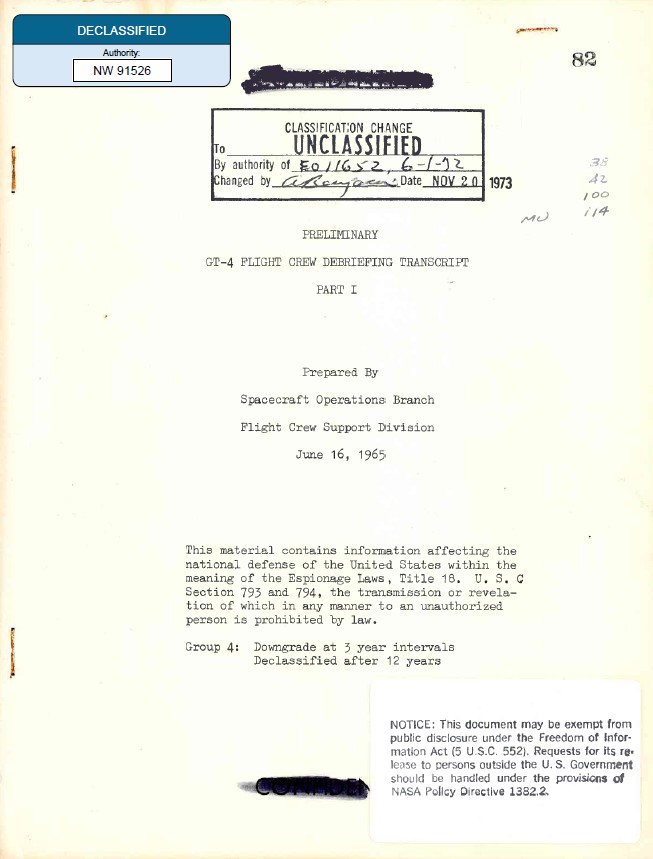
NASA-UAP-D016, Preliminary Gemini 4 Crew Debriefing, Part I, 1965
Casos relacionados
Mesmo local
NASA-UAP-D012, Trecho de Áudio Mercury Atlas 8, 3 de Outubro de 1962
NASA-UAP-D013, Mercury Atlas 7, 24 de Maio de 1962
NASA-UAP-D010, Trecho de Áudio Mercury Atlas 9, 15 de Maio de 1963
NASA-UAP-D011, Trecho de Áudio Mercury Atlas 9, 15 de Maio de 1963
NASA-UAP-D003, Transcrição Gemini 7, 1965
NASA-UAP-D003A, Trecho de Áudio Gemini 7, 1965
Mesma série de arquivos
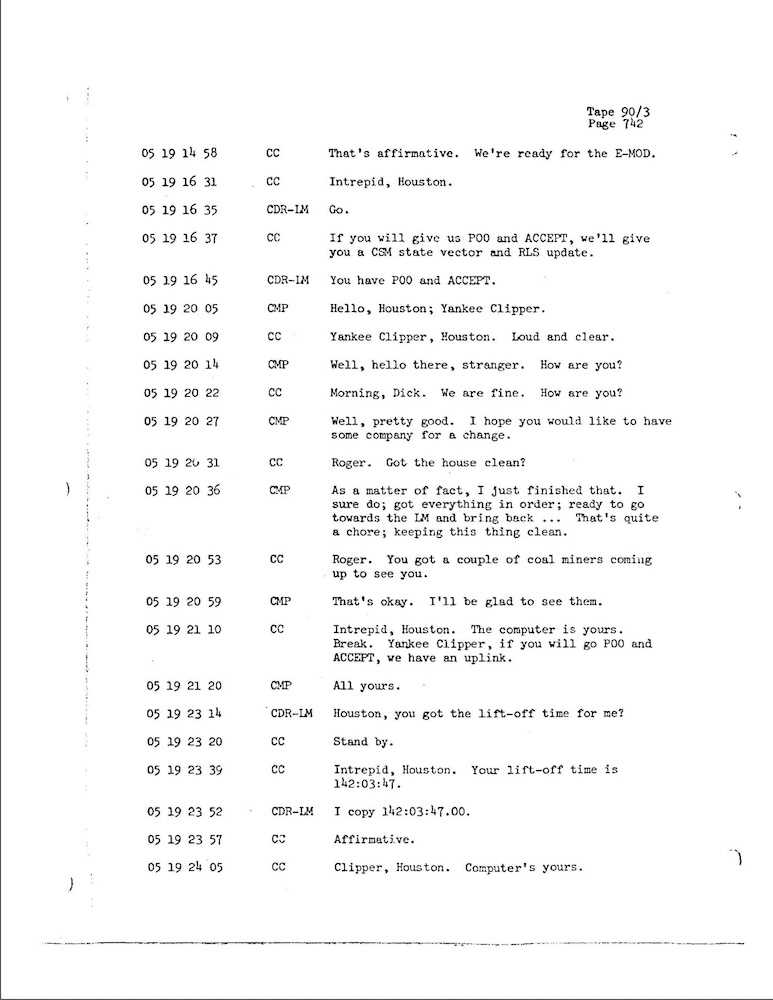
NASA-UAP-D001, Transcrição Apollo 12, 1969
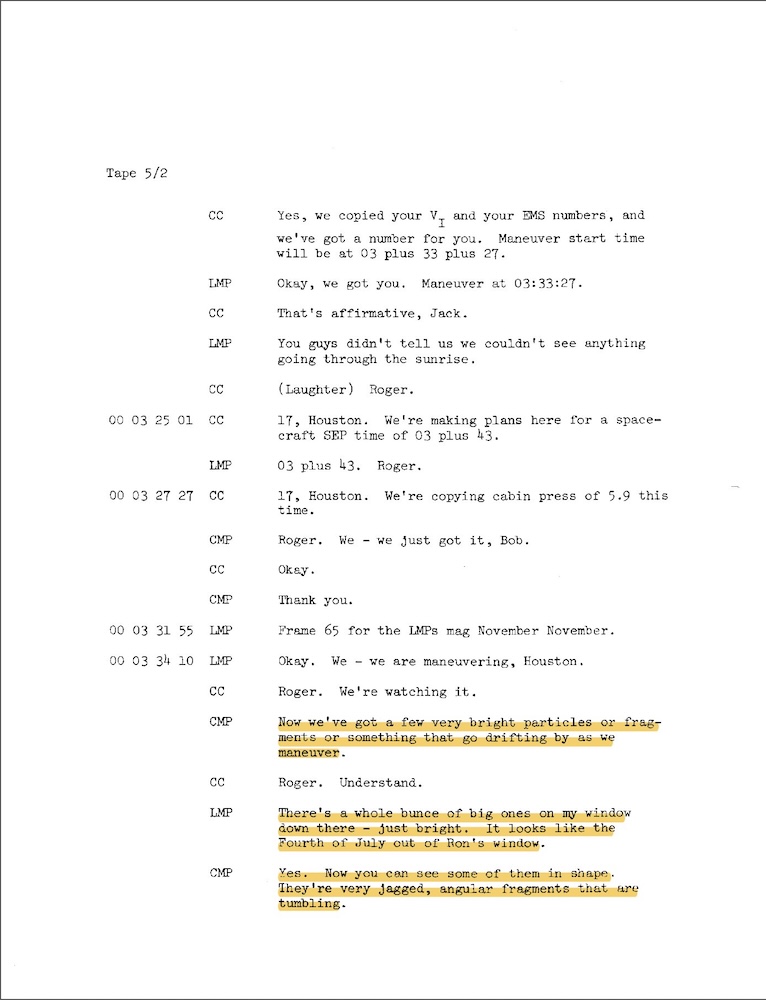
NASA-UAP-D002, Transcrição Apollo 17, 1972
NASA-UAP-D004, Entrevista Técnica da Tripulação Apollo 11, 1969
NASA-UAP-D005, Entrevista da Tripulação Apollo 17 para Ciência, 1973
NASA-UAP-D006, Entrevista Técnica da Tripulação Apollo 17, 1973
NASA-UAP-D007, Entrevista Técnica da Tripulação Skylab 1973
Mesmo período
CIA-UAP-D022, Objeto Voador Não Identificado Relatado nas Proximidades de Porto Rico, 1965
NASA-UAP-D016, Debriefing Preliminar da Tripulação da Gemini 4, Parte I, 1965
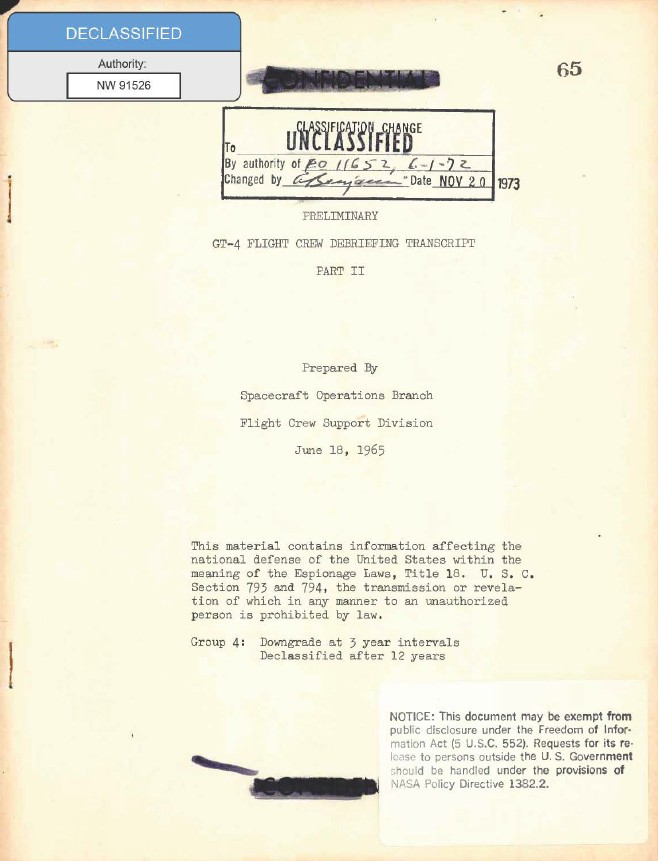
NASA-UAP-D017, Debriefing Preliminar da Tripulação da Gemini 4, Parte II, 1965
NASA-UAP-D019, Debriefing Técnico da Gemini 5, Parte I, 1965
NASA-UAP-D020, Debriefing Técnico da Gemini 5, Parte II, 1965
NASA-UAP-D021, Debriefing Técnico da Gemini 7, 1965
Mesmo release
FBI-UAP-D011, Encaminhamento de Correspondência D/FBI, 1949
CIA-UAP-005, Artigo de Cientista Alemão sobre "Discos Voadores"
CIA-UAP-002, Painel Consultivo Científico sobre Objetos Voadores Não Identificados, Relatório, 1952-1953
CIA-UAP-014, Atividade Britânica no Campo dos "Objetos Voadores Não Identificados"
FBI-UAP-D012, Escritório de Campo de Newark, 1952-1967

FBI-UAP-D013, Investigação de ‘OVNI’ no Estado de Washington, 1952-1960
Mesma agência
NASA-UAP-D014, Mercury-Redstone 4, 21 de Julho de 1961
NASA-UAP-D015, Debriefings Científicos de Astronautas, 1962-1963
NASA-UAP-D023, Trecho de Entrevista com o Astronauta Gordon Cooper, 1962
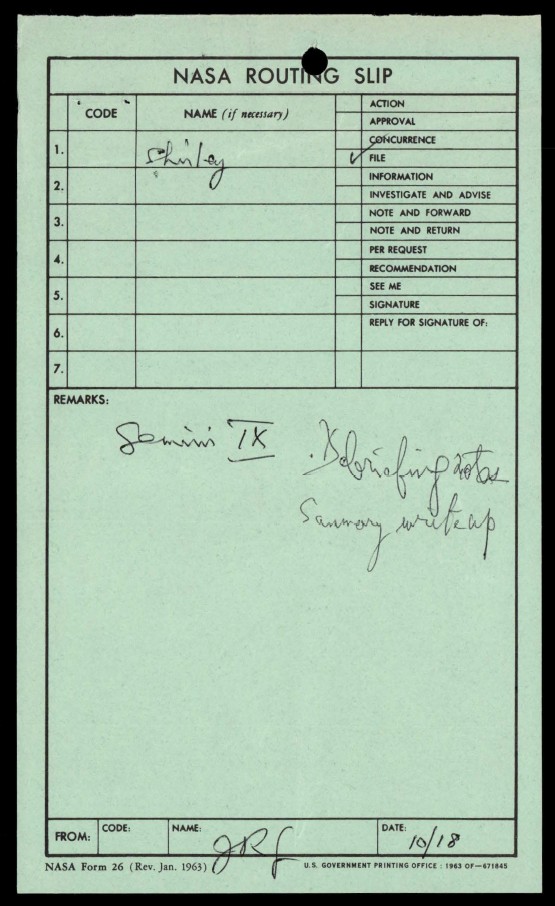
NASA-UAP-D022, Debriefing da Gemini 9, 1966
NASA-UAP-D008, Entrevista Médica Apollo 12 - Fita 12, 1969