NASA-UAP-D021, Debriefing Técnico da Gemini 7, 1965
Dados principais
- ID oficial do arquivo
- NASA-UAP-D21 (citado como NASA-UAP-D021 neste arquivo)
- Tipo de documento
- Documento
- Agência
- NASA
- Publicado em
- R03 · 2026-06-12
- Data do incidente
- December 19-21, 1965
- Local do incidente
- Cabo Kennedy, Flórida
- Coordenadas
- 28.4513556, -80.5283059
- Páginas legíveis
- 222/222
- VIRIN
- 260508-O-D0360-1126
Descrição oficial
Este documento é uma transcrição preliminar derivada de gravações de voz do debriefing da tripulação da missão Gemini 7, realizado entre 19 e 21 de dezembro de 1965, nos Alojamentos da Tripulação, Cabo Kennedy, Flórida. São mencionadas luzes e clarões, além de uma discussão sobre a necessidade de iluminação adequada para a atracação da espaçonave. Borman e Lovell discutem anomalias observacionais celestes e terrestres e mencionam avistamentos de Mercúrio, meteoros, aurora e relâmpagos. Eles também discutem a impossibilidade de ver estrelas assim que o Sol nasce.
✦ Resumo IA
Transcrição preliminar do debriefing técnico da tripulação da Gemini 7 (GT-7) —o piloto comandante Frank Borman e o piloto Jim Lovell— gravada de 19 a 21 de dezembro de 1965 nas Crew Quarters, Cabo Kennedy, após sua missão recorde de 14 dias (alvo de encontro orbital para a Gemini 6A). As 60 páginas capturadas aqui (de 222 no total) cobrem a Contagem Regressiva, o Voo Propulsionado, a Inserção, destaques do Voo Orbital, o Retrofogo, e o início da Reentrada. Conteúdo operacional digno de nota: nenhum embaçamento de janelas (ao contrário da GT-5); uma queima de ajuste de perigeu realizada com precisão usando apenas observações de estrelas, sem plataforma; um desvio persistente de guinada/rolagem à esquerda atribuído à ventilação do fervedor de água e a dois propulsores que disparavam automaticamente sempre que a energia de polarização ACME era desligada; um incidente de congelamento do fervedor de água por volta do GET 266 que exigiu um procedimento em voo (com a tripulação da Gemini 6 observando) e deixou uma massa de gelo no exterior da espaçonave; e um relato detalhado e dramático da reentrada, incluindo material de ablação do escudo térmico atingindo visivelmente as janelas e o nariz, e o esgotamento do combustível do RCS causando oscilações de arfagem/guinada no paraquedas piloto. No GET 16:40 a tripulação relata avistar o que identificam explicitamente como um satélite passando abaixo deles em uma órbita mais baixa e com inclinação ligeiramente diferente, descrito como 'apenas um reflexo' e com aparência de uma passagem de satélite a olho nu vista do solo — uma observação rotineira e explicada, não um avistamento anômalo. A seção dedicada 'Visual Sightings' do documento (10.0, página 131 na paginação original) fica além do limite de captura de 60 páginas e não está incluída aqui; nenhum fenômeno aéreo não identificado ou anômalo aparece nas páginas cobertas.
Gerado com IA a partir do arquivo oficial — pode conter erros.
▸Transcrição(222 de 222 páginas legíveis)
[PAGE 1] I Authority NW 91526 GEMINI VII TECHNICAL DEBRIEFING December 23 1965 NOTICE This document may be exempt from public disclosure under the Freedom of lnfor mation Act U.S.C 552 Requests for its re lease to persons outside the Government should be hand ed under the provisions of NASA Policy Directive 1382.2 [PAGE 2] [PAGE 3] PREFACE his preliminary transcript was made from voice tape recordings of the Ge mini flight crew debriefing conducted December 19 through December 21 1965 at the Crew uarters ape Kennedy Florida Although all the material contained in this transcript has been rough edited the urgent ne ed for the preliminary ranscript by mission analysis personnel precluded a final edit prior to its publ icat ion [PAGE 4] [PAGE 5] Paragraph 1.0 2.0 TABLE OF CONTENTS Page Number COUNTDOWN 1.1 Crew Insertion 1.2 Comm un.ications Crew Participation in Co untdown Comfort Environmental Cont rol System Sounds Vibrations 1.8 Visual Crew Station Controls and Displays POWERED FLIGHT 2.1 Lift ff cues 2.2 Roll Program 2.3 Pitch Program 2.4 Aerod.y"namics 2.5 Environmental Control System 2.6 Maximum 2.7 indsheaz 2.8 DCS Upd.ates 2.9 Engine Operation 2.10 Engine Status 2.11 Acceleration g's 2.12PO 2.13 Guidance Initiation 14 BECO 15 Stagi.ng 16 E]ngin.e Ignition 2.17 RGS Initiate 2.18 GO/NO GO 2.19 Systems Status 2.20 Accelerati on lO 2.21 Fairing Jettison 10 INSER TION 3.1 Post-SEC0 10 3.2 SECO plus 30 seconds 11 [PAGE 6] 14.0 TRAI NI NG 4.1 Gemini Miss i on imulator 185 14 DCPS Launch abort simul at 191 14 MA Engineeri ng imul a tor 191 4.4 Transl a tion an Docking Tr a iner 192 14 lane ar i um 193 14 ystems rie inga 194 14 lig ht Experiments 198 14 pacecr a sys ems tests 202 4.9 gress a ining 204 14.1 arachute Tr a ining 205 14.11 aunch simul a tiona 206 14.1 eentry simulations 206 14.1 Simul a ted ne work simulations 206 14.1 Ne or imul a tions 206 14.1 Fl ight Pl an a i ing 207 15 CONCLUDING COMMENTS 208 [PAGE 7] LANDIN AND RECOVERY 7.1 Impact 54 7.2 Checklists 55 7.3 Communicatione 55 7.4 Systems Configuration 58 7.5 Spa cecraft Status 59 7.6 Postlanding Activity 62 7.7 Comi ort 63 Recovery Force Personn el 7.9 F.g"ress 63 7.10 S1.lrVi val Gear 7.11 Crew Pick UP 64 8.0 SYSTEMS OPERATION 8.1 Pla form 64 8.2 O.AMS 65 0.3 RCS 73 ECS 75 0.5 Commun.ications 91 8.6 Electrical 95 0.7 Onboard Computer 99 0.0 rew Station 101 0.9 Biomedical 115 OPERATIONAL CHECKS 9.1 Apollo Landmark Inv estigation 122 9.2 abin Lighting Surv ey 130 9.3 HF Test 130 1O.O VISUAL SIGHTINGS 10.1 Cou.ntdo"Wll 131 10 Powered Flight l31 10.3 Orbital Flight 132 10.4 Ree ntry 138 [PAGE 8] Inser tion Act ivities 15 Post tation Keeping 17 RB I TAL LI HT 18 5.0 RETROFI RE TR-2 00 Power Up and Alignment hecklists 32 26 Ev ents 33 5.3 TR-5 GMT Stop lock 34 TR 256 34 TR- 34 TR 35 Retropack Jettison 40 5.8 Commwiic a tione 41 5.9 Upda ting 41 5.1 Post Retro Jettison Checklist 42 6.0 REENTRY 6.1 Reentry Parameters Update 42 6.2 400 6.3 Acceleration Profile 47 6.4 Spacecraft Control 47 6.5 100 48 6.6 50 48 6.7 35 Checklist 49 6.8 Comm'W'l.icationa 49 6.9 26 Checklist 49 6.10 10.6 Barostat 50 6.11 Main Check Deployment 51 6.12 Post Main Checklist 51 6.13 Single Point Release 51 6.14 Checklist 52 15 LBlldiilg 52 6.16 Postlanding Checklist 52 6.17 Blood Pressure Measurement 53 [PAGE 9] 11.0 EXPERIMENTS 11.1 elestial Sp ace and Terrestrial Radiometry D-4/D-7)•••••••••••••••••••••••••••••••••••140 11.2 Star Occul ation Measurement 146 11.3 Simp le Navigation 148 11.4 Visual Acuity and Astronaut Visibilit and ision Test 154 11.5 Syno ptic terrain and weather photograph.y 158 11.6 Proton Electron Spectrometer and Tri-Axis Flux-Gate Magnetometer MSC-2 and MSC 160 11.7 Optical communications MSC 161 11.8 Landmark Contrast 165 11.9 Cardi ovascular reflex conditioning 166 11.10 In -flight exercises 167 11.11 In- flight phonocardiogram and In-flight sleep analysis 167 11.12 Bioassay body fluids and calcium balance study 168 11.13 Miscellaneous 172 12.0 PREMISSION PLANNING 12.l Mission Pl an rajectory 175 12.2 Flig ht Pl an.••••••••••••••••••••••••••••••••175 12.3 pacecraf Changes 176 12.4 Mission Rules 177 12,5 Experiments 177 13 MISSION CONTROL 13.1 GO/NO GO 179 13,2 PLA and CLA updat es•••••••••••••••••••••••••l79 13 Consuma.bles 180 13.4 Flight Plan changes.••••••••••••••••••••••••181 13 Systems 182 13.6 Experiments real-time updatea 184 [PAGE 10] [PAGE 11] 1.0 COUNTDOWN 1.1 Crew Insertio Borman I have no comment I tho ught it went ve~y well Lov ell Likewise no comment on crew insertion I think we got quite a bit done It was very rder ly Borman Timing was good and it was done properly 1.2 Communications Borman Communications were good I had no troub at al Lovell I had no trouble it communications in the cockpi or the spacecraft but the communications in the va.n from the suiting ar ea the other area a.re rather poor Maybe we should try to get that improved sometime 1.3 Crew articipation in Countdown Borman Again I think they have been used on or aunches and I thought they were fine Lovell Right Coun tdown procedure and crew participation is just what you expect no 1.4 Comfort Borma.n Comfort was fine No problems Lovell No problems for comfort but I was surprised wh en I got in the cockP i becaus there was a lot more the re than there was when I got in it for the stowage rev ie But it a ll turned out for he best No problems [PAGE 12] 1.5 ECS Borman ECS worked fine We had no trouble with ECS at all during prelaunch or launc Lovell That is true The purge was a lot slower and it was just perfect for the final countdown It was too fast for the SIM Flight which we went through a.nd I got an ee.:r block age For the countdown it was ju.st ight Very slow 1.6 Sounds Borman We had been well briefed on a ll the soundsz the gimbaling pre valve a.nd erector As a matter of fact when the erec tor started down there was no sound had been told that probably there might be a clanking or something I hes.rd nothing Lovell All I saw was the sky 1.7 Vibrations Borm8ll Vibrations No comment I had no problems Lovell Is this liftoff vibrations Borman No this is countdown Vibr a tions of the spacecraft during coun down Lovell No nothing we had not heard before Visual Lovell The windows were perfeot We had no fogging Borman No fogging [PAGE 13] Lovell The windows were heated previous as a result of pro bl ems and our windows I hought were perfectly clean Didn you Borm8J'l Right 1.9 Crew Stat i on Control a.nd Displays Love No commen Exac tly how we had pl anned it for months Borma.n Exact he way that we had seen it and no prob ems POWERED FLIGHT 2.1 Liftoff Cues Borman Stoney cam in loud e.nd ea.r counting the countdown Lovell Cs.me in loud and ear Borman We lmew exactly when i was and I for one had absolutely no question in my mind when we lifted off It felt like I had been ied back a.nd someone cut the string a.nd there was a slow but definite acceleration at lift-off Lovell I thought you could just about put 01P CO MM V1bration and oise to get he eca us th motio ibrati on and no ise all contributed to a definite knowledge that you were going somepl ace Borman In other words wh at you are saying is that you had no pro blems determining lift-off Love ll No it went Borma.n Okay vibration wa.s nominal during ift-off Again perhaps [PAGE 14] it is because we we re so well briefed on the simulations we have run but I had no problems Lovell There was a little more noise than I expected but a little less vibration Borman Jim said there was a little more noise than he expected Even so it was not oppressive or a problem at all Visual I did not have any visual cues I was watching the instru ments 1What about you Jim Did you pick up any Lovell I had the clouds end there was a visual cue Just normal cloud cues Borman Cockpit displays were good The fuel pressure and oxidizer pressure were nominal the whole flight Just perfect 2.2 Roll Program Borman The roll program was so short it was almost like a spike We hardly even noticed the roll program Did you Jim Lovell I did not notice it at all I heard you call it out but I did not notice it Borman I called it out but we only rolled,I think,about or 2.3 Pitch Program Borman The pitch program started just as in the simulator which is very accurate on this It looked exactly the same on the ball and there wae no problem Lovell The pitch program for the RGS followed exactly what the IGS [PAGE 15] was giving for the entire aunch The needles were just matched perfectly--nulled I did not see any unusual atti tudes that some of the other people commented on 2.4 Aerodynamic Borman Age in we had had this described to us ma.ny times and it seemed to follow right along In the maximum region we got some vibration and noise but after we got through maximum it was just like going supersonic in a fighter You just slip through and from then on it was just ike riding on a train Lovell I don't think it was bad either 2.5 ms Lovell Pressure went up to 5.5 in the initial stoppage and it slowly leaked down to and stayed there Borman I was cool during lift-off Lovell I was too Comfortable Borman Comfortable I mean cool in the sense that it means comfor table Of course we can not very well comment on the cabin atmosphere because we were sealed Maximum Borman We ha.ve already discussed this There was some noise build up an some vibration but nothing to worry at all about or even discuss [PAGE 16] Wind shear Borman Wind hear I did not notice any Love ll I did not notice a:ny wind shear either Borman You could not see any on you att itude gauges either could you Love ll No that is what I mean Borman The a tt i tude gauges stayed pegged Right Lovell They stayed nulled throughout the entire flight I was a.ma.zed a the acc ur acy with wh ich the RGS was fo ll owing the IGS program 2.8 DCS Upd ate Lov ell Ca.me thr ough on sch edu le Borman No problem Lovell No trouble Borman Have any trouble punching the ligh Lovell After the second upda.te about 2:23 the are too igh to let you punch off th ight So you have to wai for staging and hen punch the ight 2.9 Engine Ope ration Borman Engine oper a tion I thought was norma.l But I did not i ce a ight hint of a POGO a.round a.bout I wou ld est i mate two minutes The slightest faintest hint I do not think im even noticed it [PAGE 17] Lovell Borm an Borm an Lovell Borma.n Borman Lovell I did not notice any POGO 2,10 Engine Status It seemed to me that from about minutes and 30 seconds to a.round minutes the noise and the feel was a little bit different than it was a.fter that as if it was vibrating little bit more But this was sort of a.gain a sensing type thing The inatrwnents were all nominal a.nd it may have just been me I certainly ca.n not complain about the operation 2.11 Acceleration g's J.ny- problems Jim No problems They were pretty nominal weren I they I could not see the meter They were right on the money And of course the g's we ha.ve are all experienced in the centri.fuge and so on One thing when the g's dropped a staging an at SECO I had no sensation of tumbling and no sensation of disorientation Nothing at all 2.12 POGO I ve mentioned th at I detected a slight hint of one tha.t was so small we cannot even really discuss it 2.13 Guidance Initiation We had a guidance initiation It was in the form of booster [PAGE 18] yaw deflecting downward more so than booster pitch deflec ting Booster it ch deflected sl i ght ly the right indi cating at guidanc initiation a booster-high trajectory But they both came right back to null jus after guidance initiation and that was it Borman We did not have the feeling that we were lofted and then a sudden pitch down Lovell No th9re was no change of boo ster performance at all It was just hat the needles deflected a guidance initi a tion to say that we had gui dance initiation and af ter that they nulled and stayed that W83 from there on 2.14 BECO Bo rm an At BECO the whole spacecraft was engulfed in a red flame I noticed that out of the corner of my eyes Jim you robably had a better view than I did Lovell Yes Flames came up thP side there to the window Borman There was a definite very brief instant of it probably in the order of milliseconds bu it did envelope the space craft and I in my own mind wonder if this is not the plac where we are picking up som of the smudge on he window 2.15 Stagins- Lovell Well I did not notice any smudge at the time of staging Slayton You did not notice any Lovell I did not notice any Of course things were going pret ty fast I did notice it after we got into o=bit bu not at [PAGE 19] Eorma.n Lovell Borman Borman Lovell Borman Borman Lovell Borman that particu ar time 2.16 Engine Ignition Again it is so well simulated that- It is very smooth It is ve:ry smooth a.nd away you go 2.17 RGS Initiate We we have talked about that Yes that is what I was talking about back p.!'eviou sly 2.18 GO/NO GO GO/NO GO Houston on the ground came through great We got a GO/NO GO before the 30 seconds we were waiting £or spacecraft separate So we knew we were in good shape before we ever had the possibility we would have to burn Of course we also had the IVI's onboa.rd and they are very good also 2.19 Systems Status The systems were all great No problem during powered flight We got two del a Plights Oh yes that is right We are talking about spacecraft systems We got delta light on BECO in the first stage that went off at staging then came back on during second stage flight and then the [PAGE 20] 10 action delta Plight did not go out a.nd it was Lovell No J:ection went on and out again during the £light It wen out a I think it went out at SECO Borman That is right Lovell But Section came on and we saw that one £or the nex 14 days 2.20 Acceleration Borman Acceleration during stage was right on the money right on the program I read of£ I think i was about six a.nd a I half a ax imum We read this off after SECO 2.21 Fairing Jettison Borman airin Jettison I did not even hear it I was concentra ting on the horizon trying to get set for turning around Jim ettisoned th fairing and punched the Spacec raft SEP I did not see a.nything or hear a.nything Lovell I aw debris and heard it and had a definite knowledge that a squib had gone off There had been an explosion 3.0 IN ERTION Post SECO Borman Maneuver controller was easy to reach I had it out an there was no problem It came out and was ready to go Attitudes and rates there were none The thing was as solid a.a a rock as far as I could determine I was watching [PAGE 21] 11 the horizon and the attitude remained constant a.nd the rates were so minimal you could not even pick them up I noticed no transients we experienced no as far as I know that was discernible Lovell Did you try to damp out the Borman There was nothing to damp out Lovell Okay Borman In fact I did not use the thrusters at all for that I just sat there 3.2 SECO pl us 30 seconds Lovell I have the IVI readings on a ca.rd Do you have those- cards that we took off Borman Yes Love ll I am sorry We did not get forward-aft left-right u.p or down because they were so quick and I was trying to get the camera But it was 17 the fore and a.ft wmdow 13 in the left-right and up and down was 20 Borman What do you mean you did not get them They a.re there Love ll No I did not know a.ft or forwa.rd or left or right or up or down Borman Oh I see Lovell I just saw th&t they were so small tha.t I just wrote down the numbers as a [PAGE 22] 12 Borman 17 30 and 20 There might have been a 17 a.nd 20 Lovell About what the numbers ca.me up with Borman Spacecraft separation We separated with minimum delay be tween thrusting and Spacecraft SEP Jim actuated the space craft separation I did not hear the thrusters firing I could not hear them and I did not even helU spacecraft separation but Lovell I heard Spacecraft SEP but I ould not hear the thrusters firing ut you told me you were firing the thrusters-- Borman I ea.id th.rusting a.nd SEIP Spacecraft a.nd we did it and away we went I thrusted for about seconds Almost immedi ately as soon as we had £inished thrusting I started a yaw right 180° and the rates were right around I think a.round --Of course you should be able to pick this up off telemetry but I would estimate they were to per second turning around As soon as I ha.d the booster in sight I thrueted be.ck seconds This is the way we tried in silllulations The simulations in St Louis were exce ll ent Lovell Turned out that was the best technique to use seconds for the seconds forward a.nd a second return Borman We turned around a.nd there it was bigger than the devil Lovell At that distance there was no problem staying in there Borman Now I did have some problem because the booster was bending [PAGE 23] 13 so rapid It wa.s tremendous It looked like one of the autogenous lines ha.d been cut I guess it was cut with a pyro a.nd it was really bending and this was causing it to translate as we ll as rotate And in order to stay wit it I was having to use quite a it of fuel although it was certainly a nominal task I also went through severa con tro modes switchings I sta:rted out in PULSE and I could not get around fast enough so I went to DIREC a.nd then slowed it up in RA.TE COMMAND Slowed up the direct rate I was using with RATE COMMAND a.n left it in RATE COMMAND without using the h&nd co ntroller for a while Finally went to l'LATFOBM When I went to PLA.'f.E'OHM we had been off to one side of the booster went to PLATFORM it yawed me back around and I lost sight of the booster SO we went out of PLATFORM and flew he rest of it in PULSE Mo using the reticle on the horizon for stabilization and using the maneuver contro ll er for thrust This is all on onboard tape,incidentally The air to ground communications throughout the li ght were superior Lovell I was really a.mazed a.t the communications especially the primary station The UHF was outstanding Borman We have already discussed GO/NO GO They came through loud and clear before we ever SEP spacecraft We had no need for [PAGE 24] 14 a velocity correction Lovell As a matter of fact right now would be a good time to men tion that address 72 read Borman Nominal was 25 804 and address 72 read 25 804 Lovell Can you imagine that ig ht th foot 25 804 I could not believe it when I punched it up Borman The orbit quantities were given to us I think,by Bermuda course at this time we really were not interested in them although they were sort of nice in.formation We had a GO/NO GO Lovell It was 87-178 the initial forward quantity that was ca lled up to ue Borman Tha l'!1JU readouts Jim read and when he saw it was 25 804 we had a GO/NO GO from the ground I do not believe you even rea4 the rest of them out did you Lovell No I did not bother reading out the rest of the addresses 94 97 52 or 73 because I saw the 72 nominal I saw the IVI's were right in there so we did not bother reading out anything else Borman Debris I did not notice a:ny debris Lovell I noti-od debris I was looking out at Spacecraft SEP and Jet Fairing and noticed debris I also noticed debris be ween the sp a cecraft and booster when we first turned around [PAGE 25] 15 Borman Could you identify any type of the debris Lovell No pieces.That is all I could tell 3.3 Insertion activities Lovell We followed the regular procedure Borman We did not have s;ny problem with safing our switches No problem I did not even stow my D-ring at insert ion I was too busy trying to stay on the booster and I did not get it stowed for the first orbit,I guess,or half an orbit Lovell What we planned on doing was getting pictures of the ring I got the br&cket up at staging and I actually had a minute after guidance initiate to reach back there and get the bracket and stick it up It worked out very nicely before the g's started building up again on second stage The bracket was up and in pl ace s;nd no problem a all Then at SECO I went around to pick up the camera because we had the camera stowed where the Agena control bq..x ie ated I managed to get the camera up and it was a lready plugged into the electric&l wire ill I had to do was turn the auxiliary switch on put it on the bracket and push the button and it started taking pictures Just about that time Frank mentioned be was going to start thrusting pretty soon so I had to go back and punch off the spacecraft Then I read up address 72 So I hope the pictures com out [PAGE 26] 16 Borman We were looking right into the sun I hope they do too The drogu.e pins were no problem Jim got them but again not until well into the first orbit As a matter of fact I pulled my own yesterd.a.y morning there The problem is solved I think they a.re easy to get to Lovell Yes They a.re easy to pull out Borm an I think that we have covered station eeping wi th stage II booater,partia lly I will mention that the booster being without attitude control translating also with this im pu se it was picking up from the venting is definitely an order of magnitude more difficult than station keeping with a stab vehic le like Spacecraft First of a ll you do not have anyone contro ling the thing you do not exactly know where it is going to go and it might translate because it is venting and ha.a a slight thrust Borma.n I know a couple of times we got in a little too close and I backed out because you just do not da.re get as close as you do the way this thing is spewing We got a rea good picture a good ook at the nozz le I thought that it looked like the nozzle was bent in on two places on the booster engine It ooked li ke the nozzle the ablat iv skirt had been bent in But then it may have been jus a [PAGE 27] 17 shadow because the next time I looked at it it looked just like a new engine The booster itself had no app arent da mage The only thing we could see was this big spewing where the venting was coming from I did not see any vent ing from the roll nozzle at all Did you Lovell No the venting ca.me from some line right along the bottom edge near the engine section of the booster Borman That is right Lo ve ll It was a line of some sort that was open and fuel was spewing out of it Borman I hope they got the data they wanted on the and Experiments It wa.s,again,a very uncomplicated maneuver one that we practiced many times and it worked just lik it does in simulation Had no difficulty at all Toe lights on the booster worked fine 3.4 Post station-keeping Borman We did not do anything with stowage on the first orbit at al D-ring pins I have already mentioned we did not get those in at all Lovell Arm restraints went down at 55 seconds Belts- We did not even loosen them until aft er we had done The life vests we left right on the harness for the entire flight but the ha.mess did not stay on us for the entire flight [PAGE 28] 18 The sequence light test This was done after the first orbit We really had this insertion checklist in two phases one at insertion and then one after 4.0 ORBITAL FLIGHT Borma.n We have already disou.ased the station-keeping That is no problem I think the situation that we used,going off with about seconds--2 to seconds--a.nd thrusting back with seconds while you a.re still on your side getting back to the booster as quickly as POss ible solves the problem and takes a lot of the orbital mechanics out of the situation I hope the film comes out The one thing that did make it little difficult on this one is when we looked back we were looking back into the sun and the booster was right in line with the sun It was ju.at like flying formation when the leader makes a turn a.nd you are down,..sun It is dif ficult to see and I tried to move off to one side and swing around and look a little bit more to the north I think it was nor th I guess I was trying to look to the south where I could get the sun out of my line of sight also had a cut-off on the booster at station-keeping at 88% fuel so that at 88% fuel we were already in darkness al though we had not reached the time for the separa tion which we.a to ooour a.to 25.I think it was about 00 23 or I [PAGE 29] 19 00,21 So when we reached thi limit and we were in darkness I nt ahead and separated thrustil:lg dawn Lovell We actual ly separated earlier than 00 25 We actv.ally separa ted at 00:-21 Borman That is right So we separated because we were in da.rlmess and because we had reached the limit on fuel We had been in darlmess for awhile One thing I di notice was that the docking light was not particularly helpful on that stage of the business I guess it is because we were not close enough to the booster Lovell We tried but the docking light just did not work Borman I suppose because,a.gain,we were looking at a lighted horizon with the dockin light and it did not work as well as it did ater on with Spacecraft The booster measurements went off We got indicat ions on the needle on the measure ment needle Lovell The recorder did not get on until 27 minutes That is a guess I am not too sure but as I understand it they had li ve transmiss i ons up until th.at time to Bermuda 8Jld An i gua wherever it is so we were okay there Borman The booster measurements were normal Again the simulator was perfect for that The lights Jim McDivitt had made some comment about not being able to judge distance because [PAGE 30] 20 they only had two ight on there We had four lights on and I will be darned if I will try to judge distance by four lights or fifty lights You have got to have illumination or you have to have a stable vehicle Lovell You have to have something th at ill um in a tes the vehicle not a light that flashes because you cannot tell from a flashing light Borman Especially on vehicles rotating I do not think that i is possibl to control them You have to have a controlled vehicle before you can judge distance from it as far as I am concerned The GO/NO GO 17-1 TR were no problem We ran through the platform-off post station keeping checklist jus the way it is listed Lovell Yes that is where we caught most of the things Borman That is where we caught most of the things like putting the D-ring away and the drogue pins and so on Only one time in flight did we require attitude control fuel to change attitude for critical delay time playback There was no problem Communications as always were superior The D-4/D-7 Vo id Measurement was again no problem just lined up on the black and ran for wo minutes Purging of the fuel cells This is the first of a long- [PAGE 31] 21 Lovell Yes but we did not do it then,did we Did not we wait unti we powered down and then waited two hours Borman Th a is right This is ne of the thin gs h&t they had in the li ght plan that we asked them to change bec a use Lovell Yes we did not purge the f'uel cells then Borman Originally this came right after power down e.nd al of the f'uel cell people recommended that you purge before power down or wait until two hours after power down So we did not do it at this i me in the flight This wa changed star me as urements The re was no prob em The eta.rs were well selected and we ere right on them Right Jim Jim copied down on the procedures book a check where we got the maximum return on the needle Lovell was a well organized experiment as far as Brentna ll keeping us hop pin a bout what to do I will ha ve to admit th.at [PAGE 32] 22 Sor:ma.n Re did a very good job We knew just what to do had all the equip,nent with us and everything went very smoothly MS0--2 ana,..3 turned out to be not much of a problem because at about the seventh dq we turned it on and left it on for the rest of the fli ght The Berigee Adjust tv1 aneuver Jim ma.de the erigee Aijust Manuever We did it on stars with out a platform I was timing for Jim and I think I fouled up We planned to use a perigee to 102 miles and I think we wotmd up with about 15 feet per se cond too much It seemed like about 117 miles One of the reasons that was causing this was we had come back into the vicinity of the booster and just about midwny through the burn the booster venting that was still occurring suddenly lit up became lit up It looked like we were flying through a lot of foreign objects or debris I was afraid that we were going to hit so.mething At the same time this trailing wire came forward and slappe the spacecraft Lovell That is where I stoppe Sor.man es After we had stoppe and it nit us I looked down and got confused and aid No we haven't burned enough we burned for about five seconds more We had a trail ing primer cord that would flop around and we didn know what it was at the time but it cam forward when Jim stoppe burning and flopped on the spacecraft It nade a [PAGE 33] 23 noise and I thought we had hit some of the stuff t~t was spewing out of the booster I wasn't sure that it was just fuel Lovell I think the ground people thought that this wire came for ward because it had gotten in the way of the thruster fire It definitely came forward after I stopped burning,because I stopped burning and this wire came slapping forward It still had the momentum you know It slapped right in front of the window I think the people got the impression that the thing had hit a thruster It hit in front of us then we stopped bu.ming But we stopped mm -taen- ths:t thing hit a.nd we added some more because we were still at og ee Borman The first a:f many powerdowns was no problem1o We wen right by the check list Some of these switch functions in the space craft particularly toward the latter pa.rt of the flight toward the 12th or 13th da.y--we were getting I won't say la.r in making the m,but it see.med more of a chore to make these things right to the minute Things like the OJ.VIED recorder and so on--we lost interest in having them turned off on the second We knew what they needed to be turned on and off for We didn't do as good a job from about the 10th day on as we did the first pa.rt as far as making those right to the minute [PAGE 34] 24 Lovell As a matter of fact why don't we get out the flight plan I think we might have a lot of comments on it Borman Let's start from the beginning Lovell The recor der as on at 27 minutes D-4/D-7 measure.ments The GET of measurement that the COLD IR as outside the two degree fiel of view of the booster was at 30 Borman At 40s58 we had 84 fuel left We were right on the flight pla.n there Lovell There was anoth er GET of mea sure.ment where the spa cecraft was lined outside the field of view or the booster at 38:00 Borman We saw the booster for or revolutions after tl:at The lights were still working We called it out and ground got readings on this Lovell The moon and booster were in view at 43:00 The booster and moon were in view and we might get an erroneous read:tn.g because we were al most on the moon Borman Here we have a note that at 2z32 the fuel cell Delta i ght bl inked off at ftours and 30 in ut es and then cam back on That is he section dalta Plight Lovell Okay then as far as stowage goes the cuf was urned on at 3z03 Borman We put the bypass hoses on at this time also-- the ECS bypass hoses Incidentally they turned out to be not too m.uch of a problem They were very handy for the type or [PAGE 35] 25 work we did without suits on Lovell Right We took the s/c out of the horizon at 2:08 to get some measurements,as requested fro.m DOD,after we measured the stars This is after we powered down the equipmen We connected the bypass hoses at 2:32 This was ho urs plus 32 minutes Lovell Crew status reports We bad or a day Borman 5:20,we started unpacking the meals This is one thing that we had trouble with lbth left and right food boxes were jam packed Fortunately we changed the lanyards v,e changed this during our stowage review though it as difficult we got them out Several of the meals had lost vacuum Lovell Which made them more difficult to get out Borman Really you can't co.mplain about this The people did the best they could We had an awful lot of food to store and we were able to get them out Lovell We had several blinkinge of the Delta Plight during this period It went out at hours a littleleas han hours then came back on again at 6:27 Borman One thing that I wanted to find out a.bout,and I still don't understand,is why we turned on the crossfeed valve right after l&:w\oh The FC pressure was just on the minit11.Um [PAGE 36] 26 or 150 pai at launch I called up Houston and said I would like to leave the gauge in the FC0 position rather than the ECS positlon Chris said No unless we really felt strongly about it they would rather have it in the ECS position So we left it there and after we were inserted and we were still with the booster they came in with a recommendation that we open the cross feed When we did this immediately raised the pressure to 250 psi The thing that was bad was that we had over 100% o:xygen and we were down to about 100 lbs on the FC0 We agreed that we would fly at least 50 lbs above the do.me So I really didn't see the need for opening that valve although it didn't cause a:n:y problems Lovell They wanted to pump up and make sure Borman It worked fine and we got right back up to 250 lbs Lovell That is one syste that did work fine Borman The first hours was pretty no minal All throughout the flight plan we have notes that the Delta Plight went out and came back on and so on Bor:man At 16,40 we sighted a satellite much lower and on a slightly higher inclination path than we were It passed underneath us It was so fe:r awa it looked like a sighting from the earth It was just a refiection We were very religious about the exercise periods We s-ot [PAGE 37] 27 th os hree times a day wi th the except i on of the las day an one other ay when we got only two I think this is a ery good ide a I is ifficult and requi es disciplin because the last thing in your mind i the desire to exer cis You get lazy ve ry eas il We di a ve ry exte ns i ve operation ith he bungee and al so i sometr ic three times a day Borman They were progr ammed 10 minute I think a more reali st ic one would be a bout five minutes three times a day I did 60 pulls on he bungee cord with both hand 20 wi each leg and then ended up with 10 with each ar on the bungee cor in ad it ion to the few or th crew status reports Lo ell I did 60 pull on the a rms and 60 on each leg and it didn't ma ke any iff er ence I cou ld have done 20 on each leg an ould have prob a bl been be tter off Borman At 45 hours im started taking off his suit During that first 45 hours our noses were clogged en stuffy our eyes ere i rr itated he cab in was ho it was miserable As oon as Jim sta rted ta king off hi suit the cabin even tho ugh he was ut of the suit and I was in got better than it as with bo th of us in our suits Lo ve ll I idn't rea i ze it was tha long were almost up there two full days bef or I started taking the suit off [PAGE 38] 28 Borman At 49t53 we got a picture of Houston with the 250 mm ns I hope it comes out Okay at 69t40 we did a Perigee Adjust Maneuver Delta 12.4 16.5 seconds and came right on the money using the stars no platform I don't think that there is any problem at all with the proper stars in making a gross adjustment Lovell I think it was an excellent idea to do it without a platform it takes two people One person times and the other person burns on the star fro attitude Both people check the attitudes by looking at the star charts and getting the updat es Then ma.king sure that the s/c is alined right and the reticle is up to get the accuracy pretty good After that once you get it et in your mind what you are aiming at one guy is in the cockpit with the watch or event timer and clocks it The other guy bas to look out the window because you can't go back and forth If you look in the cockpit at the watch you can't adjust to look out or the stars So it takes two people for that I think you can do a good job without a platform Bor:ma.n I do too Bor:ma.n Th re is one thing that was a pain in the neck and I hope they get some good out of them were UHF and the RF tests That was an hour and a half transmitting every five minutes [PAGE 39] 29 and having the HF/DF on I'.m not sure what kind of data they got but I hope they got so mething The first one we had to do on the lKJRIZ.AN SC.AN it took so me fuel and I wonder really if it was worth it Borman At about 166,40 we noted our drift rate picking up and we finally determined this was from the water boiler venting It resulted in a left yaw rate and this continued periodi cally throughout the mission It certainly would not be objectiona.l if we had fuel to counteract it During a night period in which we didn't do any attitude control at all I timed the rates during the 13th day and when we woke up they were about degrees per second I timed them around the horizon and came up with degrees per second About the only thing you can say about it is that it requires fuel to stop it It occurs primarily in left yaw and left roll Lovell There are two things in the s/c that causes the yaw left for so.me reason Gus first noticed it and I think it is char a cteristic of the s/c One is the water boiler and the other is,every tie you turn off the power it fires two thrusters that give it a left yaw The same two all the time Borman We tried to beat that ever way we could Every time we [PAGE 40] 30 shut down we put it in a different co ntr ol mode and it st ill fire he sam hru sters Every time you turn off ACME bias power it would go"boop 11 boop just like that Every time we were without attitude control for extended periods we ended up with a left yaw and a left roll Finally a.t 191>48 we got both crewmen suitless That was the best decision in the whole flight The perfor:m.e.nce of the Cryo bottles was fantastic Lovell That was one thing we were worried about The eyd.rogen bottle I thought was never going to last orty per cent of the eyd.rogen bottle was still left at the end of 14 days One thing I wanted to try was to blow the squib Remember they said t1Did you blow the squi I forgot about it Just prior to retro I wanted to go over there and blow that squib that opened up into a vacuum Borman It would have taken several hours for it to do a:n:y good Lovell Yes I know I just thought maybe we could hear it or so me thing Borman One thing that cropped up more and more as the mission progressed it seemed to get worse as it went along was the fa.ct that things were cm celled because of weather We picked up large areas of clouds over the and over [PAGE 41] 31 Amer i ca About the nly area that stayed clear was North we st Africa A lo of the experiments a.nd a lo of the Ap ollo landmarks were shot because of clouds Borman On the auncht th second ti.met we were abl track it were not able to ick up lift- ff because of ouds again but whe i got th con evel above the cl ouds we we re abl to ick i up a.nd we tracked it using IR un til we coul dn't see anymore Even ab ve th con evel I think we we re tracking the exhaust fr om the stage two en gines using PULSE de I hope we got some good data on that Borman At 2661 16 we rea ll got col the su i i nl et em erature dropped below 40 degrees a.nd we started squirting.water out of he sui in le ho ses We inf rm ed Houston ab ut th i a.nd th ey det ermined that the water boi er had fr zen up a.nd they rec mm ended a pr ocedure cl ear it We did th i with Gem i ni watching esse ntia ll i inv lved utting th rad i at or BYPASS and changing some switches Lo ve ll Evapo rat or heat Borman Put the evap orat or heat on and sett i ng up 10 de gree er second ol rate Lovel That's the icture you saw i the vi Borman It actual threw a lot of fue ut a.nd a lo of water out It eft a lo of ice on the side of th ab ut 10 [PAGE 42] 32 inches in diameter at the exit from the water oil er vent Lo vell There were only two problems that we really had There were the Fuel Cella and the two thrusters We a lso had a co ld Space craft Borman Yes that is when we had that water bo il er pr oblem Lovell Befo re that the first time we woke up it was 20 degrees ol der inside Borma.n Oh yes I'm sure what had ha ppened du.ri ng the night was that we vented the water boiler used the water oile This is the day when we woke up and had such high rates o.n the S/C We have all that in the cabin temp erature survey The wall tem pe rature was 20 degrees lower Lovell It was just freezing in there 5.0 REIBOFIRE 5.1 TR-2:00 Power Up and Alignment Check li st Borman We had a slight different procedure as far as retrofire go es Powering up for i to ok two hours The po wer up and a li gnment check li st was ca ll ed up from the ground since we had open circuited two stacks We turned ur ma in batteries on and the squib bat teries back on at TR minus two hours Lovell During the flight they had powered us do wn on the squib batteries and put in the bus ties about the ast week of the [PAGE 43] 33 fl i ght Bo rman We were flying with bus ties and tu.el cells and no squib batteries Lo ve ll To cons erve the squib batteries for th et rofire perio orman Right Lo vel Because of that configuration and because of the act that we lost two stacks we had to modify our power up proce dure orman Rig ht Inci enta lly because of the a.ct that we bad two degraded thru ters and we didn't use the mo de at all for thi alisnment We aliened it all manually The thrusters were degraded but there was still enough in them to allow you to get i'ine maneuvers fine control I used less control by turning off the circuit breaker for thruster No 12 and used 11 giving back hrust and this would give you right yaw TR -26 events Bo rman At 26 the event timer was set we didn't re ad anybody because of our orbit and we weren't able to start our vent ti mer countin own until -20 Love ll or.ma.n Read ou.t fro arna.rvon [PAGE 44] 34 rman Love ll Borman Lovell So rms..n Lovel Borm&n Sorman Lovell So rman Lovell 5.3 TR-5 GMT Stop Cl ock At TR-5 Jim ot the bug on the ei ght minutes no rob em Yes I got th a kay TR-256 TR-256 Sequence light ame on exa.ctl on schedul The digi ta cl ock never lost a second during the entire fl i ght We didn't touch it We di dn't touch that digita cl ock ne time during the ent i re ight Th at i the bes instrument i the wh ol s/c especia ly or this type of i ht when you have a lot of upd ate a.nd everything Electr i ca was no pro blem Co ntrol system the RCS wo rk ed perfectly It just worked beautiful 5.5 Tii::1 Retr a ttitude minus 20 de gr ees pi tch The ba ll had been a igned for two revolutions an it was erfect I we had not had the ba I wo uld have been ha pier if we had retr fired in the dayl i ght SEP OAMS as ad vertised You hear i Yes You feel it sl i ght That is right a.n you even eel SEP ELECT [PAGE 45] 35 Borman Yes and you really fee SEP ADAP It felt like I had put in orward thrust at at time Lovell Yes Borman It was really a good thud when we sep arated the adapter Retrorocket squibs were armed a TR Arm AUTO-RS I1RO was actually done at about TR 10 Love ll We did tha a litt bit ear ly Borman The event timer was perfect MDU Jim got all the readouts an they were exactly what ha been called up Lo ve ll Yes There was one or two that the last digit was one nu..n ber off but that is nominal We didn't bother that 5.6 TR-0 Borm an From the time we got the countdown at arnarvon we really didn tal to a ybody a all unt il we heard Houston at TR 10 se conds come in with a co unt through Canton Lovell We didn think th a they were going to come in as a at ter of fac Borman No we were wonde ring Lovell That is a very oor place to retrofire anton had oor commun ic ation co~pared wi th the rest of it Borm an But they ca.me through hat time LoYe ll Yes the ca.me through Borman We really didn need them because we had every indication [PAGE 46] that our timing was good on-board They did come through but not until TR-10 seconds At TR equal zero the s/c attitude as 20 degrees down s/c rates were easy to con trol but I thought that the thrust fro.m those retro-rockets was high I really had a sensation of being accelerated Didn you Jim Lovell Well it was different from what I had expected because we were so used to zero fl i ght Borman The only thing I could do was fly instr uments the needles and the ball Trying to hold it right on the ball I as vecy gla that I as in RATE COMMAND I had to con trol it in RAT COMMAND a little bit a rticularly on the fourth retro rocket The first three went bing bing bing Then there was a pa use of about a second and the fourth one went The fourth one seemed like it was a little mis aligned I think it was left yaw I had to bring it back I would like to emphasize this I thought those retros were really powerful and that you were holding on to something that if you really didn't have good control it could get away from you pretty easily ovell But I was sure happy to hear them go [PAGE 47] 37 Borman Lov ll Bo rmA.n Lovell Bo rman Lovell orman ovel Borman Sh ep arn Lovell l3omP.n Lovell om an Lovell Donnan Control mode as RRte Command ano the I I readouts there did you wr ite thos down I have them here Fe ca led them off and we h?ve them This is hr,t I've been usins- It as 29P and 112 And i ef Yes an:i eft hat were the nomil a.J Let iust r.iak a not of hat the nom ina ls ere Thi is usua.llJ ab out hey called up the nominP he were 113 and 296 Yes At as off from nominal I rec Pll that 298 actua and 112 actu A.l 298 aft and 112 down as the a.ctua And right An i right So we got in 01 ose th nominril A.nd hen you fi gure this out on our onboard che.rt you com up ith a bank angl of 50 decrees That why I cou dn unrlers tan the --we 11 maybe I wro ng but let tak a look at this thin again Le go through it A ll ri ght [PAGE 48] Lov ll Bo nnan Lovell Bom"'n J,ov Borm an Lov ell orman T,ov ll That a minus err or here ight And a Ju error th ere right ight kay so I we nt in ere and got to a plus rror her right fl ight Wp..nt up ere to a inus here the er mark right her to a minus one er ror where this thing crossed this thing right np to here plus and by eo sh it came right ut to 50 degr ees or de grees Th ey gave ue 55 degrees ro ll eft hich is hat the nomi na eve as I ve got i ri ght here Fi ft egrees and 60 deGrees is hat they gave us Bank ef 50 de gr ee and bank ri ght 60 deerees Yes so I look ed up th ch~r and it said 50 QeP,rees as t~e b~ck uu angl es eryth in was orking just ike a charm anrt then I wen back here to the ban contonr line to get out our down ran ge def ect ion and it was or miles I think it as no mi es over shoot hich w~s just ahout as cl ose as you can hack it And I hought oh boy this rea lJy talk about nominRl ree ntry this is the one [PAGE 49] that's eoinc to be it and th en th am up wi th 35 degree 45 deer ees and I rni si nt er~reted it I was a rg ui ng ith Prank ft er ro fire ann he says no that 30 degrees 50 eerees orr.ian 50 de gr ees ove ll 53 decrees is hat he sayin ius wan to ge it down to a ittle finer line J\nd then rank all ed bn ck ag ain An•i SR.id To it r-ts de£7e so I non kno hat he or;y ther Borman P.;e DI as fA.r as the trofire oes i was r.o rrohlem It ork ed out ine ano I ju ike to have I h:ink If you re ly were for ced into it you co ld io i on rat ee rll es ut you have to hav a lo of co nf iii ence in your ability to hold i wou ldn want do it it ut ate Command and again I did it in ate mrnRnd not en sure how nuch the hr usters we flrjnc ri nc re rofire DU you ri tice I was atchinc th b,·l f'.r rl I dUn noti ce Di it light up th horizon pretty hadl~r Lov ell fW rea ly ot to b~d But ac ua lly ye it ii it lit i up ouite a bi i'CSD eo kay Lov ell There was a point in the flight plan that they wante the [PAGE 50] 40 Pilot to evaluate the horizon for a night no pl atform retro And the thing is this you can turn out a ll the ligh ts you can get lined up for BEF retrofire ithout a plat£orm if you get the stars and everything But once you start firing you &re going to have to use the ra.te needles if they are working to hold position because you can't see the horizon 8J1Y lon ger because the thrusters do blank out 8J1Y sight outside And also if you've got the light turned up in the cockpit so that you can see thingeJ that means that you can't see outside So you have to go either outside to get cues or you have to turn the lights out in the cockpit And if you're going to use stu£f inside then you have the lights on I would be hesitant to make a night retr ofi re without platform too I think I wou ld probably wait £or a da.y one 5.7 Retro Pack Jettison Bonnan The retro pack jettison Jim fired the one thing here on manual ire Jim fired the manual retros the wa;y we alwqs have We fired in the wa;y we a.lwa;ys h&ve one second a..fter TR equals zero but we go an auto re trofire Lovell Yeah because the first one fired before I pushed the button [PAGE 51] 41 Borman That was right on the money The retro pack jettison was accomplished 45 seconds after when the amber light came on and you could feel and hear this one going of course it was pitch black so we cou ldn't see a thing This was one of the things that we didn see the REI'RO ADAPrER the AD API'ER or the RETROPACK Lovell No I didn't see any of that stuff go at all or:ma.n Total darkness Lovell Besides that the thrusters blank out anything you could possibly see Communications and 5.9 updat ing Bor:ma.n Com.unmications were rather sketchy there I was very glad though that we were able to get through to Houston I think it was over Guaym.as when they came up and told us to change in retro angle and bank angle I don know who did that but that was good work on the ground following up that computing and getting us real time updates I guess they must have done it after tracking Lovell Yes That probably hat it was Borman That's probably how they did it And that was darn good Lovell Yes Borman Because the 35 degrees I was flying right between 35 de gre es and degrees most of the time and if we'd have followe the 50 degr ees we'd have ended up way short [PAGE 52] 42 So that was very good work on the gro-.md part Lovell It looks like the initial computation of retrofire time was off and they already had a good o~bit on us Borman I don't kno what it was but they corrected it when we came in 10 os Retro Jettison Checklist Borman The pos retro jettison checklist was accomplished with no problem Oh I'm thinking we did have some discussion about as far as the retro goes With the- -we ll cover this more fully under su.i.ts The question was whether to leave th ose hoods on or off for retrofire We found th,'3-t the noise and the I don't know why didn't notice this at launch but we did dur ing reentry the noise from the air blowing in the G5C suits was an impediment to crew discussion Lovell It would go on the mikes and make a lot of noise on th mikes The mikes picked up a lo of wh istle Borman Plus the fact that the vision out of that thing certainly needs to be imporved So we didn't kno,1 what to do-- finally decided to leave them on for retro.fire REENTRY 6.1 Reen-gz Parameters edate Bor man Ree ntry 400,000 feet we had that time updated and at 400,000 feet I rolled left 55 degrees because this or fif ty degrees the value of the backup angles at th a time [PAGE 53] 43 6.2 400K Borma.n Spacecraft a ttit ude a.t 400,000 feet wa.s difficult to eter mine We di dn't h.a.ve horizon until we were below 350,000 feet a.nd I was having lot of trouble trying to fin it Jim you got the horizon first on your side Lovell Yes the horizon ca.me up first on my side Well we did not have it right at 35 00 feet but we coul look out be tween RCS firings and see the air glow if you'd stu ck your face right up there an ook out But when you're do ing the reentry on the instruments you have the lights up so one guy ca.n't do it you have to have two guys one to look out and find out where the horizon is and- Borman That was a hec of a thing I'd like to be a.ble to cross check between the ba ll and the horizon once in a while make sure that I knew exactly where we were As it tu.med ut this wa a completely instrument reentry We fin a lly found th horizon &nd Jim would tell me yes it's about in he right pl &ce But I just watched the ball And I think that it would be vecy difficult back up a reentry by watching out the window One person could provide backup guidance for you and tell [PAGE 54] 44 you where you a.re and what the ba.nk angle lo oks like with the horizon But I don't think tha.t a er son that i fly ing the reentry ca.n cross check between the ba ll a.nd the horizon I think you have to ma ke your choice and ive wit it Okay roll commands were just like the simula.torJ ime correlation was good The guid ance initiate came ri ght on the money and the need les jumped indicating an undershoot a slight undershoot From then on we just flew it the way we flown them a hundred times in St Louie and in the sim ul ator I think we were e-ry well prepared for is I tried to fly it so tha we took i down.range and we got a sli ght overshoot indicat ion on downrange of about needle width dot Then as we got down to a.round g's or g's I tr i ed to start zeroing it out so then when g's oameJ the downra.nge was pegged right on the money An we were indicating zero on the cross range And at g's I switched to flying the roll bug and just zeroing the roll bug and a.s we came on down further and furthe the do'Nnrange stayed zero but the cross range started going off full scale Well this really doesn mean anything because a ll the ross ra.nge is indicating is [PAGE 55] 45 your per cent or miss verses per cent of capa.bili ty And down on that range what it was really doing was we were coming in a little bit sho~t and it was sacrificing the cross range in order to get the down range cleared up be cause the cross ra.nge wu vecy sm.e.11 Lovell There -was a bias in the dow ra.nge needles between his ball and m:y ball a.nd I think th.&t fortunately ball -wa.s the one that was out Because when he was right on Borman You said we were overshooting &11 the time Lovell Yes Re was right on I said you were overshooting it wa.s about a needle and a half width bias Borman Okay The initial indication of g's I remember Jim called over and sa.id how ma.ny g's a.re we on now I said ess than one and you said get serious I think you coul dn't believe it The first onset you feel like you ha.ve about a ton on you but then as it builds up it never seems to get mu.oh worse It's almost if it were a step function As soon as you get the you rea.lly notice it and then you don't notice it much more And the ma.rlmum g's th.at we pulled during the reentry were 3.9 Lovell Yes that a.ma.zed me I actu&lly thought we did pull more g's Borman 3.9 g's So it was a long extended time [PAGE 56] Lovell Yes Borman During the later part of it I started out in PULSE Mode and rolled over the 55 degrees in PULSE Mode and then when we eot Guidance Initiate I went to DIRECT I was finding that in order to keep the cros11 range zeroed and we had been told that Wa ll had trouble with his cross range I was banking back and forth quite frequently maneuvering the sp acecraft around the full lift point from one side to the other and I was overshooting a little bit in DIRECT I was also starting to pick up some pitch and yaw oscillations so then I went to single ring RATE COMMAND And boy this was really a great control mode it steady as a rock You could put it right where you wanted and it st~ed there But pretty soon we eot dow a:round I guess it was when the g's were coming off after 3.9 g•s I started losing it in single ring RATE COMMAND so I threw two rings on and it held it like a rock But they were sure firing Lovell Oh yes Borman Boh those thrusters were really firing And we started getting abla.tion off the heat shield It was coming back in and hitting the nose of the spacecraft and that was pretty [PAGE 57] 47 sensational Jim was giving vivid descriptions on what was happening a.nd I was watching the ba.11 Lovell That's one thing that no one had ever told us before I was a.ma.zed Ma ybe it was peculiar to the spacec.raft Borman No Tom and Wally h.a.d mentioned it Lovell Oh is that i ght That ablative material went back and hit the forward end near the recovery section rather th RCS sect i on and I thought well I never heard of this before and I was a little worri ed that maybe we were too fa:r off a.nd the stuff was going to start getting into recovery section Bu it tiirned out to be okay Borman Another thing was that the windows really got scrounged up on that ree.ntry that's something else I could hardly see out of my window Stu.ff was coming over from the heat shield and hitting it It was really gunky Ace ler a tio!!,_Pro.file Borman Okay The acceleration rofile was very smallo It was a very high 11.ft reentry and of course this results in a low and long duration build up No problem at all 604 Spacecr&ft Control Borman Spacecra.ft control was excellent until we g'Ot down to 100,000 feet or even below 100,000 feet We turned on [PAGE 58] 48 the LANDING SQUI:B a.t 100,000 feet and sat th.ere and watched it 6.5 lOOK Feet Borman I started losing it I think we may have run out of RCS fuel between 100,000 feet a.nd 50,000 feetJ at lea.st I thought we had 6.6 50K Feet Love We didn't you turn off the RCS Borm8Jl I didn't turn th&t off unti a.fter we got on the drogue We were starting to build up the yaw and pitch rates Then at 50,000 feet I was anxiously a.wa.i lng the drogue because these rates were building up a little They weren't very bad et though I pushed he drogue expecting it to de crease and all it did wa..s a.m.plify th.em And we got a real ride on the drogue for a whi sounded like the one Jim and Ed discussed It was e&ll going pretty bad Love Our angles were what About 70 degrees We pitched up Borman Oh no I estima.te we were oscillating back and forth maybe 20 degrees Lo<rell From the drogue here it ching up we were rolling back a.:nd forth more than 20 de.grees on that initial pa.rt [PAGE 59] 49 Borman We'll have to see We don't have readings on tha Lovell Ok ay because I'm sure we did more than 20 degrees Borman Then I hre the motor valves back open age.in on the thrus ters and that seemed to stop it So I left them open a while and finally turned them on again and it stopped and it settled out and it was pretty smooth on the drogue As a matter of fact when we got dow to ma.in chute it we.a steady as a roc on the drogue Lovell Yes 6.7 35K Chec klist Borm an I turned off th RCS motor valves a.nd blipped he thrusters to clear the lin es between 30,000 feet to 26,000 feet And Jim then opened--The 40K ba.rostat worked fine 6.8 Communicati ol Borman And we gave th reentry status report I not sure th&t Houston heard it but we told the the drogue was all risht and okay 6.9 26K Checklist Borman Jim at 26,000 feet you opened the vent air snor kel [PAGE 60] 50 an we got a cabin full of I don't know what it was Lovel You had your hood off Why Borman I took my hood off to try to find the horizon so I made the reentry with the hood of Lovell Okay I had my hood on and I think when we opened up the snork the ay that works the snork draws air through he suit compressor and th en into the suit circuit I had my hood on and the flow comes out of an opening ack here in the hood and flows down I got an eye ful of something tha was an acid Borman Acid eh Love ll Yes eally burned my eyes My eyes were watering when I fin P,lly ot the hood off Borman We 11 we accomplished all he checklists and we had no problems as a matter of act i went pretty smooth in the time between the drogue deploy and the 10.6 barostat 6.10 10 Barostat Borman It as just like the i mu a or One th i ng I did notice initially when we we re on the drogue he altimeter as completely inaccurate You couldn't even read it We were oscillating so bad that it was jumping in thous an ds of eet per second oh maybe not thousands but the needles were going a over the place and I remember thinking boy [PAGE 61] 51 if this osci ll ation doesn to I ll have to punch the ma in chute on th amber ight rather than the altime ter Bu the oscil l~tio ns did stop 11 Hain Chute Dep loym nt Boman I punched the main chute at 10 600 eet as indicate on th altimet er and just a mil lisec ond af er that the yello i ght came on the 10.6 ba ros tat ight The thing de ployed immedia ly into a reefed condi io and we examined it in th reefed co nd ition and it ooked very ood Love Jl Frank thought it as in the ree ed con<lition for mon ths Borman It seemed li ke it tay ed reefed for a long time then it un reefe and I couldn find one gore or one pane that wa ripp ed or frayed or anything Lov ll It as a good ch te Borman er ct chute 12 Po st Main Ch eck li st Rorman accompl ished the post main checklist anrl the we brac ed ourse ves very we ll and wen to th sin gl point of a ttitun 6.13 Single oint Re ease Bormim Wh en we we nt to the ingle point attitude it was exac tly the same as we had had it at St Louie ere they rigged--t ey had a test after John and Gus fl ig ht Th ey put a test cap sul suspe ns ion at St Louis and this wa [PAGE 62] 52 e:x:actly the same You get a good whack and then you sit there and vibra.te ba.ck a.nd forth for a little bit 6.14 Checklist Borman 2,000 foot checklist we accomplished with no problem About this time at 2,000 feet I heard Air Boss calling and we started communicating with Air Boss I saw him flying around while we were still on the chute Houston came throU8h a.bout this time and wanted to lmow if we had a main chute I'd ca.lled a.11 these things off but I guess th.at the com xmmica.tions-maybe the Auto Cats weren't working or some thing Lovell Air Boss should have called back a.nd said Borman But I called back and confirmed main chute 6.15 Landing Borman We hit the water with a pretty good thud and your window went under water didn't it Jim's window went under watero We hit in a drift We were drifting to the right rear and there was a 14 knot wind and when we hit the sp&eecra.ft rolled to the right and your window went under the W&ter and mine eticy-ed up Nothing serious tho'U8h Lo-vell Nothi ng serious 6.16 Postlanding Checklist Borman We extended the RF antenna to get test for them &nd went on HF-DF I hope that somebody heard it But they had [PAGE 63] 53 swimmers there in a.bout minutes and so I put the HF antenna back down to keep it from getting da.maged And we conducted the electrical check I musts that I'm gl ad that the electrical check was simple because it was hot in there and we were tired I was worried about this bef ore and I would never have been able to sit there Blld go hrough this complicated long check Lovell We had both pl8l'llled that what we were going to do was take off our suits in the spacecraft and wear our orbital flight suits And I think that we probably would never have gotten out of the suits because we were just too hot and too bea Borman It was even hot in the spacecraft so Jim came through with the idea of opening the repress valve and this wa.s great We bad a.11 that oxygen and you weren't going to use it It blew all that cool oxygen out and we had HI RATE and the snorkel on So we stqed pretty cool when you get right down to it So it was a good idea I don't know if you got the blood pressure measurements or not did you 6.17 Blood pressure measurement Lovell I took them I don't know whether they came out or not I put the reprogre.mmer on in the water and started ta.king blood [PAGE 64] 54 pressure ea surements a.nd--but that harrl to do I ought to comment on that Because to take a blood pressure measurement you had to pump up the thing and lea ve your handsstill and leave your arms still until it ble erts down we ll it tak es a littl hile for it to bleed down Mean wh ile Frank got the check list ut and the guys ut there are putting on the collar and we'r trying thro sw itches and take this and at I just thoug ht I might as well start doing it with my ot her a.r Il orman Same way it the blood pressure they requ sted over Guayrnas during reentry I mak a comp ete testimonial here I think once the reentry starts that eve rything lse cets eft asid and you lon nP-ss around ith blood pressures or ex eriments or anything else From then on it sort of a case of surviving the darri thing I didn't wan rim messing a.round looking for a bl ood pressure so we diiln do it Abou thA.t time we cou ldn find the horizon any way Lov ell got ca ll ed up from the MCC Borman But anyway we didn do it So it didn ot er us Love That the first I heard of it when they ca up LANDING AN RECOVERY 7.1 Im pact Borman we re drifting backwards blunt end forwar rather as [PAGE 65] 55 Lovell Borman Lovell Borman Lovell oI'J'llan Love11 Borman Lov ell Bo rman Love ll we hit the ate Although it was a good jolt I ouldn't say it WR.S anything outstanding hit and Jim your wind ow we nt und er water ri ght The snacecra ft rolled to the right I believe Yes hit rolled to the right and you went uncier water and bobbed ri ght up ight I released the parachute and it fl ated in front of us for severa minutes I sa art of it on the lef hand side the re or ra ther on the ri ght hand ide as i fl oated by my in dow It stayed there for several minute It just the ay it been described before There was an aw ful lot of fog on the windo though I noticed th a the humidity was such that you could hardly see out er foggy I'm not sur that was humidity or tha was rom ree ntry Might have been from reentry I do know I did see the S2F on the chute We sa it whi le we were sti Jl on th chute coming down Ch ecklists Th onl thing I had about the checklists during the recovery phase I had a hard im doing the checkl ist in fact I had to give it to you because I couldn't move my [PAGE 66] 56 ann doin the blood pressure work And that comp icates the recov ery phase of it quite a bit Bonnan Ye Lovel I thi nk it also compromised the blood pressures that wa too Borman We didn't feel like running foot races when we finally hit the water We had planned to et out of our pressure suits into that orbital flight suit but the effort wa just too great So we jus opened he repress valve to ge some more coolin in there an sat Love That ri ht opened up he repress valve di we have th cabin fan on Borman we didn have he ca bi an on He had the snorkle va ve with the suit fans and he HI HA TE and the re press valv op en Borman The checklists ere all right then as far as you re con cerne ovell Yes I thought th reco ve ry ph ase as very good I in I miss ed one or two I know I didn turn all the tack switches off but the power and control switches were of during the reentry phase so there wa no pro blem there Communic at ions Boman UHF We had communicat ions with Air Boss whi we were still on the chute and we had very good communications [PAGE 67] 57 with them in the wa ter The communications with Hou ston via HF were poor Once we were on th drogue th ey kept callin us as king us to confirm main ch ut I not su re they ev er he ar us conf irm main chute Lo ell I've often wondered about ha atchin the oth er ap ace craft come in why they don't call and I found ou tha they do call but th ey ca..~•t get thro ugh Must be the re ay pl anet troub or som et ing Borman Commun i cations wi recovery forces on UHF was exce le nt HF we ex en<ie he HT an en na put out HF one for awhil Again I am not sure if anyone picked it up or not retracted it af ter i had been up only mi nu te cause of the act that we did not want to get the HF antenna broken of during the recovery operation Lovell There was no need for HF communications since we vere so close to the recovery group Bonnan The chopper as over us about or minutes after land i ng We had much better UHF communications so we di not us HF On point of impact onboard data ithin he i mits of the readability of that sca it was exce ll nt wn range and cross range needles were fine We actua ll ended up about or miles from the carrier You just can't get much finer infomation out of the down range and [PAGE 68] 58 Lovell Boman J.ovel oman Love Jl oman Lovell Borman cross range id you have any kin of a ma function in the acceler ometer No but pacecraf did I don remember that being a condition of th be I didn either Ground Informa tion The ground gave us ex cellent infor l!la tion as ar as every thing we eede to know inc uding recomp uting the guidance angles after retro The ground did an exce ll ent job racking data I don remember rece iving that When Spacecr a ft was en er ing th ey kept te ll ing them that they were fine a.nrl th ey we goi.ng ri ght do wn the ot anti very thing do not rememb er eve hP.aring fr om the ground on anything Jike that on ours do you er haps we did and we ere engrossed in fly i ng it hRt we did not notice it ll we had good communic ations pr i or to ackout over GuayrnRs Aft er we started guiding go ing into th atmos phere communications we nt pot tatus of recovery I lo not think recovery cou1d have ee any better ery smooth Sy stems onfiguration The EC as we sai before we had HI RATF ith both [PAGE 69] 59 suit fans snorkel valve open and the vent va lv open a so opened the repress valve El ectrica We per formed a simple electrical check We turned off and eft anrl on and watched for the variation in voltage on the main buses The bus that is fed by land bat teries varied with wave action Lovell That is right But and dirl not move from zero Borman And then you turned off squib batteries land also didn't you Lov ell I left squib battery on Borman Squib battery was the only one that wa on Lovell Control We turned off the platform the computer the circuit hreake rs to the thrusters and the RCS thrusters Borman He eft the compu er in PRELAUNCH for 48 seconds or more before we turned it off Aeromedical no comment Except blood pressure being a nuisance anrl perhaps even a hindrance when we were trying to go around the cockpit with the switches and you had to ho one arm stil 7.5 pacecraft St atus oman RCS fumes When you open the snorkel at around 26,000 feet you get a good lo ad of them Love ll I am not sure wha kind of fumes they were They were not familiar to me I have smelled the resu lt of fuel in the [PAGE 70] 60 RCS sy st em an I know what tha smells i ke i It did ot sm that ay I got a bu rnin se ns ation in my eyes hich as di ff erent ow I might have got a mo con centrated on I still had my helm et on and zipped up Yo had your helmet of I be1ieve hat itr th sn rke open the com pre ss or u1Jed the ambient air th ro ugh th snorke throu gh th compressors and into th uit ci rcu it hat i why I got a co ncent rated rlose of hatever as on the utsid hich causert my eyes to wa er ann to burn Wh th er it as the a blative materia th shing1 es or the RCS um es I do not kno Borman Th main chut as per ct Lovell Looked beaut ifu Bo rr.tan I coul ot see a rip or a ar or any fra yin or any thi ng i wa.s just pe rfec Th windows ere fo(!gy in flight I thought they fogged over and the visi bi li ty out of them during the hot par of th re nt ry as very poor a so Love11 hey started to burn a little bit St arted to peel off on th out id I do no know hat i as Rorman Wh en we eot on the wa ter hey were fog~ed over ith hu midity and sa lt spray I gu ss you have to expec that Lea ks There ere none th at I know of Co nldn se [PAGE 71] 61 any or hear any Lovell I did not see a:ny leaks Borman El ec trical Power We mentioned we had and main batt eries on and when we evacu ated the spacecraft we turned all four of them on per the checkl ist Turned off everyt hing but the rescue beacon F.l ectrica power as amp very good We were running both suit fans ovell Oxygen ent to repress va lv open Borman We went through that swiftly as a matt er of fact to keep cool Lov ll vie noticed before we got out that both the bottle pressures were down to zero Borman Hatch es A fter one of the swimmers said we were clear to open the hatches I unlocked mine It operated very freely and easi ly I could budge it about i ches but I could not lift it I probab ly could have if I had exerted a ot of effort and gotten my Jegs up under me However the swimmer was righ outside and I asked him to he Ile helped and it came rig ht open worked very wel We had the suit on and left them on Lovell were warm undoubtedly Getting out of the spacecra ft as quickly as we did helped us Borman That was the smart thing to do [PAGE 72] 62 Love I wo uldn want to sit in there with our suits on 13 onnan Plus I thought the visibility of that suit during re entry left a ot to be desired That is hy I had to pu1 my hood ba ck to find out her we were end what position we were in I think the suit is an exce J.lent ne but i is going have to be improved be tter grab it and start orking modifying it to make it acceptab for Ap ll Th sea condition wa very goon to fo ot waves We bobbed around alth ough I got a itt queasy I did not get nauseated Jim didn't either Lo ve ll The sea condition was ou tstanding for landing ostlanding A ctivity Bo rman Po stlan ing ac iv ity as well organized We were a li busy did not et hru until about 10 o'clock that night Is that right Lov ell Yes that is ri ght Borman He harl a little misunder standi ng about ridin a bi cyc understood we we re not supposed to rirle unti 18 hours after impact They wante us to ride it thA.t night a fter we had been thro ugh a full day of medical exams and finally had a good supper So we told them they wo uld have to hold off until 18 hou rs after impact FCSD Rep You are still in the spacecraft for this part [PAGE 73] Borman Okay On postland.1nc we just sat there Lovell we went through the check-off list That took al1 the time I saw the swimmers checked the electrica system that they wanted us to do for post anding By that time th swimmer had the collar up I couJrl see the collar going up and then he got the jacket on Borman We ha.d good commun i cation with he swir:uner throu gh thA.t jack Lovell xcellent communicati ons ith the swimmer Com ort Borman It gets pretty wa rm in that sp~cecraft I would ate tn spend any grea deal of time in there without any F.C:i Lovell I can speak as an au thority on that 7.8 ecovery oree Personnel Borman We covered communications it as exce llent Flotatio co1Ja.r as fine wo ked good F.gress Bo rm an Egress as normal just as we practiced in Galveston Day se vera time hese helicopters did a fine oh I think someone said it was about 23 minutes after we la nded that we were on our way back 7.10 Surviva Gear Bo an Ev en the und er arm life pr es er er inflated this time Wond er of onders No prob1em [PAGE 74] 64 7.11 Crew Pick Boman The crew pick up was nominal Lovell Nothing else verything was fine 8.0 SYSTEMS OPERATION le.tfom Borman We aligned the platform imes ach time it worked just as advertised Daytime alignrnent course,was no prob em We got very am ple yaw reference out the window Love ll Caging for fast heat dropout took approximately 23 minutes Boman Night time the initial alignment is a litt1e difficult i you do not have a full moon With a fu moon it is al most as easy at night as it is in the daytime It rea ly lit the ter rai up Lovell To get your initial spacecraft attitude the full moon is very nic Borman ight without a full moon I think it wo ul take you a littl whi le to align to get your Sp acecraft BEF so that you ould not have to torque the platfom too far for alignment Lovell You get to know the stars orman Yes you have to use the stars It wo uld be difficult to pick up the ground and track it Platform Morl es CAGE Jim aid that took 23 minutes for a fast heat drop out [PAGE 75] 65 SF.F worked perfectly BEF orked perfectly RB RATE eem ed to be fine us ed it preparing for the rendez vous ith Spa cecraf Aft er running BRATS fo approximately an hour and then going back to align P.P we did not notice a great amount of misalignment he only time it as on F'R F:E was during reentry I cu ess th FREF wo rked fine Lovell No probl em about displays ere there oman lfo not at all Lovell Been using- them for a couple of years now orman No prob em about contro PLATFORM mode worked we ll During our last alienment we had degraried opera ion in thrusters and so we aliened it manually or orbits It was ery easy to no ann it worked fine We had eJ the confidP-nce in the worl ri as far A atti tu de reference is concerned OAJIS Ro rinan OAMS operational che ck ad I tr ink we went arnunn the horn abou times befor they ere satisfieri Lovel It took thre circuits to et them Borman Ri gr Inflight The on ly ooerati0nal er.eek we arl is when we lost the complete authority in yaw ri ht thrusters and We notic ed this first PULSE mode [PAGE 76] 66 we sw itched to IRECT and in DIRECT we did not e;et a.ny ignitio at all as fa as I could tell In he OAHS PULSE yaw righ we were getting slight litt le pops It seemed we had about con tr ol autho ri ty that we had before we xperie nc the pro bl em We wen to DIRECT to see hat ef fect DIREC11 ha<l on it and we got some thrust but i as a hishing We weren't getting any sound of the thrusters It was a whi shing sound think we were only getting an impulse either fr om the oxi<lizer or the fuel scaping Lovell We couJd hear a cJicking of the solenoids or the operatio of the va es what ever they were back there They ere worki ng all ight but we were not ettin any resuJtant thrust Bo rma Right Sy ste onitorin Sour ce pressure was fine nt right down the predicted sche<lule ovell As a mRtter of fact the our ce pressure dropped just a pre<licted when we ran out of initial 0.Al18 fuel efor we went to the re erve tank Tt came back in at;air when we actuated the squib Il orman To that wasn't the source pressure that was the regu ated ressure Lovel I me an the regulated pressure I'm sorry Borman Th source temper ature worked fine throughout the flight [PAGE 77] 67 The regu a ed press re st aye at 300 ight on th money th ro ughout th ent ire flight until the a uxiliary tank was a ct uat ed We erated th auxiliary tank when the nressure dr opped about 30 ps i Love Ye It we nt down to about 260 or 270 IlonnAn Right It rune right ba ck up and the system orked just xactly as advertised The prope1.1ant ouantit gauge or ked fin or most of the flight it as ri ght in ae-r ee nt ith the ground comt:>utations Lov hat a.s the final pr lJ an qu antity rea ing Borman About pe rc nt to perc nt Love ll An we ti ll had 300 si gulat ed re ssure Borman Sourc pr ssure remained about 1,000 psi Monito ri ng of OAMS pr ope ll ant remaining board in oma io I th ught was good The OAMS propellant quantity gaug wor ked fine Love ll At least it as on th i de favo ring us Sorman Yes The gr ound in.f ormation was excellent At th end of every da,y they gave us ground ndown of how much O.AMS fu we had remaining It worked out fi We were short on O.&MS fuel Any ti me we di dn't have a s~ecific ass i gnme nt we were in dri ing ight That's one thing we wa nt men tioned Every time we powered down we turn ff th ACME bias power and the ACME inverter and invariably i would [PAGE 78] 68 end up in two pulses ti bump II ti ump th a ld wou ten to yaw left and roll left And the natural tendency of the spacecraft to yaw left due to water boiler venting I guess and perhaps EC venting was aggravated by this added impulse of two blips when we shut down the ACME ow about the selector controls and switches i the cockpit Lovell No comments here Borman I don't have any either The attitude controller I thought was fine No problems Man uver controllers were fine Lovell The right hand maneuver controller was a very nice operating controller and it was very handy Very easy to operate Borman As far as inflight malfunctions or irregularities we lost au hor it on thrusters and We got some of our yaw righ capability back by turning off the circuit breaker for Thruster 12 and then thrusting backwards with the maneuver controller in order to give us yaw right This wor~ed very well and enabled us to check yaw right drift rates and enabled us to make yaw right a neuvers The only thing- you couldn't get very small control inputs with this mode Lovell And you used a lot of gas Borman And you used a lot of gas I was very happy when we finally [PAGE 79] 69 ii aligned the platform for reentry that we were able to get enough control out of and to align the platform When we did this of course in order to get yaw control we went to roll jets pitch and that worked fine I don't ha ve anything to add to that malfunction We heard the sol enoids working When we went to DIRECT we ou ld feel we id get an impulse but we did not seem to get ignition It sounded more like a swish ing no ise The ground ana.lyzed it and seemed to think it we.s a problem with the valve seats I not certain what it wa.s I do know that we also tr i ed econ dary drivers and that didn't help I coul tel that was n't the problem when we i rst heard it Lovell We tried different mo des--PUL SE IRECT a.n RAT COMMAND but tb.a.t didn't help I think it was mechanica problem Borman RA TE COMMAND is a very tight contro mode I'm very glad i was there I think it is very important to have that for retrofire We also used it for reentry I think it is a very good mode Of course it is expensive in f'ue We used it also for all our thrusting when we were making orb i adjust maneuvers Lovell Let me ask a quest ion When did you go to RATE COMMAND during the reentry Borman I went to RA TE COMMAND during reentry Lfte:r guidance initi [PAGE 80] 70 ate and after I started lying the needles Lovell Because you were overshooting with DIRECT Borman Right I was not able to get the fine control I wanted It would not stay in there It seemed lik the spacecraf't was picking up a torque in roll also and I was having to watch it too close Lovell And this was different th&n what we had in the simulation Borma.n Yes REENTRY RATE COMMAND we never used DIREC'l we used once for tracking the Reentry Minuteman in order to catch it It was moving so swiftly We a so used it in the ini tial phases of reentry and it worked fine The PULSB mode of course was the one we li ved with most throughout the 14 days I thought it was an ex cellent mode Lovell It is a gas saver and even when you do have a platform the PULSE mode is adequate for mos of the work you can do- for any attitude control ground terrain observations-except for rapid rotations where you need a faster authority Borman Right All ground tracking PULSi was adequate We did not have any problem at a We were able to track the Polaris using PULSE Everything except the reentry we could use PULSE mode The IlORIZO SCAN mode was fine The only thing I noticed there was at sunrise and sunset some times we were driven to a 30 or 40 nosedown pitch attitude [PAGE 81] 71 by the thrusters The scanners worked gr eat except at sun ri se and sunset Lovel They oul ose lock Borman Sometimes they wouldn't lose lock but rem mb they drove the space craft nose down About 40° pitch down Lovell The one big thing which wa.s the question in a ll our minds a ctua ll PP4 Another spacecraft nearby will interrupt the HORIZON SCAN mod Borman Right Lovell It does effect the scanner operation so it i something you have to take in conside ra tion Borman That right When got between us a.n tha aun the sc an ne rs were inoperative and lost lock PLA'Tlt'ORM mode worked xcellently when we had it and we ll.lled it to a lign the first two time we had the pl a tf orm I think that you can do a finer job and you can a lign the pl a tform more closely man ua lly Thie is bec au se the ea db an on the PLA.TFOlffl mode i a ar ger than you can control manua lly But it ce rt a inly i a a worthwhile mode and for st a tion eepin& it is a uper ior type of operation Tra.nal& tio mane ver at apa cecr&ft aepa.ra.tion at SECO 30--I did not hear the thrusters I jwst thrwsted Jim it the SEP space craft Did you hear the thru.a ters [PAGE 82] 72 Lovell No I did not hear the thrus ers One reason why we didn't hea.r the thrusters in h.at par ticular case whereas we did later on was the fact ha we ha.d ur hoods on and the air was blowing in and ak ing a ot of noise It Wl!.S strictly by feel and by sight No sound Borman Right Per i gee Adjuat Transl at i on Accel erometer bias was what they thought it was rel aunch and it remained that way throughout the li ght This was a no platform Perigee Adjust so really tha doesn have any meaning there The timing on the first Per i get Ad just aneuver was off thanks to me Jim ma.de the maneuve We did it without a platform on a star And as I mentioned earlier about this time we were in cl ose proxim ity to the booster and we started fly ing through some part icles but I wa.s not sure exactly what it was so I told im to stop thrusting as we approached this Then when we got in there when we stopped th.rusting this wire came forward hi the hatch and I lost the timing again We thrusted I guess a little too ong I a.m not sure exact ly how ong i was I think we were aiming for a perigee of about 02 and end ed up with about 120 M.&¥be they changed their inds and we nt for a perigee of 120 don't know Lovell Well that time which they gave us was not consistent with I [PAGE 83] 73 the flight plan They e;a.ve us one minute and 16 or 17 sec onds &nd the flight plan called for 46 I think Borman Well we may get that cleared up when we talk to the ground But it was greater than I thought we had planned to do Updating throughout the flight was excellent Checklist wa.s fine and of course we did not use the computer Lovell We might mention here that both Frank and I think making adjust maneuvers without a platform is very feasible You can use the reticle for alignment and use the stars a.s a reference Since you a.re usu.a.lly using the aft thrusters you do not have thruster light to worry about You can turn down the lights It takes two people thoughf one per son to burn hold att itude on the star and watch the star reference and the other person to time It required two people but it is very feasible method of doing it I think you get some very good accuraciea with it because we found out from the second burn 8.3 RCS Borman RCS operational checks were nominal We had no problems at a ll with the RCS System monitoring was perfect and it did not drop one bit during the 14 da.ys After we actuated it it vent from 3,000 to about 2,600 to 2,500 psi on the source pressure No problems Control mode-s RATE COMMAND AJJ I [PAGE 84] 74 have said it is a very tight and fine mode We used it during most of the reentry EENT RY RATE COMMAND we did not use DIREC I used for the first part of the reentry and it seemed that we were picking up rolling torques and I was a lso starting to pick up pitch and yaw oscillations as the gs were coming on They were slight ones but I really wanted to get the spacecraft steady end I was real ly trying to lock it in on the attitude indicator so we went to RAT COMMAND I didn't see any reason to bring back a lot of RCS fuel anyway REENTRY RATE COMMAND we did not use The PUISE mode wa.s used in the reentry prior to guidance initiate and it worked fine Retrofire attitude control was excellent and I'm gl ad we bad RATE COMMAND there because we had no outside reference at all Retrofire was done on the ball with the rate needles and I thought the rockets were outstanding Yes outstanding I thought they were a little more powerful than I had anticipated Lovell Q;uite all right Borman Reentry attitude control deadbands and rate damping was fine The only thing I guess that was wrong with RATE COMMAND was the fact that it uses an awful lot of fuel But it certainly holds that spacecraft steady as a rock The heater lights we solved that problem very easily We [PAGE 85] 75 Lovell Borman Lovell Borman Love ll turned on the RCS Heaters on the second dtcy and left them on through the entire £light Th ey sequenced and went on and of£ I am sure but we did not know about it We never saw the light and we did not have to worry about it The temperatures kept right around 80° a ll the time No comments on thruster ir ing worked fine We shut the RC system down initially around 35,000 feet shut off the motor va lv es and then the oscillation on the drogue bu ilt up even greater than it was So we turned them back on again and I'm not sure if it is my imagination or not but it seemed like this had some effect on damping the oscill a tions It may have been just the position in the reentry though I had the feeling that perhaps we had run out of RCS fue prior to drogue depl oy I am not certain but if we di dn't then the RCS didn't have the authority because we were oscillating before drogue deploy I didn't notice any RCS fumes after impact Did you Jim After impact No I think that our system of turning the Repress on and getting the 8.4 ECS Why don't you comment on suit mobility This was a flight that actually did some suit We had the new li ght weight suit evaluation on the Mobility is bet ter [PAGE 86] than the suit but mobility in the Gemini cockpit with the suit still restricts the person such that it de grades his performance for long duration missions It is still quite inunobile in the suit We still have a lot of trouble with it The suits checked out all right prior to the flight We did not do any integrity checks with the light weight suits during the flight The air flow through the suit was adequate where the flow got to the body However there were many pockets where the &ir became stagna.nt especially in the crotch area It would heat up in local areas of the body and would not provide adequate cooling Humidity goes right a.long with temperature The areas where the air flow did not go across the body was very humid We also noticed that it gave you sort of a wet clammy feeling when the cool air went in there It gave you sort of a cold clammy feeling where the flow went th.rough Places where the air did not res.ch were hot and clammy Sorman Also the humidity in the ca.bin was very very low when we were in the suits The ca.bin was dry and hot Very very poor Lovell The humidity dew point was between 52 and 58 most of the time We have some accurate figures on that I don't recall any instance of even seeing the CO gauge move other than [PAGE 87] 77 during tape dumps We h&d no evidence of co Com.fort in pressure suit is compromised It restricts mobility an the Gemini cockpit is just not th.at big for long dura tion flights where you can live with the suit Suit con trols were very a.dequate no problems there We bad abso lutely no problems with the demand regulator The elec trical umbilical is unga.inly a.nd heavy The connection right angle sticks out in the cockpit It could be better designed We did not have fingertip li ghts Our mode of operation with the suit on was pr:1.ma.rily with the hood off the cover visor on and the gloves off Maey times we a lso unzipped the big zipper through the crotch and up the ba ck and left that zipper open We found that the big opening in the neck with the crotch zipper closed most of the air would go out through the neck and would not adequate ly vent the lower stoma.ch area We had planned in our flighl plan to try going suitless As per plan about the second cl&y I got out of my suit and found after settling down to the environment that the skin became drier There were no et spots or dampness in the underwear area I put my suit inlet hose along side of me on the center stowage area with the opening facing aft blowing air do-wn alongside the seat blowing &ft The exhaust hose was put back into its stowage [PAGE 88] 78 position with the screen on a lon the lower right hand footwell e.rea This provided adequate ventilation du.ring most of the time When we exercised we found out we bui lt up quite a bit of extra heat I would then move the inlet hose to a position along side of me along my left leg and tie it down along the side pedestal with the opening facing upward This would provide more cooling into the basic cockpit area and wou actually keep me a lot cooler then I had been before We fo und out that without suits on the cockpit actually became bigger There was more oppor tunity to move a.round You could move the body there was lees hesitancy to exercise less resistance to exercise you could get to things easier You actual ly had more con trol and more comfort without the suit on We stowed the suit on the seat putting the visor a.long the outer part of the top of the seat rest a.nd doubling the legs back against the back of the seat We stowed the harness in the juncture of the back and the seat of the ejection seat During zero we were floating up and we never touched the back pa.rt of the seat Borman I have some flight notes tha.t I will just read out for the record Ventilation without suits The bypass hoses on the Gemini provide excellent return ducts for the suit compres [PAGE 89] 79 sors They were mounted with the inlet on the outside wa.11 near the individual crewma.ns outboard knee The suit inlet hose wa.s then positioned to secure different low patterns ecause no provision had been made for special inlet hoses only two positions were tried The one most often used was the suit inlet hose located near the inboard shoulder point ing forwa.rd This produced a flow pattern from righ.t to left down across the body The body was never really in the flow but a very comfortable circulation pattern was set up The other primary pattern consisted of leaving the suit out let hose in the same place but putting the inlet hose nea.r the outboard lrnee pointing 90 from the direction of the outlet hose This pattern a so produced a comfortable flow pa ttern In truth I believe the cabin is so small in volume compared to the amount of air introduced by the suit circuit that almost any- arra.ngement would provide enough &ir to provide efficient coo lin We also have some sketch es of how this went Lovell We a lso believe after spending several dteys without suits on that the theory that at zero there would be no con vec Ji on cooling Borma.n I am ure that there isn't a:riy due to oha.nge in the heating condition [PAGE 90] 80 Lovell The mass of the air being pushed out by the compressors is enough to give adequate flow throughout the entire Gemini cockl)it We had no problems with air flow Borman It would have been a very very difficult task to stay in those suits for 14 days i not impossible We ce a in ly wou have been in much worse shape when we got down Lovell I believe so We were requested from Houston to try the hose position evaluation where by the inlet and outlet hoses we.re together Borman Yes Lovell We tried it and to be perfectly honest with the small cock pit and the 8.lllount of flow out of the inlet hose we did not find much difference it was adequate but it was awkward to use it that way We di find out that if my exhaust hose was put on Fr ank side ha we ould get st agna nt spots on my side of the cockpit where although I wasn't uncomforta ble Borman that is with yo in et hose being turned off So all these flows were introduced on my side and both the return hoses were on my side Lovell That is right they were on your side I found stagnant areas I wasn't uncomfortable but I did find stagnant area.a where there was no flow going on on my side You have to [PAGE 91] 81 have adequate positioning of the exhaust and inlet hoses Borman I think rea lly to solve the whole problem if you want to design efficient cooling for suits off operation in space craft design it the same as you wou ld on the ground Lovell Right I think you are right Borman You would have no problem For instance in J110st the airp lanes now that are pressure cooled the flow is so great across the that you have a continuous flow patte:r.n there coming out usual ly f.'.rom one inlet located up around you:r right shou ld er a.nd a couple around your feet I don think you have to worr about the bll88,boo of no convection in zero because it is overshadowed by the large kineti energy input through the arge amount of air Lovell Cabin pressure was 5.5 on lif t-off ame dow.n to 5.1 and st!cy-e there exactly 5.1 for 14 dqs It did not move when we jettisoned th ad&pter and went on the bottles it stqed exactly 5.1 The only time I saw it move was on the water when we used a ll the o:zyge up and it went to ze:ro Borman Well i was el ow 5.1 wh en we opened the Inlet Snorkle Lovell Inlet norkle yes that is right Borman You were talking about the inlet bottle pressure Lovell Yea tb&t•s right the bot tl pressure [PAGE 92] 82 Borman The temperature va.ried with the suits on and the suits off operation I have gone through my notes here and I note that it says when we both had suits on and we were just barely cool enough ith both suits on and the pumps run ning On the other hand when we were both out of the suits the pumps only running we were very comfortable When we were up working and opera.ting we noticed that the temp erature level in the cockpit was just right We were run ning most of the time with the suits full cold the heat exchanger full cold and maximum air flow on both controls Then for seve ra days when we went to bed we left the con trols that way a.nd we would wake up very cool Lovell Well there a.re several factors I think the size of the Gemini cockpit and the fact of completely closed loop system is very dependent on factors One was the heat output of the people and two was the amount of heat you get in through the windows due to the sun At night our heat output decre ased we put up shields on the windows includ ing some aluminiz~d foil to reflect the sun and I think the combination of both these things with the systems we had during the day time really dropped the heat in the cockpit Then during the day when we were active and had the windows open a.gs.in the temperature increa.aed inside the cockpit so [PAGE 93] it was very com.fortable Borman That is right but the las couple of dqs we turned dollll the suit flow at night and it helped out Lovell To compensate for this thing we turned down the suit flow Borman There's a lot of inertia in the cooling system and it takes long time from the time you make a move on the oontrols before you can feel it Lovell Just to regress here one minute When I was out of the suit and Frank was in it we put my suit flow to i'ull decrease &nd his to full increase to give him ma.rlmum cooling in the suit I was not uncomfortable with the full decrease flow in the cockpit Borman The humidity in the ca.bin was higher with the suits off It W&s a much more comfortable cabin Your skin di dn't get dry and the nose problems we ha.d the first or cla3"s went awa I am not sure that we ca.n contribute this solely to beina out of the suits or whether it was the fact we were becoming more acclimated to the 100 per cent o:r:ygen Lovell We have some accurate figures I believe thou&h that with suits on the humidity-temperature ra.nge w&s &bout 20 degrees difference With the suite off they went a.round 10 degrees I suapect Bo:rman We have them &11 there The onl time the CO jumped at &11 [PAGE 94] 84 as dlll."ing a pe dumps it would go up a.nd then come b&ok down but we lrnew this before flight though Comf rt dq a.nd night with and without suits There is just no com parison I have the notes that I wrote down while we were still up there There is no comparison between suit on and suit off operation The suit off is 1,00 per cent better I think I may have been conservative It wa.s ma.ybe a lot better than tha.t Comfort without the suits was by and large very good We used the cabin fan only once in the entire mission during one of the checks with the suit off This was when we had Jim's uit inlet hose blocked off &nd my in et hose operating in my side &nd the two suit outlet hoses in my side of the spacecraft As we already mentioned here Jim noticed some stagnant areas in the ap&oecra.ft and we turned on the cabin fan to see if this aleviated the pro blem and it did help There was a definite circulation with the cabin fan on The only problem is the cabin £an draws a cons iderable electrical lo a and we did not have the power to run it continually The cabin pre sure gu lator worked perfectly it never worked at all Lovell That is right never heard it thank goodness Borman That's the pressure relief valve Right never hea.rd it It never actuated The cabin pressure regulator was ae [PAGE 95] 85 Lo ve ll SD rep Lovell Borman Love ll Borman Lovell Borman steady as a rock AB Jim ha.a already ment ion ed it st~ed 5.1 the wh ole flight a.nd•I never saw it budge at a.11 until you opened the snorkel Right ab in vent va.lve We had a double vent valve with the tip bent up to protect he stop We ever used tha.t until we got own to the checkl ist during the reentry portion of the flight The Cabin Repress V~lve was on the entire flight because we had the Experiment hooked to it Then of course we ac tua ted it aga.in when we got on the wa.te just to get some cooling oxygen into the spa.oeora.ft I have no oomments on i we bad no problem with it the friction had bean in crea.sed on it so tha.t it worked quit well It st!cy"ed in the open pos i i on for the entire fligh et Valve we used Just during the reentry phase Right Just during the reentry pha se with the snorkel valve th&t is when I whiff of that stuff through there The Ca.bin Air In hink I got a All the time with the suits off we were running with the Cabin Air Re ci.rcula.tion Valve closed The est of the time when there was one person in the suit and one person out of [PAGE 96] 86 the suit we r&n with it in a 45 degree position When both people were the suits we ran it in the 45 degree posi tion Lovell I'd like to make one comment on the C&bin Inlet Valve I think a future procedure wou be to either open the visor or unzip the hood prior to using th snorke va.lve so you do not get this concentrated ambient flow into the suit in a small concentrated area Okay Primary System Monitoring Borm e.n Prima:ry System Monitorin was no problem The cryogen ics bottle for ECS orygen did vent I think i was a.b out the 8th it start ed venting Performance of the cryogen ics bottles have been outstanding The first one ECS started venting tod And we were still adding heat to the other two bott es Let's see th is was Sunday morning so that wou have been the 8th day that i started ventmg The quantity measuring system worked fine The flow rates were adequ&te I just ca;nnot emphasize enough the desirabi ity of going without suits The press ure a.nd temperature remained just nominal We had dome plots &boa.rd the spacecraft and we checked them out We had to use the auto heater on the bottl perhaps the first two days or so and then we were ab le to turn the heater off complete [PAGE 97] 87 ly That bottle had a big enough heat leak so that it main tained pressure itself As I said it started venting on the 8th day We never used the manual heater on the E'.JS bottle Lovell As a matter of fact the prilna.ry helped rather we util ized the primary to pump up the pressure on the ro sometime in the early pa.rt of the portion of the flight Borman Yes we used the crosso ver valve When you hit the squib or when you hit the switch to open the solenoids even though we had been led to believe that i takes some time for that pressure to build up it lo oked to me that it went to about 250 in the FC bottle almost immediately It went from 100 to 250 almost immediately I imagine it will come down when we talk about the FC problem Borman Secondacy System Monitoring was nothing we checked it all the time but GO/NO GO decision once a It stS3"ed exactly the same throughout the entire flight--5400 and 5300 Lovell It id not budge at all Borman Quanti ty me aaur in we do not me asure except for pressure and as we sa id that stayed constant Flow rates pressures end controls were nominal in the secondary You could not tell when we had gone off the primary onto the seconda.ry [PAGE 98] 88 We have already talked about the co partial pressure It was below zero the entire flight except during tape dumps when it jumped up due to a glitch that the tape dump puts in the TM system Radiator operation and configuration We ran radiator on all the time except for two checks that were made Actually when we opened circuited the fuel cells be fore we brought them back on the line we went to RADIATOR BYPASS twice Then we went to RADIA'IDR BYPASS once when we wanted to get the water out of the ECS System One time during the flight we were picking up water This might be a good place to cover that We were picking up water coming out of our suit inlet hose in quite large quantities We called the ground and they suggested that perhaps the vater boiler was not venting They called up the procedure that included putting on evaporator heat turning off the radia tor and going to bypass on the radiators and rota.ting the sp a cecraft at 10 degrees per second This threw out large amount of water and things got back to normal Later on in the flight we noticed the same thing but we were busy align ing the platform and other things and we did not want to setup rol -rates All we did was put the suit coolant to warm and put both suit fans on and blew the water out of he system and that wor ked also We did notice that during [PAGE 99] 89 the flight down in the vicinity of my right foot in the center pedestal lower area there around the cabin heat exchanger we got a lot of condensation It was very we on the wa lls a.nd the blotter paper was sopping wet a radius of about 12 inches on the lo wer right pedestal on my side I do not know how it was on your side Lovell It started getting wet on my side the inboard Borman Yes inboard side That is the only place in the spacecraft that I noticed any condensation As far as I know the evap orator only ope rated during aunch and the first orbit We also had one other day when we woke up and were tumbling quite badly and the wall temperatures were 16 degrees to 20 degrees lower th.an we ever recorded tb1;!m before I suspect that the evaporator might have worked that night We men tioned this to the ground and let's see I have some notes on that Lovell It probably got filled up from the moisture going into the system Borman This was noted in the data for the cabin temperature surveys also I don't remember exactly what day it was where we noticed this big change in temperature Lovell It was &bout or days after the mission started wasn't it [PAGE 100] 90 orma.n Yes here it is here it was 158 hours a.nd 27 minutes when we got up a.nd we had a wall temperature of 64 degrees and a pilot ha.tch temperature of 66 degrees Comparing this with 144 hours and minutes the hatch temperature had been 84 degrees so there was a 20 degrees drop du.ring this one evening I attributed this plus the fact th.at we no ticed la.:rge drift rates when we woke up to the fact that the water boiler must have been opera.ting during the night It was the only time during the flight that we noticed these large drops in tempera.ture the very cold wall tempera.tures We were on double loop pumps most of the time Finally went to A pump twice in the flight when people were in the suits in order to at cool We went to double A pumps of course when we were powered up Lovell We bad one time when we bad one A pump on Borman Twice we had it on Lovell Twice but just one primary pump We did not go to two A pumps l3orma.n No A pump in the primary loop was on twice to keep cool Lo ell Right The second.a.ry loop A pump was not on Borman Never on except during periods when the platform we.a running Lovell Right Borman Now as I mentioned before when we were running both [PAGE 101] 91 Lovell Borman Lovell Borman Lovell Borman Lovell Borman Lovell pumps with the suits off it was comfortable When we got the suits on &nd both pumps going it was not enough to handle the load It was marginal That is right Normal mode was all we used on water manage ment Never touched the-- Never touch the condensator The drink gun worked as advertised One thing I would mention is the fact that this logging every ounce you drink was an operational nightmare I think the gun is adequate for flights if all you want to do is to know the total quantity of water that is going out for balliet purposes or CG purposes I do not think there is a requirement to know just how much each crewman is drink ing as long as it is adequate There is no need to log all you have to do is report counter readings once a da,y for the guidance people and fuel cell people to know just how much ater is being consumed Right It says flush mode We never used the Flush mode or Evapora tor Fill mode 8.5 Communications The interphone Operation and Quality was okay without the [PAGE 102] 92 hoo on The G5C suit ma.de communicatio ns poor because of the flow of the air to the hood Other than that I thought the interph one wa pretty good Borman Yes we should mention the fact th.at the G5C suit with the hood zipped did introduce a lot of noise Lov ell Yes a feed back into those two mikes and there was a lot of noise Bo rman The quality of the interPhone was excellent With the suits off we didn't use them most of the time just like alking in a room so we didn't need it My UHF was a little fuzzy during countdown Lovell Mine was good Sorman Yes yours was good and mine was a little fuzzy I could hear people all right but they claimed that I was a little weak In orbit I just can't say enough nice things about the UHF Lovell UHF was exce llent in orbit for the entire 14 da;ys little static High quality reproduction Borman With the squelch on zero Lovell Right th s~uelch on zero Borman The UHF performance during recovery wa.s excell ent No peo blems with that at al Lovell We did have trouble getting back to Houston [PAGE 103] 93 Borman I was very pleased with the entire Voice procedure operation a.round the world I thought they did 8J1 excellent job We didn have a:ny problems at all They were quiet when they were requested to be during our sleep period Lovell They were outstanding Borman They were outst&nding yes Lovell The voice ta pe re corder perat ion was fine There were no hitche as far as operating the voice recorde It was easy to we ll that's three feet of change We used mostly the CO NTINUOUS mode rather than the MOMEN111A.R Ya I used MOMENTA.RY when we just wa.nted to m&ke a comment As a mat ter of fact I think the MOMENTARY position does save a lot of voice tape because you dontt have it on and forge it However we had a rocedur with the voice tape that was going to record the quantity of urine that was dumped And this led us to leave the voice tape on quite a long time when we weren't doing anything or saying anythin~-and using quite a bit or tap I think that i would be helpful if we had some sort or a little light of some sort to let you know that he tap es When we ha ve a flow meter wh ich was being eva uated for future flight and might be a standard piece of equi pmen then it would certainly be nice to have [PAGE 104] 94 some indication if the tape is on On long flights you can't ha.ve the tape on all the time like the short flights- you ha.vet conserve tape Cartridge change was no problem The controls were adequate Data Recording We tried to record as much data as we could Borm an We didn't indulge in a uxury many times of recording both in the log book and on the tape We only had 20 tapes for a 14 day mission If we got a good representation of it in the log book-we didnJt put it on the tape Now we find out we probably brought back some unused tapes too Lo vell We did It was hard for a 14 day mission to adequately budget the tape We would try to budget it so th.at we could get the in:f'orm&tion on there Without leaving long periods of inactivity on the tape However we didn't budget it well enough and we left about or tapes without any record ings Borman Digital Command System updates were good no problem--every thing worked fine Real-time transmitter and delay-time transmitter were no problem As a matter of fact tb.at whole system I thought was excellent The only problem we had in the area of Digital Command System or the telemetry was th.at we lost the tape recorder and goofed up the de 1,cy-ed time The procedure that we worked up for operating [PAGE 105] 95 with Spacecraft in the air I thought went very well It posed no problems Communications Controls &nd Switches Voice Control Center Audio modes Keying and Antenna Selec tion were all nominal We might mention in Sleep Configu ration--we never used the Sleep switches bees.use we had the situation where we pretended it was night and went to sleep every evening and the ground never cal ed us I don't think they ever violated that for the 14 days They never called us during the sleep period Lovell So that worked very well Borman Beacon Control was no problem We didn't use the Reentry C-band Beacon until reentry The TM controls tr8Jlsmitter and antenna again were no problem It was operated just a.a advertised due to all instructions from the ground 8.6 Electrical Borman Now we have some interesting things to talk about Lovell Well we monitored the electrical system pretty closely Borma.n Yea.h I guess we did Lovell The only thing we can say here is reiterate what we have probably said before On lift-off we had delta Plights come on for fuel cells--both sections blinked on and off several times and went off blinked on and off several times and stayed on through insertion and stayed on [PAGE 106] 96 most of the ime during the 14 days We have recorded in the fli ht book of the flight pla.n--those times th.at it went off and on to the best of our lmowledge I'm au.re we missed severa of them Borman When we we re sleeping particularly Lovell When we were sleeping we missed them but it appears to me that there are two things now that these fuel cells have lot more latitude than we really first realized We can oper&te wi th the fuel cells with delta Plig hts on more than we thought we could As a matter of fact we were doing normal pur ges with the t'uel cell delta Pligh ts on whioh the systems book said flatly not to do But we had some excel lent guidance a.nd ass istance from the ground in keeping the sections running Borman I think so too Lovell I think that's wha kept Stacks and going as ong as they did go The gauge is a little inaccurate to monit or the system If we are going to have troubles with fuel cells as we did on this flight and if the ground is going to keep requesting a ccurate stack a.mp readouts The gauging system is poor beca use it is ha.rd to read accurately the amps when they are down in the low and amps Each indicator is canted a if fe rent way -alternately throughout the stack [PAGE 107] 97 readouts The ones that are canted inward away from you are hard to read Bor:ma.n The fuel cell as Jim said was an interesting thing We finally lost stacks and 20 about the 11th or 12th day stack re mained on and I'm sure there is a whole history written on the ground of the things they did and tests they ran at McDonnell when we were in the air to see just what they could do and how far they could go with these fuel cells I thought they did a.n excellent job,and we ended up being able to run them the whole time As a matter of fact we turned on our Squib batteries about the 10th day-used the Bua Tie switches and were running entirely on the f'uel cells the latter part of the flight [PAGE 108] 98 Borman The onboard cu es for monitoring the el ectri cal syst em are adequate found out one thing in this lig ht at is the Delt a Pligh really don't mean a lot We had been told efore the flight never to purge if you had a Delta light en ded up violating every i ngle one of he ca.r- dinal ru les that we had I think the hing to note about the entire electrical sy st em as the ine work done on the ground he ame up with so luti on They evidently were runni ng imi la ype cel ls a MA St Louis and they kept the working or on ger th an they should have Fuel cel operation as far as I was concerned Secti on was i de al Section maintained its share of the load the whole fl ig Se ction we lost stacks and event ua I believe on about the 12th day I was a little co nce rne on the 3th day with the st a us of Sect i on becaus we had ha a delta Plight on Section or he firs tim and we had been running almost 24 ho urs But he ground came through and read us up a technic al report fro St ouis that explained the who thin I mad me feel a lot easier when they did that Rather th an having he ground comment blindly on it the fuel ce lls are going to be good for 24 hours I would like get a [PAGE 109] 99 Borman little background information on it How else could we know it was going to be good for 24 hours and what had they do ne to prove it would be good for 24 hours They read it to us over CS it eased my mind a lot because I wasn anxious to miss the WASP On the 13th day I wanted to be able to go the full 24 hours rather than have to land in the Pacific So the whole story of the electri cal monitoring as far as I a.m concerned was great work by the ground The main batteries held constant between 22.5 and 22.7 amps for the entire mission and we checked them once a day at the GO/NO GO stations When we turned them on hours before retrofire they carried their share of the load and were operating fine when we were i the water We turned off the squib batteries about the 10th day and used the bus tie switches We ran entirely on fuel cell power for the last five days When he squibs came back on th voltage was 25.5 after they had been turned off for five days They operated properly for the last hours of the flight Onboard computer During he aunch it was absolutely a nominal case The pitch status yaw status and roll status ere zeroed except for a brief period at guidance initiate when they wen out abo ut to de grees and then zeroed We had no violent [PAGE 110] pitch down at guidance initiate Attitude indications were nominal all the way through At in ser tion the nom i nal velocity on address 72 was 25,804 and when we read it up i read 25,80 The or bi maneuve rs using the computer and the platform er right on the money The accelerome ter bias did not vary an we burned them off on the IVI a by insert i ng them through the MDIU and it came out very well I did not burn on time we burned on he IVI Borman The updates were all made in the PRELAUN CH mode as agreed on before fl i ght There was no prob le no mi sunderstanding I think F0D did very well i this regard I know hat in Gemin i here was a little mix-up but we had none of that Borm an Retrof ir occurred automa tica ll at the exact second All four Ret ros ire and the IRS was right on the money Reentry guidanc was nominal I was very i mi lar to the i mulat io ns th at we had o.m There was one littl anomaly in the guid ance i hat we were gi ven back-up ree ntry angl es of 50 degr es We computed wi th our onboard char a reen try angle of 50 degrees back-up an gle of 50 degrees ut hen after tracking the ground called up a 35 degrees which proved to be closer to what we actua lly ew I am ti ll not aware of the reason for change why it changed from 50 degrees 35 degrees The important ing i ha it did change and the ground was able to update in rea time and it agreed very well ith the a [PAGE 111] 101 Borman Borman The MDU worked perfectly the entire flight Computer modes PRELADNCH ASCENT CATCH-UP RENDEZVOUS REENTRY were all perfect no anomalies in any of those 8.8 Crew Station Controls and di splays The sequent i al te elights o~erated exactly as programmed At minus 2:56 hey came on to the second They a turned green when they were punched no prob ems there The event timer was used only intermittantly throughout the li ght for timing and for the last 20 minutes It worked i ne The IVI's also worked exactly as planned The li ght Di rector Indicator was again a nomi nal case One sl i ght difference bet een the simulator and the Flight Director Indicator i the spacecraft was the little outer roll gimbal i ndi cator in the simulator always came up to the top I'd grown used to flying the reentries by using that as a lift vec or In the spacecraft when we got all set up for reentry low and behold the outer roll gimbal was down at the bottom so I had to fly the re i procal of it But it was just a minor change and I ended up acclimating to it with no problem I think it is just a function of how you happen go through zero If you go through zero just a little bit to one side the gimbal goes to the top and if you go through the other side it goes to the bottom [PAGE 112] 102 Borman GLV fuel and oxid i zer pressure gauges were nominal The concept of sticking the decals on the outside of the gauge is poor at the best But we all know this has been do ne and they're not going to change the gauges and it worked fine I would suggest never going this way again I think we ought to change the meters in the future Borman The alt i meter worked fine The only problems we had with the altimeter was when we were os illating violently on the drogue it was not indi at i ng descent As soon as the drogue oscillations st eadied ut the alt i meter came down very well Rate of descent indicator was likewise As a matter of fact I can't tell you what the ate of descent was after we opened the main chute The main chute was so good when we looked at it We didn't see any gores or frays And when we went to i ngle point release I didn't even look at the rate of da scent indicator Did you Lovell I couldn't see it Borman Did you even think about it Lovell No you mean to tell me you didn't look at the rate of I descent indicator Borman We could tell from the altimeter we were going down very slow The accele ometer seemed to give us slightly lower values thttn the recorded I think on the reentry the highest value we got was 3.9 g's During launch the highest that [PAGE 113] 103 was recorded on the a~celerometer was about 6.75 g's I understand that the actual value was over On the nominal profile it i Lovell Was the reentry a little higher than 3.9 Borman I don know I doubt if it was it was so near ful lift Switches and circuit breaker panels We had a coupl of cases knocking of circuit breakers did have one fuel cell control ci rcuit breaker pop on us twice Lovell I am not real sure i popped I don know whether I hit it ina.dve rtantly twice Borman No you didn't The second time I watched it pop Other than that I thought the switches and circuit panel were well located I think it i very important that we have those guards on there particularly with changing suits Lo vell The fuel ce switches the power and control switches should be LIFT to ove switches They should be over center locks that you have to lift to move them up There was a guard over i but still it was so easy to reach up there and hit those things I was a ways worried about throw i ng the control switch of wh ic would have really fou ed up the fuel cells Borman You me an like the squib switches Lovell Yes like the squib switches I think that is the way they ought to be ecause you never touch them unless deliberately [PAGE 114] 104 Bo -m.a.n Yes that is a switch that is never moved unless there is a failure in the fuel cells Lovell They should be a little better type of switch than they are Borman Mirrors Operating without suits on I found that I seldom needed the mirror I don't believe I used it more than or times except to check and see how far m;r beard had grown Row about you did you Lovell Well they were good for things like looking way back in the corner and shining a light ba ck there Borman I was mobile enough that without a suit on I could turn around very easily and see all around There is no question you need the mirrors I am not suggesting even remotely that you take them out With the suit off it cuts down the need for them The swizzle stick we used once to pry up the center line stowage bracket When we opened the center line stowage after launch the bottom bracket sprung down about inches and we bad great difficulty to close it We only closed it twice during the flight after that We just kept it velcroed partially shut Lovell I think the boost acceleration sprung it out of position Borman Either that or when they put that fix on there to beef it up it resulted in an out-of-tolerance eitua.t ion I hope that the people did not fo~ce it shut and then let us take off that That was a pain in the neck to get it shut [PAGE 115] 105 Lovell We had to use the levers of the swizzle stick to get the thing back together again his was bad We also used the swizzle stick to keep the manual heater switch down on the FC which is a real big pa.in I is a very a mall swit ch and you have to hold it for a long tiine That gets to be a lot of trouble Borman Lighting indicators and instruments here is one instrument in the spacecraft that should be lit that i not Tba.t is the digital tim hat is th most valuable instrument onboard used it continually it never varied one second in 339 hours We never had to reset that once It was exactly on the money We checked it periodically and it never gained or lost a second Lovell But it had to be lit Bor.man It should be lit because it is right on the center panel and there is no lighting on it except for the bright i ght from the back Ma.ny times at night and when you are trying to maintain dark adaptation you end up having to use the flashlight on it Lovell It should be a red light for night work In the day time you don't need it because the cockpit is lit up anyway It really ruined night vision to turn on that flashlight to find out what time it was Bor:ma.n The left panel was fine when it was lit up with the display [PAGE 116] 106 light The center panel and the right panel were all right There is no question that the lighting system on the LEM is superior Lovell We used the red lighting more than I thought we would ever use it We never used it in simulations The red lighting turned out ve-ry nicely when we started lo oking out the window using the stars getting oriented and things of this nature Borman The pedestal console and circuit breaker areas just aren't lit Same way with the water management panel when you wanted to check that,the only thing you could do was use your flashlight It was not a big problem The little flashlight that CSD developed and put in was one of the most valuable pieces of gear we had We used it continually throughout the flight it is much more valuable than finger tip lights I see no reas on for fingertip lights because you're not going to fly with gloves on most of the time If we would have had them they would have been stowed This little flashlight turned out to be a little jewel The utility light I did not use once in the whole flight Lo vel I turned mine on once to see if it worked Borman The flashlight was much easier to get to We velcroed it right in front of us and it was very handy And at the end of 14 days it seemed as bright as it was before One [PAGE 117] 107 of the serious deficiencies in the flight was the dirty window Lovell I just talked to John Erinkman about the film He said a lot of it was good but a lot of it they could tell the window was dirty Eorman What about the booster film Lovell They haven't processed two rolls of film yet and they don't have the Polaris launch yet The Houston one turned out sort of hazy and I thought it was a clear day He told me there was haze on the ground Borman Did they see Houston all right Lovell They could make out the International Airport Borman You took that with the 250 mm lens Lovell The high speed film They don want to process it until they ta to us to find out what kind of ex:posures we used had all kinds of ex:posures I think the picture that was in the paper was from the 16 mm camera The window was very dirty And I have a a picture was taken of it Shows the Borman Jim drew a sketch of the window in the S-8/D-13 log Lovell There was a greenish greasy film over the whole thing right in the center Outside of that was a sort of a haze or fog effect Right along the outer edge it was clear If I focused on the nose of the spacecraft it would be blurry [PAGE 118] 108 Just off the nose it wou lurr out There are two theories one group of peopl sey it's the nose cover that is ablating on launch others sey it is staging We saw quite a bit of flame at staging and it looked like there were severa streaks there caused by staging There is also a general depos it like a stagnat io point right there that might have been built up during the entire launch which might be the nose cover So it might be the combination or both Borman It might have accumulated due to the urine dumps throughout flight.seve~al times we saw urine crystals come·back e.nd hi the nose cone We never saw them actually hit the window I am not sure that some of it that was practically invisible might have hit th window It did seem to get worse ith flight l-zy- window was not nearly as bad as Jim's Love ll Frank's was better than mine Whenever I could I would give him the cameras to take a picture He did a lot of the Apollo lan dmark and and pictures while I was controlling the spacecraft We have to improve the windows somehow We've got to have some sort of cover or get some certain ty:pe of material The windows were perfect when we got in the cockpit The problem they had on GT-5 where they had fog and humidity because of the difference in temperature when the White [PAGE 119] 109 Room was dismantled was not there this time Intensity control was good no problem We had two white lights in the center cockpit this was our request a long time ago and after using it I think we ma.de a mistake We never did use the thunderstorm light that we stuck in place of the red lig ht Right now Frank and I think we could have used the red light again because we both did use red lights a lot more than we thought we were going to for night work It gets your eyes accustomed to the night and you can see the airglow and stars a lot better If you have bright lights on in the cockpit at night with glare off the window and your eyes adjusted to the white ligh ts you could never see out It just lack Onboard data checklist cards preparation excellent I think the people who made them up Chuck Stough has to take a personal bow because I think that he did an outstanding job of making up all the onboard data books and cards They are very very good What we did was tear off the lift-off cards pr io to reentry and just had the reentry section so we wouldn't get mixed up There are several min or things which we could change to make it a little it more compatib le like getting one card with all the data on it so we didn't have to flip the cards back and forth when MCC gave it to us As a matter of fact that i exactly what I ended up doing [PAGE 120] 110 I took the core card and after I read the various cores for the reentry parameters I got the nominal IVI's also the bank angle updates and things of this nature all on one card Then I went back to the other section and transposed them in there Borman One of he most i mport ant things about the checklist on this flight was he fact that we had them about a month before the fl ig ht We used them in training and the peop respons i le for that di a great job Chuck Stough and Ted Guillory Love ll That is important On GT-4 ecause of the newness of the system we were sti ll rearranging cards and books just prior to the li ght Learning from that flight on GT-7 we really gained a lot by having the cards and books early in the game so we could train with them Checklist cards usefu ness was outstanding Borman The maps and overlays were fine We car ri ed the larger orbital display m.e.p I'm not really sure we needed it It was a little cumbersome i the coclq)it It was all right but general areas would have been just as readily available on a small map When we were doing the Apo llo landmarks particularly those with coastal features I thought Apollo landmark maps were entirely adequate I did not see any- reason for photographs If you really want photographs the [PAGE 121] 111 Lovell Borman Lovell Borman Lovell Borman Lovell Borman Lovell Borman best way to do it would be to fly over them ith an airplane and then change the scale to whatever you wanted it The photographs were important but I don think you have to spend valuable fuel and time to get them An airplane can do the same job getting photographs that we need for Apollo landmarks That's right No quest i on about that I found it difficult to move the map overlay It got better as the flight went on Yes because we wore it in The overlay we have with periods orbits and the map underneath I think th at can be improved needed a very simple device with two rollers on the end or some system a little bit more elaborate but a lot easier to handle I don't know it worked all right toward the end Jim I you get it too elaborate or too easy to roll then it is going to change on you It has to have a system where it can change It was valuable You knew where you were all the time used it more than we used the star charts Mainly we used the star charts for the no platform burns for retro fire posit i on and for SEF and BEF positions By and large the maps and overlays were well prepared They were available early to us knew how to us the and i [PAGE 122] 112 was a very very fine job by FCSD people responsible for them Borman Data books We were using a system that was started in GT-4 furthered in GT-5 and I think it is working out very ell If there is any derogatory remarks on it at all it is the equired amount of logging you have to do It is really a double entry system But hopefully this will cut down the pos tflight activities and give people a better idea of what they are looking for I would not suggest even for a mo me nt that we change it We did delete some of the redun dancy to endeavor to save voice tape We tried to log everything in the book but many of the things we did not put on voice tape that were already in the book because we wanted to save the tape only had 20 tapes for 14 ays Everything that was done is in the books Most of the critical things that we re time significant are on the tape Borm an Star cha.rte Polar and Mercator We used the Mercator almost exclusively Lovell I'm not saying the Polar was not any good but the Mercator was very adequate and we knew how to use it I enjoy that particular ty:pe of chart a little bit bet er Borman It as preference more than anythi ng else did ch ec the olar out during flight an it was apparently accurate I didn see any reason to change thos star charts either [PAGE 123] 113 did you Lovell No I think we have enough stars on there I think they're adequate Borman Stowage at aunch was a i ttle gruesome When we got in we found all the stuff stuffed on the floor over our feet Once we got into orbit and started going through our pre arranged procedure there was absolutely no problem We used the food bags to put the refuge from each meal in We usually stored three meals in the front until we were ready to dispose of them and then we would put them behind the seat We filled the debris guard areas we had behind the seats in about eight days A.fter that we stowed the used ones in the bags we had For reentry we placed them over the seats as we had done before It worked fine Love When we first started training for the flight there always seemed to be a de-emphasis on exactly how much we were going to stow For instance the size of the food bags was a lot smaller than i turned out The size of the tissue we used was a lot smaller I think that we ought to look at it realistically early and make sure that we get the right i zes We were led down the path there on that first stowage rev i ew in St Louis Borman Yes caught up with it on the third one though doubled the si ze of everything [PAGE 124] 114 Lovell Th at i right Sorman took an actual meal and ate i and got the refuse Love ll It was very fortun a te th at we did this It caused us to ook for new places to tow hi ng So rman As it was it or ked out re al i ne The cockpit was cleaner when we ree nter ed an when we left Another i em that was very helpf ul from the cockpit cleanliness standpoint were these by-pass hoses with the scr ee ns on them They acted as vacumn cleaners on the whole flight A ll the gar bage and refuse wou ld get collecte on them could clean them off and put them in the bag and it orked great Lov ell ever ad any a rge amounts of dandruff or anything floating around Borman Th harness we took of All you an say about the harness i it is a nece ss ary evil Once you get it off it is toug to st i you sat on yours didn't you Lovell I st owed ine between the seat and the back of the ejection seat because it was a dead spa ce fo Sorman I stowed mine on th utboard si de of he seat never took the lif vests of the arnes Sorman aste disposal and stowage We used th af food boxes for the de fecatio gloves and the urin sample bags i filled up hi first and then I started filling up mine We ended up putt i ng one day of food and me other refu se in the [PAGE 125] 115 left hand food box in addition to the defecation gloves and the urine sample bags One thing we might note is the horrible odor every time we opened those boxes to put some thing away Lovell It was a necessary evil Frank Borman We were a little concerned when we opened the vents on the boxes for the reentry that the smell might be with us for a couple of hours because we had to open them early before we put our suits on But evidently the vent is just fine It is large enough that it equalized the pressure but it is not large enough that it lets the odors escape into the cockpit Biomedical Oral temperature measurements and thermo meter no p:roblem Although it seems strange to me that we have to have a TM temperature hat thing got in the way Lovell Yes the tube got in the ay and floated around and you almost poked your eye a couple of times with the thing I is a thin probe It is very awkward because there are two of them One is in the lightweight headset and i you do not have the suit on you have to stick it down through here If you have the helmet on it is supposed to be sticking out here and it gets in the way If they want inflight te mperature we should take along a regular [PAGE 126] 116 thermometer We had a lot of glass in the cockpit I do not see why we cannot carry some sort of a plastic thermo meter It seems ridiculous to me to have to TM a temperature Borman I must admit I did not even know I had a blood pressure cuff on except when I filled it up It did not cause any skin problems or anything It is probably as good a way as we can go Lovell It seemed like I pumped up nzy- cuff a lot more inflight than I had to on the ground for the same ea surement Sometimes we would not get the comment that your cuff is full from the ground until after your arm was quite puffed up Some times your arm really got to be sore I do not know what you can do about it Borman We used the equipment not only for the medical or the crew status passes but we used it regularly three times a day It is a very valuable piece of equipment It ca.me in very handy and it certainly was useful for this reason guess there is some reason for it for medical data I did not understand why we could not stow it the last day We had already checked and they ai All right go ahead and stow it you do not need it Later they said Yo have to unstow it We want to get one more pass on you the last morning of the flight After 14 days of flight I did not understand why we needed it but we did it Jim left it out I [PAGE 127] 117 actually You left it right over the circuit breaker panel didn't you Did it come out during reentry Lovell No There was no problem Borman There is no water problem Lovell There might have been a little air in it because we got air in the food all the time I do not know how it got in because the food packages were evacuated We would put the gun in and pump it up with water and yet there was air in the food every time you opened it up There was probably some air in the water but it did not bother us too much Borman No I thought it was a minimum amount too The water tasted good It was cool The gun as we have already commented was very adequate I think it is inconceivable that we continue to have to log drinks the way we did I think if people want to know how much water you drink you can read them off the counter on the gun and that is it went crazy logging these things by numbers and counter numbers and everything else It is operationally unacceptable Lovell For flights that are not primarily medical all they have to have is a counter reading once or twice a day for the systems p~opl They could just divide it by the number of crew and com out very close to what the actual consumption per man i Borman The food I thought was by and large ery good One [PAGE 128] 118 Lovell suggestion on the food is that they try to reconfigure the meals so that Meal A is more like you would think of as a breakfast with maybe SQme toast cereal bars and sausage pattiess rather than fish potato soup and clam chowder for breakfast The idea of making our day like a regular Houston day was a very very valuable one I would also be rather nice to have the meals correspond to the type of meal you wou ld eat on the Earth We ought to have a break fast that is brea kfasts a.nd so on with lunch an dinner One breakfast we bad shrimp sauce peas and I think potato soup This is all right but it wo ld be more desirable to have had something like cereal cubes and sau sage patties and things like that so mething you are more used to The disinfectant pill crumbles They wou ld crumble when we got them out The pieces would flbat about and if they got in your eye they burned because i i a chlorine base pill of some sort It happened to me once early in the flight and it happened to Frank towards the end of the flight We had to use the exhaust hoses to vacuum down the spacecraft to get rid of these things so we wuld not get the'!D in our eyes I think tha.t we can probably go to eo me thing better in the future There is a lot of roo for i mprovement in food It was good It was adequate We [PAGE 129] 119 lasted 14 days We could have lasted a lot longer on the food But that does not mean there is not room for improve ment Borman The concept as far as packaging and everything goes is good What is lackin now is really an adequate quality control for uniformity If everyone of the food bags had been as good as the good ones there would have been no problem Som of them did not have velcro on the some of them burst and that sort of thing Lovell You could get the soups out of the spout very easily but trying to get tuna salad and shrimp and sauce out of there was a real job We should change the size of the spout according to the type of food we have We noticed at the beginning of the flight that dry solids were especially bad Borman Yes Beef bites and bacon and egg bites are horrible and should be deleted from the menu Lovell GT-5 reported that the beef bites were crumbly Every single package of beef bites that I got out was crumbs They would float all over the place and you had to get out your exhaust hose and gather them all up again and throw the.m away If we did not ba.ve that technique did not have the screens on the exhaust hoses they wou ld either go into the ECS sys te.m or float around I could see where GT-5 got an awful lot of crumbs floating around [PAGE 130] 120 Borman Sleep periods This is one of the areas where we really made a wise decision We de cided that we would sleep simul taneously on the regular Houston schedule did slide it back every day to correspond with the precession of the orbit When we were scheduled for house-keeping and sleep we would close up the windows We found that the polaroid filters were not adequate so we cut up an aluminized food bag and placed it between the window and the polaroid shield Then it was really dark inside it cut out the heat and this left us with a real simulated night As far as we were concerned it was night time We would get up the next day go to work and it kept us regular It kept ue relatively on a constant type of schedule I thought it was very very good Love ll are going to have to go to that for any of the long flights any of the lunar missions For any of the long flights we are going to need to use a regular Houston or Cape day and not change the routine Borman On Apollo with three men you proba bl will have to stand a wa tch ovell True But still you are going to have to keep from getting too irregular I thought sleeping in zero was very com fortable I slept like a log that first week Borman Yes I had trouble sleeping The was the culprit It [PAGE 131] 121 was a pain in the neck We decided to leave it on though on the theory that if we turned it off the first thing the experimenter would say was We ll you turned it off It was not a valid test Then some crew in the future would have to fly with the thing So we left it on for two weeks and listened to it clank As far as I know it didn do any good Maybe that the end of the Invariably in a state of semi- consciousness it would rouse again I did not like that Lovell Sleep configuration was very easy You just clasp your hands ogether and hold them there When you wake up your bands are still clasped together There are no pressure points You can have a book up there go to sleep holding the book and wake up the next morning and the book is still right there still at the same page It was outstanding If mattress companies ever find out how to make a zero-g mattress they would really have a fortune Borman Sleep period mission briefing It followed the way we were briefed Very good Lovell Fl ight control er were very outstanding Ke eping quiet during the sleep period As a matter of fact they even call ed up Wa lly one time and told him to be quiet Yes they told him to be quiet It was our sleep period Borman Everything went fine [PAGE 132] 122 OPERATIONAL CHECKS 9.1 Apollo La d.mark Investigation Borman We should first mention the weather because this ca sts some reflection on the whole i dea of Apollo andma rk as a navi gational aid The weather was the bi bugaboo i this flight as far as achieving any A pollo land.mark photography I do not know whether it was the particular argets we were trying to get or wh at Invariably there were clouds Lovell As can be seen from the map anything south of 15 degrees north at itude in Africa is no good for Apollo lan dmarks because it is i nva ri ably cloudy South of 15 degrees north at i ud is in var i abl too cloudy for Ap ollo lan d.marks Borman Right Lovell Al of South Ameri ca is out As a matter of fact everything south of 15 degrees north latitude all the way ac ross the m~p is no good We found out that North Africa and South west United States and parts of Mexico as prev io us crews stated a long time ago that includes Saudi Arabia Paki stan a lley have predominantly clear weather in the morning but not in the aftern oon Borman The Red Sea area was one of the clear areas all the i me Even the South-west and Mex ic were clobbered most of the ti me on our flight [PAGE 133] 123 Lovell Right Weather is the big bugaboo on Apollo landmarks or using earth land.marks for Apollo Borman The acquisi tion data was good The pointing data was good on all the experiment updates except for one They missed the time on an We caught it and did it ourselves be cause we knew where the a.rea was supposed to be The point ing data given was great throughout the flight The updat ing wa.s fine We bad no problem.a at all Pointing instruc io ns were good Borman Concerning taking acquisit i on photographs for the Apollo andmar ks it was pretty dam hard to determine any hing when we pitched 30 degrees down to pick up the landmarks We could not pick out the air i elds or anything We would point the camera and take a picture but we did not lmow what we were taking pictures of We could not see it with the naked eye I am thinking of the airf iel in raz il We took this acquisition picture without any idea of what we were taking a picture of until we finally got to the nadir Then we looked down and could see the runw I think it was in Belam Province in Br azi The weather was a very definite actor in photographing the Apollo a.nd ma.rks and of course it wuld be a very definite factor in using the Apollo landmarks Lovell We had to use the sun ang that we had at the time we got [PAGE 134] 24 over the target Bo rma.n Evidently the people who called them up were taking this into considerati because the sun ang les for a ll the Apollo andma rk attem ts were good as far as ph oto gra hy go es Sightings were tough on a lot of them rimar il because of clouds Lovell Apollo andma rk of i nterior Afr i ca wh i ch they gav us severa times like isl ands lakes Leopoldville in the middle of the Congo were very difficu lt because there is nothing down there but jung le and li tt le streams and things Borman By far the best andmarks a re interf aces of beaches and water Lovell That i right Sandy beaches with blue water There is no doubt ab out that Borman There i good co ntrast and with a good map you do not need the photogr aphs I do not understand the value of the ph tographs I do ot see why they do not engage the Army Ma Service to aer i a photo gra ph these areas and rint the pictures acc or di.ng the see.le they want It ould be a re at i vely easy ob to do and certainly wou ld be much less expensive than taking the fuel to do it on an ope rati nal mtssion Borman The esignated targets were clouded over more often than ot We did take some alternate targets and ointed ut [PAGE 135] 125 some prominent featu:res along coastlines in Africa We have them logged and we will be able to go over them with he Apollo landmark people Even an area like Dakar which you would think would be a latively clear area we tried three times to photograph and each tim it was cloudy Lovell Mostly in the afternoon Bo rman The maps and Apollo landmark data package was all right One of the problems with the maps was it is difficult to orient the map segments on the page so that several of the targets were anywhere near the middle of the map You might end up with a map with an Apollo landmark right on the edge of it It is then difficult to associate the surrounding terrain with it The big map that we had in the front of the book solved a lot of this problem could get the big picture from the big map and then go to the detailed one for the detailed pictures Borman Photographs 350 and 352 the Cairo area you don't need a photograph of the Nil River running into the Mediterranean That was one of the most prominent features we had The Suez Canal the Red Sea and the coast of Arabia were loud and clear the whole flight The junction of the two rivers the white Nile and the blue Nile were also ve ry prominent Again you did not need a photograph to [PAGE 136] 126 determine those Lov el The Red Sea and the Gu of Eden as it goes into the Arabian Sea were very prominent Borman Yes Lovell The 90 degree bend was very very prominent Borman have a difference of opinion here but I th ought the a ps were entirely adequate Mountains were as far as we could tell adequately portrayed a though we did not have any landmarks that were in the mountainous area Most of ours for some reason were in the tropical areas and they were cloudy all the time The cities that we saw were by and large over the United States ovell We did not really see much in the way of cities We saw the Australian cities at night we could see the lights from the Borman saw small towns along the coast of Mexico Lo ve ll A lso South America I wonder what the difference in alti tu de does to visibility of landmarks I am sure that your visibility is going really go down I think that is what happened Borman Ma ybe although whe we were in an orbit of 120 by 178 I could not tell the difference One di ffere nce of course is we ere in the darkness at 178 When we were ally loo ki ng we ere around 120 to 140 I never got the feeling [PAGE 137] 127 that I was going up hill or going down hill in the elliptical orbit Lovell We saw one good airport I thought it was Ellington and it turned out to be Houston International Borma.n We also saw that one in South America very well I stood out loud and clear that white runway on the Apollo landmark When we finally got over it there was a break in the clouds and at the last minute we got a picture of it Lovell Airports in general would stand out BOl!l!liBl1 Coastlines are the answer They are by far the beet land marks you have I do not think island a.re too good for landmarks unless they are relatively large small islands are tough to pick up Lovell And they are usually covered by clouds Borman Color contrast between land and water was very good parti cularly along sandy beaches We had onboard some photographs that were taken on GT-5 with the actual scene we were viewing We were able to compare the color of these photo graphs We found it then to be very very close One strange phenomena is that greens don't come through The very green jungles of Brazil and Africa appeared almost a brownish-mustard color The predominant color is blue even at night time with a full moon Lovell I thought the jungle even iooked blue bluish-brown [PAGE 138] 128 Borman Pe rhaps the colors were a little deeper i the photographs than were the landmarks but photographs are very adequate presentat i on of co lors I think probably any ariance in the photographs i due to va ri~nce i sun angle Lovell We understood the targets well enough I don see any problem there at all didn't use the maps with gloves on You can hardly use anything with gloves on Borman The best hi ng you can do it gloves i ake hem off and stow hem as soon as poss i ble Lovell The Apollo Landmark Book size was adequate Any smaller ize in maps gets to be too thick or too small and you really can't read them in detail I did like the big map of the orld broken up in four sections because that gave us a good approach to the targets could use that much be tt er than we could the orbital plotboard Borman Probably all you need is that bi map cut up in four sections and then a small scale map of the specif i ar a We don need th darn phot ographs Lo ve ll It's the thickest thing we had to stow Borman Spacecraft co ntrol As far as tracking ground targets you coul always ac ie ve the rates in PULSE de Fuel was nom inal PULSE was no dif iculty We tried to tak everything at a 90 degre angle had no problems wi th space cr aft control to acquire and take pictures of the Apollo landmarks [PAGE 139] 129 Borman Certainly this factor of weather eads me to be lieve that the whole ide a of na:vigating Apollo by a landmark needs be reevaluated It seems to me that a much more desirable feature wou be a series of radar beacons pl aced thr ough out the world simil ar to the ones that are used by SAC or some type of le ctronic gadget not depe ndent upon cl ear weather You cannot choose the we ath er you want and in our urtee.n day mission for ab ut el even days we had lousy weather The number of primary targ~ts hotograph How many did you photograph Lo vell We have nine Ap ollo andmarks logged in the Apol lo land.mark secti Sequence 85 clouds at nadir Sequence 137 no luck clouds overhe ad Sequence 94 unable because of uds Took a point of land nearby Sequence 58 lo udy Sequence 70 Okay Sequence 85 Just weather is the remark Sequence 108 Clouds resulting in poor picture Sequence 130 Weather Sequence 97 Weather os of the andmarks they gave us that were down be lo the 15 degrees north a titude ended up ith weather [PAGE 140] 130 Borman The number of primary targets photographed was Evalua tion of sequence 350B and 35IB I maintain that the maps are entirely adequate We evaluated them looking at the Cairo area and the Dead Sea and I see no reason for the photographs Jim ha.a a different feeling about that 9.2 Cabin Lighting Survey Borman We did not have We have already talked about the lighting glare the dirty windows and so forth I felt that this was a pain in the neck and I would like to make sure that somebody got some usef ul data out of that We went around the earth in the HORIZON SCAN mode once with the HF transmitter on and I wonder i there i anything at all going to be learned from it Lovell I am beginn ing to wonder whether the HF system is worth the cost to put it in to orbit Borman You might be better off with another UHF set Lovell That is right Go to something that is compatible like single side band Borman HF was adequate when UHF was adequate As far as any over the-horizon transmission with HF there was not any Lovell It was very very poor [PAGE 141] 131 Borman The reception on HF during the fl i ght was very poor Lovell Right 10.0 VI UAL SI GHTINGS 10.1 Countdown Borman We did not have any visual i ghtings No wasps bees bugs or anyth:iJlg in the spacecraft 10 Powered li ght Borman I did not loo out at i ft off Lovell I think we wen thro u,gh cl ouds didn't we We went through an overcast FCSD rep I looked lik Frank steered i right through a ho in the overcast Lovell Could anyone see us after we went through the overcast Or was that the end of i FCSD rep No the hole was big enough so that you were in sight Lovell Could you see staging FCSD rep No you dis&ppeared from sight before staging Borman At BECO the spa.cecra.ft was enveloped in a yellow flame BECO &nd sta.ging &re so cl ose that you cannot tell the difference Engine ignition was very smooth no noise no bang.1.ng The horizon ca.me into view just like the simulator Ve-ry very adequate presentation At SECO I did not notice a thing just stop and a oessa.tion of noise I did not see [PAGE 142] 132 any flames debris or anything A lthough you did at Fairing Jettison and Spacecraft eparation Lovell On Fairing Jettison I saw debris fly especially during the turnaround l0.3 Orbital light Borman As for man-made objects sighte we took sightings of the booster We had no difficulty in sighting the booster at turnaround and in station keeping with it We maintained the flashing light in sight throughou th firs orbit we saw them on the second orbit and the third orbit during the night phase Lovell But you could not tell distance by the flashing lights Borman No As a matter of fact I think it would be impossible to tell distance at night unless you have some sort of ill utnina tion Lovell Yes if the lights are illuminating the vehicle by spread ing it over the vehicle maybe you could tell You cannot tell the way they are now We picked up pacecraft on the final rendezvous phase I guess at about five miles Is that right Borms.n Right Again this is entirely dependent upon where the sun is Spacecraft was able to see us a long time before we could see them because we were in a position where the sun [PAGE 143] 133 was reflecting off our adapter and they were in a position so that the sun was not reflecting off their adapter It is a strange phenomenon but it is entirely dependent upon the sun Once we acquired Spacecraft it certainly was no problem of maintaining a visual on it It was no different than it is on the ground in the daytime Lovell I agree Borman We sighted two satellites We saw the Minuteman reentry at exactly the right time and exactly the right place It looked i ke a meteorite Lovell Very brilliant It broke up toward the end Borman Very brill i ant it broke up toward the end and there were several different pieces flying around I was surprised at the speed at which it went in I was also surprised at the control authority required to track it We did get on it though before it broke up and went out I hope they got good data on it Lovell We saw what we think were two at ellites mov ing Borman Yes we took IR readings on one of them It was a de£inite satellite in a polar orbit We took photographs of two satellites in the polar orbits One of them was below us crossing from left to right and the other one wa.s above us crossing left to right We picked them up first in the handle of the [PAGE 144] 134 Big Dipper It was definitely a satellite and tracked it on the IR and we used the recorder It will be interesting to see if they got any data of it We were never close enough to see any satellites and to pick th em out as far as definite features Lovell They were just points of light Borman Just light points There certa inly was not any problem viewing the ground As we have already mentioned over the radio we were able to see the Astrodome The horizontal markings or the east west markings on the S-8/D-1 pattern stood out loud and clear when we acquired it It is very akin to flying an a i rp ane at high altitude Roads stood out well rivers stood out well and beaches particularly well Towns were a li tt le more difficult to determine but when you had them you could easily see the ayout and appar ent size Also the atmosphere made a va st difference If there was any sort of haze or cloud it definitely cut down your vision When we finally got over the Himal ayas in daylight it was easy to see why it was so cl ear lovell Haze does affect sightings from space as well as it does from airplanes It is very similar If the area is pretty hazy it is goi ng to decrease tr:e contrast of the ground and makes viewing ground obje cts very difficult Where you have [PAGE 145] 135 excellent viewing is where the ai:r is clear It is the same way with airplanes But I think you ha.ve a better chance to look below than you do in an airplane There is a better chance of seeing something but you still have the haze problem Borman When we first got up a.nd had a f'ull Mo on we did not see lDA1'cy more stars than you see on an ordin&ry flight at thirty or forty thousand feet However during the latter pa.rt of the flight with a quarter Mo on we found that there were more stars visible We have a d:rawing here of the number of stars we could see in the Pleiad.es which b.&e been recorded Lovell The big thing to remember here is the fact that the Moon has a big effect on the number of stars you see and which ones you can use for celestial navigation Borman Right Lovell If the M::>on is full it is the predominant feature in the sky and s:n:y stars near the on at the time are washed out and they are very hard to use for sextant sightings Borman Right Same way with the Milky Way It is not very appar ent when the M:>on is full Lovell In reverse though when the oon is full the Earth is a very good reference Borman That's right It's a blue reference with white clouds very [PAGE 146] visible Cloud coverage there was a lot of it The first three days were relatively clear and from then on there were lots and lots of clouds About the only area that was consistently clear was the Sahara and the Red Sea a.rea The States were cloudy as was Mexico South America Southern Africa and a gre at deal of he ocean was cl oudy Lovell The entire area of the Paci fic Ocean was cloudy Borman Again we ca.n reiterate that i uld be retty tough to count on being able to observe pecific landmarks at ari::t given time The horizons were interesting In the daytime I never noticed much of a difference between the horizon We've drawn pictures of them with little notes beside them that have been carried back and which will be published We noticed the difference in the horizon end the air glow ayer between a f'ull oon and a no Moon When we had a f'ull Moon there was a definite arth l~er then almost a normal blaclmess and then a definite band of ai glow When we had no oon or a quarter oon the area between the Earth and the outer air glow wa.s more milky Lovell That's right For sextant sightings the best thing to use during a full Moon was the bottom part of the air glow or the Earth's horizon which was probably the upper air hori [PAGE 147] 137 zon And with no Moon the best sextant sighting spot to use was the upper a ir glow because it wa the sharpest of the two The area between the upper air glo are a and the earth's horizon was too milky during a no oon to get a good sharp contrast you could see stars through it but you couldn't find out exactly where the horizon was So it varied between full Moon and no Moon Borman Very drastically too Also your ability to pick out the earth and determine yaw from earth's passage i no Moon wa.s zilch ith the full Moon it wa.s just as go od as it was in the daylight Lovell The fuon is very bright up there very bright Borman Both att i tude a.nd translation thrusters firing were apparent The a.ft firing thrusters were not apparent But the- forward thrusters were a pparent night and so were the transla tio al up down sideways The attitud hru sters were a lso app ar ent with puffs sort of like subdued fl as hbulbs a ppearing out to the side of the window They wer just little flashes of light in the ba ckgroun and we couldn determine &nything from them wvell couldnJt determine a.nything l3orma.n But you could on Spacecra.ft wvell On Sp a cecraft he thruster firings looked as though they [PAGE 148] 138 went out about forty feet against a dark background You could see this light haze going out about forty feet It wasn't a bell shaped pattern as we thought it was going to be but it was like a garden hose straight out At a distance we could not see the bright flash of ignition in the chamber itself All we could see was the haze going out But as we got in closer we could start picking up the bright flash ma.inly because of attitude I suspect as we were getting closer to see it It had no effect on our spacecraft at all They actually fired about twenty feet away with their forward firing thrusters to us and departed l3or:man They got in back behind us in the adapter and fired their forward firing thrusters and made the curtain ji ggle don I know how far away they were when they did this hope they can tell us and give you some idea of the effect that these thrusters might have on the EVA Mission It just like firing a rocket at night I guess that's the way we expected it to look That is exactly what you are doing firing a rocket at night 10.4 Reentry Borman We retrofired in the darkest most dis m.al part of the night slcy- and we didn't see anything We didn see Adapter Separation We didn't see My of the retros fire We idn't [PAGE 149] s.ee Retro Pack&ge jettison At reentry we didn't have a light ed horizon at 400,000 feet We didn have a lighted horizon until we were below 400,000 feet This was not particularly to my liking although we picked it up about 330,000 feet After then it was all right Lov ll We saw ionization Borman Yes we did Lovell The whole window started to be just a glow outside Then it got into the ri?18S of this ionization layer It started out to be just glowi?18 Borman When we went subsonic it looked like the re was a bunch of steam and flame that engulfed the nose eection I think this may have been when the spacecraft finally went subsonic right before drogue deploy You could see the spacecraft oscillations and you could reference them with the drogue which was relatively steady You could also reference them with th sky You didn't have any stars or anything but you could just pick out the motions across the sky At tim es it was pretty viol ent It would be intereeting to see the magni~u.d.e of the oscillations and the rates Borman Th drogue deploy was very evident We saw the drogue chute We saw the Rand Can come off and then I saw it following us down in the parachute off to one side Main chute [PAGE 150] 140 deploy was very nice Lovell Ma.in chute deploy vecy enjoyable to watc Borman During landing and recovecy we had the S2F in sight before we ever hit the water 11 EXPERIMENTS 11.1 Celestial Space and Terrestrial Radiometry D-4/7 Borman I think we have more valuable data on D-4/D-7 than all the others put together Lovell Right Borman Updating techniques and communications procedures were excellent Evecything ca led up on D-4/D-7 was right on the money including the time and pointing locations for the reentcy vehicle Lovell They did an outstanding job of giving us the right information onboard Borman We were perfectly trained in equipment setup and usag Jim didn't have a question about it I think ther as no problem at all ovell We got evecything going I hope that we got some good data Borman Cooled Spectrometer checks were nominal [PAGE 151] 141 I don't know what else to say as far as we lmow every th i ng was perfect it's all logged they have the records they have the TM Lovell We saw the needle go down when we jettisoned the fairing cover af ter the fifteen second timer delay after we did our separa tio maneuver I saw the cover go by when we jettison ed Borman Did you Lovell It is ight above the right hand windo Borman I id not ee tha The booster measurements were no problem at all It was ju.st like the wa;y the simulator worked It was just fine Very good We had no problems making he reticle measurements They were very close to zero on both the IR and the spectrometer Power- down procedures Did you have any Lovell No Booster background measurements were no problem at all Borman Okay The Milky Way measurement without the cooled sensor was performed exactly on ime We had no problems with the equipment No problems with any of this [PAGE 152] 142 The Void wa very easy ick out a~d to take the readings The Zodiac al ligh test was deleted in real time substituted Sirius for the Zod iac al light Borman The star me as urements were done with no proble Night and measurements ar not ed on the tape and in the log book did ave some problem ith hese bec aus he night land was covered wi th clouds So we ere tryi ng skew the spacecraf al on and avoid clouds I'm afra id that we may not av always miss ed the clouds The same situation exi ted ith he nigh wa ter measurem nts We had very good luck on the Pola.:~is We had good luck on the Polaris a~d good lu ck on the booster We shou ld h,i ve had pr etty good luck on Gemini were abl rack it We had good lu ck on the sled Lovell We hope we had good luck on the sled Borman They called us up from the ground and said they had a th ousand percent on hat [PAGE 153] 143 Lovell You could track he Polaris launch in PULSE Borman You could track everything in PULS except the reentry vehicle The reentry vehicle was pre ty fas and you had to go DI:-tECT Lo ve ll I have to give cred it to the pe rsonnel the experimento Brent nall Borman He hus ed and he did his work He made sure th at we knew what we were doing It was well done Lovell This is the firs i ssile hat was ever aunched from a submarine their ORI I guess To launch at the exact ti.me so that we would be i the exac position I th ought was an ama zi ng piece of coordina ti on among all people involved Borman I jus hope hey got all the data [PAGE 154] 144 Bormar1 We always had the ACQ off when we were transmitting The only possible problems that we could have had with thi expe=lment was when we lost our ape recorder We could not put som of the data on tape We had to always take the data over a receiving station Lovell Or use the recorder Borman Or use a recorder Lovell One problem which we did ha.ve a.nd which I was not briefed on was the fact that I inadvertently eft the gear on one time and it gave a nine second pulse on the main ammeter system We could not figure out what this glitch was coming in on the Main Bus Borman This was right after we lost the thru ters We th ought there might have been something in the ACME bias power or something in the in,rerter th at was breaking down and putting out a glitch We called the ground to tell the we found it and they said hat i was ex ac tly what the ground had thought it was Borman Cloud illumination lightning we got some good lightning shots for them Day land measurements we got Ascension Cali brat ion was done twice [PAGE 155] 145 Love ll Listen that was do.ne twice Borman Yea Love ll Was this the NADIR 35 degrees West orman Love ll Of course we nev er saw Ascens io I di not orman ah we never saw Ascens io but i was the lo cati on of he area where we wanted find Lov ell I think we di that once or di we do 19 once rma.n Yes i i he same thing Cumu us lo uds We got me cl oud measurem nts Star measurements the onl th th i ng we got there was the ightning Ce estial measurement We got that The stars we did not get the Zodiacal ight We got the stars the mi kyway th oi 23 Moon measure ments We got the Moon We got a ll the missi measure ments I do not think it is necessary for us to record i ff ur log book Love ll We missed the Ti tan aunch Borman Yes we di not get the ift ff because of clouds But we icked hem up when we pi cked up their co ntrai Love ll Yes Borman We als th ew i an extra sate lli te It wi be i nteresting see if they got any ata ut of that The [PAGE 156] 146 Sun measureme nt was done That was a real interesting one because in order to get the Sun we had to put up he polaroid lights and wear sun glass and then poi nt at it Lovell Hot Earth easurement we had that bi fire in Nort A frica th a was there all the ti That was a arg et of opport unity We got Hot Earth Measurements of hi i re in Nor Afric a Borman The ape record er was used properly Voice recorder usage was adequa Flight cont ro procedure the only time we had to do anything a all differen was to go to DIRECT pickup hat reentry vehi cle The res of the ime it was a very well organized well br i efed well rai ned a nd I thought a well -run exper i ment Lovell That i i ght I thought i as quite a bit of data and work do in that experiment Borm a As a matter of fac I hink the equipment on thes represented about million dol la rs So it wa a pr tt hefty piece of equipment 11 St ar Oc cula tion Meaw,_e~e.~-t Borman No we go from the sublime to the ridiculous The star oc cu lation measu re ment The equipment [PAGE 157] 147 never worked and we fooled around with it for hours trying to ma.lee it work I a.m sure somebody is going to sit down stairs now and ground check it okay but it did not work Lovell We did everything and we traded it back and forth to make sure that both of us saw the same results Borman We had been briefed on this we used it in the set up at St Louis where we had seen how it changed We had bad adequate briefings We ha accurate presentations on it Lovell Primarily you could not calibrate the equip ment the reticle would not change fro re to green Borman We made a couple of measurements where we just used the calibration lmob at a certain setting and let it alone But this equipment was inoperative I thought it was a little strange too when they called up and said We have just found out that this equipment is sensitive to RF interference Turn off all your transmitters and see if this affects it I think we ought to know before we go charging into the 3rd or 4th day of flight that the equipment is sensitive to RF interference It see ms to me tba.t perhaps there was not a very good Qual test done on this piece of gear I have [PAGE 158] 148 nothing else to say about the except the equipment did not work Lovell Well star acquisition and identification which has nothing to do with the equipment was outstanding with the chart A ctually I would like to put in a little pitch here for the sill!Ulator because the visual part of the simulator was a big help It gave us a good idea of what we could expect in flight And the Planetarium's work was very valuable in conjunction with the simulator I think that we did not waste time with any of our star recosnition stuf'f They did come in handy As a matter of fact if you really get to know that celestial sphere you can really get around without the earth 11.3 Simple Navigation Borman Jim used this test exclusively He was trained at Ame But we actually used the sextant down here before the flight many times with the experimenters We used it in the simu.la tor Lovell Let me give so me comments on this sextant There are a lot of co mments on the tape Number one the sextant alignment [PAGE 159] 149 was fine the sto watch was an excellen id ea The lig ting on the sextant ang le reading was too brigh It was a wh i te br i ght li ght Everytime you read th sextant out you lost your dark ada tati on because we wer looking at this wh i te li ght And al it had to be,since the spacecraft is ar anyway if you are ooking a stars is red or dimmer i ght to read the angle out The eticle was i during the irs pa.rt of the flight and th en or some reason it be cam a doub le i mag I found ut that I never used the reticle dur ing the full M.o or eve.n at ha Moon I could see the dark line without ha ving to li ght up th retic One of he big things ab out the sextant the mechanical as pects as he fact that th ig ht was not pli 50 50 between the pper rism and the lo wer te le scope It was a 20-80 split and therefore one image wou be bright and the other one dim This was fin if you went from th st art of the horizon wh ere you ould hav a br ig ht star a.nd a dim hor i zon You had a contro but if you went from say two stars to measure the ang le between two st ars to check the al i gn ent of a sextant cause the ang es ar alr ady known one star wou be br ight and the other star rea dim if you got them within a certain ang of each other But as soon as you got that other di star then the bright [PAGE 160] 150 star you cou ld not te ll when they were over a ppi ng Lovell You had to have two stars of th same magnitude in lock So I had pr act i ced and tra ined in the one ith the 50 50 split which I th ught was a lo better than this 20-80 which we i na ended up with And this a lso is true when you ook st ar oon limb shots ec aus they had it ar a~.g ed that most of th li ght ca.me from the Mo Eighty percent of the li ght as sage was from the Moon and they had il ters cut that down And 20 ercent came from th st a ell the fi lte rs were ot dark enough for the Mo and as oo as you got those st a rs somewhere near the limb they just faded out of view You coul not see it so you had a hard time getting star to Mo on li mb sh ots Lovell We noticed ne big thing i navigation with the sextant i th a ful oon you a oi ng have a hard time using the st a rs under the Moon It just blanks ut the li ght I is ust to br i ght i dims the stars and rui ns your dark ada pt ati on On no Mo o.n nights or quarter oo nights st of the stars come ut and the na.vigati i a lot better We found out a so on fu ll oon nights as we aid efore th a we'd use the bo ttom Earth's hor i zon wh i ch i pro bab an upper a ir hor izo an had the shar pes i ne of i dentific at ion or angl es [PAGE 161] 151 Lovell Borman Lovell Borman ovell On no oon ni ghts th whole a i lo layer seemed to be of the same consista.ncy And the sharpest part was he upper a ir glow ayer where we could bring stars do wn to it Did you in it difficult at times to get the stars acq ui ed at the angle Right We found out due to the window design tllat if the stars were not lined vertically with one ano ther if we were taking star to star shots or st ar to Moon shots i was hard to get the sextant lined up The best way to hold the sextant was he way it was developed originally just up a.nd down If you had to move it around here to get a star ov er here,or horizonta or angle shots you had to move the space craft around to get the window in line to get all the view Now we ooul sho ot ang es up to ab out I think 45 degrees if we had the right window alignment and had bright enough stars But anything above that and most of the time around 35 to 40 degrees one of the two either th upper pri sm or he ower elesc ope wou get in the way of he rim of the window and get lost to view Then we couldn't do anything with it I remember there were a couple of imes when you icked up the wrong star too Yes [PAGE 162] 152 Bo rman Even though you know the st ar very we using the system of esti ma ting the ang i ah ea of ti me you av your el open to ic king the wrong ar Love ll Yes one of the big thi ngs about he sextant is you have be sure you can identify the star wh en you are lo oking inside he sextant aft er you get the thing down becaus you might get th wrong star That is why you should use stars in sext ant navigation th at have identifying fe a tures in the fie of vi ew of the sext ant For inst ance Capella was a very good one because it has the litt stars around i I guess there were stars I forget Bo rman hr ee stars Lovell Th ree stars but anyway you coul te Capella when you looked through the sextant!But,a star that was a ut by itself even though it was bright,you really could not tell whether th a was a star or not unti you went out an ooked aga in and th a was sort of difficult Borman We did not ha ve any radar but I know darn we if I was out tryi ng ef fect a rendezvous I wou much rather have an operati ng radar wi th range and range rat than I wou ld th at ext ant Lo ve ll We th thi ng i there ar a ot of ac tors that affect is thing window a re th act that we had to urn on white li gh everytime we got a readi ng because [PAGE 163] 153 we had to read the digital clock to get an exact time of the reading the reflection from the Moon all that stuff complicates visual sightings Borman Ro ab out picking out a proper horizon You even had trouble doing that What horizon were we going to use Lovell Th at is right We don't know what hor izon we are going to use Borman The horizon is dependent upon the Moon Lovell So sextant sightings are going to be very difficult Borm an And the accuracy of this instrument as advertised is phenomenal But the accura cy to what If we do not know wh at horizon we are measuring to Did you mention the fact that the green filter cuts out everything Lovell Well that is right Yes the green and blue filters one of the modes as a matter of fact was to use the green filter for the horizon Unfortunately you stick the green filt er in there and then look for the horizon and it is gone Borman Everything is gone Th re is nothing All you see are the stars up above you do not see any horizon Lovell So the filter idea was useless as far as the sextant goes Borm an Also th blue filter you stayed dark adapted and then tri ed th blue filt er in daylight as was requested [PAGE 164] 154 Lovell Th at was a little sc ienti ic experi ment hich we were asked to do to se if we could see the blue hor iz on line blue air glow in the daytime by keeping ark adapted and using the blue fil ter Borm an Th esul ts we re neg at ive Lovell That is right Borman A ny thing else Lovell I think we hit everything on the sextant Borman We had no equipment malfunctions wit the sextant other han he a ct that you got double vision Lov ell A nd he sextant was not as bulky to oper a te on he space craft as it i on and It is a pretty bulky piece of equipment but it is not bad 11.4 isual Acuity and Astronaut Vis ibility and Vision est Borm an pdating tec ni qu es and communications proc edu resi Th is was an area that was ou tstanding I ee ms redundant to co mment ab out it everytime but is is true Eq uipment set up and usage for he vision test and the experiment no problem We tried hi in the simulat or and we tried it in flight an it was he same ovell The photometer left a little bit to be desired Borm an Oh I think we are talking not just ab out the tests that [PAGE 165] 155 we did every morning he vision test and the other one Borman The vision test also caused no problem As a matter of fact we did a little interesting experiment of our own We used the brace the head brace and the bite board everytime but once and then we co.m.pared the results with and without using the head brace or bite boards the last day We noted this in the log book The re was no difference in the outco m.e so I have begun to won der if it is necesary One of the great points o:f interest was trying to observe this ground observation at Laredo a.nd we picked it up times I believe Acquisition is very difficult be cause of the poor terrain features I never did really see the smoke pots but we did see the dashes that they had in the block We had a real good pass at it a.nd we had it acquired excellently and I called off numbers and they are liste in the og book I think there was a 3-1-3 or a 1-3-1 Borm.a.n I would be interested to know if I was right on a:ny of these because you could see the:m I should have been able to see the on that one 1-3-3 I gu.ese it was we called off No 3-1-3 ground observation Lovell I had one pass where I saw it and by the time I got to see the squares or the rectangles we were already by it [PAGE 166] 156 I guess from what I could see of the thing I think it was a 2-3 that was all I had of it Basical we had a icture from Gr- Borman had pictures from G'11-5 with us in the cockpit to help us acquire it Lovell We could see the red ground with no strain at all We knew where to look and it was just difficult to find Borman You might mention that if they had gone to Yuma if we had not had to change our aunch trajectory it would have been great You could pick out th area of the Salton Sea ther even from wh re we were or hundred miles south it stood out ike a re thumb Love ll I do think though that for the amount of time that you are over the target the amount of squares they were expecting you to read are too much Borman Yes Lovell Because you just cannot read that much You have to acq uire it examine it and then by that time you ar going over it Borman The window measurements We did this it was called to do it twice but we did it three times be cau se of the act that the tape recorder was shot a.nd they had to get rea time Th ey did not get good TM on ne pass so we did it aga in at an opportune time Unfortunately the photometer [PAGE 167] 157 I had not had a chance to warm up for 10 minutes We were at such a low fuel state then that it was either then or never so we did it and I hope they got the dat a Now this window measurement business was always a itt nebulous to me am not sure exactly what they were going to get out of it But it seems like they a.re scratching Lovell I do not understand the procedures too well I mean I went th.rough the procedur es followed them exactly but the pho tometer left me out to lunch We tried to get the dope but I do not see what they are going to get out of it Borman We did not have mu.ch confidence in that We did it exactly the wa;y it was practiced We did ractice it in the simu.la tor and it is recorded on voice tape They came ba.ck though and said that TM did not make much sense to them and I think that is probably right Voice tape recorder usage by and la.rge this wa.s another experiment that was well han dled preflight a.nd during flight We admit that we spent a ot of time on this one 8Jld with all the vis u.a a.cui ty data they got a.head of time and were briefed by the princi pa.l experimenters ma.ny many times I thought that it was handled a.s well as it could be handled The site in Aus tralia We were over Australia [PAGE 168] 58 in the da ylight of course the site was not manned because of the few pa ss es we'd have to have When we were over Australia we didn't have attitude contro Lovell We might menti o.n one thing I think with the ong flight like we had if we ha the fuel we could ha ve become ore skilled in observing the site and probably ha ve gotten better results Borman No we coul not ha ve on th i o.ne becaus after the 3rd day the clouds we re the factor the who i me We had only days to observe that a.nd everything was oudy Love ll Ok ay it was cloudy but I suspect that the re pa sses over the thing you wou get better But we just did not hav the fu el and the weather was ba 11 yn optic terrain and weather photogr a ph Borm an Synoptic terr a i a.nd weather photography On unusual or signific a nt subject matter ll it turns out we did not have any unusual or significant subject matter as ar as I know We ook the equences and we took a ot of it as gener a hotography that was not even ca ll ed up st of the time it had be done i drifting flight We were sorry about this but there was not the fuel ava il abl The two sequences that wer called up where we were alloc a ted the fue from the ground we ook them I hope they were well done We did get som [PAGE 169] 159 ictur es over Brazil that have never been gotten before They were not ca lle up took them with th IR co lo shifted i We go me pict ur es of Mex i hat we re ot ca lle up Lovel We got a good sequence over North Afric a Borman We got veral good sequences over North Africa Lovell But I am sure tha.t they ha ve been used before Borman We a so took a seque.nce a ong the southern coast from New Or le ans thr ough Fl or i da using ol or shifted I eva uat he il ore than anyth i ng se I hope this comes in handy We got some sh ts of the is and cha i ns off lo rida to see if they can determine any effect from the hurr i can that we nt thr ough Betsy Love ll As a matter of a ct we got a stri eque nce of Cuba too Borman Al thes ar targ et of oppo rtunity done without att i tud contro but they were a ll targ ts that were li sted before ight got th uth of th Amazon and I think that i the fir time ha ha ee pho tographed Now on th th we ath er hotography we tried in the ast pa.ss to ta.ke a successive revo ution icture of weather devel opment Ve got one good shot over the Andee a so got some good sho ts of wave ouds over the Andes during th atter art of the flight We ooked for hurricane or tropica storm Alice in the [PAGE 170] 160 Indian Oce an but we never did see it ovell We had an weather to ge that to but we never did see it Borman Air to ground rel ay of data was good Voice re cor der usag thi is one ar ea where we are not ed undant If we had ti me record a ll he photographs we pu in th log book and not on the voice recorder in an effort to sav tape Ever yt hin th a was done tho ugh was logged eit her or in gener al pho to graphy Now another item th at is going to degrade this was the scum on your window Lovell Yes The window is an area which we a re going to ave to work on Borman As it got worse and worse we shifted so that I was taking he pictures but I had scum on my window also The major ro ble hough here was jus a ck of fue We could not orient he spacecraft cont ro it he way we wanted 11.6 Protron El ect ron Spectrome ter Tri-Axis Flux-Gate Magnetometer Borman turned the switch on and ef it on I hink we should have reruns and reains of data a lt hough unfortun at ely wit the ape ecorder being sho I do not know what good it is go i ng do Lovell el they got real ti me telemetry over the sta ti on Borman Ri ght [PAGE 171] 161 Lovell After seeing GT-6 film of our back area the straps hanging off our spacecraft looked like they were all intertwining in that boom area It could probably foul up that boom somewhat in future flights I mean in a future fligh if we still had hat same problem it mi ght foul up th a boom and te ar off th a wire There is a wire th at goes out to the end of that thing Bo rman All the experiment we talked about so far were well presented before hand We knew exac ly what we were going to do and the only reason we weren't able to uo it was weather lack of fuel and in the case of the the equipment broke down I think we got a substanti al amount of and done As a matter of fact we got everything done that was called up and we got a lot more done just in general pho ography 11.7 Optical Communications MSC-4 Borman Optical communications MSC-4 Okay acquisition of the ground a rget I have never been bet ter locked in on White Sands in my ife than [PAGE 172] 162 we were when we went by there and saw two blinks of the laser We had the photogra ph in front of us marking where the laser was located We saw Holo ma we aw White Sands but we never did see the beam except the short flashes Lovell The magnitude of this laser is a lot less than either Frank or I suspected after our briefings by the experi enters a nd by ac ua lly looking at one at Houston Obviously this laser at Houston was a lot shorter and can be very much magnified Borman racking was no problem We acquired one over awaii we were able to ack it easily The pr oblem is a cquisition of the light Lovell The light beam is a lot smaller oint than we suspected Borman And then a gain the big bugaboo in this whole experiment was weather Ascension never got up we never got ground equipment at Ascension We never got really good passes at White Sands because we were a ways about 300 mil es South And Hawaii as available to us on only passes We a cquired the laser on both passes but were not able to get the handheld laser on the beam on the ground Borman Okay how about the field of view Lovell The field of vi ew Well let me a lk a bout the equipment Basically the equipment was fine except for the telescope [PAGE 173] No i did ot have as much ig ht gathering as was requ ired for th i particu ar equipment It should have a arg er magn i i cat i on It had a green il er over it wh i ch was upposed to enhance pi ck i ng up the be am but a it di was ad out eve ryth ing You ould not see terra in fe at ures a.nd you needed to see terrain features find out where that be am was lo cat ed Borman Yes to know where th beam was Love You coul ook out a.nd we had hot ogra hs of the area where the eam shoul be coming fr And we cou ac quire i by our na ke eye by just looki.ng out and seeing i But.as soon as you we nt to th telescope of th aser everything faded ut to this reen co lo Un ess you just ha ppened to pi ck up the be am you're os and I never was ab to pick up the beam thru th el es ope The filter was just too stro ng I mu ch refer to hav a ear view So I coul pi ck out the terrain features Th re ti le of co urs Borman Of course we knew that was shot be fore we took off Love ll We never had a good check of is thi ng hought at night and I ish we had had a good night ass over something but we never did Because I fee that we robab cou have pro babl icked up th be am a ot bett er at night [PAGE 174] 164 Protective glasses To tell you the truth the one time where I was really trying to get onto the Hawaii pass I took them off I did not use them And they we re in the way they were cumbersome and together with the telescope it was just too hard to find Borman I used mine but I did not put them on until right before Jim was supposed to transmit Lo vell Of course I had them I had them on and I transmitted and found out that I could not see anything so I just pulled them off and started transmitting by going back because as I understand it the operato really does not need them if he i right next to it Borma The big word on this one as far as the retic goes should go back to that is for the day time you do not want that green in there At night time you are going to need a lighted reticle You cannot see the reticle at ni ght Lovell That is right So you need a better acquisition device on the laser a better bigger telescope with more light gath ring and clarity of the te.rrain of the target I would imagine PULSE mode wo uld be great for tracking the thing Borman Yes I tracked one at Hawaii very easily No problems The tracking is a nominal task there is nothing to it [PAGE 175] 165 But the other business of acquiri ng,is very difficult Parti cularly with the reticle set 11.8 Landmark Contrast Borman We did one of these with the photometer We knew it was bad but we put the calibration needle in the full up position told the experimenter that we were doin8 this and took the data Nowt they will have to check it to see how it worked Lovell We did just one Borman We had an equi pment malfunction Right No sense ta lking about it anymore Sp acecraft control was no problem We accomplished all the meoha.nios of doing it but unfortunately the equipment we knew was ma funo tioning before we did it Rig ht Lovell Right you are [PAGE 176] 166 EOt~FIDEt~TIAL 11.9 Cardi ov as cular reflex conditions Lovell Got that started at I think it is hours and minutes or somet hing like that At 2:39 I turned on the experiment Borman Okay Procedures and operational problems We had the hose coming all the way across your whole lap to get into your right eg when it should have been put in the left leg Lovell That is right Bo rman Periods of operation Th thing was operating continuously for 14 days And I might point out it is a pain in th neck Because of the clanking noise Even though it seemed you would get used to it many times just as we were about to drop off to sleep that thing wou clank and wake you up he only reason we did not turn it off at sleep CO FIDE~~TIAL [PAGE 177] 167 period was that we did not want to have the people say Well you did not run it the whole time so the experiment was not valid We left it on and put up with it in the hope that we could get rid of it once and for all Lovell Obviously it did not work Borman So far as we know it did not make any dif£erence And it did not seem to make any difference inflight or post flight Lovell It was a waste of time 11.10 In-f li ght exerciser Borman It is a valuable piece of equipment We used it not only for the crew status passes we exercised with it times a day and I thought i was vecy worthwhile It is a simple pie ce of gear but it is a good dev ic Righ Lovell Although I imagine we can improve on exerc ise equipment in the fut ur spacecraft Borman Perhaps the biggest deteriorat i on that we noted in the muscles was in our legs and that exerciser was-I do not know how you can improve on that much 11.11 In i ght phonocardiogram and In-flight leep analysis Borman Well the equipment problems ith were that the th i ng is operation a lly incongruous You cannot have those [PAGE 178] 168 wires on your head and stringing down the back of your neck and not expect to catch them on something in a small space craft Now we found that we couldn't keep the helmet on I kept it on for two days but my head became extremely hot and I was uncomfortable So when I took it off I ripped all four of the leads off And I think that the whole thing is extraneous a:nyway I felt after 14 days I was perfectly capable to judge my own condition and my own awareness and my own degree of alertness I did not need that bunch of wires hanging on my head to tell me or to tell somebody on the ground how awake or how asleep I was Lovell Inflight phonoca.rdiogram I have no comments because it was stuck on me at prelaunch and it stayed on me during the entire flight Borman Well did it bother you Did you get any sensor problems Lovell No 11.12 Bio assay body fluids and calcium balance study Borman Urine samplings bags well actually the bags were pretty good We had one break around the head Marking was all right a.nd stowage was fine I might point out that the tracer accumu lator we changed with no problem The mixing bag was a ll right but they left out the most important thing here the condom device that we used to [PAGE 179] urinate into is unsatisfactory We ended up with urine all over ourselves everytime we ried use it I was sort of happenstance If you lucked out you didn't get a leak But based on the experience that we had up ther I would think that the we.y to go is a simpl overboard device where you vent ight to the atmosphe re and urinate in to a tub e•E sse ntially the sa me thi.ng you do in C-47 Borman We carried the flow meter a long and th Delta across the lo meter and the fi lter can be i ncorporated with it I am sure this is enough to a low you just to urinate right into a relie tube right ove rboard I do not see any reas on to go through this stage where you have urine al over yourself or times a day A very unacceptab devi ce Do you a gree Lovell Ri ght I th i nk we can imp rove on the urine dump system tr mend ou sly Borman I think th ey ught to start looking into just a dump right overboard You do not use a rubber condom or anything Lovell Because that things puts back pressure wh i ch i rea lly sort of danger us I think a nd besides that it is uncomfortable And when you have ba ck pressure Borman Ye a When you have a big enough receiver a nd you urinate [PAGE 180] 170 a stream into a vacuum it is going to go right on over board I do not understand wby okay The defec at ion bags were fine And we really used them this time The defecation bags were really put to use in this flight I think we used a total of 15 of them Lovell Yes Borman And they were fine I have no comments on those It seems to be the best solution you can have to the situation Lovell For this articular type spacecraft Borman For this art icular type For the Gemini Sp acecraft I do not know what other ap pro ach you could have to them I thought their marking was easily done The finger hole I never used that at all One of the big assets we might as well put it in here was the fact that the food that we ate caused well formed bowels so we did not have any loose stools or any of that problem I never had any occasion to use that finger device in there at al Any other comments Lovell No Borman The water intake the W&ter counter number The gun was satisfactory The recording that goes with it is completely unsatisfactory I think the only way we should [PAGE 181] 171 Lovell Borman Lovell Borman Lovell consider using that gun again is to read down a daily counter number and let the people use that as a--we ra.n into a regular night mar Recording drinks used and drinks It was too much I think our water intake was adequate And again I do not think this is something we need to be hounded about from the ground A person seems to have enough problems without being reminded that he is drinking enough water I do not see any reason at all to have this com plica.ted bookeeping system The food intake was not a problem We recorded the food One thing we might note the food was pa.eked out of sequence So when we got it out we did not end up eating Day meal A Meal A but we did always eat Meal A first Meal the second meal of th de.y and Meal the third meal of the day Al though it might be day meal A day 13 meal and day meal Also while we are talki ng about food we better ta lk about the stowage of the food It was right up to the maximum That is right And in fact it was a little bit ov erboard for 14 days [PAGE 182] 172 Rather tight packed in We rea ll had to work to get it out Borman But aga in th i is one of those things we were op erating right up to th maximum capab i i ty of the spacecraft and I guess we ha to expect that e.ven though we did get it out So I would not say it was unacceptable 11.13 Miscellaneous Borman Celest i a and rrest i al observat i ons and significant observat i ons or a.nomoiies affect i ng other op era.tio naJ or expe rim nta da a Lovell Wel we got to see Mars just nea.r the sun by looking a.t it just at sunse Borman Mercury you mean Mercury We saw ercury And we made some other observations here for the sc i entists Lovell Zodiacal light came in loud and clear after we found out how to look or it Borman Right Lovell We could not ee the Gegenshein though we knew exact where ok Borman Okay We also made several night passes count i ng meteor One at 215 hour plus 23 minutes 25 seconds I llade one night pass counting meteors for the entire 30 some minutes And I saw.l meteor under Taurus and leia.des and it was below us and it was short and white The [PAGE 183] 173 Lovell Borman Lovell Borman Lovell Borman Lovell Borman next night pass ending at 217 17 I counted discrete flashes of lightening for the entire pass I collnted 206 discrete occurrances lightning This was with the spacecraft level in HORIZON SCAN mo de looking out one window with no yaw control Now we also saw individual meteors at different times in flight that are recorded on the tape recorder But unfortunately we did not see this great shower that was supposed to come out of Gemini I saw two in a perio of about 10 minut es out of Gemini They headed below us of course Alright th meteors Another significant observation that we made was a brilliant display of the Aurora he Southern Aurora over Australia And we have some pictures here Sketches Sketches of what it looked like and we will cover this in the scientific debriefing And we measured the time it took for tars to occult to the air glow layer and for Venus to go through I think this would be best to di scuss when we talk to the scientists I think so Do you have anything else that was significant As far [PAGE 184] 174 as operat i onal experimental data Lovell No Borman We al ready mentioned the fact about the a ir glow changing with the oon Oh I tell you one thing that is significant an we ooked for it time and time again This was the com plete inability to observe stars in daylight Lovell Oh yes Borman I hope we put that one to bed because we trie and tried and tried We strained we squinted we ooked at all angles Lovell Looked at all the angles Borman Looked at a the angles and we were never once ab to observe a star in daytime Now you can observe just at sunrise and just at sunset but never in the daytime Lovell When that sun comes up those stars go Borman That is right And you get a black horizon--I mean a black sky above a blue horizon I do not know what the reason for this is but I will vouch for the fact that you can't see it Lovell Right [PAGE 185] 175 12.1 Lov ell Borman Lovell Borman Lov ell 12 Bo rman 12 PREMISSI0N PL.ANNING Mission Plan ra,ject ry ell of course it va rie her this is the last It changed had ne all wire and writte up £'or a 72 degree launch az i muth and this changed with the ad dition of th GT mission But I tho ught the people were very lexi ble and ada pt ed rap i dly to the change Well are talking ab out the mi sion pl an and they a re talking about the trajectory alone here is no doubt about it ha our mis sio as origin a lly set up for our fuel was adequate But wh en we introduced GT-6 and the rendezvou mission the a.m ount of experimenta work which we had to do also was not reduced at all This compromised the results of our experimental ork by having to use the fuel for the rendezvous Althoug I th ink the rendezvous was i po rtant or hat it was higher priority I would like to ha ve it put on the record that the re sul ts we gathered from the rest of th flight were not as good as could be expected beca use of the fact that we just did not hav the fuel 110 po unds of gas went down the drain too Yes Flight Pl an I thought the people did a great job there [PAGE 186] 176 Lovell There is no doubt about it The only way you can plan a mission of this length of time is real time flight planning Call up the data you want for the day it is a regular work day schedule Call up wh at you want and we will put it down and we will work at it we will run it off that night 12.3 Spacecraft Changes Borman I do not know of one major change in the spacecraft that we wanted that we did not get GPO was very cooperativ about everything Of course the big thing that we wanted that we got after a hassel was the ability to operate suits off We planned this from the beginning with our first stowage review and we finally made it by going the route of getting the suits that we could take off And I think this contributed much to the satisfactory completion of the mission Don't you I have got personal notes here that were made during the flight Every other page it says suits off was the only way to go I do not know how I stayed in the suit for six days and so on The suit I am sure has done more to increase the bugaboo of physical deterioration in space flight than a:n:y other single item Fa.r more than zero [PAGE 187] 177 12.4 Mission Rules Borman They are routine now We have no ea arguments Lovell The only thing I can say about mission rules is the fact that they can be changed by the Flight Director to suit the si tuatio.n There is enough flexibility in them that allows the mission rules to meet the problem at hand Borman Althoug we did not have any problems that required us to change them Lovell No we did not 12.5 Experiments Borman The only exp eriment that I thought was not well presented pre -miss ion was the laser That was a sor of half baked preparation for quite a while and at the last they brought the equipment down to Hou.ston and it came out pretty good [PAGE 188] 178 Lovell Borman Lovell Borman Lovell Borman Lovell Borman Lovell Borman Lovell When we were first introduced to the equipment back at the stowage review up at St Louis we didn't lmow enough about the experiment to really ana lyze the equipment to find out whether it would be adequate or not That is right We should have picked up the reticle light ing on that Because we did not pick up the reticle lighting and we did not pick up the green filter No The green filter looked all right when we used it on the ground It is just the fact that we were not able to observe from far enough a to pick it up That is right The lighting contrast Also experiments to the experiment was sort of a last minute glitch Yes We had a lot of compromise Not compromise but a lot of failures Putting the into the ECS system you mean AlthoulJh I will have to admit that the whole thing worked out fine The mechanics of the experiment did as 14 sand was abso lutely no problem as far as operation of spacecraft or the ECS system [PAGE 189] 179 Borm an Right Lovell It did complicate the pre-miss io planning Borman very other experi ment I thought was well presen te Th experimen ts division with Dick Mo ke help i ng out did a good job I WP very very sa tis fied in other words wi th the who le bus iness 13.0 MISSION CON1ROL Borman Descri be and discuss updating on the st a tu of spacecraft and mission Borman Once a day op er a ti on wh ere we ead out cert ain parame ter in the spacecraf reported th to the ground and they have a GO or NO GO for the r-ext ar a 13.2 P1A and CLA llE.dates Borman They were extrem~ly easy to handle They cam up in blocks of ab out or No pr obl em i nce we dec i ded to use a ro ling reentry in the event of contingency landing ovell We had ver little wr iti ng do Borman ery little writing And I ight add based on that reentry i I had to do it agai that is exact ly what I wan a rolling reentry i I did not have a oad in that computer Bec ause I thin it is very difficult to look ut the in dow and observe a horizon during a reentry At least it was during ours especi ally dur i ng a night reentr [PAGE 190] 180 13.3 Consumables Borman My goodness we had 30 per cent eft when we jettisoned the adapter 30 some per cent and about 40 per cent hydrogen The OAMS were a ittle di fferent situation We cut that ff at about per cent I was a ittle dis turbed on the real ime ight planning in the l&et couple of d.!cys when hey were sending up for more experiments than they knew had f'uel to do And telling us to sift them out This so of put the onus of not doing it on the pilot I guess in the ng run i is the est W8:3 to do it but they would call up and sa_y- well here is a whole lot of up dates that you can do i.f you have he f'uel Well they knew darn well di dn have the f'ue Lovell That is right Borman In ma.ny cases it turned out to be weathered a:nywa.y Lovell And we had been briefed that there was a rather large error in the quantity- Nadout on the quantity gauge and fortun ately for us it ooked like it was in our favor Borman We also had the Vo kswagon tank which helped out So we knew e:r:a.ct where we were then Lovell But we should in future flights make sure that the spa.oe cra.ft has enough f'uel fo adequate BEF alignment and for at least a coup of rev ol utions with enough reserve to m.a.ke [PAGE 191] 181 sure that in case something goes wrong with the thruster they could utilize more fue to keep that alignment Borman Right Wel as it worked out we came out all right any way Because we just said we were not going to do anymore if we got to per cent to per cent Tb.en they came back and said that one time I sa id Well we're at er cent and they said thought you would go ahead and go to pe cent And this is an awful nebulous thinking Lovell Besides the gauge is hard to read to that accurac Borman Th.a.t is ight Okey- We have already is cussed I think the consumables on the fuel cells and the batteries We turned off the squib batteries about the 10th The fuel ce ll consumables were never a problem Lovell Main battery voltage was never real hi gh I thought I have been led to believe that 22.5 volts was sort of a minimum voltage for a battery hey were up about 23 or 22 in the ear ly part of the flight and they were down to about 22 I guess towards the end of the flight 13.4 Flight pl an changes Borman If there was a flight plan change the only one that I know of that we were not aware of was the one of updat i ng our perigee in the first burn We thought we were going to burn it to 102 It came out we burned it to 120 and I'd like to [PAGE 192] 182 know whether this was programmed or whether we just burned too long Other tb&n that the flight plan went very well 13.5 Systems Borman One of the items tha.t I objected to a litt bit in the flight and it was the natural tendency with people on the g:roundJ was the tendency when we had a litt systems mal f'unction to exp ore it to the greatest depths without re gard to the est of the mission For instance when we had the failed thrusters and we were ve-ry very low on i'u.el they wanted me to put second direct burst th:rough the tb:rustersJ so they could get TM on what was happening Well this is fine except when you do this you are intro ducing the problem of the thrusters sticking and losing all your i'u.el there Or at least you are quirting out sec onds of valuable fuel which is a heck of big chu.nlc in DIRECT And if you were to induce ignition or even with three seconds of just venting fuel through the thruster you pick up a great ra.te and then you have to ston so you would use a tremendous amount of fuel this~- I wills when I refused to do it though they acceded so it was all right Another thing I didn I like wa.s this idea of blowing the OAMS squib Remember This isn I in the flight pla.n"-"if you feel like doing i I want you to blow [PAGE 193] 183 the OAMS squib just to see if you can he ar it At this stage of the game we were depending upon the OAMS fuel for realignL"lg the platform I thought that by then we were in a stage of the mission that we were operatio rather than interested in blowing something to see if we cou.1.d hear it Lovell Especi a lly for a night a lignment Borman Right And I agree with you a thous and times it ould not make any difference but on the thousand and first time it might have made a diffe ren ce if we lost our OAMS and I could not see any reason to do it so we did not do it Another item that I did not like came up as far as flight pl an chan ges go The request that was put in as part of the flight plan and never was in the flight plan That was to get a blood pressure over Guaymas after retrofire As it turns out we tried to do this but we coul not find the horizon and so we did not do it I wou strongly as a matter of fact I oul not even consider it After retro fire as far as I am concerned the blood pressures and a ll the other non-o per a tional equipment can go by the way side Lovell Right Borman Right then the important thing is to get on the groun ovell Yeah actua lly the retrofire time the triple orbits before [PAGE 194] 184 retrofire when you are getting rea.dy for reentry should be exclus i ve ly devoted to that We should be doing nothing el ae Borman Ri ght 13.6 E:z;Perim&nts real-time updates Borman Experiments rea ime upda.tes we can a is that it was done fa i rly well [PAGE 195] 185 14.1 14.0 TRAINING Gemini Mission Simul ator Lovell Since there were three crews that had been through these simul ators quite extensively and only one that required any more knowledge or any more oper ati on of it we decided to use the simulator at Houston as a systems trainer Most of our basic rain ing in the arly phases of Gem i ni was done on sys tem We sed the Houston trainer to gain knowledge of the systems Towards the end we also used it for launch and reeentry training Bo rman We made no effort to keep it up to stowage configuration Lovell We made no effort to keep the Gem ini Miss ion Simulator at Hou ton in any kind of a GT-7 stowa ge configuration We just merely used the flying port io ns of it to get acqua i nted with systems and proce dur es It was a procedure and sys tems rainer [PAGE 196] 186 Borman We got a lot of good reentries Lovel Well that procedure We got a lot of good reentrie and we got a lot of good lift-offs with the trainer One thing that helped us out quite a bit on procedur es was the visual displays Borman For stowage we kept the wooden mock up in Hou ston up to our configuration It came up better than I ve ever seen it before did several exercises on the Gemini Crew Station Mock-up We used that as di st inct from the simulator for stowage Lovell The stowage mock-up was also used for ex:periments to copy down updates to put together equ ip ment to find out what electrical leads went where and to practice using equipment in ide the spacecraft That wey we didn't have to tie up the valuable Gemini Mis sion Simulator that had a lot of electronics attached to it with tr a ining th at required only a i ul at ion of space and envi onment We acquired a pretty good knowledge of the sys tems with the i mu lator [PAGE 197] 187 There one ar ea of procedures and systems tr a ini ng wh ich can be improved and th at is he use of more correct procedures between ground and simula or A lot of ti we got into the simulator to do a reentry or launch a nd didn't get the parameters wh ich you normally get from Mlssion Control There have been five manned aun ches ith apes on all of them where the communica tions bet ween the grouno an:l th spacecraf are well documented We ought incorporate hose in training So you could copy down upda te you could get the you could get systems failures and how the ground handles them and things of this n~tu.re I think we could simul a te them a lot better now especi a lly in Houston Borm an I think Lynn Ta egart was doi ng hat Lovell Lynn was attempting to follow that procedure We requested th1t they get some tape from MGC from G1-5 aunch but by the time we left there they hadn't yet arr i ved Launch was very re a li tic Borman I don't think that we flew a simul a or ith our roll p~ogram in it and it really didn make a ny if ference I guess what we are say i ng a bout the [PAGE 198] 188 Houston imu lator is that we don have to keep it right up to the final conf i guration It's a basic tr a iner Borman It helps a lo to get in there and get the work done rather than not be able to get in it because it is being mod i fied to bring it up to th latest configu ration As long as the math low is proper and the basic parts are ere you can almost leave it the same for every launch Lovell It hould be updated as far as basic sys ems We had the fuel cell panel put in ours we wouldn want ba tteri es because of a lo of sys ems tr ainin on fuel cells That is important We don't ha ve to have every little item like on the Cape simulator for initi al simulator rain i ng Borman I was very pleased with the Cape i mulat or We've had very good ork out of it and it wa right up to the atest to wage configuration I believe we were only hot down on the simulator once It wasn work ing perfectly every time we got in it but at least we got va uable training out of i [PAGE 199] 189 Lovell Right One area that does need improving is the coordination between the imulator the Cape and Houston Borman You're alkin about SIM Nl!i"'TS when we ran wi th Houston which was almost a total waste of time on our par Borman That's right Lovell We wasted an awful lot of time just waiting around because there wasn the coordination between the two Borman It was not the coordination it was just the interface Lovell That's wha I mean the interface They weren't connected properly We did get a lot of bum dopeJ it wasn the lack of training it was the lack of proper training Lovell Station keeping wi th the booster occurred down here at the Cape only I thought that was fairly real istic when it was working I thought it helped aome Borman I thought it helped a lot [PAGE 200] 190 Lovell Retrofires procedure-wise was very good The horizon visual display rea lly is a big item It made all the difference in the world between what we had before with no display and what we have now As far as training goes that is a very big item The Houston Simulator ought to have a visual display as soon as possible Retrofire reentries were all as programmed Borman We had visual at RoustonJ we just did not have the targets We had the stare at night Lovell We had the stars but we had the occluding disc and we did not have the horizon Borman Reentry on the Mission Simulator was good a very close approximation to what we flew in the spacecraft I think that was very valuable On GT-4 we had only flown about two or three reentries We had to go up to St Louis to fly these Lovell GT-3 and GT-4 we re both that way Essentially what we are saying about the Gemini Mission Simulator at Houston is that it is the basic trainer for systems an:l procedures The one at the Cape is a fine mock-up for the final flight plan simulator We go right through [PAGE 201] 191 the numbers in the flight plan and the SIM-NETS with the entire network 14.2 DCPS Launch abort imulator Borman We used it and it was very effective It never worked closed loop as well as i was supposed to We did not have any visual with it but nevertheless the runs that we got there I thought were invaluableJ we certainly could not do without them The noise and the sensations seemed as close as you could get to them without running on centrifuge It was a good program the tapes were good Lovell I think it is a very necessa ry simulator It was not working completely like we wanted it to work but it was just being put into operation when we were at Houston We did not have much of an opportunity to use it 14.3 MAC Engineering Simulator Borman We ran a whole week at MAC two days on reentries and three days on station keeping and that was a very worthwhile week It was concentrated effort and the station keeping simulation was as close to what we saw [PAGE 202] 192 Lovell Borman a.a you could possibly get It was just fantastic I was really well done and the reentries were also We got a real good feel for the reentriea We had the people fro FOD and the people fro FCS up there at the time we understood not only the proc edures or flying the reentries but the lJSr the how's the imit ations of the systems Well that's where we dug out the procedures a ct ua lly for the reentry technique That's right That's where we deve loped the proc ed ure of following the roll needle up to G's That was pr oba bly as good a week in training as we bad the hole time 14.4 Translation and Docking rainer Lovell Borman In the little wo rk that I did it is representative of the actual case if not more sensitive It's more sensitive It is a more simple ask to dock in space that it i in the Tr ansla tion and Docking Trainer Lovell A long as it is more co:mplioat ed there is no problem [PAGE 203] 193 Borman I was really surprised at that 14.5 Planetarium Lovell The Planetarium is one which I have to admit I degraded for the last trip I said I didn't want to go and we weren't going to go Then we decided we'd better go and I think right now it was well worth it The last trip to the lanetarium was the best one Borman We got more dope on the actual orbit We had settled on our flight path and they displayed it and it was amazingly accurate Lovell We worked out our initial burn at the lanetarium the stars we were going to burn on for our perigee adjust burn I took a cha.rt along that I ma.de up at the Planetarium to use for the zero seven and four teen days in he celestial sphere It worked out fine When you go there that's what you have to do You have to take the azimuth that you are going to launch on take all the charts that you are going to have and run through that type of mission To go there and just learn all the stars I might be okay for basic training like we did several [PAGE 204] 194 years ago After you get assigned to a specifi mission you better start learning the stars you need to use for certain burns and things of this nature That's a good place to do it I thought pe~haps since we had the visual display tba.t we could eliminate the Planetarium because the visual display had more real feel for it and it does However the visual displays in the simulators don't carry the magnitude of the stars that you can actually see Borman And they are not flexible enough Lovell Tba.t right They are not flexible Borman You can't change them Lovell So the Planetarium was helpful Borman Spacecraft orientation As Jim said we studied the burns and ma.de the first two burns on the stars The Planetarium was very helpful for this Rem ember you were all set to find Corvus and then Spica and we had it all lined up before we ever launched 14 Systems Briefings Borman We had one hundred and twenty six hours and thirty minutes of systems briefing'S and [PAGE 205] 195 it's all well documented and scheduled Another thing that was very helpful to us was Mike Brzezinski the way he scheduled all the systems briefings and all the tra i ning We didn't fool around with any of i It was set up well and went like clockwork I think this was one of the real fine points of our training Mike came down to the Cape a week early and the whole schedule was set up a week before we got here and with very little change after that He did an outstanding job and as far as I am concerned that's the only way to run it Lovell lhat's right There's no sens running around doing it yourself when we have a nice well run organiza ion that can do t\his work for us Borman As far as any figures or numbers on the time spent i the different ph ases of training they are all availab I anybody wants the we have the fina.l report and we have a weekly report Borman It was very helpful to us to just have to deal with one person rather than dealing with the Planetarium people the people at MAC the people at the Cape The only thing we did at all was contact Mike We [PAGE 206] 196 never contacted anyone else We didn't go direct to anybody Borman We might mention that the systems briefings were really of two types We had preliminary systems briefings by our FCSD people at Houston At Mc Donnell du.ring the SD1S flights and altitude chamber tests we filled in the dead time with systems br i efings from the people at McDonnell This was a good way to go also For instance while one crew was flying the MAC Rendezvous Simulator practicing station-keeping the other crew was getting systems briefing So we didn't have any dead time It worked out well Borman The station-keeping on the booster was mor difficult than it was on GT-6 primarily because the booster was venting and tumbling and trans lating Also because of the fact that we really didn't have a lot of time We were having to use fuel in order to get set up before night for the separat~on burn However once we got it squared away there was no difficulty at all staying with the booster at a distance I'd estimate from about sixty to one hundred and fifty feet During [PAGE 207] 197 the booster station keeping we did observe the ablat i ve skirt on the engine At one time it appeared that there were two poi nts right at the edge of the skirt that might have been rolled in It looked like maybe there were two approximately twelve inch sections that might have been rolled in It may have been shadows cast off the booster By and large I would say that the engine looked very well Lovell To me the engine looked brand new It had a gold cast to it It looked perfectly good to me Borman I did not notice any venting out the roll nozzle which is unusual We thought the venting came out of the relief for the PSV valve on the side of the booster We just discussed this with the Martin people They were a little surpr ised to hear this The venting we saw came out ninety degrees to the longitudinal axis of the ooster Lovell It looked like it came out i ght at the edge of the tank Borman And this is the Pressure Sequencing Valve drain And the next one is If so what was its condition It looked great id you get pictures Yes [PAGE 208] 198 we got pictures with a 16 mm We did not get pictures with the Hassleblad because we could not unstow the Hassleblad at this time 14.7 Flight Experiments Borman Simulations The one we used most frequently was the Gl'1[S for the D-4/D-7 tracking Lovell We also used it for the sextant Borman Although it wasn't a good utilization we used it for t~e Lovell Just for procedures Most of our experiment simulation was done in the mock-up The wooden mock-up Borman Translation and Docking Tr ainer We used the Translation and Docking Trainer for some tracking training with the laser It was not all I had hoped it would be Nevertheless it did give us training and convinced us it would be no problem in tracking with the laser This was borne out by the flight that the ma i problem would be a cquiring it We picked up the fact in the docking trainer that the reticle is not visible [PAGE 209] 199 at night The ranslation and Ilocking Tra±ne was helpful in station keeping We didn eally do any traini ng at McDonn ell for the experiments Lovell We did mostly the station keeping and the reentry at McDonnell Borman And you went to Ames Lovell Just for the sextant The sextant briefing at Ames I thought could have been done at Houston I got more information out of Bob ilva on the roof of the Cape here than I did really out of Ames The two I simulators I used out there really didn't help me out at all I think the simulator and a star field in the Gemini simulator plus work outside on the roof would be more valuable than Ames which I passed on to Wally and Tom Borman We had many briefings Total i me spent on experi ments i two hundred hours and thirty minutes A great deal of that time was briefing I felt that by the time we took off we knew not only the pro cedures for every experiment we knew the hows the whys and the wherefores I thought we were [PAGE 210] I I I 200 I I I I I I adequa te ly a ined on every xperiment If I could co mme nt o.n the one exper i ent that I thought as handle i a sort of I won't say haphazard but a east a a ther free style was th as er We didn get re a pr oper tr a i ning on th at I didn't get look at the a ser unti at er in the gam The gr ound equipment a Ascensi on never did com up and I think that if we a re a ll go ing make th i ase wo rk we a re go ing have put mo re emphasi on the eople who a re runn i ng i It seems me that ere we need ome special procedure fo training experiments I seems me that we went to so me pl ace where Mike was stuck wi th the pos i tion of trying scr ounge peop le an equ ip me nt or the individ ua exper iment ers were stuck wi th it It seems i ke ma.yb Lill should ha ve been abl work wi th so me section in ur or gan izati on to ge he a i ni ng th a we wanted an et i set up The wa it i no for tra i ning on exp erim ent you a lmo st ha ve depend i ndi vi dual ex per i mente rs a nd a lot of he ime they do n't under tand a a ll the pr oblems of per a ting a pac ecr af Did you have that fee ing ever ike FCSD Rep Just wi th the MS did have a pr oblem ge tt i ng [PAGE 211] 201 Bo rman FCS Rep Borman Lo ve ll J3orma.n Lovell the equipment All the other equipment seemed to come in well Yes but we always depend upon the experimenters for the training You lmow like on the sextant Maybe this is the way you have to continue to go This is the way the program is set up for the experi menters to actually do the briefing Yeah and then the hardware training That is the way it did work That probably the best way The S-8/D-13 we went to the trainer I guess what we are really saying is that we should emphasize to the exper imenter that they have a responsibility for providing training and for providing training hardware That is the big thing The experimenters or the exper iments group has to provide the training to get adequate resu lts from their experiment Otherwise they are not going to get adequate results That is right And he tr ain ing equipment and the training periods have to come early enough in the program so that we work out any problems that evolve For instance a classic example was the laser when we ran into th reticle problem We did not find out until too late in he game [PAGE 212] 202 to ch a nge a nyt hi ng coul not pu a li gh ted et i le on th aser Bo rman In a ll a i rness we ug ht po i nt ut ab out th a se oo that i was sever el ha nd i ca pp ed when we changed he a un ch a zi ut Be cau se i ni i a ll th ey had not pl anned wo rk anywhere except at Wh i Sa nd Then wit he ha nge in aunch a zimu th Wh i te an ds went do wn he tub pr tty ell then they ha scr ounge ar ound a nd try get awa i i and Ascension The ex pe i nt equi pment by and arge I th ught was ead il ava i ab le on this li ht ha nks mai nl Lou A ll en and the pr es ure he ut on the peo pl ra in ing equ ip me nt as pr ett we ll ava il abl ar ly in he gam 14 Spa cec raf sys ms test Bo rma.n cove red a lo fewer of th spa cecr af systeins te th an pre vio us spa ce craf ha ba ed on ur experienc on Spa ce cr af Le me se exact wh a i wa Sp ac ec aft tes 69 ho urs and th i inute for he Prime Crew and 193 our and 30 mi nut es fo the Ba ckup Crew I do not th i nk th re i a ny re a son to cove hi ngs [PAGE 213] Lovell Borman Lovell 203 like Systems Assurance and so on in St Louie It is a waste of time At St Louis you should plan on co vering the IM flights the Altitu de Chamber and the Horizontal SEDR And down at the Cape I thought even though we cut out six days of testing and we id not have a Wet Mock I saw absolutely no impediment at a ll to our launch training I do not th ink that any of it is necessary I do not think we cut out one necessary thing I think that you could use your ime more wi se ly in simula tor training in recovery training and in training you are really going to use than in study of some of the sys tems assurance tests where you spend hours in the spa cecr aft just throwing switches You reach a point there where you are not learning any more I think yo should follow at St Lo uis th SIM li ght the Altitude Chamber and the Horizontal SEDR And down here at the Cape we want to do the SIM flight the Joint Combin ed Systems test the EIIV test and finally of course the SIM flight and Stowage Review That is somethi ng which we put in and I think ought to be in clude in all the stowage is one thing that changes constantly right after launch and it ought to be put i just before launch A week or so before launch to make sure everything is correc [PAGE 214] 204 14,9 Egress training Borman Briefing Gulf Exercise and Survival Gear All went off well We had it done on Spacecraft so we only went off in Static Article We did not use the Boil er Pl ate No 201 and it worked out fine We had the helicopter pickup Lovell I think the helicopter pickup was well worth it though because i was exactly what you do on recovery Might as well do it in practice Borman And that is strange how that got thrown in there That one time on Spacecraft we just thought we ll it would be nice to come back by helicopter rather than back by ship And it worked out to be very valuable as a matter of fact I think that is good training I think that you should have th Gulf exercise No question in my mind that you should have that Lovell That is about the most re alisti type training you can possibly get Borman We were well trained in the use of survival gear Of course I think that it is a very good idea We had it laid out here in the crew quarters a ll th time we were down here and we stopped in and took a look at it [PAGE 215] 205 Lovell Borman We were thoroughly briefed on the ejection seat by NASA people I thought we were well prepared for that 14.10 Parachute Training I think that all the parachute training that is required is launch off the island for a water landing I think that is all the Parachute training you need because that is most likely where you are going to la.nd You are going to land on la.nd during an abort so there would be all kinds of people to help you or you are not going to make it e:nyway Guess you would be too close to the booster I think the water landing training is very important especially when you are using new equipment like our new su i ts If we had the suits again for this flight I think that since we had rotated so early from Gemini that we could have eliminated that and not have any real probletll!I I think that all he raining should be conducted with training suits It does not make much sense to go out there in a swimming eui And we might mention that we had one suit out there for [PAGE 216] 206 our train i ng We switched in and ut of a sing su i wet or not we and got it a ll com pl eted by ne clock 4.1 Launch i mula tions 4.1 Re ent ry simul at ion 14 13 Simul at ed netwo rk simul a io ns 14 14 Netw rk si ul at ion Bo rman Launch imul a io ns Reentry simul a ti ons and Simul at ed Netw ork Si mu a tio ns and Network Simulations a the Ca pe down here or us were a total waste of time We have a ready menti oned this ar lie but because of the act th at the simulator was not playing with the Mcc would not say th aunch si mu at io ns were a ot al waste of ti me did get so me aunches but I am af a i that the time spent was not profi tab le [PAGE 217] 207 Lovell Borman Lovell Borman We wasted an awful lot of time on that It is not that they would not be profitable I think that is really where you get the good tra.ining because you get I am not going to recolDlllend eliminating it I would recommend fixing it so that it pl&ys pro erly That is right Because you get the actual operating with the people that a.re going to be conducting the flight get the communication procedures down get the whole bit Un fortunately the whole bit was not working Tha.t is right I think this is recognized by a.11 sides I understand that Gemini was much better a.fter we left 14.15 Flight plan tra.i.ning I really do not think you would c.all that tra.ining It is sort of procedures that you go through and I hope that the people that come behind rea.lize how big a hand they can have in ma.king the flight plan and how early they should get into the business because there a.re so many people with the ir own little inputs If the orew does not get in early and keep things under control you will end up with a.n impossible situation [PAGE 218] 208 Fortunately I think that the people that you have to work with now Bill Tindall and Barney Evans are pretty good One of the first things I would recommend to anyone to do is to start talking to the Mission Planning people as soon as they get assigned to a flight From then on keep their fingers on the flight pl an I think that is reflected in the amount of time we spent on ours 133 hours was spent i that training just on preparing and reviewing the flight plan I thi nk it paid off because we ended up with one that was reasonable and one that we coul work wi th I would not call it training though as it was sor of doing flight plan ing 15.0 CON CLUD I NG COMMENTS Borman What else do you have to say James Lovell We are back home that proves the mission was a success Borman There is one thing that I have to say I think the system we have set up here in FCSD now to handle these flights this task force organizat i on is outstanding I was very well pl eased with the support we got from everybody Lovel I do not think we could have done it urselves and having gone through i before when we did not have the [PAGE 219] 209 Borman Love ll Borman organization set up this way it sure made a difference And every part of the Center came through It was very effective at the stowage mockups and the De ign Re iew to ha ve Kenny Kleinknecht or Chuck Matthews righ there and to make a desicion and then it stuck That wa very very helpful from the very beginning there The first day we went to that stowage review up there we had the bas ic concept solved and we had the ECP's in to get the stowage the way we wanted it It was very helpful I do not think there was one thing that we really wa ted in the spacecraft that GPO did not provid Everybody was very cooperative I thought But that was another it em that I strongly recommend the crews to do is attend Management Meetings particularly while the space cr aft is in St Louis You will find a lot of decisions are made and you can get in there and get your voice in The people listen to you as long as you are not unreasonable and you will end up mak ing an awful lot of money in a very short ti me if you will get to the decision making [PAGE 220] 210 i ke ep a lose tab on wh a oes on at the CCB i ilo deau is the best oin of co.nt a.c her He kept us i nf ormed For ins tanc us ay we wanted an th er st wag bag i th right fo otw ell Rather than st going hr ough th back oo and try i ng to get a Sto ne mak up a bag we i mm edi at el subm i tt ed a requ i em ent th CC We ound th a im ea ct on th is th i ng was amaz i ng sh rt Yo coul get ne i on a Thursday a.nd it woul be act ed on by Monday Then a fter you had th i ar ance hr ough th CC things we nt sm oo th I gu ss what I a.m sayi ng is the system wo rks a nd just pl ow in and us it hat is i [PAGE 221] [PAGE 222]
Gerado com IA a partir do arquivo oficial — pode conter erros.
Tradução automática — o documento original está em inglês. Ver em inglês →
Fonte: Departamento de Guerra dos EUA / AARO — domínio público · war.gov/ufo
Entidades neste documento
Casos conectados
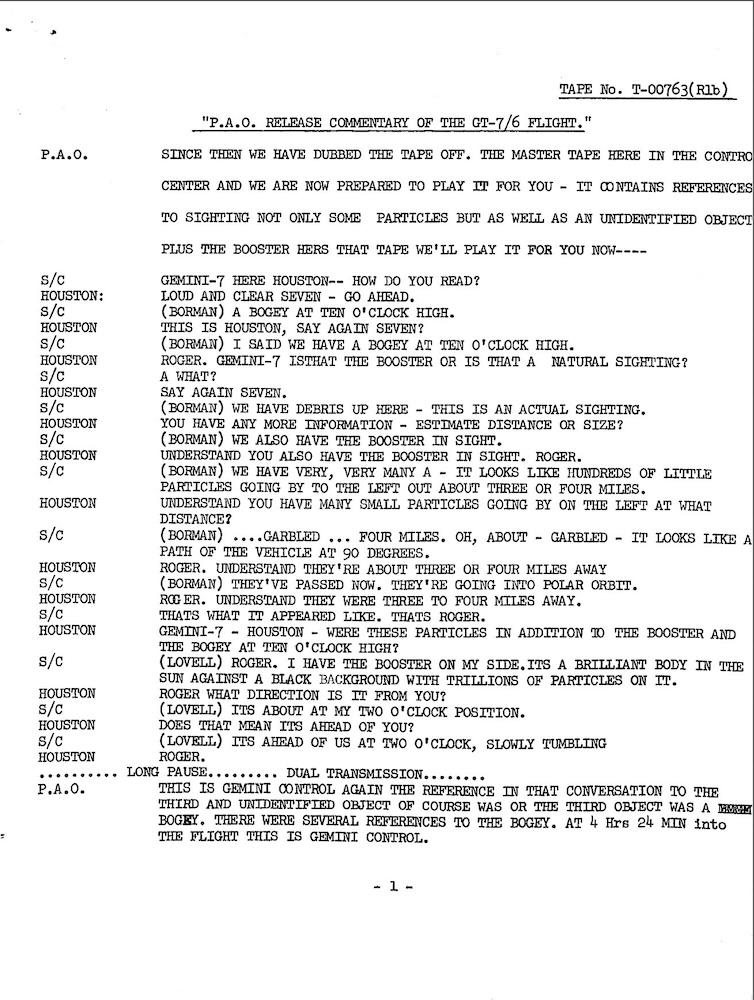
NASA-UAP-D003, Gemini 7 Transcript, 1965

NASA-UAP-D003A, Gemini 7 Audio Excerpt, 1965
NASA-UAP-D018, Gemini 4 Experiment Debriefing, 1967
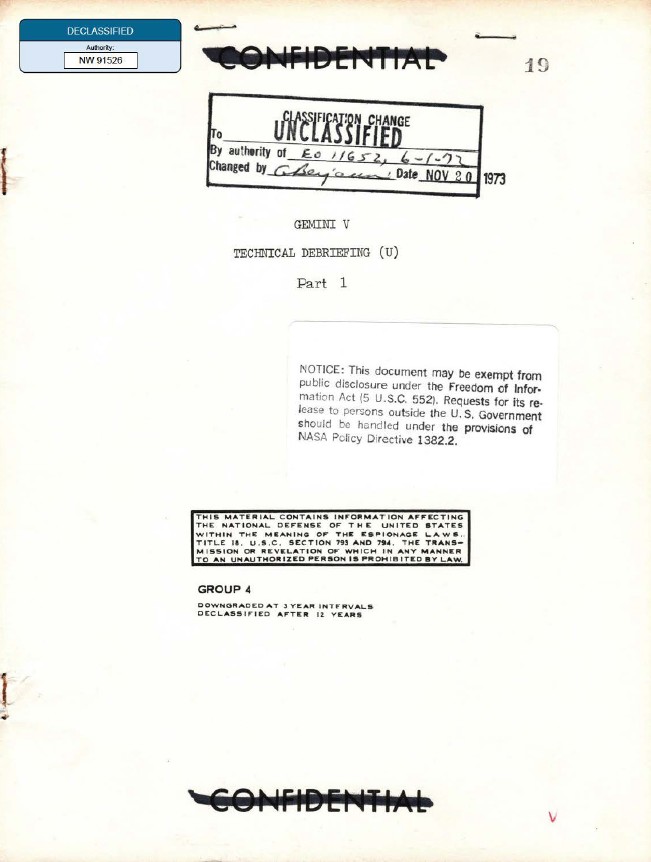
NASA-UAP-D019, Gemini 5 Technical Debriefing, Part I, 1965
NASA-UAP-D020, Gemini 5 Technical Debriefing, Part II, 1965
USG-UAP-D001, Congressional, White House, UFO-related Constituent Correspondence, 1998
Casos relacionados
Mesmo local
Mesma série de arquivos
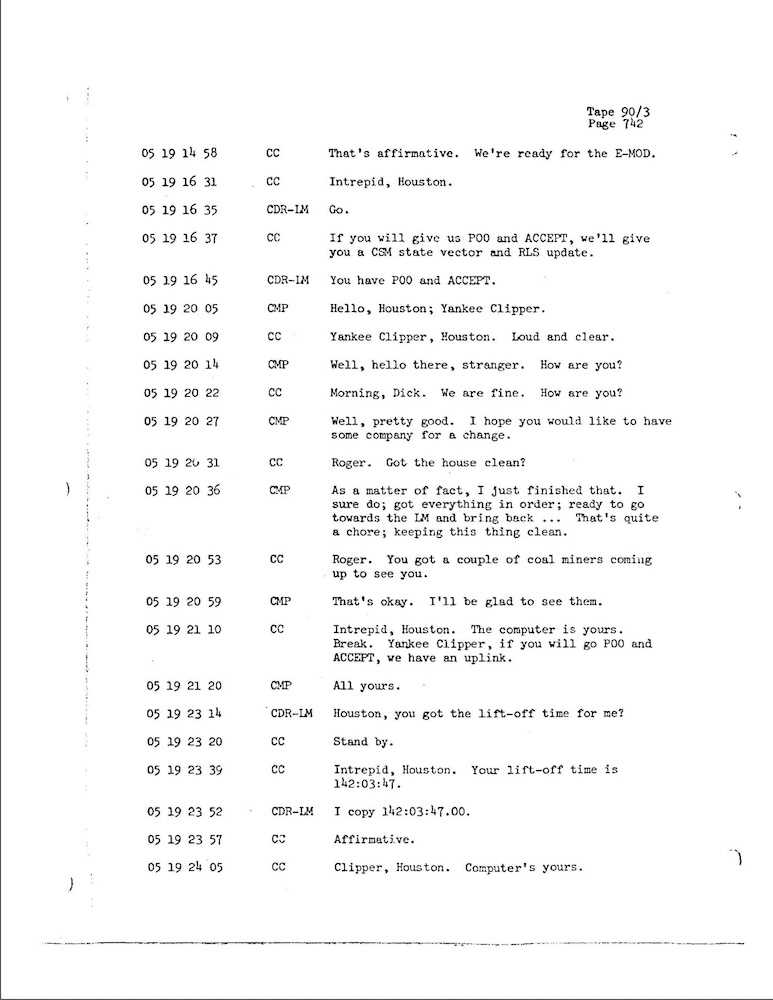
NASA-UAP-D001, Transcrição Apollo 12, 1969
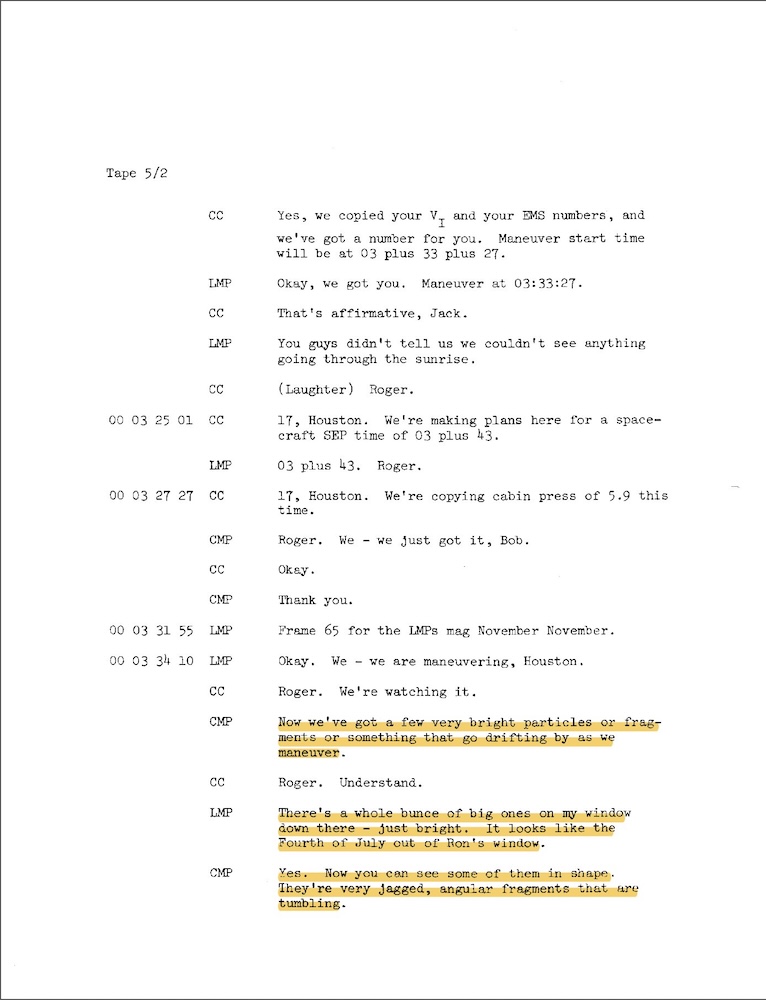
NASA-UAP-D002, Transcrição Apollo 17, 1972
NASA-UAP-D003, Transcrição Gemini 7, 1965
NASA-UAP-D003A, Trecho de Áudio Gemini 7, 1965
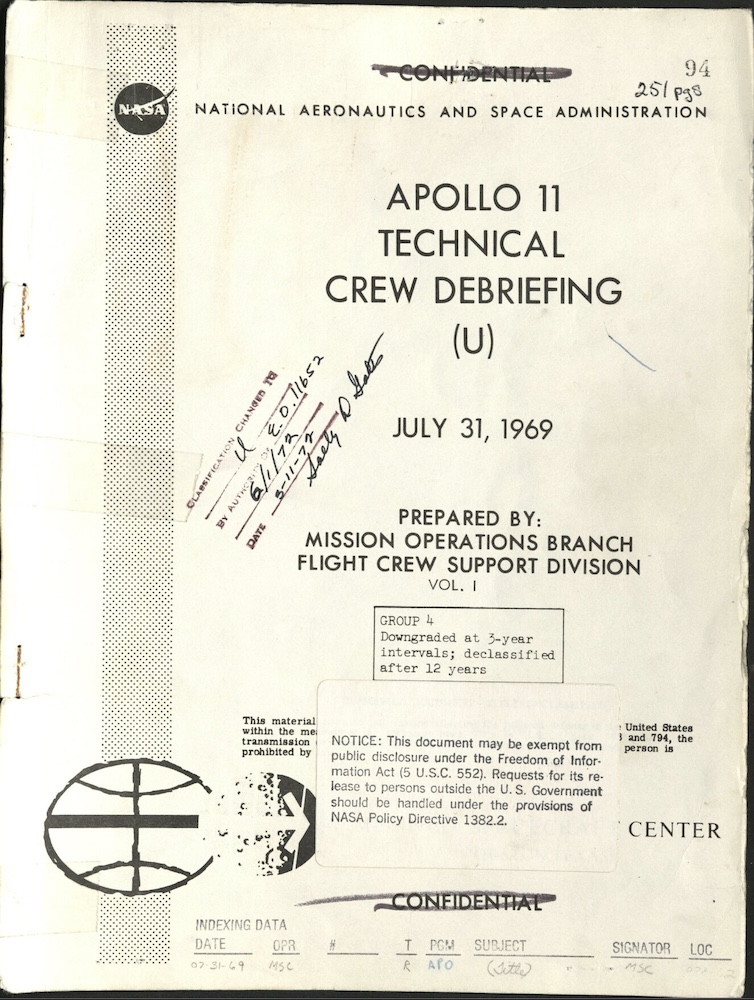
NASA-UAP-D004, Entrevista Técnica da Tripulação Apollo 11, 1969
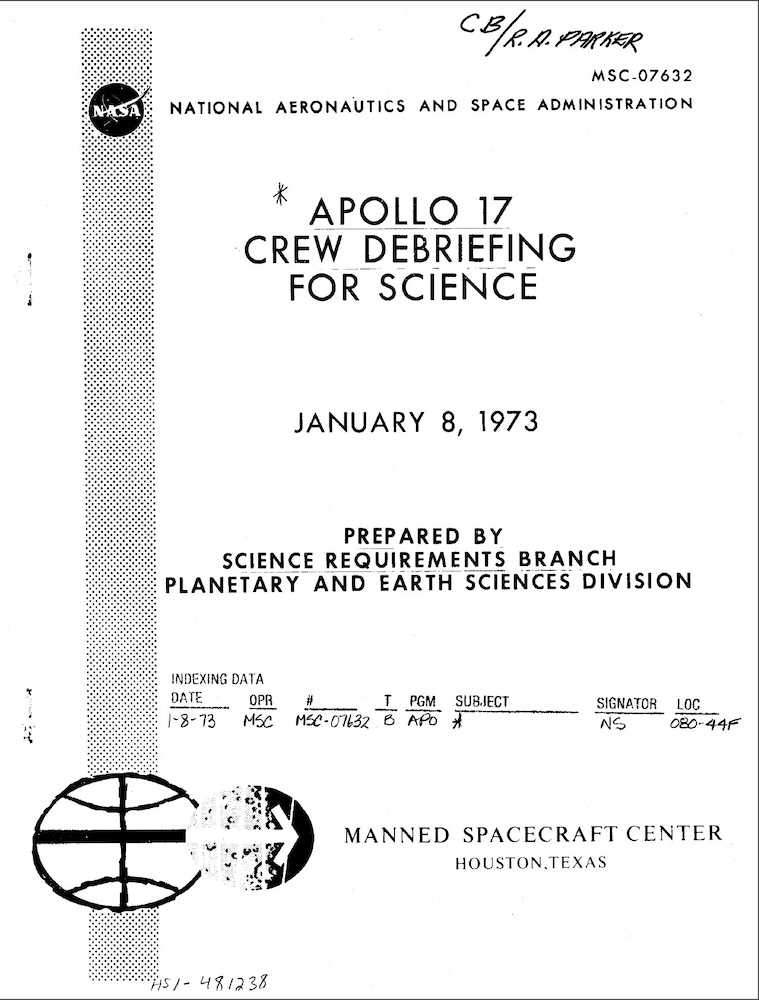
NASA-UAP-D005, Entrevista da Tripulação Apollo 17 para Ciência, 1973
Mesmo período
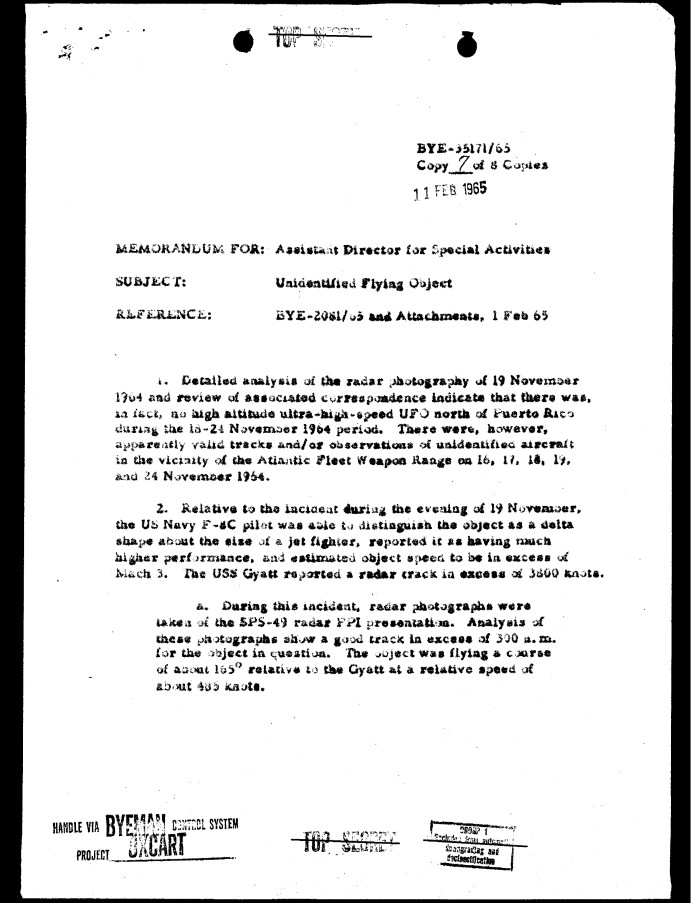
CIA-UAP-D022, Objeto Voador Não Identificado Relatado nas Proximidades de Porto Rico, 1965
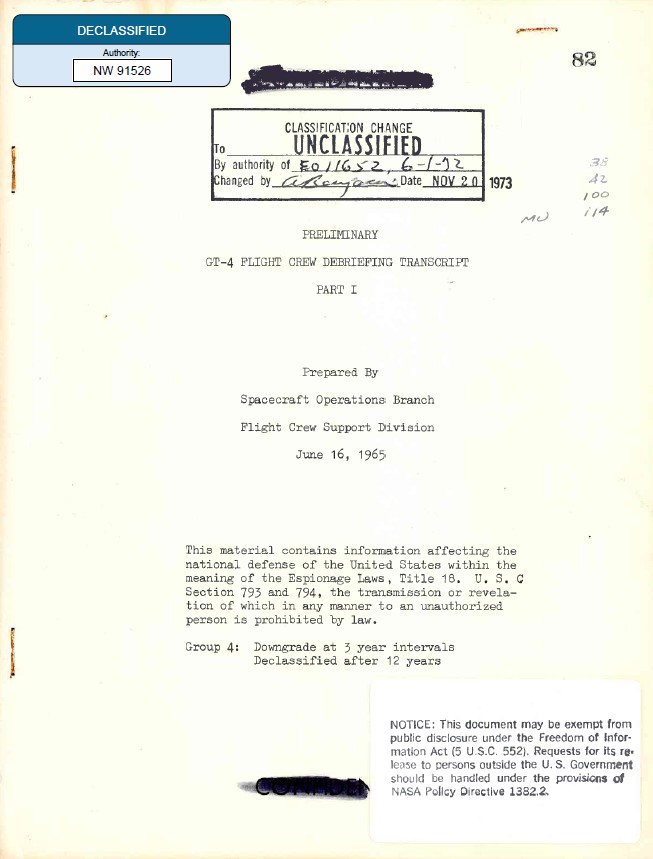
NASA-UAP-D016, Debriefing Preliminar da Tripulação da Gemini 4, Parte I, 1965
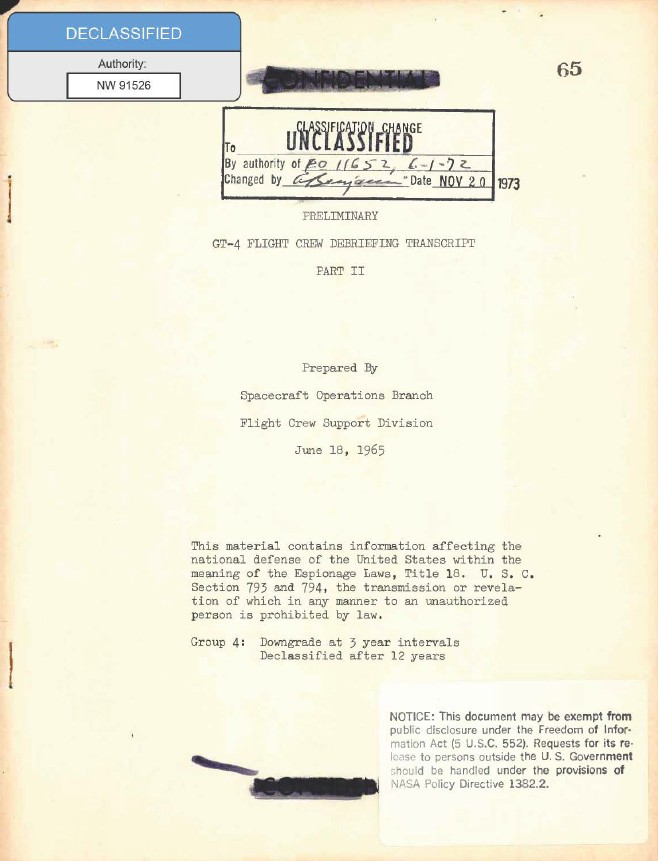
NASA-UAP-D017, Debriefing Preliminar da Tripulação da Gemini 4, Parte II, 1965
NASA-UAP-D018, Debriefing do Experimento da Gemini 4, 1967
Mesmo release
FBI-UAP-D011, Encaminhamento de Correspondência D/FBI, 1949
CIA-UAP-005, Artigo de Cientista Alemão sobre "Discos Voadores"
CIA-UAP-002, Painel Consultivo Científico sobre Objetos Voadores Não Identificados, Relatório, 1952-1953
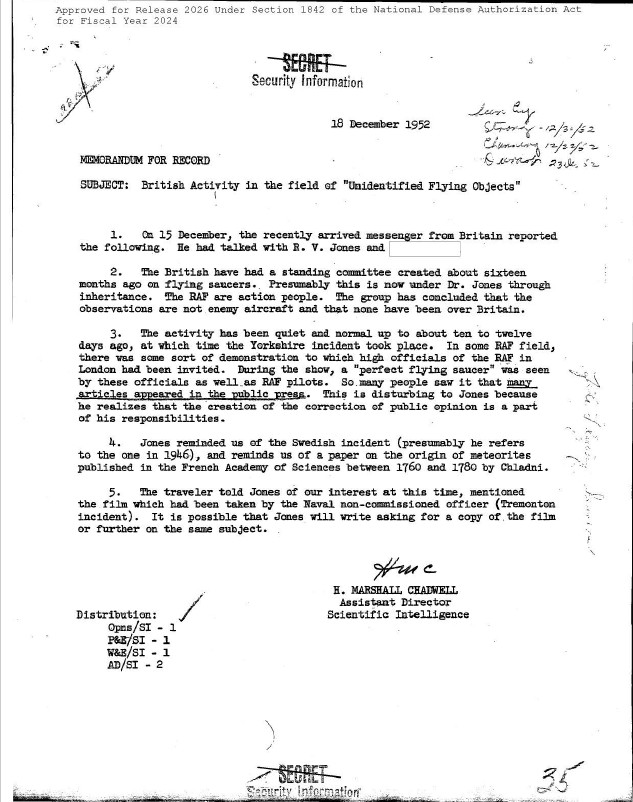
CIA-UAP-014, Atividade Britânica no Campo dos "Objetos Voadores Não Identificados"
FBI-UAP-D012, Escritório de Campo de Newark, 1952-1967
FBI-UAP-D013, Investigação de ‘OVNI’ no Estado de Washington, 1952-1960
Mesma agência
NASA-UAP-D014, Mercury-Redstone 4, 21 de Julho de 1961
NASA-UAP-D012, Trecho de Áudio Mercury Atlas 8, 3 de Outubro de 1962
NASA-UAP-D013, Mercury Atlas 7, 24 de Maio de 1962
NASA-UAP-D015, Debriefings Científicos de Astronautas, 1962-1963
NASA-UAP-D023, Trecho de Entrevista com o Astronauta Gordon Cooper, 1962