
USG-UAP-D002, Correspondance interagences concernant des fragments spatiaux, 1962-1964
Faits essentiels
- ID officiel du dossier
- USG-UAP-D2 (cité comme USG-UAP-D002 dans cette fiche)
- Type de document
- Document
- Agence
- U.S. Government
- Publié dans
- R07 · 2026-10-23
- Date de l'incident
- 1962-1964
- Lieu de l'incident
- Washington (district de Columbia)
- Coordonnées
- 38.8950982, -77.0363849
- Pages lisibles
- 72/72
- VIRIN
- 260508-O-D0360-1171
Description officielle
Ce dossier contient une série de mémorandums et de lettres échangés entre de hauts responsables du pouvoir exécutif entre le 2 octobre 1962 et le 26 mai 1964, concernant l’élaboration d’un cadre politique et d’une stratégie de communication pour la récupération, la manipulation, l’analyse et le sort des matériaux liés aux activités spatiales américaines et étrangères. Au fil de multiples projets et révisions s’étalant sur près de deux ans, le dossier retrace les efforts visant à délimiter les compétences selon l’origine présumée et la nature des matériaux récupérés. Dans l’ensemble, le cadre proposé prévoyait que les matériaux liés à une mission ou à un équipement du département de la Défense des États-Unis seraient reçus, analysés et traités par ce département ; que les matériaux spatiaux étrangers seraient remis au département de la Défense ou à la National Aeronautics and Space Administration (NASA), selon les circonstances ; et que le département d’État se coordonnerait avec les gouvernements étrangers pour obtenir l’accès à ces matériaux lorsqu’ils seraient récupérés à l’étranger. La correspondance témoigne aussi des efforts pour confier à l’Atomic Energy Commission la responsabilité des matériaux dangereux ou radioactifs. Selon les versions, la responsabilité du traitement des matériaux dont l’origine ne pouvait être facilement déterminée revenait tantôt au département de la Défense, tantôt à la NASA. La correspondance témoigne en outre d’une préoccupation quant à la perception publique des activités de récupération et comprend des projets de déclarations publiques décrivant le cadre proposé. Cette communication publique désignait la NASA comme l’autorité dépositaire des matériaux étrangers, tandis que la correspondance privée décrivait un plan parallèle visant à exploiter ces matériaux à des fins d’analyse technique. En définitive, bien que ces négociations n’aient pas abouti à un cadre politique arrêté, la correspondance illustre les délibérations interagences entre hauts responsables dans le contexte de la course à l’espace et, plus largement, de la guerre froide entre les États-Unis et l’Union soviétique.
✦ Résumé IA
Ce dossier de 72 pages de la bibliothèque LBJ rassemble la correspondance du gouvernement américain de 1962 à 1964 sur la manière de traiter les fragments de véhicules spatiaux qui retombent sur Terre. L'essentiel provient du National Aeronautics and Space Council du Bureau exécutif du président (secrétaire exécutif Edward C. Welsh) et consigne des réunions interagences d'octobre et novembre 1962 et de novembre 1963, avec des versions successives de deux documents : des "Guidelines for Interagency Handling of Space Vehicle Fragments" confidentielles et une "Public Statement on Handling of Space Vehicle Fragments". Dans ces projets, la NASA est désignée pour recevoir et identifier les fragments tombés sur le territoire américain, sauf ceux issus de lancements du département de la Défense, qui reviennent au DoD ; les fragments soupçonnés de provenir de lancements étrangers doivent être remis rapidement au DoD pour analyse de renseignement ; le département d'État fixe la ligne politique sur les fragments étrangers, la Commission de l'énergie atomique intervient lorsque des matières nucléaires peuvent être en jeu, et la NASA peut continuer à faire appel à la Smithsonian Institution pour collecter et analyser les pièces. Une note de transmission de décembre 1962 décrit une "petite querelle" entre le DoD et la CIA sur la validation des lignes directrices, que l'auteur qualifie de "tempête dans un verre d'eau". D'autres pièces comprennent un projet de National Security Action Memorandum, un briefing de la NASA de 1963 sur la rentrée attendue des étages Saturn SA-5/SA-6 (débris dispersés sur une zone longue de 2 170 à 2 500 milles, une probabilité estimée de victimes d'environ 1 sur 50 000 et une comparaison avec quelque 310 chutes de météorites par an en Afrique), ainsi que les consignes de la NASA d'avril-mai 1964 pour répondre aux questions du public, qui soulignent que le risque de blessure est minime et qu'aucune information ne doit être donnée spontanément. Le dossier porte sur des débris spatiaux d'origine humaine ; il ne décrit pas d'objets non identifiés.
Généré par IA à partir du fichier officiel — peut contenir des erreurs.
▸Transcription(72 des 72 pages lisibles)
[PAGE 1] = LBJ LIBRARY DOCUMENT WITHDRAWAL SHEET Page 1 Doc# DocType Doc Info Classification Pages Date Restriction 04_—-_meme——_Wetsi to Fritsch, et-at— iB 7 11/15/63 A open) Al is jy} 06 draft Near duplicate of #7 & 9 Cc | 11/15/63 A 07 draft Near duplicate of #6 & 9 Cc 2 11/15/63 A Open 9/1 \4 09 draft "Guidelines for Interagency Handling..." Cc 2 11/15/63 A [Near duplicate of #6 & 7] 10 draft "Guidelines for Interagency Handling..." Cc 3 [11/63] A 42 aii NASC-Meeting— peét——_1 41/6/63. A open 4/15/14 — i 5/31/63 A Open 4/17 \4 ideti ing--" o—————_2_ [1963] A i Open /+]1@ Per RAC 21% : o——t— 424046 2— A [Duplicate of #25] OPEN Alian\y Collection Title National Security File, Files of Charles E. Johnson Folder Title "Space Vehicle Fragments - Responsibilities and Procedures" Box Number 018 Restriction Codes 1/13/2009 g (A) Closed by Executive Order 13292 governing to national rity information. : (B) Closed by statute or by the agency which originated the document. Initials (C) Closed in accordance with restrictions contained in the donor's deed of gift. [PAGE 2] .. Page2 LBJ LIBRARY DOCUMENT WITHDRAWAL SHEET Doc# DocType Doc Info Classification Pages Date Restriction :.23 ff18ff18 Te ~MS&s, MA SC C 1 12/7/62 A open C1JJL3//14 25 FROFR8 Dttplieete of #21 d; 12710!62 A OJ)ef) q/lc;JIY .36~ draft "Attacl:IFJient Ii!!... '-6 2 [10tS2) A 0~ q/J'7114 Collection Title National Security File, Files of Charles E. Johnson Folder Title "Space Vehicle Fragments - Responsibilities and Procedures" Box Number 018 Restriction Codes 1/13/2009 (A) Closed by Executive Order 13292 governing accns to national ncurlty lnfonnatlon. (B) Closed by statute or by the agency which originated the document Initials (C) Closed In accordance with restrictions contained In the donor's deed of gift. [PAGE 3] NASA HEADQUARTERS ROUTING SLIP CODE NAME (if necessary) ACTION APPROVAL 1. Charles Johnson CONCURRENCE FILE 2. National Security INFORMATION INVESTIGATE AND ADVISE 3. Council NOTE AND FORWARD NOTE AND RETURN 4. PER REQUEST RECOMMENDATION 5. SEE ME SIGNATURE 6. REPLY FOR SIGNATURE OF: 7. REMARKS: Underlined sections have been added since the last draf't. s CODE· NAME: FROM: AI DATE: 5/26/64 William F. Hausman NASA Form 26 (Rev. July 19~9) U. S. GOVERNMENT PRINTING OFFICE : 1959 o,-513021 [PAGE 4] ba << NASA —Ccousipentzan /‘ 4 <0 . CS agit s7 Fs 0 5° [ AF BY oO ace = A 08 HE oot ao Pave MANNED SPACECRAFT CENTER -- ATTN: DR. GILRUTa “~~ D Haney Baar MARSHALL SPACE FLIGHT CENTER -- ATTN: DR. vow Braun *¥D,SLaTEny NASA JOHN F, KENNEDY SPACE CENTER -- ATTN: DR. DEBUS, . JOHN KING UNTIL FURTHER NOTICE, THE FOLLOWING IS THE RESPONSE TO QUERIES ON POSSIBLE EARTH IMPACTS OF FRAGMENTS FROM RBITING SA-6 BOOSTER. NO QUERIES HAVE BEEN RECEIVED AT THIS TIME. AFTER LAUNCH WE WILL GIVE TRACKING ELEMENTS FOR TWO TO TWELVE DAY ORBIT BUT NO IMPACT PREDICTION. NO INFORMATION IS BEING VOLUNTEERED, THIS HAS BEEN COORDINATED BY OUR INTERNATIONAL PROGRAMS OFFICE WITH THE STATE DEPARTMENT. ALL ADDITIONAL RESPONSE OVER AND ABOVE THE FOLLOWING WILL BE ONLY BY THE ADMINISTRATOR, THE DEPUTY ADMINISTRATOR OR THE ASSOCIATE ADMINISTRATOR. QUERIES REQUIRING SUCH ADDITIONAL RESPONSES SHOULD BE REFERRED TO THEM. “A, ON SIZE OF FRAGMENTS: ACTUAL SIZE AND NUMBER OF FRAGMENTS CANNOT BE PREDICTED. DECLASSIFIED E.0. 13292, Sec. 3.4 L 3 By RA, Date_|-2 [PAGE 5] tel i | LOCATION OF IMPACT: SINCE THS VEHICLE |. BREAKS UP OW REENTRY, THERE IS NO BASIS FOR PREDICTING _ A SINGLE IMPACT POINT. “C, PRIOR TO ANY IMPACT: THIS PROBLEM HAS BELW VERY CAREFULLY STUDIED. THE POSSIBILITY OF A #RACMENT FROM ANY SPACE VEHICLE ENDANGERING HUMAN LIFE OR PROPERTY IS QUITE REMOTE, ANY DISCUSSION OF SUCH aN IMPROBABLE INCIDENT WOULD BE HEAVILY CONJECTURAL. "D, AFTER A REPORTED IMPACT: UNDER NO CIRCUMSTANCES DOES THIS AGENCY (GOVERNMENT) CONJECTURE ON THE ORIGIN OF AN OBJECT. RATHER, IT DESIRES TO OBTAIN, ANALYZE, AND ATTEMPT TO ESTABLISH THE ORIGIN OF SUCH AN OBJECT. “B, APTER IT IS KNOWN THAT A FRAGMENT IS TO BE DELIVERED TO US: THE OBJECT WILL BE SUBJECTED TO [PAGE 6] i: | NASA ANALYSIS HAS BEEN COMPLETED," JULIAN SCHEER ASSISTANT ADMINISTRATOR FOR PUBLIC AFFAIRS ccs | AT/vie. Frutkin nou? 5 pron. FH 08 sss AA/Mc. Williamson Exe sng ond M/Dr. Mueller gowns MAO/Mr. Abernethy AFP/Mr. Lloyd M-N/Mr. Alibrando A/Mr. Webb | AA/Dr. Seamans Julian Scheer, Asst. Administra- tor for Public prea Shae: Wifes: CONPLEENTIAL~ STUDY AND PROMPT PUBLIC ANNOUNCEMENT WILL BE MADE WHEN —COnrICENTTAS— [PAGE 7] CONFIDENTIAL File - Saturn Launch Background data. December 16, 1963 DIARY NOTE Subject: SA-5 1. NASA provides bimonthly launch briefings to the Department of State on all NASA launchings scheduled for the following two-month period. 2. The SA-5 launch was flagged at the briefing of October 23 because of the large weight expected to be put in orbit and re-enter. No objection was registered by the Department of State. 3. The following day, October 24, Mr. Frutkin called Dr. Golovin to recommend that Dr. Weisner be briefed on the SA-5. Golovin was to arrange a meeting for this purpose. A request for a briefing was received from Dr. Steininger of Dr. Weisner's staff on December 9, 1963, and he was briefed that day by Capt. Holcomb (NASA). 4. Prior to the initial briefing, NASA had taken two principal precautions to reduce the total weight of fragments that might return: (1) 13,000 lbs. of sand were substituted for the ballast originally programmed (lead and iron); (2) the Jupiter nose cone was roughed up so that it would burn up during reentry. 5. At Department of State request, a second briefing on SA-5 was held on November 27. No objections were registered to the launching by Dr. Rollefson or his associates. 6. The facts which were presented in the briefing for Dr. Rollefson (subsequently revised as in Paragraph 7) are: (a) There is a 95% probability that 2,800 lbs. of material will return to earth, a 75% probability that 4,600 lbs. will return and a 50% chance that 10,200 lbs. will return. The 2,800 lbs. would probably take the form of 30 to 39 fragments, consisting of six engines, three Titanium spheres and approximately 30 electronics packages. The difference between 2,800 lbs. figure and the 4,600 lbs. figure is in the Jupiter nose cone. DECLASSIFIED E.O. 13292, Sec. 3.4 By [illegible], NARA, Date 1-8-09 CONFIDENTIAL[PAGE 8] (bo) It was steted that fraguents would probebly impect over en area between 2,170 and 2,500 miles long by 100 miles wide. (c) Sone of the aluminua skin material is expected to survive reentry. Interior parte should therefore be exposed to heating during - (Moet fragments collected to date have been stainless steel pieces of Atles skin). (4) If 30 fregments reenter the atmosphere, the probability of @ casulty is estimated at .0000179. If 39 pieces reenter, the probability ie .0000232, or one casulty per 50,000 flights. A fragment is considered capable of inflicting injury or death if it hite with more than 58 foot pounds of kinetic energy. (e) the nominal but wicertein lifetime projected for the satellite is 148 days. The vehicle is to be leunched on « heading of 105°, with e 345 nautical mile apogee, 141 neutical mile perigee, 31.60 inclination and a 93.9 minute period. (f) WASA has investigated the possibility of destructing the satellite in orbit. This does not eppear feasible since any that the vehicle will be of the approximate weight and size of not [PAGE 9] 7. Revised Information Since the November 27 briefing, the following revised date bas been provided: 95% probability 2,361 lbs. will return; 50% probability 8. Based on data provided through Suithsouien Astrophysical Observatory, it hes been estimated that in ome year, 310 meteorite impects occur in Africa (epproximately 11,000,000 square kilometers); i.e., 10 times as mony objects as are involved in GA-5 reentry fell in Africa alone in one year. To date there has been no substentiated report of a personnel casualty resulting from these impects. ec: Mr. C. Johnson, White House [PAGE 10] U. S. GoYunment Prmting Otf c1;. 1963 o/9668 FROM illi F. He&./Code ll -------------------------1 TO Johnso 11 DATE OF DOCUMENT 1~ CHECK WHETHER □ ACTION □ INFO, COPY COPY INFORMATION COPY TO ~ DATE RECEIVED ACTION COPY TO DESTROYED ( DATE AND NO.) -----------------"""T""-------1 CLASSIFIED CLASSIFICATION SUSPENSE DATE POST OFFICE REGISTRY NO. MATERIAL~ NO: AI-15 INUMBER OF COPIES REFERRED TO REC'D. BY DATE REFERRED TO REC'D BY DATE cret DESCRIPTION ( MUST BE UNCLASSIFIED) to ENCLOSURES I Johnson, rutk:l.n., ries , amens, :te BY □ NO REPLY NECESSARY C&T NASA MAIL CONTROL FORM NASA 416A (JUNE 1959) [PAGE 11] (PLACE NASA CONTROL FORMS HERE) DECLASSIFIED E.O. 13292, Sec. 3.4 By [illegible], NARA, Date 1-8-09 This sheet and NASA Control Forms must be attached to Secret material while in the custody of NASA Headquarters. SECRET NATIONAL AERONAUTICS AND SPACE ADMINISTRATION The attachment contains information affecting the National Defense of the United States within the meaning of the espionage laws, Title 18, U.S.C., Secs. 793 and 794, the transmission or revelation of which in any manner to an unauthorized person is prohibited by law.[PAGE 12] RESPONSE TO QUERY ie RGUE — g ea at 12 year ea ; not gutomatically,, in 83 aeclassified ‘April 8, 1964 RE: Queries on Fragment Return from NASA Spacecraft or Space Vehicles A much abbreviated guideline for RTQ has been provided by Mr. Scheer to various NASA officials who might be queried on this subject. ‘The following more extensive responses are provided as background information to be used by the Administrator, Deputy Administrator, or Associate Administrator of NASA, in their judgment, in event of queries on the ' return of space vehicle fragments to the earth. It is suggested that the minimum information be used to satisfy a given query. (A) FOR USE PRIOR TO AND AFTER A PARTICULAR LAUNCH BUT BEFORE ANY KNOWN IMPACT OF RETURNING FRAGMENTS: 1. 2. 3 Do fragments from (satellite X) pose a threat to life or property? The probability that fragments from (satellite X) may cause damage or injury is remote. The probability of injury from natural meteorites is far greater. a. What is the probability of impact? There are many factors (e.g. » time in orbit, atmospheric conditions, how the vehicle breaks up, dispersal pattern, etc.) involved and the calculations are extremely complex. We have assured ourselves, however, that the hazard is far less than me hazards encountered in everyday living. thie? 77 7] 7 cap ot sto6/ dd 5 Cake \A t se of GI-1, it is one in“27,500 he Has NASA taken steps to lessen the fragment problem? /tn Yes. NASA is actively engaged in minimizing it. For example, on the SA-5 satellite, NASA used 13,000 lbs. of harmless sand as ballast and roughed up the nosecone so that it would burn on reentry. On the GI-1 spacecraft, NASA bored large holes in the heat shield to assist burning during reentry. In addition to specific steps such as these, studies are underway to assist NASA in further coping with the overall reentry problem. bef ‘What is theynumerica) probability a7 has placed 7 : uphis document consists a ANY INFORMATION IN THIS DOCUMENT USED (3 pages, Noh IN RESPONSE TO ios, Series. — —— TED. ceo S a Downgraded at 12 weer. SSIFIE intorvals; not automatically . 13292, Sec. oe declassified 36 [PAGE 13] be 6. T 8. Ac AO Geer Be at 2.9887 oe 0954. "ead a ee Sheers or fn’ BrVanee yo - alilwe we” 2 if any fragments come down, where are they most likely to impact? The small number of fragments surviving from any satellite will be dispersed over an area of thousands of square miles, most of which are likely to be oceans, seas, or other water surface. Can the fragment problem be further decreased by exploding the orbiting element? Explosion or destruct of the orbiting element could produce more fragments and, hence, increase the possibility of fragment impact. If one were to be hit by a fragment, would it be lethal? In the remote possibility that one were to be struck by a eet > it niet 4 aepent ats 7h area Bil Sa oe » be Smithsonian jeanne Observatory; panies number of meteorites”over 2.2 lbs. which impact.on the earth every year 1e<est estimatedmaty 56285" This~is many;-many--times greatér than r number of fragments, bo..be--e: pected. from (satellite : ‘te, there axe no substantiated reports of injury Meteorites are natural phenomena. Do you consider NASA justified in increasing the possibilities of a lethal impact, no matter how improbable? Many human activities carry with them a demonstrable probability of casualty--flying, automobile driving, golfing. during an electrical storm. But we do not stop driving, flying or golf- ing. GROUP: S. Downgraded at 12 yoar : *{ > Et intervals; not automatically heap aeclassified [PAGE 14] 9. 10. se tl Downgraded at 12 year \~ intervals; not automatically & ‘ Will this sort of thing be a continuing hazard? In some degree, yes. In time, it should become possible to develop some solutions such as ensured return over water, but these will take a great deal of research and development as well as significant payload margin. It is a matter of constant attention. How do reentry problems with GI-1 compare with those of other rockets? Very roughly, about the same as with Atlas reentries, from which there have been no casualties. oup 3 > See eepaed at 12 eee reall? untae not automatical-s,, ao = ' ae o ewe [PAGE 15] EXECUTIVE OFFICE OF THE PRESIDENT NATIONAL AERONAUTICS and SPACE COUNCIL WASHINGTON EXECUTIVE SECRETARY November 15, 1963 MEMORANDUM TO: Dr. Arnold Fritsch (AEC) Mr. Albert D. Wheelan (CIA) Dr. Albert C. Hall (DOD) Mr. Arnold Frutkin (NASA) / Mr. Charles Johnson (NSC) v Dr. Nicholas Golovin (OST) Mr. Robert Packard (State) Subject: Fragments The meeting on November 6 was informative. At the close of that session, I promised to weigh various suggestions and come up with a draft paper for joint consideration. Such a paper is attached. I would doubt that everyone's interests are completely satisfied with this language, but it is hoped that it comprises a reasonable basis for agreement. In any event, I would appreciate your evaluating it and preparing yourselves to indicate what por tions are satisfactory and what portions need improvement. A meeting to discuss this language and related issues is scheduled for November 21, 10 o'clock, in Room 213 Executive Office Build ing. Please adt-ise my office i n aavance wlro"'will attend for your respective agencies. - Classified attachment (2 cys) E. C. Welsh Upon removal of attach• D~> ments this document ~uthontY N\.'J -02913. O) t) .oo\ / ( becomes unclassified. !i,~ NARA, Datel:.) I; l.f [PAGE 16] [Handwritten note] SAT EVE POST Hot Rocket to Nowhere[PAGE 17] NATIONAL AERONAUTICS AND SPACE COUNCL. lateragency dieeting om Upace Vehicle Frage.ente Thureday, November <i, 1963 + 16:00 a. m. Reems 213 « £,O. B. CHALBALAN: De. &. GC. Welsh CIA: Mr. Huntington Sheldon NASA: hry emake natin — Colesel “iiMam F, Hausman NSC; bir. Charlies Johnson OST: ah hee hei De. Oesald H. Steiniager STATE: bax. Gobert Packard NASC: his, Richard Hirech hie. Russell W. Hale De. Chartes 6, Sheldon, DECLASSIEIE’> AuthontyMLA..030R.01 £.00\/ 4 7 NARA. Date$2'44 [PAGE 18] Draft of Nov. 6, 1962 Revised by DOD 3/1/63 { ] + material deleted Underlining - material added GUIDELINES FOR INTERAGENCY HANDLING OF SPACE VEHICLE FRAGMENTS 1, The National Aeronautics and Space Administration (NASA) is designated as the agency responsible for receiving, _[ analyzing] and identifying [any] fragments, or suspected fragments of space vehicles of all types, including the contents thereof, which fall upon the territory of the United States or which otherwise come into its possession, except that the Department of Defense (DOD) is solely responsible for receivi and identifying fragments from vehicles launched by the DOD. [2. NASA will turn over to the Department of Defense (DOD) as expeditiously as possible fragments which are readily identifiable as coming from space vehicles launched by the DOD. ] 2. _In the event NASA should come into possession of space fragments under the sole and exclusive responsibility of the DOD, NASA will deliver such fragments as expeditiously as possible to the DOD, 3. To insure prompt analysis for intelligence purposes, NASA and other U. S. Government agencies will [ give] deliver to the DOD[and other responsible agencies access] as expeditously as possible and on a priority basis fragments (including whole vehicles) which are readily identifiable or suspect as coming from [ space] vehicles launched from foreign countries. Such foreign fragments which come initially into possession of the DOD will be retained by DOD for analysis. Such analysis of foreign fragments will be completed expeditiously, and thereafter such fragments will [ remain] be placed in the custody of NASA, pending final arrangements for their return to the launching country or for other appropriate disposition, 4. All other fragments will be retained by NASA pending agreement as to disposition, 5. NASA may continue to use the Smithsonian Institution for collection and analysis of fragments by contractual arrangements, and may also make appropriate arrangements for assistance with private agencies, meet aA ecir mr wy | [PAGE 19] CONFIDENTIAL. 6. The DCD will notify NASA when deorbits are expected and when collection teams have been alerted to obtain the deorbiting fragments. Also, DCD will inform NASA of the results of such collection efforts whether successful or not. 7. The Atomic Energy Commission (AEC) will participate in the analysis of fragments of space vehicles which have utilized or transported, or are suspected of having utilized or transported, radioactive materials or special nuclear materials, and will exercise responsibility for special nuclear materials, in accordance with its statutory responsibility. In addition, the AEC will continue to make available to NASA and the DCD its special scientific capabilities. 8. The Department of State will provide policy guidance with respect to the final disposition of fragments from vehicles launched by foreign countries, or made available to the United States by foreign countries, The Department of State will provide assistance in the acquisition of fragments that fall on foreign territory. 9. NASA will serve as the focal point for the coordination and release of public information on fragments except for release of public information on fragments resulting from space vehicles launched by the DOD, which will be the responsibility of DCD, [PAGE 20] NATIONAL AERONAUTICS AND SPACE COUNCIL Interagency Meeting on Space Vehicle Fragments Wednesday, November 6, 1963 - 10:00 a. m. Room 213 - E. O. B. CHAIRMAN: Dr. E. C. Welsh AEC: Dr. Arnold Fritsch CIA: Mr. Albert D. Wheelon, Mr. Carl Duckett DEFENSE: Dr. Albert C. Hall, DDR&E NASA: Mr. Arnold Frutkin, Colonel William F. Hausman NSC: Mr. Charles Johnson OST: Dr. Nicholas Golovin, Dr. Donald H. Steininger STATE: Mr. Robert Packard, Mr. C. E. Dillery NASC: Mr. Richard Hirsch, Mr. Russell W. Hale DECLASSIFIED Authority NLJ.030R.018.001/5 By [illegible], NARA, Date 8-21-14[PAGE 21] DRAFT November 6, 1962 PUBLIC STATEMENT ON HANDLING OF SPACE VEHICLE FRAGMENTS The National Aeronautics and Space Administration is designated as the Government agency responsible for receiving [ analyzing], and identifying [any] fragments or suspected fragments of space vehicles of all types, including the contents thereof, which fall upon the territory of the United States or which otherwise come into its possession, Fragments identified as coming from vehicles launched by foreign countries will be retained by NASA pending final arrangements for their return to the launching country or for other appropriate disposition. In performing these functions, NASA will coordinate fully with other Government agencies. Delete bracketed words to conform to DOD revisions of paper dated March i, 1963. [PAGE 22] [Handwritten note] Did USIB take any final action at or since their December meeting?[PAGE 23] EXECUTIVE OFFICE OF THE PRESIDENT NATIONAL AERONAUTICS and SPACE COUNCIL WASHINGTON EXECUTIVE SECRETARY October 24, 1963 MEMORANDUM TO: Honorable Dean Rusk Honorable John A. McCone Secretary of State Director, CIA Honorable Roswell L. Gilpatric Honorable Jerome B. Wiesner Deputy Secretary of Defense Director, OST Honorable James E. Webb / Honorable McGeorge Bundy Administrator, NASA Special Assistant to the President Subject: Responsibility and Procedure re Space Vehicle Fragments Subject matter has in the past been discussed with representatives of interested agencies. Draft language was circulated and agreement was initially obtained. Subsequently, some variations in preferred languagetleveloped. In response to inquiry from Chairman Miller of the House Science and Astronautics Committee regarding legislation introduced on this subject, the Administrator of NASA responded that he did not believe such legislation was needed at this time, as the question of responsi bility for receiving, analyzing, and identifying fragments and suspected fragments was being considered within the Executive Branch. This consideration was presumably a reference to the meetings and drafts developed under our auspices. There has been more than sufficient time elapsed since this matter was first examined for the interested agencies to agree upon a responsible position. Consequently, I am calling a meeting to examine this subject on November 6 at 10 o'clock in Room 213 of the Executive Office Build ing. It would be appreciated if you would identify representation for your agency at such a session. When you have done so, it would be appreciated if my office were notified as to the person or persons who expect to attend. E. C. Welsh I L I [PAGE 24] EXECUTIVE OFFICE OF THE PRESIDENT NATIONAL AERONAUTICS and SPACE COUNCIL WASHINGTON EXECUTIVE SECRETARY October 24, 1963 MEMORANDUM TO: Honorable Dean Rusk Honorable John A. McCone Secretary of State Director, CIA Honorable Roswell L. Gilpatric Honorable Jerome B. Wiesner Deputy Secretary of Defense Director, OST Honorable James E. Webb Honorable McGeorge Bundy Administrator, NASA Special Assistant to the President Subject: Responsibility and Procedure re Space Vehicle Fragments Subject matter has in the past been discussed with representatives of interested agencies. Draft language was circulated and agreement was initially obtained. Subsequently, some variations in preferred language developed. In response to inquiry from Chairman Miller of the House Science and Astronautics Cemmittee regarding legislation introduced on this subject, the Administrator of NASA responded that he did not believe such legislation was needed at this time, as the question of responsi- bility for receiving, analyzing, and identifying fragments and suspected fragments was being considered within the Executive Branch. This consideration was presumably a reference to the meetings and drafts developed under our auspices. There has been more than sufficient time elapsed since this matter was first examined for the interested agencies to agree upon a responsible position. Consequently, I am calling a meeting to examine this subject on November 6 at 10 o'clock in Room 213 of the Executive Office Build- ing. It would be appreciated if you would identify representation for your agency at such a session. When you have done so, it would be appreciated if my office were notified as to the person or persons who expect to attend. 7 ~ E. C. Welsh /3>1 [PAGE 25] Segre +s wt aie sete IN REPLY REFER TO: Dr. Eéward Welsh © Executive Secretary Neticneal Aeronautics Space Council “seu is. Westington 2 (3 D.. Cc, es Lear Ed; : licwing our i piaet on of inst. atedey ate have etiewed as ~ on handling of fragments am@ greatly simplified our cCz- ments, 6l¢ hough it wae not possible to eliminate them el. she PoLlowing “omment 8 are pace: es ; i. NASA has nc objection. ‘to deleting the uotd Roan tyiiae” in pazsgreph one, line two, with the clear understaciin \/ that fragment iiear ificetion my Ain fact pegeirs iad manos anelysis. ys! 2. In per agrach three, the vords meta ee Us government agencies" ani "Sach foreign fregrents which come initially into possession of DOD will be retained by DOD for analysis." should be deleted simce they ere inconsistent with the statement in paragraph one thet "(NASA) is @esignated as the agency responsitle for receiving and identifying fragments” With the exse; ion c? fragments frcem DOD vehicles. — GREE 3. Paragraph five has been deleted since it pervains exclusively to internal NASA matters. : Director, Lice ot International Progrars [PAGE 26] May 31, 1963 MORANDUM FOR See rte ee r intelligence Cesirman USIBeard Subject: Dise 5 : This office was asked seme time ago te ceerdinate the preparation of a public announcement and an internal (classified) document to fix responsibilities and te outline procedures regarding the subject matter. To this end, my memorandum te 14. General Carter, dated November 28, 1962, provided draft decuments and set forth the status ef the project at that time. hae a pevdiage di evided, but we now under It is requested that the draft paper Tab A--the eee paper--ba given cencidsratien. = gests a reg ll ee Se 162, Get he mater would be given prac! ppreciated if we eeuld obtain @ favevable reply on this matter. E. GC. Welsh ECWimq aclosure (as Tab A) Defense Draft of March 1/63 "Guidelines for uaniiling 4f gues Vilicle Ponguace” 0 DECLASSIFIBYs SAN CORY Anthomty NLD .0308-N¥. Oot [6 CONFIDENTIAL fyG. NARA, DateL:2t-1 [PAGE 27] -GGNFlDENTIAL GUIDELINES FOR INTE RAGENCY HANDLING OF SPACE VEHICLE FRAGMENTS lo The National Aeronautics and Space Administration (NASA) is designated as the agency responsible for receiving and identifying fragments, or suspected fragments of space vehicles of all types, including the contents thereof, '-irhich fall upon the terri tory of the United States or which otherwise cc:ne into its possession, except that the Department of Defense (DoD) is solely responsible for receiving and identifying fragments from vehicles launched by the DoD• 2. In the event NASA should come into possession of space fragments under the sole and exclusive responsibility of the DoD, NASA will deliver such fragments as expeditiously as possible to the DoD. 3. To insure prompt analysis for intelligence purposes, NASA and other u.s. Government agencies will deliver to the DoD as expe ditiously as possible and on a priority basis fragments (including whole vehicles) which are readily identifiable or suspect as coming from vehicles launched from foreign countries. Such foreign fragments which come initially into possession of the DoD will be retained by DoD for analysis. Such analysis of foreign fragments will be completed expeditiously, and thereafter such fragments will be placed in the cus tody of NASA, pending final arrangements for their return to the launch ing country or for other appropriate disposition. 4. All other fragments will be retained by NASA pending agree ment as to disposition. s. NASA may continue to use the Smithsonian Institution for collection and analysis of fragments by contractual arrangements, and may also make appropriate arrangements for assistance with private agencies. 6. The DoD will notify NASA when deorbits are expected and when collection teams have been alerted to obtain the deorbiting frag ments. Also, DoD will inform NASA of the results of such collection efforts whether successful or not. -OONFIDENTL\L [PAGE 28] r CONFIDEN rlAL .. z 7. The Atomic Energy Commission (AEC) will participate in the analysis of fragments of space vehicles which have utilized or transported, or are suspected of having utilized or transported, radioactive materials or special nuclear materials, and will exer ... cise responsibility for special nuclear materials, in accordance with its statutory responsibility. In addition, the AEC will continue to make available to NASA and the DoD its special scientific capabilities. s. The Department of State will provide policy guidance with respect to the final disposition of fragments from vehicles launched by foreign countries, or made available to the United States by foreign countries. The Department of State will provide assistance in the acquisition of fragments that fall on foreign territory. 9. NASA will serve as the focal point for the coordination and release of public information on fragments except for release of pub.. lie information on fragments resulting from space vehicles launched by the DoD, which will be the responsibility of DoD. [PAGE 29] ---- NATIONAL AERONAUTICS and SPACE COUNCIL 2t) March 4 , 1963 To: Charles Johnson This is the paper to which I re £erred on the phoneo .......... E. C. Welsh [PAGE 30] CONFIBENTI. Zon GUIDELINES FOR INTERAGENCY HANDLING OF SPACE VEH.CLE FRAGMENTS 1. The National Aeronautics and Space Administration . (NASA) is designated as the agency responsible for receiving and -identifying fragments, or suspected fragments of space vehicles. of all types, including the contents thereof, which fall upon the territory of the United States or which otherwise come into its possession, except that the Department of Defense (DoD) is solely responsible for receiving and identifying fragments from vehicles launched by the DoD. 2 In the event NASA should come into possession of space fragments under the sole and exclusive responsibility of the DoD, NASA will deliver such fragments as expeditiously as possible 3. To insure prompt analysis for intelligence purposes, NASA and other U.S. Government agencies will deliver to the DoD as expeditiously as possible and on a priority basis fragments (including whole vehicles) which are readily identifiable or suspect as coming from vehicles launched from foreign countries, Such foreign fragments which come initially into possession of the DoD will be retained by DoD for analysis. Such analysis of foreign fragments will be completed expeditiously, and thereafter such fragments will be placed in the custody of NASA, pending final arrangements for their return to the launching country or for other appropriate disposition, : . 4. All other fragments will be retained by NASA pending agreement as to disposition, 5. | NASA may continue to use the Smithsonian Institution for collection and analysis of fragments by contractual arrangements, and may also make appropriate arrangements for assistance with private agencies, eo DECLASSIFIED | _ mo oo or TS Soe haan PRESERVATION COPY ns C7, [PAGE 31] ., 6. The DoD will n•::,tify NASA when d6orbits are exp~cted and when collectior_ :cams have been alerted to obtain the deorbiting fragi:nents. Also, DoD will inform NASA of the results of such collection efiorta whether successful or not. 7. The Atomic Energy Commission (AEC) will participate in the analysis of fragments of space vehicles which have utilized or tranaported, or a.re suspected of having utilized or tran;,,ported, radioactive materials or special nuclear material•, ar..d will exercise responsibility for special nuclear materials, in accordance with its statutory respons ibility. In additior., the AEC will continue to make available to NASA and the DoD its special scientific capabilitiea. 8. The Department of State will provide policy guidance with respect to the·final.disposition of fragments from vehicles la'1llched by foreign count·ries, or made available to the United States by foreign countries. The Department of State will provide asai~ta.nce in the acquisition of fragments that fall on foreign territory. 9. NASA will serve as the focal point for the coordination and release of public information on fragment• except for release of public information on.fragment• resulting from apace vehicle• launched by the DoD, which will be 'the reaponaibility of DoD • . . .-. 2 00,iFIBEriTiA~~ [PAGE 32] December 1 MEMORANDUM FOR: Mr. Thomas Parrott Tom- You should know about the attached documents and the small hassel between DOD and CIA concerning the procedural guidelines paper. As I under tand it, the departmental repre sentatives that worked with Ed Welsh had secured departmental clearances on the procedure but later on the Agency clearance somehow got unstuck. At this point there is no White House intervention that is either desirable or needed but, on the other hand, there is no guarantee that this could not become a White House issue on strictly jurisdictional grounds. As far as I am concerned it is a >-"tempest in a tea cup~ that would have been avoided ~entirely if the Space Council would have brought the Agency into the ad hoc committee from the beginning. Please return the papers when you have seen them. Attachment: 1. Dec. 7, 1962 Memo to NAS~ fr CIA 2. Draft 11/6/62 Guidelines for Inter agency Handling of Space Vehicle FPagments. .-00N .E IDEN1'IAL . DJICLASSJnJ,, \uthomy Nk:S •P•«> B-o,<(.oo\f( NARA. Date .;H-Jll [PAGE 33] [Handwritten note] Mr. Johnson Chuck - agree with your remarks. Thanks for letting me see. [illegible signature] see attached note.[PAGE 34] 23 CENTRAL INTELLIGENCE AGENCY WASHINGTON 25, D.C. OFFICE OF DEPUTY DIRECTOR OF CENTRAL INTELLIGENCE 7 DEC 1962 MEMORANDUM FOR EXECUTIVE SECRETARY, NATIONAL AERONAUTICS AND SPACE COUNCIL SUBJECT: Interagency Handling of Space Vehicle Fragments I should like to acknowledge with appreciation your 28 November memorandum requesting consideration by the Central Intelligence Agency of the draft documents containing guidelines" and a “Public Statement" on the subject. Review of these documents has clearly indicated that the interagency handling of space vehicle fragments is of interest and concern to the United States intelligence comm unity. Accordingly, this matter has been placed before the United States Intelligence Board (USIB) to develop promptly its coordinated views on USIB action is scheduled for its 12 December the subject documents. meeting, following which the Board's views will be transmitted to you. ec: Executive Secretary, N $C - (Sfenedy MarshalT S$. Carter MARSHALL & CARTER Lieutenant General, USA Deputy Director of Centra! Intelligence Ss <= = “3 downsiading and Hevinssi fication Sa ade tO! Se Exstudad. from =| [PAGE 35] ,, EXECUTIVE OFFICE OF THE PRESIDENT NATIONAL AERONAUTICS and SPACE WASHINGTON EXECUTIVE SECRETARY November 6, 1962 Mr. Johnson: Herewith are the draft papers as revised and agreed to at today's meeting0 Copies have been sent to interested agency heads for formal concurrence• COUNCIL .... .... E. C. Welsh 2 Enclosures • Fragments L, (Unclassified) 2o (Confidential ... 2 pages) [PAGE 36] Z4a DRAFT 11/6/62 PUBLIC STATEW.ENT ON HANDLING OF SPACE VEHICLE FRAGMENTS The National Aeronautics and Space Administration is designated as the Government agency responsible for receiving, analyzing, and identifying any fragments or suspected fragments of space vehicles of all types, including the contents thereof, which fall upon the terri- tory of the United States or which otherwise come into its possession. Fragments identified as coming from vehicles launched by foreign countries will be retained by NASA pending final arrangements for their return to the launching country or for other appropriate dis- position. In performing these functions, NASA will coordinate fully with other Government agencies. [PAGE 37] I GOP.lFID E HTI.AL DRAFT 11/6/62 GUIDELINES FOR INTERAGENCY HANDLING OF SPACE VEHICLE FRAGMENTS I. The National Aeronautics and Space Administration (NASA) is designated as the agency responsible for receiving, analyzing, and identify ing any fragments, or suspected fragments of space vehicles of all types, including the contents thereof, which fall upon the territory of the United States or which otherwise come into its possession. z. NASA will turn over to the Department of Defense (DOD) as expedi... tiously as possible fragments which are readily identifiable as coming from space vehicles launched by the DOD. 3. To insure prompt analysis for intelligence purposes, NASA will give the DOD and other responsible agencies access, as expeditiously as possible, to fragments which are readily identifiable as coming from space vehicles launched from foreign countries. Such analysis will be completed expeditiously and thereafter such fragments will remain in the custody of NASA, pending final arrangements for their return to the launching country or for other appropriate disposition. 4o, All other fragments will be retained by NASA pending agreement as to disposition. s. NASA may continue to use the Smithsonian Institution for collection and analysis of fragments by contractual arrangements, and may also make appropriate arrangements for assistance with private agencies. 6. The DOD will notify NASA when deorbits are expected and when collection teams have been alerted to obtain the deorbiting fragments. Also, DOD will inform NASA of the results of such collection efforts whether suc cessful or not. 7. The Atomic Energy Commission (AEC) will participate in the analysis of fragments of space vehicles which have utilized or transported, or are suspected of having utilized or transported, radioactive materials or special nuclear materials, and will exercise responsibility for special nuclear materials, in accordance with its statutory responsibility. In addition, the AEC will continue to make available to NASA and the DOD its special scientific capabilities. CONFIDEP.lTI..AL DEC By~ 1 D •__,___ [PAGE 38] 8. The State Department will provide policy guidance with respect to the disposition of fragments from vehicles launched by foreign countries, or made available to the United States by foreign countries. 9. NASA will serve as the focal point for the coordination and release of public information on fragments. en ee ae ee oe [PAGE 39] CLASSIFIED DOCUMENT RECEIPT TO (Name an a re.rs> Mr. Charle E. John• National Security Council R.oom #368 EOB Wubtn FROM <Name aftd address> E. C. Welah National Aeronautics and Spac Council W abi'l'Udon D General Services Administration TITLPOR 1oe:ift1F~AMN NCLASS[PJED Dercriptio,z s11ch (IJ File No., Sr1bject, etc.) Fr gment DATE OF TRANSFER GSA REGISTER NO. <TOP Sl~CRET o,,/y) 11/6/62 CLASSIFICATION ~ --CONF!DEN l'.....U. NUMBER OF ENCLOSURES Two NUM DENTIFIED MATTER WAS PERSONALLY RECEIVED BY ME: THIS COPY TO BE RETAINED BY ADDRESSEE <Date> <Thne> GSA FORM 1237 MARCH 1060 [PAGE 40] December 10, 1962 * eourIsin ria. MEMORANDUM FOR: Mr. Thomas Parrott Torm-~« You should know about the attached documents and the small hassel between DOD and CIA concerning the procedural guidelines paper. As I understand it, the departmental repre- sentatives that worked with Ed Welsh had secured departmental clearances on the procedure but later on the Agency clearance somehow got unstuck. At this point there is no White House intervention that is either desirable or neéded but, on the other hand, there is no guarantee that this could not become a White House issue on strictly jurisdictional grounds. As far as lam concerned it is a “tempest in a tea cup that would have been avoided kentirely if the Space Council would have brought the Agency into the ad hoc committee frorm the beginning. Please return the papers when you have seen them. Charles E. Johnson Attachment: l. Dee. 7, 1962 Memo to NAS€ fr CIA 2. Draft 11/6/62 Guidelines for Inter - agency Handling of Space Vehicle Fragments. nay GONFIDENTIAL ; -—_ DECLASSIFIB"? Authoatty NLS. 030R.01¥- 00' PyXS.__ NARA, Dace $-2.\-14 |N [PAGE 41] DRAFT 11/6/62 PUBLIC STATEWENT ON HANDLING CF SPACE VEHICLE FRAGMENTS The National Aeronautics and Space Administration is designated as the Government agency responsible for receiving, analyzing, and identifying any fragments or suspected fragments of space vehicles of all types, including the contents thereof, which fall upon the terri- tory of the United States or which otherwise come into its possession. Fragments identified as coming from vehicles launched by foreign countries will be retained by NASA pending final arrangements for their return to the launching country or for other appropriate dis- position, In performing these functions, NASA will coordinate fully with other Government agencies. [PAGE 42] — CONFIDENTIAI DRAFT 11/6/62 GUIDELINES FOR INTERAGENCY HANDLING OF SPACE VEHICLE FRAGMENTS 1, The National Aeronautics and Space Administration (NASA) is designated as the agency responsible for receiving, analyzing, and identify- ing any fragments, or suspected fragments of space vehicles of all types, including the contents thereof, which fall upon the territory of the United States or which otherwise come into its possession, 2. NASA will turn over to the Department of Defense (DOD) as expedi- tiously as possible fragments which are readily identifiable as coming from space vehicles launched by the DOD, 3. To insure prompt analysis for intelligence purposes, NASA will give the DOD and other responsible agencies access, as expeditiously as possible, to fragments which are readily identifiable as coming from space vehicles launched from foreign countries. Such analysis will be completed expeditiously and thereafter such fragments will remain in the custody of NASA, pending final arrangements for their return to the launching country or for other appropriate disposition, 4, All other fragments will be retained by NASA pending agreement as to disposition, 5. NASA may continue to use the Smithsonian Institution for collection and analysis of fragments by contractual arrangements, and may also make appropriate arrangements for assistance with private agencies, 6. The DOD will notify NASA when deorbits are expected and when collection teams have been alerted to obtain the deorbiting fragments, Also, DOD will inform NASA of the results of such collection efforts whether suc- cessful or not, 7. The Atomic Energy Commission (AEC) will participate in the analysis of fragments of space vehicles which have utilized or transported, or are suspected of having utilized or transported, radioactive materials or special nuclear materials, and will exercise responsibility for special nuclear materials, in accordance with its statutory responsibility, In addition, the AEC will continue to make available to NASA and the DOD its special scientific capabilities, SONFIDENTIAL DECLASSIFIED wm XA [PAGE 43] 8. The State Department will provide policy guidance with respect to the disposition of fragments from vehicles launched by foreign countries, or made available to the United States by foreign countries. 9. NASA will serve as the focal point for the coordination and release of public information on fragments. [PAGE 44] [Handwritten note] Nov. 6 Meeting 1. Public Statement - Clearance by White House for release by NASA. NASA to [illegible] the program. 2. [illegible][PAGE 45] NATIONAL AERONAUTICS AND SPACE COUNCIL Interagency Meeting on Space Vehicle Fragments Tuesday, November 6, 1962 - 10:30 a. m. Reom 213 E. 0. B. CHAIRMAN: Dr. E. C, Welsh AEC: Dr. Arnold Fritsch DEFENSE: Dr, F. ©, Schuette JUSTICE: Mr. Robert Saloschin NASA: Mr. Marvin Robinson NSC; Mr. Charles Johnson OST: Mr. Eugene Skolnikoff NASC: Dr. Charles S. Sheldon Ii Mr. Richard Hirsch Mr, R. W. Hale . Mr. Robert Packard StAE= Mr. Leonard Meeker Z4 [PAGE 46] DRAFT ~CONFIDENTHL— November 1, 1962 GUIDELINES FOR INTERAGENCY HANDLING OF SPACE VEHICLE FRAGMENTS 1, The National Aeronautics and Space Administration (NASA) is designated as the agency responsible for receiving, analyzing, and identifying any fragments, or suspected fragments of space vehicles of all types, including the contents thereof, which fall upon the territory of the United States or which otherwise come into its possession, 2. NASA will turn over to the Department of Defense (DOD) as expeditiously as possible fragments which are readily identifiable as coming from space vehicles launched by the DOD, 3, To insure prompt analysis for intelligence purposes, NASA will give the An € AD, te oe py access, as expeditiSusly as possible, to fragments which are readily Pe identifiable as coming from pene vehicles launched from foreign countries, I As QAI = bhD Ndveete iy coy hae Min \ [Upon completion of such analysis, \ id nem penal ooch egmentatgeal to a A Le ae AAs int they will remain pending final arrangements for a “is their return to the launching country or for other appropriate disposition, if N We C J -« All other fragments will be retained by NASA pending agreement as to ¥ 7X wr disposition, AY | vf se r\ ~SONFIDENTIAL _ DECLASSIFIED if . 13292, Sec. 3.4 ? By NARA, Deto/-f97 [PAGE 47] ay A __CONFIDENTIAD: 5. NASA may continue to use the Smithsonian Institution for collection and analysis of fragments by contractual arrangements, and may also make appropriate arrangements for assistance with private agencies, 6, The DOD will notify NASA when deorbits are expected and when collection teams have been alerted to obtain the deorbiting fragments, Also, DOD will inform NASA of the results of such collection efforts whether successful or not, 7. The Atomic Energy Commission (AEC) will participate in the analysis of fragments of space vehicles which have utilized or transported, or are suspected of having utilized or transported, radioactive materials or special nuclear materials, and will exercise responsibility for special nuclear materials, in accordance with its statutory responsibility, In addition, the AEC will continue to make available to NASA and the DOD its special scientific capabilities, 5, Upemcampiationettnchateaiamatyeiey [the State Department will provide policy guidance toNAGA ron with respect to ul, iefontin of fragments from vehicles launched oreign countries, rely paar ie t- po Thon th f = = Peery, Amen ? 9. NASA will serve as the focal point for the release of public information on @@@h fragments, [PAGE 48] NATIONAL AERONAUTICS AND SPACE COUNCIL Nevember 2, 196Z MEMORANDUM TO: Mr. Howard Brown (AEC) Mr. Charles E. Johnson (NSC) Mr. Robert Packard (State) Mr. Marvin Robinson (NASA) Dr. F. ©. Schuette (DOD) Mr. Bugene Skolnikoff (OST) Mr. Leon Ulman (Justice) Subject: Fragments of Spacecraft Under date of October 22, I distributed two papers on the subject matter and asked that they be returned with suggested improve- ments. All such suggestions have been received and have been incorporated in the attached redrafts. With the exception of the addition of the phrase “or for other appropriate disposition’ in the next to the last paragraph of the draft public statement, no changes were suggested in that paper. The addition of that phrase is clearly indicated to make the public statement consistent with the internal paper. There were, however, several suggested changes for the internal paper. These were primarily language additions. Inasmuch as these changes are of some significance, it is considered desirable that we have one final meeting to go over the enclosed drafts. Such meeting is called for 10 o'clock Tuesday, November 6, in Room 213, Executive Office Building. ~ ae *. Executive Secretary wath th 2A, Le fF0F [PAGE 49] DRAFT November 1, l 96Z PUBLIC STATEMENT ON HANDLING OF SPACE VEHICLE FRAGMENTS The National Aeronautics and Space Administration is designated as the Government agency responsible for receiving, analyzing, and identifying any fragments or suspected fragments of space vehicles of all types, including the contents thereof, which fall upon the territory of the United States or which otherwise come into its possession. Fragments identified as coming from vehicles launched by foreign countries will be retained by NASA pending final arrangements for their return to the launching country or for other appropriate disposition. In performing these functions, NASA will coordinate fully with other Government agencies. [PAGE 50] 33 DRAFT CONFIDENTEAL— November 1, 1962 GUIDELINES FOR INTERAGENCY HANDLING OF SPACE VEHICLE FRAGMENTS 1. The National Aeronautics and Space Administration (NASA) is designated as the agency responsible for receiving, analyzing, and identifying any fragments, or suspected fragments of space vehicles of all types, including the contents thereof, which fall upon the territory of the United States or which otherwise come into its possession, 2. NASA will turn over to the Department of Defense (DOD) as expeditiously as possible fragments which are readily identifiable as coming from space vehicles launched by the DOD, 3. To insure prompt analysis for intelligence purposes, NASA will give the DOD access, as expeditiously as possible, to fragments which are readily identifiable as coming from space vehicles launched from foreign countries, Upon completion of such analysis, the DOD will turn such fragments over to NASA, in whose custody they will remain pending final arrangements for their return to the launching country or for other appropriate disposition, 4, All other fragments will be retained by NASA pending agreement as to disposition, SONFIRENTIAL— DECLASSIFIED 5 Sami NARA oe LPOF [PAGE 51] aZe ~CONFIDENTIAL-—~ 5. NASA may continue to use the Smithsonian Institution for collection and analysis of fragments by contractual arrangements, and may also make appropriate arrangements for assistance with private agencies, 6. The DOD will notify NASA when deorbits are expected and when collection teams have been alerted to obtain the deorbiting fragments, Also, DOD will inform NASA of the results of such collection efforts whether successful or not, 7. The Atomic Energy Commission (AEC) will participate in the analysis of fragments of space vehicles which have utilized or transported, or are suspected of having utilized or transported, radioactive materials or special nuclear materials, and will exercise responsibility for special nuclear materials, in accordance with its statutory responsibility, In addition, the AEC will continue to make available to NASA and the DOD its special scientific capabilities, 8. Upon completion of technical analysis, the State Department will provide policy guidance to NASA with respect to the disposition of fragments from vehicles launched by foreign countries, 9. NASA will serve as the focal point for the release of public information on such fragments, [PAGE 52] EXECUTIVE OFFICE OF THE PRESIDENT NATIONAL AERONAUTICS and SPACE COUNCIL Srey WASHINGTON EXECUTIVE SECRETARY October 24, 1962 MEMORANDUM TO Mr. Charles E, Johnson National Security Council Washington, D.C. Thank you for your memorandum of October 23, as well as for the re-structuring of the guidelines paper e both on the subject of handling of space vehicle fragments, As soon as I receive comments from the other agencies, I will get in touch with you, E. C. Welsh [PAGE 53] GONTIDENTIAL _ October 23, 1962 MEMORANDUM TO MR, E. C. WELSH, EXECUTIVE SECRETARY, NATIONAL AERONAUTICS AND SPACE COUNCIL In reference to the two papers you sent me, I would suggest that you might wish to insert the phrase “or otherwise cblle state disposition" at the end of the second paragraph of the pu state- ment. A similar phrase is at the end of numbered the "Guidelines" paper, and I frankly can't see why the Sepeetacaat dna Uaioe aismied tole te unblie amnenant It stands to reason that if we believe the satellite were hostile that we would not return it to its point of origin. When the "Guidelines" paper is distributed in the government, I think it would be most ropriate in the form of a Presidentially- approved NSAM. To tate this matter, I have put Your paper in that form and attach a copy herewith. hs j ~ Charles E. Johnson Attachment Draft NSAM on "Guidelines for Interagency Handlin ag of Space Vehicle Fragments". A fh. ahvunrthe te, Cc - Mr, Carl Kaysen (51.4%) 2% ae NSC Files Fe by hug ee CONFIDENTIAL— DECLASSIFIED E.0. 13292, Sec. 3.4 By NARA, Date LP OF [PAGE 54] 2 ——er DRAFT “TO72376z —CONFPIPENTIAL NATIONAL SECURITY ACTION MEMORANDUM NO. TO: The Administrator, National Aeronautics and Space Administration The Secretary of State The Secretary of Defense The Director, Central Intelligence Agency The Chairman, Atomic Energy Commission The Secretary of the Smithsonian Institution The Director, Arms Control and Disarmament Agency The Executive Secretary, National Aeronautics and Space Council SUBJECT: Guidelines for Interagency Handling of Space Vehicle Fragments The President has approved the following procedures: 1, The National Aeronautics and Space Administration is designated as the agency responsible for receiving, analyzing, and identifying any fragments, or suspected fragments of space vehicles of all types, including the contents thereof, which fall upon the territory of the United States or which otherwise come into its possession. 2. NASA will turn over to the Department of Defense as expeditiously as possible fragments which are readily identifiable as coming from space vehicles launched by the Department of Defense. 3. Fragments identified as coming from vehicles launched by foreign countries will be retained by NASA pending final arrangements for their return to the launching country, or other disposition. 4. All other fragments will be retained by NASA pending agreement as to disposition. ects Sud # i | [PAGE 55] GONFIDENTIAL -2- 5. The Department of Defense will notify NASA when deorbits are expected and when collection teams have been alerted to obtain the deorbiting fragments. DOD will also inform NASA of the results of such collection efforts whether successful or not. Any such objects obtained are to be returned initially to NASA. Subsequent handling will be in accordance with existing intelligence collection procedures. 6. In accordance with its statutory responsibility, the Atomic Energy Commission will participate in the analysis of fragments of space vehicles which have utilized or transported, or are suspected of having utilized or transported, radioactive materials, as well as taking res- ponsibility for the radioactive materials themselves. 7. NASA may continue to use the Smithsonian Institution for collection and analysis of fragments by contractual arrangement, and may also make appropriate arrangements for assistance with private agencies. 8. Upon completion of technical analysis, the State Department will provide policy guidance to NASA with respect to the return of vehicle fragments to the country where such fragments were recovered or es the country responsible for launching the original vehicle. 9. NASA will serve as the focal point for the release of public informa- tion on such fragments. [PAGE 56] 36 NATIONAL AERONAUTICS and SPACE COUNCIL October 22, 1962 To: Mr. Charles Johnson National Security Council Attached is a set of papers which have been distributed to the individuals indicated. I thought it might be helpful for you to have an advance look at this language while it is being re-examined by the respective interested agencies. Let me know if you have any ideas regarding it. ~ ..... QL.; E. C. Welsh Attachment: ECW memo-10/22/62 [PAGE 57] NATIONAL AERONAUTICS AND SPACE COUNCIL Oetober 22, 1962 MEMORANDUM TO: Mr, Howard Brown (AEC) Dr. ¥, ©, Schustte (90D) Me. Leon Ubnan (Justice) Mer, Rebert Packard (State) Sabject: Fragments of Spacecraft In our interagency meeting of Uctober 17, it was agreed that the Council stafl would incorporate the auggestioas, developed at the meeting, into two papers. Those draft papers are attached. One is intended for con- sideration a2 a public release, and the other as @ paper of intra-govern- mental uaderstanding. It would be appreciated if the two papers would be examined carefully and would be returued to me by October <9 with suggested ixaprove- ments neted thereon, Hi there are suggestions of major significance, another meeting will be called to discuss them. If the suggestions are relatively minor, they will be appropriately incorporated and the papers will then be returned fox concurrence, These actions will aleo be coordinatea with the staff of the National security Council, KC. Welsh SEED This memorandum is unclassified if separated from attachments, Attachivents [PAGE 58] 364 OFFICIAL USF ONLY ™ ATTACHMENT A PROPOSED PUBLIC STATEMENT ON HANDLING OF SPACE VEHICLE FRAGMENTS Cetober 16, 1962 The National Aeronautics and Space Administration is designated as the Government agency responsible for receiving, analyxing, and identifying any fragmenta or suspected fragments of space vehicles of all types, including the contents thereof, which fall upon the territory — of the United States or which otherwise come into its posseasion, countries will be retained by NASA pending final arrangements for their return to the launching country. , In performing these functions, MASA will eosedinate fity with other Government agencies, OFFICIAL USE ONLY [PAGE 59] CONFIDENTIAL DRAFT NSAM For: NSAM State Def CIA ATTACHMENT B [illegible handwritten annotation], Chmn AEC GUIDELINES FOR INTERAGENCY HANDLING OF SPACE VEHICLE FRAGMENTS The President has approved the following procedures: 1. The National Aeronautics and Space Administration is designated as the agency responsible for receiving, analyzing, and identifying any fragments, or suspected fragments of space vehicles of all types, including the contents thereof, which fall upon the territory of the United States or which otherwise come into its possession. 2. NASA will turn over to the Department of Defense as expeditiously as possible fragments which are readily identifiable as coming from space vehicles launched by the Department of Defense. 3. Fragments identified as coming from vehicles launched by foreign countries will be retained by NASA pending final arrangements for their return to the launching country, or other disposition. 4. All other fragments will be retained by NASA pending agreement as to disposition. CONFIDENTIAL DECLASSIFIED Authority NLJ.030R.018.001/10 By [illegible], NARA, Date 8-21-14[PAGE 60] ATTACHMENT (Cont'd) o 2 = 5. The Department of Defense will notify NASA when deorbite are expected fragmenta, DOD will also inform NASA of the results of such collection efforts whether successful or not. Any such objects ebtained are to be retarned initially to NASA, Subsequent handling will be in accordance with existing intelligence collection procedures. 6 In accordance with its statutory responsibility, the Atomic inergy Commission will participate in the analysis of fragments of space vehicles which have utilized or transported, or are suspected of having utilised tor the radioactive materiale themselves, 7. MASA may continus to ase the Smithsonian Institution for collection and analysis of fragments by contractual arrangement, and may alse & Upon completion of technical analysis, the State Department will provide policy guidance to NASA with respect te the return of vehicle fragrente to the country where euch fragments were recovered or to the country responsibile for launching the original vehicle. eon such fragraents, [PAGE 61] CLASSIFIED DOCUMENT RECEIPT GSA FORM 1237 MARCH 1960 THIS COPY TO BE RETAINED BY ADDRESSEE TO <Name an a re.rs) ~r. Charle• Johnaon National Security Council Room #368, E. O. B. • Waehington ZS, D. C. FROM <Name ""d address> E. C. Welah National Aeronautic• and Space Council General Services Administration TITLE Drscri/ltion s11ch as File No., S11hjert, etc.) Fragments THE ABOVE-IDENTIFIED MATTER WAS PERSONALLY RECEIVED BY ME: SI DATE OF TRANSFER 10/Z2/6Z CLASSIFICATION GeafiMatiel NUMBER OF ENCLOSURES NUMBER OF COPIES (2) (1) [PAGE 62] October 17, 1962 TELECON SUBJECT: Recovery of satellite fragments Called R. W. Hale, Space Council, and informed him that I would be unable to attend the meeting this afternoon in yiew of a conflict in commitments. Suggested that my presence. was not needed in view of my concurrence and support of the designation of NASA to have responsibility for the program. Suggested the development of an NSAM based on the draft statement attached in order to get the program under way, even though Justice and State might still have some legal and substantive questions. Hale was pleaS'ed to hear my views, and said they agreed with those that Welsh and he hold. He will inform Welsh of our conversation, and will fill me in after the meeting. s E. Johnson Attachment Draft statement for consideration at meeting on 10/ 17/ 62, 2:30 p. m., in Rm. 218, E. 0. B. [PAGE 63] NA TI O NA L A E R O NA U TI C S and S PA C E C O UN CI L 0~ .,.,--, 10/12/62 Mr. Johnson: In accordance with telephone conversation with your secre tary this morning. R. W. Hale [PAGE 64] 3 Ba Draft Statement for Consideration at Meeting on October 17, 1962 2:30 p. m. -- Room 218 E. O. B. The National Aeronautics and Space Administration has been designated as the Government agency responsible for obtaining, analyzing, and identifying any fragments or suspected fragments from space vehicles of all types which fall upon the territory of the United States or which are turned over to the United States by foreign coun- tries. The only exception to this responsibility is that fragments ‘which are readily identifiable as coming from space vehicles launched by the Department of Defense will be turned over to the DOD as expeditiously as possible. NASA will be responsible for the disposition of all fragments which do not come from DOD vehicles. Fragments identified as coming from vehicles launched by foreign countries will be retained by NASA pending final arrangements for their return to the launching country. In performing these functions, NASA will coordinate fully with other interested government and private agencies. [PAGE 65] 3 10/12/62 3:45 p.m. Mr. Johnson: (1) This is part of the correspondence which will form the background for next Wed nesday's 2:30 meeting. (2) Another draft paper, I was told, is being sent to you for consideration at the meeting. Mabel [PAGE 66] 1 NA T I O N A.L A E R O NA U T I C S and S PA C E C O UN C I L Mabel: 3-- A memo. similar to the attached was sent to Mr. Bundy. M. uill [PAGE 67] Menevable Jamee E. Webb Avieniad stretoe : it has been suggested that there is neod for a decision as te what ~~ geverament agencies should have what responsibilities in regard te obtaining, emalysing, and identifying tragmeats er suspected fragments frem epace vebicies which fall on U.S. torritery or whick etherwise some tuts U.S. poesessten. it has likewise been suggested that the National Acrensutics and Space Council is the epprepriate agency te work out a coordinated pesition on this matter. There are legal as well ac operational probleme taveived, and hence it would be heipful if this combiaa- tien ef iseues were hept in mind ia identifying a person or persons fvem yeur egency te participate ta a meeting om this matter. Te the extent that agreements er recemmendations have already been made om this problem, information regarding them would contribute tp Such Golitevattons, 3 wesld egpredials tous buving uur alias tiiede 113 « hutensten 2203) advised as te whe would represent your agency. Such individual o¢ tntividene eee ee eee appropriate time fer 6 meeting, [PAGE 68] L.(O EXECUTIVE OFFICE OF THE PRESIDENT NATIONAL AERONAUTICS and SPACE COUNCIL WASHINGTON EXECUTIVE SECRETARY October 2, 1962 MEMORANDUM FOR . Honorable McGeorge Bundy Special Assistant to the President for National Security Affairs Subject: Responsibility and Procedure Re Space Vehicle Fragments. It has been suggested that there is need for a decision as to what government agencies should have what responsibilities in regard to obtaining, analyzing, and identifying fragments or suspected fragments from space vehicles which fall on U.S. territory or which otherwise come into U.S. possession. It has likewise been suggested that the National Aeronautics and Space Council is the appropriate agency to work out a coordinated position on this matter. There are legal as well as operational problems involved, and hence it would be helpful if this combina tion of issues were kept in mind in identifying a person or persons from your agency to participate in a meeting on this matter. To the extent that agreements or recommendations have already been made on this problem, information re garding them would contribute to such deliberations. I would appreciate your having my office (Code 113 - Extension 2203) advised as to who would represent your agency. Such individual or individuals will then be contacted for the purpose of determining an appropriate time for a meeting. E. C. Welsh [PAGE 69] '-II DRAFT November 1, 196Z PUBLIC STATEMENT ON HANDLING OF SPACE VEHICLE FRAGMENTS The National Aeronautics and Space Administration is designated as the Government agency responsible for receiving, analyzing, and identifying any fragments or suspected fragments of space vehicles of all types, including the contents thereof, which fall upon the territory of the United States or which otherwise come into its possession. Fragments identified as coming from vehicles launched by foreign countries will be retained by NASA pending final arrangements for their return to the launching country or for other appropriate disposition. In performing these functions, NASA will coordinate fully with other Government agencies. [PAGE 70] DRAFT November 1, 1962 PUBLIC STATEMENT ON HANDLING OF SPACE VEHICLE FRAGMENTS The National Aeronautics and Space Administration is designated as the Government agency responsible for receiving, analyzing, and identifying any fragments or suspected fragments of space vehicles of all types, including the contents thereof, which fall upon the territory of the United States or which otherwise come into its possession, Fragments identified as coming from vehicles launched by foreign countries will be retained by NASA pending final arrangements for their return to the launching country or for other appropriate disposition, In performing these functions, NASA will coordinate fully with other Government agencies, [PAGE 71] q~ / Draft Statement for Consideration at Meeting on October 17, 1962 2:30 p. m. -- Room 218 E. O. B. The National Aeronautics and Space Administration has been designated as the Government agency responsible for obtaining, analyzing, and identifying any fragments or suspected fragments from space vehicles of all types which fall upon the territory of the United States or which are turned over to the United States by foreign coun tries. The only exception to this responsibility is that fragments which are readily identifiable as coming from space vehicles launched by the Department 0£ Defense will be turned over to the DOD as expeditiously as possible. NASA will be responsible for the disposition of all fragments which do not come from DOD vehicles. Fragments identified as coming from vehicles launched by foreign countries will be retained by NASA pending final arrangements for their return to the launching country. In performing these functions, NASA will coordinate fully with other interested government and private agencies. [PAGE 72] ---- L(3 Draft Statement for Consideration at ?vleeting on October 17, 1962 2:30 p. m. -- Room 218 E. O. B. The National Aeronautics and Space Administration has been designated as the Government agency responsible for obtaining, analyzing, and identifying any fragments or suspected fragments from space vehicles of all types which fall upon the territory of the United States or which are turned over to the United States by foreign coun tries. The only exception to this responsibility is that fragments which are readily identifiable as coming from space vehicles launched by the Department of Defense will be turned over to the DOD as expeditiously as possible. NASA will be responsible for the disposition of all fragments which do not come from DOD vehicles. Fragments identified as comlng frotn vehicles launched by foreign countries will be retained by NASA pending final arrangements for their return to the launching country. In performing these functions, NASA will coordinate fully with other interested government and private agencies.
Généré par IA à partir du fichier officiel — peut contenir des erreurs.
Traduction automatique — le document original est en anglais. Voir en anglais →
Source : Département de la Guerre des États-Unis / AARO — domaine public · war.gov/ufo
Entités dans ce document
Dossiers reliés

EOP-UAP-D002, Memorandum on Interagency Coordination for the Recovery of Foreign Materiel, May 1963

59_214434_SP 16 [7.18.1963]
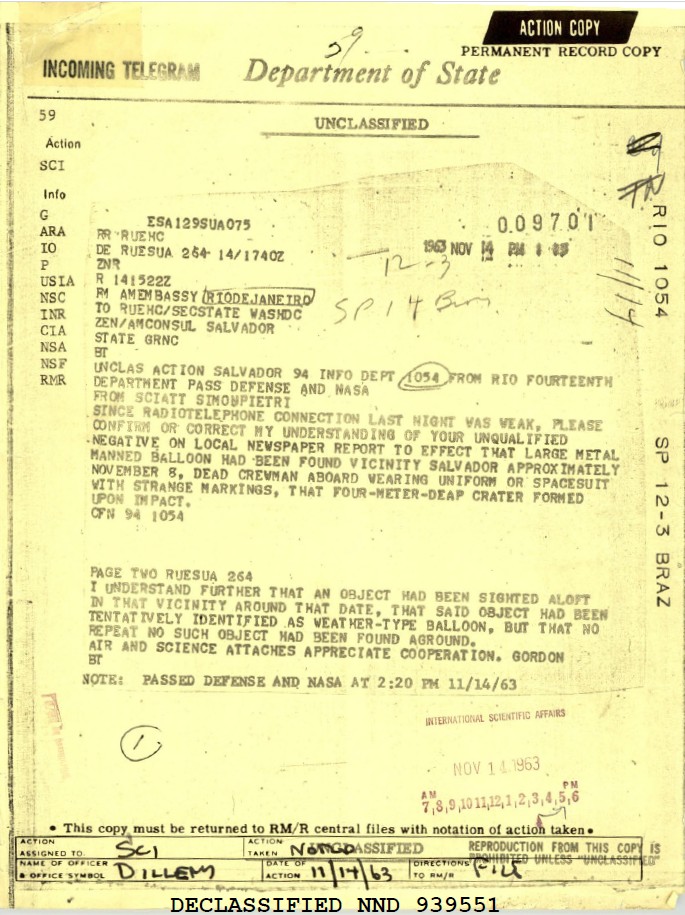
DOS-UAP-D001, Diplomatic Cable, Brazil, November 14, 1963
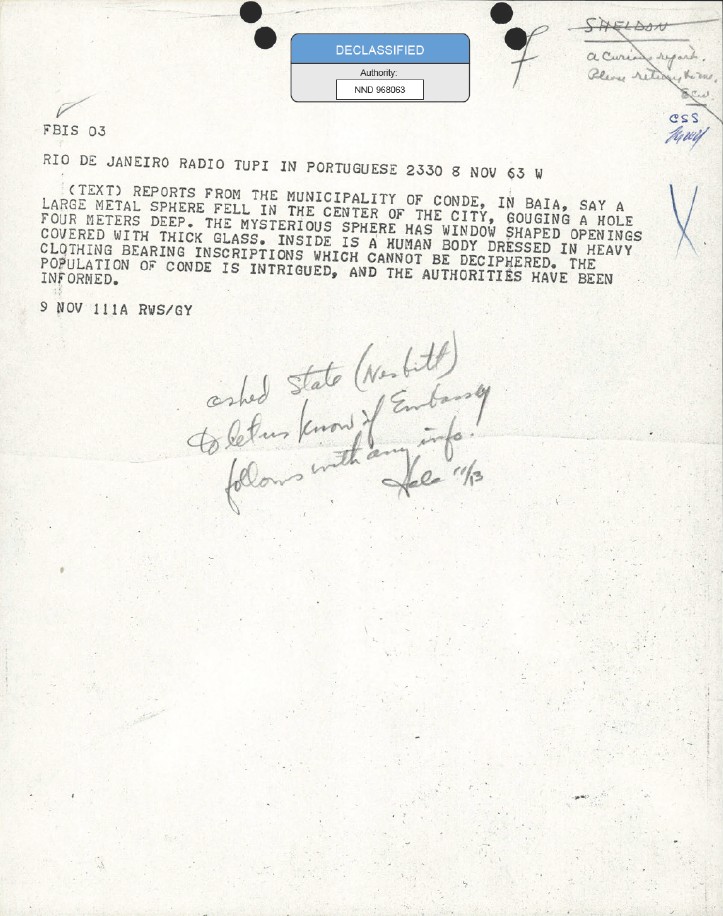
EOP-UAP-D001, NASC Inquiry into Bahia, Brazil Incident, November 13, 1963
65_HS1-834228961_62-HQ-83894_Section_001
65_HS1-834228961_62-HQ-83894_Section_006
Affaires liées

DOW-UAP-D110, Déclaration d’objectifs de l’AAWSAP, juillet 2008

DOW-UAP-D111, Appel d’offres et ordre de commande initial de l’AAWSAP, septembre 2008

DOW-UAP-D112, Modification de contrat P00001 de l’AAWSAP, septembre 2009

DOW-UAP-D113, Modification de contrat P00002 de l’AAWSAP, février 2010

DOW-UAP-D114, Modification de contrat P00003 de l’AAWSAP, mai 2010
Même lieu
EOP-UAP-D002, Mémorandum sur la coordination interagences pour la récupération de matériel étranger, mai 1963
DOW-UAP-D110, Déclaration d’objectifs de l’AAWSAP, juillet 2008
DOW-UAP-D111, Appel d’offres et ordre de commande initial de l’AAWSAP, septembre 2008
DOW-UAP-D112, Modification de contrat P00001 de l’AAWSAP, septembre 2009
DOW-UAP-D113, Modification de contrat P00002 de l’AAWSAP, février 2010
DOW-UAP-D114, Modification de contrat P00003 de l’AAWSAP, mai 2010
Même période
NASA-UAP-D012, Extrait audio de Mercury Atlas 8, 3 octobre 1962
NASA-UAP-D013, Mercury Atlas 7, 24 mai 1962
NASA-UAP-D015, Débriefings scientifiques d'astronautes, 1962-1963
NASA-UAP-D023, Extrait d'entretien avec l'astronaute Gordon Cooper, 1962
Même publication

DOW-UAP-D181, Rapport UAP non résolu, île Santa Catalina, 1949

DOW-UAP-D157, Rapport de renseignement aérien, Italie, 1952

DOW-UAP-D179, Rapport de renseignement aérien, île Santa Catalina, 1952

DOW-UAP-D158, Rapport sur un objet volant, Canada, 1953

DOW-UAP-D159, Rapport de renseignement aérien, Allemagne, 1953
