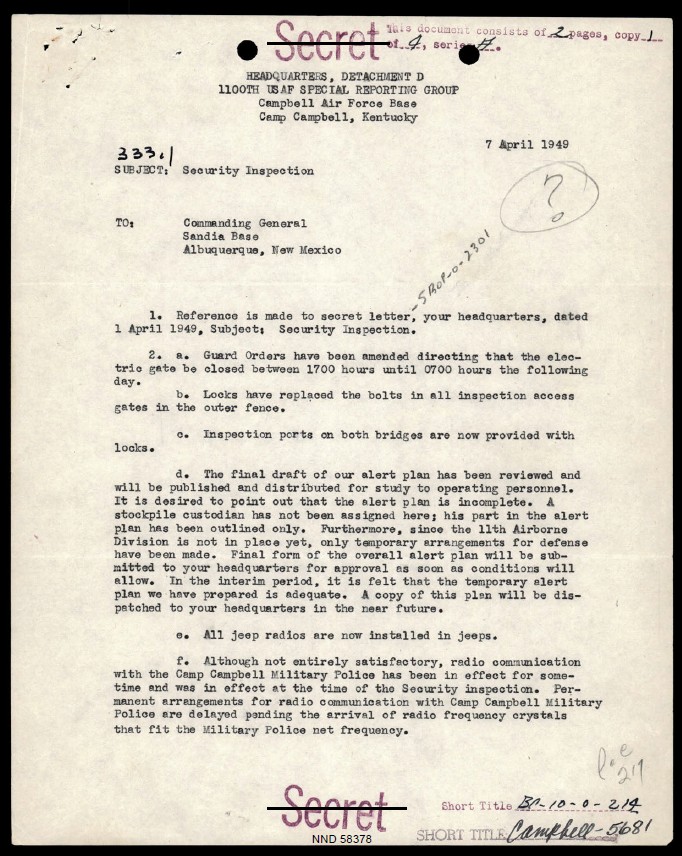
Carta do senador Harry Reid sobre AAWSAP e OVNIs, 2009
Arquivo oficial: DOW-UAP-D183-Correspondência do Senador Harry Reid, Junho de 2009
Publicado em
Dados principais
- ID oficial do arquivo
- DOW-UAP-D183
- Tipo de documento
- Documento
- Agência
- Department of War
- Publicado em
- R08 · 2026-11-20
- Data do incidente
- 6/24/09
- Local do incidente
- Washington, D.C.
- Coordenadas
- 38.8950982, -77.0363849
- Páginas legíveis
- 4/4
- VIRIN
- 261120-D-D0360-1177
Descrição oficial
Esta carta de junho de 2009 do Senador Harry Reid (D-NV) ao Secretário de Defesa Adjunto William Lynn III solicita que partes do Advanced Aerospace Threat Identification Program (AATIP) sejam colocadas sob um Programa de Acesso Especial (SAP) restrito, com uma lista de acesso rigidamente controlada. A carta afirma que o Senado havia determinado que a DIA avaliasse ameaças aeroespaciais avançadas estrangeiras de longo prazo, descreve o trabalho técnico em andamento alinhado às áreas do programa AAWSAP e afirma que o programa já havia produzido vários resultados não convencionais altamente sensíveis. Com base nisso, Reid declara que as práticas comuns de manuseio de informações classificadas, e até mesmo os procedimentos convencionais de SAP, seriam insuficientes para proteger algumas partes do esforço, particularmente aquelas que envolvem a metodologia de coleta, a aplicação de engenharia, a participação da indústria e as identidades de pessoal especializado. O material anexo propõe uma estrutura preliminar de SAP, incluindo uma lista de acesso “bigoted”, um cronograma provisório do programa até o Ano Fiscal de 2013 e a continuidade de papéis tanto para o pessoal do governo quanto para o da BAASS.
Sobre este tipo de documento
Este documento é um registro administrativo ou programático relacionado ao Programa de Aplicações de Sistemas de Armas Aeroespaciais Avançados (AAWSAP), um programa administrado pela Agência de Inteligência de Defesa (DIA) ativo entre 2008 e 2012. O escopo oficial de trabalho do AAWSAP identificou 12 áreas de pesquisa técnica relacionadas a potenciais ameaças aeroespaciais em um horizonte de tempo de mais de 40 anos. Como registro administrativo, o arquivo documenta como o AAWSAP foi delimitado, organizado, direcionado, financiado ou descrito em um determinado momento.
Ver o glossário →✦ Resumo IA
Trata-se de uma carta de quatro páginas datada de 24 de junho de 2009 do senador Harry Reid, de Nevada, então líder da maioria, ao subsecretário de Defesa William Lynn III. Reid escreve que o Senado havia determinado que a Defense Intelligence Agency avaliasse, a longo prazo, as ameaças aeroespaciais avançadas estrangeiras, com estudos técnicos sobre sustentação avançada, propulsão, materiais não convencionais, redução de assinatura, armamento e efeitos humanos. Afirma que o Advanced Aerospace Threat and Identification Program (AATIP) havia produzido vários achados aeroespaciais não convencionais altamente sensíveis e pede a Lynn ajuda para estabelecer um Programa de Acesso Especial (SAP) Restrito com uma «Bigoted Access List» (redação do documento) para partes específicas do AATIP. Enumera as partes a proteger: a metodologia, a alocação de pessoal, apoio e supervisão, e a aplicação e engenharia, citando mecânica quântica, ciência nuclear, teoria eletromagnética, gravítica e termodinâmica. O Anexo 1 traz detalhes do programa (FY09-FY13 preliminar, categoria Inteligência e Aquisição do DoD) e uma lista preliminar de acesso para o ano fiscal de 2010 que nomeia Lynn, Reid, o senador Daniel Inouye, Robert T. Herbert e três vagas de contratados da Bigelow Aerospace Advanced Space Studies; os demais nomes estão substituídos por marcadores.
Gerado com IA a partir do arquivo oficial — pode conter erros.
▸Transcrição(4 de 4 páginas legíveis)
[PAGE 1] HARRY REID NEVADA MAJORITY LEADER United States Senate WASHINGTON, DC 20510-7012 June 24, 2009 Honorable William Lynn III Deputy Secretary of Defense 1010 Defense Pentagon Washington, DC 20301-1010 Dear Secretary Lynn: Beginning this past September, the U.S. Senate has mandated that the Defense Intelligence Agency assess far-term foreign advanced aerospace threats to the United States. The scope of program interest covers from the present out to forty years and beyond. In order to further our effort in recognizing emerging disruptive aerospace technologies, technical studies are being conducted in regard to advanced lift, propulsion, the use of unconventional materials and controls, signature reduction, weaponry, human interface and human effects. Since the Advanced Aerospace Threat and Identification Program (AATIP) and study were first commissioned, much progress has been made with the identification of several highly sensitive, unconventional aerospace-related findings. Given the current rate of success, the continued study of these subjects will likely lead to technology advancements that in the immediate near-term will require extraordinary protection. Due to the sensitivities of the information surrounding aspects of this program, I require your assistance in establishing a Restricted Special-Access-Program (SAP) with a Bigoted Access List for specific portions of the AATIP. In order to support this national effort, a small but highly specialized cadre of Department of Defense (DoD) and private sector individuals are necessary. These individuals must be specialized in the areas of advanced sciences, sensors, intelligence/counterintelligence, and advanced aerospace engineering. Given the likelihood that these technologies will be applied to future systems involving space flight, weapons, communications, and propulsion, the standard management and safeguarding procedures for classified information are not sufficient. Even the use of conventional SAP protocols will not adequately ensure that all aspects of the project are properly secured. Although not every aspect of AATIP requires Restricted SAP read-on, the following portions should be maintained at the Restricted SAP level: • The methodology used to identify, acquire, study, and engineer the advanced technologies associated with AATIP. o Specific methodologies used to study unconventional technology may require nuanced approaches that will undoubtedly be of significant interest if not a top priority for adversarial Foreign Intelligence Security Services (FISS). [PAGE 2] o Undue attention by government, or private sector entities, not involved in AATIP or any international interest will directly or indirectly interfere with the daily AATIP mission and perhaps threaten the overall success of the program. • Allocation of personnel, support, and oversight. o Due to the highly specialized nature of the personnel involved with AATIP, the overt acknowledgement of their participation in the program will lead to an unnecessary security and counterintelligence risk. o Occasional assistance from specialized individuals within DoD, the scientific community, or academia may be necessary from time to time based on demonstrated subject matter expertise. Adequate protection of their identities or affiliation is critical to avoid unnecessary scrutiny. o Without the appropriate Restricted SAP protection, the cost associated with a compromise would be significantly higher than the cost associated with a properly administered Restricted SAP. o Protection of industry partnerships and participation is critical. Public awareness of an industry's AATIP affiliation may discourage that industry's further participation with the U.S. Government in this program. • Application and engineering. o The nuanced manner in which some of these technologies will be collected, engineered and applied by the U.S. may require senior level government approval. These decision makers must be afforded the necessary time to make strategic decisions by restricting access to the "big picture" or overall intent of the program to those on a strict Bigoted List. o Associated exotic technologies likely involve extremely sophisticated concepts within the world of quantum mechanics, nuclear science, electromagnetic theory, gravitics, and thermodynamics. Given that all of these have the potential to be used with catastrophic effects by adversaries, an unusually high degree of operational security and read-on discretion is required. Due to the expertise required to carry out the objectives of this program, we will require a small, specialized group of DoD personnel, who are dedicated to performing the SAP-related functions and executing programmatic requirements within the program. It is essential that the Government & military personnel who are already involved with this program are assigned to further support this program in a Restricted SAP capacity (see Attachment 1). These individuals all currently possess the appropriate security clearances and are already providing unique support to AATIP. [PAGE 3] Ultimately, the results of AATIP will not only benefit the U.S. Government but I believe will directly benefit DoD in ways not yet imagined. The technological insight and capability gained will provide the U.S. with a distinct advantage over any foreign threats and allow the U.S. to maintain its preeminence as a world leader. Thank you in advance from your time and consideration of this request. If you or your staff have any questions, please contact [1843(a)(2)] of my staff at [1843(a)(2)] Sincerely, [signature] HARRY REID United States Senator HR:[illegible] [PAGE 4] Attachment 1 Sponsoring Agency: Undetermined (DEPSECDEF) Component-level SAP Central Office: Undetermined (DEPSECDEF) Unclassified Nickname: Advanced Aerospace Threat Identification Program (AATIP) Program Length: FY09-FY13 (Preliminary) Program Funding: FY09-O&M, FY10-FY13-TBD SAP Category Designation: Intelligence, DoD Acquisition FY 10 Preliminary Bigoted List of Government Personnel: 1. Honorable William Lynn III, Deputy Secretary of Defense (Gov't) 2. Honorable Senator Harry Reid of Nevada (Gov't) 3. Honorable Senator Daniel Inouye of Hawaii (Gov't) 4. Robert T. Herbert (U.S. Senate) 5. [AAP Person 1] (Gov't) 6. [AAP Person 2] (Gov't) 7. [AAP Person 91] (Gov't) 8. [AAP Person 92] (USN) 9. [AAP Person 93] (USMC) 10. [AAP Person 3] (Gov't) 11. [AAP Person 94] (Gov't) FY 10 Preliminary Bigoted List of Contractor Personnel funded under the AATIP: 1. [AAP Person 4] Bigelow Aerospace Advanced Space Studies LLC (BAASS), (CTR) 2. [AAP Person 7] BAASS (CTR) 3. [AAP Person 57] BAASS (CTR) This document contains information exempt from mandatory disclosure under the FOIA. Exemptions 1 and 5 apply.
Gerado com IA a partir do arquivo oficial — pode conter erros.
Comentário da AARO
No registro administrativo em torno deste programa, o “Advanced Aerospace Threat Identification Program” (AATIP) aparece em alguns documentos como um nome alternativo para o mesmo esforço subjacente do AAWSAP, e não como um programa totalmente separado. Neste contexto, o Senador Reid usou o termo em correspondência pública em vez do nome do programa AAWSAP.
Tradução automática — o documento original está em inglês. Ver em inglês →
Fonte: Departamento de Guerra dos EUA / AARO — domínio público · war.gov/ufo
Casos conectados
65_HS1-834228961_62-HQ-83894_Serial_164

DOW-UAP-D110, AAWSAP Statement of Objectives, July 2008

DOW-UAP-D111, AAWSAP Solicitation and Original Order, September 2008

DOW-UAP-D112, AAWSAP Contract Modification P00001, September 2009

DOW-UAP-D113, AAWSAP Contract Modification P00002, February 2010

DOW-UAP-D114, AAWSAP Contract Modification P00003, May 2010
Casos relacionados

Programa AAWSAP sobre OVNIs: escopo de trabalho, 2008

AAWSAP e OVNIs: nota informativa sobre Reid, maio 2009

Programa AAWSAP sobre OVNIs: acesso especial, nov. 2009

Nota da DIA sobre AAWSAP e OVNIs, janeiro 2009

Programa AAWSAP sobre OVNIs: revisão de entregas, 2009
Mesmo local

Avaliação da CIA sobre OVNI e discos voadores, 1952

Briefing da CIA sobre discos voadores e OVNI, 1952

Diário oficial da CIA sobre OVNIs e discos, 1952

Memo da CIA: OVNI e segurança nacional, outubro 1952

Memorando da CIA sobre OVNI: guerra psicológica, 1952

OVNI e a CIA: proposta de painel científico, 1952
Mesma série de arquivos
Relatório de missão OVNI, Golfo Pérsico, 2020
Relatório de missão OVNI, Golfo Pérsico, 2020
Relatório de missão OVNI, Golfo Pérsico, 2020
Relatório de missão OVNI, Golfo Pérsico, 2020
Relatório de missão OVNI, Golfo Pérsico, 2020

Relatório de missão OVNI, Djibuti, 2025
Mesmo período
AAWSAP e OVNIs: nota informativa sobre Reid, maio 2009

Caso Colares, OVNI: relatório mensal BAASS, 2009
Contrato OVNI AAWSAP: modificação P00001 (2009)

Estudo OVNI AAWSAP: Matéria programável (DIA, 2009)

Estudo OVNI AAWSAP: Vidros metálicos (DIA, 2009)
Nota da DIA sobre AAWSAP e OVNIs, janeiro 2009
Mesma publicação

Relatórios de OVNI: Glendale e Los Angeles, junho 1949

OVNI perto de Agoura e Point Mugu, Califórnia, 1953

Avistamento de OVNI em Avalon, Ilha Santa Catalina, 1955

Avistamento de OVNI: objeto vermelho em Fontana, 1956

Luzes de OVNI perto de Fontana e La Jolla, Califórnia

Relatório USAF: radar e OVNI, pilotos de F-86D, Japão
Mesma agência
Foo fighters: arquivo OVNI do SHAEF, 1945
Arquivo OVNI do Projeto Sign: Air Materiel Command, 1948
Arquivo OVNI Flying Discs: carta de Twining, 1947
Foguetes fantasmas na Suécia: relatório OVNI, 1947
Estudo da Força Aérea sobre OVNIs nos EUA, 1948