Brief von Senator Harry Reid zu AAWSAP und UFOs, 2009
Offizielle Datei: DOW-UAP-D183-Korrespondenz von Senator Harry Reid, Juni 2009
Veröffentlicht am
Kerndaten
- Offizielle Akten-ID
- DOW-UAP-D183
- Dokumenttyp
- Dokument
- Behörde
- Department of War
- Veröffentlicht in
- R08 · 2026-11-20
- Datum des Vorfalls
- 6/24/09
- Ort des Vorfalls
- Washington, D.C.
- Koordinaten
- 38.8950982, -77.0363849
- Lesbare Seiten
- 4/4
- VIRIN
- 261120-D-D0360-1177
Offizielle Beschreibung
Dieses Schreiben von Senator Harry Reid (D-NV) an den stellvertretenden Verteidigungsminister William Lynn III vom Juni 2009 beantragt, Teile des Advanced Aerospace Threat Identification Program (AATIP) in ein eingeschränktes Special Access Program (SAP) mit einer streng kontrollierten Zugangsliste zu überführen. Das Schreiben führt aus, dass der Senat die DIA angewiesen hatte, ferne ausländische fortgeschrittene Luft- und Raumfahrtbedrohungen zu bewerten, beschreibt laufende technische Arbeiten, die mit den Programmbereichen von AAWSAP übereinstimmen, und behauptet, das Programm habe bereits mehrere hochsensible unkonventionelle Ergebnisse hervorgebracht. Auf dieser Grundlage erklärt Reid, dass übliche Verfahren zum Umgang mit Verschlusssachen und selbst herkömmliche SAP-Verfahren nicht ausreichen würden, um einige Teile des Vorhabens zu schützen, insbesondere jene, die die Erhebungsmethodik, die technische Anwendung, die Beteiligung der Industrie und die Identitäten spezialisierten Personals betreffen. Das beigefügte Material schlägt eine vorläufige SAP-Struktur vor, einschließlich einer „Bigot“-Zugangsliste, eines vorläufigen Programmzeitplans bis zum Haushaltsjahr 2013 und fortgesetzter Rollen sowohl für Regierungs- als auch für BAASS-Personal.
Über diesen Dokumenttyp
Bei diesem Dokument handelt es sich um eine administrative oder programmatische Unterlage im Zusammenhang mit dem Advanced Aerospace Weapon System Applications Program (AAWSAP), einem von der Defense Intelligence Agency (DIA) verwalteten Programm, das von 2008 bis 2012 aktiv war. Der offizielle Arbeitsumfang von AAWSAP umfasste 12 technische Forschungsbereiche im Zusammenhang mit potenziellen Luft- und Raumfahrtbedrohungen über einen Zeithorizont von mehr als 40 Jahren. Als administrative Unterlage dokumentiert die Akte, wie AAWSAP zu einem bestimmten Zeitpunkt definiert, organisiert, beauftragt, finanziert oder beschrieben wurde.
Zum Glossar →✦ KI-Zusammenfassung
Dies ist ein vierseitiger Brief vom 24. Juni 2009 von Senator Harry Reid aus Nevada, damals Mehrheitsführer, an den stellvertretenden Verteidigungsminister William Lynn III. Reid schreibt, der Senat habe die Defense Intelligence Agency beauftragt, langfristige ausländische fortgeschrittene Luft- und Raumfahrtbedrohungen zu bewerten, mit technischen Studien zu fortgeschrittenem Auftrieb, Antrieb, unkonventionellen Materialien, Signaturreduzierung, Waffen und Auswirkungen auf den Menschen. Er sagt, das Advanced Aerospace Threat and Identification Program (AATIP) habe mehrere hochsensible, unkonventionelle luft- und raumfahrtbezogene Ergebnisse hervorgebracht, und bittet Lynn um Hilfe bei der Einrichtung eines Restricted Special Access Program (SAP) mit einer „Bigoted Access List“ (Wortlaut des Dokuments) für bestimmte Teile des AATIP. Er nennt die zu schützenden Bereiche: Methodik, Zuteilung von Personal, Unterstützung und Aufsicht sowie Anwendung und Engineering, und verweist auf Quantenmechanik, Kernwissenschaft, Elektromagnetismus, Gravitik und Thermodynamik. Anlage 1 enthält Programmdetails (FY09-FY13 vorläufig, Kategorie Intelligence und DoD Acquisition) und eine vorläufige Zugangsliste für das Haushaltsjahr 2010, in der Lynn, Reid, Senator Daniel Inouye, Robert T. Herbert und drei Auftragnehmerplätze von Bigelow Aerospace Advanced Space Studies genannt sind; andere Namen sind durch Platzhalter ersetzt.
Mit KI aus der Originaldatei erstellt — kann Fehler enthalten.
▸Transkript(4 von 4 Seiten lesbar)
[PAGE 1] HARRY REID NEVADA MAJORITY LEADER United States Senate WASHINGTON, DC 20510-7012 June 24, 2009 Honorable William Lynn III Deputy Secretary of Defense 1010 Defense Pentagon Washington, DC 20301-1010 Dear Secretary Lynn: Beginning this past September, the U.S. Senate has mandated that the Defense Intelligence Agency assess far-term foreign advanced aerospace threats to the United States. The scope of program interest covers from the present out to forty years and beyond. In order to further our effort in recognizing emerging disruptive aerospace technologies, technical studies are being conducted in regard to advanced lift, propulsion, the use of unconventional materials and controls, signature reduction, weaponry, human interface and human effects. Since the Advanced Aerospace Threat and Identification Program (AATIP) and study were first commissioned, much progress has been made with the identification of several highly sensitive, unconventional aerospace-related findings. Given the current rate of success, the continued study of these subjects will likely lead to technology advancements that in the immediate near-term will require extraordinary protection. Due to the sensitivities of the information surrounding aspects of this program, I require your assistance in establishing a Restricted Special-Access-Program (SAP) with a Bigoted Access List for specific portions of the AATIP. In order to support this national effort, a small but highly specialized cadre of Department of Defense (DoD) and private sector individuals are necessary. These individuals must be specialized in the areas of advanced sciences, sensors, intelligence/counterintelligence, and advanced aerospace engineering. Given the likelihood that these technologies will be applied to future systems involving space flight, weapons, communications, and propulsion, the standard management and safeguarding procedures for classified information are not sufficient. Even the use of conventional SAP protocols will not adequately ensure that all aspects of the project are properly secured. Although not every aspect of AATIP requires Restricted SAP read-on, the following portions should be maintained at the Restricted SAP level: • The methodology used to identify, acquire, study, and engineer the advanced technologies associated with AATIP. o Specific methodologies used to study unconventional technology may require nuanced approaches that will undoubtedly be of significant interest if not a top priority for adversarial Foreign Intelligence Security Services (FISS). [PAGE 2] o Undue attention by government, or private sector entities, not involved in AATIP or any international interest will directly or indirectly interfere with the daily AATIP mission and perhaps threaten the overall success of the program. • Allocation of personnel, support, and oversight. o Due to the highly specialized nature of the personnel involved with AATIP, the overt acknowledgement of their participation in the program will lead to an unnecessary security and counterintelligence risk. o Occasional assistance from specialized individuals within DoD, the scientific community, or academia may be necessary from time to time based on demonstrated subject matter expertise. Adequate protection of their identities or affiliation is critical to avoid unnecessary scrutiny. o Without the appropriate Restricted SAP protection, the cost associated with a compromise would be significantly higher than the cost associated with a properly administered Restricted SAP. o Protection of industry partnerships and participation is critical. Public awareness of an industry's AATIP affiliation may discourage that industry's further participation with the U.S. Government in this program. • Application and engineering. o The nuanced manner in which some of these technologies will be collected, engineered and applied by the U.S. may require senior level government approval. These decision makers must be afforded the necessary time to make strategic decisions by restricting access to the "big picture" or overall intent of the program to those on a strict Bigoted List. o Associated exotic technologies likely involve extremely sophisticated concepts within the world of quantum mechanics, nuclear science, electromagnetic theory, gravitics, and thermodynamics. Given that all of these have the potential to be used with catastrophic effects by adversaries, an unusually high degree of operational security and read-on discretion is required. Due to the expertise required to carry out the objectives of this program, we will require a small, specialized group of DoD personnel, who are dedicated to performing the SAP-related functions and executing programmatic requirements within the program. It is essential that the Government & military personnel who are already involved with this program are assigned to further support this program in a Restricted SAP capacity (see Attachment 1). These individuals all currently possess the appropriate security clearances and are already providing unique support to AATIP. [PAGE 3] Ultimately, the results of AATIP will not only benefit the U.S. Government but I believe will directly benefit DoD in ways not yet imagined. The technological insight and capability gained will provide the U.S. with a distinct advantage over any foreign threats and allow the U.S. to maintain its preeminence as a world leader. Thank you in advance from your time and consideration of this request. If you or your staff have any questions, please contact [1843(a)(2)] of my staff at [1843(a)(2)] Sincerely, [signature] HARRY REID United States Senator HR:[illegible] [PAGE 4] Attachment 1 Sponsoring Agency: Undetermined (DEPSECDEF) Component-level SAP Central Office: Undetermined (DEPSECDEF) Unclassified Nickname: Advanced Aerospace Threat Identification Program (AATIP) Program Length: FY09-FY13 (Preliminary) Program Funding: FY09-O&M, FY10-FY13-TBD SAP Category Designation: Intelligence, DoD Acquisition FY 10 Preliminary Bigoted List of Government Personnel: 1. Honorable William Lynn III, Deputy Secretary of Defense (Gov't) 2. Honorable Senator Harry Reid of Nevada (Gov't) 3. Honorable Senator Daniel Inouye of Hawaii (Gov't) 4. Robert T. Herbert (U.S. Senate) 5. [AAP Person 1] (Gov't) 6. [AAP Person 2] (Gov't) 7. [AAP Person 91] (Gov't) 8. [AAP Person 92] (USN) 9. [AAP Person 93] (USMC) 10. [AAP Person 3] (Gov't) 11. [AAP Person 94] (Gov't) FY 10 Preliminary Bigoted List of Contractor Personnel funded under the AATIP: 1. [AAP Person 4] Bigelow Aerospace Advanced Space Studies LLC (BAASS), (CTR) 2. [AAP Person 7] BAASS (CTR) 3. [AAP Person 57] BAASS (CTR) This document contains information exempt from mandatory disclosure under the FOIA. Exemptions 1 and 5 apply.
Mit KI aus der Originaldatei erstellt — kann Fehler enthalten.
Kommentar der AARO
Innerhalb der Verwaltungsunterlagen zu diesem Programm erscheint das „Advanced Aerospace Threat Identification Program“ (AATIP) in einigen Dokumenten als alternative Bezeichnung für dieselbe zugrunde liegende AAWSAP-Initiative und nicht als ein völlig eigenständiges Programm. In diesem Zusammenhang verwendete Senator Reid den Begriff in öffentlicher Korrespondenz anstelle des Programmnamens AAWSAP.
Automatische Übersetzung — das Originaldokument ist auf Englisch. Auf Englisch ansehen →
Quelle: US-Kriegsministerium / AARO — gemeinfrei · war.gov/ufo
Verbundene Fälle
65_HS1-834228961_62-HQ-83894_Serial_164

DOW-UAP-D110, AAWSAP Statement of Objectives, July 2008

DOW-UAP-D111, AAWSAP Solicitation and Original Order, September 2008

DOW-UAP-D112, AAWSAP Contract Modification P00001, September 2009

DOW-UAP-D113, AAWSAP Contract Modification P00002, February 2010

DOW-UAP-D114, AAWSAP Contract Modification P00003, May 2010
Verwandte Fälle

AAWSAP-UFO-Programm: Leistungsbeschreibung, Aug. 2008

AAWSAP und UFOs: Vermerk zu Senator Reid, Mai 2009

AAWSAP-UFO-Programm: Sonderzugang, November 2009

DIA-Vermerk zu AAWSAP und UFOs, Januar 2009

AAWSAP-UFO-Programm: Prüfung der Liefergegenstände, 2009
Gleicher Ort

CIA-Bewertung: UFO und Untertassen, August 1952

CIA-Briefing zu fliegenden Untertassen und UFOs, 1952

CIA-Memo zu UFOs: psychologische Kriegführung, 1952

CIA-Memo: UFOs und nationale Sicherheit, Okt. 1952

CIA-UFO-Akte: Vorschlag für ein Expertenpanel, 1952

Offizielles CIA-Tagebuch zu UFOs, 28. Oktober 1952
Gleiche Aktenserie
UFO-Einsatzbericht, Persischer Golf, 2020
UFO-Einsatzbericht, Persischer Golf, 2020
UFO-Einsatzbericht, Persischer Golf, 2020
UFO-Einsatzbericht, Persischer Golf, 2020
UFO-Einsatzbericht, Persischer Golf, 2020
UFO-Einsatzbericht, Dschibuti, 2025
Gleicher Zeitraum
AAWSAP und UFOs: Vermerk zu Senator Reid, Mai 2009
AAWSAP-UFO-Programm: Prüfung der Liefergegenstände, 2009
AAWSAP-UFO-Programm: Sonderzugang, November 2009

BAASS-Monatsbericht, UFO-Programm AAWSAP, April 2009

BAASS-Monatsbericht, UFO-Programm AAWSAP, Juni 2009

BAASS-Zehnmonatsbericht (AAWSAP) zu UFOs, Juli 2009
Gleiche Veröffentlichung

UFO-Berichte: Glendale und Los Angeles, Juni 1949

UFO bei Agoura und Point Mugu, Kalifornien, 1953

UFO-Sichtung: Avalon, Santa Catalina Island, 1955

UFO-Lichter bei Fontana und La Jolla, Kalifornien, 1956

UFO-Sichtung: rotes rundes Objekt, Fontana, 1956

USAF-Bericht: UFO-Radar, F-86D-Piloten, Japan, 1956
Gleiche Behörde
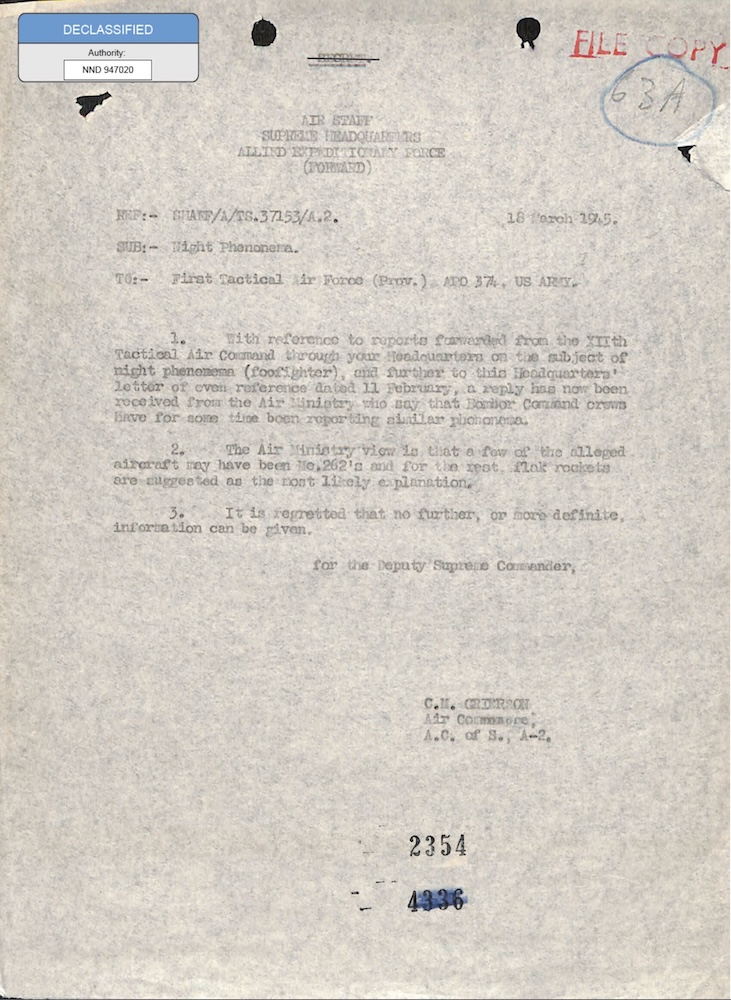
Foo Fighters: UFO-Akte des SHAEF, 1945
Geisterraketen über Schweden: UFO-Bericht, 1947
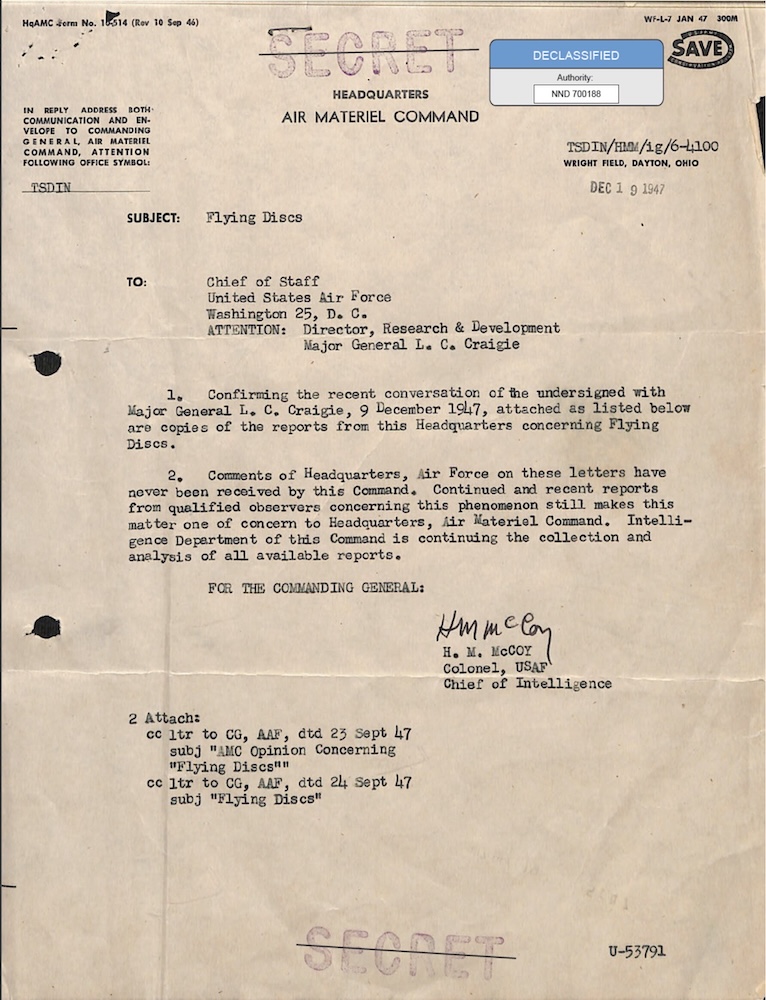
UFO-Akte Flying Discs: Twining-Brief, 1947
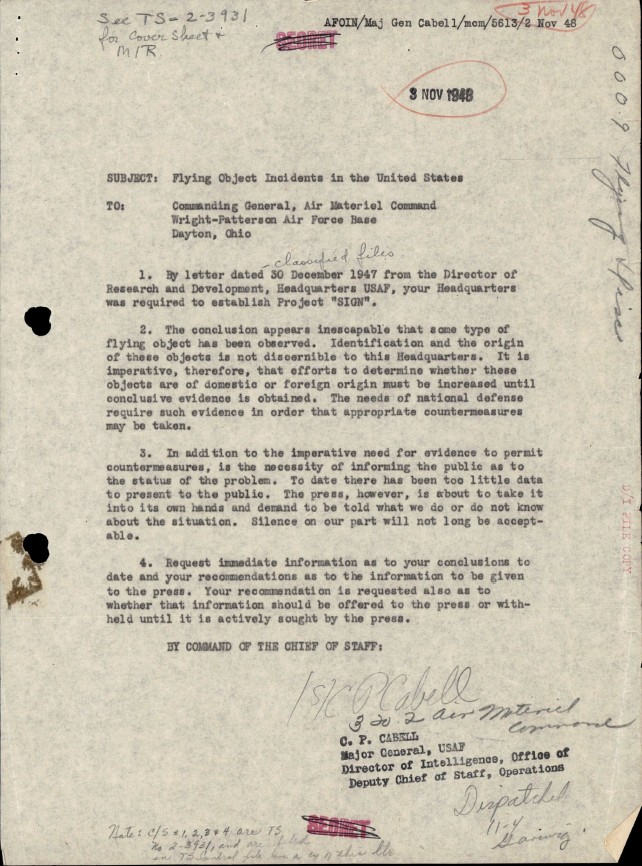
UFO-Akten zu Project Sign: Air Materiel Command, 1948
Project Sign: UFO-Akte Flying Discs, 1948