Journal officiel de la CIA sur les OVNI, 28 oct. 1952
Fichier officiel: CIA-UAP-D029, Entrée du journal officiel sur les « soucoupes volantes », 1952
Publié le
Faits essentiels
- ID officiel du dossier
- CIA-UAP-D29 (cité comme CIA-UAP-D029 dans cette fiche)
- Type de document
- Document
- Agence
- CIA
- Publié dans
- R08 · 2026-11-20
- Date de l'incident
- 10/28/52
- Lieu de l'incident
- Washington (district de Columbia)
- Coordonnées
- 38.8950982, -77.0363849
- Pages lisibles
- 2/2
- VIRIN
- 261120-O-D0360-1177
Description officielle
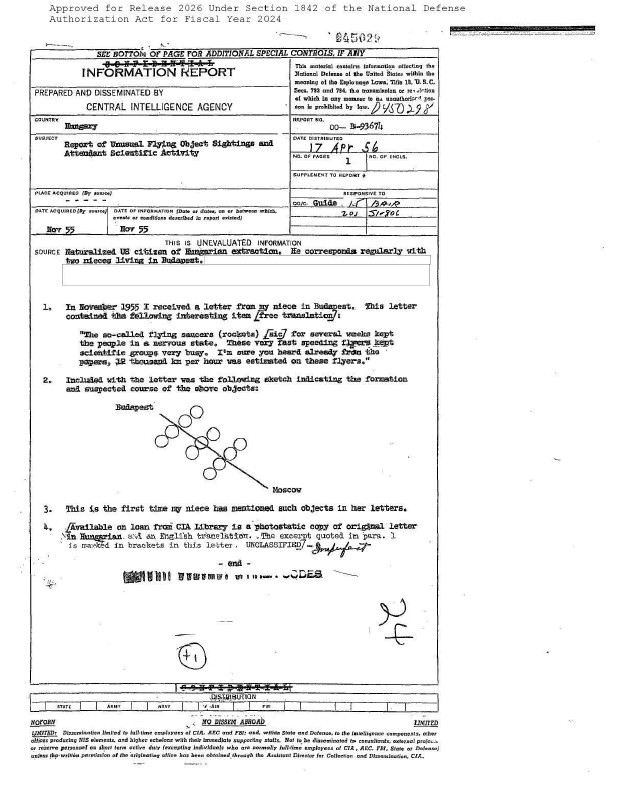
Cette entrée du 28 octobre 1952 dans un journal officiel de la Central Intelligence Agency (CIA) consigne une discussion sur de nouvelles informations concernant les « soucoupes volantes ». M. Clark a indiqué que la CIA avait reçu des informations supplémentaires, notamment des signalements d’objets observés depuis le sol par des personnes que l’entrée qualifie de relativement fiables. L’entrée note que l’absence de bruit ou de flamme signalés dans certains témoignages posait une difficulté théorique pour leur interprétation. Elle précise en outre que plusieurs scientifiques avaient présenté des communications décrivant une méthode de propulsion possible qui n’entraînerait ni bruit ni flamme. Le Dr Clark a proposé un exposé sur le sujet et recommandé de porter l’information à l’attention de l’U.S. Air Force et du Research and Development Board ; l’auteur du journal a approuvé.
✦ Résumé IA
Il s'agit d'une entrée de deux pages du « Official Diary » (journal officiel) TOP SECRET de la CIA pour le mardi 28 octobre 1952, approuvée pour publication en 2026, qui consigne une journée de questions administratives et de coordination pour la plupart sans lien entre elles. Le seul point sur les soucoupes volantes figure à la page 2, point 9c, où M. Clark signale que des informations supplémentaires avaient été obtenues sur les soucoupes volantes, notamment des rapports d'observations au sol par des observateurs relativement fiables. Il note que l'une des principales difficultés théoriques des observations était l'absence de bruit et de flamme, et que plusieurs scientifiques avaient récemment présenté des travaux indiquant un moyen de propulsion possible qui n'impliquerait ni bruit ni flamme. Il proposa un briefing sur le sujet et de porter l'information à l'attention de l'armée de l'Air et du R&DB, et l'auteur du journal approuva. Les autres entrées portent sur un document de l'OTAN, un briefing sur la guerre électronique, des cours de formation internes et le Project VICTOR. Plusieurs noms et points sont caviardés, et l'entrée ne tire aucune conclusion sur les observations.
Généré par IA à partir du fichier officiel — peut contenir des erreurs.
▸Transcription(2 des 2 pages lisibles)
[PAGE 1] Approved for Release 2026 TOP SECRET Security Information Official Diary Tuesday, 28 October 1952 BEST COPY AVAILABLE 1. Passed to DCI Contact Division information received from [redacted] and [redacted] respecting their future plans, and secured his approval to having this information restricted to CIA only. 2. After my talk with Mr. Noyes, I felt that he was not fully informed as to the activities of Paul Nitze [redacted] and called this to the attention of Fisher Howe. It subsequently developed that Mr. Noyes had been fully informed. 3. Attended PRC. 4. Discussed the case of [redacted] and Shef Edwards. It was agreed that she should be put on sick leave and this was done. Col. Edwards undertook to assist in any way possible. 5. Dr. Craig consulted me respecting the NATO paper which was produced as a result of the recent [redacted] meetings. Kermit Roosevelt was interested in this meeting and Craig had requested it from General Porter who had not delivered. Dr. Craig inquired whether he might look at the paper in CIA. I stated that we would be unable to permit this, since not only would Pentagon approval have to be obtained, but also CIA was not officially represented in the meeting which produced the paper. 6. Dr. Craig informed me as to his plan to have Admiral Kirk briefed on electronic warfare matters which would involve a Mr. Clark, who is a member of the President's Committee on Telecommunications. I approved, with the understanding that Mr. Clark, in doing this, would not be representing CIA, but would be acting in his capacity as a member of the Presidential Committee. 7. Talked with Mr. Amory about the possibility that Alton Jones was feeling hurt because he had not been invited to speak to DCI. I explained that I had checked with the Office of the DCI and learned that an appointment had been cancelled by Mr. Jones, who would call DCI as soon as he could come to Washington to have a talk. 8. Told Mr. Amory that I would request General Porter to give us a copy of the NATO paper resulting from the [redacted] Conference. I later did this, and was informed by General Porter that a copy of the paper was sent to CIA. Asked Mr. Drain to follow up. 9. Mr. Clark consulted me on the following: a. [redacted] This document is part of an Integrated file. If separated from the file it must be subjected to individual systematic review. Security Information [PAGE 2] Approved for Release 2026 TOP SECRET Security Information Official Diary 28 October 1952 b. Dr. Clark inquired as to the best manner to brief DCI in his capacity as Chairman of PSB, on the Telecommunications Committee paper on electronic warfare. I suggested that this should be done through [redacted] who was the DCI's briefing officer on PSB matters. c. Mr. Clark informed me that additional information had been obtained on flying saucers, particularly reports of sightings on the ground by relatively reliable observers. He noted that one of the primary theoretical difficulties with sightings thus far reported was the lack of noise and flare. Several scientists have recently delivered papers indicating a possible means of propulsion which would not involve noise and flare. He proposed to have a briefing on this general subject and to call the information to the attention of Air Force and R&DB. I concurred. 10. Discussed with Dr. Stout, and later with Matt Baird, the Director of Training's program of lectures for incoming trainees. I indicated my general approval of the course he suggested, and that it be kept flexible. It should be arranged with ADs that incoming personnel need not take the course as soon as they come on board, where there was an emergency and immediate need for their services in the Office; further, all personnel would not require all portions of the course. I felt that this was a matter for Training to work out on an individual basis with our offices. Dr. Stout and Col. Baird indicated that they agreed with this position and would talk with the ADs, and would have a talk with me after this had been done. During the course of my discussion with Col. Baird, he discussed the over-all activities and mission of training. I indicated that, as far as I was concerned, I felt that all matters could be resolved between Training and all our Offices. I felt that they could afford us very helpful services, but that this would have to be [struck out: carried into] [handwritten: coordinated with] the activities of the various Offices. When Col. Baird raised some question about O/RR's internal Office training, I pointed out the necessity that his Office, with its broad charter, be relatively liberal in giving a license to the various AD's to accomplish results within their own Office, where that was the logical place to do the job. I did not feel that there was any magic in having a course under the auspices of training personnel reporting to the Director of Training. I was primarily interested in results. I really feel, however, that Col. Baird understood this and will proceed along these lines. 12. Conferred with Mr. Bundy as to a number of matters pertaining to Project VICTOR. [handwritten initials] TOP SECRET Security Information
Généré par IA à partir du fichier officiel — peut contenir des erreurs.
Traduction automatique — le document original est en anglais. Voir en anglais →
Source : Département de la Guerre des États-Unis / AARO — domaine public · war.gov/ufo
Dossiers reliés
65_HS1-834228961_62-HQ-83894_Serial_164

DOW-UAP-D110, AAWSAP Statement of Objectives, July 2008

DOW-UAP-D111, AAWSAP Solicitation and Original Order, September 2008

DOW-UAP-D112, AAWSAP Contract Modification P00001, September 2009

DOW-UAP-D113, AAWSAP Contract Modification P00002, February 2010

DOW-UAP-D114, AAWSAP Contract Modification P00003, May 2010
Affaires liées

OVNI et CIA : proposition de panel scientifique, 1952

Note de la CIA sur les OVNI : guerre psychologique, 1952

Évaluation de la CIA : OVNI, soucoupes, août 1952

Briefing de la CIA sur soucoupes volantes et OVNI, 1952

Note de la CIA : OVNI et sécurité nationale, oct. 1952

Programme AAWSAP sur les OVNI : cahier des charges, 2008
Même lieu
Briefing de la CIA sur soucoupes volantes et OVNI, 1952
Évaluation de la CIA : OVNI, soucoupes, août 1952
Note de la CIA : OVNI et sécurité nationale, oct. 1952
Note de la CIA sur les OVNI : guerre psychologique, 1952
OVNI et CIA : proposition de panel scientifique, 1952

Dossiers OVNI : courrier sur les débris spatiaux, 1962-64
Même série de dossiers
Dossier OVNI : rapport de la CIA sur l'URSS, 1973
Note de la CIA : OVNI observé depuis un train, 1955
Analyse de la CIA de l’OVNI vu d’un train, 1955
Notes de la CIA sur un OVNI à Porto Rico, 1964
Note de la CIA : OVNI à Porto Rico, USS Gyatt, 1964
Même période
Audio OVNI : Ruppelt et le Projet Blue Book, 1952

Dossier « Flying Discs » de l'USAF : OVNI, 1952
Dossier du FBI de Newark sur les OVNI au New Jersey, 1952
Dossier Flying Discs du FBI : OVNI, État de Washington

Exposé OVNI de Ruppelt, Projet Blue Book, 1952

Film OVNI de Tremonton : Projet Blue Book, 1952
Même publication

Rapports OVNI : Glendale et Los Angeles, juin 1949

OVNI près d'Agoura et de Point Mugu, Californie, 1953

Observation OVNI à Avalon, île Santa Catalina, 1955

Lumières OVNI près de Fontana et La Jolla, Californie

Observation OVNI : objet rouge à Fontana, août 1956

Rapport USAF : OVNI au radar, pilotes F-86D, Japon, 1956
Même agence
Théorie OVNI d'un savant allemand, rapport CIA, 1950
Note de la CIA sur les enquêtes OVNI britanniques, 1952
Panel Robertson : rapports OVNI de la CIA, 1952-53
Note de la CIA sur le projet OVNI de l'USAF, 1953
Histoire de l'U-2 et d'OXCART (CIA), chapitre OVNI