DOW-UAP-PR160, Presentación del capitán Edward J. Ruppelt, 1952
Datos del expediente
- ID oficial del expediente
- DOW-UAP-PR160
- Tipo de documento
- Audio
- Agencia
- Department of War
- Publicado en
- R06 · 2026-09-18
- Fecha del incidente
- 3/26/52
- Lugar del incidente
- Boston, Massachusetts
- Coordenadas
- 42.3588336, -71.0578303
Descripción oficial
Este archivo de audio registra una presentación de marzo de 1952 del capitán Edward J. Ruppelt, en la que se describe la investigación reorganizada de la Fuerza Aérea de EE. UU. sobre los objetos voladores no identificados (OVNI). La presentación anticipa metodologías técnicas futuras, como la fotografía con rejilla de difracción y la sincronización de pantallas de radar, que posteriormente se incorporaron a Project Blue Book, un programa de la Fuerza Aérea de EE. UU. activo entre 1952 y 1969 que investigó la naturaleza y el origen de los OVNI. Ruppelt explica que, de aproximadamente 800 casos históricos revisados por la Fuerza Aérea, alrededor del 20 % permaneció sin explicación después del análisis técnico. Estos reportes sin resolver provenían de personal militar creíble, pilotos comerciales y otros observadores técnicos calificados. Destaca concentraciones geográficas de reportes alrededor de instalaciones sensibles de seguridad nacional y armas nucleares (entre ellas Los Álamos, Albuquerque y los Laboratorios Nacionales de Oak Ridge), y señala características anómalas recurrentes, entre ellas vuelo silencioso a alta velocidad y detecciones de radar que indicaban velocidades aéreas no confirmadas de entre 1,000 y 3,500 millas por hora. Al destacar que la Fuerza Aérea no encontró evidencia concluyente sobre la naturaleza o el origen de los fenómenos, Ruppelt subraya la necesidad, por seguridad nacional, de un esfuerzo sistemático de recolección de datos físicos para evaluar mejor estos avistamientos.
✦ Resumen IA
Se trata de una grabación de audio de una sesión informativa de marzo de 1952 a cargo del cap. Edward J. Ruppelt, recién nombrado ingeniero de proyecto de la investigación reorganizada de ovnis de la Fuerza Aérea de EE. UU. (que pronto se llamaría Project Blue Book). La grabación se abre con tonos de prueba de equipo y verificaciones de micrófono antes de que Ruppelt comience, trazando la historia del proyecto desde el avistamiento de Kenneth Arnold en Idaho en 1947, pasando por el informe de la Fuerza Aérea de 1949 y la acumulación de casos, ahora unos 800-900 reportes, de los cuales cerca del 20% sigue sin explicación tras descartar engaños, histeria colectiva y objetos convencionales mal identificados. Describe concentraciones geográficas de avistamientos cerca de Los Álamos, Albuquerque, White Sands y Oak Ridge, y repasa las formas reportadas, las categorías de testigos, y velocidades no confirmadas rastreadas por radar de 1.000 a 3.500 mph. Analiza en detalle casos específicos, incluidas las fotografías de las Luces de Lubbock de agosto de 1951, la fotografía de Phoenix de 1947, y los avistamientos de bolas de fuego verdes investigados por el Dr. Lincoln LaPaz. Adelanta metodologías planificadas — cámaras de rejilla de difracción y cámaras de pantalla de radar — destinadas a reunir datos físicos. Las preguntas del público abarcan los procedimientos de reporte, un próximo artículo de la revista Life, y la persecución fatal del cap. Thomas Mantell en 1948. Ruppelt insiste en que la Fuerza Aérea no tiene pruebas de qué son los casos sin explicar, solo reportes creíbles que carecen de datos suficientes.
Generado con IA a partir del archivo oficial — puede contener errores.
▸Transcripción
[00:00] This medium has been declassified in compliance with applicable executive orders, statutes, and regulations. [00:30] The rights of death can be done, and I want my... [00:42] Pressing them was my voice straight at the microphone and my mouth separated from the microphone by a distance of about 15 inches. [00:52] I expect that the speaker will put out approximately this volume, and I will now, as before, turn around slowly and address my words of the blackboard. [01:04] This I am now doing, talking straight into the blackboard as if I were drawing some diagrams. [01:11] I am then going to turn around slowly again now to face the audience. [01:15] I am separated from the microphone by a somewhat greater distance as if I were slightly leaning backwards. [01:22] Right around the zero, that is the desirable level. [01:26] If, for example, we turn the game down... [01:35] Now? Now? [01:37] So you see it is just about wide open now to pick everything in the room up. [01:42] Let's see how it jumps in the end. [01:45] Now let's see if we play it back. [01:52] I can't hear you. [01:58] Is there anything already now taken out? [02:01] Yeah, there are a few things on the tape. [02:04] Why don't you say something while you start talking. [02:08] I'm a little embarrassed to have something to say. [02:11] I can understand you. [02:13] What? What? I couldn't hear you. [02:17] When I was here in about 1947, you are possibly familiar with them to a certain extent following the newspaper reports. [02:25] The first ones were cited by Kenneth Arnold in June of 1947 out in Idaho. [02:31] Now, I'll refer to them as these things because we have no idea what we are dealing with. [02:37] The newspapers and radio played them up to a great degree at that time [02:43] and consequently introduced probably a little bit of mass hysteria or something like that into the problem. [02:50] They flared up spasmodically for about two years and then the things were dying down to a certain extent. [02:59] The Air Force took over this project soon after the first sighting because the public demanded an explanation of these objects. [03:08] Now, in August of 1949, the Air Force came out with a report, supposedly a final report on this, where they reached a few conclusions. [03:19] Now, they had some specialists in certain fields working on this problem and you might be interested in knowing who they were. [03:28] There was a Dr. J. A. Hynek, an astronomer at Ohio State, Dr. G. Valley of the Scientific Advisory Board, [03:34] Dr. Fitz of the Aeromedical Laboratory, I believe he was a psychologist, the RAND Corporation, the Air Weather Service, [03:41] Cambridge Field Station, and the U.S. Department of Commerce Weather Bureau. [03:46] All those people took the reports. I believe they had about 300 reports at that time. [03:50] They took the reports, read them over, came up with their conclusions. [03:54] All their conclusions varied to a certain extent. [03:58] They all agreed that they didn't know exactly what they were. [04:02] Obviously, no direct threat to the United States, so they didn't pay too much more attention to them. [04:08] The Air Force came up with several conclusions in that report. [04:14] One of them was that it was a mild case of mass hysteria due to when we might say war and there was a war just over. [04:22] Some of them were due to psychopathological people or not something like that, [04:29] trying to create an excitement or get publicity due to pure hoaxes. [04:35] The other one was that they were due to misinterpretation of conventional objects. [04:39] Since that time, several years has passed, we've been able to go back and review these conclusions a little bit. [04:47] We've been able to drop out all except the misinterpretation of conventional objects. [04:52] Going back, we have approximately 800 cases now on record, and only about 2% of those are actual hoaxes [05:00] or psychopathological people who just don't know what they see. [05:06] The misinterpretation of known objects is still, of course, a large factor. [05:12] That could possibly account for all of them. [05:15] However, it's a little bit doubtful. [05:18] We've gone through these reports and come up with the fact that about 20% are very good reports offered by very reliable people [05:26] and there are just absolutely no conclusions can be drawn. [05:33] The mass hysteria factor has gone out because the newspapers haven't played this up for the last approximately three years. [05:40] There's occasional flurries but nothing to get excited about it all and still reports continue to come in. [05:48] We dropped this project in 1949, as I said, as a special project in giving this information as regular intelligence material since that time. [06:00] We've decided, about last October, we decided there possibly was enough material now to reopen this case. [06:10] The center appointed a permanent project engineer, which I'm the project engineer, and we reviewed all this stuff. [06:18] We reworked and filed them all in a neat file so we could tell what we had. [06:25] We went through and cross-indexed all the material so we could get an idea of the different factors that were involved in these reports. [06:33] We came up with some results. I won't say they're outstanding results. We don't know what the results mean. [06:40] But I'm lucky. I didn't realize we were going to have such a large audience here. [06:44] I don't know if any of you in the back of the room see this print. [06:49] I'll pass it around and you can get an idea. [06:52] This is a plot of the sightings in the United States. [06:58] We have sightings outside the United States, but we're not too worried about those at the present time. [07:03] We're more interested in the United States. I'll explain this a little bit to you since you can't see it. [07:08] We have certain areas in the United States where there are concentrations. [07:12] Dayton and Columbus, Ohio are concentrations. [07:17] This is possibly due to two things. [07:20] One of them is the fact that the people in that area knew that all the activity in this project was taking place in that area. [07:27] Consequently, they were doing a little bit more reporting. [07:30] Another thing is that all the experimental flying was being done around Wright Field. [07:36] We still have a lot of trouble with that. [07:38] I just saw a great big light go over 5,000 miles an hour. It turns out it's an airplane carrying a flare or something like that. [07:45] We've disregarded that concentration. [07:48] However, around all the ports in the United States, San Francisco, Los Angeles, the coastal area around New York City and New Orleans, there's concentrations. [07:58] Around Los Alamos and the Albuquerque area, there's concentrations. [08:03] Around White Sands, there's concentrations, and down here at Camp Hood, Texas. [08:07] The concentration was due to an outbreak of odd lights about two years ago. [08:14] They never did determine exactly what the lights were. [08:17] They were a special type of report that happened to occur again, and we haven't paid too much attention to that. [08:26] But the ones around Oak Ridge and the ones around Albuquerque may possibly mean something we don't know. [08:34] The rest of the reports are pretty well scattered out around the United States. [08:38] If you plot these reports up by years, they started in the west coast, up around in the northwest, around Washington, Oregon, and Idaho in 1947. [08:49] The next year, they tended to be on the east coast to a certain extent. [08:53] From then on, they were just spread out all over the United States. There was no pattern. [08:58] We've plotted the frequency of these reports again. [09:02] You'll see that it doesn't vary too much, year from year to year. [09:07] This large peak down here occurred right after the first sighting by this Arnold out in Idaho. [09:18] A lot of it was due to mass hysteria of people wanting to get their names in the paper. [09:24] You'll see it tapered off, and it reaches a peak right in, see this is June and July, and every year almost, it's reached a peak in there. [09:35] It's also peaked to a certain extent here in January, and then again, there's a peak here in December. [09:42] Now, there's actually no direct pattern to that, but there's enough of a pattern that it plans to see the doubt in your mind. [09:49] You sort of wonder why this thing should run a cycle like that. [09:52] In these two years, '47 and '48, there was a lot of newspaper publicity. [09:57] However, in '49, '50, and '51, there was very little newspaper publicity, and the reports from '49, '50, and '51 are mostly from military sources. [10:08] The civilians have dropped out because possibly they didn't know where to report this stuff, or they weren't interested in it. [10:13] The Air Force came out and said that there was nothing to it, so they just quit making reports. [10:17] Our military has continued to make reports. I should say military and a few airlines pilots are covering these two years. [10:25] We've taken the reported shapes. We have a lot of questions. People say, "Well, what are people reporting?" [10:32] So we've broken it down into shapes. [10:34] In this segment here, there were no shapes reported. Somebody just called in and wrote a letter and said, "I saw something," so we've had to disregard it. [10:42] This segment right here represents some type of an astronomical body. [10:50] I mean, you could say it was either a bright light in the sky or a streak of light that could have been a meteor. [10:56] We've lumped all those together. [10:58] In this section, our disc are spherical-shaped objects. [11:02] We've lumped those together because we don't believe that people can tell if they're seeing a disc or a spare, [11:07] unless they should happen to see it both in the bottom view and edge-wise to determine if it's a disc. [11:13] So we've lumped those all together. [11:15] Some of these could be balloons. I mean, there's no doubt about that, that they could be weather balloons. [11:21] However, contrary to popular opinion of these things, they are definitely not all balloons. [11:28] These are shapes that just report as oval shapes. It's difficult to tell what they are. [11:34] In the United States of Pennsylvania, this is almost anything. [11:38] Vapor trails probably actually were vapor trails of aircraft. [11:42] There's one small segment in here, which is only six-tenths of 1% of all 800 reports, [11:48] and that is reports of groups of lights going through the sky. [11:52] We've had quite a bit of difficulty with those because the reports are usually from pretty good sources, [11:57] and they'll see anywhere from 6 to 20 lights in a formation going streaking across the sky. [12:04] It's almost impossible that you would find six meteors together. [12:08] I understand it's possible to see two of them together, that it would appear to be in formation, [12:13] but no more than that, certain percentage, 1%, are reported to be balloons. [12:21] Now, these are balloons that we've not been able to establish the origin. [12:25] In other words, they're just balloons floating over the United States, [12:28] and they're probably meteorological balloons that have gotten loose from some station [12:33] and have burst when they were supposed to. [12:37] Two and a half percent resemble actual aircraft. [12:42] We've had quite a bit of discussion as to whether or not these objects could possibly [12:46] be some highly developed aircraft type that the Soviets have. [12:50] We've almost been able to throw that out because a small percentage of reports [12:55] that even mention any shape due to aircraft that would resemble aircraft. [13:00] This percentage here are reported to be rockets, or cigar-shaped objects. [13:06] Now, once again, we've gone into that quite thoroughly and have found that, [13:11] and we've common knowledge, that any bright light traveling through the air [13:15] will burn an image in your eye and you'll have some persistence there, [13:19] and it will appear to be elongated when actually it's just a round source of light. [13:25] That's some of the shapes that we've had. [13:30] Now, getting back to this disc or spherical-shaped objects, [13:34] these things are always silent. [13:37] If we want to assume that this object we're dealing with is a disc-shaped thing, [13:41] these are always silent, and they're usually highly maneuverable, [13:44] although lately the reports that have been coming in have neglected [13:49] to put this 90-degree turn business in. [13:52] They just go over at a great rate of speed. [13:55] But the fact that they're silent is quite interesting, [14:00] because we have no knowledge of any type of power plant that would be completely silent. [14:09] Now, these are the types of people that send in our reports. [14:13] This segment here are civilians, and most of these reports came in [14:17] when the project was first initiated back in 1947 and '48. [14:22] The black segment here are reports from military sources. [14:27] We've put them in as just ground officers, usually not flying officers. [14:33] At least the reports are not made from the air. [14:37] We have a small segment here of radar returns that we've been unable to explain. [14:42] This section right here are reports from civilian pilots [14:46] who were airborne at the time of the sighting. [14:49] And here, especially, is the one we're very interested in. [14:53] There are reports from airline pilots, from tower operators, and balloon observers. [14:58] Now, these balloon observers are normally people like the General Mills crews [15:03] that launch these high altitude balloons. [15:05] And here we have technically trained personnel, such as scientists, engineers, and so forth. [15:11] This segment, as I said, are the ones that we're very much interested in. [15:16] Airline pilots are, we consider, very reliable because they're very... [15:22] Well, they don't like to stick their neck out and make one of these reports [15:25] unless they're absolutely sure they saw something. [15:27] They received some very unfavorable publicity during this last rash of reports [15:33] for the first time, I should say, in '47, '48, and '80. [15:36] They absolutely refuse to give us reports unless they're completely sold that they saw something. [15:42] I've talked to quite a few of the pilots, and one of them made the statement [15:46] his window and saw a V-2 rocket or something like that flying wingtip to wingtip with him over Spokane. [15:53] He wouldn't tell anybody about it. [15:55] I mean, he'd never report it to the Air Force or to anybody because they'd just say it was crazy [15:59] and probably ground him. [16:01] So that's the big difficulty we have in getting reports from airline pilots. [16:04] We do hear through the grapevine that they see an awful lot of odd things that they don't report, [16:11] especially over in the Near East, Iran and Middle East, they should say Iran, Palestine, Egypt, and those runs. [16:19] Now, we haven't been able to pin that down as fact. [16:22] That's just a rumor that we've picked up in talking to other airline pilots. [16:27] We've heard other airline pilots say that, but we've never been able to pin it down. [16:31] However, it would be very interesting to find out, and we're making attempts, [16:35] although we've run up against a lot of trouble because they said the pilots just don't want publicity [16:40] and they don't make those reports. [16:42] This segment in here has been reported by Air Force pilots and their aerial sightings. [16:48] A lot of these have been balloons. [16:50] We've had a lot of trouble with the balloons in it. [16:53] A pilot meeting a balloon in the air isn't familiar with what that balloon is going to do. [16:58] I mean, he's familiar with meeting another airplane, [17:01] and he's already made up his mind as to what the rate of closure should be and different things like that. [17:06] We usually assume that when he meets a balloon that it's, instead of a balloon, [17:11] it's some object about 30 or 40 feet in diameter, [17:13] and judging the rate of closure, he assumes it's going at a very terrific speed. [17:18] But we've been able in some cases to actually show how that pilot was misled and that it was actually a balloon. [17:25] However, we don't try to say that everything was a balloon. [17:31] In other words, if a balloon was launched in the area, [17:34] we try to definitely pin that down. [17:37] And we can get the time to launch the balloon, the rate of ascent, the winds are lost, [17:41] and we can plot out the path of that balloon and plot out the pilot's path [17:45] and show, by various lines of sight, how he actually did see the balloon. [17:51] In the past, it's been a practice to say, well, there was a balloon launched within 100 miles. [17:57] Consequently, the pilot must have seen a balloon. [17:59] We don't want to try that because it's, well, we just want to have more proof before we say that it's a balloon. [18:04] And the Air Force has gotten into a lot of trouble in the past by very loosely tying up these balloons with the sightings. [18:10] We have some photographs of these objects that... [18:20] We have quite a few photographs, I should say. [18:23] A lot of them are definitely either hoaxes or else they're flaws in the negative, [18:29] and the people that have found this print have looked at it and said, [18:33] "I found a picture of the sky and I didn't see this flying saucer, although here's a picture of it," [18:38] and they'll send it in to us. [18:40] It's not too difficult to examine the emulsion through a microscope [18:44] and find out that the image is due to an imperfection in the negative. [18:49] However, we have a few photographs that are very difficult to evaluate. [18:53] This is one of them right here. [18:55] It was taken in Phoenix, Arizona on the 7th of July, 1947. [19:00] It's been hashed around quite a bit, and there's a little bit of doubt as to whether or not this was purposely faked, [19:07] but we've never been able to prove it. [19:09] This picture is probably the most interesting one that we've ever received, [19:15] mainly because we went into the background of this thing a lot more. [19:18] This was taken in Lubbock, Texas last September. [19:21] Now, this Lubbock case is probably the most interesting one. [19:25] The whole case is the most interesting one we've ever had. [19:28] These five college professors from Texas Tech were sitting out in the backyard one evening, [19:33] and I believe it was in August, August 25th, [19:36] and they happened to be discussing meteors, and so they were sitting there looking up in the sky, [19:40] and all of a sudden this bunch of lights went over. [19:43] So one of them, they looked at each other and said, "What was that?" [19:47] Nobody seemed to know. [19:49] About a half an hour later, while they were still discussing the lights, [19:53] they said they wished that something like that would go over again, and it did. [19:57] But all together, in a period of, I believe it was five or six nights, [20:03] they observed 12 of these things that went over. [20:05] Well, they assumed that it was some kind of a missile that the Air Force had been developing, [20:10] and being nosy, they thought they'd find out what this... [20:14] Well, they reached this conclusion after they saw that first, too, [20:17] that they'd find out what these missiles were. [20:19] So they set up their own crude measuring systems. [20:24] They were able to set up or measure the angles on the houses and things in their backyards, [20:31] so they could tell the angle this thing went through, and they tied it with a stopwatch. [20:35] They also set up a baseline 90 degrees to the path, [20:39] and incidentally, these things always came over the same path, [20:42] and at roughly the same time every night, so they knew about what was going on. [20:46] They set up this baseline and got it in with two-way radios, [20:51] a homemade, you might call them theodolites, or angle-measuring devices, [20:56] and tried to get an altitude, but they were unsuccessful on that. [20:59] However, they did get their angular measurement across the sky, [21:02] and it came out to be 30 degrees per second. [21:05] Now, that's the only measurement we've got on these things. [21:07] We didn't hear about it until about a month after it happened, [21:10] and I went down and spent quite a bit of time with these people. [21:13] At first, we thought it was just one big hoax, that they were just out to get some publicity, [21:18] but on investigating these people and talking to them, [21:22] we found out that there was a professor, [21:26] I believe he was head of the physics department at Texas Tech, [21:29] a gentleman who was head of the petroleum engineering department at Texas Tech, [21:33] a gentleman who'd spent the last five years in Alaska studying the aurora, [21:38] and a doctor of mathematics, and he had an astronomer who didn't see these, [21:43] although he was in on the investigation. [21:45] Well, after they found out the Air Force was interested in it, [21:48] they took an entirely different view. [21:52] I mean, they found out that it wasn't one of our missiles, [21:54] and they began to wonder what it was, [21:56] but the thing had happened, and it was finished, [21:58] and they couldn't get any more information for us. [22:00] Now, these pictures, well, incidentally, before that, [22:03] they put a couple pieces in a local newspaper [22:06] to try to determine who else had seen these things, [22:09] and they put their names in the paper so that people could write to them [22:12] and say, "I saw it," or "I didn't see it," [22:14] and they got a lot of publicity. [22:17] Not only everybody in Lubbock, Texas was sitting up at night [22:19] waiting for these things to go over, [22:21] and a college freshman at Texas Tech had his camera ready when they went over one night, [22:26] and this is the picture that he got. [22:28] Now, this was one formation that went over, and this is another formation. [22:34] His story is that he saw one go over, and all of a sudden it dawned on him, [22:39] "Why don't I try to get a picture?" [22:41] He was a fairly good amateur photographer. [22:43] He took these with a Kodak 35. [22:46] He shot him a tenth of a second at 35 on Plus Next Film. [22:50] He tracked him, and consequently, we don't know whether this blur [22:56] is due to the movement of the object or the movement of his camera [22:59] since he shot him a tenth of a second. [23:01] This is the first formation that went over, and this is the second formation. [23:05] Now, we've tried every way that we know of to prove that these pictures are a fake. [23:11] I've talked to the kid, and in fact, I've talked to him twice. [23:15] The OSI talked to him about three times, and the last time they got him alone, [23:19] and they said, "Now, look, we'll let you back out on this if you want to. [23:24] We'll never tell anybody as far as the newspaper is concerned." [23:27] Everybody who sold these pictures, too, while they're really good photos, [23:31] but if you'll just confess to the OSI, we'll drop it. [23:34] But he said, "No." [23:36] He said, "These are pictures of something that flew over Lubbock, Texas." [23:39] Well, this happened to be taken on the 31st of August. [23:42] He said, "I don't know what they are." [23:44] He said, "I took the pictures, and that's all I know." [23:48] He signed a sworn statement for us, so we had to drop it right there. [23:52] I mean, we've got no way to... Yes, sir? [23:54] This picture's checked with the observation that this fire... [23:58] No, sir, I was going to just mention that. [24:00] The college professors say that these pictures are fake. [24:03] I mean, they won't believe them at all. [24:05] They say the things that they saw, they know were too dim to ever take a picture of. [24:09] Now, we cross-checked with the kid on that, and he said... [24:14] He said, "That's right." [24:16] He said, "After I took these pictures, I didn't develop them for two days." [24:19] Because he said, "I just thought, mown-minded, that I wouldn't even have an image because they were... [24:24] What I saw was... I thought it was too dim to take a picture of, but I just took a chance." [24:28] So he took those pictures, or he finally developed them, and that's what he came out with. [24:33] And he sold those... I believe he got $8 for the original set of prints from a newspaper. [24:39] We had those prints over at the photo. [24:41] And he checked them out. I mean, they are an actual image. There's no doubt about that. [24:47] He could have taken a black sheet of paper and just punched holes in it and faked them very easily. [24:52] But he swears up and down. He didn't do that. [24:55] These things under a microscope show that the relative position of these things vary just a little bit in each picture. [25:06] If he took a piece of cardboard and just punched holes in it, if he would be smart enough to vary the holes, the position of the hole in each exposure, [25:18] he'd probably just taken four shots of the same thing and maybe moved his camera to give him a little appearance of motion there. [25:25] But the actual exposures or images are moved just a little bit in each exposure. [25:33] Again, that could come from the fact that maybe he tipped his paper as he took the picture. [25:39] But we don't know. We've never been able to prove that they were fakes. [25:43] The density on the negative compares to the density of a bright star. [25:49] In other words, we used the same exposure in the same film and went out and took a couple pictures of some bright planets. [25:55] And the density of the negative is just a little bit more than that of a bright planet at night. [26:02] But that's all we know about it. We haven't been able to... [26:06] Did you plan to get two sets of lights in some cases other than a cement? [26:10] No, sir, we haven't. We asked him about that and he said he took the picture to look like a straight line. [26:17] He didn't notice two different formations. [26:19] Now, I always hesitate to tell this because it could again be one big coincidence. [26:24] If you plot those points on a piece of graph paper and plot them out exactly, you'll see that as the consecutive frames, [26:36] one row of lights, the back row, we'll say moves up to the first row and then it moves on ahead in the third picture. [26:45] Now, that doesn't make sense at all because the fact that there are two different formations he took. [26:50] Now, this facing into the microscope up to the second row, the same as the fifth row? [26:55] Yes, sir. I have a plot here. If you've been here since seeing a little later, I'm sure. [26:59] Now, let's... [27:02] It's... We haven't been able to reach any conclusions at all. [27:06] There's only two possibilities that we can think of. [27:09] And here are the plots of those. [27:13] Only two possibilities that we can think of. [27:16] One is that it's still one great big hoax that the college professors just decided to see how much they could fool the people in Lubbock, Texas, [27:23] and they planted these pictures with the kid. [27:25] The other thing is that it was known that there was a duck flight on any area at the time, that the ducks were flying across Lubbock. [27:33] We tried, and the people in Lubbock tried, to see whether or not you could take a picture of ducks at night just from the reflection of the city lights, and that's impossible. [27:42] So if these pictures aren't true, are not fakes, well, then these pictures are not a duck, so we'll put it that way. [27:51] The college professors won't believe the duck story at all. I mean, they say those were not ducks. [27:56] If they were ducks, they'd have to be at such and such a height to give that 30 degrees per second. [28:02] If they were that low, I... In fact, I think it comes out to be about 75 to 80 feet. [28:07] The ducks would have to be that low to be flying 60 miles an hour and go through that angle at that certain time. [28:12] And they say they are not ducks. Now, that's the only possibility we have, or the only idea of what they could be. [28:18] They might be ducks reflecting the city lights, although it's still hard to believe that because just of all the circumstances, it just doesn't sound like ducks. [28:28] A lot of people in Lubbock who were looking for these objects on these nights did see ducks. [28:35] And when we were down there, they'd call us up and they'd say, "I know what these lights are. They're ducks." [28:39] Because I saw them, and I could see the wings flapping, and I could hear them hawking, and I could see their necks sticking out, [28:45] and they're wasting our good taxpayers' money coming down here talking about it, because they were ducks. [28:50] But once again, there's about half the people that saw these objects again say they were not ducks, [28:56] because they said, "We've lived in Lubbock all our life, and we've seen ducks for the last 30 years, and those were not ducks." [29:01] So we're up against a black wall on this one case. [29:06] We've reached several general, or I shouldn't say reached any conclusions. [29:22] There's two or three general facts about all of the sightings, the overall collection of sightings that we have. [29:29] One of them is that on our good sightings, there's absolutely no noise ever reported connected to these objects, [29:35] no matter how low they are. [29:37] They may be reported as just being specks in the sky or down fairly low, and there's absolutely no noise reported. [29:45] And once again, we don't know of any kind of propulsion system that would do that. [29:51] I mean, everything that we know of has some type of noise connected with it. [29:56] Another thing is, we've had a lot of radar returns, but we have never had a visual sighting linked up with the radar return. [30:04] We've had two or three reports of that, but we've never been able to pin them down enough and get enough facts about them to make sure that they were both looking at the same thing. [30:14] They have had a project on this down at Holloman. They've been very much interested in it because they've been seeing it on a comparative basis more of these things around the Holloman White Sands area. [30:27] They did track something down there with their cinetheodolites. They don't know what it is, and it could possibly be a slow-moving daylight meteor. [30:36] No, I'm not an astronomer, but I understand such things exist. They got pictures of it, and they were able to track it. [30:42] However, they saw about five or six of these things at once. It was right after they launched a missile, and they had their scanning of cinetheodolites pointed up in the air, [30:54] and they saw these four or five things right behind a missile, and they got the word to swing over on those and forget the missile. [31:01] They're a little bit doubtful as to whether or not all stations track the same object. [31:06] Consequently, their readings are a little bit off, but they did come up with an altitude reading of about 150,000 feet. [31:13] The speed was very great. They came up with a speed of about 3,500 miles an hour, but again, they won't back that up because they aren't sure of the conditions that these readings were made for. [31:24] That's the only time we've ever come really close to getting any accurate data on these things, and I want to say again that it could be that it was a meteor in a daytime. [31:38] Now, they have another type of phenomena or object or something floating around down that area, and that's these green fireballs. [31:47] I know you've been reading about that in a paper, but there's a Dr. Lincoln LaPaz down in Albuquerque at University of New Mexico who's been making a big deal out of these green fireballs. [31:58] They appear to be similar to a meteor, except that they have a definite flat trajectory. [32:04] They're reported to be a brilliant greenish-blue color, and they don't explode. [32:11] They appear to be about a third or a fourth the size of a full moon, and they're very low, and they just go out like that. They don't explode. [32:20] Now, Dr. LaPaz's theory on this thing is that if it's a normal meteor, there should be a terrific explosion because of the size of these things. [32:29] It indicates that they're down low in the atmosphere, and there should be a terrific explosion when they get down low enough to explode. [32:38] Again, we don't know what they are. I mean, they actually exist. There's no doubt about it. [32:43] I mean, it's not anybody's imagination because they've been reported by, well, Dr. LaPaz himself has seen one, and we've had some very fine reports, and they all follow the same path. [32:54] There's a definite flat trajectory right across the, well, parallel to the Earth's surface. [32:59] They go out with no explosion, and they're a brilliant bright green. Now, airline pilots would see them, and maybe if they meet them head-on or something like that, they'll rack the airliner up and just about toss everybody out of seats because they think they're going to have a head-on collision with this whatever it may be. [33:16] Now, Cambridge Labs have been working on that for two years, and they came up with no conclusions whatsoever as to what there might be. [33:24] I understand that we're going to take it over again and see if we can possibly come up with some idea. [33:31] We've talked to, well, Dr. Kaplan's, LaPaz's idea is that they come from Russia, and he said that they're using some kind of a self-destruction missile, and they're zeroing in on Los Alamos. [33:45] Now, that's a good story. I mean, it sounds really exciting, and there's a possibility. I mean, we can't say that it isn't because we don't know what it is. [33:54] But we've talked to Dr. Kaplan quite a bit on his subject, probably knowing it from the University of California. [34:02] He thinks that there are either some kind of possibly a new meaning here that we are not familiar with or some phenomena that's related to the aurora. [34:13] He claims that he can duplicate this color in his lab, and I'm not sure of just exactly how he does it. I believe he uses... [34:23] Well, I don't know. I won't say I've got a report, but I don't want to quote something I don't know about. But anyway, he can duplicate this color, and he believes that that's what it is. [34:31] Now, as I say, that is a definite division of these things. I mean, they definitely exist, and our problem is to really find out what they are. [34:42] If there's some kind of phenomena, well, then we can turn it over to the astronomers and let them take it. [34:46] If they should happen to come from Russia, well, then we better start finding out what they're trying to do on it. [34:51] We have quite a few, sir. I'd hate to say. I mean, I couldn't say exactly a number, but they started out, I believe, in '49, didn't they, sir? [35:02] There was a big outbreak of them in '49, and they seemed to appear in January, or in December and January, in that period, between the years. [35:14] And they coincide with a meteor shower that occurred at that time. I don't remember the name of it is. [35:22] But for a long time, they tried to tie them in with that meteor shower. [35:25] But just recently, now, within the last year, they began to occur more over the whole year instead of coming at one time. [35:34] OSI, Dr. Lapaz worked for OSI in '49 on these, and they tried to come up with a conclusion they couldn't. [35:42] They've also spent a lot of time trying to find any fragments and have never been successful. [35:47] I mean, they've been able to triangulate these things and get a heck of a lot of reports on people who have seen them, or seen one of them, [35:53] and then work their triangulation like they do on large meteors, but they've never been able to find any parts. [36:00] They went as far as to pick up, put a dust collector on a B-29 and try to fly through the area right after these things occurred, [36:08] and try to pick up any dust that they might have left in the upper atmosphere, but they didn't find anything at all that would indicate anything unusual was going on. [36:17] So, we're up against the stone wall and these things, too. I mean, all we've got is just people's ideas. [36:24] We've got no proof as to what they actually may be. [36:27] Now, one of our approaches on this thing is going to be the use of diffraction gradings on cameras. [36:34] This is Dr. Kaplan's idea. He says that we can, and I mean, I should say he says, well, he knows that we can take a very inexpensive camera and put a diffraction grading on it [36:46] and give them to these guards around Sandia and White Sands and all these places where the guards are outdoors 24 hours a day, [36:55] and every time they see something that's unusual, we'll just point the camera at it and take a picture, and then he says that he can take the reading [37:03] and match him up, either by knowing objects or match him up in his lab and tell us what the composition is of this object that's emitting this light. [37:13] Now, we haven't, that's just strictly in the planning stage now, we haven't done very much, except Dr. Kaplan is now trying to figure out the cheapest camera that he can build for us, [37:23] and the most rugged camera, so these guards can throw it around and still, we'll get some decent pictures of these objects. [37:30] Another thing that we've done is, recently we've briefed Air Defense Command on this whole project and have got their cooperation with their radar scope cameras. [37:41] As I mentioned before, we have had quite a few unknown radar returns. These things, the Air Defense Command radars tracked objects going anywhere from 1,000 up to about 3,500 miles an hour. [37:55] We've never been able to determine, however, that these weren't malfunctions in a radar set or due to some type of atmospheric phenomena. [38:04] We've tried to get the weather charts, at the time, weather conditions, at the time this phenomena has occurred, [38:11] and tried to correlate that data and show that due to a certain type of weather condition that they had this type of return. [38:18] We haven't had too much luck on that angle, so now we're going to try to get radar scope cameras and get pictures of this stuff, [38:27] and then we'll know, and before we've just had the radar observer's interpretation of what he saw in his scope, [38:34] we think that with pictures, probably we can do a little bit more of this. [38:38] Another step further in that, and we haven't done anything on this except talk about it, [38:44] is to get into the point where we're going to do this, and that is try to put in a long focal length camera, [38:51] try to match a local long focal length camera with the radar spinner. [38:57] Whenever this radar operator gets a return, all he has to do is poke a button, [39:02] and this camera will take a picture of the area of the sky that the radar spinner is pointing at. [39:07] We get that far, and if we get a funny return, we'll say, and a usual return on the scope, and if we get an image, [39:15] no matter how big the image is on the photographic plate or on the film at the same time, [39:20] then we can say that this radar operator was actually picking up something. [39:24] I mean, that would be a great help to us now, because we don't know for sure if they're even picking anything up. [39:30] But that's the next step, and it's still in the planning, or even in the talking stage right now. [39:37] That's about the main thing we're going to try to do as far as future plans is concerned. [39:42] We want to try to get some concrete data to say that these things exist. [39:47] Up to the present time, we've got no real proof that anything even exists. [39:52] The only thing we've got are reports from very reliable people that do have a lot of details in them, [39:59] but the details aren't the kind that we want. [40:01] They don't give us enough data as to the possible performance or anything else that we might need on these objects. [40:08] The official Air Force viewpoint is that we've got enough good reports from reliable people to be interested in this. [40:17] We can't back up any of these books by Scully or Keyhoe and say that we know that they're from Venus, [40:23] or that we know they're from Russia, or that we even know they exist. [40:26] I mean, there's a possibility that everything that's being reported is, as a balloon, or as a meteor, or ducks, [40:35] or anything you can think of, that somebody just saw them from an odd angle, or under odd lighting conditions, [40:41] and they looked like something else. [40:43] But at the present time, we have enough faith in these people that have been turning into reports to say that we don't exactly believe that. [40:52] And we're going to have to get more proof before we can say that everything that's being seen is some known object just viewed under different circumstances. [41:02] I could go on for a long time and tell you about the good reports we've had. [41:07] I'd say about 20% of the 800 or 900 reports that we now have just cannot be explained. [41:15] I mean, you can't say that looks like a meteor. You can't say that could be a balloon if there's a balloon in the area, because it just doesn't fly up. [41:23] And most of these people who have made these reports are well-established airline pilots, I mean, old pilots who've had a lot of flying time. [41:30] The people who have released these General Mills balloons have seen something. [41:34] The people at White Sands have seen very odd things. [41:38] Dr. LaPaz himself has seen a couple things floating over the mountains down New Mexico that he couldn't explain. [41:46] And we've got about 20% of our reports are like that, but we can't go up to them and say, "Now, this can't be your nuts." [41:55] I mean, that would be our only answer on those. [41:57] You're just crazy, but you can't go up to anybody and tell them that. [42:02] I mean, they've seen something and we don't know what it is. [42:05] Now, well, some of the big questions that enter our mind on this is, one, the no-sound business. [42:13] If it actually exists and there's some type of propulsion, but there's no sound, what could it possibly be? [42:19] Another big question is, and it's getting in the lines of psychology, why or how could a person look up at night, or in the dusk, we'll say, or even in the daytime, [42:32] and see some of these things that they report. [42:36] Right along those lines, we had the same time these pictures were taken down Lubbock within two or three days that time. [42:41] Two women were driving along in a car, and all of a sudden they looked out over the Texas plains and they saw this object that they described as being top-shaped, [42:51] like when these old-fashioned tops would put a string around and pull, and it was silver, and it was hovering along over the prairie, [42:57] and they approached it, and as they approached it, the thing began to take off like that. [43:03] Well, we checked on these women and found out that they were just as reliable as your wives or anybody else. [43:09] I mean, they didn't have any reputation of being habitual liars or stretching stories or anything like that. [43:15] They were just good old Texas farmwives, or all they were, and we questioned them, but that's their story. [43:22] They said, "That's what we saw. We don't know what it was. We're leaving up the Air Force to tell us what we saw." [43:28] Well, Thunder, we can't tell them. Once again, it goes down back to the point, "How much can people imagine?" [43:35] At the same time, these Lubbock pictures were taken. [43:39] In fact, it's the same night a guard in his wife from the Sandia base in Albuquerque, were sitting out in her backyard, [43:47] and all of a sudden, he looked up, and he saw this big dark shape go over, and they said that it was a... [43:53] It looked a lot like a flying wing-type aircraft, and it was down about 150 feet, [43:59] and it just scared the dickens out of them because it was so low, and they could see little exhaust flames on the back of the airplane. [44:06] Well, we checked them again, and once again, we found out that they're just good, normal people. [44:11] I mean, the guy's been a guard at Sandia for a good number of years, so he's reliable to that extent, [44:17] and they don't usually hire psychopathic cases to guard places like Sandia. [44:23] Just out of curiosity, we sent these pictures down to that guy, and the OSI showed them to him. [44:30] He said, "Yeah." He said, "That's what I saw," but he said, "These little lights are the exhaust stacks that I saw." [44:38] It happened on the same night that these pictures were taken, just about two hours before these people saw this thing at Lubbock. [44:46] I mean, it's probably a coincidence, but again, you can't say it's a coincidence. [44:52] I mean, we can't get enough facts to ever pin it down, but it's one of those things that's just very interesting to work on. [44:59] I mean, it'll drive you nuts after so long a time, but then we try to keep going. [45:03] Well, that's about all that I had. [45:08] What sort of performance state did you get out of the radar return? [45:13] It varies. It varies quite a bit. Usually high speed. By high speed, I mean anything over a thousand miles an hour. [45:21] For a while, we thought we had it pinned down, or our radar people did, because the return always went over the station. [45:29] It came in, went through the ground, cluttered, practically directly over the station, and went out the other side. [45:34] Now, they claimed that that was an indication of something I'm not sure interferes with their station, or something like that. [45:43] But lately, they haven't been doing that. I mean, they'll come into the range, and they'll maybe make it turn and go out. [45:51] Now, we had one interesting case from New Spay Library, and this GCA operator was sitting there luckily in scope, and all of a sudden he saw these two objects come in. [46:00] They were coming in about four or five hundred miles an hour, and at the same time, a C-47 was coming in, and he was going to land his 47. [46:07] Well, he noticed they were on a collision course, so he called the tower and said, "Tell those two unidentified airplanes they're on a collision course with this 47." [46:15] So the tower just called, the tower said, "There's no other airplanes out there." The radar man said, "Yes, there is." [46:21] The tower just called in the blind and said, "You two unidentified airplanes, you're on a collision course with a 47." [46:27] Just they said that these two returns made a turn. [46:30] Now, once again, we got coincidence, or we actually got something. See, I mean... [46:36] Speak English. [46:40] So, that's about the only conclusion we can draw, but that's some of the things we run into. [46:47] We run into a lot of that kind of stuff, where we'll have a lot of small situations that all build up into a big one, and it might be just a coincidence. [46:58] We may put our imagination into it unconsciously, only we try to keep away from them. We try to stay right in a straight and narrow one. [47:07] I mean, we don't want to be influenced either way on this thing. They may be from Mars, but if they are, we don't want to think they are. [47:13] We don't want to think they're all balloons. I mean, we try to stay right in the middle of the road. [47:17] So, interesting one from New Jersey, around Sandy Hook and Fort Monmouth, here not too long ago. [47:30] These pilots, the T-33, chased something, and just about ten minutes later, all our radar stations in that area began to pick these objects up, going back and forth all over the skies. [47:40] They thought, "Boy, this is it." So, we tore up there to find out what the story sounded real fine. The T-33 pilots saw this great big disc-shaped thing over there, and he took out after it, and he couldn't catch it. [47:51] And then the radar stations began to pick up these signals, and they were clocking speeds up to 3,500 miles an hour and everything else. [47:58] Well, it turned out that the pilots had seen a big balloon. It was larger than a normal weather balloon. It had been launched in Fort Monmouth. [48:06] And they were a little bit mixed up with their radar closure and stuff like that, and had seen a balloon. [48:11] And the radar crews, the first radar crew, had picked up probably just an ordinary aircraft, but they were giving a demonstration to a bunch of colonels. [48:22] And the operators got a little bit flustered on the whole thing, and they couldn't lock in this automatic tracking, so they assumed the thing must be going about 3,500 miles an hour. [48:31] The reason they couldn't lock it in is they were just too excited and got a little bit fouled up on their procedures. [48:37] And from then on, they were picking up weather balloons with these radar reflectors hanging on and everything else. [48:44] And the students, incidentally it turned out they were mostly student radar operators picking this stuff up. [48:50] The headquarters had called in and hadn't explained anything. They just said, "Get on your radar scopes and look for these mysterious objects floating around." [48:59] Well, they saw everything. [49:02] Well, what at first appeared to be a very good sighting just all broke down. We get enough facts. [49:07] Now, maybe it'll all turn out to do that, but so far we've got an awful lot of them that we can't even come close to explaining. [49:13] I guess that's about all I had. If you've got any questions, well, we'd be very happy to discuss any aspect of this whole thing with you folks. [49:21] Have you seen yourself anything? [49:23] No, sir, I haven't. [49:25] How about the thing you saw? [49:27] You know, I saw something on there. But it was just a large meteor, one of these green fireballs or something. [49:34] I think it was one of these green fireballs, Don, Texas. But that's all that I have ever seen. [49:44] Let me at the risk of repeating some of these points. One is Lieutenant Ruppelt mentioned that around 800 cases that we have in our files, [49:59] we know that that's only a portion of the sightings that have been made. [50:05] Those are the ones that have managed to be reported to some military base and then through channels get to us. [50:12] You can read local newspapers almost anywhere in the country, and if you read them over a period of time, you'll find stories on these things that we have not heard of. [50:23] We've even heard of them in military organizations that have not been reported, because I think it's almost a case of airline pilots who wonder if there isn't something peculiar. [50:36] For example, I was talking to some people from SAC the other day, and they were telling me about a radar bomb-scoring run of a B-29 out at St. Louis. [50:46] They were following the B-29 into the initial point, and the operator noticed this plane flying an object at 48,000 feet. [51:00] The B-29 was at 25,000 feet. He immediately thought, "Well, that's possible. I mean, double harmonics or something." [51:08] Anyway, he explained it away in his own mind. [51:11] Then the blip started descending on a collision course, and a quick check revealed that it was descending at an array of something like 1,000 miles an hour. [51:22] He got a little more concerned, and still thought, "Well, possibly this is either in the radar or in some atmospheric condition." [51:31] But then when the thing broke off, made a turn, and then another turn took the course and disappeared, they just don't know what it is. [51:37] Well, we find on these radar sightings that you just left pretty much outside. I mean, you can't really dig in. You haven't got anything. [51:46] There are so many of them that can be explained. There's a possibility that it is something, either in the atmosphere or in the sand. [51:54] We had one good one not too long ago, and one of our electronics people pulled out a textbook. [52:01] Gee, there was a case written up in a textbook, exactly what had been reported to us. [52:06] A hovering object made a rapid rate of ascent, and then took off on a course. [52:13] Such a thing has occurred, apparently, because of what phenomena had been reported and pretty thoroughly written up. [52:20] So we find that whole area of sightings, I mean, we're just left without any answers. [52:29] One point that was not brought out is a relationship with Battelle. [52:38] Battelle Memorial Institute. They're one of the contractors who do work for us. [52:51] They became interested in this when we pointed out to them one day that here's an area in which we've had a lot of problems, and we're looking for help. [53:02] We don't know the answers. So one of the things that they hope to do for us is make available to us people who are specialists in various areas. [53:13] So if we get a case that calls for an astronomer, we can quickly get an astronomer to work on it. [53:19] Another thing is possibly a clipping service that will bring in a mass of reports that we don't have, and if any of them are worth following up, we can. [53:29] But our problem, as you've probably seen, is just getting facts. [53:34] We don't have enough facts to do anything other than explain that 80 percent of these, roughly, are known objects. [53:45] Possibly. As a matter of fact, they're not 80 percent definitely proved, but say 60, definitely. [53:52] I mean, there's no question in our mind. It was a plane or something else. [53:56] Then these are rough figures, say 20 percent that may be. They could have been a plane, a balloon, or a meteor. [54:06] And then there's that 20 percent, like the green fireballs and the lights, that we just do not have an answer for. [54:12] Now, one thing that people have suggested, well, how about a feasibility study? [54:18] Well, a feasibility of what? The unknown. We're stuck there. [54:24] Colonel, all the intelligence officers, air bases and units, have been alerted on this report to everything. Is the military generally alerted? [54:35] Yes. We should have brought that out earlier. There is a directive from headquarters USA that establishes a reporting procedure. [54:47] Now, we felt for a long time, like most directives, particularly if there's no activity on it, people forget about it. I mean, he gets stuck off in the file. [54:55] We've also felt that it was not a very good one. It had a lot of weak points in it. So we prepared a new directive. [55:02] And in the meantime, suggested that they go ahead and remind all of these people that there is a reporting procedure set up so that it would bring reports in. [55:12] And the new directive has just recently been coordinated, I believe, hasn't it? [55:18] It should be out. Now, Lieutenant Ruppelt, in getting around on these cases, of course, there's a lot of missionary work. [55:25] I mean, he heads a base. I mean, he briefs them pretty thoroughly on our problem. [55:29] And the places he's hit, I'm sure, are well aware of how it's done. I'm equally sure there are a number of these places that just don't know. [55:38] I'm just thinking of my own case. I knew folks were interested in this association of it, but no, it's still on the efficient channel. [55:49] I've never heard of those any interest throws in it. [55:53] How about the ground observer code? I have 100,000 people that may have been quite active now. Are they about it? [56:00] They are, to a certain extent. So we've talked about that quite a bit. And we don't know whether it's worth alerting those people. [56:09] Now, they're not now on a 24-hour basis. They hope to get them on a 24-hour basis soon. [56:14] But we don't know exactly how far to go. I mean, we're afraid maybe if we alert that number of people, then everybody in the United States will get excited again. [56:25] That's the thing we're trying to keep out of this thing, is this excitement business. Now, in two weeks, a week from this coming Friday, life is coming out with an article on these objects. [56:37] And we've been working closely with life. And they supposedly are going to print what we told them to. I hope they do. [56:44] They're going to put it on a factual basis. I mean, just about like this briefing. In other words, there may be something to it, but we don't know. [56:52] We feel that that report may tend to take the mysteriousness and hysteria out of the thing and just get people to give us a few reports. [57:03] Well, people with good common sense instead of all these nut letters that we get occasionally. [57:08] Another thing Colonel Kirk will refer to this newspaper clipping service, we hope to get that started before this Life Magazine article comes out and keep it going over, say, a period of a year and see how the peaks in the newspaper publicity correspond with the peaks in the reports that we get. [57:27] I mean, we feel that after life comes out, while then several other magazines will undoubtedly pick this stuff up. A true magazine is supposed to be coming out with an article sometime within the next couple of months. [57:39] It will be slanted the other way. It's going to be written by one of these science fiction writers. And it should give us no kind of trouble. [57:46] We haven't been able to get true to cooperate with this at all. I mean, I shouldn't say that. They probably would. [57:52] But their type of magazine, I mean, they sell a sensational items and they don't, they want to play it up. And then I believe Look is also thinking about coming out with an article. [58:03] So, magazines are going to follow life. And we'll probably, we'll run into a little bit of flack again on this thing. [58:12] Is it unlikely that, or is it unlikely that any of these magazines have facts that they would say, or are they just for the sake of being sensational? [58:22] Life magazine has a lot of information that we do not have on different sightings. They have some very good sightings too. I mean, they've called in some pretty important people around the United States. [58:35] They are very hesitant to tell you who works for them as their consultants. But they have got some pretty good sightings that we have never heard of. [58:45] I don't want to use those in their article, although they have checked those with us. The two or three old stand boys that everybody always plays up, such as this Mantell case down in Kentucky where this guy got killed chasing one of them, supposedly. [58:59] The one up in Sioux Falls, South Dakota where the F51 pilot fought with this thing for 15 minutes. [59:06] And a few of those that are outstanding as far as the science fiction writers are concerned, life is going to leave out. They are not going to dig those up and rehash them again. [59:16] Was it ever established? What caused Mantell's death and disintegration? [59:23] The official report, and I tend to believe it, is that he didn't have any oxygen at all. He just climbed up until he passed out and then the airplane went into a dive and tore itself to pieces. [59:37] So chasing is still open to discussion. It was probably either Venus or one of these great big sky hook balloons that General Mills puts up. Because there was one lost in the area at the time, although they were never able to say where it was except that it was either over Kentucky or Tennessee. [59:55] That's all they've been able to pin down, and they think that that might have been it. [59:59] Is this still classified a top secret? [60:02] No sir, it isn't. We actually carried this confidential overall project. We're trying to get it dropped down and restricted now because life is going to come out with a lot of material we've given them that is classified or was classified at one time. [60:22] The only time this was classified top secret was right after it came out. We've been carrying this confidential. There are some aspects that we'll have to keep classified as secret or maybe higher when we start listing air defense radar stations, possible tie-in with some of our latest developments and things like that. [60:43] It's not classified, but just the details of the sighting, we're going to try to declassify it to restrict it. Because we've had trouble in the past when some newspaper will call up and say "big sighting" up somewhere and we'll say "yes we've heard about it" and we'll say "what's the results?" [61:01] We'll say "well we can't tell you about that, it's classified." So immediately they came out with a big story about the Air Force just picked up a spaceship somewhere and they won't tell us about it. [61:09] And that's the thing we're trying to get away from. We don't want to excite anybody on the project. [61:15] There is one other area that's classified and I swear we have reports on people, their background, to try to determine whether or not they're alive or not. [61:25] We run into one interesting bit of discussion on this classification because there's some people who say "well now these could be from Russia" which is true, it could be. Therefore, we're doing them a great service reporting in our papers very carefully, they can get quads, which is true. [61:50] But we feel that the papers, when they get one, are going to report it and then they're going to come to us for what we know on it and it's inevitable if the papers pick it up. [62:01] So that's one reason we like this reporting channel that's established. If anybody cites one of them, it's not too illogical for somebody to see something in the air to call the nearest Air Force Base. [62:13] That's one of the first things they would think of. Maybe they've got something in the air. We have found though, just as an example of this T-33 case you mentioned, the reporters were right on hand to discuss this thing with pilots when they landed and took pictures of them. [62:33] We found out that in the New York area, some paper, I couldn't tell you which one it is, monitors VHF, monitors all the air traffic in the area. I don't know why they do it, but they do. [62:48] The only way they picked up that T-33 incident was monitoring the air traffic. I heard two different stories. One, the newspaper actually has a set up themselves to monitor it. Another one, they have two or three hams in the area alerted to call them if anything happens. [63:05] The T-33 pilot did call the tower and told them about it and the newspapers were right there. We found out one thing, that is the newspapers surpassed the Air Force and their intelligence channels. They're good. There's just no getting around. [63:29] We can't let them join us because that's about our policy. [63:36] Actually, it goes a little further than that. It's a wonderful ally. I think the project has varied and is handling a lot of this through difference in opinion or changes in opinion. There's been great interest in it and then it would fall away and not too much interest. That's officially too as well as public. [63:57] We feel that by going right down the line and taking every case we get and trying to get additional facts and encouraging anybody and everybody to give us information. There are a lot of groups that are interested in this. [64:11] I don't know if any of you read the time article a few weeks ago on the saucers. There's a group out on the west coast that's in their spare time trying to get all of these cases to work on. We feel that that group, if we're quite frank with them, would be very cooperative and help us. [64:32] We're not trying to hide anything. We're trying to get help. You do have a problem on how far you can go publicly, but I think possibly this life-type article will help if they publish what we expect. [64:55] This medium has been declassified in compliance with applicable executive order statutes and regulations.
Generado con IA a partir del archivo oficial — puede contener errores.
Traducción automática — el documento original está en inglés. Ver en inglés →
Fuente: Departamento de Guerra de EE. UU. / AARO — dominio público · war.gov/ufo
Entidades en este documento
Casos conectados

DOW-UAP-D154, Transcript of a Presentation by Captain Edward J. Ruppelt, 1952
65_HS1-834228961_62-HQ-83894_Section_006
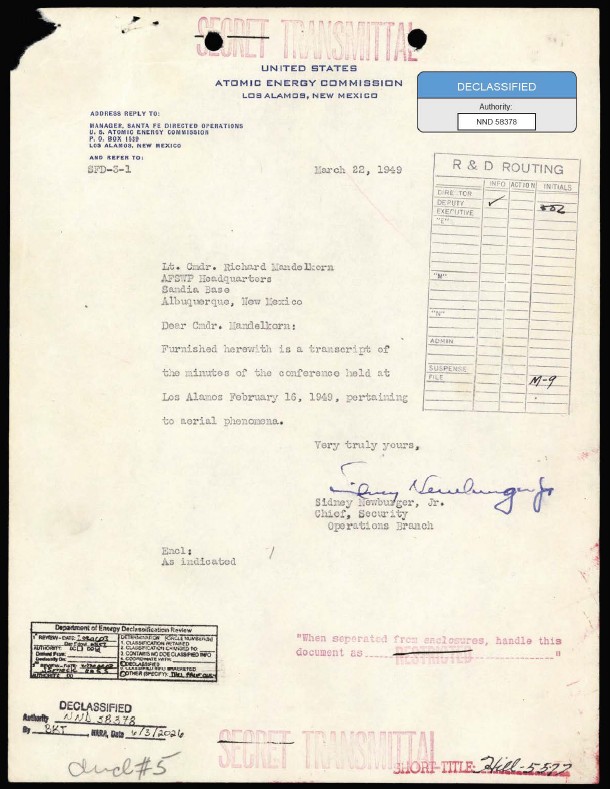
DOE-UAP-D004, Los Alamos Conference on Aerial Phenomena, 1949
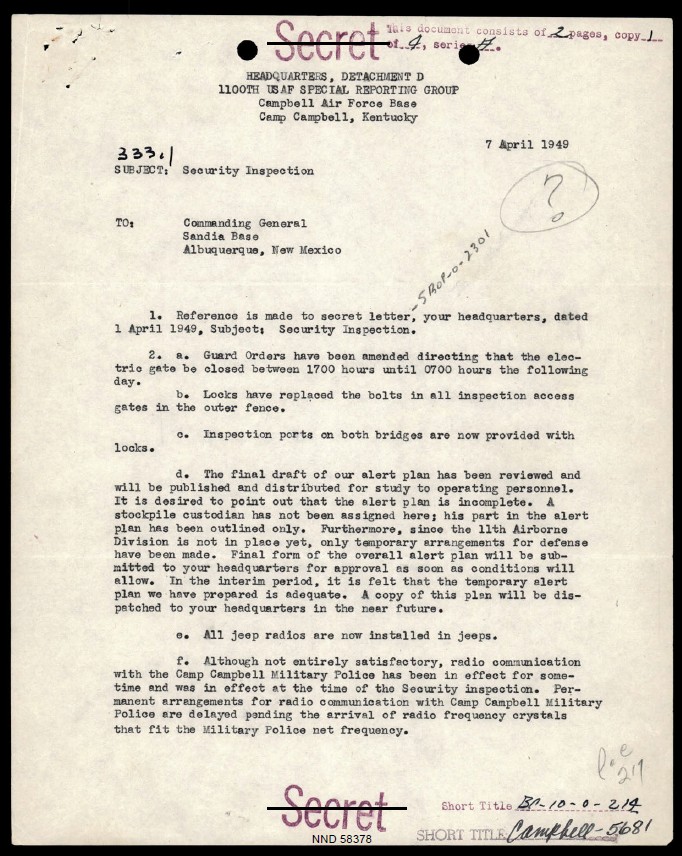
DOW-UAP-D017, UAP Reported at Sandia Base, 1948-1950

CIA-UAP-002, Scientific Advisory Panel on Unidentified Flying Objects, Report, 1952-1953
DOW-UAP-D097, Project Sign Progress Report, 1948
Casos relacionados

DOW-UAP-D102, Archivo de Project Blue Book sobre la filmación de Tremonton, Utah, 1952

DOW-UAP-D103, Archivo fotográfico de Project Blue Book relacionado con la filmación de Tremonton, Utah, 1952

DOW-UAP-D105, Archivo de discos voladores de la Fuerza Aérea de EE. UU., 1952
 ▶ 70s
▶ 70sDOW-UAP-PR159, Filmación histórica de OVNI reportados, Utah, 1952
DOW-UAP-D098, Análisis fílmico de objetos no identificados, 1953
Misma serie de expedientes
 ▶ 5s
▶ 5sDOW-UAP-PR019, Reporte de UAP sin resolver, Medio Oriente, mayo de 2022
DOW-UAP-PR020, Reporte de UAP sin resolver, Kuwait, mayo de 2022
 ▶ 10s
▶ 10sDOW-UAP-PR021, Reporte de UAP sin resolver, Irak, mayo de 2022
 ▶ 14s
▶ 14sDOW-UAP-PR022, Informe UAP sin resolver, Siria, julio de 2022
 ▶ 11s
▶ 11sDOW-UAP-PR023, Informe UAP sin resolver, Irak, diciembre de 2022
 ▶ 18s
▶ 18sDOW-UAP-PR024, Informe UAP sin resolver, Medio Oriente, 2023
Mismo periodo
59_64634_711.5612[7-2852
CIA-UAP-002, Panel Asesor Científico sobre Objetos Voladores No Identificados, Informe, 1952-1953
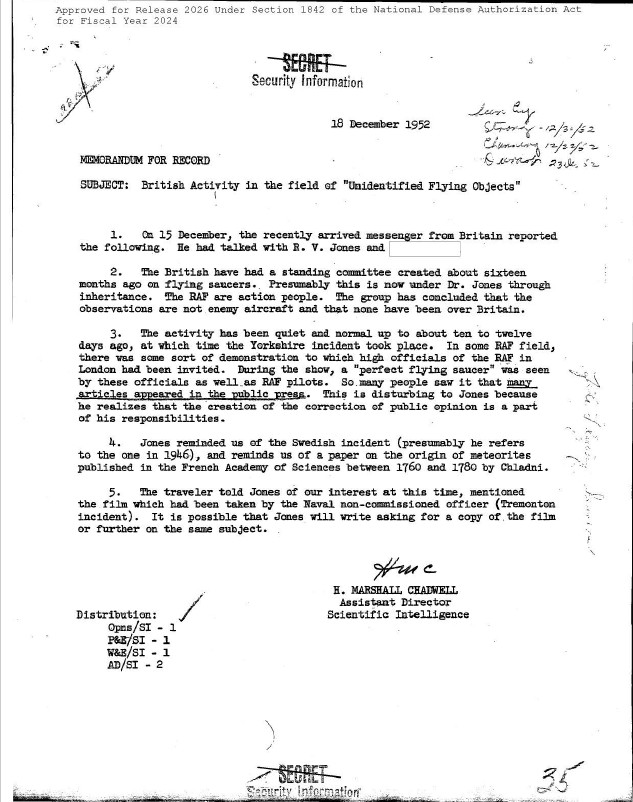
CIA-UAP-014, Actividad británica en el campo de los “objetos voladores no identificados”
DOW-UAP-D102, Archivo de Project Blue Book sobre la filmación de Tremonton, Utah, 1952
DOW-UAP-D103, Archivo fotográfico de Project Blue Book relacionado con la filmación de Tremonton, Utah, 1952
DOW-UAP-D105, Archivo de discos voladores de la Fuerza Aérea de EE. UU., 1952
Mismo release
▶ 70sDOW-UAP-PR159, Filmación histórica de OVNI reportados, Utah, 1952

DOW-UAP-D104, Expediente final de personal de Newhouse, Delbert C., Marina de EE. UU., 1957

DOW-UAP-D110, Pliego de objetivos de AAWSAP, julio de 2008

DOW-UAP-D111, Solicitud y orden original de AAWSAP, septiembre de 2008

DOW-UAP-D112, Modificación de contrato P00001 de AAWSAP, septiembre de 2009

DOW-UAP-D117, AAWSAP DIRD, Vidrios metálicos para aplicaciones aeroespaciales, diciembre de 2009
Misma agencia
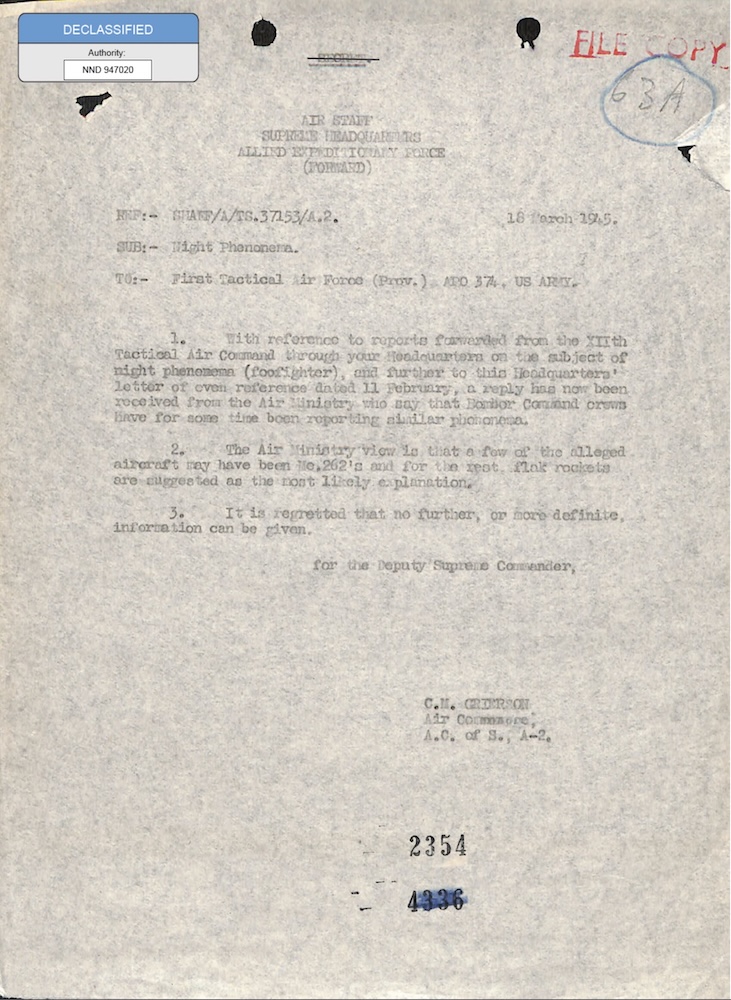
331_120752_Numeric_Files_1944–1945_37153_German_Armament_Equipment_Documents
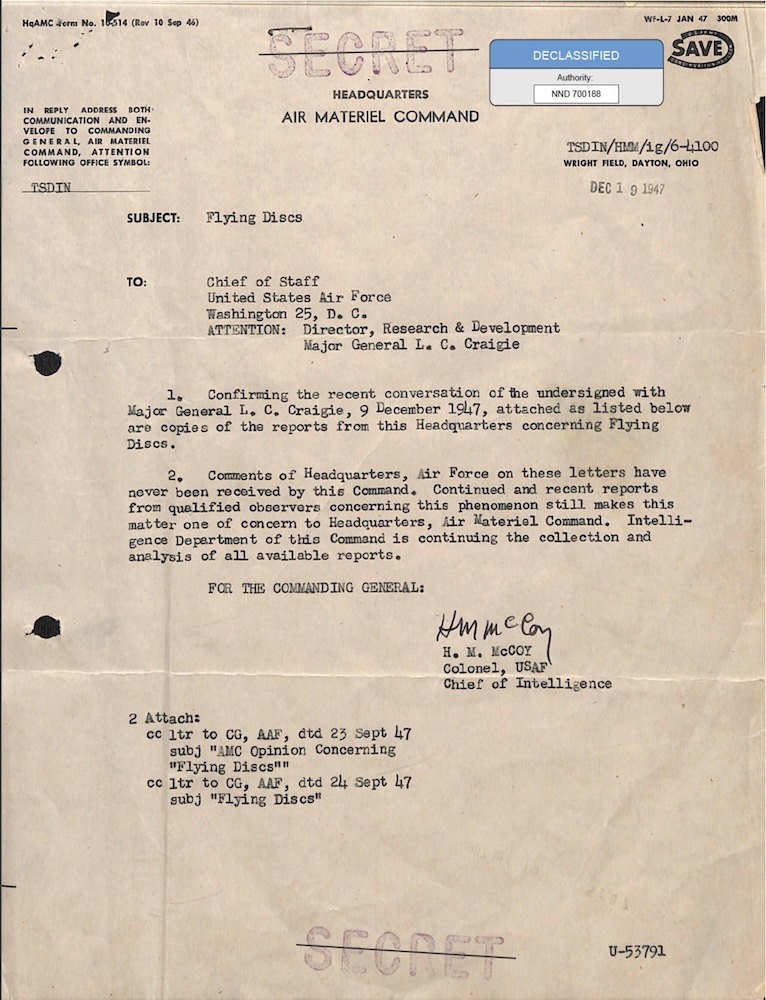
18_100754_ General 1946-7_Vol_2
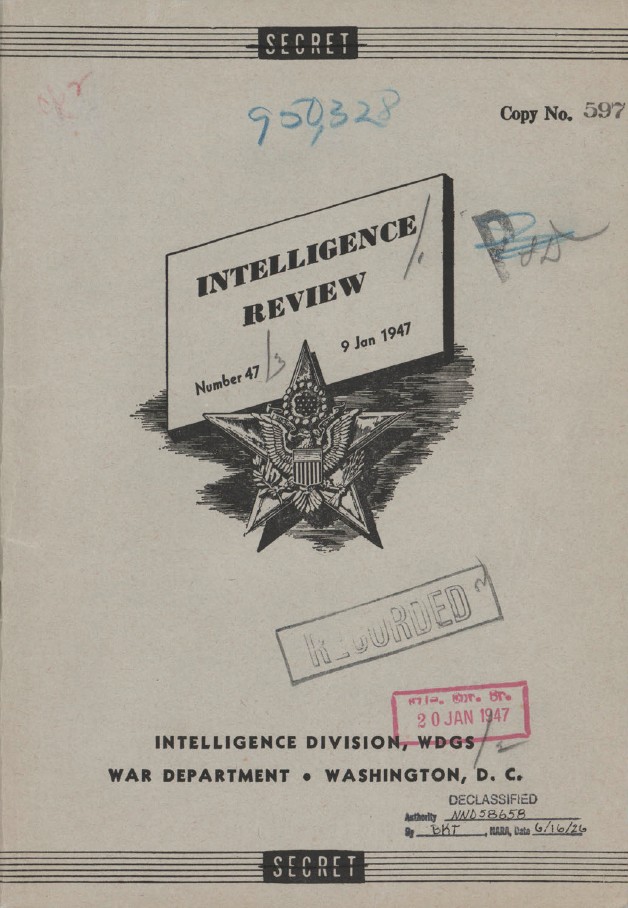
DOW-UAP-D099, Revisión de inteligencia sobre los incidentes de “cohetes fantasma”, 1947
DOW-UAP-D100, Informe del Comando de Material Aéreo sobre objetos voladores no identificados, 1947-1948
18_6369445_General_1948_Vol_1