NASA-UAP-D005, Apollo 17 Crew Debriefing for Science, 1973
Key facts
- Official file ID
- NASA-UAP-D5 (cited as NASA-UAP-D005 in this file)
- Document type
- Document
- Agency
- NASA
- Released in
- R01 · 2026-05-08
- Incident date
- 1973
- Incident location
- Pages legible
- 3/3
- VIRIN
- 260508-O-D0360-1064
Official description
Apollo 17 was the ninth crewed U.S. mission to the Moon, and the sixth to land Astronauts on the lunar surface. This document is an excerpt from the Apollo 17 Crew Debriefing for Science on January 8, 1973, in which Dick Henry, co-investigator on the ultraviolet experiment on Apollo 17, discusses seeing results that were unexpected. • Pages 119-120. “One of the most exciting results of X-ray astronomy was the fact that an X-ray background was observed over the sky that nobody had expected, and part of this is the gamma-ray background that Dr. Trombka talked about. In the UV, nobody knows, but you never know until you look. You do have to deal with this background of stars that we know is there. So, we did look at a large number of different points at high galactic latitudes, both north and south. The spectrum that we see is above this dark count. In other words, this abnormally high dark current did not, in fact, interfere with that experiment. The spectrum that we see looks like the spectrum of the hot star; however, we know that there were no hot stars within our field of view. Therefore, the most conservative interpretation, I think, is that what we're seeing is light from hot stars in the galactic plane going up out of the plane and reflecting off interstellar dust. There are certain characteristics of the spectrum, though, that don't fit that theory, and it's at least possible that this is extragalactic radiation. I'm looking forward very much to the detailed computer study of this, but it's going to take a long time.”
✦ AI summary
This document is NOT about UAP. It is a 3-page excerpt (pages 119-120 of the original, dated January 8, 1973, MSC-07632) from an Apollo 17 'Crew Debriefing for Science' press-style briefing held at the Manned Spacecraft Center, Houston. The speaker (identified as 'HENRY,' likely astronomer/PI Richard Henry) discusses results from the mission's far-ultraviolet spectrometer/camera experiment: a search for Lyman-alpha radiation from ionized hydrogen possibly holding the Coma galaxy cluster together (none found, ruling out that binding mechanism); an unexpected UV background observed at high galactic latitudes resembling hot-star spectra, tentatively attributed to starlight reflecting off interstellar dust in the galactic plane (with some spectral features possibly indicating extragalactic radiation); interplanetary Lyman-alpha hydrogen data from interstellar hydrogen streaming through the solar system (cross-referenced with OGO-5 observations by Gary Thomas and Charles Barth); and a planned discussion of Earth spectral observations from outside the atmosphere. This is a straightforward astrophysics/science results briefing with no UAP or anomalous sighting content; it appears to have been included in the release only because it is part of the broader Apollo 17 crew debriefing documentation set.
Generated with AI from the official file — may contain errors.
▸Transcript(3 of 3 pages legible)
[PAGE 1] * APOLLO 17 - CREW DEBRIEFING - - - FOR SCIENCE JANUARY 8, 1973 MSC-07632 SIGNATOR LOCUS oso-44 MANNED SPACECRAFT CENTER HOUSTON, TEXAS [PAGE 2] 119 HENRY (CONT'D) ... gravitationally holding it together. We thought it might be in the form of ionized hydrogen. We looked for Lyman-alpha radiation, red shifted from the ionized hydrogen, and we didn't see any. We set a lower limit, which certainly excludes the possibility that the Coma cluster is held together by this ionized hydrogen. I think that may leave a real mystery as to what is holding the thing together. The fourth point may turn out to be the most interesting thing of all. When you look in the Milky Way, you see a lot of UV coming from the stars, but the question is, what do you see when you look up to the North Galactic Pole or down to the South Galactic Pole. One of the most exciting results of X-ray astronomy was the fact that an X-ray background was observed over the sky that nobody had expected, and part of this is the gamma-ray background that Dr. Trombka talked about. In the UV, nobody knows, but you never know until you look. You do have to deal with this background of stars that we know is there. So we did look at a large number of different points at high galactic latitudes, both north and south. The spectrum that we see is above this dark count. In other words, this abnormally high dark current did not, in fact, interfere with that experiment. The spectrum that we see looks like the spectrum of the hot [star] [PAGE 3] 120 HENRY (CONT'D) star; however, we know that there were no hot stars within our field of view. Therefore, the most conservative interpretation, I think, is that what we're seeing is light from hot stars in the galactic plane going up out of the plane and reflecting off interstellar dust. There are certain characteristics of the spectrum, though, that don't fit that theory, and it's at least possible that this is extragalactic radiation. I'm looking forward very much to the detailed computer study of this, but it's going to take a long time. Fifth point: Lyman-alpha hydrogen radiation is a completely separate problem, and Gary Thomas at the University of Colorado and Charles Barth [?] observed this from OGO-5. We obtained just an enormous amount of data on the Apollo that's going to straighten out this picture and clarify it considerably. This is hydrogen that is inside our solar system. It's sunlight reflecting off this. The hydrogen, Gary Thomas thinks, is hydrogen from interstellar space streaming through the solar system, and he is looking forward with great anticipation to getting detailed analyses of that. One more thing: the spectrum of the Earth. I keep saying 'we' but these were the guys that were there. We looked at the Earth from outside. A lot of people have observed [text continues beyond excerpt]
Generated with AI from the official file — may contain errors.
Source: U.S. Department of War / AARO — public domain · war.gov/ufo
Entities in this document
Connected cases
NASA-UAP-D024, “Apollo 16 Scientific Debriefing”
18_6369445_General_1948_Vol_1
NASA-UAP-D002, Apollo 17 Transcript, 1972
NASA-UAP-D006, Apollo 17 Technical Crew Debriefing, 1973
NASA-UAP-D007, Skylab Technical Crew Debriefing 1973
NASA-UAP-D009, Apollo 17 Audio Excerpt, December 7, 1972
Related cases
NASA-UAP-D026, Apollo 14 Debriefing, 1971
NASA-UAP-D027, Apollo 14 Debriefing (Continued), 1971
NASA-UAP-D028, Apollo 17 Crew Medical Debriefing, 1972
NASA-UAP-D029, Apollo 17 Crew Medical Debriefing (Continued), 1972
Same document series
NASA-UAP-D001, Apollo 12 Transcript, 1969
NASA-UAP-D002, Apollo 17 Transcript, 1972
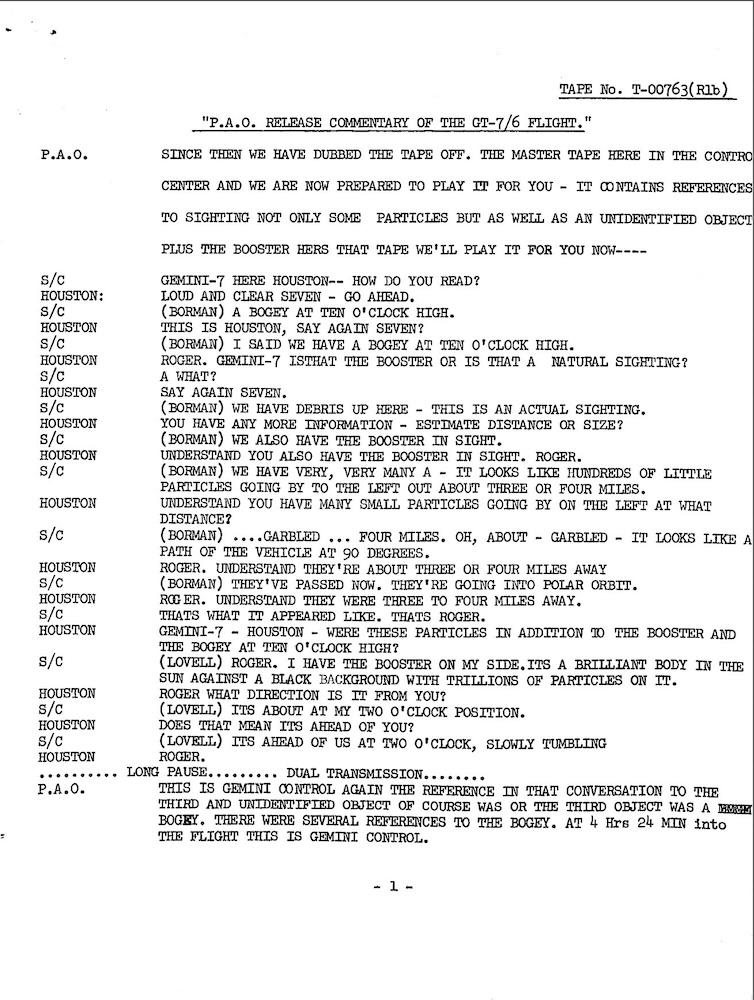
NASA-UAP-D003, Gemini 7 Transcript, 1965
NASA-UAP-D003A, Gemini 7 Audio Excerpt, 1965
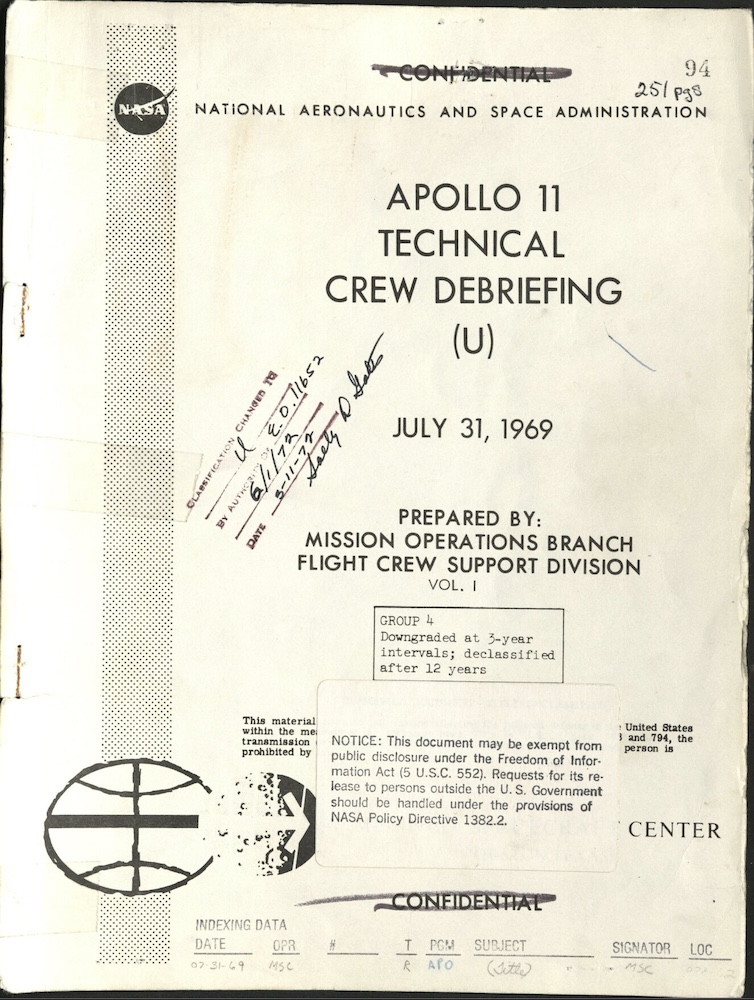
NASA-UAP-D004, Apollo 11 Technical Crew Debriefing, 1969
NASA-UAP-D006, Apollo 17 Technical Crew Debriefing, 1973
Same period
Same release
331_120752_Numeric_Files_1944–1945_37153_German_Armament_Equipment_Documents
18_100754_ General 1946-7_Vol_2
18_6369445_General_1948_Vol_1
341_110448_Records_Relating_to_the_Collection_and_Dissemination_of_Intelligence_1948-1955-TS_CONT_No.2_2-5300-2-5399
342_HS1-416511228_319.1 Flying Discs 1949
59_64634_711.5612[7-2852
Same agency
NASA-UAP-D014, Mercury-Redstone 4, July 21, 1961
NASA-UAP-D012, Mercury Atlas 8 Audio Excerpt, October 3, 1962
NASA-UAP-D013, Mercury Atlas 7, May 24, 1962
NASA-UAP-D015, Astronaut Scientific Debriefings, 1962-1963
NASA-UAP-D023, Interview Excerpt with Astronaut Gordon Cooper, 1962