
18_100754_ General 1946-7_Vol_2
Key facts
- Document type
- Document
- Agency
- Department of War
- Released in
- R01 · 2026-05-08
- Incident date
- 12/30/47
- Incident location
- N/A
- Pages legible
- 5/28
- VIRIN
- 260508-D-D0360-1001
Official description
This file contains memorandums and correspondence related to flying disc/saucer sightings and that those are a matter of concern for the Air Materiel Command.
Document status
AI summary withheld: only 5 of 28 scanned pages contain legible text, so an automatic summary risked being inaccurate. Read the official description above or consult the source PDF for the complete record.
▸Transcript(5 of 28 pages legible)
[PAGE 1] Headquarters, Air Materiel Command, 19 December 1947, Subject: Flying Discs, To: Chief of Staff, USAF, Attention: Director, Research & Development, Maj. Gen. L.C. Craigie. 'Confirming the recent conversation of the undersigned with Major General L.C. Craigie, 9 December 1947, attached as listed below are copies of the reports from this Headquarters concerning Flying Discs. Comments of Headquarters, Air Force on these letters have never been received by this Command. Continued and recent reports from qualified observers concerning this phenomenon still makes this matter one of concern to Headquarters, Air Materiel Command. Intelligence Department of this Command is continuing the collection and analysis of all available reports.' Signed for the Commanding General by the Chief of Intelligence. Attachments: cc letters dated 23 and 24 September 1947, subject 'AMC Opinion Concerning Flying Discs.' [PAGE 3-4] 30 December 1947 letter: 'It is Air Force policy not to ignore reports of sightings and phenomena in the atmosphere but to recognize that part of its mission is to collect, collate, evaluate and act on information of this nature.' Directs AMC to set up a project to collect, collate, evaluate, and distribute to interested government agencies and contractors all information on sightings/phenomena construed as a national security concern, assigned Priority 2A with a 'Restricted' security classification (higher-classification data to be handled/classified accordingly), with an initial report followed by quarterly reports. [PAGE 4, 1st Indorsement, 9 Dec 1947] Regarding a Fourth Air Force (Hamilton Field, CA) photograph incident: 'The marks appearing on the photographs included in basic letter are believed to be defects in the film, paper, or camera and not pictures of "flying discs". It is requested that no further investigation be made of this incident.' [PAGE 6] Fourth Air Force letter regarding photographs submitted by Mary L. Herron of Portland, Oregon, taken between Nov 5-12, 1946 near Jefferson, Oregon, showing objects she 'did not recall seeing herself but thought might possibly be flying discs'; assessed that uniform markings suggest a defective camera/film, and no flying disc incidents were reported from that area/time. [PAGE 7] 18 Nov 1947 AMC letter forwarding newspaper clippings including a Seattle incident and a story on alleged war-weapon development by German scientists in Spain (assessed as unconfirmed, with AMC German-scientist experts stating none of the named individuals were known to them), and referencing a 'flying disc incident in Alaska in September' with a close-range sighting warranting follow-up; also requests status on 'plotting of all flying disc incidents to date, particularly in North America,' understood to be handled by 'Dr. Carroll.' [PAGE 9-11] THE TWINING LETTER (23 September 1947, TSDIN, Subject: 'AMC Opinion Concerning "Flying Discs"', To: Commanding General, Army Air Forces, Attn: Brig. Gen. George Schulgen, AC/AS-2), signed by Lt. Gen. N.F. Twining, Commanding: presents AMC's considered opinion based on interrogation report data and studies by T-2 Intelligence and Aircraft Laboratory/Engineering Division T-3 personnel: (a) the phenomenon is real, not visionary/fictitious; (b) objects probably approximate disc shape, appreciable size comparable to man-made aircraft; (c) some incidents may be natural phenomena like meteors; (d) reported extreme climb rates, roll maneuverability, and evasive action near aircraft/radar suggest some objects may be manually, automatically, or remotely controlled; (e) common description: metallic/light-reflecting surface, usually no trail (rare rumbling roar noted in three instances), circular/elliptical shape flat on bottom and domed on top, formation flights of 3-9 objects, level flight speeds estimated above 300 knots; (f) feasible with extensive development to build a piloted aircraft of this description with ~7000-mile subsonic range, though such a program would be extremely expensive; (h) must consider: (1) possibility of domestic origin from an unknown high-security project, (2) lack of physical/crash evidence, (3) possibility of a foreign nation possessing an unknown propulsion system, possibly nuclear. Recommends AAF headquarters issue a directive with priority, classification, and code name for a detailed study, sharing data with Army, Navy, AEC, JRDB, Air Force Scientific Advisory Group, NACA, RAND, and NEPA, with a preliminary report within 15 days and detailed reports every 30 days thereafter. [PAGE 15-16] 24 September 1947 letter enclosing a drawing 'Loedding Flying Disc' (LD-2, patent-sensitive, signature log required) and a Royal Aircraft Establishment technical note on the Horten brothers' flying-wing designs, with specific page references to the Horten VIII and IX and the 'Parabola' aircraft, explicitly framed as relevant to 'the alleged Flying Saucer case.' Also cites a June 1947 U.S. military attache report from Moscow indicating ~1,800 aircraft based directly or indirectly on the Horten VIII design (6-engine pusher, 131-ft wingspan, ~33,000 lb gross weight) were being built for Soviet bomber use, with a jet-propelled Russian variant. [PAGE 18-21] October 1947 correspondence regarding Mrs. Madeline Gwynne Merchant of Santa Fe, New Mexico, who presented a theory to Brig. Gen. Brentnall that 'Flying Discs' were being fired from a laboratory in central Mexico operated by the Russians, aimed at the United States to 'sight in' on important atomic energy and aircraft installations. Gen. Brentnall assessed her as 'extremely talkative' and more interested in 'promoting a personal enterprise' than assisting; it was recommended no further interrogation be pursued and the case be closed. [PAGE 26] 22 August 1947 Routing and Record Sheet, AC/AS-2 Air Intelligence Requirements Division to Deputy Chief of Air Staff for Research & Development: 'From a detailed study of certain reported observations on the flying saucers, selected for their veracity and reliability, it is apparent that several aspects of their appearance have a common pattern,' listing: metallic surface; trail (when observed) a light blue-brown haze similar to rocket exhaust, with one observation suggesting throttleable (liquid rocket) fuel; circular/elliptical shape, flat bottom, slightly domed top; size near a C-54 or Constellation at 10,000 feet; some reports of two rear tabs; formations of 3-9 objects at speeds above 300 knots; lateral oscillation ('snaking'). Requests confirmation no AAF research project matches this description. [PAGE 28] 29 August 1947 reply, Deputy Chief of Air Staff for Research and Development (Maj. Gen. Lawrence C. Craigie): 'The Army Air Forces has no research project with the characteristics described in Comment No. 1' — formally ruling out a known domestic explanation.
Generated with AI from the official file — may contain errors.
Source: U.S. Department of War / AARO — public domain · war.gov/ufo
Entities in this document
Connected cases
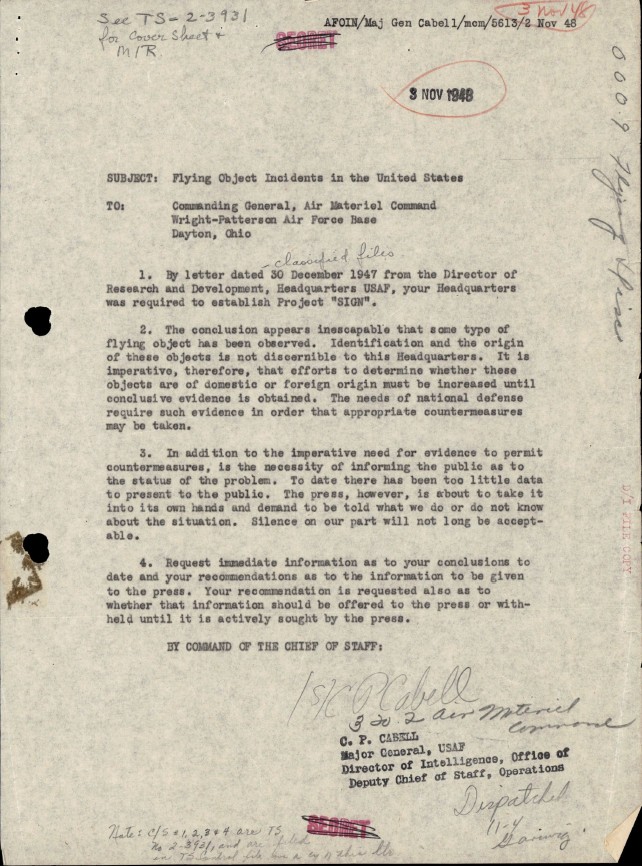
DOW-UAP-D100, Air Materiel Command Report on Unidentified Flying Objects, 1947-1948
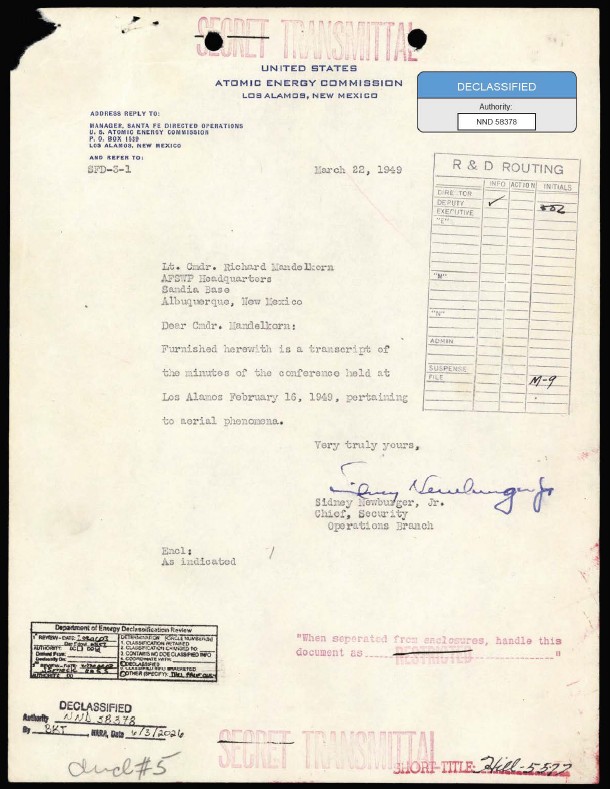
DOE-UAP-D004, Los Alamos Conference on Aerial Phenomena, 1949
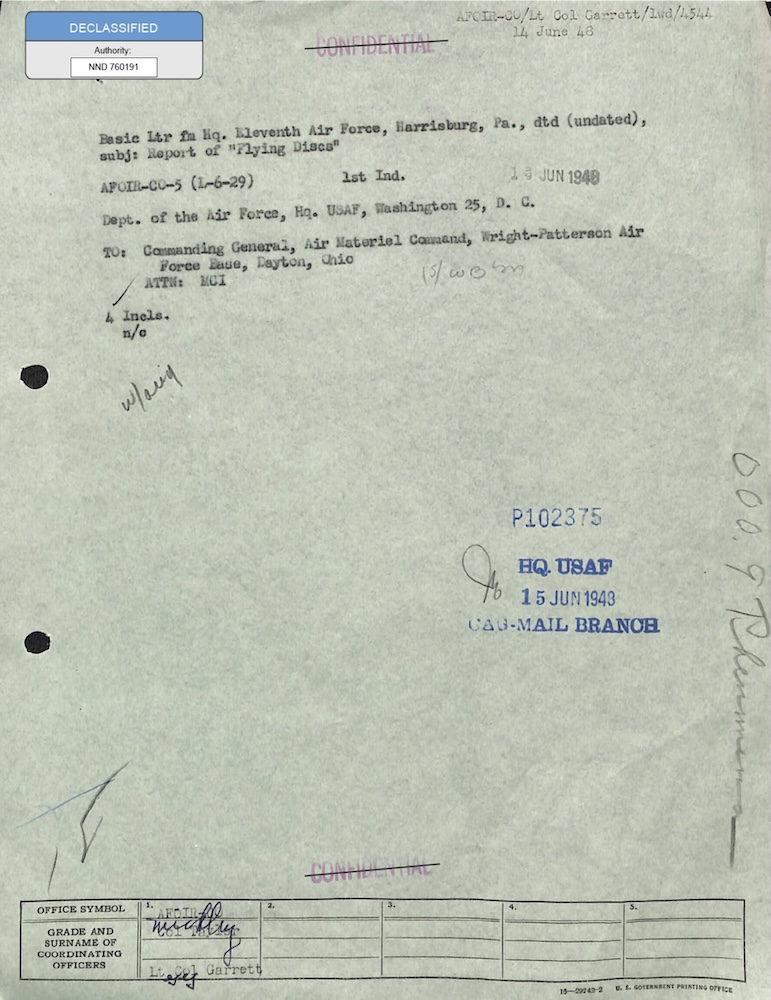
18_6369445_General_1948_Vol_1
255_413270_UFO's_and_Defense_What_Should_we_Prepare_For
65_HS1-834228961_62-HQ-83894_Section_004
65_HS1-834228961_62-HQ-83894_Section_005
Related cases

DOW-UAP-D104, Final Personnel Record for Newhouse, Delbert C., U.S. Navy, 1957
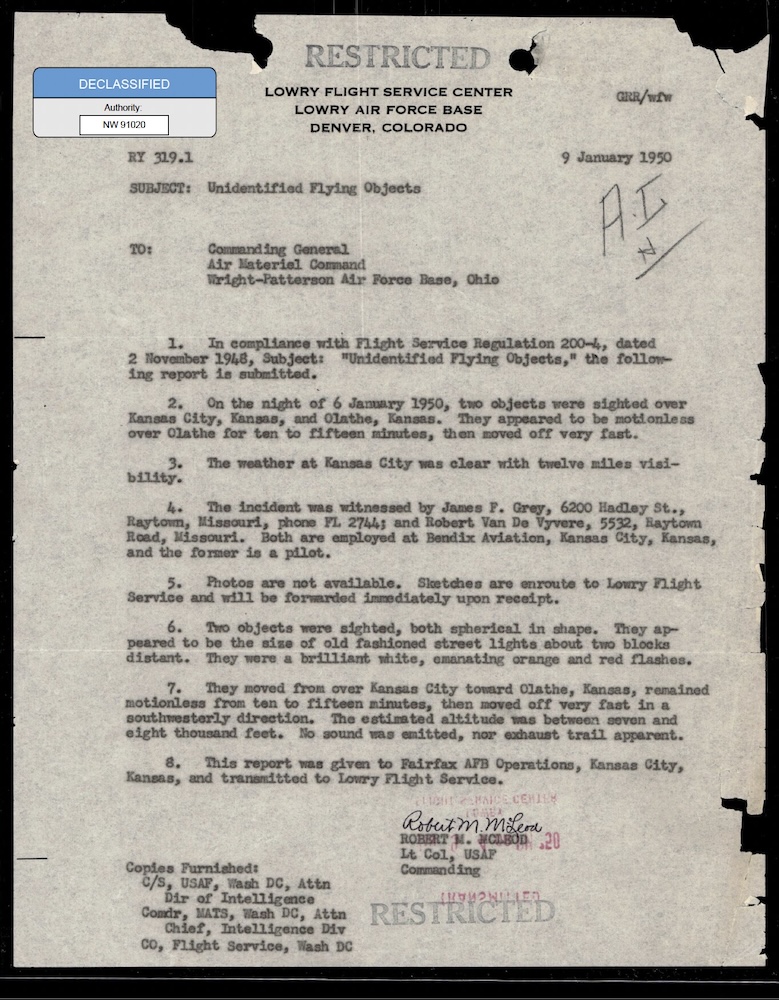
342_HS1-416511228_319.1 Flying Discs 1949
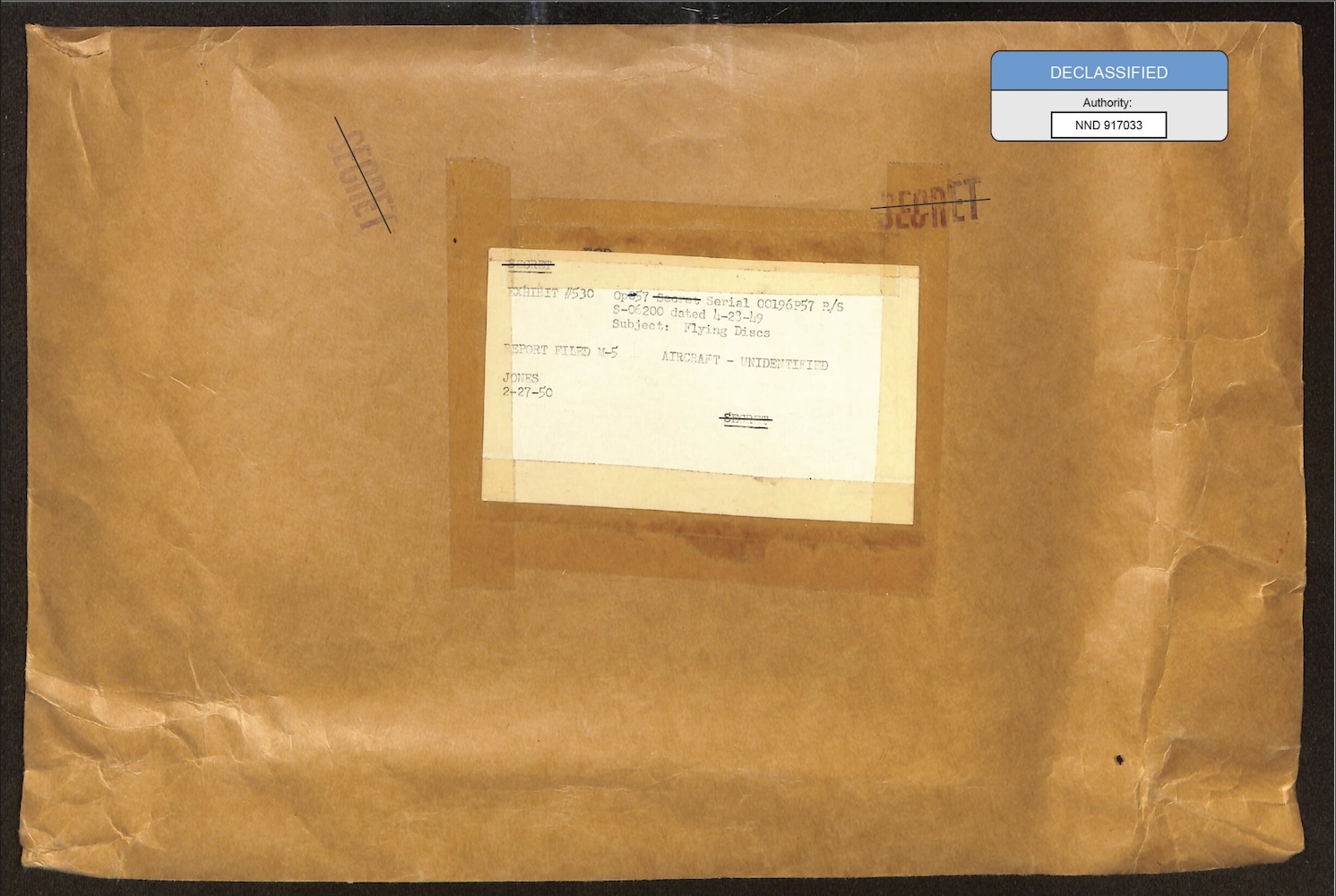
38_143685_box_Incident_Summaries_101-172
38_143685_box_Incident_Summaries_173-233
Same period
Same release
331_120752_Numeric_Files_1944–1945_37153_German_Armament_Equipment_Documents
18_6369445_General_1948_Vol_1
341_110448_Records_Relating_to_the_Collection_and_Dissemination_of_Intelligence_1948-1955-TS_CONT_No.2_2-5300-2-5399
342_HS1-416511228_319.1 Flying Discs 1949
59_64634_711.5612[7-2852
341_110677_Numerical_File,_5-2500
Same agency
DOW-UAP-D017, UAP Reported at Sandia Base, 1948-1950
DOW-UAP-D093, Analysis of Flying Object Incidents in the United States, 1948
DOW-UAP-D097, Project Sign Progress Report, 1948
DOW-UAP-D094, Analysis of Flying Object Incidents in the United States, 1949
DOW-UAP-D098, Film Analysis of Unidentified Objects, 1953
