
NASA-UAP-D023, Interview Excerpt with Astronaut Gordon Cooper, 1962
Key facts
- Official file ID
- NASA-UAP-D23 (cited as NASA-UAP-D023 in this file)
- Document type
- Audio
- Agency
- NASA
- Released in
- R03 · 2026-06-12
- Incident date
- November, 1962
- Incident location
Official description
In November 1962, journalist Walter Cronkite interviewed astronaut Gordon Cooper. In this excerpt from that interview, Cronkite asks Cooper about his views regarding the nature of unidentified flying objects, having previously expressed an interest in the subject. Cooper opines that “a large number of exceptionally well-qualified people have seen objects” without a “logical explanation” and speculates on the existence of other planets with “a livable atmosphere” and that maybe there are “some type of human life” out there. Interview was conducted in November 1962.
✦ AI summary
This is an excerpt from a November 1962 television interview in which journalist Walter Cronkite questions Mercury astronaut Gordon Cooper about unidentified flying objects. Cronkite notes Cooper's previously expressed interest in the topic and asks whether he still believes there might be something to UFO reports. Cooper responds that a large number of "exceptionally well-qualified" people have seen objects without a logical explanation, and while he allows each sighting may individually have a mundane cause, he speculates that given the vast number of planets in the universe, some could have livable atmospheres and perhaps some form of life, making it plausible some sightings involve such origins. Cronkite then asks whether Cooper's own upcoming Mercury flight (a relatively short trip into space) would be far enough to make relevant observations; Cooper says no, since true spaceflight distances are measured in millions of miles versus the roughly hundred miles Mercury reaches. Cronkite closes by raising the "Glenn effect" — the snowflake/firefly particles reported by John Glenn, Scott Carpenter, and (per corrected transcription) Wally Schirra, which Glenn attributed to frost off the capsule — and the excerpt ends before Cooper answers.
Generated with AI from the official file — may contain errors.
▸Transcript
[00:00] Cronkite: I know you expressed interest at one time in unidentified flying objects, the feeling that there might be something to all these stories. Do you still feel that way? [00:17] Cooper: Well, I feel that there have been a large number of fairly well-qualified, or exceptionally well-qualified, I should say, people who have seen objects that have not had any really logical explanation other than this. I think that maybe, in fact, each and every one of them does have an explanation. But I think that there are so many possibilities, so many thousands of possibilities of other planets out somewhere in the universe that would have a livable atmosphere, that I would hate to rule out the possibility that maybe there are people or some type of human life on some of these. And if this is the case, then it's not too unfeasible to think that perhaps some of these objects might have been something of this type. [01:09] Cronkite: You don't think that the comparatively short step out into space that the Mercury flight will take you on is far enough out to make any observations in this area? [01:20] Cooper: No, I think we're still at a fairly low order of getting out into space when you speak of space and being millions of miles involved, and we're only getting out a hundred miles or so. [01:39] Cronkite: What about the so-called Glenn effect? You know, the snowflakes, the fireflies — now both Schirra and Carpenter seem to feel that it's a frost of some nature off of the capsule, but apparently Glenn still sort of casts doubt on that theory.
Generated with AI from the official file — may contain errors.
Source: U.S. Department of War / AARO — public domain · war.gov/ufo
Entities in this document
Connected cases
NASA-UAP-D018, Gemini 4 Experiment Debriefing, 1967
NASA-UAP-D010, Mercury Atlas 9 Audio Excerpt, May 15, 1963
NASA-UAP-D012, Mercury Atlas 8 Audio Excerpt, October 3, 1962
NASA-UAP-D015, Astronaut Scientific Debriefings, 1962-1963
NASA-UAP-D011, Mercury Atlas 9 Audio Excerpt, May 15, 1963
NASA-UAP-D013, Mercury Atlas 7, May 24, 1962
Related cases
Same document series
NASA-UAP-D001, Apollo 12 Transcript, 1969
NASA-UAP-D002, Apollo 17 Transcript, 1972
NASA-UAP-D003, Gemini 7 Transcript, 1965

NASA-UAP-D003A, Gemini 7 Audio Excerpt, 1965
NASA-UAP-D004, Apollo 11 Technical Crew Debriefing, 1969
NASA-UAP-D005, Apollo 17 Crew Debriefing for Science, 1973
Same period
Same release
FBI-UAP-D011, D/FBI Correspondence Referral, 1949
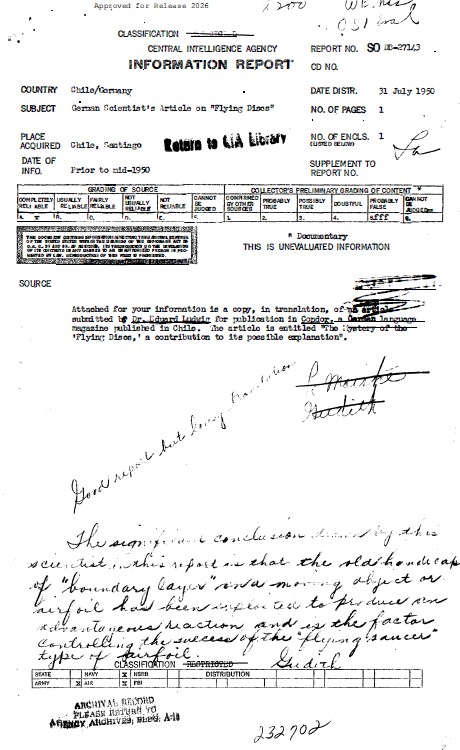
CIA-UAP-005, German Scientist's Article on 'Flying Discs'
CIA-UAP-002, Scientific Advisory Panel on Unidentified Flying Objects, Report, 1952-1953
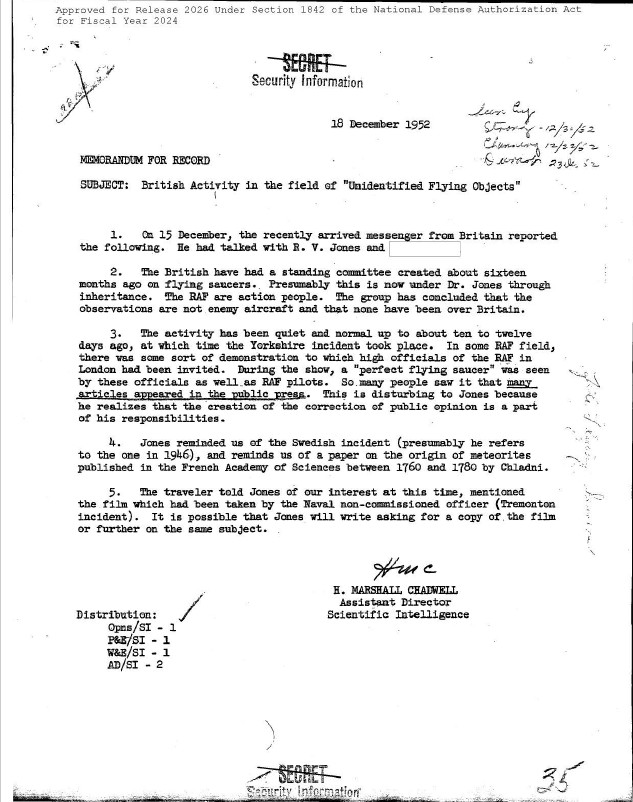
CIA-UAP-014, British activity in the Field of "Unidentified Flying Objects"
FBI-UAP-D012, Newark Field Office, 1952-1967
FBI-UAP-D013, Washington State ‘UFO’ Investigation, 1952-1960
Same agency
NASA-UAP-D014, Mercury-Redstone 4, July 21, 1961
NASA-UAP-D010, Mercury Atlas 9 Audio Excerpt, May 15, 1963
NASA-UAP-D011, Mercury Atlas 9 Audio Excerpt, May 15, 1963
NASA-UAP-D016, Preliminary Gemini 4 Crew Debriefing, Part I, 1965
NASA-UAP-D017, Preliminary Gemini 4 Crew Debriefing, Part II, 1965