DOW-UAP-D167, Projeto Capella, dezembro de 2008
Dados principais
- ID oficial do arquivo
- DOW-UAP-D167
- Tipo de documento
- Documento
- Agência
- Department of War
- Publicado em
- R07 · 2026-10-23
- Data do incidente
- 12/10/08
- Local do incidente
- São Francisco, Califórnia
- Coordenadas
- 37.8089356, -122.4771603
- Páginas legíveis
- 42/42
- VIRIN
- 260508-D-D0360-1159
Descrição oficial
Este relatório de dezembro de 2008, desenvolvido para a Bigelow Aerospace Advanced Space Studies (BAASS), descreve o Projeto Capella, uma estrutura proposta de armazém de dados para a captura, o processamento, a classificação e a recuperação de informações sobre fenômenos aéreos “incomuns” e anomalias relacionadas. O relatório descreve uma metodologia para integrar catálogos existentes, padronizar critérios de classificação e confiabilidade, revisar bancos de dados estrangeiros e privados e desenvolver capacidade de pessoal e software para apoiar a análise, a revisão bibliográfica e possíveis investigações de campo futuras. Apresenta o projeto como um meio de consolidar materiais de casos históricos e contemporâneos dispersos em um sistema de pesquisa estruturado, capaz de apoiar várias iniciativas da BAASS. Ao propor uma arquitetura de dados centrada em fenômenos aéreos incomuns e anomalias relacionadas, o documento ajudou a lançar as bases de esforços posteriores da BAASS para formalizar a coleta e a análise de dados voltadas a UAP na execução do AAWSAP pela BAASS.
Sobre este tipo de documento
Este documento é um registro administrativo, programático ou produzido por um contratado, relacionado ao Programa de Aplicações de Sistemas de Armas Aeroespaciais Avançados (AAWSAP), um programa administrado pela Agência de Inteligência de Defesa (DIA) ativo entre 2008 e 2012. O escopo oficial de trabalho do AAWSAP identificou 12 áreas de pesquisa técnica relacionadas a potenciais ameaças aeroespaciais em um horizonte de tempo de mais de 40 anos. Como parte do registro mais amplo do programa, o arquivo documenta como o AAWSAP foi delimitado, organizado, direcionado, financiado, executado ou descrito em um determinado momento.
Ver o glossário →✦ Resumo IA
Trata-se do "Report no. 001" da Documatica Research, LLC (San Francisco) para a Bigelow Aerospace Advanced Space Studies (BAASS), datado de 10 de dezembro de 2008 e intitulado "Project CAPELLA: Towards the development of a data warehouse in support of research on unusual aerial phenomena and related anomalies". O autor aparece censurado como "AAP Person 5". A visão geral revisa catálogos de óvnis anteriores, desde a análise em cartões perfurados que o Battelle Memorial Institute fez dos dados do Projeto Livro Azul para o "Report 14" (1953) até o UFOCAT, o catálogo Magonia de cerca de 700 casos de pouso (1868-1968), os arquivos do MUFON e do NARCAP e a base de dados francesa GEIPAN, e propõe uma metodologia para capturar, processar e recuperar dados de casos para a BAASS, incluindo acesso a catálogos estrangeiros e privados e considerações de pessoal e privacidade. Seguem três apêndices: (A) um sistema de classificação e indicadores de confiabilidade para os avistamentos relatados, com notas de três dígitos em que 222 ou mais indica os relatos mais confiáveis; (B) um "modelo de seis camadas" para fenômenos anômalos que abrange aspectos físicos, psicológicos, sociais e culturais, sob o título "Physics of High Strangeness"; e (C) estruturas de dados e telas de software propostas para um catálogo de casos, com entradas de exemplo. É uma proposta de desenho de pesquisa, não uma análise de incidentes específicos.
Gerado com IA a partir do arquivo oficial — pode conter erros.
▸Transcrição(42 de 42 páginas legíveis)
[PAGE 1] Project Capella [cover/title page; rest of page blank] [PAGE 2] . .___________ ___ _ _ C_H_ __ oo_c_UMATICA RES_EAR_ , L_L_c Report no.001 to Bigelow Aerospace Advanced Space Studies, LLC (BAASS) Project CAPELLA: Towards the development ofa data warehouse in support of research on unusual aerial phenomena and related anomalies B AAP Person 5 San Francisco, orma December 10, 2008 CAPELLA Data Warehowe page 1 [PAGE 3] O· Project CAPELLA: Towards the development ofa data warehouse in support of research on .unusual aerial phenomena and related anomalies IAAP Person 5 Documatica Research, LLC How this report is organized This report consists of the present overview proposal and three appendices (two of which summarize previously-published work). Together, these four documents describe a consistent methodology for the capture, processing and retrieval of parameters characterizing unusual aerial phenomena and related anomalies. The appendices address three specific implementation areas, describing the technical choices we have made in each area and the reasons for these choices: - A Classification methodology and reliability measures for reported sightings - B. Modeling ofinfonnation categories, including high-strangeness data elements - C. Data Structures and Software Platforms in support ofAerial Phenomena Research Given the tools described hereafter, some of which have already been implemented and tested in prototype form in the course ofprior research, we examine several scenarios for the long term acquisition, exploitation and maintenance of a comprehensive data warehousing system that could serve the needs ofa geographically diverse research community with a wide variety ofinformation needs. Historical Background As we undertake this work we are building on a series ofprojects developed by many groups around the world, whose experiences contain important lessons. Over the last half century many researchers, both professional and amateurs, have undertaken to build catalogues (either on paper or in computer readable form) or data bases about the range of phenomena that interest us. • As early as 1953, the U. S. Air Force entrusted the Battelle Memorial Institute with the task of analyzing the reports that Project "Blue Book" had accumulated. Battelle used punched cards for this work, developed a coding system, and produced extensive statistics presented in Blue Book "Report 14." Unfortunately this work was not pursued and the cards were not kept. • Following the Battelle study the Air Force never built a computer catalogue ofProject Blue Book files, but the author and his wife compiled their own version of it using IAAP Person 5 CAPEUA Data WarehOU.fe page 2 [PAGE 4] punched cards following a data scheme that had been first used in France in 1962 and expanded at the University of Texas and at Northwestern University in the period 1963-1967. This catalogue served as the source of a series of statistical studies that were published in several works. • Our database, which included all unidentified cases from Project Blue Book, was turned over to the Condon study at the University ofColorado in 1968 and eventuall ~e b~is for the catalogue (now known as UFOC~T) direct~ b~. 1843(a)(2) 1843(a)(2) t:=__J This catalogue has been greatly expanded and 1s now mamtamed by the CUFOS organization 1843(a)(2) separately developed a catalogue ofvehicle interference cases, an 1843(a)(2) compiled all known cases ofphysical traces. • In 1968 the author compiled and published the Magonia catalogue, a list of over 700 close encounter cases (landings) reported between 1868 and 1968. • Other groups, such as MUFON, have started to compile their own computer files, and IAAP Person 8 r5sembled a catalogue ofphysiological effects. • In the 1980s an independent researcher 1843(a)(2) developed a catalogue called UNICAT in collaboration wi 1843( a )(2) Several independent projects have been implemented around the world since that time. • In the United State~1843(a)(2) !a private researcher working alone, developed a popular scheme to be run on PC platforms under DOS. His catalogue eventually reached almost 20,000 entries. • In France the GEPAN (now GEiPAN) group under the CNES, implemented an ACCESS database available to a "College of Experts" under password access control on the Internet. The system maintains the full text of over 3,000 official reports to the French Gendarmerie, in the form of scanned images. It is embedded in an online collaboration system that gives experts access to maps, Google Earth views, photographs and videos. Note that both the GEiPAN database and UFOCAT treat every report of a given case as a separate entry (iffive witnesses in separate locations report sighting the same object, there are five entries in the file), while other catalogues, like the Hatch catalogue, give a single entry per sighting. • Also in France a database of pilot sightings has been built by l1843(a)(2) !1843(a)(2) rrtie file uses EXCEL and a set ofspecial codes to facilitate retrieval. Every case has been scrupulously re-analyzed and transcribed. A larger set of pilot data, as CAPEUA Data Warehouse page 3 I [PAGE 5] w II ecific investigation files, are maintained by the NARCAP group under D J?43(a)(2) 1843(a)(2) In recent years, easy access to personal computers and the Internet has made it much easier for interested groups to start their own files. There are at least 30 active catalogues at various points of development, with obvious overlap and widely-varying standards. Special catalogues exist for material trace analysis, abduction claims, ancient sightings, and also for particular countries or regions. Several groups are active through closed Internet conferences and have begun to develop and exchange information through wikis in various languages. Furthermore, the range of available data sources has been expanded as countries like the U.K and Spain followed the example of the U.S. Project Blue Book in releasing their declassified files, although not in an organized, structured computer-readable format. Lack of data validation and lack of standards has impeded progress among the researchers responsible for these databases. It is natural for people who have recently become aware of the field to launch into their own implementation of a file of selected cases in the hope of rapidly "solving" some of the problems raised by this pu1..zling phenomenon. Unfortunately, they rarely have the financial wherewithal or professional staff necessary to conduct field investigations or even elementary checks on the validity ofthe information they collect. As time goes on, unfortunately, this reinventing of the wheel fails to generate new results. Every group has implemented its own way of indexing, ":'hich makes it impractical, if not impossible, to exchange data Furthennore, these groups have often used software techniques that were overly complex and hindered research and ease of access instead of promoting it: These catalogues rely on ambitious coding systems that demand large editing and updating efforts. As the implementers get older and are constrained by family or professional requirements they tend to move on and lose interest, and the files get abandoned for lack of trained staff to maintain the overaJI structure. 1. Implementation requirements The new system to be developed needs (I) to support a family·ofcatalogues of observations of unusual aerial phenomena whose nature or behavior suggest the presence of an unrecognized threat, (2) to be up and running within a short time, (3) to extend the search for such data to as many relevant regions ofthe world as possible to find out what knowledgeable researchers or authorities in those regions possess about such phenomena and (4) to allow sophisticated analyses and datamining to improve our own understanding of the extent, structure, and frequency of such events, as well as their potential correlation to known physical, environmental, biological or socio-political factors. The project should avoid the major pitfalls identified above. It should not require any special hardware or network scheme. It has to serve a closed community of physicists and analysts CAPEI.LA Data Warehowe page 4 [PAGE 6] with the need to test certain theories (and counter-theories) about the nature ofthe phenomena involved. Therefore the work cannot be limited to data acquisition, indexing and storage but extends to the essential tasks ofdynamic data validation and ofproviding the ability for users in the project environment to apply their own interactive screens against the data The project should also be of service in contacting experts in other countries to validate certain findings from our teams and "drill down" deeper into certain hypotheses, archives or interesting sites around the world. Therefore it should be accessible anywhere through the Internet (under password protection when applicable). The software should make it easy to convert existing data into a single standard structure, to search for specific natural language expressions or keywords, to sort according to specific criteria and to support statistical tables and graphs. The system also must empower a community of researchers to propose and test their own hypotheses. Such testing is not possible today: Although many interesting theories have been advanced, they are limited by the poor selection of physical and social data available to us. The phenomenon is so diverse that any theory of it can be proven, provided one is free to select the "right'' observations - and ignore the rest! This is not good science, but in the absence of reliable data bases this selection bias is unavoidable. The large, scientifically based effort that is contemplated here cannot afford to repeat the mistakes that, unfortunately, characterize the field. In summary, in order to accomplish all this, the system bas to be portable, frugal, easily implemented on various computer platforms, without the need for a dedicated system team for maintenance or special programming. 2. Recommended platform(s) and structure Given the variety ofdata sources we do not believe it is practical to design a single, massive chronological catalogue for sightings of unidentified phenomena Nor is it practical to merge existing databases together since every one of them has its own social, demographic and cultural bias, and serves its own community and type ofresearch (e.g., on pilot cases, on trace analysis, on vehicle interference, etc.) Instead we propose a data warehousing system that supersedes the individual databases, using a standard structure and coding system over the set offiles. In contrast to the patchwork ofdatabases mentioned above, we propose to assemble a small specializ.ed team and to train its members in data acquisition, data validation and quality control, using only standard, commercially-available software for storage and analysis as first step to reach rapid implementation We believe that this can be accomplished using a standard Microsoft package such as EXCEL, which is widely available (even on Apple computers) and benefits from a large AAP CAPELLA Data Warehouse Person 5 page 5 [PAGE 7] population already trained in its use. Although EXCEL is not a database system, it has some advantages over ACCESS or other software in our case because it makes it very easy to find, sort, replace and tabulate significant amounts ofdata among a set offlat files. We have mentioned above that many private efforts in this field have suffered from over ambitious schemes and coding systems that were too complex. They also contain an Figure 1: Data Warehouse concept embedded bias as a consequence ofthe beliefs ofthose compiling the data, usually under the (unstated) assumption that all cases involve spacecraft from extraterrestrial origin, to the exclusion of any other hypothesis. In the three appendices below we propose a series of simple conventions that minimize such bias and can be applied widely across the various datasets. It should be noted that the total number of available cases that have given rise to sighting reports is estimated to number only about 100,000. Even if we double or triple this number, AAP CAPELLA Data WarehOU3e page 6 Person 5 [PAGE 8] the resulting file is a small one by the standards ofmodem databases, and it does not require a sophisticated software system for editing and searching. This framework, in our estimation, will be useful in supporting the various projects contemplated by BAASS over the first two years. When the size and quality of the available files reaches maturity, the project may wish to revisit the implementation scheme and extend it through a more sophisticated collaboration system that would integrate instant messaging and electronic mail as part of its structure. Another useful extension of CAPELLA would be the implementation of an artificial intelligence screening program (using a rules-based engine) that would simplify the work of the analysts and prioritize assignments to field investigation teams. However, such undertakings are not needed at the beginning and would only distract the staff from the immediate practical objectives ofthe project. It would require the addition ofcomputer resources and personnel that are not needed in the initial stages. 3. Priorities in data capture The most direct way to test the proposed system is to implement it using already-available AAP Person data such as the NIDS catalogue, developed in the 1990s bf,AP Person 7 I ! 58 AAP Person EJ and their colleagues in Las Vegas. Appendix C contains an example of such 58 implementation. Since the original data is still available, converting it into the proposed format could be a straightforward way to train the new staffand test the system. • Another effort that could be started immediately involves the capture ofnew information in raw form. For instance the project could decide that, starting on January lat, 2009, all cases coming to the knowledge ofBAASS would be recorded in the new fonnat by a staff person dedicated to this task. This person (a data analyst) would continue to maintain paper files and folders (to keep newspaper articles, photographs etc.) but would also enter the highlights of the case into a CAPELLA file. These two efforts assume that a basic computer facility will be in place at BAASS. It is expected that it will use the same secure servers already installed for other user groups, and would take advantage of network-attached storage for back-up, etc. thus minimizing initial expense. The data project itself does not require an elevated system of security as long as access can be controlled by the database administrator. In connection with the building of the full data warehouse, a separate effort needs to be initiated towards an extensive literature review, with books and reports available in the major languages. Internet links to selected remote experts need to be in place to facilitate quality assurance, consistency ofdata and access to photographs, videos and other items ofinterest. AAP CAPEi.LA Data Warehouse page 7 Person 5 [PAGE 9] 4. Access to Foreign and Private Catalogues Apart from capturing new data and converting the existing NIOS files, there is a need for integrating as many of the available catalogues as possible under the CAPELLA framework Some of these files are publicly available, or are likely to be made available by authors interested in collaborating with BAASS, but other catalogues are jealously guarded or covered by intellectual property agreements restricting their use. In such cases it will be necessary to review the legal rules governing access and data conversion. These catalogues usually contain information obtained from published sources and cannot claim ownership of each case, only its representation in a computer fonnat. To the extent that the same information can be converted by BAASS into a new format, and is not used in any commercial operation, any claims restricting the use of such data is debatable. This question should be examined on a case-by-case basis with the owners ofthe catalogues. A major decision to be made by BAASS concerns the external visibility ofthe CAPELLA effort. While it is entirely conceivable to keep it as an in-house effort, ifonly to prevent leaks of private information such as the names of witnesses or the conclusions reached by BAASS AAP Person about certain cases, one can also argue for releasing the data structure used by CAPELLA and 5 inviting other groups to use it in their own work. (Similarly our system of codification and / reliability indicators was published in several languages years ago, and thel -- I ···· f:. ~~Person model in six layers bas also been widely reviewed and translated). It woul!d be a service to the field in general to, publish our standards and to stimulate others to bring data to the surface in a fonnat that was easily usable by everyone. In connection with this phase ofthe work we would undertake two trips to present the project and its methods to knowledgeable researchers with their own databases in Western Europe, with initial emphasis on France, Switzerland, Spain and Italy where such catalogues are known to exist. This could later be extended to Scandinavia, Germany, Russia and the U.K and (in a later stage) to other continents. We would expect the CAPELLA project to facilitate access to and serious discussion with responsible managers at the level ofindustry and foreign governments. 5. Personnel In the above presentation we have identified three important roles, namely: (i) A database administrator whose job is to decide which catalogues need to be integrated into the data warehousing structure, to maintain the consistency of the information, to insure the security and integrity of the files, to verify that regular backups are properly executed and kept, and to make the information easily accessible by the user community, including over the Internet. This person also needs to be in charge of access priorities, permissions and passwords. He or she will be expected to have a sound background in data processing with knowledge of networking standards and notions ofprogramming, but he or she does not need to be a CAPELLA Data Warehowe page 8 [PAGE 10] systems expert or computer scientist. Experience in serving a diverse community (such as a campus or multi-site company such as a bank) would be most useful. (ii) A data analyst who captures incoming data and reduces it intelligently to summary text. This person will need to interview witnesses on the phone and to interface with authors of external catalogues. He or she will need to be neat, very well organized, able to maintain a paper-based filing system as a back-up. General knowledge of standards for maps, weather reports and military and civilian aviation systems will be useful. This person could come from the military or from a major company, possibly as administrative assistant to an international manager. Soon after the start ofimplementation we need to add: (iii) A quality control coordinator who can challenge the information in the file, verify sources and codes, and check that all available information has been captured. This person should be an independent thinker with a good eye for noticing mistakes and inconsistencies. He or she could come from many backgrounds, such as copy-editing, paralegal, or technical work where close inspection is mandatory. Most importantly, this person must not report to others in the data warehouse team and must be protected from criticism when challenging the integrity ofthe data in the files. In the second year the project needs to be completed with the addition of (iv) A statistician in charge of pattern analysis, data extraction for specific studies and reports, and advanced datamining. This person should have at least an M.S. degree in statistics and practical experience with hard field data (as opposed to economics, marketing or astronomy). Experience in geology, ecology, medicine (epidemiology) or other field involving sparse data sets with high variability will be helpful. (v) A second data analyst specializ.ed in the large extant literature of aerial phenomena This person would review the books and reports compiled over the last 50 years, including files released by various governments (the U.K., Spain, France and others) in order to improve the quality and consistency of the CAPELLA files. This person must have knowledge offoreign languages such as French and Spanish in addition to English. His or her background could be in library science, indexing or publishing, with a keen interest in literature research and impeccable mastery of reference systems and international library search techniques. As a team the members ofthis group should be encouraged to review the cases on file and critique them, looking for missing data elements or inconsistencies in the information. In this author's experience, such mistakes are frequent and they naturally pollute any statistical result or physical theory developed on the basis of the system Such collective review sessions would be the best training process for the group and would enhance its contribution to BAASS as a whole. I . Whether or not members ofthis group should be cleared is open to question. Most of the information on file will be from open sources and only sensitive in terms of individual CAPEI.LA Data WarehOU.Je page 9 [PAGE 11] privacy, unless BAASS has special access to recent military data It would also be useful to setup a policy on foreign access. There are centers of excellence in this field outside the United States, notably in France and Spain. Establishing a channel of collaboration with the individuals there could be highly beneficial to BAASS, if it is consistent with the group's security requirements. 6. Budget estimates At this point we can only give a rough estimate ( + or - 30%) of the expense involved. The following assumes that the team uses an already-established, secure system ofservers internal to BAASS, professionally-maintained. It also assumes that offices and basic furniture are already in place. First Year Three (3) persons at $120,000 fully-loaded average salary $360,000 Computer equipment: 5 desktop computers + 5 laptops . . . $ 40,000 Software packages ...... ................................. ........ $ 5,000 Data acquisition (internal) . . . . . . . . . . . . . . . . . . . . . . . . . . . . . . . . . . . . . $ 20,000 Communications, local travel, meetings . . . . . . . . . . . . ............ $ 70,000 Filing systems, supplies, projection system, media . . . . . . $ 15,000 External contracts for information gathering ............... $ 100,000 $610,000 Second Year Five (5) persons at $120,000 fully-loaded average salary $ 600,000 Computer hardware/software updates .................. ... .. $ 10,000 Communications, travel, meetin~ . . . . . . . . . . . . . . . . . . . . . . . . . . . $ 80,000 Datamining and analysis software ............................. $ 20,000 Data acquisition (internal) . . . . . . . . . . . . . . . . . . . . . . . . . . . . . . . . . . . . . . $ 20,000 External contracts for information gathering ................ $100,000 $ 830,000 IAAP CAPEILA Data Warehowe page JO Person 5 [PAGE 12] Appendix A A System of Classification and Reliability Indicators for the Analysis of the Behavior of Unidentified Aerial Phenomena IAAP Person 5 When faced with hundreds or even thousands of reports of unusual aerial phenomena, no serious research.er can undertake any study or hazard any hypothesis before analyzing the patterns buried in th.e reports. These patterns only reveal themselves when the witnesses' accounts arc classified into major categories whose prevalence and recurrence can then be computed. This is a time-consuming task that demands a great deal of rigor, which explains why so few research organizations have done it consistently. In our own work, we have used such classification systems for many years, in the context of very different data sets. We have learned from early mistakes, and this effort has led us to propose the current scheme based on the reported behavior of the phenomenon under observation. The purpose of this paper is to clarify the system and its practical use. Background Any classification system for anomalous reports needs to start from the observed behavior of the phenomenon rather than any subjective feature special to the observer. At the same time, the classification system must be able to support the testing of hypotheses by researchers coming from "skeptical" as well as "proponent" positions with respect to popular interpretations of the phenomena in question. And it must not presuppose any particular theory. To my knowledge, the first classification system of this type that was applied to unidentified aerial phenomena grew out of my work in 1961 and 1962 with!1 843(a)(2) l and l1843(a)(2) 1 ~~)43(a) Iin Paris. I proposed to separate the massive collections of French sightings - notably those from the 1954 wave - into four major categories. Briefly summarized, they encompassed the following: Appendix A page 1 [PAGE 13] . •• /' 1843(a)(2) Type I, which was further divided into three subgroups, gathered all the "landing" reports thaG • ••• l1843(a)(2) Iwould later call "close encounters." It may be hard for the modem reader to realize that until the late Sixties, American ufology did not admit that such re rts existed. • • ·1· • • n1 APRO h ded b □ ·d 1843(a)(2) 1843(a)(2) Among the maJor c1v1 1an orgaruzattons, o y , ea up y • an _____...•·········•·· ...... . recognized their significance. The Air Force's Project Blue Book automatically sent landing reports into the psychological file. Type II reports were observations of the "cloud cigars" so prevalent in Europe in 1954, and whose apparent role in the development of major waves had been pointed out b~1843(a)(2) I (+). Such reports became rare in the following years, and there is no longer a justification for this category. Type III reports involved objects that exhibited a discontinuity in their trajectory; either they stopped and hovered, or they came towards the ground with a falling leaf motion before resuming their flight, or they perfonned some other maneuver that identified a specific point in space and time. This was important for us at the time because we were compiling a catalogue with longitudes and latitudes, recorded with as much precision as possible. Type IV, by contrast, gathered all cases of objects in uninterrupted flight. This classification served its purpose for many years. It enabled us to uncover specific time and space patterns for various types of behavior, notably the "law of the times" for landing reports. 1843(a)(2) classification In 1972, on the basis of the work we had done together since the mid-si.x.tiesJ.___••...•Ibuilt upon • my earlier classification when he proposed (*) to divide all reports into two groups: the short range sightings which corresponded to my "Type r' and which be called Close Encounters I'843(a)(2) AAP Person Appendix A page 2 5 [PAGE 14] •• 2 (a term later immortalized byl1843(a)( ) ~; and the objects observed "at some distance," which he further divided into three categories: NL for Nocturnal Lights DD for Daylight Disks RV for Radar-visual l1843(a)(2) Iwas well aware that these divisions were arbitrary, and he remarked himself that the categories "may not be mutually exclusive." The major contribution of~classification ~ was the clarity with which "landings" were now defined: CEl was the class of objects seen on the ground or close to the ground CE2 was the class of cases where physical effects or traces were reported CE3 was the class of reports where "occupants" or "entities" were present, a category from which he excluded claims of repeated contact. These definitions bave stood the test of time. In recent years a new category has been invented. Called CE4, it encompasses the abduction reports in which the witness claims not only to have seen occupants but to have extensively interacted with them inside their vehicle or craft. Rather than taking an abduction claim as our reference, we prefer to use the term "reality transformation." Serious complications arise, however, when one tries to use~ categories of nocturnal lights, daylight disks and radar-visual cases, especially when the screening process works from a computerized database, as it needs to do in any sophisticated effort to attack the problem. Not only do these categories overlap (a "disk" may be seen in daylight and also tracked on radar, for instance) but many reports cannot be placed into any of these classes: What happens if an object is seen at night, but is not a light? Or when an object seen in daylight is not shaped like a disk? What about reports of objects seen at dusk or dawn? l~p Person Appendix A page 3 [PAGE 15] The work we have done in recent years with four parallel computer catalogues has led us to suggest a practical solution to the problem. A Classification System based on the Behavior of the Phenomenon The major flaw in previous classification systems is that they take as their basis the position of the observer, which is arbitrary and changing, rather than the reported behavior of the phenomenon from which one could draw important conclusions in terms of patterns. In other words, it may be interesting to know that a particular witness described a disk while another saw a triangle or a square, but this is a purely subjective item that is a function of the percipient, not a behavioral attribute of the phenomenon: one person's "disk" is another person's ''ball of light." It is more relevant to know such stable facts as whether or not the object presented a discontinuity in flight or came close to the ground, items for which there is more consistent agreement. Another flaw in existing systems is that they are too complicated and require constant reference to codebooks with overly-detailed definitions that are time consuming and error-prone. In order to encompass the full range of phenomena one finds in the reports from witnesses, it is important to acknowledge that what most people call ''UFOs" are related in significant ways to other anomalies. It is the rule, rather than the exception, to find the observation of a flying object preceded or followed by other unusual phenomena. For that reason, I find it useful to begin with a classification of Anomalies that parallel~1843(a) lclose encounter designations: 1(2) , ANl events are anomalies like amorphous lights or unexplained explosions in the sky, that do not have lasting physical effects. AN2 reports involve lasting physical effects, such as poltergeist phenomena, anomalous photographs, flattened grass or "apports." AN3 cases are anomalies with associated entities. This could involve reports of ghosts and instances of crytozoology, or even "spirits." AN4 designates those anomalous reports in which witnesses describe personal interaction with entities in the reality of the entities themselves. This includes near-d.eath experiences, claims ofreligious visions and some cases of out-of-body experiences. IAAP Person 5 Appendix A page 4 [PAGE 16] Finally, we place under ANS the cases in which anomalous injuries or deaths are reported, such as unexplained wounds or spontaneous combustion. Claims ofpermanent healings would also fit within this category. We now come to the UFO reports themselves, which we will divide, followind1843(a)(2) into close encounters and distant sightings. We see no reason to change anything to the classification of close encounters that is in current use, from CEl to CFA, althou~1843(a)(2) !was not responsible for creating the CFA category and was not especially happy with this extension of his work. In recent years the need has arisen for a new category, CE5, which encompasses cases of close encounters in which the witnesses have suffered permanent injury or other physiological or pathological effects. Naturally, in introducing these classes of items, we make no assumption regarding the reality of the phenomenon as described by the witnesses, and we do not presuppose any physical explanation. The distant sightings will be classified according to the apparent behavior ofthe object under two general categories, namely MA for "maneuver" and FB for "flyby." Within these categories, the sub-definitions follow those of close encounters. Maneuvers MAl gathers those observations that involve an object with a discontinuous trajectory such as a drop, a maneuver, a hovering stop, or a loop. MA2 includes those cases that give rise to physical effects in addition to a discontinuity in trajectory. For instance, an official French report described an object that hovered close to a town's photocell, triggering an extinction ofthe street lighting system. MA3 contains the cases of objects with discontinuous trajectories when beings are observed on board. Appendix A page 5 [PAGE 17] MA4 covers instances of maneuvers accompanied by a sense of transformation of reality for the percipient. MAS involves reports of permanent injury or death related to a maneuvering object in the sky. Flybys The classification continues with the "Flyby" cases: FB 1 is a simple sighting ofan unexplained object "flying by" in the sky without discontinuity. It is the most-frequently reported category. FB2 involves cases of flyby with physical evidence, such as a recorded sound or radar tracking. FB3 gathers cases of flyby where report of an object is accompanied by the observation of beings on board. Although rare, this type ofsighting is occasionally reported. FB4 represents a flyby in connection with which the witness claims he or she has undergone a transformation of reality. FB5 has to do with cases where witnesses of a flyby suffer serious injuries, as in the well documented "Cash-Landrum" medical incident near Houston, Texas, where two women and a boy were hurt as an unexplained, very bright object flew above them without stopping. These four major categories, with their five variants, define a very simple system of20 codes that are easy to remember and to handle statistically since very little overlap can occur among the categories. An additional benefit of a behavior-based classification system for the analyst is found in the fact that certain hypotheses to explain the observations are specific to each category. For instance, FB events should be examined for explanations involving meteors or airplanes, which are unlikely to apply to CE cases. The SVP Credibility Rating No classification system is complete without a way of assigning credibility or "weight" to an observation. While such a procedure is an integral part of any intelligence evaluation, UFO l~P Person I Appendix A page 6 [PAGE 18] researchers have rarely applied it in support of their work. (A notable exception is the "quality index" proposed by Spanish researchersl1843(a)(2) !and 1843 but it may be too detailed • (a)(2) for practical use on large databases.) The system needs to be simple enough to be applied quickly, and with enough mnemonic value to insure it does not require constant reference to a thick codebook. In our own work we now use a simple, three-digit code to indicate the weight of a UFO report. Each of the three digits has a value from zero to four, as follows: The first digit, "S" indicates the reliability of the source: 0 is used for an unknown source, or an unreliable source 1 is for a report attributed to a source of unknown reliability 2 is from a credible source, second hand 3 is from a credible source, first hand 4 is a firsthand personal interview with the witness, by a source of proven reliability The second digit, "V" indicates whether or not a site visit took place: 0 is used when there was no site visit, or the answer is unknown 1 indicates a visit by a casual person unfamiliar with such phenomena 2 flags a site visit by a personal familiar with the range of phenomena 3 is a site visit by a reliable investigator with some experience 4 indicates a site visit by a skilled analyst The third digit, "P" indicates the probability of natural explanations: 0 is used when the data is consistent with one or more natural causes 1 means that a natural explanation onlly requires slight alteration of the data 2 means that a natural explanation would demand gross alteration of one parameter 3 means that a natural explanation demands gross alteration of several parameters 4 means that no natural explanation is possible, given the evidence IAAP Person 5 Appendix A page 7 [PAGE 19] Thus a rating of 222 or better (meaning that each of the three digits is 2 or higher) indicates events reported through a reliable source, in which a site visit has been made, and where a natural explanation would require the gross alteration ofat least one parameter. Equipped with this reliability code and the classification described above, it is possible to start making sense of the patterns extracted from the mass of unusual aerial phenomena reports. This system has been used by several studies, notably by CUFOS in their UFOCA T catalogue, by the National Institute for Discovery Science (NIDS) in its private database, and by the French study of pilot sightings conducted byj1843(a)(2) Iin connection with the GEIPAN (Groupe d'Etudes et d'Information sur les Phenomenes Aeriens Non-identifies) and the CNES in Paris. Thus it is becoming possible to compare statistical data in cross-indexing among several databases, a significant first step towards international cooperation in the study of this puzzling phenomenon. 1843(a)(2) AAP Person 5 Appendix A page 8 [PAGE 20] I . AppendixB A six-layer model for Anomalous Phenomena: Incommensurability, Orthodoxy and the Physics of Consciousness I_ ... P_P_er-so_n_s __.....lan~AAP Person 58 Abstract The main argument presented in this paper is that the continuing study of unidentified aerial phenomena ("UAP") may offer an existence theorem for new models of physical reality. The current SETI paradigm and its "assumption of mediocrity" place restrictions on forms of non-human inteUigence that may be researched. A similar bias exists in the ufologists' often-stated hypothesis that UAP, if real, must represent space visitors. Observing that both models are biased by anthropomorphism, the authors attempt to clarify the issues surrounding "high strangeness" observations by distinguishing six layers of information that can be derived from UAP events, namely (1) physical manifestations, (2) anti-physical effects, (3) psychological factors, (4) physiological factors, (5) psychic effects and (6) cultural effects. In a further step they propose a framework for scientific analysis of unidentified aerial phenomena that takes into account the incommensurability problem. (*) Based on a presentation at the Forum on "Science, Religion and Consciousness" at the University Fernando Pessoa. Porto (Portugal) 24 October 2003. AAP Person D __58.--- ~ ____..,. AAP Person r-.:::7 . ----- .. and~ Physics ofHigh Strangeness page 1 5 [PAGE 21] The Challenge of High Strangeness The rational study of reported cases of Unidentified Aerospace Phenomena (UAP) is currently at an impasse. This situation has as much to do with the incomplete state of our models of physical reality as it does with the complexity of the data. A primary objection to the reality of UAP events among scientists is that witnesses consistently report objects whose seemingly absurd behavior "cannot possibly" be related to actual phenomena, even under extreme conditions. Skeptics insist that intelligent extraterrestrial (ETI) visitors simply would not perpetrate such antics as are reported in the literature. This argument can be criticized as an anthropocentric, self-selected observation resulting from our own limited viewpoint as 21st century Homo Sapiens trying to draw conclusions about the nature of the universe. Nonetheless, the high strangeness of many reports must be acknowledged. Advocates of UAP reality, on the other hand, generally claim that the Extra-Terrestrial Hypothesis (ETH) centered on interstellar travelers from extrasolar systems visiting the Earth is the most likely explanation for the objects and the entities associated with them. This argument, too, can be challenged on the basis of the witnesses' own testimony: Ufologists have consistently ignored or minimized reports of seemingly absurd UAP behaviors that contradict the ETH, by selectively extracting data that best fits their agenda or version of the ETH. Thus the ETH, just like the skeptical argument, is based on anthropocentric self-selection IAAP Person 5 I Here we are witnessing an interesting overlap between the SETI and UAP paradigms: each excludes consideration of the other when laying claim to the legitimate search for and contact with potential non-human intelligence. In the view of the authors, current hypotheses are not strange enough to explain the facts of the phenomenon, and the debate suffers from a lack of scientific information. Indeed, from the viewpoint of modem physics, our Cosmic Neighborhood could encompass other (parallel) universes, extra spatial dimensions and other time-like dimensions beyond the common 4 dimensional spacetime we recognize, and such aspects could lead to rational explanations for apparently "incomprehensible" behaviors on the part of visitors to our perceived continuum. As it attempts to reconcile theory with observed properties of elementary particles and with discoveries at the frontiers of cosmology, modern physics suggests that mankind has not yet discovered all of the universe's facets, and we must propose new theories and experiments in Physics ofHigh Strangeness page 2 [PAGE 22] order to explore these undiscovered facets. This is why continuing study of reported UAP events is important: It may provide us with an existence theorem f or new models ofphysical reality. Much of the recent progress in cosmological concepts is directly applicable to the UAP problem: Traversable wormholes (3-dimensional hypersurface tunnels) have now been derived 1343 2 from Einstein's General Theory of Relativity 1 (a)( ) I In particular, it has been shown that Einstein's GeneraJ Theory of Relativity does not in any way constrain spacetime topology, which allows for wormholes to provide traversable connections between regions within two separate universes or between remote regions and/or times within the same universe. Mathematically it can also be shown that higher-dimensional wormholes can 1843 2 provide hypersurface connections between multidimensional spaces l...__ _(a_)_( _)________. Recent quantum gravity programs have explored this property in superstring theory, along with proposals to theoretically and experimentally examine macroscopic-scale extra-•dimensionaJ spaces l1843(a)(2) I Thus it is now widely acknowledged that the nature of our universe is far more complex than observations based on anthropocentric self-selection portend. In this respect, ufologists and SETI researchers appear to be fighting a rear-guard battle. Both suffer from identical limitations in the worldview they bring to their own domains, and to their antagonism. Anthropocentric Bias in the SETI and UAP Paradigms The anthropocentric biases in the SETI program are evident in the present search paradigm. Historically the founders of SETI defined the search paradigm from a series of complex arguments and assumptions that led to the creation of a "SETI orthodox view" of interstellar communication while applying the "assumption of mediocrity" to our known present 843 2 technological capabilities ... 11__ _(a-)(_ _) _____, This approach was predicated on the notion that it was economically cheaper and technologically easier to generate and receive radio-wave photons for interstellar signaling rather than engage manned interstellar travel or robotic probes. Indeed the latter was considered economically and technologically improbable within the "SETI orthodox view". This has led to ~p Person EJandl~p Person Physics ofHigh Strangeness page3 [PAGE 23] four decades of the SETI program following a dominantly radio/microwave (RMW) oriented search scheme. Given the failure of this initial approach, in the last two decades alternative SETI programs have been proposed. They exploit coherent laser optical/IR (COSETI), holographic signals and worldwide web detection schemes, as well as ideas to search for ETI artifacts (SETA, or astroarchaeology) and visiting probes (SETV, V=visitation) in the solar system or on Earth 1843(a)(2) 1 1 There are new proposed search schemes based on the application of high-energy (particle) physics detection, such as modulated neutrino beams, X-rays, gamma rays, and cosmic rays, etc. Other search schemes propose looking for artificially generated excess radiation emissions from astronomical bodies in space or for high-energy radiation starship exhaust trailsl1843(a)(2) ps43(a)(2) I These new programs have been at odds with members of the dominant RMW-SETI program, possibly because of concern over having to share scarce resources or compete with other non RMW programs for the very limited private funding available for overall SETI research. The community of UAP researchers is also driven by its own orthodoxy, which is only violated at great personal risk to the critic who proposes a deviant view, and by its own "principle of mediocrity" when attempting to categorize and hypothesize explanations for the phenomenon. For this reason we prefer to use the term "UAP" rather than the more common "UFO", which is immediately associated with the idea of space visitors in the mind of the public and media. Yet a bridge could be formed between the disparate SETI and UFOiogy communities if both would only recognize a simple fact: No experiment can distinguish between phenomena manifested by visiting interstellar (arbitrarily advanced) ETI and intelligent entities tltat may exist near Earth within a parallel universe or in different dimensions, or who are (te"estrial) time travelers. Each of these interesting possibilities can be manifested via the application of the physical principle of traversable wormholes since they theoretically connect between two different • -1.iriiverses-;-fwo -remote- spacelocahons; -dJ.fferent times and dimensions l1843(a)(2) Traversable wormholes are but one example of new physical tools that are available or on the horizon for consideration of interuniversal, interstellar, interdimensional or chronological travel. AAP AAP Person Physics ofHigh Strangeness page4 ..EJand Person 58 5 [PAGE 24] This leads the present authors to speculate that a new synthesis can be found by examining the full context of the UAP phenomenon -- including its apparently "absurd" characteristics -- in terms of a six-layer model. The model uses the framework of the incommensurability problem and concepts borrowed from semiotics. UAP - The Need for a Unified Approach What we present here is a new framework for UAP analysis that takes into account the lessons from SETI. In any scientific question it must be possible to ascertain to what extent a hypothesis, when tested and proven to be true, actually "explains" the observed facts. In the case of UAP, however, as in physics generally, a hypothesis may well be "proven true" while an apparently contradictory hypothesis is also proven true. Thus the hypothesis that the phenomenon of light is caused by particles is true, but so is the opposite hypothesis that it is caused by waves. We must be prepared for the time when we will be in a position to formulate scientific hypotheses for UAP, and then we may face a similar situation. The framework we present here is based on such an apparent contradiction, because we will argue that UAP can be thought of both as physical and as "psychic". We hope that it will prove stimulating as a unified approach to a puzzling phenomenon that presents both undeniable physical effects suggesting a technological device or craft and psychic effects reminiscent of the literature on poltergeists and psychokinetic phenomena. Here we use the word "psychic" in the sense of an interaction between physical reality and human consciousness. The feeling of absurdity and contradiction in these two aspects is not worse than scientific puzzlement during the particle/wave or, more recently, quantum entanglement and multi dimensional transport controversies. The contradiction has to do with the inadequacy of our language to grasp a phenomenon that defies our attempts at classification. The Six Layers of UAP Analysis Let us consider the characteristics of the sightings that are not explained by trivial natural causes; we can recognize six major "layers" in terms of our perceptions of these characteristics, ~p Person --EJan~~p Person Physics ofHigh Strangeness page5 [PAGE 25] 843 2 as they can be extracted from earlier works about UAP phenomenologyl... 1_ _ _(a_)_( _)______, or from the current NIDS database. Layer I: First of all is the physical layer, evident in most accounts describing an object that: ► occupies a position in space, consistent with geometry ► moves as time passes ► interacts with the environment through thennal effects ► exhibits light absorption and emission from which power output estimates can be derived ► produces turbulence ► when landed, leaves indentations and bums from which mass and energy figures can be derived ► gives rise to photographic images ► leaves material residue consistent with Earth chemistry ► gives rise to electric, magnetic and gravitational disturbances Thus UAP, in a basic physical sense, are consistent with a technology centered on a craft that appears to be using a revolutionary propulsion system. Layer II: For lack of an adequate term we will call the second layer anti-physical. The variables are the same as those in the previous category but they form patterns that conflict with those predicted by modem physics: Objects are described as physical and material but they are also described as: ► sinking into the ground ► shrinking in size, growing larger, or changing shape on the spot ► becoming fuzzy and transparent on the spot ► dividing into two or more craft, several of them merging into one object at slow speed ► disappearing at one point and appearing elsewhere instantaneously ► remaining observable visually while not detected by radar ► producing missing time or time dilatation ► producing topological inversion or space dilatation ( object was estimated to be of small exterior size/volume, but witness(s) saw a huge interior many times the exterior size) ► appearing as balls of colored, intensely bright light under intelligent control AAP AAP Person Physics ofHigh Strangeness page 6 E]an ...P_e_rs_on_ sa__, 5 [PAGE 26] Layer III: The third layer has to do with the psychology of the witnesses and the social conditions that surround them. Human observers tend to see UAP while in their normal environment and in normal social groupings. They perceive the objects as non-conventional but they try to explain them away as common occurrences, until faced with the inescapable conclusion that the object is truly unknown. Layer IV: Physiological reactions are another significant layer of information. The phenomenon is reported to cause ► sounds (beeping, buzzing, humming, sharp/piercing whistling, swooshing/air rushing, loud/deafening roaring, sound of a storm, etc.) ► vibrations ► burns ► partial paralysis ► extreme heat or cold sensation ► odors (powerful, sweet or strange fragrance, rotten eggs, sulphurous, pungent, musky, etc.) ► metallic taste ► pricklings ► temporary blindness when exposed to the objects' light ► nausea ► bloody nose and/or ears; severe headache ► difficulty in breathing ► loss of volition ► drowsiness in the days following a close encounter Layer V: The fifth category of effects can only be labeled psychic because it involves a class of phenomena commonly found in the literature of parapsychology, such as ► impressions of communication without a direct sensory channel ► poltergeist phenomena: motions and sounds without a specific cause, outside the observed presence of a UAP ► levitation of the witness or ofobjects and animals in the vicinity ► maneuvers of a UAP appearing to anticipate the witness' thoughts ► premonitory dreams or visions ► personality changes promoting unusual abilities in the witness ► healing MP Person Physics ofHigh Strangeness page 7 5 [PAGE 27] Layer VI: The sixth category could be called cultural. It is concerned with society's reactions to the reports, the way in which secondary effects (hoaxes, fiction and science-fiction imagery, scientific theories, cover-up or exposure, media censorship or publicity, sensationalism, etc.) become generated, and the attitude of members of a given culture towards the concepts that UAP observations appear to challenge. The greatest impact of the phenomenon has been on general acceptance of the idea of life in space and a more limited, but potentially very significant, change in the popular concept of non-human intelligence. Possible Nature of UAP Technology A framework for scientific hypothesis on the UAP observations can be built on the identification (admittedly very coarse) of the six major layers of UAP effects. If we must formulate a view of the problem in a single statement at this point, that statement will be: Everything works as if UAPs were the product of a technology that integrates physical and psychic phenomena and primarily affects cultural variables in our society through manipulation ofphysiological and psychological parameters in the witnesses. This single statement can be developed as follows: a) The phenomenon is the product of a technology. During the observation, the UAP is a real, physical, material object. However, it appears to use either very clever deception or very advanced physical principles, resulting in the effects we have called "anti-physical", which must eventually be reconciled with the laws of physics. b) The technology triggers psychic effects either purposely or as a side effect of its manifestations. These consciousness phenomena are now too common to be ignored or AAP Person .EJami 5 .. AAP Person 58 Physics ofHigh Strangeness page8 [PAGE 28] relegated to the category of exaggerated or ill-observed facts. All of us who have investigated close-range sightings have become familiar with these effects. c) The purpose of the technology may be cultural manipulation - possibly but not necessarily under control of a form of non-human intelligence - in which case the physiological and psychological effects are a means to that end. But the parapsychologist with a Jungian framework may argue that the human collective unconscious is also a potential source ofsuch effects - without the need to invoke alien intervention. The Incommensurability Problem The above considerations bring us back to a discussion of the SETI paradigm. Many SETI workers now realize that we cannot be so presumptuous as to assume that ET cultures, possessing a cognitive mismatch with us, will behave as humans do in the 2 I st century. Specifically, there is no reason to restrict them to radio-based communications technology and to exclude travel through interstellar space or the sending of automated probes. Thus the SETV/SETA program overlaps ETH-based UFOiogy. Both are dedicated to detecting non human intelligence on or near the Earth, demonstrating a paradigm shift away from the "SETI orthodox view" and principle ofmediocrity. The view that ETs and humans may have such divergent ways of conceptualizing the world that there can be no mutual understanding is referred to as the ''Incommensurability Problem" in the SETI literatur~1843(a)(2) I- The cognitive mismatch or Incommensurability Problem between human and ET cultures will guarantee that the latter will develop communication techniques other than radio. ET cultures may be sending radio and optical signals to Earth now but they may also be sending signals in a variety of other forms such as holographic images, psychic or other consciousness-related signals, modulated neutrinos, gamma ray bursters, wonnhole-modulated starlight caustics, signals generated by gravitational lensing techniques, modulated X-rays, quantum teleported signals, or some quantum field theoretic effect, etc. The lncommensurability Problem even applies to the problem of understanding UAP manifestations within the framework of the ETH. At the core of the Incommensurability Problem is the view that no intelligent species can understand reality without making certain methodological choices, and that these choices may AAP AAP Person EJand Person 58 Physics ofHigh Strangeness page9 5 [PAGE 29] 1843 2 vary from civilization to civilization 1..___(_a_>(_>___. If ETs and UAP entities have different biologies and live in considerably different environments from humans, they may well have different goals for their science, and radically different criteria for evaluating the success of their science. Their explanatory mechanisms, their predictive concerns, their modes of control over nature might all be very different, and their means of formulating models of reality should be expected to differ drastically from ours 11843(a)(2) In this regard, there is one additional feature that needs to be mentioned in support of alternative SETI paradigms. The SETI program's encryption/decryption emphasis on pictorial images or messages is predicated on the assumption that ETs have sight like humans vis-a-vis the "SETI orthodox view" l1843(a)(2) IWe observe that this emphasis is not so much a reflection of the primacy of vision in humans, but rather a reflection of the philosophical assumptions about the proper means of gaining knowledge. Hence, anthropocentric self selection becomes manifest within the SETI and UFOlogy "orthodox view". l1843(a)(2) Iasserts that human reliance on science is based on studying visible characteristics of objectsl1843(a)(2) IThe belief that true knowledge must be acquired from sight originated in the 17th century. This emphasis on sight led to eliminating the other senses as potentially valuable sources of scientific information. Without even raising the question of whether ETs or UAP entities can "see", we may be wise not to overestimate the importance of pictorial representations for them. The same applies for ET/UAP transmissions to us. We can see and gain knowledge by sight, but ET/UAP signals potentially bombarding the Earth could be misunderstood, unrecognized or undetected because we are not employing paradigms involving our other modalities, such as psychic functioning. Many examples of this are found in interactions between humans from different cultures I1843(a)(2) Because we cannot be certain of the nature of ET/UAP recipients of our deliberate messages and they cannot be certain of our nature when sending us their messages a priori, it is difficult to construct pictures that will be unambiguous. To some extent, ET/UAP viewers of our pictograms may project characteristics from their own species-specific experiences onto our messages, and we certainly project our own species-specific experiences onto their messages. The former may be the cause for the lack of detected ET signals (save for those 100+ radio and AAP Person Physics ofHigh Strangeness page 10 EJan ..~_e_~_o_n_s_a.... 5 [PAGE 30] optical signals which were not false positives but also not repeated by their source) while the latter can be the cause of the current impasse in the study of UAP phenomena. Semiotics ln his analysis of the communication problem SETI Institute psychologistl1843(a)(2) Ihas advocated the application of semiotics, the general theory of signsl1843(a)(2) I !1843(a)(2) !where a sign is something that represents something else, the signified. For example the words "the coin" might represent the object you hold in your hand. ln interstellar messages, in terms of classical infonnation theory, there is no innate relationship between the form of the message and the content borne by the message. Once the infonnation of the message is decided upon, an efficient means of encoding it is sought. ln this approach, there is a purely arbitrary connection between content and form of the message. Semiotic-based messages have a wider range of possibilities for relating form and content. Semioticians categorize signs according to the ways that the sign and signified are related to one another. ln the association between the sign "the coin" and its signified object, this relationship is purely arbitrary. The sign for this object could have well been ''the pootboffer". This is a purely conventional association. In semiotics, when the association between sign and signified is arbitrary, the sign is referred to as a symbol. With symbols, there is no intrinsic connection between the form of expression (the sign) and the content that is expressed (the signified). There are alternatives to the arbitrary connection between sign and signified that are seen in symbols. One alternative is the icon, a sign that bears a physical resemblance to the signified. With icons, the form of the message reflects its contents. For example, the profile of the man on a modem American quarter is an icon for a specific man who was the first President of the United States. We can also represent the same man with the symbol "George Washington". In the former case, the image of Washington is an icon because it physically resembles the ~ignified. Icons can also be used when the signified is less concrete. For example, the scales of justice icon represents the concept of justice because there is similarity between the sign (scales that balance two weights) and the signified (concept ofjustice, which involves a balance between transgression and punishment). AAP ~p Person ,,_,.EJanG ~rson Physics ofHigh Strangeness page 11 [PAGE 31] . It is also helpful to realize that icons are not specific to the visual sensory modality. It is possible to have a sign that physically resembles the signified in a nonvisual way. For example, the fly Spilomyia hamifera beats its wings at a frequency very close to,the wing-beat frequency of the dangerous wasp Dolichovespula arenaria. As a result, when one of these flies is in the vicinity of a group of these wasps, the fly gains some immunity from attack by insect-eating birds. The fly's mimicry of the wasps occurs within the auditory modality. It is not attacked by would-be predators because it sounds like the wasps. In short, the fly' s defense strategy is based on producing an auditory icon, in which the fly's wing-beating (the sign) physically resembles the wing-beat of the wasps (the signified)l1843(a)(2) ~. Icons could function in any sensory modality. Given that we are not sure which sensory modality will be primary for ETs/UAP, a sign for communication that is not reliant on any particular sensory modality would be preferable. In SETI/CETI, electromagnetic radiation is used as an iconic representation, allowing a direct communication of concepts (Earth chemistry, solar system organization, human DNA, math, geometry, etc.) without encoding the message into a format specific to a particular sensory modality. In using icons, the message's recipients are pointed directly toward the phenomena of interest, and not toward our models of these phenomena. From a more complete perspective, the sign and the signified are in a triadic with the interpreter of the relationship. Thus, the similarity that exists between an icon and its referent does not exist independently of the intelligence perceiving this similarity. Although in iconicity there is a natural connection between the sign and the signified, this connection cannot exist without intelligence to observe the connection. Ultimately, the problem of iconicity is that similarity is in the eye of the beholder. And because we do not know what ETs/UAP are really like, we cannot be sure that what to us seems an obvious similarity will be seen as such by an intelligence with a different biology, culture, and history, possibly originating in a different universe. Thus, judgment of similarity is not purely objective, but is influenced by a variety of factors that impact conventions of interpretation. ~p Person . •.EJand ~~on 58 Physics ofHigh Strangeness page 12 [PAGE 32] The UAP and Abduction Problem The aforementioned behavior of UAP is not fundamentally absurd. This apparent absurdity is merely a reflection of the cognitive mismatch or the Incommensurability Problem that exists between humans and the phenomenon. In this particular case, UAP are sending the message and we are the recipients. The message(s) they are sending to us are icons, icons fashioned by the phenomenon and sent to us via various sensory modalities. The difference between our respective cultures, biologies, sensory modalities, histories, dimensional existence, physical evolution, models of nature and science, etc. is directly responsible for our lack of understanding of the phenomenon and its message. We cannot see what UAP believe to be (iconical) similarities in the message that is intended for us. These stated differences directly impact our conventions of interpretation in such a way as to impair our recognition of the "similarity" between the sign and the signified contained within the icons of the UAP message, further impairing our ability to "see and understand" the potential message. The difference between the sensory modalities of UAP entities and humans is responsible for our inability to properly detect the UAP message (icons) and correspond with them. This difference may also prevent us from correctly interpreting what their icons are if we do in fact recognize them. In this regard, recall that we will project our own species-specific experiences onto their icons (messages) thus manifesting the appearance of "absurdity'' during the human UAP interaction. UFO abduction cases may exemplify this, .in the sense that the "absurd" activities (or scenes) concurrent with abduction events could merely be the iconical defense mechanism deployed by the UAP to protect itself from the victim/subject much like the way Spilomyia hamifera protects itself from insect eating birds by mimicry. 2 I1843(a)(2) Iandl1843(a)( ) Isuggest that ETs/UAP visiting Earth would find it necessary to hide themselves from our detection mechanisms until they have assessed our technological layer or potential threat and hazards. They would employ an adaptive multi-layer risk program to avoid danger. Low observable stealth such as simple camouflage through mimicry, which works well in nature, may be the technique of choice for visiting UAP/ETI experienced in 2 surveillance l1843(a)( ) I Examples of mimicry techniques are UAP/ETI entering the AAP Person ... EJan AAP Person 58 Physics ofHigh Strangeness page 13 4 5 [PAGE 33] atmosphere with either the look or trajectory of a meteor or hidden within a meteor shower, behaving like dark meteors without the associated optical signature, hiding within an artificial or natural cloud or a satellite reentry, behaving as pseudo-stars sitting stationary over certain regions, or mimicking man-made aircraft's aggregate featuresl1843(a)(2) IAnother possibility is mimicry techniques employed for the manipulation of human consciousness to induce the various manifestations of "absurd" interactions or scenery associated with the encounter. Conclusion Modern engineering has made us familiar with display technologies that produce three dimensional images with color, motion and perspective through physical devices. We speculate that UAP are analogous to these display technologies but utilize a wider range of variables to operate on the percipients and, through them, on human culture. The long time scale and the global nature of the effects make it difficult to test hypotheses involving such cultural effects. Science fiction bas familiarized us with the concept of machines (or beings) projecting an image of themselves that systematically confuses observers. One could imagine that UAP represent physical craft equipped with the means to interact both with the surrounding atmosphere and with the senses of observers in such a way as to convey a false image of their real nature. One could argue that such an object could use microwave devices to create perceptual hallucinations in the witnesses (including messages that are beard by a single individual in a group). Even such a complex scheme, however, fails to explain all the reported effects and the subsequent behavior changes in close-range witnesses. We must assume something more, the triggering of deep-seated processes within their personality. The question then becomes: to what extent are these effects evidence of a purposeful action of the operators? To answer this question, and to t,est more fully the hypothesis that UAP phenomena are both physical and psychic in nature, we need much better investigations, a great upgrading of data quality, and a more infonned analysis not only of the object being described, but of the impact of the observation on the witnesses and their social environment. ~p Person □a1 AAP Person 58 Physics ofHigh Strangeness page 14 [PAGE 34] References IMP Person 58 1843(a)(2) IMP Person 5 ~p Person ··· -·•EJ and AAP Person 58 Physics ofHigh Strangeness page 15 [PAGE 35] AAP Person 5 ~p Person ...EJa~~p Person Physics ofHigh Strangeness page 16 [PAGE 36] Appendix C Data Structures and Software Platforms in support ofAerial Phenomena Research: Proposed Organization, with examples IMP Person 5 I Documatica Research, LLC The implementation ofdata bases for the purpose ofresearch poses unusual challenges for the software analyst. While an industrial database might consist of milJions of items in a rapidly changing transaction environment, the data elements are well-defined and their characteristics are fixed. For example, a database of parts for a car company will consist of elements where composition, size, weight, price and availability are known at any given time. Furthermore, a team of specialists is in charge of maintaining the database and optimizing it for specific corporate departments whose requirements have been taken into account at the time ofdesign. The situation is very different in research: Not all the questions to be posed can be defined at the beginning ofdesign; new elements, or novel ways of characterizing them, may appear in the course of the project; there may be different user communities to be served; and even the , nature of the phenomenon under study may be in question. The problem of unexplained aerial phenomena is of particular complexity, because the database must accommodate not only initial hypotheses or mind frames of the designers, but those of future groups of users with unpredictable requirements. Some of the users may be strong believers in a particular interpretation of the data, or they may look for certain patterns, while researchers with opposing views (,or skeptics) will need to access the same data to creatively challenge their colleagues' conclusions. The design mu~ serve all these needs. In prior work the author and his colleagues have defined a general classification system for reports ba.5ed on the observed behavior of the phenomenon. This three-digit system wa.5 adopted years ago by several catalogues, notably by NIDS in the 1990s, by UFOCAT (a catalogue of the CUFOS organization) and by l1843(a)(2) Iin France in support of his IMP Appendix C page 1 Person 5 [PAGE 37] catalogue of pilot sightings. We propose to use it as one ofthe elements in the present work (see definitions in Appendix A). In the same work we also established an "SVP" code for reliability indicators, tracking (S) the level of the source for the data, (V) the degree to which the site was visited or inspected and (P) the probability for a conventional explanation of the reported facts. This system is also described in detail in Appendix A. The combination of the classification system and the reliability indicators enables a given user to define his or her own "screen" to place over the data to select a particular sample or subset of interest, or to split a catalogue into parts to be compared statistically against one another - an operation that is usually impossible in most extant catalogues because behavior and reliability are not clearly indicated. More recently, f P Person 58 Iand the author have proposed a six-layer system for the analysis of the phenomenon. This system (given in Appendix B) separates the various elements of the witnesses' narrative into sections that are relevant to specific scientific disciplines, from physics to medicine and psychology. Accordingly, the data structure we have defined is implemented in Excel in the form of ten pages or screens, which can be consulted and searched together, locally or globally. Each page is self-contained and designed to be printed out separately ifneeded. Screen 1: "When-where-what" 1. Line number 2. Catalog entry (case) number 3. Day (1 to 31, blank if unknown) 4. Month (I to 12, blank ifunknown) 5. Year (such as 1845 if AD., or-56 ifB.C.) 6. Location (usually town name and province or country) 7. Narrative summary ofthe observation in plain English 8. Classification (such as MAI or CE3) 9. Time ofday (local time, such as 10:34 or 21 :45) 10. Duration ofthe observation in minutes rp Pe,son 5 AppendixC page 2 [PAGE 38] Screen 2: "Witnesses and references" I. Catalog entry (case) number 2. Location (repeated from Screen I) 3. Witness(es) 4. Primary source 5. Secondary reference Screen 3: "Quality control" 1. Catalog entry (case) number 2. Location (repeated from Screen 1) 3. Regional code (three letters, such as NAM for N.America, WEU for Western Europe) 4. Country code (three letters, such as USA for the U.S., ITA for Italy) 5. Julian date 6. Time zone (-12 to +12, with Ofor Greenwich, positive towards the West) 7. Local time in decimal hours (10.50 means lOh 30m) 8. Universa! time in decimal hours 9. Degrees oflongitude 10. Minutes oflongitude 11 . Longitude East or West (E or W)? 12. Degrees oflatitude 13. Minutes oflatitude 14. Latitude North or South (Nor S)? 15. Date-time accuracy: Y or N depending on the knowledge ofthe year, month, date and hour 16. Location accuracy (radius in kilometers) 17. Reliability indicator (SVP) as defined in Appendix A Screen 4: "Layer I: Physics" 1. Catalog entry (case) number 2. Location (repeated from Screen l) 3. Weather (clear, cloudy, overcast, rain, fog, stonn, thunder) 4. Terrain (country, urban, forest, mountain, ocean, desert etc.) 5. Apparent nature ofthe object (metallic, light only, fuzzy, sharp etc) 6. Shape 7. Estimated size in meters 8. Presence ofsound (whirring, buzzing, melodious, whistling etc) IAAP Person 5 I Appendix c page 3 [PAGE 39] Screen 5: "Layer I: Physics, continued" 1. Catalog entry (case) number 2. Location (repeated from Screen 1) 3. Lights, beams or other projections 4. Electromagnetic effects 5. Ground traces (including vegetation effects) 6. Material sample(s) 7. Trajectory characteristics 8. Radar return characteristics 9. Photographs or video? (YIN) Screen 6: "Layer II: anti-physics" 1. Catalog entry (case) number 2. Location (repeated from Screen 1) 3. Reported patterns conflicting with conventional physics Screen 7: "Layer ID: Psychological factors" 1. Catalog entry (case) number 2. Location (repeated from Screen 1) 3. Witnesses reactions, including disorientation, fear or terror, bliss or ecstasy, etc. 4. Social parameters Screen 8: "Layer IV: physiological factors" 1. Catalog entry (case) number 2. Location (repeated from Screen I) 3. Physiological effects 4. Pathological effects IAAP AppendixC page 4 Person 5 [PAGE 40] • Screen 9: "Layer V: Psychic effects" and "Layer VI: Cultural effects" I. Catalog entry (case) number 2. Location (repeated from Screen 1) 3. Psychic effects: reports ofout-of-body experiences, associated poltergeist orother phenomena before or after the sighting 4. Cultural effects, including religious, social or media reactions Screen 10: Hyperlinks 1. Catalog entry (case) number 2. Location (repeated from Screen l} 3. Web links to specific catalogues, documents, experts or special databases about the case such as photographs, videos or special websites 4. Final comments on documentation An example ofthe proposed format is given in the Exhibit below, with the first two pages from the NIDS catalogue. Conclusion The requirements of a searchable, portable, easily-accessible series ofdatabases capturing all six layers of information about unexplained aerial phenomena can be satisfied with a comprehensive data structure using nothing more complex than Microsoft Excel. The proposed 10-page structure, which can be started with a single page and expanded later as information is reviewed or becomes available, has already been tested on several catalogues in prototype form It will support data sorting and the production ofgraphs, mathematical or statistical functions, and export to more special.iz,ed studies without requiring either new training ofoperators or new programming. The resulting files, in most cases, will be small enough to be transferred via e-mail attachments. They will fit on most electronic media and even on portable devices. IAAP Person 5 1 AppendixC page 5 [PAGE 41] [Table: Appendix C, "Exhibit," sample data from the NIDS catalogue, page 1 of 2 (referenced on page 40: "An example of the proposed format is given in the Exhibit below, with the first two pages from the NIDS catalogue"). Columns: # | Catalog Entry | Day | Month | Year | Location | Description | Classif. | Time (hh:mm) | Duration (min).] 3. N-301 | 7/1/1946 | San Rafael (Outside Movie Theater) | Size:10X plane disk with hump. Weather:CLEAR, sun setting Color:light brown on top, silent | FB1 | 19:00 | 1. 4. N-223 | 7/1/1948 | Orville (While Walking In The Woods) | Shape:disk. Weather:hot, CLEAR, beautiful Color:bright white, almost translucent | CE2 | [blank] | 3. 5. N-163 | 1/1/1950 | Riverside (Over The City) | Size:a little bigger than a jet. Color:silvery/ silent | MA1 | 18:00 | [blank]. 6. N-389 | 15/6/1950 | San Diego | Size:~50+ feet Shape:saucer. Weather:CLEAR and sunny Color:pale green, metallic | CE1 | 22:00 | 2. 7. N-260 | 1/3/1951 | Dulce (Stinking Lake, S Of Dulce) | Size:737 jet Shape:cigar. Weather:CLEAR, sunny Color:silver/aluminum/ silent | CE1 | 16:00 | [blank]. 8. N-412 | 7/1/1952 | Sierra National Forest (Signal Peak) | Size:600 ft X 200 ft Shape:(1/4 pie). Weather:Sunny, CLEAR Color:shiny metallic, like mirrors | MA1 | 14:00 | 20. 9. N-490 | 1/3/1952 | Salton Sea (Usaf Bombing Range) | Size:30 ft to 50 ft diam. Shape:saucer (similar to Arnold's?). Weather:CLEAR Color:dull aluminum | MA1 | 12:00 | 7. 10. N-731 | 1/7/1952 | Deming (10 Miles S) | Size:40 feet Shape:Egg-shaped. Weather:Clear Color:Silver/ silent | MA1 | 16:00 | 10. 11. N-859 | 7/1/1952 | Mountain Home Afb | Reddish-orange "star" zipped at incredible speeds. Weather:Clear Dusk | MA1 | 19:00 | 90. 12. N-866 | 1/1/1952 | Salt Lake City | Size:Seemed to fill 2' windows. Shape:Round Color:Glowing silver | FB1 | 01:00 | 1-2. 13. N-016 | 1/10/1953 | Hanford | Shape:blips circular on radar screen / silent | MA1 | [blank] | 30. 14. N-608 | 1/1/1953 | Duchesne | Size:dime Shape:Disk-shaped. Weather:Clear, blue sky Color:Multi-colored/ silent | MA1 | [blank] | 1-2. 15. N-775 | 7/1/1953 | Cottonwood (Shasta County) | Size:Larger than a fist stretched out. Weather:Clear Color:Varied/ silent | MA1 | 18:00 | 0. 16. N-458 | 1/1/1954 | Spokane (Near) | Shape:lights in triangular formation. Weather:CLEAR night Color:blue-green/ silent | MA1 | 01:00 | 30. 17. N-010 | 1/1/1955 | Asugi, Japan | Large light, jerky movements seen 5 minutes. Weather:CLEAR / silent | MA1 | [blank] | 4. 18. N-336 | 8/2/1955 | Navarre (10 Mi Sw Of Canton, Oh) | Size:looked large Shape:cigar. Weather:CLEAR night, stars Color:orange/ silent | MA1 | 21:00 | 120. 19. N-379 | 1/5/1955 | Riverside (From 2Nd Floor Bedroom Window) | Size:27'x30' in diameter. Weather:CLEAR, full moon Color:golden/ silent | CE1 | 21:00 | 8. 20. N-653 | 7/1/1956 | Long Beach | Size:100 ft x 40 ft Shape:Disk-domes. Weather:Very clear Color:black-blue, metallic/HUM | FB1 | [blank] | 3. 21. N-434 | 1/9/1957 | Fargo (Main Street) | size:1-1/2X moon Shape:classic saucer. Weather:CLEAR, winter night Color:white or silver/ silent | FB1 | [blank] | 15. 22. N-809 | 7/1/1957 | Chimayo (County Rd. #94) | Size:1/2 football field (150 yards in diameter) Shape:Disk. Weather:Clear Color:Black/grey/ | FB1 | 05:00 | 5. 23. N-055 | 7/1/1958 | Shreveport (West Of Red River) | Shape:round like a ball. Weather:CLEAR night Color:glowed green/ silent | MA1 | 21:00 | 1. 24. N-216 | 1/1/1958 | Caracas | Size:like Venus Shape:bright star. Weather:CLEAR skies. Color:white/ silent | MA1 | 21:00 | 15. 25. N-326 | 1/9/1958 | Caribbean Sea (Aboard Uss Fdr) | Size:75-100' long Shape:cigar. Weather:CLEAR & warm Color:red/orange glow/ silent | CE3 | 20:00 | 5. 26. N-168 | 1/5/1959 | Ashford | Shape:plate shaped. Weather:Clear Color:white/ silent | CE1 | [blank] | 30. 27. N-190 | 7/1/1960 | Raf Kirknewton 6952 Rsm Usaf | Size:like a Boeing 747. Weather:Clear Color:dark/ silent | CE1 | [blank] | 10. 28. N-285 | 1/1/1960 | Alamosa (1 Mi N) | Size:headlights far away Shape:round. Weather:Clear Color:red & white/ silent | AN1 | 09:00 | 5. 29. N-749 | 1/1/1960 | San Francisco | Size:100-150 feet Shape:Disk. Weather:Clear, calm Color:Silver/ silent | CE1 | 13:00 | 0. 30. N-217 | 1/7/1961 | Peru: Somewhere South, High Desert | Size:15 meters diam. Shape:lens (saucer). Weather:blue sky. Color:silver/mercury/ silent | CE1 | 12:00 | 11. 31. N-460 | 7/1/1962 | Bc Border | size:8 ft diam Shape:Saturn. Weather:CLEAR Color:completely silver metallic/ silent | CE1 | 12:00 | 0. 32. N-416 | 19/8/1963 | Pitman (Open Church Field, Houses Around) | size:each 25-30 ft in diameter Shape:circular lights. Weather:Clear Color:solid red/ silent | CE1 | 02:00 | 10. 33. N-662 | 1/9/1963 | Kincheloe Afb-B52 Alert Pad (Sault Ste.Marie) | Size:Grapefruit at arm's length Shape:Discs. Weather:Clear Color:Silvery white/ silent | MA1 | 01:00 | 0. 34. N-685 | 7/1/1963 | Kamas (20 Miles E, In Uintah Mountains) | Size:2 pickup trucks each Shape:Egg-shaped. Weather:Clear, calm Color:Silver/ silent | FB1 | 16:00 | 4. 35. N-764 | 1/1/1963 | Gulf Of Tonkin (At 20,000 Ft, 200 Mi Fm Carrier) | Size:20-30 feet in diameter Shape:Saucer. Weather:Clear, cloud deck above 20,000 ft. Color:Dark | CE1 | 21:00 | 2. 36. N-062 | 1/1/1965 | Monterey Peninsula | Size:football field Color:metallic/ silent | MA1 | 17:00 | 1. 37. N-263 | 1/1/1965 | Dulce | Shape:domed disc / silent | CE2 | 01:00 | 0. 38. N-413 | 7/1/1965 | Show Low (On 77N Showlow-Holbrook) | size:20 ft diameter Shape:ball of light. Weather:perfectly Clear Color:bright white/EME/HUM | CE2 | 23:00 | 65. 39. N-563 | 1/8/1965 | Cheyenne (Foxtrot Arena At F.E. Warren Afb) | size:Very big Shape:Boomerang. Weather:Clear, beautiful Color:Dark/EME/ silent | FB1 | 08:00 | 18. 40. N-698 | 1/8/1965 | York (Seen From Women'S Penitentiary) | Size:50-cent piece Shape:Disk. Weather:Calm, Clear Color:Maybe silver (silhouette)/ silent | MA1 | [blank] | 2. 41. N-780 | 1/7/1965 | Klamath Falls (Kingsley Field) | Size:quarter at arm's length. Circular lights. Weather:Clear (night) Color:like aircraft landing lights/ silent | AN1 | 02:00 | 20. 42. N-807 | 1/8/1965 | Whittier | Size:Like a VW Shape:Fireball. Weather:Clear Color:Green/ | AN1 | 03:00 | 0. 43. N-067 | 16/8/1966 | Prophetstown | Size:1/2 $ at arm's length Weather:CLEAR Color:bright orange/ silent | FB1 | 21:00 | 7. 44. N-177 | 7/1/1966 | Eastern | Size:car Shape:long, cigar-shaped Color:couldn't see a color/ silent | CE1 | 18:00 | 90. 45. N-316 | 1/10/1966 | Phoenix (44K-47K Ft Alt) | Pilot USAF T-38 saw white light off right wing - off when approached. Weather:CLEAR night | MA1 | [blank] | 1-2. 46. N-327 | 1/7/1966 | Nashville (Back Yard Of Residence) | Weather:CLEAR /HUM/DRONE | AN2 | 20:00 | [blank]. 47. N-337 | 1/5/1966 | Canton (Her Home) | Size:larger than full moon Shape:round. Weather:CLEAR, starry night Color:pulsating orange/ silent | CE1 | 02:00 | 15. 48. N-444 | 1/5/1966 | Myton | Shape:squashed ball. Weather:moon out Color:silver (polished stainless) red tint/EME/ silent | [blank] | [blank] | [blank]. 49. N-640 | 9/5/1966 | Deerfield Beach (From Grandparents' Yard) | size:Dollar at arm's length Shape:Disc Frisbee. Weather:Clear, no clouds Color:Blue-green/ silent | MA1 | 22:00 | 2. 50. N-235 | 1/1/1967 | Myton Area | Size:50' diameter Shape:round. Weather:Clear Color:red, dark to light/ silent | MA1 | 21:00 | 30. [PAGE 42] [Table: Appendix C, "Exhibit," sample data from the NIDS catalogue, page 2 of 2 — continuation of the page-41 table, same 48 catalog entries (N-301 to N-235) with columns Catalog Entry | Location | Who saw it? (Witnesses) | Who says so? (Sources) | Other References? Most cells in the Witnesses and Other References columns are redacted (boxed "1843(a)(2)" markers, or placeholder labels "AAP Person 7" / "AAP Person 58"); exact row-by-row alignment of the sparse legible Sources entries is uncertain because the row grid does not line up cleanly with the location list in the scan. Legible fragments visible in the Sources column, in top-to-bottom order: "on the radio"; "C2C radio program"; "Radio interview by [redacted]"; "Art Bell radio program"; "[redacted] of Lumberton, NM"; "SP Survey"; "Fox 13 News/nids@anv.net"; "Radio [redacted]/e-mail"; "C2C"; "[redacted]"; "C2C radio program"; "[redacted] radio program/e-mail"; "Internet"; "Personal contact"; "historical"; "Roosevelt (UT) Standard newspaper"; "C2C"; "Local newspaper"; "SP Survey"; "KUTV-TV news/e-mail"; "Met[redacted] MUFON symposium"; "AFSPA survey"; "[redacted]/e-mail"; "Internet/e-mail"; "FBI seminar, [redacted] was guest speaker". Legible entries in the Other References column: "AAP Person 7" (appears twice); "AAP Person 58" (appears three times); the rest are redacted "1843(a)(2)" boxes.]
Gerado com IA a partir do arquivo oficial — pode conter erros.
Tradução automática — o documento original está em inglês. Ver em inglês →
Fonte: Departamento de Guerra dos EUA / AARO — domínio público · war.gov/ufo
Entidades neste documento
Casos conectados

DOW-UAP-D170, BAASS Monthly Report, April 2009

DOW-UAP-D166, MUFON Reports Prepared for BAASS, November 2008

DOW-UAP-D168, BAASS Project Management Plan, December 2008

DOW-UAP-D169, BAASS Monthly Report, March 2009

DOW-UAP-D171, BAASS Monthly Report, June 2009

DOW-UAP-D173, BAASS Monthly Report, November 2009
Mesma série de arquivos
DOW-UAP-D003, Relatório de Missão, Golfo Arábico, 2020

DOW-UAP-D004, Relatório de Missão, Golfo Arábico, 2020

DOW-UAP-D005, Relatório de Missão, Golfo Arábico, 2020

DOW-UAP-D006, Relatório de Missão, Golfo Arábico, 2020

DOW-UAP-D007, Relatório de Missão, Golfo Arábico, 2020

DOW-UAP-D008, Relatório de Missão, Djibouti, 2025
Mesmo período

CIA-UAP-017, Colocação em Alerta Máximo Devido a Postura Estrangeira Agressiva Percebida

DOW-UAP-D110, Declaração de Objetivos do AAWSAP, Julho de 2008

DOW-UAP-D111, Solicitação e Pedido Original do AAWSAP, Setembro de 2008
DOW-UAP-D166, Relatórios da MUFON Preparados para a BAASS, novembro de 2008
DOW-UAP-D168, Plano de Gerenciamento de Projeto da BAASS, dezembro de 2008
Mesma publicação

DOW-UAP-D181, Relatório de UAP Não Resolvido, Ilha de Santa Catalina, 1949

DOW-UAP-D157, Relatório de Informações de Inteligência Aérea, Itália, 1952

DOW-UAP-D179, Relatório de Informações de Inteligência Aérea, Ilha de Santa Catalina, 1952

DOW-UAP-D158, Relatório de Objeto Voador, Canadá, 1953

DOW-UAP-D159, Relatório de Informações de Inteligência Aérea, Alemanha, 1953

DOW-UAP-D160, Relatório de Informações de Inteligência Aérea, Marrocos, 1953
Mesma agência
331_120752_Arquivos_Numéricos_1944–1945_37153_Documentos_de_Equipamento_de_Armamento_Alemão
18_100754_ Geral 1946-7_Vol_2
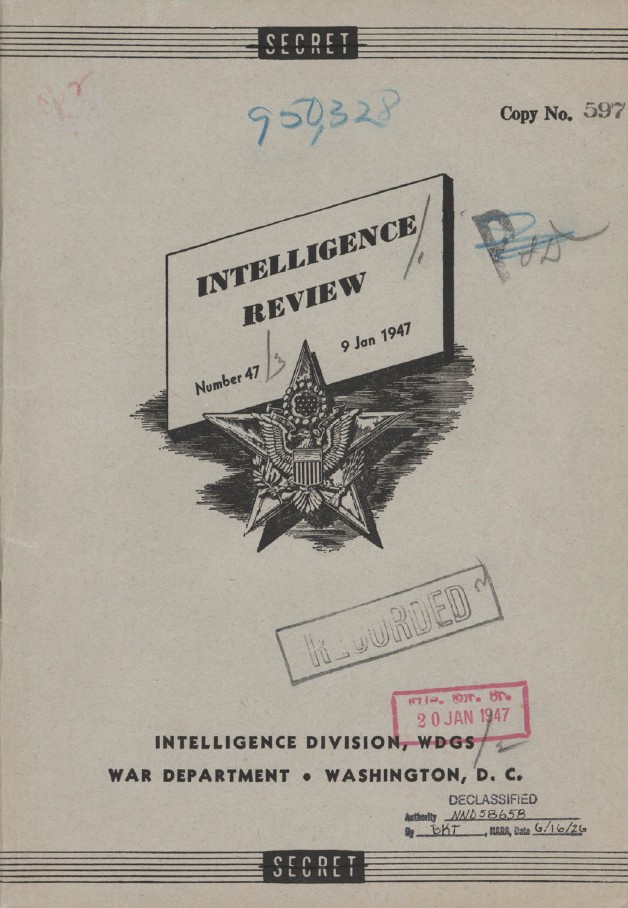
DOW-UAP-D099, Análise de Inteligência sobre Incidentes de “Foguetes Fantasmas”, 1947
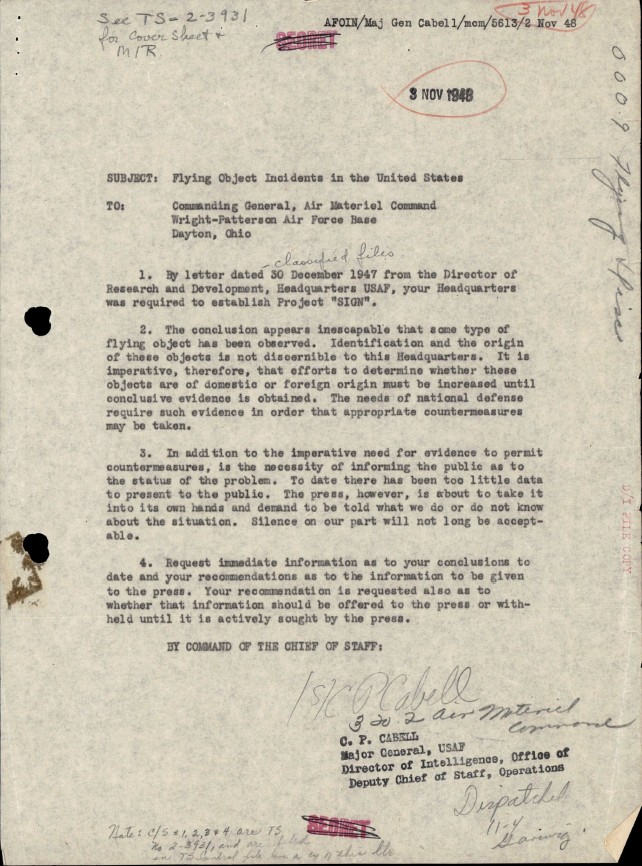
DOW-UAP-D100, Relatório do Air Materiel Command sobre Objetos Voadores Não Identificados, 1947-1948
18_6369445_Geral_1948_Vol_1