Marine-Analyse von UFO-Filmen, Montana und Utah, 1953
Offizielle Datei: DOW-UAP-D098, Filmanalyse unidentifizierter Objekte, 1953
Veröffentlicht am · Aktualisiert am
Kerndaten
- Offizielle Akten-ID
- DOW-UAP-D98 (hier zitiert als DOW-UAP-D098)
- Dokumenttyp
- Dokument
- Behörde
- Department of War
- Veröffentlicht in
- R05 · 2026-08-07
- Datum des Vorfalls
- 1950, 1952
- Ort des Vorfalls
- Montana, Utah
- Koordinaten
- 40.5138376, -111.9438247
- Lesbare Seiten
- 9/23
- VIRIN
- 260807-D-D0360-1087
Offizielle Beschreibung
Diese Akte enthält ein Memorandum zur Bewertung zweier Filme durch das U.S. Naval Photographic Interpretation Center, die angeblich unidentifizierte Flugobjekte zeigen, aufgenommen 1950 in Montana beziehungsweise 1952 in Utah. Die Akte dokumentiert den Analyseprozess des Zentrums, die Annahmen, die den Grad seiner Zuversicht einschränkten, vorläufige Schlussfolgerungen sowie Empfehlungen für künftige Untersuchungen. Das Zentrum kam allgemein zu der Einschätzung, dass die im Film gezeigten Objekte Merkmale aufwiesen, die weder mit natürlichen Phänomenen noch mit allgemein bekannten Luft- und Raumfahrttechnologien vereinbar waren. Das Memorandum dokumentiert die Empfehlung des Zentrums für eine besser ausgestattete Untersuchung zur Bestätigung seiner vorläufigen Feststellungen, wobei ein Mangel an Finanzmitteln und Personal angeführt wird. Die beigefügten Diagramme vergleichen die Leuchtkraft des Films mit der scheinbaren Winkelgröße der Phänomene unter Anwendung zeitgenössischer mathematischer Modellierungs- und photogrammetrischer Analysetechniken.
✦ KI-Zusammenfassung
Dieses 23-seitige Dokument (gestempelt "DECLASSIFIED Authority: NND 67905") enthält ein Laufblatt des Bureau of Aeronautics (Seiten 1-2, Eingangsstempel vom 14. Mai 1953), einen siebenseitigen Zwischenbericht vom 4. Mai 1953 (Seiten 3-9) sowie beigefügte Diagramme und Grafiken (Seiten 10-23), bei denen es sich um Plots und Dichtegraphen statt um Text handelt. Der Bericht stammt vom Officer in Charge des U.S. Naval Photographic Interpretation Center, Washington, D.C. (unterzeichnet von L. W. Keith), und richtet sich an den Director of Naval Intelligence (OP-322H4D); er betrifft die Auswertung von Filmen unidentifizierter Objekte: rund 30 Fuß 16-mm-Farbfilm, aufgenommen am 2. Juli 1952 in Utah, sowie zusätzliche Filme aus Montana von 1950. Der Utah-Film war trocken, spröde und in sehr schlechtem Zustand und wurde daher dupliziert; Positionen wurden anhand von Einzelbildern aufgetragen, die 22-fach vergrößert auf eine Mattglasscheibe projiziert wurden, die Dichte wurde mit einem Densichron Modell 2150 gemessen. Die Analysten sahen drei Gruppen blauweißer, abgeflachter bzw. scheibenförmiger Objekte mit maximaler und minimaler Größe von 98 und 16 Fuß unter der willkürlichen Annahme, sie seien fünf Meilen von der Kamera entfernt, die sich entgegen dem Uhrzeigersinn auf einer elliptischen oder ähnlichen Bahn bewegten. Beim Utah-Film betrugen die maximale und minimale Geschwindigkeit 2457 und 378 mph bei einer maximalen Beschleunigung von 965 g; laut Bericht ist die tatsächliche Geschwindigkeit größer als berechnet, weil die Annahme einer Bewegung senkrecht zur optischen Achse ein Trugschluss sei. Beim Montana-Film, gemessen an terrestrischen Objekten und als zuverlässiger eingestuft, lagen maximale und minimale Geschwindigkeit des linken Objekts bei 1374 und 361 mph, die des rechten bei 1117 und 189 mph. Die Mehrheitsmeinung der Gruppe war, dass die Bilder Lichtquellen sind; sie kam zu dem Schluss, die Objekte seien von einer Art, die sie nicht als natürliche Phänomene oder allgemein bekannte menschengemachte Objekte identifizieren konnte, und schloss Vögel, Flugzeuge und Ballons aus. Der Bericht sagt, die Untersuchung sei durch Mangel an geeigneter Ausrüstung, Geld und Personal begrenzt gewesen und an einem Duplikat einer Kopie durchgeführt worden; eine spektrophotometrische Analyse des Utah-Films sei beantragt und ein vorläufiger Testplan in Arbeit.
Mit KI aus der Originaldatei erstellt — kann Fehler enthalten.
▸Transkript(9 von 23 Seiten lesbar)
[PAGE 1] DECLASSIFIED Authority: NND 67905 CONFIDENTIAL [struck through] BUAER ROUTE SHEET NAVAER-141A (REV. 5-52) [Form: routing grid with columns DIVISION, RTG. & ACT., DATE RECD./RELD., INIT. Divisions listed: CHIEF OF BUAER (AER); AIDE (A); GENERAL INSP. (GI); ASST. RES. TRA. (SR); SMALL BUS. SP (SB); DEPUTY & ASS'T CHIEF OF BUREAU (1); EXECUTIVE OFFICE (12); ADM. SERVICES (AS); AIRCRAFT LOG (AL); COUNSEL (CO); FISCAL (FI); MIL. REQUIREM. (MR); PERSONNEL (PE); PLANS COORD. (PC); ASS'T CHIEF FOR RES. & DEVEL. (2) with DEP. ASST. CHIEF, EXECUTIVE ASST., ASW COORD. ASST., RDB-SPEC. ASST., ADMINISTRATIVE ASST.; AERO. STDS. GP. (AG); AIRBORNE EQUIP. (AE); ARMAMENT (AR); DESIGN ELEMENTS (DE); ELECTRONICS (EL); EVALUATION (EV); EXP. PROGRAM (EP); GUIDED MISSILES (GM); AIRCRAFT (AC); POWER PLANT (PP); RESEARCH (RS); SHIPS INSTALL. (SI); TECHNICAL DATA (TD); ASS'T CHIEF FOR MTL. & SERVICES (4) with DEP. ASST. CHIEF; CONTRACTS (CT); INDUSTRIAL PL. (IP); INSPECTION (IN); MAINTENANCE (MA); PHOTOGRAPHIC (PH); PRODUCTION (PD); PUBLICATIONS (PB); SHORE ESTAB. (SE); SUPPLY (SU); PATENT COUNSEL (PL); USAF LIAISON. SPACE FOR ADDITIONAL ROUTINGS.] [Handwritten routing entries, including "FI-1", "PH 1", "PH 11", "PH 5", "PH-431", "PH-4", dates such as 5/20, 5/19, 6/4, 5/15, 5/18, 6/2, and initials; mostly illegible] [Red stamp: REVIEWED BY NAVAIR DECLASS PROJECT ON 10/4/01 DECLASS IN FULL PER EO 12958 OTHER EQUITIES: YES, with handwritten date] ACTION DESIRED: Expedite; 24 hour reply requested; Confer with; Information and return; Recommendation and return; Return with information req.; Prepare reply for signature of: NO FURTHER ACTION NECESSARY (Signature) [handwritten signature illegible] J12 FILE NUMBERS 1. Red routings shall be made and changed only by Comm. & Files Br. All other routings shall be made in black. 2. Indicate order of routing for both incoming and outgoing correspondence by consecutive numbers. 3. X - Indicates activity preparing reply. (Place in "RTG & ACT." column. To left of column if numeral already inserted.) 4. 0 - Indicates routing of pink copy after correspondence is mailed. (If numerical sequence desired indicate to left of column.) 5. All numerical routings must be initialled prior to mailing. 6. Indicate instructions by placing numerical routings in appropriate box in lower right hand corner. 7. This form is UNCLASSIFIED when blank and unattached. CONFIDENTIAL [struck through] SECURITY INFORMATION [Handwritten: "Enclosure's Recd"; "5/25"] CONFIDENTIAL [struck through] [PAGE 2] CONFIDENTIAL [struck through] (Attach Correspondence Here) COMMENTS 1. In order that persons making comments may be readily identified, comments shall be numbered, dated, legibly signed with the Last Name and Initials, Rank if any, Section, and telephone extension. 2. By order of the Chief of the Bureau, material attached to this route sheet shall not be removed. (See AD 3-1) 3. Extra copies may be removed, but the Record Copy (identified by the control number) must remain attached at all times. [Blank ruled comment lines. Stamp: BUREAU OF AERONAUTICS NAVY DEPARTMENT RECEIVED 1953 MAY 14 AM 8 15] NAVAER 141A (REV. 1-52) (BACK) (Do not write below this line) ATTACH ADDITIONAL COMMENTS ON LETTER SIZE (8x10½) SHEETS ONLY. NUMBER ALL COMMENTS IN DATE ORDER. C-50423 CONFIDENTIAL [struck through] SECURITY INFORMATION CONFIDENTIAL [struck through] [PAGE 3] U. S. NAVAL PHOTOGRAPHIC INTERPRETATION CENTER U. S. NAVAL RECEIVING STATION Washington 25, D. C. Code 01/HWW/lbh J12 Serial: 0105 MAY 4 1953 CONFIDENTIAL [struck through] SECURITY INFORMATION From: Officer in Charge To: Director of Naval Intelligence (OP-322H4D) Subj: Interpretation of Movies of Unidentified Objects; progress report on Ref: (a) Conf ltr DNI OP322Y5/rtm, dtd 27 Oct 1952 with enclosures thereto (b) Conf memo, Chief, Topical Division, USAF, AFOIN 2A2, dtd 24 Nov 1952 with enclosures thereto (c) PIC Conf ltr 01/HWW/gcl, ser 0263 dtd 5 Dec 1952 (d) Rest memo, Chief, Topical Division, USAF, AFOIN 2A2, dtd 16 Feb 1953 Encl: (1) Charts 2-13 1. Reference (a) is a request from U. S. Air Force for the interpretation of movies of unidentified objects taken in Utah, 2 July 1952. Included among the enclosures are approximately 30 feet of processed, 16mm color motion picture film and a list of questions for guidance in determining the type of analysis desired. Reference (b) requested interpretation of additional movies taken in Montana, 1950. This report supercedes reference (c) and presents the test procedures and methods designed to answer the questions contained in enclosure 7 of reference (a). The results and analysis were performed by the Photogrammetry Division, Evaluation Department of this Center and do not necessarily represent the official attitude of the Department of the Navy or this Center. 2. Tests and Procedure. a. Plots. The film exposed in Utah is in very poor condition; dry, brittle, and with a tendency to break. After initial viewing, duplication of the film was performed in order to preserve the film. In the duplication process some color correction was made to permit better viewing of the objects. To prepare plots of the objects, a stop frame projector was rigidly mounted at a fixed distance from a finely-ground glass screen. The magnification was 22 times giving a format size of 14.2" wide. This proved very satisfactory and provided a shadow free image upon which overlay plots could be made. CONFIDENTIAL [struck through] SECURITY INFORMATION [Stamp: CONFIDENTIAL (struck through) SECURITY INFORMATION] [Margin: DECLASSIFIED Authority NND 67905 By BKT NARA, Date 6/23/26; "Enclosure's Rec'd"; handwritten "99", "J12"] [PAGE 4] Code 01/HWW/lbh J12 Serial: 0105 MAY 4 1953 CONFIDENTIAL [struck through] SECURITY INFORMATION Subj: Interpretation of Movies of Unidentified Objects; progress report on A preliminary detailed study of the Utah film was made and it was decided that: a. Brightly colored spots of red and green lasting only one or two frames were not to be considered. b. Water spots could be detected easily and eliminated from the study. c. The color of the objects was fairly constant as blue-white. d. Size and luminosity of an object varied through-out the film. For convenience in interpretation, the film was divided into three parts, each part being considered an entity. Part I consisted of the footage taken at f8; Part II, the footage taken at f16 with a panning motion; and Part III, the footage taken at f16 during which the camera was held steady. Three definite groups of lights were observed throughout the film and plots were recorded as follows: TABLE I PLOTS OF POSITIONS Utah | Parts | Control | Chart I II III | Holding to lower group | Not enclosed I II | Holding to one object and azimuth of another | 2 and 3 I | Arbitrary 1/2 inch correction per frame for panning | 4 III | Holding to frame outline | 5a and 5b I | One image held to base line. Every tenth frame to show changes within apparent formations | 6 Montana | All | Terrestial Objects | 7a and 7b CONFIDENTIAL [struck through] SECURITY INFORMATION 2 [Stamp: CONFIDENTIAL (struck through) SECURITY INFORMATION] [PAGE 5] Code 01/HWW/lbh J12 Serial: 0105 MAY 4 1953 CONFIDENTIAL [struck through] SECURITY INFORMATION Subj: Interpretation of Movies of Unidentified Objects; progress report on b. Densitometric tests: Densitometric data were obtained with a Densichron, Model 2150 manufactured by the Welch Scientific Company. The Densichron has a scale range of 0-3. The procedure was to project each frame at approximately 22 times magnification onto a finely-grained-glass screen. The background (sky) was then measured at several places and the density set to 3.0 (variations in background densities were in the order of 0.02 and were regarded as uniform). A set of three readings were made of each of seven objects in Part I, and of the single object in Part III of the Utah Film. Readings were made of the entire Montana film. Enclosure (8a and 8b) are graphs of the density readings obtained of the two lower groups of objects in frames 1-129 of the Utah film. Enclosure (9) is a density graph of the single object (94 frames) in Part III. Enclosure (10) is a graph where six successive Densichron readings were averaged and advanced one reading each determinant. Of the Montana film, densities were plotted as above and are enclosures (11) and (12). The results of the density readings may be questioned in that these objects varied in size so that at the minimum sizes the densichron probe was measuring the entire object, and at the maximum size the probe was measuring only a portion of the objects. Because of this situation only the largest readings obtained by scanning the objects were used. It is understood that normal procedure would be to read the entire object. This was impossible with the equipment on hand. In addition the film, with which this investigation was conducted, is a duplicate of a copy. This raises the question as to whether the central portion of the objects were burnt out during the duplication processing. Density readings were made to compare the clear areas and the objects. It was found that the minimum difference is 0.4. This indicates that relative luminosity may still be obtained with the procedure used. Concurrent with the density readings, relative sizes of the objects were noted in order to correlate distance and luminosity. Enclosure (13) is a plot of the same object wherein the relationship of distance and luminosity can be detected in Utah film. 3. Answers to Questions. Answers keyed to the questions contained in enclosure (7) of reference (a) are hereby presented. They supercede those contained in reference (c) and present the final analysis as requested. CONFIDENTIAL [struck through] SECURITY INFORMATION 3 [Stamp: CONFIDENTIAL (struck through) SECURITY INFORMATION] [PAGE 6] Code 01/HWW/lbh J12 Serial: 0105 MAY 4 1953 CONFIDENTIAL [struck through] SECURITY INFORMATION Subj: Interpretation of Movies of Unidentified Objects; progress report on 1. Analysis of the graph correlating luminosity and size indicate that as the luminosity of the objects increase, the size is larger also. This could be the effect of viewing directly, a reflecting surface. This is considered not probable because of the length of time they were viewed continuously on the film, approximately 90 seconds, and because of the angle through which they were photographed, approximately 60 degrees. It is felt that if these images are reflective surfaces, blinking would occur during a period of 90 seconds while passing through an angle of 60 degrees when photographed at the rate of 16 frames per second. This premise would permit highly reflective balloons or spheroids to be a possibility. However, the velocity and acceleration computations (sub paragraph 8) rule this possibility out. It appears, therefore, that if these objects are a reflecting surface, they are of a design, speed, and power not commonly known. The velocity and acceleration attributed to the objects may be caused by light reflected off a highly reflective surface onto an atmospheric screen where a slight angular turn of the reflective surface would appear as high acceleration. This possibility is considered not probable because of the sun angle and atmospheric condition reported at the time of photography and because of the variations in luminosity which, under the above conditions would remain constant. It is the majority opinion of the group conducting this analysis that these images are light sources. This will explain the non-blinking and variations in luminosity - but not the velocity or acceleration factors. In either case, light source or reflective surface, it appears as if the objects are of a nature which we are not able to identify in terms of natural phenomena or commonly known man-made objects. 2. There is no indication of what kind of objects could have caused the images except that they must be of a construction, design, and material not commonly known. This is indicated by the computed acceleration rate and elocity (answer 8). For the same reasons, birds, aircraft and balloons are ruled out. 3. An analysis of the charts relative to movement indicate that there were group and individual movement. Within a group it appears as if the individual objects were moving counter-clock-wise along an elliptical or similar track. Thus when two objects crossed the camera line of sight they will appear to fuse into one. As they continued along their paths it will appear as if one object became two. This occured at reglar intervals at approximately every 25th frame as plotted in charts 5a and 5b. CONFIDENTIAL [struck through] SECURITY INFORMATION 4 [Stamp: CONFIDENTIAL (struck through) SECURITY INFORMATION] [PAGE 7] Code 01/HWW/lbh J12 Serial: 0105 MAY 4 1953 CONFIDENTIAL [struck through] SECURITY INFORMATION Subj: Interpretation of Movies of Unidentified Objects; progress report on 4. All objects appear to have the same characteristics in regards to shape, color, size and relative motion. 5. The shape of the objects appears to be oblate or disk shaped, color; blue-white, and maximum and minimum size; 98 and 16 feet. The size is based on the assumption that the objects are five miles from the observer. 6. Fade in and fade out of the objects were analyzed as in 3 above. In this case the group movement was such that the distance between the objects and camera was increased so that the objects could not be recorded on the film thereby causing the apparent fade-out. Fade-in as attributed to a shortening of the distance from the fade-out area to the camera station. 7. Plots of the groups indicate that the objects move counter-clock-wise relative to the axis of flight path. However, nothing has been detected which indicates motion of the individual objects about their own axis although this motion appears to be likely. 8. In determining the velocity of the objects three assumptions were made: a. The camera was held steady during Part III of the film. b. The objects were moving perpendicular to the optical axis, and c. The objects were five miles from the camera. It is obvious that (b) is a fallacy; however, this assumption will give the minimum velocity and the actual velocity is greater than computed. The assumption that the objects are five miles from the camera is an arbitrary one. However, based on the emulsion speed and focal length, an object 50 feet in diameter and five miles from the camera will be recorded on the film with sufficient resolution to identify major details of the object. It is felt that if these objects were closer than five miles at the time of recording, details would appear on the film. Velocity is computed to be 3780 mph for a shift of 1 mm per frame if the object is five miles from the observer. From 55 measurements taken from Part III of the Utah film, the maximum and minimum velocities CONFIDENTIAL [struck through] SECURITY INFORMATION 5 [Stamp: CONFIDENTIAL (struck through) SECURITY INFORMATION] [PAGE 8] Code 01/HWW/lbh J12 Serial: 0105 MAY 4 1953 CONFIDENTIAL [struck through] SECURITY INFORMATION Subj: Interpretation of Movies of Unidentified Objects; progress report on were 2457 and 378 mph respectively. These figures differ from those given in reference (c) and were computed from measurements obtained under more controlled conditions. Acceleration was determined from the formula: a = (Vf - VO) / T where: a = Acceleration Vf = final velocity VO = initial velocity T = time = 1/16 second Since "g" is equal to 32.17 ft/sec2 it was computed that: Maximum acceleration = 21,168 mph/sec = 965 g Minimum acceleration = 1,104 mph/sec = 50 g Maximum deceleration = 32,448 mph/sec = 1479 g Minimum deceleration = 272 mph/sec = 12 g Velocity and acceleration determinations were also made from the Montana film. In this case, terrestial objects appeared in the film and were held to as control. Subsequently, the velocity and acceleration determinations are considered to be more reliable. On the assumption of (b) and (c) above the maximum and minimum velocities of the left object are 1374 and 361 mph respectfully. For the right object they are 1117 and 189 mph. Accelerations were computed as: | Left Object | Right Object Maximum acceleration mph/sec | 14,016 = 639 g | 12640 = 576g Minimum acceleration mph/sec | 0 = 0 g | 0 = 0g Maximum deceleration mph/sec | 13,184 = 601 g | 14288 = 651g Minimum deceleration mph/sec | 0 = 0 g | 0 = 0g The above determinations were made from a total of 322 measurements. It was noted that the acceleration and determinations were in multiples of 12.5 approximately. This may be of significance although no study has been conducted to determine this. 9. Velocity and acceleration were treated in sub-paragraph 8 above. Paragraph 2a indicates the controls used during this investigation. CONFIDENTIAL [struck through] SECURITY INFORMATION 6 [Stamp: CONFIDENTIAL (struck through) SECURITY INFORMATION] [PAGE 9] Code 01/HWW/lbh J12 Serial: 0105 CONFIDENTIAL [struck through] SECURITY INFORMATION Subj: Interpretation of Movies of Unidentified Objects; progress report on 10. a. There is no recurring pattern in the relative position of the objects in formation. It appears however, as if the shift in relative positions were regular and that the original formation would be recovered if the continuing action has been recorded. b. No. However, the same formation is maintained with objects changing positions. c. No detection of relative positions being maintained coincidental with movement about their axis. d. No detection of undulating motion of objects in phase either in formation or tumbling motion. e. There is evidence of abrupt changes in direction of flight path through fairly large angles. f. Certain objects do appear to remain motionless while other move about. g. Certain objects disappear while still well within the field of view. This is discussed in sub-paragraph 6 above. 4. Discussion. During the study and investigation of the unidentified objects, the preliminary data uncovered were revealed to experts (with proper security clearance) in the fields of astronomy and physics. Although they presented certain natural phenomena theories to explain the cause of the objects under certain conditions they were not able to do so under the conditions during which the photography was taken, nor were they able to recognize these objects as man-made. As to the results of the investigations being reported, no attempt was made to corroborate the opinions presented. Because of the lack of proper equipment, money and personnel, the investigation was limited. There are obvious tests which can be conducted to prove or disprove some of the findings presented. It is suggested that these be undertaken. 5. Reference (d) requests spectrophotometric analysis of the Utah film be made. Preliminary plan of test is underway. [Signature] L. W. KEITH Copy to: CNO (OP553) BuAer (PH) CONFIDENTIAL [struck through] SECURITY INFORMATION 7 [Stamp: CONFIDENTIAL (struck through) SECURITY INFORMATION] [PAGE 10] [Diagram: Page scanned rotated 90 degrees. Three line graphs on millimeter graph paper, titled "PLOTS OF DENSITY AND MAGNITUDE (SIZE) OF AN OBJECT SHOWING POSSIBLE RELATIONSHIP"; panels "Magnitude (Size-Minor Axis) Plot", "Magnitude (Size-Major Axis) Plot" and "Density Plot", each plotted against Frames 0-100 (magnitude axes about 20-50 and 20-60; density axis 20-30). Labelled "Enclosure 13". Stamped CONFIDENTIAL (struck through) SECURITY INFORMATION.] [PAGE 11] [Diagram: Page scanned upside down. Line graph on millimeter graph paper with two curves (legend: Image 1 dashed, Image 2 solid), Frames axis 0-130 and density axis 22-32. Labelled "End 12" (Enclosure 12). Stamped CONFIDENTIAL (struck through) SECURITY INFORMATION.] [PAGE 12] [Diagram: Line graph titled "DENSITY READINGS" on millimeter graph paper, two curves (Image 1 solid, Image 2 dashed), Frames axis 0-130, density axis 22-34. Annotations: "NO IMAGE" (around frames 10-12); "NOTE - Montana film. Lowest reading indicates brightest image"; "Enclosure 11". Stamped CONFIDENTIAL (struck through) SECURITY INFORMATION.] [PAGE 13] [Diagram: Line graph titled "DENSITY READINGS" on millimeter graph paper, single curve, Frames axis 0-50, density axis 3.4-3.8. Note: "Phase III Utah Film"; "Enclosure 9". Stamped CONFIDENTIAL (struck through) SECURITY INFORMATION.] [PAGE 14] [Diagram: Line graph titled "DENSITY READINGS" on millimeter graph paper, four curves (Images 1-4 in the legend), Frames axis 0-100, density axis about 20-30. Note: "Smallest recording indicates brightest image Part II"; "Enclosure 8 A". Stamped CONFIDENTIAL (struck through) SECURITY INFORMATION.] [PAGE 15] [Diagram: Line graph titled "AVERAGE OF DENSITY READINGS" on millimeter graph paper, four curves (Images 1-4 in the legend), Frames axis 0-120, density axis about 22-32. Labels: "Enclosure 10"; "Note Utah Film". Stamped CONFIDENTIAL (struck through) SECURITY INFORMATION.] [PAGE 16] [Diagram: Hand-traced plot of object tracks on gray paper: several thin dotted curved lines, including a long arc in the middle, with no text other than the label "Enclosure 2" and the stamp CONFIDENTIAL (struck through) SECURITY INFORMATION at top and bottom.] [PAGE 17] [Diagram: Hand-traced plot of object tracks on gray paper: several jagged traced lines in clusters near the center and short dotted marks; labelled "Enclosure 3". Stamped CONFIDENTIAL (struck through) SECURITY INFORMATION at four corners.] [PAGE 18] [Diagram: Long narrow chart of traced position lines labelled Group I, Group II and Group III, with legend "Image 1-4" in different line styles; labelled "Enclosure 4".] [PAGE 19] [Diagram: Page scanned upside down. Single wavy traced line with dots across the middle of gray paper; labelled "Enclosure 5A". Stamped CONFIDENTIAL (struck through) SECURITY INFORMATION at four corners.] [PAGE 20] [Diagram: Traced wavy lines in different line styles on gray paper; legend "Image 1" to "Image 5" in different line styles; labelled "Enclosure 5B". Stamped CONFIDENTIAL (struck through) SECURITY INFORMATION.] [PAGE 21] [Diagram: Plot titled "RELATIVE IMAGE POSITION WITHIN A GROUP": rows of small symbols (circle, plus, asterisk, square, triangle, star) plotted along a frame scale of about 0-130, with a dark band across the middle of the scan. Legend: Image 1 to Image 7 with a different symbol each. Note: "Plots made of every ten frames. Image 1 plotted on a base line for control". Labelled "Enclosure 6". Stamped CONFIDENTIAL (struck through) SECURITY INFORMATION.] [PAGE 22] [Diagram: Wide plot of two nearly parallel traced lines (Image 1 solid, Image 2 dashed) sloping down to the right. Note: "Montana Film". Legend: Image 1, Image 2. Labelled "Enclosure 7". Stamped CONFIDENTIAL (struck through) SECURITY INFORMATION at four corners.] [PAGE 23] [Diagram: Line graph titled "DENSITY READINGS" on millimeter graph paper, three curves (Images 5, 6, 7 in the legend), Frames axis 0-100, density axis about 2.4-3.2. Note: "Smallest reading indicating brightest image. Part I". Labelled "Enclosure 8B". Stamped CONFIDENTIAL (struck through) SECURITY INFORMATION.]
Mit KI aus der Originaldatei erstellt — kann Fehler enthalten.
Automatische Übersetzung — das Originaldokument ist auf Englisch. Auf Englisch ansehen →
Quelle: US-Kriegsministerium / AARO — gemeinfrei · war.gov/ufo
Entitäten in diesem Dokument
Verbundene Fälle
18_100754_ General 1946-7_Vol_2
18_6369445_General_1948_Vol_1
255_413270_UFO's_and_Defense_What_Should_we_Prepare_For
38_143685_box_Incident_Summaries_101-172
38_143685_box_Incident_Summaries_173-233
38_143685_box7_Incident_Summaries_1-100
Verwandte Fälle
 ▶ 70s
UFO-Film von Tremonton, Utah, 1952 (Newhouse)

UFO-Berichte: Glendale und Los Angeles, Juni 1949

UFO-Bericht: Kugel über Sardinien, Italien, 1952

UFO-Bericht: drei Pfadfinder auf Santa Catalina, 1952

UFO-Brief an Kenneth Arnold: Catalina, 1949

UFO-Film von Tremonton: Project Blue Book, 1952
Gleiche Aktenserie
UFO-Einsatzbericht, Persischer Golf, 2020
UFO-Einsatzbericht, Persischer Golf, 2020
UFO-Einsatzbericht, Persischer Golf, 2020

UFO-Einsatzbericht, Persischer Golf, 2020

UFO-Einsatzbericht, Persischer Golf, 2020

UFO-Einsatzbericht, Dschibuti, 2025
Gleicher Zeitraum
Gleiche Veröffentlichung
Geisterraketen über Schweden: UFO-Bericht, 1947
UFO-Akten zu Project Sign: Air Materiel Command, 1948
NASC-Anfrage zum angeblichen UFO in Bahia, 1963
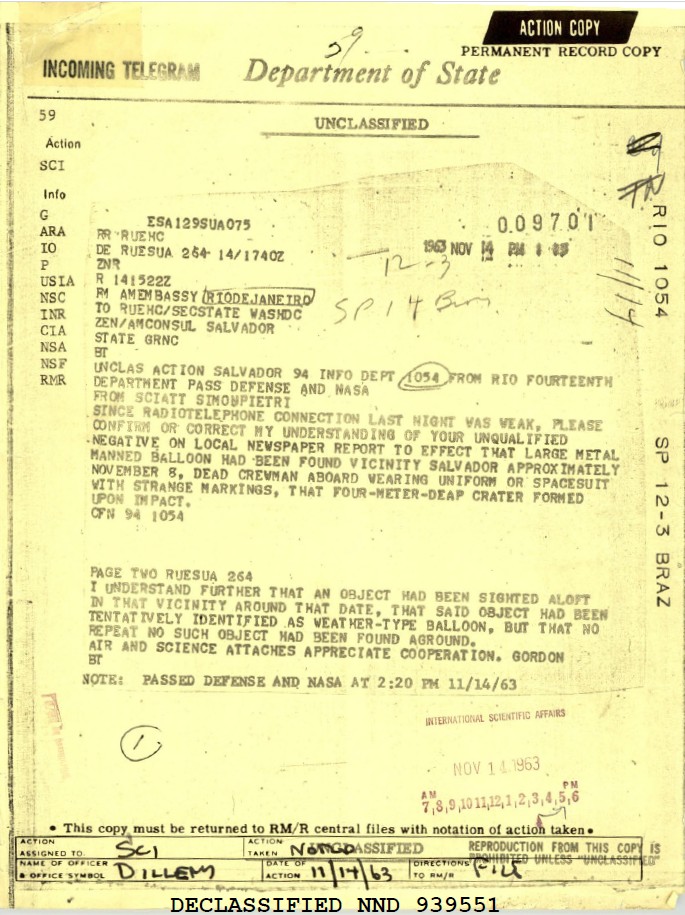
US-Depesche zu einem UFO in Bahia, Brasilien, 14.11.1963
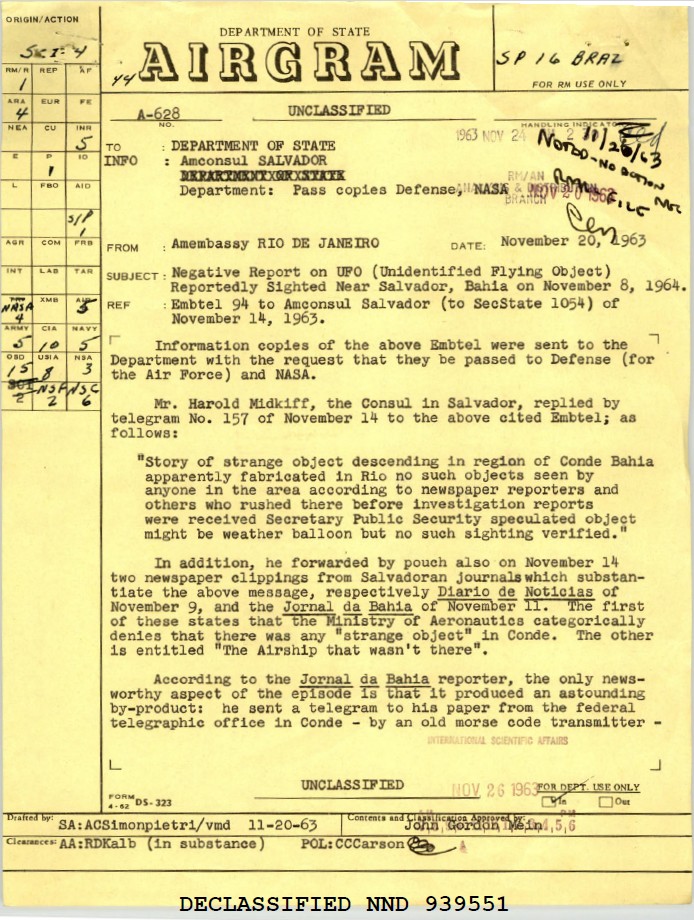
US-Depesche zu einem UFO in Bahia, Brasilien, 20.11.1963
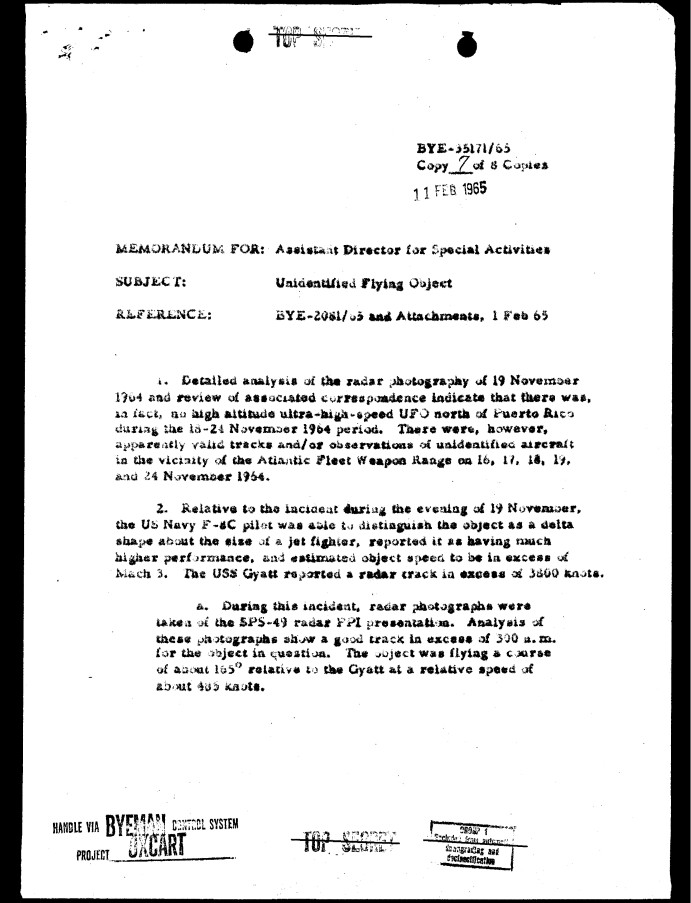
CIA-Memos zu einem UFO bei Puerto Rico, 1964
Gleiche Behörde
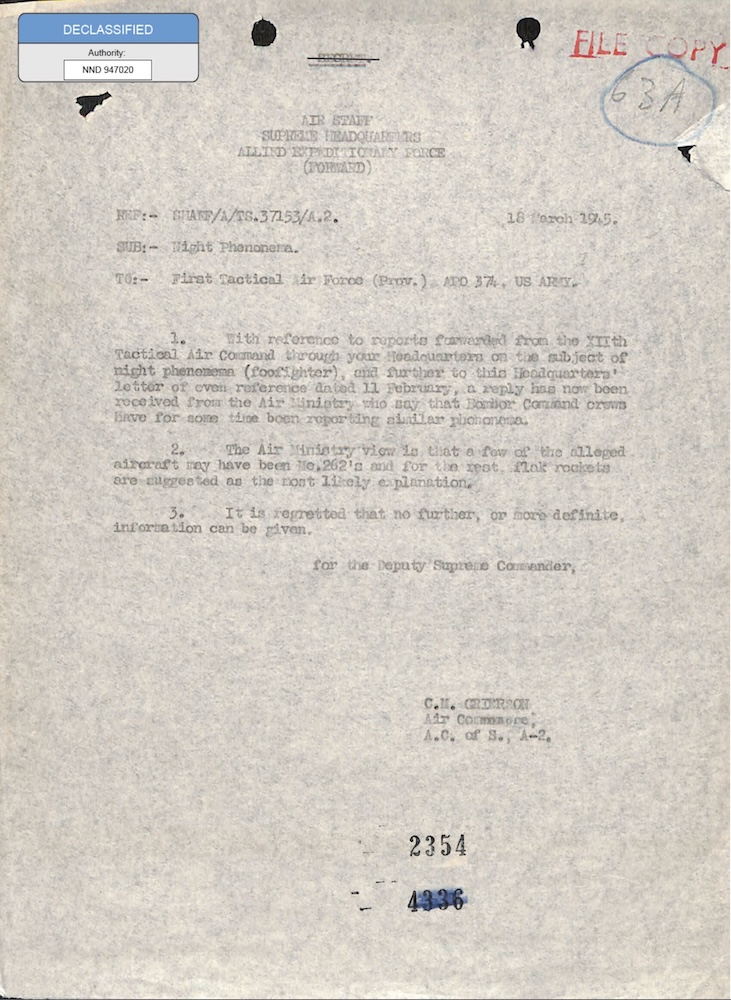
Foo Fighters: UFO-Akte des SHAEF, 1945
UFO-Akte Flying Discs: Twining-Brief, 1947
Project Sign: UFO-Akte Flying Discs, 1948
Project-Sign-Bericht zu 100 UFO-Sichtungen, 1948
Studie der US-Luftwaffe zu UFO-Vorfällen, 1948