NASA-UAP-D027, Debriefing da Apollo 14 (Continuação), 1971
Dados principais
Descrição oficial
Este arquivo contém o segmento 2 de 2 do debriefing pós-missão da tripulação da Apollo 14 no Manned Spacecraft Center (atual Johnson Space Center), em Houston, Texas. Neste segmento de continuação, membros da tripulação e entrevistadores continuam a discutir o “fenômeno de clarões de luz” (light flash phenomena), um efeito biológico então recém-descoberto e hoje bem documentado, no qual raios cósmicos de alta energia atravessam o olho e atingem a retina, causando a percepção de riscos ou clarões de luz.
✦ Resumo IA
Este áudio dá continuidade (segmento 2 de 2) ao debriefing pós-missão da tripulação da Apollo 14 no Manned Spacecraft Center, em Houston, com o comandante Alan Shepard, o CMP Stuart Roosa e o LMP Edgar Mitchell discutindo o fenômeno dos flashes de luz com os investigadores de voo. Os membros da tripulação usam cartões de referência impressos em uma sala escurecida para definir o vocabulário ('risco', 'flash/estrela', 'nova'), quantificar o comprimento dos riscos e um campo periférico de cerca de 150-160 graus alcançado até 50-60 graus por alguns flashes, e descrever alguns como 'quebrados' em dois pontos rápidos sugerindo movimento pela retina curva. O novo material inclui um brilho difuso branco/prateado semelhante a um 'relâmpago de calor' que ninguém conseguiu associar aos cartões de referência; relatos fortemente enviesados para o olho direito, apesar de um membro da tripulação acreditar favorecer o esquerdo; três coincidências de flashes simultâneos entre membros da tripulação; evidências de que uma lanterna sobre os olhos NÃO eliminou a capacidade de ver flashes, desafiando a hipótese de adaptação ao escuro; uma correlação entre observar um objeto brilhante e depois fechar os olhos; e um flash azul-branco em forma de 'diamante azul'. Encerra com recomendações para futuras missões.
Gerado com IA a partir do arquivo oficial — pode conter erros.
▸Transcrição
[00:00] Crew (Roosa): Most of my streaks appeared to be on the periphery, and for the first several days I got the impression that one direction was predominant. Later on it seemed I couldn't get that good a pattern, but that was my first impression for the first couple of days. [00:22] Debriefer: Was there any apparent direction of propagation — could you tell it was moving from one side to the other, or was it just a flash? [00:33] Crew: Some of the time it went from left to right or similar. I tried to correlate it, but I couldn't really find a pattern. [00:42] Debriefer: The time period when we tried to report them streak by streak, flash by flash — was that representative? It seemed generally random during that period, and therefore generally random throughout. [01:00] Debriefer: No, I meant could you detect it moving from one side to the other? — Crew: Yes. It was moving — a specific flash traveling from one side to the other, definitely. [01:14] Debriefer: You really think you reported it that way? — Crew: Yes, we did. It was puzzling because it happens very fast. [laughter] [01:30] Debriefer: Was there some character to the flashes with an aspect of direction — were they all rod-shaped, or did they have a tail? [01:41] Crew: What I reported as a streak was simply that. Maybe subconsciously I determined direction because it was a ball of light moving and leaving a tail — but I can't say for sure. All I reported was a streak, with the impression it moved from one direction to the other. [02:10] Debriefer: Let's dim the lights and use these reference cards so you can point to whether any of these resemble what you saw. [02:26] Crew: Yes, except it was traveling — it started and definitely progressed across the field of view, in a specific direction. [02:43] Crew: I never saw two [streaks] simultaneously. — Another crew member: Neither did I. [02:54] Debriefer: At one point you described a semicolon-shaped object, in an earlier report. — Crew: I don't recall that; if I reported it, that's what I saw, but I don't remember it now. [03:19] Crew: We discussed the various shapes before the flight and I concentrated on trying to see the shapes. As I reported: it was either a simple streak or a simple flash — nothing too exotic. A rarer one was just a pinpoint of light for an instant rather than a full flash — that was rarer than the other two. [04:01] Debriefer: By "flash" you mean something more distributed? — Crew: Yes, like watching an explosion — a ball, versus just a steady dot. [04:15] [Crew reviews printed reference images with the debriefers in the dimmed room, pointing to which shapes match what they saw — several exchanges of "can you see that one," "no," "that's the pinpoint I'm describing."] [04:52] Crew: The eruption, or "nova" as we called it, would be more of an explosion — a very bright center with a diffused edge, though the center wasn't predominantly that bright; that's closer to what I'd call a nova or flash. [05:26] Debriefer: Ed, was your nova an explosion like this, or a discrete flash? — Crew (Mitchell): No — what I called a nova was more of a blob that started small and expanded, growing more diffuse over time, but brighter than a simple flash. That's what I'd call a flash or star versus a nova — here the contrast between center and diffused area is too strong, and the timing of the flashing in these cards is too slow; it was faster than that. [06:05] Debriefer: So when you said "flash," did you really mean "star," not what you just described? — Crew: I tended to use flash and star interchangeably. — Another crew member: Not for me — flash and nova were essentially the same thing for me; the only distinction I made was pinpoint versus explosion. [06:29] Debriefer clarifies: what Stu called a "pinpoint" is about what others called a "star" or "flash," and a "nova" was a much bigger, brighter event. [06:42] Debriefer: Quick ones first — was the cabin lighting completely dark, or were instrument lights on during the quantitative reporting period? — Crew: Absolutely dark, confirmed for the period of the formal quantitative report. [07:00] Debriefer: Did you have your eyes closed most of the time, or open in the dark cabin? — Crew: Mine was closed. Even with window shades on, when we rolled so the sun hit some windows, light seeped in around the edges — we were aware of that. Eyes were closed during those periods, open otherwise, and always closed when someone flashed a flashlight. Generally speaking though, eyes were open. — Another crew member: Mine was almost always closed — I was floating near a corner of the LM and kept my eyes shut because I didn't know when we'd roll into the sun and didn't want any light at all. [07:42] Debriefer: On the flashlight test — what was the approximate duration in each eye? — Crew: About five seconds, moved across the eyes. — Debriefer: Five, six seconds — it hurt, right? — Crew: Right. [08:03] Debriefer: On your orientation in the LM — you said you were looking toward plus-X; were you across? — Crew: Roughly — with the three couches, plus-X being forward, I was oriented with my head looking face-up in that corner. — Debriefer: So your head was in the same direction as on the couch, just rotated 90 degrees? — Crew: Yes. [08:36] Debriefer: In almost every case you reported it was one eye or the other, with at least one incident of both eyes — were you certain you could distinguish which eye? — Crew: I felt I was getting more on the left for some reason. — Debriefer: In fact, all of you were heavily biased toward the RIGHT eye in your reports. — Crew: Really? — Crew: I'd have sworn I was biased left. — Debriefer: You had twelve right and six left; Al, ten right and four left; and Stu, six right and two left of the ones reported — the rest were unreported or both eyes. Very heavily biased to the right eye. — Crew: That's very surprising. [09:22] Crew: It seemed to me I'd get a flash or streak simultaneous with somebody else reporting one. — Debriefer: That's exactly the next question — from listening to the tapes, there were three such coincidence events, involving different pairs of crew members. In one case Ed said "flash" and Al reported a simultaneous flash in his right eye. Was it simultaneous right after he began speaking, or was his verbal mark good enough for you to note your own flash against it? — Crew: Within a fraction of a second, I think. — Crew: Yes, a couple of times his mark, or whoever's, was good enough. — Crew: Same here. [10:23] Debriefer: Earlier, before this session, you mentioned "halos" you'd seen — a flash followed by an afterglow. Were the after-effects present most of the time — a spike then a glow? — Crew: Only with what I call the nova or supernova. — Debriefer: Is that true for you too? — Crew: I didn't really notice a halo effect — not sure what's meant by it, a diffused brightness? — Debriefer: More like an afterglow. — Crew: I don't remember calling any of those. — Crew: No, I didn't describe it, and don't think I saw any. [11:25] Debriefer: Do you recall making any observations in lunar orbit? There were no formal periods, but... — Crew: I thought about that on the way back — I was so tired that night I don't remember seeing any flashes, but I wasn't looking for any either, so I wouldn't take that as a data point. [11:59] Debriefer: After the formal session, around 191 hours GET, you had a sleep period later on — do you recall seeing any during that period, closer to Earth [inside the magnetopause]? — Crew: I don't consciously recall any, other than on the lunar surface. — Debriefer: You definitely didn't see any on the lunar surface? — Crew: I don't remember about the lunar surface — there was precious little sleep that night. [12:40] [Lights dimmed further in the room for another round of visual comparison.] Debriefer: One additional question — did you get the impression the light flashes could have been within the cabin, or definitely within your eye? — Crew: Definitely within the eye. [12:57] Debriefer: I want to get an idea of orientation and length of the streaks — did you ever see anything in the spotlight [reference light]? — Crew: No, never. [13:09] Debriefer: You used "o'clock" terminology — when you say six o'clock to the center, about how long is the streak? — Crew: Hard to answer. — Debriefer: If you visualize something about arm's length away, how long would your streak be? [Crew uses fingers to estimate; described as roughly two inches long, appearing three to four inches in front of the face.] [14:42] Crew (another): It depends how big a circle I draw for my field of view — with my eyes closed I imagine a rather large field of view, so I'd say I saw streaks about that long. One crew member described length as about half the radius of the field of view of the eye. [15:16] Debriefer: One time you said the streaks had a certain preferred orientation — do you remember? — Crew: Yes. — Debriefer: And Ed, what about you? — Crew (Mitchell): I had them from several directions and reported them as moving from one direction to the other at the time — there were several. — Debriefer: Al, any particular orientation, up-down or left-right? — Crew (Shepard): I didn't notice any preferred orientation. I'd try to express the arc length of the flash in terms of the peripheral field — if the horizontal peripheral field is roughly 150 to 160 degrees, the light flashes in some cases spanned as much as 50 to 60 degrees of that. [16:12] Debriefer: Were the light flashes broken in the center? — Crew: In some cases, yes — the impression of two dots, one immediately following the other, giving the sense of right-to-left, top-to-bottom, bottom-to-top, or left-to-right motion. — Debriefer: The point is the retina is curved enough that a straight streak shouldn't be able to get very long without going off the retina — in the plane of the retina it's a straight line. — Crew: But it has some depth, doesn't it? — Debriefer: It shouldn't be longer than that if it's on the retina in one track — but if it crossed a couple of areas of the eye, you'd get the impression of a longer streak. That's why we're interested in the character of it. [17:00] Debriefer: One more thing — about the "cloud" you saw. This is a new phenomenon we hadn't expected — can you describe this lightning-behind-a-cloud effect? — Crew: I reported it a couple of times — it appeared down low in one eye or the other, and it was just a diffuse glow. — Debriefer: Any color? — Crew: White, silver. — Debriefer: If you were out in the country looking at the horizon with lightning behind a cloud, was it like that? — Crew: Except normally you'd see a streak behind the cloud — this had no streak, just a diffuse glow. [17:39] Debriefer: We have a device that simulates that sort of phosphene — maybe you can look at it once you're out of quarantine. [Attempt to reproduce the effect using cards/lights in the room; crew could not positively identify a match — "I didn't see it," "still don't see it," "haven't seen anything on it."] Debriefer: What you're describing sounds like what we used to call heat lightning as a kid — a general diffuse light. — Debriefer: Did you see an outline of the cloud? — Crew: No, not necessarily — just a blob of light. [18:35] Debriefer: One final question — did you notice any other sensations besides the flashes themselves — tingling, twitching, hearing anything? The reason for asking is that if this is an interaction back in the brain, other senses might be about as sensitive as vision, and you might notice something you hadn't connected to it — for instance, thumb itching or lip twitching. — Crew: Didn't notice it. — Crew: Didn't notice any sensation. — Crew: Never looked for it either. [20:07] Debriefer: I told Ed yesterday that you really provided enormously improved [quantitative] data on this phenomenon compared to previous missions — that's great. — Crew: I'd add that this is really the way to go — set aside a definite period and concentrate, because otherwise it's so random, with so many other things going through your mind, that a dedicated period is the only way to get anything quantitative. [20:32] Debriefer: Was it unreasonable to ask you to concentrate on this for that length of time without falling asleep? — Crew: It's a pretty boring thing to do, lying there watching. — Debriefer: Should this be planned for future missions, without overdoing it since it's tiring to lie there concentrating? — Crew: If you can find a time period during the flight when there isn't much else to do, it's reasonable to suggest it — but I wouldn't do it right before a sleep period or when they're tired, or they'll fall asleep watching. [21:14] Crew: I think if you brief the crew a bit pre-flight like we did, they'll know the phenomenon is there — the first sleep period or the first time the spacecraft goes dark and they close their eyes, they're going to see flashes, and that sparks curiosity, so when you ask them to settle down and count them, they'll be agreeable to it. [21:42] Crew (Roosa): One other comment, not sure if it's related — just a general impression — if I'd look at, say, the glow of my wristwatch or something like that, and then close my eyes again, I'd almost always see a flash. I tried to correlate looking at a crack of light through the window shade, or my watch, and then closing my eyes, and I came to the impression the two may have been correlated — though I never looked at it enough to say for sure. But I think there was a correlation between seeing a light like that and then closing your eyes and picking up a flash soon after. [22:36] Debriefer: That's an important observation — if the action is directly on the bipolar or retinal cells rather than another mechanism, you might expect it to behave like electrical phosphenes rather than something requiring dark adaptation from light. What do you think, Ed? — Crew (Mitchell): Not quite sure what your point is. — Debriefer: I was going to make the comment that, with respect to the flashes, putting the flashlight in my eyes did NOT seem to destroy my dark adaptation — not sure what that means. [23:08] [Crew demonstrates the flashlight-wiping motion; confirms it was done for about a minute, roughly five seconds per pass, with eyes open.] Debriefer: You're saying the reason you think you didn't wipe out your dark adaptation is that you could still see the flashes? — Crew: Well, the cockpit looked different — it seemed, with what I consider dark adaptation, that I actually dark-adapted sooner after doing that than when we started the experiment. [24:14] Crew: I'd like to nail down this dark adaptation point — during the formal hour-forty session Ed was shining the light, but I also did that during one of the sleep periods before that, and you do not have to be dark-adapted to see these flashes. — Debriefer: That's a very significant data point — it almost certainly proves this isn't a real light in your eye in the conventional sense; it takes only a minute to trigger them. [24:41] Crew: But why did it take so long when we started the formal experiment before we saw anything — quite a while — and yet when I wiped the light across my eyes, within thirty or forty seconds there they were again [reported as seventeen minutes for the first flash of the formal session]. — Crew: They seemed fainter than earlier times. — Debriefer: There's definitely some kind of threshold effect, because you saw twice as many during that period as the other two. — Debriefer: Maybe you just weren't yet tuned to fainter flashes, and it took a while to adjust your attention. — Crew: That may be the case, except they were indeed fainter at the beginning and got brighter after a while — it wasn't simply a matter of looking for fainter objects; and after the flashlight pass, they didn't diminish in brightness — still just as bright thirty seconds later as before I used the flashlight. That's why I question the dark-adaptation explanation — either I didn't actually wipe out the dark adaptation, or dark adaptation is related to the phenomenon in some other way. [26:12] Crew: It didn't make sense to me either — the dark, quiet period we did it in and the few flashes we saw was very surprising, and we commented on it at the time. It seemed like when you'd wake up during a sleep period, they'd be all over the place — though maybe I lose track of time lying there in the dark cabin, and it was longer than I thought — but it seemed like an abundance of flashes. I was amazed it took seventeen minutes to see one in the formal session; I thought any time you closed your eyes and concentrated, you'd see these things. [26:52] Crew: That's why I'd suggest doing it non-quantitatively as often as possible, aside from the formal timed period, since it's such a random function. Each individual is probably also reporting at different activity thresholds — I had a feeling of faint things I didn't want to call out because I couldn't confidently call them a flash. — Crew: Yeah, I had those too. [27:23] Debriefer: That's a good reason to capture data in real time, since your subjective impression afterward isn't necessarily accurate — you felt one way and it turned out not to be true. — Debriefer: When you go to sleep at night normally, do you see any of these? Most people see something as they're falling asleep in a dark room. — Crew: I think everybody does — you get lights blinking around in your eyes in a really dark room occasionally. Maybe it's because we never really concentrated on looking for this specific type of phenomenon before. — Debriefer: Were the in-flight ones different from what you see occasionally on the ground? — Crew: Certainly a lot more frequent. — Debriefer: How about in [unintelligible — possibly a reference to bunk beds or a location]? — Crew: Hard to say — I'll make a note to watch for it from here on, but I certainly haven't noticed any since we've been back. [28:32] Crew: Ed mentioned this and I agree — it's another subjective thing, but the flashes seen waking up in the middle of the night, as a whole, appeared brighter than the flashes during the daytime formal experiment. I was, like Al, a little reluctant to call anything except a very positive flash during that formal time frame — I wanted to be really sure before calling it a mark. But the ones seen in the middle of the night seemed brighter and more numerous — though you might lose track of time lying there for what feels like five or ten minutes but is really longer; it's a subjective thing. [29:24] Debriefer: Ed saw one blue flash — did anyone else see color? — Crew: No — wait, that wasn't blue... — Crew (Mitchell): It was silver, a blue-white, sort of like a blue diamond. — Debriefer: Was that the brightest one you saw? — Crew: I don't recall it being the brightest, no. [29:41] Debriefer: Has anybody hit their head and seen stars — were these anything like that? — Crew: I think I was more concentrating on the pain. [laughter] [29:55] Debriefer: Tonight, in a dark room, if you press on your eyeballs you should see flashes — might be worth comparing whether they look like the same sort of thing. — Crew: Yeah, we cry a lot in here already. [laughter] [30:11] Crew: If you can get the next crew interested in this, Phil, it makes a great topic of conversation during translunar coast when there's nothing else to talk about — you can talk about light flashes. [laughter] If you get the crew's curiosity aroused, that's a good thing. — Crew: I think the interest and pressure built up around this subject is such that there will likely be a formal experiment on it in the future — probably the way to go. [30:41] Debriefer: Okay, thanks very much. — Crew: Thank you. Thank you. — Debriefer: We'll stay in touch and let you know what we decide to do about this and how the timing is coming for the end of the debrief. [Session moves into brief administrative discussion of quarantine release scheduling and upcoming radiation body-count measurements — not related to the light flash phenomenon.]
Gerado com IA a partir do arquivo oficial — pode conter erros.
Tradução automática — o documento original está em inglês. Ver em inglês →
Fonte: Departamento de Guerra dos EUA / AARO — domínio público · war.gov/ufo
Entidades neste documento
Casos conectados
NASA-UAP-D026, Apollo 14 Debriefing, 1971
NASA-UAP-D008, Apollo 12 Medical Debriefing - Tape 12, 1969
NASA-UAP-D028, Apollo 17 Crew Medical Debriefing, 1972
NASA-UAP-D029, Apollo 17 Crew Medical Debriefing (Continued), 1972
DOE-UAP-D001, Enhanced PANTEX Imagery
DOE-UAP-D004, Los Alamos Conference on Aerial Phenomena, 1949
Casos relacionados
Mesmo local
NASA-UAP-D008, Entrevista Médica Apollo 12 - Fita 12, 1969
NASA-UAP-D026, Debriefing da Apollo 14, 1971
NASA-UAP-D028, Debriefing Médico da Tripulação da Apollo 17, 1972
NASA-UAP-D029, Debriefing Médico da Tripulação da Apollo 17 (Continuação), 1972
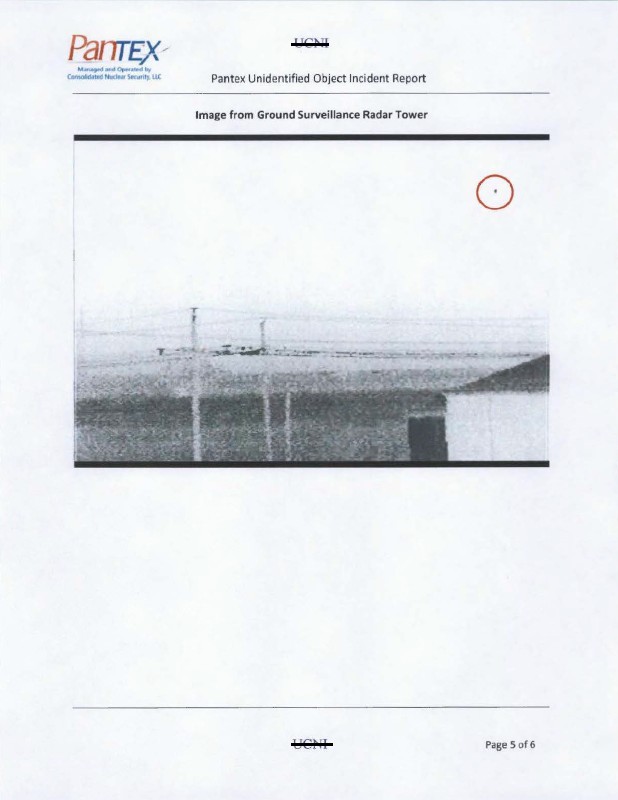
DOE-UAP-D005, Relatório de Incidente com Objeto Não Identificado em Pantex, 2015
Mesma série de arquivos
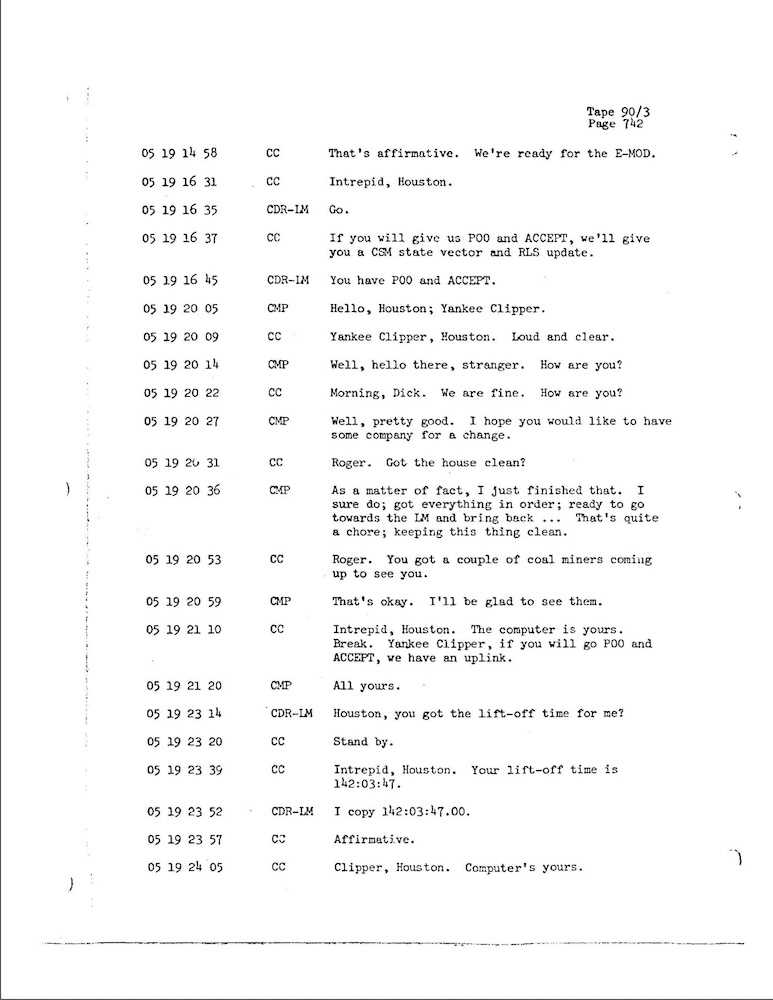
NASA-UAP-D001, Transcrição Apollo 12, 1969
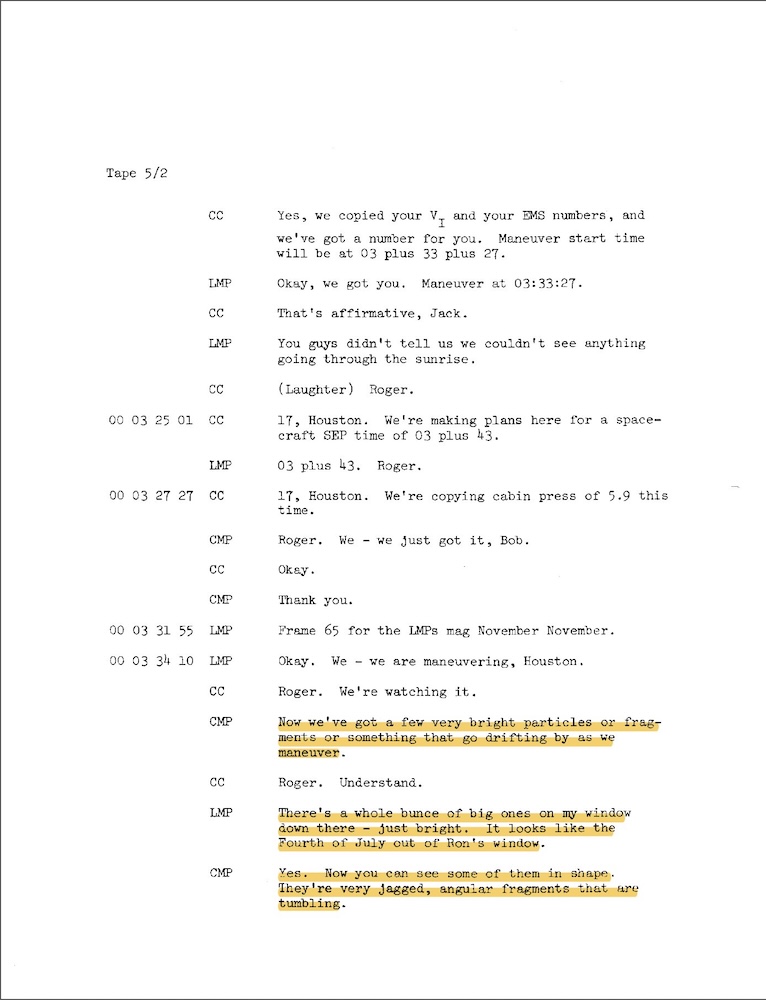
NASA-UAP-D002, Transcrição Apollo 17, 1972
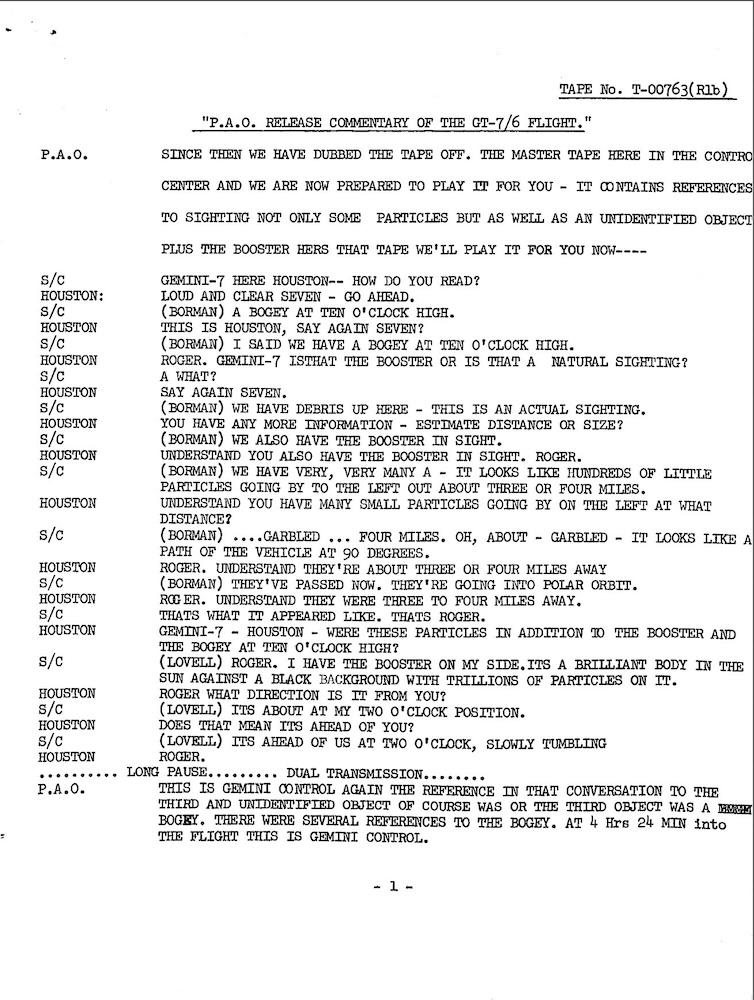
NASA-UAP-D003, Transcrição Gemini 7, 1965

NASA-UAP-D003A, Trecho de Áudio Gemini 7, 1965
NASA-UAP-D004, Entrevista Técnica da Tripulação Apollo 11, 1969
NASA-UAP-D005, Entrevista da Tripulação Apollo 17 para Ciência, 1973
Mesmo release
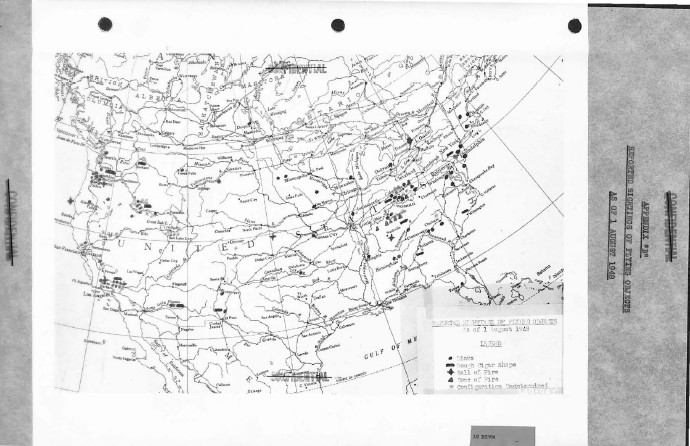
DOW-UAP-D093, Análise de Incidentes com Objetos Voadores nos Estados Unidos, 1948
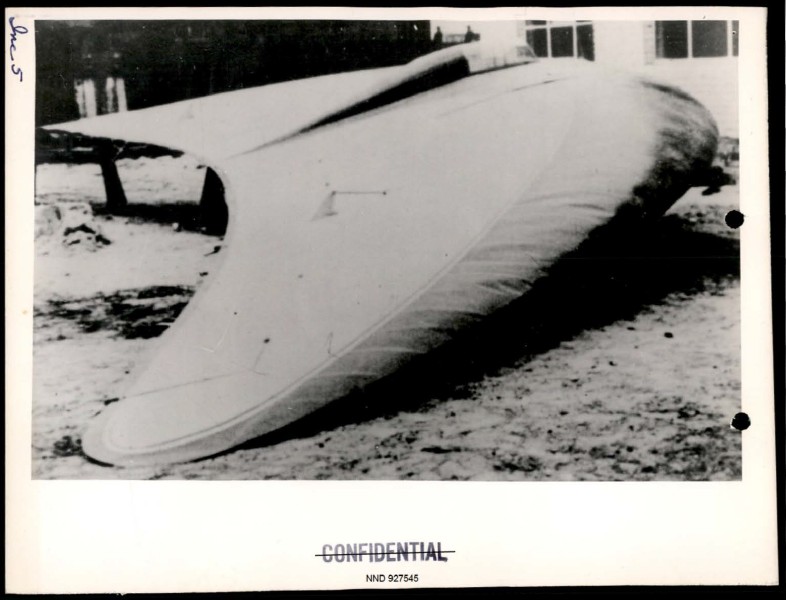
DOW-UAP-D097, Relatório de Progresso do Projeto Sign, 1948
DOE-UAP-D004, Conferência de Los Alamos sobre Fenômenos Aéreos, 1949
DOW-UAP-D094, Análise de Incidentes com Objetos Voadores nos Estados Unidos, 1949
CIA-UAP-D020, Memorando sobre Avistamentos de Aeronaves Não Convencionais, 1955
CIA-UAP-D021, Análise de Avistamentos de Aeronaves Não Convencionais, 1955
Mesma agência
NASA-UAP-D014, Mercury-Redstone 4, 21 de Julho de 1961
NASA-UAP-D012, Trecho de Áudio Mercury Atlas 8, 3 de Outubro de 1962
NASA-UAP-D013, Mercury Atlas 7, 24 de Maio de 1962
NASA-UAP-D015, Debriefings Científicos de Astronautas, 1962-1963
NASA-UAP-D023, Trecho de Entrevista com o Astronauta Gordon Cooper, 1962