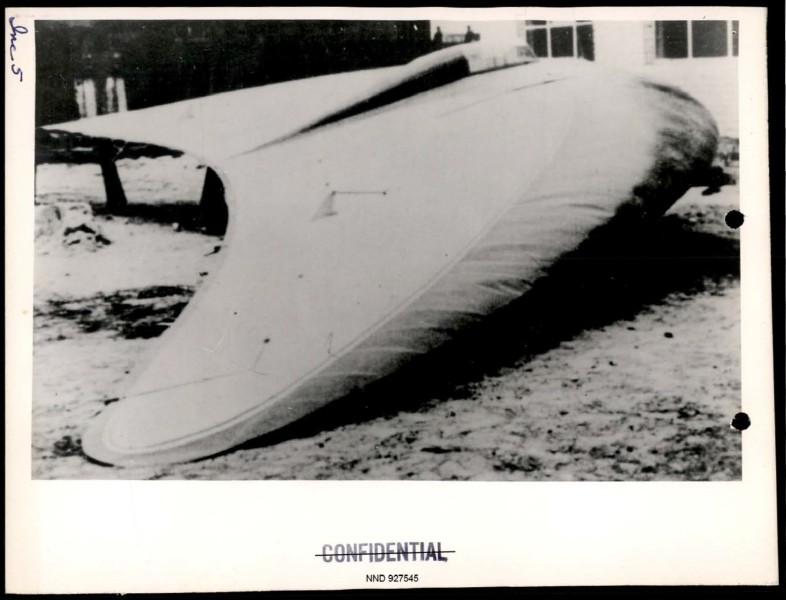
AAWSAP UFO program Statement of Objectives, July 2008
Official file: DOW-UAP-D110, AAWSAP Statement of Objectives, July 2008
Published · Updated
Key facts
- Official file ID
- DOW-UAP-D110
- Document type
- Document
- Agency
- Department of War
- Released in
- R06 · 2026-09-18
- Incident date
- 7/18/08
- Incident location
- Washington, D.C.
- Coordinates
- 38.8950982, -77.0363849
- Pages legible
- 4/4
- VIRIN
- 260918-D-D0360-1099
Official description
This July 2008 Statement of Objectives defines AAWSAP as a contractor-supported research effort intended to assess far-term foreign aerospace threats by understanding the physics and engineering of possible breakthrough technologies out to the year 2050 rather than extrapolating from then-current aerospace trends. It identifies 12 technical study areas, including lift, propulsion, control, power generation, spatial or temporal translation, materials, configuration and structure, signature reduction, human interface, human effects, armament, and related supporting topics. The document also sets out the program’s expected work structure, requiring monthly status reports, technical-area program management plans within 60 days, comprehensive research reports and briefings by the tenth month, and a final integrated threat assessment.
About this type of document
This document is an administrative or programmatic record related to the Advanced Aerospace Weapon System Applications Program (AAWSAP), a Defense Intelligence Agency (DIA)-administered program active from 2008 to 2012. AAWSAP’s official scope of work identified 12 technical research areas relating to potential aerospace threats over a time horizon of more than 40 years. As an administrative record, the file documents how AAWSAP was scoped, organized, tasked, funded, or described at a particular point in time.
See the glossary →✦ AI summary
This is a Statement of Objectives (SOO) for the Advanced Aerospace Weapon System Applications Program (AAWSAP), dated 18 July 2008. Its background section describes the Acquisition Support Division (DWO-3) of the Defense Intelligence Agency (DIA). It is a procurement document defining the work a contractor must propose, not a report of findings or observations. The stated objective is to understand the physics and engineering of breakthrough aerospace weapon system applications relevant to the foreign threat out to the year 2050, across twelve areas: lift, propulsion, control, power generation, spatial/temporal translation, materials, configuration/structure, signature reduction, human interface, human effects, armament (RF and DEW) and other peripheral areas. Requirements include experts with a minimum of 10 years' experience, a lead integrator, at least one PhD on each analytical team, at least three references, and examples from the past 7 years of prime-contractor analysis, design, construction and flight testing of high performance aircraft and/or satellites. Work may be based on material classified up to TS/SCI; cleared facilities are not required at contract inception, but offerors must provide personnel eligible for Top Secret with SCI access and at least two personnel cleared at the Secret level at the start. Deliverables are monthly Status Reports, a Project Management Plan at the 60-day point, Research Reports per technical area by the end of the tenth month, a final Integrated Threat Assessment, and resumes of key personnel. The contract is anticipated to run five years (a 12-month base year plus four 12-month option years) as firm fixed price (FFP). The Contracting Officer, COR and Government Project Leader names are redacted. The document is administrative and contains no description of sightings or research findings.
Generated with AI from the official file — may contain errors.
▸Transcript(4 of 4 pages legible)
[PAGE 1] STATEMENT OF OBJECTIVES FOR THE ADVANCED AEROSPACE WEAPON SYSTEM APPLICATIONS PROGRAM 18 July 2008 PAN: # 1. BACKGROUND: The Acquisition Support Division (DWO-3) of the Defense Intelligence Agency (DIA) has the responsibility to provide guidance and oversight to the Department of Defense (DoD) acquisition process along with leveraging the DoD Intelligence Community to coordinate, produce and maintain projections of the future threat environment in which U.S. air, naval, ground, space, missile defense and information systems operate. In order to accurately assess the foreign threat to U.S. weapon systems, a complete as possible understanding of potential breakthrough technology applications employed in future aerospace weapon systems must be obtained. 2. OBJECTIVE: One aspect of the future threat environment involves advanced aerospace weapon system applications. The objective of this program is to understand the physics and engineering of these applications as they apply to the foreign threat out to the far term, i.e., from now through the year 2050. Primary focus is on breakthrough technologies and applications that create discontinuities in currently evolving technology trends. The focus is not on extrapolations of current aerospace technology. The proposal shall describe a technical approach which discusses how the breakthrough technologies and applications listed below would be studied and include proposed key personnel that have experience in those areas. 3. REQUIREMENTS: a) The contractor shall complete advanced aerospace weapon system technical studies in the following areas: 1. lift 2. propulsion 3. control 4. power generation 5. spatial/temporal translation 6. materials 7. configuration, structure 8. signature reduction (optical, infrared, radiofrequency, acoustic) 9. human interface 10. human effects 11. armament (RF and DEW) 12. other peripheral areas in support of (1-11) [PAGE 2] b) It is expected that numerous experts with extensive experience (minimum of 10 years) in breakthrough aerospace research and development will be required to meet the demands of the above program. The offeror should clearly identify their approach to obtaining the services of and their utilization of these scientific and technical experts. Management personnel must include a lead integrator to oversee the work of the various analytical teams, and to integrate their findings into final coherent products. At least one member of each analytical team must have a PhD, although that member can be on several teams. A technical plan for conducting the advanced aerospace weapon system studies described above must be included in the offeror’s proposal. (c) Offeror must be able to produce integrated finished assessments in each of the above advanced aerospace weapon system technical areas. Finished reports and presentations, while highly analytical and technical, must be in a format suitable for dissemination at the highest levels of the federal government. In addition to the main technical section of each assessment, an executive summary utilizing clearly understandable (non-technical) language must also be contained in each report. (d) To assess relevant experience, offerors shall submit at least three (3) references, including a POC name and phone number, with a brief description of the business relationship with the Government or other corporations. In addition, offerors should provide examples, conducted within the past 7 years, of having performed, as a prime contractor, the analysis, design, construction, and flight testing of high performance aircraft and/or satellites. Success in this program is dependent upon this capability and experience. 4. PLACE OF PERFORMANCE: The work under this contract shall be performed at the Contractor's facility. 5. SECURITY REQUIREMENT: Contractor company and personnel proposed shall be clearable and able to obtain a security and facility clearance upon award of the contract. All requirements specified in this SOO may be based on materials classified at or below Top Secret with access to Sensitive Compartmented Information (TS/ SCI). The contractor shall comply with the terms and conditions of the DD-254 BEFORE initiating any classified effort. The contractor shall notify the COR and Contracting Officer immediately upon the determination that higher classification requirements exist in order to accomplish the specified requirements. The contractor shall ensure that each individual assigned to this contract shall be identified, cleared, and approved through DIA/DAC-3 PRIOR to granting that individual access to, or authority to generate classified information in association with this effort. 5.1. Contractor shall provide a work facility (including unclassified information systems) with a Top Secret Facility Clearance granted by the Defense Security Service (DSS). Cleared facilities are not required at contract inception. Offeror must provide personnel eligible for a Top Secret clearance level with further eligibility for SCI access. At least two personnel cleared at the Secret level are required at contract inception. 6. GOVERNMENT FURNISHED PROPERTY/EQUIPMENT: The Government will provide the contractor access to computers and peripherals such as printers as the Government deems necessary to access and produce classified information. These computers and peripherals remain the property of the Government. [PAGE 3] 7. GOVERNMENT FURNISHED INFORMATION/DATA: Data required by the contractor to fulfill the terms of this contract shall be requested from the Government Project Lead (GPL). A good faith effort will be made to fulfill any legitimate request (as assessed by the GPL), however, the responsibility to collect information and data necessary for the conduct of this effort remains with the contractor. Any classified data provided by the Government in support of this contract will remain the property of the Government and will be returned to the government not more than 30 days after contract conclusion. 8. CONTRACTOR ACQUIRED / GOVERNMENT OWNED PROPERTY: Any accountable property acquired by the contractor with government funds during the execution of this contract shall become government owned property. The contractor shall obtain written permission from the CO or Contracting Officer Representative (COR) prior to any purchase of real property with government funds. The contractor shall establish and maintain an inventory of all such property. This property must be inventoried and returned to the government not more than 60 days after the end of the contract. 9. EQUIPMENT LEASE OR PURCHASE: The purchase of equipment is preferred, however, it may be more advantageous to the government to lease in certain circumstances. When it is contemplated a lease would be more advantageous to the government, contractor shall furnish the following information to the COR so the government can determine the best solution: 1. Estimated length of time the equipment will be used and the extent of use within that period 2. Financial and operating advantages of alternative types and makes of equipment 3. Cumulative rental payments for the estimated period of use 4. Net purchase price 5. Transportation and installation costs 6. Maintenance and other service costs 10. TRAVEL: It is anticipated that travel will be required for this contract. The Government will pay up to the rates specified in the government Federal Travel Regulations for travel destination. Travel reservations will be made by the contractor and will be reimbursed for actual costs only, with supporting documentation/receipts attached to the invoice. 11. DELIVERABLES: The contractor shall prepare the following deliverables: a. Status Reports - monthly reports outlining accomplishments, milestones, and work in progress. b. Project Management Plan — For each technical area, the team lead shall submit, at the 60 day point, an overview paper identifying the scope of the final report; a Plan of Action and Milestones, and the composition of the analytical team. c. Research Reports For each technical area, a comprehensive report and briefing forecasting potential advancements and their impact is to be submitted to the GPL by the end of the tenth month. An executive version of each report should also be submitted. Format will be specified by the GPL. d. Integrated Threat Assessment — A final report and briefing that assesses the foreign threat from advanced aerospace platforms incorporating the technologies discussed in the individual research reports will be [PAGE 4] provided to the GPL at the end of the period of performance. An executive version of the report should also be submitted. Format will be specified by the GPL. e. Resumes - The Contractor shall submit resumes of all key personnel proposed for this effort. The Government reserves the right to review resumes and qualifications prior to acceptance of individuals for assignment. 12. PERIOD OF PERFORMANCE: The term of this contract shall is anticipated to be 5 years which consists of a base year of 12 months from date of award plus four (4) 12 month option years. 13. CONTRACT TYPE: The contract shall be firm fixed priced (FFP). 14. KEY GOVERNMENT PERSONNEL: The Contracting Officer for this contract will be [redacted (b)(3):10 USC 424, (b)(6)] The COR and Government Project Leader will be [redacted]. 15. DEFINED TERMS: Key personnel - defined as proposed management and lead science and engineering staff Contracting Officer Representative (COR) — The government official appointed by the contracting officer and who is responsible for operations of the execution of the contract. The COR handles all aspects dealing with the interpretation and deliverables of the contract. Contracting Officer— Procurement official who holds a contracting warrant and is authorized to obligate the government under the terms of a contract and make changes to the contract.
Generated with AI from the official file — may contain errors.
Source: U.S. Department of War / AARO — public domain · war.gov/ufo
Entities in this document
Connected cases

DOW-UAP-D111, AAWSAP Solicitation and Original Order, September 2008

DOW-UAP-D112, AAWSAP Contract Modification P00001, September 2009

DOW-UAP-D113, AAWSAP Contract Modification P00002, February 2010

DOW-UAP-D114, AAWSAP Contract Modification P00003, May 2010

DOW-UAP-D115, AAWSAP Contract Modification P00004, May 2010

DOW-UAP-D116, AAWSAP Contract Modification P00005, September 2010
Same location

UFO files: US space fragments policy letters, 1962-1964

Memo on recovering space fragments (UFO files), 1963
AAWSAP UFO program solicitation and contract, Sept 2008
AAWSAP UFO contract modification P00001 (2009)
AAWSAP UFO contract modification P00002 (2010)
AAWSAP UFO contract modification P00003 (2010)
Same document series
UFO mission report, Arabian Gulf, 2020

UFO mission report, Arabian Gulf, 2020

UFO mission report, Arabian Gulf, 2020

UFO mission report, Arabian Gulf, 2020

UFO mission report, Arabian Gulf, 2020

UFO mission report, Djibouti, 2025
Same period

BAASS project plan for the AAWSAP UFO program, 2008

MUFON reports for BAASS, AAWSAP UFO program, 2008

Project Capella: UFO data warehouse for BAASS, 2008

UFO sighting at Harare Airport, Zimbabwe, CIA, 2008
Same release

Ruppelt’s Project Blue Book UFO briefing, 1952 audio

Ruppelt’s Project Blue Book UFO briefing, 1952 transcript
 ▶ 70s
Tremonton UFO film, Utah, 1952 (Navy’s Newhouse)

Tremonton UFO film: Project Blue Book file, Utah, 1952

Tremonton UFO photos: Project Blue Book file, 1952

USAF Flying Discs file: UFO reports, 1952
Same agency
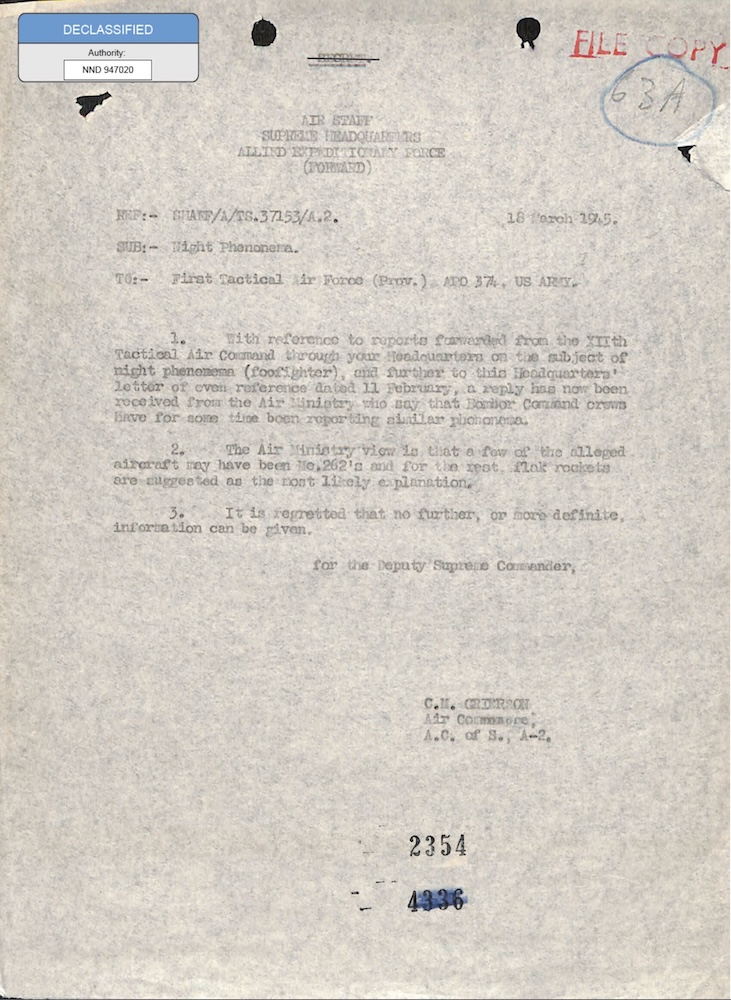
Foo fighters UFO file: SHAEF reports, 1945
Ghost rockets over Sweden: UFO intelligence review, 1947
Project Sign UFO files: Air Materiel Command, 1947-48
UFO Flying Discs file: Twining letter, 1947
Air Force study of UFO incidents in the US, 1948 (Study 203)