
DOW-UAP-D093, Analysis of Flying Object Incidents in the United States, 1948
Key facts
- Official file ID
- DOW-UAP-D93 (cited as DOW-UAP-D093 in this file)
- Document type
- Document
- Agency
- Department of War
- Released in
- R04 · 2026-07-10
- Incident date
- 12/10/48
- Incident location
- Virginia
- Coordinates
- 37.1232245, -78.4927721
- Pages legible
- 47/67
- VIRIN
- 260710-D-D0360-1078
Official description
This file contains a U.S. Air Force (USAF) Air Intelligence Division study, “Analysis of Flying Object Incidents in the United States,” Study No. 203, dated 12/10/1948. The analysis includes an assessment of various reported unidentified flying object (UFO) incidents and theories to account for their nature and origin. Overall, the study assesses that “it appears that some object has been seen; however, the identification of that object cannot be readily accomplished.” The study offers that two “reasonable” origins might account for the phenomena: technologies of a domestic or foreign origin. It also suggests that, if foreign, it is prudent for the United States to assume that UFO observations are attributable to scientific, military, or intelligence activities of the Soviet Union, and, in that case, to take seriously the threat such objects may pose. The file also contains contemporary UFO reports and examples of experimental “flying wing” type aircraft planforms that might account for certain commonly reported UFO characteristics.
✦ AI summary
This is a declassified 10 December 1948 U.S. Air Force study, "Analysis of Flying Object Incidents in the United States" (Study No. 203), produced by the Air Intelligence Division under Project Sign. It analyzes approximately 240 reported sightings of "flying saucers" over the U.S., concluding that some type of flying object has genuinely been observed, based on the credibility and technical background of many witnesses (weather bureau personnel, rated USAF pilots, civilian pilots, and scientists). Objects fell into three broad categories: disk-shaped, round/spherical, and balls of fire, with sighting concentrations along the Eastern and Western U.S. coasts and near sensitive sites (Oak Ridge, Los Alamos/Las Cruces, Hanford). The report's central hypothesis explores whether the objects could be Soviet-developed flying-wing aircraft, built using captured German flying-wing research (citing German engineer Dr. Walter/Guenther Bock, reportedly working for the USSR) intended to intimidate the U.S. and Western Europe, conduct photographic reconnaissance, test U.S. air defenses, or familiarize crews with U.S. territory ahead of potential attacks. An extensive appendix catalogs individual sighting reports (1947-1948), including the Kenneth Arnold-era Richmond, Virginia weather bureau disk sightings, the Mantell fatal pursuit incident, the Gorman North Dakota F-51 chase, and the Andrews Field sighting, plus radar intercepts from Japan. A separate appendix details real flying-wing aircraft of the era (German Horten/Arado/Junkers designs, British Armstrong Whitworth AW.52, U.S. Northrop XB-35) as possible mundane explanations, while noting the Air Materiel Command had positively explained only about 9% of cases (balloons, celestial bodies, birds) and left most unresolved.
Generated with AI from the official file — may contain errors.
▸Transcript(47 of 67 pages legible)
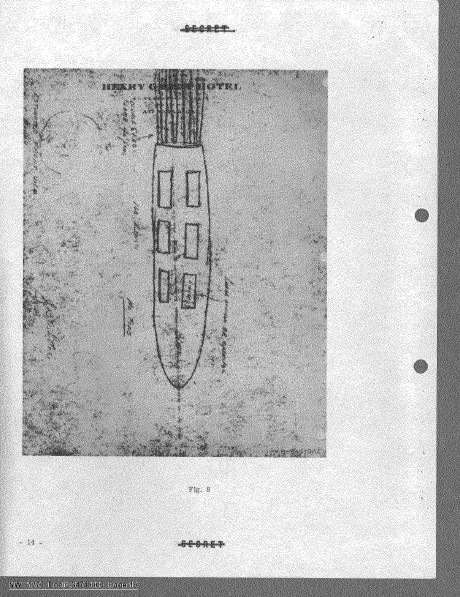
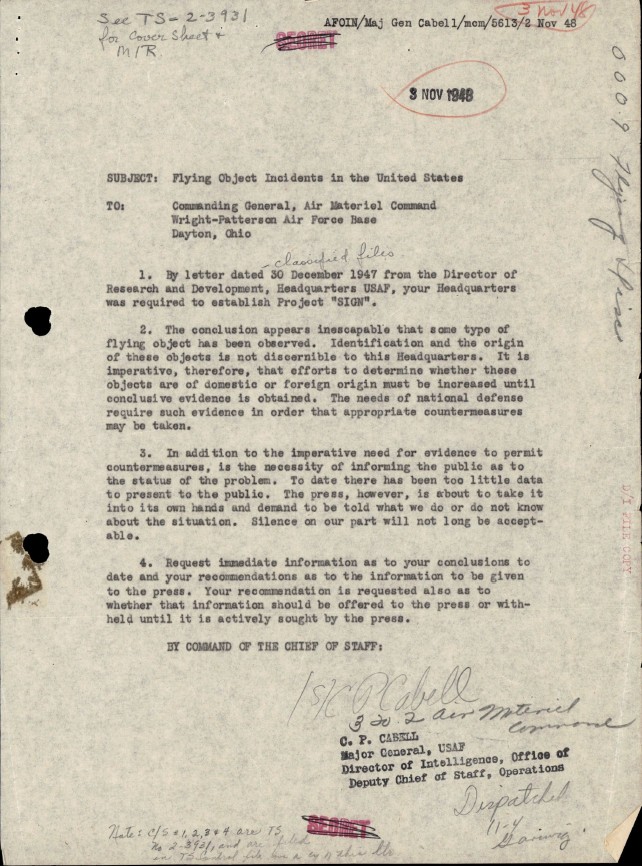
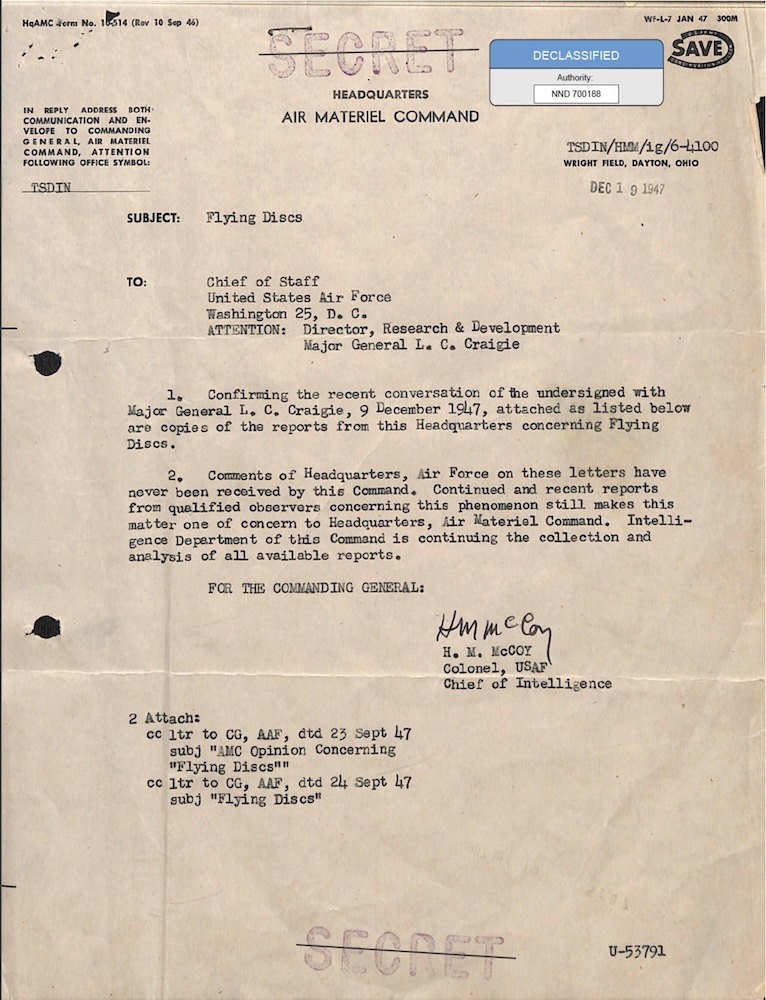
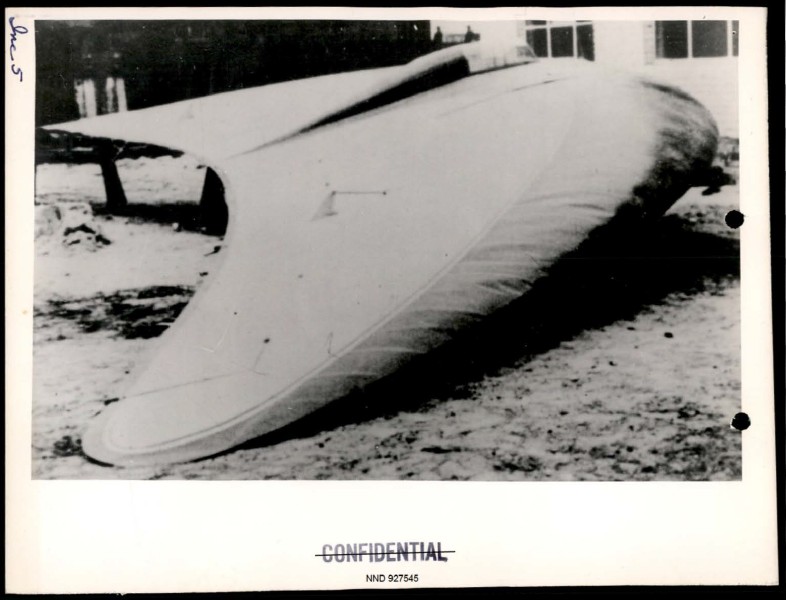
[PAGE 1] Z9T9 ACALS NQ LLOZS8 GNN AQuouny [PAGE 3] MEMO ROUTING SLIP NEVERSMSE YERAPPROVALS DISAPPROVALS CONCURRENCES OR SIMILAR ACTIONS NAME OR TITLE INITIALS CIRCULATE ORGANIZATION AND LOCATION DATE COORDINATION FILE INFORMATION NECESSARY ACTION NOTE AND RETURN SEE ME SIGNATURE REMARKS a a Pe o_o Zak LEE 2-7ILFS FROM NAME OR TITLE WA DATE ORGANIZATION AND LOCATION CG ‘TELEPHONE FORM Replaces DA AGO Form 895 Apr 48 and AFHQ 10—48487-4 GPO DD i iteto OS Foes Novae nies may be used [PAGE 4] ae bier See od resis DIVISION STUDY ne cba Ke ANALYSIS OF PETG ORJEOr INcrMENES TN THE Study Woe 203 a ay Sg 10 heconber 1948 pisma Tgun Tow oarr No Air Tntel Req Div awe Air gutimates Branch ONT je Intel Div DEDLagsiFvED Author AINA Ken Sy By hat oe Ww —for-SEcRer [PAGE 6] le to exanine pattern of tacties of “Flying Saucers hereinafter Referred to as flying ebjects and ve develep conclusions ax te the possibility of existence mi Stag te Re A dwtatied dtevesiion af internation bearing 62 the probden as set forth above in attached as Appendix A The main points estab Mished therein are summarized below the frequmney of reported ineidanta the similarity in many ef ‘te characteristics attribated to the observed objects and the quality of observers considered aso whcle support the contention that sone type of flying object has been chearved “Approxinatoly 220 incidents hava been reported Anong the observers reporting on such ineidenba are trained and experioneed 45 Neather Durea personnel USAP rated effleers experienced civilian pilots technicians ssseciated with various research projects and technicians employed by commercial air- The possibility thet reported observations ef flying objects over the U.S were influesced by previous sightings of unidentified phenomena in Gurope particularly over Scandinavia in 1946 and that the observers reporting gach Incidents may have been interested in ob- taining personal publicity have been congidered ag possible explanations repette such ag the one from Wealthar ureau at Michnond ave ex- anined ‘nring ebuervations of weather balloons at the dichnend pureau one well trained observer has sighted strange metallic disks on three sedation and another observer his sighted similar ebject on one er On eae a la Ve Coen ee ee eRe Py pe ay Fie a eepeae eee eee [PAGE 7] Jop-seCRET oecasions tie Inst cbeervation Of widentified ohgvete was in April 1947 On all four eécasions the weather valloon end thy unidentified objects were in view through the theodolite These observations at the Richmond Bureau cecurred several months before publicity on the flying saucers appeared in a UseSe newspapers Tescriptions of the flying objects fall into three configura- tion categories disk-shaped rough olgar—shaped balls of fire Varying conditione of visibility and differences in angles st which the objects may have been viewed introduces a possibility that a single type object may have been observed rather than three different typese This possibility is further substantiated by the fact that in the areas where such objects have been observed the ratio of the three general configurations is approximately the sans Ge Therefore it appears that sone object has been seens however the identification of that object cannot be readily accomplished on the basis of information reported on each incidents It is possible that the object or objects may have beon domestically launched devices such as weather balloons rockets experinmental flying wing aireraft or celes-+ tial phenomena It is necessary to obtain informetion on such domestica activity to confirm or deny this possibility fepanding upon the degree with which thie my be accomplished foreig devices mst then be con~- sidered as a possibility ‘Te The pattern of sightings is definable Sightings have been most intense throughout the states bordering the Atlantic and Pacific coast linea and the central states of Ohio and Kentucky A map showing location of sightings is attached Appendix The origin of the devices is not ascertainable There are twa reagonable possibilities The objects are domestic devices and if ao their identification or origin can be agtablished by a wurvey of al lawehings of airborne objects Domestic flying wing type aircraft ob- served in various aspsots of flight might be responsible for some of the Remlece on [PAGE 8] reported flying objects particularly those described as disks and rough cigar shapes See Appendices and Among those which have been operational in recent years are the XFS5U-1 Flying Flapjack developed by Chance-Vaught the Northrup B-35 and the turbo-jet powered Northrup YB-49 The present existence of any privately developed flying- wing tiee nireet’ hag not been determined but one such aircraft the Arup tailless monoplane wae operational at South Bend Indiana prior to 1935 Objects are foreig and if it would seem most logi- cal to consider that they are from a Soviet source The Soviets possess informtion on a number of German flying~wing type aircraft such as the Gotha P6OA Jumkers EF 130 long-range high-speed jet bomber and the Horten 229 twin-jet fignter which particularly resembles some of the descriptions of midentified flying objects See Appendix As early as 1924 Tacheranowaky developed a “Parabola aircraft an all wing design which was the outcome of considerable Soviet experimemtation with gliders of the same general form Soviet aircraft based on such desigs might have speeds approaching transonie speeds attributed to some flying objects or greater overall performance assuming the successful development of some unusual propulsion device such as atomic energy engine That the Soviets have a current interest in flying-wing type eiroraft ia suggested by their utilisation of Dr Guenther Bock who at the end of World War IT was in charge of the flying-wing program in Germany See Appendix A paragraph page Achievements satia- factory to the U,8.5.R are indirectly indicated by the personal recog- nition he is reported to be receiving in the U.5.5.R Recently it has been reported that the 0.3,5.R planning to build a fleet of 1,800 Horten flying-wing aircraft Information of low wihettm has been received stating that a regiment of jet night fighters Model Horten XIII ie at Kusmikha an air base two miles southwest of Irkutsk [PAGE 9] Kuzmikha is identified as one of a number of airfields for the pro- tection of an atomic energy plant at Irkutsk The Horten XIII ag developed by Germany was a glider 10 ‘Auatthing thab the objects might eventublly be ideitigted as foreign or forelga-sponsored devices the possible reason for their appearance over the U.S requires consideration Several possible ex- planations appear noteworthy viz a TO negate U.S confidence in the atom bomb as the most advanced and decisive weapon in warfare be To perform photographic reconnaissance missions Ce To test U.S air defenses da To conduct familiarization flights over U.S territory CONCLUSTONS lis Since the Air Force is responsible for control of the air in the defense of the U.S it is imperative that all other agencies co- operate in confirming or denying the possibility that these objects have a domestic origin Otherwise if it is firmly indicated that there is no domestic explanation the objects are a threat and warrant more active efforta of identification and interceptions 12 It must be accepted that some type of flying objects have been observed although their identification and origin are not discernable Tn the interest of national defense it would be umwise to overlook the possibility that ponte of these objects may be of foreig origin Inols Appéndix A Analysis of Flying Object Incidents in the U.S and Hypothetical Tactics Employed Appendix BY Plot of Flying Object Sightings in the U.S Appendix CO Selected Reports of Flying Object Incidents Appendix Plying Wing Type Aircreft [PAGE 10] APPENDIX aA ANALYSIS OF FLYING OBJECT INCIDHNTS IN THE U.S AND HYPOTHETICAL TACTICS WiPLOYED Introdu To formulate the possible tactics of flying ob- jects reported over the U.S assumes from the outset that firm conclu- sions have been reached on both the existence and origin of the reported flying objects The current status of information on such incidents and overall analysis does not allow substantiation for such conclusions However the lack of such firm conclusions points to the necessity for ean immediate and sound statistical analysis of every aspect of the situa- tion and does not preclude a concurrent examination of the reported in- cidents to develop explanations of their possible tactics The latter will be useful at some future date should the existence and.origin of the flying objects be definitely established Therefore the following analysis of available information advanced in order to present evi» dence on the actual existence of some type flying object and to relate same to tactical purposes for which the objects are possibly designed The following discussion must be considered a provisional analysis pending a further detailed analysis of all aspects of the problem Some Aspects Regarding Flying Object Incidentg A cursory examination of evidence on reported incidents has been made and it is possible to cite certain generalities which it appsars may be borne out when detailed analyses have been completed Among the incidents reported there are many statements by reliable and experienced persons which tend to confirm that flying ob=- jecta have been seen The description of such objects seems to fail roughly into three categories Sliver disks or bails approximating a Horton wing type aireraft Balle of fire of various colors and intensities Cigar or pencil-shaped objects similar in appearance to type rockets in horizontal flight The numbers of configurations GVHD Am 2SVi [PAGE 11] ganna might be further reduced with the following considerations in mind Silver disks or balla have for the greater part been observed in daylight and a number under clear weather conditions with visibility unlimited In most instances balls of tive have been observed at night Gigar or pencil=shaped objects have been sighted in fewer numbers but with about equal distribution in diplipst and at night A few accounts tell of the disks having a rough cigar-shape when viewed while maneuvering Some of the atokcs are described as having luminosity in daylight It therefore is possible that a single type of object may be involved in all sightings and differences in des- cription may veault from viewing the objects at various angles and under differing conditions of visibility The above tends to indicate that some hyd object has been seen and the possibility exists that the object or objects seen are conven tional domestic devices such as weather balloons test rockets or jet- equipped aircraft with pancake or flying wing configurations The possibility exists that the reporting of flying objects may have been influenced by earlier reports on similar incidents in Scandinavia and Central Purope The publication in newspapers of de taile on such incidents both foreign and domestic may have induced some of the description provided in reported domestic incidents However one of the earliest reported sightings in the wae the one observed by U.S Weather Bureau personnel in April 1947 at Richmond Virginia and on the basis of this one report it appears that the diske are not Dalloons It would seem that thie sighting was not influenced by the re ports of foreign incidents the newspaper accounts of domestic incidents nor by misidentification of a conventional object Although reported domestic incidents are widely svattered through- out the frequenoy of sighting and number of observers per sighting FOP SE [PAGE 12] assumes a definable pattern There is a large concentration of sight- ings along the Eastern Seaboard another large concentration through- out the Western Coast states and a few sightings in the Middle West Distribution of incidents by configuration of object and description of maneuverability is approximately equal in each of these areas and this is believed to further substantiate the possibility that one type of object might have been observed in different aspects of flight If sightings are induced by rumor it seems unusuel thet more incidents have not been reported from the areas with high concentra tion of population Reports from such areas would also have greater facility in channeling either to newspapers or official reporting agen- eies For the most part sightings have been made in fairly open country where there are few restrictions to visibility toh may indicate that obstructed vision has reduced sightings in- built-up areas A It therefore seems that some type of flying object has been ob« served the identification of its origin requires the completion of other analyses Se Possible Origin of Unusual Flying Objects Provided upon the Completion of analyses it is indicated that some or all of the reported flying objects over the U.S are of foreign origin the objects could from a logical viewpoint be considered Soviet It is evident from the performance characteristics attributed to the unidentified objects at thia time that if they are foreign they involve efficiencies of per- formance which have not been realized in any operational airborne de vice in this country It would therefore be mistake to analyze the technical aspects of the situation within the limits of ovr own knowl- sedge of practical developmonte It is more desirable to consider then the outer limits of possible Soviet developments and objectives in at tempting te formulate some idea of the tactios which might be involved Se [PAGE 13] First of all the scientific objectives of the U.S.S.R have been stated ec times and indicated in many forms ‘The most ¢clear- cut statement of this witoertve is probably the one contained in the preamble pes the Fourth Fiveeyear Plan 1946-1950 which states that the objective of Soviet science is to overtake and surpass the scienti- £40 end technical developments of the capitalist nations It apparently would be an impossible task for the Soviet Union to accomplish such an objective by proceeding step-by=step along the same lines of develop- ment already achieved in the capitalist nations This would mean that it would be Ge encaay to rapidly proceed through each phase of aero- nautical development that has already been accomplished in this country and this probably would never have any prospects of accelerating Soviet develop- ment beyond any point reseed by the U.S The obvious answer to accom- plish their objective of not only overtaking but surpassing the capitalist countries serait a scientific shortcut This possibility is not so re- mote when examined on the basis of our knowledge of the current situation in the U.8.8.R Provided Soviet emphasis was given to the most promising and advanced ideas acquired from Germany in 1945 and the work aided by German scientists the possibility of catching up and possibly surpassing other nations in technical developments becomes more realistic It be- comes even more realiatic if the Soviets have shown a tendency to concen=- trate on certain developments which have still not received a maximum of priority in our own programs Tt ie known that the U,S,8.R has since 1945 enlisted the ser- vices of Dr Guenther Bock a German who headed all development of low aspect ratio flying wing type aircraft in Germany Dr Bock is believed to be the top German scientist in charge at TSAGI and TSIAM which are Air Materiel Command type organizations in the U.$.9.8 Further it ie believed that Dr Bock has made available all Gorman plans for fly- ing wing type aircraft to the Soviets Among the designe considered by FOP GEOR [PAGE 14] ‘gop-secne- the Germans end possibly exploited by the U.$.8.2 are jet-propelled flying wing type aircraft whose configuration would be similar to pee eriptions of certain objects reported flying over the The eine mated speeds of such aircraft ere within range of the lower limits of speed attributed to flying objects over the U.S It is not impossible that emphasis on surpassing foreign developiients has led to unusual pro- eress in fuelsand propulsion by the U.S.5.R In connection with pos- sible advancements in the field of fuels and propulsion it should be observed that the Russian oi situation regardless of estimated oil Yeserves is quite different from that in the U.S For example oil industry is prepared to turn out tremendous quantities of highly fractionated petroleum produrts while the U.$.9.R eannot reagonably approach such ospabilities This consideration dictates different solu- tions on fuels for propulsion in the two countries and in turn dictates the direction taken in develipment of jet motors or the use of other pro pulsive devices We must therefore arrive at the conclusion that any Soviet device which may have made its appearance over the as des- eribed would possess unusual performance characteristics which in all probability would include umusuel range The possibility that they could have been launched at fairly close range should not be discarded Possible Rensons or Pactios for the Use of Soviet Unconventional Aircraft Over the U.S Predilcated on all the foregoing asaumptions Soviet unconventional aircraft may have been flown over the for one all or combination of the following reasons a Zo negate U.S confidence in atom bomb ag the mogb ad vanced pnd decisive weapon If the objects have been used in a propaganda sense it would he reasonable to assum’ that the Soviets would choose first to frighten pro-American nations in Durope with the appearance of a radiaelily etna [PAGE 15] a new weapon to counteract the ability of the U.S to obtain full propaganda effectiveness with the atom ‘bomb It will be remembered that strange objects first appeared over the Scandinavian countries in 1946 The ob- jects observed there had unusual range and unusual performance characteris- tied As this demonstration over tho Scandinavian countries occurred the was making a vigorous campaign for the economic and political alignment of these nations with other prosAmerican Western Muropean na- Yiokes When Sisus incidents subsided strange flying objects began to be observed at an increasing rate over the The conclusion on this point is that flying objects may have been used to frighten both Buro- pean natiofis and the U.S by the appearance of a new device and that failure to identify such a Soviet object would give them invaluable in- dication that U.S development is far behind that of the Soviets Except for this indication it is believed that the use of the objects to promots fear has been worthless in that the U.S public has tended to characterize these incidents entirely as hallucinations by crack pota misidentification of conventional objecte or that they represent a secret Amevican project which should not be publicized Any fear that might re- sult from Soviet use will come only by a discovery that the objects have been Soviet aircraft and that they involve radical developments which are in advance of our own accomplishments It is possible that the Soviets have employed the flying objects for the collection of photographic intelligence or the mapping of certain areas in the U.S The evasive action employed by all cbjects Sighted indicates not so much an attempt to avoid being sighted as an attempt to prevent disclomre of the exact type of flying craft and ite mission ‘The sighting of objects over the U.S has been most intense in Mastorn and Western Coastel States In addition sightings of flying objects Puede [PAGE 16] have been made near Oak Ridge Tenn Les Cruces I and in the general area of the Hanford Works in Oregon Gonerally sightings have not been made over what we consider strategic industrial areas The reason for this might be either that the flying objects have been ob served only enroute to or oan missions over these more concentrated strategic areas or that the Soviets obtained sufficient information during their World War IT liaison with U.S industry to satisfy their intelligence requirements and have a more active requirement for informa tion on industrics and areas which were not available to them during World War If contacts This ia of interset in connection with the sightings mear Oak Ridge Ias Cruces and in the general area of the Hanford Works since these establishments were not and are not accessible to Soviet collectors of photographic intelligence It possible that the use of Soviet flying objects over the U.S is intended only to determine the ability of the U.S defenses to spot foreign aircraft This would be of extreme importance to the U.S.5.R in the event that a one-way all-out attack of Soviet strate- gic bombers is planned Ability to operate over the U.S uninhibited ot time when the U.S is supposedly re-arming and putting great stress on defenses would provide valuable information on which to base estimates for probability of success in bombing strategie objectives in the a Jamtligrization Fights over 0.8 Terpitory This possible reason is perhaps the most improbable It assumed that should this purpose be involved other purposes are probably also accomplished in its execution Provided the U.9.5.R has unusually high performance aireraft they might find it advantageous to familiarise themselves with the topography of the U.S in anticipation of future combat missions to strategic targetea LopeibeRit [PAGE 17] Conclusion The conclusion that some type of flying abject has been observed over the U.S seems to be substantiated It is not Inown at this time Witestion these Dhaene’ are misidentifications of domestically launched devices natural phenomena or foreign un- conventional aircraft It therefore impossible to make any re- liable explanation for their appearance over the U.S or the tactics which they may employ if the objects observed include any foreign developments in aeronautical fields It is likewise impossible at this time to contain discussions of possible performance characteristics or tactics within limits of practical reason if for no other reason than the fact that proof of the existence of a foreign development of this type would necessarily introduce considerations of new principals and means not yet considered practical possibilities in our own re- search and development [PAGE 18] of ugust 19438 Tisks vourh Cigar Shape 3:11 of Fire ‘one of Fire Configuration Undetermined [PAGE 20] A number of reports on unidentified flying objects cons from observers who because of their technical background and experience do not appear to be influenced by unfounded sensationalism nor inclined to “report explanable phenomena as new types of airborne devices Some of the details of their’ reports are presented in this appendix along with those from possibly lesa reliable sources who have reported evidence which is of such a nature that it cannot be entirely ignored vor 20 Descriptions of significant ineidents arranged chronologically a During April 1947 two employees of the Weather Bureau Station at Rishnond Virginia reported seeing a strange metallic disk on tne occasions through the theodolite while mking PIBAL observa- tions One observation was at 25,000 feeb when a disk was followed for 15 eeueedtn The disk appeared metallic shaped something like an ellipse with a flat bottom and a round top It appeared below the balloon and was much larger in size The disk appeared to be moving rather rapidly although it wae impossible to estimate its speed The other observations were wade at 27,000 feet in like manner be The foliowing month Byron Savage a field engineer for a disk flying near his home in A ject was thought to be at an altitude 10,000 feet de ond was moving toward the north no trailing effects 14000 feet on a course of 300 degrees Nevada an Alr Force lieutenant Meireular objects in close formation traveling at an estimated speed of 285 miles per hour This sighting occurred on 28 June 1947 oo [PAGE 21] day a party of three two of them scientists the white Sand New Mexico Vane firing grounds and reported rge dick or sphere moving hori- an ait Appin epigip endian ated atitade of 20,000 feat Tt se of mifora shape and had no protruding surfaces such as wines The object was in Sight for about 60 seconds before it disappeared to the northeast ‘The thres observers apteed on the details of the sighting except that one thought he had geen vapor traile Om duly 1947 five Portland Oregon police officers re- ported varying numbers of disks flying over different parts of the city All observations were mate within a minute or two of 1305 hours On the same day William Rhoads of Phoenix Arizona al- Besa saw adisk ¢dircling his locality during sunset ang ayes front and a aquat MHPEn plan forn These photographs ee aa oe fections in the lens See Figs and I 104 Fig Figs [PAGE 22] puw ait4 eg peusoUDe SF Weaneyo ANS ouy SU JEz Se VOT VEAIREQS e,JIRApOCK “AH Gaoddna andes woqoyd Duyyrnwes oyL seokoyeme vyd amyqour peuteoyord sua pur oy WE qnoqe doy AAS Oy UT POLIFEMAT YOTIA awe caTe Sued seq}o om pUUTpUNosMeN “pTeT4 UourUH avou SuyyA ys oul suoyyumntos pnoyo oqg zo udn JuyuNgs oe peruedde YoTy THEag FupANHT puw eousane S,yyawe yy Suyterrered “KqpooTEA yITY AULATZ qoofqo anrnoszo peqacdes oyumjoen atuarty usoTseny—umg ‘yznapoon an L¥6T AtHE OL OF [PAGE 29] hy Om 29 July 1947 Kenneth Arnold while flying near Tooom Washington reported formtion of flying objects Wis sketeh of thetr shape dorreaponda alosely to that shown in the photographs made by Urs Whondae Gt the same day two Usks Ady Fores pote at tntiton Field reported two flying disks trailing P00 following it townrd Oakland Californias On Auguat 2947 the pilot and co-ptlot of a Do-3 flying for ene Al Jonea near Bethely Alaska raported a flying disk larger ‘than thely aivoraft This diak crossed they path at about 1000 foot and they tuned to give chase The Do~3 was flying ab 170 mph but the disk flew out of aight in four minutes de 12 Novenber 1947 two Clying dike trfling JotaLice strona of five ware reportedly sighted fron the bridge of the tanker Teonderoga socording to the second officers The Teonderogs wa 20 miles off the Oregon shore This officer said tte dieke were in side AS seconde movlig ot ayeed eetimtted ut 70-900 mph eorring in a Long low aroy i Kee on Jameasy 1968 a Mion Oued phot was Kided wae attoapting te chase an uidentisie object up to 30,000 feat While it Ao presuned that this pilot euffered anoxia reguiting in his crash his last masmye te the tower was Et appears to be metallic objoctesss of oS eabaucas seconds fed Gsanpenrod ‘auddeniy Seectone sheen Sirs ahead nad ey stores Xan ting to loss for better Losi,” ie de ‘on Apett 2948 three trained talon obsarvare fran the Cnophyates Taboratory Seetion Wateon Laboratories lis Je reported sesing a romd indistinct object in the visinity of Hella Air Force RS Bane New Mexieos Te mas vary high and fant and appeared to execute ss violent maneuvers at high aponds ‘The object was under gbearvation for [PAGE 30] Sail ty A yellow ar Light colored sphere 25 to 40 fect in diameter was reported by its Comdry Mavoun is Lowe Wit just south of anagostia aval Ate Station Dede while he wae flying on 30 April 194% Th wae weving at speed of Spproximtely 100 miles par how at an altitude of ite course wae to the north te a duly 1048 twelve diske were reported over the Kapid OLty Aiy aee by Major Hammers These diske ware oval~ahtped about 100 feet long Mying in excess of an estimated 500 myh fescending frou 10,000 fest thase disks wade a 20-degree to O~tagree olinbing tir accolerating vary rapidly until oul ef sight Os Om 17 July 1948 report from Kirtland Ale Force dase desorites sighting in ths vicinity of San Aonais New Maxleo of seven unidentified objects flying in a foraation at an estinated hel sit of 20,000 feet atove the terrain The formation varied fram to Ly to etrole after passing the wanith Flashes from the objects were observed after paseing 30 degrese bayond the uenith bat there was no smoke or vapor tills If the reported altitude is correct the speed was esti+ mated at 1900 miles per hour #ecarding to the report De Other aightinan of ght and tratle vabher than disks have beer reported viny “qn 22 Beptenber 1947 the pllot and complet of a Pen Anerican Gircratt en route fron iiidway to flonelulu sar a bluswhite Light apmosching changing vo twin reddish glows upon withdrawal De EE eon eee et NE 24000 Imotes ek Qn 15 June 1942 ore Boonevidte elitr nae fev the Bs Ts cocteich company ghserved a reddish dow with jot eximush in the vietntty of vSlea wae [PAGE 31] City Montena Thi» glowing light made no sound traveled shout twice the speed of conventional aircraft and flew from north to south several times in a wide arc finally disappearing over the horizon During the early morning of 25 July 1948 two Rastern Airlines pilots reported having seen a huge flying craft similar to a pase their aircraft in flight See Figs and ‘The attached @rawings mnde by these two observers very closely resemble a flying ob- ject reported to have deen seen on July 1948 by A Otter chief investigator of Court of Damage Inquiry and his daughter at Arnham Netherlands This object appeared to be a winglens aircraft having two decks The craft sighted four times through scattered clouds and limited visibility was traveling at high speed at a high altitude cound similar to that made by a was reported yr An odject similar in shape to the one in the preceding incident was reported by an experienced American newspaper reporter about 25 kilometers northeast of Moscow on August 1948 A Russian acquaintance identified it as a rigid airship but the reporter disagrees because it flew at a high but not exeeseive speed On October 1948 at approximately 2030 hours the pilot of a P-5l aircraft 2nd Lt George Gorman North Dakota Air National Guard flying near Fargo North Dakota aighted an intermittent white light about 3,000 feet below his 4500 feet cruising altitude The pilot pursued the light which appeared to then teks evasive tactics The object or light out-turned out-speeded and out-climbed the V-51 in every instance during the attempt to intercept The pilot lost contact 27 minutes after the initial sighting The same light was observed by three snes wRiedunas from the ground Mr Jensen Air Traffic Controller Mr Manuel Johnson Assistant Traffic Con- troller and Br Gannon Occulist A comparison of all testimony Ss [PAGE 32] ete revealed that one object wae sighted and thet it consisted only of a small round ball of clear white light with no apparent shape attached It was about to inches in diameter At times if traveled faster than the 751 snd performed maneuvers in an evasive manner When first sighted the ball of light was traveling at an entiluated 250 miles per hour Under this condition the light was not continuous but dlinked off and on At high performance the white light was continuous Sub- sequent investigation eliminated the possibility that thie ineident may have been another aircraft or a meteorological balloon On 18 Novembor 1948 at approximately 2145 hours three re- serve pilots 2nd Lt Kenwood Jackson 2nd Lt Glen Stalker and and it Henry Comba flying near Andrews Field Marylend encoumtered an unidentifiable flying object When first sighted it appeared to te lighted and flying at about 1700 fest ‘Throe or four passes were made in an attempt to identify it The pilot of the allreraft stated that while diving his aircraft at approximately 240 millee per hour the object would climb vertically aud then would drop below the aircraft from vehind and continue to circle On the last pass the landing light was switched on and momentarily a dull gray glow ifrom the object wan ob- served Lt Combs stated he maintained contact for about ten minutes with the object flying between the lights of Weshilagton and hig aircraft All that could de observed wae an oblong ball with one light no wings and no exhaust flame It finally made a very tight baie and heated toward the east coast at on eatimated 500 to 600 milee per hour Ab the same time Staff Sergeant John kuchner oliserved ftom the ground an unusual object in the air over Andrews JMeld He atated that it was not very high and that it did not look like an aircraft Heports of radar intercepts point to wmuqual air activity which may be related to flying objects eae [PAGE 34] SREnEEnaEEaeme [PAGE 38] Film [PAGE 39] er a On July 1947 a GCA radar at Hokkaido Japan picked up em wildeatified target at 16 miles with a speed in excess of 600 mph This target split inte twe targets each estimated to be larger then P61 vb Gn 16 September 1947 an MB radar at Fukuoka Japan picked wp a target at 89 miles and trailed it to 19 miles where it faded Speed was 840-900 mph The speed measurement made by a good erew through a 70-mile track is believed accurate Investigations conducted by Headquarters Air Materiel Com- mand have definitely establiahed the identification of 18 of approxi- mately 210 so-called flying ssucers which havo been reported Approxi- mately nine per cent of the total number of incidents are therefore eliminated from further specific consideration Among thone incidenta positively explained three were hoaxes two yere from wrelieble wit- nessos In the remaining 13 eliminated incidents objects were actually geen but investigation hae shown that they were celestial bodies or phenomena meteorological and carnival balloons and airborne cosmic ray experiuental equipment The following examples are presented for com- parison of the information reported by witnesses and true identification of the object involved On 22 July 1948 Captain Henry Glever Ordnance Reserve and his wife observed at Yan Nuys California an object which they were unable to positively identify Object at first appeared to ‘be round and looked like a weathér balloon at about 2,000 feet but there Was no characteristic vovbing The wind was blowing on the ground but the object was quite steady luring the time it was under observation about an hour it traveled through a vertical arc of about twenty-five 25° degrees or more The observer concluded that was not a celestial body It had a Dluish luminescence and as the sun set the odjoct's color gradually ‘changed to habia at dusk and ceased to be iliuminated [PAGE 40] almost instantancously The outline was clear and the air wae clear with visibility wilimited The object traveled from the east to the weet This object was determined by investigation to have been a balloon earrying cosmic ray equipment On 19 August 1948 at approximately 1050 hours an unideati- fied flying object was visible from the ground ot Godman Air Force Base Kentucky ‘This object wae estimated to be at about 30,009 to 40,000 feet altitude spherical in shape bright silver color and gave a bright reflection from the sum An ¥-51 was dispatched from Stendiford Air Force Base Kentucky to observe the object During observation from the grownd there wae no change in the elevation of the object end it seemed to be moving southwest from Godman Air Voreo Base ‘The F-5i which was flying over Godman AFS at an altitude of 30,000 to 35,000 feet reported that it was unable to locate the object although was still visible from the ground with the naked eye Azimuth and eleva- tion readings were taken by theodolite every minute and the path of the object was charted fhe object was determined to be the planet Venus by Mr Moore the head astronomer at the University of Louisville Louisville Ken- tucky It is believed that earlier incidents at Godman Wield reference paragraph page Appendix may also have been observations of the planet Venus Among those incidents still not positively explained reported gbaervations aifter to some extent but three general categories of sightings emerge the flying dick the ball of fire and the large jet rocket Interesting observations that vere noted are a Most of the objects are a thin disk round on top and fiat on the bottom The front half of the disk often circular eweeping back to a square tail across the full width 13 [PAGE 41] ney A high rate of climb ae well as the apparent ability te rewein motionless or hover for considerable length of time is indi- cated Reported sizes heve varied from thet of a 25~-cent pices to 259 feot in diancter and from the size of a pursuit plane to the bulk of six 3-29 airplanos Speeds have been entinated throughout the entire range from very slow or hovering to supersonic eo Sounds and visual trails are not normally associated with the sightings [PAGE 42] APPMIDIX DY TAYING WING TYPE ALHCRAVE Aeronautical engineers in several countries have been engaged for gome time in the design construction and flight of flying wing type aircraft The study of flying objects requires at least a brief examination of proposed and existing unconventional aircraft whose con- figurations when seen by the uninitiated could lead to reports of strange flying devices A description of some of the more significant types by country follows Germany At the end of World War II German aircraft designers had numerous projects wider way concerning taillesa aircraft which con- ceivably could be mistaken for Flying Saucers or disc-like objects It in not clear just what the Soviets are doing in the way of develop- ing these projects but it isconsidered that German studies on tailless delta-wing and related configurations are available to the U.8.8.R a Ar Night and Weather PF This is atsilless low-wing monoplane with swept-back wing of large root chord and having a long narrow fuselage Span 60.3 feet length 42.5 feet Power Plant HeS 011 turbo jet units Max Speed sea level 441 mph Max Speed 29,500 feet 503 mph be Arado 581-2 A high-wing taillese single-seater with single jet unit mounted in the fuselage Fin and rudder wits are mounted on the wing midway between fuselage and wing tip at the trailing edge Span 29.3 feet Length 18.4 feet Power Plant HeS O11 turbo jet unit Max Speed sea level al Wax Speed service ceiling tYHO AR Eeyin [PAGE 43] Sethe 60.8 This was the first of the 60 series of jet fighters it is a flying wing type and sinee the pilot and observer lie prone there is no projecting canopy thue permitting a particularly clean design The jet units are mounted at the rear of the center section one above and one below fe 40 feet in ing Area 604 equare feet Power Plant BMW 003 turbo jet units Max Speed 25,000 feet 596 miles per hour Hednkel 1080 ah fhis is a single-seat fighter with a sharply puny bb ing a flying wing type but having a single fin er rad 10 eon plane i To Span “29.2 feet ae Wing area 218 square tia “Mo performance estimates are available Of the flying wing type this project was estab shed Longe high-speed Jet bomber i ee er 78.8 fect le Wing Area Pid 1290 square fect Power Plant Aare HeS 011 turbo jet Anit Max Speed 620 miles per hour Range 3700 miles ‘This is a tailless mi é-wing monoplane driven by two pusher ‘Uemusnaaes with the ceca centrally located in the wings on ‘each side of the Gah feuded fuselage Bpan 56 feet Length 25.4 feet Max Speed js 455—465 miles per hour Power Plant siete DB 603 reciprocating engines fhe closest resemblance to the estimated configuration of Flying Disks is represented by the Horten Wing aircraft Work on aaa [PAGE 44] the Horten 229 a twin jet fighter had progressed to the final stages at the end of Vorld War Ii Ite prototype a Horton glider succens- fully soared to an altitude of 14,200 feet an early as 1948 proving the soundness of this design Figs and [PAGE 46] ates ae on ot oo eS go a Pp nei Oo fe Pat ue Sears Oo batw fesign a [PAGE 49] 33567 A.C.-WRIGST FIELD ORIO Tho Horten 229 flying wing twin-engine jet fighter was in its finiehing stages at the ond of the war Tho pilot of this airplanc eat in the nose between the two jet unite The soundness of this design was proved es eerly as 1938 when Horten glider prototype of the 229 soared to an altitude of 14,200 fect CREDIT U.S AIR FORCE PHOTO WASH D.C [PAGE 50] [PAGE 51] ro a She Armstrong Whitworth The AW 52 a glider end the AW 52 a twin-jet airplane are British designe of tailless alreraft The vertical stebilisers are located at the tips of the swept-back wing Figs and Date on the AW 52 appear below Span 90 feet Lenth feet Max Speed sea level 435 knots Max Speed 20,000 feet 435 knots Max Speed 36,000 feet 417 knote Range 1300 nautical miles Power Plont Mene II turdo jet wits [PAGE 52] WEN kD er [PAGE 53] A.W 826 PROTOTYPE MARCH 1945 [PAGE 55] [PAGE 57] 31622 A.C,-I0S ANGELES TOOkS UP AT THE FUTURE @he U.S Air Forces Horthrop built XB-395 Flying Wing” casts ahadow of things to come over Los Angoles This radicaléd eparture from conrentionel airplane desig is capable of carrying the bei ex 10,000 Ib bowb icsd 20,000 mallee Flying only The Wing” has completed first test flights This airplome has span of i72 feet an® a length 53 feet CREDIT “U.S AIR FORCE PHOTO WASH D.C.” eee eee Se ee re ee [PAGE 58] United States a Moxthren B85 This is a flying wing type aircraft powered by four re- ciprocating engines and hae a wing span of 172 fevt and a length of only 53 feet See Fig.6 [PAGE 60] on thet extensive tests et Muroc Air Force Base California where thie photegrath was made CREDIT U.S AIR FORCE PHOTO WASE D.C.” [PAGE 61] Ghange-Vaught P5U-1 Developed by Chance-Vaught Aireraft this radicsl de- sign promises the reality of high and lew epeed performance Powered by two R-2000-2 engines the airplane will have a speed range of from 40 to 425 wiles per hour lee Fig ae TR ee te are Pere Boe os ee Fer Ae [PAGE 63] Op ote [PAGE 64] by Morthren Yh 49 Powered by eight turbo-jet engines this alrplene is the jet-propelled version of the Northrop Flying Wing 25 See Fig Pig [PAGE 65] ae Jane's “All the Werld's Aireraft 1935 edition describes this eirplane as two-seat machine with a 70 hep LeBlond ongine This has high aspect ratio wing with straight leading-edge and built in nacelie In plas form the wing is almost semi~cireular dn Air Force film Aeronautical Oddities showe this airplane in flight at South Bend Indiana and in some attitudes appears identical to the photograph included in Appendix as Figure Al- though it is altered that the ARUP Manufacturing Co no longer in existence it te possible that later modele of thie or similar civil aircraft may have been observed Span 82 feet Length ee feet Power Plant LeBlond engine Max Speed 86 miles per hour [PAGE 66] oT on are S@VSN Sur uv et Segersy A ‘O'S “HS YA [PAGE 67] FIRES EG bs Northron ¥B_49 Powered by eight turbo-jet engines ‘this airplané is the jet~propelled version of the Northrop Flying Wing 35 See Fig NW 91410 Docld:34750978 Page 46
Generated with AI from the official file — may contain errors.
AARO comment
This file appears to be an earlier draft version of the file contained in DOW-UAP-D094, whose content is substantively similar.
Source: U.S. Department of War / AARO — public domain · war.gov/ufo
Entities in this document
Connected cases
DOW-UAP-D094, Analysis of Flying Object Incidents in the United States, 1949
DOW-UAP-D100, Air Materiel Command Report on Unidentified Flying Objects, 1947-1948
18_100754_ General 1946-7_Vol_2
18_6369445_General_1948_Vol_1

65_HS1-834228961_62-HQ-83894_Section_004

65_HS1-834228961_62-HQ-83894_Section_005
Related cases
DOW-UAP-D098, Film Analysis of Unidentified Objects, 1953
DOW-UAP-D099, Intelligence Review of “Ghost Rocket” Incidents, 1947
DOW-UAP-D097, Project Sign Progress Report, 1948
DOW-UAP-D017, UAP Reported at Sandia Base, 1948-1950
Same document series
DOW-UAP-D003, Mission Report, Arabian Gulf, 2020

DOW-UAP-D004, Mission Report, Arabian Gulf, 2020

DOW-UAP-D005, Mission Report, Arabian Gulf, 2020

DOW-UAP-D006, Mission Report, Arabian Gulf, 2020

DOW-UAP-D007, Mission Report, Arabian Gulf, 2020

DOW-UAP-D008, Mission Report, Djibouti, 2025
Same period
18_6369445_General_1948_Vol_1
341_110448_Records_Relating_to_the_Collection_and_Dissemination_of_Intelligence_1948-1955-TS_CONT_No.2_2-5300-2-5399
DOW-UAP-D017, UAP Reported at Sandia Base, 1948-1950
DOW-UAP-D097, Project Sign Progress Report, 1948
Same release
DOE-UAP-D004, Los Alamos Conference on Aerial Phenomena, 1949
CIA-UAP-D020, Memorandum on Unconventional Aircraft Sightings, 1955
CIA-UAP-D021, Analysis of Unconventional Aircraft Sightings, 1955
DOW-UAP-D095, Joint U.S.-Canadian Aviation Projects and UFO Sighting Reports, 1954-1955
DOW-UAP-D096, Correspondence Relating to Project Blue Book, 1955
DOW-UAP-D092, Department of the Air Force Committee to Review Project Bluebook, 1966-1967
Same agency
331_120752_Numeric_Files_1944–1945_37153_German_Armament_Equipment_Documents
18_100754_ General 1946-7_Vol_2
DOW-UAP-D099, Intelligence Review of “Ghost Rocket” Incidents, 1947
DOW-UAP-D100, Air Materiel Command Report on Unidentified Flying Objects, 1947-1948
342_HS1-416511228_319.1 Flying Discs 1949